


Surface Seeding of Wheat: A Sustainable Way towards Climate Resilience Agriculture
 ,
,  , ,
, ,  , ,
, ,  ,
,  and
and 
Abstract
:1. Introduction
2. Data Extraction
- Only picking up the experiments conducted in the IGP with RWCS;
- Mostly considered the experimental findings reported in 2016 and onwards in peer-reviewed publications/journals. Some experiments with good fundamental knowledge are also included that are published before 2016;
- Only field experiments were selected with side-by-side comparisons of ZT and CT practices;
- Experiments conducted for at least 2 years were considered;
- If R applied, CT taken as CT without R (CT − R), and ZT taken as ZT with R (ZT + R);
- If other factors such as irrigation, fertilizer application rate, varieties, etc. are implemented in a combination with tillage practices, then common irrigation, fertilizer application rate, varieties, etc. (package and practices) were selected during the comparison between CT and ZT;
- The only difference in the herbicidal application was considered during the comparison between CT and ZT;
- In case the mean value is not available, for comparison between CT and ZT, the most significant one throughout the years of the experiment was selected. Otherwise, the mean value was considered for comparison between CT and ZT;
- For soil properties, only upper soil layer differences were considered among CT and ZT.
3. Crop Productivity in Surface Seeding
4. Resource Use Efficiency in Surface Seeding
5. Weed Management under Surface Seeding
6. Soil Health under Surface Seeding
6.1. Physical Properties
6.2. Chemical Properties

| Location | Soil Type | Effect on Soil Properties | Change over Conventional Practices (%) | Reference |
|---|---|---|---|---|
| Haryana | Loam | pH: 7.6 | −3.5 | [35] |
| Loam | pH: 7.8 | −2.7 | [16] | |
| Loam | Available N: 156 kg ha−1 | 33 | [16] | |
| - | Available N: 216 kg ha−1 | 39 | [12] | |
| Madhya Pradesh | CL | Available N: 221 kg ha−1 | 7.3 | [36] |
| Punjab | SL | Available N: 60 mg kg−1 | 54 | [39] |
| West Bengal | SL | Mineralizable N: 149 kg ha−1 | 9.6 | [49] |
| Haryana | Loam | Total N: 0.2% | 36 | [16] |
| Loam | Available P: 21.5 kg ha−1 | 38 | [16] | |
| - | Available P: 23 kg ha−1 | 41 | [12] | |
| Madhya Pradesh | CL | Available P: 9.9 kg ha−1 | 19 | [36] |
| Punjab | SL | Available P: 11 mg kg−1 | 14 | [39] |
| SL | Available P: 21 mg kg−1 | 9.2 | [40] | |
| West Bengal | SL | Available P: 42 kg ha−1 | 7.8 | [49] |
| Haryana | Loam | Available K: 236 kg ha−1 | 29 | [16] |
| - | Available K: 312 kg ha−1 | 40 | [12] | |
| Madhya Pradesh | CL | Available K: 197 kg ha−1 | 7.7 | [36] |
| Punjab | SL | Available K: 74 mg kg−1 | 3.6 | [40] |
| West Bengal | SL | Available K: 226 kg ha−1 | 3.2 | [49] |
| Haryana | Loam | Available S: 19 mg kg−1 | −8.2 | [16] |
| Loam | DTPA-extractable Zn: 9.2 mg kg−1 | 93 | [16] | |
| Loam | DTPA-extractable Fe: 136 mg kg−1 | 3.0 | [16] | |
| Loam | DTPA-extractable Mn: 99 mg kg−1 | 21 | [16] |
6.3. Biological Properties
| Location | Soil Type | Effect on Soil Properties | Change over Conventional Practices (%) | Reference |
|---|---|---|---|---|
| Haryana | Loam | MBC: 207 μg g−1 dry soil | 22 | [35] |
| - | MBC: 1113 μg g−1 dry soil | 122 | [16] | |
| SL | MBC: 257 μg g−1 soil | 29 | [88] | |
| New Delhi | SL | MBC: 145 mg kg−1 soil | 27 | [19] |
| SL | MBC: 65 mg kg−1 soil | - | [95] | |
| SL | MBC: 140 μg g−1 soil | 20 | [38] | |
| Punjab | SL | MBC: 333 μg g−1 soil | 57 | [23] |
| SL | MBC: 138 μgCmic g−1 soil | 39 | [83] | |
| Uttar Pradesh | SL | MBC: 164 mg kg−1 dry soil | 47 | [44] |
| Uttarakhand | SCL | MBC: 0.3 g kg−1 | 23 | [13] |
| Haryana | Loam | MBN: 80 μg g−1 dry soil | 36 | [35] |
| - | MBN: 433 μg g−1 dry soil | 171 | [16] | |
| SL | MBN: 61 μg g−1 soil | 56 | [88] | |
| SL | Bacterial PLFA: 82 nmol g−1 | 52 | [88] | |
| SL | Fungal PLFA: 7.3 nmol g−1 | 135 | [88] | |
| West Bengal | Entisol | Actinomycetes population: 95 × 105 CFU g−1 | 17 | [93] |
| Haryana | Loam | Dehydrogenase: 51 µg TPF g−1 24h−1 | 37 | [35] |
| New Delhi | SL | Dehydrogenase: 247 µg TPF g−1 24 h−1 | - | [95] |
| Punjab | SL | Dehydrogenase: 18 µg TPF g−1 h−1 | 21 | [39] |
| SL | Dehydrogenase: 14 µg TPF g−1 h−1 | 39 | [21] | |
| New Delhi | SL | Fluorescein di-acetate: 18 μg fluorescein g−1 hr−1 | - | [95] |
| Punjab | SL | Fluorescein di-acetate: 1.3 μg fluorescein g−1 dry soil | 13 | [39] |
| SL | Fluorescein di-acetate: 1.1 μg fluorescein g−1 h−1 | 19 | [21] | |
| Haryana | Loam | Alkaline phosphatase activity: 52 µg p-nitrophenol g–1 h–1 | 53 | [35] |
| Punjab | SL | Alkaline phosphatase activity: 86 µg p-nitrophenol g–1 h–1 | 48 | [39] |
| SL | Alkaline phosphatase activity: 53 µg p-nitrophenol g–1 h–1 | 29 | [21] | |
| New Delhi | SL | Acid phosphatase: 127 μmol p-nitrophenol g−1 h−1 | - | [95] |
| Punjab | SL | Acid phosphatase activity: 33 µg p-nitrophenol g–1 h–1 | 5.9 | [39] |
| SL | Acid phosphatase activity: 25 µg p-nitrophenol g–1 h–1 | 37 | [21] | |
| Haryana | Loam | β-glycosidase activity: 43 µg p-nitrophenol g–1 h–1 | 19 | [35] |
| Punjab | SL | β-glycosidase activity: 36 µg p-nitrophenol g–1 h–1 | 96 | [39] |
| Punjab | SL | β-glucosidase activity: 16 μg PNP g−1 hr−1 | 25 | [21] |
| SL | Urease activity: 4.6 µg urea g–1 min–1 | 1.1 | [39] | |
| SL | Urease activity: 3.9 µg urea g–1 min–1 | 1.3 | [21] | |
| SL | Phytase activity: 0.7 µg g–1 h–1 | 24 | [21] | |
| SL | Phytase activity: 0.5 µg g–1 h–1 | 35 | [21] | |
| SL | Asparaginase activity: 39 μg g−1 hr−1 | 43 | [21] | |
| SL | Xylanase activity: 33 μg glucose g−1 hr−1 | 34 | [21] | |
| SL | Cellulase activity: 16 μg glucose g−1 hr−1 | 71 | [21] | |
| SL | Phenol oxidase activity: 0.4 μg DOPA g−1 hr−1 | −38 | [21] | |
| SL | Peroxidase activity: 5.5 μg DOPA g−1 hr−1 | −23 | [21] | |
| SL | Metabolic quotient: 1.2 μg C-CO2 cumulative μg total organic carbon−1 | 16 | [21] | |
| New Delhi | SL | Fluorescein di-acetate, urease, and total phosphatase activities | 13, 13l and 25%, respectively | [38] |
| Punjab | SL | Dehydrogenase, urease, acid, and alkaline phosphatase activity | 13, 5, 25l and 16, respectively | [23] |
7. Environmental Impact on Surface Seeding
8. Cost Savings and Profitability of Surface Seeding
9. Future Researchable Priorities and Institutional Support
- Screening of wheat genotypes suitable for the SS could help in the proper crop establishment under sub-optimal soil moisture;
- Development of proper package of practices specifically for SS. Research and long-term field experiments on the methodology of nutrient application, weed management, and irrigation scheduling are the need of the hour;
- Development of light-weight harvesting machineries suited for SS, and its supply on subsidized rates to the marginal and small farmers;
- Development of handheld and field-specific machines for small and marginal farmers that promote SS and residue management, which are easy to operate and accepted by the farming community;
- Setting up training and demonstration campaigns by different public and private organizations for creating awareness and feasibility of SS;
- Suitable integrated weed and pest management (IWPM) strategies should be promoted via field demonstrations, as well as through active extension services;
- Surface seeding has a lack of institutional support and linkages. A close relationship among farmers and stakeholders in a participatory manner involving scientists, farmers, and farm machinery manufacturers should be initiated.
10. Conclusions
Author Contributions
Funding
Institutional Review Board Statement
Informed Consent Statement
Data Availability Statement
Conflicts of Interest
References
- Bhattacharyya, T.; Pal, D.K.; Mandal, C.; Velayutham, M. Organic carbon stock in Indian soils and their geographical distribution. Curr. Sci. 2000, 79, 655–660. [Google Scholar]
- Somasundaram, J.; Chaudhary, R.S.; Kumar, D.A.; Biswas, A.K.; Sinha, N.K.; Mohanty, M.; Hati, K.M.; Jha, P.; Sankar, M.; Patra, A.K.; et al. Effect of contrasting tillage and cropping systems on soil aggregation, carbon pools and aggregate-associated carbon in rainfed Vertisols. Eur. J. Soil Sci. 2018, 69, 879–891. [Google Scholar] [CrossRef]
- Biswas, P.P.; Sharma, P.D. A new approach for estimating fertiliser response ratio-the Indian scenario. Indian J. Fertil. 2008, 4, 59. [Google Scholar]
- Jat, H.S.; Datta, A.; Choudhary, M.; Sharma, P.C.; Jat, M.L. Conservation Agriculture: Factors and drivers of adoption and scalable innovative practices in Indo-Gangetic plains of India—A review. Int. J. Agric. Sustain. 2021, 19, 40–55. [Google Scholar] [CrossRef]
- Ladha, J.K.; Dawe, D.; Pathak, H.; Padre, A.T.; Yadav, R.L.; Singh, B.; Singh, Y.; Singh, Y.; Singh, P.; Kundu, A.L. How extensive are yield declines in long-term rice-wheat experiments in Asia? Field Crop. Res. 2003, 81, 159–180. [Google Scholar] [CrossRef]
- Byerlee, D.; Ali, M.; Siddiq, A. Sustainability of the rice-wheat system in Pakistan’s Punjab: How large is the problem? Improv. Product. Sustain. Rice-Wheat Syst. 2003, 65, 77–95. [Google Scholar]
- Mohanty, M.; Painuli, D.K.; Misra, A.K.; Ghosh, P.K. Soil quality effects of tillage and residue under rice-wheat cropping on a Vertisol in India. Soil Tillage Res. 2007, 92, 243–250. [Google Scholar] [CrossRef]
- Pingali, P.L.; Shah, M. Policy re-directions for sustainable resource use: The rice-wheat cropping system of the Indo-Gangetic Plains. J. Crop Prod. 2001, 3, 103–118. [Google Scholar] [CrossRef]
- Hobbs, P.R.; Gupta, R.K. Rice-wheat cropping systems in the Indo-Gangetic plains: Issues of water productivity in relation to new resource-conserving technologies. In Water Productivity in Agriculture: Limits and Opportunities for Improvement; CABI: Wallingford, UK, 2003; Volume 1, Chapter 15; p. 239. [Google Scholar]
- Tripathi, J.; Adhikari, C.; Duxbury, J.M.; Lauren, J.G.; Hobbs, P.R. Assessment of Farmer Adoption of Surface Seeded Wheat in the Nepal Terai: Rice-Wheat Consortium Paper Series 19; Rice-Wheat Consortium for the Indo-Gangetic Plains: New Delhi, India, 2006; p. 50. [Google Scholar]
- Erenstein, O.; Farooq, U.; Malik, R.K.; Sharif, M. On-farm impacts of zero tillage wheat in South Asia’s rice-wheat systems. Field Crop. Res. 2008, 105, 240–252. [Google Scholar] [CrossRef]
- Jat, H.S.; Datta, A.; Choudhary, M.; Yadav, A.K.; Choudhary, V.; Sharma, P.C.; Gathala, M.K.; Jat, M.L.; McDonald, A. Effects of tillage, crop establishment and diversification on soil organic carbon, aggregation, aggregate associated carbon and productivity in cereal systems of semi-arid Northwest India. Soil Tillage Res. 2019, 190, 128–138. [Google Scholar] [CrossRef]
- Choudhary, M.; Panday, S.C.; Meena, V.S.; Singh, S.; Yadav, R.P.; Pattanayak, A.; Mahanta, D.; Bisht, J.K.; Stanley, J. Long-term tillage and irrigation management practices: Strategies to enhance crop and water productivity under rice-wheat rotation of Indian mid-Himalayan Region. Agric. Water Manag. 2020, 232, 106067. [Google Scholar] [CrossRef]
- Gathala, M.K.; Laing, A.M.; Tiwari, T.P.; Timsina, J.; Islam, S.; Bhattacharya, P.M.; Dhar, T.; Ghosh, A.; Sinha, A.K.; Chowdhury, A.K.; et al. Energy-efficient, sustainable crop production practices benefit smallholder farmers and the environment across three countries in the Eastern Gangetic Plains, South Asia. J. Clean. Prod. 2020, 246, 118982. [Google Scholar] [CrossRef]
- Mishra, G.; Kushwaha, H.S. Winter wheat yield and soil physical properties responses to different tillage and irrigation. Eur. J. Biol. Res. 2016, 6, 56–63. [Google Scholar]
- Jat, H.S.; Jat, H.S.; Datta, A.; Datta, A.; Sharma, P.C.; Sharma, P.C.; Kumar, V.; Kumar, V.; Yadav, A.K.; Yadav, A.K.; et al. Assessing soil properties and nutrient availability under conservation agriculture practices in a reclaimed sodic soil in cereal-based systems of North-West India. Arch. Agron. Soil Sci. 2018, 64, 531–545. [Google Scholar] [CrossRef]
- Nandan, R.; Singh, V.; Singh, S.S.; Kumar, V.; Hazra, K.K.; Nath, C.P.; Poonia, S.; Malik, R.K.; Bhattacharyya, R.; McDonald, A. Impact of conservation tillage in rice–based cropping systems on soil aggregation, carbon pools and nutrients. Geoderma 2019, 340, 104–114. [Google Scholar] [CrossRef]
- Singh, Y.P.; Singh, S.; Singh, A.K.; Panwar, B. Influence of Wheat Establishment Techniques and Previous Kharif Season Crops on Productivity, Profitability, Water Use Efficiency, Energy Indices and Soil Properties in Central India. Agric. Res. 2020, 9, 203–212. [Google Scholar] [CrossRef]
- Nath, C.P.; Das, T.K.; Rana, K.S.; Bhattacharyya, R.; Pathak, H.; Paul, S.; Meena, M.C.; Singh, S.B. Greenhouse gases emission, soil organic carbon and wheat yield as affected by tillage systems and nitrogen management practices. Arch. Agron. Soil Sci. 2017, 63, 1644–1660. [Google Scholar] [CrossRef]
- Kumar, V.; Jat, H.S.; Sharma, P.C.; Singh, B.; Gathala, M.K.; Malik, R.K.; Kamboj, B.R.; Yadav, A.K.; Ladha, J.K.; Raman, A.; et al. Can productivity and profitability be enhanced in intensively managed cereal systems while reducing the environmental footprint of production? Assessing sustainable intensification options in the breadbasket of India. Agric. Ecosyst. Environ. 2018, 252, 132–147. [Google Scholar] [CrossRef]
- Saikia, R.; Sharma, S.; Thind, H.S.; Sidhu, H.S.; Singh, Y. Temporal changes in biochemical indicators of soil quality in response to tillage, crop residue and green manure management in a rice-wheat system. Ecol. Indic. 2019, 103, 383–394. [Google Scholar] [CrossRef]
- Singh, M.; Kumar, P.; Kumar, V.; Solanki, I.S.; McDonald, A.J.; Kumar, A.; Poonia, S.P.; Kumar, V.; Ajay, A.; Kumar, A. Intercomparison of crop establishment methods for improving yield and profitability in the rice-wheat system of Eastern India. Field Crop. Res. 2020, 250, 107776. [Google Scholar] [CrossRef]
- Dhaliwal, J.K.; Singh, M.J.; Sharma, S.; Gupta, N.; Kukal, S.S. Medium-term impact of tillage and residue retention on soil physical and biological properties in dry-seeded rice-wheat system in north-west India. Soil Res. 2020, 58, 468–477. [Google Scholar] [CrossRef]
- Erenstein, O.; Laxmi, V. Zero tillage impacts in India’s rice-wheat systems: A review. Soil Tillage Res. 2008, 100, 1–14. [Google Scholar] [CrossRef]
- Das, T.K.; Bandyopadhyay, K.K.; Bhattacharyya, R.; Sudhishri, S.; Sharma, A.R.; Behera, U.K.; Saharawat, Y.S.; Sahoo, P.K.; Pathak, H.; Vyas, A.K.; et al. Effects of conservation agriculture on crop productivity and water-use efficiency under an irrigated pigeonpea–wheat cropping system in the western Indo-Gangetic Plains. J. Agric. Sci. 2016, 154, 1327–1342. [Google Scholar] [CrossRef]
- Samal, S.K.; Rao, K.K.; Poonia, S.P.; Kumar, R.; Mishra, J.S.; Prakash, V.; Mondal, S.; Dwivedi, S.K.; Bhatt, B.P.; Naik, S.K. Evaluation of long-term conservation agriculture and crop intensification in rice-wheat rotation of Indo-Gangetic Plains of South Asia: Carbon dynamics and productivity. Eur. J. Agron. 2017, 90, 198–208. [Google Scholar] [CrossRef]
- Parihar, C.M.; Yadav, M.R.; Singh, A.K.; Kumar, B.; Pooniya, V.; Pradhan, S.; Verma, R.K.; Parihar, M.D.; Nayak, H.S.; Saharawat, Y.S. Long-Term Conservation Agriculture and Intensified Cropping Systems: Effects on Growth, Yield, Water, and Energy-use Efficiency of Maize in Northwestern India. Pedosphere 2018, 28, 952–963. [Google Scholar] [CrossRef]
- Dhar, A.R.; Islam, M.; Jannat, A.; Ahmed, J.U. Adoption prospects and implication problems of practicing conservation agriculture in Bangladesh: A socioeconomic diagnosis. Soil Tillage Res. 2018, 176, 77–84. [Google Scholar] [CrossRef]
- Subba Rao, A.; Biswas, A.K.; Sammi Reddy, K.; Hati, K.M.; Ramana, S. IISS: Two Decades of Soil Research; ICAR-Indian Institute of Soil Science: Bhopal, India, 2009. [Google Scholar]
- Tomar, S.S. Conservation Agriculture for Rice-Wheat Cropping System. J. Indian Soc. Soil Sci. 2008, 56, 358–366. [Google Scholar]
- Keil, A.; Mitra, A.; McDonald, A.; Malik, R.K. Zero-tillage wheat provides stable yield and economic benefits under diverse growing season climates in the Eastern Indo-Gangetic Plains. Int. J. Agric. Sustain. 2020, 18, 567–593. [Google Scholar] [CrossRef]
- Gathala, M.K.; Kumar, V.; Sharma, P.C.; Saharawat, Y.S.; Jat, H.S.; Singh, M.; Kumar, A.; Jat, M.L.; Humphreys, E.; Sharma, D.K.; et al. Optimizing intensive cereal-based cropping systems addressing current and future drivers of agricultural change in the northwestern Indo-Gangetic Plains of India. Agric. Ecosyst. Environ. 2013, 177, 85–97. [Google Scholar] [CrossRef]
- Sapkota, T.B.; Shankar, V.; Rai, M.; Jat, M.L.; Stirling, C.M.; Singh, L.K.; Jat, H.S.; Grewal, M.S. Reducing Global Warming Potential through Sustainable Intensification of Basmati Rice-Wheat Systems in India. Sustainability 2017, 9, 1044. [Google Scholar] [CrossRef] [Green Version]
- Kakraliya, S.K.; Jat, H.S.; Singh, I.; Sapkota, T.B.; Singh, L.K.; Sutaliya, J.M.; Sharma, P.C.; Jat, R.D.; Choudhary, M.; Lopez-Ridaura, S.; et al. Performance of portfolios of climate smart agriculture practices in a rice-wheat system of western Indo-Gangetic plains. Agric. Water Manag. 2018, 202, 122–133. [Google Scholar] [CrossRef]
- Choudhary, M.; Sharma, P.C.; Jat, H.S.S.; McDonald, A.S.; Jat, M.L.S.; Choudhary, S.S.; Garg, N.S. Soil biological properties and fungal diversity under conservation agriculture in Indo-Gangetic Plains of India. J. Soil Sci. Plant Nutr. 2018, 18, 1142–1156. [Google Scholar] [CrossRef] [Green Version]
- Singh, P.; Singh, G.; Sodhi, G.P.S. Energy and carbon footprints of wheat establishment following different rice residue management strategies vis-à-vis conventional tillage coupled with rice residue burning in north-western India. Energy 2020, 200, 117554. [Google Scholar] [CrossRef]
- Gupta, D.K.; Bhatia, A.; Kumar, A.; Das, T.K.; Jain, N.; Tomer, R.; Malyan, S.K.; Fagodiya, R.K.; Dubey, R.; Pathak, H. Mitigation of greenhouse gas emission from rice–wheat system of the Indo-Gangetic plains: Through tillage, irrigation and fertilizer management. Agric. Ecosyst. Environ. 2016, 230, 1–9. [Google Scholar] [CrossRef]
- Nath, C.P.; Das, T.K.; Bhattacharyya, R.; Pathak, H.; Paul, S.; Chakraborty, D.; Hazra, K.K. Nitrogen Effects on Productivity and Soil Properties in Conventional and Zero Tilled Wheat with Different Residue Management. Proc. Natl. Acad. Sci. India Sect. B Biol. Sci. 2019, 89, 123–135. [Google Scholar] [CrossRef]
- Bera, T.; Sharma, S.; Thind, H.S.; Sidhu, H.S.; Jat, M.L. Soil biochemical changes at different wheat growth stages in response to conservation agriculture practices in a rice-wheat system of north-western India. Soil Res. 2017, 56, 91–104. [Google Scholar] [CrossRef]
- Thind, H.S.; Sharma, S.; Singh, Y.; Sidhu, H.S. Rice-wheat productivity and profitability with residue, tillage and green manure management. Nutr. Cycl. Agroecosyst. 2019, 113, 113–125. [Google Scholar] [CrossRef]
- Jat, M.L.; Gathala, M.K.; Ladha, J.K.; Saharawat, Y.S.; Jat, A.S.; Kumar, V.; Sharma, S.K.; Kumar, V.; Gupta, R. Evaluation of precision land leveling and double zero-till systems in the rice-wheat rotation: Water use, productivity, profitability and soil physical properties. Soil Tillage Res. 2009, 105, 112–121. [Google Scholar] [CrossRef]
- Gathala, M.K.; Ladha, J.K.; Saharawat, Y.S.; Kumar, V.; Kumar, V.; Sharma, P.K. Effect of Tillage and Crop Establishment Methods on Physical Properties of a Medium-Textured Soil under a Seven-Year Rice-Wheat Rotation. Soil Sci. Soc. Am. J. 2011, 75, 1851–1862. [Google Scholar] [CrossRef]
- Kumar, N.; Nath, C.P.; Hazra, K.K.; Das, K.; Venkatesh, M.S.; Singh, M.K.; Singh, S.S.; Praharaj, C.S.; Singh, N.P. Impact of zero-till residue management and crop diversification with legumes on soil aggregation and carbon sequestration. Soil Tillage Res. 2019, 189, 158–167. [Google Scholar] [CrossRef]
- Kumar, R.; Singh, U.; Mahajan, G. Performance of Zero-till Wheat (Triticum aestivum L.) and Weed Species as Influenced by Residue and Weed Management Techniques in Rice based Cropping System. Int. J. Curr. Microbiol. Appl. Sci. 2019, 8, 270–277. [Google Scholar] [CrossRef]
- Zuddin, S.; Singh, V.P.; Chandra, S.; Singh, S.; Guru, S.; Pareek, N.; Sarvadamana, A.K.; Paliwal, A. Growth and Productivity of Wheat under Tillage Systems and Residue Loads in Tarai Region of Uttarakhand, India. Int. J. Curr. Microbiol. Appl. Sci. 2019, 8, 11–19. [Google Scholar] [CrossRef]
- Singh, M.; Singh, O.; Singh, R. Impact of Wheat Establishment Methods and Weed Management Practices on Weed Flora, Yield and Nutrient Uptake of Wheat in Rice-Wheat Cropping System: Establishment methods and weed management practices on weed dynamics nutrient uptake of wheat. J. AgriSearch 2019, 6, 73–77. [Google Scholar] [CrossRef]
- Chatterjee, S.; Biswas, B.; Saha, P.K.; Chakrabarti, U.; Chand, S.P. Long-term impact of conventional and zero tillage on wheat (Triticum aestivum) in red and lateritic zone of West Bengal. Indian J. Agron. 2016, 61, 102–109. [Google Scholar]
- Mukherjee, D. Enhancement of productivity potential of wheat (Triticum aestivum) under different tillage and nitrogen-management strategies. Indian J. Agron. 2019, 64, 348–353. [Google Scholar]
- Mitra, B.; Majumdar, K.; Dutta, S.K.; Mondal, T.; Das, S.; Banerjee, H.; Ray, K.; Satyanarayana, T. Nutrient management in wheat (Triticum aestivum) production system under conventional and zero tillage in eastern sub-Himalayan plains of India. Indian J. Agric. Sci. 2019, 89, 775–784. [Google Scholar]
- Islam, S.; Gathala, M.K.; Tiwari, T.P.; Timsina, J.; Laing, A.M.; Maharjan, S.; Chowdhury, A.K.; Bhattacharya, P.M.; Dhar, T.; Mitra, B.; et al. Conservation agriculture based sustainable intensification: Increasing yields and water productivity for smallholders of the Eastern Gangetic Plains. Field Crop. Res. 2019, 238, 1–17. [Google Scholar] [CrossRef]
- Qureshi, A.S.; Shah, T.; Akhtar, M. The Groundwater Economy of Pakistan; IWMI: Lahore, Pakistan, 2003; Volume 64, ISBN 9290905301. [Google Scholar]
- Kashyap, P.L.; Xiang, X.; Heiden, P. Chitosan nanoparticle based delivery systems for sustainable agriculture. Int. J. Biol. Macromol. 2015, 77, 36–51. [Google Scholar] [CrossRef]
- Jat, H.S.; Kumar, P.; Sutaliya, J.M.; Kumar, S.; Choudhary, M.; Singh, Y.; Jat, M.L. Conservation agriculture based sustainable intensification of basmati rice-wheat system in North-West India. Arch. Agron. Soil Sci. 2019, 65, 1370–1386. [Google Scholar] [CrossRef]
- Faurès, J.M.; Hoogeveen, J.; Bruinsma, J. The FAO Irrigated Area Forecast for 2030; FAO: Rome, Italy, 2002; pp. 1–14. [Google Scholar]
- Wisser, D.; Frolking, S.; Douglas, E.M.; Fekete, B.M.; Vörösmarty, C.J.; Schumann, A.H. Global irrigation water demand: Variability and uncertainties arising from agricultural and climate data sets. Geophys. Res. Lett. 2008, 35, L24408. [Google Scholar] [CrossRef] [Green Version]
- Sun, H.; Zhang, X.; Liu, X.; Ju, Z.; Shao, L. The long-term impact of irrigation on selected soil properties and grain production. J. Soil Water Conserv. 2018, 73, 310–320. [Google Scholar] [CrossRef]
- Al-Ghobari, H.M. The effect of irrigation water quality on soil properties under center pivot irrigation systems in central Saudi Arabia. WIT Trans. Ecol. Environ. 2011, 145, 507–516. [Google Scholar] [CrossRef] [Green Version]
- Zimdahl, R.L. Fundamentals of Weed Science; Academic Press: Cambridge, MA, USA, 2018; ISBN 0128111445. [Google Scholar]
- Ramesh, K. Weed problems, ecology, and management options in conservation agriculture: Issues and perspectives. In Advances in Agronomy; Elsevier: Amsterdam, The Netherlands, 2015; Volume 131, pp. 251–303. ISBN 0065-2113. [Google Scholar]
- Mishra, J.S.; Singh, V.P. Effect of tillage and weed control on weed dynamics, crop productivity and energy-use efficiency in rice (Oryza sativa)-based cropping systems in Vertisols. Indian J. Agric. Sci. 2011, 81, 129–133. [Google Scholar]
- Ramesh, K.; Matloob, A.; Aslam, F.; Florentine, S.K.; Chauhan, B.S. Weeds in a Changing Climate: Vulnerabilities, Consequences, and Implications for Future Weed Management. Front. Plant Sci. 2017, 8, 95. [Google Scholar] [CrossRef]
- Dang, Y.P.; Moody, P.W.; Bell, M.J.; Seymour, N.P.; Dalal, R.C.; Freebairn, D.M.; Walker, S.R. Strategic tillage in no-till farming systems in Australia’s northern grains-growing regions: II. Implications for agronomy, soil and environment. Soil Tillage Res. 2015, 152, 115–123. [Google Scholar] [CrossRef]
- Singh, M.; Bhullar, M.S.; Chauhan, B.S. Influence of tillage, cover cropping, and herbicides on weeds and productivity of dry direct-seeded rice. Soil Tillage Res. 2015, 147, 39–49. [Google Scholar] [CrossRef]
- Raliya, R.; Nair, R.; Chavalmane, S.; Wang, W.-N.; Biswas, P. Mechanistic evaluation of translocation and physiological impact of titanium dioxide and zinc oxide nanoparticles on the tomato (Solanum lycopersicum L.) plant. Metallomics 2015, 7, 1584–1594. [Google Scholar] [CrossRef]
- Kumar, V.; Gathala, M.K.; Saharawat, Y.S.; Parihar, C.M.; Kumar, R.; Kumar, R.; Jat, M.L.; Jat, A.S.; Mahala, D.M.; Kumar, L. Impact of tillage and crop establishment methods on crop yields, profitability and soil physical properties in rice-wheat system of Indo-Gangetic Plains of India. Soil Use Manag. 2019, 35, 303–313. [Google Scholar] [CrossRef]
- Yadav, G.S.; Lal, R.; Meena, R.S.; Babu, S.; Das, A.; Bhowmik, S.N.; Datta, M.; Layak, J.; Saha, P. Conservation tillage and nutrient management effects on productivity and soil carbon sequestration under double cropping of rice in north eastern region of India. Ecol. Indic. 2019, 105, 303–315. [Google Scholar] [CrossRef]
- Lal, R. Sequestering carbon and increasing productivity by conservation agriculture. J. Soil Water Conserv. 2015, 70, 55A–62A. [Google Scholar] [CrossRef] [Green Version]
- Blanco-Canqui, H.; Ruis, S.J. No-tillage and soil physical environment. Geoderma 2018, 326, 164–200. [Google Scholar] [CrossRef]
- Srinivasarao, C.; Kundu, S.; Lakshmi, C.S.; Rani, Y.S.; Nataraj, K.C.; Gangaiah, B.; Laxmi, M.J.; Babu, M.V.S.; Rani, U.; Na-glakshmi, S. Soil health issues for sustainability of South Asian Agriculture. EC Agric. 2019, 5, 310–326. [Google Scholar]
- Alakukku, L.; Weisskopf, P.; Chamen, W.C.T.; Tijink, F.G.J.; van der Linden, J.P.; Pires, S.; Sommer, C.; Spoor, G. Prevention strategies for field traffic-induced subsoil compaction: A review: Part 1. Machine/soil interactions. Soil Tillage Res. 2003, 73, 145–160. [Google Scholar] [CrossRef]
- Bhatt, R.; Kukal, S.S.; Busari, M.A.; Arora, S.; Yadav, M. Sustainability issues on rice-wheat cropping system. Int. Soil Water Conserv. Res. 2016, 4, 64–74. [Google Scholar] [CrossRef] [Green Version]
- Verhulst, N.; Sayre, K.D.; Vargas, M.; Crossa, J.; Deckers, J.; Raes, D.; Govaerts, B. Wheat yield and tillage-straw management system×year interaction explained by climatic co-variables for an irrigated bed planting system in northwestern Mexico. Field Crop. Res. 2011, 124, 347–356. [Google Scholar] [CrossRef]
- Patra, S.; Julich, S.; Feger, K.-H.; Jat, M.L.; Jat, H.; Sharma, P.C.; Schwärzel, K. Soil hydraulic response to conservation agriculture under irrigated intensive cereal-based cropping systems in a semiarid climate. Soil Tillage Res. 2019, 192, 151–163. [Google Scholar] [CrossRef]
- Thierfelder, C.; Wall, P.C. Effects of conservation agriculture techniques on infiltration and soil water content in Zambia and Zimbabwe. Soil Tillage Res. 2009, 105, 217–227. [Google Scholar] [CrossRef]
- Mohammad, A.; Sudhishri, S.; Das, T.K.; Singh, M.; Bhattacharyya, R.; Dass, A.; Khanna, M.; Sharma, V.K.; Dwivedi, N.; Kumar, M. Water balance in direct-seeded rice under conservation agriculture in North-western Indo-Gangetic Plains of India. Irrig. Sci. 2018, 36, 381–393. [Google Scholar] [CrossRef]
- Modak, K.; Ghosh, A.; Bhattacharyya, R.; Biswas, D.R.; Das, T.K.; Das, S.; Singh, G. Response of oxidative stability of aggregate-associated soil organic carbon and deep soil carbon sequestration to zero-tillage in subtropical India. Soil Tillage Res. 2019, 195, 104370. [Google Scholar] [CrossRef]
- Singh, V.K.; Singh, Y.; Dwivedi, B.S.; Singh, S.K.; Majumdar, K.; Jat, M.L.; Mishra, R.P.; Rani, M. Soil physical properties, yield trends and economics after five years of conservation agriculture based rice-maize system in north-western India. Soil Tillage Res. 2016, 155, 133–148. [Google Scholar] [CrossRef]
- Meena, J.R.; Behera, U.K.; Chakraborty, D.; Sharma, A.R. Tillage and residue management effect on soil properties, crop performance and energy relations in greengram (Vigna radiata L.) under maize-based cropping systems. Int. Soil Water Conserv. Res. 2015, 3, 261–272. [Google Scholar] [CrossRef] [Green Version]
- Tiwari, R.; Naresh, R.K.; Vivek Lali Jat, P.S.; Singh, A. Soil aggregation and aggregate associated organic carbon fractions and microbial activities as affected by tillage and straw management in a rice-wheat rotation: A review. J. Pharmacog. Phytochem. 2018, 7, 2865–2893. [Google Scholar]
- Devi, S.; Gupta, C.; Jat, S.L.; Parmar, M.S. Crop residue recycling for economic and environmental sustainability: The case of India. Open Agric. 2017, 2, 486–494. [Google Scholar] [CrossRef]
- Hati, K.M.; Chaudhary, R.S.; Mandal, K.G.; Bandyopadhyay, K.K.; Singh, R.K.; Sinha, N.K.; Mohanty, M.; Somasundaram, J.; Saha, R. Effects of tillage, residue and fertilizer nitrogen on crop yields, and soil physical properties under soybean-wheat rotation in vertisols of Central India. Agric. Res. 2015, 4, 48–56. [Google Scholar] [CrossRef]
- Kushwa, V.; Hati, K.M.; Sinha, N.K.; Singh, R.K.; Mohanty, M.; Somasundaram, J.; Jain, R.C.; Chaudhary, R.S.; Biswas, A.K.; Patra, A.K. Long-term Conservation Tillage Effect on Soil Organic Carbon and Available Phosphorous Content in Vertisols of Central India. Agric. Res. 2016, 5, 353–361. [Google Scholar] [CrossRef]
- Saikia, R.; Sharma, S.; Thind, H.S.; Singh, Y. Tillage and residue management practices affect soil biological indicators in a rice-wheat cropping system in north-western India. Soil Use Manag. 2020, 36, 157–172. [Google Scholar] [CrossRef]
- Tripathi, R.; Nayak, A.K.; Bhattacharyya, P.; Shukla, A.K.; Shahid, M.; Raja, R.; Panda, B.B.; Mohanty, S.; Kumar, A.; Thilagam, V.K. Soil aggregation and distribution of carbon and nitrogen in different fractions after 41 years long-term fertilizer experiment in tropical rice-rice system. Geoderma 2014, 213, 280–286. [Google Scholar] [CrossRef]
- Mandal, A.; Patra, A.K.; Singh, D.; Swarup, A.; Masto, R.E. Effect of long-term application of manure and fertilizer on biological and biochemical activities in soil during crop development stages. Bioresour. Technol. 2007, 98, 3585–3592. [Google Scholar] [CrossRef]
- Marschner, P.; Umar, S.; Baumann, K. The microbial community composition changes rapidly in the early stages of decomposition of wheat residue. Soil Biol. Biochem. 2011, 43, 445–451. [Google Scholar] [CrossRef]
- Mohanty, M.; Sinha, N.K.; Reddy, K.S.; Chaudhary, R.S.; Rao, A.S.; Dalal, R.C.; Menzies, N.W. How important is the quality of organic amendments in relation to mineral N availability in soils? Agric. Res. 2013, 2, 99–110. [Google Scholar] [CrossRef]
- Chaudhary, A.; Sharma, D.K. Impact assessment of zero-tillage on soil microbial properties in rice-wheat cropping system. Indian J. Agric. Sci. 2019, 89, 1680–1683. [Google Scholar]
- Navarro-Noya, Y.E.; Gómez-Acata, S.; Montoya-Ciriaco, N.; Rojas-Valdez, A.; Suárez-Arriaga, M.C.; Valenzuela-Encinas, C.; Jiménez-Bueno, N.; Verhulst, N.; Govaerts, B.; Dendooven, L. Relative impacts of tillage, residue management and crop-rotation on soil bacterial communities in a semi-arid agroecosystem. Soil Biol. Biochem. 2013, 65, 86–95. [Google Scholar] [CrossRef]
- Trivedi, P.; Delgado-Baquerizo, M.; Jeffries, T.C.; Trivedi, C.; Anderson, I.C.; Lai, K.; McNee, M.; Flower, K.; Singh, B.P.; Minkey, D. Soil aggregation and associated microbial communities modify the impact of agricultural management on carbon content. Environ. Microbiol. 2017, 19, 3070–3086. [Google Scholar] [CrossRef]
- Gosai, K.; Arunachalam, A.; Dutta, B.K. Influence of conservation tillage on soil physicochemical properties in a tropical rainfed agricultural system of northeast India. Soil Tillage Res. 2009, 105, 63–71. [Google Scholar] [CrossRef]
- Brussaard, L.; de Ruiter, P.C.; Brown, G. Soil biodiversity for agricultural sustainability. Agric. Ecosyst. Environ. 2007, 121, 233–244. [Google Scholar] [CrossRef]
- Kar, S.; Pramanick, B.; Brahmachari, K.; Saha, G.; Mahapatra, B.; Saha, A.; Kumar, A. Exploring the best tillage option in rice based diversified cropping systems in alluvial soil of eastern India. Soil Tillage Res. 2021, 205, 104761. [Google Scholar] [CrossRef]
- Parihar, C.; Jat, S.L.; Singh, A.; Kumar, B.; Singh, Y.; Pradhan, S.; Pooniya, V.; Dhauja, A.; Chaudhary, V.; Jat, M.; et al. Conservation agriculture in irrigated intensive maize-based systems of north-western India: Effects on crop yields, water productivity and economic profitability. Field Crop. Res. 2016, 193, 104–116. [Google Scholar] [CrossRef]
- Singh, G.; Bhattacharyya, R.; Das, T.K.; Sharma, A.R.; Ghosh, A.; Das, S.; Jha, P. Crop rotation and residue management effects on soil enzyme activities, glomalin and aggregate stability under zero tillage in the Indo-Gangetic Plains. Soil Tillage Res. 2018, 184, 291–300. [Google Scholar] [CrossRef]
- Aryal, J.P.; Sapkota, T.B.; Jat, M.L.; Bishnoi, D.K. On-Farm Economic and Environmental Impact of Zero-Tillage Wheat: A Case of North-West India. Exp. Agric. 2015, 51, 1–16. [Google Scholar] [CrossRef] [Green Version]
- Grace, P.R.; Harrington, L.; Jain, M.C.; Robertson, G.P. Long-Term Sustainability of the Tropical and Subtropical Rice-Wheat System: An Environmental Perspective. Improv. Product. Sustain. Rice-Wheat Syst. 2003, 65, 27–43. [Google Scholar]
- Dey, A.; Dwivedi, B.S.; Bhattacharyya, R.; Datta, S.P.; Meena, M.C.; Das, T.K.; Singh, V.K. Conservation agriculture in a rice-wheat cropping system on an alluvial soil of north-western Indo-Gangetic plains: Effect on soil carbon and Nitrogen pools. J. Indian Soc. Soil Sci. 2016, 64, 246–254. [Google Scholar] [CrossRef]
- Modak, K.; Biswas, D.R.; Ghosh, A.; Pramanik, P.; Das, T.K.; Das, S.; Kumar, S.; Krishnan, P.; Bhattacharyya, R. Zero tillage and residue retention impact on soil aggregation and carbon stabilization within aggregates in subtropical India. Soil Tillage Res. 2020, 202, 104649. [Google Scholar] [CrossRef]
- Tirol-Padre, A.; Rai, M.; Kumar, V.; Gathala, M.; Sharma, P.C.; Sharma, S.; Nagar, R.K.; Deshwal, S.; Singh, L.K.; Jat, H.S.; et al. Quantifying changes to the global warming potential of rice wheat systems with the adoption of conservation agriculture in northwestern India. Agric. Ecosyst. Environ. 2016, 219, 125–137. [Google Scholar] [CrossRef]
- Govaerts, B.; Verhulst, N.; Castellanos-Navarrete, A.; Sayre, K.D.; Dixon, J.; Dendooven, L. Conservation Agriculture and Soil Carbon Sequestration: Between Myth and Farmer Reality. Crit. Rev. Plant Sci. 2009, 28, 97–122. [Google Scholar] [CrossRef]
- Mousques, C.; Friedrich, T. Conservation Agriculture in China and the Democratic People’s Republic of Korea; FAO: Rome, Italy, 2007. [Google Scholar]
- Anwar, M.Z.; Farooq, U.; Sharif, C.M.; Akmal, N.; Morris, M. Diffusion of Zero-Till Seed Drills in Punjab Province; Internal Report; Social Science Institute, National Agricultural Research Center (NARC): Islamabad, Pakistan, 2004.
- Tripathi, R.S.; Raju, R.; Thimmappa, K. Impact of zero tillage on economics of wheat production in Haryana. Agric. Econ. Res. Rev. 2013, 26, 101–108. [Google Scholar]
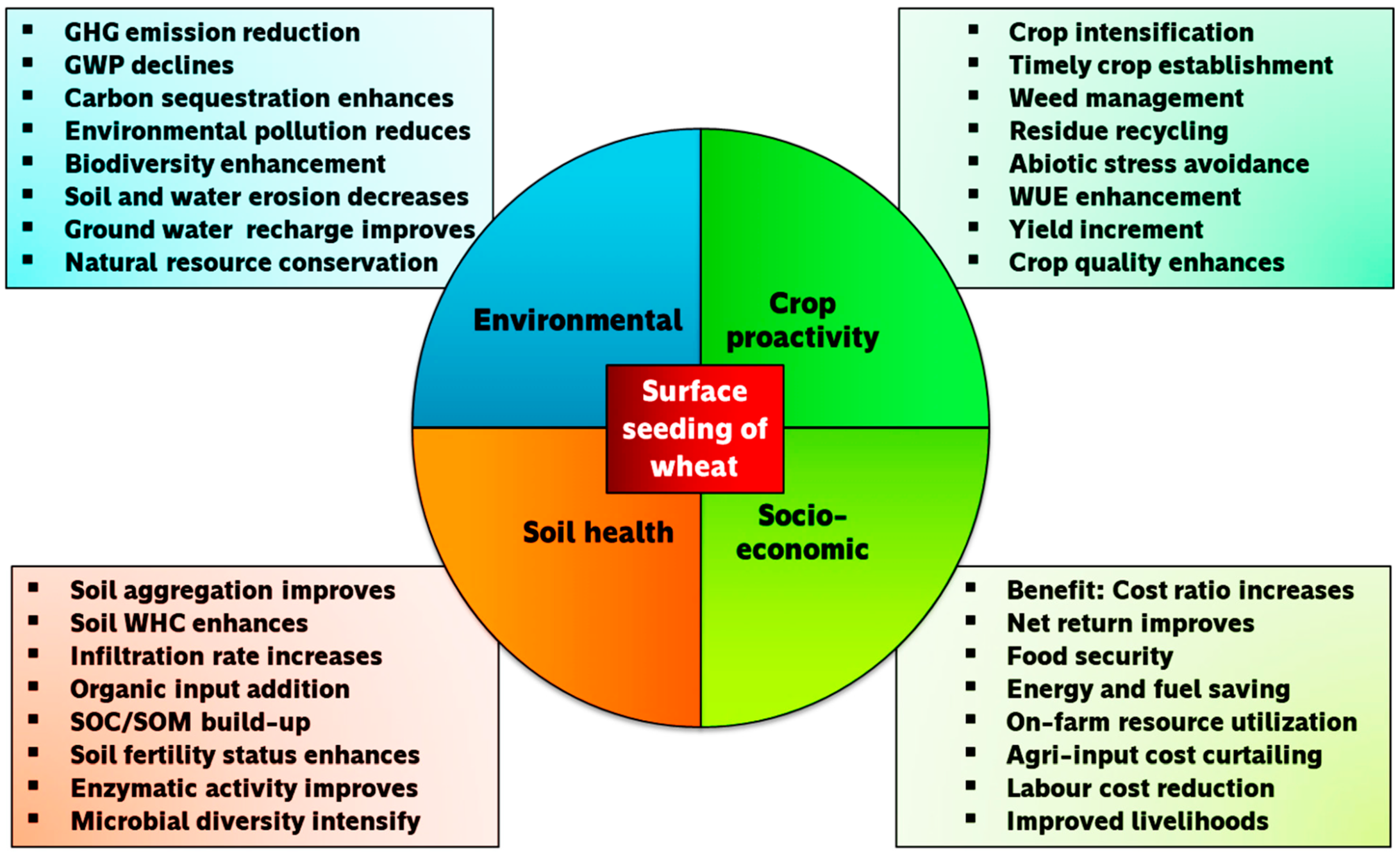
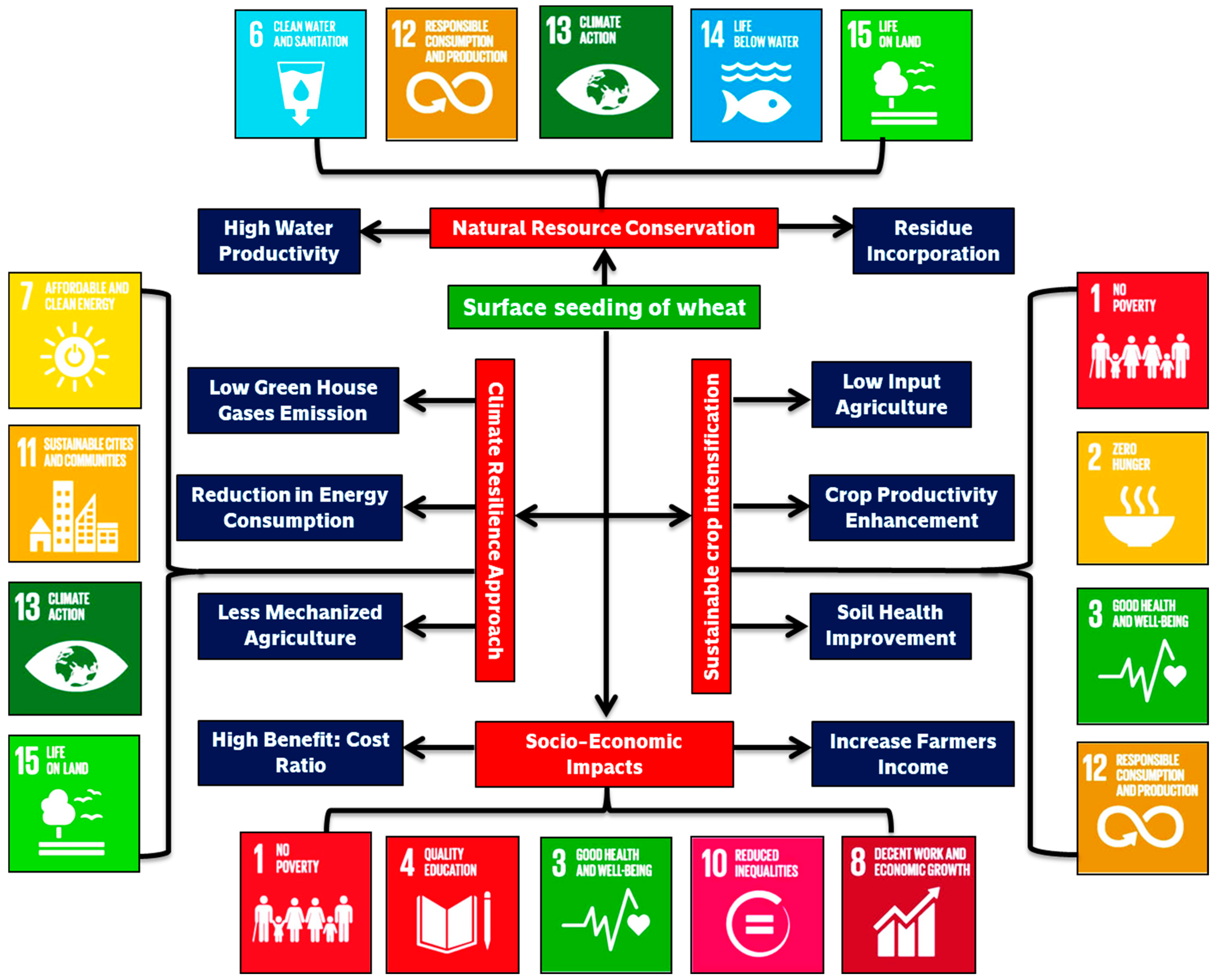
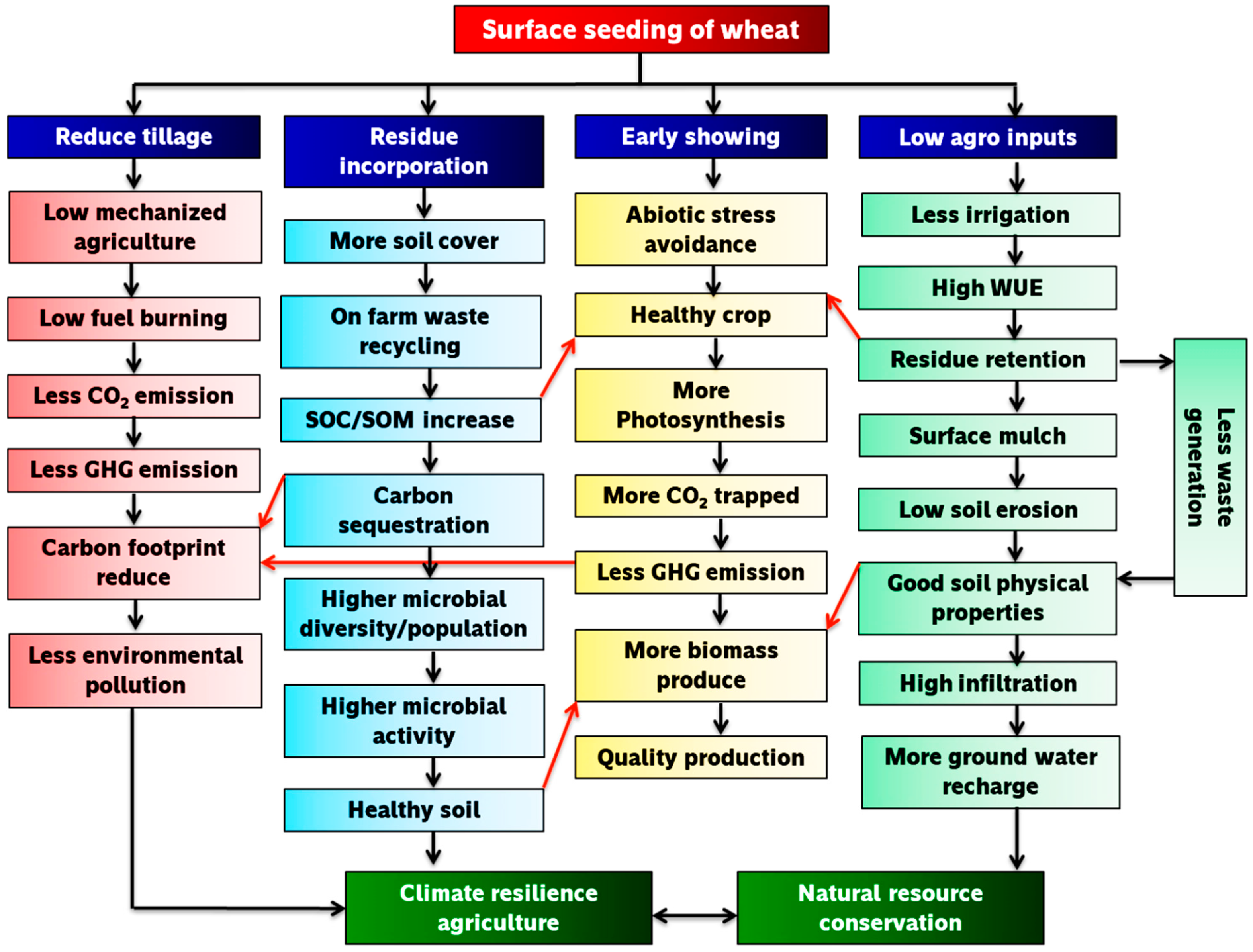
| Parameters | Conservation Agriculture | Conventional Agriculture | Surface Seeding |
|---|---|---|---|
| Practice | Nominal soil disruption and the surface of the soil is fully covered | Maximal soil disruption and the surface of the soil is fully exposed | Least soil disruption and the surface of the soil is fully covered |
| Tillage | Minimal or no-tillage operation | Excessive mechanical tillage operation | No-tillage operation |
| Timeliness | Mechanized operations, ensure timeliness of operations | Operations can be delayed | Timeliness of operations more optimal |
| Residue management | Residue retention on the soil surface | Residue burning or removal | Surface retention of residues |
| Use of organics | Use of in-situ organics/composts | Use of ex-situ organics/composts | Use of in-situ organics/composts |
| Erosion | Wind and water erosion is minimal | Wind and water erosion is maximum | Least wind and soil erosion |
| Water infiltration | Better water infiltration | Lowest due to clogging of soil pores | The infiltration rate of water is high |
| Soil physical health | Comparatively good by increasing porosity, water-holding capacity aggregation, and reducing bulk density | Very poor by increasing bulk density, and decreasing porosity, water-holding capacity, and aggregation | Comparatively good by reducing bulk density, and increasing porosity, water-holding capacity, and aggregation |
| Soil organic matter | Soil organic carbon build-up and worthy C-sequestration rate | Low due to oxidation of organic matter and residue removal | Higher soil organic carbon build-up and C-sequestration rate |
| Soil biological health | More diverse and healthy biological properties and populations | Poor biological health, and less microbial diversity and activity | Better biological health, and rich in microbial diversity and activity |
| Weeds | Weeds are troublesome in the initial stages of adoption but decrease with time; residues can aid in weed-growth-suppression | Controls weeds, causes more weed seeds to germinate, and more crop–weed competition in later growth stage | Weeds are troublesome in the initial stages of adoption but decrease with time; residues can aid in weed-growth-suppression/ reduce the weed seed germination, as they are not allowed to come above soil surface |
| Environmental stress | Additional resilience to stresses, lower yield losses under stress | Poor adaptation to stresses, yield losses greater under stress conditions | Added resilience to stresses, minimum yield losses under stress conditions |
| Greenhouse gases (GHGs) emission | Low, and global warming potential is also less | Higher GHGs emission and global warming potential | Very low GHGs emission and global warming potential |
| Use of machinery | Controlled traffic, no compaction in crop area, compaction in tramline | Free-wheeling of farm machinery, increased soil compaction | No compaction in crop area |
| Diesel use and costs | Diesel use much reduced | Diesel use high | Lowest use of diesel |
| Production costs | Low | High | Very low |
| Yield | Yields on a par with CT, but can surpass if planting is performed in advance | Generally lower than CA and delayed planting further reduces productivity | Productivity of grains is higher, due to advanced planting |
| Location | Soil Type | Variety | Grain Yield (t ha−1) | Increase over Conventional Practices (%) | References |
|---|---|---|---|---|---|
| Bihar | SC | - | 5.2 | 11 | [26] |
| SC | HD 2967 | 5.5 | 18 | [17] | |
| SL | - | 5.2 | 22 | [18] | |
| - | - | 2.7 | 4.5 | [31] | |
| Haryana | Loam | DBW 17 | 6.2 | 25 | [32] |
| CL | DPW 621-50 | 6.2 | 7.4 | [33] | |
| Silt loam | HD 2967 | 6.0 | 13 | [34] | |
| Loam | - | 5.5 | 7.0 | [16] | |
| Loam | - | 5.4 | 7.4 | [35] | |
| - | DPW 621–50 | 6.4 | 17 | [12] | |
| Madhya Pradesh | CL | MP 4010 | 4.7 | 5.8 | [36] |
| New Delhi | Loam | HD 2894 | 4.9 | 8.6 | [37] |
| SL | HD 2967 | 4.7 | 15 | [19] | |
| SL | HD 2967 | 5.0 | 8.0 | [38] | |
| Punjab | SL | HD 2967 | 5.7 | 6.8 | [39] |
| SL | HD 2967 | 5.2 | 7.4 | [40] | |
| SL | HD 2967 | 5.8 | 8.7 | [21] | |
| Uttar Pradesh | SL | - | 6.0 | 20 | [41] |
| SL | PBW 343 | 5.4 | 13 | [42] | |
| SL | Pusa 1121 | 4.8 | 18 | [43] | |
| SCL | HUW 234 | 3.6 | 5.8 | [44] | |
| Uttarakhand | - | UP 2565 | 3.6 | −8.9 | [15] |
| CL | UP 2628 | 4.7 | 2.2 | [45] | |
| SL | PBW 343 | 4.6 | 3.2 | [46] | |
| SCL | Wheat 804 | 3.6 | 0.3 | [13] | |
| West Bengal | SL, CL to clay | - | 3.1 | 15 | [47] |
| SCL | K 0307 | 3.4 | 6.3 | [48] | |
| SL | - | 4.0 | 10 | [49] | |
| Eastern Gangetic Plains, south Asia | Loam to SL | - | 3.3 | 5.1 | [50] |
| Location | Soil Type | Nutrients Application Rate (kg ha−1) | Total Water Productivity (kg Grain m−3 Water) | Increase over Conventional Practices (%) | Reference |
|---|---|---|---|---|---|
| Bihar | SL | N:150, P2O5:60, K2O:40 | - | - | [18] |
| Haryana | Loam | - | 1.3 | 13 | [32] |
| Silt loam | N:135, P2O5:62, K2O:60 | 1.4 | 30 | [34] | |
| - | N:150, P2O5:26, K2O:50 | 0.9 | 67 | [12] | |
| New Delhi | SL | N:150, P2O5:80, K2O:60 | - | - | [38] |
| Punjab | SL | N:120, P2O5:25, K2O:25 | - | - | [39] |
| Uttar Pradesh | SL | N:120, P2O5:26, K2O:50 | 1.4 | 44 | [41] |
| SL | N:150, P2O5:26, K2O:50 | - | - | [42] | |
| SL | N:150, P2O5:26, K2O:50 | - | - | [43] | |
| West Bengal | SL | N:150, P2O5:26.3, K2O:33.3 | - | - | [49] |
| Haryana | CL | N:150, P2O5:60, K2O:60 | Water consumption: 0.5 | 36 | [33] |
| Madhya Pradesh | CL | N:120, P2O5:26.2, K2O:33.1 | WUE: 131 kg grain ha−1 cm−1 | 14 | [36] |
| Uttarakhand | - | N:120, P2O5:60, K2O:40 | WUE: 16 kg ha−1 mm−1 | 13 decreases | [15] |
| Uttarakhand | SCL | N:100, P2O5:60, K2O:40 | WUE: 11 kg ha−1 mm−1 | 2.8 | [13] |
| Eastern Gangetic Plains, south Asia | Loam to SL | N:60–145, P2O5:11–45, K2O:14 to 50 | 2.5 | 30 | [50] |
| Location | Soil Type | Weed Management Practices | References |
|---|---|---|---|
| Bihar | SL | Glyphosate @ 1.0 kg a.i. ha−1 is used as pre-plant 2 days before sowing, to kill existing weeds. Pre-mix herbicide sulfosulfuron + metsulfuron @ 32 g a.i. ha−1 at 30–35 DAS. | [18] |
| Haryana | Loam | In the 1st year, pre-mixed herbicide sulfosulfuron + metsulfuron @ 32 g a.i. ha−1 is applied at 35 DAS. In 2nd year, tank mixture of clodinafop-ethyl + metsulfuron @ 60 + 4 g a.i. ha−1 is applied at 35 DAS. | [32] |
| Haryana | CL | Glyphosate @ 1.25 kg a.i. ha−1 sprayed pre-planting of wheat. Total (metsulfuron methyl 75% + sulfosulfuron) @ 1250 mL a.i. ha−1 is sprayed to control weeds after emergence. | [33] |
| New Delhi | SL | Pendimethalin 1.0 kg ha−1 applied before emergence (1 DAS), followed by sulfosulfuron @ 25 g ha−1 after emergence (25 DAS). | [38] |
| Uttar Pradesh | SL | Glyphosate @ 900 g a.i. ha−1 sprayed before the sowing of wheat. | [41] |
| SL | Glyphosate at 900 g a.i. ha−1 sprayed as pre-plant of wheat. Grassy and broad-leaf weeds are managed by spraying sulfosulfuron + metsulfuron methyl @ 35 g a.i. + 4 g a.i. ha–1 at 25–30 DAS. | [65] | |
| West Bengal | SL | Glyphosate 41% S.L. at 3.75 l ha−1 applied 7 days prior to sowing, to smother the existing weed flora. 2,4-D Na salt 80% W.P. at 1 kg a.i. ha−1 at 4–5 weeks after sowing, to smother the broad-leaf weed flora. | [49] |
| Eastern Gangetic Plains, south Asia | Loam to SL | Glyphosate sprayed 4 to 7 days before the sowing of wheat | [50] |
| Uttarakhand | SL | Dominant grassy weeds flora is Phalaris minor (55.0%), whereas major non-grassy weed is Melilotus indica in wheat crop. | [66] |
| Location | Soil Type | Effect on Soil Properties | Change over Conventional Practices (%) | Reference |
|---|---|---|---|---|
| Bihar | Entisol | Bulk density: 1.5 Mg m3 | −6.5 | [33] |
| - | Bulk density: 1.5 g cm3 | −6.4 | [20] | |
| Haryana | Loam | Bulk density: 1.6 Mg m3 | −2.4 | [16] |
| Madhya Pradesh | CL | Bulk density: 1.5 Mg m3 | −3.9 | [18] |
| New Delhi | SL | Bulk density: 1.5 Mg m3 | −1.3 | [76] |
| Punjab | SL | Bulk density: 1.6 Mg m3 | 6.7 | [23] |
| Uttar Pradesh | SL | Bulk density: 1.6 Mg m3 | 4.7 | [42] |
| Uttarakhand | - | Bulk density: 1.4 Mg m3 | 2.9 | [15] |
| SCL | Bulk density: 1.3 Mg m3 | 2.3 | [13] | |
| New Delhi | SL | Mean weight–diameter: 0.4 mm | 13 | [38] |
| Punjab | SL | Mean weight–diameter: 1.2 mm | 10 | [23] |
| Uttar Pradesh | SL | Mean weight–diameter: 2.7 mm | 102 | [41] |
| SL | Mean weight–diameter: 1.2 mm | 32 | [44] | |
| Uttarakhand | - | Mean weight–diameter: 0.7 mm | 4.2 | [15] |
| SL | Soil aggregates (>0.25 mm): 70% | 35 | [41] | |
| SL | Soil aggregates (>0.25 mm): 75% | 51 | [42] | |
| Bihar | - | Water-stable soil aggregates (MWD): 6.1 mm | 407 | [20] |
| Haryana | Loam | Aggregate stability: 46% | 91 | [53] |
| Loam | Water-stable macro-aggregates: micro-aggregates: 7.9 | 796 | [53] | |
| Uttar Pradesh | SL | Aggregate ratio: 4.3 | 83 | [44] |
| Bihar | - | Air-filled porosity: 45.1% | 9.1 | [20] |
| Uttarakhand | SCL | Total porosity: 53% | 2.3 | [13] |
| - | Effective porosity: 1.9 m3 m−3 | 7.5 | [15] | |
| Bihar | - | Water-holding capacity: 55% | 40 | [20] |
| Haryana | Loam | Infiltration rate: 0.3 cm hr−1 | 244 | [16] |
| Madhya Pradesh | CL | Infiltration rate: 5.8 mm hr−1 | 18 | [36] |
| Punjab | SL | Steady-state infiltration: 1.0 cm h−1 | 25 | [23] |
| Uttar Pradesh | SL | Steady-state infiltration: 0.4 cm h−1 | 200 | [42] |
| SL | Steady-state infiltration: >0.1 cm hr−1 | 67 | [43] | |
| Uttarakhand | - | Saturated hydraulic conductivity: 21 | −2.3 | [15] |
| Haryana | Loam | Volumetric water content: 27% | 50 | [16] |
| Location | Soil Type | Effects on Carbon Status or Accumulation | Increase over Conventional Practices (%) | References |
|---|---|---|---|---|
| Haryana | Loam | Organic carbon: 7.5 g kg−1 | 67 | [16] |
| Loam | Organic carbon: 6.1 g kg−1 | 30 | [35] | |
| - | Organic carbon: 7.4 g kg−1 | 40 | [12] | |
| Loam | Organic carbon: 8.1 g kg−1 | 65 | [53] | |
| Madhya Pradesh | CL | Organic carbon: 4.0 g kg−1 | 1.8 | [18] |
| New Delhi | SCL | Organic carbon: 5.8 g kg−1 | 5.7 | [98] |
| Punjab | SL | Organic carbon: 6.7 g kg−1 | 14 | [39] |
| SL | Organic carbon: 4.7 g kg−1 | 16 | [40] | |
| SL | Organic carbon: 6.2 g kg−1 | 6.9 | [23] | |
| SL | Organic carbon: 5.4 g kg−1 | 13 | [83] | |
| Uttar Pradesh | SL | Organic carbon: 5.2 g kg−1 | 40 | [65] |
| Uttarakhand | - | Organic carbon: 7.6 g kg−1 | 2.7 | [15] |
| SCL | Organic carbon: 8.8 g kg−1 | 12 | [13] | |
| West Bengal | SL | Organic carbon: 9.8 g kg−1 | 10 | [49] |
| Bihar | Entisol | Total soil organic carbon: 5.5 t ha−1 | 57 | [33] |
| Silt clay | Total soil organic carbon: 6.9 g kg−1 | 9.1 | [17] | |
| Haryana | Loam | Total soil organic carbon: 11 g kg−1 | 81 | [53] |
| New Delhi | SCL | Total soil organic carbon: 7.3 g kg−1 | 4.3 | [98] |
| SL | Total soil organic carbon: 13 Mg ha−1 | 11 | [19] | |
| SL | Total soil organic carbon: 5.1 g kg−1 | - | [95] | |
| SL | Total soil organic carbon: 10 g kg−1 | 25 | [76] | |
| SL | Total soil organic carbon: 7.6 Mg ha−1 | 23 | [99] | |
| SCL | Total soil inorganic carbon: 2.1 g kg−1 | −22 | [98] | |
| Bihar | Silt clay | Total soil organic carbon stock: 14 Mg ha−1 | 20 | [26] |
| New Delhi | SL | Soil organic carbon stock: 13 Mg ha−1 | 9.7 | [19] |
| Punjab | SL | Soil organic carbon stock: 14 Mg ha−1 | 16 | [23] |
| New Delhi | SL | SOC sequestration: 3.5 Mg ha−1 | 2.6 | [76] |
| SL | SOC accumulation: 7.6 Mg ha−1 | 23 | [76] | |
| Punjab | Inceptisol | C-sequestration: 47.1 kg C ha−1 | −9.9 | [36] |
| Uttarakhand | SCL | C-sequestration: 25 Mg ha−1 | 8.6 | [13] |
| SCL | C-sequestration rate: 460 kg C ha−1 year−1 | 36 | [13] | |
| Bihar | Silt clay | Carbon management index: 111 | 11 | [17] |
| New Delhi | SL | Carbon management index: 0.7 | 4.8 | [76] |
| Uttar Pradesh | SL | Carbon management index: 154 | 41 | [65] |
| New Delhi | SL | Oxidative stability of C: 0.5 | 20 | [76] |
| Punjab | Inceptisol | Carbon sustainability index: 10 | 400 | [36] |
| Location | Soil Type | Environmental Stress | Change over Conventional Practices (%) | Reference |
|---|---|---|---|---|
| Haryana | SL to CL | N2O–N flux: 0.5 kg ha−1 | 14 | [100] |
| CL | N2O–N flux: 1.7 kg N ha−1 | −32 | [33] | |
| CL | N2O–N flux: 4.5 kg N ha−1 | 72 | [33] | |
| New Delhi | Loam | N2O–N flux: 0.9 kg ha−1 | −2.2 | [37] |
| SL | N2O–N flux: 390 g ha−1 | 2.6 | [19] | |
| West Bengal | Entisol | N2O flux: 11 mg m−2 h−1 | 3.6 | [93] |
| New Delhi | SL | CO2–C flux: 266 g ha−1 | −17 | [19] |
| Haryana | CL | GWP from emission: 825 kg CO2 eq ha−1 | −31 | [33] |
| CL | GWP from emission: 2204 kg CO2 eq ha−1 | 72 | [33] | |
| Silt loam | GWP: 4592 kg CO2 eq ha−1 yr−1 | 40 | [34] | |
| New Delhi | Loam | GWP: 378 kg CO2 eq ha−1 | −4.8 | [37] |
| SL | GWP: 477 kg CO2 eq ha−1 | −18 | [19] | |
| Loam | GHG intensity: 0.1 | −8.1 | [37] | |
| Punjab | Inceptisol | Total carbon equivalent emission: 1624 kg CO2 eq ha−1 | −21 | [36] |
| Inceptisol | GWP: 2.1 Mg CO2 eq ha−1 | −16 | [36] | |
| Haryana | Silt loam | GHG intensity: 0.4 kg kg−1 CO2 eq ha−1 yr−1 | 44 | [34] |
| Punjab | Inceptisol | GHG intensity: 0.3 kg CO2 eq kg−1 | −12 | [36] |
| Inceptisol | Carbon equivalent emission: 0.6 Mg CO2 eq ha−1 | −17 | [36] | |
| Eastern Gangetic Plains, south Asia | - | Carbon dioxide equivalent emission: 1.4 Mg ha−1 | −8.4 | [14] |
| Location | Soil Type | Benefit: Cost Ratio | Increase over Conventional Practices (%) | Reference |
|---|---|---|---|---|
| Bihar | SL | 2.3 | 17 | [18] |
| Haryana | - | 2.3 | 16 | [104] |
| Loam | 3.6 | 31 | [32] | |
| Madhya Pradesh | CL | 2.4 | 41 | [22] |
| Uttar Pradesh | SL | 3.7 | 64 | [41] |
| SL | 3.1 | 41 | [43] | |
| West Bengal | SL, CL to clay | 2.2 | 187 | [47] |
| SCL | 2.1 | 17 | [48] | |
| SL | 1.6 | 10 | [49] | |
| Haryana | CL | Net return: USD1278 ha−1 | 13 | [33] |
| - | Net return: USD1108 ha−1 | 21 | [12] | |
| Punjab | SL | Net return: USD 621 ha−1 | Benefits: USD 167 ha−1 | [40] |
| Uttar Pradesh | SCL | Net return: USD 395 ha−1 | Benefits: USD 29 ha−1 | [65] |
| Bihar | - | Returns to capital: INR 3.0 INR−1 | 27 | [31] |
| Uttar Pradesh | - | Cost of cultivation: USD 623 ha−1 | Benefits: USD 133 ha−1 | [77] |
| - | Cost of cultivation: USD 620 ha−1 | Benefits: USD 158 ha−1 | [77] | |
| Haryana | Silt loam | Net return: USD 1280 ha−1 | 22 | [34] |
| Benefits | Resulting from | Reasons |
|---|---|---|
| Agro-ecological benefits | ||
| Progressive suppression of weed growth | Improvement in soil structure and stability | Reduce tillage that allows weed seed in deep soil |
| Long-term yield increase | Reduced water and wind erosion | Reduce tillage and improve soil structure |
| Increase in soil fertility and stability, and improved soil structure | Reduce tillage, improve soil cover due to mulching, intercropping, and crop rotation | |
| Improved retention of water, nutrients, and soil moisture | Reduce tillage, improve soil cover due to mulching | |
| Reduces run-off | Decrease in erosion, improved soil structure and water-retention capacity | Reduce tillage and improve soil cover |
| Improves rooting conditions | Increase in soil fertility stability, and improved soil structure | Reduce tillage, improve soil cover due to mulching, intercropping, and crop rotation |
| Improves agrobiodiversity | Higher biological activity in the soil and in the field | Improved soil cover due to mulching |
| Crop diversification | Crop rotation and intercropping | |
| Output stability | Reduced vulnerability to climatic shocks | Improved rooting conditions |
| Enhanced biological pest and disease control | Crop rotation | |
| Higher biological activity in the soil and in the field | ||
| Reduces waste of water and inputs | Reduced run-off | Decrease erosion, improve soil structure and water retention capacity |
| Environmental benefits | ||
| Decrease in land degradation | Reduced dust particles, aerosol, and other particulate material | Reduce tillage, improve soil cover, mulching, intercropping, and crop rotation |
| Improved agrobiodiversity | Higher biological activity in the soil and in the field | |
| Reduces downstream sedimentation and siltation | Reduced run-off | Decrease erosion, improve soil structure and water retention capacity |
| Reduces contamination of soil, and surface and ground water | Reduced run-off | Decrease erosion, improve soil structure and water retention capacity |
| Reduction in CO2 emissions to the atmosphere | Higher carbon sequestration | Reduce tillage, improve soil cover, and mulching |
| Higher biological activity | Improve soil cover and mulching | |
| Socio-economic benefits | ||
| Increases food security | Long-term yield increase and output stability | Reduce erosion, greater soil arability, improve soil structure, field capacity, and nutrient retention |
| Enhance biological pest and disease control | ||
| Crop diversification | Reduce vulnerability to climatic shocks | |
| Compatibility with various farming systems and agro-ecological environments | ||
| Increases net profitability | Long-term yield increase and output stability | Reduce erosion, greater soil arability, improved soil structure, field capacity, and nutrient retention |
| Enhance biological pest/disease control | ||
| Reduce susceptibility to climatic fluctuations | ||
| Reduction in on-farm costs | Cost-effective labor, machinery, and (in the medium-term) chemical inputs (herbicides, fertilizer, and pesticides, depending on the technology adopted) | |
| Technological sustainability | Compatibility with different farming systems and agro-ecological environments | An appropriate integration of cultivation techniques, equipment, and inputs |
| Constraints | Resulting from | Management Strategy |
|---|---|---|
| Management Constraints | ||
| Short-term pest and disease problems | Variation in crop management | Development of suitable technology and training programs |
| Increased usage of soil cover/mulching | Disease control through IPM technique | |
| Bio intensification and application of additional green chemicals | ||
| Short-term weed infestation | Alteration in crop management | Formulating appropriate technology packages and training |
| Modified tillage techniques | Additional incorporation of suitable chemicals at the critical growth stage of weed | |
| Additional labor and drone-based application | ||
| Limited management skills | Need to carefully plan the crop rotations and intercropping, cover crop preferences, new approaches to weed control and pest management, appropriate application of chief SS principles, etc. | Technical support |
| Farmers’ participation in learning and experimentation | ||
| Devising proper training programs | ||
| Creation and operation of farming groups, research, and extension networks | ||
| High perceived risk (country specific) | Technology shift | Appropriate use of rewards/incentives |
| Designing appropriate technology packages and training | ||
| Inadequate management skills | Farmers’ involvement and time commitment to learning and experimentation | |
| Lack of country specific knowledge and information | Technical and institutional support | |
| Commitment of extension officers and innovative farmers | ||
| Cultural barriers and/or community prejudice | Community involvement in training/ demonstrations and technology adaptation | |
| Economic Constraints | ||
| Additional startup costs | Procurement of specialized planting equipment | Better access to certain markets |
| Farmers’ participation in learning and experimentation | Appropriate use of rewards and incentives | |
| Additional labor requirements at initial stages | Expansion of suitable technology packages and training | |
| Lower yields at initial stages | Initial immobilization of nutrients | Intercropping with leguminous/ nitrogen-fixing crops |
| Supplementary fertilizer application | ||
| Short-term problems related to pests, weeds, and diseases | IPM training and biological pest/ disease control | |
| Administration of additional chemicals and labor | ||
| Devising appropriate training and technology packages | ||
| Inadequate management skills | Technical support and extension | |
| Farmers’ participation and time commitment to experimentation/learning | ||
| Creating operational farming networks and research/extension groups | ||
Publisher’s Note: MDPI stays neutral with regard to jurisdictional claims in published maps and institutional affiliations. |
© 2022 by the authors. Licensee MDPI, Basel, Switzerland. This article is an open access article distributed under the terms and conditions of the Creative Commons Attribution (CC BY) license (https://creativecommons.org/licenses/by/4.0/).
Share and Cite
Singh, S.K.; Patra, A.; Chand, R.; Jatav, H.S.; Luo, Y.; Rajput, V.D.; Sehar, S.; Attar, S.K.; Khan, M.A.; Jatav, S.S.; et al. Surface Seeding of Wheat: A Sustainable Way towards Climate Resilience Agriculture. Sustainability 2022, 14, 7460. https://doi.org/10.3390/su14127460
Singh SK, Patra A, Chand R, Jatav HS, Luo Y, Rajput VD, Sehar S, Attar SK, Khan MA, Jatav SS, et al. Surface Seeding of Wheat: A Sustainable Way towards Climate Resilience Agriculture. Sustainability. 2022; 14(12):7460. https://doi.org/10.3390/su14127460
Chicago/Turabian StyleSingh, Satish Kumar, Abhik Patra, Ramesh Chand, Hanuman Singh Jatav, Yang Luo, Vishnu D. Rajput, Shafaque Sehar, Sanjay Kumar Attar, Mudasser Ahmed Khan, Surendra Singh Jatav, and et al. 2022. "Surface Seeding of Wheat: A Sustainable Way towards Climate Resilience Agriculture" Sustainability 14, no. 12: 7460. https://doi.org/10.3390/su14127460
APA StyleSingh, S. K., Patra, A., Chand, R., Jatav, H. S., Luo, Y., Rajput, V. D., Sehar, S., Attar, S. K., Khan, M. A., Jatav, S. S., Minkina, T., & Adil, M. F. (2022). Surface Seeding of Wheat: A Sustainable Way towards Climate Resilience Agriculture. Sustainability, 14(12), 7460. https://doi.org/10.3390/su14127460

