


Abstract
Small lodging enterprises encompass a major proportion of the lodging industry worldwide. Nonetheless, limited research has addressed the HRM-innovation-performance link on these enterprises. This research draws on ability, motivation, opportunity (AMO) theory and resource-based view (RBV) theory to examine the influences of green human resources management (GHRM) practices by owner-managers of small lodging enterprises on their enterprises’ green innovation and environmental performance. More specifically, the research examines the direct influence of GHRM on the environmental performance of small lodging enterprises and the indirect influence through green innovation. A self-administered questionnaire was given to owner-managers of small lodging enterprises in Greater Cairo, Egypt. The results of structural equation modeling (SEM) showed direct, positive and significant influences of owner-managers’ green ability, motivation and opportunity on both enterprise green innovation and environmental performance. The ability of owner-managers was the most influential GHRM practices on both green innovation and environmental performance. Moreover, the results showed that the influence of GHRM on environmental performance was doubled with green innovation, reflecting the value and vital role of green innovation in small lodging enterprises’ environmental performance. Several policy-level, theoretical and practical implications are identified and discussed.
1. Introduction
The environmental performance of organizations has gained growing attention from scholars and practitioners over the past few decades. Governments’ emphasis on environmental performance as a part of their policies to sustain the natural resources or surrounding environment and achieve the United Nations sustainable development goals (UNSDGs). Environmental performance plays a vital role in persevering the natural environment from the negative impacts (e.g., pollution, environmental releases, wastes) and sustaining enterprises’ overall performance [1,2]. However, a recent study [2] showed that research often concentrates on the environmental performance of large businesses with limited studies on small enterprises. Additionally, in the hospitality and tourism context, studies often focus on the environmental practices management from two sides: either customer perspective [3] or employees’ awareness about environmental practices [4]. However, “there is a lack of empirical studies that link human resources management (HRM) to environmental performance” in the hospitality context, e.g., lodging enterprises [1], p. 83, which is especially true for small lodging enterprises.
There is a lack of empirical evidence on the relationship between green human resources management (GHRM), green innovation and overall environmental performance of small lodging enterprises. GHRM includes practices intended at the green and ecological effect of the organization and is often related to an enterprise’s environmental strategy [5]. It incorporates the environmental management objectives of the organization into the HR functions (e.g., employee selection and hiring, orientation and development, remuneration and empowerment) [6]. Green innovation can broadly be defined as the development of eco-friendly products, services and procedures by adopting organizational practices. This includes using greener and fewer raw materials through the product design process, using eco-design ideas and aiming to reduce pollution, reduce water, electricity and other raw materials consumption [7,8]. Environmental performance relates to the green outcomes of enterprises from green initiatives to eliminate the negative environmental impacts [1,2].
Studies on HRM and enterprises’ innovation in general (see, for example, [2,9,10]) suggested that HRM positively and significantly influences product and/or service innovation. Furthermore, enterprises that apply green innovation are more likely to exhibit positive performance [11], and this significantly reduces negative environmental impact and enhances enterprise environmental performance [7,12]. Nonetheless, there is a lack of empirical evidence to support these arguments, especially in relation to small lodging enterprises.
This research examines the direct influence of GHRM on the environmental performance of small lodging enterprises, i.e., small hotels, and the indirect influence through green innovation. Small lodging enterprises encompass the greatest proportion of the lodging industry worldwide [13], which is also the case in Egypt [14]. Nonetheless, to the best of researchers’ knowledge, there is no published research addressing these issues on small lodging enterprises. This research gives a better understanding of the interrelationship between GHRM, green innovation and their environmental performance of small lodging enterprises. The research builds on ability, opportunity and motivation (AMO) theory [15] for the proper understanding of GHRM influences on green innovation and ultimately on environmental performance. The research also draws on the resource-based view (RBV) theory [16] to examine the role of owner-manager as a critical resource for achieving green innovation and environmental performance. More specifically, the research examines the direct impact of owner-managers’ green ability, motivation and opportunity on their small lodging enterprises’ environmental performance and the indirect impact through green innovation. Like other enterprises, small lodging enterprises have major environmental impacts [17]. This research shows how the environmental performance of small lodging enterprises could be enhanced through GHRM adopted by their owner-managers.
The research adopts AMO theory to predict the link between GHRM practices, enterprise green innovation and environmental performance. Research (e.g., [15,18]) has confirmed that proper HRM practices positively influence both employee and organizational performance. However, research often adopts AMO theory to examine HRM practices regarding employees’ ability, motivation and opportunities to predict their attitudes, behaviors and job performance [19] and influences on enterprise performance [20]. An intensive review of research in the past twenty years relating GHRM practices and their association or influences with green innovation and/or environmental performance (see Appendix A) showed limited studies in the hospitality industry, especially in relation to small lodging enterprises. GHRM was assessed in previous studies using either a unidimensional scale of HRM practices from an employee perspective [1]; or a multidimensional scale, i.e., various items for assessing employee recruitment and selection; training and development, performance management, pay and reward, and involvement [5]. Other research applied the AMO theory to examine GHRM practices from a top management perspective [2]. Recent research [2] showed that to better understand, predict and assess the influences of GHRM on green innovation and enterprise environmental performance, it is crucial to examine the GHRM practices by leadership or enterprise management. This is because the high-performance HRM practices by leadership directly and significantly affect employee ability, opportunity and motivation as well as their performance [19]; hence overall green innovation and environmental performance of enterprises [2]. This research adopts AMO theory to examine to what extent owner-managers’ green ability, motivation and opportunity contribute to enterprise green innovation and environmental performance. The research also draws on RVB theory [16] to examine how owner-managers strategically use their enterprises’ resources to achieve green innovation and environmental performance.
2. Review of Literature
2.1. GHRM and Green Innovation
Organizations with green innovation are wildly successful businesses [7]. Several studies (e.g., [11,12,21]) showed that organizations with green innovation have a better performance than their competitors, as they influence their green capabilities and resources to identify the needs of customers quickly and effectively and add key benefits and resources to the organization. Studies also have shown that HRM has a significant and positive effect on product/service innovation [10,22]. Research also has shown that strategic HRM positively effects on firm’s product or service innovation [9].
A recent study [2] has examined the impact of GHRM on green innovation in small and medium enterprises (SMEs), using the RBV theory [23] and the AMO theory [15]. The results showed that the adoption of GHRM practices, particularly green ability, opportunity and motivation, promoted SMEs’ capability for products, services and procedures innovation. Owner-managers adoption of GHRM practices was found to directly, positively and significantly influence green innovation in their SMEs. The same study stressed the role of leadership as a strategic and key resource in influencing employee green ability, motivation and opportunity; thus, enterprise green innovation. This research draws on both AMO and RVB theories that owner-manager ability, motivation and opportunity are key determinants of green innovation. Thus, the following hypotheses could be proposed in relation to small lodging enterprises:
Hypothesis 1 (H1).
Green ability of owner-manager in small lodging enterprises has a positive effect on green innovation.
Hypothesis 2 (H2).
Green motivation of owner-manager in small lodging enterprises has a positive effect on green innovation.
Hypothesis 3 (H3).
Green opportunity of owner-manager in small lodging enterprises has a positive effect on green innovation.
2.2. GHRM and Environmental Performance
Green enterprises should emphasize the green values and awareness of their employees about the environment to support green performance [5,24]. Standardizing GHRM objectives, obligations, and assessment improve enterprises’ green performance [25]. Several studies, e.g., [5,26,27,28,29,30], addressed the relationship between GHRM and environmental performance. Studies showed that GHRM raises green consciousness [5], green creativity [26,28], green innovation [26,30] as well as green performance [26,27,29,31].
Research has confirmed that GHRM practices improve green performance [3]. Moreover, enterprises implementing official green management systems (i.e., GHRM) indicated a high level of green performance [32]. A recent study [2] on SMEs showed that GHRM (i.e., ability, motivation and opportunity) had a positive but indirect influence on environmental performance. This research also argues that the green ability, motivation and opportunity of owner-managers could have an influence on the environmental performance of their small lodging enterprises. Thus, the following hypotheses could be proposed regarding small lodging enterprises:
Hypothesis 4 (H4).
Green ability of owner-manager in small lodging enterprises has a positive effect on environmental performance.
Hypothesis 5 (H5).
Green motivation of owner-manager in small lodging enterprises has a positive effect on environmental performance.
Hypothesis 6 (H6).
Green opportunity of owner-manager in small lodging enterprises has a positive effect on environmental performance.
2.3. Green Innovation and Environmental Performance
Green innovation is related to the enterprises’ green management agenda, which encourages green performance [33]. Green product/service and processes innovation decreases business’s negative impact and increases the financial and social performance of businesses by reducing costs and waste [34]. Earlier research [35,36,37] revealed that enterprises’ green innovation might be anticipated as proactive practices to increase green performance.
Green performance is concerned with enterprises’ efforts to fulfill and exceed social expectations versus the green nature [38] in a way that goes further simple agreements with values and principles [39]. It includes green impacts of enterprises’ procedures, products, and consumed resources to fulfill the best fit with allowed green desires [40]. Numerous studies [39,40,41,42] suggested that green performance relies on green products, services and process innovation.
Previous research examined the impact of green suppliers and innovation on green performance and competitive advantage from different industries in Taiwan [43]. The major results showed that green innovation, especially product, process and managerial innovation, has a direct positive influence on enterprises’ green performance. Another recent study on SMEs [2] revealed that green innovation has a positive effect on environmental performance. Therefore, the following hypothesis could be proposed regarding small lodging enterprises:
Hypothesis 7 (H7).
Green innovation of small lodging enterprises has a positive effect on environmental performance.
2.4. The Role of Green Innovation in the Relationship between GHRM and Environmental Performance
Previous studies, e.g., [9,10,22,44,45,46], showed that GHRM practices positively influence green innovation. Moreover, green innovation is considered a major tool for the success of their business performance [31,47,48,49] to achieve its green goals. There is evidence that HRM bundles positively affect employee attitude and behavior; thus, overall performance [19]. More specifically, GHRM was found to have a direct and positive effect on environmental performance and an indirect effect through employee commitment and eco-friendly behavior [1]. According to the results of a recent study on SMEs in the manufacturing industry [2], green innovation fully mediates the relationship between GHRM and green performance. It was found that green leadership directly affects GHRM, whereas GHRM affects environmental performance through green innovation. Therefore, the following hypotheses can be proposed:
Hypothesis 8 (H8).
Green innovation of small lodging enterprises mediates the relationship between an owner-manager’s green ability and environmental performance.
Hypothesis 9 (H9).
Green innovation of small lodging enterprises mediates the relationship between an owner-manager’s green motivation and environmental performance.
Hypothesis 10 (H10).
Green innovation of small lodging enterprises mediates the relationship between an owner-manager’s green opportunities and environmental performance.
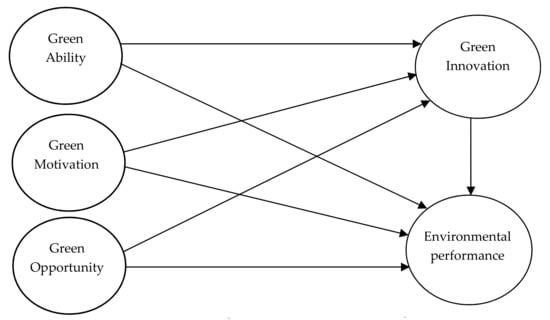
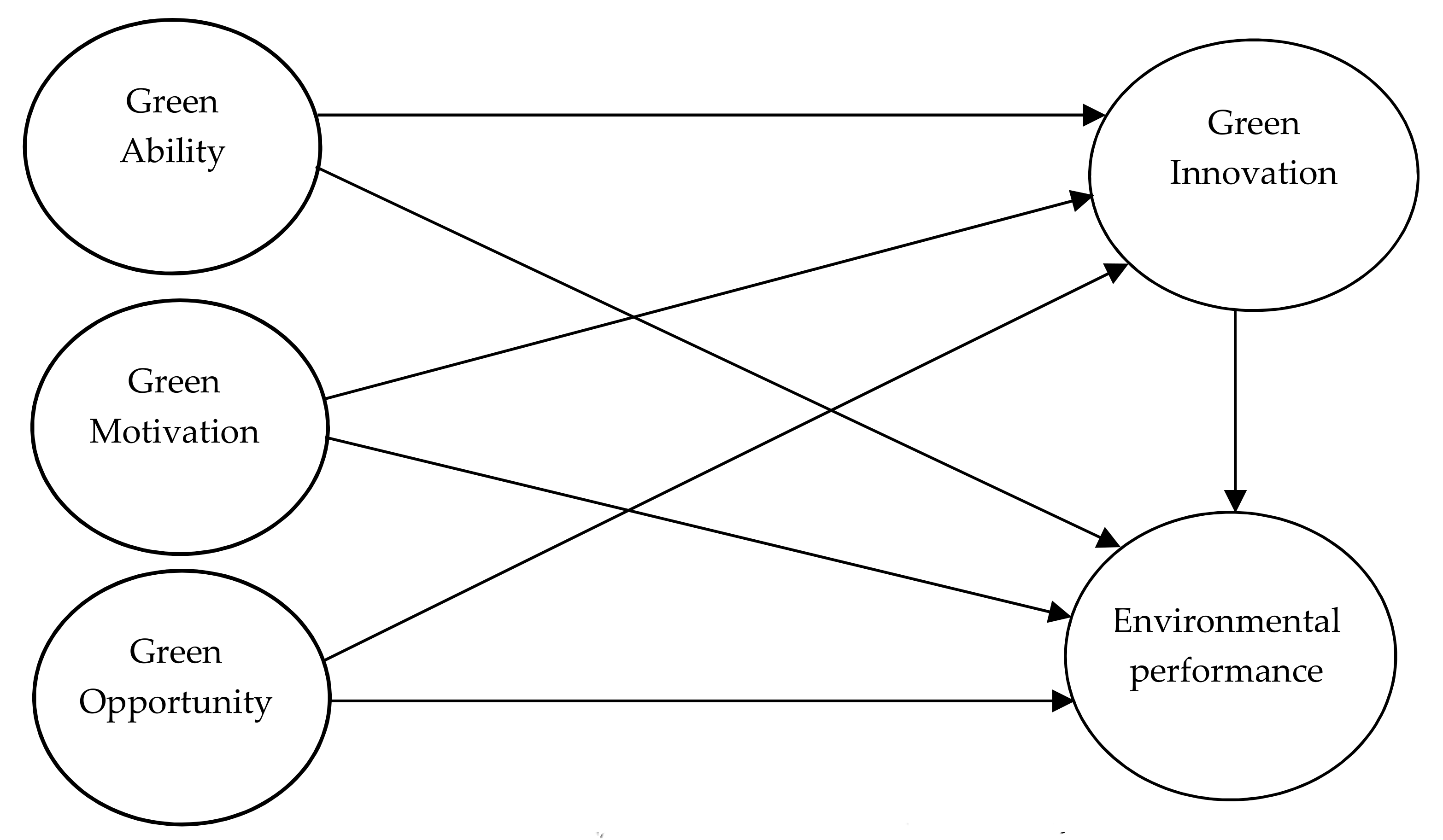
The research hypotheses are summarized in the research conceptual framework (Figure 1).
Figure 1.
The research conceptual framework.
3. Methodology
3.1. Research Population and Sample
The population of the current study includes all owner-managers of small lodging enterprises in Egypt. Small lodging enterprises in the current study include all small lodging enterprises that are operated and financed by their owner-managers [13]. The communication with different authorities in Egypt showed that there is no published database about small lodging enterprises; notwithstanding, there is evidence that encompasses the major proportion of the lodging industry in Egypt [14]. A total of 700 questionnaires were self-administrated to the owner-managers of these small lodging enterprises using the drop and collect approach, which improved the response rate greatly [50]. This research sample was compared favorably with similar research on small enterprises, e.g., [2,43]. Participants in this research were identified via a personal network. The research team works in the Colleges of Tourism and Hotel Management in Egypt. Hence, they have a proper network with hospitality enterprises, including small lodging enterprises. The collection process yield 525 valid forms for analysis.
3.2. Measure
All reflective measures with their related items were derived from existing scales in previous studies; a five-point rating scale was employed, where 1 = (strongly disagree) and 5 = (strongly agree). GHRM was measured by three dimensions based on abilities, motivation, opportunities (AMO) theory and derived from [5,51]. Green abilities measure has 6 items (i.e., “Great effort goes in to select right person”; “Considerable importance given to green staffing process” (as shown in Table 1). The green motivation measure has 4 items, and the green opportunities scale has 3 variables (see Table 1). The Cronbach’s alpha for the three GHRM was acceptable and ranged from 0.935 to 0.959 (Table 1). Four variables (a = 0.945) were employed from [31] to operationalize green product innovation (i.e., “My company uses materials that produce least pollution; My company uses materials that are easy to recycle, reuse, and decompose”). Finally, 5 items (a = 0.971) were employed to measure environmental performance adopted from [32,52] (see Table 1).
Table 1.
Confirmatory factor analysis (CFA) factor loading, t-value (CR), mean (M), and standard deviation (SD).
3.3. Data Analysis
To observe any difference in the mean scores between early and late collected responses, an independent sample t-test was conducted. No statistical differences were detected (p > 0.05), which approves that nonresponse bias is not a problem [53].
To detect expected common method variance (CMV), several suggestions from [54] were followed: (1) all respondents were assured that their data were kept confidential and anonymous. (2), the instrument was constructed where dependent variables come first, then independent variables come second [55]. (3), the instrument was pilot tested with 15 practitioners 15 academic and modified accordingly. (4), Harman’s single-factor analysis was employed, all variables are exposed to EFA (exploratory factor analysis), and the extracted option is fixed to the value of 1 and no rotation method. Consequently, one dimension is emerged to explain 39.5% of the variance. Taken together, the previous steps indicate that CMV is not a problem.
The mean (M) values (as shown in Table 1) are ranged from 3.93 and 4.27, the standard deviation (SD) values are between 0.873 to 1.064, which signals that the study data are dispersed and less concentrated around the mean [56].
4. Results
4.1. The Profile of Respondents
The respondents were mostly males (93.3%) (Table 2). The majority of them were also aged between 46 and 60 years old (47.7%), whereas 32.3% of the participants were aged below 45 years. The majority of them were also university graduates (56.6%) or even higher (19.9%). Most of these small lodging enterprises have employees between 11 and 25 (57.9) or less than 11 employees, 26.4% (Table 2). The vast majority of these employees were temporary employees and hourly paid (70.5%), and only 29.5 were in a full-time job. Most of the participated enterprises were in operation between 10 and 20 years (Table 2).
Table 2.
The profile of owner-managers.
4.2. Measurement Model
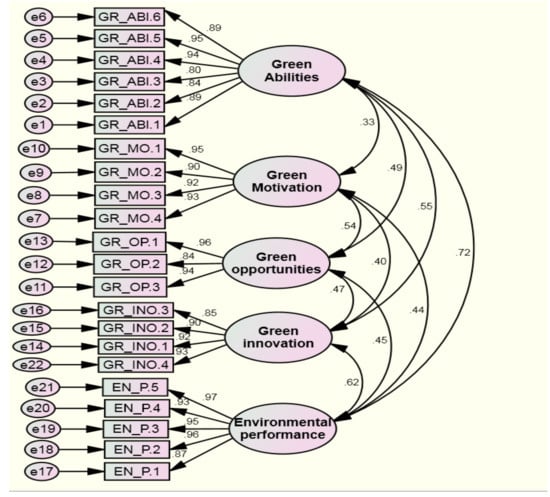
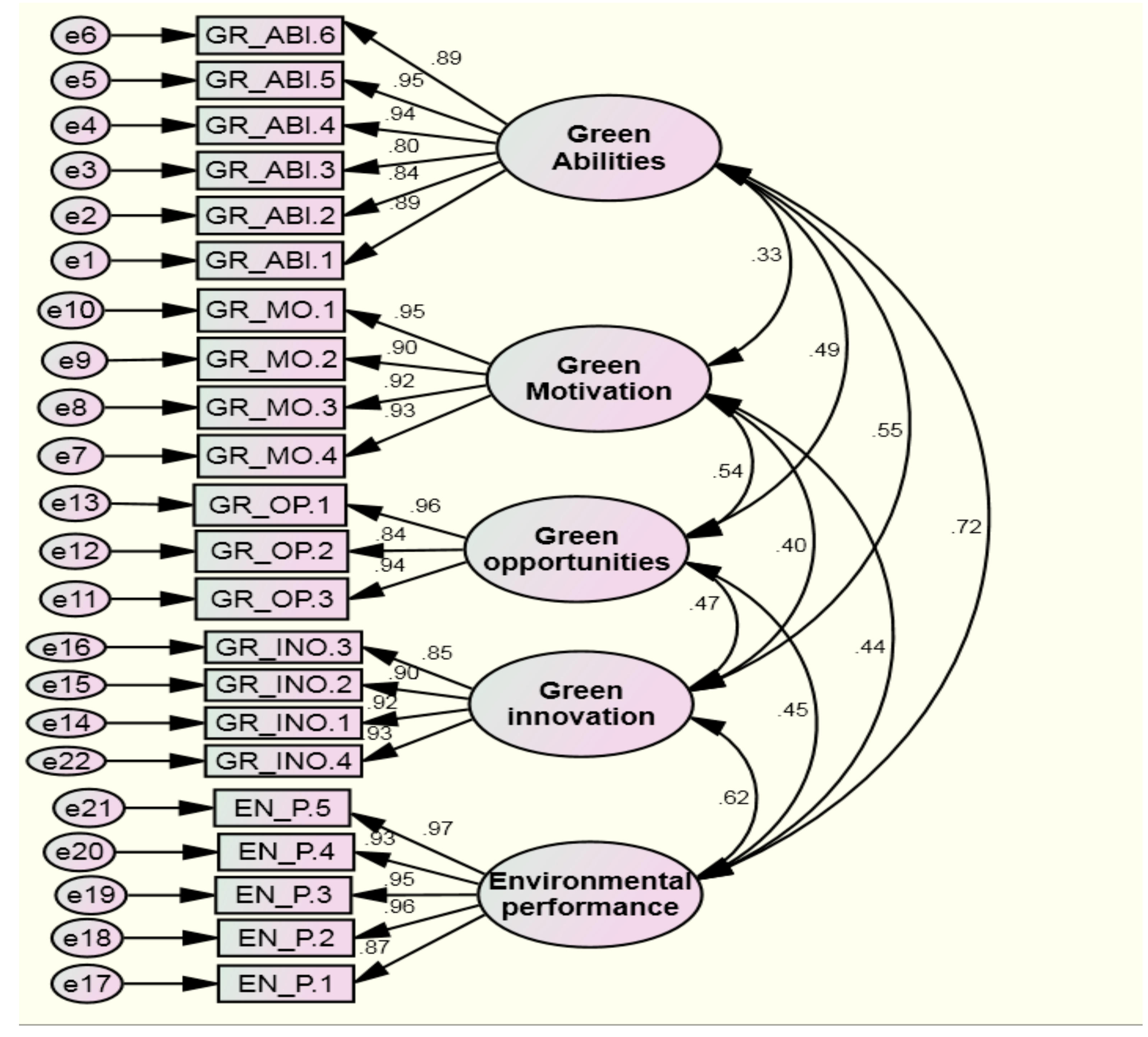
Cronbach’s alpha values were assessed to test the reliability of the instruments’ variables in this paper [57], and its values are acceptable and are ranged from 0.935 to 0.971. The validity of the employed construct was approved by employing first-order confirmatory factor analysis (CFA) with Amos vs. 18 to test the study contract’s’ convergent and discriminant validity (see Figure 2). As revealed in Table 2, the CFA model has good fit χ2 (199, N = 525) = 797.393, p < 0.001, normed χ2 = 4.007, root mean square error of approximation (RMSEA) = 0.041, standardized root mean square residual (SRMR) = 0.048; comparative fit index (CFI) = 0.960 (see Table 1). As per [58] suggestions, the measure (s) possess convergent validity if the item loading on its symmetrical dimension exceeds 0.7 [59]. Additionally, composite reliability (CR) should be greater than 0.70, and the average variance extracted (AVE) should exceed 0.50. All the dimensions employed in this research paper met the previous conditions [58]. All loadings were between 0.80 and 0.96, which exceeds the preferable threshold of 0.7, with t-values greater than 24.355 (Table 1). The CR values exceed 0.7, and the AVE values for all factors are greater than the suggested 0.50 threshold (Table 3), which ensures the convergent validity as recommended by [58].
Figure 2.
The first-order CFA.
Table 3.
Discriminant validity based on Fornell–Larcker criterion analysis.
To test discriminant validity, previous studies’ suggestions [57,58] were adopted. The AVE square root for every single dimension should exceed the values of the shared correlation of the other dimensions in both row and column [58]. Moreover, the AVE values should be greater than the MSV value (maximum shared value) for each construct [57] (Table 3). As shown in Table 1 and Table 3, the discriminant validity conditions were met and assured.
4.3. Structural Model
SEM with the maximum-likelihood method was employed to test the research hypotheses. SEM is an appropriate data analysis technique in this study as it permits the test of concurrent and simultaneous relationships staking into account the measurement error [60]. Overall, the SEM model shows a good fit to data (χ2 = 950.208, df = 202, p < 0.001; CFI = 0.931; SRMR = 0.048; RMSEA = 0.044) (Table 4). Moreover, the model has acceptable explanatory impacts, as the dependent variables can explain 0.43 of variance in green innovation; and 0.48 of variance in environmental performance.
Table 4.
The results of the structural model.
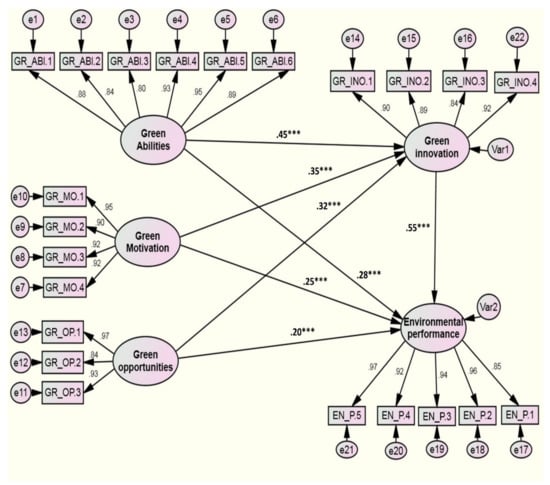
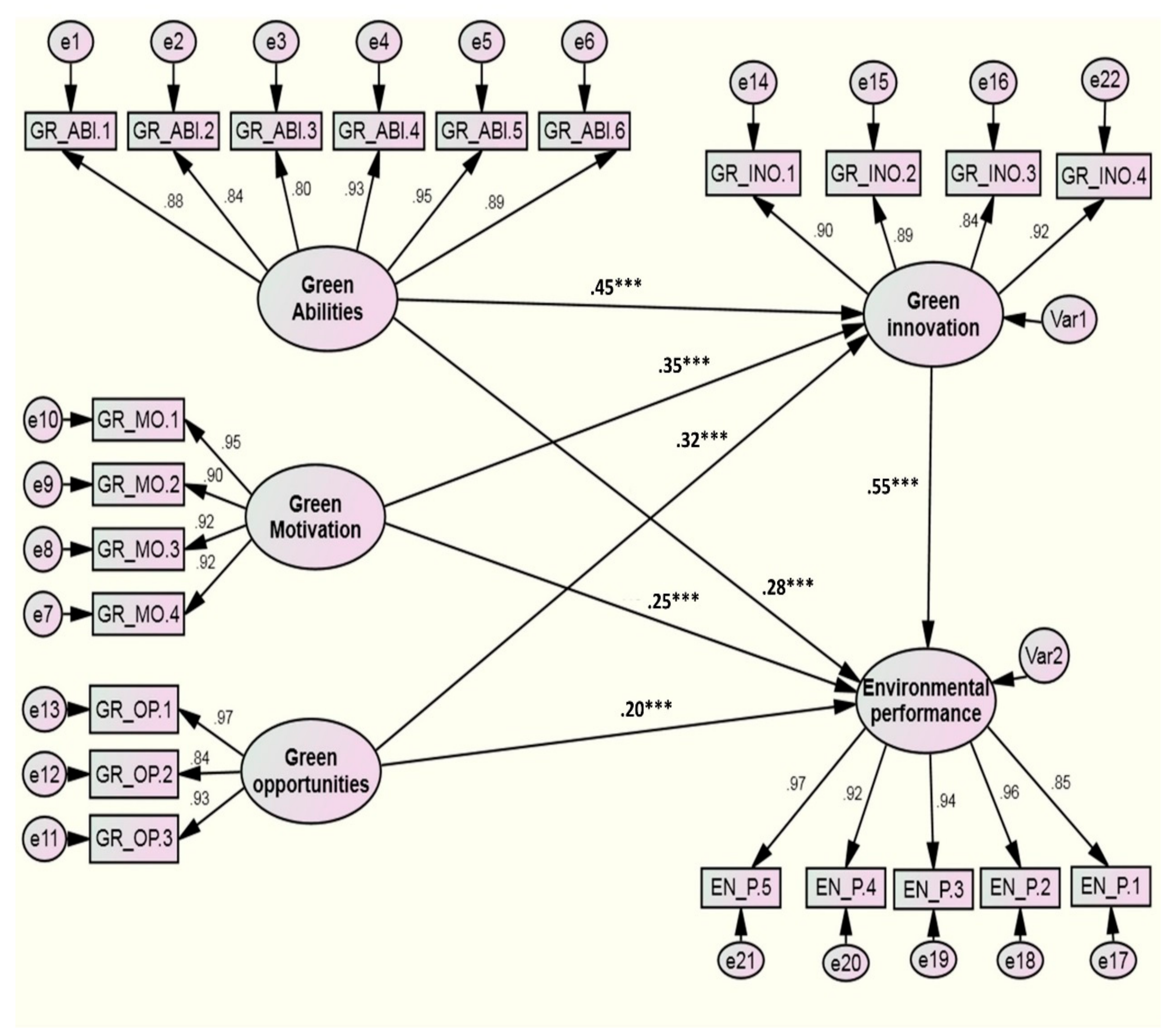
Table 4 and Figure 3 show the results of testing the direct and indirect hypotheses in the current study. The SEM results give an evidence that approve the direct positive and significant impacts of green abilities on both green innovation (β = 0.45, t-value = 10.712, p < 0.001), and environmental performance (β = 0.28, t-value = 5.573, p < 0.001), accordingly hypotheses H1, and H4 were supported. Likewise, green motivation was found to has positive and significant effects on both green innovation (β = 0.35, t-value = 9.078, p < 0.001), and environmental performance (β = 0.25, t-value = 4.864, p < 0.001), accordingly hypotheses H2, and H5 were supported. Similarly, green opportunities have positive and significant influences on green innovation (β = 0.32, t-value = 8.868, p < 0.001) and environmental performance (β = 0.20, t-value = 4.562, p < 0.001), hence hypotheses H3, and H6 were supported. Finally, the SEM results approves the high positive and significant impact of green innovation on environmental performance (β = 0.55, t-value = 13.907, p < 0.001), which support hypothesis H7.
Figure 3.
The research structural model. *** p < 0.001.
The mediation effects were assessed as per suggestions from [60,61,62]. Full mediation can only be approved if the indirect effects are significant, but the indirect is not; if both direct and indirect effects are significant, then partial mediation is confirmed [61,62]. Consequently, the SEM results in Table 3 show the significant direct and indirect relationships in this study, which indicates that green innovation can partially act as a meditation dimension in the relationships between GHRM (green abilities, green motivation, and green opportunities) and environmental performance. The earlier outcome is confirmed by investigating the SEM standardized indirect impacts from GHRM to environmental performance. The direct effect of green abilities on environmental performance increased from (β = 0.28, p < 0.001) to a total effect of (β = 0.41, p < 0.001). Similarly, the direct effect of green motivation to environmental performance (β = 0.25, p > p < 0.001) increased to a total effect of (β = 0.37, p < 0.001). Finally, the direct effect of green opportunities on environmental performance (β = 0.20, p < 0.001) increased to a total effect of (β = 0.31, p < 0.001). The previous results further support the partial mediation of green innovation in the relationship between GHRM (abilities, motivation, and opportunities) and environmental performance.
5. Discussion
The current research examined the interrelationship between GHRM, i.e., green ability, motivation and opportunity, and green innovation, as well as the environmental performance of small lodging enterprises in Egypt. The results coincide with previous studies (e.g., [2,10,22]) that GHRM practices, especially green ability, motivation and opportunity, positively influence green innovation and environmental performance [1,2]. The ability of owner-managers was the most influential GHRM practices on both green innovation and environmental performance. This means that owner-managers’ green ability (i.e., their abilities for recruiting and selecting the right staff with environmental values and developing their environmental skills and knowledge) significantly and positively contribute to green innovation and environmental performance than green motivation and opportunity.
The results also showed that the direct influence of GHRM on environmental performance was lower than the indirect influence through green innovation. The influences of GHRM on environmental performance was almost doubled with green innovation. Owner-managers agreed that green innovation in their small lodging enterprises has a significant and positive influence on the relationship between GHRM and environmental performance. This raises the value of green innovation in products/services and/or processes in small lodging enterprises. This finding is in agreement with previous research on SMEs [2] that green innovation plays a significant mediating role between GHRM and environmental management.
The results also advance previous studies in relation to the influence of GHRM practices, especially green ability, motivation and opportunity on environmental performance [2,32,63]. Furthermore, the results support previous studies on the direct, positive and significant influence of green innovation on environmental performance [2,43]). The results, interestingly, supported all hypothesized relationships in relation to small lodging enterprises. The results confirmed the role of owner-managers as a key strategic resource in achieving green innovation and environmental performance through GHRM.
None of the GHRM practices (green abilities, motivation, and opportunities) has insignificant impacts on green innovation and environmental performance, which means that the GHRM should be employed as a multidimensional construct to improve green innovation and environmental performance. The impact power of the GHRM practices (abilities, motivations, and opportunities) on green innovation and environmental performance are not equivalent. The impacts of green abilities on green innovation and environmental performance have more power than the impact of green opportunities and green motivations on green innovation and environmental performance. This result highlights the importance of the management’s ability to select the right person, recruiting only those who possess environmental values, and designing employee’s environmental training on enhancing green innovation and environmental performance (i.e., reduced overall costs and lead–time, improve quality and reputation of the hotels).
6. Implications of the Study
The study has policy-level, theoretical and practical implications. Regarding the policy implications, the results send an important message to governments and policymakers about small lodging enterprises that in order to achieve positive environmental performance, policymakers should work closely with owner-managers of small lodging enterprises to enhance their green ability, motivation and opportunity to positively influence green innovation and ultimately achieve positive environmental impacts. Small lodging enterprises often have limited financial resources and HRM support [13,14]; hence, support programs, e.g., training programs and workshop, should be directed to owner-managers of these small lodging enterprises to enhance their green abilities, motivate them and maximize their opportunities, which impact positively on green enterprise innovation and environmental performance. Small lodging enterprises should gain greater attention from policymakers due to their economic and social contribution, especially with the limited resources that they have in comparison to larger businesses.
The study also has several theoretical implications. First, the study advances the use of both AMO theory and RVB theory in understanding the influence of owner-managers’ green ability, motivation and opportunity on green innovation and environmental performance. Earlier studies often use AMO theory to examine the influence of HRM practices relating to employees. The current study contributes to small enterprises in the service industry, especially the small lodging industry. The RVB theory was also adopted to examine the link between owner-managers practices and enterprise performance. Supporting a recent study [2], the results showed that the green ability of owner-managers is a strategic and key resource for enhancing green innovation and environmental performance. Second, the study showed that GHRM practices by owner-managers are crucial for achieving green innovation and environmental performance. Third, the study confirmed the mediating role of green innovation in the relationship between GHRM and environmental performance. This maximizes the role of green innovation in achieving a positive environmental impact.
The study also has some implications for owner-managers in small lodging enterprises. First, owner-managers need to put more emphasis and investment in GHRM practices, especially green ability, since it significantly influences product/service green innovation and environmental performance of the enterprise. Attention needs to be paid to selecting the right staff with environmental values, developing their environmental skills and knowledge, rewarding them from environmental management, and involving them in team working to resolve environmental issues. Second, the study showed that environmental practices depend on the achievement of GHRM practices and green innovation. It can also be achieved by a combination of these two antecedents together. This environmental performance has become crucial not only for small lodging enterprises but also for the whole tourism industry that is dominated by small enterprises.
7. Limitations and Opportunities for Further Research
The current study is concerned with small lodging enterprises in Egypt. The classification of small enterprises often differs from one country to another and sometimes from one industry to another. The current study considers hotels with less than 50 workers, with the majority of fewer than 25 workers. The respondents in this study are the owner-managers of small lodging enterprises in Egypt, thus restraining the generalization of the research results. It would therefore be worthwhile to collect data from different contexts (country and/or industry). Further research could examine the results of the current study in different categories of small tourism enterprises, e.g., restaurants or travel agencies. The results could also be examined in different country contexts. Second, the cross-sectional sample collection method employed in this research is an additional limitation. In any research in which causality may be inferred (by employing SEM), longitudinal research is recommended to approve more solid inferences [64].
Author Contributions
Conceptualization, A.E.E.S. and I.E.; methodology, I.E. and A.E.E.S. and A.H.; software, I.E.; validation, A.E.E.S. and I.E.; formal analysis, I.E. and A.E.E.S.; investigation, A.H. and A.E.E.S. and I.E.; resources, A.H.; data curation, A.E.E.S. and I.E.; writing—original draft preparation, I.E. and A.E.E.S. and A.H.; writing—review and editing, A.E.E.S. and I.E.; visualization, I.E.; supervision, I.E.; project administration, A.E.E.S. and I.E. and A.H.; funding acquisition, A.E.E.S. All authors have read and agreed to the published version of the manuscript.
Funding
The authors extend their appreciation to the Deputyship for Research and Innovation, Ministry of “Education” in Saudi Arabia, for funding this research work through the project number (IFT20108).
Conflicts of Interest
The authors declare no conflict of interest.
Abbreviations
List of abbreviations:
| HRM | Human resources management |
| GHRM | Green human resources management |
| AMO theory | Ability, motivation, opportunity theory |
| RBV theory | Resource-based view theory |
| SEM | Structural equation modeling |
| UNSDGs | United nation sustainable development goals |
| SMEs | Small and medium enterprises |
| CMV | Common method variance |
| EFA | Exploratory factor analysis |
| M | Mean value |
| SD | Standard deviation |
| CFA | Confirmatory factor analysis |
| RMSEA | Square error of approximation |
| SRMR | Standardized root mean squared residual |
| CFI | Comparative fit index |
| CR | Composite reliability |
| AVE | Average variance extracted |
| MSV | Maximum shared value |
Appendix A
Table A1.
Major past studies related to green human resources management (GHRM) and association with green innovation and/or environmental performance.
References
- Kim, Y.J.; Kim, W.G.; Choi, H.-M.; Phetvaroon, K. The effect of green human resource management on hotel employees’ eco-friendly behavior and environmental performance. Int. J. Hosp. Manag. 2019, 76, 83–93. [Google Scholar] [CrossRef] [Scilit]
- Singh, S.K.; Del Giudice, M.; Chierici, R.; Graziano, D. Green innovation and environmental performance: The role of green transformational leadership and green human resource management. Technol. Forecast. Soc. Chang. 2020, 150, 119762. [Google Scholar] [CrossRef] [Scilit]
- Kim, C.G.; Choi, Y.S. A high performance parallel DCT with OpenCL on heterogeneous computing environment. Multimed. Tools Appl. 2013, 64, 475–489. [Google Scholar] [CrossRef] [Scilit]
- Paillé, P.; Chen, W.S.C.; Boiral, O.; Jin, J. The Impact of Human Resource Management on Environmental Performance: An Employee-Level Study. J. Bus. Ethics 2014, 121, 451–466. [Google Scholar] [CrossRef] [Scilit]
- Renwick, D.W.S.; Redman, T.; Maguire, S. Green Human Resource Management: A Review and Research Agenda. Int. J. Manag. Rev. 2012, 15, 1–14. [Google Scholar] [CrossRef] [Scilit]
- Muller-Carmem, M.; Jackson, S.; Jabbour, C.J.; Renwick, D. Green human resource management. Z. Pers. 2010, 24, 95–96. [Google Scholar]
- Albort-Morant, G.; Leal-Rodríguez, A.L.; De Marchi, V. Absorptive capacity and relationship learning mechanisms as complementary drivers of green innovation performance. J. Knowl. Manag. 2018, 22, 432–452. [Google Scholar] [CrossRef] [Scilit]
- Gunasekaran, A.; Spalanzani, A. Sustainability of manufacturing and services: Investigations for research and applications. Int. J. Prod. Econ. 2012, 140, 35–47. [Google Scholar] [CrossRef] [Scilit]
- Wei, L.; Liu, J.; Herndon, N.C. SHRM and product innovation: Testing the moderating effects of organizational culture and structure in Chinese firms. Int. J. Hum. Resour. Manag. 2011, 22, 19–33. [Google Scholar] [CrossRef] [Scilit]
- Jimenez-Jimenez, D.; Sanz-Valle, R. Could HRM support organizational innovation? Int. J. Hum. Resour. Manag. 2008, 19, 1208–1221. [Google Scholar] [CrossRef] [Scilit]
- Albort-Morant, G.; Henseler, J.; Leal-Millán, A.; Carrión, G.A.C. Mapping the Field: A Bibliometric Analysis of Green Innovation. Sustainability 2017, 9, 1011. [Google Scholar] [CrossRef] [Scilit]
- Allameh, S.M. Antecedents and consequences of intellectual capital: The role of social capital, knowledge sharing and innovation. J. Intellect. Cap. 2018, 19, 858–874. [Google Scholar] [CrossRef] [Scilit]
- Thomas, R.; Shaw, G.; Page, S.J. Understanding small firms in tourism: A perspective on research trends and challenges. Tour. Manag. 2011, 32, 963–976. [Google Scholar] [CrossRef] [Scilit]
- Sobaih, A.E.E. Human resource management in hospitality firms in Egypt: Does size matter? Tour. Hosp. Res. 2018, 18, 38–48. [Google Scholar] [CrossRef] [Scilit]
- Appelbaum, E.; Bailey, T.; Berg, P.; Kalleberg, A.L.; Bailey, T.A. Manufacturing Advantage: Why High-Performance Work Systems Pay Off; Cornell University Press: Ithaca, NY, USA, 2000. [Google Scholar]
- Barney, J. Firm resources and sustained competitive advantage. J. Manag. 1991, 17, 99–120. [Google Scholar] [CrossRef] [Scilit]
- Boiral, O.; Heras-Saizarbitoria, I.; Brotherton, M.-C. Assessing and Improving the Quality of Sustainability Reports: The Auditors’ Perspective. J. Bus. Ethics 2019, 155, 703–721. [Google Scholar] [CrossRef] [Scilit]
- Bos-Nehles, A.C.; Van Riemsdijk, M.J.; Looise, J.K. Employee Perceptions of Line Management Performance: Applying the AMO Theory to Explain the Effectiveness of Line Managers’ HRM Implementation. Hum. Resour. Manag. 2013, 52, 861–877. [Google Scholar] [CrossRef] [Scilit]
- Sobaih, A.E.E.; Ibrahim, Y.; Gabry, G. Unlocking the black box: Psychological contract fulfillment as a mediator between HRM practices and job performance. Tour. Manag. Perspect. 2019, 30, 171–181. [Google Scholar] [CrossRef] [Scilit]
- Gerhart, B. Human resources and business performance: Findings, unanswered questions, and an alternative approach. Manag. Rev. 2005, 16, 174–185. [Google Scholar] [CrossRef] [Scilit]
- Del Giudice, M.; Carayannis, E.G.; Palacios-Marqués, D.; Soto-Acosta, P.; Meissner, D. The human dimension of open innovation. Manag. Decis. 2018, 56, 1159–1166. [Google Scholar] [CrossRef] [Scilit]
- Verburg, R.M.; Den Hartog, N.D.; Koopman, P.L. Configurations of human resource management practices: A model and test of internal fit. Int. J. Hum. Resour. Manag. 2007, 18, 184–208. [Google Scholar] [CrossRef] [Scilit]
- Barney, J.B. Resource-based theories of competitive advantage: A ten-year retrospective on the resource-based view. J. Manag. 2001, 27, 643–650. [Google Scholar] [CrossRef]
- Jackson, S.E.; Seo, J. The greening of strategic HRM scholarship. Organ. Manag. J. 2010, 7, 278–290. [Google Scholar] [CrossRef] [Scilit]
- Jabbour, C.J.C.; de Sousa Jabbour, A.B.L. Green human resource management and green supply chain management: Linking two emerging agendas. J. Clean. Prod. 2016, 112, 1824–1833. [Google Scholar] [CrossRef] [Scilit]
- Chen, Y.-S.; Chang, C.-H. The Determinants of Green Product Development Performance: Green Dynamic Capabilities, Green Transformational Leadership, and Green Creativity. J. Bus. Ethics 2013, 116, 107–119. [Google Scholar] [CrossRef] [Scilit]
- Guerci, M.; Longoni, A.; Luzzini, D. Translating stakeholder pressures into environmental performance—The mediating role of green HRM practices. Int. J. Hum. Resour. Manag. 2015, 27, 262–289. [Google Scholar] [CrossRef] [Scilit]
- Jia, J.; Liu, H.; Chin, T.; Hu, D. The continuous mediating effects of GHRM on employees’ green passion via transformational leadership and green creativity. Sustainability 2018, 10, 3237. [Google Scholar] [CrossRef] [Scilit]
- O’Donohue, W.; Torugsa, N. The moderating effect of ‘Green’ HRM on the association between proactive environmental management and financial performance in small firms. Int. J. Hum. Resour. Manag. 2015, 27, 239–261. [Google Scholar] [CrossRef] [Scilit]
- Zhou, S.; Zhang, D.; Lyu, C.; Zhang, H. Does Seeing “Mind Acts Upon Mind” Affect Green Psychological Climate and Green Product Development Performance? The Role of Matching Between Green Transformational Leadership and Individual Green Values. Sustainability 2018, 10, 3206. [Google Scholar] [CrossRef] [Scilit]
- Chen, Y.-S.; Lai, S.-B.; Wen, C.-T. The Influence of Green Innovation Performance on Corporate Advantage in Taiwan. J. Bus. Ethics 2006, 67, 331–339. [Google Scholar] [CrossRef] [Scilit]
- Melnyk, S.A.; Sroufe, R.; Calantone, R.J. Assessing the impact of environmental management systems on corporate and environmental performance. J. Oper. Manag. 2003, 21, 329–351. [Google Scholar] [CrossRef] [Scilit]
- Adegbile, A.; Sarpong, D.; Meissner, D. Strategic Foresight for Innovation Management: A Review and Research Agenda. Int. J. Innov. Technol. Manag. 2017, 14, 1750019. [Google Scholar] [CrossRef] [Scilit]
- Weng, H.H.R.; Chen, J.S.; Chen, P.C. Effects of green innovation on environmental and corporate performance: A stakeholder perspective. Sustainability 2015, 7, 4997–5026. [Google Scholar] [CrossRef] [Scilit]
- Kratzer, J.; Meissner, D.; Roud, V. Open innovation and company culture: Internal openness makes the difference. Technol. Forecast. Soc. Chang. 2017, 119, 128–138. [Google Scholar] [CrossRef] [Scilit]
- Lin, R.J.; Tan, K.H.; Geng, Y. Market demand, green product innovation, and firm performance: Evidence from Vietnam motorcycle industry. J. Clean. Prod. 2013, 40, 101–107. [Google Scholar] [CrossRef] [Scilit]
- De Burgos-Jiménez, J.; Vázquez-Brust, D.; Plaza-Úbeda, J.A.; Dijkshoorn, J. Environmental protection and financial performance: An empirical analysis in Wales. Int. J. Oper. Prod. Manag. 2013, 33, 981–1018. [Google Scholar] [CrossRef] [Scilit]
- Chan, R.Y. Does the natural-resource-based view of the firm apply in an emerging economy? A survey of foreign invested enterprises in China. J. Manag. Stud. 2005, 42, 625–672. [Google Scholar] [CrossRef] [Scilit]
- Chen, Y.; Tang, G.; Jin, J.; Li, J.; Paillé, P. Linking market orientation and environmental performance: The influence of environmental strategy, employee’s environmental involvement, and environmental product quality. J. Bus. Ethics 2015, 127, 479–500. [Google Scholar] [CrossRef] [Scilit]
- Dubey, R.; Gunasekaran, A.; Ali, S.S. Exploring the relationship between leadership, operational practices, institutional pressures and environmental performance: A framework for green supply chain. Int. J. Prod. Econ. 2015, 160, 120–132. [Google Scholar] [CrossRef] [Scilit]
- Darnall, N.; Jolley, G.J.; Handfield, R. Environmental management systems and green supply chain management: Complements for sustainability? Bus. Strat. Environ. 2008, 17, 30–45. [Google Scholar] [CrossRef] [Scilit]
- Oliva, F.L.; Semensato, B.I.; Prioste, D.B.; Winandy, E.J.L.; Bution, J.L.; Couto, M.H.G.; Bottacin, M.A.; MacLennan, M.L.F.; Teberga, P.M.F.; Santos, R.F.; et al. Innovation in the main Brazilian business sectors: Characteristics, types and comparison of innovation. J. Knowl. Manag. 2019, 23, 135–175. [Google Scholar] [CrossRef] [Scilit]
- Chiou, T.-Y.; Chan, H.K.; Lettice, F.; Chung, S.H. The influence of greening the suppliers and green innovation on environmental performance and competitive advantage in Taiwan. Transp. Res. Part E Logist. Transp. Rev. 2011, 47, 822–836. [Google Scholar] [CrossRef] [Scilit]
- Fu, N.; Flood, P.C.; Bosak, J.; Morris, T.; O’Regan, P. How do high performance work systems influence organizational innovation in professional service firms? Empl. Relat. 2015, 37, 209–231. [Google Scholar] [CrossRef] [Scilit]
- De Winne, S.; Sels, L. Interrelationships between human capital, HRM and innovation in Belgian start-ups aiming at an innovation strategy. Int. J. Hum. Resour. Manag. 2010, 21, 1863–1883. [Google Scholar] [CrossRef] [Scilit]
- De Saá-Pérez, P.; Díaz-Díaz, N.L. Human resource management and innovation in the Canary Islands: An ultra-peripheral region of the European Union. Int. J. Hum. Resour. Manag. 2010, 21, 1649–1666. [Google Scholar] [CrossRef] [Scilit]
- Singh, S.K.; El-Kassar, A.-N. Role of big data analytics in developing sustainable capabilities. J. Clean. Prod. 2019, 213, 1264–1273. [Google Scholar] [CrossRef] [Scilit]
- El-Kassar, A.-N.; Singh, K.S. Green innovation and organizational performance: The influence of big data and the moderating role of management commitment and HR practices. Technol. Forecast. Soc. Chang. 2019, 144, 483–498. [Google Scholar] [CrossRef] [Scilit]
- Kammerer, D. The effects of customer benefit and regulation on environmental product innovation. Ecol. Econ. 2009, 68, 2285–2295. [Google Scholar] [CrossRef] [Scilit]
- Ibeh, K.; Brock, J.K.-U.; Zhou, Y.J. The drop and collect survey among industrial populations: Theory and empirical evidence. Ind. Mark. Manag. 2004, 33, 155–165. [Google Scholar] [CrossRef] [Scilit]
- Sun, L.-Y.; Aryee, S.; Law, K.S. High-Performance Human Resource Practices, Citizenship Behavior, and Organizational Performance: A Relational Perspective. Acad. Manag. J. 2007, 50, 558–577. [Google Scholar] [CrossRef] [Scilit]
- Daily, B.F.; Bishop, J.W.; Massoud, J.A. The role of training and empowerment in environmental performance. Int. J. Oper. Prod. Manag. 2012, 32, 631–647. [Google Scholar] [CrossRef] [Scilit]
- Armstrong, J.S.; Overton, T.S. Estimating nonresponse bias in mail surveys. J. Mark. Res. 1977, 14, 396–402. [Google Scholar] [CrossRef] [Scilit]
- Podsakoff, P.M.; MacKenzie, S.B.; Podsakoff, N.P. Sources of Method Bias in Social Science Research and Recommendations on How to Control It. Annu. Rev. Psychol. 2012, 63, 539–569. [Google Scholar] [CrossRef] [Scilit]
- Salancik, G.; Pfeffer, J. An examination of need-satisfaction models of job attitudes. Adm. Sci. Q. 1977, 22, 427–456. [Google Scholar] [CrossRef] [Scilit]
- Bryman, A.; Cramer, D. Quantitative Data Analysis with IBM SPSS 17, 18& 19: A Guide for Social Scientists; Routledge: Abingdon, UK, 2012. [Google Scholar]
- Hair, J.; Black, W.; Babin, B.; Anderson, R. Multivariate Data Analysis, 7th ed.; Pearson: Harlow, UK, 2014. [Google Scholar]
- Fornell, C.; Larcker, D.F. Structural equation models with unobservable variables and measurement error: Algebra and statistics. J. Mark. Res. 1981, 18, 1–22. [Google Scholar] [CrossRef] [Scilit]
- Anderson, J.C.; Gerbing, D.W. Structural equation modeling in practice: A review and recommended two-step approach. Psychol. Bull. 1988, 103, 411. [Google Scholar] [CrossRef]
- Tabachnick, B.; Fidell, L. Using Multivariate Statistics, 5th ed.; Pearson: New York, NY, USA, 2007. [Google Scholar]
- Kelloway, E.K. Structural equation modelling in perspective. J. Organ. Behav. 1995, 16, 215–224. [Google Scholar] [CrossRef] [Scilit]
- Zhao, X.; Lynch, J., Jr.; Chen, Q. Reconsidering Baron and Kenny: Myths and truths about mediation analysis. J. Consum. Res. 2010, 37, 197–206. [Google Scholar] [CrossRef] [Scilit]
- Dwyer, R.; Lamond, D.; Molina-Azorín, J.F.; Claver-Cortés, E.; López-Gamero, M.D.; Tarí, J.J. Green management and financial performance: A literature review. Manag. Decis. 2009, 47, 1080–1100. [Google Scholar]
- Morgan, R.M.; Hunt, S.D. The commitment-trust theory of relationship marketing. J. Mark. 1994, 58, 20–38. [Google Scholar] [CrossRef] [Scilit]

Publisher’s Note: MDPI stays neutral with regard to jurisdictional claims in published maps and institutional affiliations. |
© 2020 by the authors. Licensee MDPI, Basel, Switzerland. This article is an open access article distributed under the terms and conditions of the Creative Commons Attribution (CC BY) license (http://creativecommons.org/licenses/by/4.0/).