

Envisaging Mitigation Action Can Induce Lower Discounting toward Future Environmental Gains and Promote Pro-Environmental Behavior



Abstract
1. Introduction
1.1. Episodic Future Thinking and the Discounting Tendency
1.2. The Discounting Tendency and Pro-Environmental Behavior
1.3. Overview of the Current Research
2. Experiment 1
2.1. Method
2.2. Results and Discussion
3. Experiment 2: A Replication Study
3.1. Method
3.2. Results and Discussion
4. General Discussion
5. Conclusions
Author Contributions
Funding
Conflicts of Interest
Data Sharing
References
- Weber, E.U. Experience-based and description-based perceptions of long-term risk: Why global warming does not scare us (yet). Clim. Chang. 2006, 77, 103–120. [Google Scholar] [CrossRef]
- Spence, A.; Poortinga, W.; Pidgeon, N. The psychological distance of climate change. Risk Anal. 2012, 32, 957–972. [Google Scholar] [CrossRef] [PubMed]
- Lee, T.M.; Markowitz, E.M.; Howe, P.D.; Ko, C.Y.; Leiserowitz, A.A. Predictors of public climate change awareness and risk perception around the world. Nat. Clim. Chang. 2015, 5, 1014–1020. [Google Scholar] [CrossRef]
- Jones, C.; Hine, D.W.; Marks, A.D.G. The future is now: Reducing psychological distance to increase public engagement with climate change. Risk Anal. 2017, 37, 331–341. [Google Scholar] [CrossRef] [PubMed]
- Conceição, P.; Zhang, Y. Discounting in the context of climate change economics: The policy implications of uncertainty and global asymmetries. Environ. Econ. Policy Stud. 2010, 12, 31–57. [Google Scholar] [CrossRef]
- Gifford, R. The dragons of inaction: Psychological barriers that limit climate change mitigation and adaptation. Am. Psychol. 2011, 66, 290–302. [Google Scholar] [CrossRef]
- Hirsh, J.L.; Costello, M.S.; Fuqua, R.W. Analysis of delay discounting as a psychological measure of sustainable behavior. Behav. Soc. Issues 2015, 24, 187–202. [Google Scholar] [CrossRef]
- Van der Linden, S.; Maibach, E.; Leiserowitz, A. Improving public engagement with climate change: Five “best practice” insights from psychological science. Perspect. Psychol. Sci. 2015, 10, 758–763. [Google Scholar] [CrossRef]
- Atance, C.M.; O’Neill, D.K. Episodic future thinking. Trends Cogn. Sci. 2001, 5, 533–539. [Google Scholar] [CrossRef]
- Benoit, R.G.; Gilbert, S.J.; Burgess, P.W. A neural mechanism mediating the impact of episodic prospection on farsighted decisions. J. Neurosci. 2001, 31, 6771–6779. [Google Scholar] [CrossRef]
- Daniel, T.O.; Stanton, C.M.; Epstein, L.H. The future is now: Reducing impulsivity and energy intake using episodic future thinking. Psychol. Sci. 2013, 24, 2339–2342. [Google Scholar] [CrossRef]
- Lin, H.; Epstein, L.H. Living in the moment: Effects of time perspective and emotional valence of episodic thinking on delay discounting. Behav. Neurosci. 2014, 128, 12–19. [Google Scholar] [CrossRef]
- Chiou, W.; Wu, W. Episodic future thinking involving the nonsmoking self can induce lower discounting and cigarette consumption. J. Stud. Alcohol Drugs 2017, 78, 106–112. [Google Scholar] [CrossRef]
- O’Donnell, S.; Daniel, T.O.; Epstein, L.H. Does goal relevant episodic future thinking amplify the effect on delay discounting? Conscious Cogn. 2017, 51, 10–16. [Google Scholar] [CrossRef] [PubMed]
- Wu, W.; Cheng, W.; Chiou, W. Episodic future thinking about the ideal self induces lower discounting, leading to a decreased tendency toward cheating. Front. Psychol. 2017, 8, 287. [Google Scholar] [CrossRef]
- Schacter, D.L.; Addis, D.R.; Buckner, R.L. Remembering the past to imagine the future: The prospective brain. Nat. Rev. Neurosci. 2007, 8, 657–661. [Google Scholar] [CrossRef]
- Peters, J.; Büchel, C. Episodic future thinking reduces reward delay discounting through an enhancement of prefrontal-mediotemporal interactions. Neuron 2010, 66, 138–148. [Google Scholar] [CrossRef]
- Cheng, Y.; Shein, P.P.; Chiou, W. Escaping the impulse to immediate gratification: The prospect concept primes a future-oriented mindset, prompting an inclination toward delay gratification. Br. J. Psychol. 2012, 103, 129–141. [Google Scholar] [CrossRef]
- Oettingen, G. Expectancy effects on behavior depend on self-regulatory thought. Soc. Cogn. 2000, 18, 101–129. [Google Scholar] [CrossRef]
- Oettingen, G.; Pak, H.; Schnetter, K. Self-regulation of goal setting: Turning free fantasies about the future into binding goals. J. Pers. Soc. Psychol. 2001, 80, 736–753. [Google Scholar] [CrossRef] [PubMed]
- Sheeran, P.; Orbell, S. Implementation intentions and repeated behaviors: Augmenting the predictive validity of the theory of planned behavior. Eur. J. Soc. Psychol. 1999, 29, 249–370. [Google Scholar] [CrossRef]
- Chen, P.; Vazsonyi, A.T. Future orientation, impulsivity, and problem behaviors: A longitudinal moderation model. Dev. Psychol. 2011, 47, 1633–1645. [Google Scholar] [CrossRef] [PubMed]
- Kurth-Nelson, Z.; Bickel, W.; Redish, A.D. A theoretical account of cognitive effects in delay discounting. Eur. J. Neurosci. 2012, 35, 1052–1064. [Google Scholar] [CrossRef]
- White, K.; Habib, R.; Hardisty, D.J. How to SHIFT consumer behaviors to be more sustainable: A literature review and guiding framework. J. Mark. 2019, 83, 22–49. [Google Scholar] [CrossRef]
- Ebreo, A.; Vining, J. How similar are recycling and waste reduction? Future orientation and reasons for reducing waste as predictors of self-reported behavior. Environ. Behav. 2001, 33, 424–448. [Google Scholar] [CrossRef]
- Van Lange, P.A.; Joireman, J.A. How we can promote behavior that serves all of us in the future. Soc. Issues Policy Rev. 2008, 2, 127–157. [Google Scholar] [CrossRef]
- Milfont, T.L.; Wilson, J.; Diniz, P. Time perspective and environmental engagement: A meta-analysis. Int. J. Psychol. 2012, 47, 325–334. [Google Scholar] [CrossRef] [PubMed]
- Van Vugt, M.; Griskevicius, V.; Schultz, P. Naturally green: Harnessing stone age psychological biases to foster environmental behavior. Soc. Issues Policy Rev. 2014, 8, 1–32. [Google Scholar] [CrossRef]
- Leiserowitz, A.A. American risk perceptions: Is climate change dangerous? Risk Anal. 2005, 25, 1433–1442. [Google Scholar] [CrossRef]
- Hardisty, D.J.; Weber, E.U. Discounting future green: Money versus the environment. J. Exp. Psychol. Gen. 2009, 138, 329–340. [Google Scholar] [CrossRef]
- Arbuthnott, K.D. Taking the long view: Environmental sustainability and delay of gratification. Anal. Soc. Issues Public Policy 2010, 10, 4–22. [Google Scholar] [CrossRef]
- Arnocky, S.; Milfont, T.L.; Nicol, J.R. Time perspective and sustainable behavior: Evidence for the distinction between consideration of immediate and future consequences. Environ. Behav. 2014, 46, 556–582. [Google Scholar] [CrossRef]
- Joireman, J.A.; Van Lange, P.A.; Van Vugt, M. Who cares about the environmental impact of cars? Those with an eye toward the future. Environ. Behav. 2004, 36, 187–206. [Google Scholar] [CrossRef]
- Cohen, J. Statistical Power Analysis for the Behavioral Sciences, 2nd ed.; Lawrence Erlbaum Associates: Hillsdale, NJ, USA, 1988. [Google Scholar]
- D’Argembeau, A.; Van der Linden, M. Phenomenal characteristics associated with projecting oneself back into the past and forward into the future: Influence of valence and temporal distance. Conscious. Cogn. 2004, 13, 844–858. [Google Scholar] [CrossRef]
- Hauser, D.J.; Ellsworth, P.C.; Gonzalez, R. Are manipulation checks necessary? Front. Psychol. 2018, 9, 998. [Google Scholar] [CrossRef]
- Freitas, A.; Trope, Y.; Gollwitzer, P. The influence of abstract and concrete mindsets on anticipating and guiding others’ self-regulatory efforts. J. Exp. Soc. Psychol. 2004, 40, 739–752. [Google Scholar] [CrossRef]
- Chiou, W.; Wu, W.; Chang, M. Think abstractly, smoke less: A brief construal-level intervention can promote self-control, leading to reduced cigarette consumption among current smokers. Addiction 2013, 108, 985–992. [Google Scholar] [CrossRef]
- Kao, C.; Wu, W.; Chiou, W. Exposure to nature may induce lower discounting and lead to healthier dietary choices. J. Environ. Psychol. 2019, 65, 101333. [Google Scholar] [CrossRef]
- Lin, S. The gap between global issues and personal behaviors: Pro-environmental behaviors of citizens toward climate change in Kaohsiung, Taiwan. Mitig. Adapt. Strat. Glob. Chang. 2013, 18, 773–783. [Google Scholar] [CrossRef]
- Joshi, P.D.; Fast, N.J. Power and reduced temporal discounting. Psychol. Sci. 2013, 24, 432–438. [Google Scholar] [CrossRef] [PubMed]
- Preacher, K.J.; Hayes, A.F. SPSS and SAS procedures for estimating indirect effects in simple mediation models. Behav. Res. Methods Instrum. Comput. 2004, 36, 717–731. [Google Scholar] [CrossRef]
- Lee, P.-S.; Sung, Y.-H.; Wu, C.-C.; Ho, L.-C.; Chiou, W.-B. Using Episodic Future Thinking to Pre-Experience Climate Change Increases Pro-Environmental Behavior. Environ. Behav. 2018, 52, 60–81. [Google Scholar] [CrossRef]
- Gollwitzer, P.M. Implementation intentions: Strong effects of simple plans. Am. Psychol. 1999, 54, 493–503. [Google Scholar] [CrossRef]
- Gollwitzer, P.M.; Sheeran, P. Implementation intentions and goal achievement: A meta-analysis of effects and processes. Adv. Exp. Soc. Psychol. 2006, 38, 69–119. [Google Scholar]
- Bamberg, S. Effects of implementation intentions on the actual performance of new environmentally friendly behaviors: Results of two field experiments. J. Environ. Psychol. 2002, 22, 399–411. [Google Scholar] [CrossRef]
- Prestwich, A.; Kellar, I. How can the impact of implementation intentions as a behaviour change intervention be improved? Eur. Rev. Appl. Psychol. 2014, 64, 35–41. [Google Scholar] [CrossRef]
- Webb, T.L.; Sheeran, P. How do implementation intentions promote goal attainment? A test of component processes. J. Exp. Soc. Psychol. 2007, 43, 295–302. [Google Scholar] [CrossRef]
- Corral-Verdugo, V.; Fraijo-Sing, B.; Pinheiro, J.Q. Sustainable behavior and time perspective: Present, past, and future orientations and their relationship with water conservation behavior. Interam. J. Psychol. 2006, 40, 139–147. [Google Scholar]
- Whitmarsh, L.; O’Neill, S. Green identity, green living? The role of pro-environmental self-identity in determining consistency across diverse pro-environmental behaviours. J. Environ. Psychol. 2010, 30, 305–314. [Google Scholar] [CrossRef]
- Trope, Y.; Liberman, N. Construal-level theory of psychological distance. Psychol. Rev. 2010, 117, 440–463. [Google Scholar] [CrossRef]
- Trope, Y.; Liberman, N. Temporal construal. Psychol. Rev. 2003, 110, 403–421. [Google Scholar] [CrossRef] [PubMed]
- Trope, Y.; Liberman, N.; Wakslak, C. Construal levels and psychological distance: Effects on representation, prediction, evaluation, and behavior. J. Consum. Psychol. 2007, 17, 83–95. [Google Scholar] [CrossRef]
- Myerson, J.; Green, L.; Warusawitharana, M. Area under the curve as a measure of discounting. J. Exp. Anal. Behav. 2001, 76, 235–243. [Google Scholar] [CrossRef]
- Sargisson, R.J.; Schöner, B.V. Hyperbolic discounting with environmental outcomes across time, space, and probability. Psychol. Rec. 2020, 70, 515–527. [Google Scholar] [CrossRef]
- Chatelain, G.; Hille, S.L.; Sander, D.; Patel, M.; Hahnel, U.J.J.; Brosch, T. Feel good, stay green: Positive affect promotes pro-environmental behaviors and mitigates compensatory “mental bookkeeping” effects. J. Environ. Psychol. 2018, 56, 3–11. [Google Scholar] [CrossRef]
- Lujala, P.; Lein, H.; Rød, J.K. Climate change, natural hazards, and risk perception: The role of proximity and personal experience. Local Environ. 2015, 20, 489–509. [Google Scholar] [CrossRef]
- Leiserowitz, A.A. Climate change risk perception and policy preferences: The role of affect, imagery, and values. Clim. Chang. 2006, 77, 45–72. [Google Scholar] [CrossRef]
- Nagin, D.S.; Pogarsky, G. An experimental investigation of deterrence: Cheating, self-serving bias, and impulsivity. Criminology 2003, 41, 167–194. [Google Scholar] [CrossRef]
- van Gelder, J.L.; Hershfield, H.E.; Nordgren, L.F. Vividness of the future self predicts delinquency. Psychol. Sci. 2013, 24, 974–980. [Google Scholar] [CrossRef]
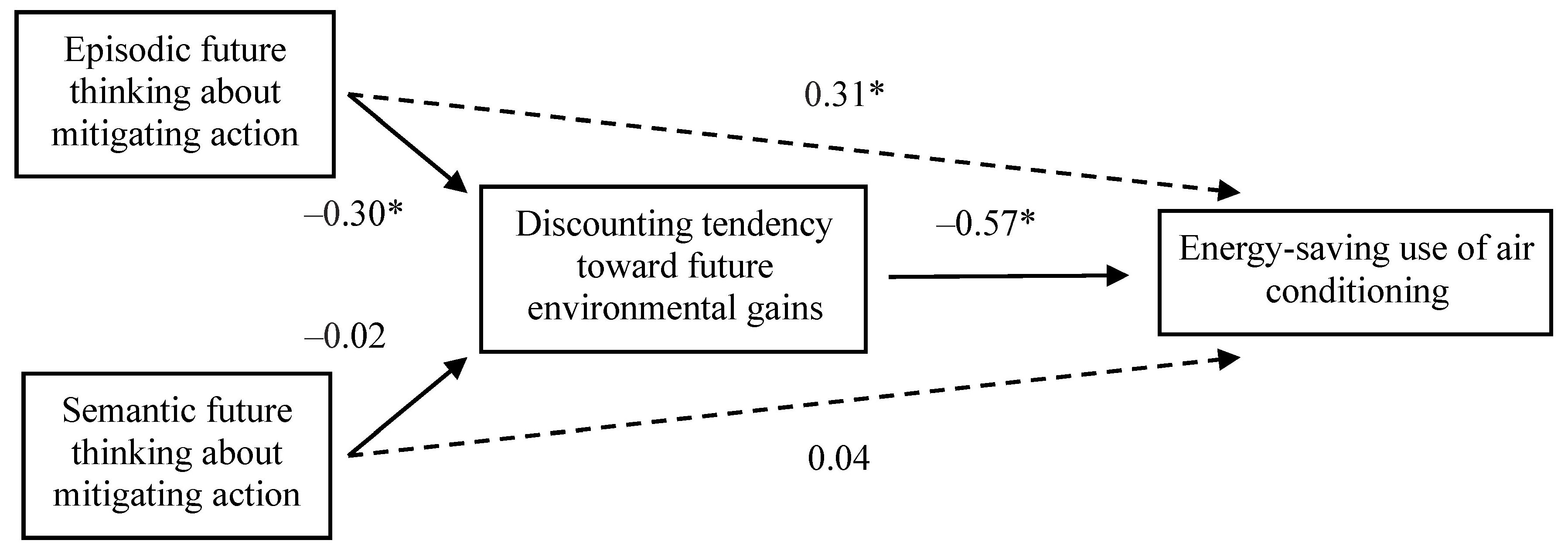

| Mitigation-EFT | Mitigation-SFT | Control | ||||
|---|---|---|---|---|---|---|
| Measure | Mean | SD | Mean | SD | Mean | SD |
| Discounting rate (k parameter) | 0.34 | 0.23 | 0.49 | 0.24 | 0.50 | 0.25 |
| Tendency toward energy-saving use of air conditioning (0–6) | 5.26 | 1.55 | 4.23 | 1.73 | 4.10 | 1.81 |
| Mitigation-EFT | Mitigation-SFT | |||
|---|---|---|---|---|
| Measure | Mean | SD | Mean | SD |
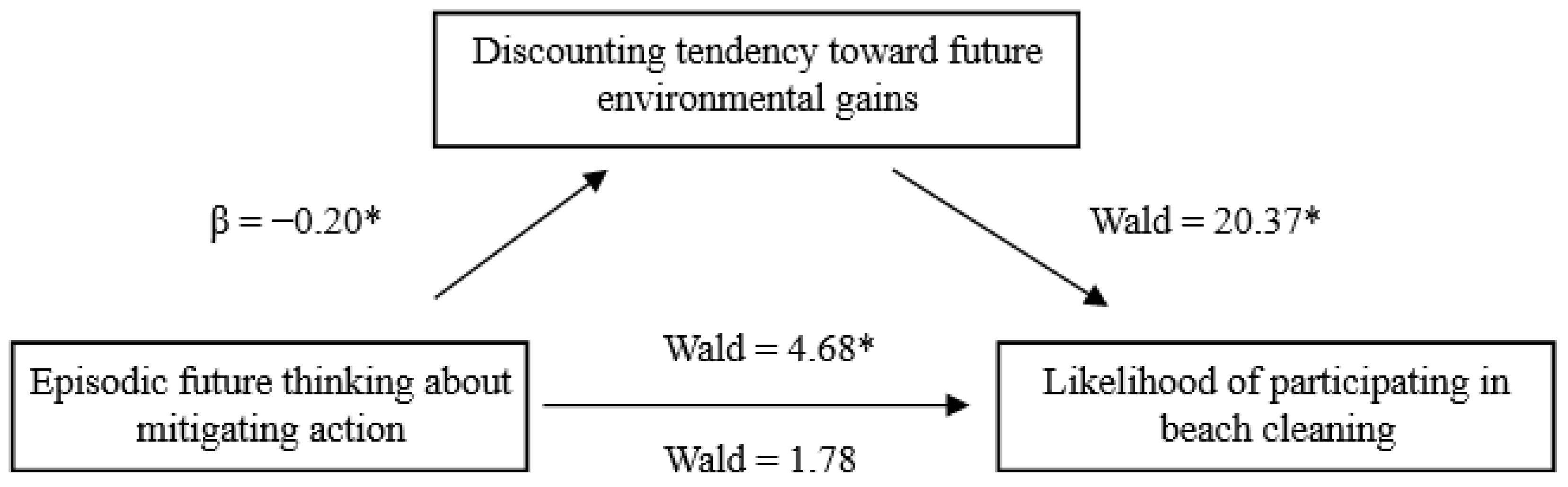
| Discounting rate (k parameter) | 0.38 | 0.25 | 0.48 | 0.25 |
| Choosing a vegetarian meal box (%) | 39.2 | 4.9 | 19.6 | 4.0 |
| Participating in beach cleaning (%) | 58.8 | 5.0 | 37.3 | 4.9 |
Publisher’s Note: MDPI stays neutral with regard to jurisdictional claims in published maps and institutional affiliations. |
© 2020 by the authors. Licensee MDPI, Basel, Switzerland. This article is an open access article distributed under the terms and conditions of the Creative Commons Attribution (CC BY) license (http://creativecommons.org/licenses/by/4.0/).
Share and Cite
Ho, L.-C.; Sung, Y.-H.; Wu, C.-C.; Lee, P.-S.; Chiou, W.-B. Envisaging Mitigation Action Can Induce Lower Discounting toward Future Environmental Gains and Promote Pro-Environmental Behavior. Sustainability 2020, 12, 9289. https://doi.org/10.3390/su12219289
Ho L-C, Sung Y-H, Wu C-C, Lee P-S, Chiou W-B. Envisaging Mitigation Action Can Induce Lower Discounting toward Future Environmental Gains and Promote Pro-Environmental Behavior. Sustainability. 2020; 12(21):9289. https://doi.org/10.3390/su12219289
Chicago/Turabian StyleHo, Liang-Chu, Yu-Hsien Sung, Chia-Chun Wu, Pei-Shan Lee, and Wen-Bin Chiou. 2020. "Envisaging Mitigation Action Can Induce Lower Discounting toward Future Environmental Gains and Promote Pro-Environmental Behavior" Sustainability 12, no. 21: 9289. https://doi.org/10.3390/su12219289
APA StyleHo, L.-C., Sung, Y.-H., Wu, C.-C., Lee, P.-S., & Chiou, W.-B. (2020). Envisaging Mitigation Action Can Induce Lower Discounting toward Future Environmental Gains and Promote Pro-Environmental Behavior. Sustainability, 12(21), 9289. https://doi.org/10.3390/su12219289