Spatial Analysis of Accidental Oil Spills Using Heterogeneous Data: A Case Study from the North-Eastern Ecuadorian Amazon

 ,
,
Abstract
1. Introduction
- ▪
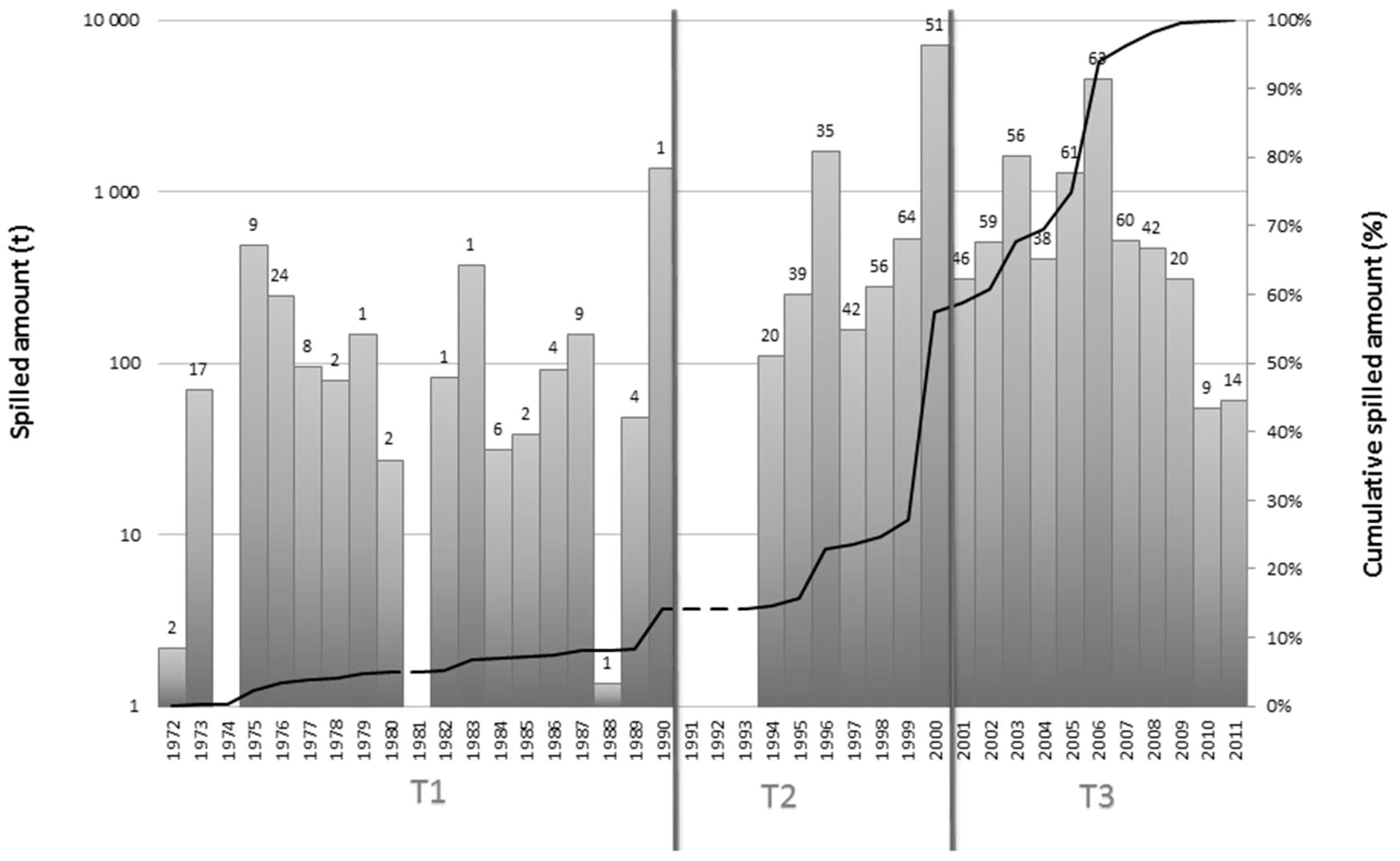
- T1 (1972–1991): the foreign company Texaco and the National Petroleum Corporation (CEPE) were engaged in oil and gas activities. Over this period, the MEM estimated that 397.5 × 10⁶ t of crude oil were discharged to the environment [18].
- ▪
- T2 (1992–2001): State-owned Petro-Ecuador took over oil production. Data compilation on accidental oil spills was reinforced.
- ▪
- T3 (from 2001): period after the environmental decree taken for regulating oil activity (RAHOE).
2. Materials and Methods
2.1. Study Area
2.2. Data for Crude Oil Spills
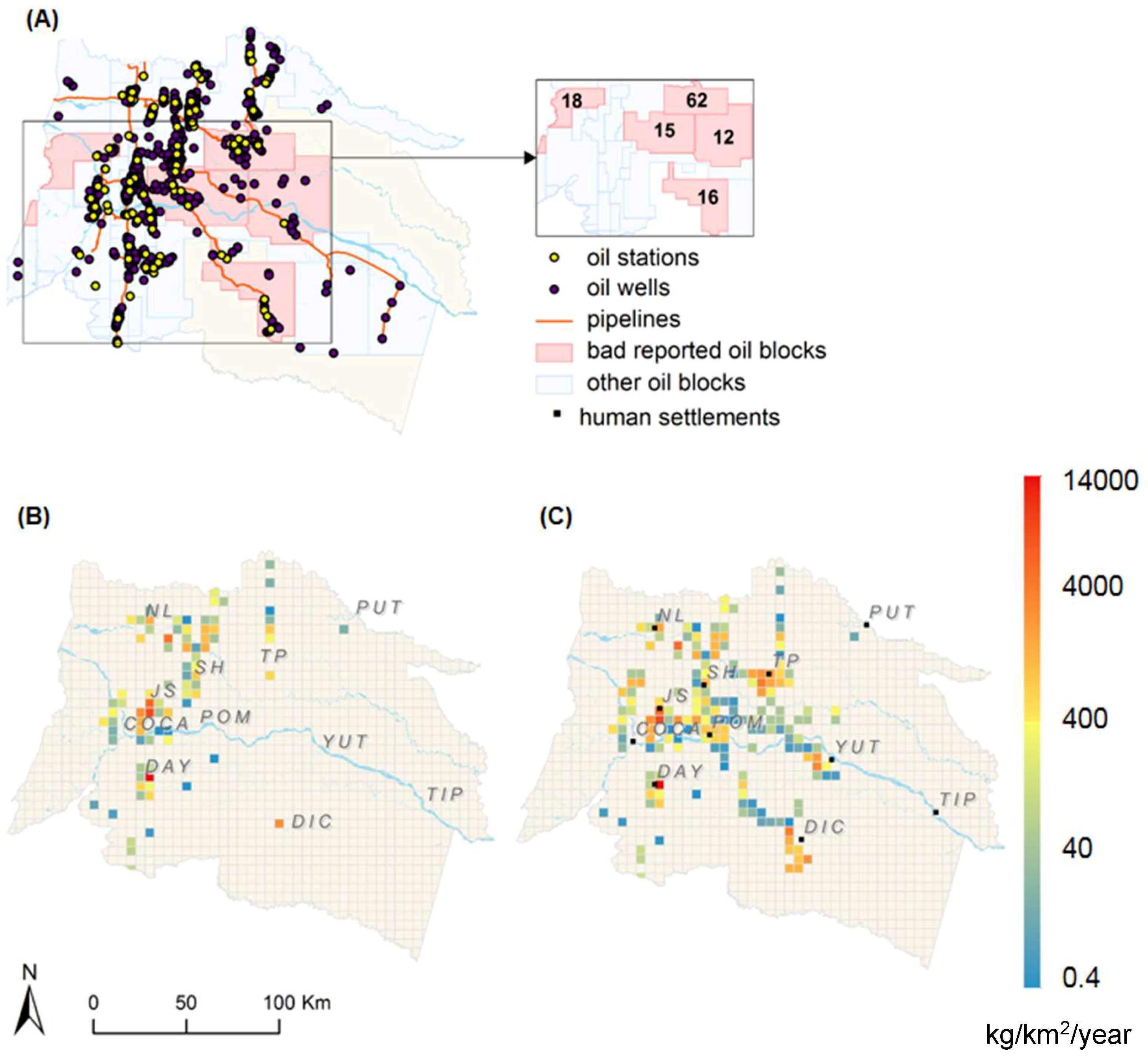
2.3. Accounting for Heterogeneity in Data Quality: Well- vs. Poorly-Documented Oil Blocks
- n =
- number of oil spills on the block from 2001 to 2011.
- λ =
- expected number of oil spills from 2001 to 2011 calculated based on the number of oil infrastructures on the block and the oil spill rate for all the oil blocks in the study area.
2.4. Calculating the Oil Spill Rates to be Used for Estimations on Poorly-Documented Blocks
2.5. Oil Spill Mapping
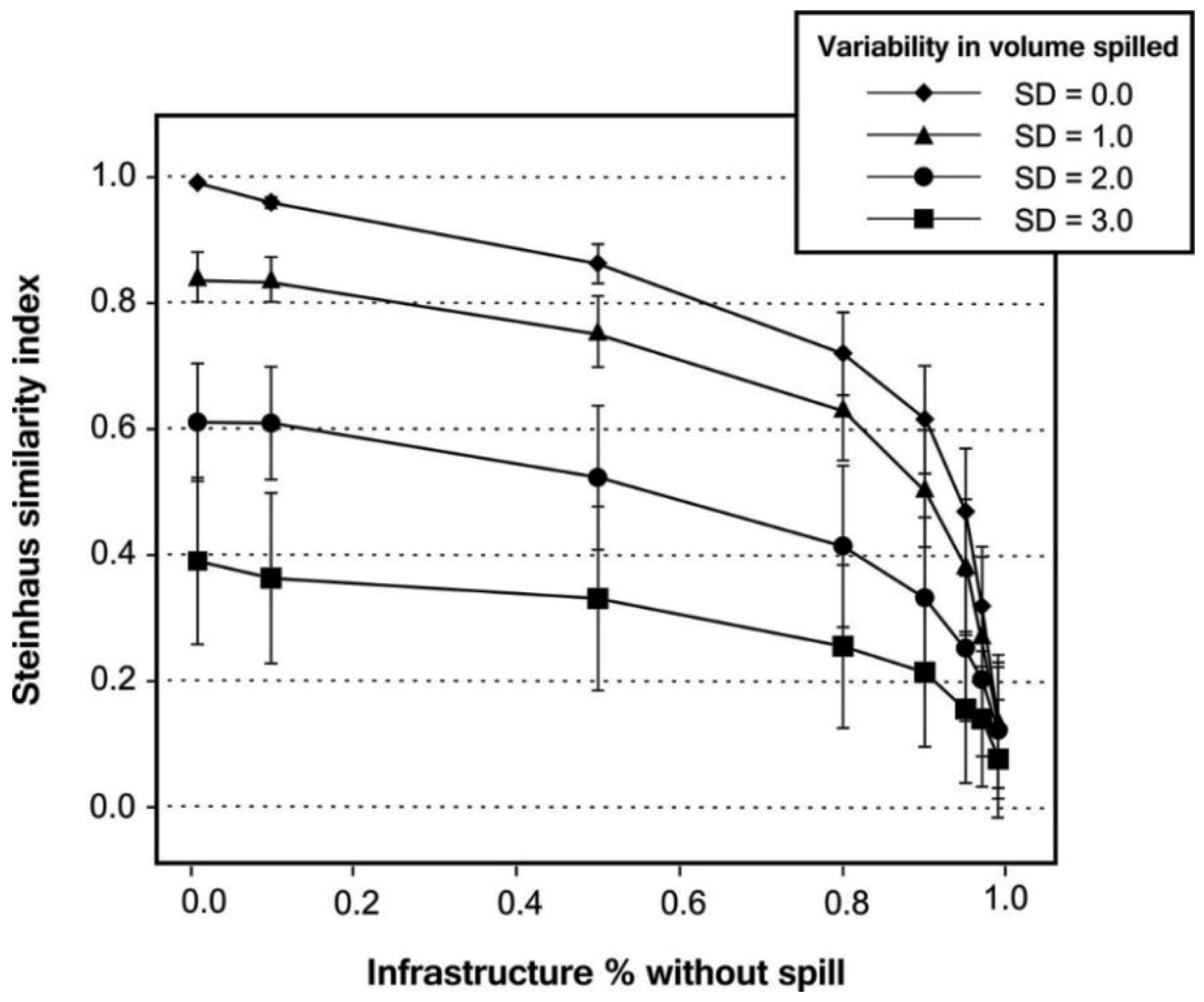
2.6. Validity of the Procedure to Estimate Oil Spills on Poorly-Documented Blocks
3. Results
3.1. Oil Spills: Temporal and Spatial Patterns
3.2. Reliability of the Procedure Used to Estimate Missing Data
4. Discussion
4.1. Uncertainties and Data Quality
4.1.1. Data Reporting
4.1.2. Spill Estimates
4.2. Accuracy of Oil Spill Estimations
4.3. Spatial Distribution of Spills and Hazard Potential
4.4. Potential Economic, Health, and Environmental Losses
5. Conclusions
Author Contributions
Funding
Acknowledgments
Conflicts of Interest
References
- Jernelöv, A. The Threats from Oil Spills: Now, Then, and in the Future. Ambio 2010, 39, 353–366. [Google Scholar] [CrossRef] [Scilit]
- Burgherr, P. In-depth analysis of accidental oil spills from tankers in the context of global spill trends from all sources. J. Hazard. Mater. 2007, 140, 245–256. [Google Scholar] [CrossRef] [Scilit]
- Chang, S.E.; Stone, J.; Demes, K.; Piscitelli, M. Consequences of oil spills: A review and framework for informing planning. Ecol. Soc. 2014, 19, 26. [Google Scholar] [CrossRef] [Scilit]
- Wernersson, A.-S. Aquatic ecotoxicity due to oil pollution in the Ecuadorian Amazon. Aquat. Ecosyst. Health Manag. 2004, 7, 127–136. [Google Scholar] [CrossRef] [Scilit]
- Bondur, V.G. Aerospace methods and technologies for monitoring oil and gas areas and facilities. Izv. Atmos. Ocean. Phys. 2011, 47, 1007–1018. [Google Scholar] [CrossRef] [Scilit]
- Myers, N.; Mittermeier, R.A.; Mittermeier, C.G.; da Fonseca, G.A.B.; Kent, J. Biodiversity hotspots for conservation priorities. Nature 2000, 403, 853–858. [Google Scholar] [CrossRef] [Scilit]
- Bass, M.S.; Finer, M.; Jenkins, C.N.; Kreft, H.; Cisneros-Heredia, D.F.; McCracken, S.F.; Pitman, N.C.A.; English, P.H.; Swing, K.; Villa, G.; et al. Global conservation significance of Ecuador’s Yasuní National Park. PLoS ONE 2010, 5, e8767. [Google Scholar] [CrossRef] [Scilit]
- Larrea, C. Hacia una Historia Ecológica del Ecuador: Propuestas para el Debate; Biblioteca General de Cultura: Quito, Ecuador, 2006. [Google Scholar]
- Finer, M.; Jenkins, C.N.; Pimm, S.L.; Keane, B.; Ross, C. Oil and Gas Projects in the Western Amazon: Threats to Wilderness, Biodiversity, and Indigenous Peoples. PLoS ONE 2008, 3, e2932. [Google Scholar] [CrossRef] [Scilit]
- Baynard, C.W.; Ellis, J.M.; Davis, H. Roads, petroleum and accessibility: The case of eastern Ecuador. GeoJournal 2013, 78, 675–695. [Google Scholar] [CrossRef] [Scilit]
- Butt, N.; Beyer, H.L.; Bennett, J.R.; Biggs, D.; Maggini, R.; Mills, M.; Renwick, A.R.; Seabrook, L.M.; Possingham, H.P. Biodiversity risks from fossil fuel extraction. Science 2013, 342, 425–426. [Google Scholar] [CrossRef] [Scilit]
- Waldner, C.L.; Ribble, C.S.; Janzen, E.D.; Campbell, J.R. Associations between oil- and gas-well sites, processing facilities, flaring, and beef cattle reproduction and calf mortality in western Canada. Prev. Vet. Med. 2001, 50, 1–17. [Google Scholar] [CrossRef] [Scilit]
- Sebastián, M.S.; Armstrong, B.; Córdoba, J.A.; Stephens, C. Exposures and Cancer Incidence near Oil Fields in the Amazon Basin of Ecuador. Occup. Environ. Med. 2001, 58, 517–522. [Google Scholar] [CrossRef] [Scilit]
- San Sebastián, M.; Hurtig, A.K. Oil development and health in the Amazon basin of Ecuador: The popular epidemiology process. Soc. Sci. Med. 2005, 60, 799–807. [Google Scholar] [CrossRef] [Scilit]
- Boxall, P.C.; Chan, W.H.; Mcmillan, M.L. The impact of oil and natural gas facilities on rural residential property values: A spatial hedonic analysis. Resour. Energy Econ. 2005, 27, 248–269. [Google Scholar] [CrossRef] [Scilit]
- Buccina, S.; Chene, D.; Gramlich, J. Accounting for the environmental impacts of Texaco’s operations in Ecuador: Chevron’s contingent environmental liability disclosures. Account. Forum 2013, 37, 110–123. [Google Scholar] [CrossRef] [Scilit]
- Juteau, G.; Becerra, S.; Maurice, L. Environment, oil and political vulnerability in the Ecuadorian Amazon: Towards new forms of energy governance? Am. Lat. Hoy 2014, 67, 119–137. [Google Scholar]
- Amazon Defense Front. Breve Historia de las Operaciones de Texaco en el Oriente Ecuatoriano 1964–1990. Unpublished Work. 2008.
- Andreo, B.; Goldscheider, N.; Vadillo, I.; Vías, J.M.; Neukum, C.; Sinreich, M.; Jiménez, P.; Brechenmacher, J.; Carrasco, F.; Hötzl, H.; et al. Karst groundwater protection: First application of a Pan-European Approach to vulnerability, hazard and risk mapping in the Sierra de Líbar (Southern Spain). Sci. Total Environ. 2006, 357, 54–73. [Google Scholar] [CrossRef] [Scilit]
- Guttikunda, S.K.; Calori, G. A GIS based emissions inventory at 1 km × 1 km spatial resolution for air pollution analysis in Delhi, India. Atmos. Environ. 2013, 67, 101–111. [Google Scholar] [CrossRef] [Scilit]
- Lahr, J.; Kooistra, L. Environmental risk mapping of pollutants: State of the art and communication aspects. Sci. Total Environ. 2010, 408, 3899–3907. [Google Scholar] [CrossRef] [Scilit]
- Lahr, J.; Münier, B.; De Lange, H.J.; Faber, J.F.; Sørensen, P.B. Wildlife vulnerability and risk maps for combined pollutants. Sci. Total Environ. 2010, 408, 3891–3898. [Google Scholar] [CrossRef] [Scilit]
- Serra-Sogas, N.; O’Hara, P.D.; Canessa, R.; Keller, P.; Pelot, R. Visualization of spatial patterns and temporal trends for aerial surveillance of illegal oil discharges in western Canadian marine waters. Mar. Pollut. Bull. 2008, 56, 825–833. [Google Scholar] [CrossRef] [Scilit]
- Bertazzon, S.; O’Hara, P.D.; Barrett, O.; Serra-Sogas, N. Geospatial analysis of oil discharges observed by the National Aerial Surveillance Program in the Canadian Pacific Ocean. Appl. Geogr. 2014, 52, 78–89. [Google Scholar] [CrossRef] [Scilit]
- SENPLADES. Atlas de las Desigualdades Socioeconómicas del Ecuador; Larrea, C., Camacho, G., Eds.; TRAMA: Quito, Ecuador, 2013; ISBN 9789942074782. [Google Scholar]
- Maestripieri, N.; Saqalli, M. Assessing health risk using regional mappings based on local perceptions: A comparative study of three different hazards. Hum. Ecol. Risk Assess. 2016, 22, 721–735. [Google Scholar] [CrossRef] [Scilit]
- Smith, R.; Slack, J.; Wyant, T.; Lanfear, K. The Oilspill Risk Analysis Model of the U.S. Geological Survey; US Geological Survey: Washington, DC, USA, 1982.
- Getis, A.; Ord, J.K. The Analysis of Spatial Association by Use of Distance Statistics. Geogr. Anal. 1992, 24, 189–206. [Google Scholar] [CrossRef] [Scilit]
- Meng, Q. Spatial analysis of environment and population at risk of natural gas fracking in the state of Pennsylvania, USA. Sci. Total Environ. 2015, 515–516, 198–206. [Google Scholar] [CrossRef] [Scilit] [PubMed]
- Gower, J.C. A General Coefficient of Similarity and Some of Its Properties. Biometrics 1971, 27, 857–871. [Google Scholar] [CrossRef] [Scilit]
- Legendre, P.; Legendre, L. Numerical Ecology, 2nd ed.; Elsevier B.V.: Amsterdam, The Netherlands, 1998. [Google Scholar]
- Limpert, E.; Stahel, W.A.; Abbt, M. Log-normal Distributions across the Sciences: Keys and Clues. Bioscience 2001, 51, 341–352. [Google Scholar] [CrossRef] [Scilit]
- Schmidt Etkin, D. Analysis of Oil Spill Trends in the United States and Worldwide. 2001. Available online: http://www.environmental-research.com/publications/pdf/spill_statistics/paper4.pdf (accessed on 15 August 2017).
- Schweitzer, L. Accident frequencies in environmental justice assessment and land use studies. J. Hazard. Mater. 2008, 156, 44–50. [Google Scholar] [CrossRef] [Scilit]
- Darbra, R.M.; Palacios, A.; Casal, J. Domino effect in chemical accidents: Main features and accident sequences. J. Hazard. Mater. 2010, 183, 565–573. [Google Scholar] [CrossRef] [Scilit]
- Burgherr, P.; Eckle, P.; Hirschberg, S. Comparative assessment of severe accident risks in the coal, oil and natural gas chains. Reliab. Eng. Syst. Saf. 2012, 105, 97–103. [Google Scholar] [CrossRef] [Scilit]
- McKain, K.; Down, A.; Raciti, S.M.; Budney, J.; Hutyra, L.R.; Floerchinger, C.; Herndon, S.C.; Nehrkorn, T.; Zahniser, M.S.; Jackson, R.B.; et al. Methane emissions from natural gas infrastructure and use in the urban region of Boston, Massachusetts. Proc. Natl. Acad. Sci. USA 2015, 112, 1941–1946. [Google Scholar] [CrossRef] [Scilit] [PubMed]
- Arellano, P.; Tansey, K.; Balzter, H.; Boyd, D.S. Detecting the effects of hydrocarbon pollution in the Amazon forest using hyperspectral satellite images. Environ. Pollut. 2015, 205, 225–239. [Google Scholar] [CrossRef] [Scilit] [PubMed]
- Burgherr, P.; Hirschberg, S. Comparative risk assessment of severe accidents in the energy sector. Energy Policy 2014, 74, S45–S56. [Google Scholar] [CrossRef] [Scilit]
- Bissardon, P.; Becerra, S.; Maurice, L. Le risque sanitaire lié aux activités pétrolières en Amazonie équatorienne: Des alertes aux décisions. Environ. Risque Sante 2013, 12, 338–344. [Google Scholar] [CrossRef]
- Kontovas, C.A.; Psaraftis, H.N.; Ventikos, N.P. An empirical analysis of IOPCF oil spill cost data. Mar. Pollut. Bull. 2010, 60, 1455–1466. [Google Scholar] [CrossRef] [Scilit]
- Castello, L.; Mcgrath, D.G.; Hess, L.L.; Coe, M.T.; Lefebvre, P.A.; Petry, P.; Macedo, M.N.; Ren, V.F.; Arantes, C.C. The vulnerability of Amazon freshwater ecosystems. Conserv. Lett. 2013, 217–229. [Google Scholar] [CrossRef] [Scilit]
- Cuba, N.; Bebbington, A.; Rogan, J.; Millones, M. Extractive industries, livelihoods and natural resource competition: Mapping overlapping claims in Peru and Ghana. Appl. Geogr. 2014, 54, 250–261. [Google Scholar] [CrossRef] [Scilit]
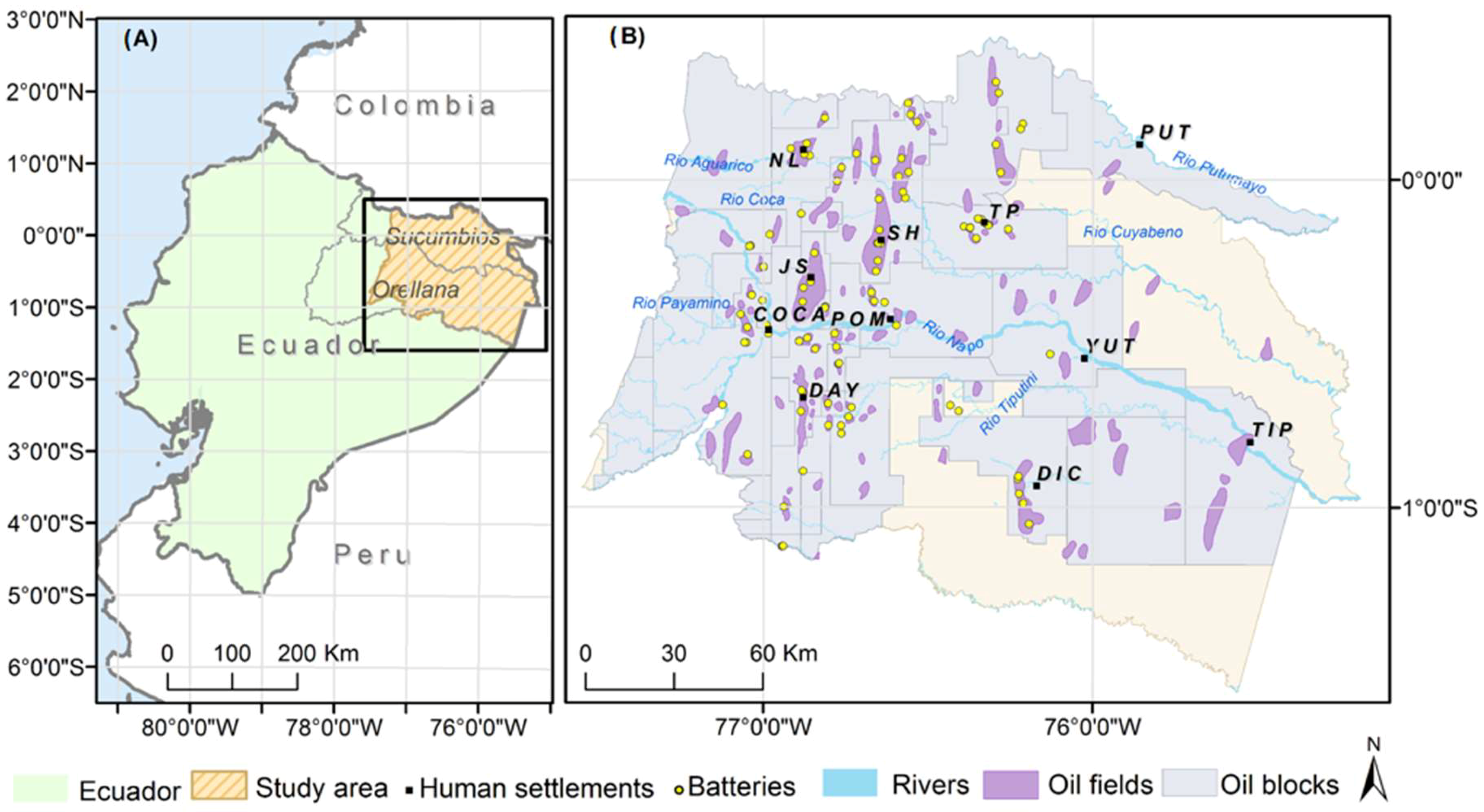


| GIS Data | Description | Sources |
|---|---|---|
| Oil blocks, oilfields | Polygons, 1:250,000 | National Board of Hydrocarbons (2014) Petro Ecuador (2013) |
| Oil wells, platforms, refineries, oil separation batteries | Points | PRAS (1972–2014) |
| Oil spills | Points | PRAS (1972–2014) |
| Pipelines | Lines | SENPLADES (2009) |
| Inventories | ||
| Oil spills | Historical data | PRAS (2014) and local governments |
| Oil Spill Occurrences | Oil Spill Volumes | |||||
|---|---|---|---|---|---|---|
| Total (n) | Average (n/year) | Total (t) | Average (t/year) | Share (%) | ||
| on oil blocks (N = 13) | block 61 (AU) | 76 | 7 ± 5.82 | 4054.50 | 368.59 (±1119.09) | 40.54 |
| block 60 (SC) | 98 | 9 ± 7.8 | 2801.56 | 254.68 (±324.87) | 28.01 | |
| block 57 (LT) | 154 | 14 ± 7.5 | 1792.13 | 162.92 (±159.80) | 17.92 | |
| block 56 (LA) | 53 | 5 ± 3.6 | 368.78 | 33.52 (±47.23) | 3.69 | |
| sub-total | 381 | 34.6 ± 7.8 | 9016.97 | 819.73 (±1170.14) | 90.17 | |
| on single infrastructure | Wells | 339 | 30.82 ± 0.19 | 6971.66 | 633.79 (±1149) | 69.71 |
| Pipeline | 7 | 0.6 | 472.88 | 42.98 (±55.4) | 4.73 | |
| Oil separation batteries | 118 | 10.7 ± 0.62 | 2555.7 | 232.33 (±327.69) | 25.56 | |
| Total | 464 | 42.2 | 10,000.23 | 909.11 (±1219.46) | 100.00 | |
| Location | Abbr. | ETC (136 t) | ERC (34 t) |
|---|---|---|---|
| COCA | COCA | - | 2 |
| Dayuma | DAY | 1 | 3 |
| Dicaro | DIC | 1 | 1 |
| Joya de los Sachas | JS | 8 | 21 |
| Nueva Loja | NL | 2 | 10 |
| Pompeya | POM | - | - |
| Putumayo | PUT | - | 1 |
| Shushufindi | SH | - | 6 |
| Tarapoa | TP | - | 1 |
| Yasuni-ITT | TIP | - | - |
| Yuturi | YUT | - | - |
| Number | 12 | 45 |
© 2018 by the authors. Licensee MDPI, Basel, Switzerland. This article is an open access article distributed under the terms and conditions of the Creative Commons Attribution (CC BY) license (http://creativecommons.org/licenses/by/4.0/).
Share and Cite
Durango-Cordero, J.; Saqalli, M.; Laplanche, C.; Locquet, M.; Elger, A. Spatial Analysis of Accidental Oil Spills Using Heterogeneous Data: A Case Study from the North-Eastern Ecuadorian Amazon. Sustainability 2018, 10, 4719. https://doi.org/10.3390/su10124719
Durango-Cordero J, Saqalli M, Laplanche C, Locquet M, Elger A. Spatial Analysis of Accidental Oil Spills Using Heterogeneous Data: A Case Study from the North-Eastern Ecuadorian Amazon. Sustainability. 2018; 10(12):4719. https://doi.org/10.3390/su10124719
Chicago/Turabian StyleDurango-Cordero, Juan, Mehdi Saqalli, Christophe Laplanche, Marine Locquet, and Arnaud Elger. 2018. "Spatial Analysis of Accidental Oil Spills Using Heterogeneous Data: A Case Study from the North-Eastern Ecuadorian Amazon" Sustainability 10, no. 12: 4719. https://doi.org/10.3390/su10124719
APA StyleDurango-Cordero, J., Saqalli, M., Laplanche, C., Locquet, M., & Elger, A. (2018). Spatial Analysis of Accidental Oil Spills Using Heterogeneous Data: A Case Study from the North-Eastern Ecuadorian Amazon. Sustainability, 10(12), 4719. https://doi.org/10.3390/su10124719