
Impact of Cannabis and Cannabis Legalization on US Atrial Septal Defect Rates



Abstract
1. Introduction
2. Methods
2.1. Data
2.1.1. Congenital Anomalies
2.1.2. Drugs
2.1.3. Others
2.1.4. Derived Variables
2.2. Data Analysis
2.3. Causal Inference
2.4. Ethics Approval
2.5. Generative Artificial Intelligence
2.6. Data Availability
3. Results
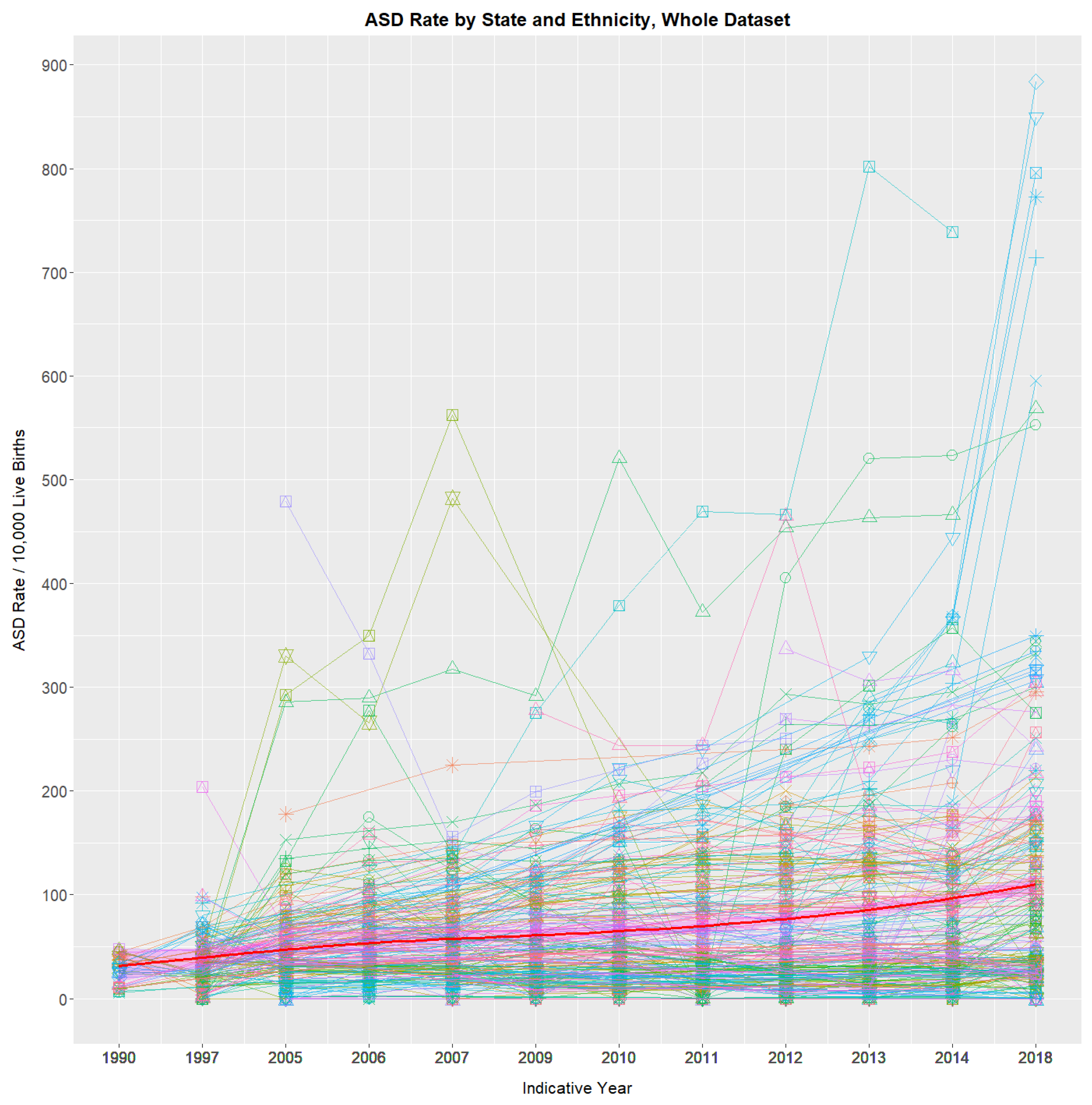
3.1. ASD Rates
3.2. Bifurcation of ASD Rates
3.3. Substance Use
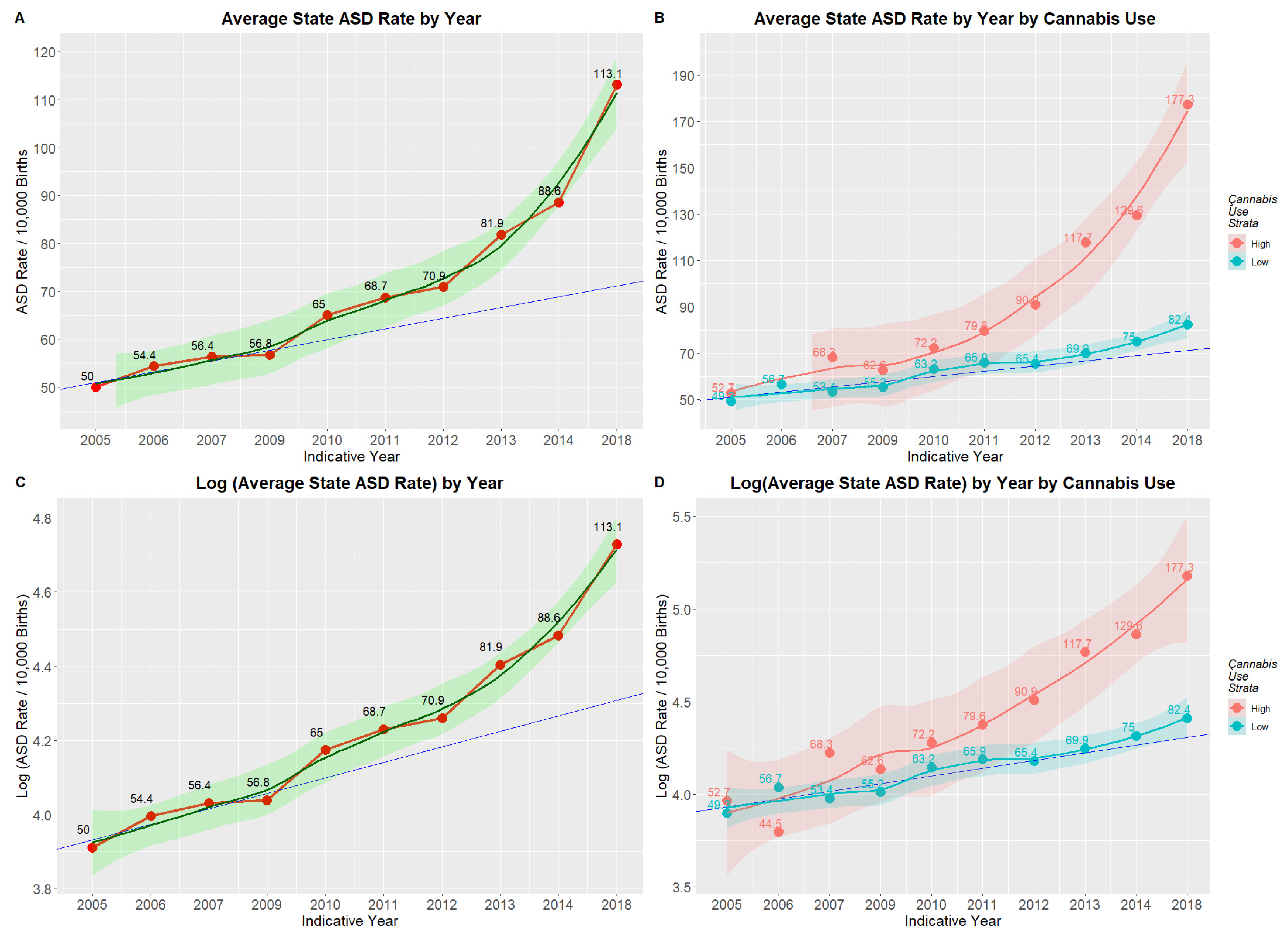
3.4. ASDR over Time vs. ASDR by Cannabis Exposure
3.5. Multivariate Modeling
3.5.1. Mixed-Effects Models
3.5.2. Survey Regression Models
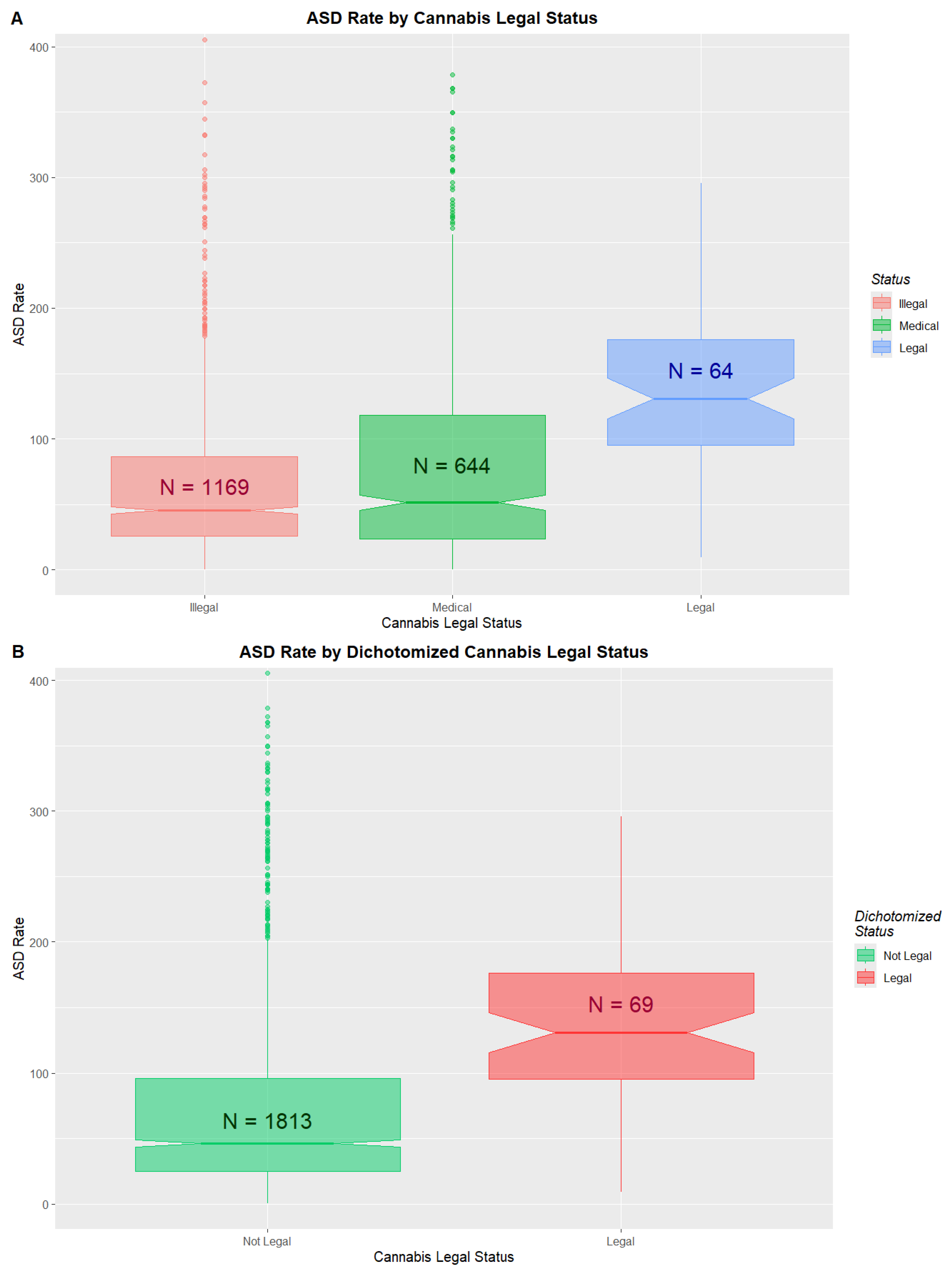
3.6. Legal Status
3.7. Effect Sizes
3.8. Within- and Between-States Mixed-Effects Modeling
3.9. Sensitivity Analysis
3.10. Variance Inflation Factors
4. Discussion
4.1. Main Results
4.2. Interpretation
4.3. Literature Review
4.4. Cellular and Molecular Mechanisms
4.4.1. Morphological Cardiogenesis
4.4.2. Cardiogenic Morphogens
4.4.3. Cardiogenic Epigenomics
4.5. Strength of Association
4.6. Generalizability
4.7. Comparisons to Known Teratogens
4.8. Strengths and Limitations
5. Conclusions
Supplementary Materials
Author Contributions
Funding
Institutional Review Board Statement
Informed Consent Statement
Data Availability Statement
Conflicts of Interest
Abbreviations
| AIC | Akaike Information Criterion |
| alcmon | Alcohol use in the past year |
| anlyr | Analgesic misuse in the past year |
| ASD | Atrial septal defect, secundum type |
| ASDR | Atrial septal defect rate |
| audyr | Alcohol use disorder in the past year |
| BIC | Bayesian Information Criterion |
| bngalc | Binge alcohol use in the past year |
| BMP | Bone morphogenetic proteins |
| CBG | Cannabigerol |
| CENPN | Centrosomal Protein N |
| C.I. | Confidence Interval |
| cigmon | Cigarette use in the past month |
| COUP-TF II | Chicken Ovalbumin Upstream Promoter Transcription Factor II |
| CRAN | Central R Archive Network |
| cocyr | Cocaine use in the past year |
| EDF | Estimated degrees of freedom |
| EWAS | Epigenome-wide association study |
| E-Value | Expected value |
| Δ9THC | Δ9-tetrahydrocannabinol |
| GATA | GATA transcription factor family |
| Hispanic | Hispanic |
| IQR | Interquartile Range |
| logLik | Log Likelihood ratio at model maximization |
| GLI3 | Gli family zinc finger 3 |
| MEF2 | Myocyte Enhancer Factor 2 |
| MEGF8 | Multiple EGF-like domains 8 |
| mgcv | Mixed Gam Computation Vehicle |
| mrjmon | Cannabis use in the past month |
| NBDPN | National Birth Defect Prevention Network |
| NHWhite | Non-Hispanic White |
| NHBlack | Non-Hispanic Black |
| NHAIAN | Non-Hispanic American Indian Alaskan Native |
| NHAsPI | Non-Hispanic Asian/Pacific Islander |
| NKX2 | NK2 Homeobox 2 |
| NSDUH | National Survey of Drug Use and Health |
| Overall | Overall or total of all races combined |
| PCE | Prenatal Cannabis Exposure |
| SAMHSA | Substance Abuse and Mental Health Services Administration |
| SD | Standard deviation |
| SEM | Standard error of the mean |
| SHH | Sonic hedgehog |
| TBX | T-box transcription factor family |
| TMEM107 | Transmembrane protein 107 |
| VEGF | Vascular Endothelial Growth Factor |
| VIF | Variance inflation factor |
References
- Koller, V.J.; Ferk, F.; Al-Serori, H.; Misik, M.; Nersesyan, A.; Auwarter, V.; Grummt, T.; Knasmuller, S. Genotoxic properties of representatives of alkylindazoles and aminoalkyl-indoles which are consumed as synthetic cannabinoids. Food Chem. Toxicol. 2015, 80, 130–136. [Google Scholar] [CrossRef] [Scilit]
- Russo, C.; Ferk, F.; Misik, M.; Ropek, N.; Nersesyan, A.; Mejri, D.; Holzmann, K.; Lavorgna, M.; Isidori, M.; Knasmuller, S. Low doses of widely consumed cannabinoids (cannabidiol and cannabidivarin) cause DNA damage and chromosomal aberrations in human-derived cells. Arch. Toxicol. 2018, 93, 179–188. [Google Scholar] [CrossRef] [Scilit]
- Fish, E.W.; Murdaugh, L.B.; Zhang, C.; Boschen, K.E.; Boa-Amponsem, O.; Mendoza-Romero, H.N.; Tarpley, M.; Chdid, L.; Mukhopadhyay, S.; Cole, G.J.; et al. Cannabinoids Exacerbate Alcohol Teratogenesis by a CB1-Hedgehog Interaction. Sci. Rep. 2019, 9, 16057–16075. [Google Scholar] [CrossRef] [Scilit] [PubMed]
- Hölzel, B.N.; Pfannkuche, K.; Allner, B.; Allner, H.T.; Hescheler, J.; Derichsweiler, D.; Hollert, H.; Schiwy, A.; Brendt, J.; Schaffeld, M.; et al. Following the adverse outcome pathway from micronucleus to cancer using H2B-eGFP transgenic healthy stem cells. Arch. Toxicol. 2020, 94, 3265–3280. [Google Scholar] [CrossRef] [Scilit]
- Reece, A.S.; Hulse, G.K. Chapter 3: Geospatiotemporal and causal inferential analysis of United States congenital anomalies as a function of multiple cannabinoid-and substance-exposures: Phenocopying thalidomide and hundred megabase-scale genotoxicity. In Epidemiology of Cannabis: Genotoxicity and Neurotoxicity, Epigenomics and Aging; Reece, A.S., Hulse, G.K., Eds.; Elsevier: New York, NY, USA, 2025; Volume 1, p. 570. [Google Scholar]
- National Birth Defects Prevention Network. Major Birth Defects Data from Populatoin-Based Birth Defects Surveillance Programs in the United States, 2016–2020; NBDPN, Ed.; National Birth Defects Prevention Network, NBDPN: Houston, TX, USA, 2024; Volume 2020. [Google Scholar]
- National Survey of Drug Use and Health (NSDUH 2020). Available online: https://datatools.samhsa.gov/das/nsduh/2020/nsduh-2020-ds0001/variable-list (accessed on 2 February 2026).
- censusapi: Retrieve Data from the Census APIs—R Package Version 0.8.0. Available online: https://CRAN.R-project.org/package=censusapi (accessed on 1 January 2026).
- Chandra, S.; Radwan, M.M.; Majumdar, C.G.; Church, J.C.; Freeman, T.P.; ElSohly, M.A. New trends in cannabis potency in USA and Europe during the last decade (2008–2017). Eur. Arch. Psychiatry Clin. Neurosci. 2019, 269, 5–15. [Google Scholar] [CrossRef] [Scilit] [PubMed]
- ElSohly, M.A.; Chandra, S.; Radwan, M.; Majumdar, C.G.; Church, J.C. A Comprehensive Review of Cannabis Potency in the United States in the Last Decade. Biol. Psychiatry Cogn. Neurosci. Neuroimaging 2021, 6, 603–606. [Google Scholar] [CrossRef] [Scilit] [PubMed]
- ElSohly, M.A.; Mehmedic, Z.; Foster, S.; Gon, C.; Chandra, S.; Church, J.C. Changes in Cannabis Potency Over the Last 2 Decades (1995–2014): Analysis of Current Data in the United States. Biol. Psychiatry 2016, 79, 613–619. [Google Scholar] [CrossRef] [Scilit] [PubMed]
- ElSohly, M.A.; Ross, S.A.; Mehmedic, Z.; Arafat, R.; Yi, B.; Banahan, B.F., 3rd. Potency trends of delta9-THC and other cannabinoids in confiscated marijuana from 1980–1997. J. Forensic Sci. 2000, 45, 24–30. [Google Scholar] [CrossRef] [Scilit]
- Freeman, T.P.; Craft, S.; Wilson, J.; Stylianou, S.; ElSohly, M.; Di Forti, M.; Lynskey, M.T. Changes in delta-9-tetrahydrocannabinol (THC) and cannabidiol (CBD) concentrations in cannabis over time: Systematic review and meta-analysis. Addiction 2021, 116, 1000–1010. [Google Scholar] [CrossRef] [Scilit]
- Gostin, L.O.; Hodge, J.G., Jr.; Wetter, S.A. Enforcing Federal Drug Laws in States Where Medical Marijuana Is Lawful. JAMA 2018, 319, 1435–1436. [Google Scholar] [CrossRef] [Scilit]
- Cannabis Overview. Available online: https://www.ncsl.org/civil-and-criminal-justice/cannabis-overview?utm_source=chatgpt.com (accessed on 1 January 2026).
- Timeline of Cannabis Laws in the United States. Available online: https://en.wikipedia.org/wiki/Timeline_of_cannabis_laws_in_the_United_States?utm_source=chatgpt.com (accessed on 1 January 2026).
- CDC Wonder. Natality Information, Live Births. Available online: https://wonder.cdc.gov/natality.html (accessed on 1 January 2026).
- Wickham, H.; Averick, M.; Bryan, J.; Chang, W.; McGowan, L.D.; Francios, R.; Groelmund, G.; Hayes, A.; Henry, L.; Hester, J.; et al. Welcome to the Tidyverse. J. Open Source Softw. 2019, 4, 1686–1691. [Google Scholar] [CrossRef] [Scilit]
- ggpubr: ‘ggplot2’ Based Publication Ready Plots. Available online: https://CRAN.R-project.org/package=ggpubr (accessed on 1 January 2026).
- Xu, S.; Chen, M.; Feng, T.; Zhan, L.; Zhou, L.; Yu, G. Use ggbreak to Effectively Utilize Plotting Space to Deal With Large Datasets and Outliers. Front. Genet. 2021, 12, 774846. [Google Scholar] [CrossRef] [Scilit]
- grepel: Automatically Position Non-Overlapping Text Labels with ‘ggplot2’. R package version 0.9.6. Available online: https://slowkow.r-universe.dev/ggrepel (accessed on 1 January 2026).
- Patchwork: The Composer of Plots. R Package Version 1.1.2. Available online: https://CRAN.R-project.org/package=patchwork (accessed on 1 January 2026).
- gridExtra: Miscellaneous Functions for “Grid” Graphics. R Package Version 2.3. Available online: https://CRAN.R-project.org/package=gridExtra (accessed on 1 January 2026).
- tableone: Create ‘Table 1’ to Describe Baseline Characteristics with or Without Propensity Score Weights. R Package Version 0.13.2. Available online: https://CRAN.R-project.org/package=tableone (accessed on 1 January 2026).
- Bates, D.; Mächler, M.; Bolker, B.; Walker, S. Fitting Linear Mixed-Effects Models Using lme4. J. Stat. Softw. 2015, 67, 1–48. [Google Scholar] [CrossRef] [Scilit]
- Kuznetsova, A.; Brockhoff, P.B.; Christensen, R.H.B. lmerTest Package: Tests in Linear Mixed Effects Models. J. Stat. Softw. 2017, 82, 1–26. [Google Scholar] [CrossRef] [Scilit]
- Lumley, T. Analysis of Complex Survey Samples. J. Stat. Softw. 2004, 9, 1–19. [Google Scholar] [CrossRef] [Scilit]
- Lumley, T. Complex Surveys: A Guide to Analysis Using R; Wiley: Hoboken, NJ, USA, 2010; Volume 1. [Google Scholar]
- Wood, S.N. Stable and Efficient Multiple Smoothing Parameter Estimation for Generalized Additive Models. J. Am. Stat. Assoc. 2004, 99, 673–686. [Google Scholar] [CrossRef] [Scilit]
- Wood, S.N. Fast stable restricted maximum likelihood and marginal likelihood estimation of semiparametric generalized linear models. J. R. Stat. Soc. Ser. B Stat. Methodol. 2011, 73, 3–36. [Google Scholar] [CrossRef] [Scilit]
- Wood, S.N.; Natalya, P.; Säfken, B. Smoothing Parameter and Model Selection for General Smooth Models. J. Am. Stat. Assoc. 2016, 111, 1548–1563. [Google Scholar] [CrossRef] [Scilit]
- Venables, W.N.; Ripley, B.D. MASS: Modern Applied Statistics with S, 4th ed.; Springer: New York, NY, USA, 2002; Volume 1. [Google Scholar]
- Lüdecke, D.; Ben-Shachar, M.S.; Patil, I.; Waggoner, P.; Makowski, D. performance: An R Package for Assessment, Comparison and Testing of Statistical Models. J. Open Source Softw. 2021, 6, 3139. [Google Scholar] [CrossRef] [Scilit]
- Fox, J.; Weisberg, S. An R Companion to Applied Regression (CAR), 3rd ed.; Sage: Thousand Oaks, CA, USA, 2019; Volume 1. [Google Scholar]
- effzise: Efficient Effect Size Computation. Available online: https://CRAN.R-project.org/package=effsize (accessed on 1 January 2026).
- Lenth, R.V. emmeans: Estimated Marginal Means, aka Least-Squares Means. 2025. Available online: https://cran.r-project.org/web/packages/emmeans/index.html (accessed on 1 January 2026).
- Van der Wal, W.M.; Geskus, R.B. ipw: An R Package for Inverse Probabilty Weighting. J. Stat. Softw. 2011, 43, 1–23. [Google Scholar]
- VanderWeele, T.J.; Ding, P. Sensitivity Analysis in Observational Research: Introducing the E-Value. Ann. Intern. Med. 2017, 167, 268–274. [Google Scholar] [CrossRef] [Scilit]
- VanderWeele, T.J.; Ding, P.; Mathur, M. Technical Considerations in the Use of the E-Value. J. Causal Inference 2019, 7, 20180007. [Google Scholar] [CrossRef] [Scilit]
- Package ‘EValue’. Available online: https://cran.r-project.org/web/packages/EValue/EValue.pdf (accessed on 1 January 2026).
- Reece, A.S.; Hulse, G.K. Contemporary epidemiology of rising atrial septal defect trends across USA 1991–2016: A combined ecological geospatiotemporal and causal inferential study. BMC Pediatr 2020, 20, 539–550. [Google Scholar] [CrossRef] [Scilit]
- Forrester, M.B.; Merz, R.D. Risk of selected birth defects with prenatal illicit drug use, Hawaii, 1986–2002. J. Toxicol. Environ. Health 2007, 70, 7–18. [Google Scholar] [CrossRef] [Scilit] [PubMed]
- Reece, A.S.; Hulse, G.K. Cannabis Teratology Explains Current Patterns of Coloradan Congenital Defects: The Contribution of Increased Cannabinoid Exposure to Rising Teratological Trends. Clin. Pediatr. 2019, 58, 1085–1123. [Google Scholar] [CrossRef] [Scilit] [PubMed]
- Reece, A.S.; Hulse, G.K. European Epidemiological Patterns of Cannabis- and Substance- Related Congenital Cardiovascular Anomalies: Geospatiotemporal and Causal Inferential Study. Environ. Epigenet. 2022, 8, dvac015. [Google Scholar] [CrossRef] [Scilit]
- Reece, A.S.; Hulse, G.K. Geotemporospatial and causal inference epidemiological analysis of US survey and overview of cannabis, cannabidiol and cannabinoid genotoxicity in relation to congenital anomalies 2001–2015. BMC Pediatr. 2022, 22, 47–124. [Google Scholar] [CrossRef] [Scilit]
- Reece, A.S.; Hulse, G.K. Canadian Cannabis Consumption and Patterns of Congenital Anomalies: An Ecological Geospatial Analysis. J. Addict. Med. 2020, 14, e195–e210. [Google Scholar] [CrossRef] [Scilit]
- Carlson, B.M. Human Embryology and Developmental Biology, 6th ed.; Elsevier: Philadelphia, PA, USA, 2019; Volume 1. [Google Scholar]
- Gheasuddin, Y.; Galea, G.L. Cannabidiol impairs neural tube closure in mouse whole embryo culture. Birth Defects Res. 2022, 114, 1186–1193. [Google Scholar] [CrossRef] [Scilit]
- Boa-Amponsem, O.; Zhang, C.; Mukhopadhyay, S.; Ardrey, I.; Cole, G.J. Ethanol and cannabinoids interact to alter behavior in a zebrafish fetal alcohol spectrum disorder model. Birth Defects Res. 2019, 111, 775–788. [Google Scholar] [CrossRef] [Scilit] [PubMed]
- Boa-Amponsem, O.; Zhang, C.; Burton, D.; Williams, K.P.; Cole, G.J. Ethanol and Cannabinoids Regulate Zebrafish GABAergic Neuron Development and Behavior in a Sonic Hedgehog and Fibroblast Growth Factor-Dependent Mechanism. Alcohol. Clin. Exp. Res. 2020, 44, 1366–1377. [Google Scholar] [CrossRef] [Scilit]
- Schrott, R.; Murphy, S.K.; Modliszewski, J.L.; King, D.E.; Hill, B.; Itchon-Ramos, N.; Raburn, D.; Price, T.; Levin, E.D.; Vandrey, R.; et al. Refraining from use diminishes cannabis-associated epigenetic changes in human sperm. Environ. Epigenet. 2021, 7, dvab009. [Google Scholar] [CrossRef] [Scilit]
- Gao, H.L.; Yang, Y.; Tian, H.; Fu, L.Y.; Liu, K.L.; Jia, X.Y.; Shi, X.L.; Kang, Y.M.; Yu, X.J. Inhibition of CB1R in the Hypothalamic Paraventricular Nucleus Ameliorates Hypertension Through Wnt/β-Catenin/RAS Pathway. Cardiovasc. Toxicol. 2025, 25, 9–23. [Google Scholar] [CrossRef] [Scilit]
- Zhu, D.; Zhang, J.; Hashem, J.; Gao, F.; Chen, C. Inhibition of 2-arachidonoylglycerol degradation enhances glial immunity by single-cell transcriptomic analysis. J. Neuroinflamm. 2023, 20, 17. [Google Scholar] [CrossRef] [Scilit] [PubMed]
- Muhammad, I.; Ibrahim, M.A.; Kumarihamy, M.; Lambert, J.A.; Zhang, J.; Mohammad, M.H.; Khan, S.I.; Pasco, D.S.; Balachandran, P. Cannabinoid and Opioid Receptor Affinity and Modulation of Cancer-Related Signaling Pathways of Machaeriols and Machaeridiols from Machaerium Pers. Molecules 2023, 28, 4162. [Google Scholar] [CrossRef] [Scilit] [PubMed]
- Hösch, N.G.; Martins, B.B.; Alcantara, Q.A.; Bufalo, M.C.; Neto, B.S.; Chudzinki-Tavassi, A.M.; Santa-Cecilia, F.V.; Cury, Y.; Zambelli, V.O. Wnt signaling is involved in crotalphine-induced analgesia in a rat model of neuropathic pain. Eur. J. Pharmacol. 2023, 959, 176058. [Google Scholar] [CrossRef] [Scilit]
- Feng, P.; Zhu, L.; Jie, J.; Yang, P.; Sheng, N.; Chen, X.; Chen, X. Cannabidiol inhibits invasion and metastasis in colorectal cancer cells by reversing epithelial-mesenchymal transition through the Wnt/β-catenin signaling pathway. J. Cancer Res. Clin. Oncol. 2023, 149, 3587–3598. [Google Scholar] [CrossRef] [Scilit]
- Yui, K.; Imataka, G.; Yoshihara, S. Lipid-Based Molecules on Signaling Pathways in Autism Spectrum Disorder. Int J Mol Sci 2022, 23, 9803. [Google Scholar] [CrossRef] [Scilit]
- Vallée, A.; Lecarpentier, Y.; Vallée, J.N. Possible actions of cannabidiol in obsessive-compulsive disorder by targeting the WNT/β-catenin pathway. Mol. Psychiatry 2022, 27, 230–248. [Google Scholar] [CrossRef] [Scilit] [PubMed]
- Yun, C.; Haleem, M.S.; Jeong, S.; Oyer, M.A.; Driscoll, A.J.; Chang, K.Y.; Yun, J.; Paul, J.; Lubbe, R.J.; Stock, S.R.; et al. Effect of Postoperative Analgesic Exposure to the Cannabinoid Receptor Agonist WIN55 on Osteogenic Differentiation and Spinal Fusion in Rats. J. Bone Jt. Surg. Am. 2021, 103, 984–991. [Google Scholar] [CrossRef] [Scilit] [PubMed]
- Xu, T.R.; Yang, Y.; Ward, R.; Gao, L.; Liu, Y. Orexin receptors: Multi-functional therapeutic targets for sleeping disorders, eating disorders, drug addiction, cancers and other physiological disorders. Cell. Signal. 2013, 25, 2413–2423. [Google Scholar] [CrossRef] [Scilit]
- Birerdinc, A.; Jarrar, M.; Stotish, T.; Randhawa, M.; Baranova, A. Manipulating molecular switches in brown adipocytes and their precursors: A therapeutic potential. Prog. Lipid Res. 2013, 52, 51–61. [Google Scholar] [CrossRef] [Scilit] [PubMed]
- Richard, D.; Picard, F. Brown fat biology and thermogenesis. Front. Biosci. 2011, 16, 1233–1260. [Google Scholar] [CrossRef] [Scilit]
- Díaz-Alonso, J.; Aguado, T.; Wu, C.S.; Palazuelos, J.; Hofmann, C.; Garcez, P.; Guillemot, F.; Lu, H.C.; Lutz, B.; Guzmán, M.; et al. The CB(1) cannabinoid receptor drives corticospinal motor neuron differentiation through the Ctip2/Satb2 transcriptional regulation axis. J. Neurosci. 2012, 32, 16651–16665. [Google Scholar] [CrossRef] [Scilit] [PubMed]
- Gęgotek, A.; Atalay, S.; Wroński, A.; Markowska, A.; Skrzydlewska, E. Cannabidiol Decreases Metalloproteinase Activity and Normalizes Angiogenesis Factor Expression in UVB-Irradiated Keratinocytes from Psoriatic Patients. Oxid. Med. Cell. Longev. 2021, 2021, 7624389. [Google Scholar] [CrossRef] [Scilit]
- Hirao-Suzuki, M.; Takayuki, K.; Takiguchi, M.; Peters, J.M.; Takeda, S. Cannabidiolic acid activates the expression of the PPARβ/δ target genes in MDA-MB-231 cells. Arch. Biochem. Biophys. 2022, 731, 109428. [Google Scholar] [CrossRef] [Scilit]
- Al-Eitan, L.; Alahmad, S. The expression analyses of GSK3B, VEGF, ANG1, and ANG2 in human brain microvascular endothelial cells treated with the synthetic cannabinoid XLR-11. Gene 2023, 878, 147585. [Google Scholar] [CrossRef] [Scilit]
- Al-Eitan, L.N.; Alahmad, S.Z.; ElMotasem, M.F.M.; Alghamdi, M.A. The synthetic cannabinoid 5F-MDMB-PICA enhances the metabolic activity and angiogenesis in human brain microvascular endothelial cells by upregulation of VEGF, ANG-1, and ANG-2. Toxicol. Res. 2023, 12, 796–806. [Google Scholar] [CrossRef] [Scilit]
- Al-Eitan, L.N.; Alahmad, S.Z.; Ajeen, S.A.; Altawil, A.Y.; Khair, I.Y.; Kharmah, H.S.A.; Alghamdi, M.A. Evaluation of the metabolic activity, angiogenic impacts, and GSK-3β signaling of the synthetic cannabinoid MMB-2201 on human cerebral microvascular endothelial cells. J. Cannabis Res. 2024, 6, 43. [Google Scholar] [CrossRef] [Scilit]
- Newton, C.A.; Chou, P.J.; Perkins, I.; Klein, T.W. CB(1) and CB(2) cannabinoid receptors mediate different aspects of delta-9-tetrahydrocannabinol (THC)-induced T helper cell shift following immune activation by Legionella pneumophila infection. J. Neuroimmune Pharmacol. 2009, 4, 92–102. [Google Scholar] [CrossRef] [Scilit] [PubMed]
- Miranda, K.; Mehrpouya-Bahrami, P.; Nagarkatti, P.S.; Nagarkatti, M. Cannabinoid Receptor 1 Blockade Attenuates Obesity and Adipose Tissue Type 1 Inflammation Through miR-30e-5p Regulation of Delta-Like-4 in Macrophages and Consequently Downregulation of Th1 Cells. Front. Immunol. 2019, 10, 1049. [Google Scholar] [CrossRef] [Scilit]
- Besser, E.; Gelfand, A.; Procaccia, S.; Berman, P.; Meiri, D. Cannabinoid combination targets NOTCH1-mutated T-cell acute lymphoblastic leukemia through the integrated stress response pathway. Elife 2024, 12, RP90854. [Google Scholar] [CrossRef]
- Ryckebusch, L.; Wang, Z.; Bertrand, N.; Lin, S.C.; Chi, X.; Schwartz, R.; Zaffran, S.; Niederreither, K. Retinoic acid deficiency alters second heart field formation. Proc. Natl. Acad. Sci. USA 2008, 105, 2913–2918. [Google Scholar] [CrossRef] [Scilit]
- Xavier-Neto, J.; Rosenthal, N.; Silva, F.A.; Matos, T.G.; Hochgreb, T.; Linhares, V.L. Retinoid signaling and cardiac anteroposterior segmentation. Genesis 2001, 31, 97–104. [Google Scholar] [CrossRef] [Scilit]
- Zile, M.H. Function of vitamin A in vertebrate embryonic development. J. Nutr. 2001, 131, 705–708. [Google Scholar] [CrossRef] [Scilit]
- Abraham, E.; Kostina, A.; Volmert, B.; Roule, T.; Huang, L.; Yu, J.; Williams, A.E.; Megill, E.; Douglas, A.; Pericak, O.M.; et al. A retinoic acid:YAP1 signaling axis controls atrial lineage commitment. Cell Rep. 2025, 44, 115687. [Google Scholar] [CrossRef] [Scilit] [PubMed]
- Zhang, H.; Sen, P.; Hamers, J.; Sittig, T.; Woestenburg, B.; Moretti, A.; Dendorfer, A.; Merkus, D. Retinoic acid modulation guides human-induced pluripotent stem cell differentiation towards left or right ventricle-like cardiomyocytes. Stem Cell Res. Ther. 2024, 15, 184. [Google Scholar] [CrossRef] [Scilit] [PubMed]
- Bruneau, B.G.; Nemer, G.; Schmitt, J.P.; Charron, F.; Robitaille, L.; Caron, S.; Conner, D.A.; Gessler, M.; Nemer, M.; Seidman, C.E.; et al. A murine model of Holt-Oram syndrome defines roles of the T-box transcription factor Tbx5 in cardiogenesis and disease. Cell 2001, 106, 709–721. [Google Scholar] [CrossRef] [Scilit] [PubMed]
- Niederreither, K.; Subbarayan, V.; Dollé, P.; Chambon, P. Embryonic retinoic acid synthesis is essential for early mouse post-implantation development. Nat. Genet. 1999, 21, 444–448. [Google Scholar] [CrossRef] [Scilit]
- Lin, S.C.; Dollé, P.; Ryckebüsch, L.; Noseda, M.; Zaffran, S.; Schneider, M.D.; Niederreither, K. Endogenous retinoic acid regulates cardiac progenitor differentiation. Proc. Natl. Acad. Sci. USA 2010, 107, 9234–9239. [Google Scholar] [CrossRef] [Scilit]
- Schultz, M.B.; Sinclair, D.A. When stem cells grow old: Phenotypes and mechanisms of stem cell aging. Development 2016, 143, 3–14. [Google Scholar] [CrossRef] [Scilit]
- Lautrup, S.; Sinclair, D.A.; Mattson, M.P.; Fang, E.F. NAD(+) in Brain Aging and Neurodegenerative Disorders. Cell Metab. 2019, 30, 630–655. [Google Scholar] [CrossRef] [Scilit]
- Lu, Y.; Brommer, B.; Tian, X.; Krishnan, A.; Meer, M.; Wang, C.; Vera, D.L.; Zeng, Q.; Yu, D.; Bonkowski, M.S.; et al. Reprogramming to recover youthful epigenetic information and restore vision. Nature 2020, 588, 124–129. [Google Scholar] [CrossRef] [Scilit]
- Yang, J.H.; Hayano, M.; Griffin, P.T.; Amorim, J.A.; Bonkowski, M.S.; Apostolides, J.K.; Salfati, E.L.; Blanchette, M.; Munding, E.M.; Bhakta, M.; et al. Loss of epigenetic information as a cause of mammalian aging. Cell 2023, 186, 305–326.e27. [Google Scholar] [CrossRef] [Scilit]
- Reece, A.S.; Hulse, G.K. Epigenomic and Other Evidence for Cannabis-Induced Aging Contextualized in a Synthetic Epidemiologic Overview of Cannabinoid-Related Teratogenesis and Cannabinoid-Related Carcinogenesis. Int. J. Environ. Res. Public Health 2022, 19, 16721–16776. [Google Scholar] [CrossRef] [Scilit]
- Reece, A.S.; Hulse, G.K. Chapter 5: Multivalent Cannabinoid Epigenotoxicities and Multigenerational Aging. In Epidemiology of Cannabis: Genotoxicity and Neurotoxicity, Epigenomics and Aging; Reece, A.S., Hulse, G.K., Eds.; Elsevier: New York, NY, USA, 2025; Volume 1, p. 570. [Google Scholar]
- Morishima, A.; Henrich, R.T.; Jayaraman, J.; Nahas, G.G. Hypoploid metaphases in cultured lymphocytes of marihuana smokers. Adv. Biosci. 1978, 22–23, 371–376. [Google Scholar] [PubMed]
- Reece, A.S.; Hulse, G.K. Impacts of cannabinoid epigenetics on human development: Reflections on Murphy et. al. ‘cannabinoid exposure and altered DNA methylation in rat and human sperm’ epigenetics 2018; 13: 1208–1221. Epigenetics 2019, 14, 1041–1056. [Google Scholar] [CrossRef] [Scilit]
- Antonyová, V.; Kejík, Z.; Brogyanyi, T.; Kaplánek, R.; Veselá, K.; Abramenko, N.; Ocelka, T.; Masařík, M.; Matkowski, A.; Gburek, J.; et al. Non-psychotropic cannabinoids as inhibitors of TET1 protein. Bioorg. Chem. 2022, 124, 105793. [Google Scholar] [CrossRef] [Scilit] [PubMed]
- Fuchs Weizman, N.; Wyse, B.A.; Montbriand, J.; Jahangiri, S.; Librach, C.L. Cannabis significantly alters DNA methylation of the human ovarian follicle in a concentration-dependent manner. Mol. Hum. Reprod. 2022, 28, gaac022. [Google Scholar] [CrossRef] [Scilit]
- Reece, A.S.; Hulse, G.K. Perturbation of 3D nuclear architecture, epigenomic dysregulation and aging, and cannabinoid synaptopathy reconfigures conceptualization of cannabinoid pathophysiology: Part 1-aging and epigenomics. Front. Psychiatry 2023, 14, 1182535. [Google Scholar] [CrossRef] [Scilit]
- Reece, A.S.; Hulse, G.K. Cannabinoid- and Substance- Relationships of European Congenital Anomaly Patterns: A Space-Time Panel Regression and Causal Inferential Study. Environ. Epigenet. 2022, 8, dvab015. [Google Scholar] [CrossRef] [Scilit] [PubMed]
- Reece, A.S.; Hulse, G.K. Space-Time Analysis of Burgeoning US Atrial Septal Defect Rates. J. Xenobiotics, 2026; manuscript submitted.
- Reece, A.S.; Hulse, G.K. Cannabinoid Impacts on Ethnic Modulation of Atrial Septal Defect Prevalence USA. J. Perinatol. 2026; manuscript submitted.
- Rodriguez, F.H., 3rd; Ephrem, G.; Gerardin, J.F.; Raskind-Hood, C.; Hogue, C.; Book, W. The 745.5 issue in code-based, adult congenital heart disease population studies: Relevance to current and future ICD-9-CM and ICD-10-CM studies. Congenit. Heart Dis. 2018, 13, 59–64. [Google Scholar] [CrossRef] [Scilit] [PubMed]



| Covariate | High | Low | ∆SMD | p-Value |
|---|---|---|---|---|
| Sample Size (N) | 426 | 1456 | ||
| ASD Rate (median [IQR]) | 88.60 [27.58, 141.95] | 44.11 [24.72, 85.50] | 0.4042 | <0.001 |
| Log (ASD Rate) (median [IQR]) | 4.48 [3.32, 4.96] | 3.79 [3.21, 4.45] | 0.4456 | <0.001 |
| Numbers Atrial Septal Defect (total) | 72,513 | 334,380 | 0.5567 | <0.001 |
| Births (total) | 7,010,509 | 58,607,743 | 0.2286 | <0.001 |
| Cigarettes, Monthly (median [IQR]) | 0.24 [0.22, 0.26] | 0.25 [0.23, 0.29] | 0.4679 | <0.001 |
| Alcohol, Monthly (median [IQR]) | 0.63 [0.59, 0.66] | 0.54 [0.48, 0.59] | 1.4531 | <0.001 |
| Alcoholism (median [IQR]) | 0.08 [0.07, 0.09] | 0.07 [0.06, 0.08] | 0.9286 | <0.001 |
| Binge Alcohol (median [IQR]) | 0.27 [0.25, 0.28] | 0.24 [0.22, 0.26] | 0.8030 | <0.001 |
| Cannabis, Monthly (median [IQR]) | 0.11 [0.08, 0.13] | 0.06 [0.05, 0.07] | 2.0446 | <0.001 |
| Analgesics, Annual (median [IQR]) | 0.05 [0.04, 0.05] | 0.04 [0.04, 0.05] | 0.4807 | <0.001 |
| Cocaine, Annual (median [IQR]) | 0.02 [0.02, 0.03] | 0.02 [0.01, 0.02] | 1.0907 | <0.001 |
| ∆9THC Content (median [IQR]) | 13.40 [9.58, 14.60] | 12.30 [8.76, 14.10] | 0.1858 | 0.001 |
| Cannabidiol (median [IQR]) | 0.28 [0.17, 0.46] | 0.28 [0.20, 0.46] | 0.1923 | 0.423 |
| Cannabigerol (median [IQR]) | 0.43 [0.40, 0.47] | 0.43 [0.40, 0.46] | 0.1657 | 0.002 |
| Cannabinol (median [IQR]) | 0.56 [0.38, 0.65] | 0.45 [0.37, 0.63] | 0.1980 | <0.001 |
| Cannabichromene (median [IQR]) | 0.25 [0.24, 0.27] | 0.24 [0.24, 0.26] | 0.1179 | 0.196 |
| Tetrahydrocannabivarin (median [IQR]) | 0.09 [0.09, 0.10] | 0.09 [0.09, 0.10] | 0.1514 | 0.041 |
| ∆9THC * Cannabis, Monthly (median [IQR]) | 1.30 [0.87, 1.81] | 0.65 [0.49, 0.90] | 1.3607 | <0.001 |
| Median Income (median [IQR]) | 55,928.00 [51,258.50, 60,934.00] | 49,047.00 [43,307.00, 56,134.00] | 0.7464 | <0.001 |
| Ethnic Cigarette Exposure (median [IQR]) | 0.23 [0.18, 0.27] | 0.24 [0.17, 0.29] | 0.1087 | 0.025 |
| Ethnic Analgesic Exposure (median [IQR]) | 0.08 [0.07, 0.09] | 0.07 [0.05, 0.08] | 0.3168 | <0.001 |
| Ethnic Binge Alcohol (median [IQR]) | 0.25 [0.22, 0.27] | 0.22 [0.18, 0.25] | 0.2997 | <0.001 |
| Ethnic Cannabis Exposure (median [IQR]) | 0.10 [0.07, 0.13] | 0.06 [0.04, 0.07] | 1.1870 | <0.001 |
| Ethnic Analgesic Exposure (median [IQR]) | 0.04 [0.03, 0.05] | 0.04 [0.03, 0.05] | 0.2767 | <0.001 |
| Ethnic Cocaine Exposure (median [IQR]) | 0.02 [0.02, 0.03] | 0.02 [0.01, 0.02] | 0.6115 | <0.001 |
| Legal Status of Cannabis (%) | 4.48 [3.32, 4.96] | 3.79 [3.21, 4.45] | 0.4456 | <0.001 |
| Medical | 269 (63.1) | 177 (12.2) | <0.001 | |
| Legal | 64 (15.0) | 5 (0.3) | ||
| Illegal | 63 (14.8) | 1106 (76.0) | ||
| Decriminalized | 30 (7.0) | 168 (11.5) | ||
| Number Illegal (%) | 63 (14.8) | 1106 (76.0) | 1.5573 | <0.001 |
| Number Legal (%) | 64 (15.0) | 5 (0.3) | 0.5734 | <0.001 |
| Parameter | Model | |||
|---|---|---|---|---|
| Parameter | Estimate (C.I.) | p-Value | Metric | Value |
| Additive in Drugs | ||||
| ASD ~ Cigarettes + Cannabis + Bnge.Alcohol + Analgesics + Cocaine | ||||
| Cigarettes | 4.04 (2.25, 5.83) | <0.001 | AIC | 3305 |
| LM.Cannabis | 0.70 (0.52, 0.88) | <0.001 | BIC | 3344 |
| Analgesics | −0.61 (−0.87, −0.35) | <0.001 | LogLik | −1646 |
| Cocaine | −0.13 (−0.25, −0.01) | 0.038 | S.D. | 3.850 |
| Additive in Drugs and Income | ||||
| ASD ~ Cigarettes + Cannabis + Bnge.Alcohol + Analgesics + Cocaine + Med.Income | ||||
| Cigarettes | 4.86 (2.99, 6.73) | <0.001 | AIC | 3294 |
| LM.Cannabis | 0.59 (0.39, 0.79) | <0.001 | BIC | 3338 |
| Bng.Alcohol | −2.75 (−5.10, −0.40) | 0.023 | LogLik | −1639 |
| Analgesics | −0.53 (−0.79, −0.27) | <0.001 | S.D. | 3.840 |
| Median.Income | 0.75 (0.27, 1.23) | 0.002 | ||
| Additive in Drugs, Income and Race | ||||
| ASD ~ Cigarettes + Cannabis + Bnge.Alcohol+ Analgesics + Cocaine + Med.Income + Race | ||||
| Cigarettes | 4.96 (3.15, 6.77) | <0.001 | AIC | 3163 |
| LM.Cannabis | 0.63 (0.44, 0.82) | <0.001 | BIC | 3241 |
| Bng.Alcohol | −2.51 (−4.78, −0.24) | <0.001 | LogLik | −1568 |
| Analgesics | −0.48 (−0.73, −0.22) | <0.001 | S.D. | 3.670 |
| Cocaine | −0.13 (−0.25, −0.01) | 0.038 | ||
| Median.Income | 0.75 (0.29, 1.20) | 0.001 | ||
| Race.Hispanic | 0.21 (0.13, 0.29) | <0.001 | ||
| Race.NHAIAN | 0.42 (0.33, 0.51) | <0.001 | ||
| Race.NHBlack | 0.47 (0.39, 0.55) | <0.001 | ||
| Race.NHWhite | 0.15 (0.07, 0.23) | <0.001 | ||
| Race.Total | 0.24 (0.16, 0.32) | <0.001 | ||
| Interactive–Unweighted | ||||
| Interactive in Drugs + Income and Race: Cannabis Interaction | ||||
| ASD ~ eCigarettes * eCannabis + eBnge.Alcohol + eAnalgesics + eCocaine + Med.Income + Race + Race: Cannabis | ||||
| eCigarettes | 0.16 (0.07, 0.25) | <0.001 | AIC | 1805 |
| eCannabis | 0.48 (0.37, 0.59) | <0.001 | BIC | 1910 |
| eBng.Alcohol | −0.10 (−0.18, −0.02) | 0.0143 | LogLik | −884 |
| eCocaine | −0.11 (−0.15, −0.07) | <0.001 | S.D. | 0.361 |
| Median.Income | 0.08 (0.02, 0.14) | 0.0089 | ||
| Race.NHAIAN | −0.35 (−0.50, −0.19) | <0.001 | ||
| Race.NHAsPI | 0.55 (0.13, 0.97) | 0.010 | ||
| Race.NHBlack | −0.18 (−0.28, −0.07) | 0.001 | ||
| Race.NHWhite | −0.30 (−0.40, −0.20) | <0.001 | ||
| Race.Total | −0.23 (−0.31, −0.14) | 2.12 × 10⁻⁷ | ||
| eCigarettes: eCannabis | 0.12 (0.03, 0.21) | <0.001 | ||
| eCannabis: Race.NHAIAN | −0.21 (−0.37, −0.05) | 0.010 | ||
| eCannabis: Race.NHAsPI | 0.53 (0.18, 0.88) | 0.003 | ||
| eCannabis: Race.NHBlack | −0.23 (−0.33, −0.12) | <0.001 | ||
| eCannabis: Race.NHWhite | −0.25 (−0.37, −0.13) | <0.001 | ||
| eCannabis: Race.Total | −0.18 (−0.29, −0.07) | 0.001 | ||
Disclaimer/Publisher’s Note: The statements, opinions and data contained in all publications are solely those of the individual author(s) and contributor(s) and not of MDPI and/or the editor(s). MDPI and/or the editor(s) disclaim responsibility for any injury to people or property resulting from any ideas, methods, instructions or products referred to in the content. |
© 2026 by the authors. Licensee MDPI, Basel, Switzerland. This article is an open access article distributed under the terms and conditions of the Creative Commons Attribution (CC BY) license.
Share and Cite
Reece, A.S.; Hulse, G.K. Impact of Cannabis and Cannabis Legalization on US Atrial Septal Defect Rates. J. Xenobiotics 2026, 16, 43. https://doi.org/10.3390/jox16020043
Reece AS, Hulse GK. Impact of Cannabis and Cannabis Legalization on US Atrial Septal Defect Rates. Journal of Xenobiotics. 2026; 16(2):43. https://doi.org/10.3390/jox16020043
Chicago/Turabian StyleReece, Albert Stuart, and Gary Kenneth Hulse. 2026. "Impact of Cannabis and Cannabis Legalization on US Atrial Septal Defect Rates" Journal of Xenobiotics 16, no. 2: 43. https://doi.org/10.3390/jox16020043
APA StyleReece, A. S., & Hulse, G. K. (2026). Impact of Cannabis and Cannabis Legalization on US Atrial Septal Defect Rates. Journal of Xenobiotics, 16(2), 43. https://doi.org/10.3390/jox16020043