


Abstract
Background: Older adults undergoing percutaneous coronary intervention (PCI) often experience substantial physical and psychosocial challenges that may adversely affect their quality of life. Perceived social support, coping, and health literacy are important factors associated with health outcomes, yet the pathways linking these variables remain insufficiently understood. This study aimed to investigate the relationship between perceived social support and quality of life in older adults after PCI and to examine the mediating roles of coping and health literacy. Methods: This cross-sectional study included 353 older adults with coronary heart disease who underwent their first PCI at the cardiology department of a tertiary general hospital in Anhui Province, China. Data were collected using a general information questionnaire, the Perceived Social Support Scale, the Medical Coping Modes Questionnaire, the Health Literacy Scale for Patients Undergoing Percutaneous Coronary Intervention, and the Chinese Questionnaire for Quality of Life in Patients with Cardiovascular Disease. Pearson correlation analysis, hierarchical regression analysis, and structural equation modeling were used for data analysis. Results: The mean quality of life score was 82.20 ± 19.19. Perceived social support, coping, and health literacy were all positively associated with quality of life (all p < 0.01). Perceived social support had a direct positive effect on quality of life (effect = 0.071, [95% CI (0.012, 0.207)]). It also had indirect effects through coping (effect = 0.109, [95% CI (0.052, 0.174)]) and health literacy (effect = 0.511, [95% CI (0.191, 0.873)]). In addition, coping and health literacy showed a significant serial mediating effect in the association between perceived social support and quality of life (effect = −0.065, [95% CI (−0.236, −0.015)]). Conclusions: Perceived social support was associated with better quality of life in older adults after PCI, both directly and indirectly through coping and health literacy. These findings suggest that nursing care should pay greater attention to strengthening social support, encouraging positive coping, and improving health literacy in order to promote postoperative recovery and quality of life.
1. Introduction
Coronary heart disease (CHD) is the cardiac condition characterized by myocardial ischemia and hypoxia resulting from lumen narrowing, spasm, or obstruction caused by coronary atherosclerosis. With the acceleration of societal aging, individuals aged 65 and older now constitute 13.50% of China’s total population [1], and CHD remains highly prevalent among older adults and high-risk cardiovascular populations [2]. Percutaneous coronary intervention (PCI) serves as a key approach for managing coronary heart disease. Although it offers advantages such as minimal trauma and rapid recovery [3], patients face a sudden death risk 4 to 6 times higher than the general population post-procedure [4]. Furthermore, quality of life serves as a crucial indicator for assessing patient health status and plays a significant predictive role in treatment outcomes and disease prognosis [5]. Additionally, quality of life is closely associated with patients’ ability to perceive social support, coping strategies for illness, and health literacy [6,7]. Perceived social support includes the emotional feelings and satisfaction of being valued, supported, and understood by other community members. It serves as a key factor in promoting psychosocial adaptation and is a crucial indicator of patients’ cognitive abilities. However, CHD patients face a high risk of cognitive impairment, reaching up to 45%. Previous studies have shown that patients after PCI generally perceive a moderate level of social support, and higher perceived social support is associated with better quality of life, suggesting that social support may be an important psychosocial factor influencing quality of life after PCI [8,9]. Cognitive dysfunction can weaken postoperative older adults’ comprehension and perception abilities [10]. Resilience against neurodegenerative diseases and psychosocial motivators are crucial for maintaining brain cognitive function, enabling patients to actively engage in post-surgical cardiac rehabilitation. Medical coping strategies are characterized by cognitive adjustment and environmental adaptation [11]. Confrontation coping, a problem-oriented coping strategy, may enhance disease management initiative in older adults after PCI and facilitate the acquisition and utilization of health information and resources, thereby improving health literacy [12,13]. Health literacy is the capacity of a person to access, comprehend, and evaluate essential health information in order to make well-informed choices [14]. Higher levels of perceived social support may promote positive coping strategies, improve the ability to access and utilize health information, and thereby contribute to better health outcomes in patients [15,16]. Although previous studies have demonstrated associations among perceived social support, coping strategies, health literacy, and quality of life, the underlying mechanisms among these variables in older adults undergoing PCI remain unclear. Therefore, based on the Stress-Appraisal-Coping model, this study aimed to examine the relationships among perceived social support, the confrontation dimension of medical coping, health literacy, and quality of life, and to explore the mediating roles of coping and health literacy. The findings may provide evidence for optimizing postoperative health management in older adults with coronary heart disease.
2. Objects and Methods
2.1. Research Subjects
Older adults with coronary heart disease who were undergoing their initial PCI procedure in the Cardiovascular Department of a tertiary general hospital located in Anhui Province were selected through convenience sampling from September 2024 to April 2025. Inclusion criteria: (1) Age ≥ 65 years old; (2) First-time PCI procedure; (3) Informed consent and voluntary participation. Exclusion criteria: (1) New York Heart Association functional level IV; (2) Concurrent major organ diseases (e.g., cardiac, cerebral); (3) Severe cognitive impairment or inability to communicate effectively. According to the requirements for analyzing statistical variables, the sample size for a cross-sectional survey needs to be a minimum of 5 to 10 times greater than the number of variables involved. The 15 variables were included in this study. Taking into account an 80% questionnaire validity rate requirement and based on a calculation that uses 10 times the number of variables, the minimum necessary sample size was determined to be 188 cases. Ultimately, 353 valid questionnaires were collected, meeting the structural equation modeling requirement of no fewer than 200 cases. Ethical approval for this study was granted by the hospital ethics committee (Approval No.: KYXM-202407-010).
2.2. Method
2.2.1. Survey Tool
The basic information of patients was collected using a self-designed general information questionnaire. The main contents included sociodemographic characteristics and disease-related information. Sociodemographic data included age, gender, height, weight, dietary habits, etc. Disease-related information included the timing of surgery (emergency or elective PCI), left ventricular ejection fraction, low-density lipoprotein cholesterol level, cardiac function classification, fall risk, and the presence of comorbid chronic diseases. The severity of coronary artery lesions was assessed using the Gensini scoring system based on coronary angiography findings obtained from the electronic medical records [17].
The Perceived Social Support Scale (PSSS), developed by Zimet et al. [18], was used in its Chinese version revised by Qianjin Jiang [19], which has demonstrated good reliability and validity in Chinese populations. The measurement tool includes three components: family assistance, support from friends, and additional support, culminating in a total of 12 items. Each item is evaluated using a 7-point Likert scale that ranges from “strongly disagree” to “strongly agree” with scores assigned from 1 to 7. The total score of the scale ranges from 12 to 84. Initially, Cronbach’s α coefficient was 0.800; however, in this research, it increased to 0.838.
The Medical Coping Modes Questionnaire, developed by Feifei and sinicized by Xiaohong Shen [20,21], was used to assess patients’ attitudes toward coping with illness. The questionnaire consists of three dimensions: confrontation, avoidance, and acceptance–resignation, with a total of 20 items. Each item is rated on a 4-point Likert scale ranging from 1 to 4. Higher scores on a given dimension indicate a greater tendency toward that coping style. Furthermore, the Cronbach’s α values for the dimensions of confrontation, avoidance, and acceptance-resignation were recorded as 0.799, 0.732, and 0.722, respectively. In this study, the Cronbach’s α coefficient for the confrontation dimension was measured at 0.718.
The Health Literacy Scale for Patients Undergoing Percutaneous Coronary Intervention (PCI), developed by Meng Yue [22], was used to assess the health literacy level of patients undergoing PCI. The scale consists of three dimensions: functional health literacy, communicative health literacy, and critical health literacy, comprising a total of 27 items. Each item is rated on a 5-point Likert scale ranging from 1 to 5, with four items reverse-scored. The total score ranges from 27 to 135, with higher scores indicating a higher level of health literacy. Cronbach’s α coefficient of the original scale was 0.824, and in the present study, the Cronbach’s α coefficient was 0.970.
The Chinese Questionnaire for Quality of Life in Patients with Cardiovascular Disease, developed by Jiangsheng Liu [23]. The tool comprises 24 questions organized into six categories: physical condition, health status, medical condition, overall life, psychological well-being, and capacity for work. The maximum achievable score is 154, where higher scores reflect an improved quality of life. Furthermore, this original questionnaire had a Cronbach’s α coefficient of 0.910; however, in the current study, it was recorded at 0.850, reflecting a satisfactory level of internal consistency.
2.2.2. Survey Methods
A data collection team was established, consisting of one head nurse from the Department of Cardiology, one nurse in charge, and two postgraduate students. After obtaining informed consent, the questionnaires were administered one day before discharge using a one-to-one approach. The patients themselves filled out the questionnaires. In addition, participants with intact cognitive function but with reading or writing difficulties were assisted by trained investigators during questionnaire completion. The time needed for each participant to complete the questionnaire was roughly 10 to 30 min. Questionnaires were distributed and collected in person. Two researchers independently carried out data entry and conducted cross-checks to guarantee the accuracy, completeness, and validity of the information.
2.3. Statistical Analysis
All statistical analyses were performed using SPSS (version 25.0; IBM Corp., Armonk, NY, USA), and structural equation modeling (SEM) was conducted using AMOS (version 26.0; IBM Corp., Armonk, NY, USA). Continuous variables with a normal distribution were expressed as mean ± standard deviation (SD), whereas categorical variables were presented as frequencies and percentages. Group differences were analyzed using independent-samples t-tests or one-way analysis of variance (ANOVA), as appropriate. Pearson correlation analysis was performed to examine the relationships among perceived social support, the confrontation dimension of medical coping, health literacy, and quality of life. SEM was used to test the hypothesized mediation model. The significance of indirect effects was assessed using the bootstrap method with 5000 resamples. A mediating effect was considered statistically significant when the 95% confidence interval (CI) did not include zero. All statistical tests were two-tailed, and a p-value < 0.05 was considered statistically significant.
3. Results
3.1. Patient Demographics and Quality of Life Levels
Common method bias was assessed using Harman’s single-factor test. Fourteen factors with eigenvalues > 1 were extracted, and the first unrotated factor explained 28.77% of the total variance, which was below the threshold of 40%, indicating no significant common method bias.
This research involved 353 older adults suffering from coronary artery disease who received PCI, with ages between 65 and 91 years and a mean age of 71.91 ± 6.15 years. The univariate analysis indicated that factors such as age, gender, education level, monthly household income, heart function classification, and the severity of coronary artery disease significantly influenced patients’ quality of life, showing statistically meaningful differences (p < 0.05), as demonstrated in Table 1.
Table 1.
Patient Demographics and Quality of Life Scores (n = 353).
3.2. Patients’ Perception of Social Support, Medical Coping Dimensions, Health Literacy, and Quality of Life Levels
The overall quality of life measurement for older adults diagnosed with coronary heart disease who received PCI was 82.20 ± 19.19 points. The overall score for perceived social support was 54.50 ± 7.27 points, while the total score for the confrontation dimension of the Medical Coping Modes Questionnaire was 18.40 ± 3.58 points. Furthermore, the health literacy score was 76.69 ± 19.12 points, as shown in Table 2.
Table 2.
Patients’ Perceived Social Support, Medical Coping Dimensions, Health Literacy, and Quality of Life Scores (n = 353, ± s, scores).
3.3. Analysis of the Correlation Between Patients’ Perceived Social Support, Medical Coping Dimensions, Health Literacy, and Quality of Life
Pearson correlation analysis showed that quality of life was positively correlated with perceived social support (r = 0.401, p < 0.01), the confrontation dimension of medical coping (r = 0.298, p < 0.01), and health literacy (r = 0.277, p < 0.01). Perceived social support was positively correlated with confrontation coping (r = 0.597, p < 0.01) and health literacy (r = 0.399, p < 0.01). In addition, confrontation coping was positively correlated with health literacy (r = 0.521, p < 0.01), as shown in Table 3.
Table 3.
Pearson Correlation Analysis among Perceived Social Support, Confrontation Coping, Health Literacy, and Quality of Life (n = 353).
3.4. Multivariate Linear Hierarchical Regression Analysis of Variable Relationships in Chain-of-Agency Models
In the hierarchical regression analysis, factors influencing patients’ quality of life were included as control variables. In Step 1, perceived social support was entered as the independent variable and the confrontation dimension of medical coping as the dependent variable. In Step 2, perceived social support and the confrontation dimension were entered as independent variables, with health literacy as the dependent variable. In Step 3, perceived social support, the confrontation dimension, and health literacy were entered as independent variables, and quality of life was set as the dependent variable. The variance inflation factors (VIF < 5) met the required criteria, indicating that there was no multicollinearity among the variables in each model. The results are shown in Table 4.
Table 4.
Hierarchical Multiple Linear Regression Analysis of Factors Associated with Quality of Life (n = 353).
3.5. Model Development and Refinement
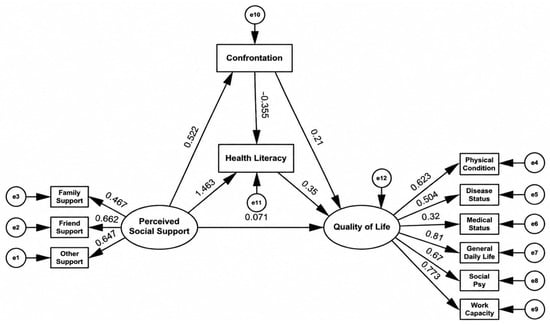
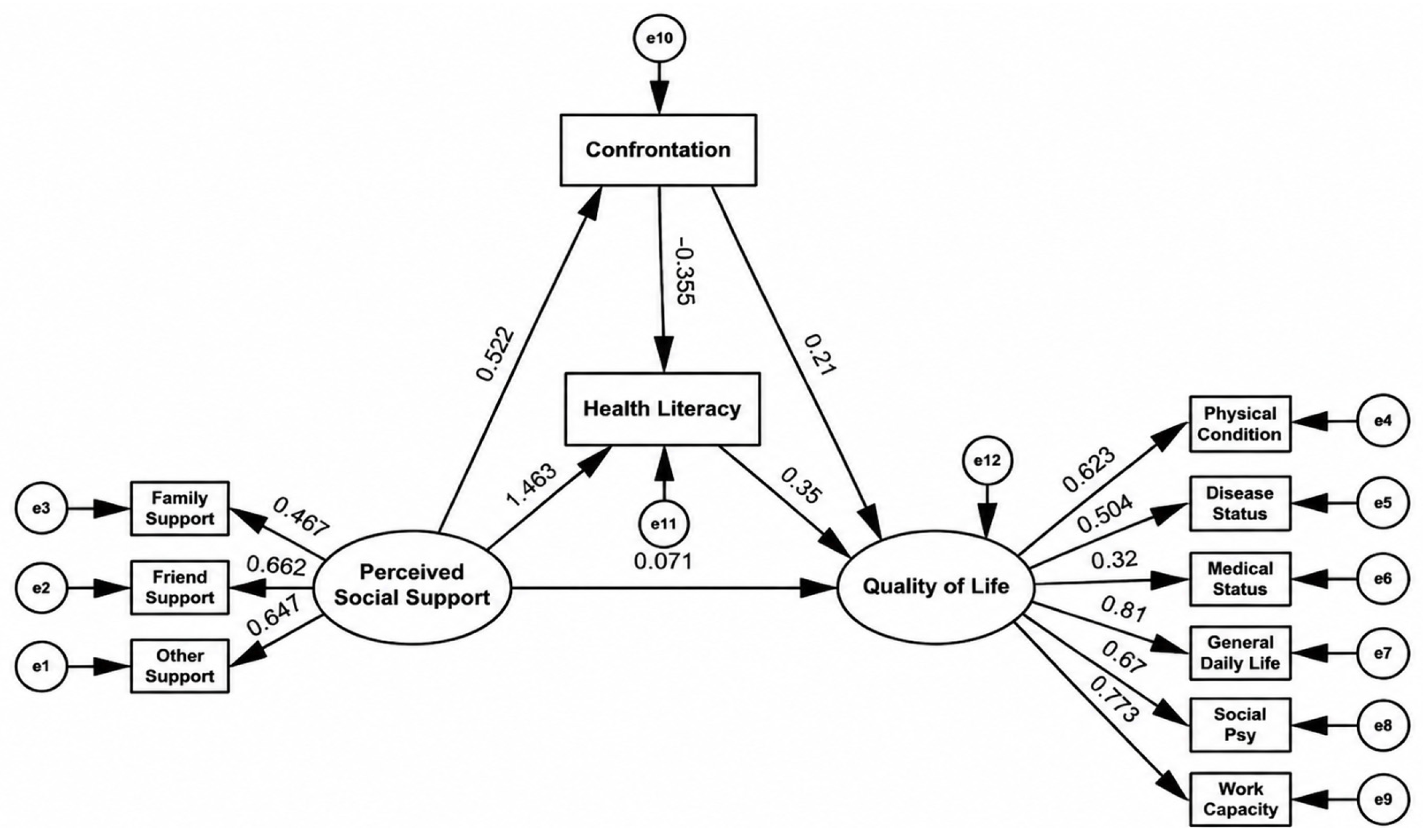
Based on the Stress and Coping Theory, a structural equation model was constructed with the confrontation dimension of medical coping and health literacy as sequential mediating variables, perceived social support as the independent variable, and quality of life as the dependent variable. Following the adjustments made to the model, the indices indicating goodness-of-fit were as follows: χ2/df = 3.127, NFI = 0.959 (>0.900), IFI = 0.972 (>0.900), TLI = 0.948 (>0.900), and RMSEA = 0.078 (<0.080). Each of these indices satisfied the suggested thresholds, signifying a strong fit for the model, as depicted in Figure 1.
Figure 1.
Chain Mediation Model of Medical Coping Dimensions and Health Literacy in Perceived Social Support and Quality of Life.
3.6. Significance Test for Chain Mediation Effects
Bootstrapping analysis with 5000 resamples was performed to examine the significance of the mediation effects, and 95% confidence intervals (95% CIs) were calculated. A mediation effect was considered statistically significant when the 95% CI did not include zero. The results showed that the mediation effect of perceived social support on quality of life through the confrontation dimension of medical coping was 0.109 (95% CI: 0.052–0.174), accounting for 17.38% of the total effect, indicating a significant mediating role. The indirect effect through health literacy was 0.511 (95% CI: 0.191–0.873), accounting for 81.50% of the total effect, also indicating a significant mediating effect. The chain mediation pathway (perceived social support → confrontation coping → health literacy → quality of life) was −0.065 (95% CI: −0.236 to −0.015), indicating a significant serial mediation effect with a suppression effect. According to mediation effect theory, when the indirect effect has an opposite sign to the direct effect, a suppression effect is indicated. In this study, the direct effect was positive (β = 0.071), while the chain indirect effect was negative (β = −0.065), suggesting a suppression effect in this pathway. This finding indicates that confrontation coping and health literacy may partially suppress the positive association between perceived social support and quality of life, as shown in Table 5.
Table 5.
The Mediating Role of Health Literacy and Medical Coping Dimensions in the Relationship Between Perceived Social Support and Quality of Life.
4. Discussion
Coronary heart disease may be associated with cerebral small vessel lesions, which may contribute to ischemic changes and neuronal apoptosis, thereby potentially affecting cognitive function. Cognitive impairment and lower educational attainment may limit patients’ ability to understand and appropriately interpret supportive information from others. In addition, older age and lower educational level may restrict the postoperative social participation of older adults, which may in turn influence treatment adherence and their willingness to seek medical information 18. The present study showed that both perceived social support and quality of life were lower than normative levels [23,24], and the score of the confrontation dimension of medical coping (18.40 ± 3.58) was lower than that reported in previous studies [11]. We interpret these findings as reflecting the relatively vulnerable psychosocial and clinical status of the study population. Specifically, a large proportion of participants had low educational attainment, multiple chronic conditions, impaired cardiac function, and moderate to severe coronary artery disease, which may collectively weaken their coping capacity and psychosocial adaptation. The total health literacy score (76.69 ± 19.12) was comparable to that reported by Brørs [25] (76.3 ± 15.6), indicating a generally low level of health literacy. These findings suggest that older adults after PCI may still face challenges in acquiring and applying health-related knowledge, which may not be conducive to optimal recovery and improvement in quality of life.
It is important to clarify that hierarchical regression analysis and structural equation modeling were used for different analytical purposes in this study. The hierarchical regression model was primarily applied to assess multicollinearity and overall model stability (VIF < 5, significant F-test, and acceptable R2 values), rather than to evaluate mediation pathways [26]. In contrast, structural equation modeling was used to test the hypothesized theoretical framework, in which health literacy functions as a mediating variable rather than an independent predictor of quality of life. Therefore, the apparent differences in statistical significance between regression and SEM results reflect differences in analytical objectives rather than inconsistencies in the data.
In this study, the quality of life in older adults with coronary heart disease was assessed across multiple dimensions, including physical condition, disease status, medical condition, diet and sleep, psychological state, and interpersonal relationships. Cardiac function status and participation in cardiac rehabilitation were also considered important components. The main objective symptoms included angina pectoris, palpitations, and dyspnea, while psychosocial assessment mainly involved negative emotions, cognitive function, and social relationships. Perceived social support reflects patients’ subjective perception of external support and is closely related to psychosocial adaptation in older adults with chronic diseases. The results showed that perceived social support was positively associated with quality of life (r = 0.401, p < 0.01), suggesting that adults with higher levels of perceived support tend to report better overall health status and psychosocial well-being. This finding is consistent with previous studies [27,28]. We interpret this association as reflecting a buffering role of social support in reducing psychological stress and enhancing coping resources, which may be particularly relevant in older adults after PCI and may contribute to better psychological adaptation and quality of life [29].Based on these findings, improving patients’ perceived social support may be beneficial for postoperative recovery. Evidence has shown that cardiac rehabilitation programs may improve quality of life and psychosocial outcomes in patients with coronary heart disease [30]. For patients with limited mobility, hybrid rehabilitation models, including home-based cardiac rehabilitation and mobile health–supported interventions, may offer additional benefits by improving accessibility and enhancing self-management ability [31,32]. Therefore, healthcare professionals may consider integrating structured cardiac rehabilitation programs with psychological support interventions to support comprehensive postoperative recovery in older adults after PCI.
The mediating effect of the confrontation dimension of medical coping in the relationship between perceived social support and quality of life was 0.109, accounting for 17.38% of the total effect. Health literacy also demonstrated a partial mediating effect, with an effect size of 0.511, accounting for 81.50% of the total effect. These findings suggest that higher levels of perceived social support are associated with better quality of life, and that both coping strategies and health literacy may serve as important pathways linking psychosocial resources to health outcomes in older adults after PCI. As an important stress-coping resource, perceived social support may provide psychological energy and facilitate adaptation to disease-related stress, thereby contributing to improved quality of life [33]. Higher levels of perceived social support may help alleviate negative emotions and encourage patients to adopt more positive coping strategies [34], promoting a more adaptive attitude toward disease management [35]. In addition, health literacy appears to be a key pathway in this process, accounting for a substantial proportion of the total effect. It reflects patients’ ability to access, understand, and apply health-related information, and higher perceived social support may enhance these abilities by facilitating information exchange and the utilization of available support resources [14,36]. Therefore, strengthening perceived social support may be beneficial for promoting postoperative recovery and supporting cardiac rehabilitation in older adults with coronary heart disease.
Mediation analysis indicated that the confrontation dimension of medical coping and health literacy jointly formed a significant serial mediation pathway between perceived social support and quality of life. The indirect effect of the chain mediation was negative (β = −0.065), whereas the direct effect remained positive (β = 0.071), suggesting a suppression effect [37,38]. This pattern reflects a statistical phenomenon in which the inclusion of mediators alters the magnitude and direction of the total relationship due to the coexistence of opposing indirect pathways. Specifically, the suppression effect indicates that the total influence of perceived social support on quality of life is composed of both positive direct effects and negative indirect components through sequential mediation. Therefore, the observed suppression should be interpreted as a structural feature of the model rather than a causal contradiction. These findings suggest that the relationship among psychosocial resources, coping processes, and health literacy is complex and may not operate in a strictly additive manner. Further studies are needed to confirm the stability of this pathway in different populations.
This study has several limitations. First, only the confrontation dimension of the Medical Coping Modes Questionnaire was included based on a theoretical focus on problem-focused coping within the Stress–Appraisal–Coping framework. The exclusion of avoidance and acceptance–resignation dimensions may limit the comprehensiveness of coping assessment. Second, the cross-sectional design limits causal inference. Future multicenter longitudinal studies are needed to further validate these findings.
5. Conclusions
Perceived social support and quality of life among older adults with coronary heart disease undergoing PCI remain suboptimal. This study showed that perceived social support directly influences quality of life and also exerts indirect effects through the confrontation dimension of medical coping and health literacy. These findings highlight the need for healthcare professionals to strengthen patients’ perceived social support, promote positive coping during postoperative rehabilitation, and enhance health literacy to improve quality of life.
Author Contributions
Conceptualization, H.S. methodology, J.W. and Z.S.; validation, M.S., J.W., Z.S., F.S., X.F. and H.S.; formal analysis, M.S.; investigation, M.S. and F.S.; data curation, M.S. and F.S.; writing—original draft preparation, M.S.; writing—review and editing, J.W., Z.S., X.F. and H.S.; supervision, H.S.; project administration, H.S.; funding acquisition, H.S. All authors have read and agreed to the published version of the manuscript.
Funding
This research was funded by Key Project of Anhui Provincial Health Commission (2024Aa10044); Young Talent Project of Anhui Medical University (Hlqm12025109).
Institutional Review Board Statement
This study was approved by the Ethics Committee of Chaohu Hospital Affiliated to Anhui Medical University (Approval No.: KYXM-202407-010, Approval date: 26 July 2024).
Informed Consent Statement
Informed consent was obtained from all subjects involved in the study.
Data Availability Statement
The data presented in this study are available from the corresponding author upon reasonable request. The data are not publicly available due to privacy and ethical restrictions.
Public Involvement Statement
No public involvement in any aspect of this research.
Guidelines and Standards Statement
This manuscript was drafted in accordance with the STROBE Statement (Appendix A) for cross-sectional research.
Use of Artificial Intelligence
ChatGPT (OpenAI, GPT-5.3-mini model) was used for English language editing assistance. The authors take full responsibility for the content, including data analysis and interpretation.
Conflicts of Interest
The authors declare no conflicts of interest.
Appendix A
Table A1.
STROBE Statement—Checklist of items that should be included in reports of cross-sectional studies.
References
- Wu, H.; Wang, Y.; Zhang, H.; Yin, X.; Wang, L.; Wang, L.; Wu, J. An investigation into the health status of the elderly population in China and the obstacles to achieving healthy aging. Sci. Rep. 2024, 14, 31123. [Google Scholar] [CrossRef] [Scilit] [PubMed]
- Martin, S.S.; Aday, A.W.; Almarzooq, Z.I.; Anderson, C.A.; Arora, P.; Avery, C.L.; Baker-Smith, C.M.; Barone Gibbs, B.; Beaton, A.Z.; Boehme, A.K.; et al. 2024 heart disease and stroke statistics: A report of us and global data from the american heart association. Circulation 2024, 149, e347–e913. [Google Scholar] [CrossRef] [Scilit] [PubMed]
- Chai, Z.; Fan, Y.; Gong, X.; Zhang, Y.; Hu, Y.; Li, X.; Fan, Z.; Han, Y. Adherence to phase I cardiac rehabilitation in post-PCI patients: A latent class analysis. Front. Cardiovasc. Med. 2025, 12, 1460855. [Google Scholar] [CrossRef] [Scilit] [PubMed]
- Van Nguyen, H.; Khuong, L.Q.; Nguyen, A.T.; Nguyen, A.L.T.; Nguyen, C.T.; Nguyen, H.T.T.; Tran, T.T.H.; Dao, A.T.M.; Gilmour, S.; Van Hoang, M. Changes in, and predictors of, quality of life among patients with unstable angina after percutaneous coronary intervention. J. Eval. Clin. Pract. 2021, 27, 325–332. [Google Scholar] [PubMed]
- Frøjd, L.A.; Munkhaugen, J.; Papageorgiou, C.; Sverre, E.; Moum, T.; Dammen, T. Predictors of health-related quality of life in outpatients with coronary heart disease. Front. Psychol. 2023, 14, 1119093. [Google Scholar] [CrossRef] [Scilit] [PubMed]
- Fan, Y.; Shen, B.J.; Ho, M.R. Loneliness, perceived social support, and their changes predict medical adherence over 12 months among patients with coronary heart disease. Br. J. Health Psychol. 2024, 29, 814–832. [Google Scholar] [CrossRef] [Scilit] [PubMed]
- Shu, P.; Xuan, L.; Jiang, X. Discharge readiness and associated factors among patients with coronary heart disease after stent implantation: A cross-sectional single center study. Patient Prefer. Adherence 2024, 18, 1373–1383. [Google Scholar] [CrossRef] [Scilit] [PubMed]
- Kähkönen, O.; Paukkonen, L.; Vähänikkilä, H.; Oikarinen, A. Perceived social support among percutaneous coronary intervention patients over a long-term follow-up period. Nurs. Open 2024, 11, e2087. [Google Scholar] [PubMed]
- Wakim, M.L.; Al Haddad, C.; Haddad, C.; Mouawad, M.; Hachem, D. The relationship between perceived social support and quality of life among hospitalized patients with schizophrenia. Sci. Rep. 2025, 15, 36039. [Google Scholar] [CrossRef] [Scilit] [PubMed]
- Quiroz, Y.T.; Aguillón, D.; Arboleda-Velasquez, J.; Bocanegra, Y.; Cardona-Gómez, G.P.; Corrada, M.M.; Diez, I.; Garcia-Cifuentes, E.; Kosik, K.; Martinez, L.; et al. Driving research on successful aging and neuroprotection in Latin America: Insights from the inaugural symposium on brain resilience and healthy longevity. Alzheimers Dement. 2025, 21, e70037. [Google Scholar] [CrossRef] [Scilit] [PubMed]
- Liang, L.X.; Liu, Y.; Shi, Y.J.; Jiang, T.T.; Zhang, H.R.; Liu, B.H.; Xu, P.Z.; Shi, T.Y. Family care and subjective well-being of coronary heart disease patients after percutaneous coronary intervention: Mediating effects of coping strategies. Int. J. Nurs. Sci. 2022, 9, 79–85. [Google Scholar] [PubMed]
- Moon, S.H.; Jeong, H.W.; Jung, U.S. Exploring the impact of the mentoring new nurses for transition and empowerment program led by clinical nurse educators in South Korea: A mixed-methods study. Nurse Educ. Today 2024, 140, 106251. [Google Scholar] [CrossRef] [Scilit] [PubMed]
- Meraz, R.; Osteen, K.; McGee, J.S.; Noblitt, P.; Viejo, H. Applying stress and coping theory to understand diuretic adherence experiences in persons with heart failure. West. J. Nurs. Res. 2023, 45, 67–77. [Google Scholar] [PubMed]
- Baker, D.W. The meaning and the measure of health literacy. J. Gen. Intern. Med. 2006, 21, 878–883. [Google Scholar] [CrossRef] [Scilit] [PubMed]
- Liu, W.Q.; Yang, W.L.; Qian, S.Y. The mediating effect of self-efficacy on health literacy and social support in young and middle-aged patients with coronary heart disease after PCI. Vasc. Health Risk Manag. 2023, 19, 341–349. [Google Scholar] [CrossRef] [Scilit] [PubMed]
- Montazeri, A.S.; Azizi, Z.; Ranjbar, L.; Rezaei, S.; Zare, A. Associations between perceived social support, self-efficacy, and health-promoting behaviors in hospitalized heart failure patients: A cross-sectional study. BMC Cardiovasc. Disord. 2026, 26, 201. [Google Scholar] [PubMed]
- Gensini, G.G. A more meaningful scoring system for determining the severity of coronary heart disease. Am. J. Cardiol. 1983, 51, 606. [Google Scholar] [CrossRef] [Scilit] [PubMed]
- Zimet, G.D.; Powell, S.S.; Farley, G.K.; Werkman, S.; Berkoff, K.A. Psychometric characteristics of the multidimensional scale of perceived social support. J. Personal. Assess. 1990, 55, 610–617. [Google Scholar]
- Huang, L.; Jiang, Q.J.; Ren, W.H. Correlation between coping styles, social support and psychosomatic symptoms in cancer patients. Chin. Ment. Health 1996, 4, 160–161. [Google Scholar]
- Feifel, H.; Strack, S.; Nagy, V.T. Coping strategies and associated features of medically ill patients. Psychosom. Med. 1987, 49, 616–625. [Google Scholar] [CrossRef] [Scilit] [PubMed]
- Shen, X.H.; Jiang, Q.J. Test report on the Chinese version of the Medical Coping Modes Questionnaire in 701 patients. Chin. J. Behav. Med. Sci. 2000, 9, 22–24. [Google Scholar]
- Yue, M.; Zhang, L.J.; Lu, Y.Y. Development and validation of a health literacy scale for patients undergoing percutaneous coronary intervention. J. Nurs. Sci. 2023, 38, 46–50. [Google Scholar]
- Liu, J.S.; Ma, C.M.; Tu, L.Z.; Wang, Y.; Zheng, B.R.; Wang, F.J.; Hong, H.S.; Guo, L.; Yin, Z.F.; Li, P.H. Development of the Chinese Cardiovascular Patients’ Quality of Life Questionnaire and establishment of normative data. Chin. J. Cardiovasc. Rehabil. Med. 2012, 21, 105–112. [Google Scholar]
- Ifroh, R.H.; Gai, X.; Rabiautsani, M.A.; Han, X. The social support, healthy lifestyle, subjective well-being, and health-related quality of life among university students. J. Educ. Health Promot. 2024, 13, 427. [Google Scholar] [CrossRef] [Scilit] [PubMed]
- Brørs, G.; Dalen, H.; Allore, H.; Deaton, C.; Fridlund, B.; Norman, C.D.; Palm, P.; Wentzel-Larsen, T.; Norekvål, T.M. The association of electronic health literacy with behavioural and psychological coronary artery disease risk factors in patients after percutaneous coronary intervention: A 12-month follow-up study. Eur. Heart J. Digit. Health 2023, 4, 125–135. [Google Scholar] [CrossRef] [Scilit] [PubMed]
- Hair, J.F.; Black, W.C.; Babin, B.J.; Anderson, R.E. Multivariate Data Analysis, 8th ed.; Cengage: Boston, MA, USA, 2019. [Google Scholar]
- Zhao, J.; Hu, D.; Du, H.; Wang, H.; Tu, X.; Wang, A. Social support and technophobia in older patients with coronary heart disease: The mediating roles of eHealth literacy and healthcare technology self-efficacy. PLoS ONE 2025, 20, e0325202. [Google Scholar] [CrossRef] [Scilit] [PubMed]
- Ding, Y.; Wang, X.; Zhang, F.; Yan, H.; Liu, Y.; Zhang, L. The relationship between perceived social support, coping style, and the quality of life and psychological state of lung cancer patients. BMC Psychol. 2024, 12, 439. [Google Scholar] [CrossRef] [Scilit] [PubMed]
- Lok, N.; Buldukoglu, K.; Barcin, E. Effects of the cognitive stimulation therapy based on Roy’s adaptation model on Alzheimer’s patients’ cognitive functions, coping-adaptation skills, and quality of life: A randomized controlled trial. Perspect. Psychiatr. Care 2020, 56, 581–592. [Google Scholar] [PubMed]
- Moreira, J.; Bravo, J.; Aguiar, P.; Delgado, B.; Raimundo, A.; Boto, P. Physical and mental components of quality of life after a cardiac rehabilitation intervention: A systematic review and meta-analysis. J. Clin. Med. 2024, 13, 5576. [Google Scholar] [CrossRef] [Scilit] [PubMed]
- Candjondjo, P.; Vaz, E.; Marques, S.; Moreira, J. Stemi-cr: Solution for patients with acute myocardial infarction at home-based cardiac rehabilitation program. Procedia Comput. Sci. 2022, 196, 561–565. [Google Scholar]
- Miguel, S.S.; Frade, A.I.; Moreira, J.M. The use of m-health to improve self-care in patients with heart failure. Eur. J. Cardiovasc. Nurs. 2024, 23, e63–e64. [Google Scholar] [PubMed]
- Thapa, A.; Kang, J.; Chung, M.L.; Wu, J.R.; Biddle, M.J.; Cha, G.; Moser, D.K. Self-care, perceived social support, and health-related quality of life in persons with heart failure. Nurs. Res. 2022, 71, 463–471. [Google Scholar]
- Guan, X.; Zhu, Q.; Qian, H. Relationship between post-traumatic stress disorder and fear of progression in stroke patients: The mediating role of perceived social support and coping styles. Top. Stroke Rehabil. 2025, 32, 544–552. [Google Scholar] [PubMed]
- Wang, L.; Zhou, B.; Wang, L. Effect of care bundles based on importance degree analysis on postoperative comorbid state, coping style and disease management ability of patients with coronary heart disease. Medicine 2024, 103, e38320. [Google Scholar] [CrossRef] [Scilit] [PubMed]
- Jennings, C.S.; Astin, F.; Prescott, E.; Hansen, T.; Chris, P.G.; Bacquer, D.D. Illness perceptions and health literacy are strongly associated with health-related quality of life, anxiety, and depression in patients with coronary heart disease: Results from the euroaspire v cross-sectional survey. Eur. J. Cardiovasc. Nurs. 2023, 22, 719–729. [Google Scholar] [PubMed]
- MacKinnon, D.P.; Krull, J.L.; Lockwood, C.M. Equivalence of the mediation, confounding and suppression effect. Prev. Sci. 2000, 1, 173–181. [Google Scholar] [CrossRef] [Scilit] [PubMed]
- Hayes, A.F. Introduction to Mediation, Moderation, and Conditional Process Analysis: A Regression-Based Approach, 2nd ed.; Guilford Press: New York, NY, USA, 2018. [Google Scholar]

Disclaimer/Publisher’s Note: The statements, opinions and data contained in all publications are solely those of the individual author(s) and contributor(s) and not of MDPI and/or the editor(s). MDPI and/or the editor(s) disclaim responsibility for any injury to people or property resulting from any ideas, methods, instructions or products referred to in the content. |
© 2026 by the authors. Licensee MDPI, Basel, Switzerland. This article is an open access article distributed under the terms and conditions of the Creative Commons Attribution (CC BY) license.