


Abstract
Background/Objectives: Personal recovery is an important outcome in mental healthcare. This study evaluated the psychometric properties of the 20-item Recovery Assessment Scale–Short Form in 334 adults receiving inpatient care who were assessed at discharge from four Chilean hospitals. Methods: Confirmatory factor analysis for ordered categorical indicators compared unidimensional, correlated four-factor, and second-order models. Internal consistency, measurement invariance across gender, and associations with perceived family functioning were examined. Results: The unidimensional model showed inadequate fit, whereas the correlated four-factor model showed acceptable-to-good fit (χ2(164) = 448.23; comparative fit index = 0.972; root mean square error of approximation = 0.072; standardised root mean square residual = 0.049). The second-order model also showed acceptable-to-good fit and did not significantly worsen fit relative to the correlated four-factor model (Δχ2(2) = 4.35, p = 0.113). Ordinal McDonald’s omega was 0.958 for the total score and ranged from 0.809 to 0.932 across domains. Although robust difference tests were significant, changes in approximate fit indices were minimal, providing preliminary support for scalar invariance across women and men. Family functioning was positively associated with the total score (r = 0.323) and all four domains, with the strongest association for Connecting and Belonging (r = 0.391). Conclusions: Overall, the scale showed favourable psychometric performance and provided support for both a multidimensional representation and an overall personal recovery score, although the differentiation of some domains and items warrants further investigation. Registration status: This study was not preregistered.
1. Introduction
The World Health Organisation has identified mental health recovery as a priority [1,2], which is in line with the provisions of the United Nations Convention on the Rights of Persons with Disabilities (CRPD) [3]. It is a multifaceted construct that has attracted growing interest in recent years [4,5] and is highly complex [6]. When recovery is approached primarily from a biomedical perspective, emphasis is placed on the alleviation of symptoms, functioning, and other clinical outcomes associated with the disorder [1,5]. Although these outcomes remain important, they may not fully capture service users’ own goals, experiences, and perspectives on progress in recovery [1,4]. Assessment may also be shaped by practical constraints such as limited time and trained staff [7], an emphasis on indicators such as readmission rates [8], and limitations in available recovery measures and their psychometric properties [1,9]. Personal recovery approaches therefore emphasise complementing clinician-defined outcomes with the perspectives and priorities of service users [1,8].
Measuring personal recovery provides valuable and meaningful information for individuals and the teams caring for them by focusing on life goals [10], within a context of hope despite ongoing symptoms [2,11]. This approach can enrich the assessment process and strengthen the therapeutic relationship by suggesting areas for discussion and facilitating shared goal setting [12], whilst incorporating cultural norms [13], social expectations, and community interactions [14]. Family members may also contribute to recovery through interpersonal connection and support [15]. Conventional clinical outcomes such as symptom reduction remain important but may capture different aspects of recovery and therefore benefit from being complemented by measures addressing individuals’ goals, hope, relationships, and participation in their recovery process [1,8]. This broader perspective has also contributed to a re-evaluation of recovery beyond conventional symptom-focused outcomes [16,17].
The CHIME framework [9,18] conceptualises personal recovery through five interrelated processes: Connectedness, Hope and optimism for the future, Identity, Meaning in life, and Empowerment [1]. Rather than implying that service users have sole control over treatment, recovery-oriented care places greater emphasis on agency, participation, and collaboration in decisions about care [4]. Intervention approaches incorporating these principles may support coping [10], social support [19], and participation in activities that are meaningful to individuals [2,18], without requiring the complete elimination of symptoms [4,9,16]. Recovery goals are shaped by individuals’ own priorities [2] and life trajectories [5]. Viewing recovery as an individual and often non-linear ‘journey’ [5,20] highlights processes such as empowerment and resilience [5], while recognising that progress may fluctuate over time. This perspective also emphasises autonomy and regaining control over one’s life [19,21], functioning and social reintegration [8,16], and the need to address stigma as an important barrier to recovery [20], given its potential to distance individuals from wider society [5,16]. From a nursing perspective, Barker’s Tidal Model [22] similarly emphasises person-centred collaboration, therapeutic relationships [20,23], and the use of each person’s own narrative and lived experience to inform care [7]. Measures of personal recovery differ in their conceptual foundations, intended populations, and domains assessed [1]. Correspondence with CHIME may be useful for describing the content covered by a measure [1,18]; however, in the present study it was not treated as a psychometric criterion.
Recovery can be assessed using scales that measure the components of recovery and others that describe the steps involved in its development. A pioneering tool for measuring recovery is the 24-item Recovery Assessment Scale (RAS-24) [24]. This self-report measure comprises five dimensions of recovery, described as personal confidence and hope, willingness to seek help, goal orientation and success, dependence on others, and freedom from symptom dominance. Originally developed for people with psychosis, the RAS-24 has shown favourable measurement properties, including evidence of content validity [1]. However, the overall quality of the available evidence regarding some of its measurement properties remains limited, and the instrument may not fully capture components associated with later stages of the recovery process [1].
Subsequently, in 2007, the Self-Identified Stage of Recovery (SISR) was published [25]. This brief, self-administered scale assesses both the stage of recovery (SISR-A) and the components of the personal recovery process (SISR-B). A Spanish-language version of the SISR has shown favourable evidence of validity and reliability [25].
The Recovery Assessment Scale–Domains and Stages (RAS-DS) [26], a 38-item self-report scale based on Corrigan’s RAS [24], assesses four dimensions described as ‘doing things I value’, ‘looking ahead’, ‘managing my illness’, and ‘connecting and belonging’. It meets the criteria for structural validity, internal consistency, and convergent validity, with high-quality evidence [1]. In terms of content, it demonstrates good relevance and comprehensiveness, covering all CHIME processes, with an emphasis on post-recovery stages [1].
The 20-item Recovery Assessment Scale–Short Form (RAS-SF) was subsequently developed from the RAS-DS in a sample of adults with anxiety and related disorders [27]. The short form retains five items from each of the four RAS-DS domains and demonstrated a four-factor structure, high internal consistency, and strong correspondence with the full-length domain scores [27]. However, evidence for the RAS-SF remains limited beyond the population and cultural context in which it was developed. Although other versions of the RAS have been examined in Spanish-speaking Latin American populations, including Argentina [28], these findings do not constitute a validation of the RAS-SF. To our knowledge, the psychometric performance of the RAS-SF has not been evaluated among Chilean mental health service users.
Because the RAS-SF was developed with a prespecified four-domain structure derived from the RAS-DS [27], the present psychometric evaluation focused on testing this published measurement structure rather than examining item correspondence with the CHIME framework. Perceived family functioning was included as a theoretically relevant external variable, based on the interpersonal and relational components of personal recovery [15].
Therefore, the present study aimed to examine its internal structure and internal consistency in a Chilean inpatient psychiatric sample, together with its associations with perceived family functioning. Measurement invariance across women and men was additionally examined as a secondary analysis.
2. Materials and Methods
2.1. Study Design and Settings
This multicentre, cross-sectional psychometric study was conducted in four hospitals in Santiago, Chile, three of which belong to the public health system. Reporting followed the Strengthening the Reporting of Observational Studies in Epidemiology (STROBE) guidelines. Data were collected between 2022 and 2025. The recruitment period was determined by the timing of ethical approvals and institutional authorizations at each participating hospital. Consequently, data collection was initiated sequentially across sites, with some overlapping recruitment periods. Eligible service users were recruited consecutively as they approached discharge, using non-probability consecutive sampling.
2.2. Participants
The sample comprised adults receiving inpatient psychiatric care. Eligibility criteria were (a) age ≥ 18 years; (b) Chilean nationality; (c) discharge from the inpatient psychiatric unit; (d) ability to read and write; and (e) no communication or cognitive difficulties precluding questionnaire completion. Participants were excluded if, at the time of assessment, they were experiencing an acute psychiatric condition that could compromise their ability to provide informed consent or safely complete the questionnaire. These conditions included an active suicidal crisis, characterised by current suicidal ideation or planning, or clinical instability following a recent suicide attempt, as well as psychomotor agitation, alcohol or drug intoxication or withdrawal, acute anxiety, or stupor. The assessment of suicide-related clinical instability was based on the participant’s condition at the time of evaluation rather than on a predefined time interval since a previous suicide attempt.
2.3. Sample Size Adequacy
The available sample size was determined by the number of eligible participants consecutively recruited during the study period. As a post hoc sensitivity analysis, the performance of the prespecified ordinal CFA at the obtained sample size (N = 334) was evaluated using a Monte Carlo simulation following Muthén and Muthén [29]. The population model reproduced the correlated four-factor RAS-SF structure reported by De Silva et al. [27], comprising 20 four-category ordinal indicators, with five indicators per factor. Standardised population factor loadings ranged from 0.47 to 0.88 and latent factor correlations from 0.44 to 0.76. Item-specific thresholds were calibrated from the observed response distributions using a Jeffreys correction (+0.5 per response category) and ranged from −2.96 to 0.80 on the probit scale. The simulated data were analysed using WLSMV estimation with theta parameterisation, consistent with the empirical CFA. Across 2000 replications, convergence was 100%, relative parameter bias was negligible (−0.19% to 0.56%), 95% confidence interval coverage ranged from 0.914 to 0.944, and power was 1.00 for all factor loadings. Absolute relative standard error bias ranged from 2.25% to 7.65%, with 17 of the 20 loadings remaining within the 5% criterion. Overall, the simulation indicated stable estimation and accurate recovery of the prespecified CFA parameters at N = 334, with only modest underestimation of standard errors for a small subset of loadings.
2.4. Instruments
- Sociodemographic and clinical questionnaire
A study-specific questionnaire assessed age, gender, occupational status, health insurance, residence, household income, ethnic background, religion, household composition, hospitalisation length, and primary diagnosis. Household income was recorded in predefined Chilean-peso categories.
- 2.
- Recovery Assessment Scale-Short Form (RAS-SF)
The 20-item Recovery Assessment Scale–Short Form (RAS-SF), derived from the 38-item Recovery Assessment Scale–Domains and Stages (RAS-DS), comprises four five-item domains: Doing Things I Value, Looking Forward, Mastering My Illness, and Connecting and Belonging [27,30]. Items are rated from 1 (Untrue) to 4 (Completely true), with higher scores indicating greater personal recovery. The Chilean Spanish version of the RAS-DS was developed with authorization from the original instrument author. Translation and back-translation were conducted by two independent translators. No formal expert-panel review or cognitive interviewing was undertaken. The resulting Spanish version is available through the official RAS-DS resource centre [31]. For the present study, the 20 items corresponding to the RAS-SF were selected according to the item configuration established by De Silva et al. [27].
For scale-score analyses, available item responses were averaged within domains and across all items, divided by 4, and multiplied by 100, yielding scores ranging from 25 to 100 [32]. This linear transformation follows the RAS-DS scoring convention and facilitates interpretation of domain and total scores on a common metric; it does not alter the relative ordering or spacing of scores. The transformation was used only for descriptive and scale-score analyses, whereas confirmatory factor analyses were conducted using the original four-category item responses.
- 3.
- Family APGAR
The Family APGAR [33] is a five-item self-report measure assessing perceived family functioning. Items are rated from 0 (hardly ever) to 2 (almost always), yielding a total score ranging from 0 to 10, with higher scores indicating better perceived family functioning. Previous studies have supported its unidimensional structure and internal consistency in Spanish-speaking populations [34]. In the present sample, the Family APGAR showed good internal consistency (Cronbach’s α = 0.864; ordinal α = 0.921; ordinal ω = 0.921).
2.5. Procedure
Following institutional and ethical approvals, 18 nurses were trained in standardised administration of the study measures. At discharge, eligible participants provided written informed consent and completed the questionnaires electronically on a computer in the unit. Ethical approval was obtained from the Scientific Ethical Committee of Hospital Clínico La Florida (CEC-HLF; 13 May 2021), the Research Ethics Committee of the North Metropolitan Health Service (CEI-SSM; 18 May 2022), the Scientific Ethical Committee of Universidad de Los Andes Clinic (CEC-CUA; 12 September 2022), and the Scientific Ethical Committee of the Southeast Metropolitan Health Service (CEC-SSMSO; 4 May 2023). The study was conducted in accordance with the Declaration of Helsinki and the international ethical guidelines of the Council for International Organisations of Medical Sciences.
2.6. Data Analysis
Item-level response frequencies, missing data, and score distributions were examined before the psychometric analyses; item-level descriptives are reported in Supplementary Table S1. Descriptive statistics were calculated for each RAS-SF domain and the total score.
Internal structure was examined using confirmatory factor analysis (CFA) in Mplus 8.3 [35]. Because the indicators used four ordered categories, models were estimated using robust weighted least squares with mean- and variance-adjusted statistics (WLSMV), theta parameterisation, and a probit link. Missing responses were handled using Mplus pairwise-present information for categorical outcomes. Item 16 had 13 missing responses (3.9%) because the mandatory-response option had not been activated for this item in the electronic questionnaire during part of the data-collection period. All other RAS-SF items were complete. Thus, 321 participants had complete item data, while all 334 contributed available information to the CFA.
Three prespecified models were tested: (a) a unidimensional model; (b) the correlated four-factor RAS-SF model comprising Doing Things I Value, Looking Forward, Mastering My Illness, and Connecting and Belonging; and (c) a second-order model in which the four domains loaded onto a higher-order personal recovery factor.
Model fit was evaluated using χ2, the Comparative Fit Index (CFI), the Tucker–Lewis Index (TLI), the root mean square error of approximation (RMSEA; 90% confidence interval), and the standardised root mean square residual (SRMR). Indices were interpreted jointly rather than using rigid cut-offs; CFI/TLI values of approximately 0.95 or higher and SRMR around 0.08 or lower indicated good fit, while RMSEA below 0.08 was considered acceptable [36]. Because WLSMV χ2 statistics cannot be directly subtracted, the correlated four-factor and second-order models were compared using Mplus DIFFTEST. Standardised loadings, factor correlations, residuals, and modification indices were inspected. Data-driven residual covariances were examined only in post hoc sensitivity analyses.
Internal consistency was assessed using conventional Cronbach’s alpha, ordinal alpha, and ordinal McDonald’s omega. Ordinal coefficients were estimated from polychoric correlations. Conventional RAS-SF alpha was calculated using complete cases for each score: n = 321 for Looking Forward and the total score because of the missing responses on Item 16, and n = 334 for the remaining domains. Ordinal omega was the primary reliability estimate, while conventional alpha was retained to facilitate comparison with previous validation studies. The same ordinal reliability approach was applied to the Family APGAR.
Measurement invariance across women and men was examined as a secondary analysis using configural, metric, and scalar models for ordered categorical indicators. Nine participants reporting another gender were retained in total-sample analyses but excluded from multigroup analyses because of the small group size. Because one response category for Item 5 was endorsed by only one participant, the two lowest response categories were collapsed for invariance analyses only. Metric models constrained factor loadings to equality and scalar models additionally constrained thresholds. Models were compared using DIFFTEST and changes in approximate fit indices; ΔCFI ≤ 0.010, ΔRMSEA ≤ 0.015, and ΔSRMR ≤ 0.030 for metric and ≤0.010 for scalar invariance were considered compatible with invariance [37]. Measurement invariance was examined across women and men because these groups provided sufficient sample sizes for multigroup analysis. Diagnostic-group invariance was not examined because the sample was distributed across several heterogeneous diagnostic categories, resulting in substantially smaller group sizes that were not considered adequate for stable multigroup estimation of the ordinal CFA model.
Associations between RAS-SF and Family APGAR scores were examined as evidence of relationships with a theoretically relevant external variable rather than as criterion validity. Pearson correlations were used as the primary analysis. Spearman correlations were conducted as sensitivity analyses because of upper-category concentration and are reported in the Supplementary Material. All tests were two-tailed, with α = 0.05.
The study and statistical analysis plan were not preregistered.
3. Results
The primary analyses included 334 participants. The largest age groups were 18–25 (35.9%), 26–35 (26.0%), and 36–45 years (21.3%). Women comprised 53.9% of the sample, men 43.4%, and participants of another gender 2.7%. Participants were most commonly salaried employees (26.9%), students (21.0%), unemployed (18.3%), or self-employed (14.7%); 94.9% resided in the Santiago Metropolitan Region. Most had public health coverage, and 38.0% lived with one or both parents. Household income was most commonly CLP 300,001–600,000 (34.1%); 91.0% reported no specific ethnic affiliation, and 43.7% reported no religion. The mean length of hospitalisation was 25.37 days (SD = 20.87; median = 18.50; range = 2–150). The most frequent diagnoses were mood disorders (33.8%), substance use disorders (19.5%), psychotic disorders (13.5%), anxiety disorders (8.7%), and personality disorders (7.5%).
Complete responses were available for all RAS-SF indicators except Item 16, which had 13 missing responses (3.9%). Item-level responses showed a general concentration in the upper response categories (Supplementary Table S1). Looking Forward had the highest mean score (M = 86.64, SD = 15.73), followed by Doing Things I Value (M = 85.27, SD = 17.05), Mastering My Illness (M = 82.87, SD = 16.40), and Connecting and Belonging (M = 77.87, SD = 15.99). The mean total score was 83.17 (SD = 13.87). The maximum possible score was observed in 28.4% of participants for Doing Things I Value, 27.8% for Looking Forward, 21.6% for Mastering My Illness, 10.5% for Connecting and Belonging, and 4.5% for the total score (Supplementary Table S2). Descriptive statistics, reliability estimates, and associations with family functioning are presented in Table 1.
Table 1.
Descriptive Statistics, Reliability, and Associations with Family Functioning.
3.1. Confirmatory Factor Analysis
The unidimensional model did not provide an adequate representation of the data, χ2(170) = 900.98, p < 0.001, CFI = 0.929, TLI = 0.920, RMSEA = 0.113, 90% CI [0.106, 0.121], and SRMR = 0.076. In contrast, the prespecified correlated four-factor model showed acceptable-to-good fit, χ2(164) = 448.23, p < 0.001, CFI = 0.972, TLI = 0.968, RMSEA = 0.072, 90% CI [0.064, 0.080], and SRMR = 0.049 (Table 2).
Table 2.
Fit Indices for the RAS-SF Confirmatory Factor Models.
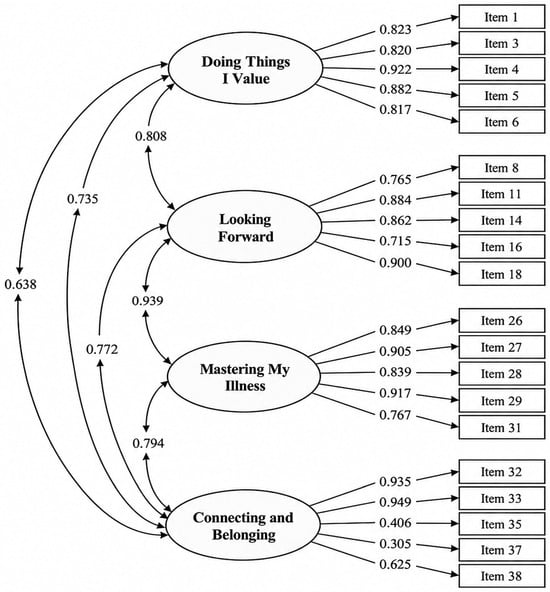
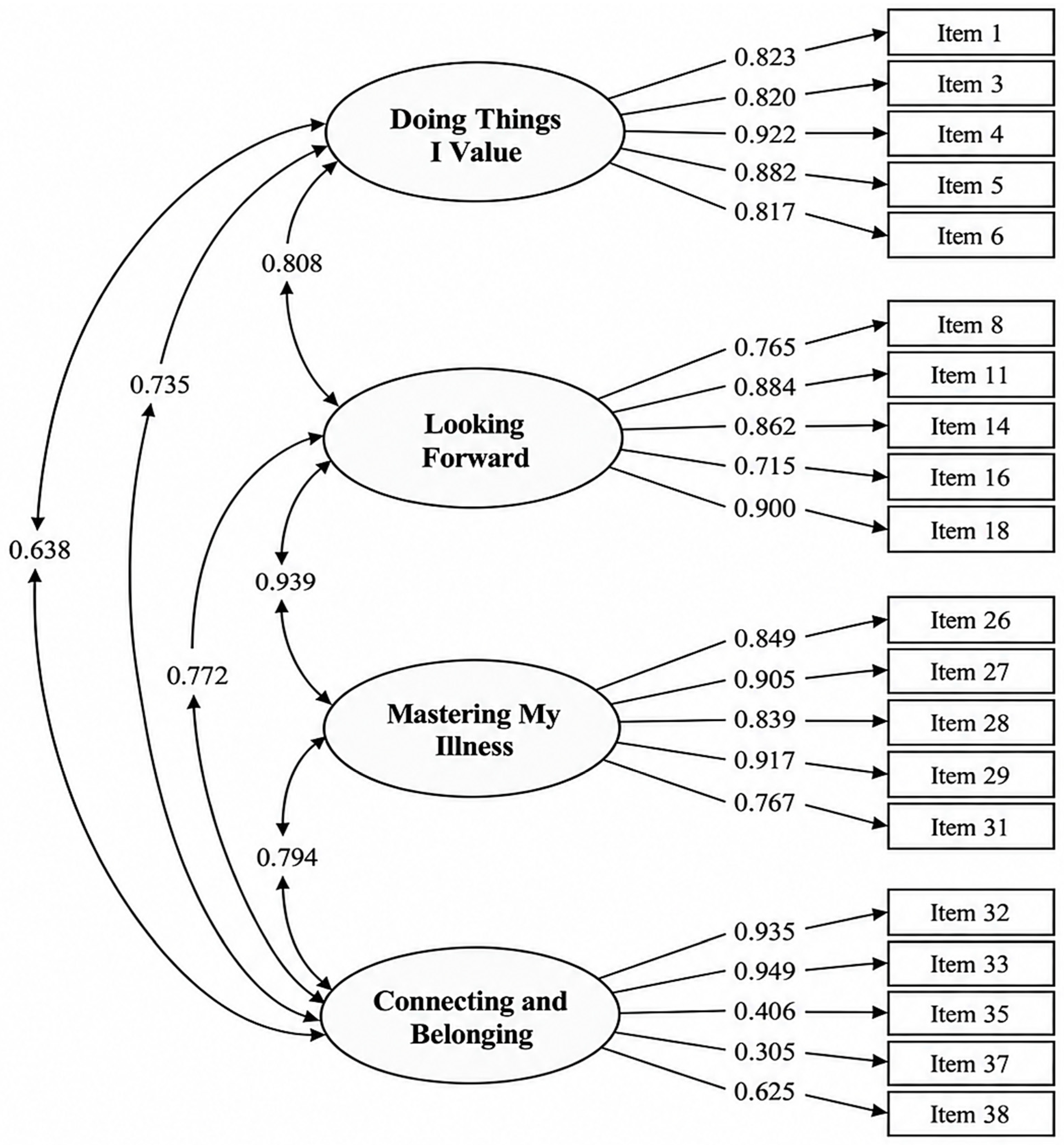
All standardised factor loadings were positive and statistically significant (p < 0.001; Figure 1). Loadings were moderate to high for Doing Things I Value (0.817–0.922), Looking Forward (0.715–0.900), and Mastering My Illness (0.767–0.917). Greater heterogeneity was observed for Connecting and Belonging: Items 32 and 33 showed high loadings (0.935 and 0.949), Item 38 a moderate loading (0.625), and Items 35 and 37 comparatively low loadings (0.406 and 0.305).
Figure 1.
Standardised correlated four-factor model of the RAS-SF in the Chilean clinical sample. Note: Values are completely standardised (STDYX) estimates obtained using WLSMV with theta parameterisation. All factor loadings were statistically significant at p < 0.001.
Correlations among the four first-order factors were positive and substantial, ranging from 0.638 to 0.939 (Figure 1). The strongest association was observed between Looking Forward and Mastering My Illness (r = 0.939), indicating substantial overlap between these domains and providing a rationale for examining a higher-order personal recovery factor.
The second-order model also showed acceptable-to-good fit, χ2(166) = 423.87, p < 0.001, CFI = 0.975, TLI = 0.971, RMSEA = 0.068, 90% CI [0.060, 0.076], and SRMR = 0.050. The DIFFTEST indicated that imposing the second-order structure did not significantly worsen model fit relative to the correlated four-factor model, Δχ2(2) = 4.35, p = 0.113.
All four first-order domains loaded strongly on the higher-order personal recovery factor: Doing Things I Value, λ = 0.795; Looking Forward, λ = 0.990; Mastering My Illness, λ = 0.949; and Connecting and Belonging, λ = 0.808. These loadings corresponded to explained variances of 63.2%, 98.0%, 90.1%, and 65.3%, respectively. However, the residual variance of Looking Forward was small and non-significant, indicating that this domain accounted for little variance beyond the general recovery factor. The standardised second-order model is presented in Supplementary Figure S1.
Overall, the correlated four-factor model was consistent with the multidimensional structure originally proposed for the RAS-SF. The second-order model was also compatible with the data, providing preliminary support for a higher-order personal recovery construct and suggesting that an overall score may be interpretable alongside domain-specific scores. Nevertheless, the near-unity loading of Looking Forward and its limited residual specificity indicate that this domain, particularly its distinction from Mastering My Illness, should be interpreted cautiously.
3.2. Local Dependence: Sensitivity Analysis
Inspection of modification indices identified evidence of local dependence between Items 35 and 37. Allowing their residuals to correlate significantly improved fit in both the correlated four-factor model, Δχ2(1) = 25.65, p < 0.001, and the second-order model, Δχ2(1) = 25.66, p < 0.001. Because this modification was identified after inspection of the data and requires independent substantive justification, the models without correlated residuals were retained as the primary models. The modified models were therefore interpreted only as sensitivity analyses.
3.3. Internal Consistency
Conventional and ordinal reliability estimates are presented in Table 1. Using complete cases for each score, conventional Cronbach’s alpha was 0.870 for the total score (n = 321) and ranged from 0.688 to 0.900 across domains; Looking Forward was also based on n = 321 (α = 0.792), whereas the other domain estimates used n = 334. Ordinal reliability estimates were consistently higher. Ordinal omega was 0.921 for Doing Things I Value, 0.916 for Looking Forward, 0.932 for Mastering My Illness, 0.809 for Connecting and Belonging, and 0.958 for the total score.
The results indicated strong internal consistency for the total score and for Doing Things I Value, Looking Forward, and Mastering My Illness. Connecting and Belonging showed lower reliability than the remaining domains, consistent with the greater heterogeneity of its item loadings. Nevertheless, its ordinal omega remained above 0.80.
The Family APGAR also showed good internal consistency, with conventional Cronbach’s α = 0.864 and both ordinal α and ordinal ω = 0.921.
3.4. Measurement Invariance Across Gender: Secondary Analysis
Measurement invariance was examined among 325 participants who identified as women (n = 180) or men (n = 145). The configural model showed acceptable fit, χ2(328) = 615.03, p < 0.001, CFI = 0.974, TLI = 0.969, RMSEA = 0.073, 90% CI [0.064, 0.082], and SRMR = 0.058. The metric model also showed acceptable fit, χ2(344) = 634.66, p < 0.001, CFI = 0.973, TLI = 0.971, RMSEA = 0.072, 90% CI [0.063, 0.081], and SRMR = 0.059. The scalar model showed similarly acceptable fit, χ2(378) = 664.43, p < 0.001, CFI = 0.974, TLI = 0.974, RMSEA = 0.068, 90% CI [0.060, 0.077], and SRMR = 0.061 (Supplementary Table S3).
Robust chi-square difference tests were statistically significant for the metric versus configural comparison, Δχ2(16) = 27.83, p = 0.033, and for the scalar versus metric comparison, Δχ2(34) = 50.98, p = 0.031. However, changes in the approximate fit indices were minimal. From the configural to the metric model, ΔCFI = −0.001, ΔRMSEA = −0.001, and ΔSRMR = 0.001; from the metric to the scalar model, ΔCFI = 0.001, ΔRMSEA = −0.004, and ΔSRMR = 0.002. Although these changes were within commonly used practical criteria for invariance, both robust DIFFTEST comparisons were statistically significant. Accordingly, the findings were interpreted as providing preliminary rather than definitive evidence of scalar invariance. The collapse of the two lowest response categories for one sparsely endorsed item further warrants caution. Because participants reporting another gender could not be included in the multigroup analysis, these findings should not be generalised beyond women and men included in the analysis.
3.5. Associations with Family Functioning
Family functioning was positively associated with the RAS-SF total score and all four domains. Pearson correlations were 0.199 for Doing Things I Value, 0.264 for Looking Forward, 0.255 for Mastering My Illness, 0.391 for Connecting and Belonging, and 0.323 for the total score, all p-values < 0.001. The strongest association was observed for Connecting and Belonging, consistent with the interpersonal and relational content of this domain.
Spearman correlations showed the same pattern, ranging from 0.277 to 0.396 (Supplementary Table S4), supporting the robustness of the observed associations to non-normality and concentration in the upper response categories. Family functioning should nevertheless be considered a theoretically related external variable rather than an alternative measure of personal recovery.
4. Discussion
To our knowledge, this study provides the first psychometric evaluation of the RAS-SF in a Chilean inpatient psychiatric sample. Overall, the findings were consistent with the correlated four-factor structure proposed by De Silva et al. [27], while also providing preliminary support for representing the four domains through a higher-order personal recovery factor. Internal consistency was adequate to strong, the measurement invariance analyses provided preliminary rather than definitive evidence of scalar invariance across women and men, and recovery scores showed theoretically meaningful positive associations with perceived family functioning.
The evidence supporting the correlated four-factor model is consistent with the structure originally proposed for the RAS-SF by De Silva et al. [27], in which five items represent each of the domains Doing Things I Value, Looking Forward, Mastering My Illness, and Connecting and Belonging. Importantly, the unidimensional model provided substantially poorer fit in the present study, suggesting that personal recovery should not be treated as a completely undifferentiated construct. These findings extend previous evidence for the RAS-SF to a culturally distinct Latin American setting and to a diagnostically heterogeneous inpatient psychiatric population. This is relevant given that previous research on personal recovery measures has highlighted the importance of structural validity and the need to examine their performance across different populations and cultural contexts [1,13].
At the same time, the adequate fit of the second-order model suggests that the four domains share substantial variance attributable to a broader personal recovery construct. The nonsignificant DIFFTEST comparison further indicated that imposing a higher-order structure did not result in a statistically significant worsening of model fit relative to the correlated four-factor solution. This finding provides empirical support for the interpretation of an overall RAS-SF score alongside domain-specific scores. Nevertheless, the strong association between Looking Forward and Mastering My Illness, together with their high loadings on the higher-order factor, indicates limited empirical differentiation between these two domains in the present sample. Conceptually, this overlap is plausible because hope, perceived self-efficacy, and the capacity to manage mental health difficulties represent closely interconnected aspects of personal recovery, as also reflected in broader recovery frameworks such as CHIME [18]. However, the near-unity second-order loading for Looking Forward suggests that the unique contribution of this domain beyond general recovery may be limited and warrants replication in independent samples. Accordingly, domain-specific scores for Looking Forward and Mastering My Illness should not be assumed to provide fully distinct clinical information in this sample. Their separate interpretation may remain useful for descriptive or person-centred discussion, but comparisons or clinical decisions based on differences between these two domain scores should be made cautiously until their differentiation is replicated.
Connecting and Belonging showed a more complex psychometric pattern. Items 35 and 37 exhibited comparatively weak factor loadings, with evidence of local dependence, between the two items, whereas the remaining indicators showed moderate to strong loadings. The comparatively weak performance of Item 35 does not appear to be unique to the Chilean sample, as it was also the only item with a loading below 0.50 in the original RAS-SF development study [27]. In the present study, however, Item 37 also showed a comparatively low loading. Consistent with this heterogeneity, conventional Cronbach’s alpha was lower for Connecting and Belonging than for the other domains, although ordinal omega remained above 0.80. Importantly, this domain showed the strongest association with perceived family functioning, providing substantive coherence given that connectedness and supportive interpersonal relationships are central components of personal recovery [18,19]. Taken together, these findings do not suggest that Connecting and Belonging lacks relevance; rather, they indicate that some of its indicators may function less uniformly in this clinical and cultural context. Future qualitative and psychometric research should therefore examine the wording and cultural interpretation of Items 35 and 37 among Chilean mental health service users before considering any modification to the scale. Because formal cognitive interviewing was not conducted during the translation process, differences in cultural interpretation remain a plausible but untested explanation for the comparatively weak loadings of Items 35 and 37. Future studies should specifically examine the comprehensibility of these items among Chilean mental health service users.
Associations with perceived family functioning provided additional information about the nomological context of RAS-SF scores. All four domains and the total score were positively associated with Family APGAR scores, with correlations ranging from small to moderate in magnitude. The strongest association was observed for Connecting and Belonging, as would be expected given its relational content. Previous research has emphasised social support, connectedness, and meaningful relationships as important resources in personal recovery [18,19]. At the same time, the modest magnitude of the correlations is also conceptually appropriate because family functioning and personal recovery are related but distinct constructs. Accordingly, these associations should be interpreted as evidence of relationships with a theoretically relevant external variable rather than as evidence that the Family APGAR [33] represents an alternative measure of personal recovery. Clinically, this pattern suggests that Connecting and Belonging may be particularly sensitive to the interpersonal context in which recovery occurs and may help identify relational or family-support needs during discharge planning. However, given the comparatively heterogeneous item performance within this domain, its score should be interpreted as a prompt for clinical exploration rather than as a stand-alone indicator of relational recovery.
Personal recovery scores should not be interpreted as proxies for the complexity or intensity of nursing care. Psychiatric inpatients with similar diagnoses or recovery profiles may differ substantially in safety risks, psychosocial and functional needs, and required nursing interventions. Recent evidence highlights the heterogeneity of care needs within psychiatric inpatient settings and the importance of individualised, collaborative care planning [38]. Accordingly, the RAS-SF may complement recovery-oriented nursing assessment and discharge planning but should not replace comprehensive assessment of individual nursing care needs.
The measurement invariance analyses provided preliminary evidence regarding the comparability of RAS-SF scores across women and men. Although changes in CFI, RMSEA, and SRMR remained within commonly used practical criteria, the robust DIFFTEST comparisons were statistically significant. The evidence for scalar invariance should therefore be regarded as provisional and warrants replication, particularly because the two lowest response categories of one item had to be collapsed owing to sparse endorsement of one category. Furthermore, the present analysis provides no evidence regarding measurement equivalence for people identifying outside the women–men groups examined here.
Another finding requiring consideration was the concentration of responses towards the upper end of the scale. Although only 4.5% of participants obtained the maximum total RAS-SF score, maximum scores were more frequent for Doing Things I Value (28.4%), Looking Forward (27.8%), and Mastering My Illness (21.6%), indicating that upper-end concentration was more pronounced at the domain level. Because participants completed the RAS-SF at discharge from inpatient psychiatric care, the timing of assessment may partly explain the concentration of scores toward the upper end of the scale, as participants were likely to be at a point of greater clinical stability and readiness for transition from hospital care. However, this interpretation cannot be established from the present cross-sectional data. This upper-end concentration may reduce the scale’s ability to discriminate among individuals reporting higher levels of recovery, particularly at the domain level. Longitudinal studies assessing the RAS-SF at different stages of hospitalisation and following discharge would therefore be valuable in determining whether this response pattern reflects the timing of assessment, characteristics of the inpatient population, or limitations in the measurement range of particular items.
At discharge, the RAS-SF may support recovery-oriented nursing assessment by providing a brief, structured account of the individual’s self-reported personal recovery alongside clinical and nursing assessments. Its domain and total scores may facilitate person-centred discussion of recovery priorities and support needs. However, its responsiveness to change and usefulness for clinical decision-making have not yet been established in the Chilean context; therefore, it should be considered a complementary assessment tool rather than a stand-alone basis for care planning [22,23].
Limitations
Several limitations should be considered. First, participants were recruited from inpatient psychiatric units in Santiago, and most resided in the Metropolitan Region, limiting the generalisability of the findings to community settings and other regions of Chile. Second, the cross-sectional design precluded examination of temporal stability, responsiveness to change, and predictive validity. Third, associations with an external variable were evaluated using family functioning rather than another established measure of personal recovery; future studies should incorporate additional recovery measures to further examine convergent and discriminant validity. Fourth, measurement invariance analyses were restricted to women and men because the number of participants reporting another gender was insufficient for multigroup analysis. Although the present findings provide evidence regarding the internal structure and reliability of the Chilean Spanish RAS-SF, they should not be interpreted as establishing cross-cultural or content validity. Formal expert review and cognitive interviewing were not conducted as part of the translation process, and these aspects should be examined in future studies.
Finally, some indicators showed highly concentrated response distributions, and the Connecting and Belonging domain exhibited comparatively heterogeneous factor loadings, warranting further examination in independent Chilean samples.
5. Conclusions
The Chilean RAS-SF showed favourable evidence regarding internal structure and reliability in adults receiving inpatient psychiatric care. The correlated four-factor structure was consistent with the data, and the second-order model provided preliminary support for interpreting an overall personal recovery score. Internal consistency was generally strong, measurement invariance analyses provided preliminary rather than definitive evidence of scalar invariance across women and men, and associations with perceived family functioning were theoretically coherent. These findings indicate that the RAS-SF is a potentially useful brief measure of personal recovery for Chilean mental health settings. Further research should examine its temporal stability, responsiveness to change, performance in community and outpatient populations, and the functioning of specific items within the Connecting and Belonging domain.
Supplementary Materials
The following supporting information can be downloaded at https://www.mdpi.com/article/10.3390/nursrep16120435/s1. Table S1: Item-level response distributions and descriptive statistics for the RAS-SF; Table S2: Distribution of RAS-SF domain and total scores; Table S3: Measurement invariance across women and men; Table S4: Spearman correlations between RAS-SF scores and Family APGAR; Figure S1: Standardised second-order factor model of the RAS-SF in the Chilean clinical sample.
Author Contributions
Conceptualization: D.F.-O.; Methodology: D.F.-O., M.E.R.-R., J.C.P. and M.J.L.M.; Software: M.E.R.-R.; Validation: J.C.P. and M.J.L.M.; Formal analysis: D.F.-O., M.E.R.-R., J.C.P. and M.J.L.M.; Investigation: D.F.-O.; Resources: D.F.-O.; Data curation: D.F.-O.; Writing—original draft preparation: D.F.-O.; Writing—review and editing: D.F.-O. and M.E.R.-R.; Visualisation: D.F.-O. and M.E.R.-R.; Supervision: J.C.P. and M.J.L.M.; Project administration: D.F.-O. All authors have read and agreed to the published version of the manuscript.
Funding
This research received no external funding.
Institutional Review Board Statement
The research was reviewed by Comité Ético Científico Hospital Clínico La Florida Dra. Eloísa Díaz Insunza (CEC-HLF) del Servicio de Salud Metropolitano Sur Oriente, 13 May 2021, approval code or reference number Ámbito DP Característica 3.1; Comité de Ética de la Investigación del Servicio de Salud Metropolitano Norte (CEI-SSM), 18 May 2022, approval code or reference number Carta N◦010/2022; Comité Ético Científico Universidad de los Andes (CEC), 12 September 2022, approval code or reference number CEC2022075; Comité Ético Científico Servicio de Salud Metropolitano Sur Oriente (CEC-SSMSO), 4 May 2023, approval code or reference number N◦2886. According to the postulates of the Declaration of Helsinski, the International Ethical Guidelines for Health-Related Research Involving Human Subjects CIOMS 2016, and the Good Clinical Practice Guidelines of ICH 1996, the research complies with Social Value, Scientific Validity, Risk/Benefit Assessment, Declaration of Conflicts of Interest, use of Informed Consent, and Protection of Participants’ Rights.
Informed Consent Statement
Written informed consent was obtained from all subjects involved in the study.
Data Availability Statement
Research data are available to anyone who wishes to request them and can be obtained by writing to the author’s email address.
Public Involvement Statement
Patients, service users, carers, and members of the public were not involved in the design, conduct, analysis, interpretation, or dissemination planning of this study beyond their participation as research participants.
Guidelines and Standards Statement
Guidelines and Standards Statement: This manuscript was reported in accordance with the Strengthening the Reporting of Observational Studies in Epidemiology (STROBE) guidelines.
Use of Artificial Intelligence
The author declares that no artificial intelligence resources or software were used in the preparation of the manuscript.
Acknowledgments
To all those receiving care within the Chilean Mental Health Network who agreed to take part in this study. To all the nurses who made it possible to administer the assessment tools. To the hospitals that opened their doors to us so that we could investigate the recovery of people affected by mental illness.
Conflicts of Interest
The authors declare no conflict of interest.
References
- Felix, S.; Valery, K.M.; Caiada, M.; Guionnet, S.; Bonilla-Guerrero, J.; Destaillats, J.M.; Prouteau, A. Personal recovery self-report outcome measures in serious mental illness: A systematic review of measurement properties. Clin. Psychol. Rev. 2024, 112, 102459. [Google Scholar] [CrossRef] [Scilit] [PubMed]
- World Health Organization. Comprehensive Mental Health Action Plan 2013–2030; World Health Organization: Geneva, Switzerland, 2021; Available online: https://iris.who.int/bitstream/handle/10665/345301/9789240031029-eng.pdf?sequence=1 (accessed on 28 February 2025).
- United Nations General Assembly. Convention on the Rights of Persons with Disabilities: Resolution Adopted by the General Assembly, A/RES/61/106; United Nations: New York, NY, USA, 2006. [Google Scholar]
- Aoki, Y.; Yaju, Y.; Utsumi, T.; Sanyaolu, L.; Storm, M.; Takaesu, Y.; Watanabe, K.; Watanabe, N.; Duncan, E.; Edwards, A.G. Shared decision-making interventions for people with mental health conditions. Cochrane Database Syst. Rev. 2022, 2022, CD007297. [Google Scholar] [CrossRef] [Scilit] [PubMed]
- Moberg, J.; Skogens, L.; Schön, U.K. Review: Young people’s recovery processes from mental health problems—A scoping review. Child Adolesc. Ment. Health 2022, 28, 393–407. [Google Scholar] [CrossRef] [Scilit] [PubMed]
- Saavedra, J.; Vázquez-Morejón, A.; Vázquez-Morejón, R.; Arias-Sánchez, S.; González-Álvarez, S.; Corrigan, P. Spanish Validation of the Recovery Assessment Scale (RAS-24). Psicothema 2021, 3, 500–508. [Google Scholar] [CrossRef] [Scilit] [PubMed]
- Hallberg, P.; Graneheim, U.H.; Olsson-Tall, M. Promoting Personal Recovery Within Psychiatric Inpatient Care—Nurses’ Experiences. Int. J. Ment. Health Nurs. 2025, 34, e13504. [Google Scholar] [CrossRef] [Scilit] [PubMed]
- Giannios, P.; Chainey, F.; Degré, C.; Borduas Pagé, S.; Hudon, A. Components and Effectiveness of Adult Inpatient Psychiatric Rehabilitation Programs: A Scoping Review. Healthcare 2025, 13, 2971. [Google Scholar] [CrossRef] [Scilit] [PubMed]
- Chirio-Espitalier, M.; Schreck, B.; Duval, M.; Hardouin, J.B.; Moret, L.; Bronnec, M.G. Exploring the Personal Recovery Construct in Bipolar Disorders: Definition, Usage and Measurement. A Systematic Review. Front. Psychiatry 2022, 13, 876761. [Google Scholar] [CrossRef] [Scilit] [PubMed]
- Dell, N.A.; Long, C.; Mancini, M.A. Models of mental health recovery: An overview of systematic reviews and qualitative meta-syntheses. Psychiatr. Rehabil. J. 2021, 44, 238–253. [Google Scholar] [CrossRef] [Scilit] [PubMed]
- Corrigan, P.W.; Larson, J.E.; Smelson, D.; Andra, M. Recovery, peer support and confrontation in services for people with mental illness and/or substance use disorder. Br. J. Psychiatry 2019, 214, 130–132. [Google Scholar] [CrossRef] [Scilit] [PubMed]
- Yildiz, M.; Erim, R.; Soygur, H.; Tural, U.; Kiras, F.; Gules, E. Development and validation of the Subjective Recovery Assessment Scale for patients with schizophrenia. Psychiatry Clin. Psychopharmacol. 2018, 28, 163–169. [Google Scholar] [CrossRef] [Scilit]
- Panadevo, J.; Kotera, Y.; Køcks, N.R.; Kring, L.D.; Møller, S.B. Personal recovery after mental illness from a cultural perspective: A scoping review. Int. J. Soc. Psychiatry 2024, 71, 444–468. [Google Scholar] [CrossRef] [Scilit] [PubMed]
- Hawsawi, T.; Stein-Parbury, J.; Orr, F.; Roche, M.; Gill, K. Exploring recovery-focused educational programmes for advancing mental health nursing: An integrative systematic literature review. Int. J. Ment. Health Nurs. 2021, 30, 1310–1341. [Google Scholar] [CrossRef] [Scilit] [PubMed]
- Guerrero, E.; Barrios, M.; Sampietro, H.M.; Aza, A.; Gómez-Benito, J.; Guilera, G. Support for Recovery in Mental Health: A Delphi Study From the Family’s Perspective. Int. J. Ment. Health Nurs. 2025, 34, e70119. [Google Scholar] [CrossRef] [Scilit] [PubMed]
- Crowe, M. Psychiatry and/or recovery: A critical analysis. Int. J. Ment. Health Nurs. 2022, 31, 1542–1551. [Google Scholar] [CrossRef] [Scilit] [PubMed]
- Roach, A.; Stanislaus Sureshkumar, D.; Elliot, K.; Hidalgo-Padilla, L.; Van Loggerenberg, F.; Hounsell, L.; Jakaite, Z.; Esnal, F.; Donaghy, J.; Bird, V.J.; et al. One-year recovery rates for young people with depression and/or anxiety not receiving treatment: A systematic review and meta-analysis. BMJ Open 2023, 13, e072093. [Google Scholar] [CrossRef] [Scilit] [PubMed]
- Leamy, M.; Bird, V.; Boutillier, C.; Le Williams, J.; Slade, M. Conceptual framework for personal recovery in mental health: Systematic review and narrative synthesis. Br. J. Psychiatry 2011, 199, 445–452. [Google Scholar] [CrossRef] [Scilit] [PubMed]
- Bjørlykhaug, K.I.; Karlsson, B.; Hesook, S.K.; Kleppe, L.C. Social support and recovery from mental health problems: A scoping review. Nord. Soc. Work Res. 2022, 12, 666–697. [Google Scholar] [CrossRef] [Scilit]
- Foster, K.; Coventry, L.; Middlewick, Y.; Smith, L.; Ewens, B. Collaboration Between People Admitted to Acute Mental Health Units, Their Family Members and Nurses in the Detection of Mental State Changes and Recovery: A Qualitative Systematic Review. Int. J. Ment. Health Nurs. 2026, 35, e70244. [Google Scholar] [CrossRef] [Scilit] [PubMed]
- Inta, N.; Phetlerthirunkul, P.; Kaewchuchuen, J.; Khanthavudh, C.; Sakharang, W. Recovery-Oriented Care Planning in Mental Healthcare Services: A Combined Concept Analysis and Scoping Review. Int. J. Ment. Health Nurs. 2026, 35, e70337. [Google Scholar] [CrossRef] [Scilit] [PubMed]
- Barker, P.J.; Buchanan-Barker, P. Mental Health Nursing and the Politics of Recovery: A Global Reflection. Arch. Psychiatr. Nurs. 2011, 25, 350–358. [Google Scholar] [CrossRef] [Scilit] [PubMed]
- Desmet, K.; Vrancken, B.; Bergs, J.; Van Hecke, A.; Deproost, E.; Bracke, P.; Muylaert, S.; Verhaeghe, S. Patient-Reported Outcomes, Influencing Factors, Nursing Care/Intervention(s) and Measurement Scales of Psychiatric and/or Mental Health Nursing in Hospitals: A Systematic Review. J. Psychiatr. Ment. Health Nurs. 2025, 32, 1159–1183. [Google Scholar] [CrossRef] [Scilit] [PubMed]
- Corrigan, P.W.; Salzer, M.; Ralph, R.O.; Sangster, Y.; Keck, L. Examining the Factor Structure of the Recovery Assessment Scale. Schizophr. Bull. 2004, 30, 1035–1041. [Google Scholar] [CrossRef] [Scilit] [PubMed]
- Sampietro, H.M.; Barrios, M.; Berrío, Á.I.; Rojo, J.E.; Guilera, G.; Gómez-Benito, J. Evidence of Validity and Reliability for the Spanish Version of the SelfIdentified Stage of Recovery. Psicothema 2024, 36, 165–173. [Google Scholar] [CrossRef] [Scilit] [PubMed]
- Hancock, N.; Scanlan, J.N.; Kightley, M.; Harris, A. Recovery Assessment Scale-Domains and Stages: Measurement capacity, relevance, acceptability and feasibility of use with young people. Early Interv. Psychiatry 2020, 14, 179–187. [Google Scholar] [CrossRef] [Scilit] [PubMed]
- De Silva, K.T.; Cockshaw, W.D.; Rehm, I.C.; Hancock, N. A short form of the Recovery Assessment Scale-Domains and Stages: Development and validation among adults with anxiety disorders. Clin. Psychol. Psychother. 2021, 28, 1135–1145. [Google Scholar] [CrossRef] [Scilit] [PubMed]
- Zalazar, V.; Castro Valdez, J.; Mascayano, F.; Vera, N.; Scorza, P.; Agrest, M. Feasibility and Psychometric Properties of the Recovery Assessment Scale (RAS) in People with Mental Illness for Its Use in Argentina. J. Psychosoc. Rehabil. Ment. Health 2017, 4, 179–188. [Google Scholar] [CrossRef] [Scilit]
- Muthén, L.K.; Muthén, B.O. How to Use a Monte Carlo Study to Decide on Sample Size and Determine Power. Struct. Equ. Model. A Multidiscip. J. 2002, 9, 599–620. [Google Scholar] [CrossRef] [Scilit] [PubMed]
- Hancock, N.; Scanlan, J.N.; Honey, A.; Bundy, A.C.; O’Shea, K. Recovery Assessment Scale—Domains and Stages (RAS-DS): Its feasibility and outcome measurement capacity. Aust. N. Z. J. Psychiatry 2014, 49, 624–633. [Google Scholar] [CrossRef] [Scilit] [PubMed]
- Fuentes, D.; Astorga, S. Facultad de Medicina Clínica Alemana de Santiago—Universidad del Desarrollo; Escala de Evaluación de la Recuperación: Dominios y Etapas; University of Sydney: Sydney, Australia, 2018; Available online: https://ras-ds.net.au/wp-content/uploads/2018/10/RAS-DS_2016_Spanish.pdf (accessed on 6 August 2026).
- Hancock, N.; Scanlan, J.N.; Bundy, A.C.; Honey, A. Recovery Assessment Scale-Domains and Stages (RAS-DS) Manual; University of Sydney: Sydney, Australia, 2019; Available online: https://ras-ds.net.au/wp-content/uploads/2019/09/RASDS-Manual-Version-3-2019-FINAL.pdf (accessed on 6 August 2026).
- Smilkstein, G. The family APGAR: A proposal for a family function test and its use by physicians. J. Fam. Pract. 1978, 6, 1231–1239. [Google Scholar] [PubMed]
- Mayorga-Muñoz, C.; Gallardo-Peralta, L.; Galvez-Nieto, J.L. Propiedades psicométricas de la escala APGAR-familiar en personas mayores residentes en zonas rurales multiétnicas chilenas. Rev. Med. Chile 2019, 147, 1283–1290. [Google Scholar] [CrossRef] [Scilit] [PubMed]
- Muthén, L.K.; Muthén BOLos Angeles, C.A. Mplus: Statistical Analysis with Latent Variables: User’s Guide (Version 8). 2017. Available online: https://www.statmodel.com/download/usersguide/MplusUserGuideVer_8.pdf (accessed on 27 August 2026).
- Hu, L.; Bentler, P.M. Cutoff criteria for fit indexes in covariance structure analysis: Conventional criteria versus new alternatives. Struct. Equ. Model. 1999, 6, 1–55. [Google Scholar] [CrossRef] [Scilit]
- Chen, F.F. Sensitivity of Goodness of Fit Indexes to Lack of Measurement Invariance. Struct. Equ. Model. 2007, 14, 464–504. [Google Scholar] [CrossRef] [Scilit]
- Apajalahti, H.; Ameel, M.; Salanterä, S. Care Needs of Adult Patients in Psychiatric Inpatient Settings Based on the Fundamentals of Care Framework: An Integrative Review. Arch. Psychiatr. Nurs. 2026, 62, 152133. [Google Scholar] [CrossRef] [Scilit] [PubMed]

Disclaimer/Publisher’s Note: The statements, opinions and data contained in all publications are solely those of the individual author(s) and contributor(s) and not of MDPI and/or the editor(s). MDPI and/or the editor(s) disclaim responsibility for any injury to people or property resulting from any ideas, methods, instructions or products referred to in the content. |
© 2026 by the authors. Licensee MDPI, Basel, Switzerland. This article is an open access article distributed under the terms and conditions of the Creative Commons Attribution (CC BY) license.