


Abstract
Background/Objectives: Debriefing is a key component of clinical simulation that promotes reflective practice and experiential learning, with demonstrated benefits for patient safety and professional performance. However, its structured implementation in out-of-hospital emergency services remains limited and insufficiently standardized. This study aimed to explore the level of knowledge, training exposure, perceived usefulness, and implementation of debriefing among healthcare professionals in a prehospital emergency service. Methods: A descriptive, observational, cross-sectional study was conducted among physicians, nurses, and emergency medical technicians (EMTs) working in the 061-emergency service of the Murcian Health System (Spain). An anonymous and self-administered questionnaire was distributed (n = 1278), including sociodemographic variables, simulation training exposure, knowledge and perceived usefulness of debriefing. The validated Spanish version of the DASH instrument and a Spanish-translated version of the OSAD instrument was used for exploratory assessment purposes. Results: A total of 49 professionals participated (response rate: 3.8%). Overall, 85.7% of participants were familiar with debriefing, and 65.3% rated it as highly useful. However, 55.1% reported no simulation-based training within the service in the previous year. A statistically significant association was found between professional category and perceived usefulness of debriefing (p < 0.001), with EMTs reporting lower perceived usefulness compared to physicians and nurses. Despite this, when debriefing was conducted, it was generally rated as high-quality, particularly in terms of psychological safety and reflective engagement. The lowest scores were observed in the domain of application to clinical practice. Key barriers included lack of time (72%), insufficient trained facilitators (60%), and limited educational resources (50%). Conclusions: A substantial gap exists between theoretical awareness and the practical implementation of structured debriefing in prehospital emergency settings. While debriefing is positively perceived and effectively delivered when applied, organisational barriers and profession-specific differences hinder its routine use. Targeted strategies, including facilitator training, dedicated resources, and tailored approaches for different professional groups, are needed to enhance its integration into clinical practice.
1. Introduction
Out-of-hospital emergency services constitute the first link in the chain of response to acute and critical events. Professionals working in these environments must make rapid decisions, perform high-risk interventions, and manage intense emotional loads while maintaining technical excellence and effective teamwork [1,2]. The out-of-hospital setting is characterized by clinical uncertainty, time pressure, and continuous exposure to potentially traumatic situations, which demands that healthcare professionals (physicians, nurses, and emergency medical technicians [EMTs]) possess not only solid technical skills but also the ability to manage stress and act with emotional intelligence [3].
Clinical simulation is a widely used educational approach that enables healthcare professionals to practice complex clinical scenarios in a safe and controlled environment, improving both technical and non-technical skills [4,5,6]. Debriefing, a structured reflective process following simulation, is recognized as the key component of simulation-based learning, supporting performance analysis, reflective practice, and skill development [7,8]. Evidence shows that structured debriefing enhances both technical and non-technical performance and contributes to safer clinical practice [9,10].
Structured debriefing is a well-established component of simulation-based education; however, its implementation in routine clinical practice remains inconsistent. Recent evidence highlights considerable variability in debriefing practices and a lack of standardisation across settings [11]. In addition, the transfer of debriefing from simulation to clinical practice remains limited, particularly in complex environments such as prehospital emergency services, where organisational and contextual barriers hinder its systematic application [12,13].
Despite the recognized benefits, the routine use of structured debriefing is not universal in many emergency services. Common barriers include a lack of trained facilitators, insufficient time allocated to educational activities, limited resources (space, equipment, materials), and the absence of institutional protocols mandating debriefing after critical incidents or simulation sessions [14,15]. When debriefing is performed informally and without structure, its effectiveness as a learning tool is significantly reduced [16].
Several validated instruments exist to assess the quality of debriefing. The Debriefing Assessment for Simulation in Healthcare (DASH), developed by the Center for Medical Simulation, evaluates the facilitator’s ability to create a safe learning environment and guide reflective analysis [17]. The Objective Structured Assessment of Debriefing (OSAD) assesses eight key domains, ranging from the establishment of the learning environment to clinical application [18]. Both tools have been used internationally to benchmark and improve debriefing practices.
Despite the availability of validated assessment tools, evidence on the implementation of structured debriefing at the organisational level in prehospital emergency services remains limited.
This study was conducted within a public prehospital emergency service in a regional healthcare system in Spain, providing a relevant context for examining how these challenges manifest in real-world clinical practice.
Although there is increasing evidence supporting the benefits of structured debriefing, its adoption in prehospital emergency settings remains limited. Therefore, this study aims to explore the gap between knowledge and the implementation of structured debriefing and to identify modifiable organisational and training-related barriers that may hinder its integration into routine clinical care.
2. Materials and Methods
2.1. Study Design and Setting
A descriptive, observational, cross-sectional study was conducted in the 061 out-of-hospital emergency service of the SMS in the Region of Murcia, Spain.
Given the exploratory nature of the study and the complexity of the prehospital emergency setting, a cross-sectional design was selected to provide an initial assessment of training exposure, perceptions, and implementation barriers related to structured debriefing, rather than to establish causal relationships.
Within the 061 Emergency Service, simulation-based training activities are periodically organized as part of continuing professional development initiatives. These activities may include both technical and non-technical skills training, although their frequency and availability vary across operational units. When simulation sessions are conducted, debriefing is generally facilitated by professionals with previous training or experience in clinical simulation. However, the implementation of structured debriefing is not systematically standardized across all units or training activities, which provided the rationale for exploring professionals’ knowledge, perceptions, and experiences regarding debriefing within this service.
The study received institutional approval from the management board of the 061 Service, and all procedures followed Spanish data protection legislation, including Organic Law 3/2018 on the Protection of Personal Data and Guarantee of Digital Rights [19]. The study was conducted in accordance with the Declaration of Helsinki. The study received institutional approval from the Management Board of the 061 Emergency Service of the Murcian Health System and ethical approval from the Research Ethics Committee of the University of Murcia (protocol code M10/2026/011; ACTA28/2026/CEI) before participant recruitment and data collection.
This study was conducted and reported in accordance with the Strengthening the Reporting of Observational Studies in Epidemiology (STROBE) Statement for cross-sectional studies (see Supplementary Material S1) [20].
2.2. Participants and Sampling
The target population comprised all 1278 healthcare professionals working in the 061 Emergency Service, including 392 physicians, 392 nurses, and 494 emergency medical technicians (EMTs). An invitation containing a secure link to an online questionnaire (Google Forms, web version, 2025) was distributed to all eligible professionals through service coordinators. Data collection was conducted from 3 to 17 March 2026. To encourage participation, a reminder was distributed seven days after the initial invitation. No sample size calculation was performed because all eligible healthcare professionals were invited to participate. Participation was voluntary, anonymous, and no incentives were provided.
2.3. Questionnaire and Instruments
The structured questionnaire consisted of 40 items divided into three sections:
- -
- Sociodemographic and professional variables: sex, age, nationality, professional category (physician, nurse, EMT), and length of service in the 061 Service. Age and years of professional experience were collected using predefined categories. Age was grouped into five categories (25–35, 36–45, 46–55, 56–65 and ≥66 years) to facilitate description of the workforce profile. Years of professional experience within the service were classified as <5 years, 5–10 years and >10 years to distinguish early-career, intermediate-career and highly experienced professionals.
- -
- Simulation training: number of simulation-based training activities attended in the last year (both overall and within the 061 Service).
- -
- Knowledge and perception of debriefing: knowledge of the debriefing concept (5-point Likert scale: 1 = ‘strongly disagree’ to 5 = ‘strongly agree’) and perceived usefulness of debriefing (qualitative scale: very low, low, moderate, good, high).
The questionnaire items addressing knowledge of debriefing, perceived usefulness, exposure to simulation-based training, and perceived barriers to implementation were developed specifically for this study based on a review of the relevant literature. The wording of the items was discussed among the research team to improve clarity and comprehensibility prior to administration.
Two validated instruments were also incorporated:
- -
- Debriefing Assessment for Simulation in Healthcare (DASH)—Spanish version [17]: evaluates six dimensions (establishing a safe learning environment, maintaining an engaging atmosphere, structuring the debriefing, generating deep discussion and reflection, identifying performance gaps, and helping participants achieve or maintain good performance). Each dimension comprises multiple behaviours scored on a 7-point Likert scale (1 = “extremely ineffective” to 7 = “extremely effective”).
- -
- Objective Structured Assessment of Debriefing (OSAD) [18]: assesses eight domains—(1) approach, (2) learning environment, (3) learner engagement, (4) emotional reaction, (5) descriptive reflection, (6) analysis, (7) diagnosis, and (8) application. Each domain is scored on a 5-point Likert scale (1 = “poor” to 5 = “excellent”). As no formally validated Spanish version of the OSAD instrument was available at the time of the study, the research team developed a Spanish translation based on the available Portuguese version. The translation was reviewed by researchers with experience in clinical simulation and debriefing to ensure conceptual consistency, clarity, and appropriateness of terminology. As no formal psychometric validation was performed, the OSAD results were considered exploratory and were used to complement participants’ perceptions regarding the quality of debriefing.
The item referring to simulation-based training within the 061 Emergency Service addressed activities undertaken during the previous 12 months only and should not be interpreted as an indicator of lifetime exposure to simulation or debriefing. All participants had previous experience with simulation and/or debriefing activities and completed the DASH and OSAD assessments based on their prior exposure to structured debriefing.
The inclusion of these validated tools provided a structured framework to support the assessment of debriefing practices and complement self-reported perceptions.
All items included in the online questionnaire were configured as mandatory response fields. Consequently, all submitted questionnaires contained complete data for the variables analysed. No questionnaires were excluded, and all 49 valid responses were included in the final statistical analyses.
2.4. Statistical Analysis
Data were exported from Google Forms into IBM SPSS Statistics for Windows, version 30.0. Descriptive statistics were used to summarize participant characteristics and responses. Frequencies and percentages were calculated for categorical variables, while means and standard deviations were calculated for continuous variables.
Comparative analyses were conducted to explore differences between professional groups. Chi-square tests were used for categorical variables, and one-way analysis of variance (ANOVA) was applied to compare mean DASH domain scores across professional categories. Effect size estimates (Cramer’s V for chi-square analyses) were also calculated to complement significance testing. Given the limited sample size and the small number of participants in some professional categories, Fisher-Freeman-Halton exact tests were additionally performed when contingency tables presented low expected frequencies. A p-value < 0.05 was considered statistically significant. Given the exploratory nature of the study and the limited number of predefined comparisons, no correction for multiple testing was applied. Results were interpreted cautiously and complemented by exact tests and effect size estimates.
3. Results
3.1. Participant Characteristics
Of the 1278 questionnaires distributed, 49 were returned, yielding a response rate of 3.8%. Although the final sample included representation from all professional categories, the low response rate should be considered when interpreting the results. The sociodemographic characteristics of the participants are summarised in Table 1.
Table 1.
Sociodemographic characteristics of the participants (n = 49).
Compared with the target population, nurses were slightly overrepresented among respondents (51.0% vs. 30.7%), whereas EMTs were underrepresented (12.2% vs. 38.7%). Physicians accounted for 36.7% of respondents compared with 30.7% of the target population. These differences should be considered when interpreting comparisons between professional groups and the overall representativeness of the sample.
The sample was almost evenly distributed by sex (51.0% women and 49.0% men) and was predominantly composed of nurses, followed by physicians and emergency medical technicians. Participants were similarly distributed between those with less than five years of experience and those with more than ten years of experience within the service. This diversity enabled comparisons between professional groups despite the overall sample size.
3.2. Simulation Training and Knowledge of Debriefing
Regarding annual simulation training (overall), 30.6% (n = 15) had received no training, 46.9% (n = 23) had attended 1–2 courses, 14.3% (n = 7) 3–4 courses, and 8.2% (n = 4) more than 5 courses. Within the 061 Service specifically, 55.1% (n = 27) reported no simulation-based training in the last year, 30.6% (n = 15) received 1–2 courses, 8.2% (n = 4) 3–4 courses, and 6.1% (n = 3) more than 5 courses. Importantly, this variable referred exclusively to simulation-based training activities undertaken within the 061 Emergency Service during the previous 12 months and should not be interpreted as an absence of previous exposure to simulation or debriefing. All participants reported previous professional experience with simulation and/or structured debriefing activities and were therefore able to complete the DASH and OSAD assessments.
Overall, 85.7% of participants recognized the concept of debriefing, indicating a high level of theoretical awareness among professionals. However, differences were observed between professional groups, with 84.2% of physicians, 88.0% of nurses, and 66.7% of EMTs reporting familiarity with the concept. Physicians demonstrated the highest proportion of positive responses regarding knowledge of debriefing, followed by nurses, whereas EMTs reported comparatively lower familiarity with the concept. Neutral responses were more frequent among nurses and EMTs, while negative responses were uncommon across all professional categories.
3.3. Perceived Usefulness of Debriefing
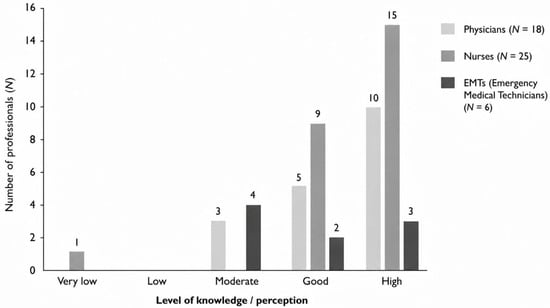
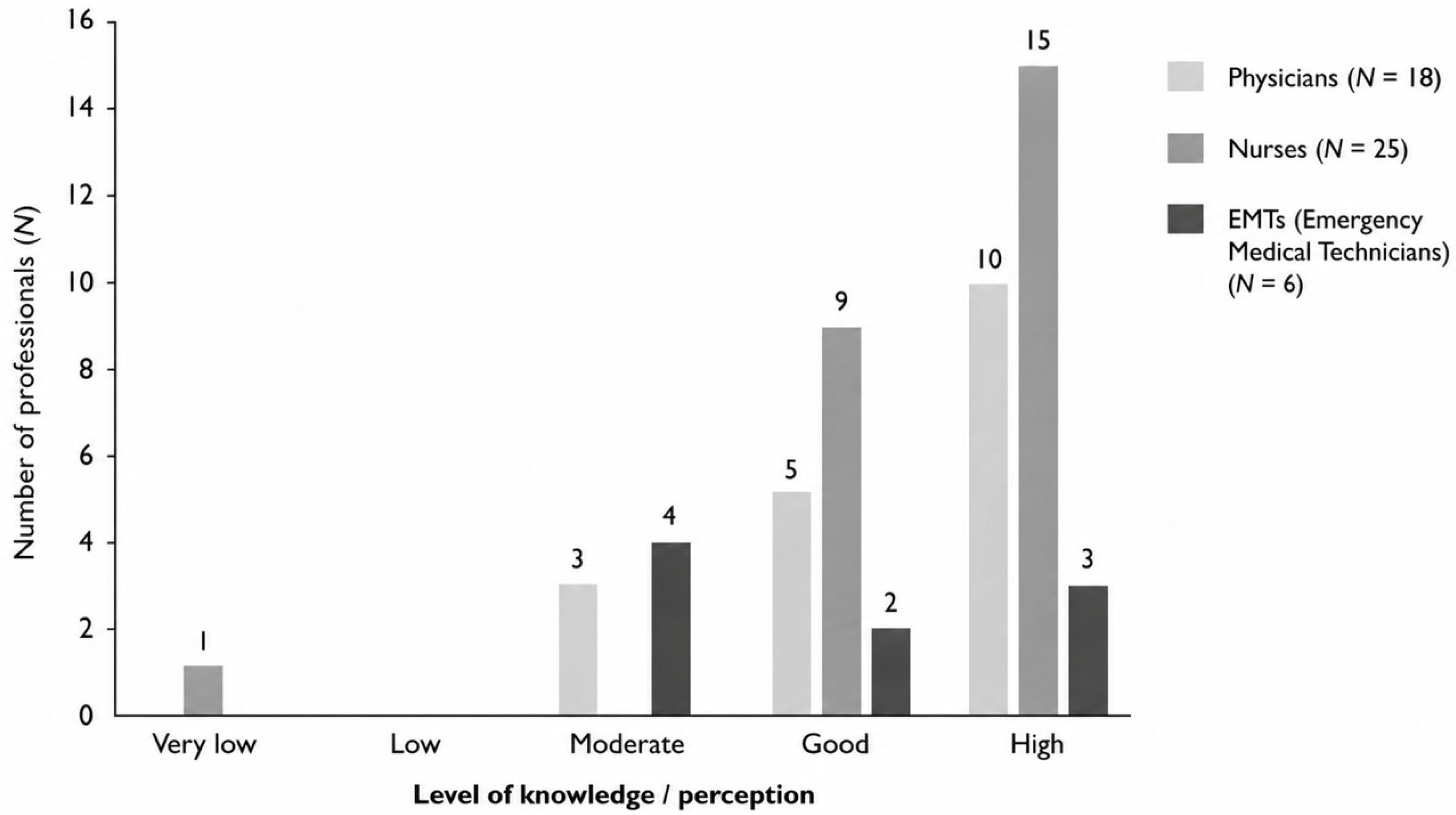
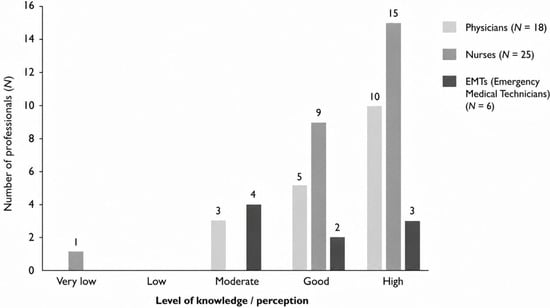
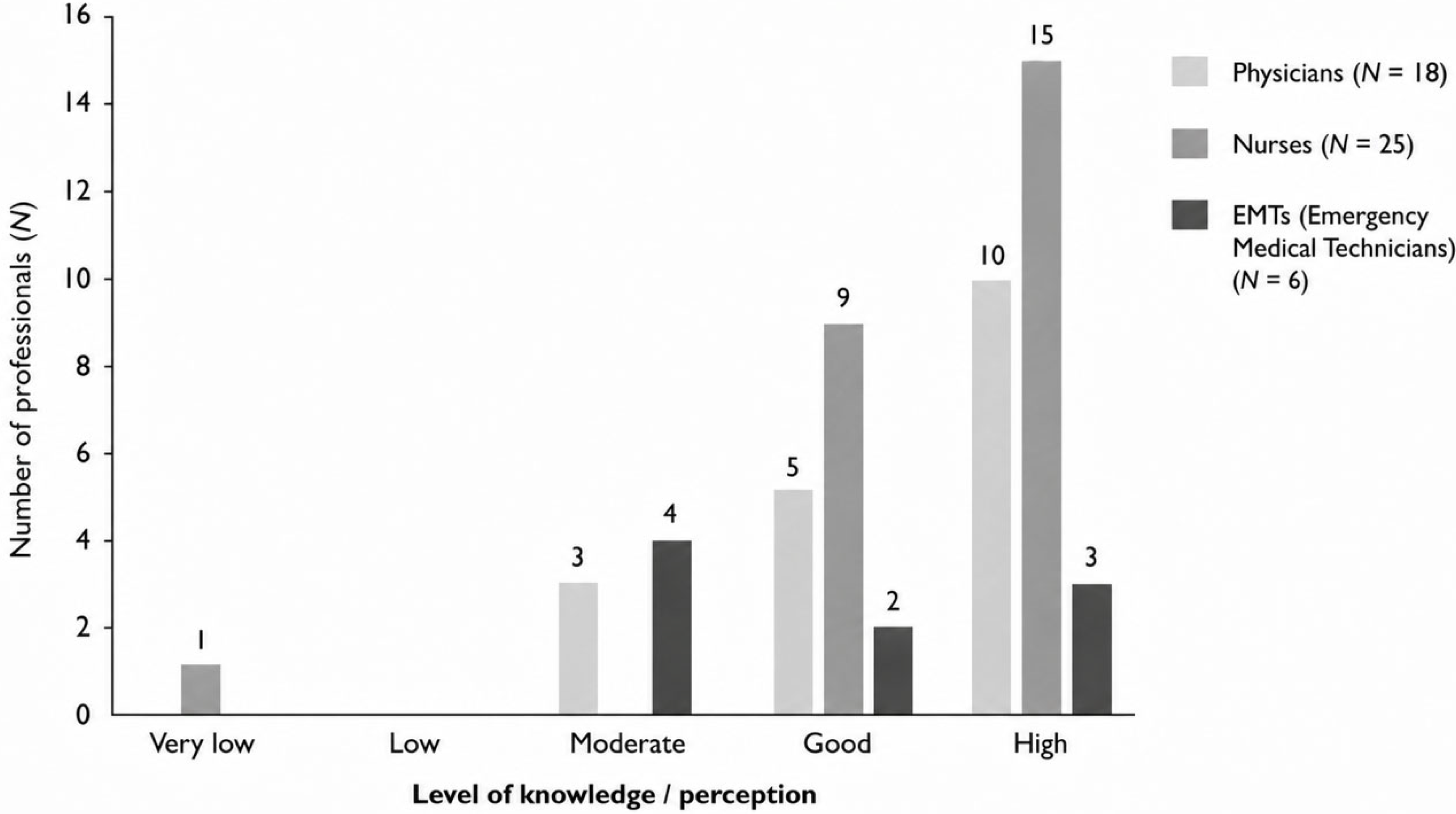
Perceived usefulness of debriefing was rated as “high” by 65.3% of respondents. By professional category, 52.6% of physicians rated usefulness as “high”, compared with 60.0% of nurses and 50.0% of EMTs. Figure 1 presents the distribution of perceived usefulness across professional groups. In addition, Figure 2 compares profession-specific knowledge of debriefing with the proportion of participants reporting high perceived usefulness.
Figure 1.
Distribution of perceived usefulness of debriefing across professional groups.
Figure 2.
Comparison by profession: knowledge of debriefing versus high perceived utility.
3.4. Quality of Debriefing: DASH Assessment
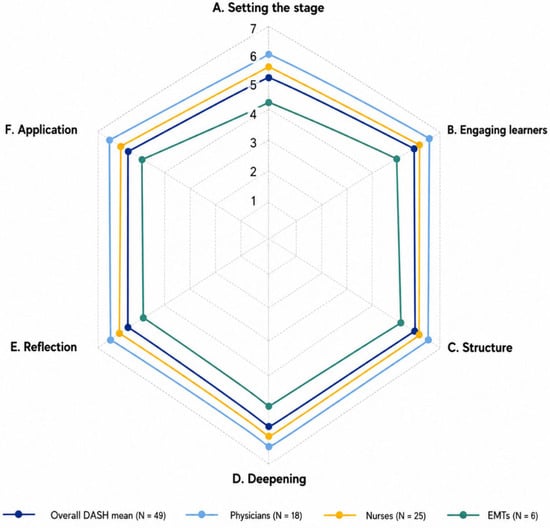
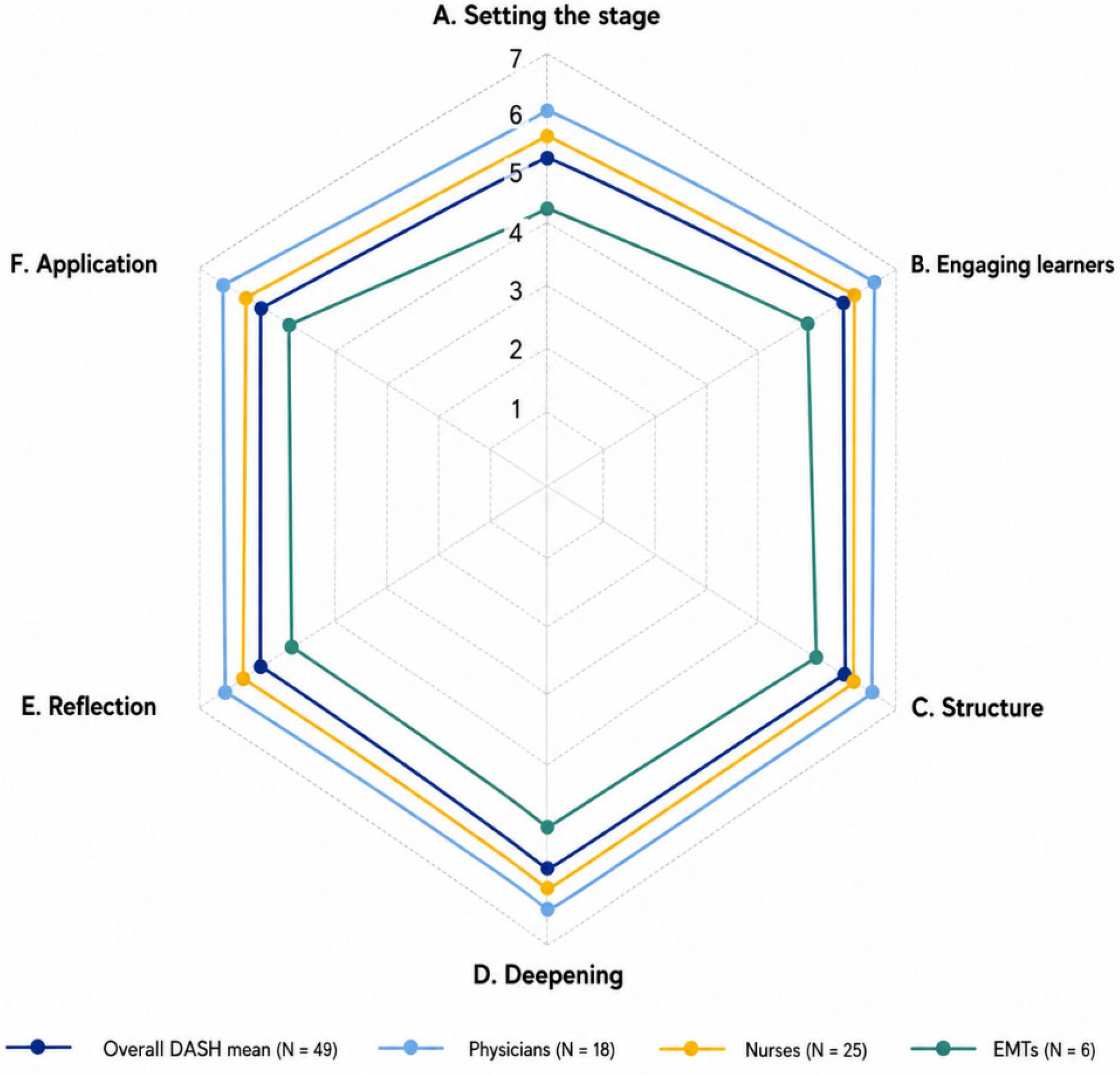
The DASH assessment was completed by all 49 participants and revealed consistently high ratings. Notably, 40 of 49 participants (81.6%) perceived the debriefing environment as psychologically safe, and 35 of 49 participants (71.4%) rated the facilitator’s ability to structure the debriefing in an organized manner as “extremely effective” or “very good”, suggesting that when debriefing is performed, it is generally perceived as high quality. Figure 3 summarizes the mean scores for each DASH dimension (scale 1 to 7).
Figure 3.
Mean DASH domain scores by professional group and overall sample (scale 1–7). Radar chart displaying the mean scores for the six domains of the Debriefing Assessment for Simulation in Healthcare (DASH) in the overall sample and by professional category. Higher scores indicate better perceived debriefing quality.
Table 2 presents the descriptive statistics for the six DASH domains. Mean scores were consistently high across all domains, ranging from 5.95 to 6.20 on the seven-point scale. The highest score was observed for Domain 2 (mean = 6.20, SD = 0.73), whereas Domain 5 showed the lowest mean score (mean = 5.95, SD = 0.96), although all domains demonstrated favourable evaluations of debriefing quality.
Table 2.
Descriptive statistics for DASH domains (n = 49).
No statistically significant differences were observed between professional groups in any of the DASH domains (all p > 0.05). Mean scores were consistently high across all groups, indicating a generally positive assessment of debriefing quality. Although emergency medical technicians tended to report slightly lower scores compared to physicians and nurses across most domains, these differences did not reach statistical significance.
3.5. Quality of Debriefing: OSAD Assessment
The OSAD assessment was completed by all 49 participants. The OSAD evaluation (Table 3) yielded the highest scores for learner engagement, with 35 of 49 participants (71.4%) assigning an “excellent” rating. Similarly, descriptive reflection and analysis received excellent ratings from 31 of 49 participants (63.3%). The lowest-scoring domain was application to clinical practice, where 30 of 49 participants (61.2%) rated the domain as “excellent”. Additionally, approximately one third of participants indicated that the discussion lacked explicit links to real-world clinical contexts, suggesting a potential gap between reflective discussion and its translation into clinical practice.
Table 3.
Percentage and frequency of “excellent” (score = 5) ratings for each OSAD domain.
3.6. Structural Barriers to Debriefing Implementation
Participants identified several structural barriers: lack of dedicated time (72%), absence of trained facilitators (60%), and insufficient educational resources (50%; including appropriate spaces, simulators, and materials). These barriers varied by professional role: physicians predominantly cited time constraints (75%); nurses highlighted the shortage of trained facilitators (70%), and EMTs most frequently pointed to the lack of resources (80%).
3.7. Comparison Between Professional Experience and Perception of Debriefing
Descriptive comparisons suggested that professionals with longer work experience tended to rate debriefing as more useful than those with fewer years of experience. Among physicians with >10 years of seniority, 85% considered debriefing highly useful, compared with 60% of those with <5 years of experience. Corresponding figures for nurses were 78% versus 55%, and for EMTs 70% versus 50%. However, no statistically significant association was observed between years of professional experience and perceived usefulness of debriefing (χ2 = 2.91; p = 0.233; exact p = 0.222).
3.8. Association Between Variables
To explore potential relationships between key variables, chi-square tests were conducted to assess associations between professional categories, level of knowledge of structured debriefing, perceived usefulness, and years of professional experience.
No statistically significant association was observed between professional category and level of knowledge of structured debriefing (χ2 = 5.99, p = 0.200), suggesting a relatively homogeneous distribution of theoretical awareness across professional groups. This finding was confirmed by the Fisher-Freeman-Halton exact test (exact p = 0.188). The observed effect size was small-to-moderate (Cramer’s V = 0.247).
In contrast, a statistically significant association was found between professional category and perceived usefulness of debriefing (χ2 = 18.87, p < 0.001). Specifically, emergency medical technicians were more likely to report lower perceived usefulness compared to physicians and nurses. Given the presence of low expected cell frequencies, a Fisher-Freeman-Halton exact test was additionally performed and confirmed the statistical significance of the association (exact p < 0.001). The magnitude of this association was large (Cramer’s V = 0.621), indicating a substantial relationship between professional category and perceived usefulness of debriefing.
No statistically significant association was observed between years of professional experience and perceived usefulness of debriefing (χ2 = 2.91, p = 0.233). This finding was confirmed by the Fisher-Freeman-Halton exact test (exact p = 0.222). The corresponding effect size was small-to-moderate (Cramer’s V = 0.244). The results of these analyses are summarised in Table 4.
Table 4.
Association between variables: Chi-square analysis.
These findings indicate that, while knowledge of structured debriefing appears to be consistent across professional groups, differences emerge in how its usefulness is perceived, particularly among emergency medical technicians.
Taken together, these results suggest a divergence between theoretical awareness and perceived practical value, highlighting the need for targeted strategies to enhance the perceived relevance and applicability of structured debriefing in specific professional groups.
4. Discussion
This study provides insight into the knowledge, training, and perceived utility of structured debriefing among professionals working in a real-world out-of-hospital emergency service. Although theoretical awareness was high (85.7%) and the perceived usefulness of debriefing was generally positive (65.3% rated it as “high”), a substantial discrepancy emerged between these favourable attitudes and actual practice.
Importantly, the present study extends previous findings by demonstrating a statistically significant association between professional categories and perceived usefulness of debriefing. The observed association was accompanied by a large effect size (Cramer’s V = 0.621), suggesting that differences in perceived usefulness may vary meaningfully across professional groups.
More than half of the participants (55.1%) reported receiving no simulation-based training within their service during the previous year, and among those who did, both the frequency and quality varied considerably.
The low response rate observed in the present study may be attributable to several contextual factors characteristic of prehospital emergency services, including demanding work schedules, rotating shifts, limited availability during the data collection period, and survey fatigue associated with online questionnaires. Consequently, the possibility of non-response bias cannot be excluded, as professionals with a greater interest in simulation or debriefing may have been more likely to participate. Therefore, although the findings provide valuable exploratory insights, caution is required when extrapolating the results to the broader population of healthcare professionals working within the service.
These findings align with previous literature that has documented a similar theory–practice gap in simulation-based education across various healthcare settings [14,21]. Debriefing has been shown to improve performance outcomes by approximately 20–25%, particularly when structured approaches are used, reinforcing its role as a high-impact educational intervention [14]. The present study adds evidence by quantifying this gap in a specific prehospital emergency context and by identifying profession-specific barriers that hinder debriefing adoption.
Although descriptive analyses suggested that more experienced professionals tended to report higher usefulness ratings for debriefing, no statistically significant association was identified between years of professional experience and perceived usefulness of debriefing. Consequently, this pattern should be interpreted cautiously and may reflect variability within the sample rather than a consistent relationship.
More experienced professionals may have encountered more adverse events, critical incidents, or team coordination failures, making them more receptive to a method that systematically analyses performance and promotes learning from experience. This interpretation is supported by studies showing that debriefing can reduce the emotional impact of critical incidents and improve coping strategies [22,23].
The lower recognition and utility ratings observed among EMTs should be interpreted cautiously given the limited number of EMT participants included in the study. Nevertheless, the observed pattern may suggest differences in perceptions that warrant further investigation in larger and more representative samples. Only 66.7% of EMTs knew the debriefing concept, and only 50% considered it highly useful. This disparity may reflect a combination of factors: limited access to simulation training (63.6% had no recent training), a more rigid hierarchical structure that may discourage active participation, and a scarcity of educational materials adapted to the specific scope of EMT practice. Previous studies in prehospital settings have also identified differences between professional roles in engagement with debriefing, suggesting that tailored educational strategies may be required to address the specific needs of EMTs [13]. Recent research confirms that targeted simulation programmes for EMTs significantly improve both their technical competence and their valuation of debriefing [24,25].
When debriefing sessions were conducted, participants rated them as high quality on both DASH and OSAD instruments. The scores for psychological safety (81.6%) and reflective analysis indicate that facilitators who perform debriefing are generally skilled at creating an open, non-judgmental environment. No significant differences were found between professional groups in the quality of debriefing as assessed by the DASH instrument, suggesting a consistently high standard when debriefing is performed. This finding reinforces the notion that observed differences between professional groups may be more related to perception and engagement rather than to variations in the quality of facilitation itself.
While no differences were observed in the quality of debriefing, a significant association was found between professional category and perceived usefulness, suggesting that differences may lie in how debriefing is perceived rather than how it is conducted.
However, the lower OSAD score for the “application” domain (only 61% excellent) suggests a missed opportunity: many participants felt that the discussion, although thorough, did not sufficiently translate into concrete, actionable strategies for real clinical practice. These findings are consistent with recent research highlighting persistent challenges in transferring debriefing from simulation to real clinical practice, particularly in complex environments such as prehospital emergency settings [12,25,26,27].
The most cited barriers (lack of time, 72%; insufficient trained facilitators, 60%; and inadequate resources, 50%) are not unique to our setting but are consistently reported in international emergency services [15,28]. Each professional group highlighted a different main obstacle, underscoring the need for tailored solutions. For physicians, time pressure is paramount; for nurses, the bottleneck is a shortage of qualified debriefing facilitators; for EMTs, the absence of basic resources is the key impediment.
These barriers are modifiable. Organisations that foster a culture of continuous quality improvement, where regular simulation and debriefing are embedded into routine practice, tend to achieve better clinical outcomes and higher staff satisfaction [29,30]. Our findings may suggest that organisational and contextual factors could contribute to lower engagement among EMTs; however, this hypothesis requires further investigation.
The results are consistent with the meta-analysis by Tannenbaum and Cerasoli [14], which reported that debriefing improves performance by approximately 20–25%, although its effectiveness is highly dependent on the structure and quality of facilitation. However, as noted in both classic and recent literature, debriefing practices in healthcare remain highly variable and often lack standardisation, which may contribute to inconsistent implementation across services [12,15,21].
5. Limitations
This study has several limitations that should be considered when interpreting the findings. First, the relatively small sample size and low response rate (3.8%) may limit the generalisability of the results. However, the sample included representation from all professional categories, allowing an exploratory analysis of perceptions across different roles within the service.
The low response rate (3.8%) increases the risk of non-response bias, as professionals with a greater interest in simulation, debriefing, or continuing professional education may have been more likely to participate. Consequently, the sample may not be representative of the broader population of healthcare professionals working in the service, limiting the external validity and generalisability of the findings. Furthermore, the views of professionals who did not participate may differ substantially from those reported in the present study. Therefore, the results should be interpreted as exploratory and should not be generalized to the entire population of the service.
In addition, some professional subgroups were represented by a limited number of participants, particularly EMTs (n = 6). Consequently, comparisons between professional categories should be interpreted with caution, as estimates derived from small subgroups may be less stable and more susceptible to random variation. Although exact statistical procedures were applied when appropriate, subgroup analyses should be regarded as exploratory.
The cross-sectional design provides a snapshot of current perceptions and practices but does not allow causal relationships to be established. As such, the findings should be interpreted as indicative rather than conclusive.
The use of self-reported data may introduce response bias, as participants with greater interest in simulation or debriefing may have been more likely to respond.
Finally, although the validated Spanish version of the DASH instrument was used, no formally validated Spanish version of the OSAD instrument was available at the time of the study. A Spanish translation was therefore developed by the research team based on the Portuguese version. Although efforts were made to preserve conceptual and linguistic equivalence, the translated instrument has not undergone formal psychometric validation. Consequently, measurement equivalence cannot be guaranteed, and findings derived from the OSAD assessment should be interpreted as exploratory and with appropriate caution.
Despite these limitations, the study provides valuable exploratory insights into the implementation of structured debriefing in a real-world prehospital emergency setting, an area that remains underrepresented in the current literature.
6. Implications for Practice and Future Research
Despite these limitations, this study provides practical implications for the 061 Service and comparable out-of-hospital emergency systems. First, there is an urgent need to institutionalize debriefing: it should become a mandatory component of all simulation-based training, supported by written protocols and allocated time. Second, facilitator training programmes should be established to increase the pool of qualified personnel, with a special focus on nurses, who currently perceive a shortage of trained facilitators. Third, resources tailored to EMTs should be developed, including scenario-based simulations that reflect their daily responsibilities. Fourth, the transfer of learning from debriefing to clinical practice should be reinforced by explicitly linking discussion points to protocol changes, checklist modifications, or team communication strategies.
Future research should aim for a larger, more representative sample. Longitudinal designs could assess whether improved debriefing training leads to measurable improvements in patient outcomes or reductions in adverse events. Additionally, qualitative studies exploring the lived experiences of EMTs in debriefing sessions could provide deeper insight into the barriers they face.
7. Conclusions
Debriefing is widely recognized and positively valued by professionals in the 061 out-of-hospital emergency service of the Murcian Health System; however, its routine and structured implementation remains limited. The gap between knowledge and practice may be associated with several potentially modifiable organisational barriers (primarily lack of time, insufficient trained facilitators, and limited resources), which affect professional groups unequally. Importantly, the findings suggest potential differences in the perceived usefulness of debriefing across professional groups. However, these observations should be interpreted cautiously given the limited sample size and the small number of EMT participants.
When debriefing is performed, it is generally of high quality, but the translation of reflective discussions into tangible clinical improvements needs strengthening. The systematic integration of debriefing into continuing education programmes, supported by facilitator training, dedicated resources, and a robust safety culture, has the potential to enhance both technical and non-technical skills, improve patient safety, and support professional wellbeing. Targeted strategies may help ensure equitable access for all professional categories, particularly for EMTs, whose responses suggested lower exposure to and perceived usefulness of debriefing, although these findings should be interpreted with caution.
Supplementary Materials
The following supporting information can be downloaded at: https://www.mdpi.com/article/10.3390/nursrep16110389/s1, Supplementary Material S1. STROBE Checklist for Cross-Sectional Studies.
Author Contributions
Conceptualization, I.O.M. and J.M.C.P.; Methodology, I.O.M.; Formal Analysis, I.O.M.; Investigation, I.O.M.; Writing—Original Draft Preparation, I.O.M.; Writing—Review and Editing, I.O.M., G.D.-A. and T.S.-M.; Supervision, J.M.C.P. All authors have read and agreed to the published version of the manuscript.
Funding
This research received no external funding.
Data Availability Statement
The data supporting the findings of this study are available from the corresponding author upon reasonable request. The data are not publicly available due to privacy and confidentiality considerations, particularly the small sample size and the potential risk of indirect identification of participants. Any data sharing will be subject to applicable ethical and data protection requirements.
Public Involvement Statement
No public involvement in any aspect of this research.
Guidelines and Standards Statement
This manuscript was prepared in accordance with the Strengthening the Reporting of Observational Studies in Epidemiology (STROBE) Statement (von Elm et al., 2007 [20]) for cross-sectional observational studies. The completed STROBE checklist is provided as Supplementary Material S1.
Use of Artificial Intelligence
During the preparation and revision of this manuscript, artificial intelligence (AI)-assisted tools were used to support exploratory literature searches, identify potentially relevant scientific publications, assist with language translation and English-language editing, correct grammatical errors, and improve academic writing, clarity, and readability. The literature identified with AI assistance was critically assessed and verified against the original scientific sources by the authors. All AI-assisted content was carefully reviewed and revised, and the authors take full responsibility for the accuracy, originality, scientific integrity, and final content of the manuscript.
Conflicts of Interest
The authors declare no conflict of interest.
References
- Yi-Chen, H.; Chair-Hua, L.; Ting-Yu, Y.; Tsung-Han, L.; Tsay-I, C.; Chih Hao, L. The Impact of Simulation-Based Emergency Training on Novice Critical Care Nurses: A Quasi-Experimental Study. Int. J. Med. Educ. 2025, 16, 138–144. [Google Scholar] [CrossRef] [Scilit]
- Salas, E.; Diaz Granados, D.; Weaver, S.J.; King, H. Does Team Training Work? Principles for Health Care. Acad. Emerg. Med. 2008, 15, 1002–1009. [Google Scholar] [CrossRef] [Scilit]
- Issenberg, S.B.; McGaghie, W.C.; Petrusa, E.R.; Gordon, D.L.; Scalese, R.J. Features and Uses of High-Fidelity Medical Simulations That Lead to Effective Learning: A BEME Systematic Review. Med. Teach. 2005, 27, 10–28. [Google Scholar] [CrossRef] [Scilit]
- McGaghie, W.C.; Issenberg, S.B.; Cohen, E.R.; Barsuk, J.H.; Wayne, D.B. Does Simulation-Based Medical Education with Deliberate Practice Yield Better Results than Traditional Clinical Education? A Meta-Analytic Comparative Review of the Evidence. Acad. Med. 2011, 86, 706–711. [Google Scholar] [CrossRef] [Scilit]
- Sawyer, T.; White, M.; Zaveri, P.; Chang, T.; Ades, A.; French, H. Learn, See, Practice, Prove, Do, Maintain: An Evidence-Based Pedagogical Framework for Procedural Skill Training in Medicine. Acad. Med. 2015, 90, 1025–1033. [Google Scholar] [CrossRef] [Scilit]
- Motola, I.; Devine, L.A.; Chung, H.S.; Sullivan, J.E.; Issenberg, S.B. Simulation in Healthcare Education: A Best Evidence Practical Guide No. 82. Med. Teach. 2013, 35, e1511–e1530. [Google Scholar] [CrossRef] [Scilit]
- Rudolph, J.W.; Simon, R.; Dufresne, R.L.; Raemer, D.B. There’s No Such Thing as Nonjudgmental Debriefing: A Theory and Method for Debriefing with Good Judgment. Simul. Healthc. 2006, 1, 49–55. [Google Scholar] [CrossRef] [Scilit]
- Green, M.; Tariq, R.; Green, P. Improving Patient Safety through Simulation Training in Anesthesiology: Where Are We? Anesthesiol. Res. Pract. 2016, 2016, 4237523. [Google Scholar] [CrossRef] [Scilit]
- Fanning, R.M.; Gaba, D.M. The Role of Debriefing in Simulation-Based Learning. Simul. Healthc. 2007, 2, 115–125. [Google Scholar] [CrossRef] [Scilit]
- Sawyer, T.; Eppich, W.; Brett-Fleegler, M.; Grant, V.; Cheng, A. More than One Way to Debrief: A Critical Review of Healthcare Simulation Debriefing Methods. Simul. Healthc. 2016, 11, 209–217. [Google Scholar] [CrossRef] [Scilit]
- Lomuscio, S.; Capogna, E.; Sironi, S. Debriefing Methodologies in Nursing Simulation: An Exploratory Study of the Italian Settings. Nurs. Rep. 2025, 15, 7. [Google Scholar] [CrossRef] [Scilit]
- Dewdney, C.J.; Waite, S.R.; Ralston, K.; Phillips, E.C.; Mellanby, E.; Tallentire, V.R. Transfer of Clinical Debriefing from Simulation to Practice: Exploring the Barriers and Enablers. Adv. Simul. 2026, 11, 8. [Google Scholar] [CrossRef] [Scilit]
- Ahmad, M.; Page, M.; Goodsman, D. What Is Simulation-Based Medical Education (SBME) Debriefing in Prehospital Medicine? A Qualitative, Ethnographic Study Exploring SBME Debriefing in Prehospital Medical Education. BMC Med. Educ. 2023, 23, 625. [Google Scholar] [CrossRef] [Scilit]
- Tannenbaum, S.I.; Cerasoli, C.P. Do Team and Individual Debriefs Enhance Performance? A Meta-Analysis. Hum. Factors 2013, 55, 231–245. [Google Scholar] [CrossRef] [Scilit]
- Duff, J.P.; Morse, K.J.; Seelandt, J.; Gross, I.T.; Lydston, M.; Sargeant, J.; Dieckmann, P.; Allen, J.A.; Rudolph, J.W.; Kolbe, M. Debriefing Methods for Simulation in Healthcare: A Systematic Review. Simul. Healthc. 2024, 19, S112–S121. [Google Scholar] [CrossRef] [Scilit]
- Rudolph, J.W.; Raemer, D.B.; Simon, R. Establishing a Safe Container for Learning in Simulation: The Role of the Presimulation Briefing. Simul. Healthc. 2014, 9, 339–349. [Google Scholar] [CrossRef] [Scilit]
- Center for Medical Simulation Debriefing Assessment for Simulation in Healthcare (DASH)–Spanish Version. Available online: https://harvardmedsim.org/debriefing-assessment-for-simulation-in-healthcare-dash-spanish/ (accessed on 2 March 2025).
- Abegglen, S.; Krieg, A.; Eigenmann, H.; Greif, R. Objective Structured Assessment of Debriefing (OSAD) in Simulation-Based Medical Education: Translation and Validation of the German Version. PLoS ONE 2020, 15, e0244816. [Google Scholar] [CrossRef] [Scilit]
- Organic Law 3/2018 of 5 December on the Protection of Personal Data and Guarantee of Digital Rights; Agencia Estatal Boletín Oficial del Estado: Madrid, Spain, 2018; BOE No. 294, pp. 119788–119857. Available online: https://www.boe.es/eli/es/lo/2018/12/05/3 (accessed on 2 March 2025).
- von Elm, E.; Altman, D.G.; Egger, M.; Pocock, S.J.; Gøtzsche, P.C.; Vandenbroucke, J.P. The Strengthening the Reporting of Observational Studies in Epidemiology (STROBE) Statement: Guidelines for Reporting Observational Studies. PLoS Med. 2007, 4, e296. [Google Scholar] [CrossRef] [Scilit]
- Cheng, A.; Eppich, W.; Grant, V.; Sherbino, J.; Zendejas, B.; Cook, D.A. Debriefing for Technology-Enhanced Simulation: A Systematic Review and Meta-Analysis. Med. Educ. 2014, 48, 657–666. [Google Scholar] [CrossRef] [Scilit]
- Fegran, L.; ten Ham-Baloyi, W.; Fossum, M.; Hovland, O.J.; Naidoo, J.R.; van Rooyen, D.R.M.; Sejersted, E.; Robstad, N. Simulation Debriefing as Part of Simulation for Clinical Teaching and Learning in Nursing Education: A Scoping Review. Nurs. Open 2023, 10, 1473–1495. [Google Scholar] [CrossRef] [Scilit]
- Kolbe, M.; Schmutz, S.; Seelandt, J.C.; Eppich, W.J.; Schmutz, J.B. Team Debriefings in Healthcare: Aligning Intention and Impact. BMJ 2021, 374, n2042. [Google Scholar] [CrossRef] [Scilit]
- Avery, P.; Thompson, C.; Cowburn, P. Training the Trainers: Improving the Quality of Education Delivered to Paramedics through a Simulation-Debrief Model. Br. Paramed. J. 2023, 7, 51–56. [Google Scholar] [CrossRef] [Scilit]
- Cheng, A.; Grant, V.; Robinson, T.; Catena, H.; Lachapelle, K.; Kim, J. The Promoting Excellence and Reflective Learning in Simulation (PEARLS) Approach to Health Care Debriefing: A Faculty Development Guide. Clin. Simul. Nurs. 2016, 12, 419–428. [Google Scholar] [CrossRef] [Scilit]
- Levett-Jones, T.; Lapkin, S. A Systematic Review of the Effectiveness of Simulation Debriefing in Health Professional Education. Nurse Educ. Today 2014, 34, e58–e63. [Google Scholar] [CrossRef] [Scilit]
- Boet, S.; Bould, M.D.; Fung, L.; Qosa, H.; Perrier, L.; Tavares, W.; Reeves, S.; Tricco, A.C. Transfer of Learning and Patient Outcome in Simulated Crisis Resource Management: A Systematic Review. Can. J. Anesth. 2014, 61, 571–582. [Google Scholar] [CrossRef] [Scilit]
- Najjuma, J.N.; Muhumuza, A.; Santorino, D.; Sekyere, S.O.; Ocheke, A.N.; Yiltok, S.J.; Bajunirwe, F. Barriers and Facilitators to Interprofessional Simulation-Based Learning in a Ugandan Medical School: A Qualitative Study. BMC Med. Educ. 2024, 24, 1528. [Google Scholar] [CrossRef] [Scilit]
- Salas, E.; Klein, C.; King, H. Debriefing Medical Teams: 12 Evidence-Based Best Practices and Tips. Jt. Comm. J. Qual. Patient Saf. 2008, 34, 518–527. [Google Scholar] [CrossRef] [Scilit]
- Konzelmann, J. A Literature Supported Model for Implementing Effective Use of Simulation and Debriefing in Paramedic Education. Int. J. Paramed. 2024, 8, 205–215. [Google Scholar] [CrossRef] [Scilit]

Disclaimer/Publisher’s Note: The statements, opinions and data contained in all publications are solely those of the individual author(s) and contributor(s) and not of MDPI and/or the editor(s). MDPI and/or the editor(s) disclaim responsibility for any injury to people or property resulting from any ideas, methods, instructions or products referred to in the content. |
© 2026 by the authors. Licensee MDPI, Basel, Switzerland. This article is an open access article distributed under the terms and conditions of the Creative Commons Attribution (CC BY) license.