


Abstract
Background/Objectives. Quality of nursing care (QNC) is a central concept in healthcare systems worldwide, with growing emphasis on developing reliable and contextually appropriate instruments for its assessment. Over recent decades, there has been a shift from outcome-based evaluation toward more holistic, patient-centered frameworks that consider both clinical indicators and interpersonal dimensions of care. This scoping review aimed to map the range, nature, and characteristics of self-report instruments used to assess the quality of nursing care, including their psychometric properties and contextual applications across different clinical settings. Methods. A systematic search was conducted in CINAHL Complete, MEDLINE (via PubMed), Scopus, Web of Science, and ProQuest Dissertations & Theses, alongside gray literature sources, following the Joanna Briggs Institute (JBI) methodology and PRISMA-ScR guidelines. Studies were included if they reported on the development, validation, adaptation, or application of QNC assessment tools in hospital or community nursing contexts, and were published in English, Portuguese, or Spanish. Results. Fifty-nine studies were included, spanning from 1995 to 2025. The instruments identified were predominantly structured around Donabedian’s structure-process-outcome model, and many emphasized relational domains such as empathy, communication, and respect. Tools like the Good Nursing Care Scale (GNCS), the Quality of Oncology Nursing Care Scale (QONCS), and the Karen Scales demonstrated strong internal consistency (Cronbach’s α ranging from 0.79 to 0.95). Conclusions. Organizational factors, including leadership and staffing, and predictors such as burnout and work intensity, were found to influence perceived care quality. Important gaps remain regarding longitudinal use and integration of patient-reported outcome measures.
1. Introduction
The quality of nursing care (QNC) is critical to healthcare delivery, directly influencing patient outcomes, safety, satisfaction, and system efficiency [1]. As healthcare systems evolve toward more patient-centered, evidence-based, and outcome-driven models, the need for robust, multidimensional, and context-sensitive tools to assess QNC becomes increasingly urgent [2]. Despite the proliferation of instruments designed to measure QNC, considerable heterogeneity persists in their conceptual foundations, target populations, and psychometric robustness [3]. Traditionally, evaluations of nursing care quality focused primarily on patient outcomes or institutional performance indicators. However, there is increasing recognition of the importance of incorporating the perspectives of nurses—those directly involved in care delivery [4]. Nurses’ insights provide a nuanced understanding of care processes, organizational dynamics, and contextual challenges that may not be captured through patient or administrative data alone [5].
Several conceptual frameworks have guided the development of QNC assessment tools. Donabedian’s model, which categorizes quality into structure, process, and outcomes, remains a foundational reference in healthcare quality evaluation [6]. More contemporary approaches, such as evidence-based practice (EBP), emphasize the integration of clinical expertise, patient preferences, and the best available evidence to guide care decisions [7].
To complement these perspectives, Watson’s Theory of Human Care provides an essential framework for understanding quality as more than technical competence. Watson emphasizes the importance of caring relationships, empathy, communication, and the holistic integration of physical, emotional, and spiritual needs in the healing process.
While the systematic review by Koy and colleagues [8] offers a valuable foundation by listing quantitative instruments for measuring nursing care quality, several distinctions justify the need for this scoping review. Their review was limited to quantitative studies published in English up to 2015, whereas the present study adopts broader inclusion criteria—encompassing qualitative, mixed-methods, and gray literature—to provide a more comprehensive and current synthesis. Furthermore, this review identifies emerging themes such as nurse well-being, culturally adapted tools, and the integration of patient-reported outcomes, offering practical insights for diverse healthcare contexts.
The aim of this review is to map existing QNC measurement tools, identify conceptual and methodological gaps, and provide a comprehensive synthesis of how quality is defined, operationalized, and validated across healthcare settings. Mapping this evidence may support stakeholders in selecting or developing appropriate instruments tailored to their specific contexts and goals. Importantly, this review acknowledges that quality in nursing care is a multidimensional phenomenon that combines technical competence, interpersonal relationships, organizational support, and patient engagement. In doing so, it aligns both with Donabedian’s structural-process-outcome framework [6] and with Watson’s emphasis on human caring, empathy, and holistic patient needs, reflecting contemporary models of co-produced healthcare quality [2,9].
2. Materials and Methods
2.1. Study Design
This scoping review was conducted following the methodology proposed by the Joanna Briggs Institute (JBI) and is reported according to the Preferred Reporting Items for Systematic Reviews and Meta-Analyses extension for Scoping Reviews (PRISMA-ScR) [10]. The objective was to map the available evidence regarding self-report instruments used to assess the quality of nursing care on self-reported instruments used to assess the quality of nursing care, with particular focus on their psychometric properties, underlying conceptual structures, and clinical application contexts. A preliminary search of PROSPERO, MEDLINE, the Cochrane Library, and JBI Evidence Synthesis databases revealed no existing or ongoing scoping or systematic reviews on this specific topic at the time of the search.
The review protocol was registered in OSF (https://doi.org/10.17605/osf.io/XUVHW).
2.2. Review Question
This scoping review aimed to systematically map and synthesize the literature on instruments used to assess the quality of nursing care (QNC).
Specific questions were:
- Clinical contexts: in which healthcare settings (e.g., hospital wards, community care, specialized units) have QNC assessment instruments been developed, adapted, or implemented?
- Instrument characteristics: what are the structural, conceptual, and methodological features of these instruments, including format, length, target respondents, and theoretical concepts?
- Domains of nursing care quality: which dimensions of nursing care quality (e.g., technical competence, interpersonal relationships, patient-centeredness, holistic care) are captured by these instruments?
- Psychometric properties: what evidence exists regarding the reliability, validity, and overall measurement robustness of these instruments, including cross-cultural adaptations and longitudinal evaluations?
2.3. Eligibility Criteria
2.3.1. Participants
Studies were eligible if they involved nurses of any training level, clinical specialty, or practice setting. Both staff nurses and nurse managers were considered if the focus was on the nurses’ perspective in evaluating quality of care.
2.3.2. Concept
The central concept was the assessment of nursing care quality using self-report instruments, including questionnaires, rating scales, checklists, or other standardized tools. Only instruments explicitly designed to measure the quality of care were included. Tools that exclusively evaluated individual nursing competencies, technical skills, or task performance without addressing broader care quality were excluded. The perspective of the nurse as care provider was central; studies capturing patient or organizational perspectives without a nurse-reported component were not included.
2.3.3. Context
Eligible studies were conducted in any healthcare setting where nursing care is delivered, including hospital units (e.g., intensive care, perioperative, oncology, palliative care), outpatient services, and community-based care. No restrictions were applied based on patient population, clinical specialty, or geographic location.
2.3.4. Types of Sources
This review included:
- Primary empirical studies, both quantitative and qualitative;
- Studies focused on instrument development or validation;
- Studies involving translation and cross-cultural adaptation instruments;
- Gray literature, such as dissertations.
Inclusion Criteria:
- Studies that describe, validate, apply, or adapt instruments to assess the quality of nursing care.
- Publications available in English, Portuguese, or Spanish.
- Studies providing sufficient methodological detail to evaluate the instrument and its domains.
Exclusion Criteria:
- Instruments focused solely on individual nursing competencies (e.g., technical skills or proficiency) without addressing broader aspects of care quality.
- Theoretical works lacking empirical testing or practical application.
- Studies where nurses were not a primary respondent group for the instrument.
2.4. Search Strategy
The search strategy was computed in the following databases: CINAHL Complete, PubMed, Scopus, Web of Science and ProQuest. The detailed queries can be found in Supplementary Table S1.
2.5. Study Selection
All identified records from the database and gray literature searches were imported into Rayyan for deduplication. Following removal of duplicates, the selection process was carried out in three stages: (1) Title Screening—Two reviewers independently screened all titles to exclude clearly irrelevant records. At this stage, studies obviously outside the scope—such as those not involving nurses, not related to quality of care, or purely theoretical works—were excluded; (2) Abstract Screening—Abstracts of remaining records were independently assessed by the same reviewers. Studies were included if they appeared to meet the eligibility criteria for participants, concept, context, and study type. Ambiguous abstracts were retained for full-text review to avoid premature exclusion; and (3) Full-Text Screening—Full texts of potentially eligible studies were retrieved and independently evaluated by the two reviewers. Each study was assessed against the inclusion and exclusion criteria.
Disagreements at any stage were resolved through discussion. If consensus could not be reached, a third reviewer was consulted.
2.6. Data Extracion
Data was extracted using a standardized form developed by the reviewers. Extracted data included:
- Authors, year, and country;
- Study objective;
- Name and type of instrument;
- Conceptual definition of quality;
- Clinical context of application;
- Domains and dimensions assessed;
- Psychometric properties (e.g., Cronbach’s alpha, construct validity, test–retest reliability);
- Summary of main findings.
The data extraction tool was updated iteratively as needed throughout the extraction process. Any disagreements between reviewers were resolved through discussion or, when necessary, by consultation with a third reviewer. In cases where key data were missing, attempts were made to contact the original study authors for clarification.
2.7. Data Analysis and Presentation
Extracted data were synthesized descriptively and presented in both tabular and narrative formats, organized around the review questions. The narrative synthesis summarized the types of instruments, evaluated domains, clinical contexts, and psychometric characteristics.
3. Results
3.1. Overall Characterization of the Studies
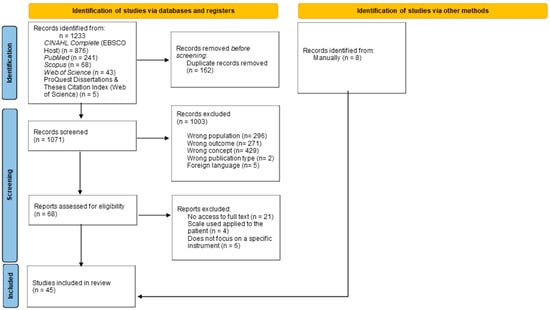
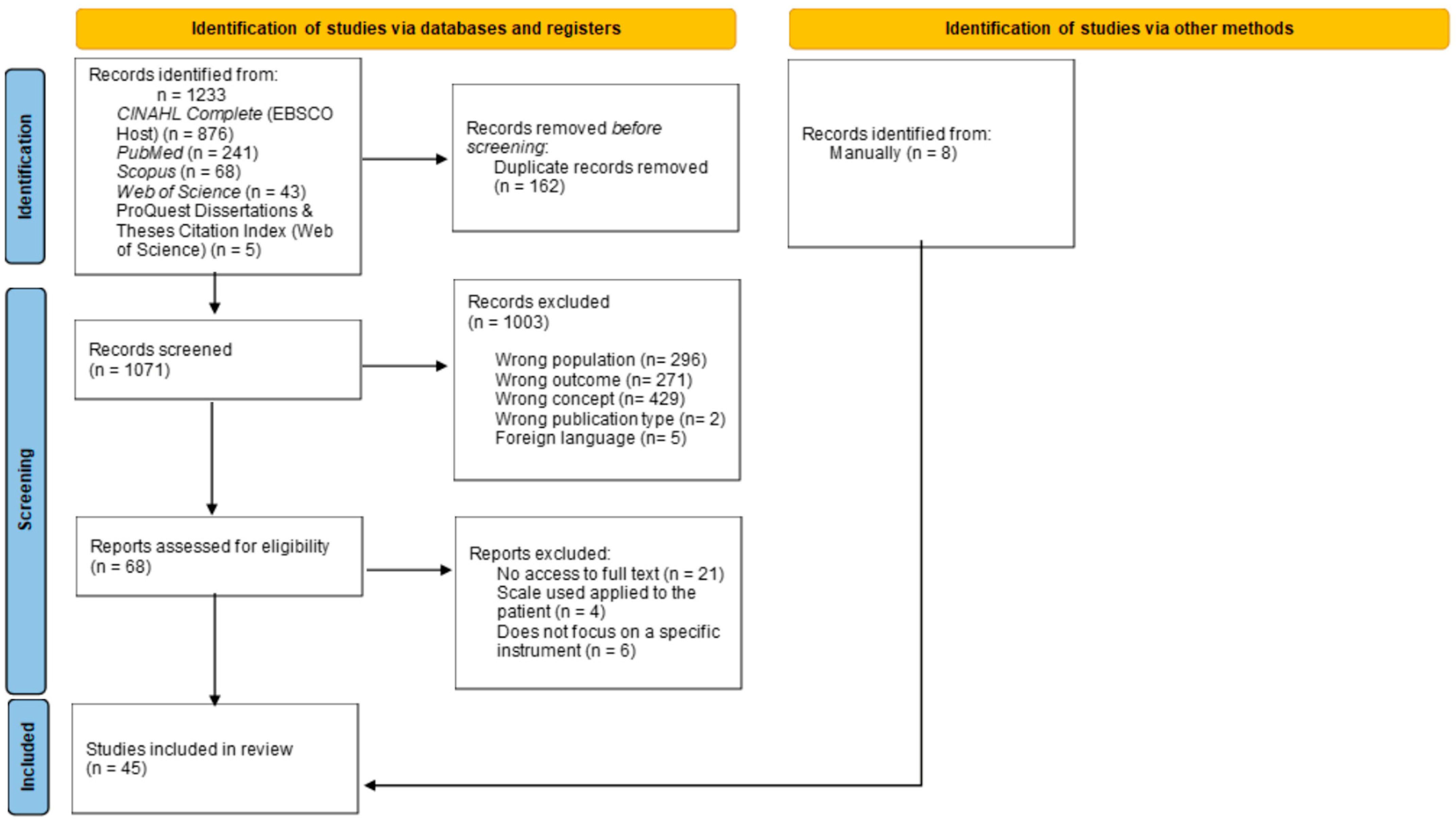
This scoping review included 45 studies (Figure 1).
Figure 1.
PRISMA-Scr Flowchart.
The overall research was conducted in 24 distinct countries or regions (Table 1). Countries with the most frequent contributions include Turkey (5 studies), China (4 studies), and Jordan (3 studies), Sweden (3 studies), and Portugal (3 studies). The preponderance of studies (approximately 88%) is quantitative, primarily utilizing surveys, instrument validation, or cross-sectional designs. A smaller proportion includes qualitative or phenomenological studies (4 studies), a modified Delphi process (1 study), and systematic reviews (2 studies). Research settings are varied, predominantly focusing on general and multi-hospital environments, alongside numerous studies in university/teaching hospitals and specialized units such as Intensive Care Units (ICUs), psychiatric wards, emergency departments, and palliative care centers. Sample sizes are highly variable, with patient samples ranging from 30 to 5536 individuals, and nurse/nursing staff samples spanning from 10 to 3451 professionals, also including head nurses and managers.
Table 1.
Synthesis of the findings (n = 45).
The total sample of nurses exceeds approximately 15,000 participants. This number includes large multicenter surveys involving thousands of nurses, such as 3451 nurses in Portugal, 1201 in Belgium, 744 in Fiji, 784 in China, 394 in Thailand, 310 in Iran, and 347 in Turkey.
3.2. Definition of Quality of Care and Related Factors
Across the reviewed studies, quality of nursing care is consistently conceptualized as a multidimensional construct that integrates technical, interpersonal, and organizational dimensions. Donabedian’s Structure–Process–Outcome (SPO) model [6] remains the predominant theoretical framework underpinning several instruments, including the Karen Scale, Good Nursing Care Scale (GNCS), CNCQS, and QONCS [54]. Within this framework, quality is defined through the dynamic interplay of structural factors (e.g., staffing levels, workload, and physical environment), nursing processes (assessment, planning, delivery, evaluation), and outcomes, such as patient satisfaction and health improvements [14,45,50,53].
A comparative synthesis of the instruments highlights four recurring dimensions that consistently define quality nursing care across contexts:
- 1.
- Empathy and Patient-Centeredness, particularly emphasized in oncology and palliative instruments (e.g., QONCS, PNCQS) [9,24,42,49,50];
- 2.
- Communication and Interpersonal Relationships, including effective dialog, teamwork, and collaboration (e.g., GNCS, Karen Scale) [20,48,54];
- 3.
- Leadership and Professional Competence, referring to both individual expertise and the organizational support needed for safe, coordinated care (e.g., Monitor, SERVQUAL-based tools) [16,22,29,35];
- 4.
- Work Environment and Structural Context, covering staffing adequacy, workload, fatigue, and organizational culture (e.g., SERVQUAL, studies of burnout and staffing adequacy) [14,50,52,53].
Holistic care—integrating emotional, spiritual, and social support—emerges as a unifying theme, especially in palliative and oncology contexts [24,49,50]. In these studies, nursing quality is framed as extending beyond technical execution to encompass empathetic, respectful, and intentional interactions that also address family involvement. Additional dimensions such as autonomy, documentation, and professional responsibility are also frequently reported as core components of nursing care quality [2,24,50,52].
Some instruments conceptualize quality explicitly as the gap between patient expectations and delivered care, emphasizing domains like reliability, responsiveness, assurance, and empathy [53]. From this perspective, nursing care quality is shaped not only by technical proficiency but also by the capacity to meet human needs through advocacy and caring, mediated by contextual factors such as staffing adequacy, workload management, and empowerment [50,52].
In specialized fields such as psychiatric and palliative nursing, quality indicators expand to include psychosocial relationships, ethical responsibility, patient safety, job satisfaction, and openness [33,53]. Collectively, these findings demonstrate that nursing care quality is a complex, multidimensional construct: it is measurable through validated instruments, but also subjectively experienced, encompassing empathy, communication, leadership, and environment as recurring pillars across cultural and clinical contexts worldwide [50,52,54].
3.3. Context of Studies
The majority of the studies were conducted in acute care hospital settings, with an increasing number focusing on specialized areas such as oncology, palliative care, and psychiatric services. For instance, oncology-focused research includes works by Charalambous and Adamakidou [24] and Marcomini et al. [49], while palliative care has been explored in studies like Zulueta Egea et al. [36], and psychiatric nursing examined by Alsyouf et al. [33] and Moen et al. [38]. Some studies concentrated on national or cross-cultural adaptations of established instruments, such as the Cambodian Nursing Care Quality Scale (CNCQS) adapted for Iran, Cambodia, and Mongolia, while others developed tools tailored to specific contexts, like the EPAECQC in Portugal and the Quality Nursing Care Scale—Turkish version (QNCS-T).
These studies encompass a broad spectrum of healthcare settings and sample sizes, reflecting diverse nursing environments worldwide. Hospital-based research predominates, including medical-surgical wards, elderly care units, specialized departments like oncology, intensive care units (ICUs), and emergency departments. Sample sizes vary widely, from small qualitative studies with around a dozen participants to large multicenter quantitative investigations involving thousands of nurses and patients.
Many studies took place in university-affiliated or teaching hospitals, often engaging hundreds of nurses and patients, such as those conducted in China, Turkey, and Italy. Multi-hospital studies are common, spanning multiple institutions within countries or regions and including general hospitals, tertiary care centers, and specialty units. Notable examples include over 3400 nurses across public hospitals in Portugal, more than 1200 nurses in various hospital settings in Belgium, and hundreds of nurses participating in hospital networks in Korea, Mongolia, and Turkey.
Smaller, focused investigations often targeted specific units like ICUs or palliative care, with sample sizes ranging from several dozen to a few hundred nurses. Although less frequent, community and mental health settings were also studied, involving specialized samples of mental health professionals. Qualitative and expert panel studies, while involving fewer participants, provided valuable in-depth insights through interviews and Delphi techniques with nursing experts, clinicians, and educators.
3.4. Psychometric Properties
The measurement of nursing care quality across numerous studies reflects robust psychometric properties. Reliability evidence consistently indicates strong internal consistency, with Cronbach’s alpha values generally ranging from approximately 0.65 to 0.97. Many instruments report alpha coefficients exceeding 0.90, signifying excellent reliability [50,54]. Test–retest reliability, another critical indicator of stability over time, shows strong correlations often between 0.79 and 0.96 [50]. Inter-rater reliability, where applicable, is also high, with Intraclass Correlation Coefficients (ICC) spanning from 0.60 to 0.98, demonstrating consistent scoring across different evaluators [54].
Split-half reliability and person-separation indices further affirm the internal consistency and reliability of nursing care quality scales across different settings [52]. Instruments have undergone item refinement, often reducing lengthy original scales—for example, from 74 to 35 items—without sacrificing psychometric robustness, thus improving practicality and user engagement [50].
Validity evidence is equally strong. Content validity is rigorously confirmed through expert panel reviews and high Content Validity Index (CVI) scores, frequently above 0.90, ensuring items adequately represent the construct of nursing care quality [24,50]. Construct validity is supported through both exploratory and confirmatory factor analyses (EFA and CFA), which generally reveal factor structures explaining between 50% and 70% of total variance. CFA fit indices across studies commonly demonstrate good model fit, with Comparative Fit Index (CFI) values around 0.90 to 0.94 and Root Mean Square Error of Approximation (RMSEA) values ranging from 0.01 to 0.08 [50,54].
Factor structures of nursing care quality instruments vary from unidimensional scales to multi-dimensional models encompassing three to seven factors. These dimensions typically cover technical nursing competence, interpersonal relationships, patient comfort, psychological and spiritual care, empowerment, and organizational factors, reflecting the holistic nature of quality care [24,54]. Convergent validity evidence is mixed; some tools show moderate correlations (ranging approximately 0.3 to 0.6) with related measures like patient satisfaction or nurse competence, while others report weaker or inconsistent relationships, highlighting the complexity of capturing this multifaceted concept [53].
Face validity is commonly achieved through qualitative methods, including interviews with nurses and patients, alongside expert judgment, confirming the relevance and clarity of items in real-world practice [52]. Criterion and concurrent validity have been demonstrated in several instruments by correlating nursing care quality scores with external benchmarks or outcomes [50]. Some studies also incorporated qualitative research without formal psychometric testing, providing rich contextual insights into nursing care quality and complementing quantitative findings [54].
Cross-cultural adaptation and validation of these tools follow rigorous translation and back-translation procedures, ensuring linguistic and conceptual equivalence across diverse settings such as Iran, Cambodia, Mongolia, Portugal, and Turkey. This supports the global applicability and relevance of nursing care quality instruments.
Additional analyses using regression models identified burnout and work intensity as significant predictors negatively impacting nursing care quality. Models explaining variance in job outcomes, nurse fatigue, and perceived quality of care accounted for approximately 30% to 50% of the variability, indicating these work environment factors play a crucial role in shaping care quality.
3.5. Instrinsic Instrument Limitations
A self-report bias can be seen as an important limitation of Karen-Personnel/Karen Patient [15,19,23,33] and Quality Nursing Care Scale instruments, since they specifically rely on nurses’ self-assessment, which may introduce social desirability bias, overestimation of performance, or underreporting of missed care. Patient-reported measures are limited in some instruments, reducing triangulation of perspectives.
Furthermore, there are some instruments (Palliative Nursing Care Quality Scale and Good Nursing Care Scale) [27,34,35] that are very vulnerable to context, since they were developed in specific cultural, linguistic, or clinical contexts (e.g., oncology, ICU, hospital-based care). This can limit their generalizability across different healthcare settings or populations without rigorous adaptation and cross-cultural validation.
Instruments like SERVQUAL [14] or QONCS [24] have a static measurement limitation, since they often capture a single time-point, failing to reflect the dynamic and evolving nature of care quality. They may not account for fluctuations in staffing, patient acuity, or organizational changes that influence quality.
GNCS [27,34,35] has also an important ceiling and floor effect, where high-performing wards or highly experienced nurses may produce clustered scores at the top end (ceiling effect), reducing discriminatory power. Conversely, instruments may fail to detect poor-quality care in low-scoring environments (floor effect).
An important limitation would also be the length and complexity, particularly evident in the Karen-Personnel instrument [15,19,23,33] and QONCS [24]. Long multidimensional instruments may lead to respondent fatigue, incomplete responses, or reduced feasibility in busy clinical settings, impacting data quality.
Finally, MMSS and SERVQUAL [14] might suffer from a lack of integration with outcomes, since they measure perceived quality rather than linking scores directly to patient outcomes, limiting their predictive utility for evidence-based quality improvement.
4. Discussion
Nursing care quality (QNC) is characterized by a clear progression from early, largely unidimensional and outcome-focused measures toward comprehensive, multidimensional, and patient-centered frameworks. The enduring influence of Donabedian’s [6] Structure-Process-Outcome (SPO) model remains foundational across many instruments, providing a robust conceptual backbone for evaluating care quality in diverse settings, including hospitals and community care [26,30].
A key finding is the convergence between nurse and patient perspectives on the centrality of interpersonal dimensions such as empathy, communication, and respect as core components of quality nursing care. This is consistent with earlier studies [9,42] and aligns with person-centered care models that emphasize relational and emotional aspects as critical to patient satisfaction and safety [55]. Instruments such as the Karen-patient and Karen-personnel scales [15], the Good Nursing Care Scale (GNCS) [35,54], and the QONCS [24,49] embody this multidimensionality by incorporating affective care, spiritual support, and patient-staff relationship domains.
Cross-cultural validations of tools such as the GNCS, QONCS, and CNCQS demonstrate their broad international applicability, while also underscoring the importance of rigorous cultural adaptation. Studies from Mongolia [34,37], Cambodia [31], Iran [44], and Turkey [40,50] illustrate a growing commitment to improving nursing care quality through context-sensitive assessment instruments.
Organizational and structural factors emerge as critical determinants of perceived care quality. Consistent associations between supportive leadership, adequate staffing levels, and positive work environments with higher quality ratings highlight the organizational context’s influence [22,29,53]. Empowering work environments have been shown to improve professional behaviors, enhance job satisfaction, and mitigate burnout and missed care, as evidenced in recent studies from Thailand and China [43,47].
Psychometrically, the reviewed instruments exhibit strong reliability—internal consistency measures such as Cronbach’s alpha frequently exceed 0.90, with test–retest reliability and inter-rater reliability also demonstrating excellent stability and agreement. Validity is well supported through expert-reviewed content validity (CVI > 0.90), construct validity confirmed via exploratory and confirmatory factor analyses explaining 50–70% of variance, and good model fit indices (CFI ~0.90–0.94, RMSEA ~0.01–0.08). Despite these strengths, convergent validity results are variable, reflecting the complexity of nursing care quality as a construct. Qualitative studies, though less common, provide complementary insights into contextual and relational aspects beyond the quantitative psychometric scope.
Nonetheless, several gaps remain. Longitudinal research assessing the sustained impact of quality improvement interventions is limited. Integration of patient-reported outcome measures (PROMs) remains insufficient, despite their potential to deepen the understanding of patient-centered quality. Additionally, while many tools demonstrate strong psychometric properties, few studies offer comprehensive guidance on implementation or culturally sensitive adaptation processes.
The findings carry significant practical implications for nursing practice, health systems, and the visibility of the profession in clinical contexts. As the assessment of nursing care quality becomes increasingly nuanced, healthcare organizations must prioritize the adoption of instruments that are both psychometrically robust and sensitive to specific cultural and clinical contexts. Widely validated tools such as the GNCS, QONCS, and Karen scales offer not only reliable measurement but also an opportunity to enhance the visibility of nursing contributions to patient outcomes when adapted with stakeholder participation. By systematically documenting the relational, technical, and organizational dimensions of care, these instruments make the often-invisible work of nurses more explicit, strengthening recognition of nursing’s role within multidisciplinary teams.
A central implication for clinical practice is the prioritization of person-centered care in both daily work and quality assessment. The recurrent emphasis on empathy, communication, and respect by both nurses and patients positions relational competencies as core indicators of high-quality care. This underscores the need for sustained investment in training, reflective practice, and continuing professional development that reinforce the caring dimension of nursing, which is frequently undervalued compared to technical proficiency.
At the organizational level, the findings highlight the decisive impact of supportive leadership, adequate staffing, and a healthy work environment on both care quality and professional sustainability. Investing in these structures not only improves patient safety and satisfaction but also enhances nurse well-being, motivation, and retention. In turn, this reinforces the profession’s visibility as a driver of patient-centered, safe, and equitable healthcare delivery.
Finally, the integration of validated instruments into routine evaluation processes provides a means for nurses to systematically demonstrate the value of their practice. By generating measurable evidence of the quality and impact of nursing care, these tools empower the profession to contribute more strongly to quality improvement initiatives, policy design, and public discourse, thereby elevating nursing’s profile as an indispensable component of healthcare systems worldwide.
Finally, incorporating PROMs and qualitative feedback into routine quality monitoring can enrich traditional metrics by capturing patient experiences, offering a more holistic and human-centered evaluation of nursing care. However, a major limitation revealed in this review is that only a few instruments systematically integrate PROMs into their design. Most tools continue to emphasize structural or process-related indicators (e.g., staffing ratios, adherence to protocols, technical competence), with limited attention to outcomes directly reported by patients, such as symptom relief, emotional support, dignity, and overall satisfaction. For instance, while instruments like the QONCS and PNCQS begin to address patient perspectives, these remain exceptions rather than the norm. This gap constrains the ability of current measurement systems to reflect what matters most to patients in their lived experiences of care. Future instrument development and refinement should therefore explicitly embed PROMs as central components, ensuring that the quality of nursing care is evaluated not only through organizational or professional lenses but also through the voices of those receiving care.
Future research should embrace mixed-methods and implementation science to unravel the complex interrelations among nurse well-being, patient outcomes, and organizational culture. There is also an urgent need to develop and validate tools that are sensitive to emerging challenges, such as digital health integration, equity in care delivery, and the critical role of interprofessional collaboration in improving the quality of nursing care.
One of the main limitations of the chosen method and eligibility criteria is the inclusion of both quantitative and qualitative studies introduced methodological heterogeneity that may affect the consistency of data synthesis. While this allowed for a richer conceptual mapping, it also made comparison across studies more complex, particularly in relation to psychometric properties and instrument performance. Furthermore, some included studies lacked full psychometric validation or reported limited statistical details, which may affect the reliability of conclusions regarding the robustness of certain instruments. Additionally, some qualitative studies were included to inform conceptual development but did not result in concrete tools, which may reduce comparability with instrument-based assessments.
5. Conclusions
This scoping review highlights the dynamic, multidimensional nature of nursing care quality (QNC) assessment, reflecting a global commitment to advancing care delivery through evidence-based, culturally sensitive, and contextually relevant instruments. The sustained prominence of Donabedian’s Structure-Process-Outcome model attests to its foundational role, while the increasing focus on interpersonal and relational dimensions—such as empathy, communication, and respect—signals a progressive shift toward holistic, person-centered frameworks.
The review further identifies a growing array of psychometrically sound instruments that have been successfully adapted and validated across diverse cultural and clinical settings, including in low- and middle-income countries. Nevertheless, critical gaps persist, particularly in the longitudinal evaluation of quality improvement initiatives, the systematic incorporation of patient-reported outcome measures (PROMs), and the nuanced exploration of nurse well-being as a key determinant of care quality.
Bridging these gaps will require interdisciplinary collaboration, innovative mixed-methods research, and sustained investment in nursing science and practice development. These efforts are vital to fully grasp the complexity of nursing care quality and to continuous improvements in care experiences and outcomes globally.
Supplementary Materials
The following supporting information can be downloaded at: https://www.mdpi.com/article/10.3390/nursrep15090342/s1, Table S1: Search Strategies.
Author Contributions
Conceptualization, P.C., R.A.B., S.C.; methodology, P.C., R.A.B., S.C.; validation, R.A.B., S.C.; formal analysis, P.C., R.A.B.; investigation, P.C., R.A.B., S.C.; resources, R.A.B., S.C.; data curation, P.C., R.A.B.; writing—original draft preparation, P.C., R.A.B.; writing—review and editing, P.C., R.A.B., S.C.; supervision, R.A.B., S.C.; project administration, P.C., R.A.B., S.C. All authors have read and agreed to the published version of the manuscript.
Funding
This research received no external funding.
Data Availability Statement
All detailed data is available upon author’s request.
Public Involvement Statement
No public involvement in any aspect of this research.
Guidelines and Standards Statement
This manuscript was drafted against the Preferred Reporting Items for Systematic Reviews and Meta-Analyses extension for Scoping Reviews (PRISMA-ScR).
Use of Artificial Intelligence
AI or AI-assisted tools were not used in drafting any aspect of this manuscript.
Conflicts of Interest
The authors declare no conflicts of interest.
References
- Sloane, D.M.; Smith, H.L.; McHugh, M.D.; Aiken, L.H. Effect of changes in hospital nursing resources on improvements in patient safety and quality of care: A panel study. Med. Care 2018, 56, 1001–1008. [Google Scholar] [CrossRef] [Scilit]
- Mattila, E.; Stolt, M.; Salminen, L.; Leino-Kilpi, H. Use of the Good Nursing Care Scale: A systematic review. J. Adv. Nurs. 2025, 81, e12567. [Google Scholar]
- Phillips, J.; Malliaris, A.P.; Bakerjian, D. Nursing and Patient Safety. PSNet [Internet]. Rockville, MD: Agency for Healthcare Research and Quality, US Department of Health & Human Services. 2021. Available online: https://psnet.ahrq.gov/primer/nursing-and-patient-safety (accessed on 7 April 2025).
- McHugh, M.D.; Ma, C.; Jiang, T.; Harless, D.W. Nurse staffing and hospital quality of care: Evidence from nurse staffing regulation in New Jersey. Health Serv. Res. 2021, 56, 471–481. [Google Scholar]
- Dall’Ora, C.; Ball, J.; Reinius, M.; Griffiths, P. Burnout in nursing: A theoretical review. Int. J. Nurs. Stud. 2020, 113, 103788. [Google Scholar] [CrossRef] [Scilit]
- Donabedian, A. The quality of care: How can it be assessed? JAMA 1988, 260, 1743–1748. [Google Scholar] [CrossRef] [Scilit] [PubMed]
- Al Maqbali, M. Quality of nursing care: A concept analysis. Int. J. Nurs. Pract. 2024, 30, e13123. [Google Scholar]
- Koy, V.; Yunibhand, J.; Angsuroch, Y. A systematic review of nursing care quality indicators for low- and middle-income countries. J. Nurs. Scholarsh. 2016, 48, 74–84. [Google Scholar]
- Burhans, L.M.; Alligood, M.R. Quality nursing care in the words of nurses. J. Adv. Nurs. 2010, 66, 1689–1697. [Google Scholar] [CrossRef] [Scilit]
- Peters, M.D.J.; Marnie, C.; Tricco, A.C.; Pollock, D.; Munn, Z.; Alexander, L.; McInerney, P.; Godfrey, C.M.; Khalil, H. Updated methodological guidance for the conduct of scoping reviews. JBI Evid. Synth. 2020, 18, 2119–2126. [Google Scholar] [CrossRef] [Scilit]
- Redfern, S.J.; Norman, I.J. Quality assessment instruments in nursing: Towards validation. Int. J. Nurs. Stud. 1995, 32, 115–125. [Google Scholar] [CrossRef] [Scilit]
- Norman, I.J.; Redfern, S.J. The validity of two quality assessment instruments: Monitor and Senior Monitor. Int. J. Nurs. Stud. 1996, 33, 660–668. [Google Scholar] [CrossRef] [Scilit] [PubMed]
- Mrayyan, M.T. Jordanian nurses’ job satisfaction, patients’ satisfaction and quality of nursing care. Int. Nurs. Rev. 2006, 53, 224–230. [Google Scholar] [CrossRef] [Scilit]
- Lee, M.A.; Yom, Y.H. A comparative study of patients’ and nurses’ perceptions of the quality of nursing services, satisfaction and intent to revisit the hospital: A questionnaire survey. Int. J. Nurs. Stud. 2007, 44, 545–555. [Google Scholar] [CrossRef] [Scilit]
- Andersson, I.S.; Lindgren, M. The Karen instruments for measuring quality of nursing care. Item analysis. Vård I Nord. 2008, 89, 14–18. [Google Scholar] [CrossRef] [Scilit]
- Zhao, S.H.; Akkadechanunt, T.; Xue, X.L. Quality nursing care as perceived by nurses and patients in a Chinese hospital. J. Clin. Nurs. 2009, 18, 1722–1728. [Google Scholar] [CrossRef] [Scilit] [PubMed]
- Maes, B.; Fontanaud, N.; Pronost, A.M. Effect of using an instrument for continuous evaluation of nursing quality in terms of employment satisfaction and of their affective implications. Rech. Soins Infirm. 2010, 102, 42–49. [Google Scholar] [CrossRef] [Scilit]
- Donmez, Y.C.; Ozbayir, T. Validity and reliability of the ‘Good Perioperative Nursing Care Scale’ for Turkish patients and nurses. J. Clin. Nurs. 2011, 20, 166–174. [Google Scholar] [CrossRef] [Scilit]
- Lindgren, M.; Andersson, I.S. The Karen instruments for measuring quality of nursing care: Construct validity and internal consistency. Int. J. Qual. Health Care 2011, 23, 292–301. [Google Scholar] [CrossRef] [Scilit]
- Cline, D.D.; Rosenberg, M.C.; Kovner, C.T.; Brewer, C. Early career RNs’ perceptions of quality care in the hospital setting. Qual. Health Res. 2011, 21, 673–682. [Google Scholar] [CrossRef] [Scilit]
- Wilson, S.; Hauck, Y.; Bremner, A.; Finn, J. Quality nursing care in Australian paediatric hospitals: A Delphi approach to identifying indicators. J. Clin. Nurs. 2012, 21, 1594–1605. [Google Scholar] [CrossRef] [Scilit]
- Van Bogaert, P.; Kowalski, C.; Weeks, S.M.; Van Heusden, D.; Clarke, S.P. The relationship between nurse practice environment, nurse work characteristics, burnout and job outcome and quality of nursing care: A cross-sectional survey. Int. J. Nurs. Stud. 2013, 50, 1667–1677. [Google Scholar] [CrossRef] [Scilit]
- Andersson, M.; Lindholm, M.; Pettersson, M. Perceptions of nursing care quality, in acute hospital settings measured by the Karen instruments. J. Nurs. Manag. 2013, 21, 87–93. [Google Scholar] [CrossRef] [Scilit] [PubMed]
- Charalambous, A.; Adamakidou, T. Construction and validation of the Quality of Oncology Nursing Care Scale (QONCS): Development of a tool to assess patients’ perceptions of oncology nursing care. BMC Nurs. 2014, 13, 48. [Google Scholar] [CrossRef] [Scilit] [PubMed]
- Rossaneis, M.A.; Gabriel, C.S.; Haddad, M.C.F.; Melo, M.R.A.; Bernardes, A. Indicadores de qualidade utilizados nos serviços de enfermagem de hospitais de ensino. Rev. Eletr. Enferm. 2014, 16, 769–776. [Google Scholar] [CrossRef] [Scilit]
- Voyce, J.; Gouveia, M.J.B.; Medinas, M.A.; Santos, A.S.; Ferreira, R.F. A Donabedian model of the quality of nursing care from nurses’ perspectives in a Portuguese hospital: A pilot study. J. Nurs. Meas. 2015, 23, 474–484. [Google Scholar] [CrossRef] [Scilit]
- Koy, V.; Yunibhand, J.; Angsuroch, Y. The quantitative measurement of nursing care quality: A systematic review of available instruments. Int. Nurs. Rev. 2016, 63, 490–498. [Google Scholar] [CrossRef] [Scilit] [PubMed]
- Martins, M.M.F.P.S.; Gonçalves, M.N.C.; Ribeiro, O.M.P.L.; Tronchin, D.M.R. Quality of nursing care: Instrument development and validation. Rev. Bras. Enferm. 2016, 69, 864–870. [Google Scholar]
- Laschinger, H.K.; Zhu, J.; Read, E. New nurses’ perceptions of professional practice behaviours, quality of care, job satisfaction and career retention: A structural equation modelling approach. J. Nurs. Manag. 2016, 24, 656–665. [Google Scholar] [CrossRef] [Scilit]
- Alcântara-Garzin, A.C.; Melleiro, M.M. The quality of nursing care in diagnostic medicine: Construction and validation of an instrument. Aquichan 2017, 17, 162–170. [Google Scholar]
- Koy, V.; Yunibhand, J.; Angsuroch, Y.; Turale, S. Development and psychometric testing of the Cambodian Nursing Care Quality Scale. Pac. Rim. Int. J. Nurs. Res. 2017, 21, 267–279. [Google Scholar]
- Ribeiro, O.M.P.L.; Martins, M.M.F.P.S.; Tronchin, D.M.R. Nursing care quality: A study carried out in Portuguese hospitals. Rev. Enferm. Ref. 2017, 4, 89–100. [Google Scholar] [CrossRef] [Scilit]
- Alsyouf, W.S.; Hamdan-Mansour, A.M.; Hamaideh, S.H.; Alnadi, K.M. Nurses’ and patients’ perceptions of the quality of psychiatric nursing care in Jordan. Res. Theory Nurs. Pract. 2018, 32, 226–238. [Google Scholar] [CrossRef] [Scilit]
- Gaalan, K.; Kunaviktikul, W.; Akkadechanunt, T.; Wichaikhum, O.A.; Turale, S. Factors predicting quality of nursing care among nurses in tertiary care hospitals in Mongolia. Int. Nurs. Rev. 2019, 66, 176–182. [Google Scholar] [CrossRef] [Scilit]
- Stolt, M.; Katajisto, J.; Kottorp, A.; Leino-Kilpi, H. Measuring quality of care: A Rasch validity analysis of the Good Nursing Care Scale. J. Nurs. Care Qual. 2019, 34, E1–E6. [Google Scholar] [CrossRef] [Scilit]
- Zulueta Egea, M.; Prieto-Ursúa, M.; Bermejo Toro, L. Good palliative nursing care: Design and validation of the Palliative Nursing Care Quality Scale (PNCQS). J. Adv. Nurs. 2020, 76, 2757–2767. [Google Scholar] [CrossRef] [Scilit]
- Tsogbadrakh, B.; Kunaviktikul, W.; Akkadechanunt, T.; Wichaikhum, O.A.; Gaalan, K.; Badamdorj, O.; Stark, A. Development and psychometric testing of the Quality Nursing Care Scale in Mongolia. BMC Nurs. 2021, 20, 68. [Google Scholar] [CrossRef] [Scilit]
- Moen, Ø.L.; Skundberg-Kletthagen, H.; Lundquist, L.-O.; Gonzalez, M.T.; Schröder, A. The relationships between health professionals’ perceived quality of care, family involvement and sense of coherence in community mental health services. Issues Ment. Health Nurs. 2021, 42, 581–590. [Google Scholar] [CrossRef] [Scilit] [PubMed]
- Liu, Y.; Aungsuroch, Y.; Gunawan, J.; Sha, L.; Shi, T. Development and psychometric evaluation of a quality nursing care scale from nurses’ perspective. Nurs. Open 2021, 8, 1741–1754. [Google Scholar] [CrossRef] [Scilit] [PubMed]
- Karaca, A.; Kaya, L.; Kaya, G.; Harmanci Seren, A.K. Psychometric properties of the Quality Nursing Care Scale–Turkish version: A methodological study. BMC Nurs. 2022, 21, 370. [Google Scholar] [CrossRef] [Scilit] [PubMed]
- Malak, M.Z.; Abu Safieh, A.M. Association between work-related psychological empowerment and quality of nursing care among critical care nurses. J. Nurs. Manag. 2022, 30, 2015–2022. [Google Scholar] [CrossRef] [Scilit]
- Stavropoulou, A.; Rovithis, M.; Kelesi, M.; Vasilopoulos, G.; Sigala, E.; Papageorgiou, D.; Moudatsou, M.; Koukouli, S. What Quality of Care Means? Exploring Clinical Nurses’ Perceptions on the Concept of Quality Care: A Qualitative Study. Clin. Pract. 2022, 12, 468–481. [Google Scholar] [CrossRef] [Scilit]
- Nantsupawat, A.; Wichaikhum, O.A.; Abhicharttibutra, K.; Sadarangani, T.; Poghosyan, L. The relationship between nurse burnout, missed nursing care, and care quality following COVID-19 pandemic. J. Clin. Nurs. 2023, 32, 5076–5083. [Google Scholar] [CrossRef] [Scilit]
- Tehranineshat, B.; Rivaz, M.; Kargar Dolatabadi, E. Psychometric testing of the Persian version of the Nursing Care Quality Scale: A methodological study. Nurs. Open 2023, 10, 6491–6500. [Google Scholar] [CrossRef] [Scilit]
- Hong, K.J.; Chung, H.; Jo, Y.M. Relationships between alternative nurse staffing level measurements and nurses’ perceptions of staffing adequacy, fatigue, and care quality. J. Nurs. Manag. 2023, 31, e3439. [Google Scholar] [CrossRef] [Scilit]
- León Román, C.A. Validation of an instrument for measuring perceived quality of nursing care in the hospital context. Rev. Cubana Enferm. 2023, 39, e6140. [Google Scholar]
- Xue, X.; Kunaviktikul, W.; Abhicharttibutra, K.; Wichaikhum, O.A. Causal modelling of factors influencing quality of nursing care in China. Pac. Rim Int. J. Nurs. Res. 2023, 27, 417–430. [Google Scholar] [CrossRef] [Scilit]
- Rivaz, M.; Tehranineshat, B. The relationship between professional collaboration and quality of nursing care in intensive care units: A cross-sectional study. J. Crit. Care Nurs. 2023, 16, 31–38. [Google Scholar]
- Marcomini, I.; Pendoni, R.; Bozzetti, M.; Mallio, M.; Riboni, F.; Di Nardo, V.; Caruso, R. Psychometric characteristics of the Quality of Oncology Nursing Care Scale (QONCS): A validation study. Semin. Oncol. Nurs. 2024, 40, 151751. [Google Scholar] [CrossRef] [Scilit]
- Mollaoğlu, M.; Basit, G.; Su, S.; Boy, Y. Turkish validity and reliability of the Quality Nursing Care Scale (QNCS-T). Bangladesh J. Med. Sci. 2024, 23, 826–833. [Google Scholar]
- Toptaş Kılıç, S.; Öz, F. Validity and reliability of the Palliative Nursing Care Quality Scale in Türkiye. J. Psychiatr. Nurs. 2024, 15, 149–156. [Google Scholar] [CrossRef] [Scilit]
- Veitamana, E.W.; Abhicharttibutra, K.; Wichaikhum, O.A.; Nansupawat, A. Factors predicting the quality of care among nurses in tertiary hospitals in Fiji: A cross-sectional study. Pac. Rim Int. J. Nurs. Res. 2024, 28, 720–732. [Google Scholar] [CrossRef] [Scilit]
- Liu, Q.; Zhang, M.; Guo, X.; Zhang, Y.; Qin, T.; Wang, Y.; Gai, Y. The Chinese version of the Palliative Nursing Care Quality Scale: Translation, cross-cultural adaptation, and validity. J. Palliat. Care 2023, 39, 47–57. [Google Scholar] [CrossRef] [Scilit] [PubMed]
- Mattila, T.; Stolt, M.; Katajisto, J.; Leino-Kilpi, H. Introduction and systematic review of the Good Nursing Care Scale. J. Clin. Nurs. 2025, 34, 5–23. [Google Scholar] [CrossRef] [Scilit] [PubMed]
- McCance, T.; McCormack, B. The Person-centred Nursing Framework: A mid-range theory for nursing practice. J. Res. Nurs. 2025, 30, 47–60. [Google Scholar] [CrossRef] [Scilit] [PubMed] [PubMed Central]

Disclaimer/Publisher’s Note: The statements, opinions and data contained in all publications are solely those of the individual author(s) and contributor(s) and not of MDPI and/or the editor(s). MDPI and/or the editor(s) disclaim responsibility for any injury to people or property resulting from any ideas, methods, instructions or products referred to in the content. |
© 2025 by the authors. Licensee MDPI, Basel, Switzerland. This article is an open access article distributed under the terms and conditions of the Creative Commons Attribution (CC BY) license (https://creativecommons.org/licenses/by/4.0/).