


Abstract
Background and Aim: Artificial intelligence (AI) is among the most promising innovations for transforming nursing education, making it more interactive, personalized, and competency-based. However, its integration also raises significant ethical and practical concerns. This scoping review aims to analyze and summarize key studies on the application of AI in university-level nursing education, focusing on its benefits, challenges, and future prospects. Methods: A scoping review was conducted using the Population, Concept, and Context (PCC) framework, targeting nursing students and educators in academic settings. A comprehensive search was carried out across the PubMed, Scopus, and Web of Science databases. Only peer-reviewed original studies published in English were included. Two researchers independently screened the studies, resolving any disagreements through team discussion. Data were synthesized narratively. Results: Of the 569 articles initially identified, 11 original studies met the inclusion criteria. The findings indicate that AI-based tools—such as virtual simulators and ChatGPT—can enhance students’ learning experiences, communication skills, and clinical preparedness. Nonetheless, several challenges were identified, including increased simulation-related anxiety, potential misuse, and ethical concerns related to data quality, privacy, and academic integrity. Conclusions: AI offers significant opportunities to enhance nursing education; however, its implementation must be approached with critical awareness and responsibility. It is essential that students develop both digital competencies and ethical sensitivity to fully leverage AI’s potential while ensuring high-quality education and responsible nursing practice.
1. Introduction
Artificial intelligence (AI) is defined as the ability of machines to perform tasks that would typically require human intelligence, including reasoning, learning, planning, and creativity. In recent years, technological advancements, increased computing power, and the availability of vast datasets have driven the rapid expansion of AI applications across various sectors [1,2,3,4], including nursing education [5]. In this context, AI is not just a digital aid but a transformative element capable of reshaping how nursing students gain knowledge, develop clinical skills, and handle complex care scenarios. Generative AI tools, such as chatbots and large language models like ChatGPT, are emerging as innovative educational resources. These technologies help learners by providing theoretical insights, practical guidance, and interactive experiences, such as explanations, simulations, and decision-making exercises [6]. As highlighted by Narayanasamy et al., AI-powered chatbots are increasingly being explored for their potential to support nursing students’ learning, communication, and clinical decision-making. However, concerns remain regarding pedagogical alignment, ethical use, and faculty preparedness [7].
In particular, the use of virtual patients and AI-based simulators has shown benefits in enhancing communication skills and the ability to manage realistic clinical scenarios. These tools provide students with safe, interactive, and immersive learning environments that replicate real-world conditions [8]. A systematic review of AI-based teaching strategies in nursing found that approaches such as adaptive quizzes, AI-assisted case generation, and automated feedback loops are increasingly being utilized to support formative assessment and foster critical thinking [9].
Moreover, AI enables the customization of educational pathways by adapting content and pacing to individual learning needs. Personalized feedback systems can monitor student progress and deliver real-time interventions to enhance learning outcomes. Liu et al. reported that AI-enhanced personalized learning improves academic performance, engagement, and student satisfaction [10]. These benefits are particularly relevant in nursing, where learners vary widely in experience and learning styles.
However, the integration of AI into nursing education is not without challenges. Ethical and practical issues remain prominent. Concerns include the quality and representativeness of data used to train AI algorithms [11], the protection of student privacy, and the potential for AI to inadvertently reinforce inequalities or biases [12]. In addition, both faculty and students may exhibit resistance to the adoption of unfamiliar technologies, which can hinder effective implementation [13].
Furthermore, global health strategies have underscored the urgency of embedding digital competencies—AI literacy included—within health education curricula. International organizations, such as the World Health Organization and the International Council of Nurses, recognize that preparing future healthcare professionals for digital transformation requires educational systems to evolve accordingly [14,15].
The need for a conscious and responsible use of AI places additional responsibility on educators. They must not only help students grasp AI’s practical applications but also encourage critical awareness of its ethical dimensions [11,16]. Moreover, gaps in digital literacy among faculty and the fast pace of AI development create barriers to the effective use of these technologies in both education and clinical practice [17]. In this context, it is essential to investigate the current state of AI integration in nursing education. A scoping review was considered the most suitable approach due to the emerging nature of this topic and the heterogeneity in study designs and outcomes. This methodology enables the systematic mapping of existing evidence, identification of key themes, and recognition of gaps in the literature. The aim of this scoping review is to explore and summarize empirical studies focused on the use of AI in nursing education, with particular attention to its application in university programs and its potential contribution to training competent, patient-centered nurses.
2. Methods
2.1. Protocol and Registration
This scoping review was registered on the Open Science Framework (OSF) platform on 2 February 2025, https://doi.org/10.17605/OSF.IO/VUE4R.
2.2. Eligibility Criteria
This scoping review was conducted following the Population, Concept, and Context (PCC) framework to guide the selection of relevant studies (Table 1). The target population comprised research involving nursing students and nurse educators. Several types of studies were excluded from this review, including editorials, commentaries, expert opinions, non-peer-reviewed sources, discussions on contemporary issues, qualitative interviews, conference proceedings, meeting abstracts, systematic reviews, narrative reviews, integrative reviews, scoping reviews, retracted articles, and conference papers. Only studies published in English were included. This review specifically explored the integration of AI in nursing education, emphasizing studies conducted within an academic environment. The academic context was defined as formal educational environments where nursing education is delivered, including university undergraduate and graduate programs (e.g., bachelor’s, master’s, and doctoral levels), as well as recognized professional training institutions.
Table 1.
The Population, Concept, and Context (PCC) tool for conducting this scoping review.
In this review, “artificial intelligence” (AI) was operationally defined as any computer-based system capable of mimicking human cognitive functions, such as learning, problem-solving, reasoning, or decision-making. This includes machine learning algorithms, natural language processing systems (e.g., ChatGPT), virtual patient simulations, and adaptive tutoring systems. Traditional digital tools such as standard learning management systems (LMSs), static e-learning platforms, or non-adaptive chatbots were excluded unless they incorporated autonomous learning or decision-making components typical of AI.
2.3. Informational Sources
A comprehensive search was conducted across multiple bibliographic databases, including PubMed, Scopus, and Web of Science (WOS), to identify relevant studies for this review. These databases were selected because they represent the most comprehensive and multidisciplinary sources for health sciences and educational research. PubMed covers the biomedical literature extensively, while Scopus and Web of Science offer broad coverage of interdisciplinary and nursing education journals. This combination ensured a balanced and exhaustive search across clinical, technological, and pedagogical domains. Two researchers (F.C. and L.C.) independently performed the queries. In cases of uncertainty or disagreement regarding study inclusion, issues were discussed within the research team until a consensus was reached. To refine the dataset, duplicate records were identified and removed. Furthermore, the reference lists of key studies and relevant reviews were manually examined to capture any significant studies that may have been missed.
2.4. Search Strategy
The search strategy employed a blend of specific keywords and phrases, combined with Boolean operators (AND, OR), to ensure a comprehensive and systematic collection of relevant studies.
Both free-text terms and structured subject headings (e.g., title/abstract terms) were incorporated where applicable. Keywords associated with AI (e.g., “artificial intelligence,” “machine learning,” “deep learning”) were combined with terms related to nursing, education, and implementation to encompass all the relevant literature (Table 2).
Table 2.
Combination of keywords used with the Boolean operator.
2.5. Data Items
Data on article characteristics (e.g., authorship, publication year, country of origin), population details (e.g., participant count, course year), findings, and conclusions were systematically gathered.
Data extraction was performed independently by two reviewers (F.C. and L.C.) using a standardized data charting form specifically developed for this review. Any discrepancies between reviewers were discussed and resolved through consensus, with the involvement of a third reviewer (R.L.) when necessary. The extracted data were used to construct a descriptive summary of the included studies, focusing on the benefits, challenges, and future perspectives of applying AI in nursing education. A narrative synthesis approach was employed to present and organize the results.
Stakeholder consultation was not conducted as part of this review, in accordance with the optional nature of this step in the JBI methodology.
In accordance with JBI guidance for scoping reviews, no critical appraisal of individual sources of evidence was performed, as the aim was to map the existing literature rather than assess study quality.
3. Results
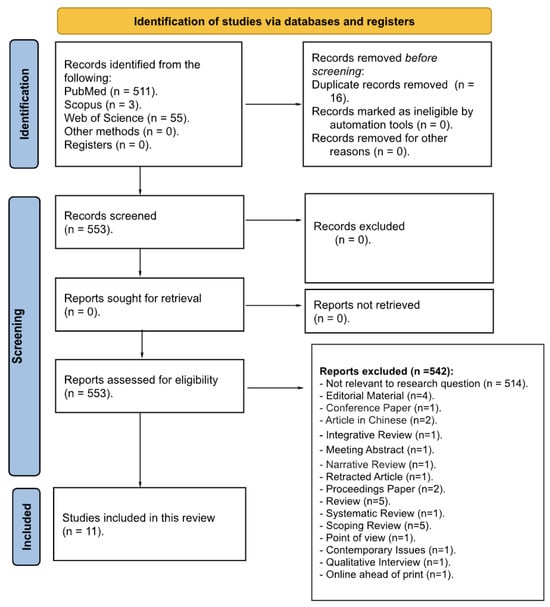
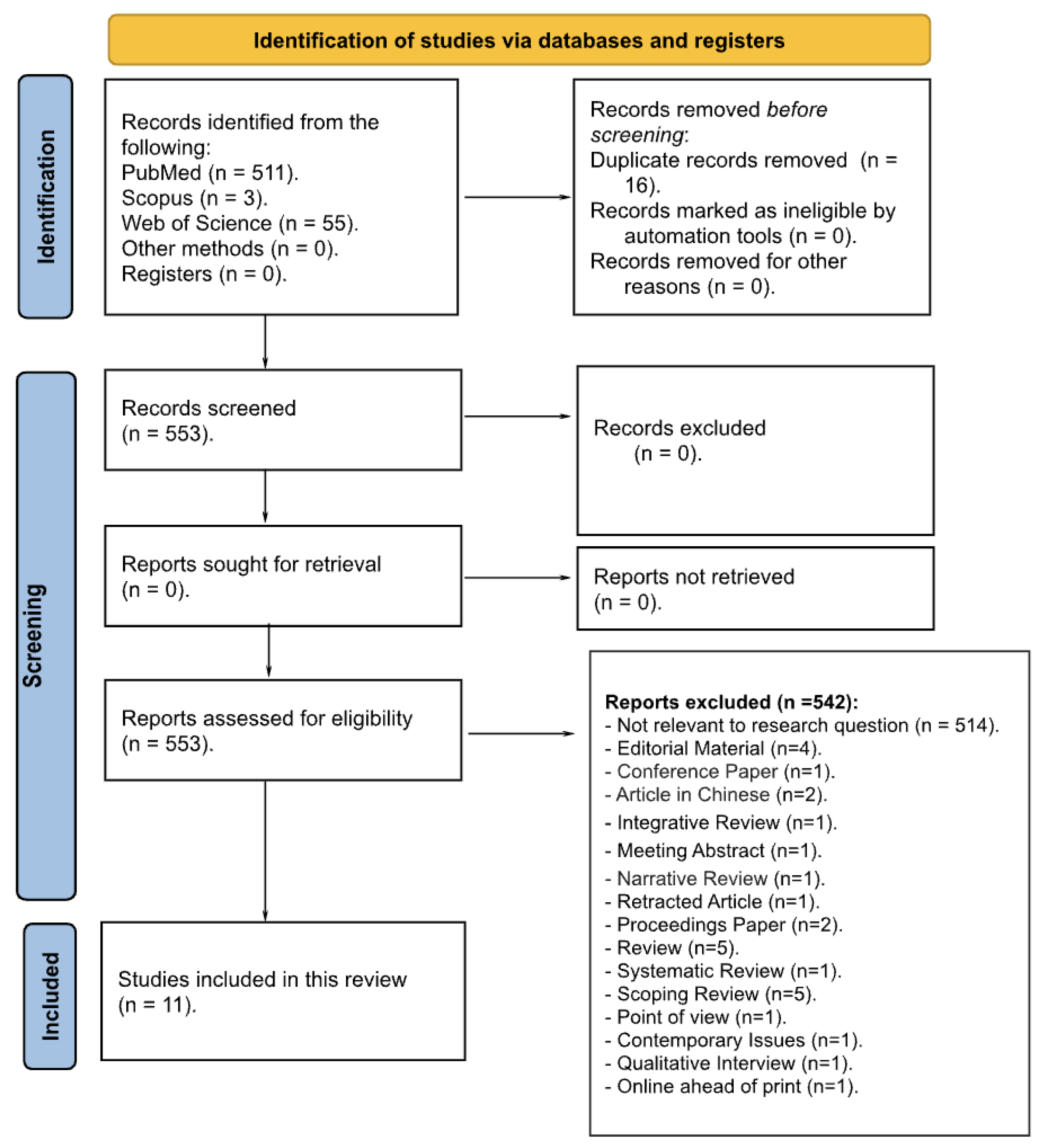
A total of 569 records were identified through database searches, including 511 from PubMed, 3 from Scopus, and 55 from WOS. No records were identified from other sources or registries. Prior to screening, 16 duplicate records were removed, resulting in 553 unique records for screening.
The titles and abstracts of these 553 records were reviewed, leading to the exclusion of 514 records that were not relevant to the research question. Specifically, 232 articles were excluded because they did not address artificial intelligence as defined in the eligibility criteria, while 282 were excluded because, despite referring to AI, they did not meet one or more elements of the PCC framework (Population, Concept, Context), such as not focusing on nursing education, not being original research, or falling outside the academic context. Additionally, 28 full-text articles were excluded for various reasons, as outlined in the PRISMA 2020 flow diagram (Figure 1). Ultimately, 11 studies met the inclusion criteria and were included in the final analysis.
Figure 1.
PRISMA 2020 flow diagram [18] of the research.
3.1. Characteristics of Sources of Evidence
This scoping review includes 11 original research articles, each analyzing the role and influence of AI in nursing students’ education. Specifically, the benefits, challenges, and future perspectives of this technology, as well as its impact on skill development during university training for future nurses, were examined. The articles included in this review were published between October 2019 and January 2025.
3.2. Results of Individual Sources of Evidence
The included studies are collected and summarized in Table 3. The table provides a comprehensive overview of the study development settings involving various international universities. Additionally, it shows the elements analyzed for conducting each individual study.
Table 3.
Summary of articles.
4. Discussion
4.1. Definitional Challenges in AI Educational Research
In this review, we adopted a broad and inclusive definition of artificial intelligence (AI), operationally described as any computer-based system capable of mimicking human cognitive functions such as learning, problem-solving, or reasoning. Although this approach aligns with perspectives in several prior reviews, such as Buchanan et al. [30], it raises important conceptual challenges. For example, tools like virtual patient (VP) simulations often rely on pre-programmed decision trees rather than adaptive or learning algorithms and, therefore, may not technically qualify as AI. This definitional ambiguity reflects a broader issue in the field: the lack of a shared, technically grounded understanding of what constitutes AI in educational contexts. As evidenced by Zawacki-Richter et al. [31], diverse digital tools are frequently labeled under the umbrella of “AI” despite operating on fundamentally different principles. Consequently, our review captures a wide spectrum of technological complexity—from simple rule-based systems to advanced generative models such as ChatGPT. This heterogeneity underscores the need for future research to clearly specify the functional capabilities of the technologies under investigation and to adopt more precise classifications. Clarifying these distinctions will strengthen the rigor and interpretability of future evidence in nursing education.
To address this heterogeneity, we propose a simple conceptual framework that classifies the AI technologies identified in this review into three main categories:
- **Generative**—AI Systems: These include tools based on large language models (e.g., ChatGPT), used primarily for content generation, writing assistance, or dialogic interaction.
- **Adaptive Learning Platforms**—These systems personalize educational content based on learner performance, often using machine learning techniques. They are typically integrated into learning management systems or digital teaching environments.
- **Simulation-Based Systems**—These include virtual patient simulations or interactive clinical scenarios that may be rule-based or enhanced with AI functionalities and are designed to support clinical reasoning and communication training.
This classification helps clarify the composite nature of the technologies included and allows for a more structured interpretation of their educational impacts.
4.2. Educational Benefits and Student Perceptions
The use of AI in nursing education is gaining increasing attention due to its potential to enhance the effectiveness and efficiency of learning. AI-driven technologies can transform nursing training [29], making it more interactive, personalized, and data-driven. It has been demonstrated that nursing students using AI systems, such as ChatGPT, report improvements in learning outcomes, clinical practice, and overall satisfaction [23]. However, these results are primarily based on self-reported measures—such as student reflections and satisfaction surveys—and not always corroborated by objective performance indicators. For instance, Gonzalez-Garcia et al. [23] reported statistically significant improvements in students’ perceived preparedness and engagement, although no clear gain in academic performance was observed. Similarly, Arcia [22] found that students appreciated the integration of generative AI in coursework while also emphasizing the need for clearer assignment instructions and more robust assessment tools. These AI-based tools foster critical thinking and enhance student engagement through innovative learning modalities [32]. Bumbach [28] emphasized how ChatGPT facilitated brainstorming and clinical reasoning exercises, particularly in graduate-level assignments, although the outcomes were not formally evaluated. AI can also enhance communication skills and decision-making abilities through virtual patients (VPs) and simulation environments. Shorey et al. [24] found that such tools increased students’ confidence in clinical interactions with patients, families, and multidisciplinary teams, although the outcomes were assessed qualitatively through student feedback. In contrast, Simsek-Cetinkaya and Cakir [21] used a randomized controlled design to compare AI-assisted and traditional simulations in breast self-examination training, showing greater satisfaction but reduced technical performance in the AI group. A positive attitude toward AI integration has been reported in multiple studies. Labrague et al. [26] emphasized the importance of cultivating openness to AI during university training to improve patient care outcomes. Similarly, Lukić et al. [20] found that students view AI positively in the context of professional preparation, particularly when technologies are clearly aligned with learning objectives and accompanied by adequate training. However, both studies relied on attitude scales rather than learning outcomes, highlighting a gap between perception and measurable impact. AI contributes to personalized learning experiences and fosters readiness for complex healthcare environments and interprofessional collaboration [28]. Recent findings confirm that nursing students exposed to AI-assisted teaching show improved engagement and readiness for clinical tasks, especially when AI is embedded in scenario-based learning or combined with reflective debriefing [33]. Moreover, Abujaber et al. demonstrated that incorporating AI technologies into nurse education increases student confidence, autonomy, and critical thinking, particularly in developing countries where such tools can help overcome faculty shortages [34].
4.3. The Research–Practice Gap in AI Integration
Our systematic search yielded only 11 empirical studies that met the inclusion criteria. This limited number of original research articles stands in stark contrast to the large volume of opinion pieces, commentaries, and conceptual discussions found during the screening process. Such a discrepancy suggests that the integration of AI in nursing education remains under-researched at an empirical level. This research–practice gap is particularly relevant given the growing presence of AI tools in healthcare and higher education. The scarcity of rigorous studies documenting actual implementation, outcomes, and challenges may hinder informed adoption by educators and institutions. This underscores the need for more primary research focused on real-world educational practices, user experiences, and long-term impacts of AI tools. We believe this review contributes to addressing this gap by mapping current empirical efforts and highlighting areas where future investigation is both needed and feasible.
4.4. Risks, Limitations, and Ethical Considerations
While AI tools offer significant opportunities to enhance nursing education, they are accompanied by important limitations that must be acknowledged and addressed [25]. One of the main risks concerns the emotional and psychological impact on students: Simsek-Cetinkaya and Cakir [21] found that AI-driven simulations increased student satisfaction but also heightened anxiety during virtual activities, a result confirmed by other studies [35,36]. In parallel, ethical concerns remain central, especially in relation to data privacy, the preservation of academic integrity, and the potential devaluation of the nursing degree, as highlighted by Summers et al. [19]. These risks underline the urgent need for institutional and national policies that define ethical guidelines for the use of AI, ensuring that its integration supports—not compromises—educational quality [37]. Furthermore, several authors stress the importance of equipping faculty with the skills needed to critically evaluate, implement, and supervise AI tools in academic settings [38]. Without adequate educator training, the integration of AI risks becoming superficial or misaligned with pedagogical goals. Krueger et al. [27] emphasized the importance of preventing misuse and ensuring the responsible adoption of AI, while El Arab et al. [25] noted that institutions must engage both students and faculty in shared strategies for its effective application. To ensure the safe and effective use of AI, students must not only be trained in its applications but also understand its risks [22]. Open dialogue between educators and learners is essential to encourage a balanced and reflective approach to AI use [39].
4.5. Policy Implications and Future Directions
Awareness of both the benefits and limitations of AI is essential to ensure its ethical implementation and preserve the integrity of the educational process. From a policy perspective, integrating AI into nursing curricula requires institutional and national guidelines addressing ethical standards, data privacy, and faculty readiness. Such policies should support educator training and promote equitable access to AI tools across institutions [13,30,40,41,42]. Preparing nursing students today means equipping future professionals with the competencies necessary to safely integrate AI into clinical practice.
4.6. Limitations
This scoping review presents several limitations that should be considered when interpreting the results. First, the selection of databases may have led to the exclusion of relevant studies not indexed in PubMed, Scopus, or Web of Science. In addition, the inclusion of only English-language publications may have resulted in the omission of valuable research published in other languages, thereby limiting the global applicability of the findings. The included studies also varied widely in terms of AI technologies, research designs, and educational settings. This heterogeneity made it difficult to conduct a uniform synthesis and reduced the comparability of findings across contexts. Moreover, all the studies analyzed were conducted in high-income countries, such as the United States, Australia, Singapore, Croatia, and Spain. This geographic concentration limits the generalizability of results to low- and middle-income settings, where access to AI technologies, digital infrastructure, and faculty training may differ significantly. Furthermore, recent scoping reviews of generative AI in education have also noted a complete absence of studies from low- and lower-middle-income countries, highlighting marked gaps in our understanding of socio-economic and cultural influences on AI adoption [43,44]. Finally, the rapid pace of technological advancement in AI presents a temporal limitation. Some of the included studies reference technologies or tools that may already be considered outdated in 2025. This temporal gap may affect the relevance and applicability of earlier findings. Ongoing research and regular updates will be essential to align the evidence base with current and emerging developments in AI.
5. Conclusions
The integration of artificial intelligence (AI) in nursing education offers transformative opportunities to make learning more interactive, personalized, and data-driven, thereby enhancing both theoretical knowledge and clinical competencies among students. Technologies such as virtual patients (VPs) and generative systems like ChatGPT have shown potential to improve student engagement, boost confidence, and support the development of communication and decision-making skills during clinical training. However, these benefits must be balanced with critical attention to ethical, technical, and pedagogical risks. Concerns persist regarding data privacy, academic integrity, and the appropriate use of AI tools in educational settings. Therefore, it is crucial that nursing curricula integrate not only technological tools but also structured frameworks for their responsible use. Faculty development plays a pivotal role in this process: educators must be equipped with the knowledge and skills necessary to effectively evaluate, implement, and supervise AI-based learning resources. Equally important is ensuring equitable access to AI technologies across diverse institutions and student populations. From a policy perspective, the development of institutional guidelines and national strategies is essential to ensure that the integration of AI supports innovation without compromising educational quality. In summary, AI represents a promising resource for both the present and the future of nursing education. To fully realize its potential, it is essential to address the ethical, pedagogical, and infrastructural challenges and to support educators and students through informed, inclusive, and forward-thinking approaches.
Author Contributions
Conceptualization, F.C., R.L. and L.C.; methodology, F.C., D.M., R.L. and L.C.; literature search, F.C., D.M., M.R., G.S. and L.C.; formal analysis, F.C., M.R., R.L. and L.C.; data curation, F.C., D.M., M.R., G.S., R.L. and L.C.; software, D.C.; visualization, F.C. and D.C.; methodological support, D.C.; writing—original draft preparation, F.C., R.L. and L.C.; writing—review and editing, F.C., D.M., R.L. and L.C.; critical review of the manuscript, C.C. and I.R.; scientific supervision, E.V.; methodological supervision, G.D.N.; supervision, F.C., R.L. and L.C.; project administration, F.C. and L.C. All authors have read and agreed to the published version of the manuscript.
Funding
This research received no external funding.
Institutional Review Board Statement
Not applicable.
Informed Consent Statement
Not applicable.
Data Availability Statement
The original contributions presented in this study are included in this article. Further inquiries can be directed to the corresponding author.
Public Involvement Statement
There was no public involvement in any aspect of this research.
Guidelines and Standards Statement
This manuscript was drafted following the PRISMA-ScR (Preferred Reporting Items for Systematic reviews and Meta-Analyses extension for Scoping Reviews) guidelines for scoping review research.
Use of Artificial Intelligence
AI or AI-assisted tools were not used in drafting any aspect of this manuscript.
Conflicts of Interest
The authors declare no conflicts of interest.
References
- Arigliani, M.; Toraldo, D.M.; Montevecchi, F.; Conte, L.; Galasso, L.; De Rosa, F.; Lattante, C.; Ciavolino, E.; Arigliani, C.; Palumbo, A.; et al. A New Technological Advancement of the Drug-Induced Sleep Endoscopy (DISE) Procedure: The “All in One Glance” Strategy. Int. J. Environ. Res. Public Health 2020, 17, 4261. [Google Scholar] [CrossRef] [Scilit]
- Lupo, R.; Zaminga, M.; Carriero, M.C.; Santoro, P.; Artioli, G.; Calabrò, A.; Ilari, F.; Benedetto, A.; Caslini, M.; Clerici, M.; et al. Eating Disorders and Related Stigma: Analysis among a Population of Italian Nursing Students. Acta Biomed. 2020, 91, e2020011. [Google Scholar] [CrossRef] [Scilit]
- Conte, L.; Lupo, R.; Lezzi, A.; Paolo, V.; Rubbi, I.; Rizzo, E.; Carvello, M.; Calabrò, A.; Botti, S.; De Matteis, E.; et al. A Nationwide Cross-Sectional Study Investigating Adherence to the Mediterranean Diet, Smoking, Alcohol and Work Habits, Hormonal Dynamics between Breast Cancer Cases and Healthy Subjects. Clin. Nutr. Open Sci. 2024, 55, 1–19. [Google Scholar] [CrossRef] [Scilit]
- Caldo, D.; Bologna, S.; Conte, L.; Amin, M.S.; Anselma, L.; Basile, V.; Hossain, M.M.; Mazzei, A.; Heritier, P.; Ferracini, R.; et al. Machine Learning Algorithms Distinguish Discrete Digital Emotional Fingerprints for Web Pages Related to Back Pain. Sci. Rep. 2023, 13, 4654. [Google Scholar] [CrossRef] [Scilit]
- European Parliament. What Is Artificial Intelligence and How Is It Used? Available online: https://www.europarl.europa.eu/topics/en/article/20200827STO85804/what-is-artificial-intelligence-and-how-is-it-used (accessed on 1 April 2025).
- Athilingam, P.; He, H.-G. ChatGPT in Nursing Education: Opportunities and Challenges. Teach. Learn. Nurs. 2024, 19, 97–101. [Google Scholar] [CrossRef] [Scilit]
- Tam, W.; Huynh, T.; Tang, A.; Luong, S.; Khatri, Y.; Zhou, W. Nursing Education in the Age of Artificial Intelligence Powered Chatbots (AI-Chatbots): Are We Ready Yet? Nurse Educ. Today 2023, 129, 105917. [Google Scholar] [CrossRef] [Scilit] [PubMed]
- Padilha, J.M.; Machado, P.P.; Ribeiro, A.; Ramos, J.; Costa, P. Clinical Virtual Simulation in Nursing Education: Randomized Controlled Trial. J. Med. Internet Res. 2019, 21, e11529. [Google Scholar] [CrossRef] [Scilit]
- Yeung, J.W.Y.; Ho, K.H.M.; Cheung, J.; Tsang, J.T.Y.; Chong, D.K.Y. Artificial Intelligence-Based Technology in Communication Training in Nursing Education: A Scoping Review. J. Prof. Nurs. 2025, 59, 40–50. [Google Scholar] [CrossRef] [Scilit]
- Shen, M.; Shen, Y.; Liu, F.; Jin, J. Prompts, Privacy, and Personalized Learning: Integrating AI into Nursing Education—A Qualitative Study. BMC Nurs. 2025, 24, 470. [Google Scholar] [CrossRef] [Scilit] [PubMed]
- Ball Dunlap, P.A.; Michalowski, M. Advancing AI Data Ethics in Nursing: Future Directions for Nursing Practice, Research, and Education. JMIR Nurs. 2024, 7, e62678. [Google Scholar] [CrossRef] [Scilit] [PubMed]
- De Gagne, J.C. The State of Artificial Intelligence in Nursing Education: Past, Present, and Future Directions. Int. J. Environ. Res. Public Health 2023, 20, 4884. [Google Scholar] [CrossRef] [Scilit] [PubMed]
- El Arab, R.A.; Al Moosa, O.A.; Abuadas, F.H.; Somerville, J. The Role of AI in Nursing Education and Practice: Umbrella Review. J. Med. Internet Res. 2025, 27, e69881. [Google Scholar] [CrossRef] [Scilit] [PubMed]
- World Health Organization. Global Strategy on Digital Health 2020–2025; World Health Organization: Geneva, Switzerland, 2021. [Google Scholar]
- International Council of Nurses. Digital Health Transformation and Nursing Practice; International Council of Nurses: Geneva, Switzerland, 2023. [Google Scholar]
- Castonguay, A.; Farthing, P.; Davies, S.; Vogelsang, L.; Kleib, M.; Risling, T.; Green, N. Revolutionizing Nursing Education through Ai Integration: A Reflection on the Disruptive Impact of ChatGPT. Nurse Educ. Today 2023, 129, 105916. [Google Scholar] [CrossRef] [Scilit]
- Booth, R.G.; Strudwick, G.; McBride, S.; O’Connor, S.; Solano López, A.L. How the Nursing Profession Should Adapt for a Digital Future. BMJ 2021, 373, n1190. [Google Scholar] [CrossRef] [Scilit]
- Page, M.J.; McKenzie, J.E.; Bossuyt, P.M.; Boutron, I.; Hoffmann, T.C.; Mulrow, C.D.; Shamseer, L.; Tetzlaff, J.M.; Akl, E.A.; Brennan, S.E.; et al. The PRISMA 2020 Statement: An Updated Guideline for Reporting Systematic Reviews. BMJ 2021, 372, n71. [Google Scholar] [CrossRef] [Scilit]
- Summers, A.; El Haddad, M.; Prichard, R.; Clarke, K.-A.; Lee, J.; Oprescu, F. Navigating Challenges and Opportunities: Nursing Student’s Views on Generative AI in Higher Education. Nurse Educ. Pract. 2024, 79, 104062. [Google Scholar] [CrossRef] [Scilit] [PubMed]
- Lukić, A.; Kudelić, N.; Antičević, V.; Lazić-Mosler, E.; Glunčić, V.; Hren, D.; Lukić, I.K. First-Year Nursing Students’ Attitudes towards Artificial Intelligence: Cross-Sectional Multi-Center Study. Nurse Educ. Pract. 2023, 71, 103735. [Google Scholar] [CrossRef] [Scilit] [PubMed]
- Simsek-Cetinkaya, S.; Cakir, S.K. Evaluation of the Effectiveness of Artificial Intelligence Assisted Interactive Screen-Based Simulation in Breast Self-Examination: An Innovative Approach in Nursing Students. Nurse Educ. Today 2023, 127, 105857. [Google Scholar] [CrossRef] [Scilit]
- Arcia, A. Incorporation of Generative AI in an Introductory Nursing Informatics Course. Stud. Health Technol. Inform. 2024, 315, 505–510. [Google Scholar] [CrossRef] [Scilit]
- Gonzalez-Garcia, A.; Bermejo-Martinez, D.; Lopez-Alonso, A.I.; Trevisson-Redondo, B.; Martín-Vázquez, C.; Perez-Gonzalez, S. Impact of ChatGPT Usage on Nursing Students Education: A Cross-Sectional Study. Heliyon 2025, 11, e41559. [Google Scholar] [CrossRef] [Scilit] [PubMed]
- Shorey, S.; Ang, E.; Yap, J.; Ng, E.D.; Lau, S.T.; Chui, C.K. A Virtual Counseling Application Using Artificial Intelligence for Communication Skills Training in Nursing Education: Development Study. J. Med. Internet Res. 2019, 21, e14658. [Google Scholar] [CrossRef] [Scilit]
- Lane, S.H.; Haley, T.; Brackney, D.E. Tool or Tyrant: Guiding and Guarding Generative Artificial Intelligence Use in Nursing Education. Creat. Nurs. 2024, 30, 125–132. [Google Scholar] [CrossRef] [Scilit]
- Labrague, L.J.; Aguilar-Rosales, R.; Yboa, B.C.; Sabio, J.B. Factors Influencing Student Nurses’ Readiness to Adopt Artificial Intelligence (AI) in Their Studies and Their Perceived Barriers to Accessing AI Technology: A Cross-Sectional Study. Nurse Educ. Today 2023, 130, 105945. [Google Scholar] [CrossRef] [Scilit] [PubMed]
- Krueger, L.; Clemenson, S.; Johnson, E.; Schwarz, L. ChatGPT in Higher Education: Practical Ideas for Addressing Artificial Intelligence in Nursing Education. J. Nurs. Educ. 2025, 64, 323–326. [Google Scholar] [CrossRef] [Scilit] [PubMed]
- Bumbach, M.D. The Use of AI Powered ChatGPT for Nursing Education. J. Nurs. Educ. 2024, 63, 564–567. [Google Scholar] [CrossRef] [Scilit]
- Bumbach, M.D.; Carrington, J.M.; Love, R.; Bjarnadottir, R.; Cho, H.; Keenan, G. The Use of Artificial Intelligence for Graduate Nursing Education: An Educational Evaluation. J. Am. Assoc. Nurse Pract. 2024, 36, 486–490. [Google Scholar] [CrossRef] [Scilit]
- Buchanan, C.; Howitt, M.L.; Wilson, R.; Booth, R.G.; Risling, T.; Bamford, M. Predicted Influences of Artificial Intelligence on Nursing Education: Scoping Review. JMIR Nurs. 2021, 4, e23933. [Google Scholar] [CrossRef] [Scilit] [PubMed]
- Zawacki-Richter, O.; Marín, V.I.; Bond, M.; Gouverneur, F. Systematic Review of Research on Artificial Intelligence Applications in Higher Education—Where Are the Educators? Int. J. Educ. Technol. High. Educ. 2019, 16, 39. [Google Scholar] [CrossRef] [Scilit]
- Lupo, R.; Zacchino, S.; Caldararo, C.; Calabrò, A.; Carriero, M.C.; Santoro, P.; Carvello, M.; Conte, L. The Use of Electronical Devices and Relative Levels of Nomophobia within a Group of Italian Nurses: An Observational Study. Epidemiol. Biostat. Public Health 2022, 17, e13272-1–e13272-10. [Google Scholar] [CrossRef] [Scilit]
- Ostick, M.; Mariani, B.; Lovecchio, C.; Moriarty, H. Nursing Student and Faculty Attitudes, Perceptions, and Behavioral Intentions of Artificial Intelligence Use in Nursing Education. Nurs. Educ. Perspect. 2025, 46, E7–E11. [Google Scholar] [CrossRef] [Scilit]
- Abujaber, A.A.; Abd-alrazaq, A.; Al-Qudimat, A.R.; Nashwan, A.J. A Strengths, Weaknesses, Opportunities, and Threats (SWOT) Analysis of ChatGPT Integration in Nursing Education: A Narrative Review. Cureus 2023, 15, e48643. [Google Scholar] [CrossRef] [Scilit]
- George, T.P.; DeCristofaro, C.; Murphy, P.F. Self-Efficacy and Concerns of Nursing Students Regarding Clinical Experiences. Nurse Educ. Today 2020, 90, 104401. [Google Scholar] [CrossRef] [Scilit]
- Yockey, J.; Henry, M. Simulation Anxiety across the Curriculum. Clin. Simul. Nurs. 2019, 29, 29–37. [Google Scholar] [CrossRef] [Scilit]
- Popenici, S.A.D.; Kerr, S. Exploring the Impact of Artificial Intelligence on Teaching and Learning in Higher Education. Res. Pract. Technol. Enhanc. Learn. 2017, 12, 22. [Google Scholar] [CrossRef] [Scilit]
- Hensel, D.; Moorman, M.; Stuffle, M.E.; Holtel, E.A. Faculty Development Needs and Approaches to Support Course Examination Development in Nursing Programs. Nurse Educ. 2024, 49, 315–320. [Google Scholar] [CrossRef] [Scilit] [PubMed]
- Rubbi, I.; Lupo, R.; Lezzi, A.; Cremonini, V.; Carvello, M.; Caricato, M.; Conte, L.; Antonazzo, M.; Caldararo, C.; Botti, S.; et al. The Social and Professional Image of the Nurse: Results of an Online Snowball Sampling Survey among the General Population in the Post-Pandemic Period. Nurse Rep. 2023, 13, 1291–1303. [Google Scholar] [CrossRef] [Scilit] [PubMed]
- Shin, H.; De Gagne, J.C.; Kim, S.S.; Hong, M. The Impact of Artificial Intelligence-Assisted Learning on Nursing Students’ Ethical Decision-Making and Clinical Reasoning in Pediatric Care. CIN Comput. Inform. Nurs. 2024, 42, 704–711. [Google Scholar] [CrossRef] [Scilit] [PubMed]
- Abou Hashish, E.A.; Alnajjar, H. Digital Proficiency: Assessing Knowledge, Attitudes, and Skills in Digital Transformation, Health Literacy, and Artificial Intelligence among University Nursing Students. BMC Med. Educ. 2024, 24, 508. [Google Scholar] [CrossRef] [Scilit] [PubMed]
- Glauberman, G.; Ito-Fujita, A.; Katz, S.; Callahan, J. Artificial Intelligence in Nursing Education: Opportunities and Challenges. Hawaii J. Health Soc. Welf. 2023, 82, 302–305. [Google Scholar]
- Ng, S.H.S.; Chan, H.; Wong, J.H.K.; Foong, L.S.C.; Privitera, A.J. A Scoping Review of the Use of Generative AI in Assessment in Higher Education 2024. Available online: https://www.researchgate.net/publication/383093207_A_Scoping_Review_of_the_Use_of_Generative_AI_in_Assessment_in_Higher_Education (accessed on 2 April 2025).
- Vitale, E.; Lupo, R.; Artioli, G.; Mea, R.; Lezzi, P.; Conte, L.; De Nunzio, G. How shift work influences anxiety, depression, stress and insomnia conditions in Italian nurses: An exploratory study. Acta Biomed. 2023, 94, e2023102. [Google Scholar] [CrossRef] [Scilit]

Disclaimer/Publisher’s Note: The statements, opinions and data contained in all publications are solely those of the individual author(s) and contributor(s) and not of MDPI and/or the editor(s). MDPI and/or the editor(s) disclaim responsibility for any injury to people or property resulting from any ideas, methods, instructions or products referred to in the content. |
© 2025 by the authors. Licensee MDPI, Basel, Switzerland. This article is an open access article distributed under the terms and conditions of the Creative Commons Attribution (CC BY) license (https://creativecommons.org/licenses/by/4.0/).