


Abstract
Background/Objective: One of the missions of the United States FDA is “protecting the public health by ensuring the safety, efficacy, and security of human and veterinary drugs, biological products.” The current guidelines for OTC hearing aids impose an output limit of 111 dB SPL for linear hearing aids and 117 dB SPL for compression hearing aids when measured using 90 dB SPL pure tones in a 2 cc coupler. This means that the sound pressure level at the ear drum at a frequency would be 111 or 117 dB SPL plus the real-ear-to-coupler difference (RECD) of the 2 cc coupler at the frequency. Methods: The maximum aidable hearing thresholds by hypothetical OTC-compression hearing aids that are compliant with the current FDA guidelines were explored using NAL-NL2 and DSLv5 prescriptive methods. The theoretical maximum permissible overall output levels in the ear canal were also calculated. Additionally, the fitting range of OTC-compression hearing aids with a maximum of 117 dB SPL output level at the ear drum was explored. Results: The current FDA guidelines allow OTC-compression hearing aids to provide sufficient gain and headroom to fit individuals with severe to profound hearing loss. In the presence of a loud wideband signal, the maximum overall output level can reach 164.5 dB SPL in the ear canal for an OTC-compression hearing aid with a bandwidth of 5657 Hz. When the maximum output levels are defined at the ear drum (i.e., the RECD is already considered), however, the fitting range is lowered to moderate hearing loss and the maximum overall output level is lowered by 10 dB. Conclusions: These findings identified potential regulatory vulnerability in the current FDA guidelines and suggest the need to take the measurement coupler and its corresponding RECDs into account when setting the guidelines for OTC hearing aids. Other alternative strategies to prevent potential abuses of the guidelines are also discussed.
Keywords:
over-the-counter; OTC; hearing aids; FDA; guidelines; real-ear-to-coupler difference; RECD 1. Introduction
The United States Food and Drug Administration (FDA) is responsible for developing guidelines to ensure public safety before the launch of any new medical devices and for reinforcing such guidelines in case of incompliance [1]. Globally, approximately 1.57 billion people have some degree of hearing loss [2] and ~90% of them have mild to moderate hearing loss [3]. In 2017, the FDA established over-the-counter (OTC) hearing aids as a new category of medical devices aiming to reduce barriers and improve access to amplification and to reduce the negative impact of untreated hearing loss [4]. Although the FDA’s definition for OTC hearing aid is to treat perceived mild to moderate hearing loss, Chung and Zeng [5] showed that the current guidelines could adequately fit individuals with 80 dB HL of flat sensorineural hearing loss. This paper further explores the maximum fitting range of OTC hearing aids, the maximum overall sound pressure level at the ear drum, and alternative considerations for the guidelines.
Hearing loss negatively impacts communication, physical and mental health, learning, income, and quality of life [6,7,8,9,10,11]. It is also associated with loneliness, depression, cognitive decline, high risk for cardiovascular disease, hypertension, hospitalizations, falls, and mortality among older adults [12,13,14,15,16,17,18]. Treating hearing loss, therefore, has become one of the global priorities for organizations such as the US National Academies of Sciences, Engineering, and Medicine [19], World Health Assembly [20], World Health Organization [21] and a Lancet Commission [22,23].
Amplification devices such as hearing aids and cochlear implants are effective options for managing the majority of chronic hearing loss cases. They improve the communication abilities of users, enable them to engage in more social interactions, and enhance their quality of life [24,25,26]. Recent studies also suggest that hearing loss is one of the two greatest modifiable causes for dementia later in life and mediating hearing loss in mid-life can reduce the world’s population with dementia by 7% [23]. Despite these benefits, individuals with hearing loss in the United States often wait 4 to more than 6 years to get their hearing aids after first noticing their hearing difficulties [27]. Individuals in other parts of the world may wait significantly longer before seeking help or they may never wear hearing aids—only 9–15% of individuals with hearing loss in low-to-middle income countries wear hearing aids [3]. Two of the major barriers often cited for not seeking amplification are: (1) the high cost of hearing aids because prescription hearing aids often cost thousands of dollars; and (2) difficulties accessing services because the hearing aid fitting process often takes several appointments with audiologists or hearing professionals [28,29,30,31]. The good news is that approximately 70% of users wished they had gotten their hearing aids sooner [32], indicating the positive impact of amplification in their lives.
In 2017, the FDA established a set of guidelines for OTC hearing aids to provide amplification for individuals with perceived mild to moderate hearing loss [4]. The American Speech-Language-Hearing Association defines a mild to moderate hearing loss as having hearing thresholds of 26–55 dB HL [33] and the World Health Organization as thresholds of 20–49 dB HL [3].
Before the final/current guidelines [34] went into effect, the FDA invited public comments. Experts from American Academy of Audiology, Academy of Doctors of Audiology, American Speech-Language-Hearing Association, and International Hearing Society formed a working group and jointly published the Consensus Paper from Hearing Care Associations [35]. Two of the five recommendations made to FDA were (1) to establish product requirements appropriate for OTC hearing aids targeting mild to moderate hearing impairment, and (2) to provide adequate consumer protection, in coordination with the Federal Trade Commission.
As part of the recommendations to establish production requirements appropriate for OTC hearing aids targeting mild to moderate hearing impairment, the four-organization working group recommended the FDA to require OTC hearing aid to have input compression with a volume control to reduce the likelihood of overamplification and loudness discomfort. Based on the gain targets of the hearing prescriptive methods developed by National Acoustics Laboratories (NAL-NL2 [36]), the working group also recommended to limit the average gain of OTC hearing aids at 1000, 1600 and 2500 Hz for pure tones presented at 50 dB SPL to be at or below 25 dB when the hearing aid is programmed to the maximum volume [37]. They also recommended limiting the coupling device to instant fit tips and requiring potential users to see an audiologist, should custom earmolds be needed.
In addition, the working group recommended limiting the maximum output level of OTC hearing aids with input compression to 110 dB SPL when measured using the ANSI/ASA S3.22:2014 (R2020) OSPL90 protocol. This is because the calculations of Johnson [38] revealed that, to avoid causing additional hearing loss due to overamplification, the outputs of hearing aids for individuals with moderate hearing loss should not exceed an overall level of 111 dB SPL in the ear canal for 8–8.5 h of daily usage. The OSPL90 testing protocol measures the maximum output levels of hearing aids in 2 cc couplers in response to pure tones presented at 90 dB SPL when the hearing aids are set to the maximum volume (i.e., full-on gain). As the OSPL90 is measured using pure tones presented one at a time from low to high frequency (i.e., a pure tone sweep), the working group also acknowledged that the overall level of the hearing aid in response to a complex signal would be much greater than 110 dB SPL.
Despite these recommendations, the FDA’s current guidelines do not limit the gain nor the type of coupling device. They allow a maximum output limit of 111 dB for OTC hearing aids with linear amplification (OTC-linear) and 117 dB for OTC hearing aids with input compression (OTC-compression) when measured in a 2 cc coupler [34]. One of the crucial aspects that is not mentioned in the FDA’s nor the joint working group’s documents, is the real-ear-to-coupler differences (RECDs). All the measurements in both documents were specified using the ANSI/ASA S3.22:2014 (R2020) standard [37], which uses the 2 cc coupler as the standard measurement coupler.
The 2 cc couplers have a volume of 2 cc. Yet the residue ear canal volume when a custom hearing aid is worn in the ear or when the output of a behind-the-ear hearing aid is coupled in the ear canal with an earmold or a dome, is typically between 0.5 and 1.5 cc, depending on the size of the ear canal and how deep the earmold/dome is placed in the ear canal [39]. The current FDA guidelines specify the insertion depth of the coupling device (e.g., dome or earmold) needs to be 10 mm or more from the ear drum, which leaves a volume of ~0.51 cc (calculated from Voss and colleagues [40], 0.616/12 × 10 = 0.51 cc). With RECDs considered, the maximum sound pressure level permitted at the ear drum is equal to the maximum level in a 2 cc coupler (i.e., 111 or 117 dB SPL) plus the RECDs of the 2 cc coupler at each frequency. After adding the RECD values, the sound pressure levels at the ear drum permitted by the current FDA guidelines become 120–140 dB SPL for OTC-compression hearing aids and 114–134 dB SPL for OTC-linear hearing aids [5].
Chung and Zeng [5] showed that OTC hearing aids that meet the current guidelines were able to fit individuals with 80 dB HL flat hearing loss monaurally. As NAL-NL2 prescribes 2 dB less gain at low input levels and up to 6 dB less gain at high input levels for binaural fittings compared to monaural fittings [36], OTC-compression hearing aids can potentially meet the prescriptive targets for binaural users with even higher degrees of hearing loss. These analysis findings raised additional questions about the limits of the current FDA guidelines: What is the maximum hearing loss that OTCs can fit? Are the guidelines suitable for individuals with mild to moderate hearing loss? With the goal to “regulate all hearing aids to ensure safety and effectiveness for consumers” [41], does the guidelines have potential vulnerability that would allow others to circumvent the existing safety regulations for prescription hearing aids to fit individuals with much higher degrees of hearing loss?
Currently, four of the big five hearing aid companies have marketed OTC hearing aids (e.g., ReSound’s Jabra) or jointly developed OTC hearing aids with another company (e.g., WS with Sony). They definitely have the capability and the know-how to design and market OTC hearing aids with the maximum output levels specified in the FDA current guidelines. Additionally, there are more than 200 amplification apps in the iOS App Store for APPLE smartphones and more than 30 apps in the Google Play Store for ANDROID smartphones. Many of them use earbuds to provide amplification. The frequency responses of traditional hearing aids are usually designed to have a prominent peak(s) between 2000 and 4000 Hz to compensate for the insertion loss [42]. The frequency responses of many earbuds, however, are relatively flat with amplitudes within 10 dB from low to high frequencies [43,44,45,46]. The effects of these relatively flat frequency responses on the overall levels of OTC hearing aids permitted by the current FDA guidelines and the maximum hearing loss they can fit have not been explored.
The purposes of the following analyses are to examine: (1) the maximum aidable hearing thresholds of OTC-compression hearing aids permitted by the current FDA hearing aid guidelines after applying the RECDs, (2) the maximum overall output sound pressure level in the 2 cc coupler and in the ear canal permissible by the current FDA guidelines, and (3) the maximum aidable hearing thresholds and the maximum overall output sound pressure level of an OTC-compression hearing aid if the 117 dB SPL limit is defined in the ear instead of in the 2 cc coupler (i.e., the effects of RECD is accounted for). OTC-compression hearing aids are chosen because most modern hearing aids have compression algorithms/circuits. The findings will shed light on the implications of the current FDA guidelines and provide evidence for alternative strategies to ensure the safety of OTC hearing aids.
2. Methods
2.1. Maximum Aidable Hearing Thresholds
The maximum aidable hearing thresholds were determined by using a VeriFit2 Hearing Aid Verification System (AudioScan, Dorchester, ON, Canada), which is capable of generating real ear aided response (REAR) targets at different input levels using several hearing aid fitting prescriptive methods based on the perspective user’s hearing thresholds [47]. The available hearing aid prescriptive methods include: NAL-NL2 [48], DSLv5 [49], CAM-REST [50], and CAMEQ2-HF [51]. Although both have children and adult versions, NAL-NL2 is the most used for fitting adults and DSLv5 for children [35]. As the FDA [34] indicated that they do not want to make decisions on the guidelines based on a particular fitting prescriptive method, both NAL-NL2 and DSLv5 are included in the following analyses.
The current FDA guidelines only specify the output limits of the OTC hearing aids and do not limit the maximum permissible gain. This means that the maximum sound pressure levels at the ear drum (i.e., in situ) across the audiometric frequencies are the limits for any hearing aid fitting. The maximum in situ sound pressure levels can be calculated by adding the RECD for 2 cc coupler at each frequency plus the maximum output permissible by the FDA guidelines (i.e., RECD + 111 dB for OTC-linear hearing aids, and RECD + 117 for OTC-compression hearing aids). Please see how RECDs are used in the hearing aid fitting process in Supplementary File S1.
In hearing aid fittings, the maximum in situ sound pressure levels are often determined by the uncomfortable loudness levels (UCLs) of the hearing aid user or the maximum power outputs (MPOs) of the hearing aids across frequencies. UCLs represent the sound pressure level at which the sound becomes uncomfortable to listen to and the MPOs represent the output levels that the hearing aid should not or cannot exceed at different frequencies. The MPO settings are usually tested using the OSPL90 protocol specified by ANSI/ASA S3.22-2014 (R2020) [37]. When the MPOs are not limited by the physical capabilities of the hearing aid, they are usually determined by the UCLs of the user and the term MPOs can be used interchangeably with UCLs in such cases. Both NAL-NL2 [48] and DSLv5 [49] recommend limiting the maximum output of the hearing aids based on the UCLs but NAL-NL2 uses the term UCLs and DSLv5 uses the term MPOs. To generate the fitting targets, the audiologist can enter the hearing aid user’s individual UCLs or apply average UCLs based on the user’s hearing thresholds.
Before the search for the maximum aidable hearing thresholds on VeriFit2, several other parameters also need to be considered. First, Verifit2 allows several different types of testing stimuli to be used in the fitting target generation process (e.g., pure tones, the “carrot passage”, or ISTS). The fitting targets generated by using different input stimuli are different because the stimuli have different spectral shapes. The International Speech Test Signal (ISTS) consists of words from six different languages spoken by six female talkers [52,53]. The ISTS was used as the speech stimuli in the current study because it has similar spectral shape as the International Long-Term Average Speech Spectrum.
Second, the hearing aid fitting targets can be generated for binaural or monaural fittings. The target gains are usually lower for binaural fittings because of loudness summation. However, the UCLs and MPOs estimated by both NAL-NL2 and DSLv5 are identical for monaural or binaural fittings. Monaural hearing aid fitting is used in the analyses with the understanding that the gains of binaural fittings are lower than those reported in this study. Other parameters used to generate the maximum aidable hearing thresholds include: (1) Insert + Foam as the transducer used to test hearing thresholds, (2) average RECD for adults, (3) non-tonal language for NAL-NL2, (4) BTE + custom mold as the hearing aid style, and (5) occluded earmold as the sound coupling device.
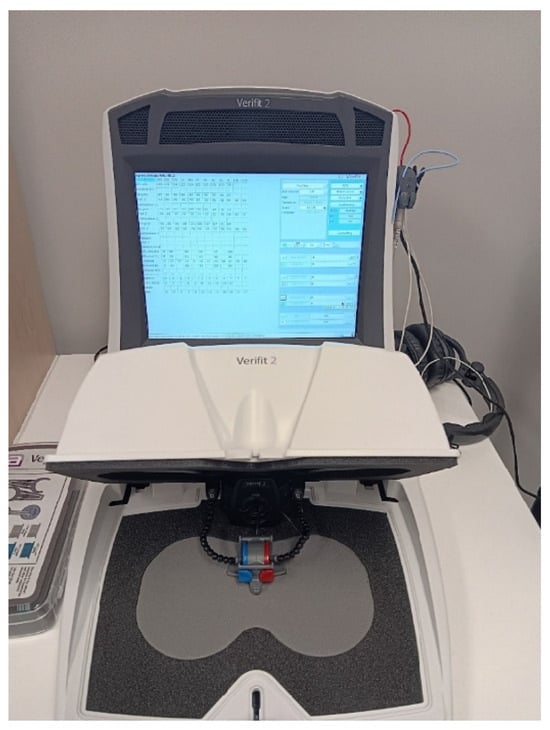
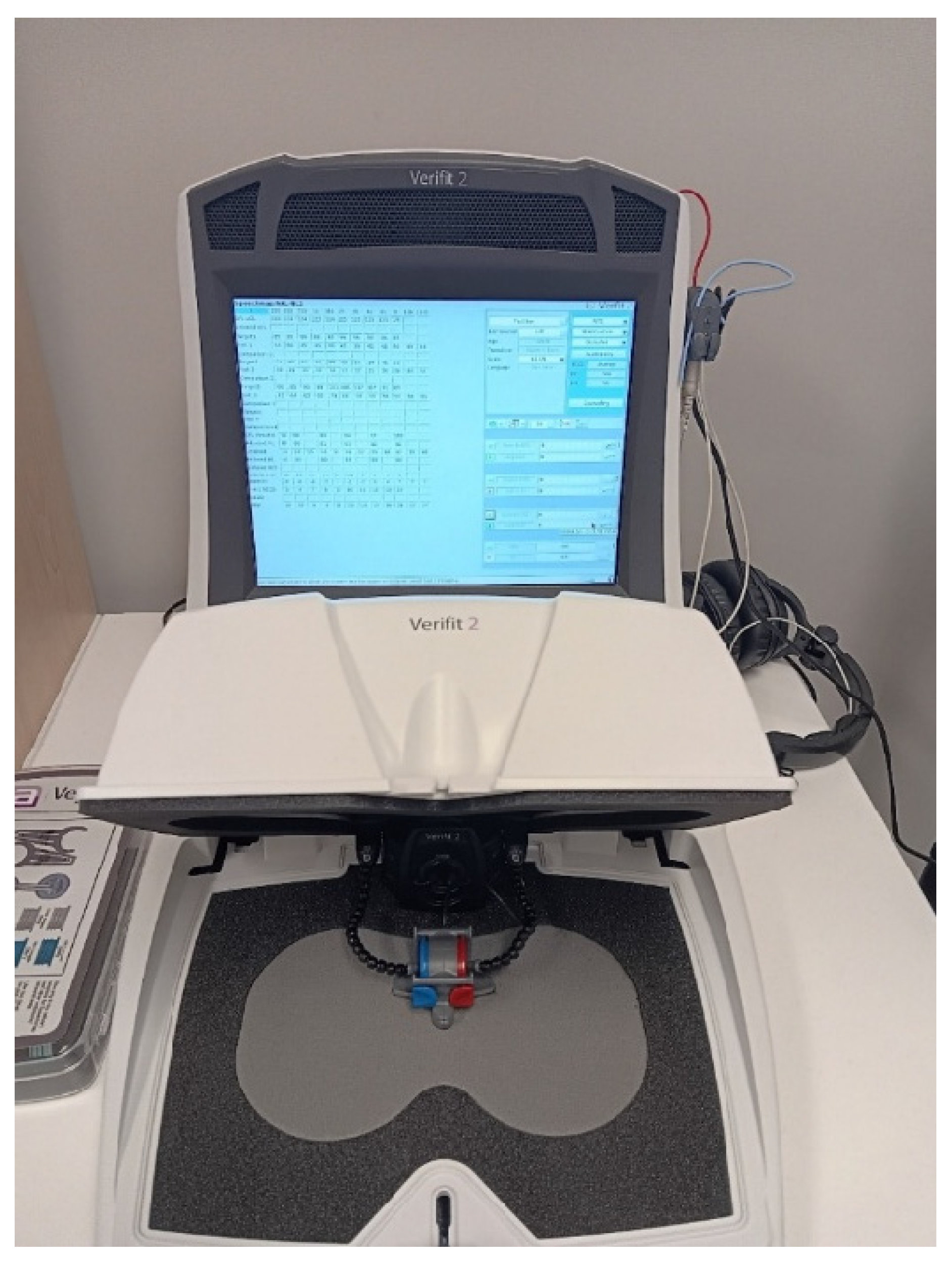
To find the maximum aidable hearing threshold at each frequency, an 80 dB HL hearing threshold was entered into VeriFit2 (Figure 1) and the threshold was increased or decreased in 5 dB steps until the UCL predicted by each prescriptive method is just below the maximum sound pressure level permitted in the ear canal at the frequency.
Figure 1.
The setup for examining the prescriptive targets for different degrees of hearing loss using VeriFit 2.
After the maximum aidable thresholds were determined, the fitting targets for one-third octave bands at octave frequencies between 250 and 8000 Hz were obtained by presenting ISTS stimuli at 80, 65, and 50 dB SPL. The presentation level of the ISTS at each one-third octave band was measured by the microphones inside the center coupler module in the hearing aid test box (i.e., the microphones are located inside the gray part between the blue and red coupler covers in Figure 1). The reference microphones (i.e., the little arms pointing at the center coupler module) ensure that the loudspeakers are emitting the intended overall levels at the coupler entrances. The gain needed to achieve the maximum aidable hearing loss was calculated using the formula: Gain = Output − Input.
2.2. Maximum Overall Sound Pressure Levels Permitted in the 2 cc Coupler and the Ear Canal
In rare occasions, a loud noise can occur in the environment that can cause dangerous levels in the ear canal. An example is a white noise with an amplitude of 90 dB SPL level per cycle. As the output limits of OTC-compression hearing aids are defined and measured by presenting a 90 dB SPL pure tone sweep (i.e., presenting 90 dB SPL pure tones one at a time from low to high frequency), this means each component of the white noise is amplified to 117 dB SPL. The maximum permissible overall sound pressure levels by the current FDA guidelines are estimated using the equation for calculating the overall levels of wideband sounds:
where
Overall Level = Level per Cycle + 10log (BW)
Level per Cycle = the sound pressure level at each frequency
BW = the bandwidth of the stimulus
Note that both ANSI/ASA S3.22-2014: R2020 [37] standard on specifications of hearing aid characteristics and ANSI/CTA standard [54] for personal sound amplification performance criteria specify the hearing aid frequency response up to 5000 Hz, above which the amplitude is not regulated. This means that the output levels can be higher or lower than the 111 and 117 limits at frequencies above 5000 Hz. As many hearing aids have a bandwidth between 5000 and 6000 Hz and the earbuds are capable of providing relatively flat frequency response to at least 8000 Hz and, in some cases, to >10,000 Hz [43,44,45,46,55,56], the maximum overall sound pressure levels are calculated for hearing aid bandwidths of 111–5756 Hz and 111–8980 Hz. Please see Supplementary File S2 and Supplementary Table S1 for detailed procedures.
According to National Institute for Occupational Safety and Health [57], every 3 dB of increase in level doubles the acoustic sound energy hitting the ear and the exposure time needs to be halved. Johnson [38] reported an 8 h safe levels of 111 dB SPL for individuals with 55 dB HL of moderate hearing loss. The duration at which an individual with moderate degree of hearing loss can safely listen at the maximum overall output level without incurring permanent hearing loss was calculated using a 3 dB trade-off rule for hearing aids with a bandwidth of 111–5657 Hz. Please see the detailed step-by-step calculations in Supplementary File S3.
2.3. What if the 117 dB SPL Output Limit Is Defined After Taking RECD into Account?
One of the alternatives and simple ways of revising the guidelines is to incorporate the RECDs in the 117 dB SPL output limit of the OTC-compression hearing aids. In other words, the maximum output level of the OTC-compression measured in the ear canal is 117 dB at each frequency, and the maximum output level measured in a coupler equals: 117 minus RECD at each frequency. The maximum aidable hearing thresholds and the maximum overall levels were determined using similar procedures as described in Section 2.1 and Section 2.2. The exposure time was also calculated using the 3 dB trade-off rule.
3. Results
3.1. Maximum Aidable Hearing Thresholds
The maximum sound pressure level permitted at the ear drum across the audiometric frequencies varied from 120 to 140 dB SPL (Row C of Table 1). With the RECDs of the 2 cc couplers taken into account, the maximum aidable hearing thresholds range from 75 to 110 dB HL according to NAL-NL2 (Row D of Table 1). The four-frequency pure tone average (i.e., PTA4 = average thresholds at 500, 1000, 2000, and 4000 Hz) equals 82.5 dB HL. These thresholds and the PTA4 are 20–55 dB higher than individuals with a maximum moderate hearing loss of 55 dB HL. The permissible amount of gain varied from 37 to 60 dB for ISTS stimuli presented at 50 dB SPL input (Row O), 32 to 59 dB at 65 dB SPL (Row L), and 26 to 58 dB at 80 dB SPL (Row I), which are in the power hearing aid range.
Table 1.
The maximum aidable hearing thresholds permitted by the current FDA guidelines using the NAL-NL2 prescriptive method.
Note that, normally, the one-third octave band sound pressure levels increase for 15 dB at all frequencies when the overall input level of the stimuli increases by 15 dB (i.e., from Row L to Row I for 50–65 dB overall levels, respectively). However, when the overall level increased from 65 to 80 dB, the one-third octave band levels increased between 8 and 22 dB (i.e., Row I–Row H). This is because VeriFit2 automatically applies a high frequency emphasis to speech with overall levels higher than 75 dB SPL to mimic the spectrum of loud speech [58].
The headroom prescribed by NAL-NL2 was calculated by subtracting the REAR targets for 80 dB inputs (Row G in Table 1) from the estimated UCLs in dB SPL (Row E). The headroom estimated by NAL-NL2 was 13–42 dB above the REAR targets of 80 dB input, which is more than adequate considering that the overall levels of speech peaks are only ~12 dB higher than the overall level of the long-term average speech spectrum (LTASS, i.e., crest factor = 12 dB) [57] and the crest factor for music is +18 dB [39].
Table 2 depicts similar results when DSLv5 was used as the hearing aid prescriptive method. The values on Row D indicate that the current FDA guidelines allow OTC-compression hearing aids to provide adequate amplification for adult users with hearing thresholds in the range of 85–125 dB HL with a PTA4 of 95 dB HL. These findings are even higher than those generated by NAL-NL2. The amount of gain required for individuals with such degree of hearing loss ranged from 47 to 73 dB for inputs at 50 dB SPL, 47–77 dB at 65 dB SPL, and 43–68 dB at 80 dB SPL. Notice that the headroom across frequencies that DSLv5 reserves are between 7 and 15 dB, which are less than those for NAL-NL2.
Table 2.
The maximum aidable hearing thresholds permitted by the current FDA guidelines using the DSLv5 prescriptive method.
3.2. Maximum Permissible Overall Sound Pressure Levels in the 2 cc Coupler and in the Ear Canal
Table 3 Column G shows the maximum hearing aid overall output level permissible by the current FDA guidelines for an OTC-compression hearing aid with flat frequency response and different bandwidths when measured in a 2 cc coupler (e.g., from 111 to 5657 Hz is 154.4 dB SPL and from 111 to 8980 Hz is 156.6 dB SPL). Table 3 Column J shows the overall levels in an average ear by adding the RECD. The overall levels for these bandwidths become 164.6 dB SPL and 170.0 dB SPL, respectively.
Table 3.
Maximum Hearing Aid Output Level in 2 cc Coupler and in the Ear.
Using the 3 dB trade-off rule, the safe listening time for a hearing aid with bandwidth of 111–5657 Hz (i.e., 164.6 dB SPL) would be 0.2 s.
3.3. What if the 117 dB SPL Output Limit Is Defined After Taking RECD into Account?
Row D in Table 4 and Table 5 show the maximum aidable hearing thresholds for hearing aids with a maximum output level of 117 dB SPL in the ear canal using NAL-NL2 and DSLv5 prescriptive methods, respectively. The fitting range generated using NAL-NL2 is 75 dB HL at 250 and 50–60 dB at higher frequencies (Table 4 Row D). The PTA4 is 62.5 dB HL which is only 7.5 dB higher than the maximum moderate hearing loss of 55 dB HL. When the DSLv5 fitting prescription is used, the maximum aidable hearing loss is 75 dB HL at 250 Hz, 50–60 dB HL in mid-frequencies, and 85 dB HL at 8000 Hz (Table 5 Row D). The PTA4 equals 55 dB HL, which is the maximum moderate hearing loss.
Table 4.
The maximum aidable hearing thresholds obtained by using the NAL-NL2 prescriptive method and treating 117 dB SPL as the maximum hearing aid output level permitted in the ear.
Table 5.
The maximum aidable hearing thresholds obtained by using the DSLv5 prescriptive method and treating 117 dB SPL as the maximum hearing aid output level permitted in the ear.
The headroom of the hearing aid fitting is calculated by subtracting Row G from Row E and tabulated in Row F (Table 4 for NAL-NL2; and Table 5 for DSLv5). The resulting headrooms for both prescriptive methods are sufficient for listening to loud speech with an r.m.s. of 80 dB SPL without distortion. The headrooms can also accommodate music with an r.m.s. of 80 dB SPL without distortion. As NAL-NL2 generally calls for higher compression ratios than DSLv5, the headrooms for NAL-NL2 are generally higher than those of DSLv5 across frequencies.
If 117 dB SPL is the maximum hearing aid output level permitted in the ear canal instead of in 2 cc coupler, the following labels should replace the first row of labels in Table 3:
- Column E: Maximum Hearing Aid Output Level Permitted at Each Frequency in the Ear (dB SPL)
- Column F: Total Band Level in the Ear (dB SPL)
- Column G: Overall Output Level for BW from 111 to fH Hz in the Ear (dB SPL)
The maximum overall level is 154.4 dB for an OTC-compression hearing aid with 5657 Hz bandwidth. This level is still very high, but it is 10 dB less than the maximum overall level permitted by the current FDA guidelines (i.e., Table 3 Column J). Calculated using the 3 dB trade-off rule, the listening time was increased to 1.3 s.
4. Discussion
Research studies conducted to examine commercially available OTC hearing aids typically recruit participants with mild to moderate hearing loss and they generally reported positive results with some areas for improvement [59,60,61,62,63]. Specifically, Sabin and colleagues [59] reported that their participants were able to self-program their OTC hearing aids and, after a month-long trial, the self-fit group obtained higher sound quality ratings than the group fit by experienced audiologists and there was no difference in speech in noise performance between the two groups. Knoetze and colleagues [60] conducted a study to compare the gain settings of six self-fit OTC hearing aids with the NAL-NL2 targets. They found that self-adjusted gains of the OTC hearing aids typically were set slightly lower than the target gains, especially in higher frequencies. When the efficacy was compared between self-fit and audiologist-fit OTC hearing aids of the same model, participants in the self-fit group reported higher subjective ratings at two weeks but no significant differences in subjective ratings at six weeks [61]. No significant difference was reported in the objective digit-in-noise test scores during the course of the trial. In the MarkeTrack report, Picou and Huang [62] reported that patient satisfaction was similar between prescriptive and OTC hearing aids. These findings indicate that at least some of the currently commercially available OTC hearing aids can be viable lower cost alternatives to prescriptive hearing aids for individuals with mild to moderate hearing loss.
In this study, the maximum aidable hearing thresholds of hypothetical OTC-compression hearing aids that are built to have the maximum levels permitted by the current FDA guidelines were examined without gain restrictions. Row D of Table 1 and Table 2 showed that the current FDA guidelines allow OTC-compression hearing aids to provide sufficient gain to fit individuals with severe to profound hearing loss as long as they claim to have perceived mild to moderate hearing difficulties and have custom earmolds. In addition, the maximum overall output sound pressure levels permitted at the ear drum can reach 164 dB for OTC-compression hearing aids with a bandwidth of 111 to 5657 Hz and 170 dB SPL for those with a bandwidth of 111 to 8980 Hz (Table 3 Column J). These levels are equivalent to firing a 12-gauge shotgun without wearing hearing protection [64] and they are dangerously high for any human ears to be exposed to. Even a brief moment of exposure would likely incur structural damage to the middle and inner ear, tinnitus, and/or permanent hearing loss [65,66,67,68]. By using the 3 dB trade-off rule, the exposure level for a hearing aid with 111–5657 Hz is only 0.2 s, which does not allow time for the user to remove the hearing aid or reduce the gain before inducing permanent hearing loss. Fortunately, such loud noise rarely happens in daily lives but the level is dangerously high if it does.
One may argue that current OTC hearing aids are relatively safe [69] and no one would create OTC hearing aids with the maximum levels permitted by the current FDA guidelines. Yet, creating such hearing aids is not too far-fetched because four of the world’s largest hearing aid manufacturers also market OTC hearing aids and studies have reported that the OSPL90 of personal sound amplification products (PSAPs) were mostly between 110 and 120 dB SPL and some could exceed 130 dB SPL [70,71]. Additionally, some earbuds have relatively flat frequency responses extending beyond 10,000 Hz. These results expose a regulatory vulnerability in the current FDA guidelines to permit others to circumvent the lengthier regulatory process for prescription hearing aids (Class II medical devices) and to market OTC hearing aids to individuals with severe to profound hearing loss.
Although allowing OTC hearing aids the capability to provide amplification to individuals with severe to profound hearing loss can help more people in need, their use might also unintentionally create missed the opportunities for better hearing care because individuals with higher degree of hearing loss are more likely to (1) experience difficulties hearing and understanding speech in background noise [72,73], and (2) have more psychophysically measured loss in addition to the loss of hearing sensitivity (e.g., longer gap detection and worse frequency selectivity) [74,75]. They may benefit from using more advanced noise reduction technologies and algorithms that are readily available in prescription hearing aids, e.g., adaptive directional microphones, remote microphones, and artificial-intelligence-based noise reduction algorithms.
One of the possible ways to retain the mission of “fostering innovation” (i.e., do not limit gain) but to bring the fitting range to mild to moderate hearing loss range is to account for RECDs in the guidelines. When the 117 dB SPL is used as the maximum output level in the ear canal (i.e., UCLs, Row C Table 4 and Table 5), OTC-compression hearing aids can provide sufficient amplification and ample headroom for speech and music for individuals with moderate (i.e., PTA4 of 55 dB HL by DSLv5, Row D in Table 5) or slightly higher than moderate hearing loss (i.e., PTA4 of 62.5 dB HL by NAL-NL, Row D in Table 4). The slightly higher aidable hearing thresholds at 250 Hz and 8000 Hz would still permit individuals with perceived mild to moderate hearing loss some leeway and flexibility to use OTC hearing aids.
Moving forward, the FDA can take one or multiple of the following parameters into consideration and revise their current OTC hearing aid guidelines to reduce the regulatory vulnerability and to increase patient safety:
- To impose a realistic gain limit for the intended populations across frequencies,
- To define the maximum output level in the ear canal and derive the maximum output levels in 2 cc or 0.4 cc coupler after considering their RECDs. The new IEC 60318-8:2022 [76] standard has incorporated the 0.4 cc coupler which is the default coupler used in VeriFit2, and
- To restrict the coupling devices to be instant fit options (e.g., domes), which serve as a secondary measure to limit the gain of the OTC hearing aids. This is one of the recommendations of the four-organization working group [35]. The rationale is that these instant-fit coupling devices do not allow high amount of gain before feedback, making OTC hearing aids feasible for individuals with mild to moderate hearing loss but not for individuals with severe to profound hearing loss.
As the availability of OTC hearing aids is likely to increase in the US and in other countries, regulatory agencies in other countries may rely on the existing guidelines to inform the development of their own guidelines. The extremely high fitting range and the dangerous overall levels permitted by the current FDA guidelines need to be known and addressed so that OTC hearing aids can be effectively regulated to serve as safe alternatives to prescription hearing aids for individuals with mild to moderate hearing loss around the world.
Supplementary Materials
The following supporting information can be downloaded at: https://www.mdpi.com/article/10.3390/audiolres16050124/s1, File S1: Use of RECD in the Hearing Aid Fitting Process; File S2: Step-by-Step Calculations of the Permissible Maximum Overall Output Levels of OTC-Compression Hearing Aids Permitted by the Current FDA Guidelines; File S3: Calculations of the Usage Time for a User with Moderate Hearing Loss; Table S1: Calculations of Max Overall Output Levels of OTC-Compresshion Hearing Aids with Different Bandwidths.
Funding
This research received no external funding.
Institutional Review Board Statement
Not applicable.
Informed Consent Statement
Not applicable.
Data Availability Statement
The original contributions presented in this study are included in the article and Supplementary Materials. Further inquiries can be directed to the corresponding author. The author is willing to deposit Supplementary Table S1, the Excel file with calculations conducted in this study, into a public depository.
Conflicts of Interest
The author declares no conflicts of interest.
References
- FDA. United States Food and Drug Administration What We Do. 2023. Available online: https://www.fda.gov/about-fda/what-we-do (accessed on 1 August 2025).
- GBD. Hearing loss prevalence and years lived with disability, 1990–2019: Findings from the Global Burden of Disease Study 2019. Lancet 2021, 397, 996–1009. [Google Scholar] [CrossRef] [Scilit] [PubMed]
- World Health Organization. World Report on Hearing. 2021. Available online: https://www.who.int/publications/i/item/9789240020481 (accessed on 1 August 2025).
- FDA. FDA Reauthorization Act of 2017, Pub. L. 115-52. 2017. Available online: https://www.congress.gov/crs-product/R44961 (accessed on 11 August 2025).
- Chung, K.; Zeng, F.G. Over-The-Counter Hearing Aids: Implementations and Opportunities. Front. Audiol. Otol. 2024, 2, 1347437. [Google Scholar] [CrossRef] [Scilit]
- Wilson, B.S.; Tucci, D.L.; Merson, M.H.; O’Donoghue, G.M. Global hearing healthcare: New findings and perspectives. Lancet 2017, 390, 2503–2515. [Google Scholar] [CrossRef] [Scilit]
- Ronner, E.A.; Benchetrit, L.; Levesque, P.; Basonbul, R.A.; Cohen, M.S. Quality of Life in Children with Sensorineural Hearing Loss. Otolaryngol. Head Neck Surg. 2020, 162, 129–136. [Google Scholar] [CrossRef] [Scilit]
- Castiglione, A.; Benatti, A.; Velardita, C.; Favaro, D.; Padoan, E.; Severi, D.; Pagliaro, M.; Bovo, R.; Vallesi, A.; Gabelli, C.; et al. Aging, Cognitive Decline and Hearing Loss: Effects of Auditory Rehabilitation and Training with Hearing Aids and Cochlear Implants on Cognitive Function and Depression among Older Adults. Audiol. Neurotol. 2016, 21, 21–28. [Google Scholar] [CrossRef] [Scilit]
- Punch, J.L.; Hitt, R.; Smith, S.W. Hearing loss and quality of life. J. Commun. Disord. 2019, 78, 33–45. [Google Scholar] [CrossRef] [Scilit]
- Chen, D.S.; Genther, D.J.; Betz, J.; Lin, F.R. Association Between Hearing Impairment and Self-Reported Difficulty in Physical Functioning. J. Am. Geriatr. Soc. 2014, 62, 850–856. [Google Scholar] [CrossRef] [Scilit]
- Davis, A.; McMahon, C.M.; Pichora-Fuller, K.M.; Russ, S.; Lin, F.; Olusanya, B.O.; Chadha, S.; Tremblay, K.L. Aging and Hearing Health: The Life-course Approach. Gerontol. 2016, 56, S256–S267. [Google Scholar] [CrossRef] [Scilit]
- Dawes, P.; Emsley, R.; Cruickshanks, K.J.; Moore, D.R.; Fortnum, H.; Edmondson-Jones, M.; McCormack, A.; Munro, K.J. Hearing Loss and Cognition: The Role of Hearing Aids, Social Isolation and Depression. PLoS ONE 2015, 10, e0119616. [Google Scholar] [CrossRef] [Scilit]
- Lin, F.R.; Ferrucci, L.; Metter, E.J.; An, Y.; Zonderman, A.B.; Resnick, S.M. Hearing loss and cognition in the Baltimore Longitudinal Study of Aging. Neuropsychology 2011, 25, 763–770. [Google Scholar] [CrossRef] [Scilit]
- Lin, F.R. Hearing Loss and Falls Among Older Adults in the United States. Arch. Intern. Med. 2012, 172, 369–371. [Google Scholar] [CrossRef] [Scilit]
- Wang, J.; Liu, N.; Zhao, X. Assessing the relationship between hearing impairment and falls in older adults. Geriatr. Nurs. 2022, 47, 145–150. [Google Scholar] [CrossRef] [Scilit] [PubMed]
- Choi, J.S.; Adams, M.E.; Crimmins, E.M.; Lin, F.R.; Ailshire, J.A. Association between hearing aid use and mortality in adults with hearing loss in the USA: A mortality follow-up study of a cross-sectional cohort. Lancet Healthy Longev. 2024, 5, e66–e75. [Google Scholar] [CrossRef] [Scilit]
- Tan, C.J.; Koh, J.W.T.; Tan, B.K.J.; Woon, C.Y.; Teo, Y.H.; Ng, L.S.; Loh, W.S. Association Between Hearing Loss and Cardiovascular Disease: A Meta-analysis. Otolaryngol. Head Neck Surg. 2024, 170, 694–707. [Google Scholar] [CrossRef] [Scilit] [PubMed]
- Zazove, P.; Plegue, M.A.; Mulhem, E.; Panzer, K.; Ratakonda, S.; Sen, A.; Greenberg, J.; McEvoy, A.; Kileny, P.R.; McKee, M.M. The Association of Hearing Loss with Hospitalization. J. Am. Board Fam. Med. 2023, 36, 439–448. [Google Scholar] [CrossRef] [Scilit]
- Blazer, D.G.; Domnitz, S.; Liverman, C.T. (Eds.) Hearing Health Care for Adults: Priorities for Improved Access and Affordability; National Academies Press: Washington, DC, USA, 2016. Available online: http://www.ncbi.nlm.nih.gov/books/NBK367633/pdf/Bookshelf_NBK367633.pdf (accessed on 10 August 2025).
- World Health Assembly. Prevention of Deafness and Hearing Loss. 2017. Available online: http://apps.who.int/gb/ebwha/pdf_files/WHA70/A70_R13-en.pdf?ua=1 (accessed on 1 November 2021).
- WHO. Global Costs of Unaddressed Hearing Loss and Cost-Effectiveness of Interventions. Geneva. 2017. Available online: https://www.who.int/publications/i/item/global-costs-of-unaddressed-hearing-loss-and-cost-effectiveness-of-interventions (accessed on 8 August 2025).
- Livingston, G.; Sommerlad, A.; Orgeta, V.; Costafreda, S.G.; Huntley, J.; Ames, D.; Ballard, C.; Banerjee, S.; Burns, A.; Cohen-Mansfield, J.; et al. Dementia prevention, intervention, and care. Lancet 2017, 390, 2673–2734. [Google Scholar] [CrossRef] [Scilit]
- Livingston, G.; Huntley, J.; Liu, K.Y.; Costafreda, S.G.; Selbak, G.; Alladi, S.; Ames, D.; Banerjee, S.; Burns, A.; Brayne, C.; et al. Dementia prevention, intervention, and care: 2024 report of the Lancet standing commission. Lancet Commisions 2024, 404, 572–628. [Google Scholar] [CrossRef] [Scilit]
- Carniel, C.Z.; Sousa, J.C.F.; Silva, C.D.D.; Fortunato-Queiroz, C.A.U.; Hyppolito, M.Â.; Santos, P.L.D. Implications of using the Hearing Aids on quality of life of elderly. Codas 2017, 29, e20160241. [Google Scholar] [CrossRef] [Scilit]
- Hyams, A.V.; Hay-McCutcheon MScogin, F. Hearing and quality of life in older adults. J. Clin. Psychol. 2018, 74, 1874–1883. [Google Scholar] [CrossRef] [Scilit]
- Haukedal, C.L.; Wie, O.B.; Schauber, S.K.; Lyxell, B.; Fitzpatrick, E.M.; von Koss Torkildsen, J. Social communication and quality of life in children using hearing aids. Int. J. Pediatr. Otorhinolaryngol. 2022, 152, 111000. [Google Scholar] [CrossRef] [Scilit]
- Powers, T.A.; Carr, K. MarkeTrak 2022: Navigating the Changing Landscape of Hearing Healthcare. Available online: https://hearingreview.com/inside-hearing/research/marketrak-2022-navigating-the-changing-landscape-hearing-healthcare (accessed on 5 August 2025).
- Valente, M.; Amlani, A.M. Cost as a barrier for hearing aid adoption. JAMA Otolaryngol. Head Neck Surg. 2017, 143, 647–648. [Google Scholar] [CrossRef] [Scilit]
- Jorgensen, L.; Novak, M. Factors influencing hearing aid adoption. Semin. Hear. 2020, 41, 6–20. [Google Scholar] [CrossRef] [Scilit]
- Powers, T.A.; Bisgaard, N. MarkeTrak and EuroTrak: What We Can Learn by Looking Beyond the U.S. Market. Semin. Hear. 2022, 43, 348–356. [Google Scholar] [CrossRef] [Scilit]
- Knoetze, M.; Manchaiah, V.; Oosthuizen, I.; Beukes, E.; Swanepoel, D.W. Perspectives on hearing aid cost and uptake for prescription and over-the-counter hearing aid users. Am. J. Audiol. 2024, 33, 942–952. [Google Scholar] [CrossRef] [Scilit]
- EuroTrak, 2019. EuroTrak Poland 2019. Available online: https://www.ehima.com/wp-content/uploads/2019/11/Anovum_EuroTrak_2019_Poland.pdf (accessed on 1 March 2024).
- Clark, J.G. Uses and abuses of hearing loss classification. ASHA 1981, 23, 493–500. [Google Scholar]
- FDA. Medical Devices; Ear, Nose, and Throat Devices; Establishing Over-the-Counter Hearing Aids. 2022. Available online: https://www.federalregister.gov/documents/2022/08/17/2022-17230/medical-devices-ear-nose-and-throat-devices-establishing-over-the-counter-hearing-aids (accessed on 7 August 2025).
- Consensus Paper by Four Hearing Care Associations. Regulatory Recommendations for OTC Hearing Aids: Safety and Effectiveness. 2018. Available online: https://www.asha.org/siteassets/uploadedfiles/consensus-paper-from-hearing-care-associations.pdf (accessed on 21 April 2025).
- Keidser, G.; Dillon, H.; Carter, L.; O’Brien, A. NAL-NL2 empirical adjustments. Trends Amplif. 2012, 16, 211–223. [Google Scholar] [CrossRef] [Scilit]
- ANSI S3.22:2014 (R2020); Specification of Hearing Aid Characteristics. Acoustical Society of America: Melville, NY, USA, 2020.
- Johnson, E.E. Safety limit warning levels for the avoidance of excessive sound amplification to protect against further hearing loss. Int. J. Audiol. 2017, 56, 829–836. [Google Scholar] [CrossRef] [Scilit]
- Chasin, M. The Acoustics of Hearing Aids, Part 2: A Closer Look at Boyle’s Law. Hearing Review. 2013. Available online: https://hearingreview.com/practice-building/practice-management/continuing-education/the-acoustics-of-hearing-aids-part-2-a-closer-look-at-boyle-s-law (accessed on 15 October 2024).
- Voss, S.E.; Horton, N.J.; Fairbanks, K.E.; Xia, L.; Tinglin, L.R.K.; Girardin, K.D. Measurements of ear-canal cross-sectional areas from live human ears with implications for wideband acoustic immittance measurements. J. Acoust. Soc. Am. 2020, 148, 3042–3051. [Google Scholar] [CrossRef] [Scilit]
- FDA. OTC Hearing Aids: What You Should Know. 2023. Available online: https://www.fda.gov/medical-devices/hearing-aids/otc-hearing-aids-what-you-should-know (accessed on 15 October 2023).
- Dillon, H. Hearing Aids; Boomerang Press: New York, NY, USA, 2012. [Google Scholar]
- Lin, H.-Y.H.; Lai, H.-S.; Huang, C.-Y.; Chen, C.-H.; Wu, S.-L.; Chu, Y.-C.; Chen, Y.-F.; Lai, Y.-H.; Cheng, Y.-F. Smartphone-bundled earphones as personal sound amplification products in adults with sensorineural hearing loss. iScience 2022, 25, 105436. [Google Scholar] [CrossRef] [Scilit]
- Ballantyne, R. Apple AirPods Pro (2nd Generation) vs. Apple AirPods (3rd Generation). 2024. Available online: https://www.soundguys.com/apple-airpods-pro-2nd-generation-vs-apple-airpods-3rd-generation-80710/ (accessed on 15 October 2024).
- Centerpoint. Centerpoint CRI500 Earbuds User Guide. 2024. Available online: https://device.report/manual/8712620 (accessed on 10 August 2025).
- Katz, L. Apple AirPods (2nd Generation) Versus Apple AirPods (3rd Generation). 2024. Available online: https://www.soundguys.com/airpods-2nd-generation-vs-apple-airpods-3rd-generation-61838/ (accessed on 15 October 2024).
- AudioScan. VeriFit2 User’s Guide. 2023. Available online: https://docs.audioscan.com/userguides/vf2manual.pdf (accessed on 1 April 2024).
- Keidser, G.; Dillon, H.; Flax, M.; Ching, T.; Brewer, S. The NAL-NL2 prescription procedure. Audiol. Res. 2011, 1, e24. [Google Scholar] [CrossRef] [Scilit]
- Scollie, S.; Seewald, R.; Cornelisse, L.; Moodie, S.; Bagatto, M.; Laurnagaray, D.; Beaulac, S.; Pumford, J. The Desired Sensation Level multistage input-output algorithm. Trends Amplif. 2005, 9, 159–197. [Google Scholar] [CrossRef] [Scilit]
- Moore, B.C.J. Use of a loudness model for hearing aid fitting: IV. Fitting hearing aids with multi-channel compression so as to restore ‘normal’ loudness for speech at different levels. Br. J. Audiol. 2000, 34, 165–177. [Google Scholar] [CrossRef] [Scilit]
- Moore, B.C.J.; Glasberg, B.R.; Stone, M.A. Development of a new method for deriving initial fittings for hearing aids with multi-channel compression: CAMEQ2-HF. Int. J. Audiol. 2010, 49, 216–227. [Google Scholar] [CrossRef] [Scilit]
- ANSI/ASA/S3.42-2012/Part 2/IEC 60118-15:2012; Testing Hearing Aids—Part 2: Methods for characterizing signal processing in hearing aids with a speech-like signal (a nationally adopted international standard). American National Standards Institute/Acoustical Society of America: Melville, NY, USA, 2012.
- Holube, I. 20Q: Getting to know the ISTS. Audiology Online. 2015. Available online: https://www.audiologyonline.com/articles/20q-getting-to-know-ists-13295 (accessed on 15 October 2024).
- ANSI/CTA-2051; Personal Sound Amplification System Performance Criteria. Consumer Technology Association (CTA): Arlington, VA, USA, 2017.
- Lee, T. Apple AirPods Pro 2nd Gen—An Audiophile’s Impressions. 2022. Available online: https://headphones.com/blogs/reviews/apple-airpods-pro-2nd-gen-impressions (accessed on 2 November 2024).
- RTINGS.com. Samsung Galaxy Buds+ Truly Wireless vs. Samsung AKG Type-C Side-by-Side Comparison. 2024. Available online: https://www.rtings.com/headphones/tools/compare/samsung-galaxy-buds-plus-truly-wireless-vs-samsung-akg-type-c/1791/14780 (accessed on 2 November 2024).
- National Institute for Occupational Safety and Health. Understanding Noise Exposure Limits: Occupational vs. General Environmental Noise. 2016. Available online: https://www.cdc.gov/niosh/bulletin/2016/noise.html (accessed on 1 August 2026).
- Byrne, D.; Dillon, H.; Tran, K.; Arlinger, S.; Wilbraham, K.; Cox, R.; Hagerman, B.; Hetu, R.; Kei, J.; Lui, C.; et al. An international comparison of long-term average speech spectra. J. Acoust. Soc. Am. 1994, 96, 2108–2120. [Google Scholar] [CrossRef] [Scilit]
- Sabin, A.T.; Van Tasell, D.J.; Rabinowitz, B.; Dhar, S. Validation of a Self-Fitting Method for Over-the-Counter Hearing Aids. Trends Hear. 2020, 24, 2331216519900589. [Google Scholar] [CrossRef] [Scilit]
- Knoetze, M.; Manchaiah, V.; Cormier, K.; Schimmel, C.; Sharma, A.; Swanepoel, D.W. Gain analysis of self-fitting over-the-counter hearing aids: A comparative and longitudinal analysis. Audiol. Res. 2025, 15, 17. [Google Scholar] [CrossRef] [Scilit]
- De Sousa, K.C.; Manchaiah, V.; Moore, D.R.; Graham, M.A.; Swanopole, D.W. Effectiveness of an over-the-counter self-fitting hearing aid compared with an audiologist-fitted hearing aid: A randomized clinical trial. JAMA Otolaryngol. Head Neck Surg. 2023, 149, 522–530. [Google Scholar] [CrossRef] [Scilit]
- Picou, E.; Huang, D.P. Are Over-the-Counter Hearing Aids Affordable, Accessible, and Satisfactory? Insights from MarkeTrak 25 Survey Data. Semin. Hear. 2025, 46, 209–216. [Google Scholar] [CrossRef] [Scilit]
- Zheng, Y.F.; Sepanski, J.; Li, L. Self-fit vs. professional-fit over-the-counter hearing aids: A randomized clinical trial. J. Am. Acad. Audiol. 2026, 37, 51–60. [Google Scholar] [CrossRef] [Scilit]
- Dangerous Decibels. Decibel Exposure Time Guidelines. 2024. Available online: http://dangerousdecibels.org/education/information-center/decibel-exposure-time-guidelines/ (accessed on 10 August 2025).
- Canlon, B. The effect of acoustic trauma on the tectorial membrane, stereocilia, and hearing sensitivity: Possible mechanisms underlying damage, recovery, and protection. Scand. Audiol. 1988, 27, 1–45. [Google Scholar]
- Tagoe, T.; Baker, M.; Jones, A.; Allcock, N.; Hamann, M. Auditory nerve perinodal dysmyelination in noise-induced hearing loss. J. Neurosci. 2014, 34, 2684–2688. [Google Scholar] [CrossRef] [Scilit]
- Kujawa, S.G.; Liberman, M.C. Synaptopathy in the noise-exposed and aging cochlea: Primary neural degeneration in acquired sensorineural hearing loss. Hear. Res. 2015, 330, 191–199. [Google Scholar] [CrossRef] [Scilit]
- Hertzano, R.; Lipford, E.L.; Depireux, D. Noise: Acoustic trauma to the inner ear. Otolaryngol. Clin. N. Am. 2020, 53, 531–542. [Google Scholar]
- Shah, R.; Wilkins, S.G.; Panth, N.; Tyagi, S.; Dunn, H.; Bell, M.D.; Norgaard, S.; Guyer, E.; Schwartz, N. Over-The-Counter Hearing Aids: Are They Safe and Effective? Otolaryngol. Head Neck Surg. 2024, 171, 1017–1026. [Google Scholar] [CrossRef] [Scilit]
- Manchaiah, V.; Taylor, B.; Dockens, A.L.; Tran, N.R.; Lane, K.; Castle, M.; Grover, V. Applications of direct-to-consumer hearing devices for adults with hearing loss: A review. Clin. Interv. Aging 2017, 2017, 859–871. [Google Scholar] [CrossRef] [Scilit]
- Kim, G.Y.; Kim, J.S.; Jo, M.; Seol, H.Y.; Cho, Y.S.; Moon, I.J. Feasibility of personal sound amplification products in patients with moderate hearing loss: A pilot study. Clin. Exp. Otorhinolaryngol. 2020, 15, 60–68. [Google Scholar]
- Dubno, J.R.; Lee, F.-S.; Klein, A.J.; Matthews, L.J.; Lam, C.F. Confidence limits for maximum word-recognition scores. J. Speech Lang. Hear. Res. 1995, 38, 490–502. [Google Scholar] [CrossRef] [Scilit]
- Killion, M.C.; Niquette, P.A. What can the pure-tone audiogram tell us about a patient’s SNR loss. Hear. J. 2000, 53, 52–53. [Google Scholar] [CrossRef] [Scilit]
- Glasberg, B.R.; Moore, B.C.J.; Bacon, S. Gap detection and masking in hearing-impaired and normal hearing subjects. J. Acoust. Soc. Am. 1987, 81, 1546–1556. [Google Scholar] [CrossRef] [Scilit]
- Moore, B.C.J. Introduction to the Psychology of Hearing; Emerald Group Publishing Limited: Leeds, UK, 2012. [Google Scholar]
- IEC 60318-8:2022; Electroacoustics—Simulators of Human Head and Ear—Part 8: Acoustic Coupler for High-Frequency Measurements of Hearing Aids and Earphones Coupled to the Ear by Means of Ear Inserts. International Electrotechnical Commission (IEC): Geneva, Switzerland, 2022.

Disclaimer/Publisher’s Note: The statements, opinions and data contained in all publications are solely those of the individual author(s) and contributor(s) and not of MDPI and/or the editor(s). MDPI and/or the editor(s) disclaim responsibility for any injury to people or property resulting from any ideas, methods, instructions or products referred to in the content. |
© 2026 by the author. Licensee MDPI, Basel, Switzerland. This article is an open access article distributed under the terms and conditions of the Creative Commons Attribution (CC BY) license.