

Skip Content
You are currently on the new version of our website. Access the old version .

Audiology Research, Volume 13, Issue 3

2023 June - 15 articles

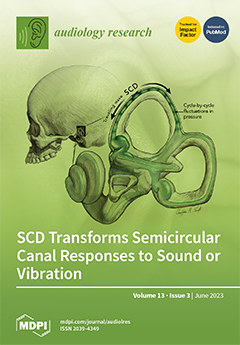
Cover Story: Semicircular canal dehiscence changes the mechanical operation of the labyrinth, allowing sound or vibration to stimulate canal receptors, thus resulting in a complex pattern of patient symptoms. Measures of fluid flow and recordings of individual single canal neurons in fish and guinea pigs before and after dehiscence show that sound or vibration now cause two effects: cycle-by-cycle phase-locked activation of vestibular receptors and also fluid flow (and so cupula deflection) in the canal. The result is these stimuli cause nystagmus (Tullio phenomenon), enhanced vestibular evoked myogenic potentials and vibration-induced nystagmus. The neural responses tie together diverse clinical phenomena that result from the unusual neural responses to sound or vibration resulting from the dehiscence. View this paper
  • Issues are regarded as officially published after their release is announced to the table of contents alert mailing list .
  • You may sign up for email alerts to receive table of contents of newly released issues.
  • PDF is the official format for papers published in both, html and pdf forms. To view the papers in pdf format, click on the "PDF Full-text" link, and use the free Adobe Reader to open them.

Articles (15)

  • Brief Report
  • Open Access
5 Citations
2,771 Views
7 Pages

Similarities and Differences between Vestibular Migraine and Recurrent Vestibular Symptoms—Not Otherwise Specified (RVS-NOS)

  • Roberto Teggi,
  • Bruno Colombo,
  • Iacopo Cangiano,
  • Omar Gatti,
  • Mario Bussi and
  • Massimo Filippi

Menière’s disease and vestibular migraine (VM) are two common inner ear disorders whose diagnoses are based on clinical history and audiometric exams. In some cases, patients have been reporting different episodes of vertigo for years bu...

  • Case Report
  • Open Access
2 Citations
4,538 Views
7 Pages

Using a Bone Conduction Hearing Device as a Tactile Aid

  • Martin Kompis,
  • Manfred Langmair,
  • Georgios Mantokoudis,
  • Stefan Weder,
  • Tom Gawliczek and
  • Marco Domenico Caversaccio

Background: With the advent of cochlear implants, tactile aids for the profoundly deaf became obsolete decades ago. Nevertheless, they might still be useful in rare cases. We report the case of a 25-year-old woman with Bosley–Salih–Alorai...

  • Article
  • Open Access
8 Citations
6,845 Views
18 Pages

Translational audiology research aims to transfer basic research findings into practical clinical applications. While animal studies provide essential knowledge for translational research, there is an urgent need to improve the reproducibility of dat...

  • Article
  • Open Access
3 Citations
4,098 Views
10 Pages

Objective: To evaluate hearing outcomes at 2 years post endolymphatic duct blockage (EDB) surgery, with an analysis of factors that may predict hearing improvement. Study Design: Retrospective comparative study. Setting: Tertiary care center. Subject...

  • Feature Paper
  • Review
  • Open Access
12 Citations
4,132 Views
13 Pages

Angular acceleration stimulation of a semicircular canal causes an increased firing rate in primary canal afferent neurons that result in nystagmus in healthy adult animals. However, increased firing rate in canal afferent neurons can also be caused...

  • Article
  • Open Access
5 Citations
2,399 Views
10 Pages

The Effects of Utilizing Cartilage Conduction Hearing Aids among Patients with Conductive Hearing Loss

  • Takuya Kakuki,
  • Ryo Miyata,
  • Yurie Yoshida,
  • Aya Kaizaki,
  • Ayami Kimura,
  • Kaede Kurashima,
  • Rui Kuwata and
  • Kenichi Takano

The cartilage-conduction hearing aid (CC-HA) is a new hearing device that is suitable for use in patients with conductive hearing loss. It has been 5 years since the introduction of the CC-HA. Although the number of users has increased, the CC-HA is...

  • Review
  • Open Access
11 Citations
3,285 Views
10 Pages

Background: The use of a cochlear implant (CI) for hearing rehabilitation after vestibular schwannoma (VS) resection is widely spreading. The procedure is usually performed simultaneously to tumor resection with a translabyrinthine approach. To ensur...

  • Communication
  • Open Access
3 Citations
3,095 Views
9 Pages

Subjective tinnitus is a highly prevalent sound sensation produced in most cases by persistent neural activity in the auditory pathway of the patient. Audiologists should be confident that they can employ elements of sound therapy and related counsel...

  • Article
  • Open Access
4 Citations
2,965 Views
11 Pages

There is currently increasing awareness of third-party disability, defined as the disability and functioning of a significant other (SO) due to a health condition of one of their family members. The effects of third-party disability on the SOs of ind...

  • Article
  • Open Access
5 Citations
2,728 Views
11 Pages

Cochlear Aqueduct Morphology in Superior Canal Dehiscence Syndrome

  • Nimesh V. Nagururu,
  • Diane Jung,
  • Ferdinand Hui,
  • Monica S. Pearl,
  • John P. Carey and
  • Bryan K. Ward

The cochlear aqueduct (CA) connects the scala tympani to the subarachnoid space and is thought to assist in pressure regulation of perilymph in normal ears, however, its role and variation in inner ear pathology, such as in superior canal dehiscence...

  • Review
  • Open Access
5 Citations
5,039 Views
10 Pages

The most common complaint among patients with vestibular schwannoma (VS) is hearing loss. This significantly affects the quality of life before, during, and after treatment for patients with VS. Untreated hearing loss in VS patients may even lead to...

  • Brief Report
  • Open Access
2 Citations
2,360 Views
10 Pages

Examination of Factors Affecting the Likelihood of Whether Individuals Would Purchase Cartilage Conduction Hearing Aids

  • Shunsuke Takai,
  • Takeshi Sato,
  • Yuya Miyakura,
  • Mika Adachi,
  • Yohei Honkura,
  • Daisuke Yamauchi and
  • Yukio Katori

Cartilage conduction hearing aids (CC-HAs) are a novel type of hearing aid relying on cartilage conduction, the so-called third auditory conduction pathway. However, CC-HAs have only recently entered routine clinical use, and therefore data on their...

  • Editorial
  • Open Access
8 Citations
3,332 Views
6 Pages

Genetic Evaluation of Prelingual Hearing Impairment: Recommendations of an European Network for Genetic Hearing Impairment

  • Laurence Jonard,
  • Davide Brotto,
  • Miguel A. Moreno-Pelayo,
  • Ignacio del Castillo,
  • Hannie Kremer,
  • Ronald Pennings,
  • Helena Caria,
  • Graça Fialho,
  • An Boudewyns and
  • Sandrine Marlin
  • + 23 authors

The cause of childhood hearing impairment (excluding infectious pathology of the middle ear) can be extrinsic (embryofoetopathy, meningitis, trauma, drug ototoxicity, noise trauma, etc [...]

  • Review
  • Open Access
1 Citations
3,427 Views
15 Pages

Impacts and Identification of Hearing Aid Refurbishing Programs for People with Hearing Loss: A Scoping Review

  • Mathieu Hotton,
  • Virginie Prud’Homme,
  • Léa Richard,
  • Laurie Cormier,
  • Katherine Simoneau,
  • Mathilde Lefebvre-Demers,
  • Claude Vincent and
  • Normand Boucher

This article consists of a scoping review completed to describe the impacts of refurbished hearing aids (HAs) for people with hearing loss, and to identify existing HA refurbishing programs around the world. In this review, JBI methodological guidanc...

  • Brief Report
  • Open Access
3,482 Views
12 Pages

Balance Rehabilitation with Peripheral Visual Stimulation in Patients with Panic Disorder and Agoraphobia: An Open-Pilot Intervention Study

  • Daniela Caldirola,
  • Claudia Carminati,
  • Silvia Daccò,
  • Massimiliano Grassi,
  • Giampaolo Perna and
  • Roberto Teggi

28 April 2023

Given the involvement of balance system abnormalities in the pathophysiology of panic disorder and agoraphobia (PD-AG), we evaluated initial evidence for feasibility, acceptability, and potential clinical usefulness of 10 sessions of balance rehabili...

Get Alerted

Add your email address to receive forthcoming issues of this journal.

XFacebookLinkedIn
Audiol. Res. - ISSN 2039-4349