


Abstract
Introduction: Plantar fasciitis is a common cause of heel pain in adults, with a significant impact on quality of life and athletic performance. While conservative treatments are effective in most cases, a subset of patients remains symptomatic and may require surgical intervention. Minimally invasive techniques, such as bipolar radiofrequency (RF) coblation using the TOPAZ system, have emerged as promising alternatives to traditional open or endoscopic procedures. Methods: This retrospective study evaluated the clinical outcomes of 49 consecutive patients (20 males and 29 females; mean age 54.3 ± 11.4 years; mean BMI 25.3 ± 3.2, range 21.5–34.7) with chronic plantar fasciitis unresponsive to at least six months of conservative treatment. The affected side was left in 24 patients and right in 25, and 35 patients were regularly engaged in sports prior to symptom onset. All patients underwent percutaneous bipolar RF coblation using the TOPAZ device between July 2019 and November 2024. Patient-reported outcome measures—including the Visual Analog Scale (VAS), AOFAS Ankle–Hindfoot Score, SF-36, and Tegner Activity Scale—were collected at the final follow-up (mean 41.7 ± 18.3 months, range 6–71). Results: Statistically significant improvements were observed in pain and function: mean VAS decreased from 8.5 to 3.1 (p < 0.001), and American Orthopaedic Foot and Ankle Society (AOFAS) pain and function scores improved from 2.5 and 12.75 to 28.75 and 38.75, respectively (p < 0.001). The mean Tegner score increased from 1.3 to 4.1 (p < 0.001), with 100% of previously active patients returning to sport. No major complications or reoperations were reported. Conclusions: Percutaneous bipolar RF coblation appears to be a safe and effective treatment for recalcitrant plantar fasciitis, offering significant pain relief, functional improvement, and a high return-to-sport rate with minimal morbidity. This technique may represent a valuable intermediate option between conservative care and open surgery.
1. Introduction
Plantar fasciitis, also known as plantar fasciopathy, is a prevalent source of heel discomfort in adults [1,2]. Annually, around one million individuals in the United States seek treatment for this condition, constituting roughly 1% of all visits to orthopedic specialists [2]. It is a common overuse injury of the plantar fascia, typically caused by repetitive stress on the heel and arch.
The diagnosis is typically clinical, with patients often reporting gradual onset of heel pain that intensifies during walking after periods of inactivity [3]. Physical examination usually reveals sensitivity along the plantar fascia and pain triggered by stretching the plantar aponeurosis [4]. Initial treatment spans at least six months and includes conservative approaches such as rest, nonsteroidal anti-inflammatory medications, physical therapy, orthotic support, night splints, casting, corticosteroid injections, and extracorporeal shock wave therapy [3,5]. While these methods achieve high success rates, persistent cases may require surgical intervention [6].
Surgical management often involves partial or complete plantar fasciotomy, which can be performed through open or endoscopic techniques [7,8,9]. Open plantar fascia release, with or without a “mini-open” approach, allows for concurrent nerve decompression and heel spur removal [10]. However, open procedures may be associated with prolonged recovery periods and the potential for complications such as secondary heel pain due to scarring, medial plantar nerve injuries, superficial infection, or even longitudinal arch collapse if more than 40% of the fascia is released [11]. Endoscopic plantar fasciotomy enables earlier weight-bearing and typically results in shorter recovery times, with comparable long-term outcomes and possibly fewer complications than open techniques [12,13]. Despite the less invasive nature of endoscopic techniques, portal-site discomfort is a documented complication, with reported incidences of 15–16% in some studies [14,15].
In order to overcome the possible complications related to open and endoscopic techniques, minimally invasive procedures such as bipolar radiofrequency microtenotomy were proposed [16]. Bipolar plasma radiofrequency (RF) coblation, such as the TOPAZ system (ArthroCare, Sunnyvale, CA, USA), is a minimally invasive microtenotomy method designed to address chronic tendinosis.
This technique promotes angiogenesis through the activation of growth factors such as FGF, VEGF, and α-V-integrin, while also modulating nociceptor activity to provide early pain relief [17,18,19,20].
The TOPAZ system was utilized in treating conditions such as lateral epicondylitis, knee tendinosis, Achilles tendinopathy, and rotator cuff issues, most of which can be described as overuse injuries like plantar fasciitis [21,22]. Clinical studies reported favorable outcomes with RF coblation for managing stubborn cases of plantar fasciitis through a minimally invasive surgical approach [18,19,23].
The objective of this study is to evaluate the effectiveness of bipolar plasma RF coblation in patients with chronic plantar fasciitis resistant to conservative treatment, by analyzing pain reduction (VAS score), functional improvement (AOFAS score), and quality of life (SF-36). Particular attention was given to the rate of return to sport, an outcome that has been rarely investigated in previous studies on this procedure.
2. Materials and Methods
This study retrospectively analyzed all consecutive patients diagnosed with chronic plantar fasciitis who underwent percutaneous bipolar RF coblation at a single specialized orthopedic center between July 2019 and November 2024.
All patients also underwent ultrasound examination to confirm the diagnosis of plantar fasciitis and to exclude other potential causes of heel pain, such as partial fascial rupture, heel spur, or tarsal tunnel syndrome.
Comprehensive review of clinical records and follow-up data was performed to ensure that all subjects met the defined inclusion and exclusion criteria.
Patients included in the study were required to have symptoms of plantar fasciitis lasting for at least six months and to have undergone extensive conservative treatments, such as rest, stretching, strengthening exercises, non-steroidal anti-inflammatory drugs (NSAIDs), and steroid injections, all of which had failed.
Exclusion criteria were applied to patients with a body mass index (BMI) greater than 35, leg length discrepancies, diabetes mellitus, confirmed or suspected pregnancy, coagulopathy, infections, tumors, peripheral vascular disease, autoimmune or systemic diseases, or a history of prior surgery on the same plantar fascia. Additionally, patients were screened to exclude any biomechanical abnormalities, including excessive pronation, pes cavus, or a hypermobile first ray. Footwear was assessed to ensure proper fit and suitability, ruling out footwear as a potential cause of symptoms.
The primary endpoint was the improvement in pain and function, while secondary endpoints included changes in return-to-sport rate, and the occurrence of postoperative complications or reoperations.
The study did not include a control group because it was designed as a retrospective observational analysis of consecutive patients treated with a single standardized technique. The primary objective was to evaluate the clinical effectiveness and safety of bipolar RF coblation in a real-world setting.
2.1. The TOPAZ Microdebrider
The TOPAZ microdebrider utilizes coblation technology, a process known as “controlled ablation,” which involves the surgical vaporization of tissue using a plasma-based radiofrequency (RF) device. The device operates by energizing electrodes in a saline solution to generate a focused, charged plasma gas. This plasma consists of free electrons, ions, and excited radicals that, when applied to tissue, break it down into basic molecular components. This approach effectively dissolves or vaporizes the targeted tissue with little to no harm to adjacent healthy structures.
Coblation operates at lower temperatures (40 °C to 70 °C) compared to traditional electrocautery, which generates significantly higher temperatures (400 °C to 600 °C). The reduced heat minimizes thermal damage. Additionally, the bond breakdown induced by coblation triggers an inflammatory response that promotes revascularization and stimulates local growth factors. Since RF currents do not directly pass through the tissue during the process, heat exposure to the tissue remains minimal, enabling precise removal of the target tissue with minimal impact on surrounding areas [24].
2.2. Surgical Technique
The procedure was carried out in the operating room. All patients received routine perioperative prophylaxis with cefazolin, except for those with known allergies.
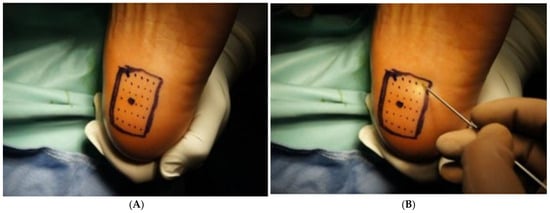
The most tender area of the sole was identified and a square is marked locally with points inside it spaced 5 mm apart from each other prior to the induction of anesthesia. (Figure 1A).
Figure 1.
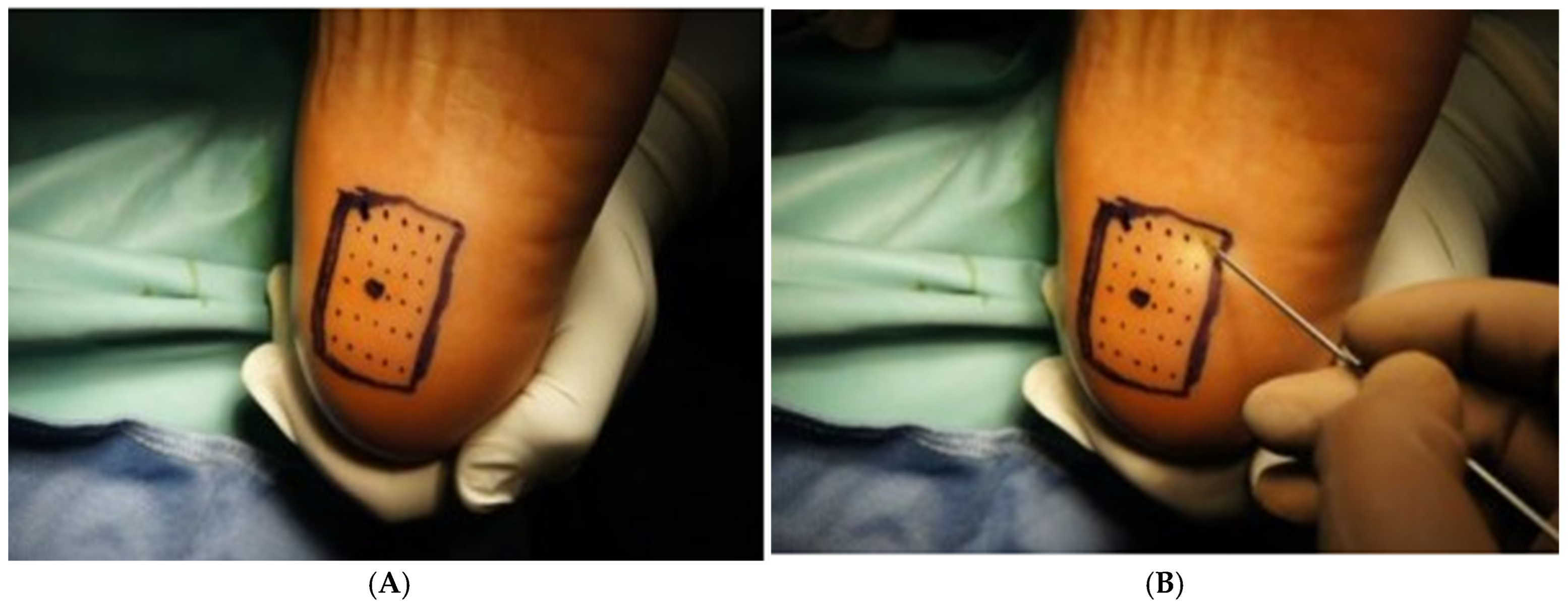
(A) The most tender area of the plantar surface was clinically identified. A square grid was marked on the skin, with points spaced 5 mm apart, to guide the radiofrequency microtenotomy treatment prior to anesthesia. (B) The radiofrequency wand was inserted percutaneously at the marked points until the tip reached the surface of the plantar fascia.
Patients were positioned supine under general, spinal, plexus, or local anesthesia, as deemed appropriate by the operating surgeon. A pneumatic tourniquet was applied at the proximal thigh to ensure a bloodless operative field.
The 0.8-mm TOPAZ microdebrider wand was connected to the RF generator according to the manufacturer’s guidelines. The wand was inserted through the skin on the marked points until its tip penetrated the plantar fascia. (Figure 1B) Activation of the device occurred intermittently for 500 milliseconds, with the wand advanced in 5-mm increments to perform coblation. This process was repeated at all the marked sites.
The small skin punctures were dressed with sterile closure strips and adhesive dressing.
2.3. Post-Operative Indications
All patients were allowed to walk immediately with full weight-bearing as tolerated, using crutches if needed for support. Thromboprophylaxis with heparin was prescribed for the first seven days postoperatively.
2.4. Clinical Outcomes
All patients were followed up clinically at 7, 14, 30 and 90 days and then yearly post operatively. At the final follow-up, Patient-Reported Outcome Measures (PROMs) were administered, including the Visual Analog Scale (VAS) for subjective pain assessment, the AOFAS Ankle–Hindfoot Scale for functional evaluation, and the SF-36 questionnaire to assess quality of life.
The American Orthopaedic Foot and Ankle Society (AOFAS) Ankle–Hindfoot score is a functional evaluation tool used to assess a patient’s symptoms. It encompasses four domains: pain, function, range of motion, and alignment, with scores ranging from 0 (worst) to 100 (best).
The SF-36 questionnaire is a patient-reported health status survey designed to evaluate the impact of medical conditions on overall well-being and quality of life across a wide range of disease states. It consists of eight categories: physical functioning, role limitations, bodily pain, general health, vitality, social functioning, emotional well-being, and mental health.
3. Statistical Analysis
Continuous variables were first assessed for normality using the Shapiro–Wilk test. Normally distributed data were analyzed using paired Student’s t-tests to compare pre- and postoperative values, while non-normally distributed data were assessed using the Wilcoxon signed-rank test. Categorical variables were compared using the chi-square or Fisher’s exact test, as appropriate. A two-sided significance level of α = 0.05 was applied for all analyses. To account for multiple comparisons across the different outcome measures (VAS, AOFAS pain and function scores, SF-36, Tegner Activity Scale), Bonferroni correction was applied where relevant. Results are presented as mean ± standard deviation (SD) with ranges.
A priori sample-size estimation was performed for the primary outcome (change in VAS pain score between preoperative and postoperative evaluations). Assuming a minimal clinically important difference (MCID) of 2.0 points on the 10-point VAS, a standard deviation of 2.5, a two-sided significance level (α) of 0.05, and a statistical power (1 − β) of 0.80, the required sample size was calculated to be 49 patients. Therefore, the present cohort (n = 49) provides sufficient statistical power to detect a clinically meaningful difference in pain reduction following the procedure.
4. Ethical Considerations
This study was conducted as a retrospective review of anonymized clinical data obtained during standard patient care. According to institutional and national guidelines, formal approval from an ethics committee and individual informed consent were not required for this type of analysis. No personally identifiable information was collected or used. All data were handled with strict confidentiality, in full accordance with the principles outlined in the Declaration of Helsinki.
5. Results
A total of 49 patients (mean age 54.28 ± 11.36 years) who met the inclusion criteria were enrolled in the study. The cohort included 20 males and 29 females, with a mean body mass index of 25.31 (range 21.47–34.68). The affected side was the left foot in 24 cases and the right in 25. Thirty-five patients reported regular engagement in sports prior to the onset of symptoms.
The mean surgical time was 9.08 min (SD 4.28; range 3–20 min). Anesthesia types included general anesthesia in 7 cases, spinal anesthesia in 30, and peripheral nerve block with sedation in 12. No accessory surgical procedures were required.
The mean follow-up period was 41.73 ± 18.31 months (range: 6–71 months) (Table 1).
Table 1.
Patient Demographics and Surgical Characteristics.
Patient-reported outcome measures (PROMs) demonstrated a statistically significant and clinically relevant improvement across all domains. The Visual Analog Scale (VAS) for pain decreased from a preoperative mean of 8.5 ± 0.92 (range 7–10) to a postoperative mean of 3.1 ± 3.16 (range 0–8), with a p-value < 0.001. The pain component of the AOFAS Ankle–Hindfoot Score improved markedly, rising from a preoperative mean of 2.5 ± 7.07 (range 0–20) to 28.75 ± 13.56 (range 0–40) postoperatively (p < 0.001). Similarly, the function component increased from 12.75 ± 8.53 (range 6–26) to 38.75 ± 18.38 (range 8–49), also with a statistically significant p-value < 0.001.
Of the 35 patients who were engaged in sports activities prior to surgery, 100% successfully returned to their previous level of participation. The Tegner Activity Scale showed a substantial improvement, with the mean score increasing from 1.3 ± 0.53 (range 0–2) preoperatively to 4.1 ± 1.22 (range 2–6) at final follow-up (p < 0.001), a value compatible with the resumption of recreational and competitive sports in most cases.
No complications or reoperations were recorded during the entire follow-up period. (Table 2)
Table 2.
Patient-Reported Outcome Measures (PROMs) and Return to Sport.
6. Discussion
The main finding of this study is that bipolar percutaneous radiofrequency coblation provides significant and clinically meaningful improvements in pain and function for patients with chronic plantar fasciitis refractory to conservative management. In addition to substantial reductions in VAS scores and marked enhancements in AOFAS Ankle–Hindfoot functional scores, all previously active patients were able to return to their pre-symptom level of sports participation. Notably, these outcomes were achieved without any recorded complications or need for reoperation, highlighting both the safety and efficacy of this minimally invasive approach.
Given the high prevalence of plantar fasciitis and its significant impact on patients’ daily functioning and quality of life, it is essential to investigate which treatment options offer the most effective outcomes, with clear indications tailored to each clinical scenario [25]. In cases refractory to conservative treatment, radiofrequency coblation represents a low-risk, minimally invasive option with durable outcomes, making it a valuable intermediate step before considering open surgical intervention.
Although only a limited number of studies are currently available in the literature, our findings are consistent with previous reports demonstrating the effectiveness of radiofrequency coblation in the treatment of chronic, refractory plantar fasciitis. Sean et al. reported significant clinical improvements in patients with recalcitrant plantar fasciitis treated with radiofrequency coblation. The AOFAS hindfoot scores improved from a preoperative mean of 34.47 to 69.27 at 3 months and 71.33 at 6 months (p = 0.00). Additionally, improvements were noted in SF-36 bodily pain, physical functioning, and social functioning domains, with 85.7% of patients expressing good to excellent satisfaction at six months post-procedure [18]. Thor et al. conducted a systematic review and meta-analysis including 11 studies on plantar fascia radiofrequency microtenotomy. Among the seven studies eligible for pooled analysis, a statistically significant mean increase of 40.9 points in AOFAS scores was observed following treatment [26].
Moreover, an important aspect of this study is the assessment of return to sport. Among physically active patients, a high percentage resumed their pre-injury level of activity within a relatively short postoperative period, without recurrence or major complications. This underlines not only the clinical efficacy of the procedure but also its functional relevance, particularly in athletic populations.
The procedure demonstrated a high safety profile, with only minor and self-limited complications such as superficial infections or transient nerve irritation. No major complications such as deep infections, plantar fascia rupture, or arch collapse were observed, further supporting the minimally invasive nature and tolerability of the technique. In terms of complications, radiofrequency coblation offers several advantages compared to traditional surgical approaches such as open or endoscopic plantar fasciotomy. Open plantar fasciotomy, though effective, is associated with a relatively high risk of complications such as secondary heel pain, hypertrophic scarring, medial plantar nerve injury, and, in cases where more than 40% of the fascia is released, potential longitudinal arch collapse [27,28]. These issues may contribute to clinical dissatisfaction, as reported by Davies et al. with 10% to 50% of patients reporting suboptimal outcomes, and an average recovery time extending up to seven months [29]. Endoscopic techniques have been developed to minimize tissue trauma and allow for earlier weight-bearing, but studies report persistent discomfort at portal sites in up to 15–16% of patients [30].
The 100% return-to-sport rate observed in this cohort should be interpreted with caution. Although this finding underscores the functional efficacy of percutaneous bipolar radiofrequency coblation, potential selection bias may have contributed to the result. The study population included a substantial proportion of younger and physically active patients who were more motivated to resume sports and adhered closely to the postoperative rehabilitation protocol. Furthermore, the exclusion of patients with significant comorbidities, biomechanical abnormalities, or previous foot surgery likely favored a more homogeneous and higher-functioning sample, potentially inflating the apparent success rate.
From a biomechanical perspective, concerns may arise regarding the structural integrity of the plantar fascia following multiple microtenotomies induced by radiofrequency energy. However, existing experimental and clinical evidence suggests that bipolar coblation induces controlled collagen denaturation and promotes angiogenesis and tissue remodeling without compromising fascial strength. In this study, no cases of postoperative fascial rupture, arch instability, or recurrence were observed throughout follow-up, supporting the biomechanical safety of the procedure. Nevertheless, longer-term and imaging-based studies would be valuable to further confirm the durability of these findings.
This study has several strengths, including the consistent surgical technique and the use of validated patient-reported outcome measures. Nevertheless, the retrospective nature remains a limitation and may affect the generalizability of the findings. Potential selection biases inherent to the retrospective design were minimized by including all consecutive patients who met the predefined inclusion and exclusion criteria during the study period.
These findings have important practical implications for the management of chronic plantar fasciitis resistant to conservative measures. Bipolar percutaneous radiofrequency coblation using the TOPAZ system offers a minimally invasive alternative to open or endoscopic procedures, providing rapid pain relief, functional improvement, and a high rate of return to sport. Given its safety profile, short surgical time, and the ability to treat patients on an outpatient basis, this technique can be considered a valuable option in the treatment algorithm, particularly for active patients who wish to resume sports or high-demand activities. Clinicians may use these results to inform patient counseling and to guide decision-making regarding surgical intervention in cases refractory to conservative care.
7. Conclusions
Percutaneous bipolar radiofrequency coblation provides significant pain relief and functional improvement in patients with chronic plantar fasciitis unresponsive to conservative treatment. The technique is safe, minimally invasive, and allows for a high rate of return to sport with minimal complications. These results support the use of percutaneous bipolar radiofrequency coblation as an effective intermediate treatment option between conservative therapy and traditional surgery. However, larger prospective studies with longer follow-up are needed to confirm these findings and further define its indications in clinical practice.
Author Contributions
Conceptualization and study design, A.M., F.B., M.P. and R.S.; methodology and study development, A.M., M.P., R.S. and G.N.; software, data management, and statistical analysis, A.M. and F.N.; validation and quality control of data, A.M., F.B., M.P., R.S. and F.N.; investigation, patient enrollment, surgical activity, and data acquisition, A.M., M.P., G.N. and R.S.; provision of clinical resources and surgical material, F.B., G.N. and R.S.; data curation and organization, A.M., M.P., R.S. and F.N.; writing—original draft preparation, A.M. and M.P.; writing—review and editing, all authors; visualization and figure preparation, A.M. and F.N.; supervision and critical revision of the manuscript, F.B., M.P. and R.S.; project administration and coordination, A.M. and R.S. All authors have read and agreed to the published version of the manuscript.
Funding
This research received no external funding.
Institutional Review Board Statement
This study is a retrospective review of anonymized clinical data collected during routine care. In accordance with institutional and national regulations, formal ethics committee approval and individual informed consent were not required for this type of study. No identifiable patient data were used, and all data were handled confidentially and in compliance with the Declaration of Helsinki.
Informed Consent Statement
No identifiable patient data were used, not applicable.
Data Availability Statement
The original contributions presented in this study are included in the article. Further inquiries can be directed to the corresponding author.
Conflicts of Interest
The authors declare no conflict of interest.
References
- Drake, C.; Chapman, L.; Burnett, C.; Halstead, J.; Redmond, A.; Roddy, E.; Wilkins, R.; Keenan, A.-M. Plantar Heel Pain Management: A Survey of UK Registered Healthcare Professionals. J. Foot Ankle Res. 2025, 18, e70087. [Google Scholar] [CrossRef] [Scilit]
- Riddle, D.L.; Schappert, S.M. Volume of Ambulatory Care Visits and Patterns of Care for Patients Diagnosed with Plantar Fasciitis: A National Study of Medical Doctors. Foot Ankle Int. 2004, 25, 303–310. [Google Scholar] [CrossRef] [Scilit] [PubMed]
- Neufeld, S.K.; Cerrato, R. Plantar Fasciitis: Evaluation and Treatment. J. Am. Acad. Orthop. Surg. 2008, 16, 338–346. [Google Scholar] [CrossRef] [Scilit] [PubMed]
- Monteagudo, M.; de Albornoz, P.M.; Gutierrez, B.; Tabuenca, J.; Álvarez, I. Plantar Fasciopathy: A Current Concepts Review. EFORT Open Rev. 2018, 3, 485–493. [Google Scholar] [CrossRef] [Scilit]
- Tseng, W.-C.; Chen, Y.-C.; Lee, T.-M.; Chen, W.-S. Plantar Fasciitis: An Updated Review. J. Med. Ultrasound 2023, 31, 268–274. [Google Scholar] [CrossRef] [Scilit]
- Nayar, S.K.; Alcock, H.; Vemulapalli, K. Surgical Treatment Options for Plantar Fasciitis and Their Effectiveness: A Systematic Review and Network Meta-Analysis. Arch. Orthop. Trauma. Surg. 2023, 143, 4641–4651. [Google Scholar] [CrossRef] [Scilit]
- Cottom, J.M.; Wolf, J.R.; Sisovsky, C.A. Midterm Outcomes of Endoscopic Plantar Fascia Debridement in 125 Patients: A 5-Year Follow-Up. J. Foot Ankle Surg. 2023, 62, 444–447. [Google Scholar] [CrossRef] [Scilit]
- Cottom, J.M.; Maker, J.M.; Richardson, P.; Baker, J.S. Endoscopic Debridement for Treatment of Chronic Plantar Fasciitis: An Innovative Technique and Prospective Study of 46 Consecutive Patients. J. Foot Ankle Surg. 2016, 55, 748–752. [Google Scholar] [CrossRef] [Scilit]
- Sorensen, M.D.; Hyer, C.F.; Philbin, T.M. Percutaneous Bipolar Radiofrequency Microdebridement for Recalcitrant Proximal Plantar Fasciosis. J. Foot Ankle Surg. 2011, 50, 165–170. [Google Scholar] [CrossRef] [Scilit]
- MacInnes, A.; Roberts, S.C.; Kimpton, J.; Pillai, A. Long-Term Outcome of Open Plantar Fascia Release. Foot Ankle Int. 2016, 37, 17–23. [Google Scholar] [CrossRef] [Scilit] [PubMed]
- Feng, S.-M.; Song, R.-L.; Wang, A.-G.; Sun, Q.-Q.; Zhang, S.-C. Endoscopic Partial Plantar Fasciotomy via 2 Medial Portals vs Mini-Open Procedure for Refractory Plantar Fasciitis. Foot Ankle Int. 2021, 42, 458–463. [Google Scholar] [CrossRef] [Scilit] [PubMed]
- Barrett, S.L.; Day, S.V. Endoscopic Plantar Fasciotomy for Chronic Plantar Fasciitis/Heel Spur Syndrome: Surgical Technique--Early Clinical Results. J. Foot Surg. 1991, 30, 568–570. [Google Scholar] [PubMed]
- Bader, L.; Park, K.; Gu, Y.; O’Malley, M.J. Functional Outcome of Endoscopic Plantar Fasciotomy. Foot Ankle Int. 2012, 33, 37–43. [Google Scholar] [CrossRef] [Scilit]
- Kinley, S.; Frascone, S.; Calderone, D.; Wertheimer, S.J.; Squire, M.A.; Wiseman, F.A. Endoscopic Plantar Fasciotomy versus Traditional Heel Spur Surgery: A Prospective Study. J. Foot Ankle Surg. 1993, 32, 595–603. [Google Scholar]
- O’Malley, M.J.; Page, A.; Cook, R. Endoscopic Plantar Fasciotomy for Chronic Heel Pain. Foot Ankle Int. 2000, 21, 505–510. [Google Scholar] [CrossRef] [Scilit]
- Yuan, Y.; Qian, Y.; Lu, H.; Kou, Y.; Xu, Y.; Xu, H. Comparison of the Therapeutic Outcomes between Open Plantar Fascia Release and Percutaneous Radiofrequency Ablation in the Treatment of Intractable Plantar Fasciitis. J. Orthop. Surg. Res. 2020, 15, 55. [Google Scholar] [CrossRef] [Scilit]
- Tasto, J.P.; Cummings, J.; Medlock, V.; Harwood, F.; Hardesty, R.; Amiel, D. The Tendon Treatment Center: New Horizons in the Treatment of Tendinosis. Arthroscopy 2003, 19, 213–223. [Google Scholar] [CrossRef] [Scilit]
- Sean, N.Y.C.; Singh, I.; Wai, C.K. Radiofrequency Microtenotomy for the Treatment of Plantar Fasciitis Shows Good Early Results. Foot Ankle Surg. 2010, 16, 174–177. [Google Scholar] [CrossRef] [Scilit] [PubMed]
- Tasto, J.P.; Cummings, J.; Medlock, V.; Hardesty, R.; Amiel, D. Microtenotomy Using a Radiofrequency Probe to Treat Lateral Epicondylitis. Arthroscopy 2005, 21, 851–860. [Google Scholar] [CrossRef] [Scilit]
- Takahashi, N.; Tasto, J.P.; Ritter, M.; Ochiai, N.; Ohtori, S.; Moriya, H.; Amiel, D. Pain Relief through an Antinociceptive Effect after Radiofrequency Application. Am. J. Sports Med. 2007, 35, 805–810. [Google Scholar] [CrossRef] [Scilit]
- Silver, W.P.; Creighton, R.A.; Triantafillopoulos, I.K.; Devkota, A.C.; Weinhold, P.S.; Karas, S.G. Thermal Microdebridement Does Not Affect the Time Zero Biomechanical Properties of Human Patellar Tendons. Am. J. Sports Med. 2004, 32, 1946–1952. [Google Scholar] [CrossRef] [Scilit]
- Taverna, E.; Battistella, F.; Sansone, V.; Perfetti, C.; Tasto, J.P. Radiofrequency-Based Plasma Microtenotomy Compared with Arthroscopic Subacromial Decompression Yields Equivalent Outcomes for Rotator Cuff Tendinosis. Arthroscopy 2007, 23, 1042–1051. [Google Scholar] [CrossRef] [Scilit]
- Tay, K.S.; Ng, Y.C.S.; Singh, I.R.; Chong, K.W. Open Technique Is More Effective than Percutaneous Technique for TOPAZ Radiofrequency Coblation for Plantar Fasciitis. Foot Ankle Surg. 2012, 18, 287–292. [Google Scholar] [CrossRef] [Scilit]
- ArthroCare Coblation Technology White Paper. ArthroCare Website. 2015. Available online: http://www.arthrocare.com (accessed on 17 December 2025).
- Salvioli, S.; Guidi, M.; Marcotulli, G. The Effectiveness of Conservative, Non-Pharmacological Treatment, of Plantar Heel Pain: A Systematic Review with Meta-Analysis. Foot 2017, 33, 57–67. [Google Scholar] [CrossRef] [Scilit]
- Thor, J.; Mao, D.W.; Chandrakumara, D.; Zheng, Q.; Yoo, T.W.; Kon Kam King, C. Radiofrequency Microtenotomy for Plantar Fasciitis: A Systematic Review and Meta-Analysis. Foot 2022, 50, 101869. [Google Scholar] [CrossRef] [Scilit]
- Thordarson, D.B.; Kumar, P.J.; Hedman, T.P.; Ebramzadeh, E. Effect of Partial Versus Complete Plantar Fasciotomy on the Windlass Mechanism. Foot Ankle Int. 1997, 18, 16–20. [Google Scholar] [CrossRef] [Scilit]
- Brown, J.N.; Roberts, S.; Taylor, M.; Paterson, R.S. Plantar Fascia Release Through a Transverse Plantar Incision. Foot Ankle Int. 1999, 20, 364–367. [Google Scholar] [CrossRef] [Scilit] [PubMed]
- Davies, M.S.; Weiss, G.A.; Saxby, T.S. Plantar Fasciitis: How Successful Is Surgical Intervention? Foot Ankle Int. 1999, 20, 803–807. [Google Scholar] [CrossRef] [Scilit] [PubMed]
- Ward, L.; Mercer, N.P.; Azam, M.T.; Hoberman, A.; Hurley, E.T.; Butler, J.J.; Ubillus, H.; Cronin, J.; Kennedy, J.G. Outcomes of Endoscopic Treatment for Plantar Fasciitis: A Systematic Review. Foot Ankle Spec. 2025, 18, 193–201. [Google Scholar] [CrossRef] [Scilit] [PubMed]

Disclaimer/Publisher’s Note: The statements, opinions and data contained in all publications are solely those of the individual author(s) and contributor(s) and not of MDPI and/or the editor(s). MDPI and/or the editor(s) disclaim responsibility for any injury to people or property resulting from any ideas, methods, instructions or products referred to in the content. |
© 2026 by the authors. Licensee MDPI, Basel, Switzerland. This article is an open access article distributed under the terms and conditions of the Creative Commons Attribution (CC BY) license.