


Abstract
Background and Clinical Significance: Lenalidomide-associated B-cell acute lymphoblastic leukemia (B-ALL) is a rare but well-documented secondary malignancy following lenalidomide exposure, most commonly administered as maintenance for multiple myeloma. Lenalidomide-associated B-ALL is frequently characterized by adverse biological features such as TP53 mutation. Treatment in older patients is complicated by limited tolerance of intensive chemotherapy. Blinatumomab represents a promising therapeutic option for older patients with B-ALL; however, clinical experience with its use in lenalidomide-associated B-ALL remains scarce. To place our case in the context of available evidence, we reviewed reported cases of lenalidomide-associated B-ALL in patients aged ≥70 years at diagnosis. Case Presentation: An 80-year-old male patient with a history of IgG-lambda multiple myeloma previously treated with lenalidomide was diagnosed with Philadelphia chromosome-negative B-ALL. Molecular and cytogenetic analyses identified TP53 and NF1 mutations and a hypotriploid leukemic clone. Given the patient’s age and comorbidities, intensive chemotherapy was deemed unsuitable. The patient initially received a short course of modified P(O)MP (prednisone, methotrexate, and 6-mercaptopurine). Vincristine (Oncovin) was omitted due to polyneuropathy. Complete morphologic remission (CR) and measurable residual disease (MRD) negativity were achieved after the first cycle of blinatumomab. Three additional cycles of blinatumomab were administered as post-remission therapy. During blinatumomab treatment, the patient developed grade 1 cytokine release syndrome and hypogammaglobulinemia, which subsequently required monthly intravenous immunoglobulin replacement. During subsequent modified P(O)MP maintenance, severe mucositis followed by spondylodiscitis required temporary treatment interruption. Twenty months after the diagnosis of B-ALL, the patient remains in hematologic remission with previously documented molecular MRD positivity and preserved quality of life while receiving modified P(O)MP maintenance therapy. Conclusions: This case illustrates the use of blinatumomab-based induction in an older patient with TP53-mutated B-ALL and prior lenalidomide exposure. In this patient, blinatumomab treatment was well tolerated and no clinically apparent hematologic relapse occurred over 20 months of follow-up, during which molecular MRD positivity was detected.
1. Introduction
Lenalidomide, an immunomodulatory agent, significantly prolongs progression-free survival and, in selected settings, overall survival as maintenance therapy in multiple myeloma [1]. As life expectancy of these patients continues to improve, increasing attention has been directed toward long-term treatment-related complications, including the development of secondary primary malignancies (SPMs). B-cell acute lymphoblastic leukemia (B-ALL) is increasingly recognized as a rare SPM following lenalidomide exposure and has been described in the literature as “lenalidomide-associated B-ALL.” Reported cases of lenalidomide-associated B-ALL are predominantly Philadelphia chromosome-negative and frequently harbor TP53 mutations [2]. Emerging molecular evidence suggests that lenalidomide-associated B-ALL represents a distinct biological entity rather than a direct transformation of the underlying plasma cell neoplasm [3]. Despite its increasing recognition, evidence regarding optimal treatment strategies remains limited, particularly in older patients with TP53-mutated disease.
Blinatumomab has emerged as an effective treatment option for adults with relapsed/refractory B-ALL and represents a promising therapeutic approach for older or medically unfit patients with B-ALL [4,5]. However, evidence for blinatumomab as the primary treatment for lenalidomide-associated B-ALL remains scarce.
Here, we report the case of an older patient who developed TP53-mutated, Philadelphia chromosome-negative B-ALL following lenalidomide maintenance for multiple myeloma. Blinatumomab-based induction resulted in an initial measurable residual disease (MRD)-negative complete remission, followed by subsequent molecular MRD positivity without clinically apparent hematologic relapse during follow-up. This case illustrates the feasibility and potential activity of a blinatumomab-based approach following a short course of modified P(O)MP in an older patient with TP53-mutated B-ALL and prior lenalidomide exposure, although clinical experience in this setting remains limited.
2. Case Presentation
A 70-year-old male patient was diagnosed with IgG-lambda multiple myeloma, Durie–Salmon stage II and ISS stage I, in June 2015. At diagnosis, the serum M-protein was 60 g/L and hemoglobin was 101 g/L. Computed tomography (CT) imaging showed no evidence of osteolytic lesions. Fluorescence in situ hybridization (FISH) demonstrated loss of 13q14 and 13q34 in 87% of analyzed cells, consistent with standard-risk disease. Bone marrow examination revealed 16% infiltration by clonal plasma cells with the following immunophenotype: CD138, CD38 (dim), CD45 (dim), CD20 (dim), CD56, CD117, CD27 (dim), and CD28 (dim), while lacking expression of CD19 and CD81.
Initial myeloma treatment consisted of bortezomib, cyclophosphamide, and dexamethasone (VCD), which was discontinued after the first cycle due to neutropenic septic shock. The patient fully recovered and the treatment was resumed with a weekly bortezomib and dexamethasone regimen, omitting cyclophosphamide. The treatment was subsequently stopped during the fourth cycle due to peripheral neuropathy. The therapy was resumed in April 2016 with lenalidomide 25 mg daily and low-dose dexamethasone. Following dose reduction for gastrointestinal adverse effects, the patient received lenalidomide maintenance at 10 mg on days 1–21 of each 28-day cycle from March 2017 to February 2018. During this period, the patient achieved a very good partial response (VGPR), with an M-protein level of 2 g/L. After nearly two years of lenalidomide treatment, the patient requested its discontinuation because of increasing treatment fatigue. Given the stable myeloma response (VGPR), lenalidomide was discontinued.
The most recent bone marrow examination from August 2025 showed 3% plasma cell infiltration and follow-up CT imaging revealed no new osteolytic lesions. Serum M-protein rose from a nadir of 2 g/L to 16 g/L by December 2024, meeting IMWG criteria for biochemical progression. It subsequently remained around 15 g/L through August 2026. The patient remained free of myeloma-related symptoms and continued under observation. The key diagnostic and therapeutic features of the patient’s multiple myeloma are summarized in Table 1.
Table 1.
Clinical characteristics and treatment courses of multiple myeloma.
In December 2024, at the age of 80, nearly seven years after discontinuation of lenalidomide maintenance therapy, progressive anemia prompted further evaluation, leading to the diagnosis of Philadelphia chromosome-negative B-cell acute lymphoblastic leukemia (B-ALL). Bone marrow flow cytometry demonstrated an immature B-cell population comprising 80.4% of nucleated cells, expressing CD19, CD34, TdT, cytoplasmic CD79a, and dim CD22, while lacking CD10 expression. Targeted next-generation sequencing (NGS) revealed two Tier 1 oncogenic variants: TP53 c.641A>G (p.His214Arg; VAF 75%) and NF1 c.4986G>A (p.Trp1662Ter; VAF 69%). Germline TP53 testing was not performed. No recurrent fusion transcripts were detected. Cytogenetic analysis revealed a hypotriploid clone; masked hypodiploidy due to duplication of an underlying hypodiploid clone could not be excluded; however, no confirmatory SNP-array analysis was performed. At this time, the serum M-protein level was 16 g/L.
While awaiting insurance approval for blinatumomab, the patient received two weeks of modified P(O)MP consisting of 6-mercaptopurine (approximately 60 mg/m2 daily), methotrexate (approximately 25 mg/m2 once weekly), and prednisone (approximately 40 mg/m2 daily). Vincristine was omitted because of pre-existing peripheral polyneuropathy. Treatment was interrupted due to severe neutropenia. On 14 January 2025, peripheral blood blasts were no longer detectable by microscopy; however, no repeat bone marrow examination was performed before blinatumomab initiation. Insurance approval was obtained, and blinatumomab induction was started in February 2025 using the dosing schedule from the phase II SWOG S1318 trial [5]. The initial lumbar puncture was traumatic. Repeat cerebrospinal fluid examination on 31 December 2024 showed no evidence of CNS involvement. SWOG S1318 used intrathecal methotrexate for CNS prophylaxis. Our institutional regimen consisted of intrathecal methotrexate (15 mg), cytarabine (40 mg), and dexamethasone (4 mg). Seven of eight planned doses were administered, with the final dose omitted because of mucositis during maintenance. The patient received one induction cycle of blinatumomab at 9 μg/day on days 1–7 and 28 μg/day on days 8–28. During induction, the patient developed grade 1 cytokine release syndrome (CRS), which resolved spontaneously without treatment interruption. On 2 April 2025, after the first cycle of blinatumomab, bone marrow examination confirmed complete morphologic remission (defined by <5% bone marrow blasts, absence of extramedullary disease, and recovery of neutrophil and platelet counts). No residual B-ALL was detectable by bone marrow flow cytometry (limit of detection, approximately 0.00015%). Quantitative polymerase chain reaction (qPCR) detected neither leukemia-specific rearrangement (VH6–JH5 or VL2–JL2) in peripheral blood or bone marrow, with a sensitivity of 10−5 for each marker. The previously identified TP53 and NF1 variants were undetectable by follow-up NGS at an assay sensitivity of approximately 0.5% VAF. The patient subsequently received three post-remission cycles of blinatumomab at 28 μg/day on days 1–28. On 27 August 2025, following post-remission therapy, bone marrow examination confirmed continued morphologic complete remission with negative MRD by flow cytometry. However, molecular MRD assessment by qPCR detected the leukemia-specific VH6–JH5 rearrangement at a level of 4.0 × 10⁻⁴, while the VL2–JL2 marker remained undetectable. The TP53 and NF1 variants also remained undetectable by NGS. Inotuzumab ozogamicin was recommended for MRD eradication but was declined by the patient. P(O)MP maintenance therapy was therefore initiated, consisting of 6-mercaptopurine 60 mg/m2 on days 1–28, methotrexate 20 mg/m2 once weekly, and prednisone 40 mg/m2 on days 1–7. Compared with SWOG S1318 [5], vincristine was omitted because of pre-existing polyneuropathy, and the prednisone schedule was modified from 60 mg/m2 daily on days 1–5. During maintenance with modified P(O)MP, the patient developed severe mucositis followed by spondylodiscitis attributed to bacterial translocation, necessitating temporary treatment interruption and subsequent reductions in methotrexate dose from 40 mg to 10 mg weekly and mercaptopurine dose from 100 mg to 50 mg daily. Modified P(O)MP maintenance therapy will be continued for up to 18 months, with earlier discontinuation in the event of disease progression or treatment intolerance. The key diagnostic and therapeutic features of the patient’s B-ALL are summarized in Table 2.
Table 2.
Clinical characteristics and treatment course of B-ALL.
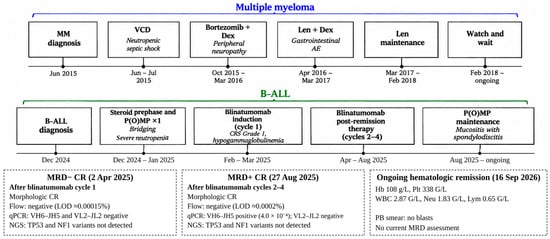
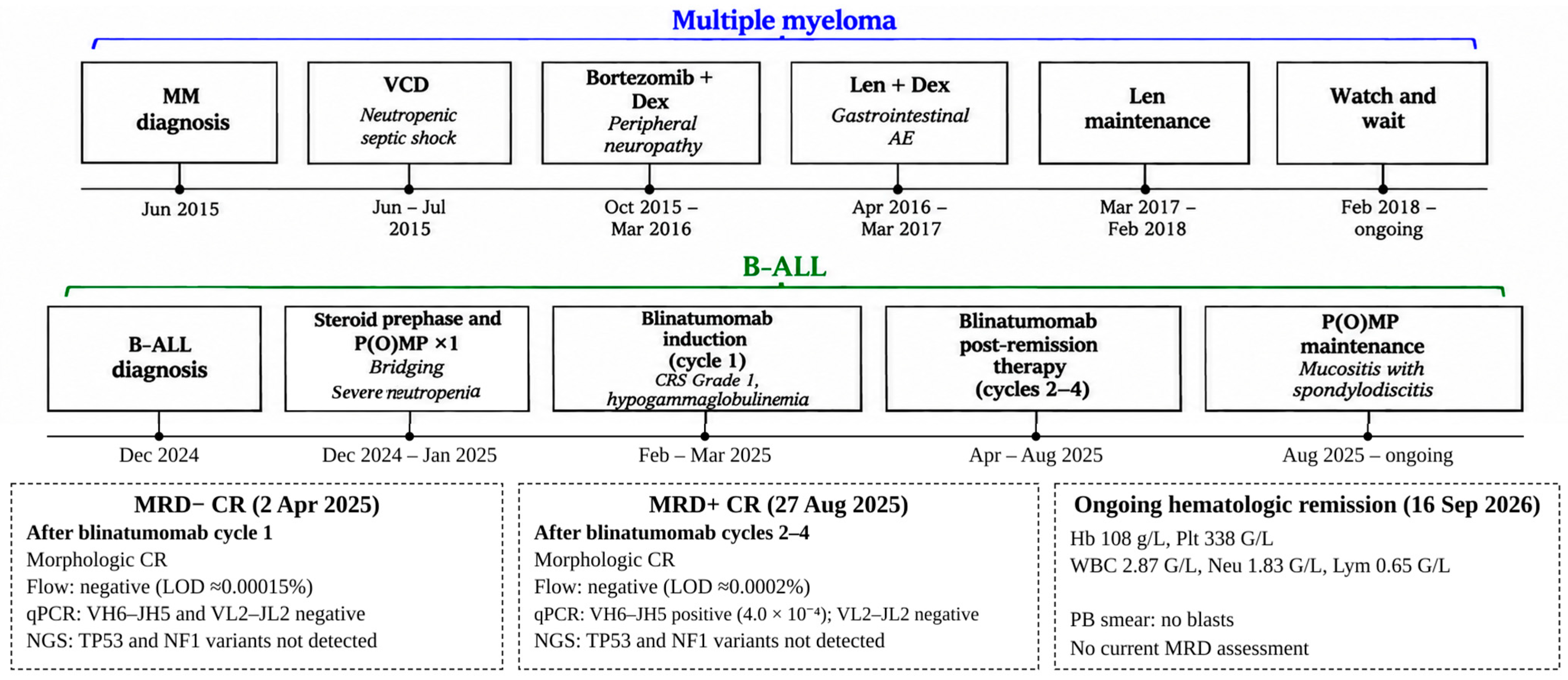
In addition, secondary hypogammaglobulinemia developed during blinatumomab treatment and progressively worsened. The estimated residual gamma globulin concentration (total gamma fraction minus M-protein) fell below 4 g/L, prompting initiation of monthly intravenous immunoglobulin replacement in December 2025 because of increased infection risk. Given the patient’s advanced age and the fact that further MRD assessment would not have altered clinical management, no additional bone marrow examinations were performed. The complete clinical course is illustrated in Figure 1.
Figure 1.
Clinical course timeline. Abbreviations: MM, multiple myeloma; VCD, bortezomib, cyclophosphamide and dexamethasone; Dex, dexamethasone; Len, lenalidomide; AE, adverse event; B-ALL, B-cell acute lymphoblastic leukemia. P(O)MP, prednisone, vincristine (omitted), methotrexate and mercaptopurine; CRS, cytokine release syndrome; CR, complete remission; MRD, measurable residual disease; LOD, limit of detection. NGS, next-generation sequencing; PB, peripheral blood; Hb, hemoglobin; Plt, platelets; WBC, white blood cell count; Neu, neutrophils; Lym, lymphocytes.
3. Discussion
Lenalidomide has substantially improved outcomes in multiple myeloma, particularly as maintenance therapy after autologous stem-cell transplantation (ASCT). Nevertheless, concerns have emerged about the risk of second primary malignancies associated with prolonged lenalidomide exposure.
In an individual-patient meta-analysis of three randomized trials, median progression-free survival (PFS) was 52.8 months with lenalidomide maintenance versus 23.5 months with placebo treatment or observation only (hazard ratio [HR] 0.48, 95% confidence interval [CI] 0.41–0.55). Overall survival (OS) also improved (HR 0.75, 95% CI 0.63–0.90) [1]. An individual-patient meta-analysis of trials in newly diagnosed myeloma reported a five-year cumulative SPM incidence of 6.9% among lenalidomide-exposed patients versus 4.8% among unexposed patients (HR 1.55, 95% CI 1.03–2.34) [6]. The pattern of SPMs varies by treatment setting and prior therapy. In the latter meta-analysis, the five-year incidence of second hematological malignancies was 3.1% with lenalidomide versus 1.4% without it (HR 3.80, 95% CI 1.15–12.62), whereas the difference in solid tumors was not statistically significant (3.8% vs. 3.4%; HR 1.10, 95% CI 0.62–2.00). The risk of hematological SPMs was particularly pronounced with lenalidomide combined with oral melphalan [6]. A subsequent systematic review of 38 randomized trials found an increased SPM risk in myeloma (risk ratio 1.42, 95% CI 1.09–1.84), with increases in both hematological and solid SPMs in its myeloma analyses [7].
B-cell acute lymphoblastic leukemia (B-ALL) following lenalidomide exposure is rare [8]. It has generally been reported after prolonged exposure, although cases following shorter treatment periods have also been described [2]. Emerging molecular evidence suggests several possible pathways to its development, which may differ from those implicated in therapy-related myeloid malignancies [3,9]. A molecular analysis of 57 cases identified three broad mutational groups: TP53-mutated, IDH2-mutated, and a heterogeneous group that included cases with NRAS or KRAS mutations [9]. TP53 alterations are also strongly associated with low-hypodiploid B-ALL [10]. Studies of paired samples suggest that pre-existing clonal hematopoiesis can provide a substrate for subsequent B-ALL [3]. In the IDH2-mutated subgroup, molecular and experimental findings support a model in which lenalidomide favors expansion of a pre-existing clone and IKAROS downregulation impairs B-cell precursor maturation. Further genetic or epigenetic changes may then permit leukemia to persist after lenalidomide is discontinued [9].
In our patient, B-ALL was diagnosed nearly seven years after lenalidomide discontinuation. Although an association between lenalidomide exposure and subsequent B-ALL has been reported, this long interval limits causal attribution in this individual case. Prior myeloma therapy, particularly exposure to cyclophosphamide and pre-existing age-related clonal hematopoiesis are other possible contributors. No samples from the myeloma period were tested for the TP53 or NF1 variants identified at B-ALL diagnosis. We therefore cannot determine whether a pre-existing clone was present before lenalidomide exposure or whether age-related clonal hematopoiesis contributed to the development of B-ALL.
Treatment of lenalidomide-associated B-ALL is challenging because affected patients may be older, have limited tolerance for intensive chemotherapy, and harbor adverse-risk features such as TP53 alterations or low hypodiploidy [2,5]. To describe the initial treatment approaches reported in older patients with B-ALL after lenalidomide exposure, we conducted a focused narrative review of published cases involving patients aged ≥70 years at B-ALL diagnosis who had previously received lenalidomide for multiple myeloma. This pragmatic cutoff is consistent with SWOG S1318, which guided our choice of blinatumomab induction. In that trial, patients aged 65–69 years were eligible only if they declined or were considered unsuitable for standard intensive induction chemotherapy [5]. We last searched PubMed on 15 August 2026 using the following strategy: (lenalidomide OR Revlimid) AND (“acute lymphoblastic leukemia” OR “acute lymphocytic leukemia” OR “B-ALL” OR “B-cell acute lymphoblastic leukemia” OR “B-lymphoblastic leukemia”). We included patients with overt B-ALL whose age at diagnosis was either reported directly or could be established as ≥70 years from the clinical timeline. Ages derived from the timeline are marked with a tilde (~) in Table 3. We excluded cases with uncertain age eligibility and patients with a B-ALL-like population who never developed overt leukemia. Conference abstracts were eligible under the same criteria. We compared age, sex, treatment history, and available cytogenetic findings across reports and found no apparent duplicate cases.
We identified 19 patients meeting these criteria. Their characteristics, B-ALL cytogenetic and molecular features, treatments, and responses are summarized in Table 3. Our patient was 80 years old at B-ALL diagnosis, compared with a median of approximately 77 years (range, 71–86) among the published cases. His 22-month lenalidomide exposure was shorter than in most cases with available data. The nearly seven-year interval between lenalidomide discontinuation and B-ALL diagnosis in our patient was close to the longest interval reported in the broader series by Geyer et al. (2430 days) [2].
Among the 19 published patients, 16 received chemotherapy-based treatment, one received ponatinib plus dexamethasone for Philadelphia chromosome-positive B-ALL, and two received no leukemia-directed therapy. None of the 19 published patients included in our review received blinatumomab as the principal induction agent. Several patients achieved complete remission, in some cases with undetectable MRD. In some reports, however, response was documented only after additional therapy or at an unspecified time, limiting attribution to induction alone.
Reported complications included cytopenias and infection leading to treatment discontinuation in one patient and sepsis with prolonged pancytopenia requiring dose reduction in another. A third patient died during the first cycle of induction. Inconsistent reporting limited assessment of the frequency of severe toxicity. Follow-up duration and disease status at the last assessment were inconsistently reported, and several patients received additional lines of therapy. These limitations preclude reliable comparisons of remission duration or survival across induction regimens.
Evidence to guide treatment of lenalidomide-associated B-ALL remains limited to case reports and small case series. No prospective trials have evaluated treatment specifically in this population. Blinatumomab is an established treatment for relapsed or refractory B-ALL [4] and has shown encouraging efficacy in older patients with newly diagnosed Philadelphia chromosome-negative B-ALL [5]. These findings provide a rationale for evaluating approaches that use blinatumomab while limiting or omitting intensive chemotherapy in older patients with lenalidomide-associated B-ALL.
Our patient had several features reported in lenalidomide-associated B-ALL, including Philadelphia chromosome-negative disease and a TP53 mutation. Cytogenetic analysis also identified a hypotriploid clone, raising the possibility of masked hypodiploidy; however, no confirmatory SNP-array analysis was performed. In adults with B-ALL, TP53 mutations are associated with shorter overall survival [11], and low hypodiploidy/near-triploidy has been linked to a high risk of relapse [12]. Following a short course of modified P(O)MP and one cycle of blinatumomab, the patient achieved MRD-negative complete remission. Given the adverse prognosis associated with TP53 mutation, it is noteworthy that, 20 months after diagnosis, the patient remains in hematologic remission despite previously documented molecular MRD positivity and reports a good quality of life. Without a bone marrow assessment between modified P(O)MP and blinatumomab, the relative contribution of each treatment to remission cannot be determined. Ongoing modified P(O)MP maintenance may also have contributed to the persistence of hematologic remission. This single case cannot establish the safety or efficacy of blinatumomab for lenalidomide-associated B-ALL in frail older patients, but it supports further investigation of blinatumomab-based treatment for this patient population. Collaborative studies with consistent reporting of toxicity, MRD response, and long-term outcomes are needed to define effective and tolerable treatment strategies.
Table 3.
Clinical characteristics, treatment, and response of previously reported patients aged ≥70 years at B-ALL diagnosis with lenalidomide-associated B-ALL.
4. Conclusions
Following a short course of modified P(O)MP, the patient achieved MRD-negative complete remission after the first cycle of blinatumomab. Despite subsequent molecular MRD positivity, he remains in hematologic remission 20 months after diagnosis. Blinatumomab was well tolerated, and quality of life was preserved. This outcome is notable given the patient’s advanced age and adverse-risk features, including a TP53 mutation and a hypotriploid clone with possible masked hypodiploidy.
In most of the published cases identified in our review involving patients aged ≥70 years at B-ALL diagnosis, cytotoxic chemotherapy formed the backbone of induction and was sometimes associated with substantial toxicity. Our patient received modified P(O)MP for only two weeks, and MRD-negative complete remission was documented at the end of blinatumomab induction. However, without a bone marrow assessment between treatments, no conclusion can be drawn about their relative contributions to remission. The hematologic remission observed 20 months after diagnosis in this case supports further investigation of blinatumomab-based approaches in older patients with B-ALL following lenalidomide exposure, particularly those whose treatment options are limited by comorbidities or whose disease has adverse-risk features.
Author Contributions
Conceptualization, Á.S., S.G., M.D. and H.S.; investigation, Á.S.; data curation, H.S., M.D., and P.M.; writing—original draft preparation, Á.S.; writing—review and editing, P.M., M.D. and S.G.; visualization, Á.S.; supervision, H.S. All authors have read and agreed to the published version of the manuscript.
Funding
This research received no external funding.
Institutional Review Board Statement
Ethical review and approval were not required in accordance with the applicable local legislation and institutional requirements, as this manuscript reports an individual clinical case. This case report was conducted in accordance with the Declaration of Helsinki.
Informed Consent Statement
Informed consent was obtained from the patient involved in the study.
Data Availability Statement
The data supporting the findings of this case report are not publicly available due to patient privacy considerations. Data included in the literature review were obtained from previously published studies cited in the manuscript.
Acknowledgments
During the preparation of this manuscript, the authors used ChatGPT (GPT-5.6, OpenAI, San Francisco, CA, USA) to assist with language editing, text formatting and organization, and the preparation of figures and tables based on data and information provided by the authors. The authors reviewed and edited all AI-assisted output and take full responsibility for the content of this publication.
Conflicts of Interest
The authors declare no conflicts of interest.
References
- McCarthy, P.L.; Holstein, S.A.; Petrucci, M.T.; Richardson, P.G.; Hulin, C.; Tosi, P.; Bringhen, S.; Musto, P.; Anderson, K.C.; Caillot, D.; et al. Lenalidomide Maintenance After Autologous Stem-Cell Transplantation in Newly Diagnosed Multiple Myeloma: A Meta-Analysis. J. Clin. Oncol. 2017, 35, 3279–3289. [Google Scholar] [CrossRef] [Scilit] [PubMed]
- Geyer, M.B.; Shaffer, B.C.; Bhatnagar, B.; Mims, A.S.; Klein, V.; Dilip, D.; Glass, J.L.; Lozanski, G.; Hassoun, H.; Landau, H.; et al. Lenalidomide-Associated B-Cell ALL: Clinical and Pathologic Correlates and Sensitivity to Lenalidomide Withdrawal. Blood Adv. 2023, 7, 3087–3098. [Google Scholar] [CrossRef] [Scilit] [PubMed]
- Barnell, E.K.; Skidmore, Z.L.; Newcomer, K.F.; Chavez, M.; Campbell, K.M.; Cotto, K.C.; Spies, N.C.; Ruzinova, M.B.; Wang, T.; Abro, B.; et al. Distinct Clonal Identities of B-ALLs Arising after Lenolidomide Therapy for Multiple Myeloma. Blood Adv. 2023, 7, 236–245. [Google Scholar] [CrossRef] [Scilit] [PubMed]
- Kantarjian, H.; Stein, A.; Gökbuget, N.; Fielding, A.K.; Schuh, A.C.; Ribera, J.-M.; Wei, A.; Dombret, H.; Foà, R.; Bassan, R.; et al. Blinatumomab versus Chemotherapy for Advanced Acute Lymphoblastic Leukemia. N. Engl. J. Med. 2017, 376, 836–847. [Google Scholar] [CrossRef] [Scilit] [PubMed]
- Advani, A.S.; Moseley, A.; O’Dwyer, K.M.; Wood, B.L.; Fang, M.; Wieduwilt, M.J.; Aldoss, I.; Park, J.H.; Klisovic, R.B.; Baer, M.R.; et al. SWOG 1318: A Phase II Trial of Blinatumomab Followed by POMP Maintenance in Older Patients With Newly Diagnosed Philadelphia Chromosome-Negative B-Cell Acute Lymphoblastic Leukemia. J. Clin. Oncol. 2022, 40, 1574–1582. [Google Scholar] [CrossRef] [Scilit] [PubMed]
- Palumbo, A.; Bringhen, S.; Kumar, S.K.; Lupparelli, G.; Usmani, S.; Waage, A.; Larocca, A.; van der Holt, B.; Musto, P.; Offidani, M.; et al. Second Primary Malignancies with Lenalidomide Therapy for Newly Diagnosed Myeloma: A Meta-Analysis of Individual Patient Data. Lancet Oncol. 2014, 15, 333–342. [Google Scholar] [CrossRef] [Scilit] [PubMed]
- Saleem, K.; Franz, J.; Klem, M.L.; Yabes, J.G.; Boyiadzis, M.; Jones, J.R.; Shaikh, N.; Lontos, K. Second Primary Malignancies in Patients with Haematological Cancers Treated with Lenalidomide: A Systematic Review and Meta-Analysis. Lancet Haematol. 2022, 9, e906–e918. [Google Scholar] [CrossRef] [Scilit] [PubMed]
- Morice, P.-M.; Khalife-Hachem, S.; Sassier, M.; Lelong-Boulouard, V.; Danu, A.; Pasquier, F.; Renneville, A.; Dolladille, C.; Micol, J.-B. Acute Lymphoblastic Leukemia in Patients Treated with Lenalidomide for Multiple Myeloma: A Safety Meta-Analysis of Randomized Controlled Trials Combined with a Retrospective Study of the WHO’s Pharmacovigilance Database. Blood Cancer J. 2024, 14, 177. [Google Scholar] [CrossRef] [Scilit] [PubMed]
- Horns, J.M.; Beder, T.; Künstner, A.; Barz, M.J.; Bendig, S.; Bozzetti, C.; Chitadze, G.; Darzentas, N.; Iben, K.; Kotrova, M.; et al. IDH2 Clonal Hematopoiesis and IKAROS Loss Cooperate in a B-ALL Subtype after Lenalidomide Therapy for Multiple Myeloma. Blood 2026, 148, 856–866. [Google Scholar] [CrossRef] [Scilit] [PubMed]
- Kim, R.; Bergugnat, H.; Larcher, L.; Duchmann, M.; Passet, M.; Gachet, S.; Cuccuini, W.; Lafage-Pochitaloff, M.; Pastoret, C.; Grardel, N.; et al. Adult Low-Hypodiploid Acute Lymphoblastic Leukemia Emerges from Preleukemic TP53 -Mutant Clonal Hematopoiesis. Blood Cancer Discov. 2023, 4, 134–149. [Google Scholar] [CrossRef] [Scilit] [PubMed]
- Harris, E.J.; Karaoglu, D.A.; Sukhanova, M.; Abaza, Y.; Karantanos, T.; Eisfeld, A.-K.; Anderson, C.; Lin, C.; Moreno Vanegas, Y.A.; Badar, T.; et al. Clinical and Molecular Characterization of TP53-Mutant Acute Lymphoblastic Leukemia in Adults. Blood Cancer J. 2025, 15, 138. [Google Scholar] [CrossRef] [Scilit] [PubMed]
- Moorman, A.V.; Barretta, E.; Butler, E.R.; Ward, E.J.; Twentyman, K.; Kirkwood, A.A.; Enshaei, A.; Schwab, C.; Creasey, T.; Leongamornlert, D.; et al. Prognostic Impact of Chromosomal Abnormalities and Copy Number Alterations in Adult B-Cell Precursor Acute Lymphoblastic Leukaemia: A UKALL14 Study. Leukemia 2022, 36, 625–636. [Google Scholar] [CrossRef] [Scilit] [PubMed]
- Crosby, J.; Erzuah, T.; Haider, M.; Smith, F.; Ganti, S.; Monohan, G.; Elsouiedi, R. Treatment-Associated Acute Lymphoblastic Leukemia Following Autologous Hematopoietic Stem Cell Transplant and Lenalidomide Maintenance in Patients With Multiple Myeloma. J. Investig. Med. High Impact Case Rep. 2022, 10, 23247096221133204. [Google Scholar] [CrossRef] [Scilit] [PubMed]
- Gonzalez, M.M.; Kidd, L.; Quesada, J.; Nguyen, N.; Chen, L. Acute Myelofibrosis and Acute Lymphoblastic Leukemia in an Elderly Patient with Previously Treated Multiple Myeloma. Ann. Clin. Lab. Sci. 2013, 43, 176–180. [Google Scholar] [PubMed]
- Sinit, R.B.; Hwang, D.G.; Vishnu, P.; Peterson, J.F.; Aboulafia, D.M. B-Cell Acute Lymphoblastic Leukemia in an Elderly Man with Plasma Cell Myeloma and Long-Term Exposure to Thalidomide and Lenalidomide: A Case Report and Literature Review. BMC Cancer 2019, 19, 1147. [Google Scholar] [CrossRef] [Scilit] [PubMed]
- Khan, A.M.; Muzaffar, J.; Murthy, H.; Wingard, J.R.; Moreb, J.S. Acute Lymphoblastic Leukemia Following Lenalidomide Maintenance for Multiple Myeloma: Two Cases with Unexpected Presentation and Good Prognostic Features. Case Rep. Hematol. 2018, 2018, 9052314, Erratum in Case Rep. Hematol. 2019, 2019, 1548610. https://doi.org/10.1155/2019/1548610. [Google Scholar] [CrossRef] [Scilit] [PubMed]
- Khan, D.S.R.; Tariq, D.M.; Fayyaz, D.S.M.; Soomar, S.M.; Moosajee, D.M. Lenalidomide Induced Secondary Acute Lymphoblastic Leukemia in a Multiple Myeloma Patient: A Case-Report. Leuk. Res. Rep. 2022, 17, 100315. [Google Scholar] [CrossRef] [Scilit] [PubMed]
- Vusqa, U.T.; Chahine, Z.; Asawa, P.; Sadashiv, S.; Samhouri, Y.; Lister, J. Three Cases of Lenalidomide Therapy for Multiple Myeloma and Subsequent Development of Secondary B-ALL. J. Oncol. Pharm. Pract. 2022, 28, 1214–1217. [Google Scholar] [CrossRef] [Scilit] [PubMed]
- Gardner, J.-A.; Sprague, J.; Greipp, P.T.; Conant, J.L. B-Lymphoblastic Leukemia with BCR::ABL1-like Features After Long-Term Lenalidomide Therapy. J. Assoc. Genet. Technol. 2024, 50, 188–192. [Google Scholar] [PubMed]
- Arribas, I.; Maluquer, C.; Pomares, H.; Carro, I.; Baca, C.; Bosch, A.; Arévalo, C.E.; Montané, C.; Ribes-Amorós, J.; Zamora, L.; et al. B-Cell Acute Lymphoblastic Leukemia after Lenalidomide Maintenance Therapy; a Deleterious Adverse Event That Needs Further Investigation. Report of Three Cases and Review of the Literature. Leuk. Lymphoma 2023, 64, 1701–1705. [Google Scholar] [CrossRef] [Scilit] [PubMed]
- Calvillo, C.D.; Cardenas Castro, V.; Shim, K.G.; Arribas, M.; Kirsch, I.; Fonseca, R.; Arana Yi, C. NGS-Based Monitoring of Secondary Acute Lymphoblastic Leukemia Dynamics Following Lenalidomide Maintenance in Multiple Myeloma Patients. Leuk. Lymphoma 2026, 67, 342–348. [Google Scholar] [CrossRef] [Scilit] [PubMed]
- Hughes, E.E.; Baron, J.; Wang, E.S.; Yu, H.; Scott, J.D. Mini-HyperCVD in Secondary Acute Lymphoblastic Leukemia Following Multiple Myeloma Treatment from Lenalidomide: A Case Series. Leuk. Lymphoma 2026, 67, 1612–1615. [Google Scholar] [CrossRef] [Scilit] [PubMed]
- Fei, F.; Reddy, V.; Rosenblum, F. B-Cell/Mixed Phenotype Acute Leukemia Following Lenalidomide Maintenance For Multiple Myeloma: A Study Of Two Cases. Am. J. Clin. Pathol. 2020, 154, S153. [Google Scholar] [CrossRef] [Scilit]

Disclaimer/Publisher’s Note: The statements, opinions and data contained in all publications are solely those of the individual author(s) and contributor(s) and not of MDPI and/or the editor(s). MDPI and/or the editor(s) disclaim responsibility for any injury to people or property resulting from any ideas, methods, instructions or products referred to in the content. |
© 2026 by the authors. Licensee MDPI, Basel, Switzerland. This article is an open access article distributed under the terms and conditions of the Creative Commons Attribution (CC BY) license.