


Abstract
The present study based in Jupiter, Florida, was a near-first look at urban native plant ecology in southern Florida. There were three objectives: 1. produce a ranked tally of native species in the urbanized environment; 2. assess the prevalence of high-occupancy niche-indifferent vs. niche-selective species; and 3. identify traits associated with local urban occupancy and examine their relationship with site occupancy. Forty-five urban sites divided among nine ecologically diverse keyword-types were sampled with species presence or absence recorded. Results were reported as a ranked species list by total site occupancy and as individual site-type occupancies as well as species possession of three featured traits. Four species emerged in high total occupancies and site-type occupancies (Phyla nodiflora (L.) Greene, Sida ulmifolia Mill., Paspalum setaceum Michx., and Eustachys petraea (Sw.) Desv.). The urban flora featured high-occupancy site-indifferent species, although site-type specialization was apparent too. Three traits were significantly associated with high urban site occupancy vs. wild background: facultative prostrate growth (70%/33%), rooted spreading (57%/22%), and reproductive assurance (61%/24%). Species having two or three of the featured traits tended toward higher site occupancy (p < 0.0001) than those with zero or one trait did. The project overall thus targeted a new area and found site occupancy to be largely broad but mixed with selectivity and to be linked to three traits, especially in combination.
1. Introduction
Southern Florida wild plant floristics have a robust history (e.g., [1,2,3]) and there is attention to Florida vertebrate urban ecology (e.g., alligators [4]; gopher tortoises [5]; coyotes [6]). By contrast, southern Florida urban plant ecology is practically unstudied. No previous studies are known to the author, and searching Google Scholar, PubMed, and Semantic Scholar in August 2026 yielded no results.
The literature on urban plant ecology is plentiful in Europe and spotty elsewhere. Plants in urban settings necessarily experience novel or exaggerated stresses or advantages, including mowing and weed control, trampling and soil compaction, vehicular damage, altered edaphic and hydraulic conditions, pollutants and nutrients including landscape management chemicals, niche fragmentation, site enclosure, and altered species associations [7,8,9]. In the last-mentioned connection, suppression or floral visitation points toward Baker’s Law or toward similar scenarios of pollinator paucity or mate limitation, especially the metapopulation scenario described by Pannell et al. [10] which recognizes self-compatibility as facilitating colonization. The prior urban spontaneous plant literature is often focused diffusely on rural-to-urban gradients, novel vs. remnant city habitats, invasive exotic species, and conservation or urban planning. Sukopp [11] provided a broad review, characterizing urban floras as stochastic in formation and in ongoing dynamics and perpetually changing rather than reaching a climax.
Sukopp’s [11] characterization suggests a salient point of interest for a spontaneous urban native floristic survey: do site compositions differ substantially within (or between) cities, or do city habitats tend to be more monolithic with minimal in-city differentiation? Mixed explicit and implicit signals are in the literature on this balance. McKinney [12] favored a unified view of the urban habitat. Knapp et al. [9] and Lososová [13] commented briefly on broad tolerances in urban species, and Wittig [14] reported loss of narrow-amplitude species. Highlighting urban site selectivity, Kalusová et al. [15] described urban habitat-specific trait filtering. Referring to animals and to plants, McKinney [12] (p. 254) said, “as with urban adapters, each urban exploiter species uses a unique opportunity niche among a variety of potential microhabitats.”
Helping to define the research gap beyond that balance, Ruas et al. [16] underscored the relevance of small cities to urban plant ecology and advocated exploration of new urban regions. The present project is intended to answer that call by examining the following research questions for Jupiter:
- What native species populate diversified local urban sites and in what frequencies?
- Are occupancy patterns predominantly uniform across site types, site-type specific, or mixed?
- Are specific traits or trait combinations associated with site occupancy?
To address those questions, the study used field-collected data to tally site-presence or absence for urban species at 45 sites sorted into nine “keyword site-types” and tallied traits for the species.
2. Materials and Methods
All study data are in the Supplementary Materials (SM) along with original documentation supporting classifying Fimbristylis cymosa R.Br. (Cyperaceae) as having reproductive assurance (File S1). Table 1 is an annotated list of the keyword sites (site visitation dates and geo-coordinates are in Table S3).
Table 1.
Annotated list of keyword site-types.
Palm Beach County in coastal SE Florida hosts 867 wild native species (extracted from Wunderlin et al. 2000+ Plant Atlas [3]). Of these, 62 were recorded within the town of Jupiter, with 23 of them in at least three sites. Excluded were obligate aquatic species, non-angiosperms, gardens and actively landscaped areas (except swales within them), trees, shrubs, and vines.
Jupiter, Florida, is an Atlantic coastal town of ca. 63,000 permanent residents plus numerous seasonal residents and tourists, centered at 26.93422° N, 80.09421° W. From NOAA 1991–2020 climate normals at Trump (West Palm Beach) International Airport weather station USW00012844 [17]: December–February (mean min–max 15–26 °C with rare freezes, mean precipitation 191 mm); June–August (24–32 °C, 575 mm); annual total precipitation 1610 mm. As observed by the author in approx. 30 years of local botany, the Jupiter-area flora outside of seasonal wetlands tends toward constancy year-round; the study species are largely perennials; and the study was conducted in the rainy season when any annuals are most apparent. The present data were collected 7 May through 16 June 2026. The soil mostly is nearly level poorly drained maritime sands and includes a hardpan layer in places (Soil Survey of Palm Beach County, Florida https://ufdc.ufl.edu/uf00025737/00001, accessed on 25 September 2026). Retail businesses, institutional buildings, and light industry dominate the data-source central regions.
In order to display a ‘spectrum’ of local urban site diversity, nine keyword-types (Table 1, see also Supplementary Materials) served as discrete organizing categories for species occurrences. Sites sharing keyword designations were not regarded as replicates and were not compared statistically. Suitable sites within Jupiter and the adjacent urban sprawl were pinpointed searching by automobile and qualified by exceeding ca. 100 m2 (with rare exceptions) and having unrestricted access, parking, traffic safety, and freedom from additional constraints. Generally the first-encountered suitable instance of each keyword site-type was surveyed. Site selection was blind with respect to plant occupancy. Sites were searched exhaustively clump-by-clump until no “new” species could be located, so that a score of zero signifies true absence. Data were gathered as presence/absence for every spontaneous native species, with five sites each for the nine keyword-categories, thus generating 45 sites (Table S2). Two occupancy metrics were used: site-type count, the number of the nine keyword-types each species occupied, and total site count, used as a second measure of situational diversity.
Reproductive assurance was defined as apomixis or self-pollination (including cleistogamy and autogamy) and excluded vegetative cloning. Reproductive assurance traits were scored uniformly for each species by searching Google for the same keywords—apomixis, cleistogamy, autogamy, and self-pollination—then clarifying any leads thus generated. Reproductive assurance was scored as known (1) or not encountered (0). In many cases, reproductive assurance was scored as 0 for lack of proof, yet annotated separately as strongly suspected, in most cases due to congeners with reproductive assurance. Citations and annotations relevant to the scoring are in Table S1. Reproductive assurance species percentage ranges were established with the low end being known reproductive assurance and the upper end being “known + strongly suspected.” Deeper literature and internet searching than the four-keyword search was conducted, but in no instance did it contradict the “four-keyword” results.
Spreader and facultative prostrate growth were typically obvious and scored by field observations. To resolve any ambiguities, Flora of North America [18], Long and Lakela [2], Small [1], Hitchcock [19], and herbarium specimen photos at the University of South Florida were consulted. The “spreader” trait was scored as positive for any species capable of lateral expansion by rhizomes, stolons, layers, root sprouts, or creeping stems with nodal rooting.
To establish a basis to compare spontaneous urban species with a wild background, a wild-species baseline was established starting with a full list of University of South Florida and University of Florida herbarium specimens collected in Palm Beach County and adjacent Martin County. (Most of the work was near the Martin County line.) This list was filtered to remove woody plants, vines, non-angiosperms, and aquatic species, leaving 279 eligible species. Then 63 names were drawn randomly by AI (Claude); these are available in Table S4. Taxonomic identity followed the original herbarium determinations. Names appearing in this article were cross-referenced against Wunderlin et al.’s online Atlas of Florida Plants [3], including synonymy which required no author reinterpretation. Additional information on the main species is in Appendix A.
Species can occur as ostensibly non-established singletons or doubletons in the urban context via unusual substrate patches, seeds or rooting fragments from landscape mulches, falling from vehicles, animal or bird scat and activities, and many additional sources. Thus a threshold of at least three encounters was taken as a working definition of “established.” This approach reflects exclusion of low-representation species by other authors such as Nadal et al. studying spiders [20].
Statistics, Graphics and AI usage.
Statistical tests were conducted and graphics prepared using R 4.5.1 with ggplot2, readxl, tidyverse, and forcats libraries. During related research and during the present project, the author used AI (Claude, Sonnet 5 (Anthropic, San Francisco, CA, USA)) in an exploratory fashion (internet and file searching, data organizing and consistency checks, nonpublished summary statistics, markup syntax) but not in a generative capacity other than for code and for the random draw applied to the wild species baseline. The manuscript, tables, graphics, and all data are original to the author. To test if the four exceptional-occupancy species and the remaining 19 of the 23 featured species (n > 2) were spread less evenly across the keyword sites than expected by chance, keyword-type labels were shuffled across the 45 sites (with site species lists held fixed) 9999 times, and chance-normalized deviations between observed and expected counts were summed into a single statistic for each shuffle, separately for the two species groups. The resulting two null distributions, each standardized to z-scores relative to its own mean, were pooled for graphic display. To assess if trait combinations help drive site occupancy, the trait counts (0–3) for the three featured binary traits (facultative prostrate growth, rooted spreading, and reproductive assurance) were computed for all 62 Jupiter-encountered species. For statistical assessment the species were divided into two groups, one group having zero or one trait and the other group having two or three. Site occupancy was then compared with a Mann–Whitney test and Spearman rank correlation, both selected because the data were not credibly normal, of uniform variance, or free of outliers.
3. Results
3.1. Research Question 1: Species and Occurrence Levels
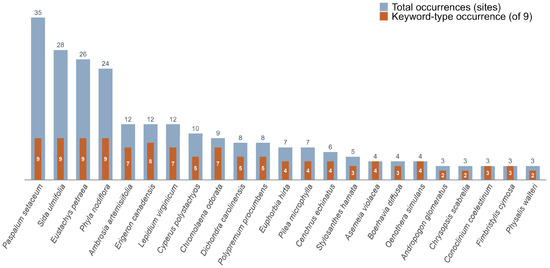
Twenty-three species occupied at least three Jupiter localities (Figure 1). Overall they are a mix of five Asteraceae, four grasses (Poaceae), two sedges (Cyperaceae), and diverse others. The 23 are heterogeneous in stature, vegetative morphology, and floral structure. As verified in the field and by the floristic references listed above, all 23 except the species tied for fewest occurrences, Physalis walteri Nutt. (Solanaceae), have dry propagules: seeds from capsules, nutlets and schizocarps, caryopses, achenes, or similar.
Figure 1.
Twenty-three species ordered by site-occurrence. Numbers above bars are counts. Blue bars show total site counts out of 45. Brown bars show numbers of keyword site-types (max = 9).
3.2. Research Question 2: Species Site-Type Indifference vs. Specificity
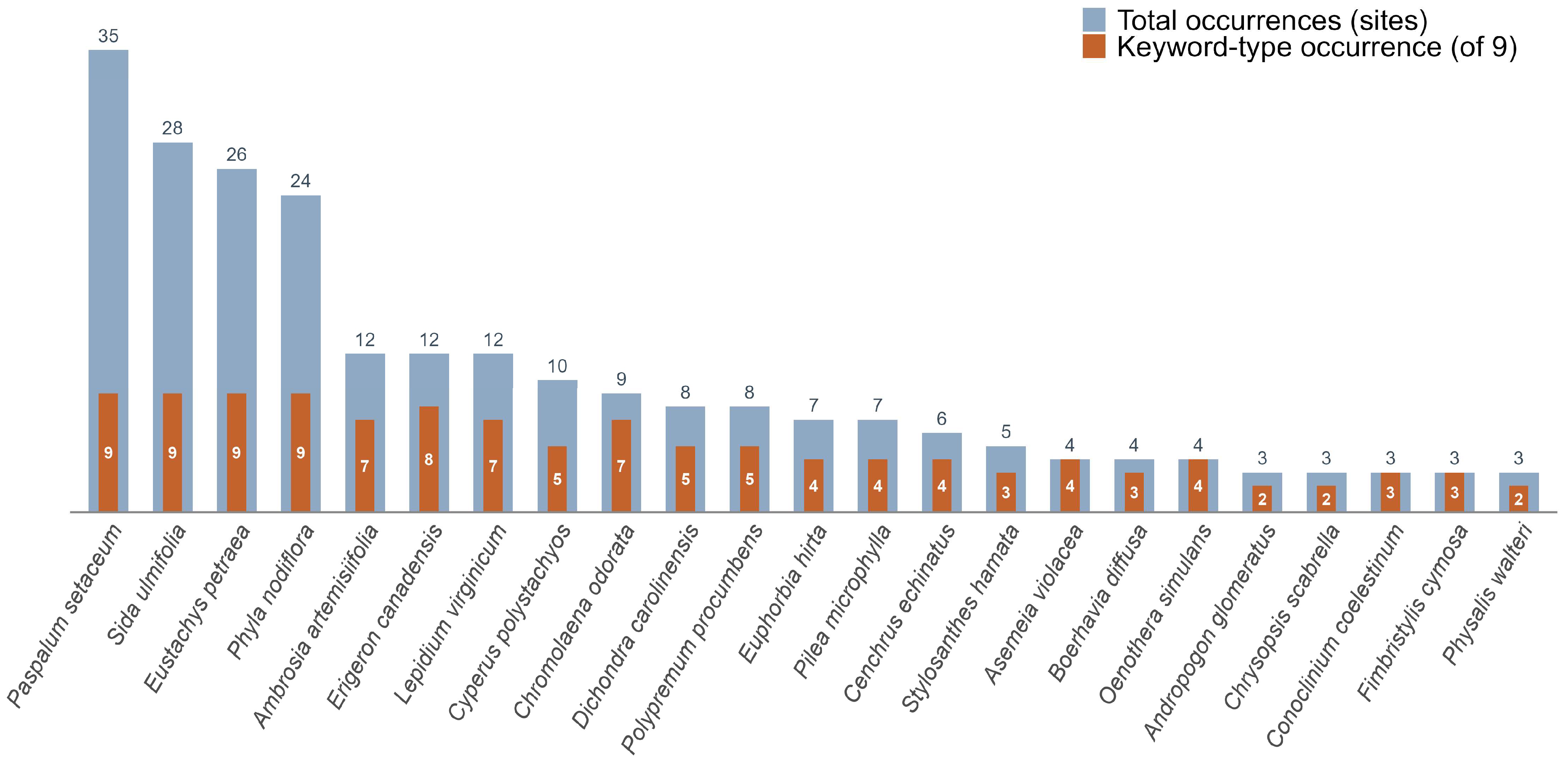
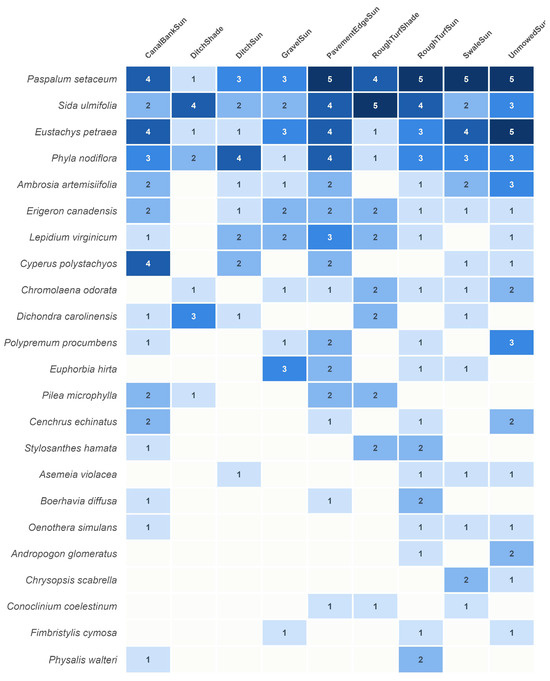
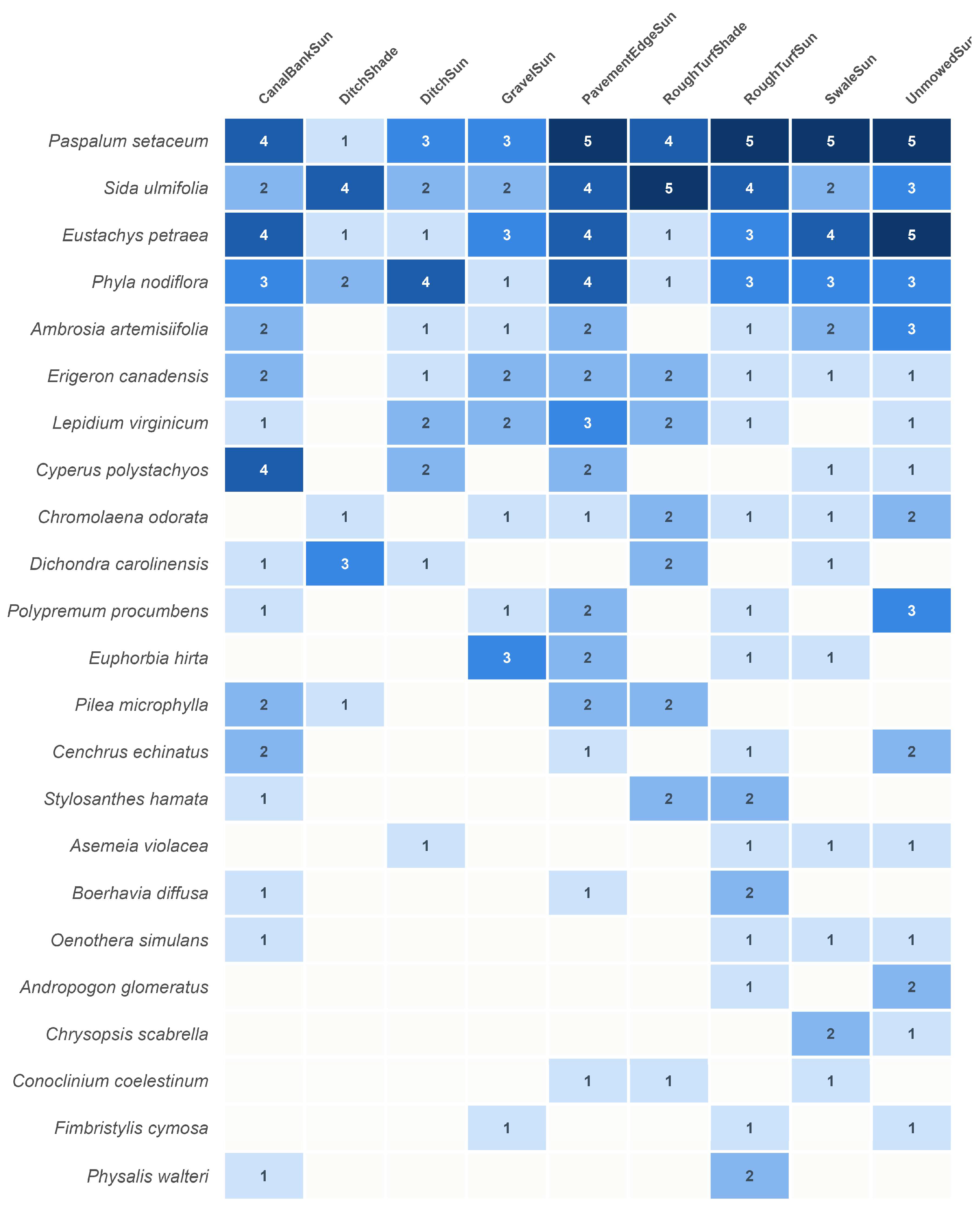
Four species have site occurrences markedly above all others (Figure 1): grass Paspalum setaceum (35/45 sites), malvaceous subshrub Sida ulmifolia (28 sites), grass Eustachys petraea (26 sites), and verbenaceous forb Phyla nodiflora (24 sites). The combined site-occupancy for these four species (113) amounts to nearly the total (123) for all 19 additional species combined. The four exceptional species occurred, albeit unevenly, in every keyword site-type (Figure 2).
Figure 2.
Species in relation to site-type occupancy. Dark colors correspond to higher occupancies (with numbers shown in squares). The four top rows represent the four exceptionally high-occupancy species.
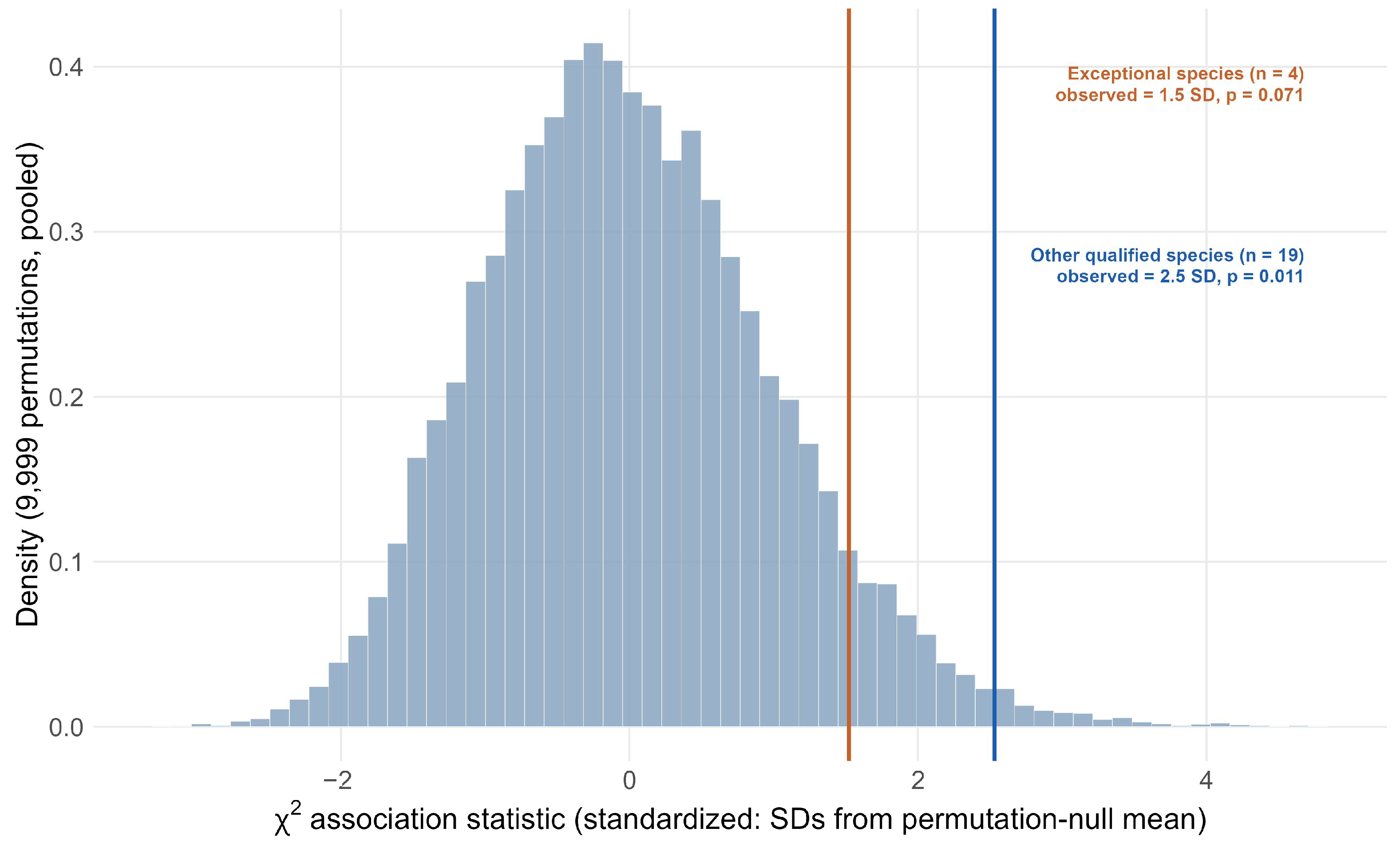
Dividing the 23 species into the exceptional four and the 19 others, both groups showed uneven site distributions (Figure 2). For the exceptional four this was not statistically significant, but it was significant for the 19 lower-occupancy others (Figure 3).
Figure 3.
Test to assess evenness in site-type distributions for the 23 species with n > 2. The four exceptional-occupancy species were assessed separately from the remaining 19. The pooled distribution profile represents expected association statistics from 9999 random reshufflings of site-type labels (see Section 2). Vertical lines mark each group’s observed association statistic, expressed as standard deviations from its own null distribution’s mean.
3.3. Research Question 3: Traits
Three traits were associated significantly with the Jupiter urban species: facultative prostrate growth, rooted lateral spreading, and reproductive assurance (Table 2; Table S1).
Table 2.
Comparison of wild baseline vs. urban species (n = 23) for three traits. Fisher’s exact tests were 2-tailed. Contingency tables are in Table S5. Confidence intervals are Clopper–Pearson exact.
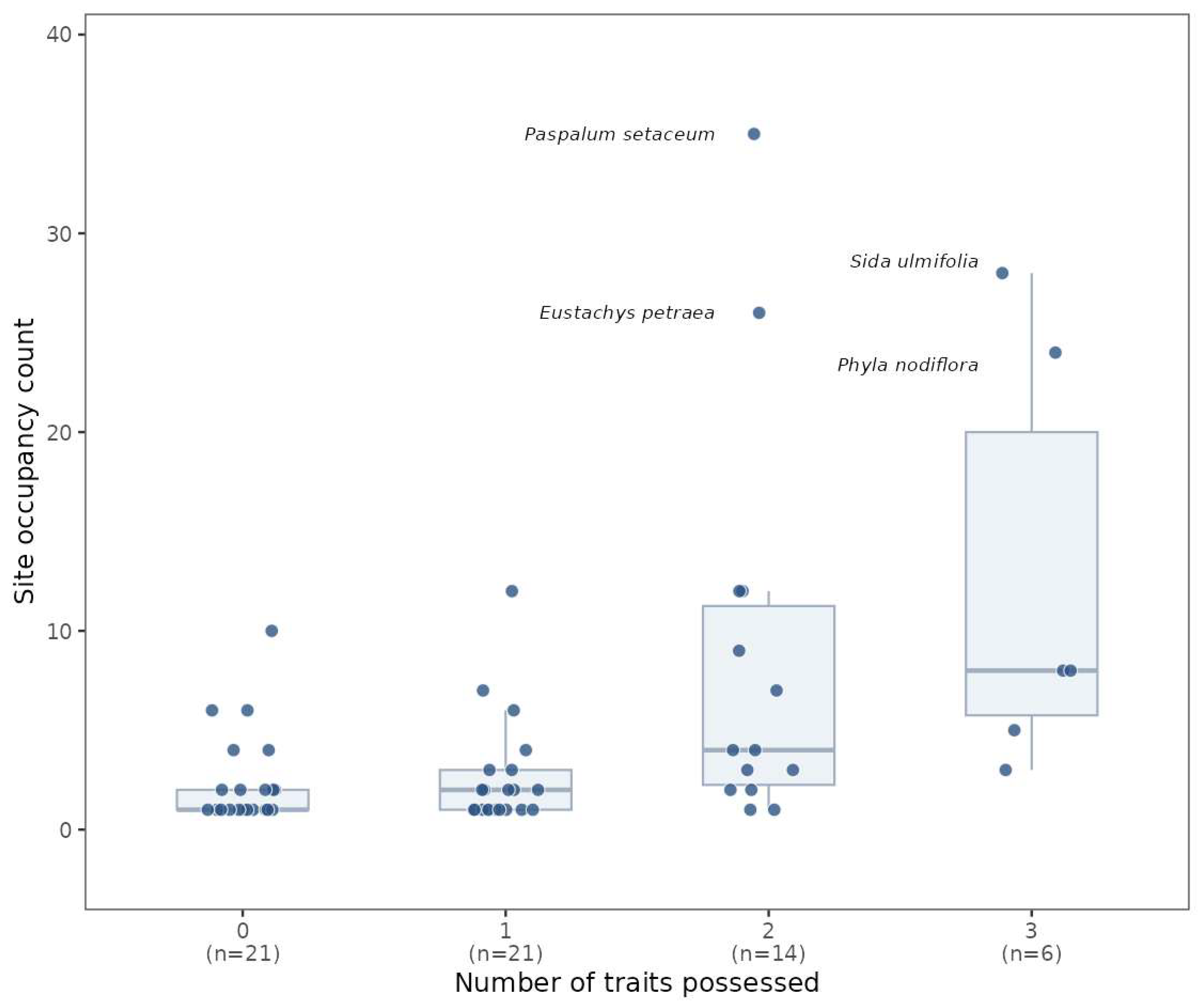
Not only did possession of single traits matter, but trait combinations were of interest as well. When the 62 species are divided into a bottom group (zero to one traits) and a top group (two to three traits), site occupancy differs significantly between the groups (Figure 4).
Figure 4.
Site occupancy count by number of traits possessed (0–3: proven reproductive assurance, spreader, facultatively prostrate growth) for all 62 Jupiter species. Mann–Whitney p = ca. 4.15 × 10⁻⁵ (0–1 vs. 2–3 traits); Spearman ρ = 0.483, p = 7.0 × 10⁻⁵ (n = all 62 encountered species).
4. Discussion
With respect to Research Question 2, which addresses ecological breadth in urban species, the four exceptional native species are multicontinental in distribution, naturally and through introductions [21]. The remaining 19 species range from globally widespread taxa (e.g., Erigeron canadensis L., Asteraceae) to one nearly endemic Florida species (Chrysopsis scabrella Torr. & A. Gray, Asteraceae). The observation that high-occupancy species also exhibit high site-type breadth must arise from some combination of statistical inevitability (species occurring in many sites have more opportunities to appear in diverse site types) and true ecological breadth. Regardless of the relative contributions of these processes, the Jupiter urban flora includes four globalist high-occupancy native species that occur in every site-type across the city, as well as in many additional site-types far beyond Florida.
Concerning Research Question 3 dealing with traits, for reproductive assurance in urban plants, the present study quantitatively confirmed the findings of prior authors who noticed high reproductive assurance in city plants [22]. Recently in Thailand Charoenlertthanakit et al. [23] tabulated 61 identified urban “sidewalk ecosystem” species, remarking on an abundance of species prone to lie flat. That trait surfaced in the present study, again quantified against a wild background. The third locally prevailing trait, rooted lateral spreading, likewise occurred significantly more often than in the wild background. The four exceptional species possess all three traits as a suite, except for the two grasses where reproductive assurance is suspected but not demonstrated. The site-occupancy association with possession of two or three of the featured traits is evident even beyond the exceptional four species, reflecting that trait combinations are crucial [8]. Knapp et al. [9] demonstrated this empirically in trait-interaction models.
4.1. Limitations
The limited number of species in Jupiter constrained using species as data points. Species occurring only once or twice were a problem that compelled a three-occurrence cutoff used throughout most of the paper to minimize analysis of dubiously established low-occurrence species. That reproductive assurance was necessarily coded as 0 for “unknown” acknowledges probable underrepresentation of this trait in the literature and in the present data due to undetected instances. Sites with public accessibility may experience more trampling, vehicular disturbance, dog waste, and similar impacts compared with inaccessible sites.
4.2. Avenues for Continued Research
Possession or absence of three traits influenced performance in the Jupiter urban system. The benefit of reproductive assurance is clear, but benefits are less obvious for prostrate growth ability (except for mower tolerance) and rooted spreading. It may be easy to speculate plausibly on the benefits of the latter two, but that speculation may raise questions of inter-specific interactions influencing urban community assembly. The functioning of standard ecological dynamics in city conditions calls for attention. Although urban environments may be paved, contaminated, scattered, and variably disturbed, they are not necessarily in constant existential turmoil. In fact, urban sites may persist for decades only moderately disturbed or subjected to the same disturbances (e.g., mowing) serially. Although species associations in such settings may not have time for coevolution, there may be ample time for abiotic and biotic forces to drive community assembly. Urban soil microbial relationships, intra- and inter-specific competition and facilitations, and symbiotic species reuniting in town are inviting avenues for continued research.
5. Conclusions
This study contributed data from subtropical southeastern Florida otherwise generally ignored to date in urban plant ecology. It attended to the gap identified by Ruas et al. [16] for sampling across a broader range of different geographic contexts, including small cities. Patterns of species occurrences revealed high-occupancy site-indifferent intercontinental species as key components in the Jupiter urban flora. Possession of three traits, especially in combination, predicted occupancy.
Supplementary Materials
The following supporting information can be downloaded at: https://www.mdpi.com/article/10.3390/ijpb17100097/s1, Figure S1: Photo Vouchers; Table S1: Species Trait Data; Table S2: Raw Field Data; Table S3: Site Coordinates; Table S4: Baseline Species Draw; Table S5: Contingency Tables; File S1: Fimbristylis cymosa Reproductive Assurance.
Funding
This research received no external funding.
Data Availability Statement
All data are available in the Supplementary Materials.
Acknowledgments
During the preparation of this manuscript, the author used Claude Sonnet 5 (Anthropic, San Francisco, CA, USA, August 2026) to generate a seeded random draw of 63 species names from the filtered wild-species candidate list used as the comparative baseline. The author reviewed the output and takes full responsibility for the content of this publication.
Conflicts of Interest
The author declares no conflicts of interest.
Appendix A
The four Exceptional Niche Occupancy taxa profiles (with photo vouchers in Figure S1):
Sida ulmifolia Mill. (Malvaceae)
Capable of rising as a small shrub to about 1 m tall but in the present context typically a small subshrub with stipulate, serrate more or less ovate to lanceolate alternate leaves and butter-yellow apopetalous flowers and numerous stamens. The fruits are multicarpellate schizocarps with beaked uniseeded mericarps. In the urban context S. ulmifolia is often prostrate or very low from a strong taproot, sometimes with creeping lateral rooted spreading. Seedlings around larger individuals can be numerous. Jupiter representatives range from moist ditches and swales to dry sand, sun and shade. The original northern limit is uncertain but Wunderlin et al. [3] listed it as native to Florida. The overall range is the southern U.S. to central South America, with introductions in tropical Africa and Asia [24].
Phyla nodiflora (L.) Greene (Verbenaceae)
Phyla nodiflora is a mostly low-growing creeping to upright forb with opposite obovate–spatulate leaves toothed apically. Small white and purplish flowers are congested into small dense heads on bare peduncles. Fruits consist of four nutlets. The species serves in horticulture as a groundcover. The present project showed P. nodiflora to respond dramatically and upright to favorable conditions, and on the other hand to fare well creeping on exposed droughty sand. It grows exceptionally well at some pavement edges apparently using abundant runoff water from the pavement drainage, and it becomes large where fertilizer runoff is apparent. Phyla nodiflora is panglobal in warm climates and beyond, especially in the Southern Hemisphere, and was introduced in Europe and in Australia [24,25].
Eustachys petraea (Sw.) Desv. (Poaceae)
Tough tuft-forming grass to 0.5 m tall, ranging from mostly upright to decumbent, often stoloniferous. Leaves keeled. In the Jupiter area its color ranges from green to glaucescent blue. Spikelets are borne on up to ca. 8 narrow digitate spikes of similar lengths and originating umbel-like from a common node. This species ranges from mostly the southern U.S. (and Pennsylvania) to Uruguay [24], introduced in Africa and eastern Asia.
Paspalum setaceum Michx. (Poaceae)
Highly variable upright to ground-hugging rhizomatous grasses tending toward wide (to 20 mm) blades, often with purplish coloration. Spikelets flat and clam-shaped, on narrow axes, these often partly hidden in leaf sheaths. Banks [26,27] documented substantial morphological variety with taxonomic confusion in P. setaceum, including in the present study area, and failed to find apomictic embryos in Paspalum setaceum and other Co“Group Setacea” species, and speculatively suggested likely autogamy based on progeny similarities. Without reference to P. setaceum, Schedler et al. [28] found Paspalum species to be mixed for presence or absence of self-compatibility and in ploidy levels. Campbell et al. [29], citing prior work, mentioned cleistogamy in a different species of Paspalum. Paspalum setaceum ranges from Canada to southern Central America and the Caribbean, introduced in the eastern Mediterranean and East Asia [24].
References
- Small, J.K. Manual of the Southeastern Flora: Being Descriptions of the Seed Plants Growing Naturally in Florida, Alabama, Mississippi, Eastern Louisiana, Tennessee, North Carolina, South Carolina and Georgia; Published by the Author: New York, NY, USA, 1933; 1554p. [Google Scholar]
- Long, R.; Lakela, O. A Flora of Tropical Florida; University of Miami Press: Coral Gables, FL, USA, 1971; xvii+962p. [Google Scholar]
- Wunderlin, R.P.; Hansen, B.F.; Franck, A.R.; Essig, F.B. Atlas of Florida Plants; Institute for Systematic Botany, University of South Florida: Tampa, FL, USA, 2000; Available online: https://florida.plantatlas.usf.edu/ (accessed on 24 June 2026).
- Eversole, C.; Henke, S.; Ballard, W.; Wester, D.; Meyer, J. Spatial ecology and habitat utilization of American alligators in an urban-influenced ecosystem. J. Urban Ecol. 2018, 4, juy018. Available online: https://academic.oup.com/jue/article/4/1/juy018/5086182 (accessed on 24 June 2026).
- Whitfield, S.M.; Valle, D.; Figueroa, A.; Chin, B.; Bravo-Gallegos, H.; Leone, F. Burrow characteristics and habitat associations of gopher tortoises in urban pine rockland reserves (Miami, Florida, USA). Ichthyol. Herpetol. 2022, 110, 22–32. [Google Scholar] [CrossRef] [Scilit]
- Kraus, M.L.; Suarez, E.; Romer, A.S.; Valenzuela, S.; Mazzotti, F.J. Seasonal diet variation among an urban population of coyotes (Canis latrans) in South Florida. J. Urban Ecol. 2026, 12, juag012. [Google Scholar] [CrossRef] [Scilit]
- Williams, N.S.G.; Schwartz, M.W.; Vesk, P.A.; McCarthy, M.A.; Hahs, A.K.; Clemants, S.E.; Corlett, R.T.; Duncan, R.P.; Norton, B.A.; Thompson, K.; et al. A conceptual framework for predicting the effects of urban environments on floras. J. Ecol. 2009, 97, 4–9. [Google Scholar] [CrossRef] [Scilit]
- Aronson, M.F.J.; Nilon, C.H.; Lepczyk, C.A.; Parker, T.S.; Warren, P.S.; Cilliers, S.S.; Goddard, M.A.; Hahs, A.K.; Herzog, C.; Katti, M.; et al. Hierarchical filters determine community assembly of urban species pools. Ecology 2016, 97, 2952–2963. [Google Scholar] [CrossRef] [Scilit]
- Knapp, S.; von der Lippe, M.; Kowarik, I. Interactions of functional traits with native status and ecosystem novelty explain the establishment of plant species within urban ecosystems: Evidence from Berlin, Germany. Front. Ecol. Evol. 2022, 10, 790340. [Google Scholar] [CrossRef] [Scilit]
- Pannell, J.R.; Auld, J.R.; Brandvain, Y.; Burd, M.; Busch, J.W.; Cheptou, P.-O.; Conner, J.K.; Goldberg, E.E.; Grant, A.-G.; Grossenbacher, D.L.; et al. The scope of Baker’s law. New Phytol. 2015, 208, 656–667. [Google Scholar] [CrossRef] [Scilit]
- Sukopp, H. On the early history of urban ecology in Europe. Preslia 2002, 74, 373–393. [Google Scholar]
- McKinney, M.L. Urbanization as a major cause of biotic homogenization. Biol. Conserv. 2006, 127, 247–260. [Google Scholar] [CrossRef] [Scilit]
- Lososová, Z.; Chytrý, M.; Tichý, L.; Danihelka, J.; Fajmon, K.; Hájek, O.; Kintrová, K.; Kühn, I.; Láníková, D.; Otýpková, Z.; et al. Native and alien floras in urban habitats: A comparison across 32 cities of central Europe. Glob. Ecol. Biogeogr. 2012, 21, 545–555. [Google Scholar] [CrossRef] [Scilit]
- Wittig, R. The origin and development of the urban flora of Central Europe. Urban Ecosyst. 2004, 7, 323–329. [Google Scholar] [CrossRef] [Scilit]
- Kalusová, V.; Čeplová, N.; Lososová, Z. Which traits influence the frequency of plant species occurrence in urban habitat types? Urban Ecosyst. 2017, 20, 65–75. [Google Scholar] [CrossRef] [Scilit]
- Ruas, R.; Costa, L.M.; Bered, F. Urbanization driving changes in plant species and communities—A global view. Glob. Ecol. Conserv. 2022, 38, e02243. [Google Scholar] [CrossRef] [Scilit]
- NOAA National Centers for Environmental Information (NCEI). 1991–2020 U.S. Climate Normals, West Palm Beach Intl. Airport (KPBI). Available online: https://www.ncei.noaa.gov/products/us-climate-normals (accessed on 24 June 2026).
- Flora of North America Editorial Committee (Ed.) Flora of North America North of Mexico; Oxford University Press: New York, NY, USA; Oxford, UK, 1993; Volume 16. [Google Scholar]
- Hitchcock, A.S. Manual of Grasses of the United States; U.S. Government Printing Office: Washington, DC, USA, 1950; 1051p.
- Nadal, M.F.; González, A.; Avalos, G. Exclusion of tourist species from assemblages in ecological studies: A methodological approach using spiders. Ecol. Process. 2022, 11, 59. [Google Scholar] [CrossRef] [Scilit]
- Govaerts, R. (Ed.) WCVP: World Checklist of Vascular Plants; Royal Botanic Gardens, Kew: Richmond, UK, 2024; Available online: http://sftp.kew.org/pub/data-repositories/WCVP/ (accessed on 29 August 2026).
- Desaegher, J.; Nadot, S.; Machon, N.; Colas, B. How does urbanization affect the reproductive characteristics and ecological affinities of street plant communities? Ecol. Evol. 2019, 9, 9977–9989. [Google Scholar] [CrossRef] [Scilit]
- Charoenlertthanakit, N.; Inta, A.; Shannon, D.P.; Boonsuk, B.; Tiansawat, P. Greens in the gaps: Diversity and the ecological potential of urban spontaneous vegetation in sidewalk ecosystems. Plants 2025, 14, 2542. [Google Scholar] [CrossRef] [Scilit]
- POWO. Plants of the World Online; Royal Botanic Gardens, Kew: Richmond, UK, 2026; Available online: https://powo.science.kew.org/ (accessed on 24 June 2026).
- Gross, C.L.; Fatemi, M.; Julien, M.; McPherson, H.; Van Klinken, R. The phylogeny and biogeography of Phyla nodiflora (Verbenaceae) reveals native and invasive lineages throughout the world. Diversity 2017, 9, 20. [Google Scholar] [CrossRef] [Scilit]
- Banks, D.J. Cytological studies in Paspalum, group Setacea (Gramineae). SIDA 1964, 1, 306–312. [Google Scholar]
- Banks, D.J. Taxonomy of Paspalum setaceum (Gramineae). SIDA 1966, 2, 269–284. [Google Scholar]
- Schedler, M.; Reutemann, A.V.; Hojsgaard, D.H.; Zilli, A.L.; Brugnoli, E.A.; Galdeano, F.; Acuña, C.A.; Honfi, A.I.; Martínez, E.J. Alternative evolutionary pathways in Paspalum involving allotetraploidy, sexuality, and varied mating systems. Genes 2023, 14, 1137. [Google Scholar] [CrossRef] [Scilit]
- Campbell, C.S.; Quinn, J.A.; Cheplick, G.P.; Bell, T.J. Cleistogamy in grasses. Annu. Rev. Ecol. Syst. 1983, 14, 411–441. [Google Scholar] [CrossRef] [Scilit]

Disclaimer/Publisher’s Note: The statements, opinions and data contained in all publications are solely those of the individual author(s) and contributor(s) and not of MDPI and/or the editor(s). MDPI and/or the editor(s) disclaim responsibility for any injury to people or property resulting from any ideas, methods, instructions or products referred to in the content. |
© 2026 by the author. Licensee MDPI, Basel, Switzerland. This article is an open access article distributed under the terms and conditions of the Creative Commons Attribution (CC BY) license.