


Abstract
Intraspecific variation in Tanacetum vulgare L. has been documented, but it remains unclear which morphological and anatomical traits differ among localities in Kokshetau State National Nature Park and whether the principal stem and leaf organization remains shared. This study compared flowering plants collected from one locality in each of the park’s five branches. Nine morphological traits were measured in 100 plants (20 per locality), and stem and leaf anatomy was examined in 50 plants (10 per locality). Flower and leaf extracts from one locality were also assessed descriptively by 1H NMR. Morphological differences among localities were most evident in plant height, leaf dimensions, and flower head number. Plants from Shalkar had the highest mean height (58.70 ± 6.25 cm), leaf width (7.95 ± 1.15 cm), and flower head number per shoot (45.15 ± 13.66), whereas shoot diameter showed no significant difference among localities. Across the pooled sample, plant height was positively correlated with the number of lateral axes (r = 0.781). The principal organization of the stem and the isobilateral structure of the leaf were shared across localities, although pith cell dimensions and selected leaf tissue measurements differed. Flower and leaf extracts produced distinguishable NMR signals, but individual compounds were not identified. By comparing morphology and anatomy across five park localities, this study documents quantitative trait variation within a shared structural pattern and provides a baseline for future comparisons in northern Kazakhstan. Because each branch was represented by one locality and environmental and genetic factors were not measured, the causes of the observed differences remain unresolved.
1. Introduction
Intraspecific trait variation is an important consideration when comparing plants across natural localities. Species-level descriptions or mean values may conceal differences among individuals and populations, and the extent of this variation depends on the trait and the spatial scale examined [1]. Field research on herbaceous plants has also shown that both abiotic conditions and biotic interactions can be associated with variation in plant height and leaf traits [2]. Consequently, a comparison of plants from different localities can establish whether their traits differ, but identifying the causes of those differences requires additional environmental or genetic data.
Tanacetum vulgare L. provides a relevant case for examining variation in vegetative and reproductive traits. Research on Finnish genotypes documented morphological and genetic differences and found a positive association between plant height and the number of flower heads [3]. In a later field experiment, T. vulgare chemotypes differed in growth and reproductive traits [4]. A separate common-garden study found that maternal genotype accounted for part of the variation in plant height, leaf number, and flower head production, while neighbourhood composition was associated with reproductive traits [5]. These findings demonstrate variation within the species, but they do not establish what causes differences among plants collected from particular wild localities.
Anatomical analysis can extend comparisons beyond external morphology. Comparative studies of Tanacetum, including T. vulgare, have described stem and leaf structure [6,7]. More recent microscopy characterized glandular and non-glandular trichomes on the vegetative and reproductive organs of T. vulgare [8]. A separate study documented changes in leaf anatomy and cellular ultrastructure in plants exposed to multi-metal pollution [9]. Together, these studies provide anatomical context for the species, while leaving a distinct question for the present investigation: whether quantitative differences in external traits across the sampled localities are accompanied by differences in stem and leaf anatomy.
Kokshetau State National Nature Park, in the forest-steppe region of northern Kazakhstan, contains the five localities examined in this study. A floristic survey of its Ormandy Bulak Branch provides regional botanical context [10], but does not compare T. vulgare morphology and anatomy across these localities. Sampling flowering plants from one locality in each of the park’s five branches allows their traits to be compared at a consistent developmental stage.
This study compared vegetative and reproductive morphology, stem and leaf anatomy, and associations among morphological traits in T. vulgare sampled at five localities. The central question was which quantitative traits differed among localities and whether the principal organization of the stem and leaf remained shared across them. It was hypothesized that selected morphological and anatomical measurements would differ among localities while the principal tissue organization of both organs would remain the same. Qualitative 1H NMR profiles of flower and leaf extracts from the Zerendy locality were also examined. Comparing variable measurements with shared anatomical features provides a baseline for future botanical comparisons in the park. Because environmental conditions and genetic variation were not tested as explanatory factors, locality differences are interpreted as patterns of trait variation rather than evidence of local adaptation.
2. Materials and Methods
2.1. Study Area and Sampling
The study was conducted in Kokshetau State National Nature Park, northern Kazakhstan. Tanacetum vulgare was documented in 18 occurrence records across the park’s five branches. One locality in each branch was selected for morphological and anatomical analysis (Table 1). Thus, the comparisons in this study concern five sampled localities.
Table 1.
Localities selected for morphological and anatomical analysis of T. vulgare.
Plants selected for morphological measurements were at the peak flowering stage. The species was identified using the Flora of Kazakhstan [11], and its accepted name was checked against Plants of the World Online [12]. A species voucher is deposited in the Herbarium of Sh. Ualikhanov Kokshetau University, Kokshetau, Kazakhstan, under accession number ShUK0000038.
2.2. Morphological Measurements
Twenty flowering plants were randomly selected at each locality (100 plants in total). Selected plants were at least 5 m apart to reduce the likelihood of sampling clonally related individuals. Plant height, shoot diameter, number of leaves per shoot, length and width of a fully expanded median leaf, inflorescence length, number of lateral axes per shoot, number of flower heads per shoot, and flower head diameter were recorded. Linear dimensions were measured with a ruler and a digital caliper with a resolution of 0.01 mm.
2.3. Anatomical Analysis
Ten plants were examined anatomically at each locality (50 plants in total). Stem and leaf samples were collected from the same individual plant and fixed in a mixture of ethanol, glycerol, and distilled water (1:1:1). Transverse sections were prepared from the middle portion of the stem and from fully expanded leaves located at the middle portion of the shoot. Stem sections were prepared manually, whereas leaf sections were obtained with an MC No. 208 sliding microtome. The resulting sections were placed on microscope slides for light-microscopic examination.
Sections were examined and photographed using a Levenhuk MED D40T LCD trinocular digital microscope (Levenhuk, Inc., Tampa, FL, USA). Anatomical measurements were performed with Levenhuk Lite software (version 4.12.30149) using a 4× objective (numerical aperture 0.10) and a WF10× eyepiece. Stem measurements comprised the length and width of epidermal, cortical parenchyma, and pith cells. Leaf measurements comprised the length and width of upper and lower epidermal cells; the thickness of upper and lower palisade parenchyma, spongy parenchyma, and the entire mesophyll; and vascular bundle length. Dimensions were recorded in micrometers.
A separate slide was prepared for each organ from each plant. Each anatomical trait was measured ten times in different areas of the slide. These technical measurements were averaged to obtain one value per plant; the individual plant was the statistical unit.
2.4. Preparation of Extracts and 1H NMR Analysis
Flower and leaf samples of T. vulgare were collected during the flowering period at the Zerendy sampling site. The material was air-dried in the shade to constant weight and ground to a particle size below 2 mm. Flowers and leaves were extracted separately with 75% (v/v) aqueous ethanol at a plant material-to-solvent ratio of 1:5 (w/v; 10 g per 50 mL) for 24 h at 25 °C. The extracts were filtered, concentrated, and dried at 40 °C.
For each analysis, 90 mg of dry extract was dissolved in 0.6 mL of D2O and transferred to a 5 mm NMR tube. Spectra were recorded at 25 °C using a JNM-ECA JEOL 400 spectrometer (JEOL Ltd., Akishima, Japan) operating at 399.78 MHz for 1H, with water signal suppression, 32 scans, and a relaxation delay of 1 s. Chemical shifts were referenced to the residual solvent signal. Spectra were processed using ACD/Labs 6.0 (Advanced Chemistry Development, Inc., Toronto, ON, Canada) and MestReNova 9.0 (Mestrelab Research S.L.U., Santiago de Compostela, Spain). The profiles were assessed descriptively.
2.5. Statistical Analysis
Analyses were performed using JASP, version 0.19.3 (JASP Team, Amsterdam, The Netherlands). Morphological and anatomical measurements are presented as mean ± standard deviation. Differences among the five sampled localities were assessed for each trait using one-way analysis of variance. Significant overall tests were followed by Tukey’s honestly significant difference test. Eta squared (η2) was reported for morphological traits. Associations among morphological traits were assessed using Pearson’s correlation coefficient. Statistical significance was set at p < 0.05. Normality of ANOVA residuals and homogeneity of variances across localities were assessed before the analyses. Scatterplots were examined for linearity and influential observations before Pearson correlations were calculated using the pooled individual-plant data (n = 100).
3. Results
3.1. Morphological Variation Among Sampling Sites
Eight of the nine measured morphological traits differed among the five sampling sites (Table 2). Shoot diameter was the only trait without a significant difference (F = 1.062, p = 0.380). Plants sampled at Shalkar generally had the highest values, including plant height (58.70 ± 6.25 cm), leaf width (7.95 ± 1.15 cm), and number of flower heads per shoot (45.15 ± 13.66). Pairwise comparisons showed that Shalkar plants were taller than those sampled at Ormandy Bulak and Arykbalyk, and had wider leaves than those sampled at Ormandy Bulak, Aiyrtau, and Arykbalyk. Flower head diameter followed a different pattern: it was greater at Zerendy (0.42 ± 0.08 cm) than at Arykbalyk (0.33 ± 0.06 cm). Effect sizes for the eight traits with significant site differences ranged from η2 = 0.106 to 0.213.
Table 2.
Morphological traits of T. vulgare at five sampling sites.
Across the 100 measured plants, the strongest positive correlation was between plant height and the number of lateral axes per shoot (r = 0.781). Positive correlations were also observed between plant height and leaf number, plant height and leaf length, leaf width and inflorescence length, leaf length and leaf width, and leaf number and the number of lateral axes per shoot (r = 0.538–0.611). All six correlations were statistically significant (p < 0.001).
3.2. Stem Anatomy
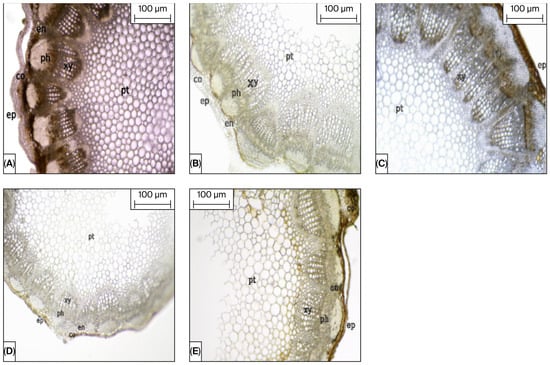
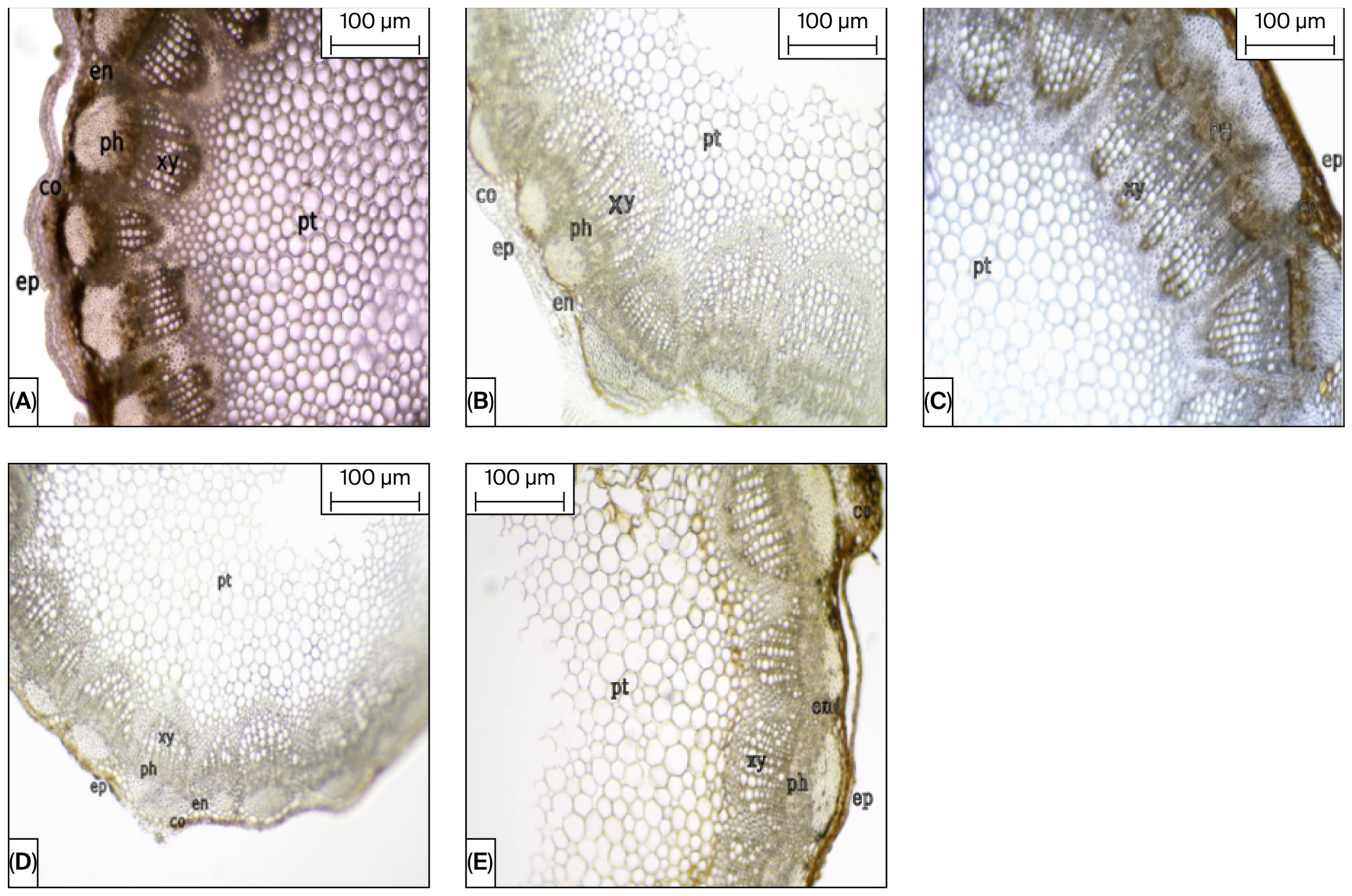
Stem cross-sections showed a similar overall organization at all five sites (Figure 1). The stem comprised a uniseriate epidermis, subepidermal collenchyma, cortical parenchyma, vascular tissue, and a central parenchymatous pith. The vascular bundles were associated with sclerenchymatous fibers.
Figure 1.
Cross-sections of the stem of T. vulgare collected from different branches from the Kokshetau State National Nature Park. (A) Zerendy Branch. (B) Ormandy bulak Branch. (C) Shalkar Branch. (D) Aiyrtau Branch. (E) Arykbalyk Branch. Abbreviations: ep—epidermis; co—collenchyma; en—endodermis; ph—phloem; xy—xylem; pt—pith. Scale bars = 100 µm.
Epidermal and cortical cell dimensions did not differ significantly among sites (Table 3). Differences were observed in pith cell dimensions. Pith cells were longest at Shalkar (25.96 ± 0.38 µm); this value exceeded those at Ormandy Bulak, Aiyrtau, and Arykbalyk in the reported pairwise comparisons. Pith cells were also wider at Shalkar (22.03 ± 0.39 µm) and Zerendy (22.00 ± 0.24 µm) than at Ormandy Bulak and Aiyrtau.
Table 3.
Morphometric characteristics of stem tissues of T. vulgare.
3.3. Leaf Anatomy
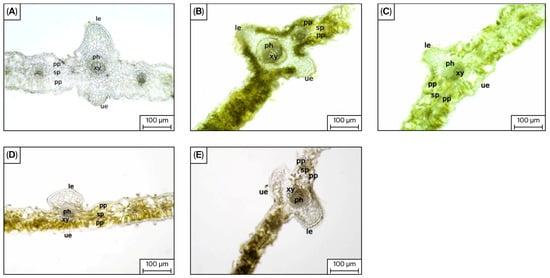
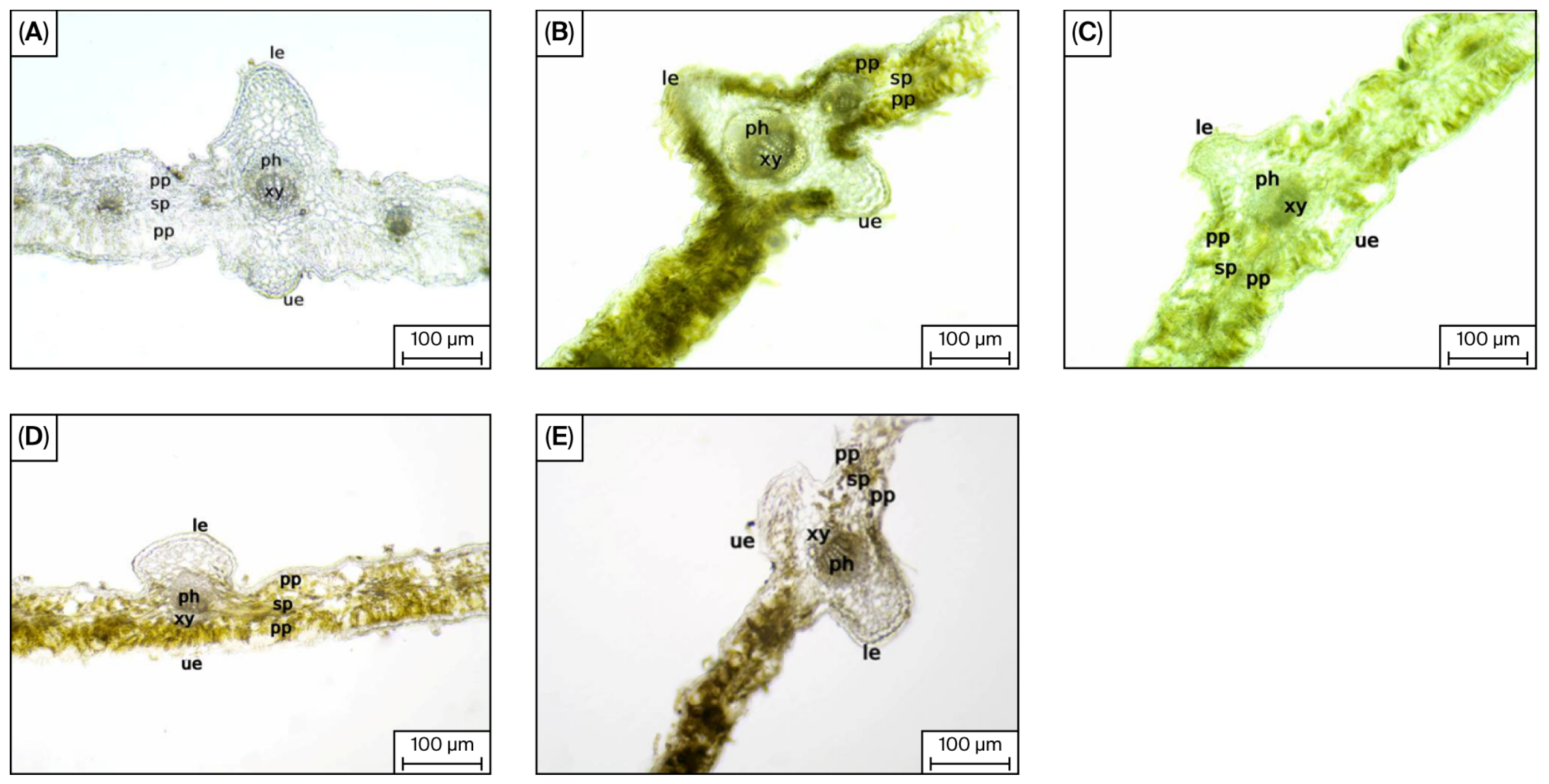
Leaf cross-sections showed palisade tissue beneath both epidermal surfaces and spongy tissue in the central mesophyll, consistent with an isobilateral arrangement (Figure 2). The vascular bundle contained xylem toward the adaxial surface and phloem toward the abaxial surface.
Figure 2.
Cross-sections of the leaf of T. vulgare collected from different branches from the Kokshetau State National Nature Park. (A) Zerendy Branch. (B) Ormandy bulak Branch. (C) Shalkar Branch. (D) Aiyrtau Branch. (E) Arykbalyk Branch. Abbreviations: ue—upper epidermis; le—lower epidermis; pp—palisade parenchyma; sp—spongy parenchyma; ph—phloem; xy—xylem. Scale bars = 100 µm.
Epidermal cell dimensions and upper and lower palisade thickness did not differ significantly among sites (Table 4). Spongy parenchyma was thinnest at Ormandy Bulak (51.62 ± 2.80 µm), with significantly greater values at Shalkar, Aiyrtau, and Arykbalyk. Mesophyll was also thinner at Ormandy Bulak (148.78 ± 7.14 µm) than at Shalkar (159.59 ± 5.83 µm) and Arykbalyk (157.94 ± 4.24 µm). Vascular bundle length differed between Shalkar (158.30 ± 4.26 µm) and Arykbalyk (151.34 ± 5.82 µm); the other sites had intermediate values.
Table 4.
Leaf anatomical measurements of T. vulgare.
3.4. NMR Analysis
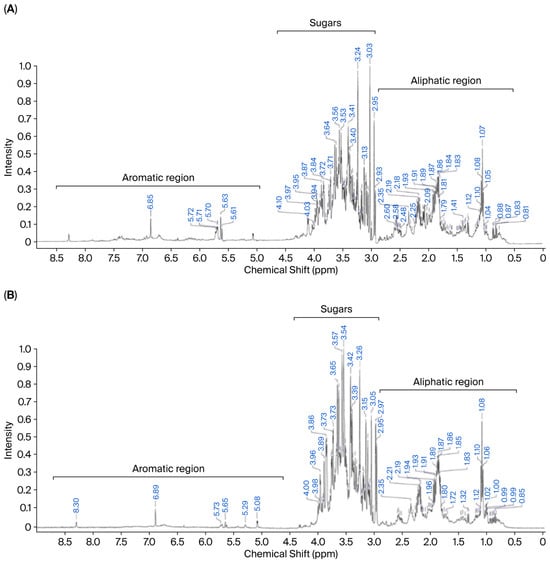
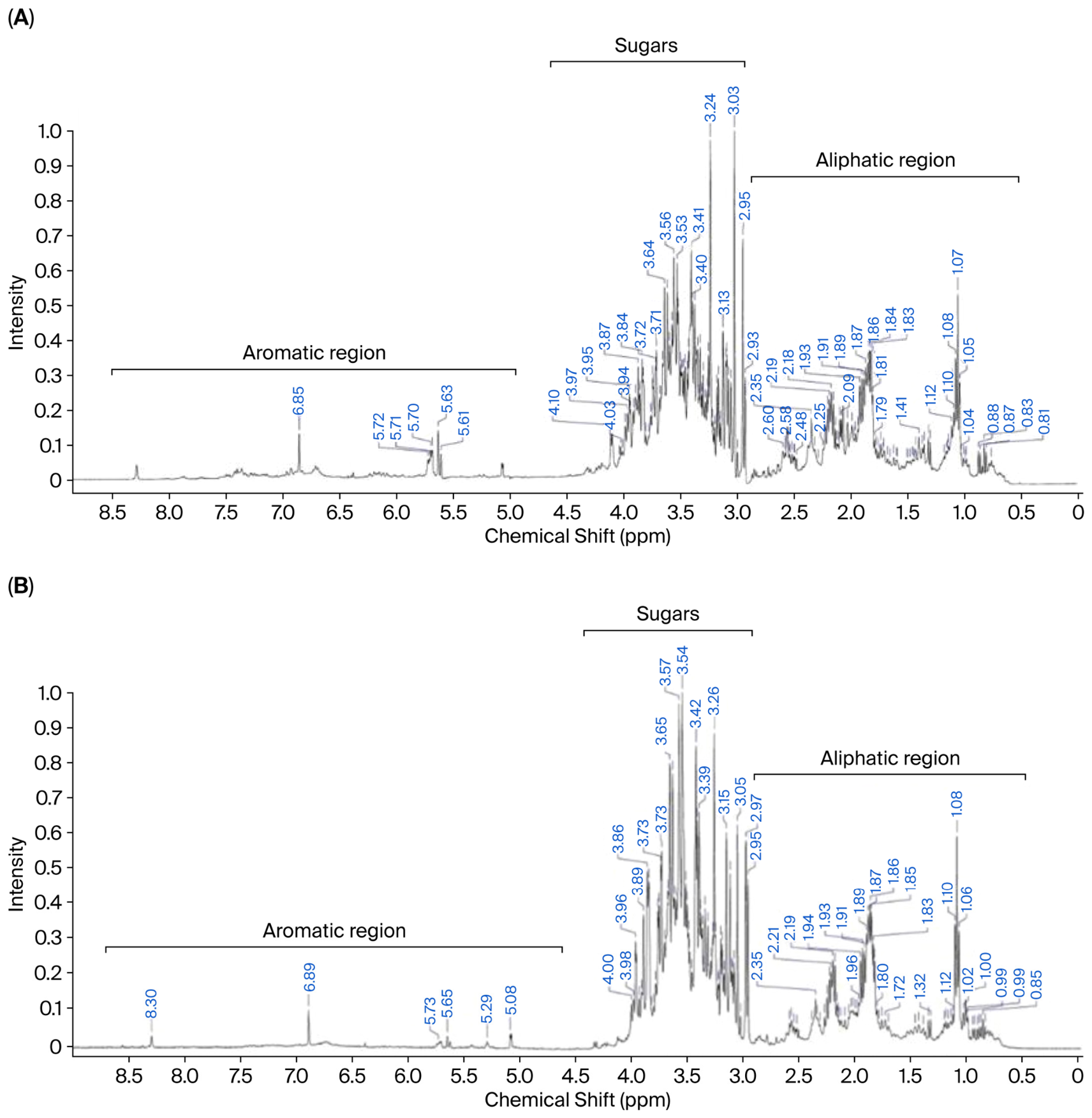
The 1H NMR spectra of flower and leaf extracts from Zerendy showed resonances across approximately δ 0.8–8.3 ppm (Figure 3). Both spectra contained a prominent cluster of signals at δ 3.0–4.1 ppm, a region that can include protons of oxygenated metabolites. Additional signals occurred in the upfield region at δ 0.8–2.9 ppm and downfield of δ 5.0 ppm. The profiles differed in their individual resonances; for example, a signal near δ 8.30 ppm was visible in the leaf spectrum. Individual compounds were not identified from these spectra.
Figure 3.
1H NMR spectra of hydroethanolic extracts of T. vulgare flowers (A) and leaves (B) collected at the Zerendy sampling site.
4. Discussion
The five sampled localities differed in several morphological traits, but these differences did not extend uniformly across the plant. The clearest contrasts involved plant height, leaf number and dimensions, and flower head number; shoot diameter showed no detectable locality difference. Shalkar generally had higher values for vegetative size and flower head production, whereas the pattern for flower head diameter was different. Locality accounted for approximately 11–21% of the variation in the morphological traits with reported differences, indicating that substantial variation remained among plants within localities. The findings therefore describe trait-specific variation across the sampled sites rather than five discrete morphological forms [1].
Plant height was strongly associated with the number of lateral axes across the pooled sample (r = 0.781). Shalkar also had the highest mean number of flower heads, although an individual-level association between height and flower head number was not tested here. A positive association between those two traits has been reported previously for T. vulgare [3]. Field and common-garden studies have further shown that chemotype, maternal genotype, and neighbouring plants can contribute to variation in growth and reproduction [4,5]. These studies help explain why the traits may vary within the species, but none of those factors was measured in the present study. Moreover, a correlation calculated across all five sites may partly reflect differences between site means; it cannot establish the strength of the relationship within each locality.
Stem anatomy showed a different pattern from external morphology. All five localities shared the same principal arrangement of epidermal, cortical, vascular, and pith tissues, broadly consistent with published anatomical descriptions of Tanacetum [6] and T. vulgare [7]. Epidermal and cortical cell dimensions did not differ significantly among localities. The reported differences were limited to pith cell dimensions and were small in absolute terms. They support a finding of quantitative variation within a shared stem structure, although their functional significance is unknown.
The isobilateral arrangement of the leaf was likewise present at all five localities and agrees with the earlier description of T. vulgare [7]. Epidermal dimensions and palisade thickness showed no significant locality differences, whereas spongy parenchyma and total mesophyll thickness differed in selected comparisons. At Ormandy Bulak, for example, both measurements were lower than at Shalkar. Thus, the detectable variation was concentrated in particular internal dimensions without a change in overall leaf organization. Leaf anatomical responses have been reported in T. vulgare exposed to metal pollution [9], but exposure and other environmental conditions were not measured at the present sites. The anatomical differences observed here cannot be attributed to a specific stressor.
The flower and leaf extracts from Zerendy produced distinguishable qualitative 1H NMR spectra. Differences between T. vulgare leaf and flower extracts have also been reported using other analytical methods [13], while a separate metabolomic study documented chemical variation among plants using leaf samples [14]. The present spectra establish only that the two analyzed extracts had different signals under the conditions used. Individual metabolites were not assigned, replicate spectra were not reported, and material from the other four localities was not analyzed by NMR. Consequently, these observations cannot establish chemical differences among localities or link chemical composition to the measured morphological and anatomical traits.
The sampling design also defines the scope of the biological interpretation. One locality represented each park branch, so locality and branch cannot be separated statistically. Sampling flowering plants reduced variation in developmental stage. Environmental measurements and genetic data would be needed to evaluate potential explanations for the locality differences. Replicated localities within branches, repeated sampling, and a common-garden comparison would allow the contributions of site conditions and inherited variation to be assessed more directly. Within the present design, the main finding is that conspicuous variation in selected external traits coexists with a largely conserved stem and leaf organization across the five sampled localities.
5. Conclusions
Tanacetum vulgare showed variation in several morphological and anatomical traits across the five sampled localities in Kokshetau State National Nature Park. Plant size, leaf dimensions, and reproductive traits differed among localities, while positive associations were observed among several morphological traits. The principal organization of the stem and leaf was shared across all examined plants. Quantitative differences were observed in pith cell dimensions, spongy parenchyma and mesophyll thickness, and vascular bundle length. The qualitative 1H NMR profiles describe flower and leaf extracts from the Zerendy locality only and do not establish chemical differences among localities. Together, these findings show that quantitative morphological and anatomical variation among localities coexists with a shared stem and leaf organization. The combined measurements add to the evidence on intraspecific variation in T. vulgare and provide reference values for future botanical comparisons in the park. Because environmental conditions and genetic variation were not tested as explanatory factors, the observed differences cannot be attributed to either cause.
Author Contributions
Conceptualization, S.D. and S.M.; methodology, S.M., G.K., T.S. and G.O.; software, Y.Z. and G.R.; formal analysis, S.D., S.M. and G.R.; investigation, S.D., S.M., G.K., T.S., Y.Z., G.O. and G.R.; resources, S.D. and G.K.; data curation, S.D. and S.M.; writing—original draft preparation, S.D., S.M. and G.K.; writing—review and editing, S.D., S.M., T.S. and G.K.; visualization, S.D. and G.R.; supervision, S.D.; project administration, S.D.; funding acquisition, S.D. All authors have read and agreed to the published version of the manuscript.
Funding
This research was funded by grants from the Committee of Science, Ministry of Science and Higher Education of the Republic of Kazakhstan (No. AP26199389).
Data Availability Statement
The datasets analyzed in the present study are available from the author Sh. Durmekbayeva upon request.
Conflicts of Interest
The authors declare no conflicts of interest.
Abbreviations
The following abbreviations are used in this manuscript:
| co | Cortex parenchyma |
| en | Endodermis |
| ep | Epidermis |
| L | Length |
| le | Lower epidermis |
| NMR | Nuclear Magnetic Resonance |
| ph | Phloem |
| pp | Palisade parenchyma |
| pt | Pith |
| SD | Standard deviation |
| SM | Sliding microtome |
| SNNP | State National Natural Park |
| sp | Spongy parenchyma |
| T | Thickness |
| ue | Upper epidermis |
| W | Width |
| xy | Xylem |
| µm | Micrometer |
References
- Siefert, A.; Violle, C.; Chalmandrier, L.; Albert, C.H.; Taudiere, A.; Fajardo, A.; Aarssen, L.W.; Baraloto, C.; Carlucci, M.B.; Cianciaruso, M.V.; et al. A global meta-analysis of the relative extent of intraspecific trait variation in plant communities. Ecol. Lett. 2015, 18, 1406–1419. [Google Scholar] [CrossRef] [Scilit] [PubMed]
- Helsen, K.; Acharya, K.P.; Brunet, J.; Cousins, S.A.O.; Decocq, G.; Hermy, M.; Kolb, A.; Lemke, I.H.; Lenoir, J.; Plue, J.; et al. Biotic and abiotic drivers of intraspecific trait variation within plant populations of three herbaceous plant species along a latitudinal gradient. BMC Ecol. 2017, 17, 38. [Google Scholar] [CrossRef] [Scilit] [PubMed]
- Keskitalo, M.; Lindén, A.; Valkonen, J.P.T. Genetic and morphological diversity of Finnish tansy (Tanacetum vulgare L., Asteraceae). Theor. Appl. Genet. 1998, 96, 1141–1150. [Google Scholar] [CrossRef] [Scilit]
- Ojeda-Prieto, L.; Medina-van Berkum, P.; Unsicker, S.B.; Heinen, R.; Weisser, W.W. Intraspecific chemical variation of Tanacetum vulgare affects plant growth and reproductive traits in field plant communities. Plant Biol. 2025, 27, 785–801. [Google Scholar] [CrossRef] [Scilit] [PubMed]
- Ziaja, D.; Sasidharan, R.; Jakobs, R.; Eilers, E.J.; Müller, C. Chemotype, maternal genotype, or field neighbors: What influences performance and resource allocation in a perennial plant species the most? Oecologia 2025, 207, 134. [Google Scholar] [CrossRef] [Scilit] [PubMed]
- Tekin, M.; Kartal, Ç. Comparative anatomical investigations on six endemic Tanacetum (Asteraceae) taxa from Turkey. Pak. J. Bot. 2016, 48, 1501–1515. [Google Scholar]
- Dere, S.; Aytas Akcin, T. Anatomical and micromorphological properties of some Tanacetum L. (Asteraceae) taxa from Turkey and their systematic implications. Acta Bot. Croat. 2017, 76, 138–145. [Google Scholar] [CrossRef] [Scilit]
- Giuliani, C.; Bottoni, M.; Milani, F.; Spada, A.; Falsini, S.; Papini, A.; Santagostini, L.; Fico, G. An integrative approach to selected species of Tanacetum L. (Asteraceae): Insights into morphology and phytochemistry. Plants 2024, 13, 155. [Google Scholar] [CrossRef] [Scilit] [PubMed]
- Alliluev, I.; Chernikova, N.; Kazachkova, V.; Ahmad, I.; Fedorenko, A.; Popov, V.; Babenko, A.; Chaplygin, V.; Mandzhieva, S.; Minkina, T. Integrated biochemical and ultrastructural responses of Tanacetum vulgare L. to multi-metal stress. Plants 2026, 15, 1112. [Google Scholar] [CrossRef] [Scilit] [PubMed]
- Durmekbayeva, S.N.; Kyzdarbekova, G.T.; Aliibek, A.B.; Khamitova, G.Z.; Shakirzhanova, I.S. Synopsis of the flora of the “Kokshetau” SNNP of the “Ormandy Bulak” branch. Eurasian J. Ecol. 2024, 79, 81–89. [Google Scholar] [CrossRef] [Scilit]
- Pavlov, N.V. (Ed.) Flora Kazakhstana [Flora of Kazakhstan]; Nauka: Almaty, Kazakhstan, 1966; Volume 9, pp. 56–57. [Google Scholar]
- Royal Botanic Gardens, Kew. Tanacetum vulgare L. Plants of the World Online. Available online: https://powo.science.kew.org/taxon/urn:lsid:ipni.org:names:252568-1 (accessed on 28 September 2026).
- Šukele, R.; Lauberte, L.; Kovalcuka, L.; Logviss, K.; Bārzdiņa, A.; Brangule, A.; Horváth, Z.M.; Bandere, D. Chemical profiling and antioxidant activity of Tanacetum vulgare L. wild-growing in Latvia. Plants 2023, 12, 1968. [Google Scholar] [CrossRef] [Scilit] [PubMed]
- Dussarrat, T.; Schweiger, R.; Ziaja, D.; Nguyen, T.T.N.; Krause, L.; Jakobs, R.; Eilers, E.J.; Müller, C. Influences of chemotype and parental genotype on metabolic fingerprints of tansy plants uncovered by predictive metabolomics. Sci. Rep. 2023, 13, 11645. [Google Scholar] [CrossRef] [Scilit] [PubMed]

Disclaimer/Publisher’s Note: The statements, opinions and data contained in all publications are solely those of the individual author(s) and contributor(s) and not of MDPI and/or the editor(s). MDPI and/or the editor(s) disclaim responsibility for any injury to people or property resulting from any ideas, methods, instructions or products referred to in the content. |
© 2026 by the authors. Licensee MDPI, Basel, Switzerland. This article is an open access article distributed under the terms and conditions of the Creative Commons Attribution (CC BY) license.