


Abstract
Background/Objectives: Pediatric thyroid cancer is uncommon, and data from middle-income countries remain limited. This study aimed to describe the epidemiological, clinical, surgical, and histological characteristics of pediatric thyroid cancer at a Colombian referral center. Methods: This retrospective observational study included patients younger than 18 years with histopathologically confirmed thyroid cancer who underwent surgical management between January 2016 and December 2022. Demographic, clinical, imaging, surgical, pathological, and outcome data were collected. Univariate analyses explored factors associated with surgical reintervention and differences between patients with and without fine-needle aspiration cytology (FNAC). Results: Fifty-six patients were included; median age was 15 years and 78.6% were female. A palpable thyroid mass was the most common presentation (50.0%), and 51.8% had lymph node involvement at diagnosis. FNAC was performed in 80.4%, while 19.6% underwent surgery without FNAC. Patients without FNAC had larger nodules and a higher proportion of high-risk disease. Total thyroidectomy with central dissection was the most frequent procedure (57.1%). In exploratory, unadjusted comparisons, reintervention occurred in 16.1% and was associated with lymph node involvement (OR 9.90; p = 0.0257) and extrathyroidal extension (OR 11.73; p = 0.0094); no association remained significant after Holm adjustment. Estimates are imprecise (9 events) and hypothesis-generating. Papillary thyroid carcinoma was predominant (52/56, 92.9%). No deaths occurred during the index surgical hospitalization; one patient with medullary carcinoma and MEN2B died during follow-up, and vital status was unknown in 60.7% of patients. Conclusions: Pediatric thyroid cancer in this referral cohort was characterized by female predominance, predominance of papillary carcinoma, and substantial locoregional disease at diagnosis. In exploratory, unadjusted analyses, lymph node involvement and extrathyroidal extension were associated with surgical reintervention, but these associations did not remain statistically significant after adjustment for multiple comparisons. Incomplete follow-up limits conclusions regarding long-term outcomes, and postoperative complications were not recorded.
1. Introduction
Pediatric thyroid cancer is the most common endocrine malignancy in children and adolescents [1]. Its incidence has increased in recent decades, with annual growth rates exceeding 3% in some regions [2]. Despite this trend, data from middle-income countries, including Colombia, remain limited, hindering the understanding of population-specific characteristics [3].
Children often present with more advanced disease than adults, including a higher frequency of lymph node and distant metastases; however, long-term survival remains excellent, with 5- and 10-year survival rates close to 95% [4,5]. Pediatric tumors more frequently harbor oncogenic rearrangements such as RET/PTC and less often BRAF mutations [4,5].
Most pediatric thyroid cancers present as asymptomatic, euthyroid solitary nodules detected on physical examination or ultrasound. Forty percent of cases are detected by family members, another 40% by medical personnel, and the remaining 20% are identified incidentally during imaging studies performed for cervical lymphadenopathy [1].
The initial evaluation relies on ultrasound to characterize nodule morphology. Ultrasound findings, including microcalcifications, irregular margins, and abnormal vascularity, together with clinical characteristics and nodule size, guide the decision to perform fine-needle aspiration cytology (FNAC) [4]. Given the potential for interobserver variability, particularly in follicular-pattern lesions, evaluation by a pathologist experienced in pediatric thyroid pathology is recommended [4].
In Colombia and other Latin American middle-income countries, information on the epidemiology, clinical presentation, and outcomes of pediatric thyroid cancer is scarce, mostly derived from small series or isolated experiences [3]. This information gap complicates the adoption of local evidence-based guidelines and underscores the importance of gathering medium- and long-term follow-up data. To contribute to regional evidence, we conducted this retrospective observational study at a Colombian pediatric referral center covering 2016–2022. The primary objective was to describe the epidemiological, clinical, surgical, and histological characteristics of thyroid cancer in patients aged <18 years.
2. Materials and Methods
2.1. Study Design
We conducted a retrospective observational study at a pediatric referral hospital in Bogotá, Colombia, including patients diagnosed with histopathologically confirmed thyroid cancer between January 2016 and December 2022. The primary objective of this study was to describe clinical characteristics, evolution, and outcomes. Additionally, we compared factors associated with surgical reintervention. This study is reported in accordance with the STROBE guidelines [6].
2.2. Participants and Selection Criteria
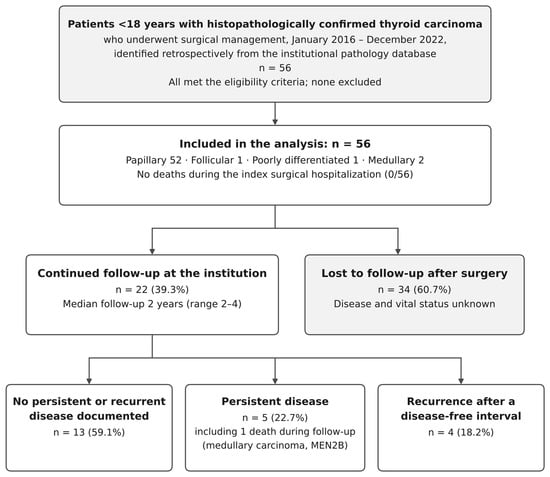
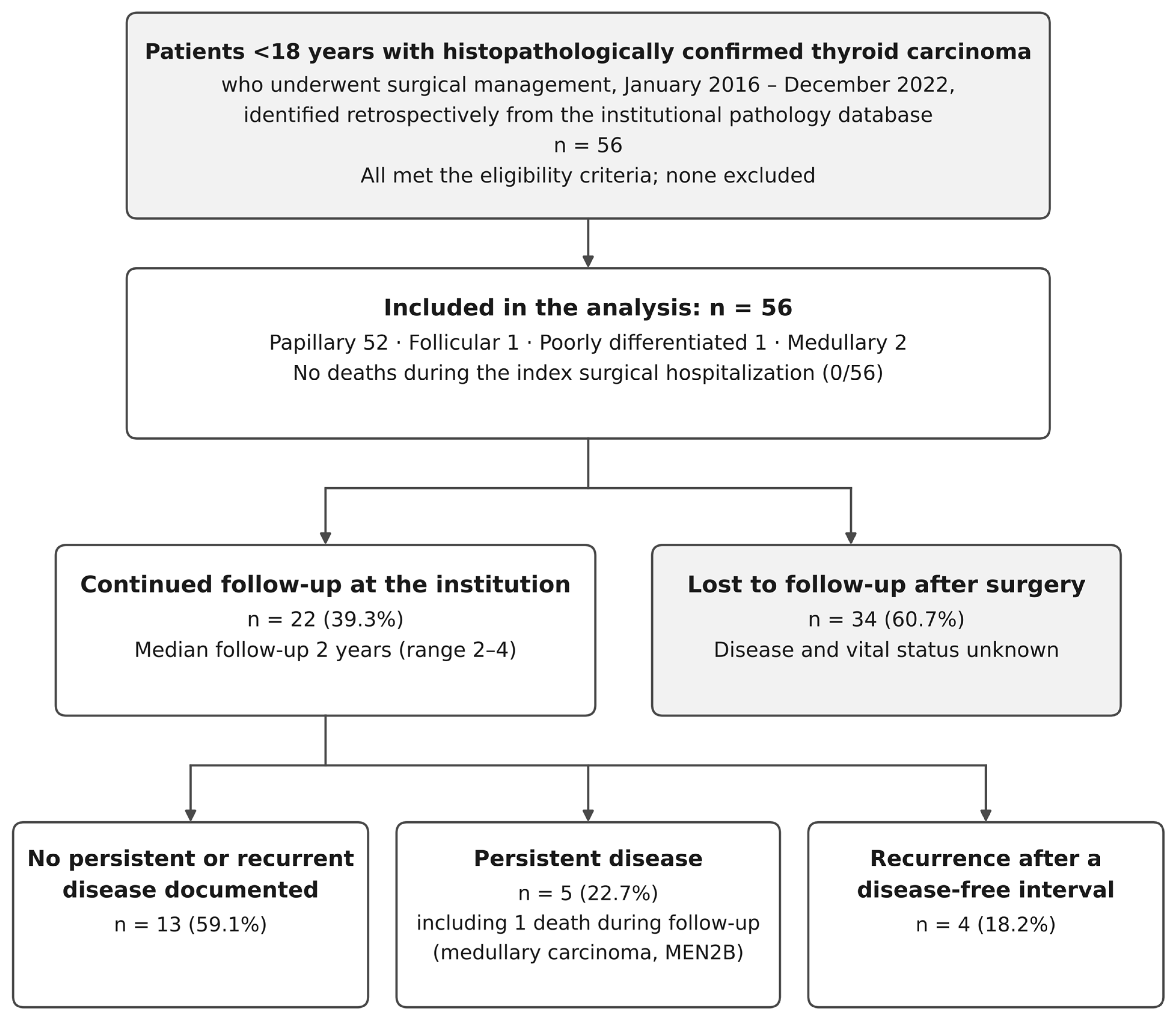
All patients aged < 18 years with thyroid cancer who underwent surgical management during the study period were eligible. Patients were identified retrospectively from the institutional pathology database. All patients identified met the eligibility criteria, and none were excluded for incomplete clinical or pathological records. The selection and follow-up of the study population are shown in Figure 1.
Figure 1.
Flow diagram of patient identification and follow-up. Patients were identified from the institutional pathology database; all met the eligibility criteria and none were excluded. Disease status was assessed only in the 22 patients who continued follow-up at the institution. MEN2B, multiple endocrine neoplasia type 2B.
2.3. Variables
We collected information regarding:
Demographic and clinical data: age at diagnosis (in completed years), sex, family history of thyroid neoplasms, clinical presentation, pubertal stage (Tanner, as recorded in the clinical record at the consultation in which surgical treatment was planned), and thyroid function.
Imaging characteristics: ultrasound findings (nodule size, recorded in categories of <1, 1–1.9, 2–2.9, 3–3.9, and ≥4 cm; borders, calcifications, echogenicity, and lymph node involvement) and, when indicated, complementary chest studies (radiography or tomography).
Surgical and pathological data: intervention type (total thyroidectomy with central or modified radical neck dissection, or hemithyroidectomy [lobectomy with isthmectomy]), reinterventions, definitive histological subtype, TNM classification, and American Thyroid Association (ATA) recurrence risk stratification.
Fine-needle aspiration cytology (FNAC): performance (yes/no) and, if performed, cytological results classified according to the Bethesda system.
2.4. Diagnostic and Therapeutic Procedures
All patients with suspected thyroid carcinoma underwent cervical ultrasonography and, when performed, fine-needle aspiration cytology (FNAC). Ultrasonography was performed by pediatric radiologists with experience in childhood oncology. The indication for histopathological study was based on the ultrasound criteria for suspected malignancy established by the American Thyroid Association for pediatric populations [1]. Ultrasound reports followed the ATA 2015 pediatric sonographic criteria for suspicious nodules (presence of suspicious features rather than size thresholds); TI-RADS was not used, as it is not validated in children. Calcifications were recorded as present or absent, without distinction between micro- and macrocalcifications. Cervical lymph node involvement was recorded as present or absent; nodal mapping by compartment was performed only when ultrasound showed extensive nodal disease, so compartment-level data are not available for the whole cohort. Inter-observer agreement was not assessed. Diagnostic procedures included ultrasound-guided FNAC or diagnostic hemithyroidectomy for nodules greater than 4 cm in diameter.
The definitive surgical approach—total thyroidectomy with central dissection or total thyroidectomy with modified radical dissection—was determined according to ultrasound findings and preliminary pathological evaluation. Hemithyroidectomy was performed as a diagnostic procedure, and total thyroidectomy was completed once carcinoma was confirmed on histopathology. In a subset of patients, preoperative FNAC was not performed because of large nodule size and the simultaneous presence of multiple ultrasound features suggestive of malignancy.
2.5. Outcome Definitions
Outcomes included:
Surgical reintervention: any additional procedure related to the thyroid neoplasm performed during the same hospitalization or subsequent admissions; planned second-stage completion of an initial hemithyroidectomy was not counted as reintervention.
Reinterventions were classified by review of the clinical records as planned staged procedures, surgery for persistent disease (disease never cleared after initial treatment), or surgery for recurrent disease (disease reappearing after a disease-free interval).
Recurrence: documented structural disease appearing after a disease-free interval following initial treatment; persistent disease (never cleared after initial treatment) was not counted as recurrence. In patients with differentiated thyroid carcinoma, a disease-free interval required no evidence of disease on neck ultrasonography and no biochemical evidence of disease based on thyroglobulin measurements.
Follow-up surveillance consisted of cervical ultrasound and basal thyroglobulin (stimulated thyroglobulin when indicated); diagnostic radioiodine (123I) whole-body scanning is not available in Colombia and was not used. Mortality: death related to thyroid cancer.
Radioactive iodine eligibility: differentiated (papillary or follicular) thyroid carcinoma with intermediate or high pediatric ATA (2015) risk. TNM staging: patients were restaged according to the American Joint Committee on Cancer (AJCC) 8th edition; T and N categories are reported as recorded in the clinical records (AJCC 7th edition), and nodal status (N) was defined by histopathological examination of the surgical specimen. Patients without chest imaging were classified as having no known distant metastasis, not as having confirmed absence of distant metastasis; accordingly, in this study, M0 and stage I denote no known distant metastasis.
2.6. Statistical Analysis
Data were consolidated in a spreadsheet and analyzed using Stata 18 (StataCorp LLC, College Station, TX, USA). Categorical variables were described as frequencies and percentages and continuous variables as median (Q1–Q3). For univariate comparisons of qualitative variables, we used Fisher’s exact test for 2 × 2 tables and the Fisher–Freeman–Halton exact test for tables with more than two categories. For 2 × 2 tables, odds ratios (ORs) are reported with exact (conditional) 95% confidence intervals (CIs). For quantitative variables, we used the Mann–Whitney U test and report the Hodges–Lehmann estimate of the location difference with its 95% CI. Statistical significance was set at p < 0.05. All between-group comparisons were exploratory and not preplanned; p-values are unadjusted for multiplicity (25 tests), and the result of Holm adjustment is reported for information. Percentages were rounded to one decimal place and are reported with their denominators. No imputation was performed for missing data.
2.7. Ethical Considerations
The study was approved by the institutional ethics committee (see Institutional Review Board Statement). Informed consent was not required for this retrospective study. All information was anonymized to ensure patient confidentiality.
3. Results
3.1. Demographic and Clinical Characteristics
Fifty-six patients were included, with a median age of 15 years (Q1–Q3, 14–16; range 6–17). Females accounted for 78.6% (n = 44) of the patients. The age distribution was 57.1% (n = 32) in the 11–15 years group. A family history of thyroid cancer in any relative was present in 6 patients (10.7%), 2 (3.6%) of whom had a first-degree relative. Normal nutritional status was present in 58.9% (n = 33). Normal thyroid function was observed in 67.9% (n = 38). These data are summarized in Table 1.
Table 1.
Demographic, clinical, imaging, treatment and outcome characteristics of the cohort (N = 56).
3.2. Clinical and Imaging Presentation
The most common reason for consultation was a palpable thyroid mass in 50.0% (n = 28) of cases, followed by incidental cervical lymphadenopathy in 19.6% (n = 11). The interval between symptom onset and thyroid cancer diagnosis was 6 months or less in 18 patients (32.1%), 7–12 months in 12 (21.4%), 13–24 months in 3 (5.4%), 25–36 months in 3 (5.4%), and more than 60 months in 1 (1.8%); duration was not recorded in 19 (33.9%). On ultrasound, nodule size was <1 cm in 8 patients (14.3%), 1–1.9 cm in 21 (37.5%), 2–2.9 cm in 9 (16.1%), 3–3.9 cm in 12 (21.4%), and ≥4 cm in 6 (10.7%) (Figure S1). Lymph node involvement was documented in 51.8% (n = 29), calcifications in 78.6% (n = 44), irregular margins in 51.8% (n = 29), and hypoechogenicity in 78.6% (n = 44). Ultrasound nodal status agreed with pathological N in 34 of 49 evaluable patients (69.4%); of 23 patients with negative nodal ultrasound, 13 had nodal metastases on pathology (N1a 5, N1b 7, N1 subcategory not recorded 1), and 2 of 26 with positive nodal ultrasound were pN0. Seven patients were not evaluable (NX 5, TNM not recorded 2). Extrathyroidal extension was identified in 12.5% (n = 7). Chest imaging was performed selectively (chest radiography in 36 patients and chest CT in 16; 9 patients had no chest imaging); pulmonary metastases were evidenced by chest radiography in 1.8% (n = 1) and chest tomography in 10.7% (n = 6); the patient with metastases on radiography was also among those detected by CT (Table 1).
3.3. Initial Cytological Evaluation of the Thyroid Nodule
FNAC was performed in 80.4% of patients, while 19.6% proceeded directly to surgery without FNAC due to high clinical and imaging suspicion. Patients without FNAC had larger nodules (median size category 3–3.9 vs. 1–1.9 cm; Fisher–Freeman–Halton p = 0.020), a higher proportion of high-risk disease (63.6% vs. 24.4%; Fisher’s exact p = 0.027 for high vs. non-high risk; overall ATA risk distribution p = 0.052), and a distinct distribution of histological subtypes (p = 0.035). No differences were observed in terms of age, sex, or other clinical or imaging variables (Table 2). These comparisons are descriptive: the larger nodules and higher ATA risk in the no-FNAC group reflect the criteria used to proceed directly to surgery, and all comparisons were exploratory and unadjusted. In the FNAC group, 13 patients (28.9%) had benign or indeterminate cytology (Bethesda II–IV): 3 cases (6.7%) were Bethesda II, 4 (8.9%) Bethesda III, and 6 (13.3%) Bethesda IV (Table S5).
Table 2.
Characteristics of patients with and without preoperative FNAC (N = 56).
In this subgroup, surgical decisions were based on high-risk ultrasound characteristics (calcifications, lymph node involvement), with total thyroidectomy performed in nine patients and hemithyroidectomy in four, followed by completion thyroidectomy. As the cohort included only patients with histologically confirmed carcinoma, these cases do not inform the accuracy of cytology; final histopathology in this subgroup was predominantly classic papillary carcinoma, with one follicular carcinoma and one poorly differentiated carcinoma.
Molecular testing was not part of routine diagnostic work-up. BRAF V600E testing was performed in the first 17 consecutive patients of the series as part of a funded institutional research project; testing was not continued after the project ended. The assay was real-time PCR for BRAF V600E (COBAS 4800, Roche) on DNA extracted from formalin-fixed paraffin-embedded tumor tissue. We identified the BRAF V600E mutation in a 15-year-old female patient who presented with a mixed classic and follicular histological pattern, as well as cervical and pulmonary metastases.
Relevant medical histories were identified in two patients: one Hodgkin lymphoma survivor who had undergone cervical radiotherapy 10 years prior to receiving a thyroid cancer diagnosis, and another patient with a germline PTEN mutation. Cytology was malignant in 6 patients and suspicious for malignancy in 26; surgery proceeded without a diagnostic cytological result in the remaining 24. These 24 patients (42.9%; 11 without FNAC and 13 with benign or indeterminate cytology, Bethesda II–IV) underwent surgery based on clinical and ultrasound criteria.
3.4. Surgical Management, Adjuvant Treatment, and Outcomes
Total thyroidectomy with central dissection was the most frequent procedure (57.1%, n = 32); 33.9% (n = 19) required modified radical dissection, and 8.9% (n = 5) initially underwent hemithyroidectomy, subsequently completing total thyroidectomy with dissection. Reintervention occurred in 16.1% (n = 9): 5 for persistent disease, 3 for recurrent disease, and 1 planned staged procedure (a planned second-stage neck dissection); one patient operated for recurrence had also undergone completion thyroidectomy, which was not counted as reintervention. Patients had one to three additional procedures. In the reintervention group, eight binary factors were evaluated; lymph node involvement (OR 9.90; p = 0.0257) and extrathyroidal involvement (OR 11.73; p = 0.0094) were associated with reoperation in unadjusted analysis. Associations with the other factors (sex, pulmonary metastasis, size ≥ 2 cm, size ≥ 1 cm, irregular borders, and calcifications) were inconclusive (p > 0.05); pulmonary metastasis was assessed only among the 16 patients who underwent chest CT. The values are presented in Table 3. When the analysis was restricted to the 8 reinterventions for persistent or recurrent disease, 7 of the 8 patients had lymph node involvement (1/27 vs. 7/29; OR 8.27; Fisher p = 0.052), and extrathyroidal extension remained associated with reoperation (4/49 vs. 4/7; OR 15.0; p = 0.0055) (Table S3). Lymph node involvement and extrathyroidal extension overlapped: all 7 patients with extrathyroidal extension also had lymph node involvement. Reintervention for any cause occurred in 1 of 27 patients (3.7%) with neither factor, 4 of 22 (18.2%) with lymph node involvement alone, and 4 of 7 (57.1%) with both (Table S4). All comparisons in Table 2 and Table 3 were exploratory and unadjusted for multiplicity (25 tests); after Holm adjustment, no association remained statistically significant.
Table 3.
Factors associated with reintervention: univariate analysis.
Final histopathological analysis revealed papillary thyroid carcinoma in 52 patients (92.9%), medullary carcinoma in 2 (3.6%), follicular carcinoma in 1 (1.8%), and poorly differentiated carcinoma in 1 (1.8%). Among the 52 papillary carcinomas (WHO 2022 subtypes), classic papillary carcinoma was the most frequent (25/52, 48.1%), followed by papillary carcinoma with mixed classic and follicular patterns (12/52, 23.1%), the follicular subtype (8/52, 15.4%, including 2 with infiltrative pattern), the diffuse sclerosing subtype (4/52, 7.7%), and the tall cell subtype (3/52, 5.8%). The follicular carcinoma was minimally invasive. Of the patients with medullary carcinoma, one had multiple endocrine neoplasia type 2B (MEN2B) and the other was a sporadic non-syndromic case. The patient with poorly differentiated carcinoma was an adolescent with a family history of thyroid carcinoma in a second-degree relative (maternal grandmother) of unspecified subtype who died from the disease; this patient was lost to follow-up.
According to ATA risk stratification, 14 patients (25.0%) were low risk, 24 (42.9%) intermediate risk, and 18 (32.1%) high risk. The T, N, and M components are shown in Table S2. Distant metastases (M1) were present in 7 patients (12.5%): pulmonary metastases in 6 patients with differentiated carcinoma, all classified as stage II, detected on chest CT in 5 and on the post-ablation radioiodine scan in 1 patient whose chest radiograph was normal and who had not undergone chest CT; and pulmonary, pleural, mediastinal and hepatic metastases in the patient with MEN2B (stage IVC). The remaining 49 patients had no known distant metastasis, including 9 without chest imaging, in whom the absence of distant metastasis was not confirmed by imaging. Restaging according to the AJCC 8th edition did not change any stage assignment. Mortality was 1.8% (n = 1) and was associated with advanced medullary carcinoma (Table 1).
In terms of follow-up, only 39.3% (n = 22) of patients continued to attend follow-up visits at the institution. The median follow-up period was 2 years (range 2–4 years). Disease status was evaluated exclusively in this subgroup. Structural disease was documented during follow-up in 9 of the 22 patients (40.9%), and no persistent or recurrent disease was documented in 13 (59.1%). Following individual review of the clinical records, 5 patients had persistent disease (5/22, 22.7%) and 4 had recurrence after a disease-free interval documented by neck ultrasonography and thyroglobulin (4/22, 18.2%). The patients with persistent disease included the patient with MEN2B, who had stage IVC medullary carcinoma at diagnosis and died during follow-up, and a patient with pulmonary uptake on the post-ablation scan whose thyroglobulin became undetectable during the first year and later rose with new cervical lesions; this patient was classified as having persistent disease because a complete structural response of the pulmonary metastases had not been demonstrated, despite an initial favorable biochemical response. Six of the 9 patients underwent surgical reintervention: 3 with persistent disease and 3 with recurrence. One patient with recurrence had previously undergone surgery for persistent disease, followed by a documented disease-free interval before the recurrence. In 3 of the 4 patients with recurrence, radioactive iodine had been delayed or not administered; these observations are descriptive. Disease status could not be established for the remaining 34 patients (60.7% of the cohort); these proportions therefore describe only patients with available follow-up and should not be interpreted as cohort-wide estimates. Baseline characteristics of patients with and without follow-up are compared in Table S1. No statistically significant differences were found, although the comparison is underpowered and patients with follow-up had numerically more advanced disease. Reintervention was required in 16.1% (n = 9) of patients, with one to three additional procedures per patient. No deaths occurred during the index surgical hospitalization (0/56). Among the 22 patients with follow-up, one died of advanced medullary carcinoma associated with MEN2B after three years of follow-up; vital status was unknown in the remaining 34 patients (60.7%), so the overall mortality of 1.8% (n = 1) is a lower bound.
Radioactive iodine (RAI) eligibility was defined as differentiated (papillary or follicular) thyroid carcinoma with intermediate or high ATA risk (n = 39; patients with medullary or poorly differentiated carcinoma were not included). Among eligible patients, 16 (41.0%) received RAI: 15 with a documented dose and 1 without a recorded dose. For the remaining 23 (59.0%), RAI was clinically indicated, but treatment was recorded as not administered, pending, or undocumented in the available clinical records. One patient with low-risk papillary carcinoma also received RAI. Administered doses ranged from 30 to 123 mCi.
4. Discussion
Thyroid carcinoma is the most common endocrine neoplasm in childhood, with an estimated incidence of 1.1 cases per 100,000 inhabitants under 18 years of age; papillary thyroid carcinoma (PTC) accounts for approximately 86% of pediatric cases, followed by follicular (9%) and medullary carcinoma (4%) [4].
This study, conducted at a Colombian pediatric referral center, describes a series of 56 patients aged < 18 years with thyroid cancer treated over a 7-year period. In our study, classic papillary thyroid carcinoma was the most frequent histological subtype (25/52 papillary carcinomas, 48.1%). According to ATA risk stratification, 24 of 56 cases (42.9%) were classified as having intermediate risk, with a high proportion of locally advanced disease at diagnosis (51.8% with lymph node involvement). Follow-up was available in 22 patients; persistent or recurrent disease was documented in 9 of them (40.9%), including recurrence after a documented disease-free interval in 4 (18.2%); disease status was unknown in the 34 patients without follow-up, so no cohort-level proportion is reported.
No deaths occurred during the index hospitalization, and one death was recorded during follow-up (1.8%, a lower bound), corresponding to advanced medullary carcinoma. Lymph node involvement was consistent with the international literature, whereas persistent disease was frequent among patients with follow-up; survival could not be compared because vital status was unknown in 34 patients. Major pediatric thyroid cancer cohorts with complete follow-up have reported long-term survival between 95% and 98% [1].
The demographic distribution in our series, with 78.6% female patients and a median age of 15 years, aligns with international studies documenting marked female predominance and incidence peaks in adolescence for pediatric thyroid cancer [5].
Six patients (10.7%) had a family history of thyroid cancer in any relative, and 2 (3.6%) of them in a first-degree relative. First-degree relatives of patients with differentiated thyroid cancer have a fourfold increased risk of the disease, and close surveillance appears most beneficial in kindreds with three or more affected members [4]; recording a detailed family history therefore remains relevant in this population.
As pediatric thyroid cancer is frequently asymptomatic, diagnosis is often established in advanced phases. In our cohort, the most common clinical manifestation was palpable thyroid mass (50.0%), followed by incidental cervical lymphadenopathy (19.6%). These findings align with those of a previous series where up to half of pediatric cases were diagnosed after nodule detection during physical exploration or lymph node findings on clinical examination [4].
Symptom duration was recorded in 37 patients and was 6 months or less in 18 (32.1% of the cohort); the remaining documented durations ranged from 7 months to 6 years. Although socioeconomic and access-related variables were not collected in this study, delays in diagnosis may reflect inequalities in timely diagnostic access in middle-income contexts, where systematic use of ultrasound and fine-needle aspiration cytology (FNAC) may be limited by logistical, economic, or professional training barriers.
Regarding nutritional status, 58.9% of patients presented normal values; however, 21.4% were classified as at risk of overweight. This finding is relevant given the growing evidence suggesting a possible association between excess adiposity and thyroid nodule appearance in pediatric populations, particularly in pubertal girls, although the literature remains heterogeneous and occasionally contradictory [7].
Ultrasound was the primary diagnostic tool for thyroid nodule characterization in our cohort. Nodules measured ≥2 cm in 48.2% of patients, 51.8% presented lymph node involvement, and 78.6% showed calcifications. These findings align with the literature, indicating that pediatric patients with differentiated thyroid cancer typically present with more advanced disease at diagnosis, with a greater frequency of lymph node involvement and, in some cases, pulmonary metastases [8]. Ultrasound underestimated nodal disease in this series, as 13 of 23 patients with negative nodal ultrasound had pathological nodal metastases; because the extent of nodal dissection depended on ultrasound findings, this comparison is subject to verification bias and does not estimate the diagnostic accuracy of ultrasound. In our series, extrathyroidal involvement was documented in 12.5% of cases, a condition associated with an increased risk of lymph node metastases [9].
This series originated from a fourth-level institution and a national pediatric oncology referral center in Colombia. At this institution, ultrasound studies were performed and interpreted by a pediatric radiology team highly specialized in oncological pathology. Because this series included only patients with histologically confirmed carcinoma, nodules with suspicious ultrasound features that proved benign were not captured, and the diagnostic accuracy of ultrasound or cytology cannot be inferred from these data. Chest imaging was performed selectively, in accordance with the ATA 2015 pediatric guidelines, which do not require chest imaging in all patients: chest radiography and/or CT may be considered in children with substantial cervical lymph node disease, whereas routine chest CT is not recommended in those with minimal neck disease, because pulmonary metastases are likely to be identified at postoperative staging [1]. Nine patients had no chest imaging: 7 of them had no lymph node involvement on preoperative ultrasound, and in the remaining 2, the decision was individualized, considering the extent of cervical disease, the indication for radioactive iodine therapy, and the need to limit diagnostic radiation exposure in children. The absence of chest imaging precludes retrospective determination of pulmonary metastasis at diagnosis in these patients. These 9 patients were initially classified as MX, following the TNM classification reproduced in the 2015 ATA pediatric guidelines, which includes this category for distant metastasis not assessed [1]. In line with current AJCC staging rules, in which the MX designation is no longer used and the clinical M category does not require imaging, they were reclassified as M0 for this report. In these patients, M0 therefore indicates no clinical evidence of distant metastasis rather than its exclusion by imaging.
FNAC is the standard initial diagnostic tool for pediatric thyroid nodules, with reported sensitivity of 94% and specificity of 81–100% [10,11].
Pediatric guidelines accept proceeding to surgery without repeat cytology in selected situations, such as indeterminate cytology, large nodules (>4 cm), nodular growth, or compressive symptoms [1]. In our series, 42.9% of patients underwent surgery without a diagnostic cytological result (11 without FNAC; 13 with benign or indeterminate cytology, Bethesda II–IV), a decision taken case by case on the basis of clinical and ultrasound suspicion, guideline criteria, and the risk of loss to follow-up; this includes an adolescent with MEN2B and metastatic medullary carcinoma, for whom total thyroidectomy with lymph node dissection is standard management. Because the cohort includes only patients with confirmed carcinoma, these data cannot validate the omission of FNAC, and the differences between patients with and without FNAC reflect selection rather than a property of the disease.
Series from other settings have reported comparable malignancy rates in children operated with or without preoperative FNAC [12,13]; those data and ours are retrospective and subject to selection bias, and molecular testing of indeterminate nodules, which could refine patient selection, is not routinely available in our setting [4].
Current pediatric thyroid cancer management is risk-adapted; despite the greater frequency of metastases at diagnosis, mortality is low, thus seeking selective aggressive treatment while avoiding overtreatment. In our cohort, total thyroidectomy with central dissection was the most frequent approach (57.1%) and modified radical dissection was indicated in 33.9%, in line with guidelines prioritizing total resection in high-risk or confirmed PTC given the elevated locoregional burden in patients aged < 18 years. Reintervention was required in 16.1% (one to three additional procedures per patient), within the 10–30% described in pediatric series. Among patients with follow-up, recurrence after a documented disease-free interval (18.2%) was within the range reported in pediatric series (10–30%), whereas persistent or recurrent disease was documented in 40.9%; given the small denominator and incomplete, possibly selective follow-up, these proportions are descriptive. The frequency of persistent disease, possibly reflecting referral selection, supports prolonged surveillance and individualized surgical decisions.
In our cohort, the reintervention rate was 16.1%, with lymph node involvement (OR ≈ 10) and extrathyroidal extension (OR ≈ 12) associated with higher reoperation probability in unadjusted exploratory analyses; no association remained statistically significant after Holm adjustment for the 25 comparisons. Because most reinterventions were neck dissections for persistent or recurrent nodal disease, the association with lymph node involvement is partly circular; when the analysis was restricted to reinterventions for persistent or recurrent disease, the association with extrathyroidal extension persisted, whereas that with lymph node involvement was no longer statistically significant (Table S3). Although lymph node involvement and extrathyroidal extension carry different weights in ATA risk stratification (limited nodal disease may remain low risk, whereas extrathyroidal extension increases risk), in this cohort the two overlapped: all 7 patients with extrathyroidal extension also had lymph node involvement (Table S4). Given the number of events, no multivariable model was fitted. This pattern is consistent with the literature linking greater initial extension with the need for additional surgery: a classic pediatric series (n = 74) identified age < 15 years and cervical lymphadenopathy as predictors of reoperation [14].
The series by Puga et al. reported a persistence/recurrence of 31.6%, at the upper limit described by other cohorts (≈17–30%) [15]. This performance suggests that estimating the real metastatic risk and postsurgical events requires more than lymph node or distant involvement at diagnosis; additional predictors are needed. Postoperative complications were not among the variables collected in this study, so surgical morbidity could not be assessed. Such morbidity is not negligible in children: a Brazilian series of 59 pediatric thyroidectomies for benign and malignant disease reported transient hypoparathyroidism in 22 patients, permanent hypoparathyroidism in 8, and vocal fold paralysis in 3 [16].
Molecular data in our series are too sparse for interpretation: BRAF V600E was tested in only 17 patients and found in one, who was lost to follow-up.
In our series, 16 of 39 eligible patients (41.0%) received radioactive iodine (RAI), 15 of them with a documented dose, in line with the current approach reserving it for intermediate/high risk (pediatric ATA) and extensive or persistent locoregional disease. Its use in children remains prudent due to their greater susceptibility to late effects, including secondary neoplasms, although it may be useful for tumor burden reduction when clearly indicated. For the remaining 23 eligible patients, treatment was recorded as not administered, pending, or undocumented; incomplete follow-up, a frequent reality in middle-income countries, is a plausible contributor, although this could not be established individually. Regarding systemic treatment, a tyrosine kinase inhibitor with palliative intent was considered for the adolescent with MEN2B and metastatic medullary carcinoma; the family declined treatment.
Regarding mortality, no deaths from papillary thyroid carcinoma were recorded during the index hospitalization or among patients with follow-up; because vital status was unknown in 34 patients, this cannot be compared with the long-term survival of 95–98% reported in series with complete follow-up [1]. The only death corresponded to medullary carcinoma in an adolescent with multiple endocrine neoplasia type 2B, diagnosed at age 16 (stage IVC) with functional metastases and chronic diarrhea, involving cervical nodes, lung, liver, and brain; she carried a germline RET p.M918T mutation, with an aggressive clinical course and unfavorable prognosis, consistent with the literature reporting 21% 10-year survival for stage IV medullary carcinoma [17].
This study has limitations inherent to its retrospective design, including the inability to perform multivariable analysis and the lack of prolonged follow-up, which prevents accurate estimation of long-term outcomes (e.g., biochemical recurrence and disease-free survival). Thyroglobulin and anti-thyroglobulin antibodies were part of follow-up monitoring in patients followed at the institution, but these values and post-therapy whole-body scan results were not systematically collected in the study database and are not reported. Ultrasound findings were not graded with a standardized reporting system, microcalcifications were not distinguished from macrocalcifications, and nodal compartment data were not available for all patients. Pubertal stage was recorded retrospectively and may not reflect individual examination in all patients. Pulmonary metastasis prevalence is unknown in patients not imaged (9 patients had neither chest CT nor chest radiography). Health system fragmentation and frequent interinstitutional transfers complicated structured follow-up and the capture of late events. Postoperative complications were not systematically recorded, as noted above, and calcitonin and carcinoembryonic antigen were used in the management of the two patients with medullary carcinoma but were not collected in the study database.
5. Conclusions
This seven-year retrospective study conducted at a pediatric oncology referral center in Colombia highlights the substantial burden of locoregional disease at the time of thyroid cancer diagnosis, with lymph node involvement in 51.8% of patients and extrathyroidal extension in 12.5%. Surgical reintervention was required in 16.1% of cases. Lymph node involvement and extrathyroidal extension were associated with reintervention in exploratory, unadjusted analyses; however, neither association remained statistically significant after correction for multiple comparisons.
Overall, 42.9% of patients underwent surgery without a diagnostic cytological result, based on clinical and ultrasonographic findings. However, the study design does not allow conclusions regarding the appropriateness or diagnostic accuracy of this approach. Persistent or recurrent structural disease was documented in 9 of the 22 patients with available follow-up (40.9%), including recurrence after a documented disease-free interval in 4 (18.2%), whereas outcomes could not be ascertained for the remaining 34 patients.
In addition to its retrospective design, a major limitation of this study was the substantial loss to follow-up (60.7%), which may have been influenced by socioeconomic factors and barriers to healthcare access and continuity of care affecting the population served. Although these factors were not directly assessed, they warrant consideration when interpreting the findings, as incomplete follow-up precludes reliable estimation of recurrence and survival outcomes for the overall cohort.
These findings underscore the importance of individualized, risk-adapted management and the need to strengthen long-term surveillance, continuity of care, and coordination across healthcare institutions while accounting for the socioeconomic circumstances of patients and the challenges faced by healthcare systems in middle-income countries.
Supplementary Materials
The following supporting information can be downloaded at: https://www.mdpi.com/article/10.3390/pediatric18060155/s1, Figure S1. Distribution of thyroid nodule size on ultrasound (N = 56). Size was recorded in categories in the institutional database. Table S1. Baseline characteristics of patients with and without follow-up. Table S2. TNM components and stage. Table S3. Factors associated with reintervention for persistent or recurrent disease (n = 8): univariate analysis. Table S4. Cross-tabulation of lymph node involvement and extrathyroidal extension with reintervention. Table S5. Cytological results of fine-needle aspiration according to the Bethesda System for Reporting Thyroid Cytopathology (n = 45).
Author Contributions
Conceptualization, C.R.-B., J.D.L.T., L.S.G.A.; methodology, C.R.-B., J.D.L.T., L.L.E.V.; formal analysis, C.R.-B.; investigation, J.D.L.T., L.S.G.A., F.F.A., L.L.E.V., A.F.G.M.; data curation, C.R.-B., J.D.L.T.; writing—original draft preparation, C.R.-B.; writing—review and editing, J.D.L.T., E.M.Q.C., E.F.P.C., E.V.C.B.; supervision, C.R.-B., E.V.C.B.; project administration, C.R.-B. All authors have read and agreed to the published version of the manuscript.
Funding
This research received no external funding.
Institutional Review Board Statement
The study was conducted in accordance with the Declaration of Helsinki and approved by the Research Ethics Committee of HOMI Fundación Hospital Pediátrico La Misericordia (protocol code 78 573-23R; date of approval 29 May 2023). Approval was obtained after the study period, as this was a retrospective review of clinical records.
Informed Consent Statement
Informed consent was not required for this retrospective study. All information was anonymized to ensure patient confidentiality.
Data Availability Statement
The data presented in this study are available on request from the corresponding author. The data are not publicly available due to confidentiality and privacy restrictions related to patient clinical information. Access to the data may be granted upon reasonable request and subject to appropriate institutional and ethical considerations.
Acknowledgments
The authors acknowledge the clinical and administrative staff of HOMI Fundación Hospital Pediátrico la Misericordia for their support in patient care and assistance with the management of clinical records used in this study. We are also grateful to the patients and their families for their trust in our institution. During the preparation of this study, the authors used OpenAI’s ChatGPT (Images 2.5 model) to create the requested Graphical Abstract. The tool was used only for the visual layout of the Graphical Abstract; all data shown were taken from the manuscript and verified by the authors. The authors have reviewed and edited the output and take full responsibility for the content of this publication.
Conflicts of Interest
The authors declare no conflicts of interest.
Abbreviations
| ATA | American Thyroid Association |
| CI | confidence interval |
| FNAC | fine-needle aspiration cytology |
| MEN2B | multiple endocrine neoplasia type 2B |
| OR | odds ratio |
| PTC | papillary thyroid carcinoma |
| RAI | radioactive iodine |
| TBSRTC | The Bethesda System for Reporting Thyroid Cytopathology |
| TNM | tumor, node, metastasis |
References
- Francis, G.L.; Waguespack, S.G.; Bauer, A.J.; Angelos, P.; Benvenga, S.; Cerutti, J.M.; Dinauer, C.A.; Hamilton, J.; Hay, I.D.; Luster, M.; et al. Management Guidelines for Children with Thyroid Nodules and Differentiated Thyroid Cancer. Thyroid 2015, 25, 716–759. [Google Scholar] [CrossRef] [Scilit] [PubMed]
- Bernier, M.O.; Withrow, D.R.; Berrington de Gonzalez, A.; Lam, C.J.K.; Linet, M.S.; Kitahara, C.M.; Shiels, M.S. Trends in pediatric thyroid cancer incidence in the United States, 1998–2013. Cancer 2019, 125, 2497–2505. [Google Scholar] [CrossRef] [Scilit] [PubMed]
- Correa, C.; Luengas, J.P.; Veintemilla, G. Experience in the diagnosis and treatment of pediatric thyroid cancer in 38 cases. Cir. Cir. 2019, 87, 7–11. [Google Scholar] [CrossRef] [Scilit] [PubMed]
- Yang, A.T.; Lai, S.T.; Laetsch, T.W.; Bhatti, T.; Baloch, Z.; Surrey, L.F.; Franco, A.T.; Ricarte-Filho, J.C.M.; Mostoufi-Moab, S.; Adzick, N.S.; et al. Molecular Landscape and Therapeutic Strategies in Pediatric Differentiated Thyroid Carcinoma. Endocr. Rev. 2025, 46, 397–417. [Google Scholar] [CrossRef] [Scilit] [PubMed]
- Hogan, A.R.; Zhuge, Y.; Perez, E.A.; Koniaris, L.G.; Lew, J.I.; Sola, J.E. Pediatric thyroid carcinoma: Incidence and outcomes in 1753 patients. J. Surg. Res. 2009, 156, 167–172. [Google Scholar] [CrossRef] [Scilit] [PubMed]
- von Elm, E.; Altman, D.G.; Egger, M.; Pocock, S.J.; Gøtzsche, P.C.; Vandenbroucke, J.P.; STROBE Initiative. The Strengthening the Reporting of Observational Studies in Epidemiology (STROBE) statement: Guidelines for reporting observational studies. Lancet 2007, 370, 1453–1457. [Google Scholar] [CrossRef] [Scilit] [PubMed]
- Wang, N.; Fang, H.; Fu, C.; Huang, P.; Su, M.; Jiang, F.; Zhao, Q.; Chen, Y.; Jiang, Q. Associations of adiposity measurements with thyroid nodules in Chinese children living in iodine-sufficient areas: An observational study. BMJ Open 2017, 7, e016706. [Google Scholar] [CrossRef] [Scilit] [PubMed]
- Zhou, B.; Hei, H.; Fang, J.; Qin, J.; Ge, H. More aggressive biological behavior in pediatric than in adult papillary thyroid carcinoma. Asian J. Surg. 2024, 47, 443–449. [Google Scholar] [CrossRef] [Scilit] [PubMed]
- Karapepera, V.; Karanikas, M.; Fiska, A. Risk Factors for Lymph Node Metastases in Pediatric Differentiated Thyroid Cancer (DTC)—A Comprehensive Review. Int. J. Pediatr. Res. 2024, 10, 129. [Google Scholar] [CrossRef] [Scilit]
- Stevens, C.; Lee, J.K.; Sadatsafavi, M.; Blair, G.K. Pediatric thyroid fine-needle aspiration cytology: A meta-analysis. J. Pediatr. Surg. 2009, 44, 2184–2191. [Google Scholar] [CrossRef] [Scilit] [PubMed]
- Partyka, K.L.; Huang, E.C.; Cramer, H.M.; Chen, S.; Wu, H.H. Histologic and clinical follow-up of thyroid fine-needle aspirates in pediatric patients. Cancer Cytopathol. 2016, 124, 467–471. [Google Scholar] [CrossRef] [Scilit] [PubMed]
- Amirazodi, E.; Propst, E.J.; Chung, C.T.; Parra, D.A.; Wasserman, J.D. Pediatric thyroid FNA biopsy: Outcomes and impact on management over 24 years at a tertiary care center. Cancer Cytopathol. 2016, 124, 801–810. [Google Scholar] [CrossRef] [Scilit] [PubMed]
- Kartini, D.; Dini, M.A.R. Case Series of Surgical Treatment in Pediatric Thyroid Carcinoma in a Single Institution. Indian J. Otolaryngol. Head Neck Surg. 2024, 76, 2018–2025. [Google Scholar] [CrossRef] [Scilit] [PubMed]
- Borson-Chazot, F.; Causeret, S.; Lifante, J.C.; Augros, M.; Berger, N.; Peix, J.L. Predictive factors for recurrence from a series of 74 children and adolescents with differentiated thyroid cancer. World J. Surg. 2004, 28, 1088–1092. [Google Scholar] [CrossRef] [Scilit] [PubMed]
- Puga, F.M.; Correia, L.; Vieira, I.; Caetano, J.S.; Cardoso, R.; Dinis, I.; Mirante, A. Differentiated Thyroid Cancer in Children and Adolescents: 12-year Experience in a Single Center. J. Clin. Res. Pediatr. Endocrinol. 2024, 16, 314–322. [Google Scholar] [CrossRef] [Scilit] [PubMed]
- Hojaij, F.C.; Cervantes, O.; Zulino, C.N.; Pereira, L.D.; Vanderlei, F.A.B.; Abrahao, M. Thyroidectomy in children. Braz. J. Otorhinolaryngol. 2025, 91, 101642. [Google Scholar] [CrossRef] [Scilit] [PubMed]
- Wells, S.A., Jr.; Asa, S.L.; Dralle, H.; Elisei, R.; Evans, D.B.; Gagel, R.F.; Lee, N.; Machens, A.; Moley, J.F.; Pacini, F.; et al. American Thyroid Association Guidelines Task Force on Medullary Thyroid Carcinoma. Revised American Thyroid Association guidelines for the management of medullary thyroid carcinoma. Thyroid 2015, 25, 567–610. [Google Scholar] [CrossRef] [Scilit] [PubMed]

Disclaimer/Publisher’s Note: The statements, opinions and data contained in all publications are solely those of the individual author(s) and contributor(s) and not of MDPI and/or the editor(s). MDPI and/or the editor(s) disclaim responsibility for any injury to people or property resulting from any ideas, methods, instructions or products referred to in the content. |
© 2026 by the authors. Licensee MDPI, Basel, Switzerland. This article is an open access article distributed under the terms and conditions of the Creative Commons Attribution (CC BY) license.