


Abstract
Excessive nitrogen (N) fertilization in rice production causes severe environmental consequences, and slow-release N fertilizer and green manure incorporation have been proposed as a sustainable alternative. However, how such integrated practices impact the rhizosphere microbiome and its linkages to plant performance remains poorly understood. In a field experiment with slow-release N fertilizer application, we explored the effects of 20% N reduction (RND) and RND combined with green manure (RNDG) on rhizosphere soil properties, rice growth, and bacterial and fungal communities. Compared with normal N application (RN), RND treatment had negative effects on rice growth, while it can be mitigated by the RNDG treatment. Fungal communities were more sensitive to RND and RNDG treatments than bacterial communities. Specific functional groups, including bacteria involved in N transformation and plant pathogenic fungi, decreased under RND and RNDG treatments. Deterministic processes dominated community assembly for both bacterial and fungal communities; however, the deterministic contribution was strengthened for bacteria under RND and RNDG, whereas it was relaxed for fungi under RND treatment. Correlation analysis revealed that the bacterial community was primarily associated with soil ammonium and nitrate, whereas the fungal community was linked to available phosphorus and plant phosphorus. Overall, integrating green manure with a 20% N reduction effectively compensates for yield loss, enhances bacterial diversity, and reshapes the microbiome toward a more disease-suppressive state. These findings provide a microbial ecological basis for developing green and efficient fertilization strategies in paddy rice systems.
1. Introduction
Nitrogen (N) is one of the most critical nutrients for rice production, directly driving tillering, leaf development, grain filling, and ultimately grain yield. To meet the food demand of a growing population, conventional rice cultivation has relied heavily on the application of N fertilizers, predominantly urea [1]. However, traditional N fertilization is plagued by inherently low nitrogen use efficiency (NUE), often as low as 30–40% in flooded paddy systems. A large amount of N loss, through ammonia volatilization, denitrification, leaching, and surface runoff, not only wastes substantial economic resources but also causes severe environmental consequences, including groundwater nitrate contamination, eutrophication of water bodies, and increased emission of nitrous oxide, a potent greenhouse gas [2,3,4]. Controlled-release or slow-release nitrogen fertilizers have emerged as a promising alternative to address these challenges [5]. By coating urea granules with semipermeable materials (e.g., sulfur, polymer, or resin) or by chemically modifying the N form, these fertilizers regulate the release rate of N to better synchronize with the crop’s temporal demand [6]. This sustained supply reduces the peak concentrations of ammonium and nitrate in the soil solution, thereby mitigating gaseous and leaching losses and substantially increasing NUE and decreasing N application.
In addition to agronomic benefits, slow-release N fertilizers can exert effects on the soil microbiome [7,8,9]. In contrast to the nutrient pulses induced by conventional fast-release fertilizers, the continuous and steady N supply from slow-release products effectively mitigates the drastic accumulation of ammonium and nitrate in the soil solution, thereby preventing ammonia toxicity and osmotic shocks to microbial cells. This buffered nutrient environment helps maintain higher microbial biomass carbon and N and preserves the stability of community structure. Furthermore, slow-release fertilizers tend to alleviate the copiotrophic effect typically triggered by conventional N inputs, reducing the competitive dominance of fast-growing copiotrophic bacteria over oligotrophic taxa and fungi [10]. As a result, fungal communities, including key symbiotic guilds such as arbuscular mycorrhizal fungi, can retain greater diversity and abundance [11]. Additionally, the sustained and balanced nutrient regime enhances the complexity and connectivity of soil microbial networks, improving the functional buffering capacity of the community against perturbations and ultimately promoting the sustainability of soil nutrient cycling and ecosystem functions [12].
Green manuring, the practice of incorporating actively growing plant biomass—often leguminous species such as Astragalus sinicus (Chinese milk vetch) or Sesbania spp.—into paddy soils, has long been recognized as an effective biological strategy to reduce the dependence on mineral N fertilizers in rice production [13,14,15]. Leguminous green manures possess the unique ability to fix atmospheric dinitrogen through symbiotic associations with rhizobia, thereby introducing substantial amounts of biologically fixed N into the cropping system [16]. This newly added organic N pool partially replaces the need for mineral N inputs, allowing a direct reduction in chemical fertilizer application rates without proportionally sacrificing soil N supply capacity [16]. Beyond N fixation, green manure biomass is rich in labile carbon compounds that stimulate heterotrophic microbial activity upon decomposition, accelerating the mineralization of organic N and phosphorus (P) and enhancing the overall nutrient turnover in soil [17]. Consequently, when green manure is combined with a moderate reduction in chemical N fertilizer, the synchrony between N release from decomposing residues and crop N demand can be improved, lowering the risk of excessive reactive N accumulation in the soil that would otherwise be lost to the environment [18]. In paddy systems, the incorporation of green manure also fosters a more diverse and resilient microbial community, strengthening the soil’s intrinsic nutrient cycling capacity and biological buffering against N limitation [19]. These combined effects render green manuring a practical, low-carbon input pathway to decrease synthetic N usage while maintaining or even improving soil fertility, microbial diversity, and long-term rice productivity.
The rhizosphere, defined as the narrow zone of soil tightly adhering to and influenced by plant roots, constitutes a critical hotspot for nutrient exchange, signal transduction, and microbial activity. Root-associated microorganisms, collectively termed the rhizosphere microbiome, perform indispensable functions for plant nutrient acquisition that extend far beyond the inherent capacity of the root system itself [20,21]. Agricultural management practices profoundly shape the assembly, diversity, and functional attributes of the rice rhizosphere microbiome [22,23]. Excessive application of synthetic N fertilizers alters the quantity and composition of root exudates, suppresses the abundance of certain beneficial diazotrophs and mycorrhizal associations, and frequently reduces microbial diversity by enriching copiotrophic taxa adapted to high-nitrogen niches [24,25]. Conversely, organic amendments such as green manure incorporation and straw return supply labile carbon substrates that fuel heterotrophic microbial growth, promote network complexity, and selectively favor functional guilds involved in organic matter decomposition and nutrient cycling [26,27,28]. Integrated practices that combine moderate chemical N reduction with organic inputs have been shown to counteract the adverse effects of sole mineral fertilization, sustaining or even enhancing the population of N-fixing bacteria, phosphate-solubilizing microorganisms, and mycorrhizal fungi in the rhizosphere [29,30,31]. Despite this knowledge, detailed insights into how such combined management strategies concurrently restructure both bacterial and fungal communities in the rice rhizosphere, and how these changes relate to soil nutrient dynamics, remain fragmentary. A more mechanistic understanding of rhizosphere microbial responses to nitrogen-reducing regimes supplemented with green manure and straw is therefore essential for designing fertilization strategies that maximize biological nutrient mobilization, improve N use efficiency, and underpin the long-term sustainability of rice cropping systems.
The agronomic and environmental benefits of slow-release N fertilizers and green manure incorporation have been reported by many studies. However, the majority of existing studies have examined either slow-release fertilizers or green manure amendments in isolation; the interactive effects of concurrent slow-release N application and green manure return on the rice rhizosphere microbiome have rarely been investigated. The objective of this study was to determine how a 20% reduction in N application, alone or in combination with the incorporation of green manure and straw under a slow-release N fertilization regime, affects rice growth, rhizosphere soil properties, and the diversity, composition, functional profiles, and community assembly of bacterial and fungal communities. The results would offer mechanistic insights into how integrated nutrient management impacts the rhizosphere microbiome and provide a microbial ecological basis for designing fertilization strategies that sustain soil biological fertility, enhance nutrient cycling, and reduce reliance on synthetic nitrogen inputs in intensive rice production.
2. Materials and Methods
The field experiment was conducted in 2022 at Gucheng Town, Feidong County, Anhui Province, China (32°7′14″ N, 117°45′58″ E). The experimental site falls within a subtropical humid monsoon climate zone, with a mean annual temperature of 15.7 °C and a mean annual precipitation of 960 mm. The soil was a hydragric paddy soil.
2.1. Experimental Design
There were three treatments involved in the present study, including RN (applied with mineral NPK fertilizers), RND (20% N reduction and the same amount of P and K fertilizers), and RNDG (RND + green manure straw returning). The N fertilizers applied in all treatment at the rice season was a slow-release N fertilizer (46% N) (Anhui Maoshi Agricultural Technology Co., Ltd., Chizhou, China) with a nutrient composition of ordinary urea: 60-day-release slow-release urea: 90-day-release slow-release urea = 6:2:2. The amounts of N fertilizers applied in RN, RND, and RNDG were 180, 144, and 144 kg (N) hm−2, respectively. All the treatments received the same amount of P and K fertilizers at 90 kg km−2 and 90 kg km−2, respectively. RN and RND treatments were under rice-wheat rotation, while RNDG was under rice-green manure rotation. Each treatment contained four replicate plots with a size of 92.0 m2 (20.0 m × 4.6 m). Rice was transplanted with a row spacing of 0.30 m and a plant spacing of 0.15 m. The rice cultivar used was “Yueliangyou 19 Xiang”, the wheat cultivar was “Ningmai 30”, and the green manure was Chinese milk vetch cultivar (“Anzi No. 3”).
2.2. Samples Collection
At the maturity stage, five rice plants in each plot were dug out. The soil far from the root was removed. The soil adhered to the roots was washed off with sterile water to obtain a soil suspension for each plant. Then the soil suspension was centrifuged at 1000× g for 5 min at 4 °C; the liquid supernatant was discarded, and the sediment was collected. The sediments from the five plants within the same plot were then pooled in equal amounts to form one composite rhizosphere soil sample per plot, which was used for microbial community and physicochemical property measurement [32]. The soil from the five plants in the same plot was equally pooled and thoroughly homogenized into one composite sample. The plants were kept for property measurement.
2.3. Measurement of Soil and Plant Properties
Soil organic carbon (SOC), total nitrogen (TN), total phosphorus (TP), total potassium (TK), ammonium nitrogen (NH4+–N), nitrate nitrogen (NO3−–N), available phosphorus (AP), and available potassium (AK) were measured using the methods described in previous studies [33]. In brief, SOC was determined by the potassium dichromate external heating oxidation method, TN by the Kjeldahl digestion method, TP by NaOH fusion followed by molybdenum-antimony colorimetry, and TK by NaOH fusion followed by flame photometry. NH4+–N was measured using potassium chloride extraction and indophenol blue colorimetry, NO3−–N by potassium chloride extraction and dual-wavelength ultraviolet spectrophotometry, AP by the sodium bicarbonate extraction–molybdenum-antimony colorimetric method (Olsen method), and AK by ammonium acetate extraction and flame photometry.
The shoots of the plants were separated into stems, leaves, and spikes. The tissues from the five replicate plants in the same plot were pooled as a composite sample, and each fraction was dried at 70 °C to a constant weight; the dry biomass was recorded. The dried tissues were then ground to pass through a 0.5-mm sieve. TN, TP, and TK concentrations were determined following sulfuric acid–hydrogen peroxide (H2SO4–H2O2) digestion, with N measured by the Kjeldahl method, P by the molybdenum blue colorimetric method, and K by flame photometry [34].
2.4. Measurement of Soil Bacterial and Fungal Communities
Total genomic DNA in rhizosphere soil was extracted from 0.5 g of fresh soil sample using the PowerSoil DNA Isolation Kit (MO BIO Laboratories, Carlsbad, CA, USA). The V4 hypervariable region of the bacterial 16S rRNA gene was amplified with the primer pair 515F (5′-GTGCCAGCMGCCGCGGTAA-3′) and 806R (5′-GGACTACHVGGGTWTCTAAT-3′), while the fungal internal transcribed spacer 1 (ITS1) region was amplified using primers ITS1F (5′-CTTGGTCATTTAGAGGAAGTAA-3′) and ITS2 (5′-GCTGCGTTCTTCATCGATGC-3′). PCR products were purified, quantified, and pooled in equimolar concentrations, and paired-end sequencing (2 × 300 bp) was performed on an Illumina HiSeq platform (Illumina, San Diego, CA, USA). Amplicon sequence variants (ASVs) were generated using DADA2 [35]. Taxonomic assignment of bacterial and fungal ASVs was conducted using SINTAX based on the SILVA 138 SSU Ref NR database and the UNITE database (version 8.3) [36]. After removing the non-targeted ASVs (unassigned ASVs and ASVs assigned as mitochondrion or chloroplast), the ASV tables were rarefied to the same sequencing depth for statistical analysis.
The functional profiles of the bacterial community were predicted using FAPROTAX [37], while the ecological guilds of the fungal community were inferred using FUNGUild [38].
2.5. Statistical Analysis
All statistical analyses were performed in R software (version 4.3.1), as described in previous studies [39,40,41]. The significance of the differences in soil physicochemical properties, plant biomass, and microbial alpha-diversity indices among treatments was assessed by the Kruskal–Wallis rank sum test using the “dplyr” library. Non-metric multidimensional scaling (NMDS) ordination based on Bray–Curtis dissimilarity was conducted with the “metaMDS” function in the “vegan” package to visualize differences in bacterial and fungal community composition. Analysis of similarity (ANOSIM) based on Bray–Curtis distance was performed to determine whether the microbial communities under different treatments were significantly different, which was conducted with the “anosim” function in the “vegan” package. To infer the relative importance of deterministic and stochastic processes in community assembly, the β-nearest taxon index (βNTI) was calculated using the “picante” and “ape” packages, and the significance of the differences in βNTI among treatments was assessed by the Kruskal–Wallis rank sum test using the “dplyr” library. Pearson’s correlation coefficients between environmental variables and microbial community were evaluated by the Mantel test with the “mantel” function in the “vegan” package.
3. Results
3.1. Changes of Rice Growth and Nutrient Content Under Different Treatments
Stem biomass was significantly lower in the RN treatment than in the two nitrogen-reduction treatments, which did not differ from each other y. In contrast, leaf biomass decreased progressively from RN through RNDG to RND, with all pairwise comparisons being statistically significant. Spike biomass in RN and RNDG treatments was not significantly different, while they were significantly higher than that in RND treatment (Table 1).
Table 1.
Biomass and nutrient content of rice tissues under different treatments.
N and P concentrations in rice tissues responded differently to the treatments (Table 1). RND generally increased N concentrations in vegetative organs, particularly in stems and leaves, whereas RNDG reduced stem N relative to RN but maintained leaf N at a level comparable to RN. Spike N concentration did not differ significantly among treatments. For P, RND elevated stem P compared with RN and RNDG, while leaf P remained unaffected. In contrast, spike P was significantly lower in RNDG than in both RN and RND, with the latter two treatments being statistically equivalent. Overall, green manure incorporation under reduced N mainly affected nutrient allocation to reproductive tissues, whereas N reduction alone tended to increase N and P accumulation in stems and leaves.
For all three plant parts examined, the RN and RND treatments maintained statistically equivalent K concentrations, whereas RNDG consistently exhibited significantly lower values (Table 1).
The highest rice yield was observed in the RNDG treatment, which was 17.28% higher than that in RN treatment. RND treatment resulted in a similar rice yield to RN treatment (Table 1).
3.2. Changes in Rhizosphere Soil Properties Under Different Treatments
The rhizosphere soil physicochemical properties measured under the three fertilization regimes are summarized in Table 2. The rhizosphere soil properties varied significantly among fertilization regimes, with the most pronounced changes generally observed in the RNDG treatment (Table 2). Soil pH differed among all three treatments, being highest in RNDG and lowest in RND. SOC and AP decreased markedly in RNDG relative to the other two treatments, whereas TN remained relatively stable across all treatments. Mineral N pools (NH4+–N and NO3−–N) were generally highest in RN and declined with N reduction, with NO3−–N decreasing progressively from RN through RND to RNDG. TP and TK exhibited contrasting treatment effects, with RND showing relatively high values and RN the lowest for TK. AK was significantly lower in RND than in RN and RNDG, while the latter two treatments did not differ. Collectively, these results indicate that the combined reduction of N and incorporation of green manure substantially altered rhizosphere chemical conditions, particularly by increasing pH and reducing SOC and AP.
Table 2.
Rhizosphere soil properties under different treatments.
3.3. Impacts of Different Treatments on the Composition and Diversity of Bacterial and Fungal Community in Rice Rhizosphere
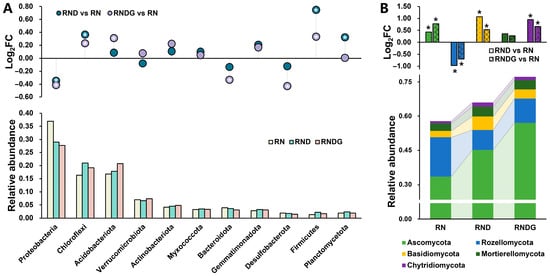
In the studied soil, the bacterial community in the rice rhizosphere was dominated by Proteobacteria, Chloroflexi, and Acidobacteriota, which accounted for more than 15% in relative abundance each (Figure 1A). Compared with RN, RND treatment significantly decreased the relative abundance of Proteobacteria, while significantly increasing that of Chloroflexi, Firmicutes, and Planctomycetota. RNDG treatment significantly decreased the relative abundance of three phyla, including Proteobacteria, Bacteroidota, and Desulfobacterota, while significantly increasing that of Chloroflexi, Acidobacteriota, and Firmicutes.
Figure 1.
Dominant bacterial (A) and fungal (B) phyla in rice rhizosphere under different treatments and the impact of RND and RNDG treatment on their dominance. * indicates a significant difference between RND/RNDG and RN determined by the Kruskal–Wallis rank sum test (p < 0.05).
The fungal community in the rice rhizosphere was dominated by five phyla, including Ascomycota, Rozellomycota, Basidiomycota, Mortierellomycota, and Chytridiomycota (Figure 1B), while they showed different responses to fertilization regimes. Compared with RN, RND and RNDG resulted in a significant decrease in the dominance of Rozellomycota, but significantly increased the dominance of Ascomycota, Basidiomycota, and Chytridiomycota. The relative abundance of Mortierellomycota was not significantly different across the three treatments.
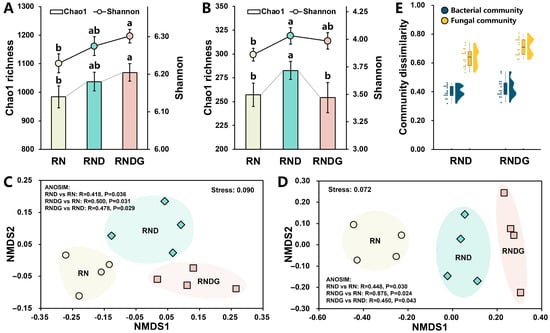
Chao1 richness and Shannon index were calculated to assess the impact of fertilization regimes on microbial diversity in the rice rhizosphere. The Chao1 and Shannon indices showed the same pattern across the treatments, increasing in the order of RN, RND, and RNDG, and RNDG had significantly higher bacterial diversity than RN and RND (Figure 2A). In contrast, the values of Chao1 and Shannon were highest in the RND treatment, while those in RN and RNDG treatments were not significantly different.
Figure 2.
Diversity of rhizosphere bacteria (A) and fungi (B) under different treatments. Different letters indicate significant differences between treatments determined by the Kruskal–Wallis rank sum test (p < 0.05). NMDS plots showing the variation of bacterial (C) and fungal (D) communities across treatments. Dissimilarity of bacterial and fungal communities between RND/RNDG and RN (E).
NMDS was performed to show the variation of bacterial and fungal communities across treatments. The 2D-plots of NMDS showed that samples from different treatments were separated from each other (Figure 2C,D). The results of ANOSIM further confirmed that the microbial communities were significantly different across the treatments.
By calculating the Bray–Curtis dissimilarity of bacterial and fungal communities between RND/RNDG and RN, the changes in microbial communities across treatments were quantified. Results showed that the dissimilarity of the fungal community between RND/RNDG and RN was larger than that of the bacterial community (Figure 2E), showing that the fungal community was more sensitive than the bacterial community to RND and RNDG treatments. In addition, the dissimilarity of bacterial and fungal communities between RNDG and RN was larger than that between RND and RN (p < 0.05), showing that RNDG treatment had greater effects on rhizosphere microbial communities than RND treatment.
3.4. Variation in the Functional Features of Rhizosphere Bacterial and Fungal Communities Across Different Treatments
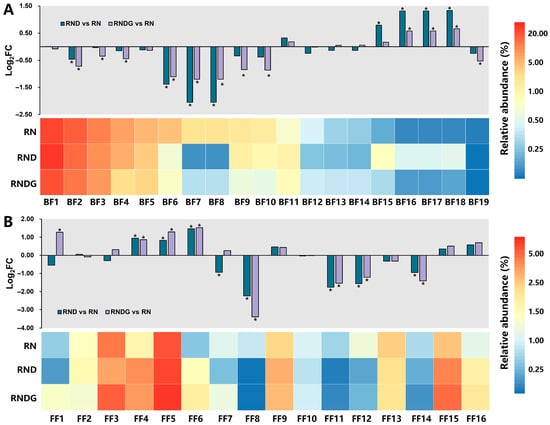
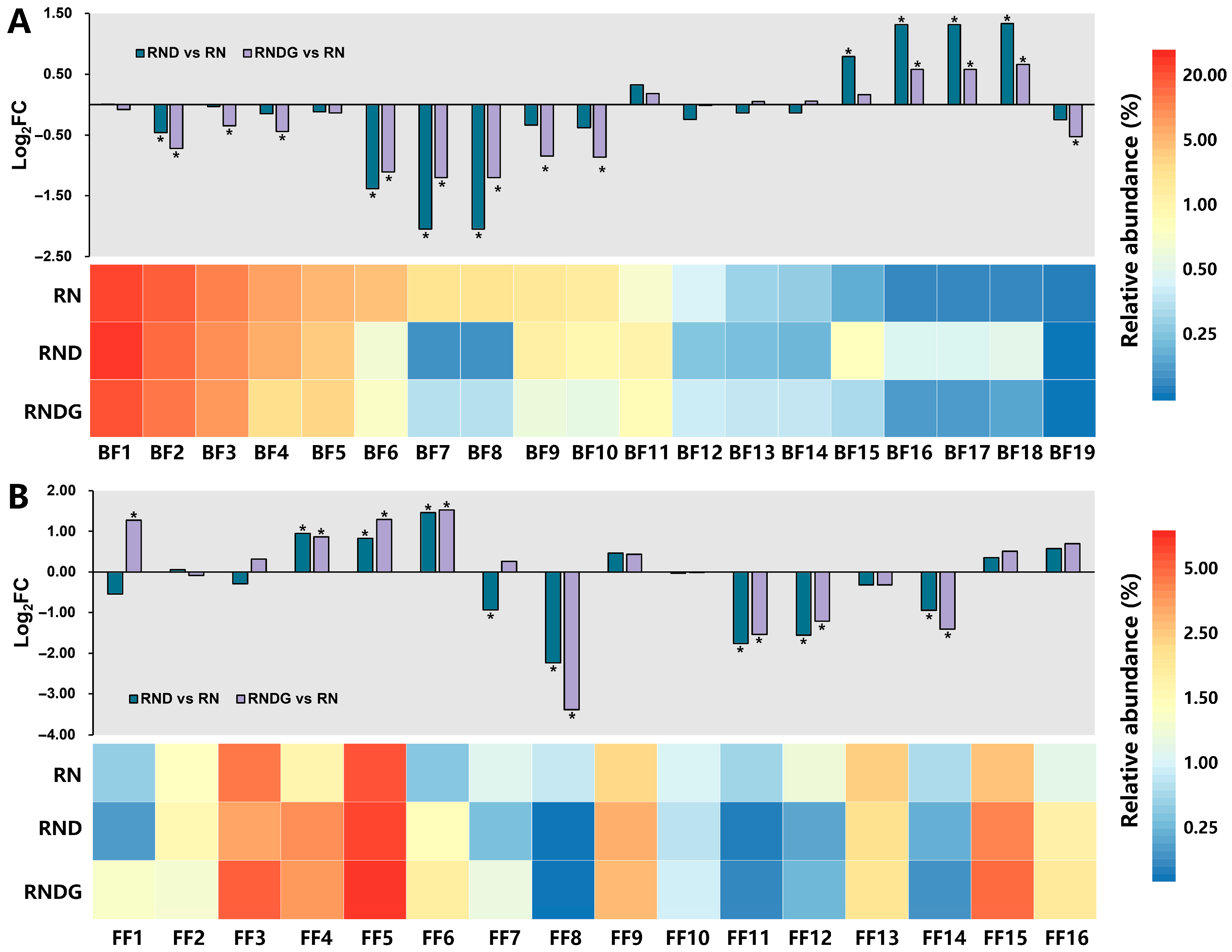
In the bacterial community, most of the taxa were assigned to the functional category of chemoheterotrophy (29.03~30.89%), and they varied little across the three treatments (Figure 3A). Compared with RN, RNND and RNDG treatments produced negative impact on the functional categories of aerobic chemoheterotrophy, nitrification, nitrogen fixation, nitrate reduction, nitrate respiration, nitrogen respiration, respiration of sulfur compounds, sulfate respiration, and photoheterotrophy, while had no significant impact on the functional categories of ureolysis, fermentation, methylotrophy, hydrocarbon degradation and methanotrophy, and had positive impact on the functional categories of phototrophyphotosynthetic cyanobacteria, oxygenic photoautotrophy, and photoautotrophy (Figure 3A).
Figure 3.
Variations in the functional profiles of the bacterial community across different treatments predicted by FAPROTAX (A). Variations in the ecological guilds of the fungal community across different treatments predicted by FUNGUild (B). * indicates a significant difference between RND/RNDG and RN determined by the Kruskal–Wallis rank sum test (p < 0.05). BF1 to BF19 indicate the functions of chemoheterotrophy, aerobic chemoheterotrophy, nitrification, nitrogen fixation, ureolysis, nitrate reduction, nitrate respiration, nitrogen respiration, respiration of sulfur compounds, sulfate respiration, fermentation, methylotrophy, hydrocarbon degradation, methanotrophy, phototrophy, photosynthetic cyanobacteria, oxygenic photoautotrophy, photoautotrophy, and photoheterotrophy, respectively. FF1 to FF16 indicate the ecological guilds of animal pathogen-dung saprotroph-endophyte-epiphyte-plant saprotroph-wood saprotroph, animal pathogen-endophyte-fungal parasite-lichen parasite-plant pathogen-wood saprotroph, animal pathogen-endophyte-lichen parasite-plant pathogen-plant saprotroph-undefined saprotroph-wood saprotroph, animal pathogen-endophyte-plant saprotroph-undefined saprotroph-wood saprotroph, clavicipitaceous endophyte-plant pathogen, dung saprotroph-plant saprotroph, dung saprotroph-plant saprotroph-soil saprotroph, endophyte-lichen parasite-plant pathogen-undefined saprotroph, endophyte-plant saprotroph-undefined saprotroph, endophyte-soil saprotroph-undefined saprotroph, fungal parasite-plant pathogen-plant saprotroph-wood saprotroph, plant pathogen, plant pathogen-plant saprotroph, plant saprotroph-undefined saprotroph, undefined saprotroph, and wood saprotroph, respectively.
Most of the fungal taxa were saprotrophs (Figure 3B). Compared with RN, RND and RNDG resulted in the enrichment of ecological guilds of animal pathogen-endophyte-plant saprotroph-undefined saprotroph-wood saprotroph, clavicipitaceous endophyte-plant pathogen, and dung saprotroph-plant saprotroph, while resulted in the dilution of ecological guilds of endophyte-lichen parasite-plant pathogen-undefined saprotroph, fungal parasite-plant pathogen-plant saprotroph-wood saprotroph, plant pathogen, and plant saprotroph-undefined saprotroph. Besides, RND also significantly decreased the relative abundance of ecological guilds involved in dung saprotroph-plant saprotroph-soil saprotroph, and RNDG significantly increased the relative abundance of ecological guilds involved in animal pathogen-dung saprotroph-endophyte-epiphyte plant saprotroph-wood saprotroph (Figure 3B).
3.5. Variation of Rhizosphere Bacterial and Fungal Community Assembly Across Different Treatments
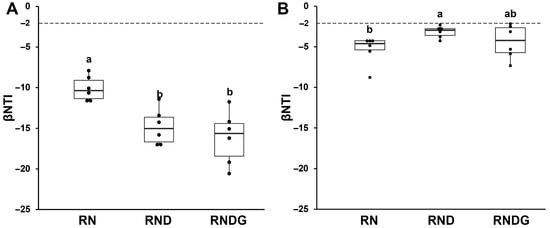
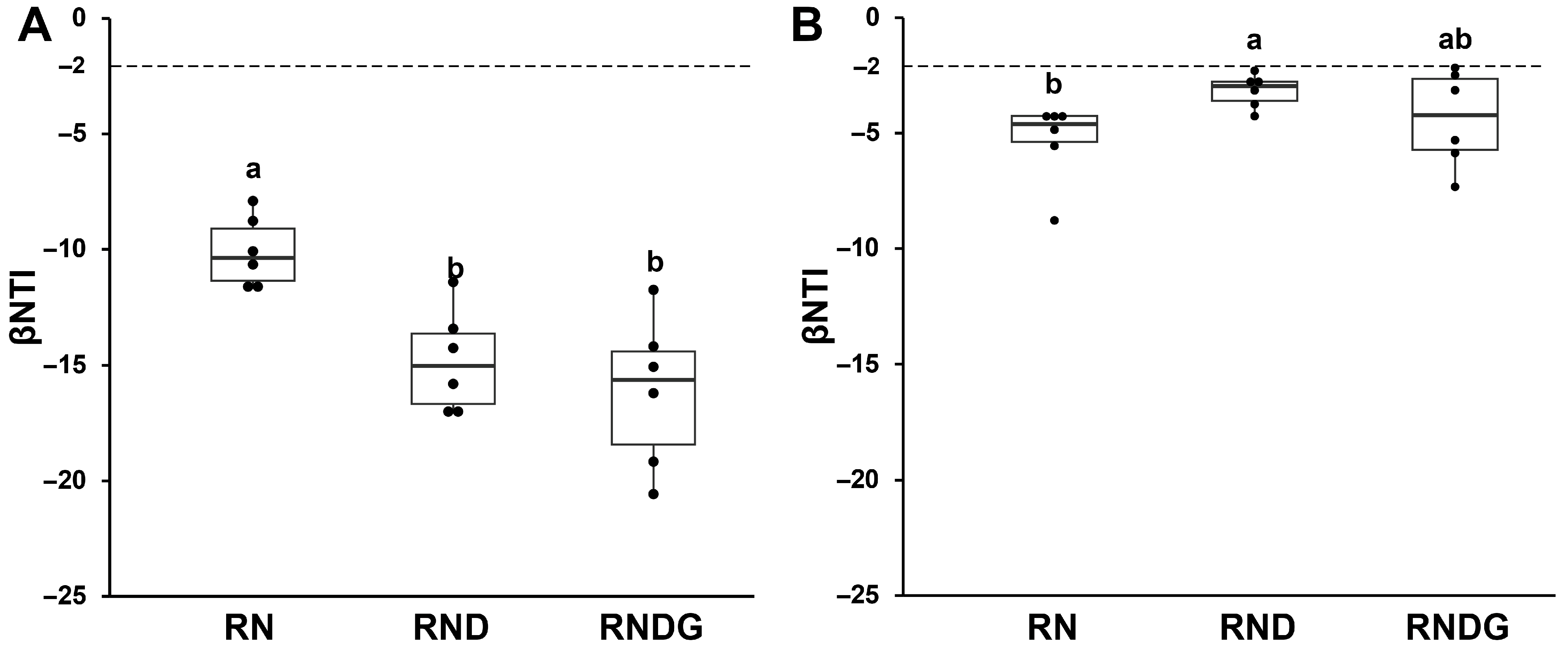
The βNTI values for both bacterial and fungal communities were smaller than −2, suggesting that the assembly of microbial communities was dominated by deterministic processes (Figure 4). However, the βNIT values of fungal communities were significantly higher than those of bacterial communities, indicating that the contribution of deterministic processes to bacterial community assembly was higher than to fungal community assembly. In addition, the βNTI values varied across treatments. In the bacterial community, the βNTI values were significantly higher in RN than in RND and RNDG treatments, while the βNTI values in RND and RNDG treatments were not significantly different (Figure 4A). In contrast, the highest βNTI values of the fungal community were observed in the RND treatment, which were significantly higher than in the RN treatment, while the βNTI values of the fungal community in the RNDG treatment were not significantly different compared with RN and RND (Figure 4B).
Figure 4.
βNTI varies bacterial (A) and fungal (B) community under different treatments. Different letters indicate significant difference between treatments determined by Kruskal–Wallis rank sum test (p < 0.05).
3.6. Correlations Between Rhizosphere Microbial Community and Soil Properties and Rice Features
Mantel test with the correlation method of “Pearson” was performed to evaluate the relationships between bacterial and fungal communities and rhizosphere soil properties and plant traits. For the bacterial community, significant correlations were detected with soil TK, NH4+–N, NO3−–N, stem biomass, and spike P concentration (Table 3). The fungal community exhibited significant correlations with soil NO3−–N, AP, leaf biomass, spike P concentration, and stem K concentration (Table 3). Other soil and plant parameters, including pH, SOC, TN, AK, leaf N, and most other tissue nutrient concentrations, did not show significant correlations with either bacterial or fungal community.
Table 3.
Pearson’s correlation coefficients determined by Mantel test between rhizosphere microbial community and soil properties and plant features.
4. Discussion
This study investigated the impact of N reduction and green manure incorporation on rice growth, rhizosphere environment, and rhizosphere microbial community assemblage in a paddy field under slow-release N fertilizer application. The results reveal several novel and functionally important patterns that extend current understanding of root-microbe-nutrient interactions under integrated fertilization.
Slow-release N fertilizers have been widely reported to enhance N use efficiency by synchronizing N release with crop demand, thereby reducing N losses and sustaining grain yield [42,43,44]. However, our results reveal that a 20% reduction in N application had distinct effects on the biomass of different tissues, with a positive effect on stem biomass but a negative effect on leaf and spike biomass (Table 1), indicating that reduced N input promotes stem growth but suppresses reproductive organ development in rice. This is consistent with a previous study based on a meta-analysis [45]. Nevertheless, RND treatment significantly increased the N content in stems and leaves, showing that N reduction changed the distribution of N in rice tissues. Green manure incorporation was shown to mitigate the effects of N reduction on rice, which resulted in a higher spike biomass than RND (Table 1). These results showed that even with the application of slow-release N fertilizer, N reduction still exerts adverse effects on crops, while green manure incorporation helps mitigate these negative impacts. Green manure incorporation has long been recognized as an effective organic amendment for sustaining crop productivity [46,47], and our results provide compelling field-based evidence for its beneficial role in mitigating the negative impacts of N reduction on rice. An important reason may be that green manure is capable of N fixation [18,48], thereby alleviating the deficiency of chemical N fertilizer.
Rhizosphere microorganisms play a vital role in crop production and are sensitive to agricultural practices and environmental changes [34,49,50,51]. Bacteria and fungi are the two dominant members of soil microorganisms, and they occupy different ecological niches and have different associations with plants [52,53,54]. The present work revealed markedly divergent responses of bacterial and fungal communities to the three fertilization regimes, underscoring the different ecological strategies and environmental sensitivities of these two kingdoms in the rice rhizosphere. The Bray–Curtis dissimilarity analysis clearly demonstrated that the fungal community was more strongly altered than the bacterial community by both N reduction and green manure incorporation, and the effect was greatest under the combined RNDG treatment. This higher fungal sensitivity may be attributed to the reliance of fungi on complex organic substrates and their slower turnover; the input of green manure and straw with a high C/N ratio likely favored saprotrophic fungi while suppressing oligotrophic or symbiotic guilds that were previously adapted to the lower organic carbon environment [55]. Bacterial diversity increased significantly only when green manure was added (RNDG), suggesting that the diverse carbon sources and microhabitats created by organic amendments promoted niche partitioning among bacterial taxa, whereas N reduction alone (RND) did not provide sufficient substrate diversity to elevate bacterial richness [33]. In contrast, fungal diversity peaked under RND and was not further enhanced by green manure, possibly because the dominance of fast-growing Ascomycota and Basidiomycota under reduced N conditions suppressed rarer fungal phyla, and the additional organic input in RNDG did not create new niches but rather reinforced existing competitive hierarchies. The composition differences further illustrate these contrasting dynamics: bacteria exhibited a trend from copiotrophic Proteobacteria toward oligotrophic Chloroflexi and Acidobacteriota with N reduction and organic amendment, whereas fungi responded with an expansion of Ascomycota and Basidiomycota at the expense of Rozellomycota, likely reflecting the enrichment of decomposers capable of utilizing lignocellulosic residues.
Functionally, predicted N-cycling bacterial groups (nitrifiers, N fixers) were consistently depleted in both N reduction treatments, while photoautotrophic bacteria were enriched, indicating that N reduction promoted the shift of the rice rhizosphere bacterial community toward a low-N-consuming and high-autotrophic community. This conversion was consistent with the decrease in N levels in the rhizosphere environment (Table 2). Fungal predicted guilds were also reorganized, with a clear decrease in plant pathogens, showing that N reduction and manure incorporation are beneficial for increasing plant health. This decline may be attributed to the reduction of nutrient levels in the rhizosphere, as reduced N availability can directly limit the growth and virulence of many soilborne fungal pathogens that are adapted to high-nutrient, copiotrophic environments; excessive N often increases plant tissue succulence and foliar N content, rendering plants more susceptible to infection, so a moderate N deficit may have lowered host attractiveness [56]. In addition, green manure incorporation introduced large amounts of organic matter, which stimulated the proliferation of diverse saprotrophic communities, intensifying competition for niches and resources and potentially enhancing biological suppression through the production of antimicrobial compounds [57,58].
The consistently negative βNTI values (below −2) for both bacterial and fungal communities demonstrate that deterministic processes predominantly govern community assembly in the rhizosphere. This has been observed in many other studies [32,59]. The predominance of deterministic processes in rhizosphere microbial community assembly is greatly associated with the highly selective nature of the root-soil interface. Plant roots continuously release a complex mixture of exudates, including sugars, amino acids, organic acids, and secondary metabolites, that create a nutrient-rich but chemically defined microenvironment [60]. This exudate profile acts as a potent environmental filter, favoring microorganisms that can efficiently utilize these specific sources while excluding those adapted to bulk soil conditions [61]. The present study found relatively more negative βNTI values for the bacterial community than for the fungal community, suggesting that bacterial communities are under greater selection by the measured soil and plant variables. In the bacterial community, the more negative βNTI in RND and RNDG compared with RN implies that N reduction and green manure addition intensified the deterministic selection. In contrast, N reduction and manure incorporation produce opposite effects on fungal community assembly compared with the bacterial community. The highest (least negative) βNTI in RND suggests that the simple N reduction treatment exerted the lowest deterministic filtering, whereas the addition of green manure in RNDG partly restored stochastic components. This differential response highlights that bacterial and fungal communities are assembled through distinct mechanisms in response to the same fertilization regimes. These differences were also reflected in the distinct correlations of bacterial and fungal communities with soil properties and crop attributes. The bacterial community exhibited significant correlations with soil inorganic N (NH4+–N and NO3−–N) and stem biomass, whereas the fungal community was associated with soil AP, NO3−–N, leaf biomass, and spike P concentration. This divergence reflects fundamental differences in metabolic capabilities and ecological roles of bacterial and fungal communities. These differential correlations indicate that fertilization practices targeting only N management may inadvertently uncouple the nutrient-specific microbial functions that support balanced plant nutrition.
When interpreting the findings above, several limitations of the present study should be acknowledged. First, rhizosphere microbial communities and soil properties were sampled only at crop maturity, and no pre-treatment baseline was established; therefore, the observed differences among treatments should be interpreted as treatment-associated differences at a single time point rather than as temporal shifts. Second, the functional interpretations of bacterial and fungal communities were based on functional prediction tools, which provide inferred functional potentials rather than direct measurements of gene expression, enzyme activity, or metabolic fluxes. Third, the experiment was conducted over a limited period at a single site, and the long-term consequences of repeated green manure incorporation under reduced N input on soil fertility and microbial community stability remain unknown. Future research should address these limitations by including conventional urea controls, establishing pre-treatment and multi-stage sampling, and conducting multi-year, multi-site field experiments. Direct functional assays, such as metagenomics, metatranscriptomics, and extracellular enzyme measurements, would help verify the predicted shifts in N and P cycling. In addition, pathogen bioassays and network-based approaches could clarify whether the observed microbial community reorganization translates into tangible disease suppression and altered inter-kingdom interactions. These integrated assessments will provide more accurate information for optimizing green manure and slow-release N management strategies that are both productive and environmentally sustainable.
5. Conclusions
The field experiment demonstrated that, under a slow-release N fertilization regime, a 20% reduction in N fertilizer and the same reduction combined with green manure incorporation exert divergent effects on rice growth, rhizosphere environmental factors, and rhizosphere microbial communities. N reduction alone showed a negative effect on rice growth, whereas the addition of green manure largely compensated for this negative effect, highlighting the agronomic value of integrating organic amendments into reduced-N management. The bacterial and fungal communities in the rice rhizosphere responded to the treatments in distinct ways. The fungal community was more sensitive to both reduction treatments than the bacterial community, and the two kingdoms were associated with different soil and plant variables, suggesting that they occupy complementary functional niches in the rhizosphere. Predicted functional profiling further indicated that N reduction and green manure incorporation may reduce the relative abundance of certain N-cycling bacteria and potential fungal pathogens, although these predictions require direct functional validation. Deterministic processes consistently governed both bacterial and fungal community assembly, yet the relative contribution of deterministic factors intensifies for bacteria under reduced N and green manure incorporation, while it weakens for fungi, indicating that the two kingdoms are governed by partly independent assembly mechanisms. These results demonstrated the divergent responses of bacterial and fungal communities to fertilization regimes, and provided a microbial ecological basis for rational N reduction and synergistic improvement of soil biological fertility.
Author Contributions
Conceptualization, R.S.; methodology, R.S.; validation, R.S.; formal analysis, C.S., Y.J., S.C., M.B., H.L., and L.Q.; investigation, C.S., Y.J., S.C., and M.B.; resources, R.S.; data curation, C.S., Y.J., and R.S.; writing—original draft preparation, R.S.; writing—review and editing, R.S.; visualization, C.S., Y.J., and R.S.; supervision, R.S.; project administration, R.S.; funding acquisition, R.S. All authors have read and agreed to the published version of the manuscript.
Funding
This research was funded by the National Key Research & Development Program of China, grant number 2023YFD1902300.
Institutional Review Board Statement
Not Applicable.
Informed Consent Statement
Not Applicable.
Data Availability Statement
The raw data supporting the conclusions of this article will be made available by the authors on request.
Acknowledgments
The authors thank the staff at the experimental station for their support in sample collection. The corresponding author, Ruibo Sun, appreciates Jessy for giving him the sweetest time in the past.
Conflicts of Interest
The authors declare no conflicts of interest.
References
- Spiertz, J.H.J. Nitrogen, sustainable agriculture and food security. A review. Agron. Sustain. Dev. 2010, 30, 43–55. [Google Scholar] [CrossRef] [Scilit]
- Anas, M.; Liao, F.; Verma, K.K.; Sarwar, M.A.; Mahmood, A.; Chen, Z.-L.; Li, Q.; Zeng, X.-P.; Liu, Y.; Li, Y.-R. Fate of nitrogen in agriculture and environment: Agronomic, eco-physiological and molecular approaches to improve nitrogen use efficiency. Biol. Res. 2020, 53, 47. [Google Scholar] [CrossRef] [Scilit] [PubMed]
- Sun, Q.; Cheng, Y.; Yin, S.; Sun, X.; Song, X.; Song, X.; Shen, W.; Meng, B.; Wang, X.; Lv, X.; et al. Substitution of 25% of chemical fertilizer nitrogen with organic amendments nitrogen reduces N2O emissions from tea plantation soils in subtropical China. Front. Microbiol. 2025, 16, 1715814. [Google Scholar] [CrossRef] [Scilit] [PubMed]
- He, H.; Li, D.D.; Pan, F.F.; Wang, F.W.; Wu, D.; Yang, S.Y. Effects of nitrogen reduction and optimized fertilization combined with straw return on greenhouse gas emissions and crop yields of a rice-wheat rotation system. Int. J. Plant Prod. 2022, 16, 669–679. [Google Scholar] [CrossRef] [Scilit]
- Melara, F.; da Silva, L.K.; Martins Sanderi, D.; Dal Castel Krein, D.; Strieder Machado, T.; Dettmer, A.; Steffanello Piccin, J. Enhanced efficiency fertilizer: A review on technologies, perspectives, and research strategies. Environ. Dev. Sustain. 2026, 28, 12505–12531. [Google Scholar]
- Moradi, S.; Babapoor, A.; Ghanbarlou, S.; Kalashgarani, M.Y.; Salahshoori, I.; Seyfaee, A. Toward a new generation of fertilizers with the approach of controlled-release fertilizers: A review. J. Coat. Technol. Res. 2024, 21, 31–54. [Google Scholar] [CrossRef] [Scilit]
- Meng, T.; Shi, J.; Zhang, X.; Ge, G.; Cheng, Y.; Rong, M.; Chen, L.; Zhao, X.; Wang, X.; Lu, Z. Slow-release nitrogen fertilizer promotes the bacterial diversity to drive soil multifunctionality. Agronomy 2024, 14, 2712. [Google Scholar] [CrossRef] [Scilit]
- Meng, T.; Shi, J.; Zhang, X.; Zhao, X.; Zhang, D.; Chen, L.; Lu, Z.; Cheng, Y.; Hao, Y.; Zhao, X.; et al. Slow-release nitrogen fertilizer application regulated rhizosphere microbial diversity to increase maize yield. Front. Plant Sci. 2024, 15, 1481465. [Google Scholar] [CrossRef] [Scilit] [PubMed]
- Jin, X.; Cai, J.; Yang, S.; Li, S.; Shao, X.; Fu, C.; Li, C.; Deng, Y.; Huang, J.; Ruan, Y.; et al. Partial substitution of chemical fertilizer with organic fertilizer and slow-release fertilizer benefits soil microbial diversity and pineapple fruit yield in the tropics. Appl. Soil Ecol. 2023, 189, 104974. [Google Scholar] [CrossRef] [Scilit]
- Zhang, Y.; Yu, H.; Shi, L.; Li, X.; Jiang, L.; Peng, C.; Li, M.; Mei, H.; Chen, X.; Wang, Y.; et al. Controlled-release fertilizer enhances soil nutrients and tea quality through microbial community modulation. Ind. Crops Prod. 2026, 245, 123249. [Google Scholar] [CrossRef] [Scilit]
- Dodd, J.C. The role of arbuscular mycorrhizal fungi in agro- and natural ecosystems. Outlook Agr. 2000, 29, 55–62. [Google Scholar] [CrossRef] [Scilit]
- Yan, M.; Liang, Q.; Yang, J.; Mao, J.; Wang, Q.; Xiong, T.; Hu, G. Effects of deep slow-release fertilizer on melon yield, economic benefits and rhizosphere microorganisms. Front. Plant Sci. 2026, 17, 1831940. [Google Scholar] [CrossRef] [Scilit] [PubMed]
- Gao, S.; Zhou, G.; Chang, D.; Liang, H.; Nie, J.; Liao, Y.; Lu, Y.; Xu, C.; Liu, J.; Wu, J.; et al. Southern China can produce more high-quality rice with less N by green manuring. Resour. Conserv. Recy. 2023, 196, 107025. [Google Scholar] [CrossRef] [Scilit]
- Liu, M.; Hu, Z.; Fan, Y.; Hua, B.; Yang, W.; Pang, S.; Mao, R.; Zhang, Y.; Bai, K.; Fadda, C.; et al. Effects of leguminous green manure–crop rotation on soil enzyme activity and stoichiometry. J. Plant Ecol. 2024, 17, rtae065. [Google Scholar] [CrossRef] [Scilit]
- Xia, Y.; Gao, P.; Lei, W.; Gao, J.; Luo, Y.; Peng, F.; Mou, T.; Zhao, Z.; Zhang, K.; Guggenberger, G.; et al. Covering green manure increases rice yields via improving nitrogen cycling between soil and crops in paddy fields. Agr. Ecosyst. Environ. 2025, 383, 109517. [Google Scholar] [CrossRef] [Scilit]
- Liang, H.; Zhou, G.-P.; Gao, S.-J.; Nie, J.; Xu, C.-X.; Wu, J.; Liu, C.-Z.; Lv, Y.-H.; Huang, Y.-B.; Geng, M.-J.; et al. Exploring site-specific N application rate to reduce N footprint and increase crop production for green manure-rice rotation system in southern China. J. Environ. Manag. 2023, 347, 119033. [Google Scholar] [CrossRef] [Scilit] [PubMed]
- Gu, C.-m.; Li, Y.-s.; Yang, L.; Dai, J.; Hu, W.; Yu, C.-b.; Brooks, M.; Liao, X.; Qin, L. Effects of oilseed rape green manure on phosphorus availability of red soil and rice yield in rice–green manure rotation system. Front. Plant Sci. 2024, 15, 1417504. [Google Scholar] [CrossRef] [Scilit] [PubMed]
- Lyu, H.; Li, Y.; Wang, Y.; Wang, P.; Shang, Y.; Yang, X.; Wang, F.; Yu, A. Drive soil nitrogen transformation and improve crop nitrogen absorption and utilization—A review of green manure applications. Front. Plant Sci. 2024, 14, 1305600. [Google Scholar] [CrossRef] [Scilit] [PubMed]
- Yang, L.; Liu, J.; Huang, J.; Jiang, Z.; Liu, M.; Cao, W. Three decades of green manure rotations sustain soil nitrogen supply by microbial functional restructuring under reduced mineral fertilization. Appl. Soil Ecol. 2026, 220, 106873. [Google Scholar] [CrossRef] [Scilit]
- Singh, B.K.; Hu, H.-W.; Macdonald, C.A.; Xiong, C. Microbiome-facilitated plant nutrient acquisition. Cell Host Microbe 2025, 33, 869–881. [Google Scholar] [CrossRef] [Scilit] [PubMed]
- Feng, Y.; Tang, Y.; Abdoulaye, A.H.; Zhang, Y.; Wen, W.; Wang, H.; Du, Z.; Chen, Y. Progress in plant rhizosphere microbiome research for improved growth, nutrient uptake, and disease resistance. Plant Stress 2026, 20, 101323. [Google Scholar] [CrossRef] [Scilit]
- Chen, Y.; Tu, P.; Yang, Y.; Xue, X.; Feng, Z.; Dan, C.; Cheng, F.; Yang, Y.; Deng, L. Diversity of rice rhizosphere microorganisms under different fertilization modes of slow-release fertilizer. Sci. Rep. 2022, 12, 2694. [Google Scholar] [CrossRef] [Scilit] [PubMed]
- Xiong, Z.; Li, Q.; Fu, R.; Wang, J.; Lu, D.; Chen, C. The reorganization of rice rhizosphere microbial communities driven by nitrogen utilization efficiency and the regulatory mechanism of soil nitrogen cycling. Microorganisms 2025, 13, 2215. [Google Scholar] [CrossRef] [Scilit] [PubMed]
- Tong, R.; Kuzyakov, Y.; Yu, H.; Cao, Y.; Wu, T. Rhizosphere response and resistance to fertilization. Commun. Earth Environ. 2025, 6, 602. [Google Scholar] [CrossRef] [Scilit]
- Zhang, X.; Han, X.; Li, Q.; Chen, Q.; Wu, Z.; Zhao, J.; Zhang, H.; Zhang, Y.; Ma, D.; Xie, Y.; et al. Long-term nitrogen fertilizer improves nitrogen use efficiency and wheat yield by regulating the interactions of rhizosphere soil-root-microbes. Agr. Ecosyst. Environ. 2026, 402, 110317. [Google Scholar] [CrossRef] [Scilit]
- Yu, Y.; Zhang, Q.; Kang, J.; Xu, N.; Zhang, Z.; Deng, Y.; Gillings, M.; Lu, T.; Qian, H. Effects of organic fertilizers on plant growth and the rhizosphere microbiome. Appl. Environ. Microbiol. 2024, 90, e01719-01723. [Google Scholar] [CrossRef] [Scilit] [PubMed]
- Deng, J.; Zhang, Z.; Wang, Y.; Ai, J.; Zhao, Y.; Li, B.; Li, H.; Deng, Y.; Zhang, F. Organic fertilizer-mediated assembly of rhizosphere core microbiota contributes to increased sugarcane productivity. Front. Plant Sci. 2026, 16, 1689397. [Google Scholar] [CrossRef] [Scilit] [PubMed]
- Sun, R.; Wang, D.; Guo, Z.; Hua, K.; Guo, X.; Chen, Y.; Liu, B.; Chu, H. Combined application of organic manure and chemical fertilizers stabilizes soil N-cycling microflora. Soil Ecol. Lett. 2023, 5, 220165. [Google Scholar] [CrossRef] [Scilit]
- Shi, Y.; Niu, X.; Chen, B.; Pu, S.; Ma, H.; Li, P.; Feng, G.; Ma, X. Chemical fertilizer reduction combined with organic fertilizer affects the soil microbial community and diversity and yield of cotton. Front. Microbiol. 2023, 14, 1295722. [Google Scholar] [CrossRef] [Scilit] [PubMed]
- Yan, H.; Wu, Y.; He, G.; Wen, S.; Yang, L.; Ji, L. Fertilization regime changes rhizosphere microbial community assembly and interaction in Phoebe bournei plantations. Appl. Microbiol. Biotechnol. 2024, 108, 417. [Google Scholar] [CrossRef] [Scilit] [PubMed]
- Ren, J.; Liu, X.; Yang, W.; Yang, X.; Li, W.; Xia, Q.; Li, J.; Gao, Z.; Yang, Z. Rhizosphere soil properties, microbial community, and enzyme activities: Short-term responses to partial substitution of chemical fertilizer with organic manure. J. Environ. Manag. 2021, 299, 113650. [Google Scholar] [CrossRef] [Scilit] [PubMed]
- Sun, R.; Zhang, W.; Liu, Y.; Yun, W.; Luo, B.; Chai, R.; Zhang, C.; Xiang, X.; Su, X. Changes in phosphorus mobilization and community assembly of bacterial and fungal communities in rice rhizosphere under phosphate deficiency. Front. Microbiol. 2022, 13, 953340. [Google Scholar] [CrossRef] [Scilit] [PubMed]
- Sun, R.B.; Zhang, X.X.; Guo, X.S.; Wang, D.Z.; Chu, H.Y. Bacterial diversity in soils subjected to long-term chemical fertilization can be more stably maintained with the addition of livestock manure than wheat straw. Soil Biol. Biochem. 2015, 88, 9–18. [Google Scholar] [CrossRef] [Scilit]
- Luo, B.; Yang, K.; Lyu, X.; Deng, X.; Yun, W.; Li, S.; Ye, X.; Sun, R. Fulvic acid increases rice resistance to phosphorus deficiency by increasing plant P uptake and rhizosphere P mobilization. Crop J. 2025, 13, 1619–1630. [Google Scholar] [CrossRef] [Scilit]
- Callahan, B.J.; McMurdie, P.J.; Rosen, M.J.; Han, A.W.; Johnson, A.J.; Holmes, S.P. DADA2: High-resolution sample inference from Illumina amplicon data. Nat. Methods 2016, 13, 581–583. [Google Scholar] [CrossRef] [Scilit] [PubMed]
- Edgar, R.C. SINTAX: A simple non-Bayesian taxonomy classifier for 16S and ITS sequences. bioRxiv 2016, 074161. [Google Scholar] [CrossRef] [Scilit]
- Louca, S.; Parfrey, L.W.; Doebeli, M. Decoupling function and taxonomy in the global ocean microbiome. Science 2016, 353, 1272–1277. [Google Scholar] [CrossRef] [Scilit] [PubMed]
- Nguyen, N.H.; Song, Z.; Bates, S.T.; Branco, S.; Tedersoo, L.; Menke, J.; Schilling, J.S.; Kennedy, P.G. FUNGuild: An open annotation tool for parsing fungal community datasets by ecological guild. Fungal Ecol. 2016, 20, 241–248. [Google Scholar] [CrossRef] [Scilit]
- Sun, R.; Zhao, Z.; Dong, W.; Wang, F.; Luo, B.; Ma, C.; Liu, B.; Hu, C.; Li, X.; Shi, Y. Soil phosphorus pool variation is more strongly associated with microbial community composition than with phosphorus-cycling functional gene profiles under long-term nitrogen fertilization. Agr. Ecosyst. Environ. 2026, 405, 110407. [Google Scholar] [CrossRef] [Scilit]
- Sun, R.; Su, X.; Qi, Y.; Liu, H.; Rüger, L.; Chu, H.; Shi, Y. Cotton suffering from Verticillium wilt shapes a rhizosphere bacteriome with high antagonism against Verticillium dahliae. Soil Ecol. Lett. 2026, 8, 260447. [Google Scholar] [CrossRef] [Scilit]
- Zhang, L.; Niu, J.; Lu, X.; Zhao, Z.; Li, K.; Wang, F.; Zhang, C.; Sun, R. Dosage effects of organic manure on bacterial community assemblage and phosphorus transformation profiles in greenhouse soil. Front. Microbiol. 2023, 14, 1188167. [Google Scholar] [CrossRef] [Scilit] [PubMed]
- E, P.; Sarkar, S.; Maji, P.K. A review on slow-release fertilizer: Nutrient release mechanism and agricultural sustainability. J. Environ. Chem. Eng. 2024, 12, 113211. [Google Scholar] [CrossRef] [Scilit]
- Ma, L.; Zhang, C.; Xu, R.; Yang, T.; Han, G.; Wu, L.; Wang, S.; Zhang, J.; Yuan, Q.; Kou, X. Slow-release nitrogen fertilizer reduces input without yield loss in a rice-crayfish integrated system. Nutr. Cycl. Agroecosyst. 2024, 128, 35–51. [Google Scholar] [CrossRef] [Scilit]
- Guo, J.; Yang, H.; Yuan, Y.; Yin, P.; Zhang, N.; Lin, Z.; Ma, Q.; Yang, Q.; Liu, X.; Wang, H.; et al. Blending of slow-release N fertilizer and urea improve rainfed maize yield and nitrogen use efficiency while reducing apparent N losses. Agronomy 2025, 15, 11. [Google Scholar] [CrossRef] [Scilit]
- Abhiram, G. Slow-release fertilisers control N losses but negatively impact on agronomic performances of pasture: Evidence from a meta-analysis. Nitrogen 2024, 5, 1058–1073. [Google Scholar] [CrossRef] [Scilit]
- Huang, H.; Zhang, Z.; Wu, Q.; Liu, Z.; Wang, Q.; Ying, Y.; Zhang, Z.; Zhang, H.; Wang, Y.; Zhang, G.; et al. Global comprehensive evaluation shows that green manure enhances crop productivity while mitigating gaseous nitrogen losses. Resour. Conserv. Recy. 2025, 220, 108351. [Google Scholar] [CrossRef] [Scilit]
- Kumar, R.; Bordoloi, N. Optimizing nitrogen fertilizer application with green manure for enhancing nitrogen use efficiency and reducing nitrous oxide (N2O) emission from rice field. Discov. Soil 2026, 3, 46. [Google Scholar] [CrossRef] [Scilit]
- Liu, R.; Zhou, G.-p.; Chang, D.-n.; Gao, S.-j.; Han, M.; Zhang, J.-d.; Sun, X.-f.; Cao, W.-d. Transfer characteristics of nitrogen fixed by leguminous green manure crops when intercropped with maize in northwestern China. J. Integr. Agric. 2022, 21, 1177–1187. [Google Scholar] [CrossRef] [Scilit]
- Ling, N.; Wang, T.; Kuzyakov, Y. Rhizosphere bacteriome structure and functions. Nat. Commun. 2022, 13, 836. [Google Scholar] [CrossRef] [Scilit] [PubMed]
- Liu, X.; Sun, L.; Wang, M.; Jiang, Z.; Wang, S.; Chen, S.; Luo, B.; Ma, C.; Sun, R. Foliar humic acid application as a top-down regulatory approach to modify rice rhizosphere bacterial communities and enhance phosphorus mobilization. Ecol. Front. 2026, 46, 1766–1774. [Google Scholar] [CrossRef] [Scilit]
- Dai, Y.M.; Cui, Y.; Xiao, Q.C.; Ping, M.L.; Zhang, Y.M.; Hu, S.G.; Chen, H.; Li, X.Y.; Chen, J. Environment disturbances influence bacterial diversity, structure and co-occurrence network in the rhizosphere. Physiol. Mol. Plant P 2025, 138, 102716. [Google Scholar] [CrossRef] [Scilit]
- Mbhele, V.S.; Donaldson, L.; Dzvene, A.R.; Mutengwa, C.S. Methodological approaches for identifying rhizosphere bacteria and fungi: A systematic review of comparative insights and best practices. Appl. Soil Ecol. 2026, 221, 106907. [Google Scholar] [CrossRef] [Scilit]
- Chepsergon, J.; Moleleki, L.N. Rhizosphere bacterial interactions and impact on plant health. Curr. Opin. Microbiol. 2023, 73, 102297. [Google Scholar] [CrossRef] [Scilit] [PubMed]
- Mendes, R.; Garbeva, P.; Raaijmakers, J.M. The rhizosphere microbiome: Significance of plant beneficial, plant pathogenic, and human pathogenic microorganisms. FEMS Microbiol. Rev. 2013, 37, 634–663. [Google Scholar] [CrossRef] [Scilit] [PubMed]
- Sun, R.; Dsouza, M.; Gilbert, J.A.; Guo, X.; Wang, D.; Guo, Z.; Ni, Y.; Chu, H. Fungal community composition in soils subjected to long-term chemical fertilization is most influenced by the type of organic matter. Environ. Microbiol. 2016, 18, 5137–5150. [Google Scholar] [CrossRef] [Scilit] [PubMed]
- Sun, Y.; Wang, M.; Mur, L.A.J.; Shen, Q.; Guo, S. Unravelling the roles of nitrogen nutrition in plant disease defences. Int. J. Mol. Sci. 2020, 21, 572. [Google Scholar] [CrossRef] [Scilit] [PubMed]
- Liang, J.; Shi, H.; Xiang, B.; Chi, L.; Wang, R.; Sun, G.; Sun, Y.; Wang, J.; Tan, J.; Wang, X. Impacts of green manure rotations and alkaline amendments on soil health and assembly and function of bacterial communities. Appl. Soil Ecol. 2025, 214, 106368. [Google Scholar] [CrossRef] [Scilit]
- Wang, Y.; Wang, T.; Zhang, F.; Zhang, X.; Duan, T. Green Manure Cropping systems and their ecological functions: Current knowledge, mechanisms, and future perspectives. Agriculture 2026, 16, 1534. [Google Scholar] [CrossRef] [Scilit]
- Ai, J.; Huang, J.; Wang, C.; Wang, X.; Zhao, Y.; Wei, G.; Li, Z. Deterministic assembly of rhizosphere bacterial community enables predictable and stable suppression of Verticillium wilt via microbial homeostasis. Microbiome 2026, 14, 188. [Google Scholar] [CrossRef] [Scilit] [PubMed]
- Zhalnina, K.; Louie, K.B.; Hao, Z.; Mansoori, N.; da Rocha, U.N.; Shi, S.; Cho, H.; Karaoz, U.; Loqué, D.; Bowen, B.P.; et al. Dynamic root exudate chemistry and microbial substrate preferences drive patterns in rhizosphere microbial community assembly. Nat. Microbiol. 2018, 3, 470–480. [Google Scholar] [CrossRef] [Scilit] [PubMed]
- Xiao, X.; Fang, X.W.; Hu, N.; Huang, K.; Huang, R.L.; Farooq, M.R.; Zhang, H.B.; Zhao, Y. Root specialized metabolites shape plant-beneficial bacterial communities to mitigate hydrocarbon stress. Microbiol. Res. 2025, 301, 128314. [Google Scholar] [CrossRef] [Scilit] [PubMed]

Disclaimer/Publisher’s Note: The statements, opinions and data contained in all publications are solely those of the individual author(s) and contributor(s) and not of MDPI and/or the editor(s). MDPI and/or the editor(s) disclaim responsibility for any injury to people or property resulting from any ideas, methods, instructions or products referred to in the content. |
© 2026 by the authors. Licensee MDPI, Basel, Switzerland. This article is an open access article distributed under the terms and conditions of the Creative Commons Attribution (CC BY) license.