


Abstract
Acute kidney injury (AKI) is a frequent, life-threatening complication in people living with HIV (PLWH), particularly those with disseminated histoplasmosis (DH), yet the determinants of severe AKI and the role of endothelial dysfunction remain poorly understood. We assessed the incidence, predictors, and biomarker profile of stage 3 AKI in PLWH hospitalized with DH. In this prospective cohort study at a tertiary infectious diseases center in Northeastern Brazil, adults with probable or proven DH were enrolled, and AKI was defined by Kidney Disease: Improving Global Outcomes (KDIGO) criteria. Kidney injury, inflammatory, and endothelial biomarkers, including angiopoietin-2 (Ang-2), were measured early in hospitalization, and predictors were identified using least absolute shrinkage and selection operator (LASSO)-based multivariable logistic regression. Of 58 patients, 24 (41.4%) developed stage 3 AKI, which was associated with intensive care admission, mechanical ventilation, vasoactive drugs, and in-hospital mortality (54.2% vs. 2.9%, p < 0.001) and with lower body mass index (BMI), hepatomegaly, circulating Histoplasma capsulatum-like yeasts, higher inflammatory and liver injury markers, and higher Ang-2. Only BMI remained independently associated: each 1 kg/m2 increase was associated with lower odds of stage 3 AKI (odds ratio 0.77; 95% confidence interval 0.60–0.95; p = 0.024). The Ang-2 association suggests that endothelial dysfunction may contribute to severe AKI and warrants further study for early risk stratification.
1. Introduction
People living with HIV (PLWH) are at an increased risk of developing acute kidney injury (AKI) compared with the general population, particularly in the presence of factors such as Black race, proteinuria, family history of kidney disease, low CD4+ T-cell count, high viral load, hepatitis C virus (HCV) infection, advanced age, and smoking habits [1,2,3].
The leading causes of AKI in PLWH include hypovolemia, acute tubular necrosis (ATN), and drug-induced nephrotoxicity [4,5]. ATN frequently results from sepsis or exposure to amphotericin B (AmB), both of which are common among patients with disseminated histoplasmosis (DH). Disseminated histoplasmosis is a severe endemic mycosis caused by the dimorphic fungus Histoplasma capsulatum and remains an important opportunistic disease in PLWH, particularly in those with CD4+ T-cell counts < 150 cells/µL [6].
DH may present with severe manifestations in patients with advanced immunosuppression, including shock, respiratory failure, hepatic dysfunction, AKI, and coagulopathy [7]. In some patients, AKI has been associated with granulomatous interstitial nephritis on renal histopathological examination [8,9].
Although kidney biopsy with histopathological examination remains the gold standard for the diagnosis of several kidney diseases, serum and urinary biomarkers may also provide valuable diagnostic and prognostic information. The most widely used biomarkers include serum creatinine-based estimated glomerular filtration rate (eGFR) and proteinuria or albuminuria [10]. However, these tests may not be effective in detecting early AKI or tubulointerstitial alterations before glomerular dysfunction becomes clinically evident [11].
We hypothesized that endothelial dysfunction contributes to severe AKI in disseminated histoplasmosis and evaluated whether circulating endothelial biomarkers improves identification of patients at risk.
2. Material and Methods
2.1. Study Design
This prospective cohort study was conducted from March 2023 to December 2024, with patient enrollment continuing until June 2024. Patients requiring renal replacement therapy (RRT) at discharge were followed for 180 days. The study population consisted of PLWH hospitalized with a diagnosis of DH at São José Hospital of Infectious Diseases, a tertiary-care infectious diseases referral hospital in Northeastern Brazil, during the inclusion period. The hospital is affiliated with the Brazilian Unified Health System (SUS) and serves as a regional reference center for infectious diseases.
2.2. Study Population
Inclusion criteria were: (1) PLWH aged ≥18 years and (2) hospitalization with probable or proven DH. Exclusion criteria were: (1) declined informed consent and (2) previous diagnosis of chronic kidney disease (CKD). In cases where consent could not be obtained due to death before signing, treatment discontinuation, or relocation, a waiver of informed consent was granted.
No formal a priori sample size calculation was performed, as this was a prospective observational study with consecutive enrollment of all eligible patients during the study period, rather than a hypothesis-driven design requiring a pre-specified effect size.
2.3. Diagnostic Criteria
HIV infection was confirmed using a fourth-generation immunoassay followed by a rapid immunoblot assay. DH was classified as proven or probable according to previously established criteria. Proven DH was defined as direct visualization or culture isolation of H. capsulatum in the peripheral blood, buffy coat, bone marrow aspirate, or another sterile site. Probable DH was defined as compatible clinical features, epidemiological exposure, and a positive urinary antigen test [12].
AKI and CKD were distinguished primarily by duration and reversibility: AKI was defined as an abrupt decline in kidney function developing within days, whereas CKD required abnormalities of kidney structure or function present for ≥3 months, in accordance with Kidney Disease: Improving Global Outcomes (KDIGO) guidelines [13,14], and eGFR was calculated using the Chronic Kidney Disease Epidemiology Collaboration (CKD-EPI) equation [15]. Baseline serum creatinine (sCr) was defined as the lowest value recorded during hospitalization. This definition was applied uniformly regardless of the timing of HIV diagnosis, including patients newly diagnosed with HIV at admission who lacked prior outpatient records, given the absence of a reliable pre-admission baseline in this subgroup. AKI stage 1 was defined as an increase in sCr to 1.5–1.9 times baseline or ≥0.3 mg/dL; stage 2 as an increase to 2.0–2.9 times baseline; and stage 3 as an increase to ≥3.0 times baseline, sCr ≥ 4.0 mg/dL, or initiation of RRT.
2.4. Data Collection Procedures
Epidemiological, clinical, and laboratory data were collected through face-to-face patient interviews and a medical record review. Race was self-reported according to the categories of the Brazilian Institute of Geography and Statistics (IBGE). Participants who self-identified as Black (preta) were compared with all other participants, including those who self-identified as mixed-race (parda). Race was recorded because Black race has been identified as a risk factor for AKI in PLWH [1,2,3]; it was analyzed as a social category and for exploratory purposes only.
Biomarker analyses were performed at the Laboratory of Pharmaceutical Bioprospecting and Clinical Biochemistry, Federal University of Ceará. The evaluated biomarkers included neutrophil gelatinase-associated lipocalin (NGAL), monocyte chemoattractant protein-1 (MCP-1), vascular cell adhesion molecule-1 (VCAM-1), syndecan-1, angiopoietin-1 (Ang-1), Ang-2, and interleukin (IL-6). Biomarker measurements were obtained when sufficient sample volume was available; missing data were not imputed, and each biomarker’s analysis included only patients with available measurements (complete-case analysis). Samples were collected before or within the first few days of induction treatment for DH in critically ill patients requiring immediate antifungal therapy.
Aliquots for biomarker analyses were separated on the day of sample collection. Serum concentrations of VCAM-1, Ang-1, Ang-2, IL-6, and syndecan-1, as well as urinary NGAL and MCP-1, were measured using enzyme-linked immunosorbent assay (ELISA), a highly sensitive and specific immunoenzymatic technique. NGAL, Ang-1, Ang-2, IL-6, and MCP-1 were measured using commercial ELISA kits from R&D Systems (Minneapolis, MN, USA). VCAM-1 was measured using a commercial ELISA kit from R&D Systems and, for samples collected later in the study, a commercial ELISA kit from Abcam (Cambridge, UK). Syndecan-1 was measured using a commercial ELISA kit from Abcam (Cambridge, UK). Optical density was measured using an Agilent BioTek 800 TS microplate reader (Agilent Technologies, Santa Clara, CA, USA) at 450 nm with wavelength correction at 650 nm. Urinary NGAL and MCP-1 concentrations were normalized to urinary creatinine and expressed as ng/mg or pg/mg creatinine, respectively.
Cumulative exposure to AmB was quantified as the cumulative number of treatment days across different formulations (deoxycholate, lipid complex, and liposomal). For analytical purposes, the days for each formulation were combined to provide a single measure of treatment duration. Given known differences in nephrotoxicity across AmB formulations, sensitivity analyses were performed assessing formulation-specific exposure: the proportion of patients exposed to conventional deoxycholate AmB (any exposure versus none) was compared using Fisher’s exact test, and cumulative days of deoxycholate exposure were compared using the Mann–Whitney U test.
2.5. Primary and Secondary Endpoints
The primary endpoint was the development of stage 3 AKI during hospitalization. The secondary endpoints included mechanical ventilation, intensive care unit (ICU) admission, vasoactive drugs use, all-cause in-hospital mortality, and length of hospital stay. RRT was analyzed descriptively, as its initiation is part of the stage 3 AKI definition.
2.6. Statistical Analysis
Categorical variables were presented as absolute counts and relative frequencies (percentages). Associations between categorical variables were evaluated using Pearson’s chi-square or Fisher’s exact tests, as appropriate. Relative risks (RR) with corresponding 95% confidence intervals (95% CI) were calculated.
Continuous variables were assessed for normality using the Shapiro–Wilk test. Normally distributed variables were expressed as mean ± standard deviation, whereas non-normally distributed variables were reported as median and interquartile range (Q1–Q3). Comparisons between two independent groups were performed using Welch’s t-test or the Mann–Whitney U test, as appropriate.
The correlation between Ang-2 levels and renal function markers (baseline serum creatinine, admission serum creatinine, and creatinine clearance) was assessed using Spearman’s rank correlation coefficient.
To identify independent predictors of stage 3 AKI, a penalized logistic regression model using the least absolute shrinkage and selection operator (LASSO) was selected over unpenalized logistic regression given the high number of candidate variables relative to the modest sample size. Continuous variables were evaluated and, when appropriate, rescaled to facilitate clinical interpretation of effect estimates. LASSO regression was performed using the glmnet package version 5.0 with a binomial distribution and logit link function. Model tuning was conducted through 10-fold cross-validation to determine the optimal penalty parameter (λ) using both the minimum cross-validated error (λ_min) and the one-standard-error rule (λ_1se).
Variables with non-zero coefficients at λ_min were selected for inclusion in the final multivariable logistic regression model to obtain interpretable effect estimates. Model results were expressed as odds ratios (OR) with 95% CI.
Sociodemographic, clinical, and laboratory variables were compared to identify factors associated with the development of stage 3 AKI. As an exploratory analysis, the association between the timing of HIV diagnosis (at hospital admission, or <5, 5–10, 11–20, or >20 years before enrollment) and stage 3 AKI was assessed using Fisher’s exact test, given the small expected cell counts in this 2 × 5 contingency table. Statistical significance was defined as p < 0.05. All analyses were performed using R software version 4.3.3 (R Core Team, 2024).
3. Results
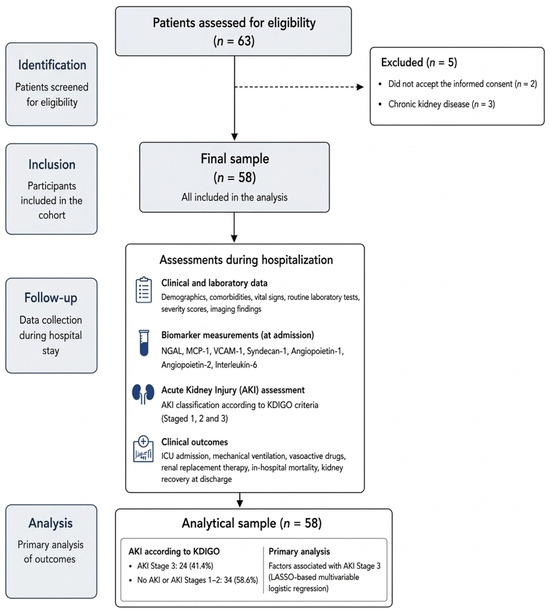
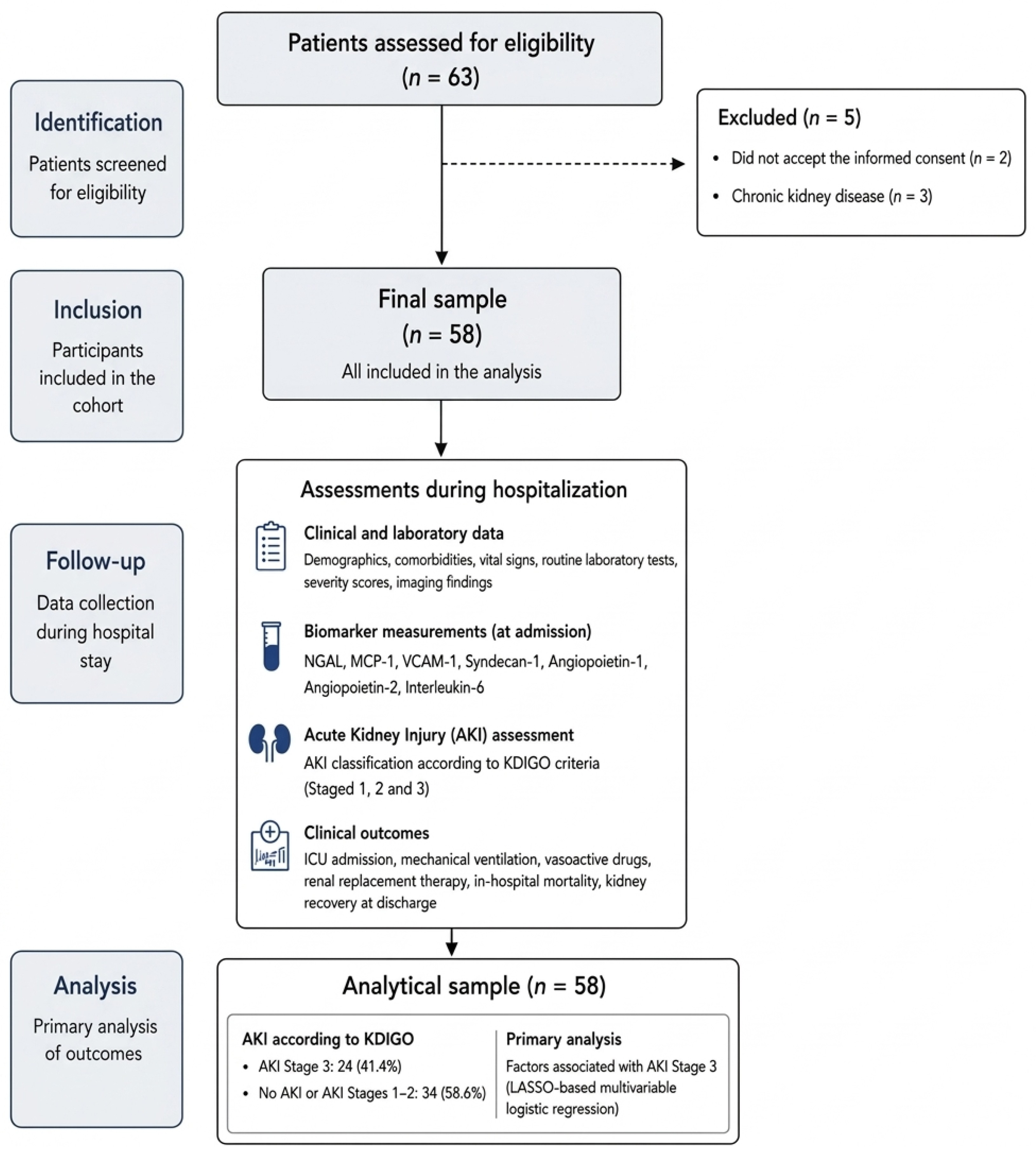
The study flow, including participant screening, exclusions, final cohort composition, biomarker assessment, and outcome analysis, is summarized in Figure 1.
Figure 1.
Strengthening the Reporting of Observational Studies in Epidemiology (STROBE) flow diagram of patient selection, inclusion, biomarker assessment, and analytical cohort. Patients living with HIV hospitalized with probable or proven disseminated histoplasmosis were prospectively screened between March 2023 and December 2024. The diagram summarizes participant eligibility, exclusions, final cohort composition, study assessments, and primary analytical groups according to stage 3 acute kidney injury. NGAL, neutrophil gelatinase-associated lipocalin; MCP-1, monocyte chemoattractant protein-1; VCAM-1, vascular cell adhesion molecule-1; AKI, acute kidney injury; KDIGO, Kidney Disease: Improving Global Outcomes; ICU, intensive care unit; LASSO, least absolute shrinkage and selection operator.
During the study period, 63 PLWH with DH were admitted to the study center. Two patients refused to provide informed consent, and three had a prior diagnosis of CKD and were excluded. Thus, 58 patients were included in the study (79.3% male; mean age, 40.4 ± 11.3 years).
Patients were classified according to the development of stage 3 AKI during hospitalization into stage 3 AKI (n = 24, 41.4%) and no/stages 1–2 AKI (n = 34) groups. Baseline sociodemographic, epidemiological, and clinical characteristics are summarized in Table 1.
Table 1.
Baseline characteristics of PLWH with DH according to stage 3 AKI status (n = 58).
Approximately half of the patients (53.4%) had a prior diagnosis of HIV before hospital admission. The timing of HIV diagnosis was not associated with the development of stage 3 AKI (p = 0.703). Residence in the state capital was associated with a lower likelihood of stage 3 AKI (RR = 0.53, 95% CI = 0.30–0.95; p = 0.033). No HCV coinfection was detected in the cohort.
The most common clinical manifestations in the overall cohort were fever (93.1%), weight loss > 10% of body weight (77.6%), fatigue (67.2%), dyspnea (65.5%), and hepatomegaly (44.8%). Hepatomegaly was associated with a higher risk of progression to stage 3 AKI (RR = 2.05; 95% CI = 1.08–3.91; p = 0.029). Patients with stage 3 AKI also had lower body mass index (BMI) values compared with those with no/stages 1–2 AKI (Table 2).
Table 2.
Clinical manifestations and BMI of PLWH with DH according to stage 3 AKI status (n = 58).
Visualization of H. capsulatum-like yeast in peripheral blood was associated with a higher risk of stage 3 AKI (RR = 2.72; 95% CI = 1.71–4.33; p < 0.001). No significant differences were observed between groups regarding other diagnostic methods for disseminated histoplasmosis.
Patients with stage 3 AKI had higher median HIV viral loads than those with no/stages 1–2 AKI, although the difference did not reach statistical significance. Significant differences were observed for C-reactive protein (CRP), aspartate aminotransferase (AST), direct bilirubin, alkaline phosphatase, and lactate dehydrogenase (LDH). Among the endothelial, inflammatory, and kidney injury biomarkers, only Ang-2 levels were significantly higher in the stage 3 AKI group (Table 3).
Table 3.
Laboratory findings and novel biomarkers in PLWH with DH according to stage 3 AKI status (n = 58).
Urinary NGAL and MCP-1 levels were available for 22 and 21 patients, respectively. VCAM-1 and syndecan-1 levels were measured in 32 patients, whereas Ang-1 and Ang-2 levels were available for 33 patients. Ang-2 levels showed no significant correlation with baseline serum creatinine (p = 0.783), admission serum creatinine (p = 0.791), or creatinine clearance (p = 0.655).
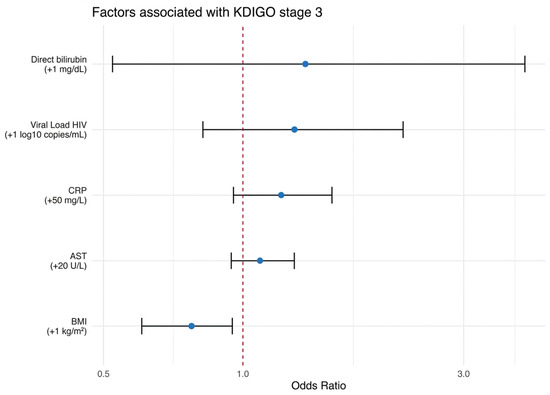
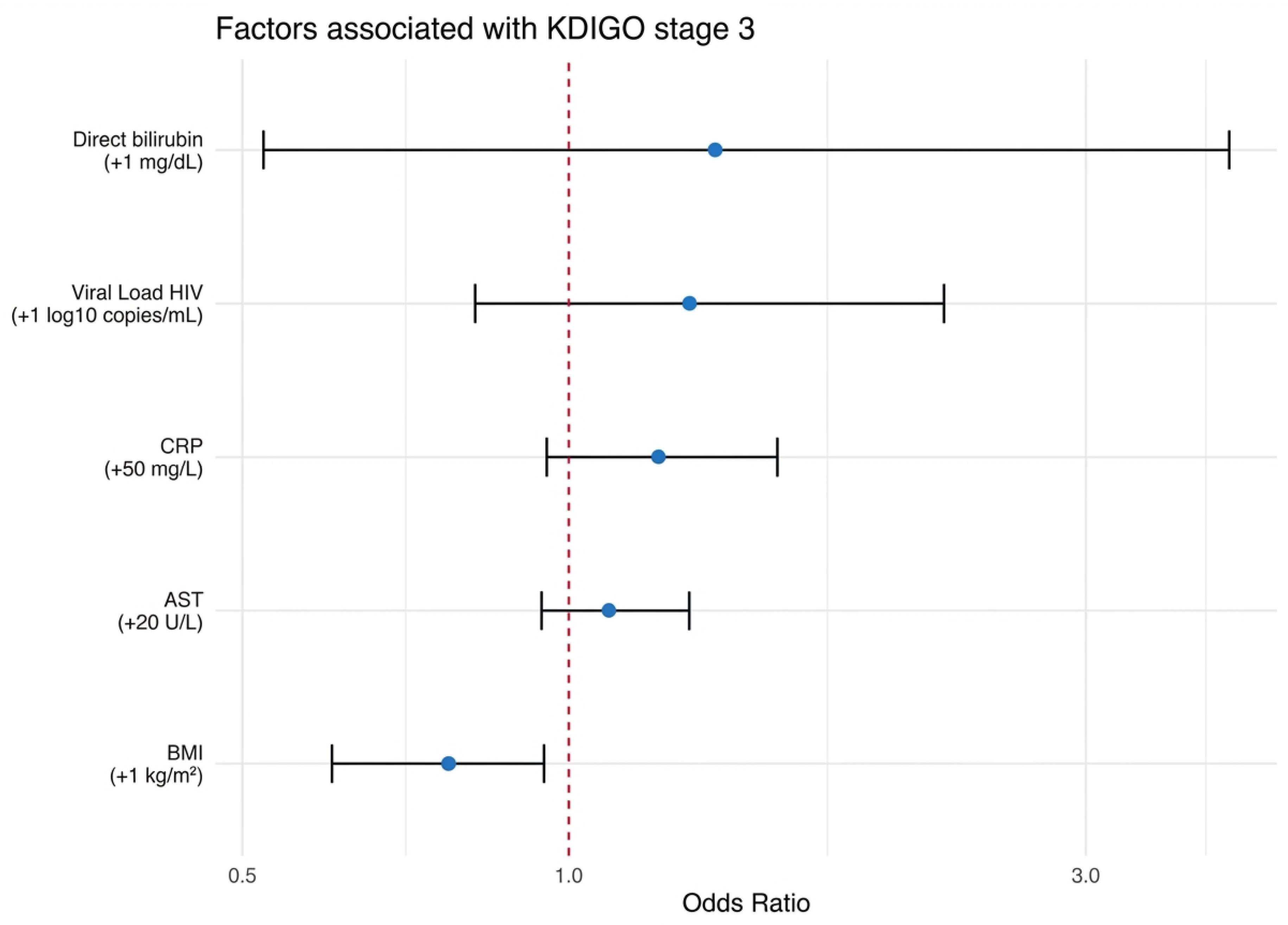
In the final multivariable logistic regression model, higher BMI was independently associated with a lower likelihood of stage 3 AKI (OR = 0.77; 95% CI = 0.60–0.95; p = 0.024). Higher HIV viral load, CRP, AST, and direct bilirubin levels were associated with increased odds of stage 3 AKI, although these associations did not reach statistical significance (Table 4 and Figure 2).
Table 4.
Final multivariable logistic regression model after LASSO variable selection for stage 3 AKI.
Figure 2.
Odds ratios from the final multivariable logistic regression model after LASSO variable selection. LASSO, least absolute shrinkage and selection operator; KDIGO, Kidney Disease: Improving Global Outcomes; CRP, C-reactive protein; AST, aspartate aminotransferase; BMI, body mass index. Blue dots represent point estimates (odds ratios); horizontal lines represent 95% confidence intervals; the red dashed line indicates an odds ratio of 1 (no association).
Patients with no/stages 1–2 AKI received AmB for a median of 14 days (13.0–15.0), compared with 15.0 days (7.8–17.3) in the stage 3 AKI group (p = 0.228). However, among patients who received AmB therapy for ≥7 cumulative days, treatment duration was significantly longer in the stage 3 AKI group (16.0 [14.0–18.0] vs. 14.0 [14.0–15.0] days; p = 0.032).
A numerically larger proportion of patients with stage 3 AKI received deoxycholate AmB at some point during treatment compared with those with no/stages 1–2 AKI (22/24, 91.7% vs. 25/34, 73.5%), although this difference did not reach statistical significance (p = 0.101). Cumulative days of deoxycholate exposure were also numerically higher among patients with stage 3 AKI (median 2.5 [2.0–4.0] vs. 1.5 [0.25–3.0] days), without reaching statistical significance (p = 0.115).
Other potentially nephrotoxic drugs administered during the induction phase of DH treatment were also evaluated. No significant differences were observed between groups regarding the use of ganciclovir, therapeutic sulfamethoxazole-trimethoprim, amikacin, or atazanavir. However, tenofovir disoproxil fumarate (TDF) use during induction therapy was significantly more frequent among patients with no/stages 1–2 AKI than among those with stage 3 AKI (67.7% vs. 20.8%; p < 0.001).
Among the 58 included patients, 14 (24.1%) died during hospitalization, 14 (24.1%) required RRT, 24 (41.4%) were admitted to the ICU, and 17 (29.3%) required mechanical ventilation and vasoactive drug support. Patients with stage 3 AKI had significantly worse clinical outcomes (Table 5).
Table 5.
Clinical outcomes of PLWH with DH according to stage 3 AKI status (n = 58).
Three patients who required RRT during hospitalization survived and were followed for 180 days after discharge. Two did not recover kidney function and were subsequently diagnosed with CKD, whereas one was lost to outpatient follow-up.
4. Discussion
In this prospective cohort of people living with HIV hospitalized with disseminated histoplasmosis, severe AKI (KDIGO stage 3) occurred in more than two-fifths of patients and was associated with a striking increase in adverse clinical outcomes, including intensive care unit admission, mechanical ventilation, renal replacement therapy, and in-hospital mortality. Patients who developed stage 3 AKI presented a clinical profile consistent with more severe systemic disease, characterized by lower body mass index, hepatomegaly, higher inflammatory and liver injury markers, and a greater burden of circulating Histoplasma capsulatum. Among the evaluated biomarkers, angiopoietin-2 was the only endothelial marker significantly associated with severe AKI, suggesting that endothelial activation may contribute to the pathophysiology of kidney injury in disseminated histoplasmosis. Although lower body mass index remained the only independent predictor in the multivariable model, the overall findings support the concept that severe AKI in this setting reflects the combined effects of advanced infection, systemic inflammation, and endothelial dysfunction rather than isolated nephrotoxicity.
The biological profile observed among patients who developed stage 3 AKI suggests that kidney injury in disseminated histoplasmosis is likely driven by systemic disease severity rather than by a single nephrotoxic insult. Patients with severe AKI exhibited lower body mass index, higher inflammatory markers, greater hepatic involvement, and increased fungal burden, indicating a phenotype of advanced disseminated infection accompanied by profound immune activation. In this context, endothelial dysfunction may represent a central pathophysiological mechanism linking systemic inflammation to renal injury. Endothelial activation increases vascular permeability, disrupts microcirculatory perfusion, promotes leukocyte adhesion, and amplifies inflammatory signaling, ultimately impairing renal oxygen delivery and predisposing to tubular injury. The finding that angiopoietin-2 was the only biomarker significantly associated with stage 3 AKI reinforces this hypothesis, as Ang-2 is a well-established mediator of endothelial activation and vascular destabilization during severe infectious and inflammatory conditions. Together, these findings support the concept that severe AKI in HIV-associated disseminated histoplasmosis reflects a complex interaction between uncontrolled fungal infection, host inflammatory response, endothelial injury, and microvascular dysfunction.
Novel biomarkers have been investigated in PLWH and histoplasmosis. Syndecan-1 levels are positively correlated with sCr and negatively correlated with eGFR in PLWH [16]. Nevertheless, the role of novel biomarkers in PLWH with DH remains unclear.
AKI is a common complication of PLWH and a significant cause of hospitalization and mortality [17]. It has been consistently associated with poor clinical outcomes [18,19]. In this population, inadequate viral suppression and concomitant infections have been associated with increased risk [17]. Although approximately half of the patients were newly diagnosed with HIV at hospital admission, an exploratory subgroup analysis found no association between the time since HIV diagnosis and the development of stage 3 AKI, suggesting that this heterogeneity is unlikely to have substantially confounded the observed associations.
The overall mortality rate in this study was 24.1%. Higher rates have been reported in a Brazilian systematic review (33.1%) [20] and in previous studies conducted in Ceará (30.2–42.0%) [21,22]. In contrast, mortality in the present cohort was comparable to that observed in another local study (20.8%) that implemented an active case-finding strategy to facilitate earlier diagnosis and treatment [23]. Notably, the present analysis excluded patients with CKD at admission. All patients who died developed AKI, and most (92.9%) progressed to stage 3 AKI. Furthermore, visualization of H. capsulatum-like yeasts in peripheral blood was more frequent among patients with stage 3 AKI, suggesting more severe disease.
Residence in the state capital appeared to be a protective factor. Almost 80.0% of the patients who did not develop stage 3 AKI lived in Fortaleza, which may have facilitated earlier access to specialized medical care. A BMI lower than 18.5 kg/m2 has previously been identified as a strong risk factor for AKI in PLWH without histoplasmosis, together with Black race [24]. In the present study, lower BMI was associated with the development of stage 3 AKI. Notably, lower BMI remained independently associated with stage 3 AKI in the final multivariable model, reinforcing the potential role of nutritional status and disease severity in the development of severe kidney injury.
A previous study conducted at the same institution reported a high incidence of AKI among hospitalized PLWH and identified elevated liver enzymes, hyperbilirubinemia, thrombocytopenia, and LDH as factors associated with AKI development [25]. In the present study, elevated AST, direct bilirubin, and LDH levels were also higher among patients with stage 3 AKI.
Another study from the same institution identified both AKI and DH as independent predictors of mortality in hospitalized PLWH [26]. Similarly, all patients who died in our cohort developed AKI, predominantly stage 3 AKI.
Ang-2 is a biomarker involved in vascular remodeling and activation, including inflammatory processes associated with infections that affect the vessel wall [27]. Elevated Ang-2 levels are associated with inflammation and pericyte loss in the vessel walls, contributing to reduced endothelial integrity and increased vascular permeability. HIV infection disrupts endothelial integrity and vascular homeostasis. Untreated individuals with HIV exhibit higher Ang-2 levels than individuals receiving antiretroviral therapy [28].
Ang-2 was significantly associated with stage 3 AKI in univariable analysis (p = 0.031; Table 3); however, because biomarker data were available for only a subset of the cohort (n = 33), Ang-2 could not be included in the LASSO-based multivariable model alongside variables measured in the full cohort (Table 4). Ang-2 should therefore not be interpreted as an independent predictor of stage 3 AKI in this study; rather, its univariable association likely reflects a broader pattern of endothelial activation accompanying disease severity, and the restricted sample size of the biomarker sub-cohort limited the ability to resolve its independent effect after adjustment.
Notably, Ang-2 levels did not correlate with baseline serum creatinine or creatinine clearance, suggesting that its elevation reflects endothelial activation independent of the degree of renal dysfunction captured by these conventional markers, rather than being a mere consequence of reduced renal clearance.
A multicenter Brazilian cohort including patients with histoplasmosis treated with AmB reported an AKI incidence of 59%, with 27% progressing to stage 3 AKI [29]. In the present study, the incidence of stage 3 AKI was even higher (41.4%), and longer AmB exposure was observed among patients with stage 3 AKI.
A multicenter study conducted in Guadeloupe and French Guiana including critically ill patients with histoplasmosis admitted to ICUs identified RRT, mechanical ventilation, and shock as predictors of mortality [30]. Similarly, patients with stage 3 AKI in our cohort more frequently required mechanical ventilation, vasoactive drugs, and ICU admission.
This study has some limitations. First, biomarker measurements were unavailable for the entire cohort, mainly due to insufficient sample volume rather than clinical selection; a complete-case approach was used, and the reduced sample size may have limited statistical power to detect associations for some biomarkers (e.g., NGAL, MCP-1, VCAM-1, syndecan-1), representing a possible type II error rather than a true absence of biological effect. Second, biomarkers were sampled before or within the first days of antifungal induction therapy rather than at a single standardized timepoint, which may have introduced variability related to prior fluid resuscitation or AmB exposure. Third, despite its prospective design, this was a single-center study with a relatively small sample size, highlighting the need for multicenter validation. Fourth, cumulative AmB exposure combined deoxycholate, lipid complex, and liposomal formulations despite their markedly different nephrotoxic profiles; because deoxycholate was preferentially initiated in more critically ill patients, the association between AmB exposure and stage 3 AKI may partly reflect confounding by indication rather than a direct nephrotoxic effect. Fifth, only four participants (6.9%) self-identified as Black, precluding a meaningful assessment of race as a risk factor for stage 3 AKI in this cohort. Finally, the small number of patients requiring RRT who survived hospitalization limited assessment of long-term renal outcomes.
5. Conclusions
Among PLWH with disseminated histoplasmosis, stage 3 AKI was associated with markers of systemic inflammation and disease severity, including higher CRP, AST, direct bilirubin, alkaline phosphatase, and LDH levels, as well as lower BMI and hepatomegaly. Elevated Ang-2 levels were also associated with stage 3 AKI, suggesting a potential role for endothelial dysfunction in the pathophysiology of severe kidney injury in this population.
Stage 3 AKI was associated with worse clinical outcomes, including ICU admission, mechanical ventilation, vasoactive drug use, RRT requirement, and high in-hospital mortality. These findings reinforce the importance of early recognition of both disseminated histoplasmosis and AKI in PLWH and support further investigation of novel biomarkers for risk stratification and prognostic assessment.
Author Contributions
Conceptualization, M.A.d.L.M. and E.D.F.D.; Methodology, M.A.d.L.M., A.M.C.M., G.C.M. and E.D.F.D.; Validation, M.A.d.L.M., G.C.M. and E.D.F.D.; Formal analysis, G.C.M. and E.D.F.D.; Investigation, M.A.d.L.M., M.M.S., Z.H.d.A.A. and J.R.L.d.M.; Resources, A.M.C.M.; Data curation, M.A.d.L.M., M.M.S. and G.C.M.; Writing—original draft, M.A.d.L.M.; Writing—review and editing, M.A.d.L.M., G.B.d.S.J., E.H.S.d.B., C.M.C.d.O., L.S.D., T.d.M.J.S.L., G.C.M. and E.D.F.D.; Visualization, M.A.d.L.M. and E.D.F.D.; Supervision, G.B.d.S.J., A.M.C.M., G.C.M. and E.D.F.D.; Project administration, G.C.M. and E.D.F.D. All authors have read and agreed to the published version of the manuscript.
Funding
This research received no external funding. The APC was funded by the University of Fortaleza (UNIFOR). The funding source had no role in the study design, data collection, data analysis, interpretation of the results, manuscript preparation, or decision to submit the manuscript for publication.
Institutional Review Board Statement
The study was conducted in accordance with the Declaration of Helsinki, and the protocol was approved by the Ethics Committee of São José Hospital of Infectious Diseases (project identification code: 60380022.0.0000.5044; date of approval: 17 March 2023).
Informed Consent Statement
Informed consent was obtained from all subjects involved in the study. Patient consent was waived for participants who died prior to signing, discontinued treatment, or relocated, as approved by the Institutional Ethics Committee.
Data Availability Statement
The data presented in this study are available on request from the corresponding author due to ethical and privacy restrictions regarding patient data.
Acknowledgments
The authors would like to thank the physicians, residents, medical students, nurses, and laboratory staff for their support and contributions to this study. The authors also acknowledge the Federal University of Ceará (UFC), the Coordination for the Improvement of Higher Education Personnel (CAPES), and the National Council for Scientific and Technological Development (CNPq) for institutional support. During the preparation of this work, the authors used Claude Sonnet 5 (Anthropic, San Francisco, CA, USA) to assist with language editing and structuring the manuscript text, and NotebookLM (Google, Mountain View, CA, USA) to generate the graphical abstract. The authors reviewed and edited all output and take full responsibility for the content of this publication.
Conflicts of Interest
The authors declare no conflicts of interest.
References
- Nadkarni, G.N.; Patel, A.A.; Yacoub, R.; Benjo, A.M.; Konstantinidis, I.; Annapureddy, N.; Agarwal, S.K.; Simoes, P.K.; Kamat, S.; Menon, M.C.; et al. The burden of dialysis-requiring acute kidney injury among hospitalized adults with HIV infection: A nationwide inpatient sample analysis. AIDS 2015, 29, 1061–1066. [Google Scholar] [PubMed]
- Muiru, A.N.; Madden, E.; Chilingirian, A.; Rubinsky, A.D.; Scherzer, R.; Moore, R.; Villalobos, C.P.C.; Trujillo, J.M.M.; Parikh, C.R.; Hsu, C.; et al. The incidence of and risk factors for hospitalized acute kidney injury among people living with HIV on antiretroviral treatment. HIV Med. 2022, 23, 611–619. [Google Scholar] [CrossRef] [Scilit] [PubMed]
- Franceschini, N.; Napravnik, S.; Eron, J.J.; Szczech, L.A.; Finn, W.F. Incidence and etiology of acute renal failure among ambulatory HIV-infected patients. Kidney Int. 2005, 67, 1526–1531. [Google Scholar] [CrossRef] [Scilit] [PubMed]
- Lopes, J.A.; Melo, M.J.; Viegas, A.; Raimundo, M.; Câmara, I.; Antunes, F.; da Costa, A.G. Acute kidney injury in hospitalized HIV-infected patients: A cohort analysis. Nephrol. Dial. Transplant. 2011, 26, 3888–3894. [Google Scholar] [CrossRef] [Scilit] [PubMed][Green Version]
- Gameiro, J.; Agapito Fonseca, J.; Jorge, S.; Lopes, J. Acute kidney injury in HIV-infected patients: A critical review. HIV Med. 2019, 20, 77–87. [Google Scholar] [CrossRef] [Scilit] [PubMed]
- Wheat, L.J. Endemic mycoses in AIDS: A clinical review. Clin. Microbiol. Rev. 1995, 8, 146–159. [Google Scholar] [CrossRef] [PubMed]
- Wheat, L.J.; Connolly-Stringfield, P.A.; Baker, R.L.; Curfman, M.F.; Eads, M.E.; Israel, K.S.; Norris, S.A.; Webb, D.H.; Zeckel, M.L. Disseminated histoplasmosis in the acquired immune deficiency syndrome: Clinical findings, diagnosis and treatment, and review of the literature. Medicine 1990, 69, 361–374. [Google Scholar] [PubMed]
- Adams, A.L.; Cook, W.J. Granulomatous Interstitial Nephritis Secondary to Histoplasmosis. Am. J. Kidney Dis. 2007, 50, 681–685. [Google Scholar] [CrossRef] [Scilit] [PubMed]
- Ahuja, T.S.; Remmers, A.; Rajaraman, S.; Funtanilla, M. Acute renal failure in a patient with AIDS: Histoplasmosis-induced granulomatous interstitial nephritis. Am. J. Kidney Dis. 1998, 32, e3.1–e3.4. [Google Scholar] [CrossRef] [Scilit] [PubMed]
- Diana, N.E.; Naicker, S. The changing landscape of HIV-associated kidney disease. Nat. Rev. Nephrol. 2024, 20, 330–346. [Google Scholar] [CrossRef] [Scilit] [PubMed]
- Fiseha, T.; Gebreweld, A. Urinary Markers of Tubular Injury in HIV-Infected Patients. Biochem. Res. Int. 2016, 2016, 1501785. [Google Scholar] [CrossRef] [Scilit] [PubMed]
- Donnelly, J.P.; Chen, S.C.; Kauffman, C.A.; Steinbach, W.J.; Baddley, J.W.; Verweij, P.E.; Clancy, C.J.; Wingard, J.R.; Lockhart, S.R.; Groll, A.H.; et al. Revision and Update of the Consensus Definitions of Invasive Fungal Disease From the European Organization for Research and Treatment of Cancer and the Mycoses Study Group Education and Research Consortium. Clin. Infect. Dis. 2020, 71, 1367–1376. [Google Scholar] [CrossRef] [Scilit] [PubMed]
- Kellum, J.A.; Lameire, N.; Aspelin, P.; Barsoum, R.S.; Burdmann, E.A.; Goldstein, S.L.; Herzog, C.A.; Joannidis, M.; Kribben, A.; Levey, A.S.; et al. Kidney Disease: Improving Global Outcomes (KDIGO) Acute Kidney Injury Work Group. KDIGO clinical practice guideline for acute kidney injury. Kidney Int. Suppl. 2012, 2, 1–138. [Google Scholar]
- Stevens, P.E.; Ahmed, S.B.; Carrero, J.J.; Foster, B.; Francis, A.; Hall, R.K.; Herrington, W.G.; Hill, G.; Inker, L.A.; Kazancıoğlu, R.; et al. KDIGO 2024 Clinical Practice Guideline for the Evaluation and Management of Chronic Kidney Disease. Kidney Int. 2024, 105, S117–S314. [Google Scholar] [CrossRef] [Scilit] [PubMed]
- Inker, L.A.; Eneanya, N.D.; Coresh, J.; Tighiouart, H.; Wang, D.; Sang, Y.; Crews, D.C.; Doria, A.; Estrella, M.M.; Froissart, M.; et al. New Creatinine- and Cystatin C-Based Equations to Estimate GFR without Race. N. Engl. J. Med. 2021, 385, 1737–1749. [Google Scholar] [CrossRef] [Scilit] [PubMed]
- Meneses, G.C.; Cavalcante, M.G.; Silva Junior, G.B.; Martins, A.M.C.; Neto, R.d.J.P.; Libório, A.B.; Daher, E.D.F. Endothelial Glycocalyx Damage and Renal Dysfunction in HIV Patients Receiving Combined Antiretroviral Therapy. AIDS Res. Hum. Retrovir. 2017, 33, 703–710. [Google Scholar] [CrossRef] [Scilit] [PubMed]
- Azagew, A.W.; Abate, H.K.; Ferede, Y.M.; Mekonnen, C.K. Acute kidney injury and its predictors among HIV-positive patients in Africa: Systematic review and meta-analysis. PLoS ONE 2024, 19, e0298302. [Google Scholar] [CrossRef]
- Couppié, P.; Sobesky, M.; Aznar, C.; Bichat, S.; Clyti, E.; Bissuel, F.; El Guedj, M.; Alvarez, F.; Demar, M.; Louvel, D.; et al. Histoplasmosis and acquired immunodeficiency syndrome: A study of prognostic factors. Clin. Infect. Dis. 2004, 38, 134–138. [Google Scholar] [CrossRef] [Scilit] [PubMed]
- Wheat, L.J.; Chetchotisakd, P.; Williams, B.; Connolly, P.; Shutt, K.; Hajjeh, R. Factors associated with severe manifestations of histoplasmosis in AIDS. Clin. Infect. Dis. 2000, 30, 877–881. [Google Scholar] [CrossRef] [Scilit] [PubMed]
- Almeida, M.d.A.; Almeida-Silva, F.; Guimarães, A.J.; Almeida-Paes, R.; Zancopé-Oliveira, R.M. The occurrence of histoplasmosis in Brazil: A systematic review. Int. J. Infect. Dis. 2019, 86, 147–156. [Google Scholar] [CrossRef] [Scilit] [PubMed]
- Daher, E.F.; Silva, G.B.; Barros, F.A.S.; Takeda, C.F.V.; Mota, R.M.S.; Ferreira, M.T.; Oliveira, S.A.; Martins, J.C.; Araújo, S.M.; Gutiérrez-Adrianzén, O.A. Clinical and laboratory features of disseminated histoplasmosis in HIV patients from Brazil. Trop. Med. Int. Health 2007, 12, 1108–1115. [Google Scholar] [CrossRef] [Scilit] [PubMed]
- Damasceno, L.S.; Ramos, A.N.; Alencar, C.H.; Gonçalves, M.V.F.; de Mesquita, J.R.L.; Soares, A.T.D.; Coutinho, A.G.N.; Dantas, C.C.; Leitão, T.D.M.J.S. Disseminated histoplasmosis in HIV-infected patients: Determinants of relapse and mortality in a north-eastern area of Brazil. Mycoses 2014, 57, 406–413. [Google Scholar] [CrossRef] [Scilit] [PubMed]
- Ramos, I.C.; Soares, Y.C.; Damasceno, L.S.; Libório, M.P.; Farias, L.A.B.G.; Heukelbach, J.; de Alencar, C.H.M.; Leitão, T.D.M.J.S. Predictive factors for disseminated histoplasmosis in AIDS patients with fever admitted to a reference hospital in Brazil. Rev. Soc. Bras. Med. Trop. 2018, 51, 479–484. [Google Scholar] [CrossRef] [Scilit] [PubMed]
- Li, Y.; Shlipak, M.G.; Grunfeld, C.; Choi, A.I. Incidence and risk factors for acute kidney injury in HIV infection. Am. J. Nephrol. 2012, 35, 327–334. [Google Scholar] [CrossRef] [Scilit] [PubMed]
- Silva Junior, G.B.; Libório, A.B.; Mota, R.M.S.; Abreu, K.; Silva, A.; Araújo, S.; Daher, E. Acute kidney injury in AIDS: Frequency, RIFLE classification and outcome. Braz. J. Med. Biol. Res. 2010, 43, 1102–1108. [Google Scholar] [CrossRef] [Scilit] [PubMed][Green Version]
- Silva Junior, G.B.D.; Parente Filho, S.L.A.; Soares, D.D.S.; Alencar, R.d.N.d.; Peixoto, T.T.T.; Nogueira, I.S.; Filho, A.M.P.d.O.; Menezes, F.H.; Cavalcante, M.G.; Neto, R.d.J.P.; et al. Acute kidney injury and other factors associated with mortality in HIV-infected patients. Rev. Assoc. Med. Bras. 2018, 64, 509–517. [Google Scholar] [CrossRef] [Scilit] [PubMed]
- Augustin, H.G.; Koh, G.Y.; Thurston, G.; Alitalo, K. Control of vascular morphogenesis and homeostasis through the angiopoietin-Tie system. Nat. Rev. Mol. Cell Biol. 2009, 10, 165–177. [Google Scholar] [CrossRef] [Scilit] [PubMed]
- Thakkar, A.B.; Ma, Y.; Dela Cruz, M.; Wu, Y.; Arechiga, V.; Swaminathan, S.; Ganz, P.; Wu, A.H.B.; Scherzer, R.; Deeks, S.; et al. Effect of HIV-1 Infection on Angiopoietin 1 and 2 Levels and Measures of Microvascular and Macrovascular Endothelial Dysfunction. J. Am. Heart Assoc. 2021, 10, e021397. [Google Scholar] [CrossRef] [Scilit] [PubMed]
- Sekiguchi, W.K.; De Oliveira, V.F.; Cavassin, F.B.; Taborda, M.; Magri, A.S.G.K.; da Cruz, I.C.L.V.; Vidal, J.E.; Falci, D.R.; Godoy, C.S.d.M.; Soares, R.d.B.A.; et al. A multicentre study of amphotericin B treatment for histoplasmosis: Assessing mortality rates and adverse events. J. Antimicrob. Chemother. 2024, 79, 2598–2606. [Google Scholar] [CrossRef] [Scilit] [PubMed]
- Camous, L.; Surel, A.; Kallel, H.; Nicolas, M.; Martino, F.; Valette, M.; Demoule, A.; Pommier, J.-D. Factors related to mortality in critically ill histoplasmosis: A multicenter retrospective study in Guadeloupe and French Guyana. Ann. Intensive Care 2023, 13, 30. [Google Scholar] [CrossRef] [Scilit] [PubMed]

Disclaimer/Publisher’s Note: The statements, opinions and data contained in all publications are solely those of the individual author(s) and contributor(s) and not of MDPI and/or the editor(s). MDPI and/or the editor(s) disclaim responsibility for any injury to people or property resulting from any ideas, methods, instructions or products referred to in the content. |
© 2026 by the authors. Licensee MDPI, Basel, Switzerland. This article is an open access article distributed under the terms and conditions of the Creative Commons Attribution (CC BY) license.