


Abstract
Background/Objectives: Hepatocellular carcinoma (HCC) is the sixth most diagnosed cancer worldwide and a leading cause of cancer-related mortality. The majority of cases arise in the setting of chronic liver disease, where immune checkpoint inhibitors (ICIs) have emerged as a cornerstone of systemic therapy for advanced disease. However, durable clinical benefit remains limited to a minority of patients, and reproducible biomarkers of ICI response are lacking. The gut–liver axis—encompassing bidirectional exchange of microbial products, metabolites, bile acids, and immune signals—has emerged as a biologically plausible determinant of both hepatocarcinogenesis and immunotherapy response. This narrative review synthesises current evidence on the role of the gut–liver axis in HCC and ICI response and proposes a unifying conceptual framework to resolve discrepancies in the existing literature. Methods: A narrative review was conducted through systematic searches of PubMed/MEDLINE, Embase, and Web of Science. Studies were selected based on relevance to the biological mechanisms, clinical associations, and experimental models underpinning gut–liver–immune interactions in HCC, with particular emphasis on studies providing mechanistic insight, addressing immunotherapy outcomes, or highlighting temporal and context-dependent effects. Results: Observational studies consistently associate higher microbial diversity and enrichment of homeostasis-promoting taxa—including Akkermansia, Bifidobacterium, and short-chain fatty acid-producing Ruminococcaceae—with ICI responsiveness in HCC. Functional microbial outputs, particularly short-chain fatty acids and secondary bile acids, exert mechanistically grounded effects on hepatic immune tone and T cell activity that are biologically proximate to ICI effector pathways. Therapeutic modulation of the gut–liver axis through probiotics, dietary interventions, faecal microbiota transplantation, and antibiotic exposure demonstrates context-dependent effects on immune activation and ICI outcomes, with timing and disease severity emerging as critical determinants. The limited reproducibility of microbiome-immunotherapy associations across cohorts is attributable primarily to the dynamic and treatment-sensitive nature of the gut–liver axis rather than a fundamental lack of mechanistic coupling. Conclusions: The gut–liver axis in HCC is best understood as a dynamic, treatment-sensitive system rather than a static baseline trait. This reframing shifts emphasis from single-timepoint taxonomic signatures toward functional and longitudinal readouts and provides a coherent rationale for the heterogeneity observed across existing studies. Longitudinal clinical studies incorporating mechanistic endpoints and functional biomarker assessment are needed to translate this framework into clinically actionable strategies for patient stratification and microbiota-targeted intervention in HCC immunotherapy.
1. Introduction
Hepatocellular carcinoma (HCC) is the sixth most commonly diagnosed cancer and the third leading cause of cancer-related mortality worldwide [1]. The majority of cases arise in the context of chronic liver disease driven by viral hepatitis, alcohol-related liver disease, or metabolic dysfunction-associated steatotic liver disease (MASLD) [2]. Progressive fibrosis and cirrhosis profoundly remodel the hepatic immune microenvironment, vascular architecture, and stromal compartment, creating a permissive niche for malignant transformation and tumour progression [3]. When feasible, potentially curative strategies—including surgical resection and liver transplantation, often combined with loco-regional therapies—remain the cornerstone of HCC management [4]. However, many patients present with advanced-stage disease or experience progression beyond curative thresholds, at which point systemic therapy becomes the principal treatment option [5].
Over the past decade, systemic therapy for advanced HCC has evolved to include multikinase inhibitors, anti-angiogenic agents, and immune checkpoint inhibitors (ICIs) targeting PD-1/PD-L1 and CTLA-4, either as monotherapy or in combination regimens [6]. Despite these advances, clinical benefit remains limited to a subset of patients. Objective response rates to ICIs are modest, primary resistance is common, and a minority of patients develop hyperprogressive disease [7]. Tumour-intrinsic biomarkers such as tumour mutational burden, microsatellite instability–high status, and deficient mismatch repair have limited prevalence and predictive value in HCC, leaving a substantial unmet need for alternative biomarkers that capture host- and microenvironment-derived determinants of treatment response [8].
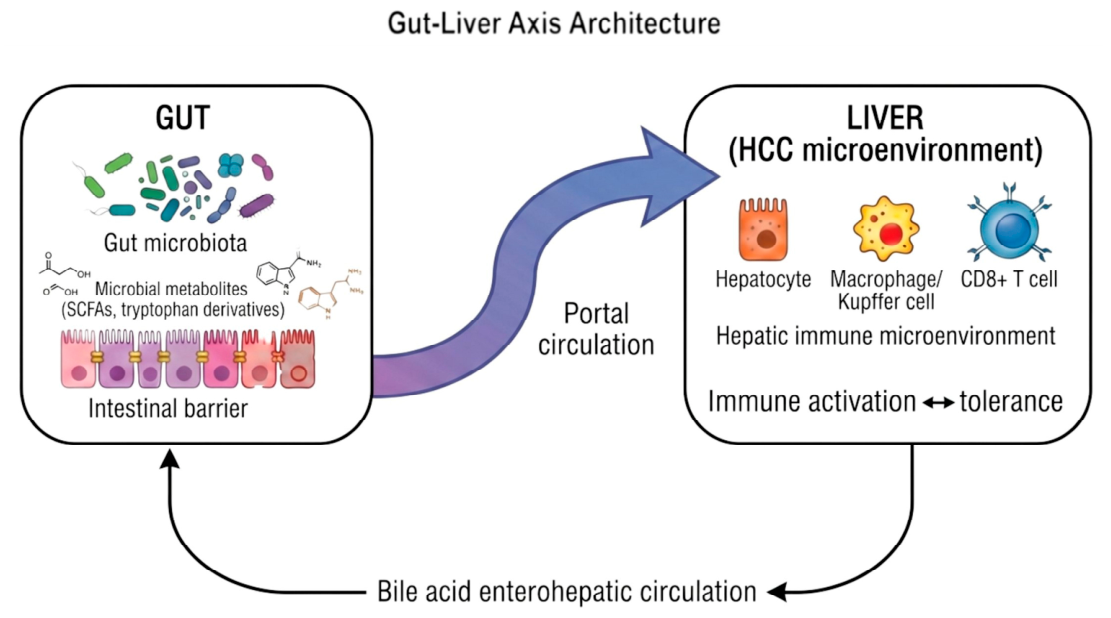
In this setting, increasing attention has turned to the gut–liver axis as a potential modulator of both hepatocarcinogenesis and therapeutic efficacy [9]. The gut–liver axis encompasses the bidirectional exchange of microbial products, metabolites, bile acids, and immune signals between the intestine and liver via the portal circulation [10]. Chronic liver disease is characterised by intestinal dysbiosis, impaired epithelial barrier integrity, and altered bile-acid signalling [11], all of which promote translocation of pathogen- and damage-associated molecular patterns to the liver [12]. These signals reprogram hepatic innate and adaptive immune responses, shaping inflammation, immune tolerance, and tumour surveillance [13] (Figure 1). Collectively, these processes provide a biologically plausible link between intestinal homeostasis, liver cancer development, and heterogeneous responses to systemic therapies [14].
Figure 1.
The gut–liver axis in HCC immunotherapy. Schematic representation of the bidirectional interactions between the intestinal compartment and the liver, encompassing microbial metabolite signalling (short-chain fatty acids, bile acids), epithelial barrier integrity, and hepatic immune activation in the context of immune checkpoint inhibitor therapy. The intestinal compartment (left) depicts the gut microbiota, microbial metabolites including short-chain fatty acids (SCFAs) and tryptophan derivatives, and the intestinal epithelial barrier. Microbial products and metabolites are delivered to the liver via the portal circulation (central arrow). The hepatic compartment (right) depicts the HCC microenvironment, including hepatocytes, Kupffer cells/macrophages, and CD8+ T cells, where these signals shape the balance between immune activation and immune tolerance during ICI therapy. The lower arrow represents bile acid enterohepatic circulation, through which microbially modified secondary bile acids return to the gut and contribute to bidirectional gut–liver crosstalk (Created in BioRender. Nero, C. (2026) https://BioRender.com/g3b7nzw (accessed on 13 May 2026)).
Accumulating clinical and experimental evidence suggests that features of the gut–liver axis—including microbiota composition, microbial metabolites, and markers of barrier dysfunction—are associated with differential sensitivity and resistance to ICIs in HCC [15,16]. Differences in study design, disease stage, background liver function, and timing of sample collection likely account for much of the variability reported across cohorts, rather than true biological inconsistency [17]. However, reported microbial signatures vary substantially across studies, and reproducibility has been limited. Limited reproducibility should not be interpreted as evidence against biological relevance, but rather as a consequence of methodological, temporal, and clinical heterogeneity inherent to advanced liver disease populations [18]. An important explanation for this variability is that the gut–liver axis in advanced liver disease is not a fixed baseline characteristic, but a system that evolves over time in response to disease state and therapy [19]. Antibiotics, diet, portal hypertension, cirrhosis severity, and systemic therapies themselves can rapidly perturb microbial ecology, metabolic output, and intestinal permeability, complicating the interpretation of static microbiome assessments [20].
In this narrative review, we synthesise current evidence linking the gut–liver axis to HCC pathogenesis and response to systemic therapy, with particular emphasis on immune checkpoint inhibition. We focus on the interconnected roles of the intestinal microbiota, epithelial barrier function, and bile-acid signalling, and we critically appraise the strengths and limitations of existing biomarker strategies. By framing the gut–liver axis as a dynamic, treatment-modulated system, we aim to reconcile discrepancies in the literature and highlight experimental and clinical approaches—including emerging human organoid and microphysiological models—capable of capturing the temporal complexity of gut–liver–immune interactions in HCC.
2. Methods
2.1. Review Design and Scope
This article was conducted as a narrative review with the aim of synthesising and critically appraising current evidence on the role of the gut–liver axis in hepatocellular carcinoma (HCC) pathogenesis and response to immune checkpoint inhibitor (ICI)-based therapy. A narrative approach was selected to allow conceptual integration across heterogeneous study designs, including basic science, translational research, and clinical studies, and to support the development of a unifying framework that accounts for the dynamic and context-dependent nature of gut–liver–immune interactions in HCC.
2.2. Literature Identification and Sources
The literature search focused on peer-reviewed articles published in English. Key databases included PubMed/MEDLINE, Embase, and Web of Science. Searches were performed using combinations of controlled vocabulary terms and free-text keywords related to hepatocellular carcinoma, gut microbiota, gut–liver axis, intestinal barrier function, bile acid signalling, immune checkpoint inhibitors, immunotherapy response, probiotics, faecal microbiota transplantation, antibiotics, and organoid or microphysiological models. Reference lists of relevant reviews and primary articles were also screened to identify additional studies of interest.
2.3. Study Selection and Thematic Synthesis
Given the narrative nature of the review, formal inclusion and exclusion criteria were not applied. Instead, studies were selected based on relevance to the biological mechanisms, clinical associations, or experimental models underpinning gut–liver–immune interactions in HCC. Particular emphasis was placed on studies that provided mechanistic insight, addressed immunotherapy outcomes, or highlighted temporal and context-dependent effects. Evidence from human observational studies, interventional trials, and advanced in vitro systems was integrated to enable cross-disciplinary synthesis.
3. Gut–Liver Axis as a Determinant of Immunotherapy Response in Hepatocellular Carcinoma
3.1. Microbiota-Associated Patterns of Immune Checkpoint Inhibitor Response
Despite recent advances, the efficacy of immune checkpoint inhibitors (ICIs) in hepatocellular carcinoma (HCC) remains limited, with only a subset of patients achieving durable clinical benefit [21]. Both primary and acquired resistance are common, underscoring the need to identify host- and microenvironment-derived factors that modulate immunotherapy response [22]. In this context, growing evidence implicates the gut microbiota as a key determinant of ICI efficacy in HCC [23].
Multiple observational studies have reported associations between baseline gut microbiota composition and response to ICIs [24]. Patients who respond to immunotherapy tend to exhibit higher microbial diversity and enrichment of taxa commonly associated with intestinal homeostasis and anti-inflammatory signalling, including Akkermansia, Bifidobacterium, members of the Ruminococcaceae family, and Faecalibacterium [15]. These microbial profiles are frequently accompanied by increased production of short-chain fatty acids (SCFAs), which have been linked to enhanced antitumour immune activity [25]. In contrast, non-responders often display reduced microbial diversity, expansion of pathobionts such as Enterobacteriaceae and Bacteroides, and markers of intestinal inflammation, including elevated faecal calprotectin [16].
While these findings support a biological link between the gut microbiota and immunotherapy response, the specific taxa associated with benefit or resistance vary substantially across cohorts. Differences in disease aetiology, cirrhosis severity, geographic location, diet, antibiotic exposure, and treatment regimens likely contribute to this variability. For example, MASLD-related HCC has been associated with enrichment of pro-inflammatory taxa including Bacteroides ovatus, Klebsiella oxytoca, and Enterococcus faecium, together with reduced faecal short-chain fatty acid concentrations, whereas viral-related HCC tends to retain a higher abundance of commensal taxa [23]. In the MASLD/NAFLD-HCC setting, an expansion of Bacteroides and Ruminococcus alongside depletion of Akkermansia and Bifidobacterium has been reported in association with hepatocarcinogenesis [9,25]. Treatment- and care-related exposures further perturb these baseline profiles: broad-spectrum antibiotic use during ICI therapy is associated with reduced abundance of Akkermansia and butyrate-producing Ruminococcaceae together with relative expansion of Enterococcus and Enterobacteriaceae [16,26,27]. Importantly, most studies rely on single pre-treatment stool samples, implicitly assuming stability of the microbiota in patients with advanced liver disease. The lack of reproducible taxonomic signatures across studies suggests that static baseline composition alone may be insufficient to capture the biologically relevant features of the gut–liver axis that influence ICI response in HCC.
3.2. Functional Mediators: Microbial Metabolites and Immune Modulation
Beyond microbial taxonomy, functional outputs of the gut microbiota provide mechanistic insight into how intestinal dysbiosis influences antitumour immunity. Microbial metabolites, particularly SCFAs such as acetate, propionate, and butyrate, play a central role in shaping immune responses within both the gut and the liver [28]. SCFAs have been shown to enhance the effector function of cytotoxic CD8+ T cells, modulate antigen-presenting cell activity, and reduce the accumulation of immunosuppressive populations such as regulatory T cells and myeloid-derived suppressor cells [29].
In the context of HCC, these effects may be especially relevant given the baseline immune dysfunction associated with cirrhosis. Alterations in SCFA production can influence hepatic immune tone by modulating cytokine secretion, epigenetic regulation of immune cells, and metabolic fitness within the tumour microenvironment [30]. Importantly, SCFA levels are highly sensitive to dietary intake, antibiotic exposure [20], and disease-related changes in intestinal permeability [10], reinforcing the notion that functional microbial signals fluctuate over time rather than remaining fixed traits.
Mechanistically, SCFAs generated by anaerobic fermentation of dietary fibre in the colonic lumen reach the liver in physiologically meaningful concentrations via the portal circulation. Butyrate is largely consumed locally by colonocytes as their primary energy source, whereas acetate and propionate are absorbed across the colonic epithelium and delivered to the liver, where they reach portal concentrations substantially higher than those measured in the systemic circulation. Within the hepatic compartment, SCFAs engage G protein-coupled receptors GPR41 and GPR43 expressed on Kupffer cells, hepatic stellate cells, and infiltrating lymphocytes, modulating cytokine production and immune cell recruitment. In parallel, butyrate that does reach the liver acts as a histone deacetylase inhibitor, influencing the epigenetic programming of intrahepatic CD8+ T cells, regulatory T cells, and innate lymphoid cells, and has been shown to enhance hepatic natural killer cell infiltration through CXCL11-dependent signalling [28,31]. Disruption of intestinal barrier integrity in cirrhosis can further amplify portal delivery of microbial products, including lipopolysaccharide, that co-modulate hepatic immune tone alongside SCFA signalling.
Bile acid metabolism represents an additional functional interface between the gut microbiota and host immunity [32]. Microbial modification of primary bile acids generates secondary bile acids that signal through receptors such as farnesoid X receptor and Takeda G protein-coupled receptor 5, influencing immune cell recruitment, macrophage polarisation, and inflammatory signalling pathways [33]. Dysregulation of bile acid profiles in chronic liver disease may therefore alter immune responsiveness to ICIs, further contributing to inter-individual variability in treatment outcomes [34]. Together, these observations highlight that dynamic, metabolite-driven signalling—rather than microbial composition per se—may represent a more proximal regulator of immunotherapy efficacy.
3.3. From Associations to Biomarkers: Opportunities and Translational Limitations
Building on these associations, several studies have proposed gut microbiota signatures, microbial metabolite levels, and markers of intestinal barrier integrity as predictive biomarkers for ICI response in HCC [23]. Candidate biomarkers include SCFA concentrations, bile acid profiles, faecal calprotectin, and zonulin, as well as composite microbiome-based classifiers [35]. More recently, machine learning approaches integrating microbiome, metabolomic, and clinical data have shown promise in stratifying patients likely to benefit from immunotherapy [36].
However, translation of these biomarkers into clinical practice has been limited. Inter-individual variability, small cohort sizes, and heterogeneity in sequencing and analytical pipelines complicate validation [37]. Moreover, confounding factors such as antibiotic use, diet, liver disease severity, and concomitant medications exert strong, time-dependent effects on both microbial composition and immune function [38]. As a result, biomarkers derived from single baseline assessments often show reduced performance when applied across independent cohorts [39].
These limitations underscore a central challenge in the field: biomarkers that do not account for the dynamic nature of the gut–liver axis may fail to capture the evolving host–tumour–immune interactions that determine immunotherapy response. Longitudinal sampling strategies and functionally integrated readouts may therefore be required to improve robustness and clinical relevance. Recognising these constraints provides a rationale for both cautious interpretation of existing biomarkers and the development of experimental platforms capable of interrogating gut–liver–immune interactions under controlled, time-resolved conditions.
4. Therapeutic Modulation of the Gut–Liver Axis: A Dynamic Perspective
4.1. Rationale for Targeting the Gut–Liver Axis in HCC
The growing recognition of the gut–liver axis as a determinant of hepatocellular carcinoma (HCC) biology and immunotherapy response has prompted substantial interest in therapeutic strategies aimed at modulating this system [40]. Approaches including probiotics, prebiotics, dietary interventions, antibiotics, bile-acid-targeting agents [40], and faecal microbiota transplantation (FMT) have been explored in both preclinical models and early-phase clinical studies [41]. Collectively, these interventions seek to restore microbial homeostasis, reinforce intestinal barrier integrity, and recalibrate hepatic immune signalling in ways that favour antitumour immunity [42].
However, clinical translation has been inconsistent. While some studies report improved immune activation or enhanced sensitivity to immune checkpoint inhibitors (ICIs), others demonstrate neutral or even deleterious effects [43]. Rather than reflecting a lack of biological relevance, these mixed outcomes likely arise from the inherently dynamic nature of the gut–liver axis in patients with advanced liver disease [25]. Therapeutic modulation occurs against a background of cirrhosis-related immune dysfunction, fluctuating intestinal permeability, and frequent exposure to concomitant medications, all of which can profoundly influence intervention efficacy [44].
4.2. Probiotics, Prebiotics, and Dietary Interventions: Timing and Context Matter
Probiotics and prebiotics represent the most widely studied and clinically accessible strategies to modulate the gut microbiota. In experimental models, supplementation with short-chain fatty acid-producing or mucin-supporting bacteria has been shown to suppress tumour growth, reduce hepatic inflammation, and enhance antitumour immune responses [45]. Early clinical studies in chronic liver disease suggest that these interventions can increase microbial diversity, improve markers of barrier function, and modulate systemic inflammation [46].
Despite these promising signals, clinical outcomes remain heterogeneous. A key limitation is that probiotic efficacy appears highly context dependent. Baseline microbiota composition, disease aetiology, cirrhosis severity, and concurrent therapies all influence engraftment and functional impact [47]. Moreover, the timing of intervention relative to systemic therapy may be critical. Modulation initiated prior to ICI exposure may shape immune priming, whereas interventions introduced during treatment may interact with established immune activation or exhaustion states [48]. These considerations underscore the difficulty of interpreting static probiotic trials without detailed temporal and mechanistic resolution.
Dietary interventions similarly exert pleiotropic effects on microbial composition, bile-acid metabolism, and immune tone [49]. However, dietary patterns are challenging to standardise and sustain in patients with advanced liver disease, and their effects may evolve over time. Together, these observations reinforce the need to conceptualise microbiota-targeted strategies as dynamic perturbations whose impact depends on sequence, duration, and host context.
4.3. Faecal Microbiota Transplantation: Promise and Practical Constraints
Faecal microbiota transplantation has emerged as a more potent means of reshaping the intestinal ecosystem [50]. In other cancer types, FMT from immunotherapy responders has been shown to restore sensitivity to ICIs in refractory disease [51]. In HCC, early-phase trials suggest that FMT is feasible and can increase microbial diversity and alter immune parameters, with ongoing studies evaluating its ability to overcome resistance to combination immunotherapy [41].
Nevertheless, FMT highlights many of the challenges inherent to gut–liver axis modulation. Donor selection, route of administration and durability of engraftment remain unresolved [52]. Importantly, FMT represents a large, acute perturbation of the microbiota that may have variable effects depending on baseline barrier integrity and hepatic immune state. Without precise control over timing and host factors, disentangling beneficial immune modulation from unintended inflammatory or infectious risks is difficult. Documented FMT-related adverse events include transmission of multidrug-resistant Escherichia coli resulting in fatal bacteraemia in an immunocompromised recipient [53], as well as isolated cases of sepsis, transient inflammatory flares, and aspiration events, prompting regulatory safety advisories and stricter donor screening. To our knowledge, direct evidence that FMT accelerates progression of an underlying cancer has not been reported; this remains a theoretical concern in the immunotherapy context that has not been substantiated in clinical series and that underscores the need for prospective safety monitoring in HCC-specific FMT trials. These limitations complicate the extrapolation of FMT outcomes and further support the need for mechanistic frameworks that account for system dynamics.
4.4. Antibiotics and Unintended Perturbations of the Gut–Liver Axis
Antibiotic exposure provides a clinically relevant example of how dynamic perturbations of the gut–liver axis can influence immunotherapy outcomes [54]. Multiple studies have reported reduced efficacy of ICIs in patients receiving broad-spectrum antibiotics, particularly when exposure occurs during or shortly before treatment [55]. In HCC, where antibiotics are frequently prescribed for cirrhosis-related complications, this effect is especially pronounced [26].
The impact of antibiotics extends beyond microbial depletion to include alterations in bile-acid metabolism, epithelial barrier function, and immune signalling [56]. Importantly, the timing of antibiotic exposure appears critical, with on-treatment exposure exerting a stronger negative effect than remote use [27]. These observations further support the concept that the gut–liver axis is highly sensitive to temporal perturbations and that therapeutic and supportive care decisions can have unintended consequences for antitumour immunity.
4.5. Implications for Translational Strategy
Taken together, current efforts to therapeutically modulate the gut–liver axis in HCC illustrate the promise of this strategy, while underscoring important translational limitations. Variability in outcomes should not be interpreted as evidence against biological relevance, but rather as a reflection of insufficient attention to timing, sequence, and disease context [57]. Most clinical studies lack longitudinal sampling and mechanistic readouts capable of capturing dynamic changes in microbial function, barrier integrity, and immune state [58].
These challenges underscore the need for complementary experimental platforms that allow controlled, time-resolved interrogation of gut–liver–immune interactions. By enabling systematic manipulation of microbial products, bile acids, and immunotherapeutic agents under defined conditions, such platforms may help prioritise interventions, refine biomarkers, and inform the design of longitudinal clinical trials.
5. Discussion and Future Directions
The gut–liver axis has emerged as an important modulator of hepatocellular carcinoma (HCC) development and response to systemic therapy, yet translation into clinically actionable biomarkers and interventions remains challenging [59]. In this review, we synthesise evidence across microbiota biology, intestinal barrier function, bile-acid signalling, immunotherapy response, and experimental modelling to propose a unifying conceptual framework: the gut–liver axis in HCC is best understood as a dynamic, treatment-sensitive system rather than a static baseline trait. This perspective provides a coherent explanation for the heterogeneity and limited reproducibility that characterise much of the existing literature.
A key implication of this framework is that single timepoint assessments of gut microbiota composition are unlikely to capture the biologically relevant features that shape tumour–immune interactions in advanced liver disease. Patients with HCC experience continuous perturbations driven by cirrhosis-related physiology, portal hypertension, dietary fluctuations, and frequent exposure to antibiotics and other supportive medications [60]. Systemic therapies themselves further modulate immune tone, vascular permeability, and intestinal homeostasis [61]. Against this backdrop, variability in microbial signatures across studies should be viewed less as a failure of the underlying biology and more as a consequence of insufficient temporal resolution and functional integration—specifically, the lack of repeated sampling of the same patient at defined treatment milestones (for example, at baseline, prior to the second and fourth cycles of ICI therapy, at radiological response assessment, and at progression), coupled with concurrent profiling of microbial metabolites, intestinal barrier markers, and circulating immune phenotypes within each individual.
A legitimate alternative explanation for the limited reproducibility of microbiome-immunotherapy associations deserves explicit consideration: that gut microbiota composition may simply lack sufficient biological proximity to the effector mechanisms of ICI response in HCC, regardless of when it is measured. Under this interpretation, variability across studies would reflect not methodological inadequacy but a fundamental ceiling on the predictive value of microbial signals in this setting. While this possibility cannot be excluded on current evidence, several observations argue against it as the primary explanation [62]. First, functional microbial outputs—particularly SCFA production and bile acid metabolism—have demonstrated mechanistically grounded effects on hepatic immune tone and T cell activity that are biologically proximate to the effector pathways targeted by ICIs [31]. Second, despite substantial taxonomic variability across cohorts, the consistent directionality of associations between homeostasis-associated microbial profiles and ICI benefit suggests a shared functional signal that compositional noise obscures but does not eliminate [15]. Third, and most compellingly, antibiotic-mediated disruption of the microbiota reproducibly impairs ICI outcomes in HCC, providing causal evidence that the gut-liver axis is not merely a bystander to treatment response [63]. Overall, available HCC data argue for genuine mechanistic and biological proximity between gut microbiota and ICI-relevant immune pathways [64], but current studies incompletely capture these links and are underpowered and heterogeneous [65]. Limited reproducibility therefore appears more attributable to study design, population, and analytical variability than to a fundamental lack of mechanistic coupling.
Importantly, this dynamic view shifts attention away from taxonomic composition alone toward functional readouts that may be more robust and clinically informative. Markers of intestinal barrier integrity, circulating microbial products, bile-acid profiles, and immune activation states are closer to the effector pathways that influence hepatic inflammation and antitumour immunity [66]. Integrating these measures with longitudinal sampling strategies may improve biomarker performance and facilitate patient stratification in clinical trials. However, implementing such approaches in routine practice will require careful standardisation, validation across disease aetiologies, and consideration of feasibility in patients with advanced liver dysfunction.
Therapeutic modulation of the gut–liver axis further illustrates the importance of timing, sequence, and context. Probiotics, dietary interventions, antibiotics, and faecal microbiota transplantation have each demonstrated context-dependent effects on immune activation and treatment response [43]. Rather than pursuing universal strategies, future efforts should prioritise identifying critical windows during which modulation is most likely to influence therapeutic trajectories. These observations highlight the importance of timing and host context in determining the effects of microbiota-targeted interventions. This includes distinguishing pre-treatment priming from on-treatment perturbations and accounting for background liver disease severity. Longitudinal clinical studies incorporating mechanistic endpoints will be essential to define these windows and guide rational intervention design.
Several challenges remain. The heterogeneity of HCC, spanning viral and non-viral aetiologies, geographic variation, and differences in cirrhosis severity, complicates generalisation of findings [67]. Experimental evidence from mouse HCC models further illustrates this point: genetic composition shapes CD8+ T cell infiltration and determines hot versus cold tumour phenotypes with directly contrasting responses to anti-PD-1 treatment, suggesting that immune compositional heterogeneity across HCC subtypes is not random but genotype-driven [68]. Patient-derived organoid platforms that preserve tumour-specific immune architecture may be useful to capture this heterogeneity in a human-relevant system [69]. Methodological variability in microbiome sequencing, metabolomic profiling, and immune phenotyping further limits comparability across studies [70]. Addressing these issues will require coordinated efforts to harmonise protocols, adopt standardised reporting frameworks, and design multicentre studies powered to capture dynamic changes over time. Concrete examples of such initiatives include the STORMS (Strengthening The Organization and Reporting of Microbiome Studies) checklist, which provides a 17-item framework for transparent and comparable reporting of human microbiome studies [71], and complementary efforts addressing inter-laboratory reproducibility of microbial profiling pipelines. In the HCC-specific context, the multicentre randomised FLORA trial of faecal microbiota transfer in patients with atezolizumab/bevacizumab-resistant disease [41] illustrates the longitudinal, prospective design needed to capture dynamic changes during immunotherapy, although comparable studies dedicated to functional and barrier-integrity readouts in HCC remain scarce.
Looking forward, the most promising advances are likely to arise from integrative strategies that combine longitudinal clinical sampling, functional biomarker assessment, and mechanistic modelling. Rather than seeking single predictive signatures, future research should focus on dynamic profiles that reflect the evolving gut–liver–immune landscape during therapy. Such approaches may enable more precise patient stratification, inform the timing of microbiota-targeted interventions, and support the rational design of combination strategies incorporating immunotherapy, anti-angiogenic agents, and supportive care.
In conclusion, recognising the gut–liver axis as a dynamic and context-dependent system provides a unifying framework for understanding its role in HCC pathogenesis and immunotherapy response. This perspective shifts emphasis from static taxonomic signatures toward functional and longitudinal readouts that may offer greater robustness for biomarker development and trial design. While significant barriers to clinical translation remain, advances in experimental modelling and longitudinal study design offer opportunities to move beyond descriptive associations toward actionable insights. By aligning biological complexity with appropriate methodological approaches, the gut–liver axis may yet fulfil its potential as a source of clinically meaningful biomarkers and therapeutic targets in HCC.
Author Contributions
Conceptualization, F.T., A.M.D.R. and F.R.P.; methodology, F.T. and A.M.D.R.; investigation, F.T., A.M.D.R. and A.C.; data curation, P.M., L.S. and A.C.; formal analysis, V.I.; writing—original draft preparation, F.T. and A.M.D.R.; writing—review and editing, E.C., F.R.P. and F.G.; supervision, F.R.P. and F.G.; project administration, F.G.; funding acquisition, F.R.P. All authors have read and agreed to the published version of the manuscript.
Funding
This research was funded by PNRR-MCNT2-2023-12378263, Finanziato dall’Unione Europea–NextGenerationEU (CUP: C53C2300121000).
Institutional Review Board Statement
Not applicable.
Informed Consent Statement
Not applicable.
Data Availability Statement
No new data were created or analysed in this study. Data sharing is not applicable to this article.
Acknowledgments
During the preparation of this manuscript, the authors used ChatGPT (https://chatgpt.com/) by OpenAI for the purposes of visual refinement, layout optimization, and improvement of the graphical clarity of the graphical abstract. The graphical abstract was conceived and designed by the authors. The authors reviewed and edited the final output and take full responsibility for the content of this publication.
Conflicts of Interest
The authors declare no conflicts of interest.
Abbreviations
| AASLD | American Association for the Study of Liver Diseases |
| AGA | American Gastroenterological Association |
| CD8 | Cluster of Differentiation 8 |
| CTLA-4 | Cytotoxic T-Lymphocyte-Associated Protein 4 |
| CXCL11 | C-X-C Motif Chemokine Ligand 11 |
| FLORA | Faecal Microbiota Transfer in Liver Cancer to Overcome Resistance to Atezolizumab/Bevacizumab (trial) |
| FMT | Faecal Microbiota Transplantation |
| HBV | Hepatitis B Virus |
| HCC | Hepatocellular Carcinoma |
| HCV | Hepatitis C Virus |
| ICI | Immune Checkpoint Inhibitor |
| MASLD | Metabolic Dysfunction-Associated Steatotic Liver Disease |
| PD-1 | Programmed Cell Death Protein 1 |
| PD-L1 | Programmed Death-Ligand 1 |
| PNRR | Piano Nazionale di Ripresa e Resilienza |
| SCFA | Short-Chain Fatty Acid |
References
- Bray, F.; Laversanne, M.; Sung, H.; Ferlay, J.; Siegel, R.L.; Soerjomataram, I.; Jemal, A. Global cancer statistics 2022: GLOBOCAN estimates of incidence and mortality worldwide for 36 cancers in 185 countries. CA Cancer J. Clin. 2024, 74, 229–263. [Google Scholar] [CrossRef] [Scilit]
- Singal, A.G.; Llovet, J.M.; Yarchoan, M.; Mehta, N.; Heimbach, J.K.; Dawson, L.A.; Jou, J.H.; Kulik, L.M.; Agopian, V.G.; Marrero, J.A.; et al. AASLD Practice Guidance on prevention, diagnosis, and treatment of hepatocellular carcinoma. Hepatology 2023, 78, 1922–1965. [Google Scholar] [CrossRef] [Scilit]
- Hammerich, L.; Tacke, F. Hepatic inflammatory responses in liver fibrosis. Nat. Rev. Gastroenterol. Hepatol. 2023, 20, 633–646. [Google Scholar] [CrossRef] [Scilit] [PubMed]
- Abu Hilal, M.; Hoogteijling, T.J.; Edwin, B.; Dagher, I.; D’Hondt, M.; Marques, H.P.; Swijnenburg, R.-J.; Boggi, U.; Sucandy, I.; Ferrero, A. The Brescia internationally validated European guidelines on minimally invasive liver surgery. Br. J. Surg. 2025, 112, znaf113. [Google Scholar] [CrossRef] [Scilit] [PubMed]
- Brown, Z.J.; Tsilimigras, D.I.; Ruff, S.M.; Mohseni, A.; Kamel, I.R.; Cloyd, J.M.; Pawlik, T.M. Management of Hepatocellular Carcinoma: A Review. JAMA Surg. 2023, 158, 410–420. [Google Scholar] [CrossRef] [Scilit]
- Vogel, A.; Meyer, T.; Sapisochin, G.; Salem, R.; Saborowski, A. Hepatocellular carcinoma. Lancet 2022, 400, 1345–1362. [Google Scholar] [CrossRef] [Scilit] [PubMed]
- Su, G.L.; Altayar, O.; O’Shea, R.; Shah, R.; Estfan, B.; Wenzell, C.; Sultan, S.; Falck-Ytter, Y. AGA Clinical Practice Guideline on Systemic Therapy for Hepatocellular Carcinoma. Gastroenterology 2022, 162, 920–934. [Google Scholar] [CrossRef] [Scilit]
- Ji, J.H.; Ha, S.Y.; Lee, D.; Sankar, K.; Koltsova, E.K.; Abou-Alfa, G.K.; Yang, J.D. Predictive Biomarkers for Immune-Checkpoint Inhibitor Treatment Response in Patients with Hepatocellular Carcinoma. Int. J. Mol. Sci. 2023, 24, 7640. [Google Scholar] [CrossRef] [Scilit]
- Ponziani, F.R.; Bhoori, S.; Castelli, C.; Putignani, L.; Rivoltini, L.; Del Chierico, F.; Sanguinetti, M.; Morelli, D.; Paroni Sterbini, F.; Petito, V.; et al. Hepatocellular Carcinoma Is Associated With Gut Microbiota Profile and Inflammation in Nonalcoholic Fatty Liver Disease. Hepatology 2019, 69, 107–120. [Google Scholar] [CrossRef] [Scilit]
- Tilg, H.; Adolph, T.E.; Trauner, M. Gut-liver axis: Pathophysiological concepts and clinical implications. Cell Metab. 2022, 34, 1700–1718. [Google Scholar] [CrossRef] [Scilit]
- Giannelli, V.; Di Gregorio, V.; Iebba, V.; Giusto, M.; Schippa, S.; Merli, M.; Thalheimer, U. Microbiota and the gut-liver axis: Bacterial translocation, inflammation and infection in cirrhosis. World J. Gastroenterol. 2014, 20, 16795–16810. [Google Scholar] [CrossRef] [Scilit]
- Hsu, C.L.; Schnabl, B. The gut-liver axis and gut microbiota in health and liver disease. Nat. Rev. Microbiol. 2023, 21, 719–733. [Google Scholar] [CrossRef] [Scilit]
- Petrick, J.L.; Florio, A.A.; Zen, J.; Wang, Y.; Gewirtz, A.T.; Pfeiffer, R.M.; Loftus, S.; Inglefield, J.; Koshiol, J.; Yang, B.; et al. Biomarkers of gut barrier dysfunction and risk of hepatocellular carcinoma in the REVEAL-HBV and REVEAL-HCV cohort studies. Int. J. Cancer 2023, 153, 44–53. [Google Scholar] [CrossRef] [Scilit] [PubMed]
- Xu, M.; Luo, K.; Li, J.; Li, Y.; Zhang, Y.; Yuan, Z.; Xu, Q.; Wu, X. Role of Intestinal Microbes in Chronic Liver Diseases. Int. J. Mol. Sci. 2022, 23, 12661. [Google Scholar] [CrossRef] [Scilit]
- Wu, H.; Zheng, X.; Pan, T.; Yang, X.; Chen, X.; Zhang, B.; Peng, L.; Xie, C. Dynamic microbiome and metabolome analyses reveal the interaction between gut microbiota and anti-PD-1 based immunotherapy in hepatocellular carcinoma. Int. J. Cancer 2022, 151, 1321–1334. [Google Scholar] [CrossRef] [Scilit] [PubMed]
- Ponziani, F.R.; De Luca, A.; Picca, A.; Marzetti, E.; Petito, V.; Del Chierico, F.; Reddel, S.; Paroni Sterbini, F.; Sanguinetti, M.; Putignani, L.; et al. Gut Dysbiosis and Fecal Calprotectin Predict Response to Immune Checkpoint Inhibitors in Patients With Hepatocellular Carcinoma. Hepatol. Commun. 2022, 6, 1492–1501. [Google Scholar] [CrossRef] [Scilit]
- Cabibbo, G.; Celsa, C.; Rimassa, L.; Torres, F.; Rimola, J.; Kloeckner, R.; Bruix, J.; Cammà, C.; Reig, M. Navigating the landscape of liver cancer management: Study designs in clinical trials and clinical practice. J. Hepatol. 2024, 80, 957–966. [Google Scholar] [CrossRef] [Scilit]
- Albhaisi, S.; Shamsaddini, A.; Fagan, A.; McGeorge, S.; Sikaroodi, M.; Gavis, E.; Patel, S.; Davis, B.C.; Acharya, C.; Sterling, R.K.; et al. Gut Microbial Signature of Hepatocellular Cancer in Men with Cirrhosis. Liver Transplant. 2021, 27, 629–640. [Google Scholar] [CrossRef] [Scilit]
- Laivacuma, S.; Oblate, O.; Derovs, A. Gut Microbiota and the Gut-Liver Axis in Liver Disease: From Chronic Viral Hepatitis to Cirrhosis, Hepatocellular Carcinoma, and Microbiome-Based Therapies. Microorganisms 2025, 13, 1053. [Google Scholar] [CrossRef] [Scilit]
- Buttler, L.; Velázquez-Ramírez, D.A.; Tiede, A.; Conradi, A.M.; Woltemate, S.; Geffers, R.; Bremer, B.; Spielmann, V.; Kahlhöfer, J.; Kraft, A.R.M.; et al. Distinct clusters of bacterial and fungal microbiota in end-stage liver cirrhosis correlate with antibiotic treatment, intestinal barrier impairment, and systemic inflammation. Gut Microbes 2025, 17, 2487209. [Google Scholar] [CrossRef] [Scilit] [PubMed]
- Llovet, J.M.; Castet, F.; Heikenwalder, M.; Maini, M.K.; Mazzaferro, V.; Pinato, D.J.; Pikarsky, E.; Zhu, A.X.; Finn, R.S. Immunotherapies for hepatocellular carcinoma. Nat. Rev. Clin. Oncol. 2022, 19, 151–172. [Google Scholar] [CrossRef] [Scilit]
- Cui, X.; Ruan, M.; Li, Y.; Yang, C.; Zhang, J.; Jin, R.; Wu, D.; Sun, W.; Wang, R. Characteristics and outcomes of primary and secondary resistance to immune checkpoint inhibitors in hepatocellular carcinoma. Cancer Immunol. Immunother. 2025, 74, 239. [Google Scholar] [CrossRef] [Scilit] [PubMed]
- Lee, P.-C.; Wu, C.-J.; Hung, Y.-W.; Lee, C.-J.; Mon, H.-C.; Chi, C.-T.; Lee, I.-C.; Kuo, Y.-L.; Chou, S.-H.; Luo, J.-C.; et al. Distinct gut microbiota but common metabolomic signatures between viral and MASLD HCC contribute to outcomes of combination immunotherapy. Hepatology 2025, in press. [Google Scholar] [CrossRef] [Scilit]
- Muscolino, P.; Granata, B.; Omero, F.; De Pasquale, C.; Campana, S.; Calabrò, A.; D’Anna, F.; Drommi, F.; Pezzino, G.; Cavaliere, R.; et al. Potential predictive role of gut microbiota to immunotherapy in HCC patients: A brief review. Front. Oncol. 2023, 13, 1247614. [Google Scholar] [CrossRef] [Scilit]
- Behary, J.; Amorim, N.; Jiang, X.-T.; Raposo, A.; Gong, L.; McGovern, E.; Ibrahim, R.; Chu, F.; Stephens, C.; Jebeili, H.; et al. Gut microbiota impact on the peripheral immune response in non-alcoholic fatty liver disease related hepatocellular carcinoma. Nat. Commun. 2021, 12, 187. [Google Scholar] [CrossRef] [Scilit]
- Alshammari, K.; Alotaibi, F.M.; Alsugheir, F.; Aldawoud, M.; Alolayan, A.; Algarni, M.A.; Sabatin, F.; Mohammad, M.F.; Alosaimi, A.; Sanai, F.M.; et al. Antibiotic Exposure Concurrently with Anti-PD1 Blockade Therapy Reduces Overall Survival in Patients with Child-Pugh Class A Advanced Hepatocellular Carcinoma. Cancers 2023, 16, 133. [Google Scholar] [CrossRef] [Scilit]
- Yi, J.-Z.; Xu, J.; Zeng, J.-Z.; Song, Y.-J.; Zhang, Y.-N.; Huang, C.-M.; Li, L.; Ding, K.; Zhu, Z.-J.; Yuan, D.-Z.; et al. Concomitant medication use and clinical outcome in hepatocellular carcinoma treated with immune-based therapy: A multicenter analysis. Front. Immunol. 2025, 16, 1680015. [Google Scholar] [CrossRef] [Scilit]
- Saadh, M.J.; Allela, O.Q.B.; Ballal, S.; Mahdi, M.S.; Chahar, M.; Verma, R.; Al-Hussein, R.K.A.; Adil, M.; Jawad, M.J.; Al-Nuaimi, A.M.A. The effects of microbiota-derived short-chain fatty acids on T lymphocytes: From autoimmune diseases to cancer. Semin. Oncol. 2025, 52, 152398. [Google Scholar] [CrossRef] [Scilit] [PubMed]
- Dong, Y.; Zhang, K.; Wei, J.; Ding, Y.; Wang, X.; Hou, H.; Wu, J.; Liu, T.; Wang, B.; Cao, H. Gut microbiota-derived short-chain fatty acids regulate gastrointestinal tumor immunity: A novel therapeutic strategy? Front. Immunol. 2023, 14, 1158200. [Google Scholar] [CrossRef] [Scilit] [PubMed]
- Hu, C.; Xu, B.; Wang, X.; Wan, W.-H.; Lu, J.; Kong, D.; Jin, Y.; You, W.; Sun, H.; Mu, X.; et al. Gut microbiota-derived short-chain fatty acids regulate group 3 innate lymphoid cells in HCC. Hepatology 2023, 77, 48–64. [Google Scholar] [CrossRef] [Scilit]
- Zhang, M.; Huang, X.; Zhang, Y.; Yu, M.; Yuan, X.; Xu, Y.; Ma, L.; Wang, X.; Xing, H. Gut microbial metabolite butyrate suppresses hepatocellular carcinoma growth via CXCL11-dependent enhancement of natural killer cell infiltration. Gut Microbes 2025, 17, 2519706. [Google Scholar] [CrossRef] [Scilit]
- Ma, C.; Han, M.; Heinrich, B.; Fu, Q.; Zhang, Q.; Sandhu, M.; Agdashian, D.; Terabe, M.; Berzofsky, J.A.; Fako, V.; et al. Gut microbiome-mediated bile acid metabolism regulates liver cancer via NKT cells. Science 2018, 360, eaan5931. [Google Scholar] [CrossRef] [Scilit]
- Fiorucci, S.; Marchianò, S.; Urbani, G.; Di Giorgio, C.; Distrutti, E.; Zampella, A.; Biagioli, M. Immunology of bile acids regulated receptors. Prog. Lipid Res. 2024, 95, 101291. [Google Scholar] [CrossRef] [Scilit] [PubMed]
- Qu, Y.; Gong, X.; Zhao, Z.; Zhang, Z.; Zhang, Q.; Huang, Y.; Xie, Q.; Liu, Y.; Wei, J.; Du, H. Establishment and Validation of Novel Prognostic Subtypes in Hepatocellular Carcinoma Based on Bile Acid Metabolism Gene Signatures Using Bulk and Single-Cell RNA-Seq Data. Int. J. Mol. Sci. 2024, 25, 919. [Google Scholar] [CrossRef] [Scilit]
- Lee, P.-C.; Wu, C.-J.; Hung, Y.-W.; Lee, C.J.; Chi, C.-T.; Lee, I.-C.; Yu-Lun, K.; Chou, S.-H.; Luo, J.-C.; Hou, M.-C.; et al. Gut microbiota and metabolites associate with outcomes of immune checkpoint inhibitor-treated unresectable hepatocellular carcinoma. J. Immunother. Cancer 2022, 10, e004779. [Google Scholar] [CrossRef] [Scilit]
- Vithayathil, M.; Koku, D.; Campani, C.; Nault, J.-C.; Sutter, O.; Ganne-Carrié, N.; Aboagye, E.O.; Sharma, R. Machine learning based radiomic models outperform clinical biomarkers in predicting outcomes after immunotherapy for hepatocellular carcinoma. J. Hepatol. 2025, 83, 959–970. [Google Scholar] [CrossRef] [Scilit] [PubMed]
- Shaikh, F.Y.; White, J.R.; Gills, J.J.; Hakozaki, T.; Richard, C.; Routy, B.; Okuma, Y.; Usyk, M.; Pandey, A.; Weber, J.S.; et al. A Uniform Computational Approach Improved on Existing Pipelines to Reveal Microbiome Biomarkers of Nonresponse to Immune Checkpoint Inhibitors. Clin. Cancer Res. 2021, 27, 2571–2583. [Google Scholar] [CrossRef] [Scilit]
- McQuade, J.L.; Daniel, C.R.; Helmink, B.A.; Wargo, J.A. Modulating the microbiome to improve therapeutic response in cancer. Lancet Oncol. 2019, 20, e77–e91. [Google Scholar] [CrossRef] [Scilit] [PubMed]
- Fernandez, E.; Wargo, J.A.; Helmink, B.A. The Microbiome and Cancer: A Translational Science Review. JAMA 2025, 333, 2188–2196. [Google Scholar] [CrossRef] [Scilit]
- Xiao, K.; Li, K.; Xiao, K.; Yang, J.; Zhou, L. Gut Microbiota and Hepatocellular Carcinoma: Metabolic Products and Immunotherapy Modulation. Cancer Med. 2025, 14, e70914. [Google Scholar] [CrossRef] [Scilit]
- Rauber, C.; Roberti, M.P.; Vehreschild, M.J.; Tsakmaklis, A.; Springfeld, C.; Teufel, A.; Ettrich, T.; Jochheim, L.; Kandulski, A.; Missios, P.; et al. Protocol: Faecal microbiota transfer in liver cancer to overcome resistance to atezolizumab/bevacizumab—A multicentre, randomised, placebo-controlled, double-blind phase II trial (the FLORA trial). BMJ Open 2025, 15, e097802. [Google Scholar] [CrossRef] [Scilit] [PubMed]
- Rajapakse, J.; Khatiwada, S.; Akon, A.C.; Yu, K.L.; Shen, S.; Zekry, A. Unveiling the complex relationship between gut microbiota and liver cancer: Opportunities for novel therapeutic interventions. Gut Microbes 2023, 15, 2240031. [Google Scholar] [CrossRef] [Scilit]
- Barragan-Carrillo, R.; Zengin, Z.B.; Pal, S.K. Microbiome Modulation for the Treatment of Solid Neoplasms. J. Clin. Oncol. 2025, 43, 2734–2738. [Google Scholar] [CrossRef] [Scilit] [PubMed]
- Schneider, K.M.; Mohs, A.; Gui, W.; Galvez, E.J.C.; Candels, L.S.; Hoenicke, L.; Muthukumarasamy, U.; Holland, C.H.; Elfers, C.; Kilic, K.; et al. Imbalanced gut microbiota fuels hepatocellular carcinoma development by shaping the hepatic inflammatory microenvironment. Nat. Commun. 2022, 13, 3964. [Google Scholar] [CrossRef] [Scilit]
- Lau, H.C.-H.; Zhang, X.; Ji, F.; Lin, Y.; Liang, W.; Li, Q.; Chen, D.; Fong, W.; Kang, X.; Liu, W.; et al. Lactobacillus acidophilus suppresses non-alcoholic fatty liver disease-associated hepatocellular carcinoma through producing valeric acid. eBioMedicine 2024, 100, 104952. [Google Scholar] [CrossRef] [Scilit]
- Horvath, A.; Durdevic, M.; Leber, B.; di Vora, K.; Rainer, F.; Krones, E.; Douschan, P.; Spindelboeck, W.; Durchschein, F.; Zollner, G.; et al. Changes in the Intestinal Microbiome during a Multispecies Probiotic Intervention in Compensated Cirrhosis. Nutrients 2020, 12, 1874. [Google Scholar] [CrossRef] [Scilit] [PubMed]
- Wu, Z.; Zhou, H.; Liu, D.; Deng, F. Alterations in the gut microbiota and the efficacy of adjuvant probiotic therapy in liver cirrhosis. Front. Cell. Infect. Microbiol. 2023, 13, 1218552. [Google Scholar] [CrossRef] [Scilit]
- Gazzaniga, F.S.; Kasper, D.L. The gut microbiome and cancer response to immune checkpoint inhibitors. J. Clin. Investig. 2025, 135, e184321. [Google Scholar] [CrossRef] [Scilit]
- Meslier, V.; Laiola, M.; Roager, H.M.; Filippis, F.D.; Roume, H.; Quinquis, B.; Giacco, R.; Mennella, I.; Ferracane, R.; Pons, N.; et al. Mediterranean diet intervention in overweight and obese subjects lowers plasma cholesterol and causes changes in the gut microbiome and metabolome independently of energy intake. Gut 2020, 69, 1258–1268. [Google Scholar] [CrossRef] [Scilit]
- Bloom, P.P.; Bajaj, J.S. The Current and Future State of Microbiome Therapeutics in Liver Disease. Am. J. Gastroenterol. 2024, 119, S36–S41. [Google Scholar] [CrossRef] [Scilit]
- Kim, Y.; Kim, G.; Kim, S.; Cho, B.; Kim, S.-Y.; Do, E.-J.; Bae, D.-J.; Kim, S.; Kweon, M.-N.; Song, J.S.; et al. Fecal microbiota transplantation improves anti-PD-1 inhibitor efficacy in unresectable or metastatic solid cancers refractory to anti-PD-1 inhibitor. Cell Host Microbe 2024, 32, 1380–1393.e9. [Google Scholar] [CrossRef] [Scilit]
- Porcari, S.; Benech, N.; Valles-Colomer, M.; Segata, N.; Gasbarrini, A.; Cammarota, G.; Sokol, H.; Ianiro, G. Key determinants of success in fecal microbiota transplantation: From microbiome to clinic. Cell Host Microbe 2023, 31, 712–733. [Google Scholar] [CrossRef] [Scilit]
- DeFilipp, Z.; Bloom, P.P.; Torres Soto, M.; Mansour, M.K.; Sater, M.R.A.; Huntley, M.H.; Turbett, S.; Chung, R.T.; Chen, Y.-B.; Hohmann, E.L. Drug-Resistant E. coli Bacteremia Transmitted by Fecal Microbiota Transplant. N. Engl. J. Med. 2019, 381, 2043–2050. [Google Scholar] [CrossRef] [Scilit]
- Li, Y.; Feng, Z.; Liang, C.; Lu, S.; Wang, G.; Meng, G. The double-edged sword: Impact of antibiotic use on immunotherapy efficacy in advanced hepatocellular carcinoma. BMC Gastroenterol. 2025, 25, 221. [Google Scholar] [CrossRef] [Scilit]
- Maesaka, K.; Sakamori, R.; Yamada, R.; Doi, A.; Tahata, Y.; Ohkawa, K.; Oshita, M.; Miyazaki, M.; Yakushijin, T.; Nozaki, Y.; et al. Pretreatment with antibiotics is associated with reduced therapeutic response to atezolizumab plus bevacizumab in patients with hepatocellular carcinoma. PLoS ONE 2023, 18, e0281459. [Google Scholar] [CrossRef] [Scilit]
- Wu, X.Q.; Ying, F.; Chung, K.P.S.; Leung, C.O.N.; Leung, R.W.H.; So, K.K.H.; Lei, M.M.L.; Chau, W.K.; Tong, M.; Yu, J.; et al. Intestinal Akkermansia muciniphila complements the efficacy of PD1 therapy in MAFLD-related hepatocellular carcinoma. Cell Rep. Med. 2025, 6, 101900. [Google Scholar] [CrossRef] [Scilit]
- Goyal, H.; Fatima, K.; Kaur, J. Understanding crosstalk between the gut and liver microbiome: Pathogenesis to therapeutic approaches in liver cancer. Cancer Cell Int. 2025, 25, 291. [Google Scholar] [CrossRef] [Scilit]
- Chang, L.; Liu, Y.; Li, H.; Yan, J.; Wu, W.; Chen, N.; Ma, C.; Zhao, X.; Chen, J.; Zhang, J. Gut microbiome and its metabolites in liver cirrhosis: Mechanisms and clinical implications. Front. Cell. Infect. Microbiol. 2025, 15, 1717696. [Google Scholar] [CrossRef] [Scilit]
- Daniel, N.; Genua, F.; Jenab, M.; Mayén, A.-L.; Chrysovalantou Chatziioannou, A.; Keski-Rahkonen, P.; Hughes, D.J. The role of the gut microbiome in the development of hepatobiliary cancers. Hepatology 2024, 80, 1252–1269. [Google Scholar] [CrossRef] [Scilit]
- Nie, G.; Zhang, H.; Xie, D.; Yan, J.; Li, X. Liver cirrhosis and complications from the perspective of dysbiosis. Front. Med. 2023, 10, 1320015. [Google Scholar] [CrossRef] [Scilit]
- Donne, R.; Lujambio, A. The liver cancer immune microenvironment: Therapeutic implications for hepatocellular carcinoma. Hepatology 2023, 77, 1773–1796. [Google Scholar] [CrossRef] [Scilit]
- Lou, S.; Li, W.; Wang, G.; Qian, H.; Zhou, J. Microbiome-gut-liver axis in chronic inflammation and cancer immunotherapy: Multi-omics Insights and a translational roadmap toward personalized medicine. Crit. Rev. Oncol. Hematol. 2026, 221, 105217. [Google Scholar] [CrossRef] [Scilit]
- Rezaee-Zavareh, M.S.; Karimi-Sari, H.; Roudsari, P.P.; Khattab, O.; Attia, A.M.; Danpanichkul, P.; Hwang, S.Y.; Liu, J.S.; Yalda, T.; Chen, P.-J.; et al. Antibiotic Use Linked to Worse Outcomes in Gastrointestinal and Liver Cancer Patients on Immune Checkpoint Inhibitors: A Meta-Analysis. Am. J. Gastroenterol. 2026. [Google Scholar] [CrossRef] [Scilit]
- Qi, X.; Yang, M.; Liu, X.; Ma, L.; Kaifi, J.T.; Ericsson, A.C.; Kimchi, E.T.; Staveley-O’Carroll, K.F.; Li, G. Modulating Bacteroides to boost anti-PD-1 immunotherapy in HCC. J. Immunother. Cancer 2026, 14, e013755. [Google Scholar] [CrossRef] [Scilit]
- Chen, P.-J.; Devkota, S.; Shiao, S.; Hendifar, A.; Yang, J.D. Gut microbiome, a novel precision medicine biomarker for hepatocellular carcinoma. Front. Immunol. 2025, 16, 1568962. [Google Scholar] [CrossRef] [Scilit]
- Watling, C.Z.; Campbell, P.T.; Graubard, B.I.; Wang, Y.; Gewirtz, A.T.; Zhang, X.; Barnett, M.J.; Buring, J.E.; Chen, Y.; Eliassen, A.H.; et al. Pre-diagnostic immunological markers of bacterial translocation and liver cancer risk: A nested case-control analysis of 12 prospective cohorts. Int. J. Cancer 2026, 158, 1801–1812. [Google Scholar] [CrossRef] [Scilit]
- Todorovic, N.; Martinelli, S.; Nannini, G.; Weiskirchen, R.; Amedei, A. Etiology-Dependent Microbiome Differences in Hepatocellular Carcinoma Development. Int. J. Mol. Sci. 2024, 25, 13510. [Google Scholar] [CrossRef] [Scilit]
- Yuen, V.W.-H.; Chiu, D.K.-C.; Law, C.-T.; Cheu, J.W.-S.; Chan, C.Y.-K.; Wong, B.P.-Y.; Goh, C.-C.; Zhang, M.S.; Xue, H.D.-G.; Tse, A.P.-W.; et al. Using mouse liver cancer models based on somatic genome editing to predict immune checkpoint inhibitor responses. J. Hepatol. 2023, 78, 376–389. [Google Scholar] [CrossRef] [Scilit]
- Re, O.L.; Corti, C.; Cerrito, L.; Cesari, E.; Creta, E.; Maio, F.D.; Prima, A.D.; Facciuto, V.; Ferraro, C.; Huqi, E.; et al. Establishment of Patient-Derived Organoids from Hepatocellular Carcinoma: Preliminary Data on Yield, Histopathological Concordance, and Methodological Challenges. Cells 2026, 15, 125. [Google Scholar] [CrossRef] [Scilit]
- Lai, M.-W.; Chu, Y.-D.; Hsu, C.-W.; Chen, Y.-C.; Liang, K.-H.; Yeh, C.-T. Multi-Omics Analyses Identify Signatures in Patients with Liver Cirrhosis and Hepatocellular Carcinoma. Cancers 2022, 15, 210. [Google Scholar] [CrossRef] [Scilit]
- Mirzayi, C.; Renson, A.; Genomic Standards Consortium; Massive Analysis and Quality Control Society; Furlanello, C.; Sansone, S.-A.; Zohra, F.; Elsafoury, S.; Geistlinger, L.; Kasselman, L.J.; et al. Reporting guidelines for human microbiome research: The STORMS checklist. Nat. Med. 2021, 27, 1885–1892. [Google Scholar] [CrossRef] [Scilit]
Disclaimer/Publisher’s Note: The statements, opinions and data contained in all publications are solely those of the individual author(s) and contributor(s) and not of MDPI and/or the editor(s). MDPI and/or the editor(s) disclaim responsibility for any injury to people or property resulting from any ideas, methods, instructions or products referred to in the content. |
© 2026 by the authors. Licensee MDPI, Basel, Switzerland. This article is an open access article distributed under the terms and conditions of the Creative Commons Attribution (CC BY) license.