


Abstract
Background/Objectives: Parkinson’s disease (PD) is characterized by the selective loss of nigrostriatal dopaminergic neurons, accompanied by the accumulation and spreading of misfolded α-synuclein aggregates. Proposed mechanisms relevant to PD include gut–brain propagation of pathology via autonomic circuits, autophagy-related maintenance of proteostasis, and sleep-associated glymphatic clearance of extracellular waste. These mechanisms have prompted interest in multimodal approaches targeting disease-relevant biological pathways. Whether such approaches modify the neurodegenerative process or predominantly promote functional adaptation and compensation remains an open question. Methods: In a real-world clinical setting, a single patient with early-stage PD was observed over two years while five interventions targeting disease-relevant pathways were introduced at different time points and partly overlapped. Evaluation included physician-based clinical assessments and patient-reported observations, complemented by wearable-derived monitoring of autonomic and sleep metrics during the final six months. Serial DAT-SPECT imaging at baseline and two-year follow-up assessed changes in DAT binding. Results: Motor impairment remained mild and the patient reported largely stable overall mobility, although the persistent unilateral tremor was perceived to increase gradually later in the observation period. During the final six months, wearable monitoring indicated relative stable nocturnal autonomic measures and no markedly atypical rapid eye movement (REM) sleep estimates, while suggesting reduced slow-wave sleep (SWS). Following implementation of a structured bedtime routine, wearable-derived SWS estimates increased. Serial DAT-SPECT imaging demonstrated lower striatal DAT binding at two-year follow-up despite clinical stability. Conclusions: In this individual case, relative clinical stability coexisted with a longitudinal reduction in striatal DAT binding. Although no inference regarding disease modification can be drawn from a single uncontrolled observation, this discordance illustrates the limitations of interpreting clinical stability alone as evidence of an unchanged underlying disease process.
1. Introduction
Parkinson’s disease (PD) is the second most common neurodegenerative disorder, characterized by progressive motor symptoms such as bradykinesia, rigidity, and tremor, as well as prominent non-motor manifestations including autonomic dysfunction, mood disturbances, and cognitive impairment [1]. Pathologically, PD involves the accumulation of intraneuronal α-synuclein inclusions (Lewy bodies) and selective loss of dopaminergic neurons in the substantia nigra pars compacta, with widespread involvement of interconnected brain regions, consistent with the staged progression proposed by Braak et al. [2,3]. According to the body-first hypothesis of PD, a subtype has been proposed to originate in the enteric nervous system (ENS) and propagate via autonomic pathways, sequentially involving the vagus nerve, medullary autonomic nuclei in the brainstem, the substantia nigra, and limbic structures [4,5,6,7]. This model describes an ascending propagation from peripheral to central autonomic structures, linking the gut–brain axis with progressively involved brain regions [8]. In the proposed body-first subtype, autonomic involvement frequently precedes overt motor symptoms, suggesting that autonomic markers could provide early functional readouts of disease-related network alterations. Vagal signaling is closely linked to central autonomic control and functionally interacts with the enteric nervous system, influencing heart rate (HR) and heart rate variability (HRV), which serve as commonly used indirect markers of cardiovagal and autonomic regulation in PD [9].
Protein deposition may arise not only from increased protein synthesis but also from impaired clearance mechanisms. In PD, multiple proteostasis pathways—including autophagy, the ubiquitin–proteasome system, and lysosomal degradation—show evidence of dysfunction, supported by both genetic and mechanistic studies [10]. Mutations in genes such as SNCA, LRRK2, PINK1, and PRKN, as well as common risk variants identified through genome-wide association studies (GWAS), underscore the importance of these pathways in maintaining neuronal protein homeostasis [10,11,12,13]. Building on this genetic evidence, the processing of α-synuclein within neurons and in the extracellular space is of central importance. Intracellularly, misfolded or aggregated α-synuclein is primarily cleared via autophagic pathways, whereas extracellular α-synuclein can be taken up by microglia through selective, receptor-mediated mechanisms, including Toll-like receptor 4 (TLR4), and subsequently degraded, potentially limiting its prion-like propagation [14]. More recent evidence suggests that fibrillar α-synuclein aggregates, in contrast to soluble species, may evade or even impair autophagic pathways, thereby contributing to pathological accumulation [15].
Sleep, particularly slow-wave sleep (SWS), has been implicated in processes involved in brain waste clearance, including the clearance of extracellular proteins such as α-synuclein [16,17]. In PD, reductions in SWS and rapid eye movement (REM) sleep have been reported, suggesting that sleep-related processes relevant to perivascular clearance may be altered [18,19]. Beyond sleep-related mechanisms, emerging evidence further implicates cerebral small vessel disease (microangiopathy) as an additional and partly independent determinant of glymphatic function, with both sleep disturbances and vascular pathology potentially converging on impaired cerebral waste clearance [20].
Understanding how brain waste clearance mechanisms are affected might be essential for elucidating the underlying mechanisms of disease. Given the evidence implicating dysregulated or overwhelmed clearance pathways in PD pathology, these insights provided a biological rationale for considering interventions aimed at supporting cellular and extracellular clearance processes.
1.1. Biological Rationale for Time-Restricted Eating (TRE)
Aside from pathological conditions, autophagic degradation and recycling are governed by nutritional cues, particularly the alternating periods of fasting and feeding that align with circadian physiology [21]. The natural overnight period without food promotes metabolic switching toward catabolic pathways, enhancing autophagic clearance and contributing to amino acid homeostasis. These processes involve nutrient-sensing pathways, including inhibition of mechanistic target of rapamycin (mTOR) signaling and activation of AMP-activated protein kinase (AMPK), which stimulate autophagy and lysosomal biogenesis. In PD, there is substantial evidence for dysregulated autophagy in affected neurons, with impaired degradation of misfolded proteins and organelles contributing to α-synuclein accumulation and dopaminergic cell loss in humans [22]. Experimental studies in mouse models of PD demonstrate that alternating periods of nutrient deprivation, such as alternate-day fasting, can enhance autophagic activity, reduce α-synuclein pathology, and improve motor function, supporting the mechanistic relevance of nutrient deprivation for proteostasis [23]. In a recent randomized controlled trial in people with PD, a personalized plant-rich dietary intervention over 6 months that included a daily 12:12 time-restricted eating (TRE) component was associated with a significantly greater improvement in motor symptoms compared with control (change in Unified Parkinson’s Disease Rating Scale (UPDRS) part III scores ≈ −11 vs +2 points over six months), representing a reduction of more than one-third from baseline scores of about 30 points [24].
1.2. Biological Rationale for Physical Exercise
Experimental and clinical studies have linked physical exercise to autophagy-related and other neuroprotective processes [25,26]. Aerobic activity, in particular, stimulates the release of a panel of so-called myokines—exercise-induced signaling molecules from skeletal muscle and other tissues—that exert diverse systemic and neurobiological effects [27]. Among these, irisin is an exercise-induced polypeptide that has been shown in a mouse model of PD to prevent α-synuclein–induced neurodegeneration [28]. In addition to promoting neuroprotection, exercise activates neurotrophic pathways. For example, brain-derived neurotrophic factor (BDNF) produced during physical activity can cross the blood–brain barrier and supports neuronal growth and synaptic plasticity [26]. In a randomized controlled trial involving patients with PD, aerobic exercise, compared with stretching, increased functional connectivity between the anterior putamen and the sensorimotor cortex [29]. Exercise also mitigated global brain atrophy and improved cognitive control in these patients [29]. While much of the PD-specific evidence cited above concerns structured aerobic exercise, these findings may also be considered within a broader biological rationale for physical activity and exercise.
1.3. Biological Rationale for Pro- and Prebiotics
Constipation, a common prodromal symptom of PD, is often associated with changes in gut microbiota. Previous studies have indeed reported correlations between PD severity and an altered microbiota, e.g., a lower abundance of butyrate-producing bacteria [30] or increases in proinflammatory, lipopolysaccharide (LPS)-expressing bacteria [31,32]. Gut dysbiosis has been proposed as a potential driver of PD, particularly in the ‘body-first’ phenotype [33]. Preclinical metabolic modeling revealed microbiome-dependent host reactions enriched in nucleotide and folate metabolism, as well as the metabolism of neurotransmitter precursors such as tryptophan and tyrosine [34]. Meta-analyses of randomized controlled trials have reported potential effects of probiotic supplementation on both motor and non-motor symptoms in PD patients [35,36]. Recently, a proof-of-concept study demonstrated that prebiotic fibers improved clinical outcomes, including gastrointestinal symptoms and UPDRS motor scores, after only 10 days of prebiotic intervention [37].
1.4. Biological Rationale for GLP-1 Receptor Agonists
Gut microbiota composition and activity influence the secretion of the incretin hormone glucagon-like peptide 1 (GLP-1), which is released from enteroendocrine L cells in the distal intestine, partly via SCFA-mediated signaling, in response to nutrient intake. Beyond glucose regulation, GLP-1 acts on receptors in multiple brain regions, including the substantia nigra and hippocampus, where it modulates neuronal survival via effects on mitochondrial function, autophagy, and cellular stress and proteostatic pathways [38,39,40,41].
Based on strong preclinical neuroprotective evidence and growing translational interest, GLP-1 receptor agonists, such as exenatide, liraglutide, and semaglutide, originally developed for glycemic control, have attracted attention for their potential to modulate key neurodegenerative mechanisms [42,43]. More recent epidemiological evidence from large population-based cohorts has further suggested an association between GLP-1 receptor agonist use and a lower risk of developing PD [44]. They also attenuate neuronal insulin resistance (IR), a condition associated with PD, contributing to dysregulated AMPK/mTOR signaling and suppressed autophagy [45]. Despite biological plausibility and preclinical and epidemiological evidence, recent randomized-controlled trials have not consistently demonstrated motor or non-motor benefits in PD [46]. GLP-1 receptor agonists thus remain mechanistically compelling but clinically unconfirmed disease-modifying candidates.
1.5. Biological Rationale for ADLL
Acetyl-D,L-leucine (ADLL), a racemic mixture of a modified branched-chain amino acid, has emerged as a symptomatic treatment for neurological disorders including cerebellar ataxia [47,48,49], lysosomal storage disorders [50], and REM sleep behavior disorder (RBD) [51]. Notably, RBD is recognized as a prodromal manifestation of PD, often preceding the onset of motor symptoms by several years. Despite its simple chemical structure, ADLL displays a distinctive pharmacological profile. In contrast to interventions such as TRE, physical exercise, and GLP-1 RAs, which exert broad systemic effects, ADLL might initially have been expected to act merely as a leucine donor, potentially activating mTOR and suppressing autophagy. Such an effect would theoretically counteract the catabolic and proteostasis-supporting mechanisms of the other interventions described above. However, although its precise mechanism of action remains under investigation, preclinical studies indicate that ADLL does not significantly affect mTOR signaling, autophagic processes, or autophagic flux [50]. It appears to bypass the L-type amino acid transporter (LAT1) in favor of anion transporters, thereby avoiding canonical leucine-mediated signaling [52], and does not substantially alter amino acid metabolism or other leucine-regulated pathways, such as glutamine/glutamate homeostasis [50]. Importantly, ADLL supports neuronal integrity—particularly in dopaminergic neurons of motor regions—by promoting a shift toward a more efficient oxidative (aerobic) energy metabolism. This includes improved mitochondrial function and increased dopamine transporter (DAT) binding [50,53]. Evidence directly relevant to PD remains limited. Accordingly, ADLL was used as an exploratory complementary intervention alongside the other components of the multimodal approach.
This report describes the two-year clinical course of a single patient with PD during the real-world implementation of a biologically motivated multimodal approach. Clinical assessments, patient-reported observations, wearable-derived measures, and neuroimaging were used to document the course longitudinally. Together, these observations provide a preliminary translational framework for generating hypotheses to be evaluated in future prospective controlled studies.
2. Materials and Methods
2.1. Interventions
Five complementary interventions targeting biological pathways relevant to PD were introduced at different time points during the observation period. The interventions were implemented as part of routine clinical care and were not administered under a predefined research protocol. No randomization or control condition was used. These comprised (i) time-restricted eating (TRE), (ii) pre- and probiotic supplementation, (iii) structured physical activity, (iv) liraglutide administration, and (v) acetyl-D,L-leucine (ADLL) supplementation.
TRE was applied with a minimum 12-h fasting window from 19:00 to 07:00, typically extending beyond 12 h. Pre- and probiotic supplementation was achieved through yogurt containing Bifidobacterium spp. (Danone Deutschland GmbH, Frankfurt am Main, Germany) supplemented with dietary fibers, complemented by additional fiber intake from rye bread and cloudy fruit juices. Later, supplementation was intensified (pre- and probiotic boost) with morning homemade kefir and evening administration of 1.5 g Omnibiotic 6 (Institut AllergoSan Pharma GmbH, Graz, Austria), a multi-strain probiotic, combined with approximately 1.5 g resistant starch type 3 (Heidelberger Chlorella GmbH, Leimen, Germany) intending to enhance nocturnal butyrate production. Additionally, a mid-morning fiber bar containing 7 g of mixed fibers (Bae Bites, bae treats, the barefood way GmbH, St. Johann in Tirol, Austria) was consumed aiming to support daytime short-chain fatty acid (SCFA) production.
Structured physical activity included supervised university sports courses involving yoga, Pilates, and related activities, performed approximately three times per week for 60 min per session, complemented by increased intentional everyday movement. This represented an increase in intensity and frequency of physical activity compared with pre-diagnosis routines.
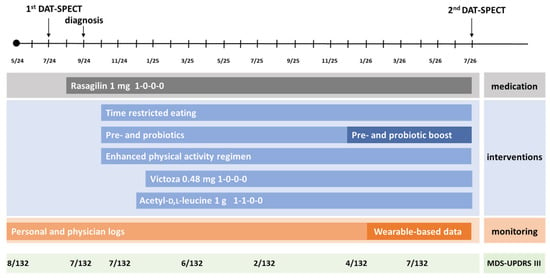
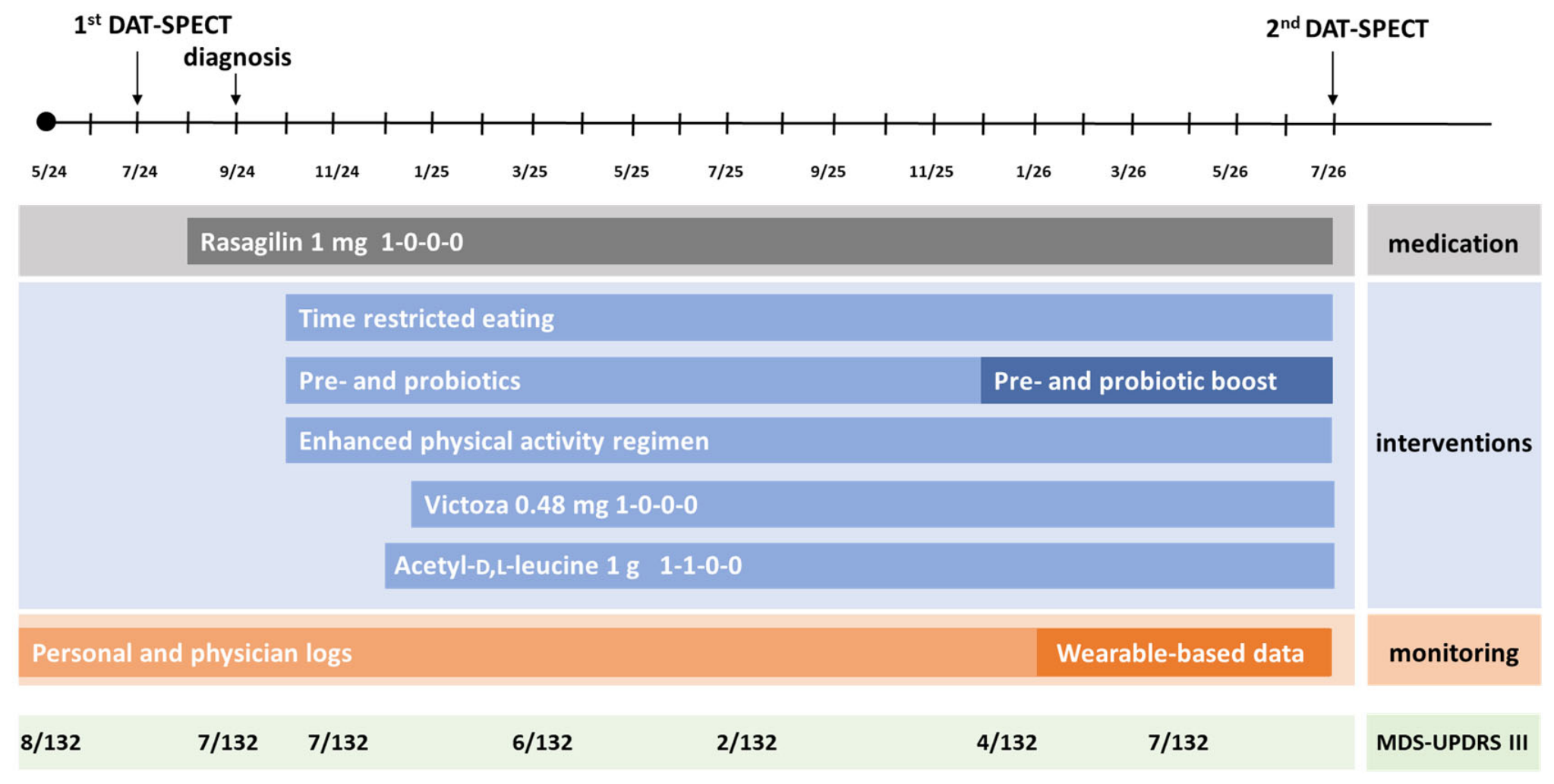
Liraglutide (Victoza, Novo Nordisk A/S, Bagsværd, Denmark) was administered subcutaneously at 0.48 mg each morning as an individualized off-label treatment in routine clinical care and under supervision of the treating general practitioner. ADLL (VitaSanum GmbH, Ottobrunn, Germany) was administered at 2 g/day in early and late morning after its use had been suggested by the treating neurologist as an exploratory complementary option. The temporal sequence and integration of these interventions are illustrated in Figure 1. The chronological implementation of all interventions, including initiation dates, dose changes, adherence, interruptions, and relevant observations, is summarized in Appendix A.2.
Figure 1.
Schematic overview of the multimodal framework, timeline of intervention implementation, and longitudinal course of MDS-UPDRS Part III motor scores, including retrospectively estimated values.
2.2. Longitudinal Monitoring and Data Sources
Longitudinal monitoring drew on three complementary data sources: routine physician documentation, patient-reported observations, and wearable-derived physiological measurements. These sources were used to document clinical status, physiological parameters, symptom evolution, and relevant contextual factors.
Longitudinal clinical data were derived from the electronic medical record across 10 visits conducted at approximately regular intervals by the same board-certified neurologist. Routine neurological examinations were guided by the UPDRS Part III, using the Movement Disorder Society (MDS)-revised version, although the full scale was not completed at every visit because of the mild motor manifestations. Rasagiline (1 mg daily) was taken each morning throughout the follow-up period. The examinations took place at varying times of day, and the interval between medication intake and examination was not standardized. Relevant clinical findings and score estimates were documented by the neurologist. Seven MDS-UPDRS Part III scores, ranging from 2 to 8 out of 132, were available. Six scores were retrospectively estimated from contemporaneous examination findings where assessments had been incomplete, whereas the final score was based on a documented assessment covering all items of the MDS-UPDRS Part III (items 3.1–3.18). The baseline score of 8/132 corresponded to the initial assessment before rasagiline initiation. Given the mild motor impairment, incomplete earlier assessments, retrospective estimation, and potential floor effects, the scores were interpreted descriptively rather than as reliable quantitative evidence of improvement or progression.
Patient-reported observations were recorded in free-form, contemporaneous personal logs following a discussion with the treating general practitioner about documenting the longitudinal clinical course. Entries were made whenever the patient considered a change relevant to the disease course or interventions. No predefined questionnaire, fixed recording schedule, or systematic prompting was used. The records were subsequently reviewed and organized into the structured narrative timeline presented in Appendix A.1. Patient-reported subjective observations were edited for clarity and consistency while preserving their original meaning and wording as much as possible. The observations remained qualitative and were not converted into quantitative scores; patient logs were not considered outcome measures.
2.3. DAT-SPECT Imaging
To assess nigrostriatal DAT-binding, single-photon emission computed tomography (DAT-SPECT) was performed using 123I-FP-CIT (123I-2β-carbomethoxy-3β-(4-iodophenyl)-N-(3-fluoropropyl)-nortropane; GE Healthcare). Thyroid uptake was blocked with sodium perchlorate prior to intravenous administration of 190 MBq of the tracer. Imaging was performed approximately 180 min post-injection using a dual-head gamma camera (AnyScan 5, Mediso Medical Imaging Systems, Budapest, Hungary). Image reconstruction was performed using an ordered-subsets expectation maximization (OSEM) algorithm with Chang attenuation correction (reconstruction protocol designation: IRChangAC).
Quantitative analysis was performed using an age-matched normal database provided by the manufacturer, which enabled calculation of striatal specific binding ratios (SBRs) and age-adjusted Z-scores for predefined striatal regions (putamen and caudate nucleus). Putamen-to-caudate ratios were derived from regional SBR values.
Serial DAT-SPECT examinations were performed at baseline and after a two-year follow-up using identical acquisition and analysis protocols.
2.4. Wearable-Derived Autonomic and Sleep Parameters
Continuous autonomic and sleep-related parameters were collected using a wrist-worn multisensor device (Garmin Lily Active 2, Garmin Ltd., Schaffhausen, Switzerland; firmware 5.27.3). Data from the first two weeks were excluded to allow for an initial adaptation period and stabilization of wearable-derived estimates. Nightly heart rate (HR) and inter-beat intervals were recorded via photoplethysmography and used to derive resting HR and heart rate variability (HRV), quantified as the root mean square of successive differences (RMSSD).
Sleep stages, including slow-wave sleep (SWS) and rapid eye movement (REM) sleep, were estimated using a proprietary algorithm integrating movement, nocturnal HR, HRV, and respiration-derived signals. Compared to polysomnography, absolute quantification of sleep stages is limited in wrist-worn devices. Wearable-derived estimates may nevertheless provide information on sleep patterns across multiple nights under habitual conditions, when interpreted cautiously.
For exploratory assessment, an ad hoc composite REM score (0–6 points) was developed for this case integrating three parameters: (i) total REM duration estimates (≥90 min = 2; 60–89 min = 1; <60 min = 0), (ii) duration of the longest estimated REM episode (≥20 min = 2; 12–19 min = 1; <12 min = 0), and (iii) timing of the longest REM episode within the night (late third = 2; middle third = 1; early third = 0). Higher scores reflect longer, later, and more consolidated REM episodes. The composite score has not been formally validated and was therefore interpreted descriptively as a summary of estimated REM sleep organization. Estimates of nightly SWS duration, total REM duration, the duration and timing of REM episodes and the ratio of SWS estimates to total REM estimates were recorded or calculated. Manufacturer-provided reference ranges for healthy adults were used as contextual references rather than absolute cutoffs.
2.5. Statistics
Continuous variables are presented as mean ± standard deviation (SD). Given the exploratory single-subject design, changes in wearable-derived sleep parameters before and after implementation of the structured bedtime routine were evaluated descriptively, based on mean values and changes across the observation periods. No inferential statistical testing was performed.
2.6. Use of AI Tools
Generative AI tools were used to support language editing, text refinement, and improvement of readability. The authors were responsible for the development of all scientific, clinical, and medical content, the interpretation of findings, and final manuscript preparation.
3. Results
3.1. Baseline Clinical State and Diagnostic Context
Baseline clinical and diagnostic data were recorded at the first evaluation in May 2024, when the patient was a 63-year-old woman. Body weight was 63 kg with a height of 173 cm (BMI: 21.1 kg/m2), body fat percentage was 18.9%, and skeletal muscle percentage was 38.9%. The patient reported a mild left-hand tremor and reduced daytime alertness, particularly during the early afternoon, despite otherwise stable nocturnal sleep quality.
Neurological examination documented a reduced spontaneous blink rate, subtle hypomimia, bradydysdiadochokinesis of the left arm, and a low-frequency resting tremor of the left arm. Moderate postural instability and a persistent glabellar tap reflex without habituation were also noted. Reduced left arm swing was considered an indirect indication of subtle increased muscle tone. The combination of bradykinetic signs and the resting tremor met the core motor definition of parkinsonism within the Movement Disorder Society (MDS) clinical diagnostic framework. The baseline MDS-UPDRS Part III score was 8/132, corresponding to the initial assessment before rasagiline initiation and indicating mild motor impairment. As the full scale was not completed at every visit, the score should be interpreted in the context of the limitations described in Section 2.2.
The patient’s relevant medical history included well-controlled hypothyroidism treated with levothyroxine 100 µg once daily. Laboratory testing identified a vitamin B12 deficiency, which was subsequently corrected.
MRI performed during initial diagnostic workup revealed an approximately 2 cm right parietal parasagittal meningioma with a tail extending into the superior sagittal sinus. MRI also demonstrated mild cerebral small vessel disease (Fazekas grade 1). EEG was within normal limits. The meningioma and microangiopathic changes were considered insufficient to explain the parkinsonian symptoms. The meningioma was subsequently treated with Gamma Knife radiosurgery in October 2025. DAT-SPECT performed in July 2024 demonstrated reduced tracer uptake in the right striatum, consistent with presynaptic nigrostriatal dysfunction. Further quantitative imaging findings are presented in Section 3.2.
Rasagiline (1 mg daily) was initiated on 20 August 2024. At the subsequent visit on 25 September 2024, the patient described a clear subjective improvement in mobility after treatment initiation, particularly when ascending and descending stairs, which had become noticeably easier and felt more dynamic. The treating neurologist independently documented improvement in bradykinetic features and a reduction in subtle rigidity, whereas the unilateral tremor did not respond. Although the improvement was clearly perceived by the patient and partly reflected in the neurologist’s examination, it was not quantitatively established through complete standardized pre- and post-treatment MDS-UPDRS Part III assessments. The medical record from the September visit documented the diagnosis of PD, following an earlier assessment that had described suspected early PD. The diagnosis was based on the overall clinical presentation and imaging findings. Rasagiline was continued throughout the subsequent observation period.
3.2. Baseline Striatal DAT Binding
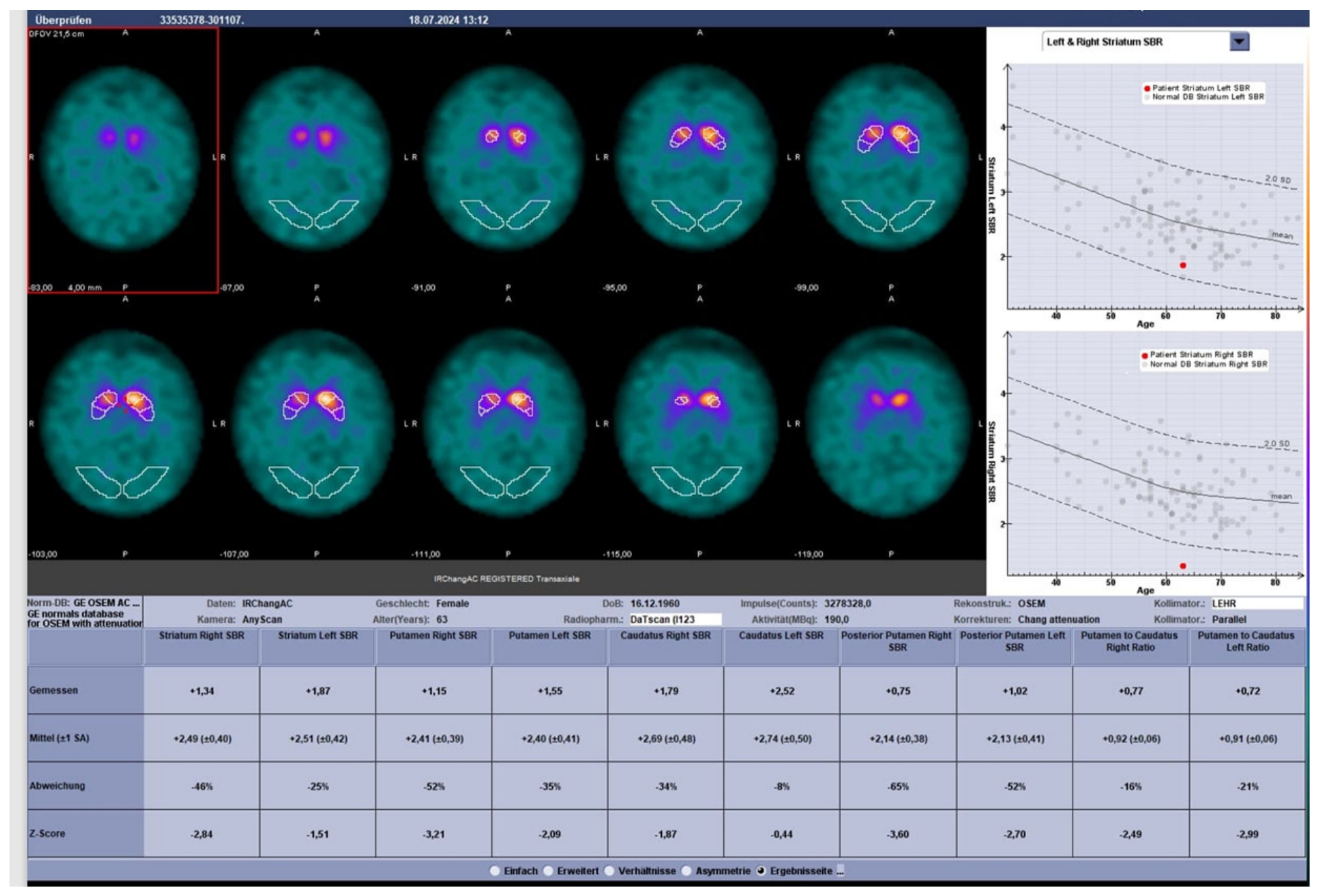
Quantitative DAT-SPECT analysis demonstrated a predominantly right-sided reduction in nigrostriatal DAT binding (Figure 2). Marked reductions in putaminal DAT binding were observed, with greater involvement on the right hemisphere (Z = −3.21; SBR 1.15) compared with the left (Z = −2.09; SBR 1.55). The most pronounced reduction was present in the posterior putamen (right: Z = −3.60, SBR 0.75; left: Z = −2.70, SBR 1.02).
Figure 2.
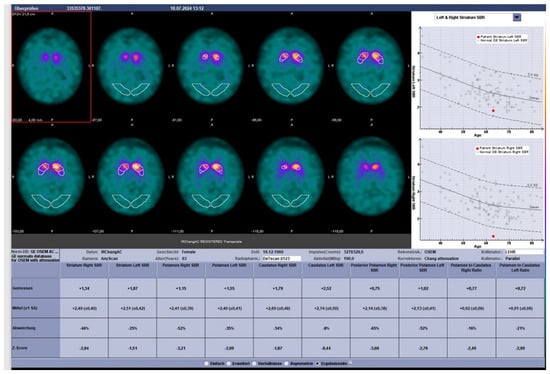
DAT-SPECT imaging (123I-FP-CIT). Axial DAT-SPECT images and quantitative analysis demonstrate a right-predominant reduction in striatal DAT binding. The red rectangle outlines the first displayed axial slice in the montage. L and R indicate left and right, respectively; A and P indicate anterior and posterior orientation. The numerical labels indicate slice positions in millimeters (−83 to −119 mm, in 4-mm increments). OFOV denotes operational field of view (21.5 cm). Reference-region markings used in the quantitative analysis are visible on the relevant slices. For each striatal region, “Measured” denotes the patient’s SBR, whereas “Mean ± 1 SD” denotes the mean SBR and one standard deviation in the age-matched reference population. The percentage deviation indicates the relative difference from the reference mean, and the Z-score expresses this difference in standard deviation units. Analysis shows markedly reduced uptake in the right putamen (SBR 1.15; Z = −3.21), with more pronounced involvement of the posterior putamen (SBR 0.75; Z = −3.60) compared with the left (SBR 1.02; Z = −2.70). The right caudate shows borderline reduction (SBR 1.79; Z = −1.87), whereas the left caudate is relatively preserved (SBR 2.52; Z = −0.44). Putamen-to-caudate ratios, derived from total (combined anterior to posterior) striatal SBRs, were reduced bilaterally (right 0.77; left 0.72), indicating preferential putaminal involvement.
The caudate nucleus was relatively less affected, with borderline reduction on the right (Z = −1.87; SBR 1.79) and near-preserved binding on the left (Z = −0.44; SBR 2.52). Putamen-to-caudate ratios derived from combined striatal SBRs were reduced bilaterally (right: 0.77; left: 0.72), indicating a relative preferential involvement of the putamen.
Overall, the imaging pattern of posterior putaminal reduction with relative caudate preservation and right-sided predominance was consistent with reduced presynaptic nigrostriatal DAT binding. These findings served as the baseline reference for longitudinal comparison in follow-up imaging.
3.3. Wearable-Derived Autonomic Measures and Sleep Metrics
Wearable-based assessment during January 2026 showed relatively stable nocturnal autonomic measures. Night-time resting HR was consistently low (51–56 bpm, mean 53.1 bpm), while sleep-related HRV ranged from 33 to 45 ms (mean 38.8 ms). Both measures were in the expected ranges reported for healthy adults [54,55].
Wearable-derived REM sleep estimates indicated approximately 2 h of REM sleep per night distributed across multiple episodes. The longest REM periods typically occurred in the final third of the night and occasionally in the middle third, broadly consistent with the expected temporal distribution of REM sleep and its usual proportion of total sleep time (~20–25%) [56]. The mean composite REM score was 5.5 out of 6, reflecting relatively high scores for estimated REM duration, its longest episode, and its temporal distribution. As an exploratory descriptive measure, the score summarizes these wearable-derived estimates but does not constitute a validated measure of REM sleep organization.
In contrast, wearable-derived SWS estimates were low, with early-night SWS episodes frequently brief or absent (20.3 min ± 12.3 min) and a mean SWS-to-REM ratio of 0.17. This ratio was below the range reported for healthy adults (~0.6–1.0) [56], although direct comparison is limited by differences in measurement methods and metric definitions. These findings contrast with the relatively stable nocturnal autonomic measures observed during the same period.
3.4. Patient and Physician Logs (Monitoring)
Longitudinal monitoring integrated physician documentation, patient-reported logs (Appendix A.1 and Appendix A.2), and wearable-derived measurements to characterize the clinical course over the observation period.
Physician documentation consisted of MDS-UPDRS Part III scores derived from routine clinical follow-up visits. Six of the seven scores were retrospectively estimated from contemporaneous clinical documentation based on neurological findings documented during the respective visits, whereas the final score was obtained by direct MDS-UPDRS Part III assessment during the clinical visit. The scores ranged from 2 to 8 out of 132 and were used descriptively to characterize overall motor severity rather than for formal quantitative longitudinal comparisons (Figure 1). Given the low absolute values, numerical changes should be interpreted with caution.
Patient-reported logs provided a structured descriptive record of functional status over time. During the first year of adherence to the multimodal approach, the patient reported improved general well-being and increased perceived motor fluidity. Thereafter, subjective stabilization was described. However, the persistent unilateral tremor became more pronounced later in the observation period, as reported by the patient and also observed by the treating neurologist. Intermittent increases in limb tone were also noted, while overall mobility remained largely stable. A structured summary of patient-reported observations is provided in Appendix A.1.
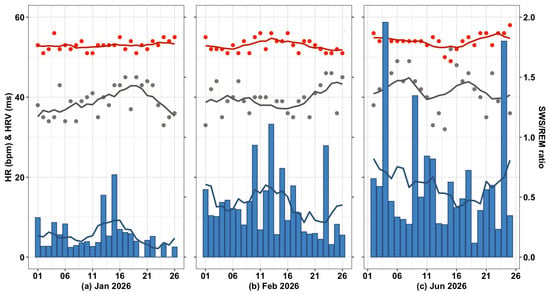
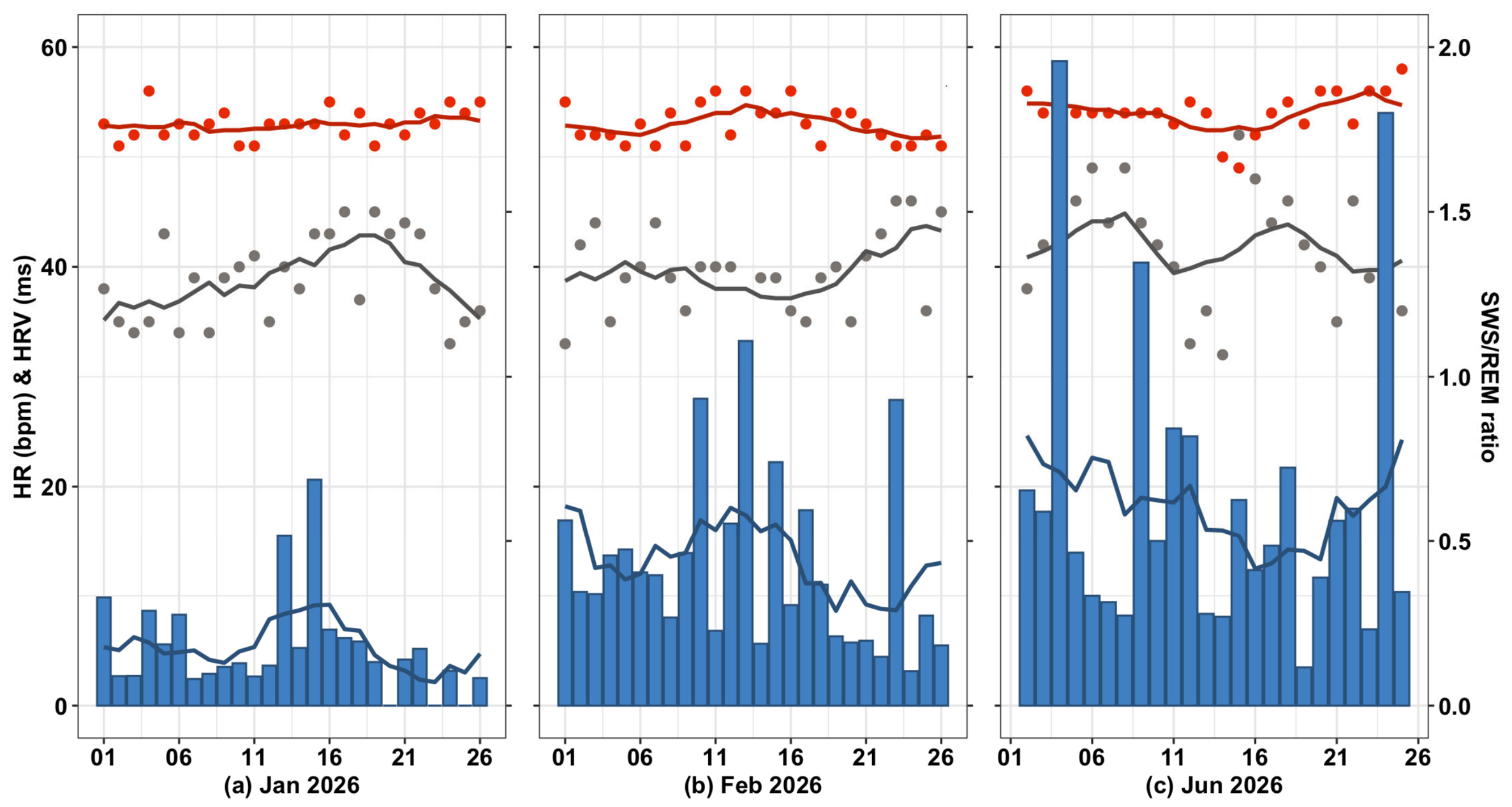
In January 2026, wearable analyses identified reduced early-night SWS metrics, as described in Section 3.3. A structured evening routine was subsequently implemented, including fixed sleep timing, reduced electronic device use before bedtime, and separation of sleep and daytime environments. Mean SWS estimates increased from 20.3 ± 12.9 min in January 2026 to 45.0 ± 19.3 min in February 2026, accompanied by an increase in the SWS-to-REM ratio from 0.18 ± 0.15 to 0.42 ± 0.25. HR and HRV remained relatively stable with mean values of 53.1 ± 2.0 versus 53.2 ± 2.6 bpm and 38.8 ± 4.1 versus 39.6 ± 3.8 ms, respectively (Figure 3a,b).
Figure 3.
Longitudinal wearable-based autonomic and SWS metrics. Data are shown for three observation periods: (a) January 2026 (baseline), (b) February 2026 (early period following initiation of a structured bedtime routine), and (c) June 2026 (intermediate-term follow-up) as indicated. Resting HR (red) and HRV (gray) are shown as daily data points and corresponding 7-day moving averages. Nightly SWS-to-REM ratios are displayed as bars with a corresponding 7-day moving average. Following implementation of the structured bedtime routine, SWS-to-REM ratios increased, whereas HR and HRV remained stable across the observation periods.
Intermediate-term follow-up in June 2026 demonstrated further increases in sleep architecture metrics, with mean SWS estimates reaching 52.4 ± 18.2 min and the SWS-to-REM ratio reaching 0.62 ± 0.44. Overall, wearable-derived SWS estimates and SWS-to-REM ratios were higher during the February and June observation periods than during the January baseline period, while nocturnal autonomic parameters remained relatively stable (Figure 3c).
3.5. Follow-Up DAT-SPECT Imaging Findings
Follow-up DAT-SPECT imaging was performed 2 years after the baseline examination using the same acquisition and quantitative analysis approach. The right-predominant pattern of reduced DAT binding, corresponding to the clinically left-dominant phenotype, persisted at follow-up, although further reductions in DAT binding were observed bilaterally (Table 1). Compared with baseline, decreases in DAT-SBR were observed across all four assessed striatal regions, with the left caudate decreasing from 2.52 to 2.03, the right caudate from 1.79 to 1.51, the left putamen from 1.55 to 1.28, and the right putamen from 1.15 to 1.06 (Table 1). Based on the lower SBR for each region, the striatal DAT-SBR decreased from 2.94 at baseline to 2.57 at follow-up, corresponding to a relative reduction of 12.6%.
Table 1.
Longitudinal changes in striatal DAT binding measured by DAT-SPECT from baseline to two-year follow-up.
For contextual reference, Costello et al. reported mean striatal DAT-SBR values of 2.50 ± 0.75 at baseline and 2.07 ± 0.68 at year 2 in a longitudinal cohort of patients with newly diagnosed PD from the Parkinson’s Progression Marker Initiative (PPMI), corresponding to a mean relative decline of 16.6% over the same period [57]. The striatal DAT-SBR values in the present case were higher than the corresponding PPMI cohort means at both time points, while the relative decline over 2 years was numerically lower than the mean decline reported in the PPMI cohort. These cohort-level data are provided for context only: the comparison does not establish whether the longitudinal DAT-SBR decline in this individual differed from the average decline in the PPMI cohort.
4. Discussion
This report describes the two-year real-world clinical course of a patient with early-stage PD during the implementation of an integrated, biologically motivated multimodal approach. The multimodal approach was guided by disease-relevant biological pathways, with a focus extending beyond symptomatic management. Its rationale centered on mechanisms implicated in cellular proteostasis and intracellular clearance, as well as sleep-related processes potentially associated with glymphatic clearance. Given the close interplay between cellular maintenance and systemic regulation, the approach also addressed circadian physiology and the coordinated timing of metabolic and restorative processes. Complementary components targeted neurotrophic signaling, metabolic pathways involved in insulin sensitivity, and gut–brain axis signaling. These pathways provided the biological rationale for the multimodal approach but were not directly measured in this patient.
The interventions were introduced at different time points and partly overlapped, with adaptations during the observation period. Their implementation over two years illustrates how a multimodal approach can be incorporated into everyday life alongside regular professional and personal commitments. This experience suggests that such an approach may be feasible in an individual real-world setting, although it does not establish its feasibility, tolerability, or effectiveness in other patients.
In addition to longitudinal neurological follow-up, wearable-derived measurements provided complementary information on sleep architecture and nocturnal autonomic measures. Wearable-derived estimates indicated reduced SWS, whereas estimated REM sleep showed no marked deviations and nocturnal HR and HRV remained relatively stable. These findings suggest that changes in estimated sleep parameters and nocturnal autonomic measures may not occur in parallel. Reduced SWS has been described as an early feature in PD and may reflect alterations in sleep-regulating networks [18,19]. However, the wearable-derived SWS estimates in the present case do not provide direct evidence of glymphatic clearance or α-synuclein clearance, neither of which was directly measured.
The potential added value of wearable monitoring lies in the repeated, low-burden assessment of estimated sleep-related trends under habitual conditions. By enabling longitudinal observation across multiple nights, wearables may help to characterize intra-individual variability and temporal patterns that may not be captured by one or a few nights of polysomnography (PSG) in a laboratory setting. This complementary role does not imply equivalence to PSG: wearable-derived sleep-stage estimates are not validated measurements of individual sleep stages in this case, and their accuracy and clinical significance remain uncertain. The increase in wearable-derived SWS estimates following implementation of the bedtime routine represents a temporal observation within this individual case and does not establish an intervention effect or provide direct evidence of changes in sleep physiology or glymphatic clearance. Prospective studies comparing wearable-derived metrics with PSG and standardized clinical assessments are needed to determine their accuracy, reproducibility, and clinical relevance.
An important unresolved question when interpreting clinical outcomes in PD is whether preserved clinical function reflects modification of the underlying neurodegenerative process or primarily functional compensation. Similar considerations have been raised in studies of GLP-1 receptor agonists in PD, where attenuated worsening of motor scores in the active treatment group compared with controls may reflect either disease-modifying effects or improvements at a symptomatic level [42]. In the present case, the longitudinal clinical and physiological observations cannot distinguish between these possibilities. This limitation is particularly relevant in early-stage disease, where subtle changes may remain below the resolution of clinical scales. Furthermore, the overall clinical course should not be interpreted as stability across all motor symptoms: the persistent unilateral tremor became more pronounced during the later observation period, as reported by the patient and observed by the treating neurologist. Nevertheless, the patient continued to report largely stable overall mobility.
To complement the clinical observations, serial DAT-SPECT imaging was included to assess longitudinal changes in striatal DAT binding. At follow-up, imaging showed lower striatal DAT binding than at baseline, in contrast to the relative clinical stability observed over the same period. This coexistence illustrates that relative clinical stability can occur alongside longitudinal changes in DAT binding, without allowing for direct inference about the extent of underlying neuronal loss. It also underscores the value of interpreting clinical observations alongside complementary neuroimaging measures. Some pathways relevant to the biological rationale for the multimodal approach are also implicated in cellular maintenance and biological aging, including autophagic processes, mitochondrial function, and insulin/IGF-1 signaling [58]. Although no aging-related outcomes or direct measures of biological resilience were assessed in this case, the coexistence of relative clinical stability and reduced striatal DAT binding may be considered within the broader conceptual framework of biological resilience. This interpretation remains speculative.
Several limitations inherent to single-individual longitudinal observations should be acknowledged. As this report describes a single uncontrolled observation, the findings cannot be assumed to be generalizable to the broader PD population, and their reproducibility remains to be established in larger, prospective studies. Because multiple interventions were introduced at different time points and partly overlapped, and were not implemented under controlled conditions, the observed clinical and physiological changes cannot be causally attributed to individual components of the multimodal approach. The continuous use of rasagiline throughout the observation period represents an additional potential confounding factor, as its symptomatic effects may have contributed to the observed stability of motor function. No direct measurements of autophagic activity, gut microbiome composition, butyrate or other short-chain fatty acid (SCFA) levels, inflammatory or metabolic markers, or glymphatic clearance were performed. These mechanisms therefore remain hypotheses underlying the biologic rationale for the interventions rather than demonstrated biological effects in this patient. In addition, the interpretation of low motor scores is inherently uncertain because most MDS-UPDRS Part III scores were retrospectively estimated from clinical documentation rather than being obtained through standardized prospective assessments. The mild degree of motor impairment and incomplete assessments further limit the sensitivity of these scores to small changes over time.
The real-world setting provides information on the practical implementation of the multimodal approach and its integration into everyday life. At the same time, the absence of standardized experimental conditions limits control over intervention timing, consistency, and potential confounding factors. The resulting ecological validity should therefore be considered alongside the limitations in causal interpretation.
Taken together, this case illustrates the real-world implementation of an integrated, biologically rational multimodal approach, documented through patient-reported observations, routine clinical assessments, wearable-derived measures, and neuroimaging. In this individual case, relative clinical stability coexisted with a longitudinal reduction in striatal DAT binding. Although no inference regarding disease modification can be drawn from a single uncontrolled observation, this discordance illustrates the limitations of interpreting clinical stability alone as evidence of biological disease stability.
Author Contributions
Conceptualization, S.M., C.H. and C.S.; data curation, S.M.; writing—original draft preparation, S.M.; writing—review and editing, C.S., C.H. and S.M. All authors have read and agreed to the published version of the manuscript.
Funding
This research received no external funding.
Institutional Review Board Statement
Ethical review and approval were waived, as the work was conducted within routine clinical care and did not involve a formal study protocol, randomization, or experimental assignment. The work includes a structured description of therapeutic interventions and longitudinal clinical observations. The implemented interventions comprised patient-initiated non-pharmacological measures (time-restricted eating, exercise, and probiotic/prebiotic supplementation) performed in agreement with the treating physician, as well as acetyl-DL-leucine, which was suggested by the treating physician and subsequently initiated by the patient. GLP-1 receptor agonist therapy was introduced as a therapeutic use outside its approved indications under physician supervision and within a structured informed consent framework. The therapeutic use was reviewed through an independent medical assessment commissioned by the patient’s health insurance provider and approved within the clinical care framework.
Informed Consent Statement
Written informed consent was obtained for publication of clinical data and related clinical observations. In addition, a structured informed consent agreement covering the therapeutic use of GLP-1 receptor agonist therapy outside its approved indications was signed by both the patient and the treating physician prior to the initiation of therapy.
Data Availability Statement
Data are not publicly available due to patient privacy and ethical restrictions. De-identified data may be made available from the corresponding author upon reasonable request, subject to applicable ethical and data protection regulations.
Acknowledgments
The authors would like to thank HSM for her contribution to the design and preparation of the figures and for critical language editing.
Conflicts of Interest
The authors declare no conflicts of interest.
Abbreviations
The following abbreviations are used in this manuscript:
| PD | Parkinson’s Disease |
| HR | Heart rate |
| HRV | Heart rate variability |
| SWS | Slow-wave sleep |
| REM | Rapid eye movement |
| TRE | Time-restricted eating |
| mTOR | Mechanistic target of rapamycin |
| AMPK | AMP-activated protein kinase |
| MDS | Movement Disorder Society |
| UPDRS | Unified Parkinson’s Disease rating scale |
| GLP-1 | Glucagon-like peptide 1 |
| ADLL | Acetyl-D,L-leucine |
| DAT | Dopamine transporter |
| DAT-SPECT | Dopamine transporter single-photon emission computed tomography |
| SBR | Specific binding ratio |
Appendix A
Appendix A.1. Structured Narrative Timeline of Patient-Reported Observations and Relevant Clinical Events
Oct 2024—Initiation of TRE and dietary changes
Following the initiation of time-restricted eating (TRE) and pre- and probiotic supplementation, the patient reported improved general well-being and increased perceived fluidity of gait and spontaneous movement.
Dec 2024—Introduction of ADLL and liraglutide
ADLL was introduced and gradually titrated, initially with administration in the morning and evening. Liraglutide was initiated later in December. Following dose escalation, transient constipation was reported, prompting dose reduction and subsequent gradual re-escalation to an individualized dose. Detailed dose changes are provided in Appendix A.2.
May 2025—Adjustment of ADLL regimen
The planned ADLL regimen was increased to four daily dosing occasions. This schedule was subsequently not sustained because doses were frequently missed, and actual intake settled at approximately 2 g/day (Appendix A.2).
Mid-2025 to Aug 2025—Patient-reported functional stability
During a period of observation in mid-2025 that included a vacation, the patient reported that Parkinsonian symptoms had become less prominent in daily awareness. Perceived improvements included greater physical agility, increased driving fluency and confidence, and improved cognitive clarity. The patient also reported being able to perform some physical exercise tasks previously considered unattainable. Intermittent olfactory perceptions were described.
Overall mobility was reported to remain stable, without perceived sustained functional decline. The persistent unilateral tremor remained present and was perceived as possibly mildly progressive. The patient self-administered the Timed Up and Go (TUG) test, recording a time of 7.5 s. Home-scale measurements of body weight and body composition remained broadly stable.
The patient also reported situational stress in complex or unfamiliar travel situations, including driving in unfamiliar settings and train journeys involving time-sensitive connections.
Sep 2025—Intensification of pre- and probiotic supplementation and meningioma management
In response to perceived stabilization without further improvement, the additional pre- and probiotic supplementation was introduced (“boost”). It was discontinued later that month because of constipation-like symptoms, while the basic morning regimen was maintained.
During the same period, meningioma-associated peritumoral edema prompted clinical discussion of treatment options. Consideration of open neurosurgical resection versus stereotactic radiosurgery was associated with increased mental burden related to the appraisal of treatment options and risks. Gamma Knife radiosurgery was subsequently selected.
Persistent unilateral tremor continued, with intermittent lower-limb tone. No clear change in the overall Parkinsonian symptom pattern was reported.
Oct 2025—Radiosurgical treatment
Gamma Knife radiosurgery was performed as planned, without reported peri- or post-procedural complications.
Nov-Dec 2025—Resumption of microbiome-directed supplementation
The additional microbiome-directed supplementation was resumed in November and temporarily withheld during antibiotic treatment for a urinary tract infection. The basic morning regimen was maintained. Following resolution of the infection, the additional supplementation was resumed in December, with homemade kefir added to the morning regimen (Appendix A.2).
Wearable-based monitoring of sleep-related and autonomic parameters commenced in December 2025.
Jan 2026—Post-radiosurgical follow-up
Three months after Gamma Knife radiosurgery, follow-up imaging showed unchanged meningioma size, a central radiation-induced reaction, and minimal mild perifocal white-matter changes. The findings were assessed as being within the expected post-radiosurgical range.
Jan–Feb 2026—Sleep monitoring and structured bedtime routine
Following wearable-based identification of low early-night SWS metrics, a structured bedtime routine was introduced in late January 2026. The routine included fixed sleep timing, reduced electronic device use before bedtime, and separation of sleep and daytime environments. Subsequent monitoring showed an increase in wearable-derived SWS estimates (see Figure 3b). These changes were documented descriptively and do not establish a corresponding change in underlying sleep physiology or glymphatic clearance.
During this period, the patient intermittently reported episodes described as a subjective sense of full health, improved performance in previously unattainable physical exercise tasks, transient improvement in left-hand motor function, and continued intermittent olfactory perception.
April 2026—Transient fluctuation in gait stiffness
The patient reported a temporary increase in gait stiffness lasting approximately two weeks, followed by spontaneous resolution without additional intervention. Increased daytime alertness and reduced fatigue were subsequently reported, while overall functional status remained largely stable.
May-July 2026—Evolution of the unilateral tremor
The persistent unilateral tremor was reported by the patient to have increased gradually over this period and was also observed by the treating neurologist to have become more pronounced. Despite this change, overall mobility and subjective functional capacity remained largely stable. The previously reported situational stress in complex or unfamiliar travel situations remained unchanged.
July 2026—Body composition follow-up
Home-scale measurements indicated broadly stable body weight and body composition over the observation period. At the latest assessment, body weight was 62 kg, body fat percentage was 19.6%, and skeletal muscle percentage was 38.5%.
Appendix A.2. Chronological Summary of Intervention Implementation
| Date | Intervention | Regimen/Change | Adherence/Relevant Observations |
| 20 Aug 24 | Rasagiline | Initiated 1 mg once daily (1-0-0-0) | Taken consistently throughout the observation period without exceptions |
| 7 Oct 24 | TRE | Initiated fasting interval typically from 19:00 to 07:00 | Followed almost without exception, occasional deviations during evening events |
| 7 Oct 24 | Pre- and probiotics | Initiated ‘morning regimen’ | Maintained throughout the observation period |
| 9 Oct 24 | Reduced hunger and cravings for sweets reported from approximately the second day, persisting for several months. TRE and pre-/probiotic supplementation had been initiated simultaneously | ||
| Mid Oct 24 | Physical activity | Intensified supervised university sports courses, including yoga and Pilates, supplemented by more deliberate everyday movement | Generally followed; occasional sessions were missed because of competing commitments |
| Early Dec 24 | ADLL | Initiated 0.5 g once daily (1-0-0-0) | — |
| Mid Dec 24 | ADLL | Increased to 0.5 g twice daily (1-0-0-1) | — |
| End Dec 24 | ADLL | Increased to 0.5 g (2-0-0-1; total 1.5 g/day) | — |
| 27 Dec 24 | Liraglutide | Initiated 0.3 mg once daily | Initially well tolerated; no perceived effect on appetite or body weight |
| 2 Jan 25 | Liraglutide | Increased to 0.6 mg once daily | Transient obstipation |
| Liraglutide | subsequently reduced to 0.3 mg because of obstipation and then gradually re-escalated to an individualized dose of up to 0.48 mg/day | Generally consistent use, except for a few days when refrigeration was unavailable. | |
| Mid Jan 25 | ADLL | Increased to 0.5 g (2-0-0-2; total 2 g/day) | — |
| 13 Apr 25 | Liraglutide | Administration adjusted to before breakfast (1-0-0-0) | Continued to be well tolerated, without a perceived effect on appetite or body weight |
| 13 Apr 25 | ADLL | Increased to 0.5 g (2-0-0-3; total 2.5 g/day) | — |
| 20 May 25 | ADLL | Increased to 0.5 g (2-2-2-2; total 4 g/day) | — |
| Mid Jun 25 | ADLL | Four-times-daily regimen not sustained; actual intake settled at 2 g/day (schedule: 2-2-0-0) | Doses were frequently missed when the four-times-daily regimen was attempted. The patient continued with morning dosing and chose not to take the additional doses later in the day or in the evening. |
| Early Sep 25 | Pre- and probiotics | Intensified (“boost”) with Omnibiotic 6 and resistant starch type 3 (RS3) at night | Boost discontinued in mid-September because of constipation; basic morning regimen continued |
| 10 Nov 25 | Pre- and probiotics | Boost resumed and supplemented with fiber bars | — |
| Late Nov 25 | Pre- and probiotics | Temporary interruption | The additional supplementation (“boost”) was temporarily withheld during antibiotic treatment for a urinary tract infection; basic morning regimen maintained |
| Mid Dec 25 | Pre- and probiotics | Boost resumed plus home-prepared kefir in the morning | Well tolerated |
| Mid Dec 25 | Wearable monitoring | Sleep monitoring initiated | |
| 25 Jan 26 | Wearable monitoring | Structured bedtime routine introduced | Mostly followed, with exceptions during vacation days |
| 30 Jun 26 | Wearable monitoring | Sleep data recording ended | |
| End Jul 26 | End of patient-reported documentation. |
References
- Lees, A.J.; Hardy, J.; Revesz, T. Parkinson’s Disease. Lancet 2009, 373, 2055–2066. [Google Scholar] [CrossRef] [Scilit] [PubMed]
- Braak, H.; Del Tredici, K.; Rüb, U.; de Vos, R.A.I.; Jansen Steur, E.N.H.; Braak, E. Staging of Brain Pathology Related to Sporadic Parkinson’s Disease. Neurobiol. Aging 2003, 24, 197–211. [Google Scholar] [CrossRef] [Scilit] [PubMed]
- Henderson, M.X.; Trojanowski, J.Q.; Lee, V.M.-Y. α-Synuclein Pathology in Parkinson’s Disease and Related α-Synucleinopathies. Neurosci. Lett. 2019, 709, 134316. [Google Scholar] [CrossRef] [Scilit] [PubMed]
- Borghammer, P.; Van Den Berge, N. Brain-First versus Gut-First Parkinson’s Disease: A Hypothesis. J. Park. Dis. 2019, 9, S281–S295. [Google Scholar] [CrossRef] [Scilit] [PubMed]
- Horsager, J.; Andersen, K.B.; Knudsen, K.; Skjærbæk, C.; Fedorova, T.D.; Okkels, N.; Schaeffer, E.; Bonkat, S.K.; Geday, J.; Otto, M.; et al. Brain-First versus Body-First Parkinson’s Disease: A Multimodal Imaging Case-Control Study. Brain 2020, 143, 3077–3088. [Google Scholar] [CrossRef] [Scilit] [PubMed]
- Wakabayashi, K. Where and How Alpha-Synuclein Pathology Spreads in Parkinson’s Disease. Neuropathology 2020, 40, 415–425. [Google Scholar] [CrossRef] [Scilit] [PubMed]
- Nielsen, S.D.; Pearson, N.M.; Seidler, K. The Link between the Gut Microbiota and Parkinson’s Disease: A Systematic Mechanism Review with Focus on α-Synuclein Transport. Brain Res. 2021, 1769, 147609. [Google Scholar] [CrossRef] [Scilit] [PubMed]
- Jan, A.; Gonçalves, N.P.; Vaegter, C.B.; Jensen, P.H.; Ferreira, N. The Prion-Like Spreading of Alpha-Synuclein in Parkinson’s Disease: Update on Models and Hypotheses. Int. J. Mol. Sci. 2021, 22, 8338. [Google Scholar] [CrossRef] [Scilit] [PubMed]
- Heimrich, K.G.; Lehmann, T.; Schlattmann, P.; Prell, T. Heart Rate Variability Analyses in Parkinson’s Disease: A Systematic Review and Meta-Analysis. Brain Sci. 2021, 11, 959. [Google Scholar] [CrossRef] [Scilit] [PubMed]
- Cook, C.; Stetler, C.; Petrucelli, L. Disruption of Protein Quality Control in Parkinson’s Disease. Cold Spring Harb. Perspect. Med. 2012, 2, a009423. [Google Scholar] [CrossRef] [Scilit] [PubMed]
- Fu, Y.; Zhang, J.; Qin, R.; Ren, Y.; Zhou, T.; Han, B.; Liu, B. Activating Autophagy to Eliminate Toxic Protein Aggregates with Small Molecules in Neurodegenerative Diseases. Pharmacol. Rev. 2025, 77, 100053. [Google Scholar] [CrossRef] [Scilit] [PubMed]
- Blauwendraat, C.; Nalls, M.A.; Singleton, A.B. The Genetic Architecture of Parkinson’s Disease. Lancet Neurol. 2020, 19, 170–178. [Google Scholar] [CrossRef] [Scilit] [PubMed]
- Nalls, M.A.; Blauwendraat, C.; Vallerga, C.L.; Heilbron, K.; Bandres-Ciga, S.; Chang, D.; Tan, M.; Kia, D.A.; Noyce, A.J.; Xue, A.; et al. Identification of Novel Risk Loci, Causal Insights, and Heritable Risk for Parkinson’s Disease: A Meta-Analysis of Genome-Wide Association Studies. Lancet Neurol. 2019, 18, 1091–1102. [Google Scholar] [CrossRef] [Scilit] [PubMed]
- Choi, I.; Zhang, Y.; Seegobin, S.P.; Pruvost, M.; Wang, Q.; Purtell, K.; Zhang, B.; Yue, Z. Microglia Clear Neuron-Released α-Synuclein via Selective Autophagy and Prevent Neurodegeneration. Nat. Commun. 2020, 11, 1386. [Google Scholar] [CrossRef] [Scilit] [PubMed]
- Birnbaum, E.; Yue, Z. The Role of Autophagy in Synucleinopathy: Clearance versus Spread of α-Synuclein. Autophagy Rep. 2025, 4, 2577406. [Google Scholar] [CrossRef] [Scilit] [PubMed]
- Xie, L.; Kang, H.; Xu, Q.; Chen, M.J.; Liao, Y.; Thiyagarajan, M.; O’Donnell, J.; Christensen, D.J.; Nicholson, C.; Iliff, J.J.; et al. Sleep Drives Metabolite Clearance from the Adult Brain. Science 2013, 342, 373–377. [Google Scholar] [CrossRef] [Scilit] [PubMed]
- Lopes, D.M.; Llewellyn, S.K.; Harrison, I.F. Propagation of Tau and α-Synuclein in the Brain: Therapeutic Potential of the Glymphatic System. Transl. Neurodegener. 2022, 11, 19. [Google Scholar] [CrossRef] [Scilit] [PubMed]
- Zhang, Y.; Ren, R.; Sanford, L.D.; Yang, L.; Zhou, J.; Tan, L.; Li, T.; Zhang, J.; Wing, Y.-K.; Shi, J.; et al. Sleep in Parkinson’s Disease: A Systematic Review and Meta-Analysis of Polysomnographic Findings. Sleep Med. Rev. 2020, 51, 101281. [Google Scholar] [CrossRef] [Scilit] [PubMed]
- Zahed, H.; Zuzuarregui, J.R.P.; Gilron, R.; Denison, T.; Starr, P.A.; Little, S. The Neurophysiology of Sleep in Parkinson’s Disease. Mov. Disord. 2021, 36, 1526–1542. [Google Scholar] [CrossRef] [Scilit] [PubMed]
- Ang, P.S.; Zhang, D.M.; Azizi, S.-A.; Norton de Matos, S.A.; Brorson, J.R. The Glymphatic System and Cerebral Small Vessel Disease. J. Stroke Cerebrovasc. Dis. 2024, 33, 107557. [Google Scholar] [CrossRef] [Scilit] [PubMed]
- Panda, S. Circadian Physiology of Metabolism. Science 2016, 354, 1008–1015. [Google Scholar] [CrossRef] [Scilit] [PubMed]
- Nechushtai, L.; Frenkel, D.; Pinkas-Kramarski, R. Autophagy in Parkinson’s Disease. Biomolecules 2023, 13, 1435. [Google Scholar] [CrossRef] [Scilit] [PubMed]
- Szegő, É.M.; Höfs, L.; Antoniou, A.; Dinter, E.; Bernhardt, N.; Schneider, A.; Di Monte, D.A.; Falkenburger, B.H. Intermittent Fasting Reduces Alpha-Synuclein Pathology and Functional Decline in a Mouse Model of Parkinson’s Disease. Nat. Commun. 2025, 16, 4470. [Google Scholar] [CrossRef] [Scilit] [PubMed]
- Tağraf, B.; Oğul, Ö.E.; Yerlikaya, D.; Hanoğlu, L. A Personalized Plant-Rich, Time-Restricted Nutritional Intervention for Motor and Non-Motor Symptoms in Parkinson’s Disease: A Randomized Controlled Trial. J. Park. Dis. 2026, 16, 351–361. [Google Scholar] [CrossRef] [Scilit] [PubMed]
- Goenawan, H.; Kiasati, S.; Sylviana, N.; Megantara, I.; Lesmana, R. Exercise-Induced Autophagy Ameliorates Motor Symptoms Progressivity in Parkinson’s Disease Through Alpha-Synuclein Degradation: A Review. Neuropsychiatr. Dis. Treat. 2023, 19, 1253–1262. [Google Scholar] [CrossRef] [Scilit] [PubMed]
- Kong, J.; Xie, Y.; Fan, R.; Wang, Q.; Luo, Y.; Dong, P. Exercise Orchestrates Systemic Metabolic and Neuroimmune Homeostasis via the Brain–Muscle–Liver Axis to Slow down Aging and Neurodegeneration: A Narrative Review. Eur. J. Med. Res. 2025, 30, 475. [Google Scholar] [CrossRef] [Scilit] [PubMed]
- Mitchell, A.K.; Bliss, R.R.; Church, F.C. Exercise, Neuroprotective Exerkines, and Parkinson’s Disease: A Narrative Review. Biomolecules 2024, 14, 1241. [Google Scholar] [CrossRef] [Scilit] [PubMed]
- Alzoughool, F.; Alanagreh, L.; Aljawarneh, Y.; Zraigat, H.; Alzghool, M. The Multifaceted Role of Irisin in Neurological Disorders: A Systematic Review Integrating Preclinical Evidence with Clinical Observations. Neurol. Int. 2026, 18, 15. [Google Scholar] [CrossRef] [Scilit] [PubMed]
- Johansson, M.E.; Cameron, I.G.M.; Van Der Kolk, N.M.; De Vries, N.M.; Klimars, E.; Toni, I.; Bloem, B.R.; Helmich, R.C. Aerobic Exercise Alters Brain Function and Structure in Parkinson’s Disease: A Randomized Controlled Trial. Ann. Neurol. 2022, 91, 203–216. [Google Scholar] [CrossRef] [Scilit] [PubMed]
- Krueger, M.E.; Boles, J.S.; Simon, Z.D.; Alvarez, S.D.; McFarland, N.R.; Okun, M.S.; Zimmermann, E.M.; Forsmark, C.E.; Tansey, M.G. Comparative Analysis of Parkinson’s and Inflammatory Bowel Disease Gut Microbiomes Reveals Shared Butyrate-Producing Bacteria Depletion. npj Park. Dis. 2025, 11, 50. [Google Scholar] [CrossRef] [Scilit] [PubMed]
- Nuzum, N.D.; Szymlek-Gay, E.A.; Loke, S.; Dawson, S.L.; Teo, W.-P.; Hendy, A.M.; Loughman, A.; Macpherson, H. Differences in the Gut Microbiome across Typical Ageing and in Parkinson’s Disease. Neuropharmacology 2023, 235, 109566. [Google Scholar] [CrossRef] [Scilit] [PubMed]
- Pfaffinger, J.M.; Hays, K.E.; Seeley, J.; Ramesh Babu, P.; Ryznar, R. Gut Dysbiosis as a Potential Driver of Parkinson’s and Alzheimer’s Disease Pathogenesis. Front. Neurosci. 2025, 19, 1600148. [Google Scholar] [CrossRef] [Scilit] [PubMed]
- Nuzum, N.D.; Loughman, A.; Szymlek-Gay, E.A.; Teo, W.-P.; Hendy, A.M.; Macpherson, H. To the Gut Microbiome and Beyond: The Brain-First or Body-First Hypothesis in Parkinson’s Disease. Front. Microbiol. 2022, 13, 791213. [Google Scholar] [CrossRef] [Scilit] [PubMed]
- Best, L.; Dost, T.; Esser, D.; Flor, S.; Gamarra, A.M.; Haase, M.; Kadibalban, A.S.; Marinos, G.; Walker, A.; Zimmermann, J.; et al. Metabolic Modelling Reveals the Aging-Associated Decline of Host-Microbiome Metabolic Interactions in Mice. Nat. Microbiol. 2025, 10, 973–991. [Google Scholar] [CrossRef] [Scilit] [PubMed]
- Du, Y.; Wang, L.; Cui, Y.; Xu, X.; Zhang, M.; Li, Y.; Gao, T.; Gao, D.; Sheng, Z.; Wang, S.; et al. Effect of Probiotics Supplementation on REM Sleep Behavior Disorder and Motor Symptoms in Parkinson’s Disease: A Pilot Study. CNS Neurosci. Ther. 2025, 31, e70541. [Google Scholar] [CrossRef] [Scilit] [PubMed]
- Park, J.M.; Lee, S.C.; Ham, C.; Kim, Y.W. Effect of Probiotic Supplementation on Gastrointestinal Motility, Inflammation, Motor, Non-Motor Symptoms and Mental Health in Parkinson’s Disease: A Meta-Analysis of Randomized Controlled Trials. Gut Pathog. 2023, 15, 9. [Google Scholar] [CrossRef] [Scilit] [PubMed]
- Hall, D.A.; Voigt, R.M.; Cantu-Jungles, T.M.; Hamaker, B.; Engen, P.A.; Shaikh, M.; Raeisi, S.; Green, S.J.; Naqib, A.; Forsyth, C.B.; et al. An Open Label, Non-Randomized Study Assessing a Prebiotic Fiber Intervention in a Small Cohort of Parkinson’s Disease Participants. Nat. Commun. 2023, 14, 926. [Google Scholar] [CrossRef] [Scilit] [PubMed]
- Grieco, M.; Giorgi, A.; Gentile, M.C.; d’Erme, M.; Morano, S.; Maras, B.; Filardi, T. Glucagon-Like Peptide-1: A Focus on Neurodegenerative Diseases. Front. Neurosci. 2019, 13, 1112. [Google Scholar] [CrossRef] [Scilit] [PubMed]
- Salles, G.N.; Calió, M.L.; Hölscher, C.; Pacheco-Soares, C.; Porcionatto, M.; Lobo, A.O. Neuroprotective and Restorative Properties of the GLP-1/GIP Dual Agonist DA-JC1 Compared with a GLP-1 Single Agonist in Alzheimer’s Disease. Neuropharmacology 2020, 162, 107813. [Google Scholar] [CrossRef] [Scilit] [PubMed]
- Merchenthaler, I.; Lane, M.; Shughrue, P. Distribution of Pre-pro-Glucagon and Glucagon-like Peptide-1 Receptor Messenger RNAs in the Rat Central Nervous System. J. Comp. Neurol. 1999, 403, 261–280. [Google Scholar] [CrossRef] [Scilit]
- During, M.J.; Cao, L.; Zuzga, D.S.; Francis, J.S.; Fitzsimons, H.L.; Jiao, X.; Bland, R.J.; Klugmann, M.; Banks, W.A.; Drucker, D.J.; et al. Glucagon-like Peptide-1 Receptor Is Involved in Learning and Neuroprotection. Nat. Med. 2003, 9, 1173–1179. [Google Scholar] [CrossRef] [Scilit] [PubMed]
- Athauda, D.; Foltynie, T. The Glucagon-like Peptide 1 (GLP) Receptor as a Therapeutic Target in Parkinson’s Disease: Mechanisms of Action. Drug Discov. Today 2016, 21, 802–818. [Google Scholar] [CrossRef] [Scilit] [PubMed]
- Kalinderi, K.; Papaliagkas, V.; Fidani, L. GLP-1 Receptor Agonists: A New Treatment in Parkinson’s Disease. Int. J. Mol. Sci. 2024, 25, 3812. [Google Scholar] [CrossRef] [Scilit] [PubMed]
- Engström, A.; Svanström, H.; Hviid, A.; Eliasson, B.; Gudbjörnsdottir, S.; Wintzell, V.; Hveem, K.; Jonasson, C.; Melbye, M.; Ueda, P.; et al. Use of Glucagon-Like Peptide-1 Receptor Agonists and Risk of Parkinson’s Disease: Scandinavian Cohort Study. Diabetes Obes. Metab. 2026, 28, 5767–5778. [Google Scholar] [CrossRef] [Scilit] [PubMed]
- Fiory, F.; Perruolo, G.; Cimmino, I.; Cabaro, S.; Pignalosa, F.C.; Miele, C.; Beguinot, F.; Formisano, P.; Oriente, F. The Relevance of Insulin Action in the Dopaminergic System. Front. Neurosci. 2019, 13, 868. [Google Scholar] [CrossRef] [Scilit] [PubMed]
- Stefanou, M.-I.; Panagiotopoulos, E.; Tentolouris, A.; Theodorou, A.; Papagiannopoulou, G.; Athanasaki, A.; Tsalouchidou, P.-E.; Peppa, M.; Lambadiari, V.; Konitsiotis, S.; et al. Efficacy and Safety of Glucagon-like Peptide-1 Receptor Agonists in Parkinson’s Disease: A Systematic Review and Meta-Analysis of Randomized Placebo-Controlled Clinical Trials. Ther. Adv. Neurol. Disord. 2026, 19, 1–13. [Google Scholar] [CrossRef] [Scilit] [PubMed]
- Schniepp, R.; Strupp, M.; Wuehr, M.; Jahn, K.; Dieterich, M.; Brandt, T.; Feil, K. Acetyl-DL-Leucine Improves Gait Variability in Patients with Cerebellar Ataxia-a Case Series. Cerebellum Ataxias 2016, 3, 8. [Google Scholar] [CrossRef] [Scilit] [PubMed]
- Strupp, M.; Teufel, J.; Habs, M.; Feuerecker, R.; Muth, C.; van de Warrenburg, B.P.; Klopstock, T.; Feil, K. Effects of Acetyl-DL-Leucine in Patients with Cerebellar Ataxia: A Case Series. J. Neurol. 2013, 260, 2556–2561. [Google Scholar] [CrossRef] [Scilit] [PubMed]
- Feil, K.; Adrion, C.; Boesch, S.; Doss, S.; Giordano, I.; Hengel, H.; Jacobi, H.; Klockgether, T.; Klopstock, T.; Nachbauer, W.; et al. Safety and Efficacy of Acetyl-DL-Leucine in Certain Types of Cerebellar Ataxia: The ALCAT Randomized Clinical Crossover Trial. JAMA Netw. Open 2021, 4, e2135841. [Google Scholar] [CrossRef] [Scilit] [PubMed]
- Kaya, E.; Smith, D.A.; Smith, C.; Morris, L.; Bremova-Ertl, T.; Cortina-Borja, M.; Fineran, P.; Morten, K.J.; Poulton, J.; Boland, B.; et al. Acetyl-Leucine Slows Disease Progression in Lysosomal Storage Disorders. Brain Commun. 2021, 3, fcaa148. [Google Scholar] [CrossRef] [Scilit] [PubMed]
- Oertel, W.H.; Janzen, A.; Henrich, M.T.; Geibl, F.F.; Sittig, E.; Meles, S.K.; Carli, G.; Leenders, K.; Booij, J.; Surmeier, D.J.; et al. Acetyl-DL-Leucine in Two Individuals with REM Sleep Behavior Disorder Improves Symptoms, Reverses Loss of Striatal Dopamine-Transporter Binding and Stabilizes Pathological Metabolic Brain Pattern—Case Reports. Nat. Commun. 2024, 15, 7619. [Google Scholar] [CrossRef] [Scilit] [PubMed]
- Churchill, G.C.; Strupp, M.; Factor, C.; Bremova-Ertl, T.; Factor, M.; Patterson, M.C.; Platt, F.M.; Galione, A. Acetylation Turns Leucine into a Drug by Membrane Transporter Switching. Sci. Rep. 2021, 11, 15812. [Google Scholar] [CrossRef] [Scilit] [PubMed]
- Vlček, P.; Horáček, J.; Grünerová-Lippertová, M.; Brunovský, M. Therapeutic Potential of Acetyl-DL-Leucine and Its L-Enantiomer in Posterior Fossa Syndrome: Mechanistic Insights. Drug Discov. Today 2025, 30, 104389. [Google Scholar] [CrossRef] [Scilit] [PubMed]
- Trinder, J.; Kleiman, J.; Carrington, M.; Smith, S.; Breen, S.; Tan, N.; Kim, Y. Autonomic Activity during Human Sleep as a Function of Time and Sleep Stage. J. Sleep Res. 2001, 10, 253–264. [Google Scholar] [CrossRef] [Scilit] [PubMed]
- Shaffer, F.; Ginsberg, J.P. An Overview of Heart Rate Variability Metrics and Norms. Front. Public Health 2017, 5, 258. [Google Scholar] [CrossRef] [Scilit] [PubMed]
- Ohayon, M.M.; Carskadon, M.A.; Guilleminault, C.; Vitiello, M.V. Meta-Analysis of Quantitative Sleep Parameters from Childhood to Old Age in Healthy Individuals: Developing Normative Sleep Values across the Human Lifespan. Sleep 2004, 27, 1255–1273. [Google Scholar] [CrossRef] [Scilit] [PubMed]
- Costello, H.; Yamamori, Y.; Reeves, S.; Schrag, A.-E.; Howard, R.; Roiser, J.P. Longitudinal Decline in Striatal Dopamine Transporter Binding in Parkinson’s Disease: Associations with Apathy and Anhedonia. J. Neurol. Neurosurg. Psychiatry 2023, 94, 863–870. [Google Scholar] [CrossRef] [Scilit] [PubMed]
- Dröge, W. Avoiding the First Cause of Death: Can We Live Longer than 120 Years? iUniverse, Inc.: Bloomington, IN, USA, 2009. [Google Scholar]

Disclaimer/Publisher’s Note: The statements, opinions and data contained in all publications are solely those of the individual author(s) and contributor(s) and not of MDPI and/or the editor(s). MDPI and/or the editor(s) disclaim responsibility for any injury to people or property resulting from any ideas, methods, instructions or products referred to in the content. |
© 2026 by the authors. Licensee MDPI, Basel, Switzerland. This article is an open access article distributed under the terms and conditions of the Creative Commons Attribution (CC BY) license.