


Abstract
Cannabis is the most widely consumed illicit substance worldwide, with rising use particularly among adolescents and young adults. Accumulating evidence indicates that chronic cannabis use may negatively impact several domains of cognition, yet findings across studies remain varied and fragmented. This comprehensive review synthesizes current knowledge on the long-term cognitive consequences of cannabis use, focusing on attention, executive functioning, learning, memory, language, motor coordination, and social cognition. Consistent impairments have been observed in domains such as attention, executive function, memory, and learning; however, most evidence derives from studies of acute or residual effects. Evidence of long-lasting deficits after extended abstinence remains more limited and methodologically heterogeneous. Acute motor coordination deficits are well established, but persistent impairments in this domain lack conclusive evidence. Effects on language remain inconclusive, and findings regarding social cognition, though limited, suggest potential deficits in emotion recognition and mental state inference. Early onset and high-frequency use are critical risk factors for more severe and enduring cognitive effects. Some deficits may partially reverse with abstinence, although many persist long after cessation. Overall, cannabis use is associated with widespread and lasting cognitive impairments. These findings underscore the need for targeted prevention strategies, especially among youth, and point to future longitudinal and mechanistic research to better understand the nature, persistence, and potential reversibility of these cognitive effects.
1. Introduction
Cannabis is an extremely controversial substance that has accompanied humanity for millennia. The earliest record of the plant being smoked dates back approximately 2500 years [1]. The expansion in its use is associated with growing trends of legalization and reduced perception of risk [2,3]. Although cannabis use is less common in Asia, Africa, and Central and South America, annual prevalence across these continents has also been on the rise [4]. However, records of cannabis used for other purposes, such as medicinal and religious purposes and the use of its fiber for fabric production, are even older.
Cannabis contains more than 500 chemical components [5]; among them, the two main compounds are delta-9-tetrahydrocannabinol (Δ9-THC) and cannabidiol (CBD). The former is the primary psychoactive component of cannabis, and the potency of the drug is directly related to its concentration, as are the adverse effects observed after use. The latter, CBD, appears to act similarly to a THC antagonist, showing protective effects against some of the effects of delta-9-tetrahydrocannabinol [6,7]. Cannabis can be found in various forms of preparation: hashish, herbal (flowers and leaves), and oils [8]. Thus, patterns of use vary across the globe. However, a consistent trend in all regions is the increase in cannabis potency in recent years across all preparations. In Europe, for example, herbal cannabis increased in potency from 5.0% in 2006 to 10.2% in 2016, while that of cannabis resin increased from 8.1% to 17.2% [4].
Currently, the World Health Organization (WHO) estimates that there are around 147 million cannabis users worldwide, with an annual prevalence of approximately 2.5% of the global population [9]. According to the WHO, cannabis has shown the largest and fastest growth in consumption since the 1960s, particularly in North America, Western Europe, and Australia. Due to its strong association with youth culture, cannabis use tends to start earlier than with other substances [9]. Additionally, the low cost of the product is directly linked to its high levels of abuse [10]. Cannabis dependence is diagnosed similarly to other substances, using the criteria defined in the International Classification of Diseases (ICD-10) and Diagnostic and Statistical Manual of Mental Disorders (DSM-5) classifications [11,12]. Cannabis use is more prevalent among men and young adults, and approximately 10% of users become daily consumers, which is one of the predictors of cannabis use disorder (CUD). The development and severity of CUD are also associated with factors such as genetic susceptibility, psychological disorders, childhood trauma, early onset of use, tobacco smoking, high frequency of use, and consumption of high-potency cannabis [4,13,14,15,16]. This increase in cannabis use has also been accompanied by growing concerns about cannabis-attributable harms, particularly in light of legalization policies. Matheson and Le Foll (2023) [17] reviewed the effects of recreational cannabis legalization and highlighted important sex/gender differences in prevalence, use patterns, and associated harms such as motor vehicle accidents and hospitalizations. Their work underscores the necessity of integrating sex/gender-based analyses into studies on cannabis impacts and suggests that the narrowing gap in use between men and women may be partly driven by legalization trends.
Cannabis use affects human cognition on multiple levels, ranging from basic motor coordination to more complex executive functions [18,19]. Thus, cannabis produces acute, residual, and long-term effects in its users [20,21]. However, the degree of cognitive impairment depends on several factors, including amount consumed, duration of use, frequency, and age of onset [19,22]. Δ9-THC primarily acts on CB1 receptors, which are widely expressed in brain regions involved in cognition, including the prefrontal cortex, hippocampus, and cerebellum. Chronic exposure may induce neuroadaptive changes in these circuits, potentially contributing to lasting cognitive effects. There is substantial evidence of cannabis interference in human cognition, with all cognitive domains being affected to some extent—namely, attention, executive function, learning, memory, language, motor coordination, and social cognition [21]. As cannabis use continues to rise globally, a better understanding of its effects on human cognition becomes increasingly necessary. Several ongoing studies aim to evaluate cognitive function in cannabis users. While previous reviews have focused on acute intoxication or specific cognitive domains, a recent synthesis across all major cognitive domains, incorporating abstinence duration and usage patterns, remains lacking.
The reviews examined the effects of cannabis use across various cognitive domains. Most investigated chronic users, although some focused solely on acute effects. For the purpose of this review, chronic cannabis use was defined as regular (at least weekly) use for at least 12 months. To differentiate the nature of cognitive effects, we classified studies according to abstinence duration at the time of cognitive testing: acute (<24 h), residual (24 h to 7 days), and chronic/persistent (>7 days). Only studies with ≥7 days of abstinence were considered as potential evidence of chronic effects, although select acute/residual studies were retained for comparison. The following sections are structured around seven key cognitive domains: attention, executive function, learning, memory, language, motor coordination, and social cognition.
We conducted a narrative literature review to synthesize the chronic and residual cognitive effects of cannabis use across distinct cognitive domains. The search was carried out between 2021 and 2023 using the PubMed and LILACS databases. We used combinations of the following keywords: “cannabis,” “marijuana,” “cognition,” “cognitive function,” “chronic use,” “residual effects,” along with domain-specific terms such as “memory,” “attention,” “executive function,” “motor coordination,” “social cognition,” “language,” and “learning.” For the purposes of this review, cognitive domains were defined according to standard neuropsychological classifications:
- Attention: The ability to selectively concentrate on relevant stimuli.
- Executive Function: Planning, inhibition, working memory, and cognitive flexibility.
- Learning: The capacity to acquire new information.
- Memory: The processes involved in the storage and retrieval of information.
- Language: Verbal comprehension and production.
- Motor Coordination: Fine and gross motor control.
- Social Cognition: Recognition and interpretation of others’ emotions, intentions, and social signals.
We included studies published in English, Spanish, or Portuguese that investigated chronic or residual effects of cannabis use on human cognition, including both systematic reviews and original empirical research. Studies focused exclusively on acute intoxication or conducted in animal models were excluded, unless they provided relevant comparative insights. Titles and abstracts were screened, followed by full-text assessment of eligible articles. Reference lists of included studies were also reviewed manually to identify additional relevant sources.
This review differs from prior work in several key ways. Unlike Broyd et al. (2016) [21], who synthesized both acute and chronic effects without systematically categorizing studies by abstinence period, our review focuses explicitly on abstinence-defined chronicity. While Figueiredo et al. (2020) [23] provided meta-analytic effect sizes, our task-based narrative synthesis emphasizes methodological nuances across studies. Scott et al. (2018) [22] restricted their analysis to adolescents and young adults, whereas we included studies across the adult lifespan. Lastly, Pocuca et al. (2021) [24] examined older adults in the context of healthy aging, while our review synthesizes evidence across age groups and domains, providing a lifespan perspective on cannabis-related cognitive effects.
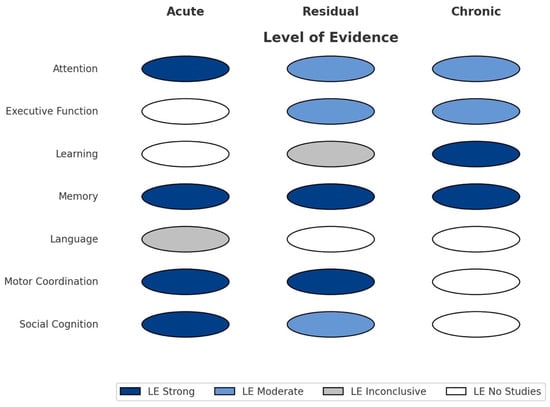
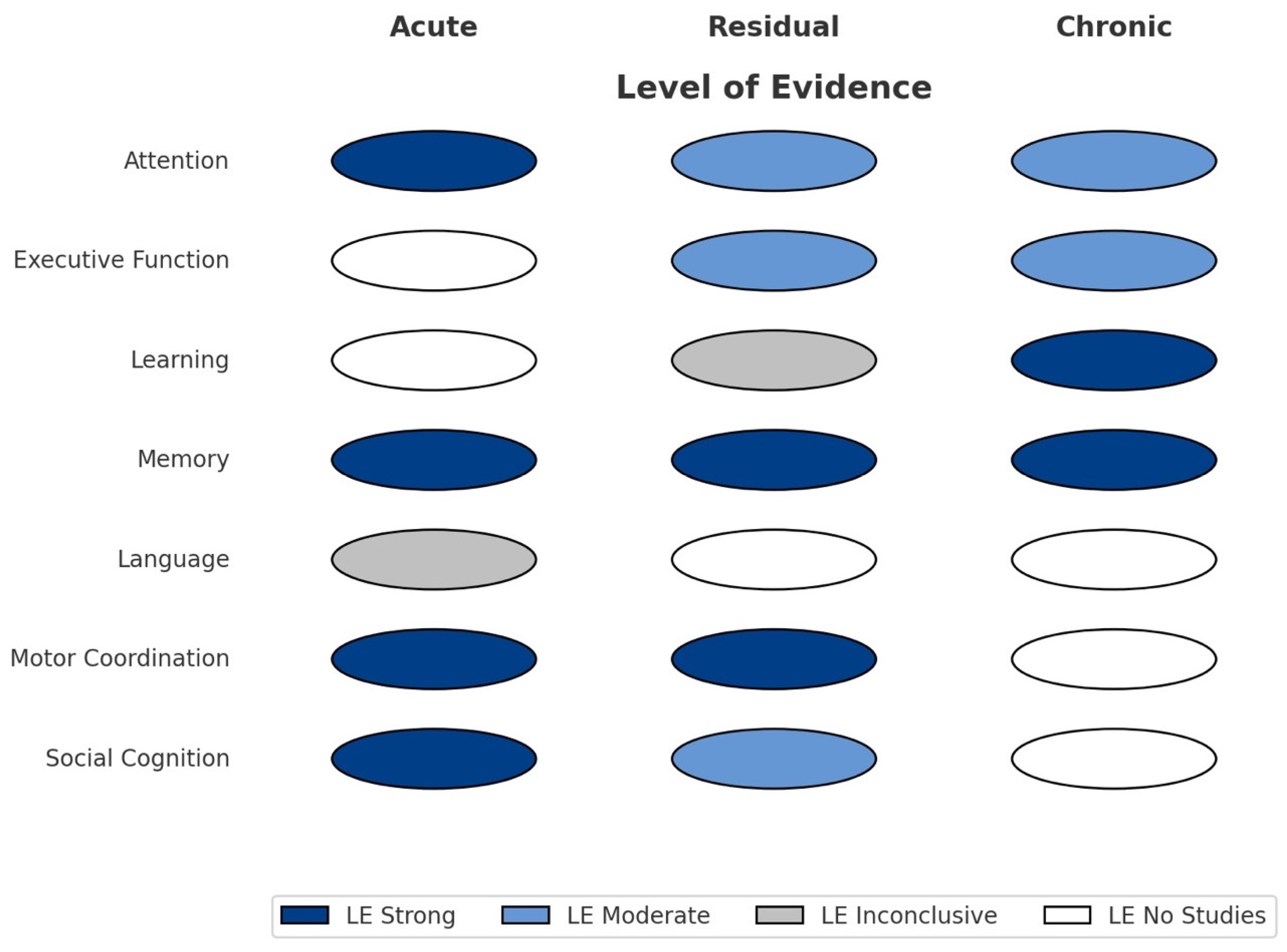
To visually summarize the patterns of cognitive impact associated with cannabis use, we developed a schematic overview (Figure 1) mapping the primary cognitive domains against the type of effect supported by the literature—acute, residual, or chronic. This figure reflects the heterogeneity of findings across domains, illustrating how certain cognitive functions, such as attention and memory, exhibit impairments across all levels of exposure, while others, like language or motor coordination, are predominantly linked to acute or residual effects. This mapping reinforces the importance of standardizing abstinence criteria and cognitive testing protocols in future research.
Figure 1.
Cannabis-related effects across cognitive domains, categorized by the level of evidence available. Each domain is marked to indicate whether the effects observed in the literature are predominantly acute, residual (i.e., short-term effects after recent use), or chronic (i.e., persistent effects after sustained abstinence).
Table 1 summarizes the characteristics and main findings of the main studies included in this comprehensive review.
Table 1.
Characteristics and main findings.
2. Attention
Several attentional processes are impaired by chronic cannabis use. Deficits in selective and divided attention have been shown to be related to the duration, frequency, and age of onset of cannabis consumption [19]. Thus, it is evident that users with a longer history of use have greater difficulty identifying irrelevant information. Moreover, early age of onset is considered a strong influence on the development of attention deficits in adulthood, even among light users [44].
The impact of chronic cannabis use on attentional domains has been investigated in several studies included in this review. Although some studies focused exclusively on the acute effects of the substance, there is evidence of chronic impairments in sustained and selective attention among frequent users. Messinis et al. (2006) [36] (chronic) identified significant deficits in sustained and alternating attention tasks in chronic users, even after a period of abstinence, suggesting lasting effects on these domains. Similarly, Gruber et al. (2012) [31] (chronic) observed that individuals who began cannabis use at an early age showed poorer performance on tasks requiring executive attention compared to late-onset users and healthy controls. For example, Anderson et al. (2010) [26] (acute), using the Stroop and UFOV tasks (Table 1), demonstrated acute impairments in divided and selective attention following cannabis administration. On the other hand, Hartley et al. (2019) [32] (residual) assessed occasional and chronic users in a simulated driving environment and found greater impairment in divided attention among chronic users, especially in tasks that required quick responses to simultaneous stimuli.
Böcker et al. (2010) [28] (acute) analyzed event-related potential (ERP) components and identified changes in selective attention among users exposed to cannabis rich in Δ9-THC. However, the study was limited to acute effects, with no assessment of long-term consequences. Finally, Fried et al. (2002) [30] (chronic/residual) reported associations between regular cannabis use and lower performance in composite cognitive tasks that included attention, although they did not isolate the attentional domain specifically.
While attention deficits are among the most frequently reported cognitive consequences of cannabis use, impairments in higher-order executive functions—such as planning, cognitive flexibility, and inhibitory control—may represent a distinct and potentially more persistent pattern of dysfunction. The next section explores evidence of such executive impairments.
3. Executive Function
Executive function appears to be diminished in cannabis users, particularly among those who began using the substance at an early age and who consume it frequently [45]. Cognitive flexibility, an executive function related to the ability to shift strategies according to changes in the surrounding environment, is found to be impaired in chronic cannabis users [46].
Several studies have reported impairments in executive functioning among chronic cannabis users. Frequent users show significantly poorer performance on tasks that require planning, reasoning, and inhibitory control, as identified by Valdiviezo et al. (2020) [40] (residual), even after adjusting for confounding variables such as educational attainment and socioeconomic status. These deficits were especially pronounced in verbal fluency tests and tasks involving cognitive flexibility. Messinis et al. (2006) [36] (chronic) observed significant impairments in planning ability and working memory among long-term users, as evidenced by poorer performance on the Wisconsin Card Sorting Test (WCST) and verbal learning tasks. Similarly, Gruber et al. (2012) [31] (chronic) reported that individuals who initiated cannabis use before the age of 16 exhibited more pronounced deficits in executive function compared to those who started later.
Impairments were detected in tasks such as the Wisconsin Card Sorting Test (WCST), semantic classification, and the Iowa Gambling Task (IGT), which assess cognitive flexibility and decision-making under risk (see Table 1). The study by Whitlow et al. (2004) [43] (residual) demonstrated impaired decision-making in heavy users, who were more likely to make disadvantageous choices in IGT.
4. Learning
Regarding learning, cannabis users exhibit a general decline in learning processes [47]. Studies have shown that individuals who use cannabis demonstrate deficits in motor learning, a fundamental skill for adapting to constantly changing environmental situations [48]. In addition, verbal learning is also reduced in frequent cannabis users, a condition that may worsen with continued use or improve with abstinence [49].
Schuster et al. (2018) [39] (residual/chronic) reported significant improvements in verbal learning after 30 days of abstinence, suggesting reversibility. In contrast, Messinis et al. (2006) [36] (chronic) found persistent learning impairments despite abstinence of up to 240 h. Learning impairments were measured using paired-associate tasks and pattern recognition tests, as summarized in Table 1. Evidence suggests that chronic cannabis use can compromise learning capacity, particularly in young users. Schuster et al. (2018) [39] (residual/chronic) demonstrated that adolescents and young adults who abstained from cannabis for one month showed significant improvement in verbal learning tests, suggesting a reversible effect linked to active use. Similarly, Fried et al. (2002) [30] (residual/chronic) reported that both current and former cannabis users performed worse on tasks related to the acquisition of new information compared to non-users, with more pronounced deficits among active users.
Moreover, Messinis et al. (2006) [36] (chronic) found that long-term frequent users had poorer results in tasks requiring paired-associate learning, indicating persistent deficits even in abstinent individuals. These findings were corroborated by Valdiviezo et al. (2020) [40] (residual), who observed impairments in tasks involving pattern learning and problem-solving among young male cannabis users. These data suggest an impairment in the acquisition of new information associated with chronic cannabis use, with evidence that abstinence may partially mitigate these negative effects.
5. Memory
Chronically, verbal memory appears to be impaired in long-term cannabis users, who show reduced performance in word learning tasks and exhibit deficits in encoding, storage, manipulation, and retrieval processes. As a result, chronic cannabis users tend to learn and recall fewer words. Working memory, which involves the temporary encoding and manipulation of information, is also impaired in different areas, such as visuospatial and auditory n-back tasks [50]. Memory deficits are assessed using tasks such as RAVLT for verbal memory, DRM for false memory susceptibility, and N-back for working memory (see Table 1). In addition, studies have shown that cannabis users are more likely to experience episodes of false memory, that is, recalling events that did not occur or remembering specific details [51].
Numerous studies have identified memory-related deficits associated with chronic cannabis use. The most reported impairments involve verbal and visual memory, as well as difficulties with the encoding and retrieval of information. One consistent finding concerns impairments in visual working memory. In a controlled study, regular cannabis users performed significantly worse on visual memory tasks compared to controls, even after a period of abstinence, suggesting a residual effect rather than solely an acute one [25] (residual). Verbal encoding impairments have also been observed in chronic users. Ranganathan et al. (2017) [37] (acute) found that users had lower accuracy in learning word lists, although retrieval of previously encoded information remained intact, indicating a specific impact on initial storage processes. Moreover, exposure to Δ9-THC has been linked to increased susceptibility to the formation of false memories. False memory effects were measured using the DRM paradigm and VR scenarios, showing increased susceptibility even after short abstinence (Table 1). Kloft et al. (2020) [33] (acute) reported that, even after a prolonged period of abstinence, regular users were more likely to accept incorrect information as true in experimental tasks, which may have important functional implications in clinical and legal contexts.
On the other hand, evidence suggests that prolonged abstinence can lead to improvements in memory performance. In a longitudinal study, Schuster et al. (2018) [39] (residual/chronic) demonstrated that young cannabis users showed significant improvement in both verbal and visual memory after 30 days of supervised abstinence, indicating that some deficits may be reversible.
6. Language
Language does not appear to be a cognitive domain significantly affected by cannabis use [52], and some studies even suggest greater verbal fluency among individuals who use cannabis compared to non-users [53]. The reviewed literature indicates that the chronic effects of cannabis use on language remain underexplored and uncertain. Only one older study [41] assessed language function in heavy users, with no significant differences. No recent studies with defined abstinence have focused on this domain. The study conducted by Weckowicz et al. (1977) [41] (acute) assessed cognitive functions in heavy cannabis users, including verbal tasks. The authors found no significant language deficits compared to non-users, although impairments were noted in other domains, such as attention and executive functions [41]. However, methodological limitations, such as small sample size and the study’s publication date, limit the strength of these conclusions.
Thus, the available findings do not allow for a definitive conclusion regarding the existence of chronic language impairments associated with cannabis use, highlighting the need for further studies using specific linguistic instruments to more accurately assess this cognitive domain. It is possible that language function, being more crystallized and less reliant on rapid information processing, may be relatively spared from chronic cannabis-related deficits.
7. Motor Coordination
During acute cannabis intoxication, users exhibit reduced motor function performance [28] (acute), and this deficit may persist for some time after chronic cannabis exposure [18] (residual). Cannabis users show slower reaction times and impaired motor control, with evidence indicating a dose-dependent relationship with the amount of THC consumed [54]. Motor coordination was assessed through driving simulation, virtual maze navigation, and reaction time tests (see Table 1).
The chronic effects of cannabis use on motor coordination were assessed in several studies included in this review, with results suggesting impairments in specific situations, particularly among frequent or heavy users. However, the distinction between acute and chronic effects is not always clearly defined in the investigations. The study conducted by Ramaekers et al. (2006) [18] (residual) evaluated motor performance in chronic cannabis users and demonstrated that, even after the acute effects had subsided, subtle alterations in motor coordination and reaction time persisted. These impairments correlated directly with serum THC levels and poorer performance in psychomotor tests. These findings are consistent with those of Weinstein et al. (2008) [42] (residual), who reported worse performance on motor coordination tests among regular users, beyond the acute intoxication phase. On the other hand, Hartley et al. (2019) [32] (residual) observed that chronic users, despite showing some tolerance to the acute effects of THC on vigilance and simulated driving, still exhibited an increased risk of accidents during tasks requiring fine motor coordination and sustained attention.
These findings suggest that chronic cannabis use may be associated with persistent, although subtle, deficits in motor coordination and psychomotor control, raising concerns for activities that demand high levels of motor precision, such as driving and operating machinery.
8. Social Cognition
Social cognition remains among the least studied domains in chronic cannabis users. Given that participants were under acute THC, the findings from Ballard (2012) [27] (acute) are considered illustrative of short-term effects and are not interpreted as evidence of chronic impairment. Tasks included facial emotion recognition, cause–effect reasoning, and social absurdity detection (Table 1).
Frequent cannabis users show impairments in facial recognition, suggesting deficits in affective processing [55]. However, occasional cannabis users demonstrate enhanced social cognition compared to non-users, while heavy users display social cognitive functioning similar to non-users. Moreover, cannabis use appears to impair emotion recognition, particularly of negative emotions [56]. In addition to recognition impairments, users also display attentional deficits toward emotionally charged stimuli [40] (residual), which may lead to inappropriate processing of context and daily life events and interactions. Although social cognition remains unexplored relative to other cognitive domains, emerging evidence points to specific deficits among regular users. For example, Valdiviezo et al. (2020) [40] assessed social cognition in young men with chronic cannabis use and found significant impairments in tasks related to theory of mind and emotion recognition, including facial emotion recognition, gaze direction interpretation, and inference of mental states [40].
These results suggest that chronic cannabis use may be associated with impairments in the ability to interpret and respond appropriately to social cues, potentially affecting the quality of interpersonal interactions.
9. Discussion
The findings of this systematic review reinforce the evidence that chronic cannabis use is associated with cognitive impairments across multiple domains, especially attention, executive function, memory, and learning. These deficits appear more consistently among users with early onset, frequent use patterns, and consumption of preparations with high concentrations of Δ9-tetrahydrocannabinol (THC), the main psychoactive component of the plant.
Sustained and selective attention were consistently impaired in chronic users, with significant functional impacts in tasks requiring prolonged vigilance, such as driving. Attentional deficits were frequently accompanied by alterations in executive functions, including planning, cognitive flexibility, and inhibitory control, suggesting a broader impairment of self-regulation and decision-making processes [31,40]. These findings are compatible with neuroimaging evidence showing structural and functional alterations in the prefrontal cortex and anterior cingulate gyrus in regular cannabis users [57].
Memory, particularly verbal and working memory, is particularly sensitive to the chronic effects of cannabis. Studies point to impairments in the encoding and storage of new information, with increased susceptibility to false memory formation even after prolonged periods of abstinence [33,37]. Although some of these effects may be reversible with cessation of use, as suggested by Schuster et al. (2018) [39], there is evidence of lasting deficits, especially among those who initiated use during adolescence. Functional MRI studies have shown reduced prefrontal activation and hippocampal volume in chronic users, aligning with behavioral findings of executive and memory deficits [57].
In the domain of learning, results converge toward the presence of deficits in both verbal and motor learning, with partial improvement observed after periods of abstinence. This pattern suggests a direct impact of the substance on circuits related to synaptic plasticity, particularly in the hippocampus and ventral striatum, regions rich in cannabinoid type 1 receptors (CB1). Reversibility appears more pronounced in learning and memory, especially among young abstinent users. However, persistent deficits remain in early-onset, long-term users.
Other domains, such as motor coordination and social cognition, have been less well explored, but available data suggest subtle and contextually relevant impairments. For example, chronic users showed poorer performance on psychomotor tests even after abstinence [18], with practical implications for activities requiring precision and quick reaction time. Regarding social cognition, deficits in facial emotion recognition and inference of mental states were observed, possibly related to altered affective processing in frequent users [40,56]. In contrast, the effects on language remain inconclusive, and further investigation with specific instruments and contemporary samples is needed.
From a methodological standpoint, it is important to note that most of the reviewed studies employed cross-sectional designs and convenience samples, limiting causal inference. However, longitudinal and twin studies suggest that cognitive deficits are unlikely to be solely explained by confounding factors such as social context or genetic predisposition [38]. The heterogeneity of samples, assessment tools, and definitions of abstinence also contributes to variations in findings and should be taken into account when interpreting results.
Another relevant point concerns the composition of cannabis used. THC levels have increased significantly in recent decades, while cannabidiol (CBD) has decreased in many recreational preparations [4]. Although CBD has been suggested as neuroprotective, the evidence remains preliminary and requires controlled trials. This shift may be amplifying adverse cognitive effects, reinforcing the need for studies evaluating the modulatory role of CBD.
Finally, the findings of this review have important implications for public policy and prevention strategies, especially those targeting adolescents and young adults. Given the association between early onset of use, high frequency, and greater severity of cognitive deficits, awareness campaigns and prevention programs should consider the potential impact of cannabis on neurodevelopment. Additionally, cannabis use in medical contexts should be carefully evaluated in terms of risk–benefit ratio, particularly in populations vulnerable from a neuropsychological perspective.
Most studies employed cross-sectional designs with convenience samples, limiting causal inference. Furthermore, variations in abstinence verification, cannabis potency, and assessment tools contribute to outcome heterogeneity. In addition, potential confounders such as polydrug use, psychiatric comorbidities, and socioeconomic status were inconsistently controlled across studies. Moreover, a particularly notable gap in the literature is the paucity of longitudinal studies with rigorous control of abstinence. Only a handful of investigations e.g., [30,49] have followed users over time to assess potential reversibility or progression of cognitive deficits. The field would benefit greatly from prospective cohort studies with clearly defined cannabis exposure profiles and extended periods of verified abstinence.
10. Conclusions
The data gathered in this review indicate that chronic cannabis use is associated with significant cognitive impairments, particularly in domains such as attention, executive function, memory, and learning. These effects are more pronounced among users with early onset, frequent use, and exposure to high-THC content. Although some deficits appear to be partially reversible with abstinence, others may persist over long periods, affecting individuals’ academic, occupational, and social functioning.
Despite consistent evidence in some domains, important gaps remain in the literature, including a lack of longitudinal studies, underexploration of domains such as language and social cognition, and limited methodological standardization. Furthermore, few studies account for relevant moderating variables, such as the role of cannabidiol (CBD), biological sex, or the presence of psychiatric comorbidities. These findings underscore the need for prevention strategies specifically aimed at adolescents and young adults, given the neurocognitive vulnerability of this age group. They also highlight the importance of a more balanced debate on the risks and benefits of medicinal and recreational cannabis use, grounded in solid scientific evidence.
Although impairments are consistently reported following recent use, the persistence of cognitive deficits after prolonged abstinence is less robustly supported and varies by domain and study design. Future research should prioritize longitudinal studies with strict abstinence verification to determine true chronic effects. In addition, there is a need for further studies with greater methodological rigor to assess the differential impact of THC and CBD concentrations and explore the neurobiological mechanisms underlying the observed deficits. Only through such efforts will it be possible to fully understand the cognitive consequences of chronic cannabis use and to guide evidence-based public policies, clinical practices, and educational strategies. Addressing these gaps will require longitudinal research with standardized cognitive assessments and carefully documented abstinence periods to better characterize the persistence and trajectory of cannabis-related cognitive changes.
Funding
This research was funded by Fundação de Amparo à Pesquisa do Estado de São Paulo (FAPESP), grant number 2023/08232-0 (PI: Castaldelli-Maia).
Conflicts of Interest
The authors declare no conflicts of interest. The funders had no role in the design of the study; in the collection, analysis, or interpretation of the data; in the writing of the manuscript; or in the decision to publish the results.
References
- Ren, M.; Tang, Z.; Wu, X.; Spengler, R.; Jiang, H.; Yang, Y.; Boivin, N. The origins of cannabis smoking: Chemical residue evidence from the first millennium BCE in the Pamirs. Sci. Adv. 2019, 5, eaaw1391. [Google Scholar] [CrossRef] [Scilit]
- Cerdá, M.; Mauro, C.; Hamilton, A.; Levy, N.S.; Santaella-Tenorio, J.; Hasin, D.; Wall, M.M.; Keyes, K.M.; Martins, S.S. Association Between Recreational Marijuana Legalization in the United States and Changes in Marijuana Use and Cannabis Use Disorder From 2008 to 2016. JAMA Psychiatry 2020, 77, 165–171. [Google Scholar] [CrossRef] [Scilit] [PubMed]
- Mennis, J.; McKeon, T.P.; Stahler, G.J. Recreational cannabis legalization alters associations among cannabis use, perception of risk, and cannabis use disorder treatment for adolescents and young adults. Addict. Behav. 2023, 138, 107552. [Google Scholar] [CrossRef] [Scilit] [PubMed]
- Kroon, E.; Kuhns, L.; Cousijn, J. The short-term and long-term effects of cannabis on cognition: Recent advances in the field. Curr. Opin. Psychol. 2021, 38, 49–55. [Google Scholar] [CrossRef] [Scilit] [PubMed]
- Radwan, M.M.; Chandra, S.; Gul, S.; ElSohly, M.A. Cannabinoids, Phenolics, Terpenes and Alkaloids of Cannabis. Molecules 2021, 26, 2774. [Google Scholar] [CrossRef] [Scilit]
- Englund, A.; Morrison, P.D.; Nottage, J.; Hague, D.; Kane, F.; Bonaccorso, S.; Stone, J.M.; Reichenberg, A.; Brenneisen, R.; Holt, D.; et al. Cannabidiol inhibits THC-elicited paranoid symptoms and hippocampal-dependent memory impairment. J. Psychopharmacol. 2012, 27, 19–27. [Google Scholar] [CrossRef] [Scilit]
- Volkow, N.D.; Hampson, A.J.; Baler, R.D. Don’t worry, be happy: Endocannabinoids and cannabis at the intersection of stress and reward. Annu. Rev. Pharmacol. Toxicol. 2017, 57, 285–308. [Google Scholar] [CrossRef] [Scilit]
- Lafaye, G.; Karila, L.; Blecha, L.; Benyamina, A. Cannabis, cannabinoids, and health. Dialogues Clin. Neurosci. 2017, 19, 309–316. [Google Scholar] [CrossRef] [Scilit]
- World Health Organization. The Health and Social Effects of Nonmedical Cannabis Use; World Health Organization: Geneva, Switzerland, 2016; Available online: https://www.who.int/publications/i/item/9789241510240 (accessed on 15 January 2025).
- World Health Organization. The ICD-10 Classification of Mental and Behavioural Disorders: Clinical Descriptions and Diagnostic Guidelines. 1992. Available online: https://apps.who.int/iris/handle/10665/37958 (accessed on 13 January 2025).
- World Health Organization. Alcohol, Drugs and Addictive Behaviours Unit. World Health Organization. (n.d.) Available online: https://www.who.int/teams/mental-health-and-substance-use/alcohol-drugs-and-addictive-behaviours/drugs-psychoactive/cannabis (accessed on 2 April 2025).
- American Psychiatric Association. Diagnostic and Statistical Manual of Mental Disorders, 5th ed.; American Psychiatric Association: Arlington, VA, USA, 2013. [Google Scholar] [CrossRef] [Scilit]
- Gerra, M.C.; Manfredini, M.; Cortese, E.; Antonioni, M.C.; Leonardi, C.; Magnelli, F.; Somaini, L.; Jayanthi, S.; Cadet, J.L.; Donnini, C. Genetic and Environmental Risk Factors for Cannabis Use: Preliminary Results for the Role of Parental Care Perception. Subst. Use Misuse 2019, 54, 670–680. [Google Scholar] [CrossRef] [Scilit]
- Badiani, A.; Boden, J.M.; De Pirro, S.; Fergusson, D.M.; Horwood, L.J.; Harold, G.T. Tobacco smoking and cannabis use in a longitudinal birth cohort: Evidence of reciprocal causal relationships. Drug Alcohol Depend. 2015, 150, 69–76. [Google Scholar] [CrossRef] [Scilit]
- Galimberti, M.; Levey, D.F.; Deak, J.D.; Zhou, H.; Stein, M.B.; Gelernter, J. Genetic influences and causal pathways shared between cannabis use disorder and other substance use traits. Mol. Psychiatry 2024, 29, 2905–2910. [Google Scholar] [CrossRef] [Scilit]
- Hayatbakhsh, M.R.; Najman, J.M.; Bor, W.; O’CAllaghan, M.J.; Williams, G.M. Multiple risk factor model predicting cannabis use and use disorders: A longitudinal study. Am. J. Drug Alcohol Abus. 2009, 35, 399–407. [Google Scholar] [CrossRef] [Scilit] [PubMed]
- Matheson, J.; Le Foll, B. Impacts of recreational cannabis legalization on use and harms: A narrative review of sex/gender differences. Front. Psychiatry 2023, 14, 1127660. [Google Scholar] [CrossRef] [Scilit] [PubMed]
- Ramaekers, J.G.; Kauert, G.; Theunissen, E.L.; Toennes, S.W.; Moeller, M.R. High-potency marijuana impairs executive function and inhibitory motor control. Neuropsychopharmacology 2006, 34, 1905–1913. [Google Scholar] [CrossRef] [Scilit] [PubMed]
- Crean, R.D.; Crane, N.A.B.; Mason, B.J. An evidence-based review of acute and long-term effects of cannabis use on executive cognitive functions. J. Addict. Med. 2011, 5, 1–8. [Google Scholar] [CrossRef] [Scilit]
- Volkow, N.D.; Baler, R.D.; Compton, W.M.; Weiss, S.R. Adverse health effects of marijuana use. N. Engl. J. Med. 2014, 370, 2219–2227. [Google Scholar] [CrossRef] [Scilit]
- Broyd, S.J.; van Hell, H.H.; Beale, C.; Yücel, M.; Solowij, N. Acute and chronic effects of cannabinoids on human cognition: A systematic review. Biol. Psychiatry 2016, 79, 557–567. [Google Scholar] [CrossRef] [Scilit]
- Scott, J.C.; Slomiak, S.T.; Jones, J.D.; Rosen, A.F.G.; Moore, T.M.; Gur, R.C. Association of Cannabis with Cognitive Functioning in Adolescents and Young Adults: A Systematic Review and Meta-analysis. JAMA Psychiatry 2018, 75, 585–595. [Google Scholar] [CrossRef] [Scilit]
- Figueiredo, P.R.; Tolomeo, S.; Steele, J.D.; Baldacchino, A. Neurocognitive consequences of chronic cannabis use: A systematic review and meta-analysis. Neurosci. Biobehav. Rev. 2020, 108, 358–369. [Google Scholar] [CrossRef] [Scilit]
- Pocuca, N.; Walter, T.J.; Minassian, A.; Young, J.W.; Geyer, M.A.; Perry, W. The Effects of Cannabis Use on Cognitive Function in Healthy Aging: A Systematic Scoping Review. Arch. Clin. Neuropsychol. 2021, 36, 673–685. [Google Scholar] [CrossRef] [Scilit]
- Adam, K.C.S.; Doss, M.K.; Pabon, E.; Vogel, E.K.; de Wit, H. Δ9-Tetrahydrocannabinol (THC) impairs visual working memory performance: A randomized crossover trial. Neuropsychopharmacology 2020, 45, 1807–1816. [Google Scholar] [CrossRef] [Scilit]
- Anderson, B.M.; Rizzo, M.; Block, R.I.; Pearlson, G.D.; O’Leary, D.S. Sex, drugs, and cognition: Effects of marijuana. J. Psychoact. Drugs 2010, 42, 413–424. [Google Scholar] [CrossRef] [Scilit] [PubMed]
- Ballard, M.E.; Bedi, G.; de Wit, H. Effects of delta-9-tetrahydrocannabinol on evaluation of emotional images. J. Psychopharmacol. 2012, 26, 1289–1298. [Google Scholar] [CrossRef] [Scilit] [PubMed]
- Böcker, K.B.E.; Gerritsen, J.; Hunault, C.C.; Kruidenier, M.; Mensinga, T.T.; Kenemans, J.L. Cannabis with high Δ9-THC contents affects perception and visual selective attention acutely: An event-related potential study. Pharmacol. Biochem. Behav. 2010, 96, 67–74. [Google Scholar] [CrossRef] [Scilit]
- Doss, M.K.; Weafer, J.; Gallo, D.A.; de Wit, H. Tetrahydrocannabinol at Retrieval Drives False Recollection of Neutral and Emotional Memories. Biol. Psychiatry. 2018, 84, 743–750. [Google Scholar] [CrossRef] [Scilit]
- Fried, P.; Watkinson, B.; James, D.; Gray, R. Current and former marijuana use: Preliminary findings of a longitudinal study of effects on IQ in young adults. Can. Med. Assoc. J. 2002, 166, 887–891. [Google Scholar]
- Gruber, S.A.; Sagar, K.A.; Dahlgren, M.K.; Racine, M.; Lukas, S.E. Age of onset of marijuana use and executive function. Psychol. Addict. Behav. 2012, 26, 496–506. [Google Scholar] [CrossRef] [Scilit]
- Hartley, S.; Simon, N.; Larabi, A.; Vaugier, I.; Barbot, F.; Quera-Salva, M.-A.; Alvarez, J.C. Effect of Smoked Cannabis on Vigilance and Accident Risk Using Simulated Driving in Occasional and Chronic Users and the Pharmacokinetic-Pharmacodynamic Relationship. Clin. Chem. 2019, 65, 684–693. [Google Scholar] [CrossRef] [Scilit]
- Kloft, L.; Otgaar, H.; Lynn, S.J.; Ramaekers, J.G.; Monds, L.A.; Merckelbach, H. Cannabis increases susceptibility to false memory. Proc. Natl. Acad. Sci. USA 2020, 117, 943–947. [Google Scholar] [CrossRef] [Scilit]
- Matheson, J.; Sproule, B.; Di Ciano, P.; Fares, A.; Le Foll, B. Acute and residual mood and cognitive performance of young adults following smoked cannabis. Pharmacol. Biochem. Behav. 2020, 194, 172937. [Google Scholar] [CrossRef] [Scilit]
- McClure, E.A.; Lydiard, J.B.; Goddard, S.D.; Gray, K.M. Objective and subjective memory ratings in cannabis-dependent adolescents. Am. J. Addict. 2015, 24, 47–52. [Google Scholar] [CrossRef]
- Messinis, L.; Kyprianidou, A.; Malefaki, S.; Papathanasopoulos, P. Neuropsychological deficits in long-term frequent cannabis users. Neurology 2006, 66, 737–739. [Google Scholar] [CrossRef] [Scilit]
- Ranganathan, M.; Radhakrishnan, R.; Addy, P.H.; Schnakenberg-Martin, A.M.; Williams, A.H.; Carbuto, M.; Elander, J.; Pittman, B.; Sewell, R.A.; Skosnik, P.D.; et al. Tetrahydrocannabinol (THC) impairs encoding but not retrieval of verbal information. Prog. Neuro-Psychopharmacol. Biol. Psychiatry 2017, 79 Pt B, 176–183. [Google Scholar] [CrossRef] [Scilit]
- Ross, J.M.; Ellingson, J.M.; Rhee, S.H.; Hewitt, J.K.; Corley, R.P.; Lessem, J.M.; Friedman, N.P. Investigating the causal effect of cannabis use on cognitive function with a quasi-experimental co-twin design. Drug Alcohol Depend. 2020, 206, 107712. [Google Scholar] [CrossRef] [Scilit]
- Schuster, R.M.; Gilman, J.; Schoenfeld, D.; Evenden, J.; Hareli, M.; Ulysse, C.; Nip, E.; Hanly, A.; Zhang, H.; Evins, A.E. One month of cannabis abstinence in adolescents and young adults is associated with improved memory. J. Clin. Psychiatry 2018, 79, 18m12138. [Google Scholar] [CrossRef] [Scilit]
- Valdiviezo, J.J.; Ramírez Flores, M.J.; Chainé, S.M. Cognición social y funcionamiento ejecutivo en hombres jóvenes con consumo de marihuana. Rev. Chil. De Neuropsicol. 2020, 15, 8–13. [Google Scholar] [CrossRef]
- Weckowicz, T.E.; Collier, G.; Spreng, L. Field dependence, cognitive functions, personality traits, and social values in heavy cannabis users and nonuser controls. Psychol. Rep. 1977, 41, 291–302. [Google Scholar] [CrossRef] [Scilit] [PubMed]
- Weinstein, A.; Brickner, O.; Lerman, H.; Greemland, M.; Bloch, M.; Lester, H.; Chisin, R.; Sarne, Y.; Mechoulam, R.; Bar-Hamburger, R.; et al. A study investigating the acute dose-response effects of 13 mg and 17 mg Delta 9- tetrahydrocannabinol on cognitive-motor skills, subjective and autonomic measures in regular users of marijuana. J. Psychopharmacol. 2008, 22, 441–451. [Google Scholar] [CrossRef] [Scilit] [PubMed]
- Whitlow, C.T.; Liguori, A.; Livengood, L.B.; Hart, S.L.; Mussat-Whitlow, B.J.; Lamborn, C.M.; Laurienti, P.J.; Porrino, L.J. Long-term heavy marijuana users make costly decisions on a gambling task. Drug Alcohol Depend. 2004, 76, 107–111. [Google Scholar] [CrossRef] [Scilit] [PubMed]
- Solowij, N.; Pesa, N. Anormalidades cognitivas no uso da cannabis [Cognitive abnormalities and cannabis use]. Braz. J. Psychiatry 2010, 32 (Suppl. 1), S31–S40. [Google Scholar] [CrossRef] [Scilit]
- Gorey, C.; Kuhns, L.; Smaragdi, E.; Kroon, E.; Cousijn, J. Age-related differences in the impact of cannabis use on the brain and cognition: A systematic review. Eur. Arch. Psychiatry Clin. Neurosci. 2019, 269, 37–58. [Google Scholar] [CrossRef] [Scilit] [PubMed]
- Nusbaum, A.T.; Whitney, P.; Cuttler, C.; Spradlin, A.; Hinson, J.M.; McLaughlin, R.J. Altered attentional control strategies but spared executive functioning in chronic cannabis users. Drug Alcohol Depend. 2017, 181, 116–123. [Google Scholar] [CrossRef] [Scilit] [PubMed]
- Lovell, M.E.; Bruno, R.; Johnston, J.; Matthews, A.; McGregor, I.; Allsop, D.J.; Lintzeris, N. Cognitive, physical, and mental health outcomes between long-term cannabis and tobacco users. Addict. Behav. 2018, 79, 178–188. [Google Scholar] [CrossRef] [Scilit] [PubMed]
- Prashad, S.; Filbey, F.M. Cognitive motor deficits in cannabis users. Curr. Opin. Behav. Sci. 2017, 13, 1–7. [Google Scholar] [CrossRef] [Scilit]
- Ajmera, N.; Collins, P.F.; Weiss, H.; Luciana, M. Initiation of moderately frequent cannabis use in adolescence and young adulthood is associated with declines in verbal learning and memory: A longitudinal comparison of pre- versus post-initiation cognitive performance. J. Int. Neuropsychol. Soc. 2021, 27, 621–636. [Google Scholar] [CrossRef] [Scilit]
- Schreiner, A.M.; Dunn, M.E. Residual effects of cannabis use on neurocognitive performance after prolonged abstinence: A meta-analysis. Exp. Clin. Psychopharmacol. 2012, 20, 420–429. [Google Scholar] [CrossRef] [Scilit]
- Riba, J.; Valle, M.; Sampedro, F.; Rodríguez-Pujadas, A.; Martínez-Horta, S.; Kulisevsky, J.; Rodríguez-Fornells, A. Telling true from false: Cannabis users show increased susceptibility to false memories. Mol. Psychiatry 2015, 20, 772–777. [Google Scholar] [CrossRef] [Scilit]
- Roten, A.; Baker, N.L.; Gray, K.M. Cognitive performance in a placebo-controlled pharmacotherapy trial for youth with marijuana dependence. Addict. Behav. 2015, 45, 119–123. [Google Scholar] [CrossRef] [Scilit]
- Becker, M.P.; Collins, P.F.; Luciana, M. Neurocognition in college-aged daily marijuana users. J. Clin. Exp. Neuropsychol. 2014, 36, 379–398. [Google Scholar] [CrossRef] [Scilit]
- Hunault, C.C.; Mensinga, T.T.; Böcker, K.B.E.; Schipper, C.M.A.; Kruidenier, M.; Leenders, M.E.C.; de Vries, I.; Meulenbelt, J. Cognitive and psychomotor effects in males after smoking a combination of tobacco and cannabis containing up to 69 mg delta-9-tetrahydrocannabinol (THC). Psychopharmacology 2009, 204, 85–94. [Google Scholar] [CrossRef] [Scilit]
- Scott, J.C.; Wolf, D.H.; Calkins, M.E.; Bach, E.C.; Weidner, J.; Ruparel, K.; Moore, T.M.; Jones, J.D.; Jackson, C.T.; Gur, R.E.; et al. Cognitive functioning of adolescent and young adult cannabis users in the Philadelphia Neurodevelopmental Cohort. Psychol. Addict. Behav. 2017, 31, 423–434. [Google Scholar] [CrossRef] [Scilit]
- Kroon, E.; Kuhns, L.; Hoch, E.; Cousijn, J. Heavy cannabis use, dependence and the brain: A clinical perspective. Addiction 2020, 115, 559–572. [Google Scholar] [CrossRef] [Scilit]
- Batalla, A.; Bhattacharyya, S.; Yücel, M.; Fusar-Poli, P.; Crippa, J.A.; Nogué, S.; Torrens, M.; Pujol, J.; Farré, M.; Martin-Santos, R.; et al. Structural and functional imaging studies in chronic cannabis users: A systematic review of adolescent and adult findings. PLoS ONE 2013, 8, e55821. [Google Scholar] [CrossRef] [Scilit]

Disclaimer/Publisher’s Note: The statements, opinions and data contained in all publications are solely those of the individual author(s) and contributor(s) and not of MDPI and/or the editor(s). MDPI and/or the editor(s) disclaim responsibility for any injury to people or property resulting from any ideas, methods, instructions or products referred to in the content. |
© 2025 by the authors. Licensee MDPI, Basel, Switzerland. This article is an open access article distributed under the terms and conditions of the Creative Commons Attribution (CC BY) license (https://creativecommons.org/licenses/by/4.0/).