
Vehicle-to-Grid Systems for Renewable Energy Integration: Scheduling, Economics, and User Engagement





Abstract
1. Introduction
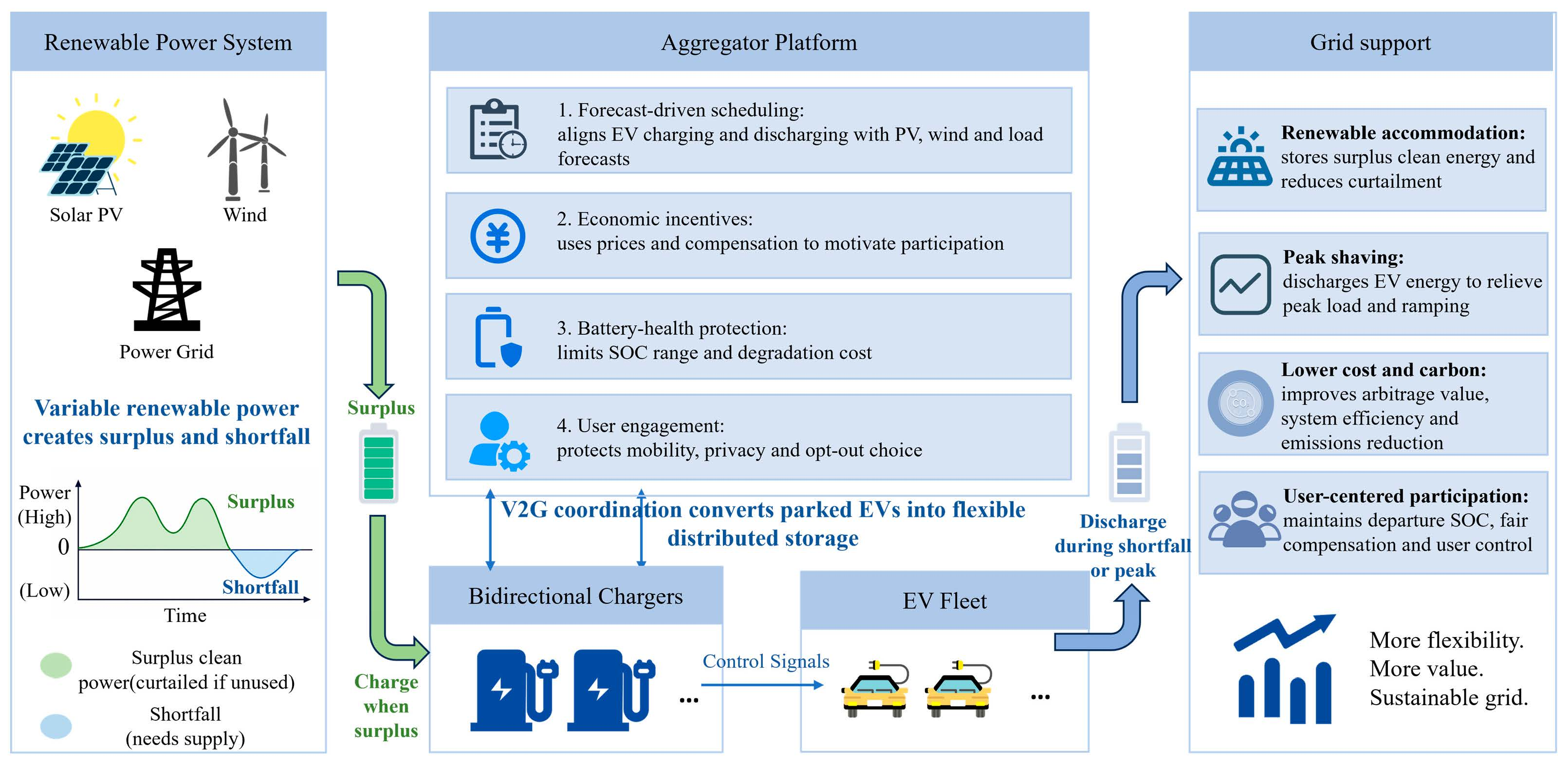
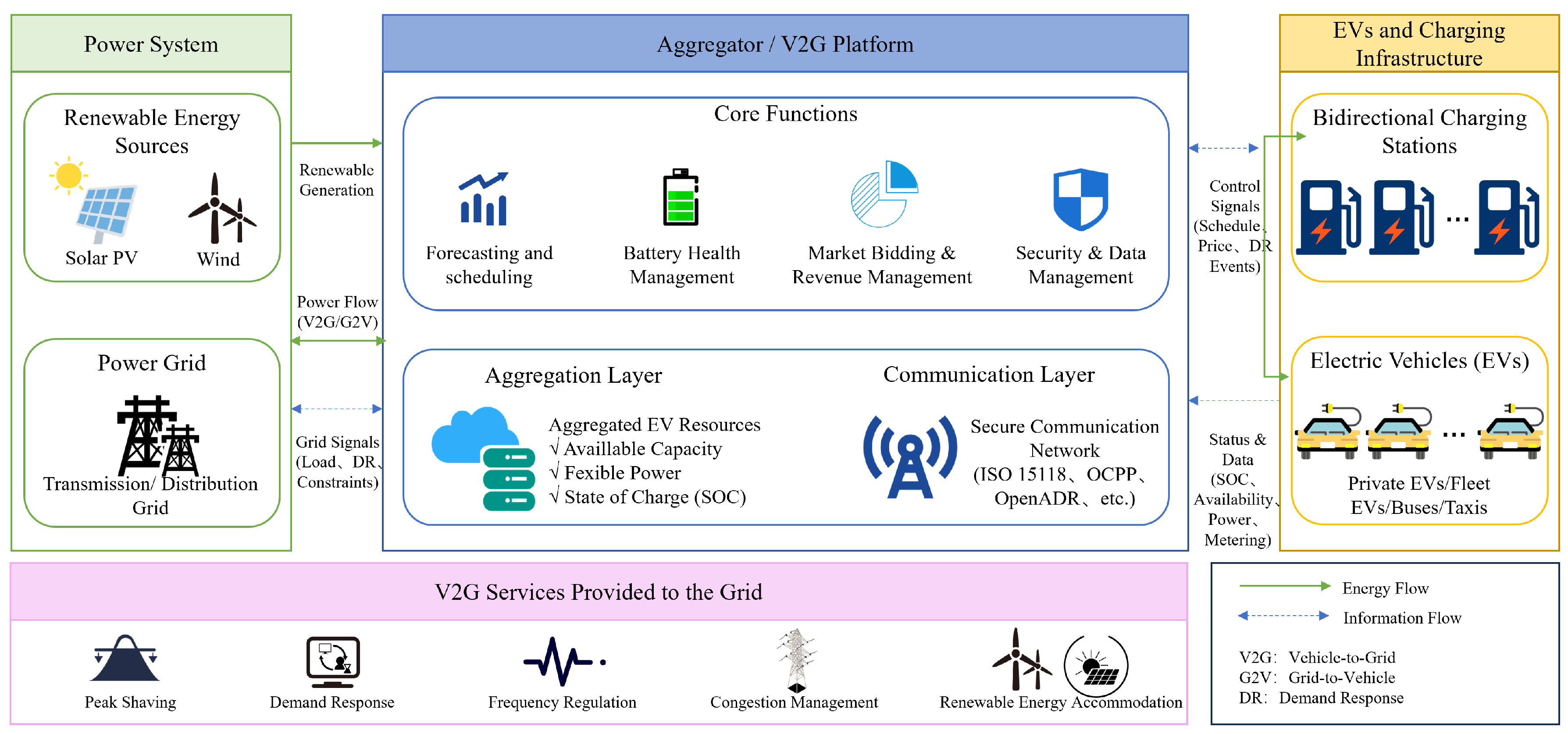
- Explanation of the technical foundation of V2G systems and how bidirectional charging, aggregation, and grid interaction enable electric vehicles to support the integration of renewable energy.
- Review and comparison of the main V2G scheduling strategies, including price based, load based, renewable energy prediction driven, centralized, and distributed methods.
- Analysis of the economic and behavioral factors that affect V2G deployment, including revenue streams, battery degradation costs, stakeholder business models, compensation mechanisms, and user engagement barriers.
- An integrated framework that links scheduling strategies, economic mechanisms, battery degradation, and user engagement for renewable energy-rich power systems.

| Ref. | Year | Main Contribution | Identified Gaps |
|---|---|---|---|
| [12] | 2021 | Reviewed V2G implementation, grid impacts, renewable energy and smart-grid integration, and scholarly literature and projects. | Although it covered V2G implementation, renewable energy and smart grid integration, and related projects, it failed to systematically integrate scheduling strategies, economics, battery degradation, user participation, standards/interoperability, or future directions. |
| [18] | 2021 | Developed a stochastic optimization framework for optimal scheduling of EV charging/discharging power and user patterns in V2G systems. | Focused on random scheduling of electric vehicle charging/discharging power and user modes but did not account for renewable energy integration, economy, battery degradation, or standards/interoperability. |
| [27] | 2022 | Reviewed EV integration and V2G operation in active distribution grids, including power architectures, grid connection standards, and typical applications. | Reviewed EV integration and V2G operation in active distribution grids, including power architectures, grid connection standards, and typical applications, but economics, battery degradation, user participation, and renewable-energy-oriented scheduling were not systematically synthesized. |
| [19] | 2022 | Presented a comprehensive state-of-the-art review of EV smart charging, systematically categorizing and summarizing relevant solutions, scheduling strategies and key enabling technologies. | Although this review systematically summarizes EV smart charging solutions, scheduling strategies, and enabling technologies, its emphasis is mainly on smart charging rather than bidirectional V2G operation. Economics, battery degradation, user participation, standards/interoperability, and future development directions are not integrated within a renewable-energy-centered V2G framework. |
| [20] | 2022 | Reviewed V2G connected technologies and charging strategies, including operational principles, control approaches, key challenges, and optimization recommendations. | It covered V2G related technologies, charging strategies, control methods, challenges, and optimization suggestions but did not discuss renewable energy integration, economics, battery degradation, user participation, or interoperability issues. |
| [28] | 2022 | Systematically reviewed international and regional standards and best practices for EV charging station-utility grid integration. | This work provided a valuable review of standards and best practices for EV charging station–utility grid integration. However, its main focus was on grid-integration standards and technical requirements, while renewable-energy-oriented V2G scheduling, economics, battery degradation, user participation, and future deployment directions were not systematically compared. |
| [13] | 2022 | Reviewed the progress and perspectives of using EVs for V2G services, including grid services, aggregation, challenges, and market penetration. | Reviewed V2G services, aggregation, challenges, and market penetration, but scheduling strategies, economics, battery degradation, and user participation were not systematically connected within a renewable-energy-centered framework. |
| [21] | 2023 | Studied charging-dispatch strategies and V2G technologies for EVs in distribution networks. | Focused on charging-dispatch strategies and V2G technologies for EVs in distribution networks, but economics, degradation-aware compensation, user participation, standards/interoperability, and renewable-energy-centered deployment pathways were not comprehensively compared. |
| [22] | 2023 | Investigated charging/discharging control of aggregated EVs for frequency regulation and discussed its contribution to V2G-based grid-support services. | This work contributed to charging/discharging control for aggregated EVs in frequency regulation. However, it focused on a specific grid-service application and did not systematically address renewable energy integration, broader scheduling strategies, economics, battery degradation, user participation, standards/interoperability, or future development directions. |
| [24] | 2023 | Explored the economic potential of V2G applications in the electricity market. | Explored the economic potential of V2G application in the electricity market but did not integrate the scheduling of renewable energy, the impact of battery degradation on net economic returns, or user participation. |
| [2] | 2023 | Reviewed renewable-energy-enabled EV charging infrastructure, smart charging approaches, utility interests, and technical challenges. | Reviewed the charging infrastructure, intelligent charging methods, and technical challenges of electric vehicles driven by renewable energy, but bidirectional V2G discharge, economy, and battery degradation have not been systematically integrated as interrelated V2G deployment factors. |
| [29] | 2023 | Systematically reviewed and classified bidirectional converter topologies for V2G systems, analyzing their operational principles, performance characteristics and application suitability. | Focused on bidirectional converter topologies for V2G systems and their operational principles, performance characteristics, and application suitability. |
| [14] | 2024 | Reviewed EV charging technology, grid integration impacts, policies, challenges, and future trends. | Reviewed EV charging technology, grid integration impacts, policies, challenges, and future trends, but renewable-energy-oriented V2G scheduling, economic compensation, battery degradation, user participation, and interoperability were not systematically compared within one integrated framework. |
| [30] | 2024 | Critical review and classification of mainstream power electronic interface topologies for V2G technology. | Focused on power electronic interface topologies for V2G technology. |
| [25] | 2024 | Reviewed V2G applications and battery cycle aging, including aging mechanisms, degradation models, simulations, and mitigation strategies. | Provided a battery-centered review of V2G applications and cycle aging, including aging mechanisms, degradation models, simulations, and mitigation strategies. |
| [26] | 2024 | Investigated EV integration optimization with V2G technology, exploring the effects of price disparity and battery costs on market adoption, economic profits and green energy utilization. | Investigated EV integration optimization with V2G, including price disparity, battery costs, market adoption, economic profits, and green energy utilization, but user participation, standards/interoperability, and broader future deployment directions were not systematically reviewed. |
| [15] | 2024 | Reviewed V2G integration schemes for power grid security enhancement, including grid stability regulation, emergency support and load balancing strategies. | Reviewed V2G integration solutions for enhancing grid security, including grid stability regulation, emergency support, and load balancing but did not consider economics, battery degradation, user engagement, or renewable-energy-centric dispatch strategies. |
| [16] | 2025 | Reviewed the technological advancements, practical challenges, and developmental future trends of V2G systems covering core technologies, application scenarios and research hotspots. | Reviewed the progress, application scenarios, practical challenges, and research hotspots of V2G technology but did not consider the integration with renewable energy, economy, battery degradation, and user participation. |
| [23] | 2025 | Explored the optimization of V2G systems using artificial bee colony algorithm, including system modeling, multi-objective scheduling and algorithm performance verification. | Focused on optimization of V2G systems using an artificial bee colony algorithm, including system modeling, multi-objective scheduling, and algorithm performance verification, but economics, battery degradation compensation, user participation, standards/interoperability, and practical deployment readiness were not comprehensively reviewed. |
| [17] | 2025 | Reviewed a decade of V2G research progress and key achievements, including technical evolution, application scenarios, research hotspots and future development directions. | Reviewed a decade of V2G research progress, technical evolution, application scenarios, research hotspots, and future development directions, but renewable-energy-centered scheduling, economic mechanisms, degradation-aware compensation, user participation, and standards/interoperability were not integrated into one comparative framework. |
| [31] | 2026 | Reviewed EV behavior modeling for V2G integration, including modeling methodologies, practical challenges, and future research perspectives. | Focused on EV behavior modeling for V2G integration, including modeling methodologies, practical challenges, and future research perspectives, but renewable energy integration, scheduling strategies, economics, battery degradation, standards/interoperability, and grid-service deployment were not comprehensively compared. |
| [32] | 2026 | Established a reliability assessment framework for V2G systems integrated with performance sharing. | Focused on reliability assessment of V2G systems integrated with performance sharing, but renewable energy integration, scheduling strategies, economics, battery degradation, user participation, standards/interoperability, and broader future directions were outside the main scope. |
| This review | 2026 | Provides an integrated review of V2G systems for renewable energy integration, linking scheduling strategies, economic mechanisms, battery degradation, user participation, standards/interoperability, and future development directions. | Unlike prior publications that mainly focused on one or several separate dimensions, this review organized these elements into an integrated deployment-oriented framework for renewable-rich power systems. |
2. V2G Fundamentals and Renewable Energy Integration
2.1. Vehicle-to-Everything Modes and Bidirectional Charging
2.2. V2G System Architecture
2.3. V2G Services for Grid Support
2.4. V2G Mechanisms for Renewable Accommodation
3. Coordinated Scheduling Strategies
3.1. Price and Load-Based Scheduling
3.2. Renewable Forecasting-Driven Scheduling
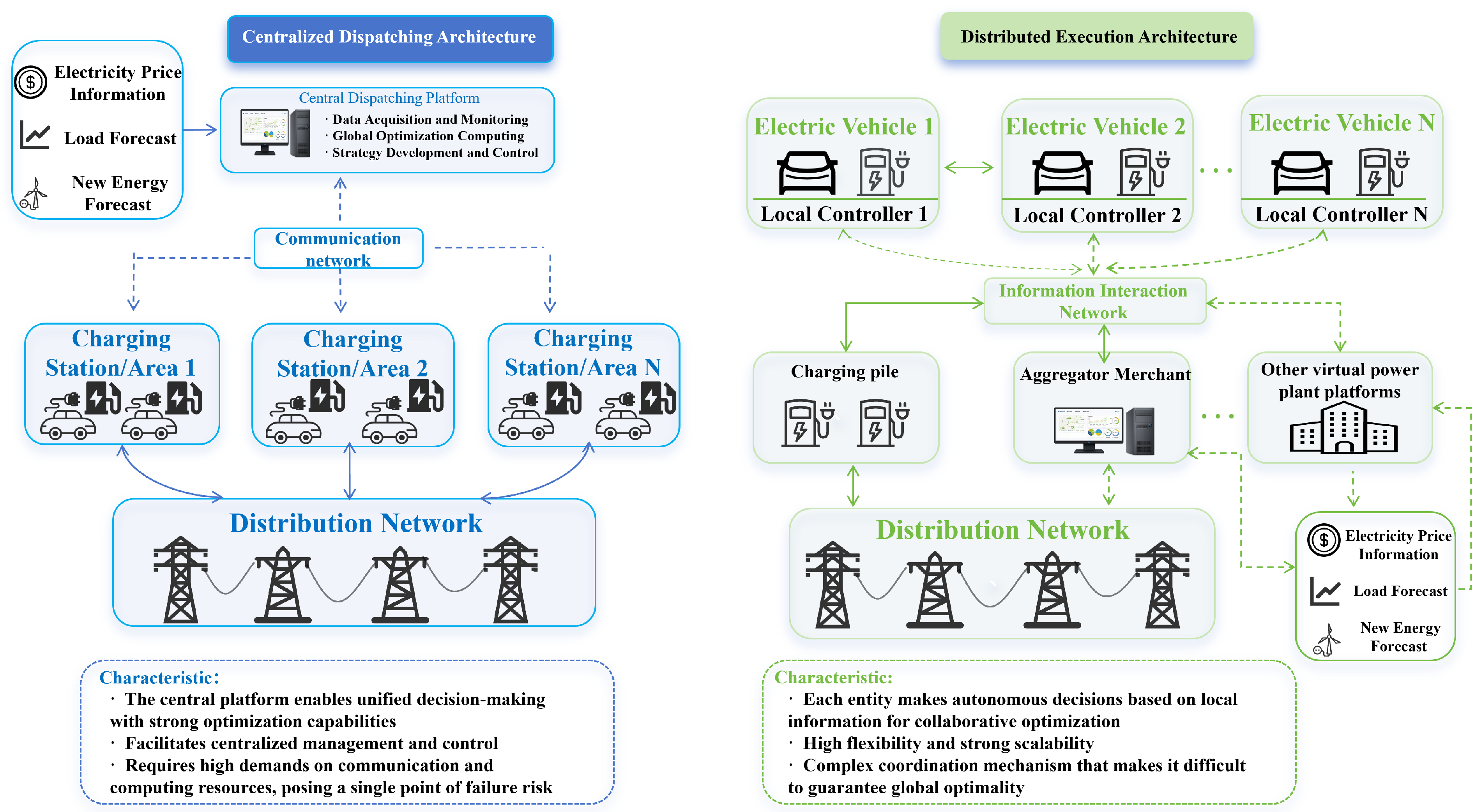
3.3. Centralized vs. Distributed Scheduling
3.4. Optimization Methodologies for V2G Scheduling
4. Economic Incentives, User Participation and Battery Considerations
4.1. V2G Revenue Sources and Pricing
4.2. Battery Degradation Cost and Compensation
4.3. Business Models for Stakeholders
4.4. User Concerns and Participation Behavior
5. Standards, Challenges and Future Directions
5.1. V2G Communication and Key Standards
5.2. Regulatory and Regional Implementation Considerations
5.3. Critical Challenges for Deployment
5.4. Future Development Directions
6. Conclusions
Author Contributions
Funding
Data Availability Statement
Conflicts of Interest
References
- Ahmed, F.; Ahmad, S.; Rahman, M.T.; Hazari, M.R.; Faiz, R.; Ahmed, T.; Karimi, M. A holistic review of electric vehicle charging impacts on power distribution networks: Technical challenges, smart mitigation strategies and future directions. Appl. Energy 2026, 402, 126961. [Google Scholar] [CrossRef] [Scilit]
- Barman, P.; Dutta, L.; Bordoloi, S.; Kalita, A.; Buragohain, P.; Bharali, S.; Azzopardi, B. Renewable energy integration with electric vehicle technology: A review of the existing smart charging approaches. Renew. Sustain. Energy Rev. 2023, 183, 113518. [Google Scholar] [CrossRef] [Scilit]
- Mohsenimanesh, A.; McNevin, C.; Entchev, E. EV and Renewable Energy Integration in Residential Buildings: A Global Perspective on Deep Learning, Strategies, and Challenges. World Electr. Veh. J. 2025, 16, 603. [Google Scholar] [CrossRef] [Scilit]
- Meraj, S.; Mekhilef, S.; Binti Mubin, M.; Ramiah, H.; Seyedmahmoudian, M.; Stojcevski, A. Bidirectional Wireless Charging System for Electric Vehicles: A Review of Power Converters and Control Techniques in V2G Application. IEEE Access 2025, 13, 75246–75264. [Google Scholar] [CrossRef] [Scilit]
- Panossian, N.; Muratori, M.; Palmintier, B.; Meintz, A.; Lipman, T.; Moffat, K. Challenges and opportunities of integrating electric vehicles in electricity distribution systems. Curr. Sustain. Energy Rep. 2022, 9, 27–40. [Google Scholar] [CrossRef] [Scilit]
- Mojumder, M.R.H.; Ahmed Antara, F.; Hasanuzzaman, M.; Alamri, B.; Alsharef, M. Electric Vehicle-to-Grid (V2G) Technologies: Impact on the Power Grid and Battery. Sustainability 2022, 14, 13856. [Google Scholar] [CrossRef] [Scilit]
- Gnanavendan, S.; Selvaraj, S.K.; Dev, S.J.; Mahato, K.K.; Swathish, R.S.; Sundaramali, G.; Accouche, O.; Azab, M. Challenges, Solutions and Future Trends in EV-Technology: A Review. IEEE Access 2024, 12, 17242–17260. [Google Scholar] [CrossRef] [Scilit]
- Huang, Z.; Guo, Z.; Ma, P.; Wang, M.; Long, Y.; Zhang, M. Economic-environmental scheduling of microgrid considering V2G-enabled electric vehicles integration. Sustain. Energy Grids Netw. 2022, 32, 100872. [Google Scholar] [CrossRef] [Scilit]
- Zhang, C.; Wang, X.; Wang, Y.; Tang, P. Economic Viability of Vehicle-to-Grid (V2G) Reassessed: A Degradation Cost Integrated Life-Cycle Analysis. Sustainability 2025, 17, 5626. [Google Scholar] [CrossRef] [Scilit]
- Thingvad, A.; Calearo, L.; Andersen, P.B.; Marinelli, M. Empirical Capacity Measurements of Electric Vehicles Subject to Battery Degradation from V2G Services. IEEE Trans. Veh. Technol. 2021, 70, 7547–7557. [Google Scholar] [CrossRef] [Scilit]
- Zhang, C.; Kitamura, H.; Goto, M. Behavioral insights into vehicle-to-grid (V2G) adoption: Beyond economic perspectives. Renew. Sustain. Energy Rev. 2026, 228, 116603. [Google Scholar] [CrossRef] [Scilit]
- Bibak, B.; Tekiner-Moğulkoç, H. A comprehensive analysis of Vehicle to Grid (V2G) systems and scholarly literature on the application of such systems. Renew. Energy Focus 2021, 36, 1–20. [Google Scholar] [CrossRef] [Scilit]
- Ravi, S.S.; Aziz, M. Utilization of Electric Vehicles for Vehicle-to-Grid Services: Progress and Perspectives. Energies 2022, 15, 589. [Google Scholar] [CrossRef] [Scilit]
- Sarda, J.; Patel, N.; Patel, H.; Vaghela, R.; Brahma, B.; Bhoi, A.K.; Barsocchi, P. A review of the electric vehicle charging technology, impact on grid integration, policy consequences, challenges and future trends. Energy Rep. 2024, 12, 5671–5692. [Google Scholar] [CrossRef] [Scilit]
- Yang, Y.; Wang, W.; Qin, J.; Wang, M.; Ma, Q.; Zhong, Y. Review of vehicle to grid integration to support power grid security. Energy Rep. 2024, 12, 2786–2800. [Google Scholar] [CrossRef] [Scilit]
- Dong, S.; Guo, S. Advancements, Challenges, and Future Trends of Vehicle-to-Grid Technologies: A Review. Energy Technol. 2025, 13, 2500481. [Google Scholar] [CrossRef] [Scilit]
- Ru, J.; Gillott, M.; Shipman, R. Vehicle-to-Grid (V2G) Research: A Decade of Progress, Achievements, and Future Directions. Energies 2025, 18, 6148. [Google Scholar] [CrossRef] [Scilit]
- Amir, M.; Zaheeruddin; Haque, A. Optimal Scheduling of Charging/Discharging Power and EVs Pattern Using Stochastic Techniques in V2G System. In Proceedings of the 2021 IEEE Transportation Electrification Conference (ITEC-India), New Delhi, India, 16–19 December 2021; pp. 1–6. [Google Scholar] [CrossRef] [Scilit]
- Sadeghian, O.; Oshnoei, A.; Mohammadi-ivatloo, B.; Vahidinasab, V.; Anvari-Moghaddam, A. A comprehensive review on electric vehicles smart charging: Solutions, strategies, technologies, and challenges. J. Energy Storage 2022, 54, 105241. [Google Scholar] [CrossRef] [Scilit]
- Hannan, M.; Mollik, M.; Al-Shetwi, A.Q.; Rahman, S.; Mansor, M.; Begum, R.; Muttaqi, K.; Dong, Z. Vehicle to grid connected technologies and charging strategies: Operation, control, issues and recommendations. J. Clean. Prod. 2022, 339, 130587. [Google Scholar] [CrossRef] [Scilit]
- Mastoi, M.S.; Zhuang, S.; Munir, H.M.; Haris, M.; Hassan, M.; Alqarni, M.; Alamri, B. A study of charging-dispatch strategies and vehicle-to-grid technologies for electric vehicles in distribution networks. Energy Rep. 2023, 9, 1777–1806. [Google Scholar] [CrossRef] [Scilit]
- Jie, B.; Baba, J.; Kumada, A. Contribution to V2G System Frequency Regulation by Charging/Discharging Control of Aggregated EV Group. IEEE Trans. Ind. Appl. 2024, 60, 1129–1140. [Google Scholar] [CrossRef] [Scilit]
- Finecomess, S.A.; Gebresenbet, G.; Zada, W.Y.; Mulugeta, Y.; Addisie, A. Optimization of Vehicle-to-Grid, Grid-to-Vehicle, and Vehicle-to-Everything Systems Using Artificial Bee Colony Optimization. Energies 2025, 18, 2046. [Google Scholar] [CrossRef] [Scilit]
- Signer, T.; Unger, F.; Ruppert, M.; Fichtner, W. Economic Potential of V2G in Electricity Markets—A Systematic Literature Review. In Proceedings of the 2023 IEEE Vehicle Power and Propulsion Conference (VPPC), Milan, Italy, 24–27 October 2023; pp. 1–6. [Google Scholar] [CrossRef] [Scilit]
- Lehtola, T. Vehicle-to-grid applications and battery cycle aging: A review. Renew. Sustain. Energy Rev. 2025, 208, 115013. [Google Scholar] [CrossRef] [Scilit]
- Li, J.; Li, A. Optimizing Electric Vehicle Integration with Vehicle-to-Grid Technology: The Influence of Price Difference and Battery Costs on Adoption, Profits, and Green Energy Utilization. Sustainability 2024, 16, 1118. [Google Scholar] [CrossRef] [Scilit]
- Yu, H.; Niu, S.; Shang, Y.; Shao, Z.; Jia, Y.; Jian, L. Electric vehicles integration and vehicle-to-grid operation in active distribution grids: A comprehensive review on power architectures, grid connection standards and typical applications. Renew. Sustain. Energy Rev. 2022, 168, 112812. [Google Scholar] [CrossRef] [Scilit]
- Sachan, S.; Deb, S.; Singh, P.P.; Alam, M.S.; Shariff, S.M. A comprehensive review of standards and best practices for utility grid integration with electric vehicle charging stations. WIREs Energy Environ. 2022, 11, e424. [Google Scholar] [CrossRef] [Scilit]
- Panchanathan, S.; Vishnuram, P.; Rajamanickam, N.; Bajaj, M.; Blazek, V.; Prokop, L.; Misak, S. A Comprehensive Review of the Bidirectional Converter Topologies for the Vehicle-to-Grid System. Energies 2023, 16, 2503. [Google Scholar] [CrossRef] [Scilit]
- Tasnim, M.N.; Riana, J.M.K.; Shams, T.; Shahjalal, M.; Subhani, N.; Ahmed, M.R.; Iqbal, A. A critical review on contemporary power electronics interface topologies to vehicle-to-grid technology: Prospects, challenges, and directions. IET Power Electron. 2024, 17, 157–181. [Google Scholar] [CrossRef] [Scilit]
- Zhao, C.; Fan, F.; Tian, Y.; Jiang, J.; Sun, C.; Xue, R.; Yang, G.; Song, K. Electric Vehicle Behavior Modeling for Vehicle-to-Grid Integration: Methods, Challenges, and Perspectives. Energies 2026, 19, 871. [Google Scholar] [CrossRef] [Scilit]
- Zhao, X.; Wang, X.; Wu, C.; Zhang, Y. Reliability assessment for a Vehicle-to-Grid mode system with performance sharing. Reliab. Eng. Syst. Saf. 2026, 272, 112559. [Google Scholar] [CrossRef] [Scilit]
- Wei, H.; Zhang, Y.; Wang, Y.; Hua, W.; Jing, R.; Zhou, Y. Planning integrated energy systems coupling V2G as a flexible storage. Energy 2022, 239, 122215. [Google Scholar] [CrossRef] [Scilit]
- Upputuri, R.P.; Subudhi, B. A Comprehensive Review and Performance Evaluation of Bidirectional Charger Topologies for V2G/G2V Operations in EV Applications. IEEE Trans. Transp. Electrif. 2024, 10, 583–595. [Google Scholar] [CrossRef] [Scilit]
- Fotopoulou, M.; Tsekouras, G.; Rakopoulos, D.; Kontargyri, V. Demand response optimization for the enhancement of the distribution system’s operation. Sustain. Energy Grids Netw. 2025, 44, 102051. [Google Scholar] [CrossRef] [Scilit]
- Dufo-López, R.; Lujano-Rojas, J.M. Optimization of Size and Operation of Stand-Alone Renewable-Based Systems with Diesel and Hybrid Pumped Hydro Storage–Battery Storage Considering Uncertainties. Batteries 2025, 11, 70. [Google Scholar] [CrossRef] [Scilit]
- Adhikary, S.; Biswas, P.K.; Babu, T.S.; Balasubbareddy, M. 12 - Bidirectional operation of electric vehicle charger incorporating grids and home energy storage: V2G/G2V/V2H/V2X for sustainable development. In Renewable Energy for Plug-In Electric Vehicles; Babu, T.S., Balachandran, P.K., Nwulu, N., Eds.; Elsevier: Amsterdam, The Netherlands, 2024; pp. 191–207. [Google Scholar] [CrossRef] [Scilit]
- Hao, F. Impact of electric vehicle charging demand on clean energy regional power grid control. Energy Inform. 2025, 8, 83. [Google Scholar] [CrossRef] [Scilit]
- Ioakimidis, C.S.; Thomas, D.; Rycerski, P.; Genikomsakis, K.N. Peak shaving and valley filling of power consumption profile in non-residential buildings using an electric vehicle parking lot. Energy 2018, 148, 148–158. [Google Scholar] [CrossRef] [Scilit]
- Meiers, J.; Frey, G. A Case Study of the Use of Smart EV Charging for Peak Shaving in Local Area Grids. Energies 2024, 17, 47. [Google Scholar] [CrossRef] [Scilit]
- Schram, W.; Brinkel, N.; Smink, G.; van Wijk, T.; van Sark, W. Empirical Evaluation of V2G Round-trip Efficiency. In Proceedings of the 2020 International Conference on Smart Energy Systems and Technologies (SEST), Istanbul, Turkey, 7–9 September 2020; pp. 1–6. [Google Scholar] [CrossRef] [Scilit]
- Yu, H.; Wu, C.; Liu, Y. Vehicle-to-Grid Integration in Smart Energy Systems: An Overview of Enabling Technologies, System-Level Impacts, and Open Issues. Machines 2026, 14, 418. [Google Scholar] [CrossRef] [Scilit]
- Seo, M.; Kodaira, D.; Jin, Y.; Son, H.; Han, S. Development of an efficient vehicle-to-grid method for massive electric vehicle aggregation. Energy Rep. 2024, 11, 1659–1674. [Google Scholar] [CrossRef] [Scilit]
- Park, W.H.; Hwang, J.S.; Ko, S.H.; Hwang, J.; Kim, Y.S. Robust virtual battery optimization for EV fleet aggregation: Operational feasibility in day-ahead and real-time markets. eTransportation 2026, 28, 100578. [Google Scholar] [CrossRef] [Scilit]
- Soliman, I.A.; Tulsky, V.; Abd el-Ghany, H.A.; Azmy, A.M. Optimizing hosting capacity and spatial deployment of EV charging stations for V2G integration in zonal distribution networks. Appl. Energy 2025, 401, 126671. [Google Scholar] [CrossRef] [Scilit]
- Hossain, S.; Rokonuzzaman, M.; Rahman, K.S.; Habib, A.K.M.A.; Tan, W.S.; Mahmud, M.; Chowdhury, S.; Channumsin, S. Grid-Vehicle-Grid (G2V2G) Efficient Power Transmission: An Overview of Concept, Operations, Benefits, Concerns, and Future Challenges. Sustainability 2023, 15, 5782. [Google Scholar] [CrossRef] [Scilit]
- Jaman, S.; Verbrugge, B.; Garcia, O.H.; Abdel-Monem, M.; Oliver, B.; Geury, T.; Hegazy, O. Development and Validation of V2G Technology for Electric Vehicle Chargers Using Combo CCS Type 2 Connector Standards. Energies 2022, 15, 7364. [Google Scholar] [CrossRef] [Scilit]
- Xie, T.; Su, Y.; Zhang, G.; Zhang, K.; Li, H.; Wang, R. Optimizing peak-shaving cooperation among electric vehicle charging stations: A two-tier optimal dispatch strategy considering load demand response potential. Int. J. Electr. Power Energy Syst. 2024, 162, 110228. [Google Scholar] [CrossRef] [Scilit]
- Yun, S.; Woo, J.; Kwak, K. Unlocking peak shaving: How EV driver heterogeneity shapes V2G potential. Energy 2025, 329, 136773. [Google Scholar] [CrossRef] [Scilit]
- Leippi, A.; Fleschutz, M.; Murphy, M.D. A Review of EV Battery Utilization in Demand Response Considering Battery Degradation in Non-Residential Vehicle-to-Grid Scenarios. Energies 2022, 15, 3227. [Google Scholar] [CrossRef] [Scilit]
- Huber, J.; Dann, D.; Weinhardt, C. Probabilistic forecasts of time and energy flexibility in battery electric vehicle charging. Appl. Energy 2020, 262, 114525. [Google Scholar] [CrossRef] [Scilit]
- Battistelli, C.; Baringo, L.; Conejo, A. Optimal energy management of small electric energy systems including V2G facilities and renewable energy sources. Electr. Power Syst. Res. 2012, 92, 50–59. [Google Scholar] [CrossRef] [Scilit]
- Wang, J.; Wang, Z.; Yang, B.; Liu, F.; Wei, W.; Guan, X. V2G for Frequency Regulation Service: A Stackelberg Game Approach Considering Endogenous Uncertainties. IEEE Trans. Transp. Electrif. 2025, 11, 463–475. [Google Scholar] [CrossRef] [Scilit]
- López, M.; Martín, S.; Aguado, J.; de la Torre, S. V2G strategies for congestion management in microgrids with high penetration of electric vehicles. Electr. Power Syst. Res. 2013, 104, 28–34. [Google Scholar] [CrossRef] [Scilit]
- Adegbohun, F.; von Jouanne, A.; Agamloh, E.; Yokochi, A. A Review of Bidirectional Charging Grid Support Applications and Battery Degradation Considerations. Energies 2024, 17, 1320. [Google Scholar] [CrossRef] [Scilit]
- Anany, M.G.; ElDesouky, A.A.; Salem, A.A. Real-time V2G simulator for grid system frequency and voltage regulation with fault ride-through capabilities. Electr. Power Syst. Res. 2024, 234, 110561. [Google Scholar] [CrossRef] [Scilit]
- Shi, R.; Li, S.; Zhang, P.; Lee, K.Y. Integration of renewable energy sources and electric vehicles in V2G network with adjustable robust optimization. Renew. Energy 2020, 153, 1067–1080. [Google Scholar] [CrossRef] [Scilit]
- Nguyen, H.N.T.; Zhang, C.; Mahmud, M.A. Optimal Coordination of G2V and V2G to Support Power Grids with High Penetration of Renewable Energy. IEEE Trans. Transp. Electrif. 2015, 1, 188–195. [Google Scholar] [CrossRef] [Scilit]
- Liu, J.; Zhong, C. An economic evaluation of the coordination between electric vehicle storage and distributed renewable energy. Energy 2019, 186, 115821. [Google Scholar] [CrossRef] [Scilit]
- Finecomess, S.; Gebresenbet, G. Hybridized Renewable Energy for Smart Vehicle-to-Grid (V2G) Systems. Energy Explor. Exploit. 2024, 42, 292–308. [Google Scholar] [CrossRef] [Scilit]
- van Triel, F.; Lipman, T.E. Modeling the Future California Electricity Grid and Renewable Energy Integration with Electric Vehicles. Energies 2020, 13, 5277. [Google Scholar] [CrossRef] [Scilit]
- Owens, J.; Miller, I.; Gençer, E. Can vehicle-to-grid facilitate the transition to low carbon energy systems? Energy Adv. 2022, 1, 984–998. [Google Scholar] [CrossRef] [Scilit]
- Yao, X.; Fan, Y.; Zhao, F.; Ma, S.C. Economic and climate benefits of vehicle-to-grid for low-carbon transitions of power systems: A case study of China’s 2030 renewable energy target. J. Clean. Prod. 2022, 330, 129833. [Google Scholar] [CrossRef] [Scilit]
- Wu, C.; Yu, H.; Yang, Z.; Liu, J.; Sun, T.; Zhang, Q. Review of Research on Electric Vehicle V2G Schedule Technology Under Multi Perspective. In Proceedings of the Asia Conference on Electrical, Power and Computer Engineering, Shanghai, China, 22–24 April 2022; Association for Computing Machinery: New York, NY, USA, 2022. [Google Scholar] [CrossRef] [Scilit]
- Sharma, S.; Jain, P.; Bhakar, R.; Gupta, P.P. Time of Use Price based Vehicle to Grid Scheduling of Electric Vehicle Aggregator for Improved Market Operations. In Proceedings of the 2018 IEEE Innovative Smart Grid Technologies - Asia (ISGT Asia), Singapore, 22–25 May 2018; pp. 1114–1119. [Google Scholar] [CrossRef] [Scilit]
- He, Y.; Venkatesh, B.; Guan, L. Optimal Scheduling for Charging and Discharging of Electric Vehicles. IEEE Trans. Smart Grid 2012, 3, 1095–1105. [Google Scholar] [CrossRef] [Scilit]
- Zhang, L.; Ji, Y.; Li, X.; Huang, Z.; Cui, D.; Chen, H.; Gong, J.; Breer, F.; Junker, M.; Sauer, D.U. Multi-objective charging scheduling for electric vehicles at charging stations with renewable energy generation. Green Energy Intell. Transp. 2025, 4, 100283. [Google Scholar] [CrossRef] [Scilit]
- Mukherjee, J.C.; Gupta, A. A Review of Charge Scheduling of Electric Vehicles in Smart Grid. IEEE Syst. J. 2015, 9, 1541–1553. [Google Scholar] [CrossRef] [Scilit]
- Al-Alwash, H.M.; Borcoci, E.; Vochin, M.C.; Balapuwaduge, I.A.M.; Li, F.Y. Optimization Schedule Schemes for Charging Electric Vehicles: Overview, Challenges, and Solutions. IEEE Access 2024, 12, 32801–32818. [Google Scholar] [CrossRef] [Scilit]
- Ren, L.; Yuan, M.; Jiao, X. Electric vehicle charging and discharging scheduling strategy based on dynamic electricity price. Eng. Appl. Artif. Intell. 2023, 123, 106320. [Google Scholar] [CrossRef] [Scilit]
- Parhizi, S.; Khodaei, A.; Shahidehpour, M. Market-Based Versus Price-Based Microgrid Optimal Scheduling. IEEE Trans. Smart Grid 2018, 9, 615–623. [Google Scholar] [CrossRef] [Scilit]
- Hafeez, G.; Islam, N.; Ali, A.; Ahmad, S.; Usman, M.; Saleem Alimgeer, K. A Modular Framework for Optimal Load Scheduling under Price-Based Demand Response Scheme in Smart Grid. Processes 2019, 7, 499. [Google Scholar] [CrossRef] [Scilit]
- Shang, B.; Dai, N.; Cai, L.; Yang, C.; Li, J.; Xu, Q. V2G Scheduling of Electric Vehicles Considering Wind Power Consumption. World Electr. Veh. J. 2023, 14, 236. [Google Scholar] [CrossRef] [Scilit]
- Yin, W.; Jia, L.; Ji, J. Energy optimal scheduling strategy considering V2G characteristics of electric vehicle. Energy 2024, 294, 130967. [Google Scholar] [CrossRef] [Scilit]
- Luo, T.; Huang, F.; Zhou, H.; Xie, G. Multi-Objective Rolling Linear-Programming-Model-Based Predictive Control for V2G-Enabled Electric Vehicle Scheduling in Industrial Park Microgrids. Processes 2025, 13, 3421. [Google Scholar] [CrossRef] [Scilit]
- Pan, W.; Yu, X.; Guo, Z.; Qian, T.; Li, Y. Online EVs Vehicle-to-Grid Scheduling Coordinated with Multi-Energy Microgrids: A Deep Reinforcement Learning-Based Approach. Energies 2024, 17, 2491. [Google Scholar] [CrossRef] [Scilit]
- Rehman, A.U.; Lu, J.; Du, B.; Bai, F.; Sanjari, M.J.; Hossain, M.A. Vehicle-to-grid technology for load balancing and energy management: A comprehensive review of technical, economic and environmental perspectives. Appl. Energy 2026, 402, 126974. [Google Scholar] [CrossRef] [Scilit]
- Zheng, Y.; Shao, Z.; Shang, Y.; Jian, L. Modeling the temporal and economic feasibility of electric vehicles providing vehicle-to-grid services in the electricity market under different charging scenarios. J. Energy Storage 2023, 68, 107579. [Google Scholar] [CrossRef] [Scilit]
- Shaheen, H.I.; Rashed, G.I.; Yang, B.; Yang, J. Optimal electric vehicle charging and discharging scheduling using metaheuristic algorithms: V2G approach for cost reduction and grid support. J. Energy Storage 2024, 90, 111816. [Google Scholar] [CrossRef] [Scilit]
- El-Hendawi, M.; Wang, Z.; Liu, X. Centralized and Distributed Optimization for Vehicle-to-Grid Applications in Frequency Regulation. Energies 2022, 15, 4446. [Google Scholar] [CrossRef] [Scilit]
- Zhang, C.; Sheinberg, R.; Narayana Gowda, S.; Sherman, M.; Ahmadian, A.; Gadh, R. A novel large-scale EV charging scheduling algorithm considering V2G and reactive power management based on ADMM. Front. Energy Res. 2023, 11, 1078027. [Google Scholar] [CrossRef] [Scilit]
- Feng, J.; Ran, L.; Wang, Z.; Zhang, M. Optimal energy scheduling of virtual power plant integrating electric vehicles and energy storage systems under uncertainty. Energy 2024, 309, 132988. [Google Scholar] [CrossRef] [Scilit]
- He, C.; Peng, J.; Jiang, W.; Wang, J.; Du, L.; Zhang, J. Vehicle-To-Grid (V2G) Charging and Discharging Strategies of an Integrated Supply–Demand Mechanism and User Behavior: A Recurrent Proximal Policy Optimization Approach. World Electr. Veh. J. 2024, 15, 514. [Google Scholar] [CrossRef] [Scilit]
- Martin, S.; Paxton, W.A.; Rajagopal, R. Residential vehicle-to-grid profits under dynamic pricing: The role of real-world charging behavior. Adv. Appl. Energy 2026, 21, 100259. [Google Scholar] [CrossRef] [Scilit]
- Alamgir, S.; Hassan, S.J.U.; Mehdi, A.; Abdelmaksoud, A.; Haider, Z.; Shin, G.; Kim, C. A comprehensive review of vehicle–to–grid (V2G) technology as an ancillary services provider. Results Eng. 2025, 27, 106813. [Google Scholar] [CrossRef] [Scilit]
- Sagaria, S.; van der Kam, M.; Boström, T. Vehicle-to-grid impact on battery degradation and estimation of V2G economic compensation. Appl. Energy 2025, 377, 124546. [Google Scholar] [CrossRef] [Scilit]
- Melo Gomes, D.; Costa Neto, R. Techno-economic analysis of vehicle-to-grid technology: Efficient integration of electric vehicles into the grid in Portugal. J. Energy Storage 2024, 97, 112769. [Google Scholar] [CrossRef] [Scilit]
- Li, Y.; Huang, Y.; Liang, Y.; Song, C.; Liao, S. Economic and carbon reduction potential assessment of vehicle-to-grid development in guangdong province. Energy 2024, 302, 131742. [Google Scholar] [CrossRef] [Scilit]
- Geng, J.; Bai, B.; Hao, H.; Sun, X.; Liu, M.; Liu, Z.; Zhao, F. Assessment of vehicle-side costs and profits of providing vehicle-to-grid services. eTransportation 2024, 19, 100303. [Google Scholar] [CrossRef] [Scilit]
- Elkholy, M.; Said, T.; Elymany, M.; Senjyu, T.; Gamil, M.M.; Song, D.; Ueda, S.; Lotfy, M.E. Techno-economic configuration of a hybrid backup system within a microgrid considering vehicle-to-grid technology: A case study of a remote area. Energy Convers. Manag. 2024, 301, 118032. [Google Scholar] [CrossRef] [Scilit]
- Nagel, N.O.; Jåstad, E.O.; Martinsen, T. The grid benefits of vehicle-to-grid in Norway and Denmark: An analysis of home- and public parking potentials. Energy 2024, 293, 130729. [Google Scholar] [CrossRef] [Scilit]
- Preis, V.; Biedenbach, F. Assessing the incorporation of battery degradation in vehicle-to-grid optimization models. Energy Inform. 2023, 6, 33. [Google Scholar] [CrossRef] [Scilit]
- Li, K.; Li, X.; Xiong, Z.; Tao, S.; Zhao, G.; Jiang, Y.; Qi, H.; Zhang, Y. Unlocking vehicle-to-grid potential of load shifting in China’s megacities considering comprehensive real-world behaviors. Nat. Commun. 2025, 16, 10087. [Google Scholar] [CrossRef] [Scilit] [PubMed]
- Zhao, Z.; Kong, S.; Bo, B.; Li, X.; Hao, L.; Xu, F.; Chen, L. Research on Battery Aging and User Revenue of Electric Vehicles in Vehicle-to-Grid (V2G) Scenarios. Electronics 2025, 14, 4567. [Google Scholar] [CrossRef] [Scilit]
- Harnischmacher, C.; Markefke, L.; Brendel, A.B.; Kolbe, L. Two-sided sustainability: Simulating battery degradation in vehicle to grid applications within autonomous electric port transportation. J. Clean. Prod. 2023, 384, 135598. [Google Scholar] [CrossRef] [Scilit]
- Wei, Y.; Yao, Y.; Pang, K.; Xu, C.; Han, X.; Lu, L.; Li, Y.; Qin, Y.; Zheng, Y.; Wang, H.; et al. A Comprehensive Study of Degradation Characteristics and Mechanisms of Commercial Li(NiMnCo)O2 EV Batteries under Vehicle-To-Grid (V2G) Services. Batteries 2022, 8, 188. [Google Scholar] [CrossRef] [Scilit]
- Andersen, D.; Powell, S. Policy and pricing tools to incentivize distributed electric vehicle-to-grid charging control. Energy Policy 2025, 198, 114496. [Google Scholar] [CrossRef] [Scilit]
- Chen, X.; Zhang, T.; Ye, W.; Wang, Z.; Iu, H.H.C. Blockchain-Based Electric Vehicle Incentive System for Renewable Energy Consumption. IEEE Trans. Circuits Syst. II Express Briefs 2021, 68, 396–400. [Google Scholar] [CrossRef] [Scilit]
- Wan, M.; Yu, H.; Huo, Y.; Yu, K.; Jiang, Q.; Geng, G. Feasibility and Challenges for Vehicle-to-Grid in Electricity Market: A Review. Energies 2024, 17, 679. [Google Scholar] [CrossRef] [Scilit]
- Biswas, P.; Rashid, A.; Habib, A.K.M.A.; Mahmud, M.; Motakabber, S.M.A.; Hossain, S.; Rokonuzzaman, M.; Molla, A.H.; Harun, Z.; Khan, M.M.H.; et al. Vehicle to Grid: Technology, Charging Station, Power Transmission, Communication Standards, Techno-Economic Analysis, Challenges, and Recommendations. World Electr. Veh. J. 2025, 16, 142. [Google Scholar] [CrossRef] [Scilit]
- Bakhuis, J.; Barbour, N.; Molin, E.; Chappin, É.J.L. Understanding user preferences regarding vehicle-to-grid (V2G): A latent class choice analysis. Transp. Res. Part A Policy Pract. 2025, 199, 104610. [Google Scholar] [CrossRef] [Scilit]
- Bakhuis, J.; Barbour, N.; Chappin, É.J.L. Exploring user willingness to adopt vehicle-to-grid (V2G): A statistical analysis of stated intentions. Energy Policy 2025, 203, 114619. [Google Scholar] [CrossRef] [Scilit]
- Mehdizadeh, M.; Nordfjaern, T.; Klöckner, C.A. Estimating financial compensation and minimum guaranteed charge for vehicle-to-grid technology. Energy Policy 2023, 180, 113649. [Google Scholar] [CrossRef] [Scilit]
- Zafar, B.; Slama, S.A.B. PV-EV integrated home energy management using vehicle-to-home (V2H) technology and household occupant behaviors. Energy Strategy Rev. 2022, 44, 101001. [Google Scholar] [CrossRef] [Scilit]
- ISO 15118-1:2019; Road Vehicles—Vehicle to Grid Communication Interface—Part 1: General Information and Use-Case Definition. International Organization for Standardization: Geneva, Switzerland, 2019.
- Kirchner, S.R. OCPP Interoperability: A Unified Future of Charging. World Electr. Veh. J. 2024, 15, 191. [Google Scholar] [CrossRef] [Scilit]
- IEC 61851-1:2017; Electric Vehicle Conductive Charging System—Part 1: General Requirements. International Electrotechnical Commission: Geneva, Switzerland, 2017.
- IEC 62196-1:2025; Plugs, Socket-Outlets, Vehicle Connectors and Vehicle Inlets—Conductive Charging of Electric Vehicles—Part 1: General Requirements. International Electrotechnical Commission: Geneva, Switzerland, 2025.
- ISO 15118-20:2022; Road Vehicles—Vehicle to Grid Communication Interface—Part 20: 2nd Generation Network Layer and Application Layer Requirements. International Organization for Standardization: Geneva, Switzerland, 2022.
- Huang, Y.; Huang, Y.; Hu, X.; Li, J.; Deng, Y. Economic and climate benefits of vehicle-to-grid for low-carbon transitions of power systems: A case study of China’s 2030 renewable energy target. J. Clean. Prod. 2025, 527, 146676. [Google Scholar] [CrossRef] [Scilit]
- Razzaque, M.A.; Khadem, S.K.; Patra, S.; Okwata, G.; Noor-A-Rahim, M. Cybersecurity in vehicle-to-grid (V2G) systems: A systematic review. Appl. Energy 2025, 398, 126364. [Google Scholar] [CrossRef] [Scilit]
- Liang, Y.; Liu, Y.; Zhang, X.; Liu, G. Physically Secure and Privacy-Preserving Charging Authentication Framework with Data Aggregation in Vehicle-to-Grid Networks. IEEE Trans. Intell. Transp. Syst. 2024, 25, 18831–18846. [Google Scholar] [CrossRef] [Scilit]
- Yu, S.; Park, K. PUF-Based Robust and Anonymous Authentication and Key Establishment Scheme for V2G Networks. IEEE Internet Things J. 2024, 11, 15450–15464. [Google Scholar] [CrossRef] [Scilit]
- Eltohamy, M.S.; Tawfiq, M.H.; Ahmed, M.; Alaas, Z.; Mohammed, B.; Ahmed, I.; Youssef, H.; Raouf, A. A comprehensive review of Vehicle-to-Grid V2G technology: Technical, economic, regulatory, and social perspectives. Energy Convers. Manag. X 2025, 27, 101138. [Google Scholar] [CrossRef] [Scilit]
- Rao, S.P.; Olusegun, T.S.; Ranganathan, P.; Kose, U.; Goveas, N. Vehicle-to-Grid technology: Opportunities, challenges, and future prospects for sustainable transportation. J. Energy Storage 2025, 110, 114927. [Google Scholar] [CrossRef] [Scilit]
- ur Rehman, U. Advancements and challenges in vehicle-to-grid technology: A systematic literature review of energy trading and optimization models and future directions. Energy Syst. 2026, 1–43. [Google Scholar] [CrossRef] [Scilit]
- Escoto, M.; Guerrero, A.; Ghorbani, E.; Juan, A.A. Optimization Challenges in Vehicle-to-Grid (V2G) Systems and Artificial Intelligence Solving Methods. Appl. Sci. 2024, 14, 5211. [Google Scholar] [CrossRef] [Scilit]
- Elnady, M.; Ozana, S. Artificial Intelligence techniques in Vehicle-to-Grid (V2G) systems: A review, comparative study, and model evaluation. J. Energy Storage 2025, 135, 118155. [Google Scholar] [CrossRef] [Scilit]
- Goswami, A. Artificial Intelligence Approaches in Electric Vehicle-to-Grid (V2G) Systems: A Review of Mechanisms and Challenges. Curr. Sustain. Energy Rep. 2026, 13, 4. [Google Scholar] [CrossRef] [Scilit]
- Du, P.; Liu, T.; Chen, T.; Jiang, M.; Zhu, H.; Shang, Y.; Goh, H.H.; Zhao, H.; Huang, C.; Kong, F.; et al. Enhancing green mobility through vehicle-to-grid technology: Potential, technological barriers, and policy implications. Energy Environ. Sci. 2025, 18, 4496–4520. [Google Scholar] [CrossRef] [Scilit]


| Mode | Energy Flow and Core Function | Functional Difference | Advantages | Disadvantages and Efficiency-Related Limitations | Typical Application Scenario |
|---|---|---|---|---|---|
| V1G | Grid-to-vehicle; controlled unidirectional charging, load shifting, and charging cost reduction. | V1G only adjusts charging time and charging power without exporting electricity from the EV battery to external loads or the grid. | It is technically mature, easy to implement, compatible with most existing charging infrastructure, and does not introduce additional battery discharge cycles. | Its flexibility is limited to demand shifting. Because it cannot discharge power, it cannot directly provide backup supply, peer-to-peer energy transfer, or discharge-based grid services. | Residential charging, workplace charging, smart charging stations. |
| V2G | Grid-to-vehicle and vehicle-to-grid; bidirectional power exchange, grid support, and renewable energy balancing. | V2G connects EV batteries with the public grid, allowing aggregated EVs to operate as distributed storage resources. | It can support peak shaving, valley filling, demand response, frequency regulation, congestion relief, and renewable energy accommodation. | It requires bidirectional chargers, communication systems, aggregation control, market access, and user permission. Its practical value may be reduced by battery degradation, charger losses, limited plug-in duration, and insufficient compensation. | Demand response, peak shaving, frequency regulation, renewable energy accommodation. |
| V2H | Vehicle-to-home; household backup power, rooftop PV self-consumption, and residential peak reduction. | V2H limits the discharge target to a household rather than the wider grid or a commercial building. | It improves household energy resilience, provides emergency backup power, increases rooftop PV self-consumption, and can reduce electricity costs during peak-price periods. | Its application scale is small and depends on home energy management, islanding protection, household load demand, and the need to reserve sufficient state of charge for driving. | Home energy management, emergency power supply, rooftop PV integration. |
| V2B | Vehicle-to-building; building-level energy management, demand-charge reduction, and backup power. | V2B coordinates one or multiple EVs with building loads, building energy management systems, and possibly local PV or stationary storage. | It is suitable for offices, campuses, commercial buildings, and fleet parking areas; it can reduce demand charges, improve local renewable energy use, and support building-level load management. | Its effectiveness depends on parking duration, fleet availability, building load profiles, charger capacity, and coordination between mobility needs and building energy objectives. | Commercial buildings, office parking lots, campus energy systems. |
| V2V | Vehicle-to-vehicle; direct energy transfer between EVs for emergency charging or local energy sharing. | V2V uses one EV as a mobile energy source for another EV, usually without relying on fixed charging infrastructure. | It can provide emergency charging, roadside assistance, temporary fleet-level energy balancing, and local energy sharing when fixed chargers are unavailable. | End-to-end efficiency is generally lower than that of fixed-interface modes because V2V may involve multiple conversion stages and additional coupling losses. For example, two 95% converters yield about 90.3% wired efficiency, while adding an 80–90% coupling link reduces the efficiency to about 72.2–81.2% before battery losses. Therefore, V2V is more suitable for emergency or auxiliary charging than for large-scale energy balancing. | Fleet operation, roadside assistance, mobile charging services. |
| Mode or Application | Evidence Type and Context | Quantitative Findings | Practical Implication |
|---|---|---|---|
| Optimized EV charging and V2G for clean-energy regional grids | Case-based evaluation using regional grid data, EV charging patterns, renewable generation uncertainty, and time-series simulation. | At a 30% EV penetration rate, unmanaged charging may increase regional peak load by about 20%. Optimized charging strategies, including time-of-use pricing, direct load control, and V2G, reduce the peak–valley load difference by 15%, improve clean-energy consumption by about 12%, and reduce dispatching costs by approximately 10% [38]. | Coordinated EV charging and discharging can mitigate peak-load stress, improve renewable energy consumption, and reduce operational costs in renewable-rich regional grids. |
| V2B using EV parking lots in non-residential buildings | Simulation using real-world building power-consumption data and parking-lot occupancy data. | Scheduling EV charging and discharging in a parking lot reduced peak power consumption by approximately 3% in the minimum parking-spot scenario and approximately 20% in the maximum parking-spot scenario [39]. | V2B operation can flatten daytime building load profiles and reduce contracted-capacity-related electricity costs. |
| Smart unidirectional and bidirectional EV charging for campus peak shaving | Case evaluation based on annual measured load data from Saarland University and simulated EV/PV operation scenarios. | Compared with the reference case, PV alone achieved a 3.2% reduction in total electricity costs, smart unidirectional EV charging achieved up to 3.0%, bidirectional EV charging achieved 8.1%, and stationary battery storage achieved 13.3% [40]. | Bidirectional EV charging provides stronger peak-shaving and cost-reduction capability than unidirectional smart charging, although stationary batteries may provide higher dedicated peak-shaving potential. |
| Measured V2G round-trip efficiency | Field experiment measuring V2G charging and discharging for different dates, current rates, and average SOC levels. | Measured V2G round-trip efficiency ranged from 79.1% to 87.8%. Under 25–75% SOC and 3×16 A operation, the average round-trip efficiency was 87.0% ± 1% [41]. | Efficiency losses should be explicitly considered when evaluating V2G energy arbitrage, renewable-energy shifting, and user compensation mechanisms. |
| Scheduling Strategy | Scheduling Rationale | Computational Complexity and Scalability | Information Exchange and Privacy | Capability for Renewable Energy Integration | Battery Degradation and Economic Implications | Deployment Maturity |
|---|---|---|---|---|---|---|
| Price-based scheduling [65] | EV charging and discharging are guided by time-of-use tariffs, real-time prices, dynamic prices, or market-clearing signals. | The computational burden is relatively low because the control signal is externally provided. Scalability is high, but simultaneous response to identical price signals may create rebound peaks or local congestion. | Communication requirements are limited to tariff or market-signal dissemination. User privacy is comparatively well preserved because detailed mobility and battery-state data are not necessarily centralized. | Its renewable-integration capability is indirect and depends on whether electricity prices accurately reflect renewable surplus, scarcity, or local network constraints. | It can improve energy-arbitrage value and reduce charging costs, but degradation costs may be underestimated if battery cycling is not explicitly priced. | High, especially in markets with mature time-varying tariffs or dynamic pricing schemes. |
| Load-based scheduling [66] | EV flexibility is scheduled to reduce peak demand, fill load valleys, smooth net-load profiles, and relieve distribution-network stress. | The computational burden is moderate and increases with network granularity, temporal resolution, and the number of controllable EVs. Scalability is feasible at feeder, community, or station level. | It requires load forecasts, feeder or transformer constraints, EV availability, and charging-state information. Collection of user-level data may introduce privacy and data-governance concerns. | Renewable integration is moderate to high when load valleys overlap with renewable surplus periods or when net-load smoothing reduces renewable-driven ramping stress. | It may reduce demand charges, peak-related operating costs, and network reinforcement needs, but degradation-aware constraints are required to avoid excessive discharge during peak-shaving events. | Medium to high, particularly for residential communities, workplaces, fleet depots, and charging stations with predictable load patterns. |
| Renewable-forecasting-driven scheduling [67] | Charging is aligned with predicted renewable surplus, while discharge capacity is reserved for renewable shortfall, net-load ramping, or peak-demand periods. | The computational burden is moderate to high because renewable forecasts, EV availability uncertainty, rolling-horizon updates, and network constraints must be jointly considered. | It requires multi-source information, including PV/wind forecasts, load forecasts, SOC, plug-in duration, charger status, and grid constraints. Secure data exchange is therefore essential. | High, because the scheduling objective is explicitly coupled with renewable accommodation, curtailment mitigation, and net-load flexibility. | It can increase renewable self-consumption and system-level flexibility value, but frequent cycling may accelerate degradation unless aging-aware constraints and compensation mechanisms are embedded. | Medium, with strong potential in renewable-rich distribution networks, microgrids, PV charging stations, and virtual power plants. |
| Centralized scheduling [68] | An aggregator or system operator optimizes fleet-level charging and discharging decisions using aggregated EV, grid, market, and renewable-generation information. | The computational burden is high for large-scale fleets, especially when binary decisions, network constraints, and high-resolution time steps are included. However, centralized optimization can achieve strong system-level coordination. | Communication requirements are substantial because detailed SOC, availability, departure time, and user-preference data may be collected centrally. This raises privacy, cybersecurity, and data-ownership concerns. | High, since the aggregator can coordinate EV flexibility with renewable forecasts, congestion constraints, ancillary-service requirements, and market signals. | It can maximize fleet-level revenue and grid-support value, but the objective function must incorporate battery aging, user compensation, and mobility guarantees to remain acceptable. | Medium, with near-term applicability to buses, taxis, logistics fleets, fleet depots, and aggregator-operated V2G programs. |
| Distributed scheduling [69] | Charging and discharging decisions are made by EVs, chargers, or local controllers based on local states and limited coordination signals. | Local computational complexity is low to moderate and scalability is strong. However, the absence of global information may lead to suboptimal system-level outcomes. | Communication burden is reduced because detailed user information can remain local. Privacy preservation is stronger than in fully centralized schemes. | Renewable-integration capability is moderate and depends on whether local incentives or control signals sufficiently represent renewable generation and grid conditions. | It improves user autonomy and may reduce participation barriers, but economic efficiency and grid-service reliability may be lower without adequate coordination. | Medium, suitable for residential EVs, local energy communities, and decentralized charging networks. |
| Optimization Methodology | Application Scope in V2G Scheduling | Methodological Strengths | Methodological Limitations | Most Suitable Application Context |
|---|---|---|---|---|
| Mixed-integer linear programming (MILP) | Commonly used for day-ahead or intra-day V2G scheduling with linearized SOC dynamics, charging/discharging limits, binary operating states, electricity prices, and simplified network constraints. | Provides a well-established mathematical structure and can obtain globally optimal solutions when the problem is formulated linearly. It is suitable for representing mutually exclusive charging and discharging decisions. | The number of binary variables increases rapidly with fleet size and time resolution. Nonlinear battery aging, charger efficiency, and AC power-flow relationships often need to be approximated. | Aggregator scheduling, fleet-depot operation, charging-station energy management, and market-oriented dispatch with moderate problem size. |
| Mixed-integer nonlinear programming (MINLP) | Applied when V2G scheduling needs to include nonlinear battery degradation, nonlinear charger efficiency, voltage constraints, AC power-flow equations, or nonlinear user-utility functions. | Provides a more physically detailed representation of V2G operation and can capture nonlinear interactions among battery behavior, power networks, and charging infrastructure. | Computational tractability is limited for large-scale EV fleets. Global optimality is difficult to guarantee, and solution time may be incompatible with real-time operation. | Offline planning, distribution-network-constrained studies, high-fidelity simulation, and small-scale V2G optimization with detailed physical constraints. |
| Dynamic programming | Used for sequential decision-making problems in which SOC evolution, electricity prices, renewable generation, and mobility requirements change over time. | Well suited to multi-stage optimization and explicit state-transition modeling. It can provide interpretable policies for charging and discharging over a finite horizon. | The state space expands rapidly with the number of EVs, SOC levels, time steps, and uncertainty variables, resulting in the curse of dimensionality. | Single-EV scheduling, small fleet optimization, benchmark studies, and simplified real-time control problems. |
| Stochastic optimization | Used to schedule V2G resources under probabilistic uncertainty conditions in renewable output, electricity prices, load demand, EV arrival/departure times, and user availability. | Can explicitly incorporate uncertainty scenarios and optimize expected cost, revenue, emissions, or grid-support value. It is suitable for renewable-rich systems with forecast uncertainty. | Performance depends on the quality of probability distributions or scenario generation. Computational burden increases significantly with the number of scenarios and constraints. | Day-ahead scheduling, renewable-energy accommodation, risk-aware aggregator operation, and electricity-market participation under uncertainty conditions. |
| Robust optimization | Used when uncertainty in renewable generation, load demand, electricity prices, or available EV capacity is represented through bounded uncertainty sets rather than probability distributions. | Improves operational feasibility with adverse uncertainty realizations and is useful when reliable probability distributions are unavailable. | The resulting schedules may be overly conservative, reducing economic performance and underutilizing EV flexibility. The selection of uncertainty sets strongly affects results. | Reliability-oriented V2G scheduling, grid-support services, distribution-network operation, and applications requiring feasibility guarantees. |
| Game theory | Used to analyze strategic interactions among EV owners, aggregators, charging operators, electricity retailers, distribution system operators, and market participants. | Provides a structured framework for pricing, incentive design, revenue sharing, competition, and user participation analysis. | Equilibrium outcomes depend on behavioral assumptions, information availability, and market structure. Practical implementation can be difficult when users behave heterogeneously or irrationally. | V2G tariff design, aggregator-user contracts, peer-to-peer trading, demand response markets, and participation incentive mechanisms. |
| Multi-agent systems | Used for decentralized coordination among EVs, chargers, aggregators, buildings, renewable generators, microgrids, and local energy management systems. | Enhances scalability, autonomy, modularity, and privacy preservation. It is suitable for systems where decision-making is geographically or institutionally distributed. | Coordination, convergence, and stability are challenging. System-level optimality may not be guaranteed without carefully designed communication and consensus mechanisms. | Energy communities, microgrids, virtual power plants, decentralized charging networks, and local flexibility markets. |
| Reinforcement learning | Used for adaptive V2G control in dynamic environments with uncertain prices, renewable output, user behavior, EV availability, and grid operating conditions. | Can learn control policies from interaction data and does not require a complete analytical model of the system. It is promising for real-time and data-driven scheduling. | Requires sufficient training data, careful reward-function design, and safety constraints. Interpretability, generalization, convergence, and constraint satisfaction remain major barriers. | Real-time charging control, AI-based aggregator platforms, adaptive PV charging stations, and renewable-rich distribution networks with high uncertainty. |
| Mechanism or Factor | Main Value or Concern | Main Stakeholders | Design Implications for V2G Deployment |
|---|---|---|---|
| Energy arbitrage | EVs charge during low-price periods and discharge during high-price periods to obtain price-spread benefits. | EV owners, aggregators, retailers | Requires sufficient price differences, high round-trip efficiency, and degradation-aware scheduling to ensure positive net benefits. |
| Ancillary services | Aggregated EVs can provide frequency regulation, reserve capacity, voltage support, and fast-response flexibility. | Aggregators, system operators, EV fleets | Requires aggregation, accurate metering, reliable communication, and market access rules for small distributed resources. |
| Demand response and peak reduction | EV charging can be reduced or reversed during peak-load periods or grid-stress events. | Distribution operators, aggregators, charging operators | Requires clear baseline calculation, event notification, user opt-out options, and transparent compensation. |
| Renewable energy accommodation | EVs absorb surplus wind or photovoltaic generation and discharge during renewable shortfall or peak demand. | Renewable operators, grid operators, energy communities | Requires renewable forecasting, local congestion awareness, and incentives for charging during renewable-rich periods. |
| Battery degradation cost | Additional charge-discharge cycles may accelerate capacity fade and reduce battery lifetime. | EV owners, fleet operators, aggregators | Degradation cost should be included in scheduling objectives and user compensation mechanisms. |
| Bidirectional infrastructure cost | V2G requires bidirectional chargers, metering devices, communication systems, and platform operation. | Charging operators, aggregators, users, utilities | Cost-sharing models and long-term revenue certainty are needed to reduce investment risk. |
| User mobility requirement | Users need sufficient state of charge before departure and may resist excessive control of their vehicles. | Private EV users, fleet operators | V2G contracts should guarantee departure SOC, flexible participation, and simple opt-out mechanisms. |
| Revenue sharing and trust | Users may be unwilling to participate if compensation rules are unclear or perceived as unfair. | EV users, aggregators, charging service providers | Transparent settlement, simple contracts, and battery health protection can improve long-term participation. |
| Data privacy and cybersecurity | V2G operation requires data on SOC, location, charging behavior, and user preferences. | Users, aggregators, platform operators | Secure communication, privacy protection, and trusted data governance are necessary for scalable deployment. |
| Standard or Protocol | Communication Layer | Main Function | Relevance to V2G |
|---|---|---|---|
| ISO 15118 [105] | EV–charger communication | Defines high-level communication between EVs and charging equipment, including authentication, charging negotiation, smart charging, and bidirectional power transfer. | Core standard for automated and interoperable V2G operation. |
| IEC 61851 [107] | Conductive charging system | Specifies general requirements for conductive EV charging systems, charging modes, and control functions. | Provides basic charging system requirements for safe EV–grid connection. |
| IEC 62196 [108] | Charging connectors and interfaces | Defines plugs, socket-outlets, vehicle connectors, and vehicle inlets for conductive charging. | Supports hardware interoperability between EVs and charging infrastructure. |
| OCPP | Charger–backend communication | Supports communication between charging stations and charging station management systems, including monitoring, session control, smart charging, and security functions. | Enables charging network management and aggregator-based coordination. |
| OpenADR | Utility–aggregator or demand response communication | Automates demand response and distributed energy resource signals between utilities, aggregators, and controllable resources. | Supports V2G participation in demand response and grid flexibility services. |
| IEEE 2030.5 | DER and grid communication | Provides communication functions for distributed energy resources, energy management systems, and grid-interactive devices. | Can support DER coordination and grid-service communication for EV resources. |
| Standard or Protocol | Main Communication Layer | Practical Maturity | Main Limitation | Interoperability Implication for V2G |
|---|---|---|---|---|
| ISO 15118 | EV–EVSE communication | Relatively mature for Plug & Charge, authentication, smart charging, and vehicle-side communication; bidirectional functions are strengthened in ISO 15118-20 [109]. | Implementation of bidirectional charging, certificate management, and vehicle–charger compatibility remains uneven across manufacturers and charging platforms. | Vehicle-level constraints such as SOC, departure time, charging limits, and user preferences must be mapped to OCPP-based backend scheduling and aggregator optimization. |
| OCPP | Charging station–backend/CSMS communication | Widely adopted for charger management; OCPP 2.0.1 improves security and smart charging, while OCPP 2.1 adds stronger support for ISO 15118-20, bidirectional charging, and DER control. | Many deployed chargers still use earlier versions, and OCPP 1.6 and OCPP 2.0.1 are not directly compatible. Bidirectional support also depends on the protocol version and vendor implementation. | Acts as the operational bridge between ISO 15118 vehicle-side negotiation and aggregator- or platform-level scheduling, metering, control, and settlement. |
| OpenADR | Utility/system-operator/aggregator demand-response layer | Mature for automated demand response and flexibility-event signaling; OpenADR 2.0a/2.0b and OpenADR 3.0 provide implementation profiles for OpenADR-enabled systems. | It does not define vehicle-level charging negotiation, charger transaction management, or battery-specific V2G operating constraints. | Grid-level event, price, or flexibility signals must be translated into OCPP-compatible charging or discharging schedules before they can be executed by EVSEs and EVs. |
| IEEE 2030.5 | Utility-facing smart-energy/DER communication layer | Active standard for smart-energy profile application communication and relevant to DERs, demand response, load control, time-of-use pricing, distributed generation, and electric vehicles. | It is not EV-charging-specific and therefore requires integration with EVSE platforms, aggregators, and vehicle-side communication protocols for V2G use cases. | Can support utility-facing DER coordination, but V2G implementation requires mapping DER control signals to charger-level commands and vehicle-level constraints. |
Disclaimer/Publisher’s Note: The statements, opinions and data contained in all publications are solely those of the individual author(s) and contributor(s) and not of MDPI and/or the editor(s). MDPI and/or the editor(s) disclaim responsibility for any injury to people or property resulting from any ideas, methods, instructions or products referred to in the content. |
© 2026 by the authors. Published by MDPI on behalf of the World Electric Vehicle Association. Licensee MDPI, Basel, Switzerland. This article is an open access article distributed under the terms and conditions of the Creative Commons Attribution (CC BY) license.
Share and Cite
Zhang, P.; Zheng, X.; Yuan, Y.; Chen, X.; Lai, C.S. Vehicle-to-Grid Systems for Renewable Energy Integration: Scheduling, Economics, and User Engagement. World Electr. Veh. J. 2026, 17, 349. https://doi.org/10.3390/wevj17070349
Zhang P, Zheng X, Yuan Y, Chen X, Lai CS. Vehicle-to-Grid Systems for Renewable Energy Integration: Scheduling, Economics, and User Engagement. World Electric Vehicle Journal. 2026; 17(7):349. https://doi.org/10.3390/wevj17070349
Chicago/Turabian StyleZhang, Peiying, Xiangguo Zheng, Yujie Yuan, Xi Chen, and Chun Sing Lai. 2026. "Vehicle-to-Grid Systems for Renewable Energy Integration: Scheduling, Economics, and User Engagement" World Electric Vehicle Journal 17, no. 7: 349. https://doi.org/10.3390/wevj17070349
APA StyleZhang, P., Zheng, X., Yuan, Y., Chen, X., & Lai, C. S. (2026). Vehicle-to-Grid Systems for Renewable Energy Integration: Scheduling, Economics, and User Engagement. World Electric Vehicle Journal, 17(7), 349. https://doi.org/10.3390/wevj17070349