


Abstract
As the electric two-wheeler (E2W) sector rapidly proliferates in India, achieving genuine sustainability is strongly dependent upon upstream supply chain dynamics. Drawing on sustainable supply chain and partnership theories, this research investigates how strategic vendor partnerships (SVP) are associated with economic, environmental, and social sustainability within this emerging market. We deconstruct the SVP framework into three fundamental practices: outsourcing (OS), vendor-managed inventory (VMI), and vendor selection tied to long-term alliances (VSLTA). For an evaluation of how these practices influence critical sustainability metrics like emission control, waste reduction, resource optimization, cost efficiency, and delivery reliability, we surveyed procurement and supply chain experts from major Indian E2W manufacturers and their tier-1 suppliers. The gathered data was empirically evaluated using Partial Least Squares Structural Equation Modeling (PLS-SEM). The analysis reveals that sustainable performance is significantly and positively enhanced by all three antecedents of SVP. Among the three antecedents, OS exhibited the largest standardized path coefficient with SVP (β = 0.356), followed by VMI (β = 0.323) and VSLTA (β = 0.266). Finally, this research advances the academic discourse on sustainable e-mobility operations in developing economies and equips industry managers with evidence-based strategies to build supply chains that are both highly competitive and ecologically responsible.
Keywords:
strategic vendor partnership (SVP); sustainability; Indian electric two-wheeler (IE2W) industry; outsourcing; vendor selection; long-term vendor relationships; vendor-managed inventory (VMI); sustainable supply chain management (SSCM); green procurement; environmental performance; social performance; economic performance 1. Introduction
The impressive proliferation of electric vehicles (EVs) in India and especially the electric two-wheelers (E2Ws, more suited for India’s dense urban infrastructure), signal the Indian intent towards a greener and more sustainable future in coherence with world trends. As the industry grows, the supplier or vendor base is also likely to proliferate to keep pace and meet the demand. A total of 85–88% of India’s oil needs come from imports [1,2,3,4], negatively impacting its resilience and self-sufficiency [5]. The Indian EV market is set to expand to USD 110.7 billion by 2029 from USD 54.41 billion in 2025 with compounded annual growth rate (CAGR) of 19.44% over 2025–2029 [6]. The EV market CAGR of 58.66% (NITI Aayog 2025 Report on Unlocking a $200 Billion Opportunity: Electric Vehicles in India) reveals the potential for IE2W to account for the maximum sales among EVs [7]. EVs will accelerate the shift towards a circular economy (CE), aligning with governmental nudges through measures like FAME (Faster Adoption and Manufacturing of Hybrid and Electric Vehicles scheme 2015) and FAME II [8]. The Government of India (GoI) encourages ‘E-Vehicles Only’ on the roads by 2030 [9,10]. With this backdrop, the IE2W industry needs to develop strategic partnerships with its vendors for timely and quality supply assurance in the desired quantity.
Environmentally conscious supply chain management (SCM) processes are a significant advantage to the EV industry and the IE2W sector by association [11]. This is referred to as the management of the environment in SCM of the auto sector [12]. Empirical analyses of green SCM practices in the Indian automobile industry [13] bear relevance to the EV and IE2W industry also, considering that processes of production, distribution, warehousing, franchising, transportation, exports, sales and after-sales support are common. Similarly, studies on an optimal strategic sourcing model for green SCM in the Indian automobile industry have been carried out [14]. Significantly, the availability of literature and research on the IE2W sector today on vendor partnerships and sustainability is very limited.
Notwithstanding the benevolence of sustainability endeavours, business interests determine that they need to be both profitable to the company and protect the environment while meeting the firm’s social commitments [15]. Numerous studies have been carried out exploring economic performance and profitability of the firms in the context of environmental awareness and responsibilities [16,17,18,19,20,21,22].
This paper seeks to establish the relationship between strategic vendor partnerships (SVP) and sustainable performance (SP) in India’s E2W (IE2W) sector, which spearheads India’s EV revolution. Existing research has focused on technology and policy as the key drivers of electric mobility; however, there is little material on the relationship between SVP and sustainability in the IE2W sector. It is evident that the sustainability of E2W growth would centre around the ability of IE2W manufacturers to structure and govern the upstream supply chain, which is where the importance of SVP may be perceived. SVP aims at incorporating environmental and social considerations in operational decisions, without compromising on cost effectiveness, competitiveness and resilience.
Existing research on sustainable supply chain management (SSCM) brings out how collaborative vendor relationships with green procurement can have a positive bearing on environmental and economic performance. Even in the IE2W industry, joint investments, shared standards and streamlined logistics can improve resource efficiency and reduce emissions. However, research at scale is lacking in the IE2W sector, especially in the field of vendor partnerships. This is glaring because, logically, strong SVP models are expected to result in the long-term sustainability of the companies, making this field a strong contender for more research. Further, the existing studies are largely conceptual or literature reviews and do not present empirical work to quantify how SVP can translate into measurable sustainability outcomes.
This study seeks to bridge that gap and examine the relationship between SVP and sustainability in the IE2W sector.
In the present study, SVP is conceptualized as a distinct relational capability that reflects the extent of strategic collaboration, coordination, mutual commitment, and long-term cooperation between organizations and their vendors. Rather than treating Outsourcing (OS), Vendor Managed Inventory (VMI), and Vendor Selection and Long-Term Agreements (VSLTA) as dimensions constituting a higher-order SVP construct, the study places these SCM practices as three theoretically distinct antecedents influencing the development of SVPs. OS facilitates interorganizational partnerships through the external allocation of operational activities, while VMI uses shared inventory and information responsibilities to facilitate functioning for the original equipment manufacturer (OEM). Similarly, VSLTA contributes to stable and cooperative supplier relationships. These practices are therefore expected to strengthen SVP, which in turn influences SP. Accordingly, SVP is visualized as an endogenous mediating construct linking the three supply chain management practices (in other words, three independent exogenous constructs) with SP (representing the ultimate endogenous outcome). This draws a clear distinction between supply chain practices facilitating strategic partnerships and the relational capability represented by SVP, ensuring consistency between the theoretical framework, measurement model, hypotheses, and the structural model. This specification represents a structural mediation model rather than a hierarchical component model.
Specifically, the study examines SVP’s influence on environmental (emissions, waste), social (workplace practices, upskilling, and vendor development), and economic performance (profitability, flexibility, quality, innovation, customer delight), consistent with the triple bottom line (3BL) perspectives of SSCM.
To navigate the complex dynamics of IE2W supply chains, this research is driven by three core questions. First, to explore the 3BL impact of OS, determining how firms actively change their environmental footprint, social equity, and economic viability through the handing over of specific operations to strategic partners. Second, to investigate the operational mechanics of VMI to determine if it can streamline logistics and cut waste enough to significantly boost the overall sustainability of the supply chain. Finally, to study the human element of these supply chains through VSLTA, to understand whether careful vetting and a commitment to enduring relationships with vendors can naturally enhance sustainable performance outcomes.
2. Research Objectives and Theoretical Contributions
The primary objectives of this study are to:
- Examine the impact of structured integration: Investigate how specific SVP mechanisms, i.e., outsourcing, VSLTA and VMI, drive sustainable operations in the IE2W sector.
- Assess 3BL outcomes: Assess how these targeted vendor practices simultaneously influence the environmental, social, and economic dimensions of sustainable performance.
Theoretical Contributions: This study advances the extant literature on SSCM through two distinct theoretical contributions:
- Shifting from Collaboration to Structural Integration: Moving beyond traditional, surface-level paradigms of supply chain collaboration, this study empirically tests how deep, structured partnership mechanisms fundamentally drive sustainability within the E2W ecosystem.
- Offering Primary Empirical Validation: Existing literature on the IE2W market relies primarily on macro-level policy reviews and conceptual models, while this study addresses a critical methodological gap. It introduces firm-level primary data to the research area, aligning theoretical assumptions vis-à-vis the operational realities of manufacturers and vendors.
Managerial Contributions
- Actionable Guidelines for E2W Manufacturers: The study translates empirical findings into a strategic framework for industry practitioners, offering data-driven guidance towards the formalization of vendor relationships with the intent of achieving green innovation, operational flexibility, and bottom-line growth in a dynamic market landscape.
3. Development of Hypotheses
The theoretical justification for the hypotheses is given below before proceeding with the methodology.
OS and SVP: Drawing on Resource Dependence Theory (RDT) [23], manufacturing firms increase their vulnerability to supply disruptions through OS for critical components. This needs to be mitigated. Firms must transition from traditional, transactional interactions with vendors to deeply integrated alliances. The added dynamics of complex subsystems like battery management systems (BMS), demanding rigorous quality control, shared intellectual property, and synchronized production schedules, need to be borne in mind. This leads the study to the first hypothesis.
H1.
OS has a significant positive influence on the development of SVPs.
VMI and SVP: VMI represents a shift wherein the vendor assumes responsibility for sustaining the OEM’s inventory levels. Grounded in Information Processing Theory [24], successful VMI is synonymous with seamless data visibility, real-time demand forecasting, and high trust. VMI is a catalyst that transforms a standard vendor relationship into a strategic partnership.
H2.
VMI has a significant positive influence on the development of SVPs.
VSLTA and SVP: An efficient vendor selection process would ensure the move beyond basic cost criteria to include technological alignment, cultural fit, and sustainability compliance. This, combined with long-term agreements, encourages vendors to make industry-specific investments by institutionalizing the trust required to elevate a vendor to a strategic partner.
H3.
VSLTA has a significant positive influence on the development of SVP.
SVP and SP: The Natural Resource-Based View (NRBV) [25] suggests that sustainable competitive advantage is achievable through capabilities facilitating environmentally and socially responsible operations. To achieve 3BL, OEM needs the collaborative ecosystem provided by an SVP to jointly reduce waste and emissions, enforce social compliance (improving workplace practices and vendor upskilling), and drive economic gains (enhancing flexibility, quality, and profitability). Therefore, SVP serves as the primary mode for imbibing sustainable practices throughout the supply chain.
H4.
Strategic Vendor Partnerships (SVP) have a significant positive influence on overall Sustainable Performance (SP).
4. Methodology
The study adopts a quantitative cross-sectional survey design to test the hypothesized relationship between SVP capability and SP. This model is considered suitable for analysing associated patterns across a relatively large number of firms and to estimate effects of these independent variables.
The sample was drawn and compiled from industry lists, trade bodies, government EV manufacturer registries and public databases, with the unit of observation being the ‘individual’ being approached within the firm, giving respondent perceptions for the study. From larger firms, multiple responses were expected across disciplines and functions, in order to reduce single-informant bias. To support multivariate analysis, the study considered the first 200 valid responses across OEMs and vendors in keeping with the requirements of structural equation modelling (SEM) and multiple regression with multiple latent constructs and indicators. A total of 80 firms responded; 72% of the respondents were from vendors and 28% of respondents were from OEMs. This was largely in line with the industry breakdown of having multiple vendors servicing fewer OEMs. In terms of organisational seniority, mid-level management dominated the sample with 49% in Asst Manager, Manager, and Senior Manager roles, followed by 25.5% in Director/Senior Director positions, 16.5% in Trainee/Associate roles, and 9.0% in C-Suite/Executive positions. With regard to the departmental alignment, key operational functions were well represented, led by Production at 35.0%, R&D at 18%, Quality at 17%, Sourcing at 13%, Marketing at 10%, and Finance/Sales at 8%.
A structured questionnaire was developed after vetting by industry experts, with 5 sections (demographic data capture, outsourcing, VSLTA, VMI and sustainable performance indicators) and 45 questions. Whenever possible, the existing literature on the topic was tapped for SSCM and SVP scales and customized for the IE2W setting. The initial pilot test (not used in the final analysis) with 50 (EV vendors and IE2W OEMs) was conducted, to help refine the questionnaire, remove superfluous questions and to improve readability. The revised questionnaire (39 questions) was floated to the decided sample size. Participation was voluntary and anonymity was assured. All ethical guidelines were adhered to: informed consent, voluntary participation, anonymity, and ensuring that there were no organizational identifiers. Reminders through follow-up emails and social media text messages were used to improve response (~45%).
Regarding exclusions during data screening, firm-level exclusions included OEMs whose sales figures, turnover, and revenue details were not available in the public domain. Vendors outside of critical supply chain parameters, such as manufacturers of batteries/BMS, power electronics, chassis, and other critical EV components, were excluded. Data-level exclusions were the 50 pilot responses not considered for the final study, incomplete responses in the survey, late responses beyond the targeted 200 responses and invalid responses. Instrument-level exclusions were six questions excluded from the initial structured questionnaire (reduced from 45 questions to 39 questions) to improve readability and remove redundancy. The selection considers that vendor partnerships and resultant sustainability outcomes arise from the ecosystem if OEMs work together with vendor channels rather than going alone.
The structural model and hypothesized relationships were evaluated using Partial Least Squares Structural Equation Modeling (PLS-SEM), executed in SmartPLS (version 4.0.9.4). Data Screening and Missing Data Treatment was achieved by screening for completeness. Missing values were addressed via complete case analysis. For PLS Algorithm Settings, the study used the path weighting scheme, efficient in maximizing R2 values of endogenous constructs, with maximum number of iterations set to 300, with a set stop criterion (convergence tolerance) of 10-7 to ensure mathematical convergence without premature termination. To evaluate the statistical significance of the path coefficients, outer loadings, and indirect effects, a non-parametric bootstrapping routine was executed using 5000 resamples.
5. Antecedents of Strategic Vendor Partnerships (SVP)
5.1. Outsourcing
Systematic OS can leverage specialization in selected OEMs, which is otherwise expensive to recreate in-house. It facilitates adoption of cleaner technologies and scale efficiencies in upstream processes, promoting sustainability in the EV supply chain [14], by transferring certain activities to specialized partners operating with greener technologies, optimized networks, and stronger environmentally managed systems. When effectively done, OS can enable EV companies to reduce their own footprint and boost resource efficiency and compliance across the value chain, positively enhancing the performance dynamics [26,27].
Specialized logistics and third-party logistics (3PL) partners often use route-optimization software, high-capacity consolidation, and EV fleets, thereby cutting transport emissions and energy waste in EV distribution [28]. Green logistics firms possess energy-efficient warehousing capabilities, recyclable packaging, and digital documentation, reducing waste. They also possess data capabilities for carbon tracking, traceability, monitoring of Scope 3 emissions and real-time reporting. These measures can make the supply chain more efficient [29,30]. In manufacturing, outsourcing non-core components or electronics to such suppliers enables cleaner production, higher yields, while also reducing energy consumption, emissions and waste. This can leave the EV manufacturers free to retain focus on core green technologies like batteries and power electronics. The environmental standards on outsourced firms are, however, audited periodically to ensure compliance is met [31].
5.2. Vendor Selection and Long-Term Agreements (VSLTA)
Appropriate VSLTA promote sustainability in the EV supply chain by locking in partners meeting rigorous environmental and social standards [31]. They facilitate joint investment in greener technologies which reduce costs [32]. This alignment mitigates the lifecycle impact of batteries, components and logistics, and stabilizes supply for scaling EV adoption.
Selecting vendors using green criteria like energy-efficient production, certified environmental management systems, responsible raw material sourcing, and safe working conditions can ensure eco-friendly manufacturing strategies for EV manufacturers [33,34]. Long-term agreements create predictable demand and margins, encouraging suppliers to invest in low-carbon processes, renewable energy, closed-loop material recovery, and safer operations [35,36,37]. Such contracts contain environmental performance clauses and emission targets, linking payments to compliance. VSLTA in the EV sector is critical to achieving net-zero goals across the full value chain, considering that batteries dominate manufacturing and cost structures. VSLTA is expected to result in effective joint problem-solving, knowledge sharing and collaboration in green processes beyond the limitations of the agreement contracts.
5.3. Vendor Managed Inventory (VMI)
Effective VMI promotes sustainability in the EV supply chain by aligning production, inventory, and logistics decisions with real demand, cutting waste and emissions throughout the network [38,39]. The supplier monitors usage data and periodically replenishes requirements of the OEM, leading to better efficiencies of production and reduced emissions. VMI optimizes order quantities, delivery frequency, transport use (by minimizing rush shipments and enabling fuller truckloads or multimodal options), costs and emissions (with visible carbon pricing). These reduce excess inventory, obsolescence, and scrap. VMI can also incorporate robust digital tools, IoT sensors, and blockchain to improve traceability, quality, and reduce defects, further shrinking environmental footprint in the supply chain.
6. Data Analysis and Interpretation
Analysis of data from the respondents using the appropriate tools led to the following results.
6.1. Measurement Model
The measurement model was assessed with the standardized outer loadings, Cronbach’s alpha (CA), Dijkstra–Henseler’s reliability (ρa), composite reliability (ρc), average variance extracted (AVE) and indicator-level variance inflation factors (VIF). All outer standardised loadings emerged within the acceptable range of 0.70, ranging from 0.734 to 0.860 as presented in Table 1, showing satisfactory indicator reliability. CA was in the range of 0.837–0.875, ρa the coefficient was in the range of 0.842-0.878, and composite reliability (ρc) was in the range of 0.884–0.909, indicating satisfactory internal consistency reliability (ICR). AVE from 0.605 to 0.668 indicated good convergent validity (recommended 0.50) [40]. VIF of indicators from 1.514 to 2.404 suggested there were no significant collinearity issues between the indicators, but, being indicator-level diagnostics, may not be described as construct-level full-collinearity VIF or proof that common method bias (CMB) is absent.
Table 1.
Assessment of internal consistency, convergent validity.
CMB was assessed using Harman’s single-factor test (Table 2) and construct-level full-collinearity analysis following Kock (2015) [41]. Harman’s test revealed that the first component explained 36.157% of the total variance, below the commonly applied 50% threshold. Additionally, latent variable scores extracted from SmartPLS were analyzed using SPSS, (IBM SPSS Statistics 29.0.1.0) and the resulting full-collinearity VIF values ranged from 1.221 to 2.070, all below the recommended threshold of 3.3 (Table 3). While the tests do not conclusively rule out CMB in self-reported, cross-sectional data, these findings suggest that it is unlikely to be a dominant concern in the study. Table 4 gives the SP measurement indicators and dimensions, while Table 5 lays down Discriminant Analysis—HTMT.
Table 2.
Harman single-factor screening.
Table 3.
Construct-level full-collinearity assessment.
Table 4.
SP measurement indicators and dimensions.
Table 5.
Discriminant analysis—HTMT.
6.2. Evaluation of Structural Model
The exclusion of direct paths from OS, VMI and VSLTA to SP is theoretically informed by the Relational View [48] and Social Exchange Theory [49] -. These theories emphasize that interorganizational benefits may arise through collaboration, trust, resource sharing, and relational governance. Accordingly, SVP is conceptualized as the central relational mechanism linking supply chain practices with SP. The model therefore focuses on these indirect pathways; however, the exclusion of direct paths does not establish full mediation, and potential direct relationships remain a limitation.
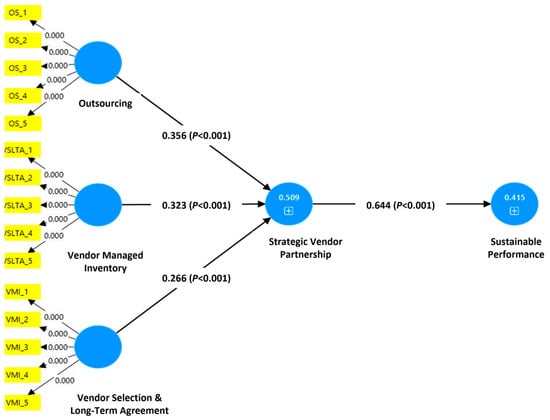
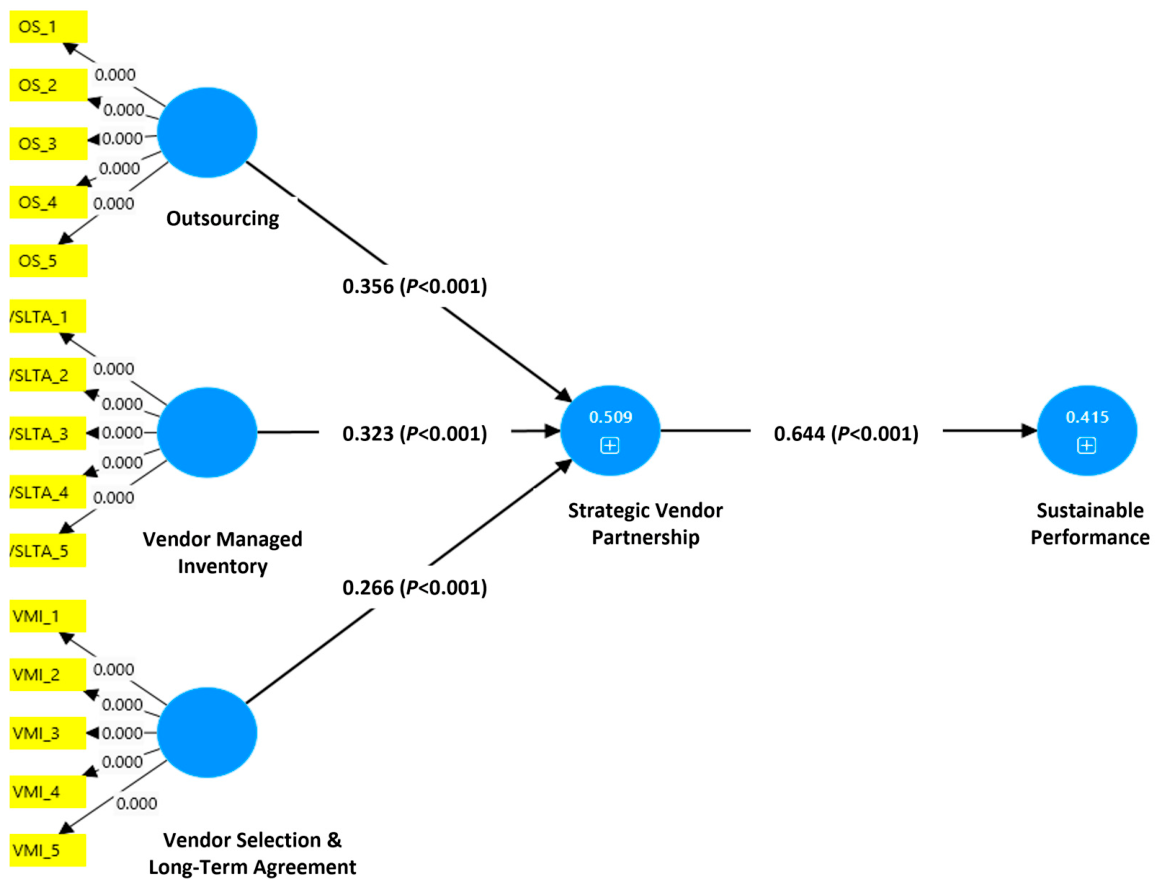
The corrected SmartPLS path estimates show positive associations with SVP: OS (β = 0.356, t = 7.020, p < 0.001), VMI (β = 0.323, t = 5.952, p < 0.001), and VSLTA (β = 0.266, t = 5.468, p < 0.001). The three predictors jointly explain 50.9% of SVP variance (R2 = 0.509). This R2 should not be attributed to OS alone. H1–H3 are supported.
SVP is positively associated with SP (β = 0.644, t = 16.327, p < 0.001), supporting H4. The reported SP R2 = 0.415 is consistent with the corrected standardized single-predictor coefficient (0.6442 ≈ 0.415), and f2 = 0.709. These results apply to the measured overall SP construct, not separately verified economic, environmental or social outcomes. The cross-sectional design does not support causal claims.
Specific indirect effects were evaluated using the supplied SmartPLS bootstrap output. The estimates are OS → SVP → SP (β = 0.229), VMI → SVP → SP (β = 0.208), and VSLTA → SVP → SP (β = 0.171); their reported 95% confidence intervals exclude zero.
As shown in Table 6, the specific indirect effects for all three paths indicate the significant mediation capabilities of SVP on the impact of OS, VMI and VSLTA on SP. Figure 1 lays out the Structural Model.
Table 6.
Structural Model Evaluation.
Figure 1.
Structural model.
The mediating role of SVP in the relationships between SCM practices and SP was examined using specific indirect effects and bootstrap confidence intervals. As presented in Table 7, the outcome indicates that all three indirect effects are positive and statistically significant, as their respective 95% confidence intervals exclude zero. Specific indirect effects were assessed using 5000 bootstrap subsamples and 95% bias-corrected bootstrap confidence intervals in SmartPLS. The estimated indirect effects were significant for OS → SVP → SP (β = 0.229), VMI → SVP → SP (β = 0.208), and VSLTA → SVP → SP (β = 0.171), as their respective confidence intervals excluded zero. The exclusion of direct antecedent-to-outcome paths was theoretically justified using the Relational View and Social Exchange Theory. Nevertheless, the restricted model does not establish the absence of direct effects or demonstrate full mediation.
Table 7.
Mediation analysis: specific indirect effects through SVP.
To evaluate the out-of-sample predictive capability of the proposed model, the Partial Least Squares Predict (PLSpredict) procedure was used (Table 8). The PLSpredict output shows lower PLS-SEM RMSE than the linear-model benchmark for all ten indicators and lower MAE for nine of ten. For SP_5, PLS-SEM MAE (0.962) exceeds LM MAE (0.946). These findings indicate generally favorable relative prediction errors, not uniformly superior performance. Q2predict is not interchangeable with other Q2 procedures. The Indicator Predictions are given in Table 9.
Table 8.
PLS Predict.
Table 9.
Indicator predictions.
Exact model fit (Table 10) was assessed using the squared Euclidean distance (dULS) and the geodesic distance (dG).
Table 10.
Model Fit.
The above model fit evaluation indicates an acceptable fit for the proposed structural model. The Standardized Root Mean Square Residual (SRMR) values for both the estimated and saturated models are well below the conservative threshold of 0.08 [50], indicating a good approximate model fit. Furthermore, the Normed Fit Index (NFI) values represent a reasonable fit for the specified PLS-SEM model. For exact model fit criteria, rather than relying on the subjective numerical proximity of the discrepancy measures to saturated models, the unweighted least squares discrepancy d_ULS and d_G were evaluated against their bootstrap-based reference values, as given in Table 11.
Table 11.
Bootstrap-based exact model fit assessment.
The bootstrap-based exact model fit assessment reveals mixed results on model fit. The d_ULS values for both the saturated model (0.868) and estimated model (1.037) are over respective 95% bootstrap quantiles (0.789 and 0.990), showing the rejection at the 5% significance level under the squared Euclidean distance criterion. Conversely, the d_G values for the saturated model (0.276) and estimated model (0.283) fall below their corresponding 95% bootstrap quantiles (0.309 and 0.313), supporting exact fit under the geodesic distance criterion. As such, the model satisfies the d_G criterion but not the d_ULS criterion, necessitating interpretation alongside other model evaluation criteria, including SRMR, construct reliability, discriminant validity, and structural model assessment [47]. Moreover, Hair et al. (2019) [50] also recommended evaluating PLS-SEM models using a broader evaluation of measurement quality, structural relationships, explanatory power, and predictive performance. By these yardsticks, the model fit is deemed acceptable.
7. Discussion
The results of the hypothesis testing present valuable information about the supply chain practices that can affect SVP and SP in the IE2W industry. The findings possess the strength to endorse the conceptual framework proposed. The findings are also aligned with relational exchange theory, transaction cost economics, and sustainable SCM literature, and further extrapolate these theories to the fast-growing IE2W industry.
7.1. Outsourcing and Strategic Vendor Partnership
The findings reveal that OS can significantly contribute to enhancing SVP. The companies that outsource their most important elements and functions are more likely to depend on long-term interaction and cooperation with the vendors, their coordination, and trust-building strategies. OS in the IE2W sector helps companies simplify their operations and concentrate on their primary products, namely design, innovation and expansion to new markets, whereas vendors help in the development of specialized services. This result is consistent with the relational exchange theory that indicates that recurrent interaction and dependency established by OS results in closer strategic relationships.
7.2. Vendor Managed Inventory and Strategic Vendor Partnership
The significant influence of VMI on SVP underlines the significance of communication, coordination, as well as joint accountability in the relationships of the supply chain. Active participation of vendors in controlling the inventory level, replenishment decisions and demand predictions is indicative of a collaborative relationship. Vendor adaptability to demand uncertainty, component availability and cost control could promote interdependence between partners, strengthening the partnership. This is consistent with supply chain integration theory, where collaborative planning and execution are the key sources of relational performance.
7.3. Selection of Vendors and Long-Term Agreements
The beneficial effect of VSLTA on SVP highlights the role of governance presented by systematic assessment and contract commitment. VSLTA shows the potential to minimize opportunism and uncertainty. In the IE2W industry, where technological compatibility and sustainability compliance are mandated, VSLTA motivates vendors to invest in innovation, quality improvement and environmental practices, giving focus to the partnerships.
7.4. Sustainable Performance and Strategic Vendor Partnership
The findings also show that strategic alliances with suppliers can greatly contribute to SP, with associated economic effectiveness, environmental sustainability, and long-term sustainability in operations. Effective collaborations in the IE2W sector facilitate resolution of issues, sustainable innovation, and harmonization of environmental and social objectives throughout the supply chain. This observation is in line with sustainable supply chain theory that argues that companies can attain the best results on sustainability by engaging in inter-organizational relationships as opposed to acting independently at a firm level.
8. Limitations and Future Research
This study provides important empirical insights into the structural drivers of SP within the IE2W industry; however, some limitations are acknowledged, which lay the ground for future research.
- Study Design and Causal Inference: The study relies on a cross-sectional survey design, capturing supply chain dynamics at one point. Although the theoretical foundations and PLS-SEM analyses strongly support the proposed directional relationships between the independent variables (OS, VMI, VSLTA) and the outcomes (SVP, SP), definitive causal claims cannot be made with certainty. Future research may employ longitudinal methodologies to track how SVPs evolve and how their impacts on 3BL mature across different phases of the E2W product lifecycle.
- Relevance to Other Geographies and Industries: The empirical context is specifically bound to the IE2W industry, which meets existing gaps; however, the unique regulatory environment, local subsidy frameworks, and the operational scale of Indian OEMs limit the generalizability of the findings. Future scholars can validate this structural model in other mobility segments like commercial EVs or traditional ICE manufacturing, apart from exploring other geographical markets similarly with a view towards establishing cross-context applicability.
- Methodological Constraints: The reliance on self-reported primary data from industry practitioners (respondent perceptions) introduces risk of CMB. CMB was assessed using Harman’s single-factor test (Table 2) and construct-level full-collinearity analysis [41]. While the tests do not conclusively rule out CMB in self-reported, cross-sectional data, these findings suggest that it is unlikely to be a dominant concern in the study. It is acknowledged that analysis of individual responses, directly drawn from multiple firms, treated as independent observations during PLS-SEM bootstrapping, could result in within-firm dependence. Because organizational identifiers were not taken into account, a clustering-adjusted sensitivity check has not been conducted, and hence, the resulting bootstrap confidence intervals may be optimistic if within-firm responses are correlated.
- The scope of the study was limited to consider a single overall sustainability construct.
- Theoretical Scope and Network Expansion: While the study isolates specific operational mechanisms as drivers of SVP, it relies on OEMs and their Tier-1 suppliers. Future research could expand focus to a multi-tier supply chain network to evaluate how sustainable practices cascade to them. Additionally, given the rapid digitization of manufacturing, future models can integrate technological moderators like blockchain for traceability, AI-driven demand forecasting, or digital twin simulations to explore how digital advancements in manufacturing influence the efficiency of VMI, VSLTA and OS.
- Bootstrap-Based Exact Model Fit: The observed d_ULS conclusions may be further investigated through future studies examining theoretically justified alternative model specifications, reassessing measurement properties, and examining out-of-sample predictive performance to establish the robustness and generalizability of the proposed relationships.
9. Theoretical Implications
This paper is an addition to the literature on SCM and sustainability in that it expands relational exchange theory, transaction cost economics, and sustainable supply chain theory to the IE2W industry. Contrary to conventional research that also investigates the results of sustainability as a direct operational practice, the study reveals that SVP serves as one of the crucial mediating processes linking OS, VMI, and VSLTA to SP. Empirically attempting to establish the basic importance of vendor partnerships, the study attempts to replace the theoretical emphasis on separate firm-based practices with relationship-based supply chain governance.
Moreover, the results may contribute to the sustainability supply chain theory by showing that SP is not the outcome of technology use or compliance with regulations but rather entrenched in inter-firm interdependence. The close relationship between SVP and SP indicates that long-term trust, coordination and shared responsibility may be critical precursors of environmental, economic, and social sustainability. Apropos, this research could contribute to the current theory because it will combine operational integration and relational governance as complementary forces of sustainability in the new green industries.
10. Conclusions
This research is an empirical analysis of how OS, vendor management practices, and SVP can facilitate sustainable supply chain performance in the IE2W industry. The results have revealed that OS, vendor-controlled inventory, and the selection of vendors through long-term contracts play a significant role in strengthening strategic vendor alliances that consequently promote sustainability. The results emphasize that sustainability outcomes are attained through a coordinated and trust-based relationship with vendors.
The paper also confirms that SVP serves as a key point of contact in the relationship between operational practice and sustainability performance. The companies that invest in working relationships with vendors are more likely to achieve greater coordination, less uncertainty and achieve greater innovation. This could also ensure sustainability goals are aligned throughout the supply chain. In the IE2W industry, operating on economies of scale and rapidly evolving technology, robust vendor relationships seem inescapable for sustainability and resilience.
To summarize, the results reveal that sustainability in the IE2W industry may not be only a technical or policy-oriented process. It could also define the way companies regulate and cooperate with their suppliers. Although the efficiency of the operations is achieved through OS and inventory coordination, the quality of vendor relations gives the sustainability edge. This paper thus highlights the importance of IE2W OEMs going beyond transactional management of suppliers and implementing strategic and long-term partnership-based supply chain models.
The study could add value to both theoretical knowledge and practical experience by elucidating the behavioral and relationship channels in the supply chain practices that contribute to sustainability. It has useful implications for manufacturers, vendors and policymakers interested in promoting sustainability in the supply chain of the IE2W sector.
Author Contributions
Conceptualization, D.K.A.; Methodology, D.K.A.; Validation, G.S.R.V.; Formal analysis, D.K.A. and G.S.R.V.; Investigation, D.K.A. and G.S.R.V.; Data curation, D.K.A.; Writing—original draft, D.K.A.; Writing—review & editing, G.S.R.V.; Supervision, G.S.R.V. All authors have read and agreed to the published version of the manuscript.
Funding
This research received no external funding.
Institutional Review Board Statement
An institutional ethics approval or IRB number is not applicable for this study, mandatory IEC/IRB approval—governed by the Indian Council of Medical Research (ICMR) National Ethical Guidelines for Biomedical and Health Research Involving Human Participants (2017) [pdf enclosed] and the New Drugs and Clinical Trials Rules, 2019 [available at https://cdsco.gov.in/opencms/opencms/en/Acts-and-rules/New-Drugs/, accessed on 23 November 2026]—applies to biomedical, clinical, and health-related research. Under these guidelines, non-clinical management and industry perception surveys are exempt from formal ethics committee review.
Informed Consent Statement
All data collection strictly adhered to ethical guidelines regarding voluntary participation, anonymity, absence of organizational identifiers and informed consent was obtained before survey completion.
Data Availability Statement
The data presented in this study is available on request from the corresponding author upon reasonable request subject to any confidentiality restrictions.
Acknowledgments
The authors have reviewed and edited the output and take full responsibility for the content of this publication.
Conflicts of Interest
The authors declare no conflicts of interest.
Abbreviations
The following abbreviations are used in this manuscript (in order of appearance):
| SVP | Sustainable vendor partnership |
| IE2W | India electric two-wheeler |
| VMI | Vendor managed inventory |
| VSLTA | Vendor selection and long-term agreement |
| E2W | Electric two wheelers |
| SSCM | Sustainable supply chain management |
| EV | Electric vehicle |
| USD | US Dollars |
| CAGR | Compounded annual growth rate |
| CE | Circular economy |
| FAME | Faster Adoption and Manufacturing of Electric and Hybrid Vehicles in India |
| GoI | Government of India |
| SCM | Supply chain management |
| 3BL | Triple bottom line |
| OEMs | Original equipment manufacturers |
| BMS | Battery management system |
| CMB | Common Method Bias |
| SEM | Structural equation modelling |
| EFA | Exploratory Factor Analysis |
| CFA | Confirmatory Factor Analysis |
| AVE | Average variance extracted |
| ICR | Internal consistency reliability |
| 3PL | 3rd party logistics |
| ESG | Environmental, social and governance |
| VIF | Variance inflation factor |
| CA | Cronbach Alpha |
| FC | Full collinearity |
| OS | Outsourcing |
| SP | Sustainable performance |
| HTMT | Heterotrait-Monotrait |
| PLS | Partial Least Squares |
| RMSE | Root-mean-squared error |
| MAE | Mean absolute error |
| SRMR | Standardised root-mean-squared residual |
References
- Pandey, P.C. India Imports 82% of Its Oil Needs and Aims to Reach 67% By 2022. Climate Scorecard, 3 June 2022.
- British Petroleum. Statistical Review of World Energy; British Petroleum: London, UK, 2020. [Google Scholar]
- Sharma, S. India’s Oil Import Dependency on Course to Hit Fresh Full-Year High in FY25 amid Growing Demand, Stagnant Domestic Production. The Hindu, 21 March 2025.
- Kala, R.R. India’s Crude Oil Import Dependence Rises to Record 90%. Business Line, 21 May 2025.
- Dua, R.; Almutairi, S.; Bansal, P. Emerging Energy Economics and Policy Research Priorities for Enabling the Electric Vehicle Sector. Energy Rep. 2024, 12, 1836–1847. [Google Scholar] [CrossRef] [Scilit]
- Mordor Intelligence. India Electric Vehicle Market—Focusing on Market Growth, Industry Analysis, Size, and Forecast up to 2030; Mordor Intelligence: Hyderabad, India, 2025. [Google Scholar]
- Kale, N.B.; Khati, D. Facts & Future Scenario: An Analytical Study of Eclectic Vehicles Market in India. Aethel Res. Dig. Juncture 2026, 2, 52–71. [Google Scholar]
- NAB FAME II. Available online: https://heavyindustries.gov.in/en/fame-ii (accessed on 11 February 2023).
- Dhawan, R.; Gupta, S.; Hensley, R.; Huddar, N.; Iyer, B.; Mangaleswaran, R. The Future of Mobility in India: Challenges & Opportunities for the Auto Component Industry; McKinsey & Company: New York, NY, USA, 2017. [Google Scholar]
- Khurana, A.; Kumar, V.V.R.; Sidhpuria, M. A Study on the Adoption of Electric Vehicles in India: The Mediating Role of Attitude. Vis. J. Bus. Perspect. 2020, 24, 23–34. [Google Scholar] [CrossRef] [Scilit]
- Balakrishnan, A.S.; Suresh, J. Green Supply Chain Management in Indian Automotive Sector. Int. J. Logist. Syst. Manag. 2018, 29, 502. [Google Scholar] [CrossRef] [Scilit]
- Liu, Y.; Srai, J.S.; Evans, S. Environmental Management: The Role of Supply Chain Capabilities in the Auto Sector. Supply Chain Manag. Int. J. 2016, 21, 1–19. [Google Scholar] [CrossRef] [Scilit]
- Luthra, S.; Garg, D.; Haleem, A. Empirical Analysis of Green Supply Chain Management Practices in Indian Automobile Industry. J. Inst. Eng. (India) Ser. C 2014, 95, 119–126. [Google Scholar] [CrossRef] [Scilit]
- Ghosh, S.; Mandal, M.C.; Ray, A. Strategic Sourcing Model for Green Supply Chain Management: An Insight into Automobile Manufacturing Units in India. Benchmarking Int. J. 2022, 29, 3097–3132. [Google Scholar] [CrossRef] [Scilit]
- Panigrahi, S.S.; Bahinipati, B.; Jain, V. Sustainable Supply Chain Management. Manag. Environ. Qual. Int. J. 2019, 30, 1001–1049. [Google Scholar] [CrossRef] [Scilit]
- Das, D. Development and Validation of a Scale for Measuring Sustainable Supply Chain Management Practices and Performance. J. Clean. Prod. 2017, 164, 1344–1362. [Google Scholar] [CrossRef] [Scilit]
- Winter, M.; Knemeyer, A.M. Exploring the Integration of Sustainability and Supply Chain Management. Int. J. Phys. Distrib. Logist. Manag. 2013, 43, 18–38. [Google Scholar] [CrossRef] [Scilit]
- Gopal, P.R.C.; Thakkar, J. Sustainable Supply Chain Practices: An Empirical Investigation on Indian Automobile Industry. Prod. Plan. Control 2016, 27, 49–64. [Google Scholar] [CrossRef] [Scilit]
- Wang, J.; Dai, J. Sustainable Supply Chain Management Practices and Performance. Ind. Manag. Data Syst. 2018, 118, 2–21. [Google Scholar] [CrossRef] [Scilit]
- Luthra, S.; Garg, D.; Haleem, A. The Impacts of Critical Success Factors for Implementing Green Supply Chain Management towards Sustainability: An Empirical Investigation of Indian Automobile Industry. J. Clean. Prod. 2016, 121, 142–158. [Google Scholar] [CrossRef] [Scilit]
- Sopadang, A.; Wichaisri, S.; Banomyong, R. Sustainable Supply Chain Performance Measurement A Case Study of the Sugar Industry. In Proceedings of the International Conference on Industrial Engineering and Operations Management, Rabat, Morocco, 11 April 2017. [Google Scholar]
- Kumar, S.; Dutt, A. Interrelating Financial Performance And Inventory Management: Study Of Indian Automobile Industry. Seybold Rep. 2022, 17, 1239–1251. [Google Scholar] [CrossRef]
- Pfeffer, J. A Resource Dependence Perspective on Intercorporate Relations. In Intercorporate Relations: The Structured Analysis of Business; Mizruchi, M.S., Schwartz, M., Eds.; Cambridge University Press: Cambridge, UK, 1987; pp. 25–55. [Google Scholar]
- Simon, H.A. Information Processing Technology. In Handbook of Learning and Cognitive Processes; Estes, W., Ed.; Psychology Press: London, UK, 2014; Volume 5. [Google Scholar]
- Hart, S.L. A Natural-Resource-Based View of the Firm. Acad. Manag. Rev. 1995, 20, 986–1014. [Google Scholar] [CrossRef] [Scilit]
- Novak, S.; Stern, S. How Does Outsourcing Affect Performance Dynamics? Evidence from the Automobile Industry. Manag. Sci. 2008, 54, 1963–1979. [Google Scholar] [CrossRef] [Scilit]
- McIvor, R. How the Transaction Cost and Resource-based Theories of the Firm Inform Outsourcing Evaluation. J. Oper. Manag. 2009, 27, 45–63. [Google Scholar] [CrossRef] [Scilit]
- Ciravegna, L.; Romano, P.; Pilkington, A. Outsourcing Practices in Automotive Supply Networks: An Exploratory Study of Full Service Vehicle Suppliers. Int. J. Prod. Res. 2013, 51, 2478–2490. [Google Scholar] [CrossRef] [Scilit]
- Chernova, O.A.; Liu, L.; Wang, X. Role of Digitalization of Logistics Outsourcing in Sustainable Development of Automotive Industry in China. R-Economy 2023, 9, 123–139. [Google Scholar] [CrossRef] [Scilit]
- Bevilacqua, M.; Ciarapica, F.E.; De Sanctis, I. Lean Practices Implementation and Their Relationships with Operational Responsiveness and Company Performance: An Italian Study. Int. J. Prod. Res. 2017, 55, 769–794. [Google Scholar] [CrossRef] [Scilit]
- Singh, G.; Pandey, A. Environmental Sustainability Integrated Supplier Selection in Electric Vehicle Supply Chains: A Grey Relational Analysis Approach. Environ. Dev. Sustain. 2024, 28, 7861–7889. [Google Scholar] [CrossRef] [Scilit]
- Feng, Z.; Li, F.; Tan, C. Supplier Development or Supplier Integration? Equilibrium Analysis in Competing Electric Vehicle Supply Chains with Power Battery Recycling. Expert Syst. Appl. 2024, 238, 121519. [Google Scholar] [CrossRef] [Scilit]
- Galan, J.I.; Zuñiga-Vicente, J.A. Discovering the Key Factors behind Multi-stakeholder Partnerships for Contributing to the Achievement of Sustainable Development Goals: Insights around the Electric Vehicle in Spain. Corp. Soc. Responsib. Environ. Manag. 2023, 30, 829–845. [Google Scholar] [CrossRef] [Scilit]
- Chen, Y. The Impact of Strategic Alliance on Corporate Performance: Evidence from Tesla; Atlantis Press: Dordrecht, The Netherlands, 2022. [Google Scholar]
- Shin, N.; Park, S.; Park, S. Partnership-Based Supply Chain Collaboration: Impact on Commitment, Innovation, and Firm Performance. Sustainability 2019, 11, 449. [Google Scholar] [CrossRef] [Scilit]
- Ramanathan, U.; Gunasekaran, A. Supply Chain Collaboration: Impact of Success in Long-Term Partnerships. Int. J. Prod. Econ. 2014, 147, 252–259. [Google Scholar] [CrossRef] [Scilit]
- Zhou, P. The Impact of Supply Chain Partnership on Firm Performance: An Empirical Study Based on Listed Manufacturing Companies in China. BCP Bus. Manag. 2021, 14, 22–38. [Google Scholar] [CrossRef] [Scilit]
- Juned, M.; Farooquie, J.A. VMI Adoption in Automotive Industries: Two Different Perspectives. Int. J. Serv. Oper. Manag. 2022, 43, 227. [Google Scholar] [CrossRef] [Scilit]
- van den Bogaert, J.; van Jaarsveld, W. Vendor-Managed Inventory in Practice: Understanding and Mitigating the Impact of Supplier Heterogeneity. Int. J. Prod. Res. 2022, 60, 6087–6103. [Google Scholar] [CrossRef] [Scilit]
- Fornell, C.; Larcker, D.F. Evaluating Structural Equation Models with Unobservable Variables and Measurement Error. J. Mark. Res. 1981, 18, 39–50. [Google Scholar] [CrossRef] [Scilit]
- Kock, N. Common Method Bias in PLS-SEM. Int. J. E-Collab. 2015, 11, 1–10. [Google Scholar] [CrossRef] [Scilit]
- Amitabh, K.; Majumder, S.; De, K.; Das, B. Electric Vehicle Production: A Comprehensive Study of Environmental and Water Resource Impacts. In Proceedings of the 2024 IEEE Silchar Subsection Conference (SILCON 2024); IEEE: Piscataway, NJ, USA, 2024; pp. 1–5. [Google Scholar]
- Asokan, V.A.; Teah, H.Y.; Kawazu, E.; Hotta, Y. Ambitious EV Policy Expedites the E-Waste and Socio-Environmental Impacts in India. Resour. Conserv. Recycl. 2023, 190, 106829. [Google Scholar] [CrossRef] [Scilit]
- Cao, J.; Chen, X.; Qiu, R.; Hou, S. Electric Vehicle Industry Sustainable Development with a Stakeholder Engagement System. Technol. Soc. 2021, 67, 101771. [Google Scholar] [CrossRef] [Scilit]
- Hossain, M.S.; Kumar, L.; Islam, M.M.; Selvaraj, J. A Comprehensive Review on the Integration of Electric Vehicles for Sustainable Development. J. Adv. Transp. 2022, 2022, 1–26. [Google Scholar] [CrossRef] [Scilit]
- Al-Doori, J.A. The Impact of Supply Chain Collaboration on Performance in Automotive Industry: Empirical Evidence. J. Ind. Eng. Manag. 2019, 12, 241. [Google Scholar] [CrossRef] [Scilit]
- Henseler, J.; Ringle, C.M.; Sarstedt, M. A New Criterion for Assessing Discriminant Validity in Variance-Based Structural Equation Modeling. J. Acad. Mark. Sci. 2015, 43, 115–135. [Google Scholar] [CrossRef] [Scilit]
- Dyer, J.H.; Singh, H. The Relational View: Cooperative Strategy and Sources of Interorganizational Competitive Advantage. Acad. Manag. Rev. 1998, 23, 660–679. [Google Scholar] [CrossRef] [Scilit]
- Blau, P. Exchange and Power; John Wiley and Sons: Hoboken, NJ, USA, 1964. [Google Scholar]
- Hair, J.F.; Risher, J.J.; Sarstedt, M.; Ringle, C.M. When to Use and How to Report the Results of PLS-SEM. Eur. Bus. Rev. 2019, 31, 2–24. [Google Scholar] [CrossRef] [Scilit]

Disclaimer/Publisher’s Note: The statements, opinions and data contained in all publications are solely those of the individual author(s) and contributor(s) and not of MDPI and/or the editor(s). MDPI and/or the editor(s) disclaim responsibility for any injury to people or property resulting from any ideas, methods, instructions or products referred to in the content. |
© 2026 by the authors. Published by MDPI on behalf of the World Electric Vehicle Association. Licensee MDPI, Basel, Switzerland. This article is an open access article distributed under the terms and conditions of the Creative Commons Attribution (CC BY) license.