


Highlights
What are the main findings?
- Existing Eco-Design tools show low CAD/PLM workflow integration.
- Critical Raw Material tracking is frequently overlooked by tools.
What are the implications of the main findings?
- Digital Product Passports are crucial for material traceability.
- AI-driven platforms and digital twins can automate circular design.
Abstract
The transition toward a Circular Economy in the automotive industry demands robust eco-design strategies for complex, energy-using, mechatronic systems. This systematic literature review critically evaluates 30 publications representing 27 distinct frameworks and computational tools for active automotive components. Using a customized Usability Scorecard on a 1–5 quantitative scale, solutions were benchmarked across workflow integration, performance trade-offs, End-of-Life, and Critical Raw Material (CRM) management. Systematic review findings reveal significant methodological gaps: circa 52% of evaluated tools exhibit low CAD/PLM workflow integration relying on manual data entry, while only 30% achieve high integration. For trade-off analysis, most tools, about 80%, rely on static multi-criteria weighting or use offline optimization. Furthermore, CRM tracking is unaddressed in 44% of the tools, rising to circa 60% including purely conceptual methods, with only 22% offering dedicated metrics or Digital Product Passport (DPP) readiness for material traceability. Based on these review findings, future research should investigate and validate automated, open-source AI-driven plug-ins leveraging Large Language Models (LLMs) and Digital Twins embedded directly in engineering environments to translate Circular Economy principles and metrics into daily design practices.
1. Introduction
The automotive industry is undergoing a major transformation driven by climate objectives, resource-security concerns, and increasingly stringent environmental regulation [1]. These pressures are accelerating the transition from the traditional linear “take–make–dispose” model toward circular production and consumption systems [2,3]. In this context, the pursuit of the Sustainable Development Goals (SDGs) (such as SDG 9—Industry, Innovation, and Infrastructure—and SDG 12—Responsible Consumption and Production) is no longer merely an ethical choice, but a fundamental goal for companies’ competitiveness. Although concepts such as recycling, reuse, remanufacturing, and extending the life cycle of vehicles are rapidly rising in priority for companies, their effective implementation faces a systemic barrier. To navigate this transition, engineers must now align their design choices with increasingly stringent regulatory frameworks and standardized assessment methods.
For instance, Directive 2000/53/EC (End-of-life Vehicles—ELV Directive) [4] mandates high recycling and recovery targets, driving the need for standardized calculation methodologies. While ISO 22628 [5] historically provided the baseline calculation method for road vehicles, more recent cross-sectoral standards, such as ISO 21106 for railway rolling stock [6], offer a valuable example of a transferable methodology that incorporates realistic recycling process efficiencies and material recovery yields for complex transport systems. Furthermore, as modern vehicles incorporate more complex energy-using components, cross-sectoral standards like EN 45555 [7] provide essential guidelines for assessing the recyclability and recoverability of mechatronic systems. Looking forward, the imminent rollout of Digital Product Passports (DPPs) under the new Ecodesign for Sustainable Products Regulation (ESPR) will compel OEMs to ensure unprecedented material traceability [8]. This is particularly critical for active components relying on Critical Raw Materials; for example, the recent development of specific Product Category Rules (PCRs) for permanent magnets in electric motors is setting new, and rigorous, benchmarks for Life Cycle Assessments and Environmental Product Declarations (EPDs) [9].
In the engineering design literature, it is widely recognized that up to 80% of a product’s total life cycle costs and downstream characteristics are committed, and effectively locked in, during the initial conceptualization and development phase [10]. In eco-design contexts, this principle translates directly to environmental burdens, as early architectural, material, and manufacturing choices inevitably determine the vast majority of overall life cycle impacts. Consequently, design plays a central role. However, translating the macro-economic principles of circularity into day-to-day technical, engineering, and design specifications remains one of the most complex technological and managerial challenges for Original Equipment Manufacturers (OEMs) and their supply chains. Designers often find themselves making crucial decisions during phases of high uncertainty, lacking clear methodologies to balance technical performance, costs, and new circularity requirements. To bridge this gap between the theory of the Circular Economy and industrial practice, the effectiveness of the transition depends heavily on the availability and systematic adoption of circular design tools. These tools, which can range from conceptual frameworks and guidelines for Design for Disassembly or Design for Remanufacturing to software that uses Life Cycle Sustainability Assessment (LCSA) and Multi-Criteria Decision Analysis (MCDA) methods, have been proposed in recent years to support engineers from the very beginning of the development process [11]. Although academic research is producing a growing body of support for eco-design, the literature on tools specifically designed to manage the extremely high architectural and systemic complexity typical of the automotive sector remains dispersed and fragmented.
This literature review is the result of the need to bring order to this rapidly evolving landscape and to fill a substantial knowledge gap. The main objective is to explore, map, and critically analyze the State of the Art of circular design tools applied to the automotive industry, in particular to those components that use energy. In fact, those “active”, energy-using, components (e.g., traction motors or active suspension) can be more difficult to design in a circular way because it can be harder to strike a balance between performance and sustainability; a clear example is the recovery of permanent magnets [12,13] used in electric motors and actuators. Through this analysis, the study aims to provide a comprehensive overview of the tools currently available, evaluating their practical applicability, their focus on various circular strategies (the so-called “R Strategies”), and their level of integration into standard business processes, in order to highlight their current limitations and outline directions for future research developments.
The work is structured as follows. The remainder of the Introduction presents some existing literature reviews, what they show, and what is missing in relation to the research objectives of this work. The Section 2 describes in detail the phases of the systematic review, following PRISMA guidelines [14]. The Section 3 lists the articles definitively selected for analysis, their characteristics, and key information about each. The Section 4 analyzes the selected articles in detail and examines the characteristics of the tools or frameworks presented, and provides an overview of potential future developments for these tools.
Preliminary Literature Review and Research Questions
Recent systematic reviews and critical analyses have significantly advanced the understanding of sustainability and circularity assessment in the automotive sector. However, they have predominantly focused on Life Cycle Assessment (LCA) methodologies and circularity indicators for Electric Vehicle (EV) batteries. Notably, Wu et al. (2025) [15] conducted a comprehensive benchmarking of state-of-the-art open-source computational tools, including GREET, Carculator, AFLEET, GHGenius, and EV Footprint. They thoroughly evaluated their adaptability, modeling mechanisms, and inventory datasets. As thoroughly demonstrated in their review, these platforms are strictly LCA-oriented and are often limited to carbon footprint calculations rather than holistic circular design instruments capable of guiding the engineering process. Other studies, such as Innocenti et al. (2025) [16], echoed these findings and highlighted how software architecture, database integration, and uncertainty modeling affect LCA results and their usability for designers. Similarly, Oluwalana and Grzesik (2025) [17] mapped methodological pluralism in EV LCA studies and called for more standardized reporting. From a circularity perspective, Picatoste et al. (2025) [18] evaluated design criteria and indicators for EV batteries. They emphasized the critical role of stakeholder perception in adopting circular strategies. Furthermore, studies like those by Li et al. (2024) [19] have highlighted the urgency of end-of-life strategies for electric motors. They note that without proper Design for X (DfX) methodologies, disassembly and recovery of Critical Raw Materials (CRMs) remain economically unviable and are often treated as non-value-added activities.
Despite these valuable contributions, a critical analysis of the existing literature reveals significant limitations when addressing the specific operational needs of design engineers working on complex, active, and energy-consuming mechatronic components (e.g., traction motors, inverters, active suspensions). The current landscape of eco-design tools seems to exhibit three primary gaps:
- The Opaque Modeling and Scope Limitation. While the software tools reviewed by Wu et al. (2025) [15] effectively evaluate the macro-vehicle level or battery packs, the internal modeling of active mechatronic components remains opaque and indivisible. The current tools lack architectural granularity and specific DfX metrics needed to design remanufacturing strategies for distinct sub-assemblies, such as isolating a printed circuit board from a motor stator.
- Cognitive Disconnect and Workflow Integration. There is a well-documented divide between LCA practitioners and product engineers. As highlighted by Cerdas (2022) [20], LCA is traditionally a retrospective tool that requires deep methodological expertise, making it difficult to embed directly in early-stage product development. Furthermore, current tools communicate almost exclusively in “environmental languages” (e.g., kg CO2,eq), as evidenced by the tools analyzed by Wu et al. (2025) [15], rather than “engineering parameters” (e.g., tolerances, thermal stress, performance yield). Additionally, these articles on eco-design frameworks have frequently highlighted that traditional tools suffer from limited integration into standard CAD (computer-aided design), CAE (computer-aided engineering), and PLM (product lifecycle management) software environments.
- Absence of Predictive Feedback and Trade-off Analysis. Existing reviews show a lack of decision-support systems capable of dynamically quantifying and visualizing the complex trade-offs between operational performance, such as energy efficiency, and end-of-life circularity [20].
While several literature reviews have addressed eco-design indicators or general Life Cycle Assessment (LCA) methodologies, they predominantly focus on static, passive vehicle structures or present macro-level environmental frameworks detached from daily engineering routines. To date, no systematic review has critically investigated the computational tools specifically tailored for active, energy-using automotive mechatronics, where End-of-Life recoverability directly interacts with operational energy consumption.
To bridge these gaps, this study offers three distinct contributions to the literature: (i) it establishes a targeted evaluation scope on active mechatronic architectures; (ii) it introduces a structured Usability Scorecard to quantitatively measure software integration within native CAD, CAE, and PLM modeling environments; and (iii) it systematically assesses tool readiness regarding Critical Raw Material (CRM) tracking and Digital Product Passport (DPP) compliance in light of emerging EU regulations. Specifically, this systematic literature review aims to explore, map, and critically analyze the state of the art of circular design tools by addressing the following Research Questions (RQs):
- RQ1. What circular design tools, software, and frameworks are currently documented in the literature for the development of active components in the automotive sector?
- RQ2. To what extent are these tools operationally integrated into existing engineering workflows (e.g., CAD, CAE, PLM)?
- RQ3. How do current tools manage the design trade-off between operational performance (e.g., energy efficiency, compactness) and circularity logic (e.g., remanufacturing, recovery of critical materials)?
- RQ4. What are the main technological barriers and future directions for integrating circularity metrics into automotive design workflows?
2. Materials and Methods
The work began with a preliminary review of the literature on tools dedicated to circular design, with a particular focus on any existing reviews. The next phase was the development of the presented systematic review, which followed the PRISMA 2020 guidelines by Page et al. (2021) [14] when applicable. Specifically, a systematic search strategy was first defined for the Scopus and Web of Science (Core Collection) digital databases. This was followed by a document selection process, culminating in a detailed analysis of the results and a discussion regarding the maturity and accessibility of the presented tools/frameworks. The identified keywords were divided into three sets, respectively linked to the macro-groups “Methodology, Sustainability, and Evaluation”, “Application Domain (Automotive)”, and “Subject of Study (decision-making tools)”. The keywords used for the search are listed in Table 1.
Table 1.
Search terms used in the systematic literature search.
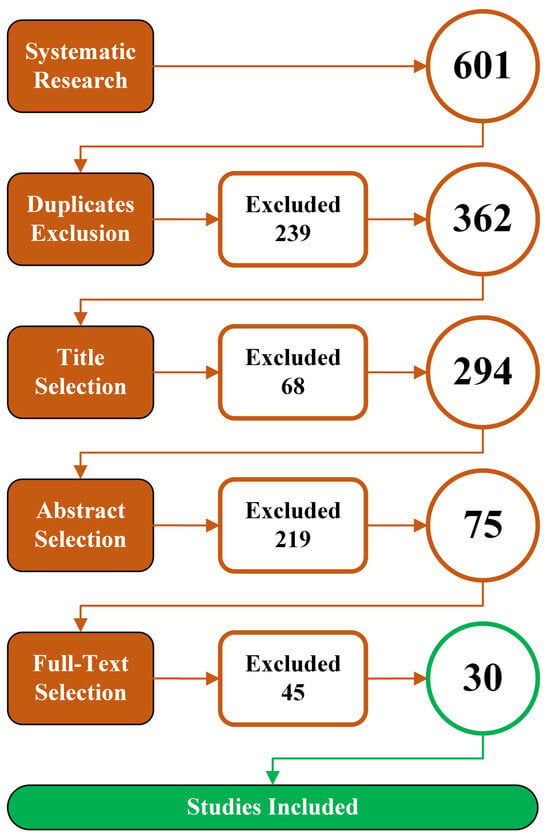
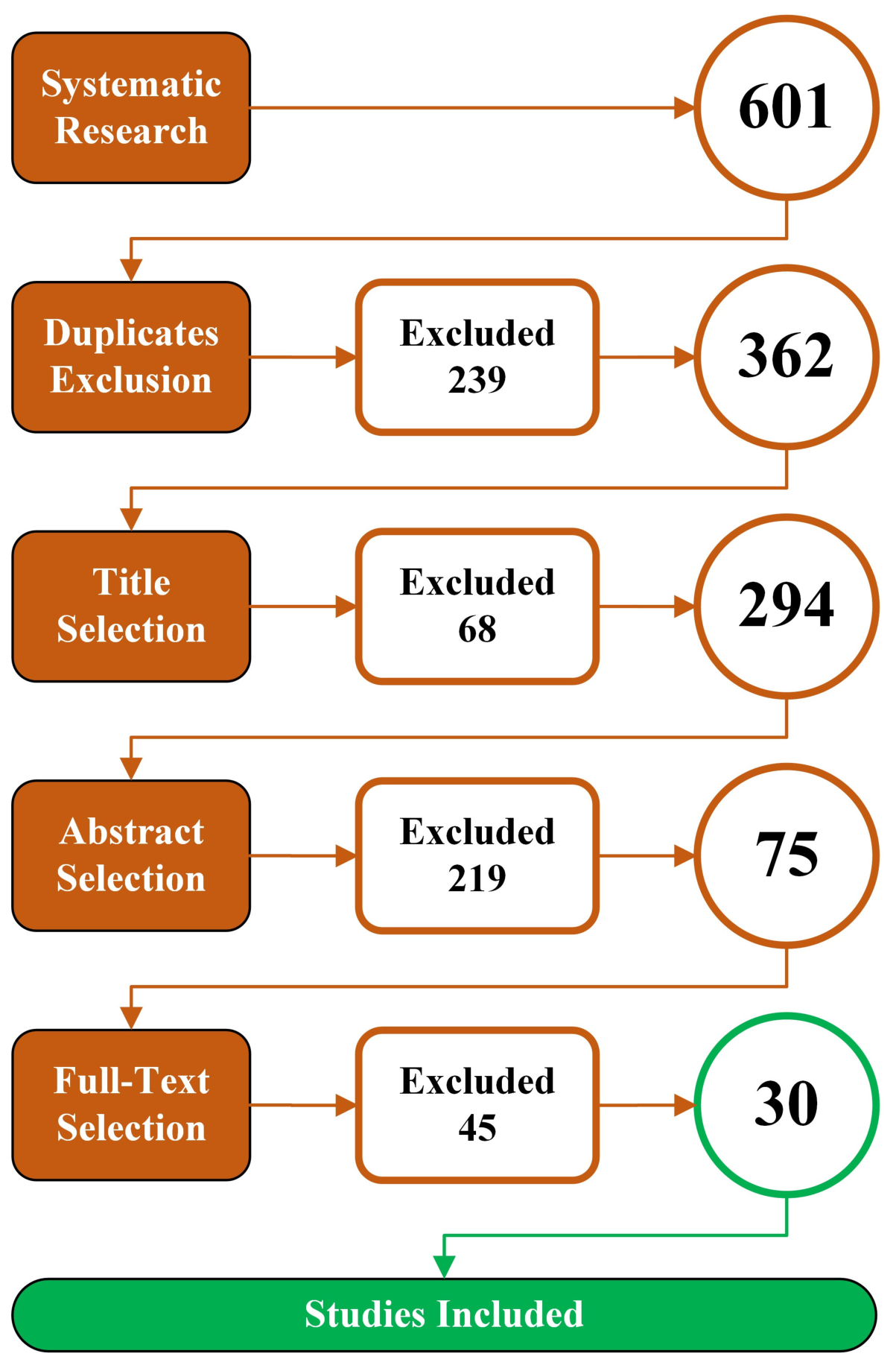
Multi-word expressions (e.g., “Circular Design”, “Design for Disassembly”) were searched as exact phrases, while terms with wildcards (e.g., Vehicle*, Tool*) captured singular and plural variations. Terms within each macro-group were combined using the Boolean OR operator, and the three macro-groups were combined using the AND operator (the exact database queries are reported in Table S1 in the Supplementary Materials). The systematic search identified 601 results. After removing duplicates, the results were reduced to 362; this phase also included the removal of any erratum or corrigendum (which were, however, considered part of the main document where applicable) as well as retracted articles. The results of the first search phase are summarized in Table S2 in the Supplementary Materials.
The document selection process was then carried out in three phases. Eligibility criteria were established prior to the literature search. The primary scope focused on circular design tools and frameworks for active automotive components. However, to capture relevant methodological innovations, publications covering passive components or non-automotive transport applications were defined as eligible a priori, provided that they presented customizable tool architectures or quantitative evaluation metrics directly transferable to complex, energy-using automotive assemblies. Studies lacking transferable methodologies or focusing exclusively on raw material processing were excluded.
In the first phase, a 2016–2026 temporal filter was applied to focus on the decade following the adoption of the EU Circular Economy Action Plan, marking the accelerated transition toward vehicle electrification and active mechatronic architectures. Crucially, foundational methodologies introduced prior to 2016 were inherently captured through their updated iterations or applications documented in the post-2016 literature. Furthermore, records were excluded if they addressed entirely unrelated domains or purely chemical synthesis without engineering design models. At the end of the first phase, 294 documents were selected.
In the second phase (abstract screening stage), articles were evaluated against eligibility criteria regarding circular design tools for transport applications. In line with PRISMA best practices, whenever an abstract did not provide sufficient detail to definitively confirm compliance, a conservative approach was adopted, retaining the publication for full-text examination. From this phase, 75 documents were designated for full-text analysis.
Finally, at the full-text screening stage, articles were rigorously assessed and excluded if they lacked a quantitative decision-support tool, focused strictly on end-of-pipe waste processing without early-stage design integration, or presented non-transferable passive component models. The final inclusion and exclusion criteria used during these two phases are presented in Table 2.
Table 2.
Inclusion and exclusion criteria.
In accordance with the PRISMA 2020 guidelines, a formal protocol for this systematic review was not prospectively registered in a public database prior to data extraction. To ensure rigor during the selection process and data collection, the initial screening of titles, abstracts, and full texts, as well as data extraction, was performed by one primary reviewer. The results were subsequently reviewed and validated by two additional reviewers. Any uncertainties or discrepancies were resolved through discussion and consensus among all authors. The completed PRISMA 2020 checklist and the official PRISMA flow diagram are provided in the Supplementary Materials.
The final selection phase resulted in the selection of 30 articles for the ultimate detailed analysis. An overview of the selection process is presented in Figure 1.
Figure 1.
Article selection process.
3. Results
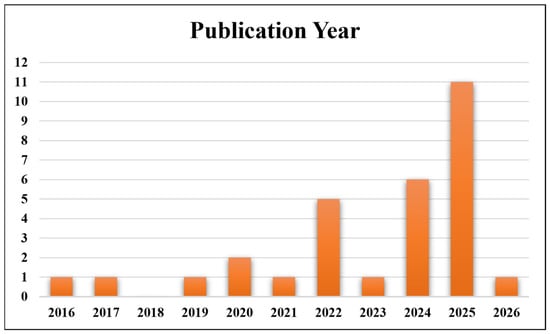
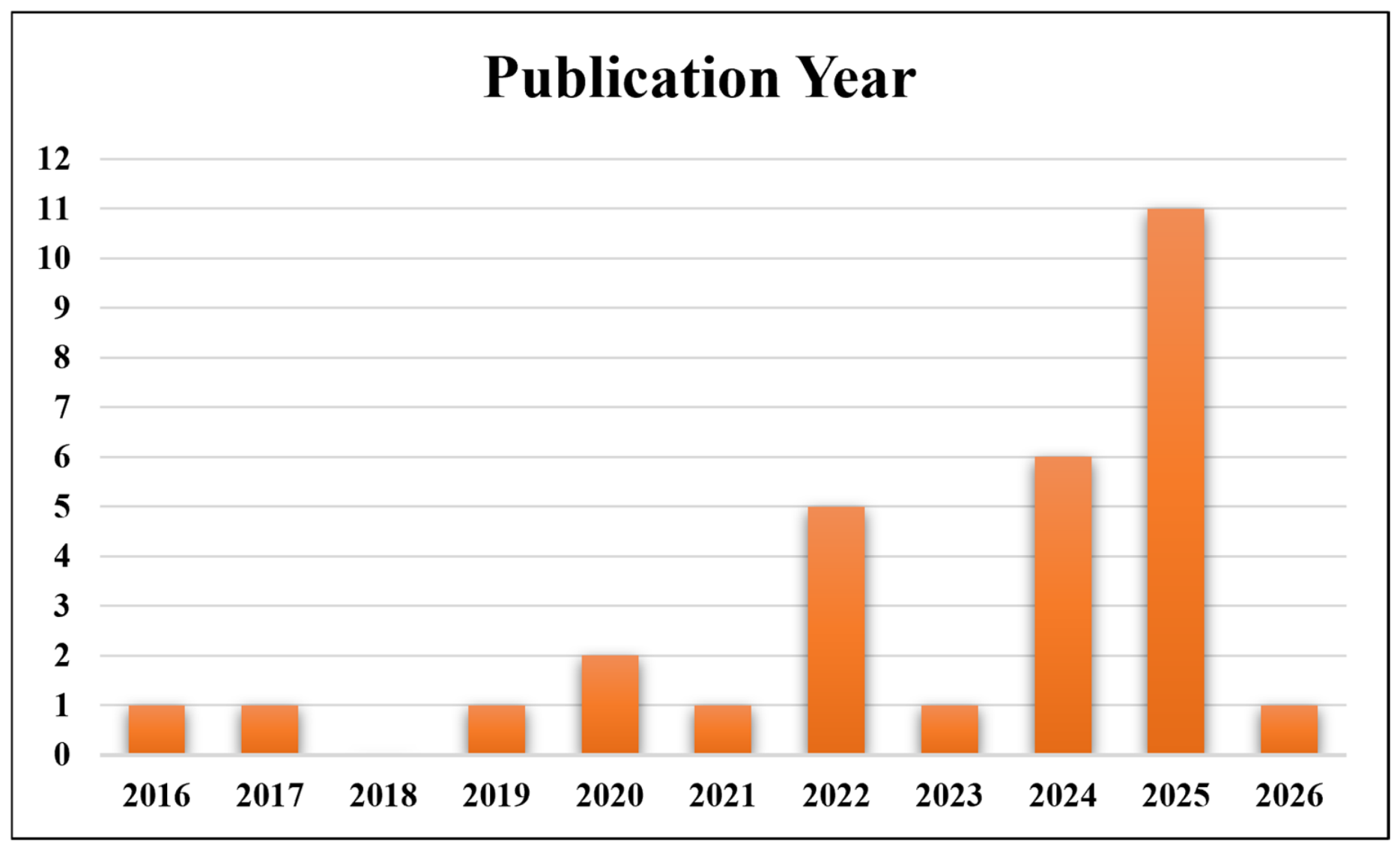
The systematic review resulted in the final selection of 30 documents for analysis. Of these, 11 are journal articles, while 19 are conference papers. The distribution of the articles over the years is shown in Figure 2. The concentration of publications in recent years reflects a marked increase in academic attention toward circular design for automotive applications. However, a higher publication frequency does not necessarily imply immediate industrial implementation or methodological maturity, as tool integration into engineering workflows remains fragmented.
Figure 2.
Distribution of articles by publication year.
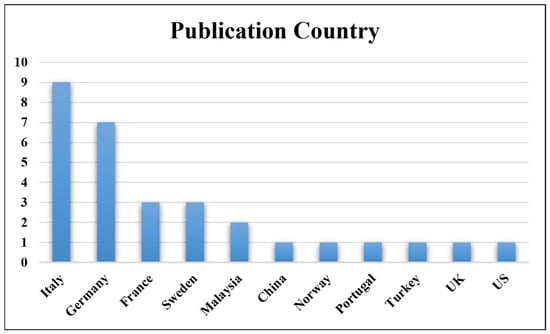
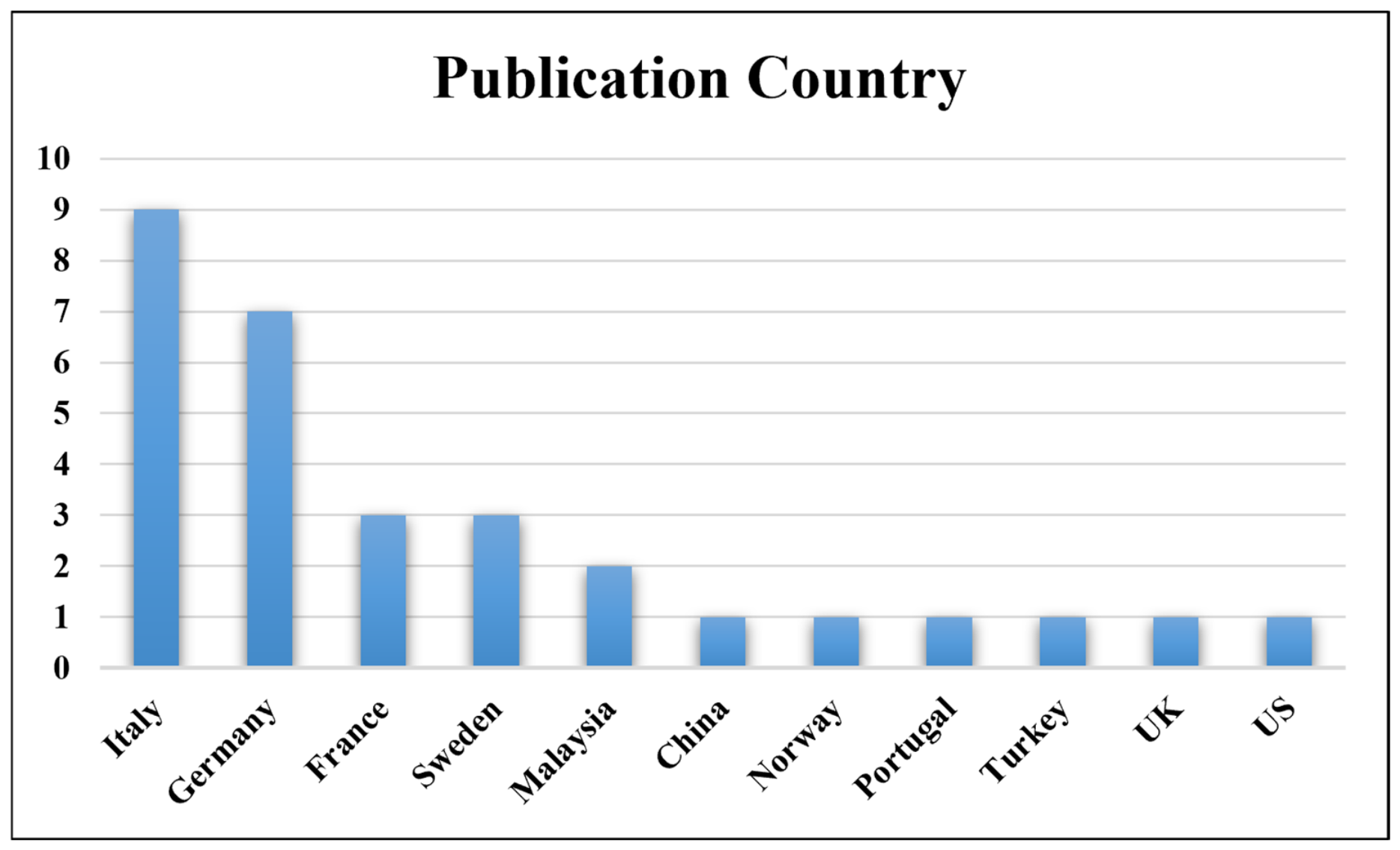
In addition to the distribution of the selected articles over the years, it is possible to observe the distribution of countries of publication, based on the affiliation of the corresponding author or the first author. Figure 3 is particularly interesting because it shows that this research topic is quite international but primarily linked to the European context, likely due to the stricter regulations in this geographic area compared to the rest of the world.
Figure 3.
Distribution of articles by publication country.
To analyze the temporal evolution of the selected literature, the Overlay Visualization mode was used in VOSviewer, version 1.6.20 [21]. In the map in Figure 4, the color of each keyword indicates the average year of publication of the articles in which it appears. The color scale shown in the legend, ranging from blue to yellow, thus represents the temporal center of gravity of the terms, calculated as the arithmetic mean of the publication years of the relevant sources. For this reason, the statistical scale generated by the software automatically centers between 2021 and 2025 reflecting the period of maximum density and convergence of the data analyzed. As illustrated in the temporal overlay map, recent research trends are characterized by an emergent focus on concepts such as “Circular Design”, “Circularity”, and “Automotive Electronics”. Additionally, the literature indicates a substantial increase in the usage of the term “Critical Raw Materials” in recent years. In terms of overall frequency across the period studied, foundational keywords including “Electric Vehicle”, “Recycling”, “Disassembly”, “Technology”, “Stage”, and “Resource” exhibit the highest prevalence, as denoted by their prominent node sizes within the network.
Figure 4.
Temporal evolution of research topics using VOSviewer’s Overlay Visualization. The color of the nodes represents the average year of publication (from blue for past topics to yellow for recent trends); the size represents the frequency of keywords.
In order to provide a structured and comprehensive overview of the state of the art as reflected in the selected articles, the characteristics of the documents were systematically extracted and evaluated using a “Usability Scorecard”. The Scorecard is intended to assess, for each document, the level of complexity and integration of the proposed tools or frameworks based on the following categories: type of tool, workflow integration, management of critical materials, trade-off analysis, circular design and regulatory alignment, and validation. Each tool was quantitatively scored on a 1-to-5 scale across three core dimensions: (i) Workflow Integration (measuring connection depth with native CAD, CAE, and PLM software environments); (ii) Performance Trade-Off Analysis (evaluating the dynamic balancing between operational engineering parameters and environmental LCA metrics); and (iii) Critical Raw Material (CRM) Tracking (assessing readiness for tracking strategic materials such as Lithium, Cobalt, and Rare Earth Elements). The complete quantitative scoring rubric, defining the explicit criteria for scores 1 through 5, is presented in Table 3.
Table 3.
Usability Scorecard Evaluation Rubric (1–5 Quantitative Scale).
The systematic literature review identified 30 publications representing 27 distinct computational tools and frameworks for circular automotive design. The full comparative evaluation matrix is presented in Table 4. Each tool is assigned a unique identifier (T01 to T27) to facilitate cross-referencing between publications, tool architectures, and supplementary scoring justifications. Given the high heterogeneity of the systems analyzed, the identified tools and frameworks were classified into four main application areas (clusters): Propulsion Batteries and Energy Storage (B), Automotive Electronics (E), Electric Drives and Mechatronics (M), and Structural/Passive Components and Complete Vehicle (S). Furthermore, tool validation was disaggregated into four distinct categories: Academic Case Study (CS), Expert Evaluation/Stakeholder Survey (EXP), UX/Usability Testing (UX), and Real-World Industrial Field Validation (IND). Finally, the application scope was categorized as either Direct Active Automotive System (DIR) or Transferable Passive/Cross-Sectoral System (TRF). Tool type is divided in Conceptual Framework (FW), Custom Script/Algorithm (SC), Standalone Software (SW), and Direct CAE/PLM Plugin (PL). The detailed analysis of each article using the Usability Scorecard is presented in Table S3 in the Supplementary Materials.
Table 4.
Systematic Review State-of-the-Art Matrix.
3.1. Typology of Circular Design Tools—RQ1
The systematic review of the selected literature reveals a highly heterogeneous landscape regarding the typology of circular design tools developed for active and energy-using automotive components. The retrieved solutions can be broadly classified into four main categories: conceptual frameworks, custom computational scripts, standalone software, and direct CAD/PLM plugins. Conceptual frameworks predominantly provide structured guidelines or indicator-based methodologies to support strategic decision-making in the early design stages. Examples include the adaptation of the 9R model for electric motors [25], the application of the House of Quality for battery redesign [44], systematic Design for Recycling (DfR) approaches for exterior plastics [33], and exhaustive global sustainability assessments using midpoint and endpoint categories [37]. However, to overcome the limitations of purely theoretical approaches, the recent literature shows a significant shift towards custom computational scripts and standalone software. For instance, dedicated platforms like B-LEAP automate life cycle and cost assessments specifically for battery systems [27], while tools like LeanDfD quantitatively assess the ease of disassembly of mechatronic products [29], and ProSET employs neural networks to calculate a Weighted Sustainability Score [35]. Advanced algorithmic solutions are also emerging, ranging from genetic algorithms applied to material and joint selection [36] and parameterized mathematical equations for battery packaging simulation [52], up to the integration of artificial intelligence. A notable example is the AutoPCM approach, which utilizes Large Language Models (LLMs) to automatically process unstructured manufacturing documents for electronic control units [47,48].
3.2. Workflow Integration and Usability—RQ2
A critical parameter for the successful industrial adoption of eco-design tools is their seamless integration into existing engineering workflows (CAD, CAE, and PLM). The analysis indicates that a substantial portion of the current tools still exhibits a “Low” level of integration, relying heavily on manual data entry or qualitative expert surveys. This is evident in tools employing Fuzzy AHP for multi-criteria decisions [23], methodologies evaluating technologies against planetary boundaries [38], or frameworks relying on manual iterations by designers for calculating micro-indicators like the Material Circularity Indicator [49]. Tools demonstrating a “Medium” integration level attempt to bridge this gap through semi-automated data imports; for example, specific frameworks extract Bill of Materials (BOM) data via XML files [29], translate BatPaC spreadsheet inputs into ecoinvent inventories for LCA [31,32], or assign weighted penalty factors based on extracted product architectures and standard times for batteries [43]. “High” integration levels, where circularity assessments are directly coupled with 3D modeling or cyber–physical systems, remain scarce but represent the most promising frontier. Exemplary approaches in this category include DeSA software, which is directly integrated into the HyperWorks and MATLAB environments [24], the eDAM framework connecting Life Cycle Engineering with CAD-based Generative Design [42], and Python-based algorithms that generate and solve meshes automatically via FEA software to optimize Circular Economy Indicators [51]. Furthermore, cutting-edge data ecosystems leverage digital twins to ensure continuous product-specific data exchange from material sourcing to end-of-life, as demonstrated by the Catena-X network [45].
3.3. Trade-Off Analysis—RQ3
For energy-using mechatronic components, the design process is inherently governed by the friction between operational performance (e.g., energy efficiency, lightweighting, thermal management) and end-of-life circularity. The retrieved tools address this complex trade-off through various multi-criteria optimization strategies. For example, in the context of electric vehicle batteries, model-based LCA approaches have been developed to simulate the severe compromises between extending the battery’s useful lifespan and the consequent increase in energy required for thermal insulation [39]. Similarly, cyber–physical integration at early Technology Readiness Levels (TRLs) helps to balance performance and environmental consequences for solid-state batteries [28]. In structural optimization, tools evaluate the trade-off between lightweighting goals and the resulting life cycle sustainability [24,42]. For complex powertrains and mechatronics, approaches utilize Constraint Satisfaction Problem (CSP) formalisms to weigh environmental impacts against functional attractiveness [50], dynamic kinematic models to balance logistics, battery capacity, and mass for autonomous guided vehicles [40,41], or Monte Carlo simulations to balance the high upfront investment of remanufacturing against long-term reliability [46]. Finally, comprehensive frameworks like CEF-DPP demonstrate how integrating Digital Product Passports can effectively reduce CO2 emissions while managing mechatronic complexity [34].
3.4. Usability Barriers and Methodological Limitations—RQ4
Despite the methodological advancements, several critical barriers hinder the widespread implementation of these tools in daily engineering practices. A primary limitation is the heavy reliance on Life Cycle Inventory (LCI) data, which is often unavailable or highly uncertain during the early conceptual design phases [24]. Moreover, the manual generation of complex product architecture matrices, a prerequisite for many Design for Disassembly tools, proves to be excessively time-consuming for industrial applications [47,48]. Another severe methodological gap is the inadequate management of Critical Raw Materials (CRMs). Most tools evaluate materials using generic environmental impact categories, failing to address the specific supply chain vulnerabilities of mechatronic components. Exceptions to this trend are rare but significant: certain advisory frameworks introduce specific “Thermodynamic rarity indicators” to explicitly prioritize the recovery of precious metals like Palladium, Iridium, and Platinum from automotive electronics [30], while advanced battery frameworks define dedicated metrics for tracking flows of Cobalt, Nickel, and Manganese [26]. Overcoming these barriers requires a shift towards highly automated, data-driven platforms capable of operating with incomplete datasets and specifically calibrated for CRM recovery.
3.5. Summary of Results per Cluster
To provide a clear, high-level synthesis of the reviewed landscape, the 27 evaluated tools were benchmarked across the four clusters, or primary component archetypes.
Table 5 maps the complete distribution of tools (T01 to T27) per cluster, detailing the quantitative mapping, methodological strengths, and implementation gaps identified for each archetype.
Table 5.
Comprehensive Benchmark of Evaluated Circular Design Tools by Component Cluster.
4. Discussion
The systematic review of the selected literature demonstrates that the eco-design of active and energy-using automotive components requires a paradigm shift from traditional, qualitative assessments to dynamic, data-driven methodologies. While classical Life Cycle Assessment (LCA) provides a robust retrospective evaluation of environmental impacts, it proves inadequate during the early conceptual design phases, where crucial decisions regarding product architecture, material selection, and assembly methods are made, but detailed data are scarce. The transition towards integrated decision support systems represents the current frontier for automotive engineers, who must constantly balance operational performance, such as energy efficiency and lightweighting, against end-of-life circularity and disassemblability. Based on the findings extracted through the Usability Scorecard, the implications of this study are articulated around some main focal points that are currently reshaping the automotive industry.
4.1. Limitations of the Present Study
While this systematic literature review provides a comprehensive synthesis of the state of the art in circular design tools for the automotive sector, a number of limitations must be acknowledged. First, the literature search was restricted to articles published in English and indexed in specific academic databases (Scopus and Web of Science—Core Collection) over the last decade. This approach may have excluded relevant industrial white papers, proprietary software documentation, or regional studies published in other languages. Second, the review intentionally focused on tools applicable to active, energy-using mechatronic components (e.g., batteries, electric motors, electronic control units) and complex structural systems. Consequently, highly specific chemical methodologies for battery cell material formulation, or purely macroeconomic models evaluating circular business strategies without a direct link to the product engineering phase, were excluded. Finally, given the rapid technological evolution of electric mobility and artificial intelligence, the landscape of available tools is expanding at an unprecedented rate; thus, some cutting-edge computational solutions currently under development in corporate R&D departments may not yet be reflected in the peer-reviewed academic literature.
4.2. Regulatory Alignment and the Role of Digital Product Passports (DPPs)
The evolution of circular design tools is no longer driven solely by voluntary corporate sustainability goals, but is increasingly mandated by stringent regulatory frameworks. The transition from theoretical eco-design guidelines to operational software was historically influenced by Directive 2000/53/EC [3], but is now directly shaped by the newly adopted EU End-of-Life Vehicles Regulation (Regulation (EU) 2026/1738) [53], which repeals previous Directives. For instance, the binding requirements of ELVR, mandating design-for-dismantling rules, mandatory recycled material targets, and the non-destructive removal of larger Printed Circuit Boards (PCBs) and traction batteries prior to shredding, are forcing engineers to adopt specific frameworks, such as the Eco-Sensitivity Framework (ESF) applied in Peitzmeier et al. (2025) [47] and Peitzmeier et al. (2026) [48], to evaluate the disassembly effort of Electronic Control Units (ECUs). Similarly, decision-making tools for automotive electronics are incorporating specific “Thermodynamic rarity indicators” [30] to ensure the recovery of Critical Raw Materials (CRMs), addressing the European Commission’s emphasis on minimizing the loss of valuable metals in conventional shredding processes. This monitoring pressure is even more pronounced in the traction battery sector, where the EU Battery Regulation [22] imposes strict thresholds for carbon footprint reporting and recycling quotas. To comply with the Circular Economy Action Plan (CEAP) [2], modern battery eco-design platforms must integrate predictive LCA capabilities capable of simulating manufacturing emissions and assessing 4R strategies (Remanufacture, Repair, Repurpose, Recycle) simultaneously [26]. To navigate this complex regulatory landscape, the literature highlights the emergence of the Digital Product Passport (DPP) as a pivotal enabler. By encapsulating material composition, origin, and end-of-life instructions into a central digital record, the DPP provides the transparency required by modern regulations. Frameworks such as the CEF-DPP [34] demonstrate that integrating digital passports into mechatronic design workflows can drastically reduce CO2 emissions by facilitating the 100% reuse of specific components, bridging the gap between legislative compliance and practical engineering design.
4.3. Dynamic Use-Phase Modeling and the Open-Access Barrier
For active, energy-using components, the “Use Phase” often constitutes the most impactful stage of the entire product life cycle. Consequently, assuming static or average energy consumption values during the conceptual design phase can lead to highly inaccurate circularity assessments. The reviewed literature demonstrates a necessary transition towards dynamic use-phase modeling. For instance, predictive models for industrial electric vehicles and Autonomous Mobile Robots (AMRs) have been developed to dynamically calculate energy consumption by integrating kinematic models, WLTC driving cycles, variable transport loads, and localized electricity grid mixes [40,41]. Similarly, for traction batteries, electrothermal and dynamic aging models have been integrated into LCA approaches, allowing designers to quantify the severe environmental trade-offs between extending a battery’s useful lifespan and the energy required for thermal management during its operation [39]. Furthermore, Constraint Satisfaction Problem (CSP) formalisms have been successfully applied to explore the architectural configurations of hybrid powertrains, explicitly targeting use-phase Global Warming Potential (GWP) optimization [50].
However, the industrial adoption of these advanced dynamic tools highlights a critical accessibility barrier. The systematic review reveals a strong dichotomy between proprietary and open-access solutions. Highly integrated frameworks often rely on expensive commercial software suites; for example, structural ecodesign evaluations are frequently coupled with proprietary CAE environments like HyperWorks and MATLAB [24], while advanced LLM-based architectures have been implemented on commercial enterprise platforms [47,48]. This reliance on proprietary software represents a severe economic barrier, particularly for Small and Medium-Sized Enterprises (SMEs). To democratize eco-design, recent research is actively shifting towards open-source environments. The widespread adoption of tools like BatPaC is largely attributed to its accessible spreadsheet-based architecture [31,32]. Moving forward, the development of Python-based optimization platforms utilizing open-source libraries, such as Brightway2 [27,51], along with the integration of open-access LCA software like OpenLCA [30], will be paramount to ensure that advanced circular design tools are universally accessible across the automotive supply chain.
4.4. Future Research Directions: Digital Twins and Artificial Intelligence
While the integration of regulatory constraints provides a clear direction for circular design, the usability barriers identified in this review, specifically the heavy reliance on manual data entry (52% of evaluated tools) and the omission of Critical Raw Material tracking (44.0%), highlight key areas for technological development.
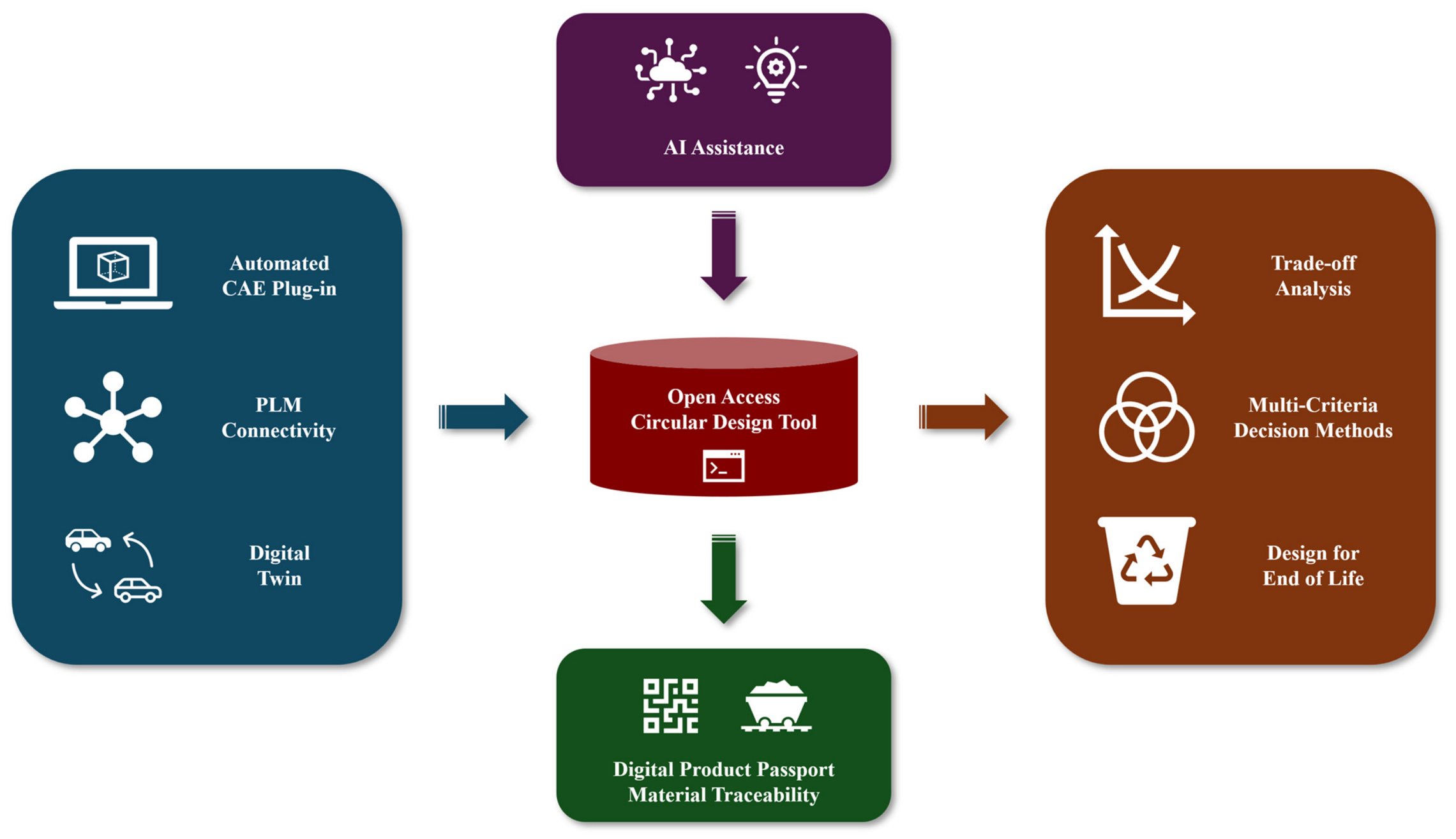
Future research and industrial applications should explore achieving higher workflow integration through the adoption of data ecosystems and Artificial Intelligence (AI). Digital twins represent a promising approach to addressing data scarcity. By ensuring a product-specific, end-to-end data exchange throughout the entire product life cycle, digital twins allow engineers to evaluate circular strategies based on the actual state of health of a component rather than theoretical averages. Collaborative cross-company networks, such as the Catena-X data ecosystem in the European automotive industry, illustrate how decentralized data sharing can empower dismantling companies and designers to optimize end-of-life decisions for mechatronic components [45].
Furthermore, the integration of artificial intelligence, specifically Large Language Models (LLMs) and Machine Learning (ML), offers opportunities to streamline the conceptual design phase. As demonstrated by the AutoPCM approach [47,48], LLMs can be utilized to automatically process unstructured manufacturing documents, such as Bills of Materials (BOMs) and assembly instructions, converting them into structured Physical Component Mapping matrices without extensive manual labor. Simultaneously, Machine Learning algorithms can be trained on existing databases to create parametric models that predict the environmental impacts of autonomous mobile robots or electric shuttles even when detailed 3D models are not yet available [40,41].
In addition, future tools should investigate natively integrating circular economy indicators into CAD and CAE software. Coupling Life Cycle Engineering (LCE) with computational optimization routines, such as Generative Design for Additive Manufacturing [42], can enable algorithms to propose high-circularity concepts that balance mass reduction, structural integrity, and end-of-life recoverability. Optimization of disassembly sequences is not only an environmental consideration but a critical driver for economic feasibility. The ability of advanced digital tools to accurately predict disassembly times and labor costs allows engineers to calculate the Profit to Loss Margin of recycling [43], demonstrating that circular strategies like remanufacturing can yield long-term savings despite high upfront investments [29,46].
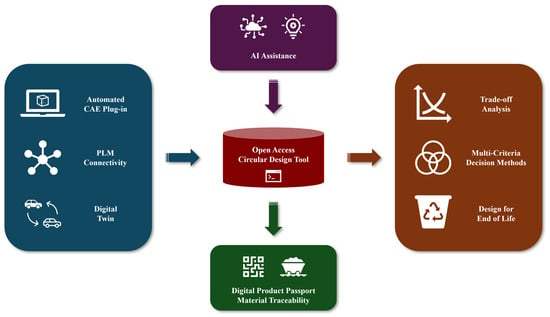
Finally, as the scope of eco-design expands, future decision-support systems could evolve to fully embrace the LCSA framework by integrating social sustainability metrics. While current tools are heavily skewed towards environmental impacts, a holistic framework should also evaluate occupational health and safety risks during the dismantling of hazardous mechatronic systems, alongside broader societal and public health impacts [23,37]. The scheme of the defined future circular design tool for the Automotive Industry is shown in Figure 5.
Figure 5.
Future Circular Design Tool in Automotive Industry.
5. Conclusions
This systematic literature review critically evaluated 30 articles (representing 27 distinct tools) on circular design frameworks for active, energy-using automotive components. Through a customized Usability Scorecard, the study assessed existing tools regarding workflow integration, trade-off analysis, EoL management, and Critical Raw Material (CRM) tracking. Empirical findings demonstrate that despite an increase in computational tools, major implementation barriers remain: 52% of evaluated tools display low CAD/PLM integration, relying on manual data entry, and 44% completely omit CRM tracking metrics. These findings must be interpreted in light of the study’s methodological scope, which focused strictly on the peer-reviewed literature indexed in Scopus and Web of Science for active mechatronic systems, thereby excluding proprietary OEM tools and purely material-chemistry formulations. To comply with evolving regulations such as the EU Battery Regulation [22] and ELV Regulation [53], future research should cautiously investigate and validate open-source data ecosystems (e.g., Digital Product Passports and digital twins) and AI-assisted workflows (e.g., LLM-based architectural mapping) to improve workflow integration and data traceability without over-complicating early-stage engineering decisions.
Supplementary Materials
The following supporting information can be downloaded at https://www.mdpi.com/article/10.3390/wevj17110593/s1. Table S1: Systematic Research scripts; Table S2: Systematic Research results; Table S3: Literature Review Usability Scorecard; PRISMA 2020 Checklist; PRISMA 2020 Flow Diagram.
Author Contributions
Conceptualization, M.G.; methodology, M.G.; software, M.G.; validation, M.G. and L.B.; formal analysis, M.G.; investigation, M.G.; resources, M.G. and M.D.; data curation, M.G.; writing—original draft preparation, M.G.; writing—review and editing, M.G., L.B., and M.D.; visualization, M.G.; supervision, L.B., and M.D.; project administration, M.D.; funding acquisition, L.B. and M.D. All authors have read and agreed to the published version of the manuscript.
Funding
This work was supported by the European Union within the project CliMAFlux Horizon Europe under grant agreement ID: 101096062 (https://climaflux.eu/). Views and opinions expressed are, however, those of the author(s) only and do not necessarily reflect those of the European Union, or the European Climate, Infrastructure and Environment Executive Agency (CINEA). Neither the European Union nor the granting authorities can be held responsible for them.
Data Availability Statement
The original contributions presented in this study are included in the article/Supplementary Material. Further inquiries can be directed to the corresponding author.
Conflicts of Interest
The authors declare no conflicts of interest. The funders had no role in the design of the study; in the collection, analyses, or interpretation of data; in the writing of the manuscript; or in the decision to publish the results.
Abbreviations
The following abbreviations are used in this manuscript:
| AHP | Analytic Hierarchy Process |
| AI | Artificial Intelligence |
| AMR | Autonomous Mobile Robot |
| BEV | Battery Electric Vehicle |
| BOM | Bill of Materials |
| CAD | Computer-Aided Design |
| CAE | Computer-Aided Engineering |
| CE | Circular Economy |
| CEAP | Circular Economy Action Plan |
| CRM | Critical Raw Material |
| CSP | Constraint Satisfaction Problem |
| DEoL | Design for End-of-Life |
| DfAM | Design for Additive Manufacturing |
| DfD | Design for Disassembly |
| DfE | Design for Environment |
| DfR | Design for Recycling |
| DfReman | Design for Remanufacturing |
| DfX | Design for X |
| DPP | Digital Product Passport |
| DSS | Decision Support System |
| ECU | Electronic Control Unit |
| ELV | End-of-Life Vehicle |
| EoL | End-of-Life |
| EU | European Union |
| EV | Electric Vehicle |
| FEA | Finite Element Analysis |
| GWP | Global Warming Potential |
| HEV | Hybrid Electric Vehicle |
| HVAC | Heating, Ventilation and Air Conditioning |
| KPI | Key Performance Indicator |
| LCA | Life Cycle Assessment |
| LCC | Life Cycle Costing |
| LCE | Life Cycle Engineering |
| LCI | Life Cycle Inventory |
| LCS | Life Cycle Simulation |
| LCSA | Life Cycle Sustainability Assessment |
| LCT | Life Cycle Technologies |
| LFP | Lithium Iron Phosphate |
| LLM | Large Language Model |
| MCDA | Multi-Criteria Decision Analysis |
| MCDM | Multi-Criteria Decision Method |
| MCI | Material Circularity Indicator |
| ML | Machine Learning |
| NMC | Nickel Manganese Cobalt |
| OEM | Original Equipment Manufacturer |
| PCB | Printed Circuit Board |
| PHEV | Plug-in Hybrid Electric Vehicle |
| PLM | Product Lifecycle Management |
| PRISMA | Preferred Reporting Items for Systematic Reviews and Meta-Analyses |
| QFD | Quality Function Deployment |
| RDI | Recycling Desirability Index |
| RQ | Research Question |
| SDG | Sustainable Development Goal |
| SLCA | Social Life Cycle Assessment |
| SME | Small and Medium-Sized Enterprises |
| TRL | Technology Readiness Level |
| UX | User Experience |
| WLTC | Worldwide harmonized Light vehicles Test Cycle |
References
- Communication from the Commission to the European Parliament, the European Council, the Council, the European Economic and Social Committee and the Committee of the regions, 2019. The European Green Deal. Available online: https://eur-lex.europa.eu/legal-content/EN/TXT/?uri=COM%3A2019%3A640%3AFIN (accessed on 8 November 2026).
- Directorate-General for Communication (European Commission). Circular Economy Action Plan: For a Cleaner and More Competitive Europe; Publications Office of the European Union: Luxembourg, 2020.
- Aguilar Esteva, L.C.; Kasliwal, A.; Kinzler, M.S.; Kim, H.C.; Keoleian, G.A. Circular Economy Framework for Automobiles: Closing Energy and Material Loops. J. Ind. Ecol. 2021, 25, 877–889. [Google Scholar] [CrossRef] [Scilit]
- Directive 2000/53/EC of the European Parliament and of the Council of 18 September 2000 on End-of Life Vehicles—Commission Statements. OJ L 269, 21.10.2000, pp. 34–43. 2000. Available online: http://data.europa.eu/eli/dir/2000/53/oj (accessed on 8 November 2026).
- ISO 22628:2002; Road Vehicles—Recyclability and Recoverability—Calculation Method. International Organization for Standardization: Geneva, Switzerland, 2002.
- ISO 21106:2019; Railway Applications—Recyclability and Recoverability Calculation Method for Rolling Stock. International Organization for Standardization: Geneva, Switzerland, 2019.
- EN 45555:2019; General Methods for Assessing the Recyclability and Recoverability of Energy-Related Products. European Committee for Standardization (CEN); European Committee for Electrotechnical Standardization (CENELEC): Brussels, Belgium, 2019.
- European Parliament and Council. Regulation (EU) 2024/1781 of the European Parliament and of the Council of 13 June 2024 Establishing a Framework for the Setting of Ecodesign Requirements for Sustainable Products, Amending Directive (EU) 2020/1828 and Regulation (EU) 2023/1542 and Repealing Directive 2009/125/EC, OJ L, 2024/1781, 28.6.2024. Available online: http://data.europa.eu/eli/reg/2024/1781/oj (accessed on 8 November 2026).
- Rare Earth Industry Association (REIA). Product Category Rules (PCR) for Rare Earth Elements and Permanent Magnets; Rare Earth Industry Association (REIA): Brussels, Belgium, 2024. [Google Scholar]
- Ullman, D.G. The Mechanical Design Process, 4th ed.; McGraw-Hill Series in Mechanical Engineering; McGraw-Hill: Boston, MA, USA, 2010. [Google Scholar]
- Merschak, S.; Diallo, T.M.L.; Hehenberger, P. Life Cycle Sustainability Assessment as a Decision-Making Tool for the Design of Mechatronic Systems. Int. J. Prod. Lifecycle Manag. 2022, 14, 142–173. [Google Scholar] [CrossRef] [Scilit]
- Binnemans, K.; Jones, P.T.; Blanpain, B.; Van Gerven, T.; Yang, Y.; Walton, A.; Buchert, M. Recycling of Rare Earths: A Critical Review. J. Clean. Prod. 2013, 51, 1–22. [Google Scholar] [CrossRef] [Scilit]
- Nordelöf, A.; Grunditz, E.; Lundmark, S.; Tillman, A.-M.; Alatalo, M.; Thiringer, T. Life Cycle Assessment of Permanent Magnet Electric Traction Motors. Transp. Res. Part D Transp. Environ. 2019, 67, 263–274. [Google Scholar] [CrossRef] [Scilit]
- Page, M.J.; McKenzie, J.E.; Bossuyt, P.M.; Boutron, I.; Hoffmann, T.C.; Mulrow, C.D.; Shamseer, L.; Tetzlaff, J.M.; Akl, E.A.; Brennan, S.E.; et al. The PRISMA 2020 Statement: An Updated Guideline for Reporting Systematic Reviews. BMJ 2021, 372, n71. [Google Scholar] [CrossRef] [Scilit] [PubMed]
- Wu, S.R.; de Bortoli, A.; Bulle, C. A Review of Current State-of-the-Art Road Vehicle Life Cycle Assessment Tools. J. Clean. Prod. 2025, 522, 146278. [Google Scholar] [CrossRef] [Scilit]
- Innocenti, E.; Guadagno, M.; Berzi, L.; Pierini, M.; Delogu, M. A Review of Computational Methods and Tools for Life Cycle Assessment of Traction Battery Systems. Eng. Proc. 2025, 85, 10. [Google Scholar] [CrossRef] [Scilit]
- Oluwalana, O.J.; Grzesik, K. A Systematic Review of Life Cycle Assessment of Electric Vehicles Studies: Goals, Methodologies, Results and Uncertainties. Energies 2025, 18, 5867. [Google Scholar] [CrossRef] [Scilit]
- Picatoste, A.; Justel, D.; Mendoza, J.M.F. Circular Design Criteria and Indicators for the Sustainable Life Cycle Management of Electric Vehicle Batteries. Sustain. Prod. Consum. 2025, 56, 182–206. [Google Scholar] [CrossRef] [Scilit]
- Li, Z.; Hamidi, A.S.; Yan, Z.; Sattar, A.; Hazra, S.; Soulard, J.; Guest, C.; Ahmed, S.H.; Tailor, F. A Circular Economy Approach for Recycling Electric Motors in the End-of-Life Vehicles: A Literature Review. Resour. Conserv. Recycl. 2024, 205, 107582. [Google Scholar] [CrossRef] [Scilit]
- Cerdas, F. Integrated Computational Life Cycle Engineering for Traction Batteries; Sustainable Production, Life Cycle Engineering and Management; Springer International Publishing: Cham, Switzerland, 2022. [Google Scholar] [CrossRef] [Scilit]
- Van Eck, N.J.; Waltman, L. Software Survey: VOSviewer, a Computer Program for Bibliometric Mapping. Scientometrics 2010, 84, 523–538. [Google Scholar] [CrossRef] [Scilit] [PubMed]
- European Parliament and Council. Regulation (EU) 2023/1542 of the European Parliament and of the Council of 12 July 2023 Concerning Batteries and Waste Batteries, Amending Directive 2008/98/EC and Regulation (EU) 2019/1020 and Repealing Directive 2006/66/EC, OJ L 191, 28.7.2023, pp. 1–117. Available online: http://data.europa.eu/eli/reg/2023/1542/oj (accessed on 8 November 2026). [PubMed]
- Acar, C.; Beskese, A.; Temur, G.T. Comparative Fuel Cell Sustainability Assessment with a Novel Approach. Int. J. Hydrogen Energy 2022, 47, 575–594. [Google Scholar] [CrossRef] [Scilit]
- Antonacci, A.; Del Pero, F.; Baldanzini, N.; Delogu, M. Holistic Eco-Design Tool within Automotive Field. IOP Conf. Ser. Mater. Sci. Eng. 2022, 1214, 012045. [Google Scholar] [CrossRef] [Scilit]
- Benfer, M.; Gartner, P.; Klenk, F.; Wallner, C.; Jaspers, M.-C.; Peukert, S.; Lanza, G. A Circular Economy Strategy Selection Approach: Component-Based Strategy Assignment Using the Example of Electric Motors. In Proceedings of the Conference on Production Systems and Logistics; Herberger, D., Hübner, M., Eds.; Publish-Ing in cooperation with TIB—Leibniz Information Centre for Science and Technology University Library: Hannover, Germany, 2022; pp. 22–31. [Google Scholar] [CrossRef] [PubMed]
- Bin, X.; Thakur, J. Circular Economy Metrics for Batteries: Enhancing Sustainability in Energy Storage Systems. Sustain. Prod. Consum. 2025, 55, 470–485. [Google Scholar] [CrossRef] [Scilit]
- Clos, D.P.; Baars, J.; Holsten, J.; Orangi, S.; Cerdas, F.; Dilger, N.; Zellmer, S.; Herrmann, C.; Strømman, A. A Battery Modeling Platform for Broad, Consistent, and Automated Life Cycle Assessments and Cost Studies (B-LEAP). J. Ind. Ecol. 2025, 29, 1208–1222. [Google Scholar] [CrossRef] [Scilit]
- Dilger, N.; Kaluza, A.; Kiesewetter, A.; Cerdas, F.; Blume, S.; Zellmer, S.; Herrmann, C. Definition and Reference Framework for Life Cycle Technologies in Life Cycle Engineering—A Case Study on All Solid State Traction Batteries. Procedia CIRP 2021, 98, 217–222. [Google Scholar] [CrossRef] [Scilit]
- Favi, C.; Marconi, M.; Germani, M.; Mandolini, M. A Design for Disassembly Tool Oriented to Mechatronic Product De-Manufacturing and Recycling. Adv. Eng. Inform. 2019, 39, 62–79. [Google Scholar] [CrossRef] [Scilit]
- Fontana, A.; Rossi, L.; Nika, J.; Dell’Ambrogio, S.; Sorlini, M.; Pachon, E.R.; Rosa, P.; Van Schaik, A.; Reuter, M. Enhancing the Sustainability of the Electronics in the Automotive Sector in the Context of Circular Economy Through a Decision-Making Framework. In Proceedings of the International Conference on Electronics Goes Green +: From Silicon to Sustainability, EGG—Proc.; Institute of Electrical and Electronics Engineers Inc.: New York, NY, USA, 2024. [Google Scholar] [CrossRef] [Scilit]
- Gianvincenzi, M.; Marconi, M.; Mosconi, E.M.; Tola, F. Eco-Design Framework for a Battery Sustainable Lifecycle Management. In Proceedings of the Lecture Notes in Mechanical Engineering; Carfagni, M., Furferi, R., Governi, L., Di Stefano, P., Gherardini, F., Eds.; Springer Science and Business Media: Cham, Switzerland, 2024; pp. 75–82. [Google Scholar] [CrossRef] [Scilit]
- Gianvincenzi, M.; Viglia, S.; Porta, P.L.; Marconi, M.; Mosconi, E.M.; Tola, F. A Comprehensive Approach to Evaluating Environmental Sustainability of EV Batteries: Integrating BatPaC with LCA Indicators for EV Battery Eco-Design. Procedia CIRP 2025, 135, 350–355. [Google Scholar] [CrossRef] [Scilit]
- Hallack, E.; Peris, N.M.; Lindahl, M.; Sundin, E. Systematic Design for Recycling Approach—Automotive Exterior Plastics. Procedia CIRP 2022, 105, 204–209. [Google Scholar] [CrossRef] [Scilit]
- Hammadi, M.; Merschak, S.; Diallo, T.M.L.; Hehenberger, P. CEF-DPP: A Circular Economy Framework Integrating Digital Product Passport for Improving Circularity of Sustainable Mechatronics Design. Circ. Econ. Sustain. 2025, 5, 3431–3463. [Google Scholar] [CrossRef] [Scilit]
- Hassan, M.F.; Mahmood, S.; Saman, M.Z.M.; Sharif, S.; Sapuan, S.Z. Application of Product Sustainability Evaluation Tool (ProSET) on Car Seat Design Configurations. Int. J. Mech. Mech. Eng. 2017, 17, 88–97. [Google Scholar]
- Hooi, L.C.; Sakundarini, N.; Ghazali, I.; Chin, C. Eco Design Tool for Material and Joining Selection of Automotive Component Using Genetic Algorithm. AIP Conf. Proc. 2024, 2998, 020006. [Google Scholar] [CrossRef] [Scilit]
- Jasiński, D.; Meredith, J.; Kirwan, K. A Comprehensive Framework for Automotive Sustainability Assessment. J. Clean. Prod. 2016, 135, 1034–1044. [Google Scholar] [CrossRef] [Scilit]
- Kumar, M.; Baumann, M.; Weil, M. A Methodology for Absolute Environmental Sustainability Assessment of Batteries: A Comparative Case Study of Sodium-Ion and Lithium-Ion Battery. Procedia CIRP 2025, 135, 594–599. [Google Scholar] [CrossRef] [Scilit]
- Lavisse, T.; Zwolinski, P.; Brissaud, D.; Panariello, R.; Perdu, F. Ecodesign of Lithium-Ion Battery Systems for E-Mobility: A Model-Based LCA Approach. CIRP Ann. 2025, 74, 203–207. [Google Scholar] [CrossRef] [Scilit]
- Manuguerra, L.; Cappelletti, F.; Manes, F.; Germani, M. A Predictive Eco-Design Method and Tool for Electric Vehicles of Industry 4.0. Procedia Comput. Sci. 2022, 217, 248–257. [Google Scholar] [CrossRef] [Scilit]
- Manuguerra, L.; Cappelletti, F.; Rossi, M.; Germani, M. Eco-Design Tool to Support the Design of Industrial Electric Vehicles. The Case Studies of an Electric Shuttle and an Autonomous Mobile Robot. J. Ind. Infor. Integr. 2024, 39, 100605. [Google Scholar] [CrossRef] [Scilit]
- Marconi, M.; Favi, C.; Mandolini, M.; Murgese, L.; Villazzi, N.; Gallozzi, S. eDAM: Lifecycle Engineering Framework for Ecodesign AM Components in Transport Vehicles. In Design Tools and Methods in Industrial Engineering IV. ADM 2024; Lecture Notes in Mechanical Engineering; Di Stefano, P., Gherardini, F., Nigrelli, V., Rizzi, C., Sequenzia, G., Tumino, D., Eds.; Springer Science and Business Media: Cham, Switzerland, 2025; pp. 206–213. [Google Scholar] [CrossRef] [Scilit]
- Monetti, F.M.; Martínez, P.Z.; Maffei, A. Assessing Sustainable Recyclability of Battery Systems: A Tool to Aid Design for Disassembly. Proc. Des. Soc. 2024, 4, 1389–1398. [Google Scholar] [CrossRef] [Scilit]
- Mossali, E.; Gentilini, L.; Merati, G.; Colledani, M. Methodology and Application of Electric Vehicles Battery Packs Redesign for Circular Economy. Procedia CIRP 2020, 91, 747–751. [Google Scholar] [CrossRef] [Scilit]
- Mügge, J.; Hahn, I.R.; Riedelsheimer, T.; Chatzis, J.; Boes, J. End-of-Life Decision Support to Enable Circular Economy in the Automotive Industry Based on Digital Twin Data. Procedia CIRP 2023, 119, 1071–1077. [Google Scholar] [CrossRef] [Scilit]
- Mundiwala, M.; Chung, I.-B.; Davied, M.; Lee, M.; Smith, C.; Thompson, T.; Wang, P.; Hu, C. A System-Level Cost Modeling Framework for Design for Remanufacturing: A Case Study of an Agricultural Machine Transmission. In Proceedings of the ASME Design Engineering Technical Conferences; American Society of Mechanical Engineers (ASME): New York, NY, USA, 2025; Volume 3B-2025. [Google Scholar] [CrossRef] [Scilit]
- Peitzmeier, H.; Tebruegge, C.; Bouattour, G.; Seibel, A. Driving Circularity—An Approach to Identify Potentials for Circular Design of Automotive Electronics. Proc. Des. Soc. 2025, 5, 1395–1404. [Google Scholar] [CrossRef] [Scilit]
- Peitzmeier, H.; Tebruegge, C.; Bouattour, G.; Seibel, A. AutoPCM–An Automated LLM-Based Approach to Identify Potentials for Circular Design in Automotive Electronics. J. Eng. Des. 2026. [Google Scholar] [CrossRef] [Scilit]
- Simão, M.J.; Matos, J.; Simoes, R. Integrating Circularity Micro-Indicators into Automotive Product Development to Evaluate Environmental Trade-Offs and Guide Sustainable Design Decisions. Environments 2025, 12, 299. [Google Scholar] [CrossRef] [Scilit]
- Tchertchian, N.; Richard De La Tour, T.; Millet, D.; Chenouard, R. Ecodesign Approach for Complex Systems—Electric Vehicle Case Study. Procedia CIRP 2024, 122, 1006–1011. [Google Scholar] [CrossRef] [Scilit]
- Türke, L.; Redeker, J.; Vietor, T. Optimizing Automotive Parts through Circular Economy Indicators. Procedia CIRP 2025, 136, 636–641. [Google Scholar] [CrossRef] [Scilit]
- Zhang, C.; Liu, Y.; Qian, Y.; Bao, H. An Optimization Framework of Electric Vehicle (EV) Batteries for Product Eco-Design. Procedia CIRP 2020, 90, 366–371. [Google Scholar] [CrossRef] [Scilit]
- European Parliament and Council. Regulation (EU) 2026/1738 of the European Parliament and of the Council of 8 July 2026 on Circularity Requirements for Vehicle Design and on Management of End-of-Life Vehicles, Amending Regulations (EU) No 168/2013, (EU) 2018/858, (EU) 2019/1020 and (EU) 2023/1542 and Repealing Directives 2000/53/EC and 2005/64/EC, OJ L, 2026/1738, 24.7.2026. Available online: http://data.europa.eu/eli/reg/2026/1738/oj (accessed on 8 November 2026).



Disclaimer/Publisher’s Note: The statements, opinions and data contained in all publications are solely those of the individual author(s) and contributor(s) and not of MDPI and/or the editor(s). MDPI and/or the editor(s) disclaim responsibility for any injury to people or property resulting from any ideas, methods, instructions or products referred to in the content. |
© 2026 by the authors. Published by MDPI on behalf of the World Electric Vehicle Association. Licensee MDPI, Basel, Switzerland. This article is an open access article distributed under the terms and conditions of the Creative Commons Attribution (CC BY) license.