


Abstract
Hybrid Electric Vehicles (HEVs) are recognized as one of the effective technologies for reducing fuel consumption and greenhouse gas emissions. However, selecting the most suitable battery technology requires balancing technical performance, manufacturing feasibility, customer expectations, resource security, and sustainability objectives. Existing studies primarily evaluate battery technologies from technical, economic, or environmental perspectives independently, with limited consideration of stakeholder conflicts and trade-offs. Therefore, this study develops a stakeholder-driven Fuzzy Analytic Hierarchy Process (FAHP) framework to evaluate Nickel–Metal Hydride (NiMH) and Lithium-Ion (LIB) batteries for HEV applications. The framework integrates three key stakeholder groups: final customers, vehicle manufacturers (OEMs), and society and policymakers, and evaluates battery technologies using four criteria: Customer Value, Technical and Commercial Performance, Production Feasibility, and Resource Security and Social Responsibility. The results indicate that OEMs are the most influential stakeholders (54.30%), followed by final customers (24.81%) and society and policymakers (20.89%). Overall, NiMH achieved the highest score (53.10%), outperforming LIB (46.90%) because of its superior production feasibility and resource security, despite LIB’s higher technical performance. Sensitivity analysis under equal-criteria and equal-stakeholder weighting scenarios confirmed the stability of the rankings.
1. Introduction
The development of Hybrid Electric Vehicles (HEVs) dates to 1901, when Lohner and Porsche introduced one of the earliest hybrid vehicle concepts, as explained by [1]. However, the widespread adoption of hybrid technology was delayed due to limitations in electrical systems and battery technologies. Early battery systems were large, heavy, and inefficient, significantly reducing vehicle performance and practicality. Advances in battery technology over the past decades have enabled the commercialization of modern HEVs, with Nickel–Metal Hydride (NiMH) and Lithium-Ion (LIB) emerging as the two principal battery technologies used in hybrid vehicle applications, as discussed by [2]. Battery technology plays a critical role in determining the efficiency, safety, reliability, and environmental sustainability of HEVs. NiMH batteries have been extensively utilized in hybrid vehicles due to their proven reliability, thermal stability, long cycle life, and established recycling infrastructure. In contrast, LIBs have gained significant attention due to their higher energy density, lower weight, faster charging capability, and improved power performance. However, the rapid growth in LIB production has raised concerns regarding the availability and scarcity of critical raw materials, such as lithium and cobalt. From a sustainability perspective, battery evaluation should extend beyond technical performance. Resource availability, recyclability, material recovery, environmental impacts, and circular economy potential have become increasingly important considerations in determining the long-term viability of battery technologies. Suriyanon [3] highlighted the importance of material recovery and resource circulation within battery supply chains, emphasizing the role of recycling and material flow management in supporting sustainable transportation systems.
2. Research Gap
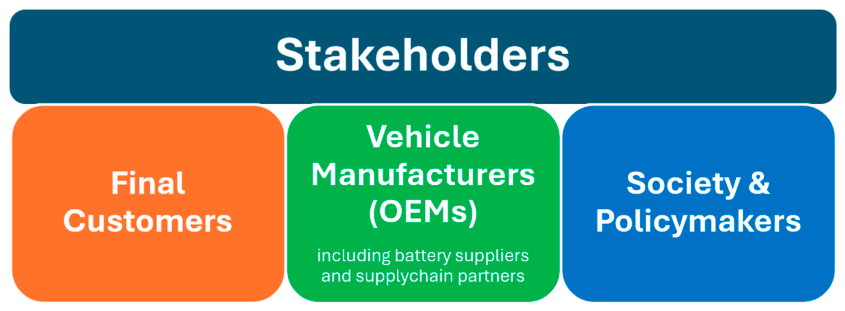
HEV battery selection requires balancing technical performance, cost, resource security, and environmental sustainability. Although previous studies have compared Nickel–Metal Hydride (NiMH) and Lithium-Ion (LIB) batteries from technical, economic, and environmental perspectives, few have addressed stakeholder conflicts. Customers prioritize affordability and reliability, OEMs focus on performance and profitability, while society and policymakers emphasize sustainability, resource security, emissions reduction, and the circular economy. To develop a practical Fuzzy Analytic Hierarchy Process (FAHP) framework, five stakeholder groups identified in the literature were consolidated into three: Final Customers, OEMs, and Society & Policymakers. Figure 1 illustrates these stakeholder groups influencing HEV battery selection.
Figure 1.
Key stakeholder groups in HEV battery selection.
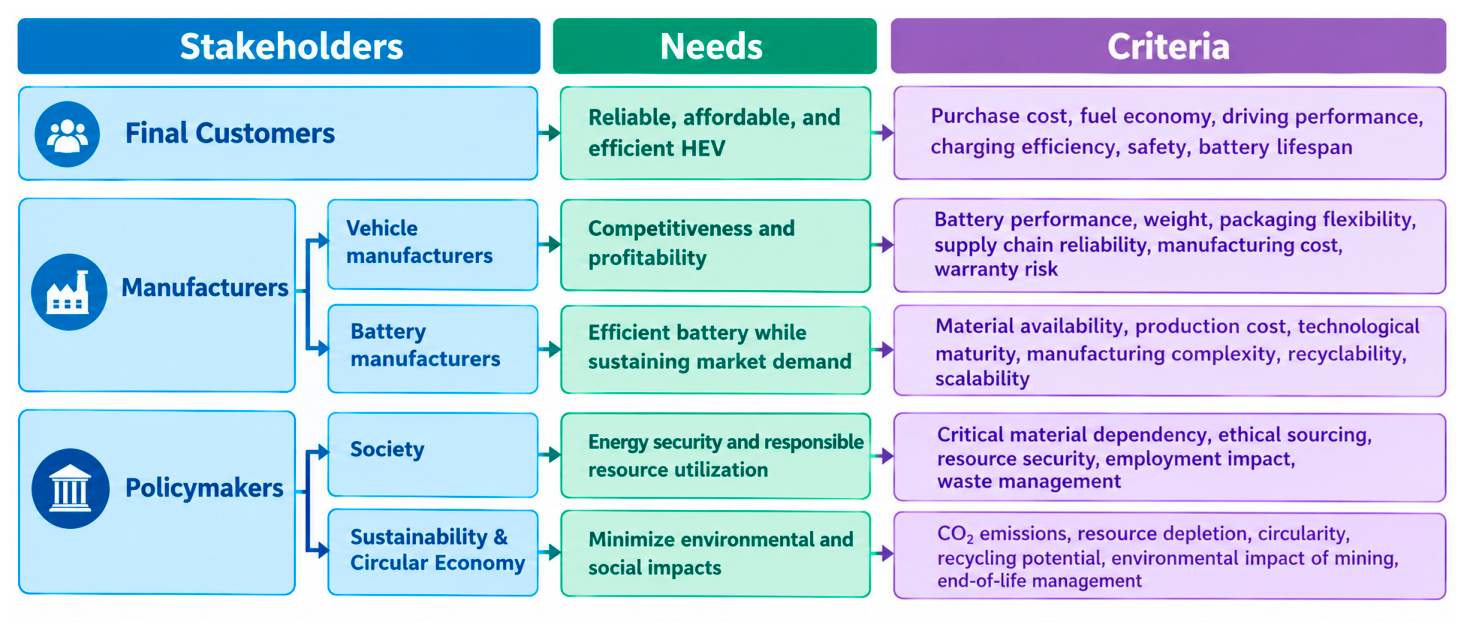
The stakeholder structure was simplified into three groups while preserving market, industrial, regulatory, and sustainability perspectives. Battery manufacturers were integrated with OEMs due to their aligned objectives, while policymakers were included within the Society & Policymakers group because of their role in environmental regulations, resource security, recycling, and circular economy policies. This study develops a framework to evaluate and prioritize NiMH and LIB batteries from these stakeholder perspectives. Figure 2 presents the stakeholder-specific criteria.
Figure 2.
Stakeholders’ conflicts.
Despite the growth of hybrid electric vehicles (HEVs), most studies evaluate battery technologies from technical, economic, or environmental perspectives separately. Few integrate conflicting stakeholder priorities or the trade-offs among performance, cost, resource security, recyclability, and circular economy objectives. Therefore, a comprehensive multi-stakeholder framework is needed to support sustainable battery selection. Chen et al. [4] applied FAHP to lithium-ion batteries for EVs, focusing primarily on overall, charging, discharging, and safety performance rather than multiple stakeholder priorities. Aishwarya et al. [5] applied a stakeholder-centric FAHP-TOPSIS framework to prioritize challenges and solutions in sustainable EV battery supply chains; however, their study focused on supply-chain challenges rather than battery technology selection. In contrast, the present study integrates the priorities of customers, OEMs, and society and policymakers to directly compare NiMH and Li-ion batteries for HEV applications. To the best of the authors’ knowledge, previous studies have not combined stakeholder-specific priorities with sustainability and circular-economy considerations within a single FAHP framework for HEV battery technology selection.
Figure 2 shows the needs of each stakeholder group and the criteria derived from them. Three main conflicts arise: (i) customers seek low purchase cost and high driving performance, whereas OEMs and battery manufacturers must also control manufacturing cost, supply-chain reliability, and warranty risk; (ii) OEMs seek high battery performance and low weight, which favor lithium-based chemistries, whereas society and policymakers seek low dependence on critical materials and ethical sourcing; and (iii) customers’ focus on affordability conflicts with policymakers’ emphasis on recycling, end-of-life management, and CO2 reduction, which add cost. The criteria in Figure 2 are grouped into the four FAHP criteria. The conflicts are then reflected in the pairwise comparison matrices, where each stakeholder rates its own primary criterion highest, producing the divergent stakeholder weights reported in Section 5.
3. Literature Review
This section reviews the existing literature on hybrid and electric vehicle battery technologies, synthesizing comparative studies on NiMH and Li-ion batteries, key selection criteria from multiple stakeholder perspectives, and the application of MCDM and FAHP methods in battery evaluation.
3.1. Hybrid Vehicle Battery Technologies
Several studies have compared the technical performance of nickel–metal hydride (NiMH) and lithium-ion (Li-ion) batteries for hybrid and electric vehicle applications. Alluraiah et al. [6] evaluated the operational behavior of both battery types using a vehicle simulation model, demonstrating differences in state-of-charge (SoC) behavior, charge consumption, and vehicle performance under realistic driving conditions. Their findings suggested that NiMH batteries remain attractive for hybrid applications because of their lower cost, easier handling, and established recycling infrastructure. Similarly, Mishra et al. [7] performed MATLAB-based simulations using electrochemical, thermal, aging, equivalent-circuit, SoC, and SoH models to compare energy density, power density, charging characteristics, cycle life, and cost. Their results confirmed the superior energy density and charging performance of lithium-ion batteries, while NiMH batteries exhibited advantages in cost and operational robustness. Experimental investigations by [8] further compared battery capacity, charge retention, charge recovery, durability, and cycle life, providing valuable quantitative evidence for evaluating battery suitability in high-performance vehicle applications. Likewise, the electrochemical characteristics, power density, energy density, safety, lifespan, and technology maturity of both battery types have been compared and assessed qualitatively by [9].
Recent studies have also emphasized the importance of battery management and application-specific battery selection. Zhang et al. [10] reviewed battery technologies and battery management systems (BMSs) for electric and hybrid vehicles, concluding that lithium-ion batteries dominate modern EVs because of their high energy density, fast charging capability, and longer driving range. However, the authors highlighted that NiMH batteries remain a reliable solution for hybrid electric vehicles due to their high-power capability and proven operational reliability. Bhardwaj et al. [11] further demonstrated the excellent storage stability of NiMH batteries, reporting an exceptionally low self-discharge rate over prolonged storage, while lithium titanate batteries exhibited outstanding charge–discharge efficiency. These findings illustrate that battery selection depends strongly on the intended vehicle application rather than on a single performance indicator.
Environmental sustainability and end-of-life management have become increasingly important in battery selection. Pratis et al. [12] investigated the sustainability of NiMH and lithium-ion batteries during the end-of-life stage, focusing on battery waste management, recycling challenges, circular economy implementation, and environmental impacts. The study highlighted the growing dominance of lithium-ion batteries despite the recycling advantages and established recovery processes associated with NiMH technology. Phogat et al. [13] similarly reviewed emerging battery technologies from the perspectives of material sustainability, recycling, energy efficiency, and environmental performance. While lithium-ion batteries offer superior energy storage capabilities, NiMH batteries continue to provide advantages in safety, reliability, and material recovery. Espera et al. in [14] extended this comparison by evaluating lead–acid, NiMH, and LiFePO4 batteries through discharge testing while simultaneously considering thermal behavior, efficiency, and environmental impacts associated with battery disposal.
3.2. Battery Selection Criteria
From the customer perspective, many researchers have analyzed end users’ preferences and the criteria influencing their decisions. Ho and Huang [15] developed an AHP-based model to compare Lithium-Ion batteries, Fuel Cells, and hybrid technologies using technological and market criteria. Lithium-Ion ranked higher for purchase cost, operating cost, and infrastructure availability, while Fuel Cells performed better in driving range, battery life, and refueling time. Environmental concern was the most influential criterion affecting consumer preferences. Liao et al. [16] examined EV adoption from economic and psychological perspectives, assessing financial, technical, infrastructure, and policy factors. The study found that adoption depends on vehicle cost and performance, as well as socio-economic characteristics, psychological attitudes, mobility needs, and social influences. The authors emphasized integrating consumer preferences into policy design to support wider EV adoption.
Ren et al. [17] proposed a decision-making framework that combined different methods to evaluate battery electric vehicles (BEVs) from a consumer perspective. The study identified five key consumer concern categories: dynamics, technology, safety, comfort, and cost. Results showed that safety was the most important dimension, while price was the most influential criterion affecting customer satisfaction. Manzini et al. [18] investigated the perceptions of users and experts regarding electric vehicle adoption and next-generation battery technologies using survey-based research involving 50 consumers and 50 experts. Results revealed that consumers are interested in sustainable mobility solutions but have varying levels of knowledge about battery technologies. The study concluded that stakeholder perspectives are essential for understanding adoption barriers and guiding strategies that accelerate the transition toward sustainable electric mobility. Krupa et al. [19] analyzed consumer willingness to adopt plug-in hybrid electric vehicles by conducting a survey of 1000 U.S. residents. Respondents were generally unwilling to pay a significant price premium for the technology. Financial considerations and battery-related concerns, including cost and performance, remained the main barriers to widespread adoption. The findings provide valuable insights for policymakers and manufacturers in developing pricing, marketing, and incentive strategies to increase PHEV market penetration.
Another researcher, Mahadin [20], investigated the factors influencing consumers’ switching behavior from Internal Combustion Engine Vehicles (ICEVs) to Hybrid Electric Vehicles (HEVs) in Jordan. The research was survey-based, with 333 vehicle users. The study found that fuel efficiency was the most influential factor encouraging the adoption of HEVs, followed by environmental friendliness, lower taxes, and technological features. Conversely, concerns regarding battery life, limited vehicle options, lack of information, and uncertainty about the relatively new technology were the primary barriers to adoption. The study highlights the importance of consumer awareness and confidence in promoting the transition toward hybrid vehicle technologies.
Zhang et al. [21] analyzed consumer preferences and willingness to pay for battery-swapping services compared with conventional rechargeable electric micro-mobility vehicles (EMVs). The study found that consumers generally favor battery-swapping technologies due to reduced charging time, greater convenience, and enhanced safety. User preferences were influenced by factors such as accessibility, battery endurance, risk perception, and social influence. Existing EMV users and long-distance riders showed a stronger preference for battery-swapping solutions, while cost-sensitive frequent riders preferred rechargeable vehicles. Based on the reviewed studies, several common criteria consistently influence consumer acceptance and technology selection for hybrid and electric vehicles. These criteria can be grouped into five main categories:
- Technical Performance, which includes driving range, battery life, energy efficiency, safety, reliability, charging/refueling time, and technological features, as discussed in [15,17,22];
- Economic Factors, which cover the purchase price, operating cost, fuel savings, maintenance cost, and tax incentives, all of which are among the most influential determinants of consumer decisions, as explained in [15,19,20];
- Environmental Sustainability includes greenhouse gas reduction, environmental friendliness, energy conservation, and contribution to sustainable mobility, which is frequently identified as a major driver of adoption [15,16,20];
- Infrastructure and Market Readiness, represented by charging availability, vehicle availability, market maturity, policy support, and information accessibility, as discussed in [16,18,22];
- Consumer acceptance, which includes awareness, trust, psychological attitudes, social influence, perceived risk, comfort, and user preferences toward emerging technologies, as discussed in [16,18,22].
For the FAHP model, these five groups, together with the manufacturer and policy criteria discussed below, were consolidated into four criteria as follows: Economic Factors and Consumer Acceptance were merged into Customer Value (CV), as both describe the value perceived by the customer; Technical Performance was retained as Technical and Commercial Performance (TCP); Environmental Sustainability was included in Resource Security and Social Responsibility (RSSR); and Infrastructure and Market Readiness was divided, with market maturity and vehicle availability included in Production Feasibility (PF) and policy support in RSSR. Charging availability was not retained because HEVs are charged on board and do not depend on external charging infrastructure.
Other stakeholders may have different selection criteria, including battery manufacturers, vehicle manufacturers, policymakers, society, and environmental organizations. Their decisions are often influenced by factors such as production feasibility, cost, supply-chain security, regulatory compliance, environmental impact, circular economy potential, resource availability, and long-term sustainability objectives. Different researchers have tried to identify criteria that can fulfill the needs of each individual stakeholder group. Celadon et al. [23] provided a comprehensive review of battery technologies for electric vehicles, highlighting the dominant role of lithium-based batteries, including lithium-ion and lithium-metal systems. The findings suggest that future battery selection should consider not only energy and performance characteristics but also environmental sustainability, resource availability, circular economy potential, and end-of-life management to support sustainable transportation systems. Mi and Masrur [24] conducted a techno-economic comparison of seven battery technologies for converting a lightweight internal combustion vehicle into an electric vehicle with a target range of approximately 100 km. The evaluation considered battery cost, weight, volume, energy density, cycle life, self-discharge, and long-term investment requirements over a 10-year period. Results showed that lead-acid batteries were the most economical option, while lithium polymer (LiPo) batteries offered the lowest weight and highest energy density. The study highlighted the trade-offs between cost, performance, durability, and physical characteristics, emphasizing the importance of multi-criteria assessment when selecting battery technologies for electric vehicle applications.
3.3. Application of MCDM and FAHP in Battery Selection
Loganathan et al. [25] proposed an MCDM framework for selecting lithium-ion battery chemistries, highlighting trade-offs among charging speed, driving range, lifespan, and cost. Öztürk [26] integrated DEMATEL, QFD, and Interval Type-2 Fuzzy VIKOR to develop a sustainable battery supplier selection framework that balances technical, environmental, and customer requirements. Similarly, Lahri et al. [27] combined the TOE framework, Dynamic Capability theory, and Fuzzy OPA, identifying policy compliance, environmental performance, and safety certification as the most important supplier criteria. Lučić and Grdinić-Rakonjac [28] emphasized that EV purchasing requires balancing economic, technical, environmental, safety, and user-related factors. Bulut et al. [29] applied MCDM to battery-pack material selection, demonstrating the need to balance safety, performance, durability, and sustainability. Likewise, Koirala and Shabbiruddin [30] integrated fuzzy QFD and fuzzy COPRAS, identifying battery price, innovation, safety, financial condition, and transportation cost as the key supplier selection criteria. Several studies compared battery technologies using MCDM methods. Roy et al. [31] used TOPSIS to rank Li-ion batteries ahead of Ni-MH, lead-acid, and Ni-Cd batteries based on performance, cost, durability, and environmental impact. Abdulvahitoğlu and Güçlüten [32] applied AHP–COPRAS and ranked Li-ion as the best alternative. Saravanan et al. [33] employed TOPSIS to compare lithium-ion chemistries, identifying LFP as the preferred option by balancing reliability, safety, energy density, and cost. Finally, Naseri et al. [34] demonstrated that hybrid NMC–LTO battery packs provide superior trade-offs in driving range, charging, lifetime, weight, and volume through multi-objective optimization. Overall, the literature consistently shows that battery and supplier selection require balancing technical, economic, environmental, and sustainability criteria, highlighting the value of MCDM techniques for supporting informed decision-making.
Beyond the crisp MCDM studies reviewed above, a growing body of work has applied fuzzy AHP specifically to capture the linguistic uncertainty inherent in human judgments about vehicle and battery technologies. Liu et al. [35] provided a comprehensive review of fuzzy AHP methods, showing that Chang’s extent-analysis approach is the most widely used variant because it converts triangular fuzzy judgments into crisp priority weights without requiring additional defuzzification steps, while still preserving the overlapping, gradual nature of expert preferences. In the transport domain specifically, Moslem et al. [36] used fuzzy AHP together with interval AHP to reconcile diverging stakeholder consensus on sustainable transport development priorities, demonstrating that fuzzy pairwise comparison is particularly well suited to settings, such as the present HEV battery-selection problem, where customers, manufacturers, and regulators hold structurally different, and at times conflicting, priorities that cannot be reliably captured by a single crisp judgment. Most directly related to the present study, Parthasarathy et al. [37] applied a fuzzy decision-analytics framework to lithium-ion battery selection for electric vehicles, confirming that fuzzy MCDM techniques outperform crisp alternatives when battery-selection criteria (e.g., energy density, safety, cost) are assessed under incomplete or imprecise information. These studies collectively justify the use of FAHP, rather than crisp AHP or other MCDM techniques, for the multi-stakeholder battery-selection problem addressed in this paper, since fuzzy triangular numbers allow the overlapping, imprecise judgments of customers, OEMs, and society/policymakers (Section 3.4) to be captured more realistically than crisp pairwise scores.
3.4. Stakeholder Analysis
Battery technology selection for hybrid electric vehicles involves multiple stakeholders with diverse and often conflicting objectives. Customers primarily seek affordability, safety, reliability, and convenience, while vehicle manufacturers focus on technical performance, production feasibility, supply-chain stability, and market competitiveness. At the same time, society and policymakers emphasize environmental sustainability, resource security, emissions reduction, and circular economy objectives. Understanding these differing priorities is essential for developing a balanced decision-making framework. This section reviews the main expectations of the three principal stakeholder groups: final customers, vehicle manufacturers (OEMs), and society and policymakers. Consumer value is considered one of the primary concerns for customers because vehicle purchase decisions are largely driven by affordability, safety, reliability, convenience, and performance, as discussed by [38]. Rezvani et al. [39] found that driving range, charging convenience, reliability, and overall vehicle performance are the main drivers of electric vehicle adoption. Similarly, McCollum et al. [40] claimed that customers prioritize convenience, reliability, familiarity, and perceived performance in addition to cost. Corradi et al. [41] further highlighted the importance of charging accessibility, social acceptance, and everyday usability. These findings indicate that customer value remains the dominant criterion from the consumer perspective, while technical performance is valued primarily through its impact on user experience and reliability. However, OEMs have different points of view; they are primarily concerned with technical and commercial performance, as well as production feasibility. Islam et al. [42] reported that manufacturers prioritize technological innovation in battery systems, energy management, power electronics, and vehicle performance to enhance efficiency, safety, and competitiveness. Nykvist and Nilsson [43] showed that technological advancement and large-scale manufacturing are critical for reducing battery costs and improving market competitiveness. OEMs also prioritize production feasibility, which depends on secure critical mineral supplies, scalable manufacturing, and resilient supply chains. Olivetti et al. [44] emphasized the risks associated with lithium and cobalt supply constraints. More recently, Cheng et al. [45] and Woodley et al. [46] highlighted supply-chain vulnerabilities, critical mineral bottlenecks, and production capacity limitations that may restrict future EV deployment. Zhai et al. [47] further demonstrated that efficient and resilient battery supply chains are essential for both industrial competitiveness and decarbonization objectives.
Society and policymakers primarily prioritize Resource Security and Social Responsibility (RSSR). RSSR covers resource-related aspects, such as critical-material dependency, ethical sourcing, and supply security, as well as environmental and circularity aspects, such as CO2 emissions, recycling, and end-of-life management (Figure 2). Gaines [48,49] emphasized economically viable recycling to secure material supply and reduce environmental impacts. Winslow et al. [50] highlighted end-of-life battery management, while Harper et al. [51], Chigbu [52], Kilavuz [53], Zhai et al. [47], and Zhang [54] reinforced the importance of recycling, resource security, circular economy, and resilient supply chains for sustainable battery production. Overall, the literature shows that customers prioritize Customer Value, OEMs emphasize Technical Performance and Production Feasibility, and society and policymakers focus on RSSR. These competing priorities underpin the stakeholder weighting in the FAHP analysis. Since no stakeholder dominates battery selection, trade-offs among economic, technical, manufacturing, and sustainability objectives are required, justifying the use of FAHP to identify the most suitable battery technology.
4. Research Methodology
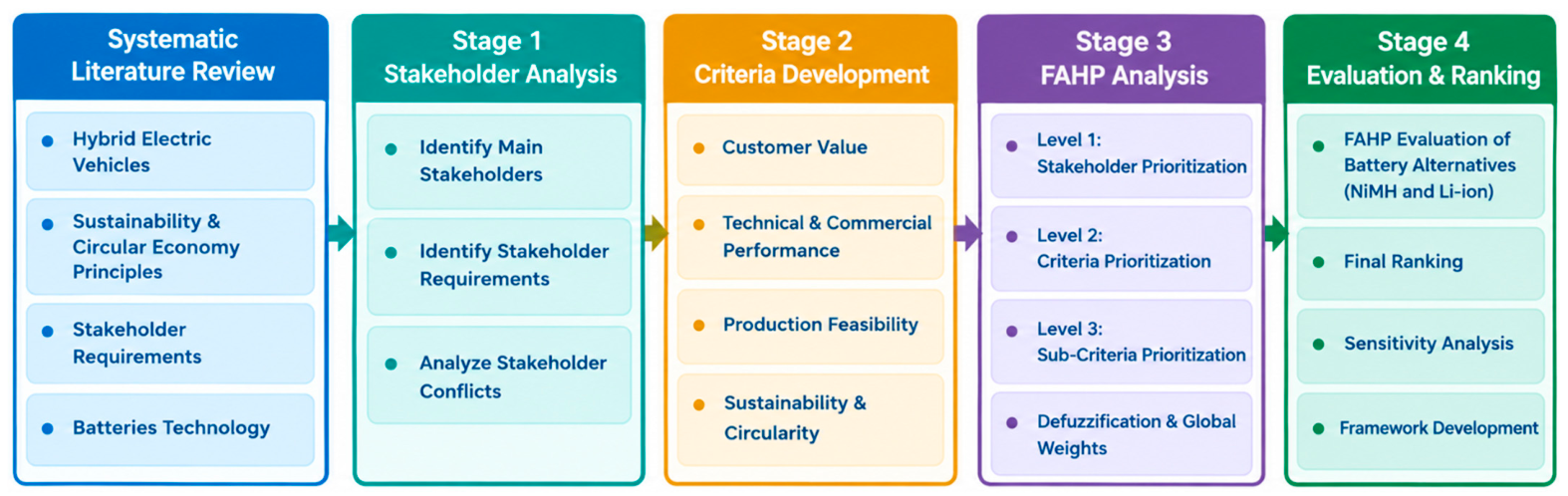
This study implements a multi-stage methodology to develop a sustainable battery selection framework for hybrid electric vehicles (HEVs). The study follows a structured multi-stage methodology to develop a stakeholder-based FAHP framework for selecting sustainable battery technology for HEVs. Figure 3 shows the methodology.
Figure 3.
Sustainable battery selection framework for hybrid electric vehicles.
The study begins with a systematic literature review to identify key concepts related to hybrid electric vehicles, battery technologies, sustainability, circular economy, and stakeholder requirements. Three stakeholder groups—customers, vehicle manufacturers (OEMs), and society/policymakers—are identified, leading to four evaluation criteria: Customer Value, Technical and Commercial Performance, Production Feasibility, and Resource Security and Social Responsibility. A three-level Fuzzy Analytic Hierarchy Process (FAHP) hierarchy is then developed, comprising stakeholders, criteria, and battery alternatives (NiMH and Li-Ion). NiMH and LIB were selected as the two technologies currently used as traction batteries in commercial HEVs; emerging options such as sodium-ion and solid-state batteries still lack reliable cost and supply data. LIB here refers to the nickel-based chemistries typical of HEVs (NMC and NCA); other chemistries, such as LFP, are not covered. FAHP is applied to determine criteria weights and rank the battery alternatives. Finally, sensitivity analysis evaluates the robustness of the results, and a stakeholder-based sustainable battery selection framework is proposed to support balanced decision-making for hybrid electric vehicle applications.
Fuzzy Pairwise Comparisons
The Analytic Hierarchy Process (AHP) was originally developed by Saaty [55]. To address uncertainty and vagueness in human judgments, Buckley [56] proposed a geometric mean approach for deriving fuzzy priorities, while Chang [57] introduced the extent analysis method. In this study, Buckley’s geometric mean method is adopted because it provides a computationally efficient and intuitively interpretable approach for deriving fuzzy weights from reciprocal fuzzy pairwise comparison matrices, and it preserves the reciprocity property throughout the aggregation and prioritization process.
FAHP uses overlapping triangular fuzzy numbers to capture judgment uncertainty, enabling gradual preference transitions and more realistic pairwise comparisons than conventional AHP. Decision-makers express relative importance using linguistic terms rather than exact values, as discussed by [58]. Table 1 shows the linguistic scale.
Table 1.
Fuzzy pairwise comparison scale used in FAHP [58].
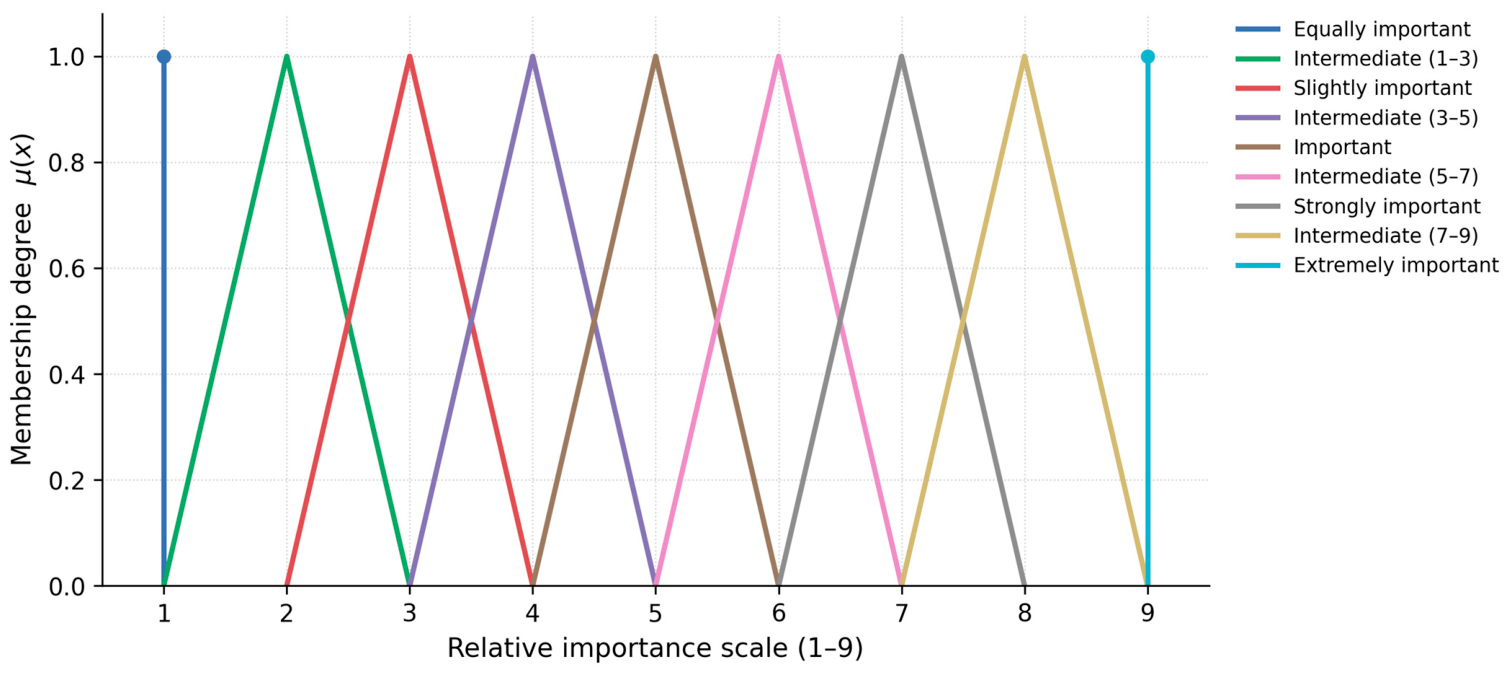
Figure 4 illustrates the overlapping triangular membership functions that formalize the nine linguistic categories of Table 1 on the 1–9 relative-importance scale. Each fuzzy number ã = (l, m, u) is defined by a membership function μ(x) that rises linearly from 0 at x = l to 1 at x = m, then falls linearly back to 0 at x = u, so that judgments closer to the most-likely value m receive full membership while values near the boundaries l and u receive partial membership. The deliberate overlap between adjacent categories (e.g., between “Equally important” and “Intermediate value between 1 and 3”) is what allows FAHP to represent the gradual, imprecise nature of expert and stakeholder judgments, rather than forcing each pairwise comparison into a single crisp integer as in conventional AHP [55]. This membership structure underlies every pairwise comparison matrix used in this study (Tables 3, 5, 7 and 9).
Figure 4.
Triangular fuzzy membership functions for the linguistic pairwise-comparison scale used in this study (Table 1).
The pairwise comparison matrix is constructed using Triangular Fuzzy Numbers (TFNs), where each comparison is represented as a fuzzy number in the form of:
where lij is the lower bound, mij is the most likely value, and uij is the upper bound. For a set of n criteria, the pairwise comparison matrix à is an n × n matrix where each element represents the preference of criteria i over the criterion j. The reciprocal property is enforced:
The resulting matrix has the following structure:
For each row i of the fuzzy pairwise comparison matrix, the fuzzy geometric mean is computed as:
The fuzzy weight for each criterion is obtained by normalizing the fuzzy geometric means:
where uT, mT, and lT denote the total fuzzy sum of all criteria comparisons. The inverse of the sum of fuzzy geometric means is computed as:
The fuzzy weights are defuzzified using the average of the lower, middle, and upper bounds (centroid method for TFNs):
The defuzzified weights are normalized to ensure they sum to 1:
The normalized vector W = (W1, W2, …, Wn) represents the final priority weights of the criteria
5. Results
This section presents the findings of the stakeholder-driven Fuzzy Analytic Hierarchy Process (FAHP) analysis, including stakeholder–criteria relationships, stakeholder prioritization, criterion weights from each perspective, global weights, and alternative ranking with sensitivity analysis.
5.1. Stakeholder–Criteria Relationship Analysis
The first stage of the analysis examined the relationship between the three primary stakeholder groups and the four battery selection criteria. Table 2 summarizes the relative importance of each criterion from the perspective of customers, OEMs, and society and policymakers.
Table 2.
Relationship between stakeholder groups and battery selection criteria.
5.2. Stakeholder Prioritization Using FAHP
The pairwise judgments in Table 3 were determined by the authors based on the stakeholder priorities synthesized from the literature in Table 2; they were not obtained from an expert panel. Specifically, the qualitative primary and secondary stakeholder priorities identified from the cited literature were translated into pairwise comparisons using the nine-level fuzzy linguistic scale presented in Table 1. Because the judgments were derived from literature-based stakeholder relationships rather than aggregated individual expert responses, no expert-consensus aggregation was required.
Table 3.
Fuzzy pairwise comparison matrix for stakeholder prioritization.
Table 3 and Table 4 summarize the pairwise comparison matrix and the resulting normalized FAHP weights and priority rankings for the three stakeholder groups, respectively.
Table 4.
Normalized FAHP weights and priority ranking of stakeholders.
The results shown in Table 3 and Table 4 indicate that OEMs are the most influential stakeholders in battery technology selection, accounting for 54.30% of the overall decision weight. This is expected because OEMs are responsible for balancing technical performance, manufacturing feasibility, supply-chain requirements, and market competitiveness. Final customers account for 24.81% of the decision weight, reflecting the importance of affordability, safety, and reliability. Society and policymakers contribute 20.89%, highlighting the growing influence of sustainability regulations, emissions targets, and resource security policies on battery technology decisions.
Notably, the weights assigned to final customers and society/policymakers are comparable (approximately 25% and 21%, respectively), suggesting that in the context of sustainable battery selection, market-driven consumer demands and top-down sustainability regulations carry comparable influence over the decision-making process. This comparable influence justifies the inclusion of both stakeholder groups as meaningful counterweights to the commercial interests of OEMs.
The higher OEM weight reflects their role as the actual decision-maker: the OEM selects and integrates the battery, commits the manufacturing investment, and carries the supply-chain and warranty risks, while customers and policymakers influence the choice indirectly through market demand and regulation. The underlying pairwise judgments in Table 3 are moderate, (1, 2, 3) relative to customers and (2, 3, 4) relative to society and policymakers.
5.3. Customer Perspective Analysis
An FAHP analysis was conducted to determine the importance of the four criteria from the customers’ perspective, as shown in Table 5.
Table 5.
Fuzzy pairwise comparison matrix of criteria from the customer perspective.
Customers primarily prioritize affordability, safety, reliability, and convenience, making Customer Value the dominant criterion. Technical and Commercial Performance is the second most important factor because it directly affects driving performance and battery lifespan. Sustainability considerations are increasingly important but remain secondary to direct user benefits. Production Feasibility receives the lowest priority because manufacturing concerns are generally outside the scope of customer decision-making. However, the indirect effects of production on customers, such as purchase price, availability, and reliability, are already captured under Customer Value, which includes affordability and reliability. The Production Feasibility criterion therefore refers only to manufacturing-side factors (manufacturability, scalability, and supply-chain readiness) that customers do not assess directly; this avoids double counting the same effects in two criteria.
The normalized FAHP weights presented in Table 6 confirm these qualitative observations with quantitative evidence. Customer Value emerged as the top customer priority, accounting for 50.56% of the total weight—reflecting the overriding importance of affordability, safety, reliability, and convenience in consumer purchasing decisions. Technical and Commercial Performance followed as the second most important criterion at 26.34%, indicating that while customers value driving performance and battery longevity, these factors remain secondary to overall vehicle value. Resource Security and Social Responsibility received a comparatively lower weight of 14.06%, suggesting that although environmental and ethical considerations are increasingly relevant to consumers, they do not yet rival direct user benefits in purchase decisions. Production Feasibility was assigned the lowest priority at 9.03%, which is expected given that manufacturing and supply-chain considerations are typically outside the scope of customer awareness and decision-making.
Table 6.
Normalized FAHP weights and priority ranking from the customer perspective.
An FAHP analysis was conducted to determine the importance of the four criteria from the OEM perspective. Table 7 presents the pairwise comparison matrix, while Table 8 summarizes the normalized FAHP weights and priority ranking for OEMs.
Table 7.
Fuzzy pairwise comparison matrix of criteria from the OEM perspective.
Table 8.
Normalized FAHP weights and priority ranking from the OEM perspective.
OEMs prioritize production feasibility because battery technologies must be economically manufacturable, scalable, and supported by reliable supply chains. Technical performance remains critical for maintaining vehicle competitiveness. Sustainability considerations are becoming increasingly important due to regulatory pressures, while customer value is indirectly represented through market requirements and therefore receives a lower weight.
The normalized FAHP weights presented in Table 8 confirm these qualitative priorities with quantitative evidence. Production Feasibility emerged as the top OEM priority, accounting for 41.65% of the total weight—reflecting the overriding importance of manufacturability, scalability, and supply-chain resilience in battery production decisions. Technical and Commercial Performance followed as the second most important criterion at 32.60%, indicating that while performance is critical for vehicle competitiveness, it is subordinate to production realities. RSSR received a comparatively lower weight of 13.92%, suggesting that although regulatory pressures are increasing, they remain secondary to immediate manufacturing and performance considerations. Customer Value was assigned the lowest priority at 11.83%, which is expected given that OEMs view customer preferences as indirectly represented through market requirements rather than as a direct decision driver in battery technology selection.
To capture the policy perspective, a separate FAHP analysis was performed for society and policymakers. The pairwise comparison matrix and the resulting normalized weights are presented in Table 9 and Table 10, respectively.
Table 9.
Fuzzy pairwise comparison matrix of criteria from the policymaker perspective.
Table 10.
Normalized FAHP weights and priority ranking from the policymaker perspective.
Unsurprisingly, sustainability and circularity dominate the policymakers’ agenda, given their regulatory mandate to enforce environmental protection, resource conservation, and climate commitments. Customer value retains some relevance as policies ultimately serve public welfare, while technical performance and production feasibility are of lesser concern, as these are viewed primarily as industrial matters best addressed by OEMs.
The quantitative results in Table 10 reinforce this logic. Resource Security and Social Responsibility ranked first at 52.18%, underscoring the policy emphasis on emissions reduction, circular economy, and sustainable supply chains. Customer Value follows at 20.23%, while Technical and Commercial Performance (16.39%) and Production Feasibility (11.20%) receive comparatively modest weights—confirming that manufacturing and performance considerations, though relevant, are secondary to broader societal and regulatory objectives.
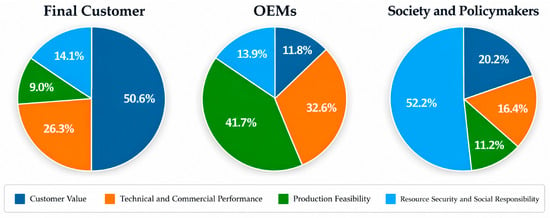
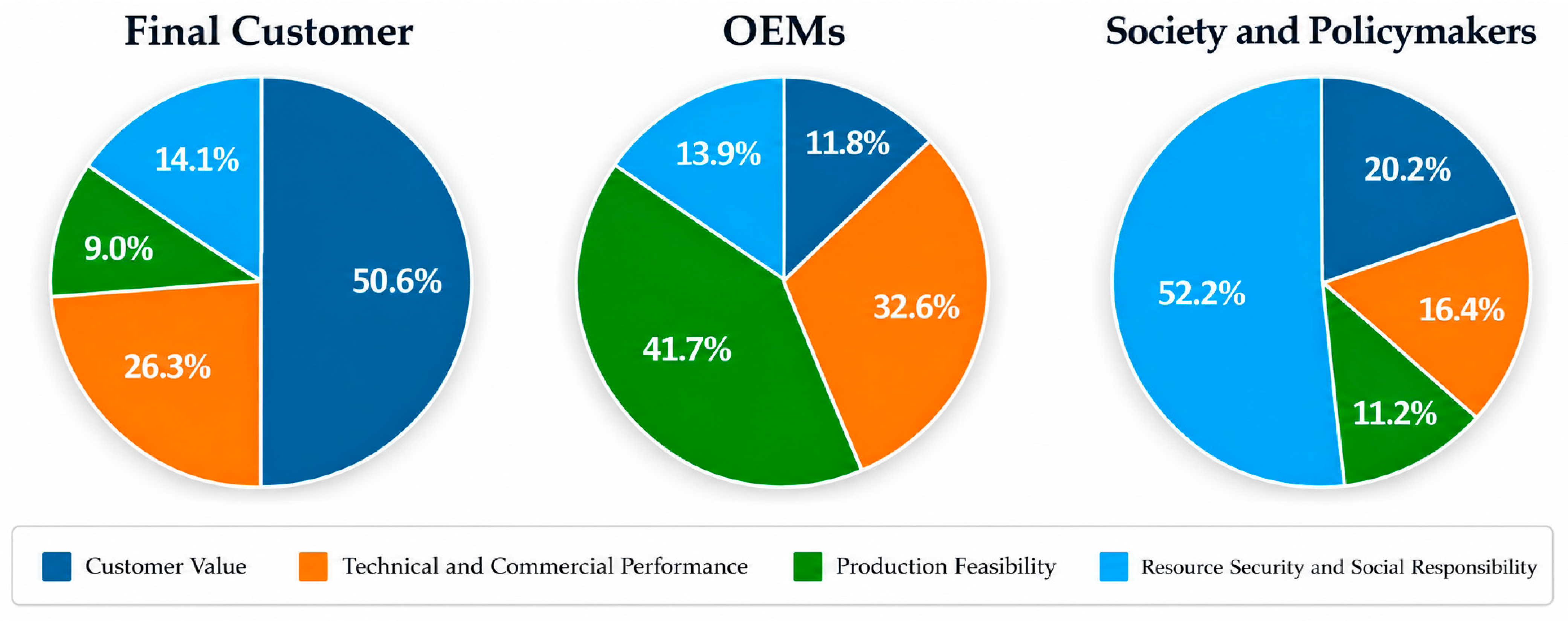
Figure 5 visualizes the priority rankings across the three stakeholders, revealing markedly different priorities. Policymakers prioritize Resource Security and Social Responsibility most heavily (52.2%), while Customer Value (20.2%), Technical and Commercial Performance (16.4%), and Production Feasibility (11.2%) are ranked lower. In contrast, OEMs rank Production Feasibility (41.7%) and Technical and Commercial Performance (32.6%) highest, with Customer Value receiving only 11.8%. Customers, meanwhile, overwhelmingly favor Customer Value (50.6%), followed by Technical and Commercial Performance (26.3%), with Resource Security and Social Responsibility (14.1%) and Production Feasibility (9.0%) as lower concerns.
Figure 5.
Priority ranking of Final Customer, OEMs, and Society and Policymakers.
The global weights of the battery selection criteria were calculated by combining the stakeholder weights with the local criterion weights obtained from the stakeholder-specific FAHP analyses. The resulting global criterion weights are presented in Table 11.
Global Weightij = Stakeholder Weighti × Local Criterion Weightij
Table 11.
Calculation of global weights for battery selection criteria.
The global criterion weights are relatively balanced, ranging from 21.95% to 27.66%. Technical and Commercial Performance (27.66%) and Production Feasibility (27.20%) emerged as the two most influential criteria overall, followed closely by Customer Value (23.19%) and Resource Security and Social Responsibility (21.95%). This balanced distribution reflects the multi-stakeholder nature of the decision framework, where no single criterion dominates the final outcome. This balance results from aggregating divergent stakeholder priorities rather than from the pairwise matrices. At the stakeholder level, the weights are clearly differentiated: Customer Value dominates for customers (50.56%), Production Feasibility for OEMs (41.65%), and RSSR for society and policymakers (52.18%), while the lowest-ranked criterion in each case receives only 9.0–11.8%. Because each stakeholder places a different criterion first, these differences offset one another when combined, producing near-uniform global weights.
Using these global weights, the local priorities of each battery alternative were multiplied by the corresponding criterion weights to obtain the final weighted scores, as presented in Table 12.
Table 12.
Final priority scores and ranking of battery alternatives.
The results indicate that NiMH achieved a total score of 53.10%, outperforming Li-Ion, which obtained 46.90%. Although LIB demonstrated superior performance in Customer Value (64.39%) and Technical and Commercial Performance (64.39%) due to its higher energy density, lighter weight, and advanced charging efficiency, NiMH achieved significantly higher scores in Production Feasibility (64.39%) and Resource Security and Social Responsibility (79.65%). NiMH’s advantage in these areas stems from its mature manufacturing processes, established supply chains, lower dependence on critical materials, and reduced concerns related to resource scarcity and geopolitical risks. Given the substantial importance of these criteria in the overall decision model—together accounting for nearly half (49.15%) of the global weight—NiMH emerged as the preferred battery technology within the proposed stakeholder-driven sustainability framework for hybrid electric vehicles.
The preference for NiMH should not be generalized to all HEV applications, as it depends on the relative importance of the criteria. These scenarios were not modeled in the present study; the conditions of application are drawn from the literature and summarized in Table 13. For mass-market full hybrids, where cost, manufacturing maturity, and proven reliability dominate, NiMH remains a suitable choice [59]. For mild hybrids, which require compact, lightweight, high-power batteries, Li-Ion is generally more suitable [60,61]. In markets with limited security of critical raw materials, such as cobalt, NiMH is favored, consistent with the priorities of society and policymakers [62]. In markets prioritizing high efficiency and driving performance, Li-Ion is preferred, consistent with customer priorities [61]. In cost-sensitive markets, NiMH may be favored, as NiMH packs do not require cell-level voltage monitoring, unlike Li-Ion packs [54]. The proposed framework allows decision-makers to reflect these contexts by adjusting the stakeholder and criteria weights.
Table 13.
Application-specific suitability of NiMH and Li-Ion batteries in HEVs.
5.4. Derivation of Alternative-Level Local Priorities
To make the alternative ranking in Table 12 fully reproducible, this subsection reports the pairwise comparison judgments between NiMH and LIB under each of the four criteria and the resulting local priorities, obtained using the same Buckley fuzzy geometric-mean procedure (Equations (4)–(8), Fuzzy Pairwise Comparisons Section) applied to the stakeholder- and criterion-level matrices, specialized here to a single pairwise comparison between the two battery alternatives. The magnitude of each judgment reflects the qualitative evidence already discussed in Section 3.1 and Section 3.2 and in the interpretation of Table 12: LIB was judged moderately preferable under Customer Value and Technical and Commercial Performance because of its higher energy density, lower weight, and faster charging; NiMH was judged preferable under Production Feasibility and Resource Security and Social Responsibility because of its mature, lower-cost manufacturing base and reduced dependence on critical minerals such as lithium and cobalt. Table 14 reports the resulting pairwise judgments and local priorities, which reproduce the values reported in Table 12 exactly.
Table 14.
Pairwise comparison judgments and local priorities of NiMH vs. LIB under each criterion.
5.5. Extended Sensitivity Analysis
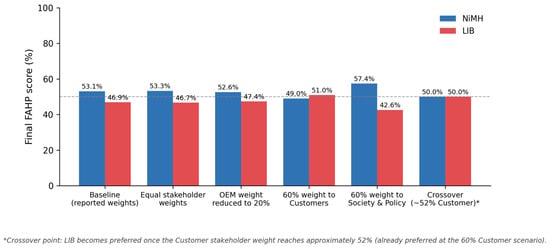
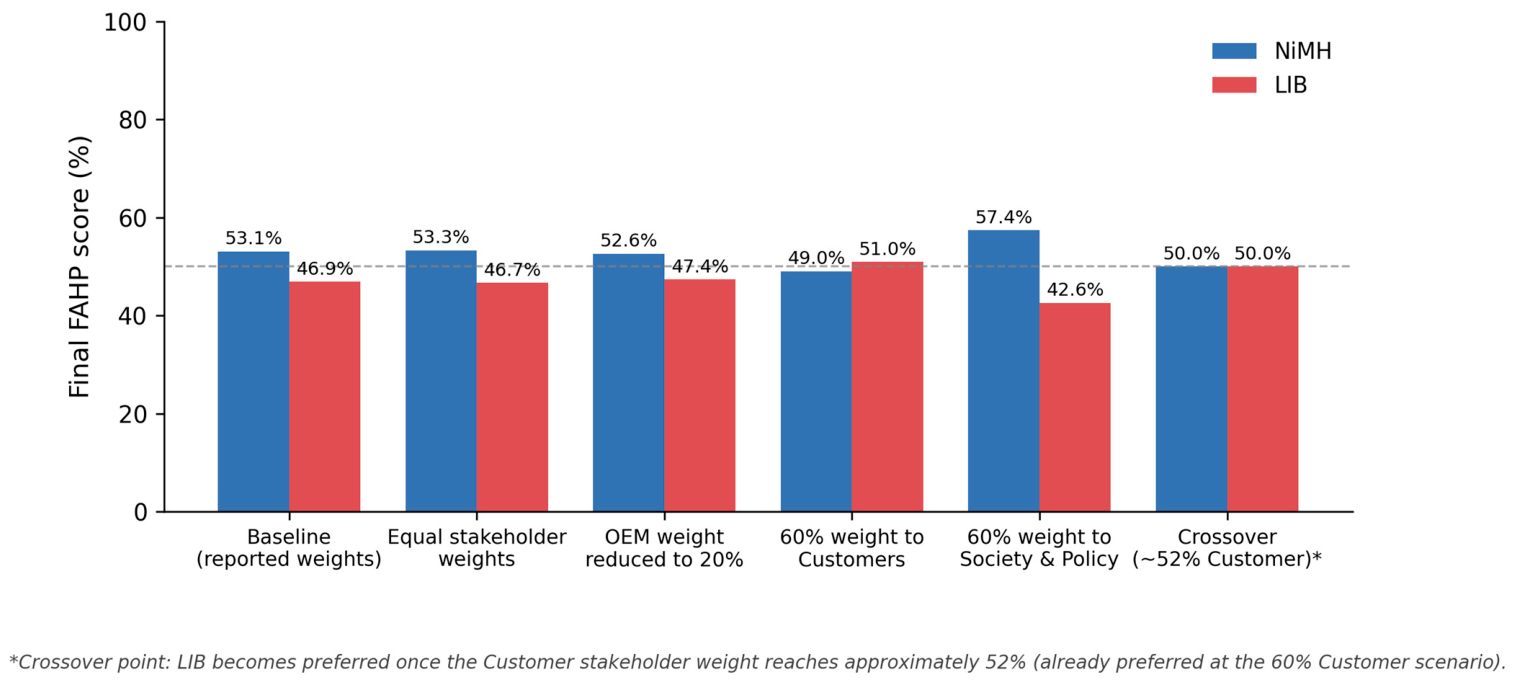
Section 5.2 reported that the overall ranking between NiMH and LIB is sensitive to changes in stakeholder weighting. Table 15 and Figure 6 present these results in full, reporting the final FAHP score of each alternative under six weighting scenarios: (i) the baseline weights reported in Table 4; (ii) equal weights across the three stakeholders; (iii) the OEM weight reduced to 20%, redistributed proportionally between the remaining stakeholders; (iv) 60% of the weight assigned to Final Customers; (v) 60% of the weight assigned to Society & Policymakers; and (vi) the approximate crossover point at which LIB overtakes NiMH. NiMH remains the preferred alternative under the baseline weighting, under equal stakeholder weights, under a reduced OEM weight, and when Society & Policymakers are favored, confirming that its advantage is not driven by the OEM stakeholder alone. However, the ranking is notably sensitive to an increase in the Final Customer weight: LIB already overtakes NiMH once Final Customers are assigned 60% of the total stakeholder weight (LIB 50.97% vs. NiMH 49.03%), and the exact crossover occurs at approximately 52% customer weight, much closer to the baseline (24.81%) than previously estimated. This indicates that while the proposed framework’s NiMH ranking is robust to OEM- and policy-weighting assumptions, it should be interpreted with caution in contexts where customer preference is weighted more heavily than in the baseline stakeholder composition adopted in this study.
Table 15.
Final FAHP scores of NiMH and LIB under alternative stakeholder-weighting scenarios.
Figure 6.
Sensitivity of the final NiMH/LIB ranking to stakeholder-weighting scenarios (Dashed line represents the crossover threshold).
5.6. Robustness to Perturbations in Pairwise Judgments
To verify that the near-uniform global weights are not an artifact of the initial pairwise judgments, a perturbation analysis was performed. Each non-diagonal pairwise judgment in the stakeholder, criterion, and alternative-level matrices was independently perturbed by ±5% and ±10%, while maintaining the reciprocal relationship of the fuzzy comparison matrices. Table 16 shows the resulting global weight ranges. Under ±5% and ±10% perturbations, the maximum deviations in any global criterion weight are less than 1.0 and 1.6 percentage points, respectively, and the rank order (TCP > PF > CV > RSSR) remains unchanged. Crucially, NiMH remains ranked first in every scenario: its final score ranges from 52.0 to 54.5% (±5%) and 50.5 to 56.0% (±10%). These results empirically confirm that both the near-uniform weights and the final ranking are robust to reasonable variations in the pairwise judgments.
Table 16.
Global criterion weights under ±5% and ±10% perturbation of pairwise judgments.
5.7. Comparison with Prior Battery/EV Selection Studies
Table 17 situates the performance and scope of the proposed stakeholder-driven FAHP framework relative to representative prior MCDM-based battery- and EV-selection studies discussed in Section 3.3, highlighting the framework’s distinguishing features: its multi-stakeholder structure and its finding that a mature, lower-resource-dependence chemistry (NiMH) can outrank a higher-performance chemistry (LIB) once production feasibility and resource security are weighted alongside customer value. Unlike prior studies, which rank batteries from a single technical, economic, or environmental viewpoint, the proposed framework explicitly integrates three stakeholder perspectives and shows that the preferred alternative can reverse once production feasibility and sustainability criteria are given weight comparable to technical performance, a distinction not captured in single-perspective MCDM studies.
Table 17.
Comparison of the proposed framework with representative prior MCDM-based battery/EV selection studies.
6. Conclusions
This study developed a stakeholder-driven Fuzzy Analytic Hierarchy Process (FAHP) framework for selecting sustainable battery technologies for hybrid electric vehicles (HEVs). Unlike previous studies that evaluate batteries mainly from technical, economic, or environmental perspectives, the framework integrates three stakeholder groups: final customers, vehicle manufacturers (OEMs), and society and policymakers. Four criteria were considered: Customer Value, Technical and Commercial Performance, Production Feasibility, and Resource Security and Social Responsibility. The results identified OEMs as the most influential stakeholders (54.30%), followed by final customers (24.81%), society, and policymakers (20.89%). Customer Value was the highest priority for customers (50.56%), Production Feasibility for OEMs (41.65%), and Resource Security and Social Responsibility for society and policymakers (52.18%). These findings highlight the trade-offs among stakeholder priorities and the need for balanced decision-making. Among the battery alternatives, Lithium-Ion outperformed NiMH in Customer Value and Technical and Commercial Performance because of its higher energy density, lighter weight, and better vehicle performance. In contrast, NiMH ranked higher in Production Feasibility and Resource Security and Social Responsibility due to its mature manufacturing, established supply chains, and lower reliance on critical minerals. Consequently, NiMH achieved the highest overall FAHP score (53.10%), compared with 46.90% for Lithium-Ion. This preference applies mainly to cost-sensitive full hybrids and markets where resource security is a priority, whereas Li-Ion remains more suitable for mild hybrids and efficiency-driven markets.
Sensitivity analysis confirmed the robustness of the framework, as the ranking remained unchanged under equal-criteria and equal-stakeholder weighting scenarios. Overall, the proposed FAHP framework provides a practical decision-support tool for balancing stakeholder expectations with technical, manufacturing, and sustainability objectives. Limitations include literature-based judgments and the focus on NiMH and nickel-based LIB. Future research should validate the judgments with experts and include additional technologies such as LFP, sodium-ion, and solid-state batteries, along with life-cycle and real-world operational data. The framework could also be applied to specific HEV scenarios, such as mild hybrids and markets with limited raw-material security.
Author Contributions
Conceptualization, M.H.A.H. and H.A.; methodology, M.H.A.H.; formal analysis, M.H.A.H. and K.H.; investigation, M.H.A.H., K.H., H.A. and A.A.A.; resources, M.H.A.H.; data curation, M.H.A.H.; writing—original draft preparation, M.H.A.H. and H.A.; writing—review and editing, A.A.A., K.H., M.H.A.H., H.A. and W.A.-N.; visualization, K.H., A.A.A., M.H.A.H., H.A. and W.A.-N.; supervision, M.H.A.H.; project administration, M.H.A.H., K.H., H.A., A.A.A. and W.A.-N.; final manuscript preparation and approval, K.H. and M.H.A.H. All authors have read and agreed to the published version of the manuscript.
Funding
This research was funded by Office of Research and Innovation at the American University of Ras Al Khaimah (Grants ENGR/011/26 and ENGR/004/26).
Data Availability Statement
The original contributions presented in this study are included in the article. Further inquiries can be directed to the corresponding author.
Acknowledgments
The authors gratefully acknowledge the support of the School of Engineering and Computing and the Office of Research and Innovation at the American University of Ras Al Khaimah. During the preparation of this manuscript, the authors used ChatGPT version GPT-5.6 for the purposes of improving writing and formatting. The authors have reviewed and edited the output and take full responsibility for the content of this publication.
Conflicts of Interest
The authors declare no conflicts of interest.
References
- Kohler, U. Hybrid Electric Vehicles: Batteries. In Encyclopedia of Electrochemical Power Sources; Garche, J., Ed.; Elsevier: Amsterdam, The Netherlands, 2009; Volume 1, pp. 269–285. [Google Scholar] [CrossRef] [Scilit]
- Cairns, E.J.; Paul, A. Batteries for electric and hybrid-electric vehicles. Annu. Rev. Chem. Biomol. Eng. 2010, 1, 299–320. [Google Scholar] [CrossRef] [Scilit] [PubMed]
- Suriyanon, W. Hybrid-Car Battery Waste Management Towards Circular Economy in Thailand. Procedia Multidiscip. Res. 2023, 1, 25. [Google Scholar]
- Chen, S.; Zhao, Y.; Chen, S.; Hu, Y. Quantifying Electric Vehicle Lithium-Ion Battery Performance Using Fuzzy Analytic Hierarchy Process. Energy Storage 2025, 7, e70269. [Google Scholar] [CrossRef] [Scilit]
- Aishwarya, V.M.; Ekren, B.Y.; Singh, T.; Singh, V. A stakeholder-centric fuzzy AHP-TOPSIS framework for prioritizing challenges and solutions in the sustainable circular supply chain of electric vehicle batteries. Clean. Logist. Supply Chain 2025, 17, 100272. [Google Scholar] [CrossRef] [Scilit]
- Alluraiah, N.C.; Nandagopal, V.; Veeramanikandan, P.; Godfrey, D.; Meena, S.; Brindha, G. Comparison of SoC in Ni-MH and Lithium-Ion Battery for E-Vehicle. Int. J. Electr. Electron. Res. 2024, 12, 1258–1263. [Google Scholar] [CrossRef] [Scilit]
- Mishra, H.; Tripathi, A.K.; Sharma, A.K.; Laxshmi, G.S. Evaluating energy storage technologies for electric vehicles: A comparative analysis and battery management system overview. In Proceedings of the International Conference on Renewable Energy, Green Computing and Sustainable Development (ICREGCSD 2023), E3S Web of Conferences; EDP Sciences: Paris, France, 2024; Volume 472. [Google Scholar] [CrossRef] [Scilit]
- Quintero Pulido, D.F.; Covrig, C.F.; Bruchhausen, M. On the Performance of Portable NiMH Batteries of General Use. Batteries 2025, 11, 30. [Google Scholar] [CrossRef] [Scilit]
- Almadani, M.; Oni, O.E.; Longe, O.M.; Olatomiwa, L. Comparison of battery chemistries for electric vehicle applications. In Proceedings of the 5th African International Conference on Industrial Engineering and Operations Management, Johannesburg/Pretoria, South Africa, 23–25 April 2024; pp. 23–25. [Google Scholar] [CrossRef] [Scilit]
- Zhang, F.; Lv, H.; Kuai, C.; Feng, T. The battery-swapping revolution: Exploring user preferences in electric micro-mobility sector. Transp. Res. Part A Policy Pract. 2025, 194, 104416. [Google Scholar] [CrossRef] [Scilit]
- Bhardwaj, L.; Hölzle, M.; Commerell, W. Comparative Analysis of Commercially Available Battery Technologies for Long-Term Energy Storage in Low-Power Applications. J. Energy Storage 2026, 162, 122076. [Google Scholar] [CrossRef] [Scilit]
- Prates, L.F.S.; Ganbat, G.; Dornack, C.; Karthe, D. Managing automotive end-of-life NiMH and Li-ion batteries in Mongolia: A Material Flow Analysis to assess challenges and opportunities for circular batteries in the Global South. Front. Sustain. 2026, 7, 1664408. [Google Scholar] [CrossRef] [Scilit]
- Phogat, P.; Dey, S.; Wan, M. Powering the sustainable future: A review of emerging battery technologies and their environmental impact. RSC Sustain. 2025, 3, 3266. [Google Scholar] [CrossRef] [Scilit]
- Espera, A.H.; Anas, D.A.; Antonio, I.J.M.J. Comparative Performance and Optimization of Lead-Acid, Nickel-Metal Hydride, and LiFePO4 Batteries for Renewable Energy Storage Applications. Res. Sq. 2026. [Google Scholar] [CrossRef] [Scilit] [PubMed]
- Ho, J.C.; Huang, Y.H.S. Evaluation of electric vehicle power technologies: Integration of technological performance and market preference. Clean. Responsible Consum. 2022, 5, 100063. [Google Scholar] [CrossRef] [Scilit]
- Liao, F.; Molin, E.; Van Wee, B. Consumer preferences for electric vehicles: A literature review. Transp. Rev. 2017, 37, 252–275. [Google Scholar] [CrossRef] [Scilit]
- Ren, X.; Sun, S.; Yuan, R. A study on selection strategies for battery electric vehicles based on sentiments, analysis, and the MCDM model. Math. Probl. Eng. 2021, 1, 9984343. [Google Scholar] [CrossRef] [Scilit]
- Manzini, A.; Martinez, G.L.; Harrivaara, P. Adoption of next-generation batteries: A survey-based analysis of user and expert perspectives. Miner. Econ. 2025, 39, 71–91. [Google Scholar] [CrossRef] [Scilit]
- Krupa, J.S.; Rizzo, D.M.; Eppstein, M.J.; Lanute, D.B.; Gaalema, D.E.; Lakkaraju, K.; Warrender, C.E. Analysis of a consumer survey on plug-in hybrid electric vehicles. Transp. Res. Part A Policy Pract. 2014, 64, 14–31. [Google Scholar] [CrossRef] [Scilit]
- Mahadin, B. Factors affecting customer-switching behavior towards hybrid electrical vehicles (HEV’s) from a customer perspective in Jordan. Eur. J. Mark. Econ. 2018, 1, 53–65. [Google Scholar] [CrossRef] [Scilit]
- Zhang, Q.; Shang, Y.; Li, Y.; Zhu, R. A Concise Review of Power Batteries and Battery Management Systems for Electric and Hybrid Vehicles. Energies 2025, 18, 3750. [Google Scholar] [CrossRef] [Scilit]
- Axsen, J.; Kurani, K.S.; Burke, A. Are batteries ready for plug-in hybrid buyers? Transp. Policy 2010, 17, 173–182. [Google Scholar] [CrossRef] [Scilit]
- Celadon, A.; Sun, H.; Sun, S.; Zhang, G. Batteries for electric vehicles: Technical advancements, environmental challenges, and market perspectives. SusMat 2024, 4, e234. [Google Scholar] [CrossRef] [Scilit]
- Mi, C.; Masrur, M.A. Hybrid Electric Vehicles: Principles and Applications with Practical Perspectives, 3rd ed.; John Wiley & Sons: Hoboken, NJ, USA, 2025. [Google Scholar] [CrossRef] [Scilit]
- Loganathan, M.K.; Mishra, B.; Tan, C.M.; Kongsvik, T.; Rai, R.N. Multi-Criteria decision making (MCDM) for the selection of Li-Ion batteries used in electric vehicles (EVs). Mater. Today Proc. 2021, 41, 1073–1077. [Google Scholar] [CrossRef] [Scilit]
- Öztürk, M. A hybrid approach for battery selection based on green criteria in electric vehicles: DEMATEL-QFD-interval type-2 fuzzy VIKOR. Sustainability 2025, 17, 6277. [Google Scholar] [CrossRef] [Scilit]
- Lahri, V.; Singh, N.K.; Virmani, N. Prioritising criteria for sustainable battery supplier selection in the EV sector using fuzzy-ordinal priority approach. Int. J. Ind. Eng. Oper. Manag. 2026, 8, 66–88. [Google Scholar] [CrossRef] [Scilit]
- Lučić, M.; Grdinić-Rakonjac, M. Defining a new set of criteria for electric vehicle selection. Transp. Res. Procedia 2025, 83, 569–576. [Google Scholar] [CrossRef] [Scilit]
- Bulut, O.; Beiting, P.M. The Rise of Artificial Intelligence in Educational Measurement: Opportunities and Ethical Challenges. Chin./Engl. J. Educ. Meas. Eval. 2024, 5, 3. [Google Scholar] [CrossRef] [Scilit]
- Koirala, K.; Shabbiruddin. Optimal selection of sustainable battery supplier for electric vehicle battery swapping station. Energy Sources Part A Recovery Util. Environ. Eff. 2023, 45, 2206–2227. [Google Scholar] [CrossRef] [Scilit]
- Roy, R.K.; Channi, H.K.; Rani, S.; Kataria, A.; Bajaj, P.; Alaneme, G.U. POWER: Performance Optimization With Evaluated Results for HEV Battery Selection via MCDM-TOPSIS. Energy Sci. Eng. 2026, 14, 2103–2117. [Google Scholar] [CrossRef] [Scilit]
- Abdulvahitoğlu, A.; Güçlüten, G.E. Utilizing an integrated AHP-COPRAS approach for battery selection in electric vehicles. Int. J. Automot. Eng. Technol. 2023, 12, 121–132. [Google Scholar] [CrossRef] [Scilit]
- Saravanan, V.; Chinnasami, S.M.R.; Chinnasamy, S. The Selection of Li-Ion Batteries Used in Electric Vehicles (EV)’s Using the TOPSIS Method. J. Appl. Chem. Phys. 2024, 3, 11–21. [Google Scholar] [CrossRef] [Scilit]
- Naseri, F.; Barbu, C.; Sarikurt, T. Optimal sizing of hybrid high-energy/high-power battery energy storage systems to improve battery cycle life and charging power in electric vehicle applications. J. Energy Storage 2022, 55, 105768. [Google Scholar] [CrossRef] [Scilit]
- Liu, Y.; Eckert, C.M.; Earl, C. A review of fuzzy AHP methods for decision-making with subjective judgements. Expert Syst. Appl. 2020, 161, 113738. [Google Scholar] [CrossRef] [Scilit]
- Moslem, S.; Ghorbanzadeh, O.; Blaschke, T.; Duleba, S. Analysing Stakeholder Consensus for a Sustainable Transport Development Decision by the Fuzzy AHP and Interval AHP. Sustainability 2019, 11, 3271. [Google Scholar] [CrossRef] [Scilit]
- Parthasarathy, T.N.; Narayanamoorthy, S.; Pamucar, D.; Kang, D. Fuzzy decision-analytics based lithium-ion battery selection for maximizing the efficiency of electric vehicles. Eng. Appl. Artif. Intell. 2025, 159, 111709. [Google Scholar] [CrossRef] [Scilit]
- Egbue, O.; Long, S. Barriers to widespread adoption of electric vehicles: An analysis of consumer attitudes and perceptions. Energy Policy 2012, 48, 717–729. [Google Scholar] [CrossRef] [Scilit]
- Rezvani, Z.; Jansson, J.; Bodin, J. Advances in consumer electric vehicle adoption research: A review and research agenda. Transp. Res. Part D Transp. Environ. 2015, 34, 122–136. [Google Scholar] [CrossRef] [Scilit]
- McCollum, D.L.; Wilson, C.; Bevione, M.; Carrara, S.; Edelenbosch, O.Y.; Emmerling, J.; Guivarch, C.; Karkatsoulis, P.; Keppo, I.; Krey, V.; et al. Interaction of consumer preferences and climate policies in the global transition to low-carbon vehicles. Nat. Energy 2018, 3, 664–673. [Google Scholar] [CrossRef] [Scilit]
- Corradi, C.; Sica, E.; Morone, P. What drives electric vehicle adoption? Insights from a systematic review on European transport actors and behaviours. Energy Res. Soc. Sci. 2023, 95, 102908. [Google Scholar] [CrossRef] [Scilit]
- Islam, M.S.; Ahsan, M.S.; Rahman, M.K.; Amin Tanvir, F. Advancements in battery technology for electric vehicles: A comprehensive analysis of recent developments. Glob. Mainstream J. Innov. Eng. Emerg. Technol. 2023, 2, 1–28. [Google Scholar] [CrossRef] [Scilit]
- Nykvist, B.; Nilsson, M. Rapidly falling costs of battery packs for electric vehicles. Nat. Clim. Change 2015, 5, 329–332. [Google Scholar] [CrossRef] [Scilit]
- Olivetti, E.A.; Ceder, G.; Gaustad, G.G.; Fu, X. Lithium-ion battery supply chain considerations: Analysis of potential bottlenecks in critical metals. Joule 2017, 1, 229–243. [Google Scholar] [CrossRef] [Scilit]
- Cheng, A.L.; Fuchs, E.R.; Karplus, V.J.; Michalek, J.J. Electric vehicle battery chemistry affects supply chain disruption vulnerabilities. Nat. Commun. 2024, 15, 2143. [Google Scholar] [CrossRef] [Scilit] [PubMed]
- Woodley, L.; See, C.Y.; Cook, P.; Yeo, M.; Palmer, D.S.; Huh, L.; Nunes, A. Climate impacts of critical mineral supply chain bottlenecks for electric vehicle deployment. Nat. Commun. 2024, 15, 6813. [Google Scholar] [CrossRef] [Scilit] [PubMed]
- Zhai, M.; Wu, Y.; Tian, S.; Yuan, H.; Li, B.; Luo, X.; Huang, G.; Fu, Y.; Zhu, M.; Gu, Y.; et al. A circular economy approach for the global lithium-ion battery supply chain. Nature 2025, 646, 1114–1121. [Google Scholar] [CrossRef] [Scilit] [PubMed]
- Gaines, L. The future of automotive lithium-ion battery recycling: Charting a sustainable course. Sustain. Mater. Technol. 2014, 1, 2–7. [Google Scholar] [CrossRef] [Scilit]
- Gaines, L. Lithium-ion battery recycling processes: Research towards a sustainable course. Sustain. Mater. Technol. 2018, 17, E00068. [Google Scholar] [CrossRef] [Scilit]
- Winslow, K.M.; Laux, S.J.; Townsend, T.G. A review on the growing concern and potential management strategies of waste lithium-ion batteries. Resour. Conserv. Recycl. 2018, 129, 263–277. [Google Scholar] [CrossRef] [Scilit]
- Harper, G.; Sommerville, R.; Kendrick, E.; Driscoll, L.; Slater, P.; Stolkin, R.; Walton, A.; Christensen, P.; Heidrich, O.; Lambert, S.; et al. Recycling lithium-ion batteries from electric vehicles. Nature 2019, 575, 75–86. [Google Scholar] [CrossRef] [Scilit] [PubMed]
- Chigbu, B.I. Advancing sustainable development through circular economy and skill development in EV lithium-ion battery recycling: A comprehensive review. Front. Sustain. 2024, 5, 1409498. [Google Scholar] [CrossRef] [Scilit]
- Kilavuz, E. Sustainable Lithium-Ion Battery Recycling: Challenges, Innovations, and Pathways to a Circular Economy. ACS Sustain. Resour. Manag. 2025, 2, 1838–1858. [Google Scholar] [CrossRef] [Scilit]
- Zhang, H. Resilience of critical transition minerals supply chain in the context of strategic rivalry: Implications for the national policy and regulatory frameworks. J. Energy Nat. Resour. Law 2026, 44, 67–93. [Google Scholar] [CrossRef] [Scilit]
- Saaty, R.W. The analytic hierarchy process-what it is and how it is used. Math. Model. 1987, 9, 161–176. [Google Scholar] [CrossRef] [Scilit]
- Buckley, J.J. Fuzzy hierarchical analysis. Fuzzy Sets Syst. 1985, 17, 233–247. [Google Scholar] [CrossRef] [Scilit]
- Chang, D.Y. Applications of the extent analysis method on fuzzy AHP. Eur. J. Oper. Res. 1996, 95, 649–655. [Google Scholar] [CrossRef] [Scilit]
- Kaganski, S.; Majak, J.; Karjust, K. Fuzzy AHP as a tool for prioritization of key performance indicators. Procedia CIRP 2018, 72, 1227–1232. [Google Scholar] [CrossRef] [Scilit]
- Young, K.; Yasuoka, S. Capacity Degradation Mechanisms in Nickel/Metal Hydride Batteries. Batteries 2016, 2, 3. [Google Scholar] [CrossRef] [Scilit]
- Grün, T.; Doppelbauer, M. Comparative Concept Study of Passive Hybrid Energy Storage Systems in 48 V Mild Hybrid Vehicles Varying Lithium-Ion Battery and Supercapacitor Technologies. World Electr. Veh. J. 2019, 10, 71. [Google Scholar] [CrossRef] [Scilit]
- Lee, S.D.; Cherry, J.; Safoutin, M.; McDonald, J.; Olechiw, M. Modeling and Validation of 48V Mild Hybrid Lithium-Ion Battery Pack. SAE Int. J. Altern. Powertrains 2018, 7, 273–287. [Google Scholar] [CrossRef] [Scilit]
- Fu, X.; Beatty, D.N.; Gaustad, G.G.; Ceder, G.; Roth, R.; Kirchain, R.E.; Bustamante, M.; Babbitt, C.; Olivetti, E.A. Perspectives on Cobalt Supply through 2030 in the Face of Changing Demand. Environ. Sci. Technol. 2020, 54, 2985–2993. [Google Scholar] [CrossRef] [Scilit] [PubMed]

Disclaimer/Publisher’s Note: The statements, opinions and data contained in all publications are solely those of the individual author(s) and contributor(s) and not of MDPI and/or the editor(s). MDPI and/or the editor(s) disclaim responsibility for any injury to people or property resulting from any ideas, methods, instructions or products referred to in the content. |
© 2026 by the authors. Published by MDPI on behalf of the World Electric Vehicle Association. Licensee MDPI, Basel, Switzerland. This article is an open access article distributed under the terms and conditions of the Creative Commons Attribution (CC BY) license.