


Abstract
Electric vehicles (EVs) are widely promoted as a key strategy for reducing carbon dioxide (CO2) emissions and advancing sustainable development. However, the real-world benefits of EV adoption may vary across countries with different income levels and energy systems. This study investigates the relationship between EV adoption and CO2 emissions per capita, as well as overall sustainable development performance (SDG Index), across 50 countries from 2010 to 2023. Using panel quantile regression, we find that EV adoption is significantly associated with reduced CO2 emissions particularly in the high-emitting countries in high-income countries (interaction coefficient at the 90th quantile = −0.24, p < 0.05) but positively associated with emissions in lower- and middle-income countries at lower quantiles of the emissions distribution. Similarly, while EV adoption correlates positively with the SDG Index in high-income countries, it shows negative effects at the median and several quantiles. These findings challenge the “zero-emission” assumption and demonstrate that the climate and development benefits of EV diffusion are context-dependent and unevenly distributed, highlighting the need for policies that link electrification to renewable energy deployment, infrastructure development, and equitable access.
1. Introduction
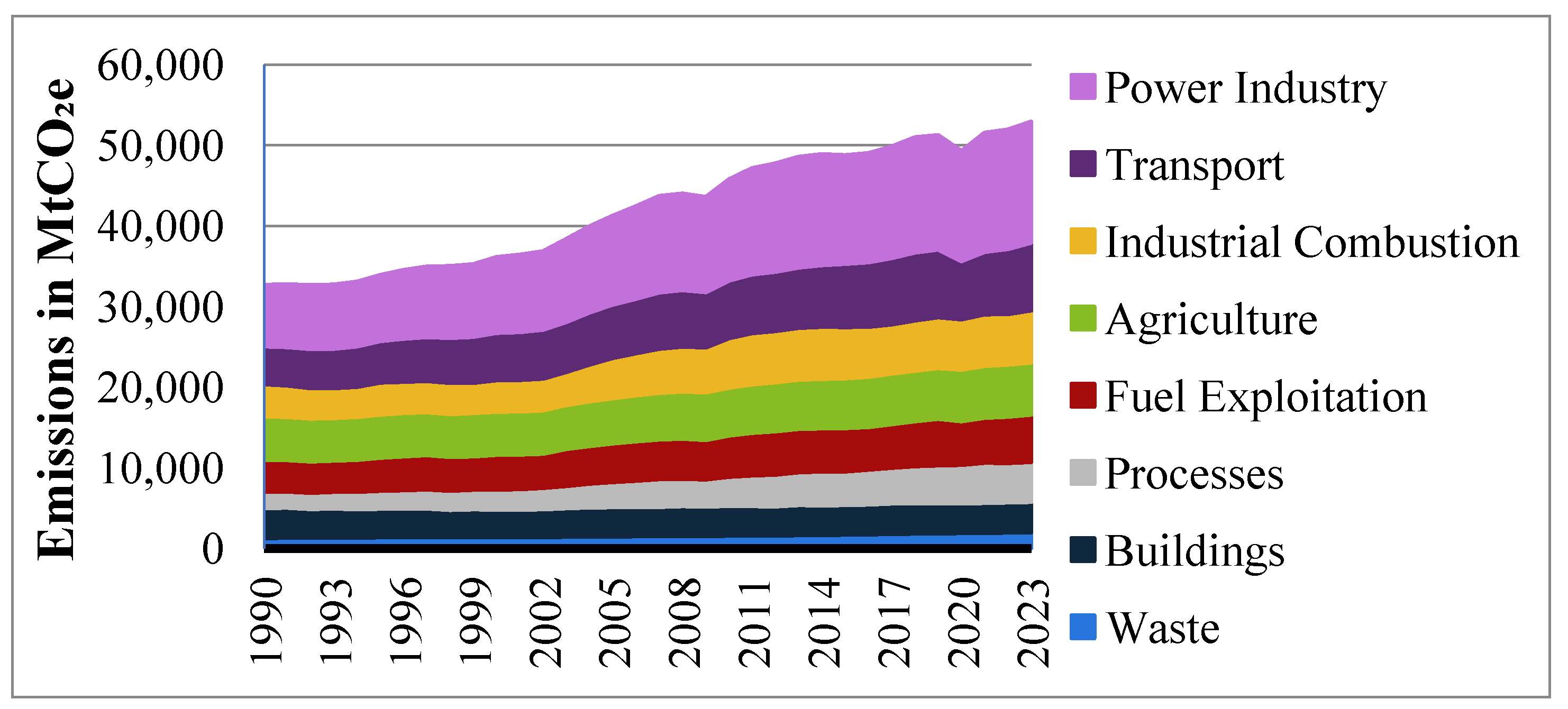
The most recent Global Risks Report (2025) has identified climate-induced extreme weather events, driven by greenhouse gas emissions, as the leading global risk of the coming decade [1]. Despite growing awareness and formal commitments by world leaders to achieve climate neutrality and net-zero greenhouse emissions as contained in international governance frameworks such as the European Green Deal, Kyoto Protocol, the Paris Agreement, and the UN Sustainable Development Goals (SDGs), global greenhouse gas emissions reached a record 53 billion metric tons of CO2-equivalent in 2023, which is over 60% higher than the 1990 level [2].
At present, the world is on pace to miss both the CO2 emissions targets and the 2030 deadline for achieving the 17 SDGs [2,3,4]. Leading greenhouse gases emitters are China, USA, and India, followed by the EU27, and then Russia, and Brazil in that order [2]. The transportation and energy sectors continue to be high-impact sectors such as methane and nitrous oxide, which are more potent continue to rise [2,5]. Given that the transportation sector is one of the largest contributors to global emissions [3,5], it is not surprising that electric vehicles (EVs) have emerged as a central pillar in the pursuit of the SDGs, particularly those related to environmental sustainability, such as SDG 7 (Affordable and Clean Energy), SDG 11 (Sustainable Cities and Communities), and SDG 13 (Climate Action).
In response to the climate crisis, EVs have gained widespread attention as a key pathway to sustainable transport and a key to reducing CO2 emissions not only because they enable mobility, but also because they do so in an environmentally friendly manner [6,7]. Statista [2] has also observed that the EV market is pivotal in promoting CO2-neutral mobility and mitigating climate change. As a result, many governments are investing in EV infrastructure through incentives and subsidies aimed at decarbonizing the transportation sector [8]. For instance, Rissman [7] points out that more than fifty countries have announced plans to ban the sale of new fossil-fuel-powered cars. The electric vehicles share in the total sales of cars are projected to go above 40% in 2030 by 2030 given current policy settings, provided countries honour their existing commitments [5].
In 2024, global electric car sales exceeded 17 million, reaching a sales share of more than 20% [5]. Forecasts suggest a compound annual growth rate (CAGR) of 26.1% for the EV sector between 2019 and 2029. However, the benefits of EV adoption have not been evenly distributed. However, in many low- and middle-income countries, the market share of EVs remains negligible [2,9]. China continues to be the global leader, exceeding the aggregate sales in the rest of the world, reaching levels nearly sixfold those of the United States, which ranks second globally. In 2023, U.S. electric-vehicle sales increased by 40%, while the European market expanded by around 19% between 2022 and 2023, with battery electric vehicles now constituting the majority of EV sales. By contrast, in many low- and middle-income countries (LMICs), EV market share remains negligible [2,9].
As a cornerstone of green innovation, EVs are increasingly viewed not only as cleaner alternatives to internal combustion engine (ICE) vehicles, but also as indicators of technological readiness and economic transformation. Over the past two decades, green technologies such as EVs have attracted growing interest among academics and innovators. According to [9] over the past two decades, EVs have generated increasing interest amongst academics and innovators to the extent that between 2000 and 2021, there have been 79,732 publications and 206,049 patents on EV technologies. Yet the benefits of this innovation have not been distributed equitably, raising urgent questions about global justice and inclusion in the green transition.
The technological co-evolution of electrification and automated driving is mutually reinforcing. Autonomous systems’ high-performance onboard computing, sensor suites, and software-defined control naturally fit electric vehicles’ simpler drive-by-wire architectures and high-voltage power supply, while fleet-based, shared autonomous operations (e.g., robotaxis and logistics) can shorten EV payback through higher utilization and enable optimized depot charging and V2X/V2G integration for system-level cost and emissions reductions. At the same time, rising computing energy demand and accelerating battery demand spotlight supply-chain bottlenecks and life-cycle impacts; decarbonization gains materialize only alongside cleaner electricity mixes, intelligent infrastructure, and circular battery management. These dynamics also shape progress toward SDG 7, SDG 11, and SDG 13, motivating integrated, equity-aware policies that treat autonomous mobility and electromobility as a single transition. A sustainable battery life cycle (recycling, second life, design-for-recycling) and a more harmonized regulatory environment remain pivotal to maximizing the socio-environmental benefits of this twin transition.
Despite this promise, empirical studies on the environmental impacts of EVs have produced mixed results. For instance, Marin and Perales [10] has noted that currently there is a debate on the environmental impact electric vehicles based on contradicting information. While proponents describe EVs as “zero-emission” technologies, critics argue that they may be more polluting than ICE vehicles due to the non-recyclability of lithium-ion batteries [10]. Critics further argue that production of EV batteries generates substantial environmental emissions, particularly during resource extraction and manufacturing. Additionally, while EVs produce no direct exhaust emissions, critics argue that their heavier weight can lead to increased particulate emissions from road wear and resuspension [10].
Given these disparities in adoption and ongoing debates about environmental impacts, combined with the urgent need to accelerate solutions that can address the climate crisis and meet the Sustainable Development Goals, this study investigates the following research question, this study seeks to answer the following questions: To what extent has EV adoption contributed to equitable outcomes in the green transition and the attainment of Sustainable Development Goals across countries in different income groups?
To address this question, the article proceeds as follows: the next section introduces EVs and explores the theoretical underpinnings of EV adoption and its role in sustainable development with a focus on the Environmental Kuznets Curve, innovation diffusion theory, and digital divide frameworks. This is followed by an overview of the research methods used to analyze the role of EVs in achieving the SDGs. The article concludes with a presentation of results, followed by conclusions and policy recommendations.
2. Literature Review
This chapter explores the theoretical and empirical foundations underpinning electric vehicle (EV) adoption and its implications for sustainable development. Given the urgent need to mitigate climate change and accelerate progress toward the Sustainable Development Goals (SDGs), understanding the forces that shape the adoption and diffusion of EVs, especially across income diverse countries, is both timely and essential. As EVs represent a prominent frontier technology and a cornerstone of green innovation, their role in the sustainability transition is shaped by both classical economic growth theories and modern innovation diffusion frameworks. This chapter begins by situating EVs within the broader discourse on technology and sustainable development, followed by a detailed discussion of their diffusion, disparities in adoption, and empirical impacts on emissions.
2.1. What Are Electric Vehicles?
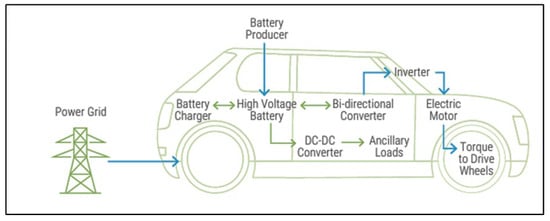
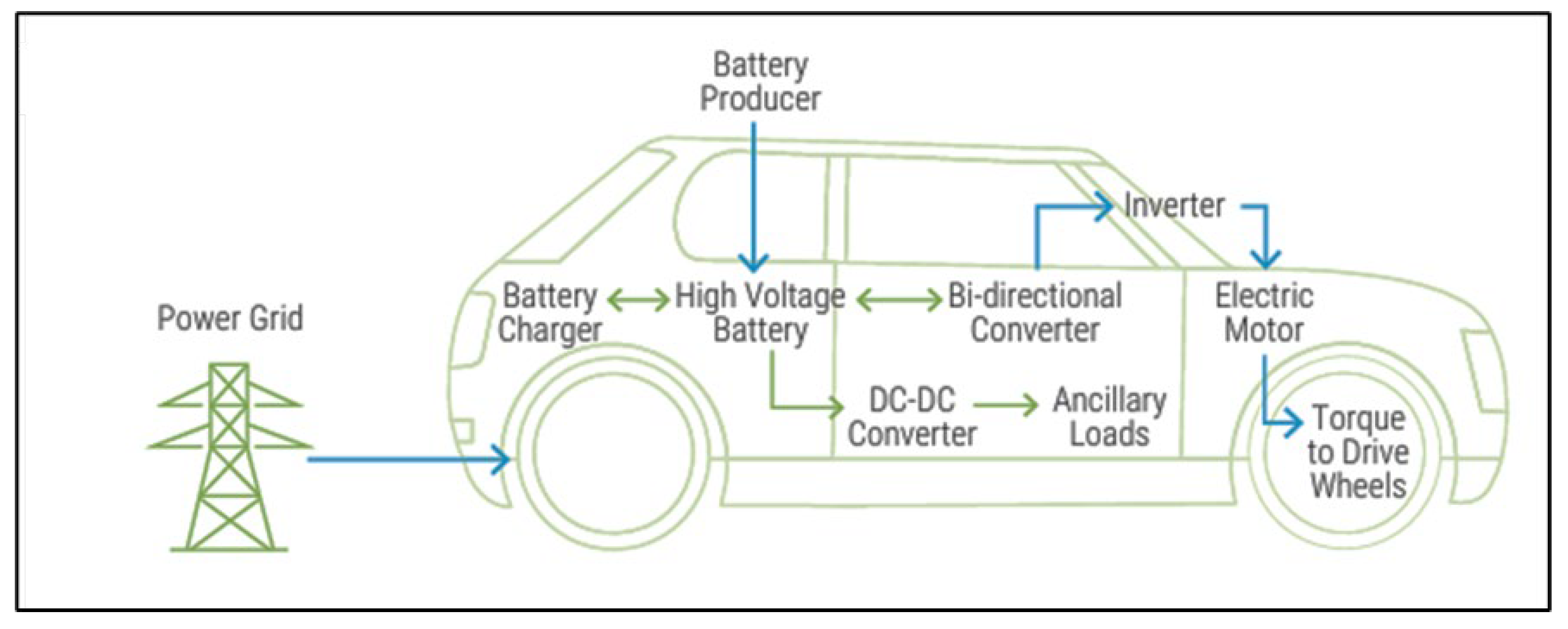
Electric vehicles (EVs) are automobiles powered entirely or partially by electricity, typically using rechargeable battery packs rather than internal combustion engines (ICEs). As indicated in Figure 1, EVs rely on electric motor-based propulsion and may obtain electricity either from external grid connections or from on-board energy storage systems, most commonly lithium-ion batteries. A typical architecture comprises an electric motor, power inverter, DC–DC converter, and integrated on-board charging unit [9]. Battery Electric Vehicles (BEVs), Plug-in Hybrid Electric Vehicles (PHEVs), and Hybrid Electric Vehicles (HEVs) are the main variants of EVs on the market. BEVs operate solely on electric power, while PHEVs combine a battery with a traditional engine, which allows for dual modes of propulsion. EVs are considered key to achieving sustainable transport due to their potential to reduce tailpipe emissions and dependence on fossil fuels.
Figure 1.
Main components of an electric vehicle. Source: UNCTAD 2023, p. 29 [9].
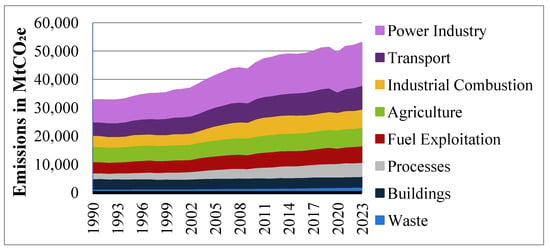
Historically, road transportation has relied almost exclusively on internal combustion engines (ICEs) that are powered by derivatives of fossil fuels such as gasoline, diesel, and compressed natural gas. Combustion of these fuels converts thermal energy into mechanical power but also releases a cocktail of exhaust gases including carbon dioxide (CO2), carbon monoxide (CO), and nitrogen oxides (NOₓ) which have accumulated to harmful concentrations in many major cities [10]. As indicated in Figure 2, globally, the transport sector ranked second in terms of contributions to greenhouse gas emissions behind the power industry in 2023. An examination of the trend from 1990 also shows that emissions from the transportation sector are increasing.
Figure 2.
Global greenhouse gas emissions 1990–2023, by sector. Source: Statista, 2025 [2].
According to UNCTAD [9], the shift to EVs has several potential benefits including reducing carbon dioxide emissions and air pollution. Alternative power train technologies based on electricity, namely battery electric vehicles (BEVs), hybrid electric vehicles (HEVs), and fuel cell electric vehicles (FCEVs), have also been proposed as solutions to the urban air pollution challenge [10].
2.2. Global Electric Vehicle Trends
According to recent market data, EV adoption has grown substantially in the past decade. The most recent Global EV Outlook 2025 report published by the International Energy Agency forecasted the global sales of electric cars to exceed 20 million, representing more than 25% of total global car sales [5]. The report further indicates that sales were up 35% year-on-year in the first three months of 2025, with record first-quarter sales in all major markets. Although EVs are making steady progress toward mass-market adoption in many countries, rising battery metal prices, the phase-out of subsidies, high inflation, and tight margins have raised concerns about the industry’s long-term growth [11].
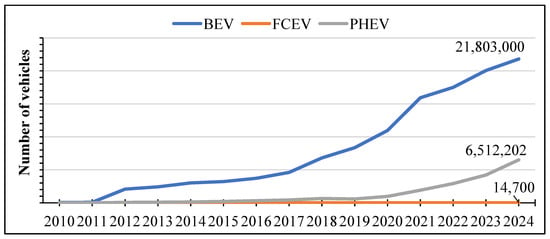
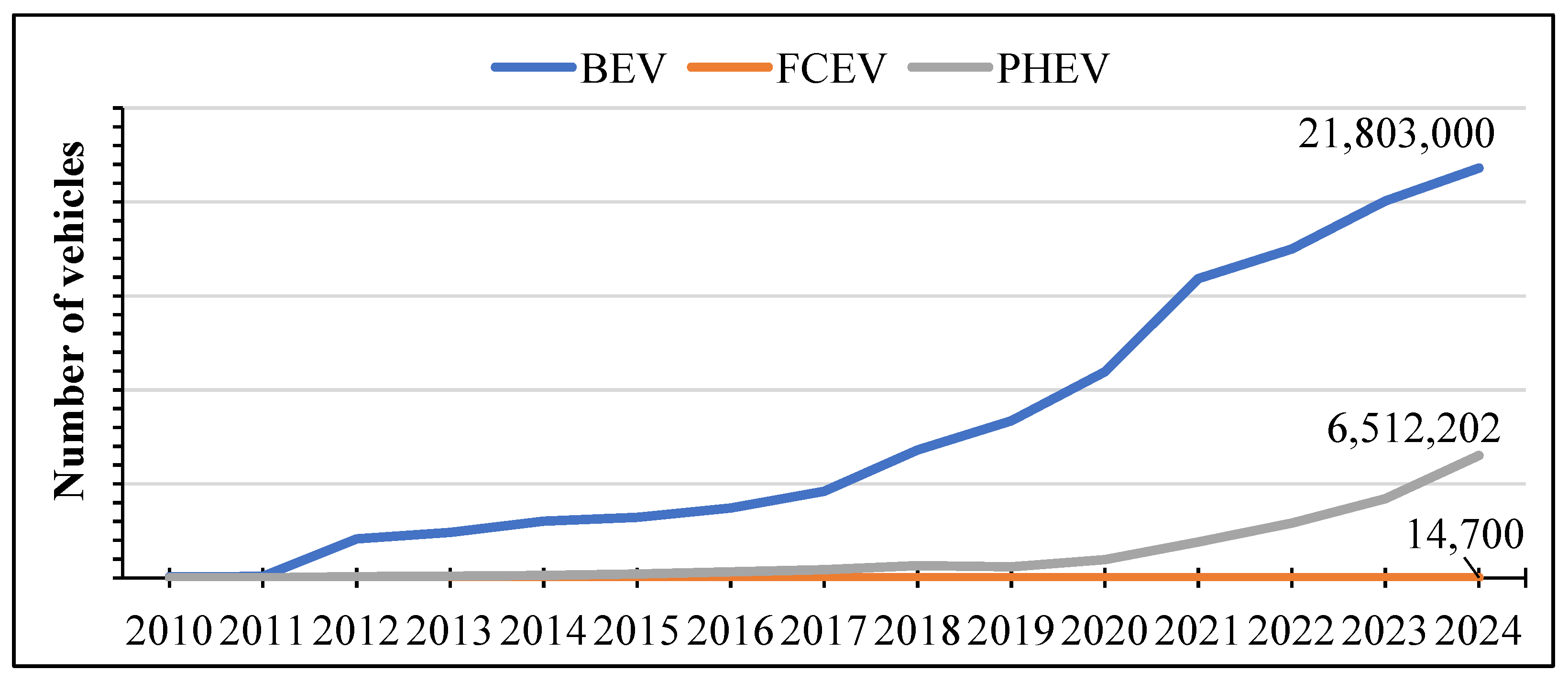
Available data indicates that the battery electric vehicles (BEV) constitute the largest share of the annual EV sales followed by the PHEV and FCEV respectively. As indicated in Figure 3. In 2024, about 73% of the EVs sold were BEV while about 23% were PHEV. The FCEV’s constituted less than 1% of the global EV sales.
Figure 3.
Global electric vehicle sales by type of vehicle 2010–2024. Source: Author’s construct based on data from IEA [5].
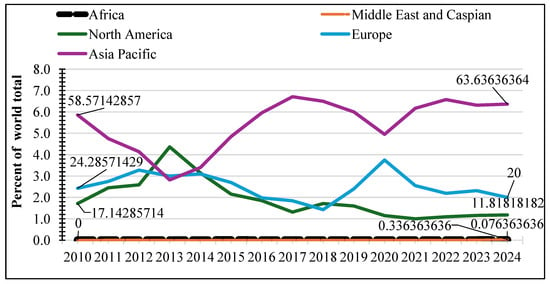
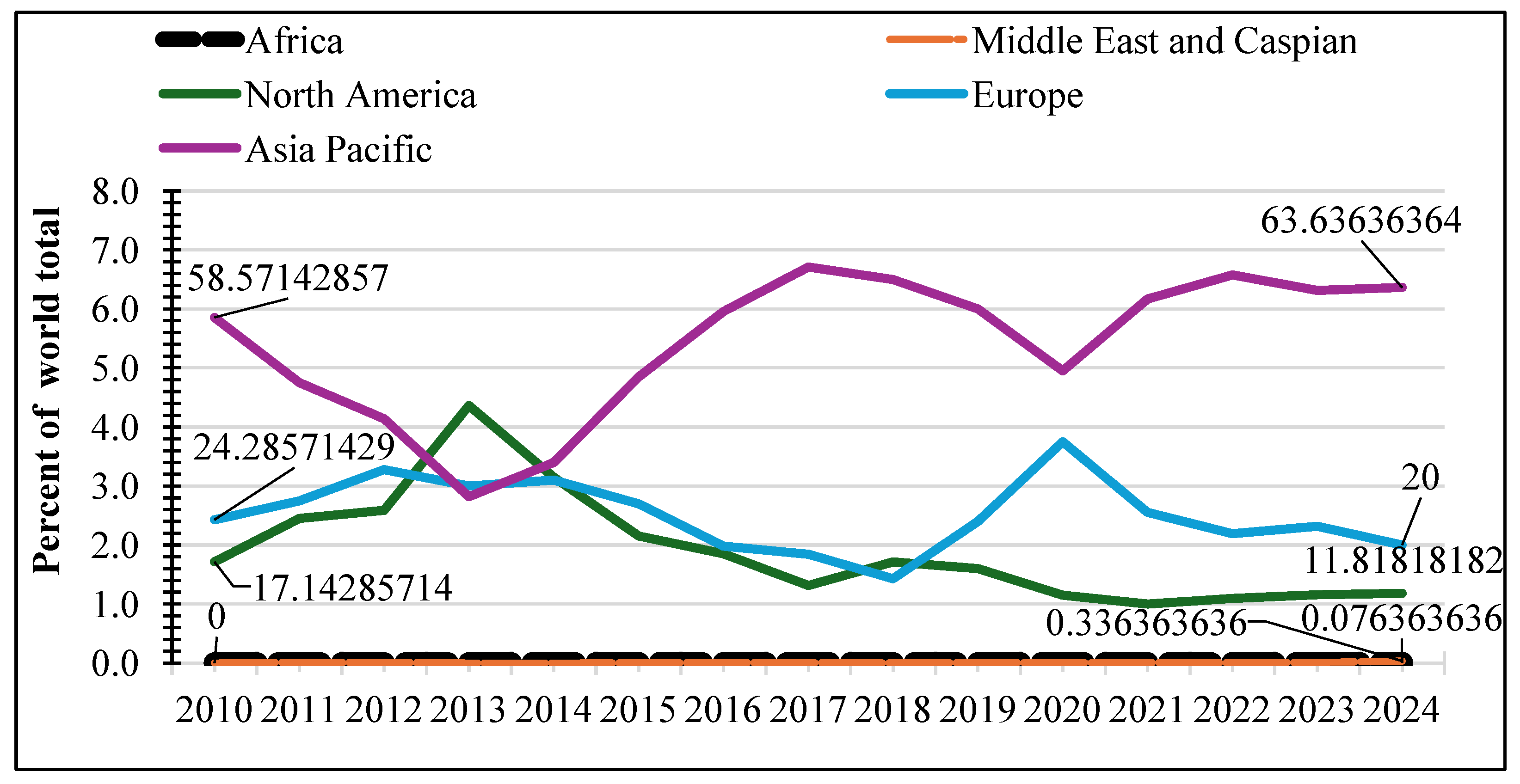
EV adoption and market share is uneven. China continues to be the world’s EV manufacturing hub and is responsible for more than 70% of global production [5]. In 2024, the Asia Pacific region recorded the most EV sales followed by Europe (See Figure 4). The IEA [5] observes that emerging markets across Asia and Latin America are evolving into new hubs of electric-vehicle expansion. In these regions, electric-car sales surged by more than 60% in 2024 to nearly 600,000 units, which is comparable to the scale of the European market five years earlier. Southeast Asia recorded growth of about 50%, lifting the share of electric cars to 9% of regional car sales, with particularly strong uptake in Thailand and Viet Nam. Brazil, the largest automotive market in Latin America, saw sales more than double to 125,000 units in 2024, corresponding to a market share above 6%. African sales likewise increased twofold, led by Egypt and Morocco, yet electric cars remain marginal at roughly 0.1% of the continent’s total car market. A similar pattern was evident in 2023, when China and the United States generated around 70% of global EV revenue, whereas Africa accounted for only 0.2% [9].
Figure 4.
Global electric vehicle sales by type of vehicles by region (% of total). Source: Author’s construct based on data from IEA [5].
2.3. Theoretical Underpinnings of EV Adoption
The emergence of EVs, like other frontier technologies, can be explained through the Diffusion of Innovations Theory. Dearing and Cox [12] posit that the diffusion or lack thereof of a new technology is shaped by three primary variables namely the perceived pros and cons of innovation, the social influence of opinion leaders, and the broader socio-political context. These factors determine whether technology is embraced, resisted, or unevenly adopted across regions and groups.
This framework aligns with UNCTAD’s [9] observation that technologies have both positive and negative consequences depending on how they are used and the local context in which they are introduced. As such, the opportunities and risks associated with EVs must be evaluated within specific societal value systems and structural challenges.
The disparities in EV adoption can also be explained by various digital divided theories. Pick and Sarkar [13] identify four leading frameworks that can explain differences in technology adoption among countries and regions.
- The Adoption-Diffusion Theory suggests that environmental conditions shape how quickly new technologies are adopted across different societal units.
- Van Dijk’s Model of Digital Technology Access argues that socioeconomic, political, and cultural inequalities influence access to digital technologies, including EV-related infrastructure.
- The Unified Theory of Acceptance and Use of Technology posits that user perceptions, social influence, and enabling conditions as key determinants of technology adoption.
- Spatially Aware Technology Utilization Model also highlights the role of geographic and locational factors in determining how technologies are used.
These theories are supported by recent empirical data showing a strong correlation between a country’s technological readiness index and its capacity to adopt EVs [9]. Countries with low readiness scores often lack the foundational infrastructure, human capital, and financing necessary to shift away from fossil fuels and decarbonize their transport sectors in alignment with their Nationally Determined Contributions under the Paris Agreement. As a result, the value of EV imports and local deployment is disproportionately concentrated in high-income economies, where institutional capacity, skilled labor, and access to capital markets are more advanced, while low- and middle-income countries face steeper barriers in their transition to cleaner transport systems.
In the context of EV adoption, scholars have identified several factors that perpetuate a digital divide between advanced and developing countries and inhibit EV adoption in the low- and middle-income countries. In addition to socioeconomic and geographic barriers, infrastructure gaps such as limited charging networks and unreliable electricity grids have been identified as key constraints that directly impede the climate benefits of EV adoption For example, studies show that in countries such as Bangladesh, Nigeria, India, and Vietnam, weak grid capacity and frequent power outages undermine reliable EV charging, reduce consumer confidence, and limit the emissions-mitigation potential of transport electrification [14].
Nsan [15] further investigated the determinants of EV adoption in African, China, and the European Union and found significant regional disparities, with Africa recording low feasibility scores due to infrastructure and grid limitations. Lukuyu [16] has also identified limitations in electricity infrastructure including high transmission and distribution losses, frequent service interruptions averaging about 81 SAIFI events annually, and localized stresses on feeders and transformers that lead to overloading and voltage deviation as some of the major constraints to EV adoption in African countries [16].
These infrastructure deficiencies such as unstable electricity supply, inadequate charging networks, and limited smart-grid capabilities substantially constrain EV adoption in developing and middle-income countries. These constraints weaken the potential of EVs to deliver emissions reductions and advance climate action (SDG 13), while simultaneously reinforcing an EV-related digital divide and limiting broader progress toward the sustainable development goals [14].
2.4. Income, Emissions, and the Environmental Kuznets Curve
The relationship between economic growth and environmental outcomes can be further explained through the Environmental Kuznets Curve (EKC) hypothesis. The EKC posits an inverted U-shaped relationship between income levels and environmental degradation [17]. According to this theory, in the early stages of economic growth, pollution and emissions tend to increase due to industrial expansion and fossil fuel use. However, as income continues to rise, societies invest more in cleaner technologies, enforce environmental regulations, and adopt sustainable consumption patterns, which eventually leads to declines in pollution [18,19,20,21,22].
In the context of EV adoption, the EKC suggests that wealthier countries are more likely to reach the turning point where environmental quality improves through technological innovation and stricter regulation. This provides a theoretical explanation for the uneven global adoption of EVs, with high-income countries more likely to transition from polluting transport systems to low-emission alternatives. Meanwhile, LMICs, which are still in the earlier stages of the EKC may continue to rely on traditional ICE vehicles due to cost constraints, infrastructure gaps, and limited policy support which may hinder their ability to realize the benefits of green technologies [23]. Even when modern innovations such as EVs are technically available, firms in these countries may remain stuck in low-productivity, high-emissions equilibria due to weak absorptive capacities and the lack of joint investment incentives. Thus, the EKC turning point may remain elusive without proactive policy intervention and capacity development.
Moreover, the assumption that rising income alone guarantees environmental improvements is increasingly questioned. UNCTAD [9] notes that per capita income growth has historically coincided with rising CO2 emissions even in developed countries. This reflects the complex trade-offs of the costs and benefits of EV adoption and between economic growth and environmental protection, particularly when governments seek to raise the incomes of the poor while simultaneously cutting carbon emissions. Achieving these dual goals requires navigating difficult policy tensions between promoting inclusive development and advancing climate action.
Therefore, while the EKC offers a useful macro-level perspective on the link between income and emissions, it must be interpreted alongside institutional economics and policy frameworks that highlight the structural conditions necessary for green transitions. Without such context, EV adoption alone may not deliver sustainability outcomes, especially in developing regions.
2.5. Empirical Studies on Electric Vehicles and Emissions
Although it is widely expected that EVs would reduce greenhouse gas emissions, empirical studies on the environmental impact of EVs have yielded mixed findings. On the positive side, Marin and Parales [10] have noted that EVs produce zero tailpipe emissions, which significantly reduces pollutants like nitrogen oxides and particulate matter, especially in densely populated areas. Additionally, studies have shown that even when accounting for electricity generation, EVs can lead to a reduction in greenhouse gas emissions over their entire lifecycle, with potential reductions of up to 24% compared to ICE vehicles, depending on the energy mix used for charging.
On the negative side, it has been argued that the extraction and processing of materials for EV batteries, such as lithium, cobalt, and nickel, can result in high emissions and environmental degradation, which can offset some of the benefits during the vehicle’s operational life. Furthermore, EVs are heavier than ICE vehicles; consequently, the heavier weight of EVs can lead to greater road wear and increased particulate emissions from tire and brake wear, which can contribute to local air pollution despite the absence of exhaust emissions [10].
While EVs may advance SDG 13 (Climate Action), their broader effects on goals such as SDG 12 (Responsible Consumption and Production) and SDG 10 (Reduced Inequalities) and other SDGs warrant deeper empirical scrutiny. Despite the growing body of literature on electric vehicles and their potential environmental benefits, significant gaps remain regarding the equity and sustainability outcomes of EV adoption across countries at different income levels. Most existing studies focus on technological efficiency or market expansion, often neglecting the broader structural and institutional factors that shape EV adoption and its alignment with the Sustainable Development Goals (SDGs). This study seeks to address this gap by answering the question: To what extent has EV adoption contributed to equitable outcomes in the green transition and the attainment of SDGs across countries in different income groups?
To investigate this question, the study draws upon a consolidated conceptual framework that integrates insights from innovation diffusion theories, digital divide models, and the Environmental Kuznets Curve (EKC) hypothesis. This framework captures not only the technical and behavioral drivers of EV uptake, but also the spatial, institutional, and developmental inequalities that influence who gain from the green transition. In particular, it emphasizes how economic capacity, technological readiness, and policy coordination intersect to shape the pace and impact of EV adoption. The following chapter outlines the research design and methodology employed to operationalize this framework and empirically analyze the impact of EV adoption on the SDGs and CO2 emissions.
2.6. Conceptual Framework for Investigating EVs, CO2 Emissions, and SDGs Nexus
This study develops a conceptual framework for investigating the role of EVs in reducing CO2 emissions and facilitating the achievement of the SDGs grounded in the theoretical underpinnings of electric vehicle (EV) adoption and the growing empirical literature on the nexus between EV diffusion and sustainable development outcomes, with a particular focus on carbon dioxide (CO2) emissions. EV adoption is increasingly viewed not merely as a transport-sector innovation, but as a systemic transformation that links energy systems, consumption patterns, and environmental performance. Accordingly, the framework integrates insights from energy economics, environmental sustainability, and development studies.
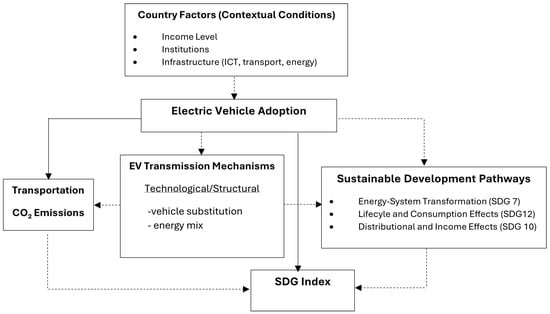
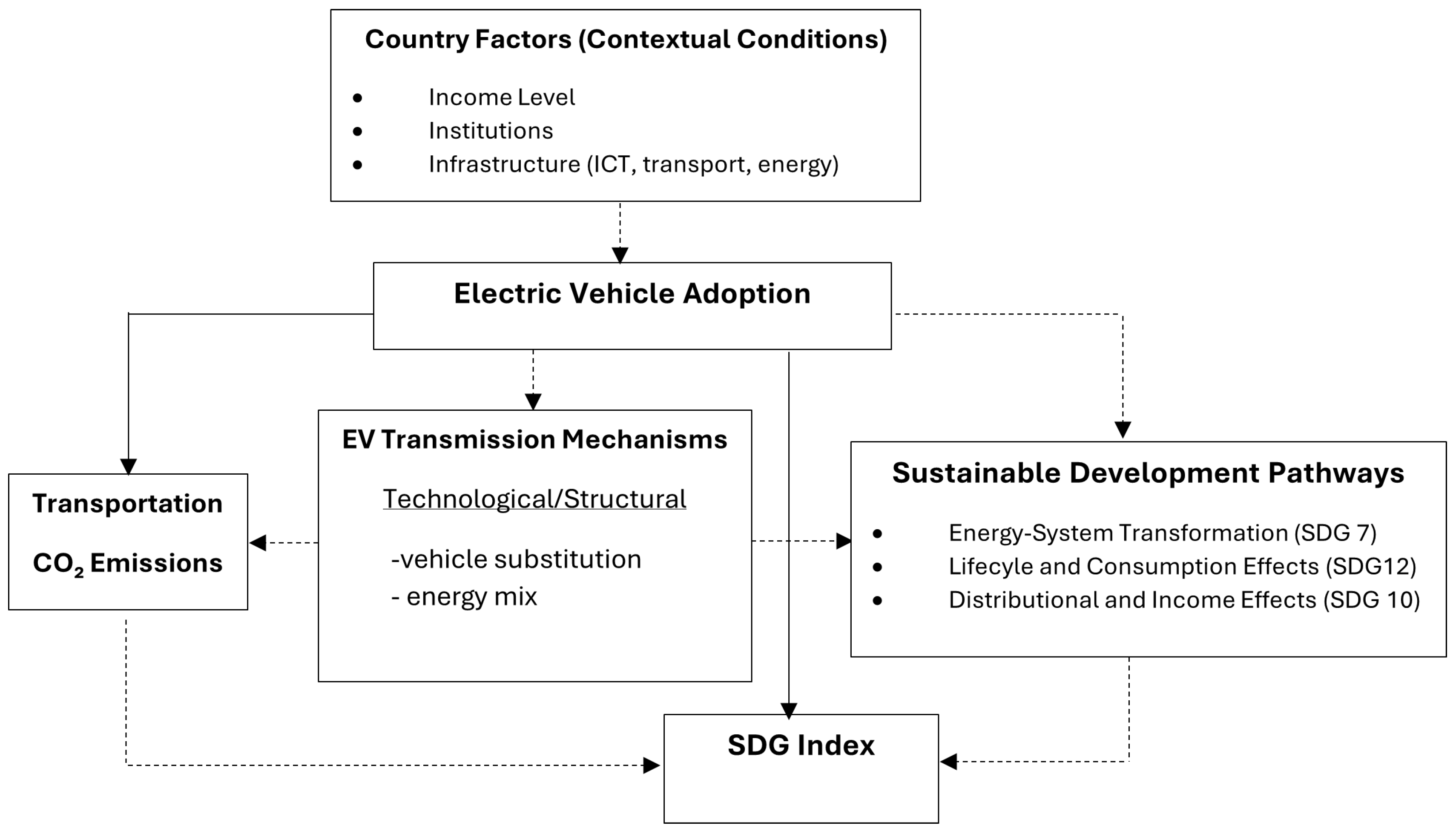
Figure 5 illustrates the direct and indirect pathways through which EV adoption affects CO2 emissions and the Sustainable Development Goals captured by the SDG Index. Solid arrows show empirically tested associations, while dotted arrows represent conceptual pathways. At the core of the framework is the premise that the environmental and developmental impacts of EV adoption are context-dependent and heterogeneous, shaped by country-specific factors such as income level, electricity generation mix, infrastructure maturity, and policy environments.
Figure 5.
Conceptual framework linking electric vehicle adoption, emissions, and the SDG. Source: Authors’ construction.
2.6.1. Country Factors (Contextual Conditions)
Country factors are included in the conceptual framework to highlight the contextual conditions under which EV adoption occurs, rather than as outcomes of interest or independently tested causal relationships. Country factors including income level, institutional quality, infrastructure, and energy system characteristics shape the context in which electric vehicle (EV) adoption occurs. These characteristics condition whether EV diffusion translates into emissions reductions and whether such benefits contribute to progress toward the SDGs. In particular, recent studies show that infrastructure constraints including unreliable electricity supply, limited charging networks, and insufficient smart-grid capacity condition whether EV adoption translates into emissions reductions, especially in low- and middle-income countries [14,15,16].
The framework therefore distinguishes between (i) mechanisms through which EV adoption affects CO2 emissions and (ii) mechanisms through which EV adoption influences overall sustainable development performance as captured by the SDG Index. Firstly, the conceptual framework links electric vehicle (EV) adoption measure by total EV stock to carbon emissions and broader sustainable development outcomes (SDG Index) through a set of transmission mechanisms.
2.6.2. Transmission Mechanisms—Mechanisms Through Which Electric Vehicles Affect CO2 Emissions
Recent literature converges on the view that the emissions impacts of electric vehicle (EV) adoption arise from the interaction of technological substitution, energy system transformation, and behavioral responses. Reviews and empirical studies have noted that the net CO2 outcomes of transport electrification are non-linear and heterogeneous, shaped by electricity generation structures, income-related infrastructure maturity, and policy environments [11,17,24].
At the core of the emissions-reduction potential of EVs is a vehicle substitution mechanism, whereby EVs displace internal combustion engine (ICE) vehicles and eliminate tailpipe CO2 emissions from gasoline and diesel combustion. This direct displacement effect reduces both downstream emissions from vehicle use and upstream emissions associated with oil extraction, refining, and fuel distribution. However, as emphasized by Zaino [24], the magnitude of these benefits depends on lifecycle and system-level conditions, including electricity generation, battery production, and policy support.
Beyond direct substitution, the literature highlights a structural energy transition mechanism. EV adoption shifts final energy demand in the transport sector from fossil fuels toward electricity, thereby linking transport-sector emissions to the carbon intensity of the power system. Life-cycle emission studies show that electric grid carbon intensity explains most of the variation in EV emissions globally and results in heterogeneous climate impacts across regions [11,25].
In addition to structural factors, recent studies have highlighted behavioral rebound mechanisms that moderate the emissions benefits of EV adoption. Efficiency improvements and lower operating costs associated with EV use reduce the marginal cost of travel, inducing increased vehicle kilometers travel and offsetting part of the emissions gains. More broadly, the econometric literature emphasizes that efficiency-enhancing technologies can generate rebound and scale effects that raise energy demand unless accompanied by demand-side management and regulatory constraints [17,26].
However, where electricity grids are weak, unreliable, or lack smart-grid capabilities, increased electricity demand from EVs may raise fossil-based generation and weaken emissions reductions, limiting progress toward SDG 13. As indicated earlier, EV infrastructure challenges particularly in middle-income and developing countries contribute to an EV adoption divided and adversely impacts the effectiveness of EVs in reducing emissions [14,16].
Recent empirical evidence further points to heterogeneity across income groups. For instance, environmental economics literature has noted that electrification without simultaneous power-sector decarbonization may raise aggregate emissions by increasing fossil-based electricity demand, particularly in middle-income economies that are typically undergoing rapid energy transitions. Middle-income economies often experience EV uptake alongside carbon-intensive electricity generation and scale-driven energy demand growth, which limits the environmental effectiveness of electrification [17,27,28].
On the contrary, high-income countries typically combine EV diffusion with cleaner electricity grids, more developed charging infrastructure, and supportive policy frameworks, which enable EV adoption to translate into larger CO2 reductions. This pattern is consistent with broader evidence that the environmental effects of technological change differ systematically across stages of development and across the emissions distribution as suggested by the environmental Kuznets curve hypothesis [17].
These transmission mechanisms imply that electric vehicle adoption has implications that extend beyond emissions mitigation to broader sustainability goals as well. We conceptualize the other channels through which EVs impact the SDGs as Sustainable Development Pathways.
2.6.3. Sustainable Development Pathways
EV adoption has implications for sustainable development that extend beyond its effects on carbon emissions, with direct relevance to several SDGs as identified in the global indicator framework of the 2030 Agenda (UN, 2017). In particular, the framework explicitly highlights reductions in transport-related emissions, sustainable transport systems, clean energy use, and resource efficiency as core components of sustainable development, all of which are closely connected to transport electrification.
EV adoption directly relates to SDG 13 (Climate Action) by reducing carbon dioxide emissions from road transport and contributing to lower emissions intensity, an outcome explicitly referenced in SDG climate indicators. At the same time, transport electrification is structurally linked to SDG 7 (Affordable and Clean Energy), as it shifts final energy demand toward electricity and interacts with renewable energy deployment and energy efficiency, which are key dimensions of progress under this goal.
The SDG framework also recognizes sustainable transport and clean infrastructure as central to SDG 9 (Industry, Innovation and Infrastructure) and SDG 11 (Sustainable Cities and Communities). EV diffusion supports these objectives through the adoption of clean transport technologies and the development of supporting infrastructure, particularly in urban contexts where transport systems play a central role in environmental quality and accessibility.
In addition, EV adoption is relevant to SDG 12 (Responsible Consumption and Production). Lifecycle considerations, consumption responses, and energy-use patterns associated with EV diffusion underscore that electrification outcomes depend on broader production and consumption systems rather than vehicle technology alone.
Finally, empirical studies suggest that the benefits of EV adoption are unevenly distributed across countries and income groups as a result of differences in energy systems, infrastructure, and institutional capacity. This uneven diffusion links EV adoption to SDG 10 (Reduced Inequalities) by raising questions about differential access to clean transport technologies and the distribution of environmental benefits across and within countries.
Because EV adoption can influence sustainable development through multiple, and because the SDG Index aggregates environmental, social, and economic dimensions, improvements in climate-related goals may be offset by adverse effects on other goals, including resource use, inequality, and energy affordability. As noted by IEA [5], affordability can be a barrier to EV adoption, particularly among lower-income households. Consequently, the net association between EV adoption and the SDG Index is theoretically ambiguous and likely to vary across countries and stages of development.
2.6.4. The SDG Index
The Global Indicator Framework for the Sustainable Development Goals and targets of the 2030 Agenda for Sustainable Development adopted by the UN General Assembly (UN, 2017) provides the internationally agreed basis for monitoring progress toward sustainable development. This framework is operationalised through the SDG Index developed by [4], which translates the UN SDG architecture into a harmonised set of measurable indicators.
The SDG Index aggregates a limited set of headline indicators spanning environmental, energy, economic, and social dimensions of sustainable development, including climate-related metrics. Each of the headline indicators making up the SDG Index is normalised on a scale from 0 to 100 and aggregated at the goal level to assess both cross-country performance and trends since 2015. While emissions outcomes form part of this broader framework, the composite nature of the index ensures that it captures sustainability performance beyond any single indicator. The SDG Index builds on a peer-reviewed, statistically audited, and transparent methodology [4]. This provides a useful analytical framework for examining how systemic transitions such as electric vehicle adoption can influence overall sustainable development performance through multiple, interconnected channels [22].
2.6.5. Novelty
Despite rapid growth in the literature on EV adoption, several gaps remain. Firstly, existing studies often focus narrowly on average emissions effects, overlooking heterogeneity across countries and across the distribution of environmental outcomes. Secondly, while EVs are frequently discussed in relation to specific SDGs, there is limited empirical work that explicitly links EV adoption to composite measures of sustainable development such as the SDG Index. Thirdly, few studies jointly examine climate outcomes and broader sustainability performance within a unified framework that accounts for income-related differences and distributional effects.
This study addresses these gaps by employing a quantile regression model to examine how EV adoption influences CO2 emissions and sustainable development performance across countries with differing income levels and sustainability profiles. Guided by the conceptual framework and the identified research gaps, the study investigates the following 2 hypotheses:
H1:
Electric vehicle adoption is associated with reductions in carbon dioxide emissions per capita, with effects differing across country income groups.
H2:
Electric vehicle adoption contributes positively to sustainable development performance, as measured by the SDG Index, with gains that are unevenly distributed across countries and income groups.
3. Research Methods
The intention was to analyze as many countries as possible; however, due to the availability of data, empirical investigation covers 50 countries for the period 2010–2023. Since the objective of the study is to understand how EV adoption impacts SDG outcomes across countries in different income groups, countries are grouped into high income (HIC), upper middle income (UMIC), and lower middle income (LMIC) categories using World Bank’s historical classification of countries.
The World Bank updates the income group classifications annually on 1 July based on the Atlas method estimates of gross national income (GNI) per capita [29]. For the 2026 fiscal year, high-income countries are defined as those with per capita GNI exceeding $13,935; upper middle-income economies fall between $4496 and $13,935; lower middle-income economies range from $1136 to $4495; and countries with GNI of $1135 or less are classified as low-income [30]. These categories, can be seen in Table 1, provide a standardized framework for analyzing the differential impact of EV adoption on CO2 emissions and progress toward the SDGs across nations with varying income levels.
Table 1.
Variable Construction, Descriptions and Justification.
3.1. Data Analysis
The data was analysed using two quantitative methods. Firstly, panel correlations, stratified by income level, were conducted to provide initial insights into pairwise relationships. Two panel quantile regression models were also estimated to determine how the effect of EV adoption varies across the distribution of emissions and SDG scores. However, the correlation analysis was not reported as the quantile regression models offer a more robust approach to capturing distributional effects and equity dynamics across income groups, which are central to the research question.
Quantile Regression Model Specifications
We investigated our 2 hypotheses using quantile regression models. Quantile regression models are estimated to be using standard linear quantile regression following Koenker [32]. Unlike traditional linear regression approaches that focus on the conditional mean, quantile regression enables the investigation of relationships across the entire conditional distribution of a dependent variable. This technique segments the population into portions of equal size at each quantile, which allows for additional insights into heterogeneity that would be missed by mean-based analysis alone [32,33]. To capture heterogeneity in CO2 emissions and SDG performance across countries, the τ-th conditional quantile of for country at time , conditional on covariates , is specified as:
where
- Qτ(∣) denotes the conditional τ-th quantile of the dependent variable ;
- is a vector of explanatory variables;
- β(τ) is a quantile-specific parameter vector.
We initially attempted to estimate specifications including country fixed effects and year fixed effects. However, given the relatively short time dimension of the panel and the inclusion of several slowly moving country-level regressors such as income, institutional quality, economic and energy structure, the fixed-effects quantile regression estimator exhibited numerical instability, including near-singular design matrices, which is a well-documented challenge in panel quantile models with many fixed effects.
As a result, we adopted a second-best strategy commonly used in macro-panel quantile regression studies, which is to rely on a rich set of time-varying country characteristics such as income level, institutional quality, electricity generation mix, urbanization, transport infrastructure, and ICT development alongside year fixed effects to account for observed and partially unobserved cross-country heterogeneity. While this approach cannot fully eliminate time-invariant unobserved heterogeneity, it substantially mitigates potential bias by capturing the main structural factors that correlate with both EV adoption and environmental and sustainability outcomes.
Given that EV adoption can be captured either in absolute terms or relative to the vehicle fleet, we estimated the models using 3 alternative measures of EV adoption (total EV stock, EV stock share, and the logarithm of total EV stock) as a robustness check to assess the stability of the results across specifications. The findings remain qualitatively consistent across quantiles.
The specifications of the final 2 models are as follows:
- Model 1: CO2 Emissions Per Capita
This model estimates the impact of electric vehicle (EV) adoption and other development controls on carbon dioxide emissions per capita, while accounting for differences across income groups and time.
where = Conditional quantile τ of the dependent variable (carbon dioxide per capita); EV = electric vehicle adoption; = Dummy variable for high-income countries (1 if high-income, 0 otherwise); is the intercept; to are the coefficients of the explanatory variables (GNI_pc, Urban, ICT, Institutions, Transport, Energy, Structural Change); represents the year fixed effects; is the quantile-specific residuals; while i the indexes countries; and t indexes years.
- Model 2: SDG Index
This model estimates the effects of the same covariates as above on the overall sustainable development performance (SDG Index), again accounting for income-based interaction and year effects.
Model fit was assessed using pseudo R-squared and the quasi-likelihood ratio (Quasi-LR) statistics. Pseudo R2 provides an indication of explanatory power in quantile models, while the Quasi-LR test compares the fitted model against a restricted baseline.
4. Results and Discussion
This study sought to investigate the extent to which EV adoption has contributed to equitable outcomes in the green transition and the attainment of Sustainable Development Goals across countries in different income groups. In order to address this objective, 2 quantile regression models were estimated. In the subsequent sections the results of the first regression will be presented and discussed followed by the results of the second regression model.
4.1. Impact of EV Adoption on Carbon Dioxide Among Income Groups
Since EVs are expected to mitigate the effects of greenhouse gas emissions [6,7], we investigated the effects of EV stocks (%) on carbon dioxide emissions per capita using Pearsons Product Moment Correlation Analysis and quantile regression. The Pearson Correlation Analysis revealed that overall, when all the countries were pooled together there was no significant relationship between EV stocks and CO2 emissions. However, when the results (seen in Table 2) were disaggregated by income groups, we find there was a significant negative relationship in the high-income countries (r = −0.15); however, the relationship was positive in the middle-income countries (r = 0.55 in the lower-middle-income countries and r = 0.42 in the upper-middle-income countries).
Table 2.
Correlation Results.
Based on these preliminary results we used panel quantile regression to test the hypothesis that electric vehicle adoption is associated with reductions in carbon dioxide emissions per capita, with effects differing across country income groups. We further examined the robustness of our results by estimating our quantile regression models with alternative measures of EV adoption namely total EV stock, total EV stock (%), and total EV stock (log), seen in Table 3. When measured as total EV stock (levels), positive effects on CO2 emissions were found to be significant only at lower quantiles (Q10–Q30). This indicates that scale effects of EV adoption on CO2 emissions are concentrated in low-emission countries. Using EV stock as a share of the total vehicle fleet (EV %), the significance extends to mid-quantiles (Q10–Q60), capturing diffusion effects relevant across a broader portion of the emissions distribution. Finally, when using the logarithm of total EV stock, positive effects persist from Q20 to Q90.
Table 3.
Quantile regression results on EV adoption and CO2 emissions.
The interaction term (EV*High-income) was not significant at median, but significantly negative at higher quantiles (τ = 0.7 to 0.9). This finding suggests that high-income countries benefit more from EV adoption in terms of reduced emissions, especially at the upper end of the emissions distribution. This is consistent with available data which suggest the USA, China, and the EU are among the highest greenhouse gas emitters [2] and also among the countries with the highest EV adoption [5].
With regard to the control variables, the study finds that GNI per capita had a negative and significant impact on CO2 emissions in the lower to middle quantiles (τ = 0.1 to 0.5). This also suggests that wealthier countries have lower CO2 emissions at these points. The study also finds that energy had a significant and positive impact in all quantiles of the CO2 emissions distribution while transportation also had significant positive impacts in all quantiles except the 10th. These results are not surprising since the energy and transportation sectors are the 2 leading emitting sectors globally [5].
ICT was consistently negative and significant in all quantiles indicating a potential modernization/efficiency effect whereas structure change, institutions, were insignificant at the median. The urban population also had a significant and negative impact from the 20th to median quantiles (τ = 0.1 to 0.5).
The slope equality test was significant (Chi-sq = 98.96, df = 42, p = 0.0000). This indicates that the impact on the slopes differs across quantiles and confirms the heterogeneous effects of predictors. In other words, EV adoption does not impact CO2 emissions in all countries equally. The Symmetric Quantile Test was also borderline significant (Chi-sq = 31.87, df = 22, p = 0.0796) indicating that EV effects may not be symmetric and that the benefits of EV adoption are not equally distributed across the emissions spectrum. The quantile process estimates indicate that EVs have the strongest positive effects at lower quantiles (τ = 0.1–0.3) and insignificant or weakly positive at higher quantiles (τ > 0.5). The implication of this result is that EVs may initially raise emissions, especially in less advanced adopters or low baseline contexts (e.g., coal-powered grids, nascent infrastructure). On the other hand, the strong negative effects of High-income*EV at τ = 0.7–0.9 and no effect at lower quantiles suggest that high-income countries reduce CO2 more effectively through EV adoption and this could reflect better policy, technological progress, or infrastructure alignment consistent with existing literature.
Although this study does not explicitly model the Environmental Kuznets Curve (EKC) by including a squared income term, the quantile regression results offer partial insight into its dynamics. The finding that GNI per capita has a negative and statistically significant association with CO2 emissions at lower and median quantiles suggests that some countries may have passed the income threshold at which emissions begin to decline, which is consistent with the downward portion of the EKC. Conversely, the lack of a significant relationship at the upper quantiles implies that high-emission countries may still be on the rising side of the curve, where growth is coupled with environmental degradation. These distributional patterns, together with the interaction between EV adoption and income levels, reinforce the view that environmental benefits from technological transitions like EVs emerge only under specific institutional and economic conditions, typically found in higher-income contexts [7,17].
Empirical Results
The bivariate Pearson correlation analysis shows no significant association between total EV stock and per capita CO2 emissions when all countries are pooled. However, disaggregating by income group reveals heterogeneous patterns. For instance, high-income countries exhibit a significant negative correlation (r = −0.277, p < 0.05), whereas lower-middle- and upper-middle-income countries show significant positive correlations (r = 0.63 and r = 0.41, respectively, p < 0.01). These patterns indicate that the effects of EV adoption on CO2 emissions may differ systematically across income groups.
The quantile regression results reveal further confirmed these patterns. When EV adoption is measured in levels (total stock), positive and statistically significant effects on CO2 emissions emerge at the lower quantiles (Q10–Q30), indicating that in low-emission countries, increases in EV stock coincide with higher aggregate emissions. When measured as a share of the total vehicle fleet, significant positive effects extend from Q10 to Q60, while using the logarithm of total EV stock yields positive and significant effects across Q20–Q90.
On the other hand, the interaction between EV adoption and the high-income dummy consistently shows negative and statistically significant effects from the 30th to the 90th conditional quantiles, with the largest reduction at the 90th quantile (coefficient = −0.24). This suggests that high-income countries, which are characterized by cleaner electricity grids, mature charging infrastructure, and supportive policies experience meaningful emissions reductions from EV adoption, particularly among high-emitting countries.
These findings are consistent with the conceptual framework (Section 2.6, Figure 5), which emphasizes that the environmental impacts of EV adoption are context-dependent and heterogeneous. Several mechanisms explain the counter-intuitive positive associations observed at lower and middle quantiles.
In many low-emission and early-transition countries particularly in middle-income countries, electricity systems remain fossil-dependent, unreliable, and lack smart-grid capabilities. Under these conditions, EV adoption increases electricity demand without displacing high-carbon generation, thereby raising aggregate emissions rather than reducing them. Furthermore, electrification shifts emissions from transport to the power sector thereby increasing net CO2 emissions [11,14,16,25].
Aside from the electricity system carbon intensity mechanism, there can also be scale and rebound effects where the lower operating costs of EVs may increase vehicle kilometers travel and overall energy demand, which can offset efficiency gains [17,26].
Additionally, in countries with nascent charging networks or limited regulatory frameworks, EV uptake alone does not automatically translate into emissions reductions [27,28].
By contrast, the negative interaction effects in high-income countries indicate that EV adoption can substantially reduce emissions when embedded within mature energy systems, supportive policy environments, and established infrastructure. These results are consistent with literature that suggests EVs are not a stand-alone mitigation technology but function as part of a broader energy–transport system, with net outcomes shaped by income, energy system decarbonization, and institutional capacity [17,24].
4.2. Impact of EV Adoption on the Achievement of the SDGs Across Income Groups
The bivariate correlation analysis shows a positive association between EV adoption and the SDG Index at the aggregate level (r = 0.161, p < 0.05), as well as within specific income groups: high-income countries (r = 0.277, p < 0.05) and lower-middle-income countries (r = 0.63, p < 0.05). This suggests that, on average, countries with higher EV adoption also exhibit higher SDG performance.
However, the conditional quantile regression results indicate that after controlling for income, institutional quality, energy systems, and other structural factors, EV adoption exhibits a statistically significant negative effect on the SDG Index at the median and across most quantiles.
These findings are consistent with the conceptual framework (Section 2.6, Figure 5), which highlights multiple pathways, both positive and negative, through which EV adoption can affect SDG outcomes. While EVs are expected to directly reduce transport-related emissions (SDG 13) and can support clean energy use (SDG 7), other channels may offset these gains. For example, in countries with carbon-intensive electricity grids or limited charging infrastructure, EV adoption may increase energy burdens and reduce affordability, and this can have an adverse effect on the achievement of SDG 7 (Affordable and Clean Energy) and SDG 11 (Sustainable Cities and Communities) [11,14,17].
The resource and lifecycle impact perspective can explain the positive impacts of EVs. Based on this perspective, battery production and disposal require energy- and resource-intensive processes, which can negatively impact SDG 12 (Responsible Consumption and Production) and exacerbate environmental externalities [24].
Unequal distribution of benefits and EV related digital divide can explain the results. Access to EVs is often concentrated in higher-income households or urban areas, creating disparities in who benefits from transport electrification. This has implications for the SDG 10, which seeks to reduce inequality within and among countries (UN, 2017) [4].
The positive correlations observed in the bivariate analysis suggest that countries with higher institutional capacity, better infrastructure, and stronger baseline SDG performance tend to adopt EVs more rapidly, see in Table 4 However, once these conditions are controlled for in the quantile regressions, the marginal contribution of EV adoption appears negative, highlighting the importance of complementary policies and structural readiness for achieving net SDG gains.
Table 4.
Quantile regression results on EV adoption and SDG Index.
The quantile regression model for CO2 emissions per capita produced a pseudo R-squared of 0.369, indicating that the model explains approximately 36.9% of the variation in emissions at the specified quantiles, relative to a baseline model using only the conditional median. Although pseudo R2 values in quantile models tend to be lower than their OLS counterparts, this result reflects a moderate degree of explanatory power, especially given the heterogeneity in emissions behavior across countries. The model’s Quasi-LR statistic was 415.69 (p < 0.001), further confirming that the full specification significantly improves upon a restricted version with fewer predictors.
For the SDG Index, the model achieved a higher pseudo R-squared of 0.504, suggesting that approximately 50.4% of the variation in sustainable development performance is accounted for by the included predictors. This indicates stronger model performance relative to the emissions model, with GNI per capita, ICT access, and institutional quality contributing substantially to explanatory power. The results affirm the robustness of the model in capturing distributional variation in SDG progress across different country contexts. In the next section, the major conclusions and recommendations of the study will be discussed.
5. Conclusions
This paper examined whether the global diffusion of electric vehicles (EVs) contributes uniformly to climate mitigation and sustainable development or whether its benefits are distributed unevenly across countries and income groups. Specifically, panel quantile regression was used on a sample of 50 countries over the period 2010–2023 to investigate the following two hypotheses:
5.1. Findings Related to H1
The empirical results provide partial support for H1. Correlation analysis indicates that EV adoption is significantly negatively associated with CO2 emissions in high-income countries (r = −0.277, p < 0.05), while in lower- and middle-income countries, EV adoption shows significant positive correlations with emissions (r = 0.63 and r = 0.41, respectively, p < 0.01).
Panel quantile regression confirms these patterns. We find that EV adoption in levels shows significant positive effects at the lower quantiles (Q10–Q30), indicating that increases in EV stocks may coincide with rising emissions in low-emission countries. When EV adoption is measured as a share of the total vehicle fleet, these positive effects extend to Q10–Q60, while logarithmic measures of EV stock produce positive effects from Q20 to Q90. On the contrary, the interaction of EV adoption with a high-income country dummy shows significant negative effects from Q30 to Q90, with the largest reduction observed at the 90th quantile (coefficient = −0.24).
These results suggest that the emissions-reducing potential of EVs is most pronounced in high-emitting, high-income countries, while countries in the lower quantiles of the emissions distribution may experience increasing emissions due to fossil-dependent electricity systems and rebound effects. These results are consistent with literature that argue that the emissions-reducing effects of EV adoption are conditional on country income, energy systems, infrastructure maturity, and complementary policies.
5.2. Findings Related to H2
In contrast, Hypothesis H2, which hypothesizes that EV adoption contributes positively to overall sustainable development performance as measured by the SDG Index, is not supported once structural factors are accounted for. Pearson correlation analysis showed a positive association between EV adoption and the SDG Index in high-income and lower-middle-income countries.
Although the bivariate analysis reveals a positive association between EV adoption and SDG performance, the quantile regression results indicate that, conditional on income, institutions, energy systems, and infrastructure, EV adoption exerts a statistically significant negative effect on the SDG Index across most quantiles. This pattern suggests that EV diffusion alone does not automatically translate into broader sustainable development gains and may, in the absence of complementary policies, exacerbate challenges related to energy affordability, resource use, lifecycle emissions, and distributional inequality. Accordingly, Hypothesis H2 is rejected, highlighting the importance of systemic readiness and policy coherence in translating transport electrification into net sustainable development benefits.
5.3. Policy Recommendations
The findings of this study indicate that the benefits of EV adoption are heterogeneous across countries and income groups. In particular, middle-income countries with lower baseline CO2 emissions may experience increased emissions as EV stocks rise, reflecting fossil-dependent electricity systems and early-stage transition dynamics. To ensure that EV adoption contributes equitably to climate mitigation and sustainable development, we recommend the following:
- Link EV adoption to energy system decarbonization, particularly in middle-income countries where EV adoption currently coincides with rising emissions at lower CO2 levels. This entails expanding and accelerating renewable energy capacity, modernizing the grid, and ensuring low-carbon electricity generation so that increasing EV stocks lead to real emissions reductions rather than shifting emissions from tailpipes to power plants.
- Promote equitable access to EVs by implementing targeted incentives, infrastructure investment, and financing mechanisms to ensure that lower- and middle-income countries and disadvantaged populations within them can benefit from transport electrification.
- Address lifecycle and supply chain impacts by promoting sustainable battery production, recycling, and second-life strategies.
- Mitigate rebound effects by integrating EV adoption with urban planning, investment in public transport, and travel demand management particularly in rapidly urbanizing contexts.
- Focus on country-specific enabling conditions such as capacity building, technology transfer, and supportive regulations to ensure that EV adoption translates into tangible sustainable development outcomes.
5.4. Research Implications
This study contributes to the literature by:
- Providing empirical evidence that EV adoption has heterogeneous impacts on CO2 emissions and sustainable development performance across countries and income groups;
- Highlighting the importance of income, infrastructure, and energy systems in mediating the effects of EV adoption on CO2 emissions and sustainable development;
- Showing that quantile regression uncovers distributional heterogeneity in the impacts of EV adoption that that mean-based analysis can obscure;
- Linking EV adoption to composite SDG outcomes by shedding light on multiple pathways through which electrification influences sustainable development.
Future research should explore country-specific mechanisms through which EV adoption influences SDG outcomes.
Author Contributions
Conceptualization, T.Y.A.; Methodology, T.Y.A.; Formal analysis, T.Y.A.; Investigation, T.Y.A.; Data curation, T.Y.A.; Writing – original draft, T.Y.A.; Writing – review & editing, G.L.T. All authors have read and agreed to the published version of the manuscript.
Funding
This research received no external funding.
Data Availability Statement
The original contributions presented in this study are included in the article. Further inquiries can be directed to the corresponding author.
Conflicts of Interest
The authors declare no conflict of interest.
References
- WEF. Global Risks Report 2025; World Economic Forum: Geneva, Switzerland, 2025. [Google Scholar]
- Statista. Greenhouse Gas Emissions Worldwide—Statistics & Facts; Statista: Hamburg, Germany, 2025. [Google Scholar]
- Arcos-Vargas, A. (Ed.) The Role of the Electric Vehicle in the Energy Transition: A Multidimensional Approach; Springer Nature: Cham, Switzerland, 2021. [Google Scholar]
- Sachs, J.D.; Lafortune, G.; Fuller, G. The SDGs and the UN Summit of the Future. Sustainable Development Report 2024; SDSN: Paris, France; Dublin University Press: Dublin, Ireland, 2024. [Google Scholar] [CrossRef]
- IEA. Global Electric Vehicle Outlook 2025; International Energy Agency: Paris, France, 2025; Available online: https://www.iea.org/reports/global-ev-outlook-2025 (accessed on 12 July 2025).
- He, H.; Zhang, J.; Wang, Y.; Jiang, B.; Huang, S.; Wang, C.; Zhang, Y.; Xiong, G.; Han, X.; Guo, D.; et al. EV Battery: A Large-Scale Electric Vehicle Dataset for Battery Health and Capacity Estimation. arXiv 2023, arXiv:2201.12358. Available online: https://arxiv.org/abs/2201.12358 (accessed on 14 July 2025).
- Rissman, J. Zero-Carbon Industry: Transformative Technologies and Policies to Achieve Sustainable Prosperity; Columbia University Press: New York, NY, USA, 2024. [Google Scholar]
- Maza-Ortega, J.M.; Matas-Díaz, F.J.; Arcos-Vargas, Á. EV International Landscape. In The Role of the Electric Vehicle in the Energy Transition: A Multidimensional Approach; Arcos-Vargas, A., Ed.; Springer International Publishing: Cham, Switzerland, 2020; pp. 1–23. [Google Scholar]
- UNCTAD. Technology and Innovation Report 2023; United Nations: New York, NY, USA, 2023.
- Marín, P.F.; Perales, D.M.C. Environmental Aspects of the Electric Vehicle. In The Role of the Electric Vehicle in the Energy Transition: A Multidimensional Approach; Arcos-Vargas, A., Ed.; Springer International Publishing: Cham, Switzerland, 2021; pp. 93–108. [Google Scholar]
- IEA. Global Electric Vehicle Outlook 2024; International Energy Agency: Paris, France, 2024. [Google Scholar]
- Dearing, J.W.; Cox, J.G. Diffusion Of Innovations Theory, Principles, And Practice. Heal. Aff. 2018, 37, 183–190. [Google Scholar] [CrossRef] [Scilit] [PubMed]
- Pick, J.; Sarkar, A. Theories of the Digital Divide: Critical Comparison. In Proceedings of the 49th Hawaii International Conference on System Sciences (HICSS), Piscataway, NJ, USA, 5–8 January 2016; pp. 3888–3897. [Google Scholar]
- Shamsuddoha, M.; Nasir, T. The Road Ahead for Hybrid or Electric Vehicles in Developing Countries: Market Growth, Infrastructure, and Policy Needs. World Electr. Veh. J. 2025, 16, 180. [Google Scholar] [CrossRef] [Scilit]
- Nsan, N.; Obi, C.; Etuk, E. Bridging Policy, Infrastructure, and Innovation: A Causal and Predictive Analysis of Electric Vehicle Integration Across Africa, China, and the EU. Sustainability 2025, 17, 5449. [Google Scholar] [CrossRef] [Scilit]
- Lukuyu, J.; Shirley, R.; Taneja, J. Managing grid impacts from increased electric vehicle adoption in African cities. Sci. Rep. 2024, 14, 1–15. [Google Scholar] [CrossRef] [Scilit] [PubMed]
- Shahbaz, M.; Balsalobre-Lorente, D.; Sharma, R. (Eds.) Economic Growth and Environmental Quality in a Post-Pandemic World: New Directions in the Econometrics of Environmental Kuznets Curve; Routledge: London, UK, 2023. [Google Scholar]
- Adebayo, T.S. Testing the EKC Hypothesis in Indonesia: Empirical Evidence from the ARDL-Based Bounds and Wavelet Coherence Approaches. Appl. Econ. J. 2021, 28, 78–100. [Google Scholar]
- Leal, P.H.; Marques, A.C. Rediscovering the EKC hypothesis for the 20 highest CO2 emitters among OECD countries by level of globalization. Int. Econ. 2020, 164, 36–47. [Google Scholar] [CrossRef] [Scilit]
- Tenaw, D.; Beyene, A.D. Environmental sustainability and economic development in sub-Saharan Africa: A modified EKC hypothesis. Renew. Sustain. Energy Rev. 2021, 143, 110879. [Google Scholar] [CrossRef] [Scilit]
- Sinha, A.; Adhikari, A.; Jha, A.K. Innovational duality and sustainable development: Finding optima amidst socio-ecological policy trade-off in post-COVID-19 era. J. Enterp. Inf. Manag. 2022, 35, 295–320. [Google Scholar] [CrossRef] [Scilit]
- Sinha, A.; Schneider, N. EKC Modelling in a Post-Pandemic Era: A Policy Note on Socio-Ecological Trade-Offs. In Economic Growth and Environmental Quality in a Post-Pandemic World; Routledge: London, UK, 2023; pp. 121–148. [Google Scholar]
- Mutambara, A.G. Artificial Intelligence: A Driver of Inclusive Development and Shared Prosperity for the Global South; CRC Press: Boca Raton, FL, USA, 2025. [Google Scholar]
- Zaino, R.; Ahmed, V.; Alhammadi, A.M.; Alghoush, M. Electric Vehicle Adoption: A Comprehensive Systematic Review of Technological, Environmental, Organizational and Policy Impacts. World Electr. Veh. J. 2024, 15, 375. [Google Scholar] [CrossRef] [Scilit]
- Chen, H.; Sener, S.E.C.; Van Emburg, C.; Jones, M.; Bogucki, T.; Bonilla, N.; Ijeoma, M.W.; Wan, H.; Carbajales-Dale, M. Electric light-duty vehicles have decarbonization potential but may not reduce other environmental problems. Commun. Earth Environ. 2024, 5, 476. [Google Scholar] [CrossRef] [Scilit] [PubMed]
- Zhao, X.; Li, X.; Mao, Y.; Fang, J. Electric vehicle adoption and the energy rebound effect in the transportation sector: Evidence from China. Transp. Policy 2025, 169, 227–241. [Google Scholar] [CrossRef] [Scilit]
- Bülbül, B.Y.; Baydar, M.B. Decarbonizing Transportation: Cross-Country Evidence on Electric Vehicle Sales and Carbon Dioxide Emissions. World Electr. Veh. J. 2025, 16, 660. [Google Scholar] [CrossRef] [Scilit]
- Tao, M.; Lin, B.; Poletti, S. Deciphering the impact of electric vehicles on carbon emissions: Some insights from an extended STIRPAT framework. Energy 2025, 316, 134473. [Google Scholar] [CrossRef] [Scilit]
- Acheampong, T.Y.; Udvari, B. The potential role of aid in escaping the middle-income trap. Soc. Econ. 2020, 42, 420–441. [Google Scholar] [CrossRef] [Scilit]
- World Bank. World Bank Country and Lending Groups; World Bank: Washington, DC, USA, 2025; Available online: https://datahelpdesk.worldbank.org/knowledgebase/articles/906519-world-bank-country-and-lending-groups (accessed on 20 May 2025).
- UNDP. Human Development Report 2025: A Matter of Choice—People and Possibilities in the Age of AI; United Nations Development Programme: New York, NY, USA, 2025. [Google Scholar]
- Koenker, R.; Hallock, K.F. Quantile Regression. J. Econ. Perspect. 2001, 15, 143–156. [Google Scholar] [CrossRef] [Scilit]
- IHS Global Inc. EViews 10 User’s Guide II; IHS Global Inc: Irvine, CA, USA, 2017. [Google Scholar]

Disclaimer/Publisher’s Note: The statements, opinions and data contained in all publications are solely those of the individual author(s) and contributor(s) and not of MDPI and/or the editor(s). MDPI and/or the editor(s) disclaim responsibility for any injury to people or property resulting from any ideas, methods, instructions or products referred to in the content. |
© 2026 by the authors. Published by MDPI on behalf of the World Electric Vehicle Association. Licensee MDPI, Basel, Switzerland. This article is an open access article distributed under the terms and conditions of the Creative Commons Attribution (CC BY) license.