


Abstract
Introduction: Although the high cost of dialysis therapy can be an economic burden, peritoneal dialysis (PD) accounts for approximately 3% of the dialysis population. Studies comparing medical costs of PD and hemodialysis (HD) in Japan are limited. We investigated medical expenditures of PD and HD using the National Database (NDB) Open Data to clarify the current status of dialysis modality-specific medical expenditures in Japan. Methods: This was a descriptive analysis of aggregate data from the NDB Open Data for fiscal years 2014 to 2024 (April 2014 to March 2025). Dialysis-related items were extracted from the dataset. In this study, medical expenditures related to PD and HD were aggregated. Results: Total dialysis therapy expenditures showed an increasing trend from 1,057,950 million JPY in fiscal year 2014 to 1,209,499 million JPY in fiscal year 2019. Although a slight decline was observed thereafter, total expenditures reached 1,272,637 million JPY in fiscal year 2024. PD-related medical expenditures consistently accounted for approximately 2% of total dialysis therapy expenditures throughout the study period; HD-related expenditures comprised the majority. Conclusions: This study found that total dialysis therapy expenditures in Japan reached approximately 1.273 trillion JPY in fiscal year 2024, with HD-related medical expenditures accounting for the majority.
1. Introduction
End-stage kidney disease (ESKD) is a severe condition that requires renal replacement therapy, including dialysis or kidney transplantation. The number of ESKD patients has been on the rise globally, and the medical costs associated with dialysis therapy impose a substantial burden on national healthcare budgets [1]. The costs of renal replacement therapy account for 0.7% to 3.3% of public healthcare expenditure depending on the economic status of the country [2], and considering that dialysis patients represent only approximately 0.1% of the population, the economic impact is disproportionately large. For example, ESKD-related expenditure accounts for 5% to 7% of total Medicare spending in the United States [1]. A survey of 38 European countries reported that public expenditure on dialysis therapy amounts to approximately 12.7 billion EUR annually, with dialysis accounting for 3.3% of public healthcare expenditure in countries with lower gross domestic product [2].
Dialysis therapy in Japan has a distinctive structure compared with other countries. According to the statistical survey of the Japanese Society for Dialysis Therapy (JSDT), the number of chronic dialysis patients in Japan was 337,414 as of the end of 2024, with a declining trend since peaking in 2021 [3]. The prevalence of dialysis patients was 2725.4 per million population, which is high by international standards [3]. In terms of treatment modality, blood purification therapies, including hemodialysis (HD) and hemodiafiltration (HDF), account for approximately 96.8% of all dialysis, while peritoneal dialysis (PD), including those combined with HD, accounts for only 3.2% [3]. On the other hand, the survival outcomes of dialysis patients in Japan are reported to be favorable compared with other countries [1,4].
Under Japan’s universal health insurance system, public subsidies are widely applied to dialysis therapy, substantially reducing the financial burden on patients. However, the total cost of dialysis therapy is estimated at approximately 1.6 trillion JPY annually [5], corresponding to approximately 3% of the national healthcare expenditure of approximately 48.1 trillion JPY in fiscal year 2023 [6]. According to a survey by the National Federation of Health Insurance Societies (fiscal year 2021), the annual medical cost per dialysis patient was 5.97 million JPY for inpatient care and 4.56 million JPY for outpatient care, both the highest among 10 lifestyle-related diseases [7]. Although the cost-effectiveness superiority of PD has been reported internationally [8] and PD-first or PD-favored policies have been adopted in an increasing number of countries and regions [9], reports examining the actual medical costs of PD and HD in Japan based on large-scale databases are limited. This study aimed to examine the medical expenditures of PD and HD using the National Database of Health Insurance Claims (NDB) Open Data and to clarify the current status of dialysis modality-specific medical expenditures in Japan.
2. Methods
2.1. Database and Data Source
The NDB Open Data used in this study [10] was established under the Act on Assurance of Medical Care for Elderly People, enforced since April 2008, and is utilized for the formulation, implementation, and evaluation of medical expenditure optimization plans. The database contains two components: (1) claims information issued by medical institutions to health insurance associations and (2) information on specific health checkups and health guidance. The provision of data to a wide range of third parties, including private enterprises, has been legalized, and the data have been utilized in various real-world studies. The dataset contains medical information on (1) Medical treatments, (2) Dental treatments, (3) Dental diseases, (4) Dispensing, (5) Prescription, (6) Medical devices, (7) Examinations of the specific health checkups, and (8) Questionnaires of the specific health checkups [11].
2.2. Study Design
This was a descriptive analysis of aggregate data from the NDB Open Data for fiscal years 2014 to 2024 (April 2014 to March 2025). Dialysis-related items were extracted from (1) Medical treatments and (5) Prescription in the NDB Open Data. Dialysis-related data from (1) Medical treatments were extracted using the codes shown in Table 1. The item “B001 31 Renal Replacement Therapy Instruction and Management Fee,” which is common to both PD and HD and could not be allocated to either modality, was excluded from this analysis. From (5) Prescription, items corresponding to “341 Hemodialysis agents” and “342 Peritoneal dialysis agents” were extracted. In this study, medical expenditures related to PD and HD were aggregated.
Table 1.
List of codes used to extract dialysis-related data from (1) Medical treatments.
2.3. Statistical Analysis
Descriptive statistics were used to report the results. In this study, medical expenditures were aggregated at the national level for each fiscal year. Expenditures were not aggregated by individual patient or by claim, as the NDB Open Data provides pre-aggregated, de-identified summary data rather than individual-level claims data. Expenditures related to medical treatments were calculated by multiplying the insurance reimbursement points listed in the NDB Open Data for each fiscal year by 10 [12] to obtain the amount per claim, which was then multiplied by the number of claims. Expenditures related to Prescription were calculated by multiplying the drug price listed in the NDB Open Data for each fiscal year by the prescribed volume. The data is compiled using annual national aggregates, not estimates per patient or per session. Of note, the NDB Open Data has a minimum aggregation unit of 400 for injectable drugs, and data with fewer than 400 units are not included; therefore, masked data could not be extracted. The NDB Open Data provides pre-aggregated national summary data and does not contain individual patient-level information; therefore, the number of patients per fiscal year could not be derived from this dataset. As the NDB Open Data represents nationwide aggregated data covering the entire Japanese population rather than a sample, statistical significance testing for temporal trends was not applicable.
3. Results
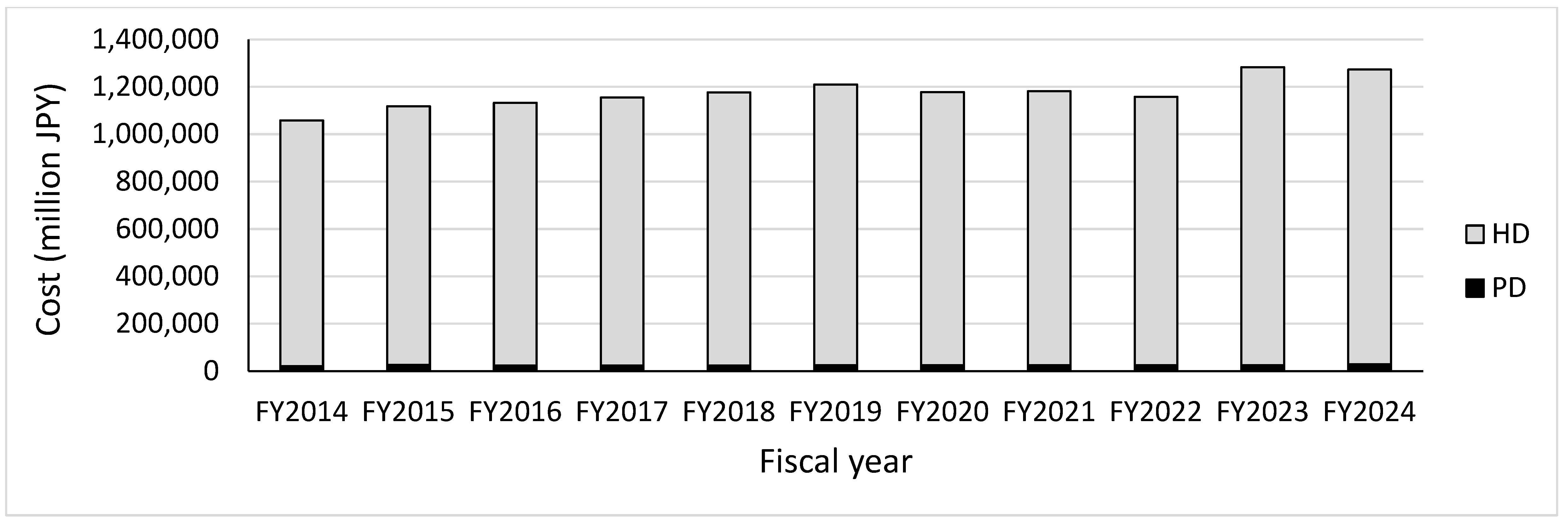
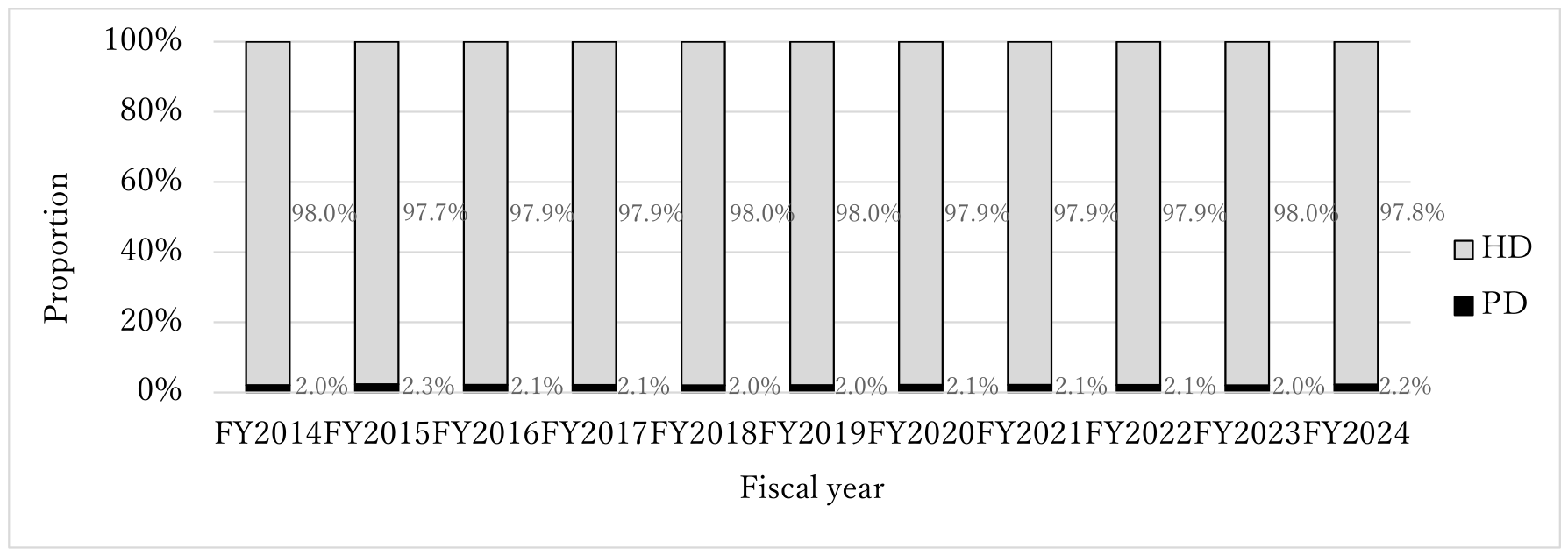
The breakdown of PD-related medical expenditures is shown in Table 2, and that of HD-related medical expenditures is shown in Table 3. No major trend changes were observed in either PD-related or HD-related medical expenditures. Total dialysis therapy expenditures showed an increasing trend from 1,057,950 million JPY in fiscal year 2014 to 1,209,499 million JPY in fiscal year 2019. Although a slight decline was observed thereafter, total expenditures reached 1,272,637 million JPY in fiscal year 2024, while the highest expenditures during the study period were recorded in fiscal year 2023 at 1,282,577 million JPY (Figure 1). PD-related medical expenditures consistently accounted for approximately 2% of total dialysis therapy expenditures throughout the study period, with HD-related expenditures comprising the majority (Figure 2).
Table 2.
Medical expenditures for peritoneal dialysis.
Table 3.
Medical expenditures for hemodialysis.
Figure 1.
Changes in dialysis therapy expenditures by fiscal year. FY, fiscal year; HD, hemodialysis; PD, peritoneal dialysis.
Figure 2.
The proportion of PD-related medical expenditures and HD-related medical expenditures in total dialysis therapy expenditures. FY, fiscal year; HD, hemodialysis; PD, peritoneal dialysis.
4. Discussion
In this study, we aggregated dialysis therapy expenditures in Japan over fiscal years 2014 to 2024 using NDB Open Data and descriptively reported the breakdown of PD- and HD-related medical expenditures. Total dialysis therapy expenditures increased from approximately 1.058 trillion JPY in fiscal year 2014 to approximately 1.283 trillion JPY in fiscal year 2023, reaching the highest level during the study period. The proportion of PD-related medical expenditures remained at approximately 2% of total dialysis therapy expenditures throughout the study period, with HD-related medical expenditures accounting for the majority. When comparing the total dialysis therapy expenditures calculated in this study with national healthcare expenditure for each fiscal year [6], the expenditures corresponded to approximately 2.6% of the 40.8 trillion JPY in fiscal year 2014, approximately 2.7% of the 44.4 trillion JPY in fiscal year 2019, and approximately 2.7% of the 48.1 trillion JPY in fiscal year 2023. However, as described in the limitations section, the estimates in this study may be undervalued, and the discrepancy with the Ministry of Health, Labour and Welfare’s estimate of approximately 1.6 trillion JPY per year [5] (more than approximately 3% of national healthcare expenditure) is considered attributable to these limitations. Nevertheless, the fact that dialysis therapy consistently accounts for approximately 2.7% to 3% of national healthcare expenditure, while dialysis patients represent only approximately 0.3% of the total population, underscores the disproportionate economic burden of this single disease area.
Multiple factors have been considered as contributing to the observed increase in dialysis therapy expenditures over time. In Japan, online HDF was approved for insurance coverage in 2012, and the rate of HDF implementation has risen rapidly since then [3]. According to the JSDT statistical survey, the number of HDF patients reached 213,721 by the end of 2024, which accounts for 63.3% of all maintenance dialysis patients [3]. HDF carries higher reimbursement points per session compared with HD, and the Japan Association of Dialysis Physicians’ survey of dialysis therapy costs reported that, despite a 56-point reduction in the hemodialysis reimbursement fee in the 2020 revision, the increase in the HDF ratio offset this reduction, which resulted in only a very modest decrease in overall treatment procedure fees [13]. Furthermore, since dialysis therapy is a life-sustaining treatment, the impact of reduced healthcare utilization during the COVID-19 pandemic is considered to have been limited when compared with other medical areas, and the slight fluctuations in dialysis therapy expenditures around fiscal year 2020 are primarily presumed to reflect the effects of medical fee revisions.
Studies examining dialysis modality-specific medical costs have been accumulated in various countries. In the United States, an analysis using Medicare claims data reported that the annual per-patient medical cost was 108,656 USD for HD and 91,716 USD for PD, with HD being approximately 11% more expensive than PD [14]. A survey of thirty-eight European countries showed that annual public expenditure on HD amounted to 11.8 billion EUR, compared with 0.9 billion EUR for PD [2]. In Asian countries, PD costs were also reported to be lower than HD costs across all countries and regions examined, including South Korea (HD 64,145 USD vs. PD 43,005 USD), Hong Kong (HD 52,307 USD vs. PD 27,529 USD), Taiwan (HD 23,479 USD vs. PD 19,300 USD), China (HD 18,032 USD vs. PD 15,888 USD), and Indonesia (HD 6249 USD vs. PD 3053 USD) [15]. A lifetime cost analysis using Taiwan’s National Health Insurance data also demonstrated that lifetime healthcare costs were higher for HD patients (237,795 USD) than for PD patients (204,442 USD) [16]. A cost-utility analysis from Canada reported that PD was associated with approximately 16,000 USD lower total costs over 10 years and higher quality-adjusted life years (QALYs) when compared with in-center HD [8]. A lifetime cost-effectiveness analysis under Hong Kong’s PD-first policy also demonstrated that PD was cost-saving [17]. Based on this evidence, PD-first or PD-favored policies have been adopted in multiple countries and regions [8]. Hyodo et al. reported on the economic status of dialysis therapy in Asian countries, suggesting that PD-first policies may contribute to cost containment, as PD is less costly than HD in Mongolia and Indonesia [18]. This study is the first to aggregate PD- and HD-related medical expenditures over time using the NDB Open Data in Japan, adding Japanese data to the above body of international evidence.
According to JSDT statistics, of the 337,414 chronic dialysis patients in Japan at the end of 2024, blood purification therapies including HD and HDF accounted for 326,640 patients (96.8%), while PD, including those combined with HD, accounted for only 10,774 patients (3.2%) [3]. PD-related medical expenditures consistently accounted for approximately 2% of total dialysis expenditures, a proportion lower than the PD patient share of 3.2%. However, aggregate expenditure shares alone do not allow conclusions about per-patient cost efficiency, as the data do not permit patient-level comparison. Structural factors exist behind the limited adoption of PD in Japan. Hanafusa et al. noted that the extensive infrastructure for in-center HD in Japan acts as a barrier against transitioning toward PD and kidney transplantation [4]. PD, being a home-based therapy, requires time for patient and family education, and the establishment of support systems for patients who cannot manage independently remains a challenge [19]. On the other hand, PD is a treatment that can be performed at home, and a systematic review has reported that PD patients have better health-related quality of life measured by Short Form-36 Health Survey (SF-36), EuroQol-5 Dimension (EQ-5D), and Kidney Disease Quality of Life Instrument (KDQOL) compared with HD patients [20]. From the perspective of patient-centered outcomes in addition to costs, there is merit in considering the promotion of PD utilization. Because the NDB Open Data used in this study are aggregated data, it is not possible to directly compare per-patient medical expenditures by modality. Therefore, as a next step, we investigated the medical expenditures required for HD and PD patients individually using claims databases to clarify the actual per-patient medical expenditures by dialysis modality in Japan [21].
This study has several limitations. First, the expenditures reported in this study are limited to dialysis-related medical procedures and pharmaceutical items captured in the NDB Open Data and do not encompass all dialysis-related medical costs, the NDB Open Data were not designed for specific research purposes, and the collected data are based on insurance reimbursement. Second, items reimbursable under both PD and HD (e.g., Renal Replacement Therapy Instruction and Management Fee [B001 31]) were excluded. For surgical procedures, only the primary reimbursement points were aggregated without including associated fee-for-service costs. Third, only dialysis-related fluid agents were included in the drug cost calculations, and other medications and various dispensing fees used in dialysis patients were not included. Other fees, including first-visit fee and follow-up-visit fee, as well as various examination fees were not identified. Fourth, due to the NDB’s policy of setting the minimum aggregation unit for injectable drugs at 400, the data below this threshold are missing, which can cause prescription-related expenditures to be underestimated. Additionally, medical devices such as automated peritoneal dialysis circuits have been excluded from the aggregation due to a lack of pricing information. Considering all these factors, the results may underestimate the actual total medical expenditure. Also, medical expenditures were not adjusted for inflation because prices are fixed by government regulations; medical institutions cannot arbitrarily set their own prices. Safety and outcome information cannot be obtained from the NDB Open Data; therefore, cost-effectiveness analyses could not be conducted. These limitations should be considered when interpreting the results of this study.
5. Conclusions
Using NDB Open Data, this study found that total dialysis therapy expenditures in Japan reached approximately 1.273 trillion JPY in fiscal year 2024, with HD-related medical expenditures accounting for the majority. PD-related medical expenditures accounted for only approximately 2% of total dialysis therapy expenditures, which was relatively low compared with the PD patient share of 3.2%. Internationally, the cost-effectiveness superiority of PD has been widely reported, and the promotion of PD utilization may contribute to the optimization of dialysis therapy expenditures in Japan. Further detailed comparative analyses of per-patient dialysis therapy expenditures using claims databases are warranted.
Author Contributions
A.T. developed the concept and the study design and analyzed the data; all authors wrote, reviewed, and approved the final version of the manuscript. All authors have read and agreed to the published version of the manuscript.
Funding
This study was funded by Terumo Corporation.
Institutional Review Board Statement
Ethics approval was not applicable to this study based on the Ethical Guidelines for Medical and Biological Research Involving Human Subjects issued by the Ministry of Health, Labour and Welfare (MHLW) because only completely encrypted data were used.
Informed Consent Statement
Not applicable.
Data Availability Statement
The data presented in this study are openly available in the Ministry of Health, Labour and Welfare of Japan at https://www.mhlw.go.jp/stf/seisakunitsuite/bunya/0000177182.html (accessed on 18 April 2026).
Acknowledgments
The authors would like to acknowledge Koki Yamashita of Maxwell International, Inc. for providing medical writing assistance, which was funded by Terumo Corporation.
Conflicts of Interest
Akina Takami, Haruki Kume and Yoshitaka Ishibashi declare no conflicts of interest. The funder had no role in the design of the study; in the collection, analyses, or interpretation of data; in the writing of the manuscript; or in the decision to publish the results.
References
- United States Renal Data System (USRDS). 2024 Annual Data Report. Available online: https://usrds-adr.niddk.nih.gov/2024 (accessed on 18 April 2026).
- van der Tol, A.; Stel, V.S.; Jager, K.J.; Lameire, N.; Morton, R.L.; Van Biesen, W.; Vanholder, R. A call for harmonization of European kidney care: Dialysis reimbursement and distribution of kidney replacement therapies. Nephrol. Dial. Transplant. 2020, 35, 979–986. [Google Scholar] [CrossRef] [Scilit]
- Masaki, T.; Hanafusa, N.; Abe, M.; Tsuneki, N.; Hoshino, J.; Kikuchi, K.; Goto, S.; Komaba, H.; Taniguchi, M.; Nakai, S.; et al. Current status of chronic dialysis therapy in Japan (as of December 31, 2024). Jpn. J. Dial. Ther. 2025, 58, 524–590. (In Japanese) [Google Scholar] [CrossRef] [Scilit]
- Hanafusa, N.; Fukagawa, M. Global Dialysis Perspective: Japan. Kidney360 2020, 1, 416–419. [Google Scholar] [CrossRef] [Scilit]
- Ministry of Health, Labour and Welfare. Strengthening Insurer Functions Through the Promotion of Data Health to Establish an Appropriate, Stable, and Efficient Health Insurance System (Policy No. I-9-1), Supplementary Materials. Available online: https://www.mhlw.go.jp/content/11601000/000818578.pdf (accessed on 18 April 2026). (In Japanese)
- Ministry of Health, Labour and Welfare. Overview of National Medical Expenditures, FY2023. Available online: https://www.mhlw.go.jp/toukei/saikin/hw/k-iryohi/23/index.html (accessed on 18 April 2026). (In Japanese)
- Health Insurance Association Federation. Survey on Trends in Lifestyle-Related Diseases, FY2021. Available online: https://www.kenporen.com/toukei_data/pdf/chosa_r05_06_02.pdf (accessed on 18 April 2026). (In Japanese)
- Klomjit, N.; Kattah, A.G.; Cheungpasitporn, W. The Cost-effectiveness of Peritoneal Dialysis Is Superior to Hemodialysis: Updated Evidence from a More Precise Model. Kidney Med. 2020, 3, 15–17. [Google Scholar] [CrossRef] [Scilit]
- Liu, F.X.; Gao, X.; Inglese, G.; Chuengsaman, P.; Pecoits-Filho, R.; Yu, A. A Global Overview of the Impact of Peritoneal Dialysis First or Favored Policies: An Opinion. Perit. Dial. Int. 2015, 35, 406–420. [Google Scholar] [CrossRef] [Scilit]
- Ministry of Health, Labour and Welfare. NDB Open Data. Available online: https://www.mhlw.go.jp/stf/seisakunitsuite/bunya/0000177182.html (accessed on 18 April 2026). (In Japanese)
- Ministry of Health, Labour and Welfare. 9th NDB Open Data. Available online: https://www.mhlw.go.jp/content/12400000/001261318.pdf (accessed on 18 April 2026). (In Japanese)
- Ministry of Health, Labour and Welfare. Ministry of Health, Labour and Welfare Notification No. 59. Available online: https://www.mhlw.go.jp/web/t_doc?dataId=84aa9729&dataType=0&pageNo=1&utm_source (accessed on 10 July 2026). (In Japanese)
- Ota, K.; Shishido, K.; Tsuchiya, S.; Yamakawa, T.; Tozawa, S.; Shinoda, T.; Koda, Y.; Kuma, H.; Akizawa, T. Report of the 24th survey on dialysis medical care costs. J. Jpn. Assoc. Dial. Physicians 2021, 36, 512–520. (In Japanese) [Google Scholar]
- Kaplan, J.M.; Niu, J.; Ho, V.; Winkelmayer, W.C.; Erickson, K.F. A Comparison of US Medicare Expenditures for Hemodialysis and Peritoneal Dialysis. J. Am. Soc. Nephrol. 2022, 33, 2059–2070. [Google Scholar] [CrossRef] [Scilit]
- Nisar, M.; Tasleem, Z.; Muhammad, S.A.; Javid, A.; Rasool, M.F.; Karuniawati, H.; Al-Tamimi, S.K.; Rehman, A.U. The direct cost of chronic kidney disease (CKD) reported in Asian countries; a systematic literature review. Cost Eff. Resour. Alloc. 2024, 22, 65. [Google Scholar] [CrossRef] [Scilit]
- Chang, Y.T.; Hwang, J.S.; Hung, S.Y.; Tsai, M.S.; Wu, J.L.; Sung, J.M.; Wang, J.D. Cost-effectiveness of hemodialysis and peritoneal dialysis: A national cohort study with 14 years follow-up and matched for comorbidities and propensity score. Sci. Rep. 2016, 6, 30266. [Google Scholar] [CrossRef] [Scilit]
- Wong, C.K.H.; Chen, J.; Fung, S.K.S.; Mok, M.; Cheng, Y.L.; Kong, I.; Lo, W.K.; Lui, S.L.; Chan, T.M.; Lam, C.L.K. Lifetime cost-effectiveness analysis of first-line dialysis modalities for patients with end-stage renal disease under peritoneal dialysis first policy. BMC Nephrol. 2020, 21, 42. [Google Scholar] [CrossRef] [Scilit]
- Hyodo, T.; Hirawa, N.; Kuragano, T.; Takemoto, Y.; Urabe, S.; Adiya, S.; Damdinsuren, K.; Munaa, B.; Yondontsamts, A.; Jamba, A.; et al. The present status of dialysis patients in Asian countries as of 2022 from a medical economic point of view. Ren. Replace. Ther. 2025, 11, 3. [Google Scholar] [CrossRef] [Scilit]
- Hiramatsu, M. History of peritoneal dialysis and future perspectives. J. Jpn. Soc. Dial. Ther. 2017, 50, 415–419. (In Japanese) [Google Scholar]
- Chuasuwan, A.; Pooripussarakul, S.; Thakkinstian, A.; Ingsathit, A.; Pattanaprateep, O. Comparisons of quality of life between patients underwent peritoneal dialysis and hemodialysis: A systematic review and meta-analysis. Health Qual. Life Outcomes 2020, 18, 191. [Google Scholar] [CrossRef] [Scilit]
- Takami, A.; Terashima, G.; Shiotsuki, Y.; Kume, H.; Ishibashi, Y. Per-patient medical costs of hemodialysis and peritoneal dialysis in Japan. J. Mark. Access Health Policy 2026. submitted. [Google Scholar]

Disclaimer/Publisher’s Note: The statements, opinions and data contained in all publications are solely those of the individual author(s) and contributor(s) and not of MDPI and/or the editor(s). MDPI and/or the editor(s) disclaim responsibility for any injury to people or property resulting from any ideas, methods, instructions or products referred to in the content. |
© 2026 by the authors. Published by MDPI on behalf of the Market Access Society. Licensee MDPI, Basel, Switzerland. This article is an open access article distributed under the terms and conditions of the Creative Commons Attribution (CC BY) license.