


Abstract
Background: The benefit of pharmaceutical innovation manifests when patients access treatment. Following regulatory approval in Europe and Canada, reimbursement decisions depend on health technology assessments (HTAs), which can be prolonged. To quantify the impact of delays on patients, we evaluated market access timelines for olaparib, osimertinib, durvalumab, acalabrutinib, and trastuzumab deruxtecan across six high-income countries with established HTA systems (Canada, England, France, Germany, Italy, Spain). Methods: Time to access was from regulatory approval to reimbursement. Survival benefit was median overall survival (OS) and progression-free survival (PFS) assessed versus the comparator at approval and the latest data cut-off. The number of eligible patients per year multiplied by the years to patient access and survival benefit reflects the lost survival benefit. Results: Efficacy benefits observed at approval continued to the latest data cut-offs. The mean time to patient access was 18 months. Although this varied by country and treatment, with England and Germany typically being the fastest and France and Spain the slowest, timelines often exceeded the 180-day EU target despite identical evidence used in HTA submissions. This resulted in an estimated mean of 2836 patients being unable to access treatment and 3391 OS-derived and 2739 PFS-derived life-years lost. Conclusions: Access processes must evolve to ensure the timely realization of new medicines’ benefits.
1. Introduction
The value of pharmaceutical innovation is only realized when patients access treatment. The process for a medicine to reach patients involves multiple coordinated steps. Following regulatory agency approval (Health Canada in Canada, European Medicines Agency [EMA] in Europe, Medicines and Healthcare products Regulatory Agency [MHRA] in the UK), health technology assessment (HTA) bodies then assess a range of evidence, including the clinical evidence, comparative effectiveness, and economic value of the medicine and issue a recommendation on therapeutic benefit and cost-effectiveness (HTA benefit assessment outcome) [1]. Following successful negotiations with payers, the medicine achieves reimbursement listing and is funded for prescribing. Patients can only routinely access the medicine once this process is complete.
Market access processes differ across countries. Indeed, although EMA approval is centralized, market access remains the responsibility of individual countries, meaning that new medicines do not become accessible to patients across Europe at the same time.
For instance, HTA agencies in France and Germany [2,3] review the clinical data using comparative clinical effectiveness assessments, which include the efficacy, patient outcomes, and safety of the assessed medicine compared with the current standard of care. In Germany, new oncology medicines are reimbursed and become available for patient access immediately after EMA approval, in parallel with the full HTA process and price negotiations. HTA agencies in Canada [4] and England [5] formally assess the economic evidence in addition to the clinical evidence by considering the expected additional clinical benefit relative to the additional cost of introducing a new medicine compared with the current standard of care using cost-effectiveness assessments. HTA agencies may also assess the budget impact of new medicines, evaluating how their costs affect the overall healthcare or pharmaceutical budget beyond what is already allocated.
In oncology, intensive research has led to the development of many innovative treatments, such as the cancer medicines olaparib [6,7,8,9,10], osimertinib [11,12,13,14,15,16], durvalumab [17,18,19], acalabrutinib [20,21,22], and trastuzumab deruxtecan [23,24,25,26], which are the topic of this manuscript. These medicines all demonstrated efficacy during their clinical development and received regulatory approval. In this study, we refer to the point at which regulatory approval and national reimbursement have both been achieved as “launch”. Patients often face prolonged delays before the market access process concludes [27]. One reason for this is that data on long-term survival, a key focus for payers, are often unavailable and/or immature at the time of launch [28,29]. This requirement for long-term survival data affects evidence availability for early-stage disease, chronic cancers, and treatments with curative intent. For instance, neither median overall survival (mOS) nor median progression-free survival (mPFS) was reached for acalabrutinib monotherapy in first-line treatment of chronic lymphocytic leukemia at the time of regulatory approval and the HTA submission because this disease progresses slowly [20]. This means that the long-term benefit of treatment is uncertain. Although this is not an issue for regulators who accept progression-free survival (PFS) as meaningful, payers are more risk-averse because of the potential lost opportunity cost. Immature overall survival (OS) data can therefore slow the HTA process and hinder payer decision-making [28,29,30]. In addition, there are process inefficiencies caused by the overlap between regulatory evaluations and HTA agencies; for example, both authorities review the clinical data for a medicine, usually sequentially, which may contribute to delays in patient access [31,32].
This study aimed to assess market access in Canada, England, France, Germany, Italy, and Spain for the first launches of five AstraZeneca cancer medicines (olaparib, osimertinib, durvalumab, acalabrutinib, and trastuzumab deruxtecan). Countries with established HTA systems were selected from the World Bank high-income category to ensure comparable economic development [33,34]. Although market access processes differ across countries, as explained above, they are sufficiently similar to allow for meaningful comparison [35]. Canada was selected for two reasons. First, similar to many European countries, it has a well-established HTA system [34]. Second, although Canada has a national HTA, decision-making occurs at the sub-regional (provincial) level, which aligns with the vision of the Joint Clinical Assessment (JCA) in the EU, a recent collaborative assessment conducted by multiple EU member states to evaluate the clinical evidence of new medicines and reduce duplication [36,37]. This approach enabled us to assess the impact of HTA-related delays on patient access and outcomes across Europe and Canada, while also identifying whether particular market access processes were associated with longer delays.
The five oncology medicines were chosen for assessment because they are often a healthcare priority for countries, given the associated high unmet need and disease severity. Moreover, all five medicines were made by a single manufacturer (AstraZeneca) and underwent their first launch indications in Europe and Canada during the study time frame. Finally, these five medicines represent different types of development scenarios and clinical evidence, such as Phase III trials, single-arm trials and trials with immature data.
The overall aim of this study was to quantify the time from regulatory approval to patient access across economically developed countries with different market access processes and how these timings may have impacted patient outcomes.
2. Methods
2.1. Data Sources
This study assessed the market access of five AstraZeneca cancer medicines in six countries for their first indications from December 2014 to August 2024. The study cut-off date was 31 August 2024, defined prior to the preparation of this manuscript. At this time, HTAs for trastuzumab deruxtecan in this clinical indication had not been submitted in Canada or Italy and had received a negative recommendation in Spain; this is noted in the analyses.
Olaparib, osimertinib, durvalumab, acalabrutinib, and trastuzumab deruxtecan were evaluated in their first launched indications in Europe and Canada. These indications and the mOS and mPFS values used in the HTA submissions are described in Table 1 (see also Table S1 for a more comprehensive overview, which includes trial numbers, completion date, and links to the webpages of the trials).
Table 1.
Overview of the medicines evaluated in the study: indications at first major launch and supporting trials.
Table 2 summarizes the data sources used to inform this analysis. Information was obtained from several sources. These included peer-reviewed publications, regulatory assessment reports and proprietary databases. The data gathered covered clinical efficacy, key clinical trials and data cut-offs used for regulatory and HTA evaluations, epidemiological estimates and access milestones (such as regulatory approval and reimbursement listings).
Table 2.
Summary of data sources used to calculate time to patient access, survival benefit, and lost clinical survival benefit.
Table 3 summarizes the HTA agencies and early access programs to provide context for differences in patient access timing across countries. Early access programs enable patients with high unmet needs to receive new medicines prior to completion of the full HTA and reimbursement process. Germany is the only country with a formal process that funds treatment immediately from EMA approval.
Table 3.
Summary of HTA agencies and early patient access programs in the different countries.
Reimbursement listing dates were taken from the NAVLIN database (https://data.navlin.com/alspc/#!/, accessed on 13 October 2025) using the data sources listed in Table S3. There were no conflicting milestones identified across data sources; therefore, heterogeneity of data sources and hierarchy of data did not affect the analyses.
2.2. Outcomes Evaluated for First Launch
All data sources used to calculate outcomes are summarized in Table 2. All calculations for each medicine in each country were performed using Microsoft Excel, and the mean of these results was subsequently derived and presented.
This analysis is descriptive and is intended to illustrate differences in market access timelines across countries rather than establish causal relationships. All data are presented in aggregate rather than at the patient level, because the analysis focuses on the overall societal impact rather than individual-level outcomes.
2.2.1. Time to Patient Access
Time to patient access was calculated as the time interval between regulatory approval and reimbursement listing for the first launched indication for each medicine, expressed in months. The numbers used to obtain the results are reported in Table S4. For any treatments that were not submitted for reimbursement, a data cut-off date of 31 August 2024 was used. In addition, the following were also evaluated: time from regulatory approval to HTA benefit assessment outcome and time from HTA submission to HTA benefit assessment outcome.
2.2.2. Survival Benefit
Two survival benefit outcomes were calculated for each medicine in the first launched indication: the difference in mPFS and mOS between the new medicine versus the control arm (OS- and PFS-derived survival benefit, respectively). Indirect comparison methods were used to quantify the survival benefit for the single-arm trials (SATs) DESTINY-Breast01 [25], AURA2 [12], and AURAex [16]. For DESTINY-Breast01, a matching-adjusted indirect comparison (MAIC) [50] was used to compare trastuzumab deruxtecan with data from external comparator studies [25]. Individual patient data from DESTINY-Breast01 were weighted to align baseline characteristics with those of patients in comparator trials. This enabled indirect comparisons of treatment effects to be made, based on the assumption that all relevant prognostic factors and effect modifiers were adequately adjusted for in the model [25,51]. For the AURA2 and AURAex trials [12], a synthetic control arm from the IMPRESS [48] study was used to evaluate osimertinib. This synthetic arm combined external trial data to provide a comparator arm, allowing indirect estimation of treatment benefit. Clinical survival benefit data for each medicine at the time of launch and at the most recent follow-up were compared to assess if the benefit observed at the time of the regulatory submission was maintained over time.
2.2.3. Lost Clinical Survival Benefit
The number of eligible patients who could not access treatment because of reimbursement process timelines was calculated as follows: number of patients affected = incidence in country × time interval from marketing application approval to product listing. Additional information on epidemiology data is available in Table S5.
The lost clinical survival benefit was calculated as follows: number of OS- or PFS-derived years lost = incidence in country × OS or PFS benefit × time interval from marketing application approval to product listing. This approach is in line with previously published methods [52,53].
As a scenario (sensitivity) analysis, outcomes were re-estimated assuming reimbursement listing within 6 months of regulatory approval, which aligns with the 180-day EU target for timely patient access [54]. Where subtracting 6 months would yield an implausible interval, a minimum lag of 1 month was applied for calculation purposes.
3. Results
3.1. Time to Patient Access
Table 4 presents the comparative therapeutic benefit assigned to the first indications of the included medicines in Germany and France, in which HTA frameworks formally evaluate and publish these assessments. It shows that the extent of added benefit varied across medicines and was, in some cases, revised upon resubmission when mature OS data became available.
Table 4.
Overview of benefit assessments taken from the HTA submission for the first indication of the presented medicines.
All treatments were reimbursed in all markets, except for trastuzumab deruxtecan, which was not submitted for HTA in Canada or Italy and received a negative HTA recommendation from the HTA body in Spain. Olaparib initially received a negative recommendation in Canada based on Study 19 data but was subsequently accepted based on the primary results from SOLO-2 [9,10]. Similarly, the osimertinib HTA initially received a negative recommendation in Germany based on the two SATs AURAex [11,16] and AURA2 [12], but it was subsequently accepted based on the health-related quality of life (HRQoL) and safety results of the AURA3 RCT [13,15]. The HTA recommendations from the first submission in all countries assessed are shown in Table 5. These were categorized as positive, negative, or positive with restrictions, where restrictions indicate approval limited to specific conditions such as a narrower patient population or defined clinical criteria.
Table 5.
Overview of HTA recommendations from the first submission.
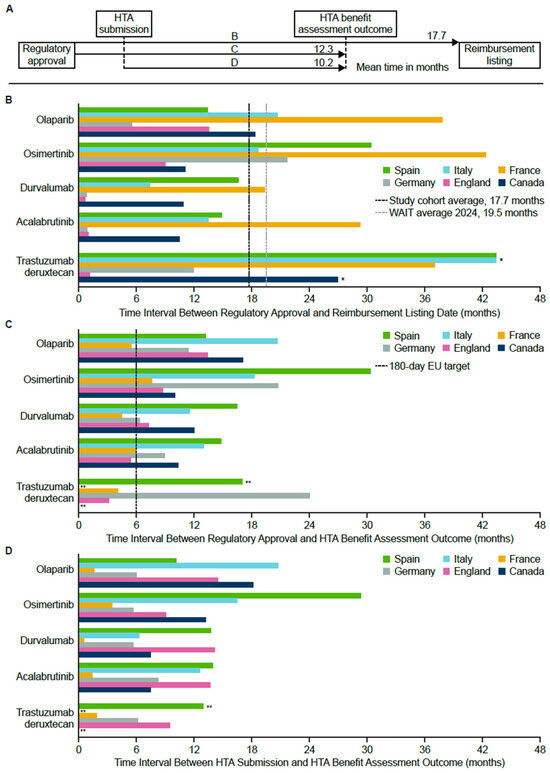
Across medicines and countries, the mean time to patient access, defined as the time from regulatory approval to product listing, was 17.7 months (Figure 1B and Table S4). England and Germany typically had the shortest intervals, while France and Spain had the longest. Of note, most cases exceeded the 180-day EU target [54]. Trastuzumab deruxtecan was assessed using a pivotal SAT (DESTINY-Breast01). SATs are commonly used in populations with high unmet need and limited treatment options, but because they lack a randomized comparator, they introduce greater uncertainty than an RCT. In this case, submissions based primarily on the SAT DESTINY-Breast01 with comparative effects estimated via a series of MAICs contributed to delays in reimbursement decisions in several countries, illustrating how evidence type can directly influence the speed of patient access to innovative cancer therapies. Figure 1A shows a schematic of the mean timelines of the study cohorts described in the bar graphs. Analyzing the components of time to access, the mean time from regulatory approval to HTA benefit assessment outcome was 12.3 months (excluding trastuzumab deruxtecan in Canada and Italy; Figure 1C and Table S4), which was considerably greater than the 180-day EU target. In addition, the mean time from HTA submission to HTA benefit assessment outcome was 10.2 months (excluding trastuzumab deruxtecan in Canada and Italy; Figure 1D and Table S4).
Figure 1.
(A) Schematic of the market access process and estimated mean timings of the study cohorts, where B represents the mean time between regulatory approval and reimbursement listing, C the mean time between regulatory approval and HTA benefit assessment outcome, and D the mean time between HTA submission and HTA benefit assessment outcome. Note: the schematic uses a different scale (e.g., 1 cm = 1 month) compared with the timelines shown in Figure 1B–D. (B) Time to patient access defined as the interval from regulatory approval to reimbursement listing. (C) The interval from regulatory approval to HTA benefit assessment outcome. (D) The interval from HTA submission to HTA benefit assessment outcome. * HTA was not submitted for trastuzumab deruxtecan in Canada and Italy; ** The trastuzumab deruxtecan indication was not launched in Canada, Italy, and Spain. EU = European Union; HTA = health technology assessment; WAIT = Waiting to Access Innovative Therapies [55].
3.2. Survival Benefit
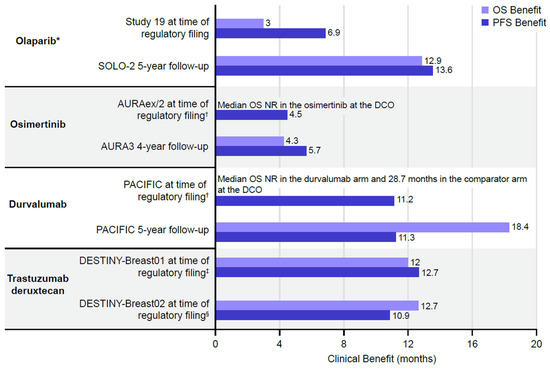
The mOS and mPFS benefits (i.e., the differences between treatment and control arms) observed for the first launched indications continued to the most recent data cut-off for all medicines except acalabrutinib, for which mOS and mPFS were not reached at either timepoint (Figure 2 and Table 6). Durvalumab did not reach the mOS at the primary data cut-off, and acalabrutinib did not reach the mOS or mPFS at either the primary data cut-off or the long-term follow-up. Figure 2 is provided for illustrative purposes only because absolute changes in survival benefit between first and confirmatory studies for a given medicine have not been quantified owing to baseline differences between studies, such as patient populations, lines of prior treatment, and extent of crossover (e.g., patients in the control arm switching to the experimental treatment after disease progression, which was allowed in the clinical trials assessing olaparib, osimertinib, and acalabrutinib). In the case of durvalumab, the same PACIFIC Phase III trial was used at regulatory submission (primary analysis) and long-term follow-up; here, there was no meaningful change in mPFS benefits from the regulatory approval (11.2 months) to long-term 5-year follow-up (11.3 months) [17,18,19]. OS was longer than PFS, which likely reflects the durable immune-mediated effect of durvalumab, with some patients deriving continued benefit beyond disease progression, as observed in the PACIFIC trial and other studies [17,19,56].
Figure 2.
OS and PFS benefit. * Olaparib survival benefit data shown for BRCA-mutated patient population. † AURAex/2 pooled analysis of single-arm trials. IMPRESS synthetic control arm used to calculate PFS benefit. ‡ MAICs were used to calculate survival benefit. § Long-term follow-up data unavailable at time of publication. DCO = data cut-off; MAIC = matching-adjusted indirect comparison; mOS = median overall survival; mPFS = median progression-free survival; OS = overall survival. mOS and mPFS were not reached at the time of regulatory filing or latest DCO for acalabrutinib; therefore, acalabrutinib was excluded from the analysis.
Table 6.
Lost clinical survival benefit.
3.3. Lost Clinical Survival Benefit
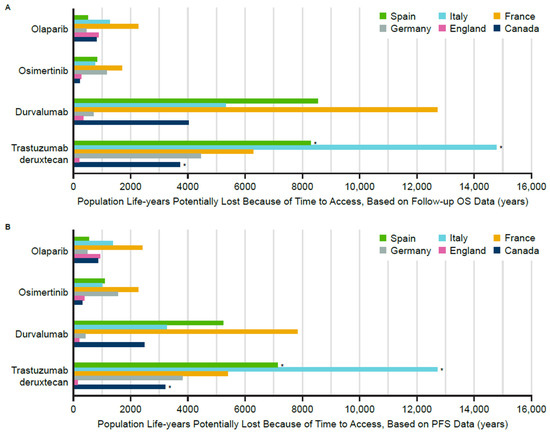
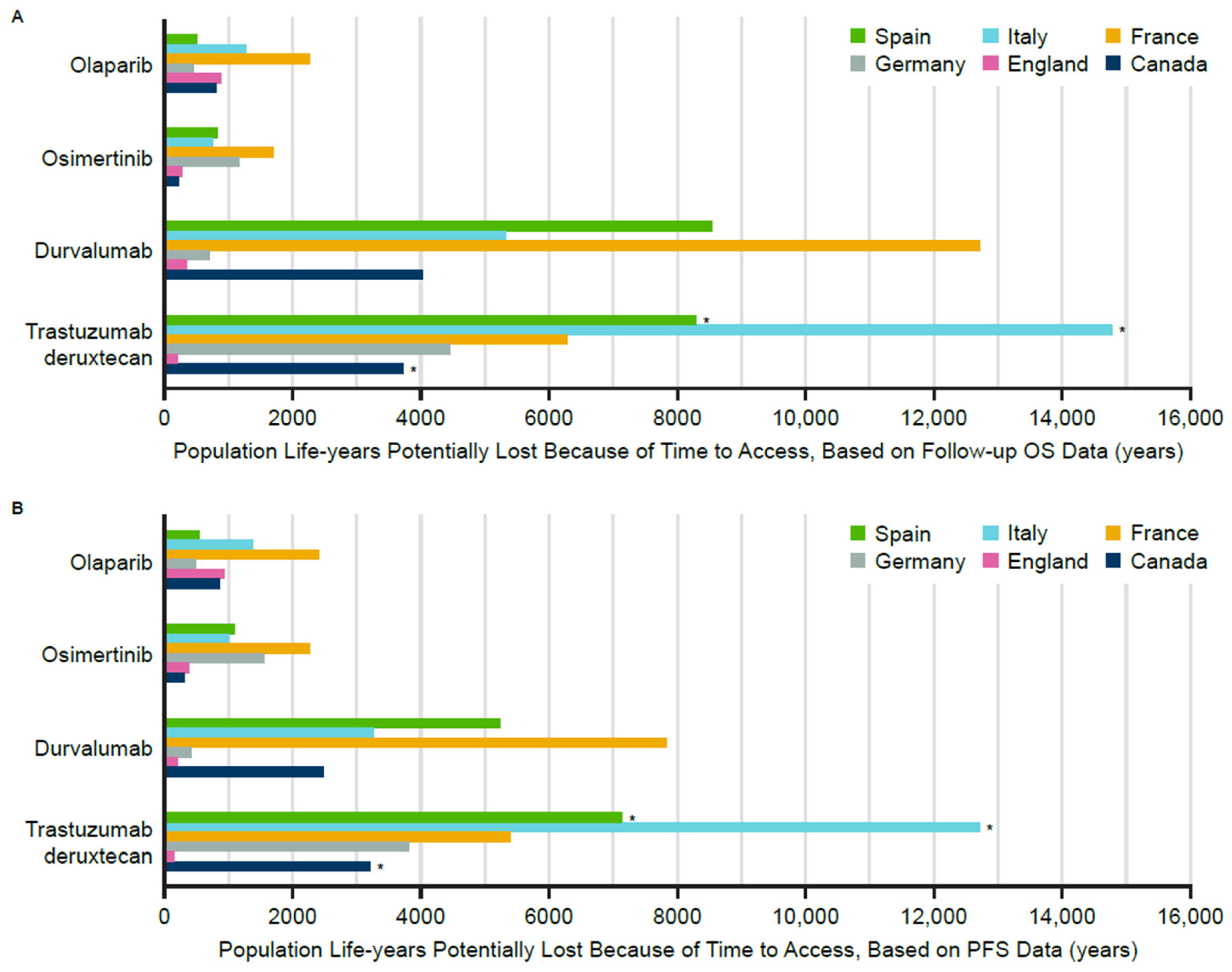
An estimated average of 2836 patients could not access treatment because of delays during the time from regulatory approval to reimbursement (Figure 3). The lowest number of patients who could not access treatment was observed for acalabrutinib (127 patients in England), and the highest for trastuzumab deruxtecan (13,986 patients in Italy). Moreover, 3391 OS-derived life-years and 2739 PFS-derived life-years (Figure 3 and Table 6) were potentially lost on average per medicine per country during the time from approval to reimbursement. Among the five countries, France and Italy had the highest number of life-years lost on average (France: 5774 OS-derived and 4494 PFS-derived life-years; Italy: 5569 OS-derived and 4610 PFS-derived life-years), while England had the lowest number lost on average (468 OS-derived and 461 PFS-derived life-years). Among all medicines, the greatest mean number of life-years was lost for trastuzumab deruxtecan (6320 OS-derived life-years), while the lowest average number of life-years was lost for osimertinib (857 OS-derived life-years).
Figure 3.
Population life-years lost from delayed access, (A) OS-derived life-years lost and (B) PFS-derived life-years lost. * The trastuzumab deruxtecan indication was not launched in Canada, Italy and Spain. Median OS and median PFS were not reached at the time of regulatory filing or latest DCO for acalabrutinib, and therefore acalabrutinib was excluded from the analysis. DCO = data cut-off; OS = overall survival; PFS = progression-free survival.
It is noteworthy that while the ELEVATE-TN trial met its endpoints for PFS (PFS was the primary endpoint for acalabrutinib in combination with obinutuzumab and the secondary endpoint for acalabrutinib monotherapy), mOS and mPFS were not reached at either the interim analysis used in the regulatory submission or the final trial analysis after 6 years of follow-up [57]. Consequently, lost clinical survival benefit could not be derived for acalabrutinib from ELEVATE-TN in this analysis.
3.4. Sensitivity Analysis
As a scenario analysis, we recalculated outcomes assuming access occurred within 6 months of regulatory approval (Table 7). This shortened the mean approval-to-access interval by 12.9 months and reduced the estimated number of patients unable to access treatment and the corresponding OS- and PFS-derived life-years lost (by 2071, 2457, and 2017, respectively). These findings support the internal validity of the approach, showing that earlier access reduced delays, life-years lost, and the number of patients without access by more than 70%.
Table 7.
Scenario analysis assuming access within 6 months of regulatory approval *.
4. Discussion
This study demonstrates the impact on patients and families of delayed access to oncology medicines while awaiting long-term survival data. The mean time to patient access, from regulatory approval to reimbursement listing, was 18 months. Although access times varied by country and treatment, with England and Germany typically taking the shortest time and France and Spain the longest, they often exceeded the 180-day EU target, despite identical evidence being used in HTA submissions. These delays translate directly into lost life-years, as reflected in our calculations of overall survival- and progression-free survival-derived life-years lost. By focusing on measurable patient outcomes, this study underscores how delays in HTA and reimbursement compromise timely access to potentially life-saving treatments. These delays may also contribute to wider societal costs, including avoidable healthcare utilization (e.g., hospitalization) and productivity losses due to early loss of employment.
The time from regulatory approval to HTA recommendation exceeded the 180-day EU target [54] in all five countries for at least one treatment, with three EU countries (France, Italy and Spain) and Canada exceeding this target for all five treatments. While Canada is not bound by EU regulations, the 180-day EU target is widely recognized as an international benchmark for timely patient access. Given the structural similarities between Canada’s HTA system and those in Europe, this standard provides a meaningful point of comparison for evaluating HTA timelines across all included countries [34,37].
The observed average time from regulatory approval to patient access of 17.7 months highlights the impact on patients and families, with wider societal implications, consistent with Waiting to Access Innovative Therapies indicator survey data reporting an average of 19.5 months for oncology medicines in 27 EU countries in 2024 [55]. Overall, although there was variability in time from regulatory approval to HTA recommendation across countries, differences in market access processes did not consistently explain why some countries experienced longer or shorter delays than others.
England and Germany had some of the fastest times from regulatory approval to reimbursement listing; however, in Germany, medicines submitted based on SATs (e.g., osimertinib) had considerably longer times, illustrating how different countries’ approaches to evidence type can influence access timelines.
France had some of the longest times due to extended pricing and reimbursement negotiations, with only a short interval from HTA submission to assessment outcome (average 2 months) but an average of 27 months from assessment outcome to reimbursement listing.
Following regulatory approval, delays in HTA initiation and lengthy assessment processes often reflect differing evidence requirements across HTA bodies and regulators, particularly regarding long-term outcomes (Table 8). HTA agencies may prioritize certainty and magnitude of clinical benefit, favoring mature or statistically robust data, which can delay recommendations. Delays in oncology medicine market access directly affect patient outcomes, with patients in some countries waiting over a year for access, potentially reducing survival and HRQoL benefits. Importantly, some patients may never receive the medicine in time to experience these benefits. Conditional reimbursement can mitigate this when benefit is uncertain, such as with SATs, by allowing access while collecting additional evidence.
Table 8.
Perspectives in decision-making.
Trastuzumab deruxtecan illustrates this issue. Countries accepting SATs with indirect comparisons, such as England, granted quick access. Countries not accepting such comparisons, like Canada and Germany, effectively delayed submission until comparative trial data were available. This led to approximately a one-year delay in patient access in Germany (February 2022 vs. March 2021) and continued unavailability in Canada, limiting access to patients unless they pay privately.
Variations in times to patient access are driven by more than differences in HTA evidence requirements. Table 8 summarizes biases from the perspective of various stakeholders that may influence decision-making and affect time to patient access. These biases (e.g., information bias driven by the requirement for certainty before decision-making) provide further context for differences in time to patient access observed across countries and highlight how factors can shape decision-making at both the individual and organizational levels. Prolonged regulatory and market access processes may place particular pressure on smaller biotech companies, which play a major role in driving innovation. When these developers cannot achieve timely, successful launches, the resulting risk of market failure can ultimately deny patients access to innovative medicines. These factors also reflect differences in the timing and availability of information across stakeholders, which can contribute to inefficient decision-making and delayed patient access. Overall, this affects how quickly patients gain access to treatment, helping explain why countries using the same evidence may still move at different speeds and how this contributes to the wider societal impact of delayed access. Together, these factors highlight the importance of approaches that can better manage clinical uncertainty and support earlier patient access, including early access programs and stronger partnering across stakeholders.
Early access programs exist to reduce wait times, although Germany is the only country with a formal process that systematically funds treatment immediately from EMA approval. France has a publicly funded early access program [58]; England uses the Cancer Drug Fund [59]. For the first launch indications of the medicines evaluated (not including subsequent indications), over 12,000 patients in England and France benefited from these programs. Other countries use temporary classification or immediate launch funding that allow limited or interim access to patients, which is different from Germany, where medicines can be reimbursed immediately at launch while assessment and pricing negotiations occur.
A limitation of this study is that the OS- and PFS-derived life-years lost may be under- or overestimated, for example, owing to treatment crossover during clinical trials, which can dilute observed overall survival benefits. In addition, the date of reimbursement listing may be less meaningful from a patient perspective, as patients may seek access as soon as positive data become publicly available (e.g., following presentations at major oncology congresses). Access delays after reimbursement (ranging from 2 months in England to 1 year in Italy or Spain) [55], including diffusion of medicines into routine clinical practice, may not be fully captured, which may underestimate delayed access. Conversely, excluding early access programs, compassionate use, private funding, and clinical trial availability may overestimate lost life-years. Patient factors such as performance status, personal choice, attrition, and access to oncologists may also influence how many patients ultimately receive the medicine, meaning that the number of patients treated in practice may be lower than the number considered eligible. On balance, these analyses provide an illustrative estimate of the patient impact of delays, with mature, controlled OS data likely to represent the most robust indicator.
In our scenario analysis, we recalculated outcomes assuming access occurred within 6 months of regulatory approval, which aligns with the 180-day EU target for timely patient access [54]. The results showed that meeting this target would have reduced access delays, the number of patients without access, and OS- and PFS-derived life-years lost by more than 70%, highlighting the potential benefits for patients if the 180-day target is achieved.
In addition, this study focuses on survival outcomes (and losses) using OS/PFS estimates; however, it is important to acknowledge that delays in access and the associated lack of PFS benefit can contribute to early clinical deterioration, with increased care needs, which can impact patients, families, carers, and the wider healthcare system. This is reflected in intermediate endpoints such as progression-free survival, which capture worsening disease and increasing care needs well before mortality. However, exploring this factor in more detail was outside the scope of this study.
Finally, although the included countries have comparable levels of economic development, differences in their market access processes, criteria, and timelines limit the generalizability of the findings across countries.
Despite these limitations, the analysis provides a clear, quantitative assessment of the consequences of delayed access to innovative oncology treatments on patient outcomes in Europe and Canada. These analyses are intended as illustrative, population-level indicators of potential impact, rather than precise patient-level causal effects, because median OS and PFS values from clinical trials represent summary measures rather than individual survival predictions and do not reflect the variability in eligibility, uptake, and access patterns seen in clinical practice.
5. Conclusions
The average time from regulatory approval to reimbursement was 17.7 months for five cancer medicines across six countries, with the time from EMA approval to HTA recommendation substantially exceeding the 180-day EU target across all countries for most treatments.
The duration from HTA benefit assessment outcome to reimbursement listing was substantial and varied.
The market access process led to approximately 3000 life-years potentially lost for patients who could not access these medicines. As drug development increasingly targets earlier and curative-intent settings, long-term outcome uncertainty will likely exacerbate these access challenges. Early disease detection and treatment benefits will only be realized if patients can access therapies. Despite centralized EMA approval, national market access processes mean patients across Europe do not receive new medicines at the same time. Multiple indications for any given medicine under evaluation further complicate HTAs because they require consideration of differential value. The EU JCA [36] is a collaborative assessment conducted by multiple EU member states to evaluate the clinical evidence of new medicines and reduce duplication. EU JCA may help to streamline market access processes and improve adherence to the 180-day EU target, provided that countries use the EU JCA submission and report, reduce national process timelines when the clinical assessment has already been undertaken, or start their market access process earlier. All stakeholders should urgently consider partnering to improve patient access, particularly for promising new medicines with uncertain long-term benefits.
Supplementary Materials
The following supporting information can be downloaded at: https://www.mdpi.com/article/10.3390/jmahp14020025/s1. Table S1: Overview of the medicines evaluated in the study: indications at first major and supporting trials [6,7,8,9,10,11,12,13,15,16,17,18,19,20,21,22,23,25,38,39,40,41,42,43,44,45,46,47,48]. Table S2: Market access dates and sources. Table S3: NAVLIN data sources for reimbursement listing dates. Table S4: Time to patient access for the five medicines in the six countries. Table S5: Country-specific annual incidence of eligible patients for the medicines included in the analysis.
Author Contributions
Conceptualization, A.H., B.C., D.P., J.R. and N.O.; Methodology, A.H., B.C., D.P., J.R. and N.O.; Software, A.H., B.C., D.P. and J.R.; Validation, A.H., B.C., D.P. and J.R.; Formal Analysis, A.H., B.C., D.P. and J.R.; Investigation, A.H., B.C., D.P., J.R. and N.O.; Resources, A.H., B.C., D.P. and J.R.; Data Curation, A.H., B.C., D.P. and J.R.; Writing—Original Draft Preparation, B.C. and D.P.; Writing—Review and Editing, A.H., B.C., D.P., J.R. and N.O.; Visualization, A.H., B.C., D.P., J.R. and N.O.; Supervision, A.H., D.P., J.R. and N.O.; Project Administration, A.H., B.C., D.P., J.R. and N.O.; Funding Acquisition, A.H., B.C., D.P. and J.R. All authors have read and agreed to the published version of the manuscript.
Funding
This study was conducted by employees of AstraZeneca and the University of Cambridge; no funding from AstraZeneca was granted to the University of Cambridge.
Institutional Review Board Statement
Not applicable.
Informed Consent Statement
Not applicable.
Data Availability Statement
Data sources included published articles for clinical efficacy data (references are included in the manuscript) and published European Public Assessment Reports (EMA) as well as Health Canada’s Summary Basis of Decision for regulatory assessments of clinical benefit–risk balance. Epidemiology data were obtained from DR/Decision Resources, LLC (© 2025, all rights reserved; reprinted with permission). Payer assessments of clinical benefit–risk balance and regulatory approval dates were sourced from the IQVIA HTA Accelerator disease database (www.iqvia.com/landing/hta-accelerator, 13 October 2025). Reimbursement listing dates were extracted from the NAVLIN database (https://data.navlin.com, 13 October 2025). Additional information on data sources and epidemiology data is available in the Supplementary Materials of this manuscript. The Microsoft Excel file generated for this analysis is not available online. However, all data sources used in this work are publicly accessible as detailed above, and the calculations used to generate the data presented in the manuscript are described in Section 2 (Methods). This work was based on data retrieved via paid access from the IQVIA and NAVLIN databases. Regulatory approval dates can be obtained from national regulatory authority websites. Product listing dates can also be requested directly from national reimbursement agencies.
Acknowledgments
The authors thank Barbara Xella, Helen Fishpool and Alice Fodder of PharmaGenesis Oxford Central, Oxford, UK, for providing medical writing support, which has been funded by AstraZeneca, UK, in accordance with Good Publication Practice 2022 (GPP 2022) guidelines (https://www.ismpp.org/gpp-2022, 13 October 2025).
Conflicts of Interest
A.H. was an employee of AstraZeneca, UK, at the time of development of this manuscript. B.C., D.P. and J.R. are current employees of AstraZeneca, UK. N.O. has no conflict of interest to declare.
Abbreviations
The following abbreviations are used in this manuscript:
| EMA | European Medicines Agency |
| HRQoL | Health-Related Quality of Life |
| HTA | Health Technology Assessment |
| JCA | Joint Clinical Assessment |
| MAIC | Matching Adjusted Indirect Comparison |
| mOS | Median Overall Survival |
| mPFS | Median Progression-Free Survival |
| OS | Overall Survival |
| PFS | Progression-Free Survival |
| SAT | Single Arm Trial |
References
- Kirwin, E.; Round, J.; Bond, K.; McCabe, C. A conceptual framework for life-cycle health technology assessment. Value Health 2022, 25, 1116–1123. [Google Scholar] [CrossRef] [Scilit] [PubMed]
- G-BA. The Benefit Assessment of Medicinal Products in Accordance with the German Social Code, Book Five (SGB V), Section 35a. Available online: https://www.g-ba.de (accessed on 4 November 2025).
- IQWiG. Drug Approval and Early Benefit Assessment in Germany. Available online: https://www.iqwig.de/en/presse/in-the-focus/new-drugs-approval-benefit-assessment-coverage/1-drug-approval-and-early-benefit-assessment-in-germany/ (accessed on 4 November 2025).
- CDA. Health Technology Reassessment: An Overview of Canadian and International Processes. Available online: https://www.cda-amc.ca/health-technology-reassessment-overview-canadian-and-international-processes (accessed on 4 November 2025).
- NICE. About Technology Appraisal Guidance. Available online: https://www.nice.org.uk/what-nice-does/our-guidance/about-technology-appraisal-guidance (accessed on 4 November 2025).
- Friedlander, M.; Matulonis, U.; Gourley, C.; du Bois, A.; Vergote, I.; Rustin, G.; Scott, C.; Meier, W.; Shapira-Frommer, R.; Safra, T.; et al. Long-term efficacy, tolerability and overall survival in patients with platinum-sensitive, recurrent high-grade serous ovarian cancer treated with maintenance olaparib capsules following response to chemotherapy. Br. J. Cancer 2018, 119, 1075–1085. [Google Scholar] [CrossRef] [Scilit]
- Ledermann, J.; Harter, P.; Gourley, C.; Friedlander, M.; Vergote, I.; Rustin, G.; Scott, C.L.; Meier, W.; Shapira-Frommer, R.; Safra, T.; et al. Olaparib maintenance therapy in patients with platinum-sensitive relapsed serous ovarian cancer: A preplanned retrospective analysis of outcomes by BRCA status in a randomised phase 2 trial. Lancet Oncol. 2014, 15, 852–861. [Google Scholar] [CrossRef] [Scilit]
- Ledermann, J.A.; Harter, P.; Gourley, C.; Friedlander, M.; Vergote, I.; Rustin, G.; Scott, C.; Meier, W.; Shapira-Frommer, R.; Safra, T.; et al. Overall survival in patients with platinum-sensitive recurrent serous ovarian cancer receiving olaparib maintenance monotherapy: An updated analysis from a randomised, placebo-controlled, double-blind, phase 2 trial. Lancet Oncol. 2016, 17, 1579–1589. [Google Scholar] [CrossRef] [Scilit]
- Poveda, A.; Floquet, A.; Ledermann, J.A.; Asher, R.; Penson, R.T.; Oza, A.M.; Korach, J.; Huzarski, T.; Pignata, S.; Friedlander, M.; et al. Olaparib tablets as maintenance therapy in patients with platinum-sensitive relapsed ovarian cancer and a BRCA1/2 mutation (SOLO2/ENGOT-Ov21): A final analysis of a double-blind, randomised, placebo-controlled, phase 3 trial. Lancet Oncol. 2021, 22, 620–631. [Google Scholar] [CrossRef] [Scilit]
- Pujade-Lauraine, E.; Ledermann, J.A.; Selle, F.; Gebski, V.; Penson, R.T.; Oza, A.M.; Korach, J.; Huzarski, T.; Poveda, A.; Pignata, S.; et al. Olaparib tablets as maintenance therapy in patients with platinum-sensitive, relapsed ovarian cancer and a BRCA1/2 mutation (SOLO2/ENGOT-Ov21): A double-blind, randomised, placebo-controlled, phase 3 trial. Lancet Oncol. 2017, 18, 1274–1284. [Google Scholar] [CrossRef] [Scilit]
- Ahn, M.-J.; Tsai, C.-M.; Shepherd, F.A.; Bazhenova, L.; Sequist, L.V.; Hida, T.; Yang, J.C.H.; Ramalingam, S.S.; Mitsudomi, T.; Jänne, P.A.; et al. Osimertinib in patients with T790M mutation-positive, advanced non-small cell lung cancer: Long-term follow-up from a pooled analysis of 2 phase 2 studies. Cancer 2019, 125, 892–901. [Google Scholar] [CrossRef] [Scilit] [PubMed]
- Goss, G.; Tsai, C.-M.; Shepherd, F.A.; Bazhenova, L.; Lee, J.S.; Chang, G.-C.; Crino, L.; Satouchi, M.; Chu, Q.; Hida, T.; et al. Osimertinib for pretreated EGFR Thr790Met-positive advanced non-small-cell lung cancer (AURA2): A multicentre, open-label, single-arm, phase 2 study. Lancet Oncol. 2016, 17, 1643–1652. [Google Scholar] [CrossRef] [Scilit]
- Mok, T.S.; Wu, Y.-L.; Ahn, M.-J.; Garassino, M.C.; Kim, H.R.; Ramalingam, S.S.; Shepherd, F.A.; He, Y.; Akamatsu, H.; Theelen, W.S.M.E.; et al. Osimertinib or platinum–pemetrexed in EGFR T790M-positive lung cancer. N. Engl. J. Med. 2017, 376, 629–640. [Google Scholar] [CrossRef] [Scilit]
- Papadimitrakopoulou, V.A.; Mok, T.S.; Han, J.-Y.; Ahn, M.-J.; Delmonte, A.; Ramalingam, S.S.; Kim, S.W.; Shepherd, F.A.; Laskin, J.; He, Y.; et al. Osimertinib versus platinum–pemetrexed for patients with EGFR T790M advanced NSCLC and progression on a prior EGFR-tyrosine kinase inhibitor: AURA3 overall survival analysis. Ann. Oncol. 2020, 31, 1536–1544. [Google Scholar] [CrossRef] [Scilit] [PubMed]
- Wu, Y.-L.; Mok, T.S.K.; Han, J.-Y.; Ahn, M.-J.; Delmonte, A.; Ramalingam, S.S.; Kim, S.-W.; Shepherd, F.A.; Laskin, J.; He, Y.; et al. Overall survival (OS) from the AURA3 phase III study: Osimertinib vs platinum-pemetrexed (plt-pem) in patients (pts) with EGFR T790M advanced non-small cell lung cancer (NSCLC) and progression on a prior EGFR-tyrosine kinase inhibitor (TKI). Ann. Oncol. 2019, 30, ix158. [Google Scholar] [CrossRef] [Scilit]
- Yang, J.C.-H.; Ahn, M.-J.; Kim, D.-W.; Ramalingam, S.S.; Sequist, L.V.; Su, W.-C.; Kim, S.-W.; Kim, J.-H.; Planchard, D.; Felip, E.; et al. Osimertinib in pretreated T790M-positive advanced non-small-cell lung cancer: AURA study phase II extension component. J. Clin. Oncol. 2017, 35, 1288–1296. [Google Scholar] [CrossRef] [Scilit] [PubMed]
- Antonia, S.J.; Villegas, A.; Daniel, D.; Vicente, D.; Murakami, S.; Hui, R.; Kurata, T.; Chiappori, A.; Lee, K.H.; de Wit, M.; et al. Overall survival with durvalumab after chemoradiotherapy in stage III NSCLC. N. Engl. J. Med. 2018, 379, 2342–2350. [Google Scholar] [CrossRef] [Scilit]
- Antonia, S.J.; Villegas, A.; Daniel, D.; Vicente, D.; Murakami, S.; Hui, R.; Yokoi, T.; Chiappori, A.; Lee, K.H.; de Wit, M.; et al. Durvalumab after chemoradiotherapy in stage III non–small-cell lung cancer. N. Engl. J. Med. 2017, 377, 1919–1929. [Google Scholar] [CrossRef] [Scilit]
- Spigel, D.R.; Faivre-Finn, C.; Gray, J.E.; Vicente, D.; Planchard, D.; Paz-Ares, L.; Vansteenkiste, J.F.; Garassino, M.C.; Hui, R.; Quantin, X.; et al. Five-year survival outcomes from the PACIFIC trial: Durvalumab after chemoradiotherapy in stage III non–small-cell lung cancer. J. Clin. Oncol. 2022, 40, 1301–1311. [Google Scholar] [CrossRef] [Scilit] [PubMed]
- Sharman, J.P.; Egyed, M.; Jurczak, W.; Skarbnik, A.; Pagel, J.M.; Flinn, I.W.; Kamdar, M.; Munir, T.; Walewska, R.; Corbett, G.; et al. Acalabrutinib with or without obinutuzumab versus chlorambucil and obinutuzumab for treatment-naive chronic lymphocytic leukaemia (ELEVATE TN): A randomised, controlled, phase 3 trial. Lancet 2020, 395, 1278–1291. [Google Scholar] [CrossRef] [Scilit] [PubMed]
- Sharman, J.P.; Egyed, M.; Jurczak, W.; Skarbnik, A.; Patel, P.; Flinn, I.W.; Kamdar, M. Acalabrutinib ± obinutuzumab vs obinutuzumab + chlorambucil in treatment-naive chronic lymphocytic leukemia: 5-year follow-up of ELEVATE-TN. In Proceedings of the European Hematology Association Annual Meeting, Palermo, Italy, 17–20 August 2022. [Google Scholar]
- Sharman, J.P.; Egyed, M.; Jurczak, W.; Skarbnik, A.; Pagel, J.M.; Flinn, I.W.; Kamdar, M.; Munir, T.; Walewska, R.; Cobett, G.; et al. Efficacy and safety in a 4-year follow-up of the ELEVATE-TN study comparing acalabrutinib with or without obinutuzumab versus obinutuzumab plus chlorambucil in treatment-naïve chronic lymphocytic leukemia. Leukemia 2022, 36, 1171–1175. [Google Scholar] [CrossRef] [Scilit]
- Krop, I.; Park, Y.H.; Kim, S.-B.; Borges, G.; Aksoy, S.; Gregori, J.G.; Roylance, R.; Lim, E.; Yerushalmi, R.; Zagouri, F.; et al. Trastuzumab deruxtecan vs physician’s choice in patients with HER2+ unresectable and/or metastatic breast cancer previously treated with trastuzumab emtansine: Primary results of the randomized phase 3 study DESTINY Breast02. Cancer Res. 2023, 85, GS2-01. [Google Scholar] [CrossRef] [Scilit]
- Modi, S.; Saura, C.; Yamashita, T.; Park, Y.H.; Kim, S.-B.; Tamura, K.; Andre, F.; Iwata, H.; Ito, Y.; Tsurutani, J.; et al. Trastuzumab deruxtecan in previously treated HER2-positive breast cancer. N. Engl. J. Med. 2020, 382, 610–621. [Google Scholar] [CrossRef] [Scilit]
- Saura Manich, C.; Modi, S.; Krop, I.; Park, Y.H.; Kim, S.-B.; Tamura, K.; Andre, F.; Iwata, H.; Ito, Y.; Tsurutani, J.; et al. Trastuzumab deruxtecan (T-DXd) in patients with HER2-positive metastatic breast cancer: Updated survival results from a phase 2 trial (DESTINY-Breast01). Ann. Oncol. 2021, 32, S485–S486. [Google Scholar] [CrossRef] [Scilit]
- Verma, S.; Miles, D.; Gianni, L.; Krop, I.E.; Welslau, M.; Baselga, J.; Pegram, M.; Oh, D.-Y.; Diéras, V.; Guardino, E.; et al. Trastuzumab emtansine for HER2-positive advanced breast cancer. N. Engl. J. Med. 2012, 367, 1783–1791. [Google Scholar] [CrossRef] [Scilit]
- Ofori-Asenso, R.; Hallgreen, C.E.; De Bruin, M.L. Improving interactions between health technology assessment bodies and regulatory agencies: A systematic review and cross-sectional survey on processes, progress, outcomes, and challenges. Front. Med. 2020, 7, 582634. [Google Scholar] [CrossRef] [Scilit]
- Mills, M. HTA Barriers for Conditional Approval Drugs. Pharmacoeconomics 2023, 41, 529–545. [Google Scholar] [CrossRef] [Scilit] [PubMed]
- Tai, T.A.; Latimer, N.R.; Benedict, Á.; Kiss, Z.; Nikolaou, A. Prevalence of Immature Survival Data for Anti-Cancer Drugs Presented to the National Institute for Health and Care Excellence and Impact on Decision Making. Value Health 2021, 24, 505–512. [Google Scholar] [CrossRef] [Scilit]
- Efthymiadou, O. Health technology assessment criteria as drivers of coverage with managed entry agreements: A case study of cancer medicines in four countries. Eur. J. Health Econ. 2023, 24, 1023–1031. [Google Scholar] [CrossRef] [Scilit]
- Wang, T.; McAuslane, N.; Goettsch, W.G.; Leufkens, H.G.M.; De Bruin, M.L. Regulatory, health technology assessment and company interactions: The current landscape and future ecosystem for drug development, review and reimbursement. Int. J. Technol. Assess. Health Care 2023, 39, e20. [Google Scholar] [CrossRef] [Scilit]
- Wang, T.; McAuslane, N.; Liberti, L.; Leufkens, H.; Hövels, A. Building synergy between regulatory and HTA agencies beyond processes and procedures—Can we effectively align the evidentiary requirements? A survey of stakeholder perceptions. Value Health 2018, 21, 707–714. [Google Scholar] [CrossRef] [Scilit]
- Our World in Data. World Bank Income Groups. Available online: https://archive.ourworldindata.org/20250909-093708/grapher/world-bank-income-groups.html (accessed on 13 October 2025).
- Pruthi, J.; Verma, A.; Krishna, A.; Rai, M.K. Evaluating the Gaps in Health Technology Assessment (HTA) Requirements: A Comparative Analysis of HTA Systems of Europe, Canada, and United States with Asia Pacific Region. Value Health 2022, 25, S515. [Google Scholar] [CrossRef] [Scilit]
- Angelis, A.; Lange, A.; Kanavos, P. Using health technology assessment to assess the value of new medicines: Results of a systematic review and expert consultation across eight European countries. Eur. J. Health Econ. 2018, 19, 123–152. [Google Scholar] [CrossRef] [Scilit]
- European Commission. Joint Clinical Assessments. Available online: https://health.ec.europa.eu/health-technology-assessment/implementation-regulation-health-technology-assessment/joint-clinical-assessments_en (accessed on 30 July 2025).
- CDA. Learn More About How a Drug Moves Through the Regulatory and Assessment System in Canada. Available online: https://www.cda-amc.ca/drug-systems-canada (accessed on 15 December 2025).
- EMA. Olaparib/Lynparza SmPC. Available online: www.ema.europa.eu/en/documents/product-information/lynparza-epar-product-information_en.pdf (accessed on 30 July 2025).
- Ledermann, J.; Harter, P.; Gourley, C.; Friedlander, M.; Vergote, I.; Rustin, G.; Scott, C.; Meier, W.; Shapira-Frommer, R.; Safra, T.; et al. Olaparib maintenance therapy in platinum-sensitive relapsed ovarian cancer. N. Engl. J. Med. 2012, 366, 1382–1392. [Google Scholar] [CrossRef] [Scilit] [PubMed]
- EMA. Osimertinib/Tagrisso SmPC. Available online: https://ec.europa.eu/health/documents/community-register/2017/20170424137471/anx_137471_en.pdf (accessed on 30 July 2025).
- Health Canada. Osimertinib/Tagrisso Product Monograph Canada. Available online: https://www.astrazeneca.ca/content/dam/az-ca/downloads/productinformation/tagrisso-product-monograph-en.pdf (accessed on 30 July 2025).
- EMA. Durvalumab/Imfinzi SmPC. Available online: www.ema.europa.eu/en/documents/product-information/imfinzi-epar-product-information_en.pdf (accessed on 30 July 2025).
- Health Canada. Olaparib/Lynparza Product Monograph Canada. Available online: https://www.astrazeneca.ca/content/dam/az-ca/downloads/productinformation/lynparza-product-monograph-en.pdf (accessed on 30 July 2025).
- EMA. Acalabrutinib/Calquence SmPC. Available online: www.ema.europa.eu/en/documents/product-information/calquence-epar-product-information_en.pdf (accessed on 30 July 2025).
- Health Canada. Acalabrutinib/Calquence Product Monograph Canada. Available online: https://www.astrazeneca.ca/content/dam/az-ca/downloads/productinformation/calquence-product-monograph-en.pdf (accessed on 30 July 2025).
- Health Canada. Enhertu/Trastuzumab Deruxtecan Product Monograph Canada. Available online: https://www.astrazeneca.ca/content/dam/az-ca/downloads/productinformation/enhertu-product-monograph-en.pdf (accessed on 30 July 2025).
- EMA. Trastuzumab Deruxtecan/Enhertu SmPC. Available online: https://www.ema.europa.eu/en/documents/product-information/enhertu-epar-product-information_en.pdf (accessed on 30 July 2025).
- Soria, J.C.; Wu, Y.L.; Nakagawa, K.; Kim, S.W.; Yang, J.J.; Ahn, M.J.; Wang, J.; Yang, J.C.; Lu, Y.; Atagi, S.; et al. Gefitinib plus chemotherapy versus placebo plus chemotherapy in EGFR-mutation-positive non-small-cell lung cancer after progression on first-line gefitinib (IMPRESS): A phase 3 randomised trial. Lancet Oncol. 2015, 16, 990–998. [Google Scholar] [CrossRef] [Scilit]
- Dunton, K.; Vondeling, G.; Paine, A. POSB19 Matching-Adjusted Indirect Comparison of Trastuzumab Deruxtecan vs. Eribulin, Capecitabine, and Vinorelbine for Treating Human Epidermal Growth Factor Receptor 2-Positive Unresectable or Metastatic Breast Cancer after Two or More Anti-Human Epidermal Growth Factor Receptor 2-Positive Therapies. Value Health 2022, 25, S28. [Google Scholar] [CrossRef] [Scilit]
- Signorovitch, J.E.; Sikirica, V.; Erder, M.H.; Xie, J.; Lu, M.; Hodgkins, P.S.; Betts, K.A.; Wu, E.Q. Matching-adjusted indirect comparisons: A new tool for timely comparative effectiveness research. Value Health 2012, 15, 940–947. [Google Scholar] [CrossRef] [Scilit]
- Phillippo, D.M.; Ades, A.E.; Dias, S.; Palmer, S.; Abrams, K.R.; Welton, N.J. Methods for Population-Adjusted Indirect Comparisons in Health Technology Appraisal. Med. Decis. Mak. 2018, 38, 200–211. [Google Scholar] [CrossRef] [Scilit]
- Gotfrit, J.; Shin, J.J.W.; Mallick, R.; Stewart, D.J.; Wheatley-Price, P. Potential life-years lost: The impact of the cancer drug regulatory and funding process in Canada. Oncologist 2020, 25, e130–e137. [Google Scholar] [CrossRef] [Scilit] [PubMed]
- Stewart, D.J.; Stewart, A.A.; Wheatley-Price, P.; Batist, G.; Kantarjian, H.M.; Schiller, J.; Clemons, M.; Bradford, J.P.; Gillespie, L.; Kurzrock, R. The importance of greater speed in drug development for advanced malignancies. Cancer Med. 2018, 7, 1824–1836. [Google Scholar] [CrossRef] [Scilit]
- EU. Council Directive 89/105/EEC of 21 December 1988 Relating to the Transparency of Measures Regulating the Prices of Medicinal Products for Human Use and Their Inclusion in the Scope of National Health Insurance Systems (OJ L 40, 11.2.1989, pp. 8–11). Available online: http://data.europa.eu/eli/dir/1989/105/oj (accessed on 12 June 2025).
- IQVIA. EFPIA Patients W.A.I.T. Indicator 2024 Survey. Available online: https://efpia.eu/media/oeganukm/efpia-patients-wait-indicator-2024-final-110425.pdf (accessed on 12 June 2025).
- Zehentmayr, F.; Feurstein, P.; Ruznic, E.; Langer, B.; Grambozov, B.; Klebermass, M.; Hochreiter, A.; Purevdorj, A.; Gruber, G.; Minasch, D.; et al. Durvalumab Prolongs Overall Survival, Whereas Radiation Dose Escalation > 66 Gy Might Improve Long-Term Local Control in Unresectable NSCLC Stage III: Updated Analysis of the Austrian Radio-Oncological Lung Cancer Study Association Registry (ALLSTAR). Cancers 2025, 17, 1443. [Google Scholar] [CrossRef] [Scilit]
- Sharman, J.P.; Egyed, M.; Jurczak, W.; Skarbnik, A.P.; Patel, K.; Flinn, I.W.; Kamdar, M.; Munir, T.; Walewska, R.; Hughes, M.; et al. Acalabrutinib-obinutuzumab improves survival vs chemoimmunotherapy in treatment-naive CLL in the 6-year follow-up of ELEVATE-TN. Blood 2025, 146, 1276–1285. [Google Scholar] [CrossRef] [Scilit]
- Gallo, A.; Stanisic, S.; Neumann, U.; Berto, P. Class CNN drugs in Italy: Purchase and prescription behavior in Italian hospitals. Value Health 2018, 21, S165. [Google Scholar] [CrossRef] [Scilit]
- Büssgen, M.; Stargardt, T. Does health technology assessment compromise access to pharmaceuticals? Eur. J. Health Econ. 2023, 24, 437–451. [Google Scholar] [CrossRef] [Scilit]

Disclaimer/Publisher’s Note: The statements, opinions and data contained in all publications are solely those of the individual author(s) and contributor(s) and not of MDPI and/or the editor(s). MDPI and/or the editor(s) disclaim responsibility for any injury to people or property resulting from any ideas, methods, instructions or products referred to in the content. |
© 2026 by the authors. Published by MDPI on behalf of the Market Access Society. Licensee MDPI, Basel, Switzerland. This article is an open access article distributed under the terms and conditions of the Creative Commons Attribution (CC BY) license.