
Review

Low-Latency Edge Computing Architectures for Real-Time Vehicle Warning Systems: A Review
by
Redeemer Kwei Amartey
1,2 and
Duan Zhao
1,2,*
1
Mining IoT Research Center, China University of Mining and Technology, Xuzhou 221116, China
2
School of Control Science and Engineering, China University of Mining and Technology, Xuzhou 221116, China
*
Author to whom correspondence should be addressed.
Future Internet 2026, 18(8), 387; https://doi.org/10.3390/fi18080387
Submission received: 11 June 2026 / Revised: 10 July 2026 / Accepted: 17 July 2026 / Published: 24 July 2026

Abstract

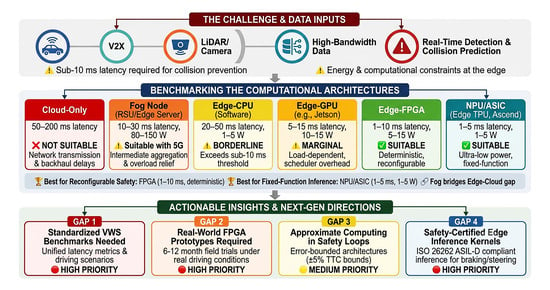
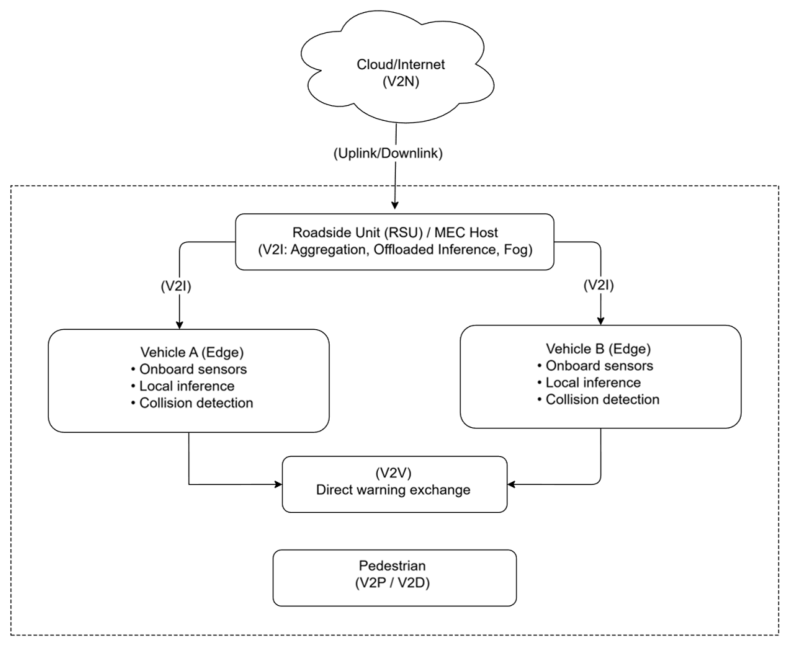
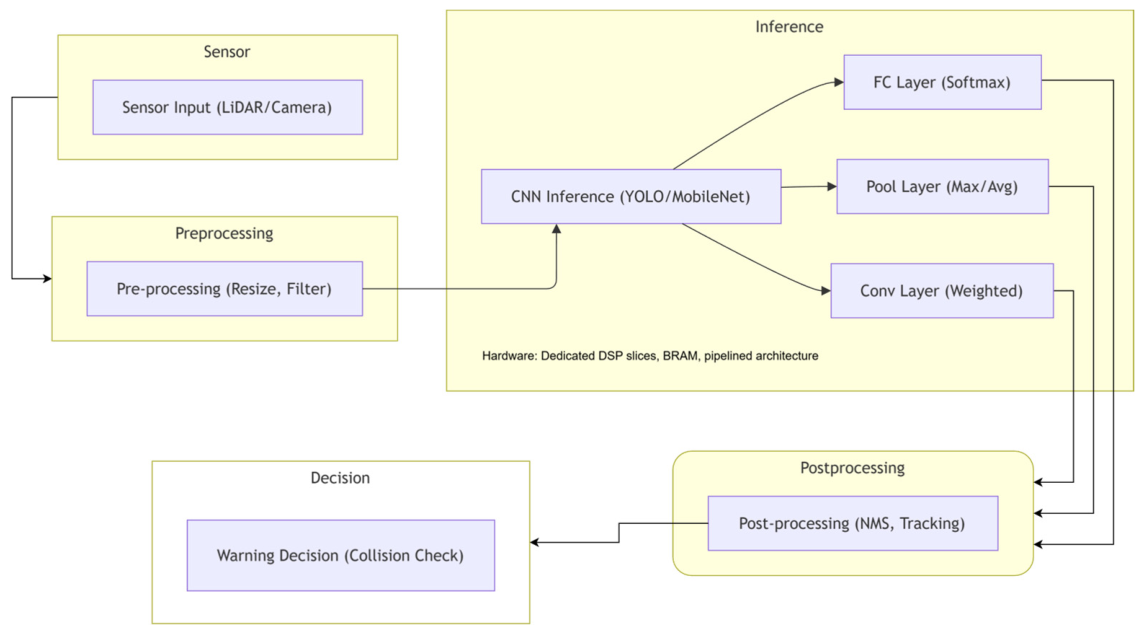
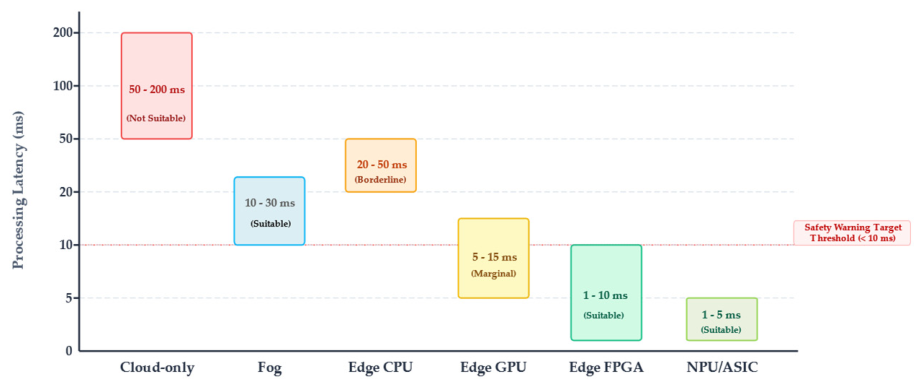
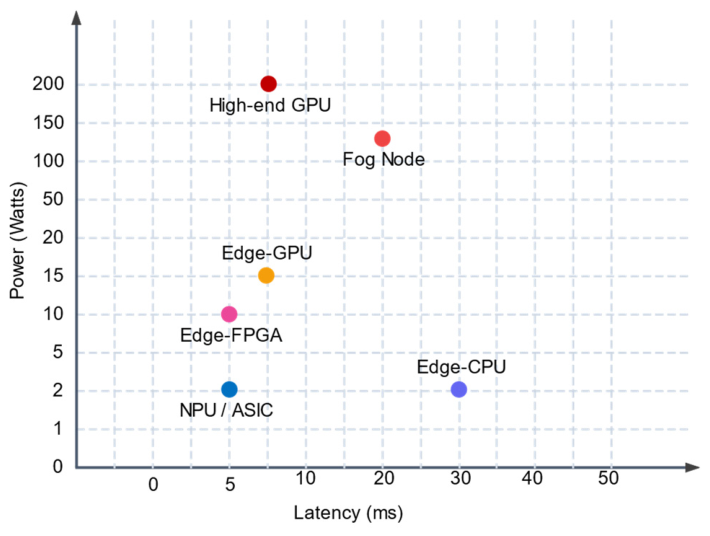
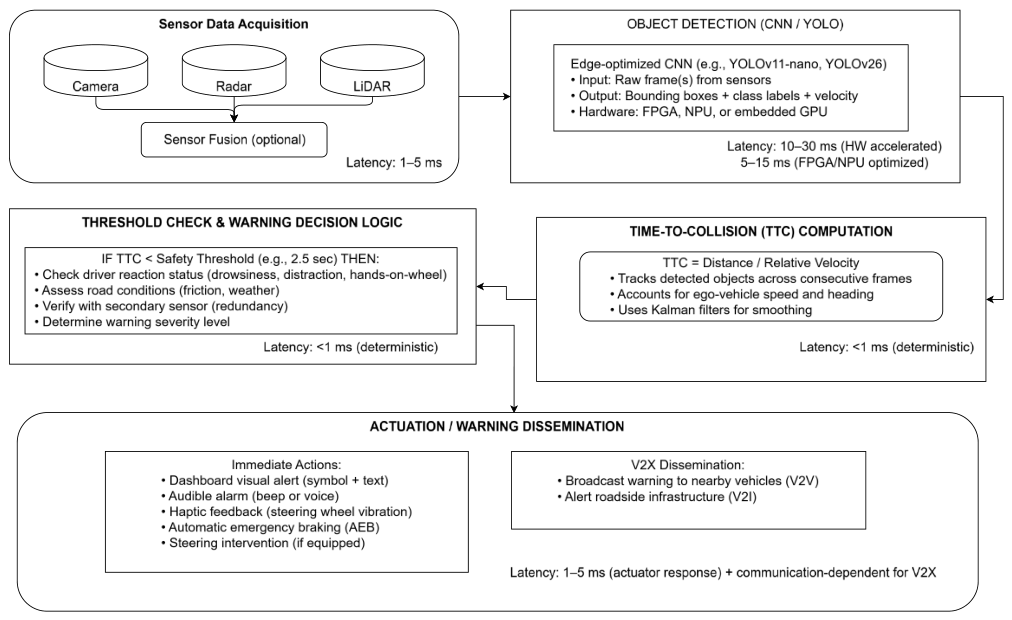
Real-time vehicle warning systems are critical for collision prevention, yet they face stringent sub-10 ms latency requirements under severe energy and computational constraints. This review systematically surveys low-latency edge computing architectures for such systems, explicitly comparing CPU-based, GPU-accelerated, FPGA-based, ASIC/NPU-embedded, fog, and cloud-only processing paradigms. We examine edge intelligence frameworks for intelligent transportation systems, the computational demands of collision avoidance algorithms, V2X communication protocols, and hardware accelerators. A key contribution is a comparative analysis of latency, power consumption, and area trade-offs, revealing that FPGA accelerators achieve deterministic sub-millisecond processing at 5–15 W, while emerging NPUs offer 1–5 W alternatives for fixed-function inference. A critical synthesis of the literature identifies major gaps: the absence of standardized benchmarks, insufficient field-testing of FPGA prototypes, and underutilized potential of approximate computing in safety loops. Furthermore, we introduce fog computing as a vital intermediary layer to bridge edge-cloud gaps. This review consolidates over 58 core studies and offers practical, actionable insights for designing next-generation vehicular safety systems.
Keywords: edge computing; low latency; vehicle warning systems; FPGA accelerators; V2X communication; real-time processing; intelligent transportation systems; fog computing edge computing; low latency; vehicle warning systems; FPGA accelerators; V2X communication; real-time processing; intelligent transportation systems; fog computing
Graphical Abstract