


Abstract
This study examines how blockchain technology is associated with institutional governance and operational effectiveness in blockchain-enabled plastic recovery, with particular attention to resource-constrained developing regions and Less Developed Countries (LDCs). Although prior research highlights blockchain’s technical capabilities, less attention has been given to the institutional, socio-technical, financial, and data governance conditions that shape practical adoption. To address this gap, the paper develops a literature-derived Blockchain-Enabled Waste Management Framework (B-WMF) and evaluates it through an interpretivist single-case study of Plastic Bank. The findings suggest that blockchain’s primary value in this case lies less in technological novelty than in its capacity to support verified recovery records, incentive-linked participation, auditability, and multi-stakeholder coordination. At the same time, the case shows that traceability, tokenized incentives, interoperability, and decentralized verification remain conditional on data quality at the source, institutional oversight, regulatory alignment, and sustainable business models. The paper contributes by reframing blockchain as a socio-technical governance infrastructure for blockchain-enabled plastic recovery, while offering practical guidance for circular economy initiatives operating in resource-constrained environments.
1. Introduction
Municipal solid waste has become one of the most pressing environmental and governance challenges worldwide. Rapid urbanization, population growth, and changing consumption patterns continue to increase waste generation, placing unprecedented pressure on existing waste management systems. These challenges are particularly acute in Less Developed Countries (LDCs) and other resource-constrained developing regions, where limited institutional capacity, inadequate infrastructure, and fragmented governance hinder effective waste collection, recycling, and environmental protection. Projections estimate that global municipal solid waste generation will reach approximately 2.2 billion tonnes annually, further intensifying environmental degradation and public health risks. Plastic waste is especially problematic because of its persistence in terrestrial and marine ecosystems, while weak institutional oversight and limited waste collection services continue to exacerbate these challenges in many developing economies [1,2].
Recent advances in digital technologies, particularly the Internet of Things (IoT) and Artificial Intelligence (AI), have improved operational aspects of waste management by supporting fill-level monitoring, route optimization, and predictive analytics. However, while these technologies enhance operational efficiency, they do not adequately address broader institutional challenges such as stakeholder mistrust, fragmented data management, limited transparency, and weak inter-organizational coordination [3,4]. Consequently, many waste management systems continue to experience difficulties in verifying waste flows, ensuring accountability, and coordinating multiple stakeholders across the recycling value chain.
Blockchain has therefore emerged as a promising complementary technology because it enables immutable record-keeping, decentralized verification, and transparent information sharing across distributed stakeholder networks [5]. Within waste management, these capabilities have the potential to strengthen traceability, reduce information asymmetry, and support more effective governance arrangements. Furthermore, blockchain-based tokenization enables incentive mechanisms that encourage citizens and informal waste collectors to participate in recycling activities through transparent and verifiable reward systems.
Despite these promising capabilities, existing research has largely focused on blockchain’s technical architecture and potential applications, while comparatively limited attention has been paid to the institutional, governance, socio-technical, financial, and data governance conditions that determine successful implementation. As a result, empirically validated frameworks explaining how blockchain can be effectively adopted within real-world waste management systems remain scarce, particularly in resource-constrained settings and LDCs [3]. Addressing this gap requires moving beyond technological capabilities to examine the organizational and governance conditions that enable sustainable blockchain adoption in practice.
To address this research gap, this paper makes three main contributions. First, it develops a governance-oriented Blockchain-Enabled Waste Management Framework (B-WMF) that integrates institutional, socio-technical, and transaction cost perspectives to explain blockchain adoption in blockchain-enabled plastic recovery. Second, it empirically evaluates the proposed framework through an interpretivist single-case study of Plastic Bank, identifying which framework variables are strongly, conditionally, or weakly evidenced within a mature plastic recovery ecosystem. Third, it refines the framework by identifying data integrity, interoperability, privacy compliance, institutional oversight, and financial viability as critical conditions that shape successful blockchain adoption in waste management. The remainder of this paper is organized as follows. Section 2 presents the systematic literature review, Section 3 introduces the initial B-WMF, Section 4 describes the research methodology, Section 5 presents the empirical findings, Section 6 discusses the refined framework, Section 7 outlines the theoretical and practical implications, and Section 8 concludes the paper.
2. Literature Review
2.1. Systematic Literature Review Methodology and Protocol
This section describes the qualitative systematic literature review (SLR) undertaken to synthesize current knowledge on blockchain adoption in waste management. The review follows the three-phase protocol proposed by Kitchenham and Charters [6] and adopts the PRISMA reporting framework to ensure transparency and methodological rigor. While the review process is systematic, the synthesis is interpretive in nature, enabling the identification of recurring concepts, governance mechanisms, and adoption conditions across the selected studies.
This approach positions the researcher as an analytical instrument tasked with evaluating the conceptual depth and contextual relevance of extant data. Guided by the research question, “What are the key factors influencing the adoption and implementation of blockchain technology in waste management?”, the literature search was conducted across six major academic databases: Web of Science, ScienceDirect, IEEE Xplore, SpringerLink, JSTOR, and EBSCOHost. To ensure a comprehensive capture of the landscape, the database search utilized three distinct Boolean query strings:
- Query 1: “Blockchain” AND “Waste Management”
- Query 2: “Cryptocurrencies” AND “Waste Management”
- Query 3: “Smart Contracts” AND “Waste Management”
Keywords such as “adoption”, “drivers”, and “barriers” were intentionally excluded from the initial search strings because blockchain-enabled waste management remains an emerging research domain with evolving terminology. A broader search strategy minimized the risk of prematurely excluding relevant studies. Adoption-related themes were subsequently identified during the screening and thematic synthesis stages.
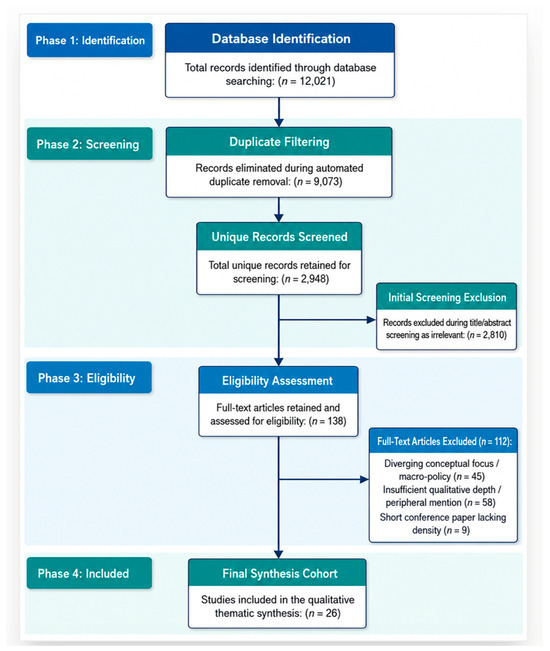
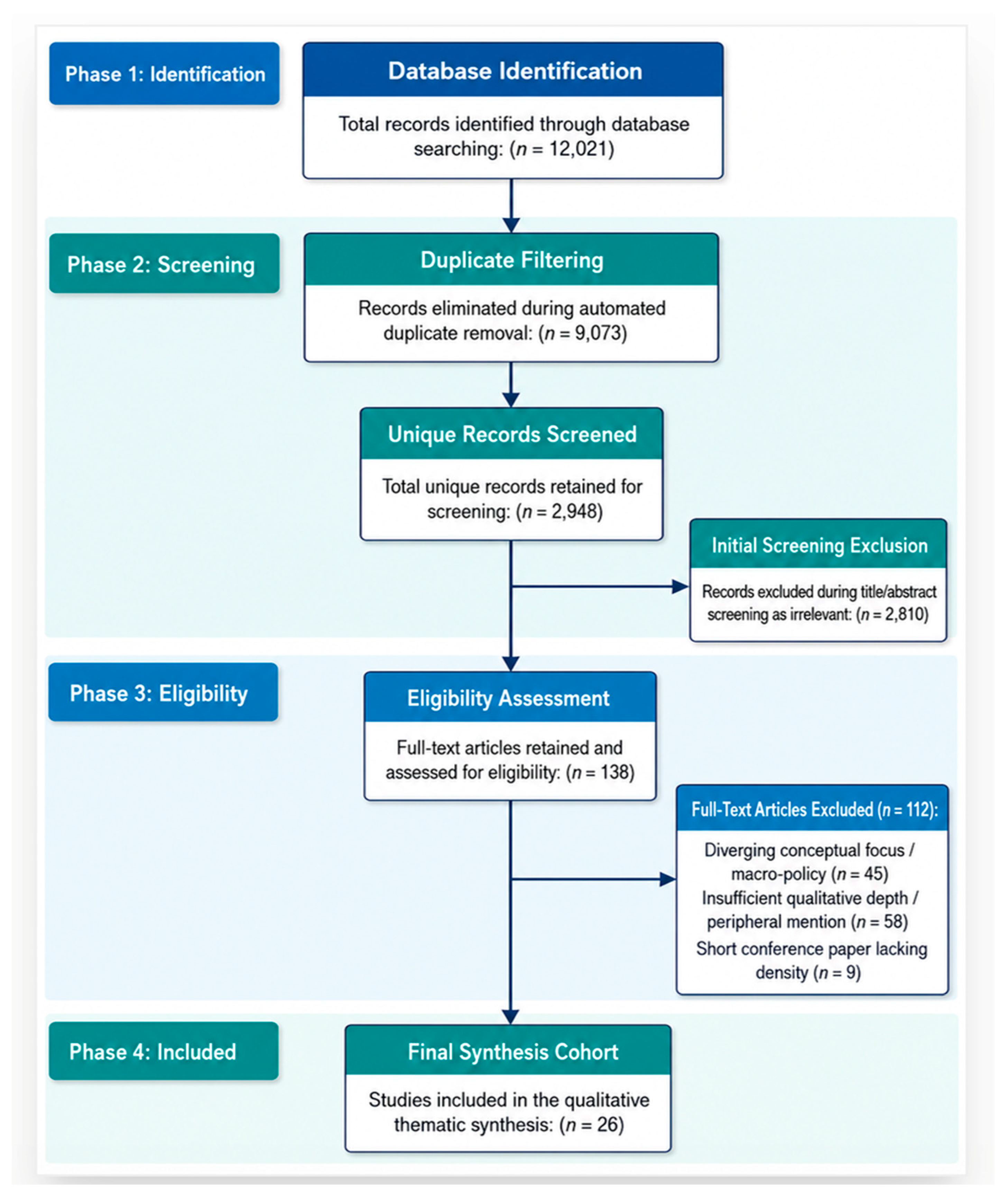
To ensure relevance and quality, the review applied strict inclusion criteria, selecting only peer-reviewed journal and conference articles published between 2017 and 2025. Non-English publications, non-academic papers, and studies outside the scope of blockchain adoption in waste management were excluded. Using the PRISMA framework, the initial search identified 12,021 records. After removing 9073 duplicates and excluding 2810 papers during title and abstract screening, 138 articles remained for full-text assessment. Following an interpretive evaluation, 112 articles were excluded: 45 focused on topics unrelated to blockchain adoption, 58 lacked sufficient qualitative depth to provide meaningful insights into implementation drivers, barriers, governance conditions, or stakeholder interactions, and 9 were short conference papers with insufficient empirical or theoretical contribution. Consequently, the final synthesis comprised 26 studies that provided rich empirical and conceptual evidence on blockchain adoption in waste management. The complete screening process is illustrated in Figure 1.
Figure 1.
PRISMA flow diagram.
The final synthesis identified four major thematic clusters that provided the conceptual foundation for the proposed B-WMF. Table 1 summarizes these clusters and their respective contributions to the framework.
Table 1.
Thematic Clusters and Their Contribution to the B-WMF.
The current literature positions blockchain technology as a disruptive digital infrastructure capable of driving institutional transparency, operational traceability, and stakeholder accountability within waste supply chains [7]. In resource-constrained developing regions, rapid urban growth is accompanied by increasing volumes of hazardous medical waste, electronic waste, and construction waste [13,15,16,17]. These challenges are exacerbated by poor infrastructure, fragmented institutional governance, and weak regulatory enforcement [3].
To mitigate these environmental and operational vulnerabilities, a primary contribution of blockchain is system-wide traceability. Technology secures records, optimizes resource flows, and mitigates risks across diverse, critical waste streams. Furthermore, blockchain-based reward structures, smart contracts, and NFTs are frequently proposed to overcome socio-cultural and behavioral barriers. By automating rewards and fostering trust, these incentive mechanisms actively encourage public participation and responsible disposal, a benefit that is particularly visible within targeted plastics recycling frameworks [9,10].
2.2. Identification of Research Gaps
Despite the growing interest in blockchain-enabled waste management, significant challenges continue to limit its practical adoption, particularly in resource-constrained environments. Existing studies consistently identify financial constraints, limited digital infrastructure, organizational readiness, and regulatory uncertainty as major barriers to implementation [15]. Operationally, the substantial data volumes generated by waste management create scalability challenges, meaning that blockchain networks may require complex and costly integration with technologies such as the Internet of Things (IoT), artificial intelligence (AI), and decentralized storage to function efficiently at scale [13]. The literature also emphasizes that technically robust decentralized solutions remain dependent on regulatory adaptation, clear legal frameworks, standardized data governance, and effective policy enforcement to transition successfully from theory to practice [4,15,16].
Despite the theoretical promise and technological capabilities highlighted in the reviewed literature, the thematic synthesis reveals a profound disconnect between conceptualized blockchain models and the realities of low-capacity environments. The gap in current research is not whether blockchain can support waste management, but how to systematically and realistically integrate it within LDCs that are structurally defined by institutional weakness, resource scarcity, and low stakeholder readiness. Existing models remain highly siloed, focusing strictly on specific waste streams (e.g., plastics or e-waste) or isolated technical use cases. Overall, the literature reveals a clear absence of empirically validated, context-sensitive frameworks that integrate technological, institutional, governance, financial, and socio-technical dimensions into a unified explanation of blockchain adoption. This gap provides the primary motivation for the Blockchain-Enabled Waste Management Framework (B-WMF) proposed in this study.
Furthermore, this gap is deepened by an unbalanced focus on purely technical configurations at the expense of non-technical adoption conditions. While technical features (e.g., smart contract execution, scalability, and IoT integration) are widely debated, critical non-technical imperatives are treated as isolated barriers rather than interdependent conditions. Factors such as organizational readiness, regulatory alignment, financial feasibility, and public awareness are rarely evaluated as a unified ecosystem. The above findings demonstrate that there is a complete absence of a consolidated conceptual model capable of synthesizing the institutional, operational, technological, and social dimensions of blockchain adoption. Without such a holistic, multi-dimensional framework to guide both future academic inquiry and practical implementation, blockchain applications in LDC waste management will remain trapped in theoretical silos, unable to transition into scalable, real-world solutions.
Recent work on reusable smart-contract design patterns is relevant to this adoption problem because waste-recovery platforms require reliable transaction verification across multiple event types, such as collection, weighing, reward release, recycling confirmation, and credit issuance [11,12]. The AdapT and CongruenT patterns show how verification rules can be reused and structured across smart contracts, thereby increasing maintainability, reducing duplicated logic, and improving the technical maturity of blockchain applications. These design patterns do not solve waste governance problems by themselves, but they provide technical mechanisms that can strengthen the verification layer of blockchain-enabled waste systems.
3. Conceptual Framework
Within the proposed Blockchain-Enabled Waste Management Framework (B-WMF), blockchain is conceptualized as the enabling digital infrastructure rather than as an outcome variable. Its role is to support key socio-technical capabilities including tokenized incentives, transparent waste tracking, decentralized verification, real-time data sharing, and auditability that collectively facilitate effective waste management. The framework therefore distinguishes between blockchain as the underlying technological infrastructure and the organizational, institutional, and socio-technical conditions that determine whether meaningful implementation outcomes can be achieved.
The systematic literature review identified a clear shortage of empirically validated context-sensitive frameworks capable of explaining blockchain adoption within resource-constrained waste management systems. Existing studies primarily emphasize technical capabilities while paying comparatively less attention to governance, institutional readiness, stakeholder coordination, and long-term sustainability. To address this gap, we propose the Blockchain-Enabled Waste Management Framework (B-WMF), which positions blockchain as a governance-enabling infrastructure that supports transparent, accountable, and collaborative waste management.
- RC.1-Limited Organizational Readiness: Waste management entities and municipalities in LDCs frequently lack the data infrastructure, digital maturity, and trained technical personnel required to implement and operate distributed networks.
- RC.2-Institutional and Regulatory Gaps: Outdated, fragmented, or missing environmental policies and legal frameworks create severe ambiguity around compliance, data ownership, and decentralized governance obligations.
- RC.3-Operational and Financial Constraints: The high capital expenditure associated with custom blockchain development, system integration, and hardware provisioning creates a steep barrier for resource-constrained public budgets.
- RC.4-Deficient Public Awareness and Engagement: Low public literacy regarding waste segregation, combined with a lack of trust in municipal programs, suppresses community participation, neutralizing the potential benefits of digital tracking platforms.
In response to these specific vulnerabilities, we introduce a novel framework entitled Blockchain-Enabled Waste Management Framework (B-WMF). This framework explicitly shifts the conceptualization of blockchain from a purely isolated technical tool to a comprehensive environmental governance infrastructure. It leverages built-in features derived from the SLR (e.g., tokenized incentive loops, real-time waste tracking protocols, smart contract-driven process automation, and cross-organizational data sharing layers) to construct a highly auditable, circular waste management ecosystem.
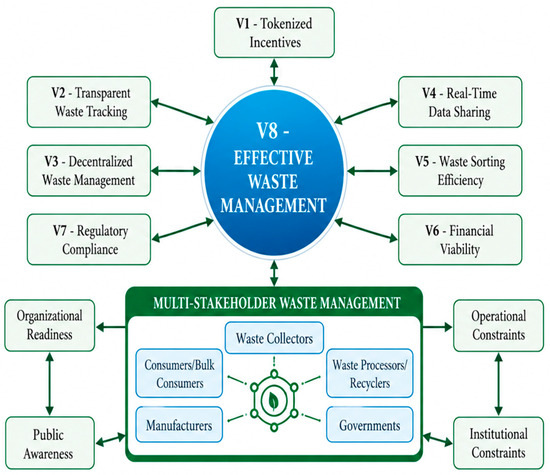
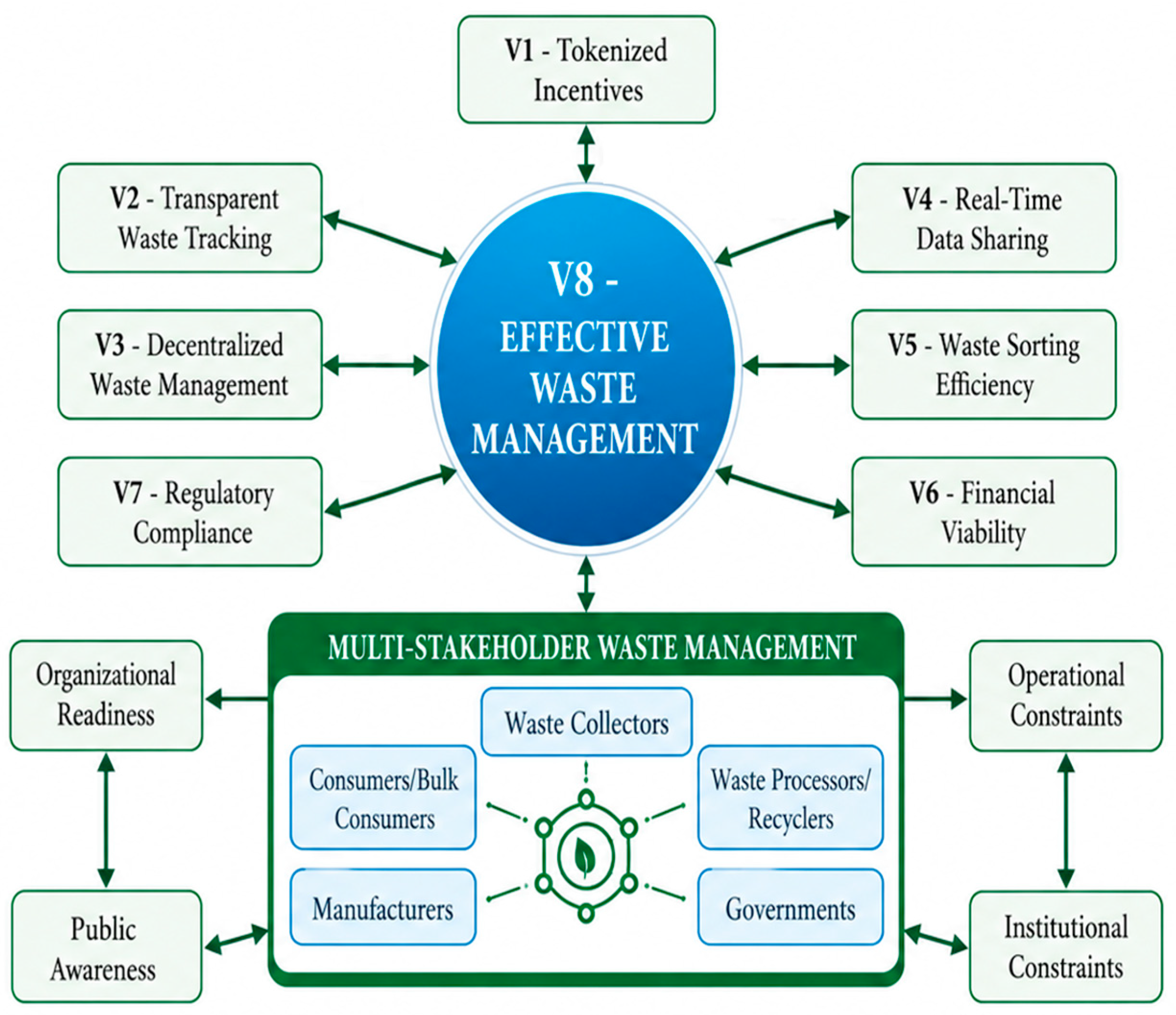
To operationalize this inquiry systematically, the study executes four sequential investigation actions that convert the challenges into an actionable causal architecture (as illustrated in Figure 2):
Figure 2.
Proposed Conceptual Framework B-WMF.
- Investigation Action 1: Analyze the four core structural research challenges (RC.1–RC.4) identified within the literature and formulate targeted socio-technical solutions.
- Investigation Action 2: Establish the theoretical grounding of the framework, ensuring that the interactions between institutional structures and blockchain capabilities are logically sound and clearly structured.
- Investigation Action 3: Identify, isolate, and operationally define the core variables that govern the blockchain-enabled waste ecosystem.
- Investigation Action 4: Present a structural conceptual model mapping the exact directional interactions and relationships that define the B-WMF.
Novel Conceptual Framework
To fully address the multidimensional nature of these four research challenges (RC.1–RC.4), our framework unpacks them into a structural network of seven operational variables, mapping complex institutional issues into discrete, field-testable dimensions. This structural approach bridges the gap between theoretical barriers and empirical field testing. The proposed variables are listed below:
- Variable 1-Tokenized Incentives (V1): Defined as the deployment of cryptographic tokens or digital rewards issued via smart contracts to directly reward citizens, informal waste pickers, and collection agencies for verified recycling activities. This variable directly addresses RC.4 by replacing abstract environmental appeals with immediate, verifiable economic value.
- Variable 2-Transparent Waste Tracking (V2) resolves data accuracy flaws highlighted in RC.1 and RC.3 by establishing a continuous, tamper-resistant trail of custody. It is defined as the immutable, end-to-end cryptographic logging of material metrics (e.g., volume, type, origin, processing state) onto a distributed ledger as waste moves through the supply chain.
- Variable 3-Decentralized Waste Management Processes (V3) encapsulates the architectural framework wherein data regarding waste collection and disposal is confirmed via blockchain technology, rather than relying on a centralized authority. This minimizes data fraud, collusion, and reporting errors, directly addressing institutional governance deficits (RC.2).
- Variable 4-Real-Time Data Sharing (V4) denotes the leverage of blockchain infrastructure to facilitate instantaneous data synchronization, real-time data sharing among waste management stakeholders, ensuring accurate and timely waste tracking. This breaks down traditional information silos, mitigating the organizational fragmentation identified in RC.1.
- Variable 5-Waste Sorting Efficiency (V5) describes the quantitative accuracy and throughput volume of waste segregation performed at the source (households/commercial units) prior to collection. Technical systems cannot extract value or generate clean recycling streams if incoming source material remains highly contaminated.
- Variable 6-Financial Viability (V6) is defined as the economic sustainability of the blockchain framework, balancing long-term operational cost reductions against initial setup costs and transaction fees. This variable directly monitors the resource realities of RC.3.
- Variable 7-Regulatory Compliance and Policy Alignment (V7) refers to the structural alignment of the blockchain platform with existing local municipal codes, national waste directives, and international data standards (e.g., public financial rules).
- Variable 8-Effective Waste Management (V8): Variable 8 is the primary dependent outcome of the B-WMF. It is defined as a verifiable increase in institutional accountability, optimized material recovery rates, high data integrity across all stakeholders, and long-term socio-technical sustainability within the regional waste management ecosystem.
The B-WMF avoids technological determinism by anchoring its design in established socio-technical and institutional economic theories. It is conceptually grounded across three core theoretical frameworks:
- Institutional Theory (InT): Posits that organizational technology adoption is fundamentally driven not just by technical efficiency, but by institutional pressures for legitimacy, regulatory compliance, and alignment with policy frameworks. In the B-WMF, InT explains how local regulations and municipal mandates act as structural forces that shape, constrain, or accelerate blockchain adoption across public and private boundaries.
- The Socio-Technical Systems (STS) Approach: Argues that an information system’s performance depends on the continuous optimization and alignment of both the technical subsystem (software architecture, ledger type, consensus rules) and the social subsystem (human behavior, cultural sorting habits, public awareness). The B-WMF applies STS theory by demonstrating that advanced ledger tracking remains operationally ineffective unless tightly integrated with human behavioral outputs like source waste sorting efficiency.
- Transaction Cost Economics (TCE): Focuses on the expenses associated with economic exchange, information asymmetries, enforcement, and auditing. The B-WMF utilizes blockchain as a trust infrastructure to automate compliance and verification through smart contracts. This significantly reduces search, oversight, and enforcement costs among fragmented stakeholders.
To ensure these theoretical insights are operationally actionable, Table 1 explicitly synthesizes the conceptual boundaries of the framework. It maps each of the seven core B-WMF variables to its primary theoretical lens and isolates the specific socio-technical or economic mechanism through which blockchain alters traditional waste management dynamics.
The theories should not be read as one-to-one labels attached to isolated variables. In practice, the variables overlap across theoretical lenses. For example, tokenized incentives are socio-technical because they depend on human motivation and digital execution, but they also have transaction-cost implications when they reduce payment uncertainty. Similarly, regulatory compliance reflects institutional theory, but it also shapes transaction costs by determining the legal enforceability of data, payments and recovery claims. The theoretical contribution of the B-WMF therefore lies in integrating these lenses rather than assigning each variable to only one theory. Table 2 summarizes how each of the seven B-WMF variables is grounded in the three theoretical perspectives underpinning the proposed framework.
Table 2.
Mapping of B-WMF Socio-Technical Variables to Primary Theories.
4. Methodology
This study adopts an interpretivist research philosophy and an abductive research approach to investigate blockchain adoption in waste management as a socio-technical governance phenomenon. An interpretivist perspective is appropriate because it enables an in-depth understanding of how different stakeholders perceive, implement, and experience blockchain within their organizational and institutional contexts [18]. The abductive approach complements this perspective by allowing iterative movement between theory and empirical observations, enabling the conceptual framework to be progressively refined in light of the evidence [19]. This iterative cycle is critical for examining how the seven initial explanatory variables operate in practice. In doing so, the empirical data can reshape and refine the initial conceptual framework into a mature, context-sensitive socio-technical governance model.
A qualitative single-case study design was adopted because it enables an in-depth investigation of a contemporary phenomenon within its real-world context [20]. Plastic Bank was selected as a critical and information-rich case because it represents one of the world’s most mature blockchain-enabled plastic recovery initiatives operating across multiple developing countries. Its long-term operational experience, governance model, and extensive stakeholder ecosystem provide a suitable environment for evaluating the proposed Blockchain-Enabled Waste Management Framework (B-WMF). To enhance the credibility and trustworthiness of the findings, this study employed methodological triangulation by combining semi-structured interviews, documentary analysis, and secondary sources [21,22]. This approach reduced dependence on any single source of evidence and strengthened the validity of the interpretation of the B-WMF variables.
A total of seven semi-structured interviews were conducted with key stakeholders occupying strategic and operational roles within the Plastic Bank ecosystem. Interviews lasted approximately 90 min and were conducted either face-to-face or online. Participants were selected through purposive sampling because of their cross-organizational knowledge of governance, operations, technology, sustainability, and supply-chain activities. Data saturation was achieved when no substantially new themes emerged during the later interviews.
The semi-structured format provided the flexibility needed to explore unexpected insights while maintaining alignment with the core research objectives. For confidentiality reasons, all collected data were anonymized. Documentary sources, including organizational reports, websites, and project materials, were used to complement the interview data and provide contextual depth, while secondary sources further strengthened the case analysis and supported triangulation. Table 3 provides an anonymized overview of the interviewees and explains why they were selected. The sample was intentionally composed of key informants with cross-organizational knowledge of the Plastic Bank model. This choice supports systemic understanding, but it also creates an elite-informant bias; for that reason, the analysis is triangulated with organizational documents and secondary evidence, and the limitations section explicitly avoids claims that would require direct ethnographic evidence from informal collectors. Table 3 summarizes the anonymized overview of the interviewees process.
Table 3.
Anonymized overview of the interviewees’ process.
Data were analyzed using a thematic analysis tailored directly to the single-case operational environment. The empirical material (interview transcripts, documentary evidence, and secondary sources) was first reviewed and organized in relation to the seven variables of the B-WMF: (a) tokenized incentives, (b) transparent waste tracking, (c) decentralized waste management processes, (d) real-time data sharing, (e) waste sorting efficiency, (f) financial viability, and (g) regulatory compliance. This allowed the analysis to remain theoretically guided while also remaining open to patterns emerging from the data. The analysis proceeded in two distinct stages.
The analysis used a transparent pattern-matching logic. Each B-WMF variable was assessed against three evidence criteria: (1) whether the variable appeared in interview evidence, (2) whether it was corroborated by documentary or secondary evidence, and (3) whether the evidence showed operational influence on the Plastic Bank model. The labels used in the findings therefore indicate the strength of evidence within this case, not statistical validation or universal generalizability. Table 4 summarizes the evidence criteria for framework analysis.
Table 4.
Evidence criteria for framework analysis.
- Stage 1: All interview transcripts, organizational documents, and secondary data were systematically reviewed and mapped directly into the predefined thematic bins of the seven B-WMF variables. This stage evaluated the degree to which Plastic Bank’s real-world operations matched the theoretical assumptions of Institutional Theory (InT), Socio-Technical Systems (STS), and Transaction Cost Economics (TCE).
- Stage 2: In line with the study’s abductive logic, the analysis involved an iterative movement between the conceptual framework and the empirical evidence [20]. Rather than treating the framework as fixed, the empirical findings gathered from the Plastic Bank case were used to refine the interpretation of the variables and the proposed framework. The researcher actively isolated where and why field data diverged from normative theory, specifically focusing on how informal workers adjusted to tokenized values, how digital illiteracy impacted app usage, and how local cash economies resisted or embraced decentralized validation.
Finally, these empirical insights were used to execute a feedback loop, directly modifying the structural links and definitions within the conceptual framework. This analytical progression successfully transitioned the initial literature-derived framework into a refined, empirically validated socio-technical governance model, ready for presentation and discussion in the subsequent sections of this paper.
5. Case Data and Analysis
Plastic pollution represents one of the most significant environmental and socio-economic challenges facing many developing countries. Weak institutional capacity, fragmented waste management systems, and limited access to formal financial services often hinder effective recycling while leaving large segments of the population dependent on informal waste collection for their livelihoods. Against this backdrop, Plastic Bank provides an appropriate empirical setting for examining how blockchain-enabled governance mechanisms can simultaneously promote environmental sustainability, financial inclusion, and stakeholder coordination within resource-constrained environments.
Plastic Bank, founded in 2013, is a global social enterprise that transforms plastic waste from an environmental liability into a valuable economic resource. Initially launched in Haiti, the organization has expanded its operations to several Less Developed Countries (LDCs) and other developing regions. Through a network of localized collection centres, informal waste collectors exchange recovered plastic for secure income and a range of social benefits, including healthcare, education, digital connectivity, and other essential services. In doing so, Plastic Bank directly links environmental remediation with poverty reduction and community empowerment.
At the technological core of this model is a blockchain-enabled digital platform that supports transparent, traceable transactions throughout the recycling value chain. Informal collectors use a dedicated mobile application to record recovered plastic and manage their earnings through digital wallets, which frequently represent their first access to formal financial services. In settings where conventional banking infrastructure remains limited, this digital platform promotes financial inclusion while reducing the vulnerabilities associated with cash-based informal economies. Furthermore, the platform enables end-to-end traceability by transforming recovered plastic into certified Social Plastic®, thereby providing corporate partners with verifiable sustainability data and strengthening trust across the recycling ecosystem.
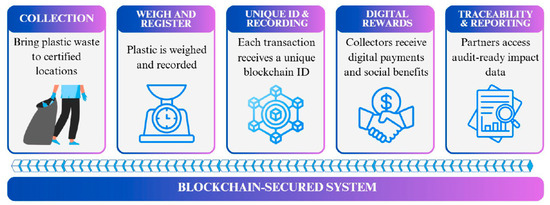
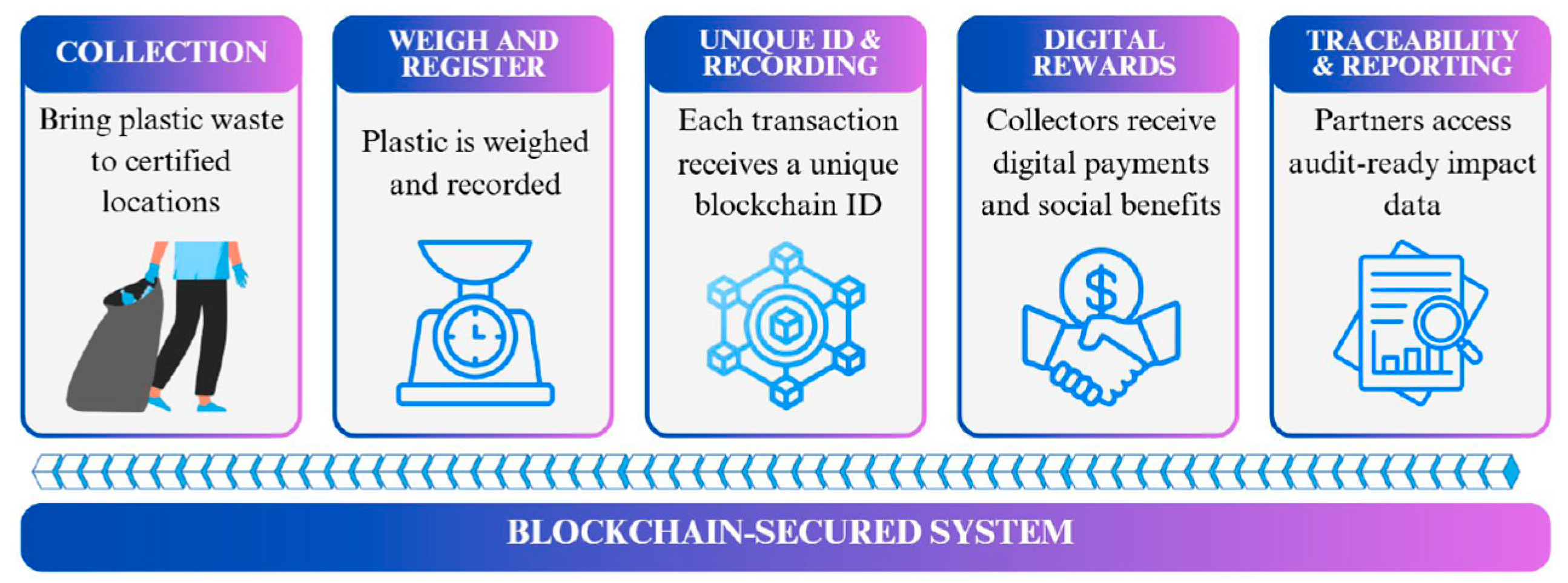
In doing so, Plastic Bank serves as a pivotal case study for this research by demonstrating how blockchain-enabled, decentralized systems can navigate and operate within complex environments where informal labor, weak institutional services, and acute environmental crises intersect. To provide a rigorous analysis of this model, empirical evidence for this case study is constructed from a dual-stream methodology: (a) a comprehensive analysis of publicly available institutional documentation and a series of semi-structured interviews conducted with key organizational stakeholders. Through this empirical lens, the following sections evaluate the structural dynamics, scalable potential, and institutional challenges of deploying digitalized circular economy solutions. In this blockchain-enabled recycling case, a local collector gathers ocean-bound plastic waste and brings it to a certified Plastic Bank collection center (Collection), where a branch employee sorts, weighs, and registers the materials into a mobile application (Weigh and Register). The system instantly packages these details (including weight, plastic type, and location data) into an immutable block on the Blockchain-Secured System, assigning it a Unique ID and Recording that prevents fraud or tampering. This action automatically triggers a smart contract that deposits secure Digital Rewards (e.g., tokens) directly into the collector’s mobile wallet to be used for daily necessities, while simultaneously providing global corporate partners with transparent data (Traceability & Reporting) to verify their sustainability investments, as illustrated in Figure 3.
Figure 3.
Plastic Bank’s Blockchain-Enabled Recycling Process.
5.1. Variable Operationalization and Testing (B-WMF Variables Assessment)
This subsection examines how the conceptual variables (V1–V7) are reflected in the Plastic Bank case. Drawing on Yin’s [20] pattern-matching logic, the analysis compares the theoretical expectations derived from the conceptual framework with the empirical evidence obtained from interview data and organizational documentation. The following assessment uses the evidence labels defined in the methodology section. The terms ‘strongly’, ‘moderately’, ‘partially’ and ‘weakly’ are therefore used as case-based interpretive labels. They do not imply statistical proof or universal validation across all waste management systems.
5.1.1. Variable 1-Tokenized Incentives
Variable 1 examines the role of tokenized rewards in stimulating stakeholder participation within recycling ecosystems. The empirical data from the Plastic Bank case study provides strong case evidence for this variable, demonstrating how a digital incentive system can effectively mobilize large-scale community engagement. Plastic Bank utilizes a structured digital reward mechanism that supplements the standard market value of recovered plastics with tokenized financial bonuses and non-financial social benefits. For many participants, this framework serves as a critical gateway to formal financial inclusion. As explained by the C-Level employee: “Collectors registered in the Plastic Bank app receive digital bonus payments on top of the market rate for the plastic they collect. These bonuses are deposited directly into collectors’ digital wallets, often their first form of savings”. The operational data underscores the efficacy of this incentive structure. At the time of data collection, the system had successfully mobilized over 61,000 registered collectors, highlighting a robust correlation between digital tokenization and stakeholder recruitment. Beyond direct financial compensation, the framework incorporates a layer of complementary social support mechanisms. Registered collectors gain access to essential services and goods, including health insurance programs, grocery vouchers, school supplies, digital connectivity, and zero-interest loans. Empirical evidence indicates that while the digital bonuses provide an immediate economic catalyst, these broader social benefits are pivotal in securing long-term retention and stabilizing participation, particularly among vulnerable, low-income communities involved in informal waste management. Consequently, the empirical findings confirm a high level of consensus among interviewees that tokenized incentives significantly drive user adoption and scale system participation. Variable 1 is therefore strongly evidenced as a critical determinant within the Blockchain-Waste Management Framework.
5.1.2. Variable 2-Transparent Waste Tracking
Variable 2 assesses the capacity of blockchain technology to enhance transparency and traceability within the recycling ecosystem. The empirical evidence from Plastic Bank strongly supports this variable, illustrating how a distributed ledger architecture can establish verifiable accountability across a decentralized supply chain. Plastic Bank’s technical infrastructure leverages a blockchain-secured platform that logs every plastic recovery transaction using unique claim identifiers. This mechanism generates an immutable ledger of collection events and corresponding disbursements, mitigating the systemic risk of double-counting. The high granularity of this supply chain tracking is emphasized by the regional program manager: “Every kilogram of plastic collected can be traced from the original collector to the processor through our blockchain-secured system”. The interviewees from corporate supply chain partners also supported this view.
This structural traceability provides immediate utility for corporate partners through the Impact Hub platform, which delivers real-time transaction data, comprehensive audit trails, and verified recovery metrics. Access to this audit-ready reporting framework allows enterprise stakeholders to rigorously verify environmental impact claims and fulfill regulatory sustainability reporting requirements. Furthermore, the data indicates that the ability to independently audit the journey of materials, from localized collection points to processing facilities and eventual integration into Social Plastic® supply chains, serves as a vital mechanism for building institutional trust. By replacing reputational claims with cryptographic validation, the platform substantially minimizes information asymmetry between informal collectors, intermediaries, and corporate buyers.
This traceability should be interpreted cautiously. Blockchain can secure the digital record of a verified collection event, but it cannot independently confirm the physical characteristics of the waste before data entry. For that reason, the reliability of V2 depends on source-level authentication mechanisms such as certified collection points, calibrated weighing devices, photographic evidence, branch controls, third-party audits, and, where feasible, IoT-enabled or edge-sensor verification. The revised framework therefore treats data integrity at the physical-digital interface as a precondition for transparent waste tracking.
5.1.3. Variable 3-Decentralized Waste Management
This variable evaluates the degree to which governance functions within the waste management ecosystem are decentralized through blockchain technology. Empirical data indicates a sophisticated, two-tiered architecture, leading to a moderate validation of this variable. The data reveals that while blockchain technology effectively decentralizes the system’s data verification layer, operational governance remains heavily centralized. Concretely, Plastic Bank operates under a hybrid governance model where the decentralized and centralized dimensions are clearly delineated:
- Decentralized Verification Layer: The blockchain infrastructure ensures distributed verification of plastic recovery activities. Once transaction records and associated payments are registered, they become immutable and resilient against unilateral data manipulation. This technical decentralization ensures data reliability and integrity across the network.
- Centralized Operational Layer: Conversely, critical strategic and administrative governance functions, like ecosystem coordination, partner onboarding, collector registration protocols, and the operational management of physical collection branches, remain strictly under the centralized authority of the organization.
The empirical data indicates that this structural configuration is a deliberate compromise rather than an architectural limitation. This hybrid framework balances technological decentralization with the rigorous institutional oversight necessary to maintain compliance with cross-jurisdiction financial regulations, enforce data protection standards, and ensure predictable operational logistics across diverse geographic regions. Consequently, while blockchain strengthens data-level transparency and accountability, it does not fundamentally redistribute institutional or operational decision-making authority within this ecosystem. For these reasons, the qualitative data demonstrates that Variable V3 is only moderately supported and validated in the Plastic Bank case study.
5.1.4. Variable 4-Real-Time Data Sharing
Variable 4 examines the extent to which blockchain infrastructure enables real-time visibility and data synchronization of recycling transactions across diverse ecosystem participants. The empirical findings from this case offer partial validation for this variable. The data demonstrates that while high-velocity data synchronization is achieved internally and presented bilaterally to corporate clients, systemic bottlenecks obstruct seamless, ecosystem-wide integration. On an intra-organizational level, Plastic Bank’s digital platform successfully synchronizes blockchain-based transaction ledgers with its internal data management systems. This architecture facilitates near real-time reporting of global plastic recovery activities. Through the proprietary Impact Hub interface, corporate partners gain immediate access to automated, audit-ready data streams, including: (a) verified environmental impact metrics, (b) granular transaction histories, and (c) comprehensive digital audit trails linked to specific sustainability investments.
By substituting manual data reconciliation with automated ledger synchronization, this framework drastically reduces verification latency and streamlines institutional reporting pipelines. Corporate stakeholders can thus validate plastic offset claims with minimal administrative delay. However, the empirical evidence uncovers significant friction at the outer edges of the ecosystem. Achieving true, multi-stakeholder real-time interoperability remains constrained by external digital infrastructure asymmetries. Because Plastic Bank operates across diverse geographic regions with varying degrees of technological maturity, integrating its blockchain outputs with the legacy Enterprise Resource Planning (ERP) systems of external partners presents notable software compatibility and network connectivity challenges. Consequently, while the internal blockchain architecture optimizes localized data sharing and bilateral reporting, it does not yet support a fully synchronized, real-time data layer across the entire macro-ecosystem. For these reasons, Variable V4 is classified as partially supported within this case study.
This finding also resolves an apparent tension in the case evidence. The system supports strong internal and bilateral traceability, but it does not establish unrestricted end-to-end traceability across every external partner system. Interoperability constraints therefore limit the reach of real-time data sharing and should be treated as a boundary condition rather than a minor technical issue.
5.1.5. Variable 5-Waste Sorting Efficiency
Waste Sorting Efficiency variable evaluates whether blockchain-enabled incentives systematically improve the efficiency and accuracy of waste sorting behavior among stakeholders. The qualitative data from this case study provides weak validation for V5. While the incentive structure yields localized, incremental improvements in material quality, it does not fundamentally transform macro-level sorting practices across diverse waste streams. The empirical data demonstrates that within Plastic Bank’s ecosystem, the financial tokenization mechanism exerts an indirect, utilitarian influence on sorting. Because payouts are tied to specific plastic grades, the framework economically penalizes contaminated or poorly segregated inputs, thereby incentivizing collectors to deliver properly categorized plastic materials to maximize financial yields. At the institutional level, Plastic Bank leverages these blockchain transaction records as an internal quality control instrument. By monitoring material purity and tracing collection quality back to specific branches, the organization can identify operational friction points and deploy targeted collector training protocols. Despite these localized benefits, the findings reveal a clear misalignment between the theoretical ideal of V5 and the empirical reality of the organization’s core strategy:
- Scope Limitations: Plastic Bank’s operational model is explicitly designed for verified plastic recovery and supply chain traceability rather than complex, multi-material waste sorting systems (e.g., separating paper, glass, organics, and metals).
- Behavioral Boundaries: While the digital incentives successfully condition upstream informal collectors to classify plastics correctly prior to transaction logging, the system exerts negligible influence on broader household or municipal source-separation behaviors. As a result, blockchain-based tokenization acts as an effective mechanism for localized material quality control, but it does not serve as a comprehensive driver for system-wide sorting efficiency. Consequently, Variable V5 is only weakly supported within the context of the Plastic Bank framework.
This limitation is important for the scope of the framework. Plastic Bank primarily addresses high-value plastic recovery rather than mixed municipal waste streams such as organic waste, electronic waste, construction waste or hazardous materials. The findings therefore should not be generalized to all waste management systems without further empirical testing. Mixed waste streams would require additional sorting infrastructure, source-separation protocols, sensor-based data authentication and regulatory controls before blockchain records could produce reliable circular economy data.
5.1.6. Variable 6-Financial Viability
Variable 6 examines the financial sustainability of the ecosystem and its subsequent influence on the adoption and scalability of blockchain-enabled waste management systems. The empirical findings provide conditional validation for V6. The data demonstrates that while Plastic Bank has established a highly innovative, multi-channel revenue model to fund its operations, the long-term scalability of the platform remains highly contingent upon macro-market forces and sustained capital inflows. To maintain structural viability, fund collector bonuses, and underwrite its proprietary digital architecture, Plastic Bank utilizes a diversified commercial framework consisting of four primary revenue streams:
- Corporate Partnerships: Long-term strategic alliances with enterprise clients who sponsor localized plastic recovery programs.
- Plastic Credit Markets: The commercialization of environmental offset credits purchased by brands seeking to mitigate their plastic footprints.
- Social Plastic® Material Sales: Premium-priced, fully traceable recycled plastic commodities integrated directly into corporate manufacturing supply chains.
- SaaS Subscriptions: Enterprise software access fees generated from corporate subscriptions to the Impact Hub data-reporting platform.
While this commercial matrix effectively covers current operational costs, the empirical evidence shows that scaling a blockchain-tied recycling framework introduces significant non-linear capital requirements. Expanding into new geographic regions requires heavy upfront investment in localized physical infrastructure, continuous software optimization for digital platforms, and intensive community coordination. Furthermore, operational replication across international borders involves substantial compliance costs to align the platform with diverse national financial and data privacy regulatory frameworks. Consequently, the data indicates that the financial resilience and scalability of this model are not entirely self-sustaining. Rather, they are structural variables tied directly to external market volatility, specifically the enduring consumer and corporate demand for traceable recycled materials and the stability of global plastic credit regulations. Therefore, Variable V6 is conditionally supported within the Plastic Bank case study, reflecting that financial viability is heavily dependent upon sustained external market integration.
5.1.7. Variable 7-Regulatory Compliance
Variable 7 evaluates the role of blockchain-based traceability in supporting regulatory compliance and securing institutional legitimacy for waste management systems. The empirical findings from the Plastic Bank case study provide strong case evidence for V7. The data demonstrates that robust, legally compliant data architectures are critical precursors for multi-jurisdictional scaling and long-term stakeholder adoption. To navigate the complex legal topographies of international waste governance, Plastic Bank places an explicit strategic emphasis on data protection and regulatory alignment. The organization’s digital platform maintains strict compliance with the General Data Protection Regulation (GDPR), a benchmark validated by independent external auditing and certification from Bureau Veritas. A core technical tension in public ledger systems is the conflict between data transparency and user privacy. Plastic Bank resolves this by decoupling identity from transactions: the platform encrypts individual personal data and structurally separates sensitive user information from publicly verifiable, cryptographically logged transaction records. This architecture ensures absolute operational traceability without compromising individual privacy rights. As articulated by the regional manager, “Our platform follows strict GDPR standards and has been independently audited to ensure data protection while maintaining full traceability of transactions”. The qualitative data indicates that this rigorous compliance framework yields two distinct institutional advantages:
- Cross-Border Regulatory Agility: It provides the structural flexibility required to operate across highly divergent international regulatory environments, particularly where data sovereignty and informal labor laws overlap.
- Institutional Trust Generation: By blending blockchain-backed supply chain transparency with verified privacy protection mechanisms, the framework mitigates reputational and legal risks for corporate partners, regulatory bodies, and local municipalities alike.
The empirical evidence for Variable 7 confirms that integrating institutional compliance mechanisms directly within a blockchain framework significantly reinforces organizational legitimacy and systematically drives ecosystem adoption. Consequently, Variable 7 is strongly supported and validated in the Plastic Bank case.
Data protection compliance is especially important because blockchain immutability may conflict with privacy rights such as correction, erasure and purpose limitation. A compliant design should therefore avoid storing personal data directly on-chain. More appropriate approaches include permissioned blockchain access, off-chain storage of personal data, hashed or pseudonymized identifiers, role-based access controls, encryption of sensitive records, and clear retention and consent procedures. In this way, the system can preserve auditability while reducing exposure of collectors and other vulnerable participants.
In summary, while the initial literature-derived framework (Figure 2) mapped these variables as independent, parallel paths pointing to an isolated dependent target, the empirical realities of the Plastic Bank case expose deep structural interdependencies and operational bottlenecks. This friction demonstrates that a linear model is insufficient, necessitating the refined socio-technical governance framework presented in the following section.
6. Discussion and B-WMF Revision
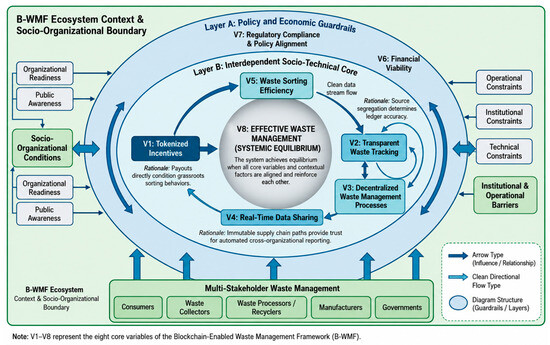
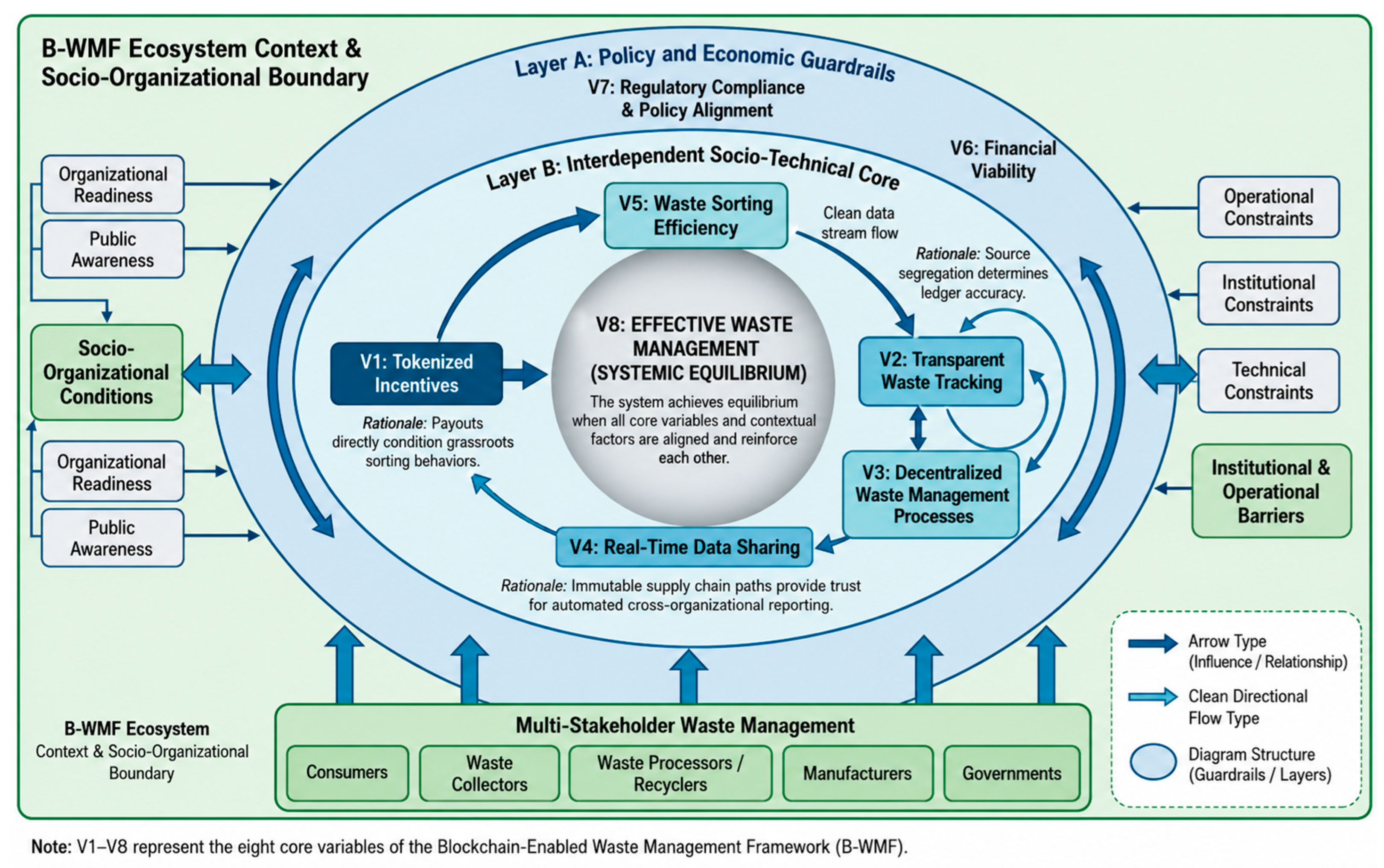
The empirical findings from this study challenge the linear, deterministic assumptions embedded in mainstream blockchain adoption literature. While the initial, literature-derived B-WMF mapped variables 1–7 as isolated, parallel inputs pointing directly toward a dependent target variable 8, our field data reveals a highly interconnected, configuration-dependent ecosystem. Real-world implementation in resource-constrained environments demonstrates that blockchain capabilities do not operate in isolation. Rather, their operationalization is bound by strict sequence dependencies and macro-level institutional realities. To bridge the deep structural divides between normative theory and empirical reality, this section introduces the Refined Governance-Oriented Socio-Technical B-WMF (Figure 4). This evolved model shifts the conceptualization of blockchain from a static, technical tool to a dynamic, layered environmental governance infrastructure. Within this refined framework, Variable 8 is explicitly redefined, and it is no longer treated as a traditional dependent outcome variable. Instead, it is conceptualized as a systemic equilibrium state, an emergent property achieved only when the surrounding policy and economic frameworks (Layer A) are synchronized with the interdependent circuits of the socio-technical core (Layer B).
Figure 4.
Revised B-WMF—A Governance-Oriented Socio-Technical B-WMF. Note. The revised framework should be read as a layered socio-technical model: blockchain functions as an enabling verification infrastructure, while effective waste management depends on institutional guardrails, data integrity at the physical-digital interface, interoperable data flows and financially viable participation mechanisms.
6.1. Layer A: The Policy and Economic Guardrails
The refined framework demonstrates that the technical features of a ledger cannot stabilize without immediate alignment with macro-level environmental and financial parameters. This outermost layer governs the baseline viability of the entire system.
- The strong case evidence of V7 in the Plastic Bank case highlights that cross-border regulatory agility and strict data protection compliance are absolute prerequisites for institutional legitimacy. In public and distributed ledgers, data transparency often creates critical tension with privacy rights. The case demonstrates that by structurally decoupling identity from transaction logs via encryption, the platform satisfies the institutional pressures for legitimacy posited by Institutional Theory (InT). Without this structural compliance layer, corporate supply chain partners cannot participate due to legal and reputational risks, stifling the ecosystem before technical adoption even begins.
- The conditional support for V6 reveals that the economic sustainability of blockchain frameworks in LDCs is fundamentally dependent on external macro-market forces. While Plastic Bank maintains a diversified commercial matrix (corporate partnerships, plastic credits, Social Plastic® sales, and SaaS subscriptions), scaling the infrastructure across borders introduces steep, non-linear capital requirements. Transaction Cost Economics assumes that smart contracts inherently reduce oversight and enforcement costs. However, our findings show that these savings are continuously pressured by heavy upfront expenditures in physical collection centers and regional software adaptations. Thus, V6 and V7 do not simply point to an outcome, but they form the rigid outer ring that defines whether the inner technical core can legally and financially survive.
6.2. Layer B: The Interdependent Socio-Technical Core Circuit
The core contribution of the refined B-WMF lies in breaking down the parallel silos of the initial framework and mapping the real-world sequential dependencies discovered during empirical testing. The initial B-WMF (Figure 2) assumed that Tokenized Incentives (V1) and Waste Sorting Efficiency (V5) were entirely separate drivers of effective management. In reality, the case shows a tight, direct causal dependency. Cryptographic tokens and digital social benefits (healthcare, grocery vouchers) act as immediate behavioral modifiers that format user actions. Because payout structures economically penalize contamination, V1 directly conditions the upstream sorting actions of informal collectors. This interaction perfectly embodies the STS approach as the technical subsystem (the smart contract reward architecture) should be optimized in direct alignment with the social subsystem (e.g., human collection habits).
To preserve end-to-end data fidelity and mitigate input-stage vulnerabilities, the framework integrates decentralized verification protocols. Our analysis shows that Transparent Waste Tracking (V2) relies entirely on the upstream output of Waste Sorting Efficiency (V5). If material sorting at the source or collection branch is inaccurate, the subsequent block recorded on the ledger represents a flawed reality. The Plastic Bank case demonstrates that tracking material volume, type, and origin becomes trustless and auditable only because the economic incentives of the previous link (V1 → V5) have already driven precise source segregation. While V2 secures an immutable, end-to-end cryptographic trail of custody that minimizes information asymmetry, the case exposes a major bottleneck regarding Real-Time Data Sharing (V4). Although transaction data synchronizes seamlessly on internal dashboards (Impact Hub) for enterprise clients, true macro-ecosystem interoperability is disrupted by external infrastructure asymmetries. Integrating rigid blockchain outputs with the fragmented legacy ERP systems of disparate international partners introduces significant software compatibility friction. This reveals that V4 is a conditional variable that, when encountering external digital limitations, acts as a systemic bottleneck that isolates the benefits of V2, slowing down the automated reconciliation of circular supply chains.
Rather than operating as a standalone management process, Decentralized Waste Management (V3) functions as an overarching validation layer that wraps around V2 and V4. The Plastic Bank case demonstrates a distinct hybrid governance configuration as strategic and operational decision-making remains highly centralized to maintain institutional control, while the data verification layer is completely decentralized via the blockchain platform. This hybrid approach utilizes decentralized verification exclusively to secure transaction immutability and prevent data manipulation, acting as a cryptographic shield that guarantees the integrity of the data being tracked (V2) and shared (V4).
6.3. Re-Conceptualizing V8: Effective Waste Management as Systemic Equilibrium
By tracing these dynamic pathways, the refined model successfully moves past the technological determinism that undermines much of the current blockchain literature. Effective Waste Management (V8) is not a static endpoint produced by a linear equation. Instead, V8 represents the fluid systemic equilibrium of the entire architecture. When the economic and regulatory frameworks of Layer A are securely established, they allow the behavioral and technological circuit of Layer B to flow continuously (V1 → V5 → V2 ←→ V4, shielded by V3). If any single link in this circuit experiences operational resistance (e.g., localized digital illiteracy suppressing app engagement (V1), high contamination rates degrading data inputs (V5), or legacy software mismatches stalling cross-border synchronization (V4)), the entire system is pulled out of alignment, degrading the overall equilibrium. Consequently, for policymakers and corporate practitioners alike, the refined B-WMF shifts the managerial focus away from simply deploying a blockchain application, redirecting it toward managing the continuous, socio-technical alignment of the entire governance infrastructure.
7. Implications
The empirical evaluation of Plastic Bank through the refined B-WMF generates critical insights that extend well beyond the immediate boundaries of the case. By transitioning from a linear technological adoption perspective to a layered, governance-oriented socio-technical ecosystem, this study reveals several deep implications for both theory and practice.
7.1. Implications for Theory
This study contributes to the literature on digital transformation, blockchain, the circular economy, and environmental supply chains in three distinct ways.
- It shifts the analytical paradigm from treating blockchain as merely an isolated technical tool to conceptualizing it as an integrated environmental governance infrastructure. Extant literature frequently suffers from technological determinism, focusing heavily on raw capabilities like smart contract execution or blockchain architectures while ignoring institutional realities. By demonstrating that blockchain’s primary value lies in its capacity to balance social behaviors with systemic compliance, this study proves that digital waste tracking cannot succeed in a vacuum. This infrastructure fundamentally alters the institutional rules of engagement among distributed, low-trust actors in resource-constrained environments.
- By explicitly synthesizing InT, STS, and TCE, the refined B-WMF bridges a major gap in multi-disciplinary theory. The framework demonstrates that blockchain’s capacity to minimize information asymmetry and reduce performance monitoring costs (TCE) is entirely contingent upon the behavioral alignment of the social subsystem (STS) and macro-level pressures for regulatory legitimacy (InT). For example, the sequential link identified between Tokenized Incentives (V1) and Waste Sorting Efficiency (V5) highlights that technical rewards are required to directly format human habits before trustless data logging can occur. This multi-theoretical integration provides a holistic foundation for future digital adoption research.
- This study introduces a novel ontological perspective to the adoption literature by re-conceptualizing Effective Waste Management (V8) not as a static, linear dependent outcome, but as a systemic equilibrium state. Our findings expose the limitation of assuming that independent variables have an unmediated, parallel influence on an outcome. In LDC environments, a single socio-technical breakdown (e.g., software incompatibility disrupting real-time synchronization) degrades the alignment of the entire core circuit. Theoretical models must therefore move toward configuration-dependent, non-linear frameworks to accurately assess blockchain adoption.
7.2. Implications for Practice
For policymakers, municipal authorities, supply chain executives, and digital sustainability entrepreneurs, the refined B-WMF offers vital practical guidance.
- Practitioners and policymakers are required to fundamentally reject the narrative that deploying a decentralized ledger will automatically resolve systemic waste crises or eradicate corruption. Instead, practical implementation should prioritize the construction of robust Policy and Economic Guardrails (Layer A). Blockchain networks require clear regulatory guidelines, explicit legal recognition of digital cryptographic records, and adapted municipal codes to function effectively.
- Managers cannot rely on a ledger to magically guarantee material purity or system-wide sorting efficiency. Because Transparent Waste Tracking (V2) relies entirely on accurate source segregation, tokenized incentive structures (V1) should be carefully designed to economically penalize input contamination. This turns the smart contract layer into a real-time quality-control mechanism that conditions human actions before data entry occurs, solving the upstream data integrity structurally.
- Enterprise architects and public administrators are required to anticipate a distinct governance paradox. While complete technological decentralization is a popular theoretical ideal, practical implementation requires a hybrid governance model. Organizations should intentionally centralize strategic coordination, partner onboarding, and physical branch operations to maintain predictable logistics, while leaving the data verification layer completely decentralized via the blockchain system to secure transaction immutability and prevent fraud.
- Practitioners should proactively address the digital infrastructure asymmetries that disrupt Real-Time Data Sharing (V4) at the outer edges of the ecosystem. Integrating rigid blockchain outputs with the fragmented legacy ERP systems of disparate international corporate buyers or local municipal partners presents significant software compatibility friction. Practitioners should avoid siloed software deployment by investing early in standardized application programming interfaces and decentralized storage middleware to ensure automated reconciliation across the entire macro-ecosystem.
- Recommendations concerning decentralized storage middleware, automated reconciliation or advanced interoperability services should be read as design implications rather than as empirically observed features of the Plastic Bank case. The case indicates the need for stronger integration mechanisms, but it does not itself provide evidence that any particular middleware solution has been implemented or tested. Future design work should therefore evaluate such technical solutions empirically before presenting them as prescriptive best practice.
At the smart-contract design level, reusable verification patterns such as AdapT and CongruenT may strengthen future waste platforms by standardizing verification rules for different transaction types, including collection, weighing, reward release, recycling confirmation and plastic-credit issuance. This technical maturity layer should complement, not replace, the governance safeguards identified in the B-WMF.
8. Conclusions, Limitations, and Future Research
8.1. Conclusions
This study investigated how blockchain technology can enhance governance and operational effectiveness in waste management systems within LDCs. In response to the technocentric bias in existing literature, this paper developed and empirically tested the Blockchain-Enabled Waste Management Framework using an in-depth, interpretivist case study of Plastic Bank.
The empirical findings challenge linear technological assumptions by demonstrating that blockchain’s primary value does not stem from raw software novelty, but from its capacity to operate as a socio-technical governance infrastructure. When supported by a robust regulatory and economic framework (Layer A), blockchain effectively shapes micro-level sorting behaviors via tokenized rewards and eliminates information asymmetry through immutable tracking. Furthermore, it provides a decentralized data verification layer that protects institutional trust without necessitating operational decentralization. Furthermore, this paper reframes effective waste management not as a static technological output, but as a fluid systemic equilibrium achieved only through continuous alignment between technological capabilities and institutional realities.
8.2. Limitations
Despite the rigor of abductive research design, several limitations are acknowledged:
- While Plastic Bank represents a critical and information-rich case for blockchain-enabled plastic recovery in resource-constrained contexts, the findings are not generalizable to all waste management systems. The case concerns a relatively mature, high-value plastic recovery network, and the dynamics identified here may differ for mixed municipal waste, organic waste, e-waste, construction waste or hazardous materials.
- The empirical data relies on a targeted sample of seven stakeholders, several of whom hold elite or managerial positions. Although these informants provide systemic insight into the organization and its partners, the sample does not fully capture the lived experiences of informal collectors. Claims concerning collector experience and household sorting behavior are therefore treated cautiously and triangulated with documentary evidence where possible.
Future research should diversify the interview pool by including informal waste pickers, branch-level workers, household participants, municipal officials and independent recyclers. Direct observation, field diaries, transaction-level records and ethnographic data would be especially valuable for validating V1 (incentives), V2 (data integrity) and V5 (sorting efficiency).
- The case analysis is bound strictly to high-value plastic supply chains. The dynamics of the B-WMF variables may shift significantly when applied to multi-material municipal streams (e.g., organic waste, e-waste, or construction debris) that require highly complex sorting structures.
8.3. Future Research
To build upon the refined B-WMF, future research is encouraged to pursue three specific trajectories:
- Future studies should quantitatively test the directional propositions embedded within the B-WMF through large-scale structural equation modeling and cross-case comparative analyses across divergent LDCs’ legal jurisdictions.
- Researchers should conduct longitudinal field evaluations to observe how tokenized incentives adapt to long-term macroeconomic inflation and shifting cash-economy resistances in developing markets.
- Given that data integrity remains a key bottleneck, future research should examine how blockchain can be combined with hardware-level authentication, including IoT-enabled scales, QR/RFID tagging, image verification, edge sensors and third-party audits. Such work is necessary because blockchain can secure digital records, but it cannot by itself verify the physical waste input before recording.
Future studies should also examine permissioned blockchain designs, encryption mechanisms, hashed identifiers and off-chain data architectures that balance auditability with GDPR and comparable privacy obligations. This is particularly important when systems record collector identity, location or payment data. Finally, the framework should be tested in non-plastic and mixed-waste contexts, including e-waste, organic waste and municipal solid waste streams, where sorting requirements, contamination risks and regulatory obligations differ substantially from high-value plastic recovery.
Author Contributions
Conceptualization, I.D. and M.T.; methodology, I.D.; validation, I.D. and M.T.; formal analysis, I.D.; investigation, I.D.; data curation, I.D.; writing—original draft preparation, I.D.; writing—review and editing, I.D. and M.T.; visualization, I.D.; supervision, M.T. All authors have read and agreed to the published version of the manuscript.
Funding
This research received no external funding.
Institutional Review Board Statement
The study was conducted in accordance with the Declaration of Helsinki and its later amendments, and was approved by UREC (University Research Ethics Committee) of University of Nicosia (Project number: UREC/2022/19).
Informed Consent Statement
Informed consent was obtained from all subjects involved in the study.
Data Availability Statement
The data presented in this study are not publicly available due to confidentiality agreements and the protection of participant anonymity. Aggregated data may be made available from the corresponding author upon reasonable request.
Conflicts of Interest
The authors declare no conflict of interest.
References
- Kaza, S.; Yao, L.; Bhada-Tata, P.; Van Woerden, F. What a Waste 2.0: A Global Snapshot of Solid Waste Management to 2050; World Bank: Washington, DC, USA, 2018. [Google Scholar]
- Ngoc, U.N.; Schnitzer, H. Sustainable solutions for solid waste management in Southeast Asian countries. Waste Manag. 2009, 29, 1982–1995. [Google Scholar] [CrossRef] [Scilit] [PubMed]
- Jiang, P.; Zhang, L.; You, S.; Fan, Y.V.; Tan, R.R.; Klemeš, J.J.; You, F. Blockchain technology applications in waste management: Overview, challenges and opportunities. J. Clean. Prod. 2023, 421, 138466. [Google Scholar] [CrossRef] [Scilit]
- Tan, E.; Mahula, S.; Crompvoets, J. Blockchain governance in the public sector: A conceptual framework for public management. Gov. Inf. Q. 2022, 39, 101625. [Google Scholar] [CrossRef] [Scilit]
- Themistocleous, M. Handbook of Blockchain Technology; Edward Elgar Publishing: Cheltenham, UK, 2025; ISBN 978-1803922799. [Google Scholar]
- Kitchenham, B.; Charters, S. Guidelines for Performing Systematic Literature Reviews in Software Engineering; EBSE Technical Report EBSE-2007-01; Keele University: Keele, UK; Durham University: Durham, UK, 2007. [Google Scholar]
- Bułkowska, K.; Zielińska, M.; Bułkowski, M. Implementation of blockchain technology in waste management. Energies 2023, 16, 7742. [Google Scholar] [CrossRef] [Scilit]
- Rejeb, A.; Appolloni, A.; Rejeb, K.; Treiblmaier, H.; Iranmanesh, M.; Keogh, J.G. The role of blockchain technology in the transition toward the circular economy: Findings from a systematic literature review. Resour. Conserv. Recycl. Adv. 2023, 17, 200126. [Google Scholar] [CrossRef] [Scilit]
- Alnuaimi, E.; Alsafi, M.; Alshehhi, M.; Debe, M.; Salah, K.; Yaqoob, I.; Zemerly, M.J.; Jayaraman, R. Blockchain-based system for tracking and rewarding recyclable plastic waste. Peer-Peer Netw. Appl. 2023, 16, 328–346. [Google Scholar] [CrossRef] [Scilit]
- Gupta, Y.S.; Mukherjee, S.; Dutta, R.; Bhattacharya, S. A blockchain-based approach using smart contracts to develop a smart waste management system. Int. J. Environ. Sci. Technol. 2022, 19, 7833–7856. [Google Scholar] [CrossRef] [Scilit]
- Górski, T. AdapT: A reusable package for implementing smart contracts that process transactions of congruous types. Softw. Impacts 2024, 21, 100694. [Google Scholar] [CrossRef] [Scilit]
- Górski, T. CongruenT: A package for smart contract verification functions that ensures the reuse of condition objects and classes. SoftwareX 2026, 32, 102796. [Google Scholar] [CrossRef] [Scilit]
- Le, H.T.; Quoc, K.L.; Nguyen, A.; Dang, K.T.; Vo, H.K.; Luong, H.H.; Van, H.L.; Gia, K.H.; Van Cao Phu, L.; Quoc, D.N.T.; et al. Medical-Waste Chain: A medical waste collection, classification and treatment management system using blockchain technology. Computers 2022, 11, 113. [Google Scholar] [CrossRef] [Scilit]
- Ajakwe, I.U.; Ajakwe, S.O.; Lee, J.-M.; Kim, D.-S. Internet-of-Things–blockchain integration in environmental pollution monitoring data management: Trends and techniques. Int. J. Environ. Sci. Technol. 2025, 22, 16123–16142. [Google Scholar] [CrossRef] [Scilit]
- Kassou, M.; Bourekkadi, S.; Khoulji, S.; Slimani, K.; Chikri, H.; Kerkeb, M.L. Blockchain-based medical and water waste management conception. E3S Web Conf. 2021, 234, 00070. [Google Scholar] [CrossRef] [Scilit]
- Samiha, I.; Forkan, M. Blockchain-based solutions for e-waste management: A review of opportunities and challenges. In Proceedings of the 2025 IEEE International Conference on Interdisciplinary Approaches in Technology and Management for Social Innovation (IATMSI); IEEE: Piscataway, NJ, USA, 2025. [Google Scholar] [CrossRef] [Scilit]
- Ma, X.; Xiong, F.; Olawumi, T.O.; Chan, A.P.C.; Darko, A.; Yoon, S.; Bello, S.A. Blockchain-enabled construction and demolition waste management: A systematic review of smart circular economy strategies. Sustainability 2024, 16, 721. [Google Scholar] [CrossRef] [Scilit]
- Walsham, G. Interpretive case studies in IS research: Nature and method. Eur. J. Inf. Syst. 1995, 4, 74–81. [Google Scholar] [CrossRef] [Scilit]
- Dubois, A.; Gadde, L.-E. Systematic combining: An abductive approach to case research. J. Bus. Res. 2002, 55, 553–560. [Google Scholar] [CrossRef] [Scilit]
- Yin, R.K. Case Study Research: Design and Methods, 3rd ed.; SAGE Publications: Thousand Oaks, CA, USA, 2003; Available online: https://iwansuharyanto.wordpress.com/wp-content/uploads/2013/04/robert_k-_yin_case_study_research_design_and_mebookfi-org.pdf (accessed on 19 July 2026).
- Carter, N.; Bryant-Lukosius, D.; DiCenso, A.; Blythe, J.; Neville, A.J. The use of triangulation in qualitative research. Oncol. Nurs. Forum 2014, 41, 545–547. [Google Scholar] [CrossRef] [Scilit] [PubMed]
- Jick, T.D. Mixing qualitative and quantitative methods: Triangulation in action. Adm. Sci. Q. 1979, 24, 602–611. [Google Scholar] [CrossRef] [Scilit]

Disclaimer/Publisher’s Note: The statements, opinions and data contained in all publications are solely those of the individual author(s) and contributor(s) and not of MDPI and/or the editor(s). MDPI and/or the editor(s) disclaim responsibility for any injury to people or property resulting from any ideas, methods, instructions or products referred to in the content. |
© 2026 by the authors. Licensee MDPI, Basel, Switzerland. This article is an open access article distributed under the terms and conditions of the Creative Commons Attribution (CC BY) license.