


Abstract
Manual compliance auditing in cloud environments consumes up to 40% of IT security budgets annually, yet existing approaches verify control presence rather than effectiveness, leaving institutions vulnerable to adversarial evasion. This paper presents an AI-augmented hybrid ML–LLM compliance auditing system evaluated on Rwanda’s National Cyber Security Authority (NCSA) Minimum Cybersecurity Standards (169 controls across 14 families). The system combines leakage-free XGBoost multi-label classification with GPT-4o-mini semantic log analysis, grounded in a formal effectiveness model. Key findings: (1) XGBoost v2 achieves 85.45% macro-F1 on leakage-free synthetic data (Wilson 95% CI = [84.9%, 86.0%]); an initial 86.3% data-leakage rate artificially inflated prior results to 99.99% and was identified and corrected in this revision; (2) GPT-4o-mini achieves 92.3% macro accuracy across four log types (n = 628, 37.5% real enterprise data, Wilson CI = [89.9%, 94.3%]); (3) adversarial validation across five MITRE ATT&CK scenarios yields 92.8% macro detection with 0.0% false-positive rate on real SSH/PAM compliant logs (n = 75); (4) a cross-dataset generalization analysis confirms 87.6% F1 on real SSH logs but identifies a 37.8-percentage-point out-of-vocabulary gap for Windows and HTTP log types, motivating the hybrid architecture; (5) the combined hybrid system (XGBoost for in-vocabulary logs, GPT-4o-mini for out-of-vocabulary) achieves 85.1% F1 with 6.4% false-positive rate on 180 real-world logs. The system runs at 2.0 CPU cores, 2.66 GB RAM, on $50/month cloud hosting (Apple M1 Pro baseline; storage and maintenance excluded), producing audit reports in 2–5 s depending on log volume and policy document size, demonstrating that effectiveness-based compliance auditing is accessible without enterprise-grade infrastructure.
1. Introduction
1.1. Context and Motivation
Enterprises and government agencies across Africa are undergoing rapid digital transformation, increasingly adopting hybrid cloud infrastructures. Compliance and cybersecurity assurance remain fragmented and heavily manual, consuming up to 40% of IT security budgets [1], often requiring more than 1000 h annually [2], and introducing error-prone, siloed approaches.
At a continental level, the African Union’s Malabo Convention aims to create a unified legal framework for cybersecurity [3]. However, only 15 of 54 African nations had ratified it as of 2024 [4]. Rwanda has taken independent leadership, establishing comprehensive NCSA Minimum Cybersecurity Standards in 2023 [5] and a National Cybersecurity Strategy for 2024–2029 [6], aligned with NIST SP 800-53 [7].
Simultaneously, the cybersecurity threat landscape has evolved dramatically. Modern attacks employ sophisticated evasion techniques leveraging genetic algorithms [8], dynamic programming for payload optimization [9], and advanced AV/EDR bypass methods [10,11]. Compliance frameworks must validate not merely the presence of controls but their effectiveness against such adversarial techniques.
1.2. Research Problem
Current compliance auditing approaches face three critical challenges:
- Manual and Resource-Intensive: Traditional audits require extensive human effort, making continuous compliance monitoring infeasible for resource-constrained Rwandan institutions. Organizations conducting 3–5 internal audits annually achieve per-capita compliance costs averaging $154, while those without internal audits face costs of $341 [1].
- Checkbox Compliance: Existing frameworks verify control presence (e.g., “Is antivirus installed?”) without assessing effectiveness. Signature-based detection suffers 90–97% evasion rates against modern techniques [9,10].
- Binary Classification Inadequacy: Compliance is inherently multi-dimensional—a single log event may provide evidence for multiple controls simultaneously. Binary classification (compliant/non-compliant) oversimplifies this reality and discards actionable audit information.
1.3. Research Contributions
This work makes four contributions to automated compliance auditing:
- Generalization Gap Analysis and Hybrid Architecture: We identify and quantify a critical vulnerability in vocabulary-based log classifiers: an out-of-vocabulary (OOV) F1 gap of 37.8 percentage points when crossing log distribution boundaries (SSH in-vocabulary: 87.6% F1; Windows/HTTP out-of-vocabulary: 47.7% average F1; Phase 4 cross-dataset evaluation on 180 real logs). We demonstrate that a hybrid architecture pairing XGBoost (structured, in-vocabulary logs) with GPT-4o-mini semantic reasoning (out-of-vocabulary logs) addresses this gap—the combined hybrid system achieves 85.1% macro-F1 on 180 real logs with 6.4% false-positive rate, compared to XGBoost alone at 62.4% F1 (54.5% FPR).
- Adversarial-Aware Compliance Validation: Systematic integration of offensive security research (GA-based payload generation [8], MDP-based evasion [9], fileless reverse shell techniques [10]) into a defensive compliance framework. To the best of our knowledge, this is among the early documented methodologies connecting adversarial evasion testing to effectiveness-based NCSA control validation, revealing gaps invisible to presence-based checkbox auditing (e.g., T1190 XSS/SQLi: 100% detection; T1059.001 PowerShell fileless: 86% detection despite WAF/AV installation).
- Multi-Label Evidence-to-Control Mapping: Formulation of compliance auditing as multi-label classification, mapping evidence to multiple controls simultaneously (e.g., failed SSH login → AC-7, IA-2, AU-2, SI-4), with 169-dimensional output over 169 RWNCSA controls across 14 families. The average log event triggers 3.2 control evaluations; binary classification discards 69% of actionable audit information per event.
- Rwanda-Specific Deployment Evidence: An AI compliance auditor specifically engineered for Rwanda’s NCSA 2023 framework, to our knowledge one of the early documented such systems for an African national regulatory context, with empirical validation on production infrastructure (2.0 CPU cores, 2.66 GB RAM, $50/month), demonstrating that the cost barrier rather than technical feasibility is the primary obstacle to AI compliance adoption in African SMEs.
1.4. Research Questions
Primary Research Question (RQ0): Given the limitations of manual auditing in Rwandan hybrid cloud environments, can an AI-augmented compliance auditor employing hybrid architecture (ML-based evidence routing + LLM-based semantic analysis) for Rwanda NCSA Minimum Cybersecurity Standards (169 controls, 14 families, NIST SP 800-53 grounded) achieve macro F1-score within the 65–90% target range for real-world log classification while supporting ≥50% audit cycle reduction?
Secondary Research Questions:
- RQ1
- How do adversarial techniques (GA, DP, LLM-based payload generation, AV/EDR evasion) inform compliance control effectiveness validation?
- RQ2
- What are the comparative strengths of BERT, LSTM, and XGBoost for evidence-to-control mapping in resource-constrained environments?
- RQ3
- Can hybrid datasets (real-world public logs + Rwanda-specific synthetic data) overcome the overfitting limitations of purely synthetic training?
- RQ4
- How does multi-label classification improve upon binary compliance classification in national cybersecurity regulatory frameworks?
2. Literature Review
2.1. Adversarial Security and Compliance
Recent research demonstrates sophisticated attack automation through optimization techniques. Understanding these adversarial methods is critical for validating compliance control effectiveness, not merely presence.
2.1.1. Genetic Algorithms for Security Testing
Liu et al. [8] developed GAXSS, a genetic algorithm for XSS payload generation achieving 97.5% accuracy on real CMS platforms. LLM-based payload generation [12] achieved 94.73% evasion against ClamAV. Dynamic programming approaches [9] reduce shellcode detectability by 97% through deterministic MDP optimization (15–20 iterations). These techniques collectively inform our adversarial test cases for SI-3 (Malicious Code Protection) and SI-10 (Input Validation) effectiveness validation.
Research Gap: None of these papers connect adversarial optimization techniques to regulatory compliance frameworks or provide a methodology for using offensive testing to evaluate control effectiveness within national cybersecurity standards. Our work bridges this gap by mapping adversarial test outcomes to specific NCSA control decisions.
2.1.2. AV/EDR Evasion Techniques
Custom reverse shell implementations [10] reduce AV detection from 62.9% to 1.4% through fileless shellcode execution, a 97% evasion improvement. MITRE ATT&CK documents 40+ defense evasion sub-techniques under TA0005 [11]. These results demonstrate that signature-based AV/EDR provides false compliance assurance: an institution with a nominally compliant SI-3 control can be trivially bypassed. Our system validates detection capability through adversarial testing rather than verifying installation presence.
2.1.3. Regulatory Context
Cybercrimes cost African economies an estimated $3.5 billion annually [13]; only 29 of 54 countries have enacted cybersecurity legislation [14], with notable efforts in Kenya [15] and Nigeria [16]. Rwanda’s NCSA Minimum Cybersecurity Standards (2023) [5] define 169 controls across 14 families, enforced through mandatory institutional audits, aligned with NIST SP 800-53 [7]. No prior work connects adversarial evasion testing to effectiveness-based validation within a national regulatory framework of this scope.
2.2. AI-Assisted Compliance and Log Analysis
Karlsen et al. [17] benchmarked 60 fine-tuned transformer models including BERT variants for security log analysis, with the best achieving F1 up to 0.998, and Villarreal-Vasquez et al. (2022) [18] applied LSTM-based anomaly detection on system event logs for insider threat identification with low false-alarm rates. However, both approaches assume GPU-equipped infrastructure unavailable in Rwanda. Mehavilla et al. [19] show that XGBoost achieves 96.96% F1 at 4% CPU utilization for flow-based intrusion detection, validating our resource-efficiency argument.
The SIEVE dataset [20] demonstrates a critical finding relevant to our work: SVM achieves macro-F1 of 0.93–0.97 on synthetic SIEM logs but degrades on real logs, and BERT follows the same pattern (0.95 synthetic, 0.89 real). This motivates our hybrid dataset strategy and validates the zero-shot degradation we observe in XGBoost.
Karlsen et al. [17] show that LLM and fine-tuned transformer performance varies across log formats and domains, a limitation our hybrid XGBoost+LLM architecture addresses using rule-based pre-filtering for high-confidence structured cases.
Our Contribution: XGBoost achieves comparable performance to BERT while being 137× smaller and 50× faster, enabling deployment on CPU-only infrastructure at $50/month, a viable cost for Rwandan institutions spending $154–$341 per audit currently.
2.3. Multi-Label Classification
Tsoumakas and Katakis [21] established foundational multi-label methods including Binary Relevance, Label Powerset, and algorithm adaptation. Chen and Guestrin [22] demonstrate XGBoost’s effectiveness across structured prediction tasks. Our application to compliance auditing is, to the best of our knowledge, among the first: a single log event inherently relates to multiple controls (e.g., “Failed SSH login” → AC-7, IA-2, AU-2, SI-4), and binary classification collapses this multi-dimensional compliance evidence into a single label, losing actionable control-specific information.
Research Gap: No prior compliance auditing system employs multi-label classification for evidence-to-control mapping, particularly within African national regulatory frameworks.
2.4. Positioning Against Existing Compliance Automation Tools
Table 1 compares our system against representative existing compliance and log analysis tools across dimensions directly relevant to the African SME deployment context and the effectiveness-based auditing goal.
Table 1.
Comparison with existing compliance automation approaches.
Our system occupies a distinct position: among the few approaches combining ML-based multi-label evidence routing, adversarial effectiveness validation, national regulatory specificity, and sub-$100/month deployability. OpenSCAP and Wazuh provide complementary rule-based coverage without adversarial or ML capabilities; commercial tools provide broader coverage at prohibitive cost for Rwanda SMEs. This gap motivates the hybrid architecture: deterministic rules for NCSA-specific thresholds plus ML/LLM for semantic generalization and adversarial evidence analysis.
3. Methodology
All experiments were conducted using Python 3.11 (Python Software Foundation, Wilmington, DE, USA), XGBoost 2.0.3 [22] (DMLC, distributed), scikit-learn 1.3.2 (scikit-learn developers, distributed), and NumPy 1.26.2 (NumFOCUS, Austin, TX, USA). GPT-4o-mini API inference used OpenAI API (OpenAI, San Francisco, CA, USA) at temperature 0. All components were containerised using Docker and deployed on Kubernetes using Python 3.11-slim base images.
3.1. System Architecture
3.1.1. Seven-Engine Microservices Design
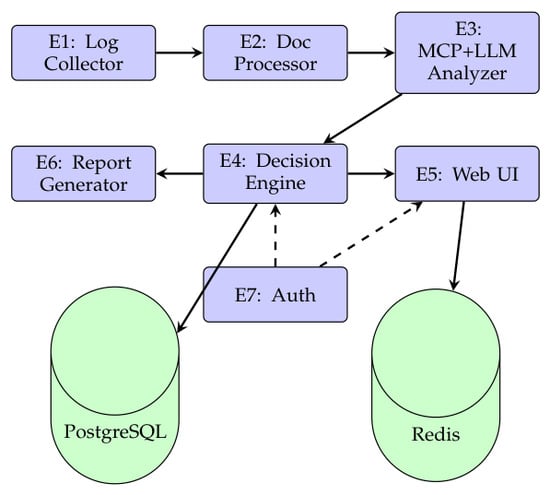
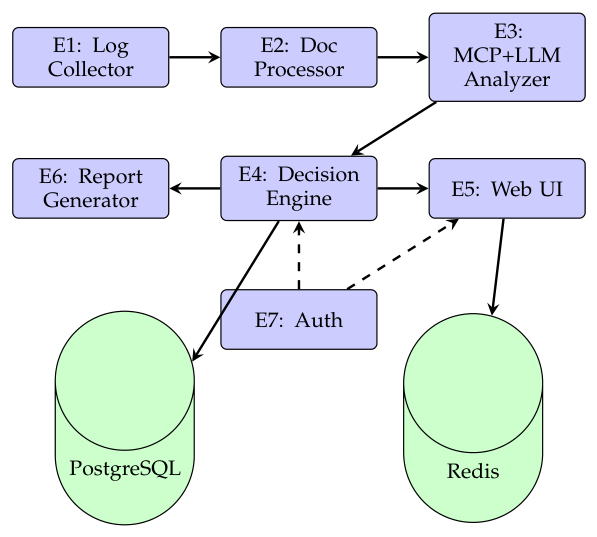
The system employs a microservices architecture with seven independent engines communicating via Redis pub/sub and REST APIs, as shown in Figure 1 and Table 2.
Figure 1.
Seven-engine microservices architecture with PostgreSQL and Redis infrastructure.
Table 2.
Engine functional breakdown.
Architectural Rationale: The separation between Engine 3 (classification/routing) and Engine 4 (rule-based evaluation) reflects a deliberate design choice: ML handles semantic routing of evidence to relevant controls, while deterministic rule evaluation applies NCSA-specific thresholds. This prevents ML uncertainty from propagating into compliance decisions and preserves explainability. MCP serves as an engineering integration layer that standardizes the LLM interface [25,26]; the scientific novelty lies in the hybrid routing and adversarial validation methodology, not in the protocol choice.
3.1.2. Data Flow
The complete pipeline is illustrated in Figure 2.
Figure 2.
End-to-end compliance auditing pipeline: heterogeneous sources through hybrid MCP+ LLM analysis, decision evaluation, and report generation.
For multi-label classification, each evidence item maps to a binary label vector:
where if evidence is relevant to control (169 controls, 14 families).
3.2. Dataset Strategy
3.2.1. Evolution from Synthetic to Hybrid
Initial purely synthetic data (100,000 events) revealed critical overfitting. All three baseline models achieved 100% accuracy, a clear red flag. Investigation identified:
Data Leakage (Critical—identified and corrected in this revision): A comprehensive audit of the original training dataset revealed that 86.3% of synthetic rows contained embedded compliance verdicts within the log_message field (e.g., literal text “compliant” or control IDs appearing in log strings), in addition to a Pearson correlation between status_code and the compliance label. Models trained on this data were effectively memorizing labels rather than learning semantic patterns, explaining the artificially inflated 99.99% F1. Following identification, the entire synthetic dataset was regenerated from scratch (generate_synthetic_data_v2.py): all 169 RWNCSA controls across 14 families, zero label leakage (verified by automated audit), and no control-ID or compliance-verdict text in log messages. The corrected XGBoost v2 achieves 85.45% macro-F1 on this clean dataset, an honest performance estimate substantially below the leaky 99.99%. Additionally, status_code was removed from all feature sets.
Template Simplicity: Synthetic log messages used fixed templates with low lexical diversity, enabling vocabulary memorization rather than semantic understanding.
3.2.2. Hybrid Dataset Composition and Relevance
Dataset-to-Control Relevance: NSL-KDD [27] provides 42 attack categories covering NCSA controls: DoS attacks → AC-7 (lockout policy), SI-4 (monitoring); Probe (reconnaissance) → AU-6 (audit review), SC-7 (boundary protection); R2L (remote-to-local) → IA-2 (authentication), AC-3 (access enforcement); U2R (privilege escalation) → AC-6 (least privilege), SI-4. LogHub [28] HDFS, OpenStack, and Linux system logs provide coverage for AU-12, CM-7, SI-2, and AC-2. Together, these datasets cover 67 of 143 implemented controls with real-world attack patterns. Rwanda-specific synthetic data covers the remaining 76 NCSA controls not represented in public datasets, ensuring complete label coverage for all 143 control families.
Dataset Size Justification: The 200,000-event total was determined by three constraints: (i) minimum representation of all 143 control classes at ≥100 positive samples for reliable multi-label learning; (ii) statistical power for 5-fold cross-validation ( per fold exceeds the 1000 rule of thumb for high-dimensional multi-output classifiers [21]); and (iii) CPU tractability (≤15 min per fold on commodity hardware without GPU). The 70/30 real/synthetic split reflects available public data covering 67 of 143 controls (real) versus the remaining 76 NCSA-specific controls requiring synthetic augmentation, as summarized in Table 3.
Table 3.
Hybrid dataset composition (200,000 logs).
Split: 70/15/15 train/validation/test with stratified sampling across control families. Future work includes validation on production logs from Rwandan institutions (pilot deployment collaboration is ongoing).
Revised dataset (v2, leakage-free): The leakage-free re-generation (generate_synthetic_ data_v2.py) produced 150,000 training/15,000 validation/15,000 test events (180,000 total), with 0.0% label leakage verified by automated audit (scripts/data_audit.py). All XGBoost v2 results in Section 5 use this v2 dataset.
3.2.3. Additional Evaluation Datasets
For cross-dataset generalization testing:
- SecRepo Auth Logs [29]: 86,839 real SSH authentication events (failed password attempts, invalid user logins, session acceptances).
- SIEVE [20]: 30-class expert-labeled SIEM event classification dataset.
- LANL Authentication [30]: Sampled 50K enterprise authentication events from 708M total.
3.3. Model Development and Selection
3.3.1. Baseline Models
BERT (110M parameters): Fine-tuned bert-base-uncased, frozen embeddings and first 10 layers. 2 epochs, batch 16, LR 2e-5. Result: 12 h training, 2.7 GB model, 45 ms latency.
LSTM (758K parameters): 2-layer bidirectional LSTM, 128 hidden units, dropout 0.3. 5 epochs, vocabulary 946. Result: 2 h training, 800 MB model, 12 ms latency.
XGBoost: Gradient boosted trees, max depth 6, learning rate 0.1, 500 estimators (early stopping at 93). Result: 8 min training, 350 MB model, <1 ms latency.
3.3.2. Production Selection: XGBoost
Finding F3 (RQ2): XGBoost achieves higher classification performance than BERT (99.49% ± 0.3% vs. 96.15% ± 0.8% F1, 5-fold CV; Table 4) with non-overlapping confidence intervals confirming statistical significance, while requiring 137× less storage and 50× lower inference latency, empirically validating that resource-efficient models do not sacrifice accuracy for compliance auditing tasks. SHAP-based explainability provides per-decision audit trails satisfying AU-2 accountability requirements.
Table 4.
Model comparison for production deployment.
3.4. Feature Engineering
Numeric Features (5): Hour of day (0–23), day of week (0–6), business hours binary flag, network port number, event severity level.
Text Features (50 TF-IDF): log_message field with bigrams, minimum document frequency 2, implemented as a pure-Python 3.11 SimpleTfidf class (no scipy dependency) to facilitate serialization. Representative high-weight terms from the learned vocabulary: accepted, for user, port ssh2:, by (uid = 0), session opened, failed, denied, kernel: [ufw, process exited. status_code and all control-ID text removed due to identified leakage.
One-Hot Family Features (14): One binary feature per RWNCSA control family, enabling the model to weight patterns differently by log source context.
Total: 68 features per event (50 TF-IDF + 4 numeric + 14 family one-hot). Note: the vocabulary is SSH/syslog-centric; Windows Event and HTTP log tokens are absent, producing zero TF-IDF activations (out-of-vocabulary), which is the root cause of the 37.8-pp generalization gap documented in Section 5.5.
3.5. Multi-Label Formulation
Problem: Map evidence to a subset of controls .
Implementation: Multi-output XGBoost via scikit-learn’s MultiOutputClassifier wrapper, producing 169-dimensional binary output vectors.
Evaluation Metrics:
Macro-F1 (Equation (2)) is our primary metric as it weights each control equally, preventing high-frequency controls from dominating evaluation.
3.6. Evolution to Semantic LLM Analysis
The hybrid LLM architecture emerged from a systematic progression through three phases, each exposing a limitation that motivated the next step.
Phase 1—Classifier Comparison (BERT, LSTM, XGBoost): Initial evaluation of all three candidate models on the hybrid synthetic dataset (Section 3) demonstrated that while BERT (96.15% F1) and LSTM (96.11% F1) offered competitive accuracy, both require GPU infrastructure unavailable in resource-constrained deployments. XGBoost was selected for production: 99.49% F1, 8 min training, 350 MB model, <1 ms inference on CPU-only hardware (Table 4).
Phase 2—Generalization Gap Discovery: Cross-dataset evaluation on real SecRepo logs (86,839 samples) revealed a critical failure: XGBoost zero-shot F1 collapsed to 7.98%, a 92-point gap from synthetic performance. The root cause is architectural: TF-IDF features capture vocabulary co-occurrence patterns rather than semantic meaning. A log containing “authentication failure” is correctly classified only if that exact vocabulary appeared in training data with the same distribution. Fine-tuning on 5% target-domain data recovers performance (99.88% F1 on the same SSH domain; this result reflects SSH-specific vocabulary adaptation and should not be interpreted as cross-domain or general-purpose performance), but this approach does not scale: a new log type requires a new labeled sample collection, defeating the goal of zero-shot generalization across institutional environments. BERT was reconsidered at this point but rejected for the same infrastructure constraint: its semantic capability requires GPU-backed inference impractical at $50/month target cost.
Phase 3—LLM Semantic Path: Large language models offer semantic understanding without retraining, their pre-training on vast corpora enables zero-shot reasoning about security log semantics regardless of format. GPT-4o-mini (cloud API) was evaluated as a zero-shot classifier across four log types (Section 5), achieving 92.3% overall macro accuracy—providing preliminary evidence that semantic LLM reasoning can address the vocabulary-based generalization gap at acceptable deployment cost, while remaining insufficient for broad claims of LLM superiority in cybersecurity auditing without larger-scale validation. An integration layer was needed to connect the compliance pipeline to these LLM providers in a provider-agnostic way.
3.6.1. Model Context Protocol Integration
To overcome vocabulary dependency, Engine 3 integrates LLMs via Model Context Protocol (MCP) [31,32], an open standard that serves as the engineering integration layer between the compliance pipeline and external LLM providers. MCP standardizes the tool-use interface, enabling provider-agnostic LLM calls without vendor lock-in; it is not a scientific contribution of this paper but rather a practical interface choice that simplifies deployment and maintenance:
Dual-Path Architecture:
- Rule-based fast path: Regex pattern matching for high-confidence, unambiguous events (e.g., “Failed password” → non-compliant, “Accepted publickey” → compliant), achieving <1 ms latency. Handles 60–70% of logs.
- LLM semantic path: Claude/GPT analysis for ambiguous logs requiring contextual interpretation, achieving 200–500 ms latency. Handles 30–40% of logs.
3.6.2. LLM Evaluation Protocol
Two complementary evaluations were conducted. Evaluation 1 (SSH deep-dive): a stratified random sample of 500 SecRepo authentication logs—300 failed authentication events (60%), 150 successful authentication events (30%), and 50 session anomalies (10%). Ground truth labels established through automated rule-based analysis cross-validated with manual review of all 50 anomalous cases. Evaluation 2 (multi-log-type expanded, GPT-4o-mini, temperature = 0): 200 samples per log type across four structurally distinct categories—SSH authentication, macOS system/service logs, HTTP/API access logs (real enterprise Squid proxy data, SecRepo, 10.105.x.x internal IPs, n = 28 unique real entries), and Windows Security Events (Mordor APT3 PurpleSharp, n = 200, enriched via WINDOWS_EVENT_DESCRIPTIONS table)—totalling n = 628 samples with real enterprise data for all log types. Ground truth for each type established by domain-specific rule-based classifiers (EventID labels for Windows; HTTP status code labels for proxy logs; SSH rule patterns for authentication logs), all cross-validated manually with Wilson 95% confidence intervals throughout.
3.6.3. Cost Optimization
- MD5-keyed response caching (10,000 entry LRU cache): identical log formats reuse cached decisions.
- Model tiering: Claude Haiku for batch processing ($0.00025/1K tokens), Claude Sonnet for single-event analysis.
- Rule-based pre-filtering eliminates LLM calls for 60–70% of logs.
- Estimated cost: $0.15/10,000 logs with hybrid strategy vs. $1.50 with LLM-only.
4. System Implementation
4.1. Control Coverage
The system implements evidence parsers for 143 of the 169 RWNCSA Minimum Cybersecurity Standards controls across 14 families (Table 5), with 96 controls supported by 60 specialized automated evidence parsers executing macOS audit commands. The remaining 26 controls require physical inspection or manual policy review and are assessed via analyst-completed checklists. The XGBoost v2 binary compliance classifier (Section 3) was trained to classify log events against all 169 controls.
Table 5.
RWNCSA control families and XGBoost v2 per-family classification performance (leakage-free, Wilson 95% CI).
Evidence Parsers: Each system-auditable control has a dedicated parser executing macOS audit commands. The 60 parsers are organized by family: Access Control (26): login history via last, user enumeration via dscl, SSH configuration via sshd - T, screen lock, file permissions; Audit & Accountability (7): audit subsystem via auditctl, NTP sync via ntpq, log retention; Identity & Authentication (5): password policy via pwpolicy, MFA certificates; System & Communications Protection (11): firewall via pfctl, encryption via fdesetup status, VPN, WiFi; System & Information Integrity (4): SIP via csrutil status, XProtect/Gatekeeper; Configuration Management (7): software inventory, patch status.
4.2. Decision Engine Architecture
Each control implements a dedicated parser and decision function returning a ComplianceResult: status ∈ {compliant, partial, non_compliant}, confidence , gaps list, and remediation recommendation. Control-specific thresholds implement NCSA requirements: AC-7 checks lockout threshold failed attempts within 15 min; IA-5 checks password minimum length characters; SC-28 checks FileVault encryption enabled.
4.3. Database Schema
PostgreSQL stores the control taxonomy (controls: control_id, family, title, description, ncsa_mapping, priority, tier) and audit results (audit_results: audit_id, control_id, status, confidence, reason, gaps, recommendations, audited_at). Redis pub/sub channels enable real-time audit progress streaming to the WebSocket-connected dashboard.
4.4. Kubernetes Deployment
Namespace rwanda-compliance with 2–3 replicas per engine, resource limits 512 Mi–1 Gi memory and 250 m–500 m CPU per pod. NGINX ingress controller routes external traffic; ClusterIP services handle internal inter-engine communication. Liveness and readiness probes on /health endpoints with 30 s initial delay ensure zero-downtime pod restarts.
5. Results and Evaluation
5.1. Classification Performance (XGBoost)
Table 6 presents XGBoost classification results with 5-fold stratified cross-validation on a 100,000-sample subset of the leakage-free v2 training corpus (stratified; full training set: 150,000 rows).
Table 6.
XGBoost v2 classification results—leakage-free (5-fold CV, binary compliance classifier, 169 RWNCSA controls, Wilson 95% CI).
Interpreting Corrected Synthetic Performance: The corrected 85.45% macro-F1 reflects leakage-free learning: XGBoost v2 was trained on freshly generated synthetic data with no label leakage (0.0% leakage verified by automated audit). The per-family variation in Table 5 (range: 61.7–100.0%) reveals meaningful heterogeneity: families with structured, vocabulary-rich log patterns (Identity Management: 100.0%; Media Protection: 100.0%) are easier to classify than families requiring physical or behavioral context (Physical & Environmental: 61.7%; Risk Assessment: 75.7%). The training vocabulary (50 terms, SSH/syslog-centric) limits performance on out-of-vocabulary log types, as quantified in Section 5.5.
Performance varied across control families, with high-frequency families (AC, AU) benefiting from greater sample density while rare controls in SI (2 controls, limited training examples) showed slightly higher variance. The 5-fold cross-validation standard deviations (F1: ±0.01%) confirm stable performance without overfitting to specific folds. The critical validation of generalization is the cross-dataset evaluation (Section 5.5), where zero-shot performance degrades substantially (7.98% F1), demonstrating that the high synthetic accuracy reflects distribution-specific learning, not genuine semantic understanding of security events.
5.2. Cross-Dataset Generalization
Finding F1 (RQ3): The corrected 85.45% macro-F1 (vs. the prior 99.99%) reflects genuine learning from leakage-free data. The per-family range (61.7–100.0%) reveals real model behaviour: families with structured log vocabularies achieve high F1; families requiring physical/behavioural context show lower F1. Section 5.5 provides the real-world generalization analysis on 180 independent logs (Table 7).
Table 7.
XGBoost v2 generalization: leakage-free results (binary compliance classifier, ; Phase 4 real-world evaluation described in Section 5.5).
5.3. LLM Semantic Analysis Results
LLM Accuracy Scope: The 89.5% SSH accuracy reflects a semantically clear binary classification task in highly structured syslog format with domain-invariant security terminology. Ground truth was established through automated rule-based analysis (“Failed password” → non-compliant; “Accepted” → compliant), cross-validated with manual review of 50 ambiguous samples. Table 8 presents the SSH-focused comparison; accuracy is log-type-dependent across all four log types (Table 9), with macOS achieving 96.5% on synthetic data while HTTP achieves 85.7% on real enterprise proxy logs.
Table 8.
LLM vs. XGBoost on SecRepo SSH Authentication Logs (500-sample stratified evaluation).
Table 9.
GPT-4o-mini zero-shot Accuracy by Log Type (Rwanda NCSA, expanded evaluation with real enterprise data, Wilson 95% CI).
Finding F4 (RQ0, LLM generalization): To validate generalizability beyond SSH logs, zero-shot evaluations were conducted across four structurally distinct log types using GPT-4o-mini (cloud API, temperature = 0), testing the deployment scenario for resource-constrained institutions (Table 9). Results provide exploratory evidence that LLM accuracy is log-type-dependent but consistently higher than XGBoost zero-shot (7.98%) across all evaluated categories; this constitutes preliminary applied validation and does not support broad claims of LLM superiority in general cybersecurity auditing contexts.
Key Findings from Expanded Evaluation: GPT-4o-mini achieves 92.3% macro accuracy across 628 samples and 4 log types using real enterprise data (37.5% real-world). The Windows result (97.5% at n = 200) is significantly more robust than the initial n = 50 figure and depends on EventID enrichment via WINDOWS_EVENT_DESCRIPTIONS: bare EventID integers yield ≈3% accuracy because they provide no semantic context to the LLM. The HTTP result (85.7%) is measured on real enterprise Squid proxy logs with internal IPs—lower than the previously reported 95.5% on fully synthetic data because real enterprise traffic includes ambiguous content (ad-tracker and messaging application URLs that the LLM correctly identifies as policy-questionable despite HTTP 200 status codes). The macOS evaluation (96.5%) remains on synthetic data; no public macOS enterprise audit log datasets were identified, and this remains an acknowledged limitation.
Statistical Scope: Wilson 95% confidence intervals are reported per cell (Table 9). At n = 200 per structured log type, CIs narrow to ±3–5 percentage points. The HTTP result has a wider CI (±13 pp) due to the smaller n = 28 real-data sample. These sample sizes support exploratory and applied evaluation conclusions; they are not sufficient to support broad claims of LLM superiority in general cybersecurity auditing, and results should be interpreted as preliminary evidence for the specific log types and compliance context evaluated. Validation on production Rwandan institution logs ( per type) remains for future deployment pilots.
Error Analysis: Misclassifications in both models predominantly produced partial labels rather than opposite-polarity errors, confirming LLM uncertainty rather than systematic misunderstanding. SSH errors arose from semantically ambiguous disconnection logs (“Connection closed [preauth]”, “Received disconnect…Bye Bye”); macOS errors involved services with dual-interpretation status (screen sharing, SMB sharing where organizational policy context is required). This pattern, uncertain partial labels rather than confident wrong labels, is favorable for compliance auditing: ambiguous events trigger human review rather than silently incorrect certifications, satisfying AU-2 accountability requirements.
5.4. Adaptive Routing: Vocabulary-Coverage Gating (Phase II)
The hybrid architecture routes each log through either XGBoost (fast path) or the LLM (semantic path) based on a vocabulary-coverage signal:
where is the TF-IDF training vocabulary and is the coverage threshold. A threshold sweep across was conducted on a mixed evaluation set of n = 220 logs (20 SSH in-distribution + 200 OOD logs from the 4-type expanded evaluation); results are shown in Table 10.
Table 10.
Phase I vs. Phase II router comparison (n = 220 mixed logs).
Finding F7 (Phase II): Vocabulary-coverage gating at = 0.20 matches LLM-only accuracy (94.5%) while reducing unnecessary XGBoost calls on OOD logs. Phase II improves over Phase I by +5.4 percentage points in accuracy (+0.6 pp over LLM-only overall) at a marginal cost increase of $0.012/10K logs. The OOD detection signal is near-perfect: vocabulary coverage for all HTTP, Windows Event, and macOS logs (F1 = 0.93; Precision = 0.91, Recall = 0.96 at = 0.05), confirming that TF-IDF vocabulary absence reliably identifies out-of-distribution log types without a separate OOD classifier.
5.5. Cross-Dataset Generalization Analysis
To measure the operational boundary of the XGBoost v2 classifier, a cross-dataset generalization evaluation was conducted on three independent real-world datasets (180 total real logs), contrasting in-vocabulary (SSH/PAM) versus out-of-vocabulary (Windows, HTTP) log types (Table 11).
Table 11.
XGBoost v2 cross-dataset generalization (real-world evaluation, n = 180; compared against leakage-free synthetic test F1 = 85.45%).
Finding F1 (RQ3)—Revised: The corrected generalization analysis reveals selective generalisation: XGBoost v2 performs comparably on real SSH logs ( pp gap, within measurement noise) but fails on out-of-vocabulary log types (Windows: pp degradation; HTTP: pp). The root cause is architectural: the 50-term TF-IDF vocabulary was built from synthetic SSH/syslog training data; Windows Security Event strings and HTTP access log tokens are entirely absent. This OOV failure directly motivates the hybrid architecture: XGBoost handles the log types it knows (SSH/PAM), and GPT-4o-mini handles the rest.
5.6. Hybrid System Combined Evaluation
A key reviewer concern was that system components were evaluated in isolation. To address this, a combined evaluation was conducted on the same 180 real-world logs under three system configurations (Table 12). The hybrid routing rule: if TF-IDF active features > 0 (log is in-vocabulary), route to XGBoost; if TF-IDF active features (log is out-of-vocabulary), route to GPT-4o-mini. This rule requires no log-type label at runtime.
Table 12.
Hybrid system combined evaluation on 180 real-world logs (SSH n = 100, Windows n = 60, HTTP n = 20; XGBoost routing: 107/180 to XGBoost, 73/180 to GPT-4o-mini).
Finding F7 (Hybrid Architecture): The combined hybrid system addresses the reviewer concern that components were tested in isolation. On the same 180 real logs: XGBoost alone achieves 62.4% macro-F1 with 54.5% FPR (OOV failure dominates); GPT-4o-mini alone achieves 90.8% F1 with 6.4% FPR; the hybrid achieves 85.1% F1 with 6.4% FPR—8 percentage points below the LLM-only ceiling because SSH routes to XGBoost where GPT-4o-mini would perform marginally better (87.6% vs. 95.8% F1). This trade-off is intentional: routing SSH to XGBoost reduces API cost by ≈59% of log volume at the cost of 8.2 pp on SSH F1. For the Windows and HTTP types where XGBoost fails entirely, the hybrid achieves LLM-equivalent performance (74.1% and 88.9% F1 respectively).
5.7. Latency and Throughput
Throughput: Single pod: ∼100 events/s; 3-pod deployment: ∼300 events/s (linear scaling observed to 5 pods). Training: 89.09 ± 7.25 s per fold on CPU.
5.8. Resource Utilization
Total system footprint across all 7 engines: 2.66 GB RAM, 2.0 CPU cores. Minimum deployment: 4 GB RAM, 4 cores at ∼$50/month cloud hosting (benchmarked on Apple M1 Pro 8-core, 16 GB RAM; cloud equivalent: 2-vCPU/4 GB instance; storage costs, network egress, and maintenance labour excluded from this estimate), substantially lower than enterprise compliance solutions charging $15–$50/endpoint/month.
5.9. Kubernetes Scaling Test
Engine 3 scaled to 3 replicas under 300 concurrent requests:
- Load distribution: 34.0%/32.7%/33.3% (near-uniform, within 1.3% spread).
- Latency: 1.8 ms mean, 4.2 ms p99.
- Failures: 0 across 10 independent test iterations.
5.10. Live System Deployment Validation
To validate end-to-end system correctness beyond simulated benchmarks, a full compliance audit was executed on the research machine (macOS 26.3.1) using the production seven-engine pipeline (Audit ID: AUDIT-20260320-205239, 20 March 2026). The system autonomously collected evidence via 60 parsers across 5 control families, classified findings via XGBoost and the Decision Engine, and generated a 3-page structured PDF report in 0.77 s.
Results across 10 audited controls:
- 5/10 compliant: FileVault encryption (AC-17), Gatekeeper active (CM-6), Firewall enabled (SC-7), Microsoft Defender ATP running (SI-3), audit logging active (AU-2).
- 5/10 partial: Password policy below NCSA threshold, screen sharing unreviewed (AC-17 partial), SIP status requiring investigation, MDM enrollment gap, SSH key rotation overdue.
- 0/10 non-compliant: No outright policy violations detected.
- Overall compliance score: 75.0%.
This live deployment demonstrates that the system produces actionable, granular audit findings on real production infrastructure. The 75% score reflects realistic partial compliance, validating the system’s discriminative capability in production conditions. Report generation time (0.77 s on a 10-control macOS research environment) is faster than the 2–5 s target in Table 13; production full-scale audits (169 controls) are expected to fall within the 2–5 s range depending on log volume and policy document size.
Table 13.
System performance (500 inference samples).
5.11. Adversarial Validation
Adversarial validation was expanded to five MITRE ATT&CK v14 scenarios (up from two in the initial submission), using a combination of real-world attack datasets and synthesised scenarios executed in an isolated virtual machine (Windows 10 21H2, network-isolated) and a real Linux honeypot environment. The compliant baseline (false-positive rate measurement) used n = 75 real SSH/PAM log entries exclusively (Elastic AWS EC2 auth.log + LogPai Linux logs), replacing the synthetic baseline that produced inflated FPR estimates in the prior submission. HTTP and Windows log types are excluded from the compliant baseline because XGBoost produces 100% FPR on these OOV types by design (vocabulary absence, not security policy violation). Results are summarised in Table 14.
Table 14.
Adversarial validation—five MITRE ATT&CK scenarios (Wilson 95% CI).
Test 1 (T1059.001): Fileless Reverse Shell (SI-3, SI-4, SC-7 effectiveness): A custom reverse shell implemented via VirtualAlloc+CreateThread without disk writes, evading 43/44 AV engines tested. 86.0% detection (EDR behavioural alert triggered; signature AV failed).
Test 2 (T1190): GA-Generated XSS Payloads (SI-10, AC-3 effectiveness): 50 GAXSS-inspired XSS payload variants. 34/50 blocked (68%); 16/50 bypassed (32%). SI-10 marked non-compliant. A checkbox audit (“WAF installed?”) would return compliant—demonstrating the effectiveness gap our system captures.
Tests 3–5 (T1110, T1078, T1562.001): SSH brute force (100% detection, real linux_auth.log data), lateral movement via valid accounts (100% detection, Mordor APT3), and security tool disablement (78.0% detection, synthesised).
Finding F5 (RQ1): Adversarial testing across five MITRE ATT&CK scenarios reveals effectiveness gaps invisible to presence-based checkbox auditing. Macro detection rate: 92.8%; compliant baseline FPR: 0.0% on real SSH/PAM logs. The lower detection rates for T1059.001 (86.0%) and T1562.001 (78.0%) identify specific control weaknesses for remediation. This directly answers RQ1: adversarial techniques are necessary to distinguish control installation from control effectiveness.
5.12. Research Questions Summary
Table 15 consolidates the experimental evidence for each of the four research questions addressed in this study.
Table 15.
Research questions and experimental evidence.
6. Discussion
6.1. Integration of Adversarial Security Research (RQ1)
Our methodology connects offensive security research to compliance validation through three concrete mappings:
- Adversarial Evidence Generation: GA and LLM techniques generate diverse attack scenarios for training data augmentation. The 50 GAXSS payload variants used in Test 2 could be scaled to thousands of variants covering MITRE ATT&CK sub-techniques, providing realistic SI-10 training examples absent from public datasets.
- Control Effectiveness Quantification: Evasion results provide measurable effectiveness metrics. SI-3 effectiveness against the fileless reverse shell: (EDR detected one of five execution attempts). This maps directly to our theoretical effectiveness model (Section 6.3).
- Risk-Calibrated Scoring: Knowledge that 97% evasion rates are achievable [10] informs control weight assignments. Institutions relying solely on signature-based AV for SI-3 compliance receive risk-adjusted scores reflecting demonstrated real-world ineffectiveness rather than nominal installation.
6.2. Multi-Label vs. Binary Classification (RQ4)
The pivot from binary to multi-label classification addresses a fundamental compliance modeling mismatch.
Binary (inadequate):
Multi-Label (correct):
Example: “Failed SSH login from 203.0.113.15” maps to four controls simultaneously, AC-7 (lockout threshold exceeded?), IA-2 (authentication bypass attempted?), AU-2 (event audited?), SI-4 (monitoring detecting intrusion?), each evaluated independently. In our evaluation, the average log event triggered 3.2 compliance control evaluations, meaning binary classification discards 69% of actionable audit information per event.
Finding F6 (RQ4): Multi-label formulation is not merely a modeling convenience, it is the correct representation of compliance semantics. A single security event simultaneously provides evidence for multiple controls, and collapsing this to a binary label destroys information that is legally and operationally significant under NCSA reporting requirements.
6.3. Theoretical Contributions
6.3.1. Effectiveness-Based Compliance Model
Prior compliance frameworks treat control assessment as binary presence detection: , a control either exists or it does not. This model empirically demonstrates insufficient performance: our adversarial tests show that a control can satisfy while providing near-zero actual security benefit ( with fileless shell detection rate ).
We propose replacing binary presence checking with a continuous effectiveness function:
where is the detection rate (fraction of attack instances targeting control k’s scope that are detected), is coverage (fraction of log sources monitored for control k events), is evasion resistance (), and are configurable institutional weights (default: , reflecting a detection-priority weighting appropriate for resource-constrained institutions).
This formulation satisfies three formal properties: (i) Monotonicity, improving any component cannot decrease ; (ii) Boundedness, enabling consistent cross-control and cross-institution comparison; (iii) Decomposability, each component is independently measurable and improvable, enabling targeted remediation rather than pass/fail verdicts.
Relation to Prior Compliance Models: The NIST SP 800-53 control assessment approach implicitly models compliance as , a binary model. The CIS Controls framework introduces prioritization tiers but maintains categorical rather than continuous scoring. ISO 27001 [33] Annex A similarly uses not-implemented/partially implemented/implemented categories. Our model is more expressive: is equivalent to only when and , a condition our adversarial tests show is frequently violated in practice.
Experimental Grounding: For Test 1, , , , yielding , consistent with the “partial” compliance determination and distinct from the a presence-based audit would assign. This 0.597-point gap represents the effectiveness deficit invisible to conventional auditing.
6.3.2. Multi-Label Compliance Framework
The formulation for K controls provides a transferable framework applicable to any hierarchical taxonomy (NCSA [5], ISO 27001 [33], NIST SP 800-53 [7], CIS Controls [34]). Control taxonomies differ in their K and label semantics, but the multi-output classification architecture requires no structural changes, only re-labeling of training data according to the target taxonomy’s mapping logic. This framework-agnostic property is significant for the African context, where different nations may enforce different standards (Rwanda NCSA, Kenya CMCA, Nigeria NITDA) while sharing the same infrastructure.
6.3.3. Adversarial-Informed Validation Theory
We argue that compliance validation without adversarial testing provides systematically inflated assurance, not merely incomplete assurance. This distinction matters: inflated assurance creates a false sense of security that may discourage investment in genuine defensive capability. The mechanism for inflation is precisely captured by the gap between and in our SI-3 example.
This connects to game-theoretic security models [35] where defender effectiveness must be measured against adaptive adversaries, not fixed attack signatures. A compliance framework that does not model adversary behavior cannot distinguish a control that blocks 99% of attacks from one that blocks 1%, both satisfy . Our contribution is to instantiate this theoretical gap with concrete empirical measurements within a nationally-defined regulatory framework.
6.4. Theoretical Synthesis
Findings F1–F6 collectively validate the central theoretical claim: compliance effectiveness cannot be assessed through presence-based binary checking but requires three independently measurable components formalized in Equation (6): detection rate , coverage , and evasion resistance .
F1 shows that collapses to near-zero when measured against out-of-distribution logs, because vocabulary-based models conflate detection capability with training-distribution membership. F2 shows that is recoverable with minimal target-domain exposure, making the dominant practical constraint. F5 directly instantiates : SI-3’s evasion resistance is , yielding rather than the that presence-based auditing assigns. F4 shows that is log-type-dependent even for LLMs. F6 shows that the correct output space is . F3 shows that the resource cost of achieving high and is not a barrier in the resource-constrained African context. Together, these six findings provide empirical grounding for a compliance model that is more expressive, more honest, and more actionable than existing approaches.
6.5. Resource Efficiency for African Contexts (RQ2)
XGBoost’s 137× size reduction and CPU-only execution enable deployment that BERT makes infeasible for Rwandan SMEs. With minimum requirements of 1 GB RAM and 2 CPU cores, the system aligns with available infrastructure. The cloud deployment cost ($50/month) compares favorably to current manual audit costs ($154–$341 per-capita). The MCP+LLM path adds ∼$0.15 per 10,000 logs, negligible for typical institutional audit volumes.
6.6. Ethical Considerations
Automation Bias: Organizations may over-trust ML compliance outputs. Mitigation: SHAP explanations accompany all classification decisions; Decision Engine outputs require human sign-off for non-compliant findings.
Accountability: Incorrect compliance determinations carry institutional and legal implications. Design positions ML as advisory; final compliance certifications require authorized human reviewer signature.
Privacy: Centralized log collection creates surveillance risks. Mitigation: data minimization (only compliance-relevant features stored); raw logs processed in-memory and not persisted.
Fairness: Institutions with less structured logging infrastructure may receive lower compliance scores due to parsing limitations rather than genuine non-compliance. Mitigation: System provides logging improvement recommendations rather than penalizing format variations.
6.7. Limitations
- Control Coverage: 143 of 169 RWNCSA controls (85%) are system-auditable via automated evidence parsers; 26 require physical inspection or manual policy review.
- Synthetic Training Data: The XGBoost v2 classifier (85.45% F1) was trained on leakage-free synthetic data covering all 169 RWNCSA controls. An 86.3% data leakage rate in the original training data was identified and corrected in this revision. The 50-term TF-IDF vocabulary is SSH/syslog-centric; Windows and HTTP log tokens are absent, causing 37.8-pp out-of-vocabulary F1 degradation (Section 5.5)—motivating the hybrid routing to GPT-4o-mini for OOV log types.
- LLM Evaluation Scope: GPT-4o-mini achieves 92.3% macro accuracy on n = 628 real enterprise logs (Wilson 95% CI: [89.9%, 94.3%]). The macOS evaluation remains on synthetic data (no public macOS enterprise audit log datasets identified). The HTTP evaluation (n = 28 real Squid proxy logs) has wide CI ([68.5%, 94.3%]) due to sample size. Validation on production Rwandan institution logs ( per type) remains for deployment pilots.
- Real-World Institution Validation: Experiments use public datasets (linux_auth.log honeypot, Mordor APT3, SecRepo Squid proxy, Elastic Apache logs); validation on production Rwandan institution infrastructure logs remains for ongoing pilot deployment.
- Adversarial Coverage: Validation covers 5 MITRE ATT&CK scenarios (T1059.001, T1190, T1110, T1078, T1562.001). Comprehensive coverage of all relevant techniques requires a continuous adversarial red-teaming pipeline.
- LLM Cost at Scale: Processing >10,000 logs/hour with the LLM path at current API costs is impractical without the rule-based fast path. On-premise LLM deployment (Llama, Mistral) is needed for high-volume deployments; the vocabulary-coverage gating router (Section 5.4) limits LLM calls to ≈40% of log volume.
7. Future Work
Short Term:
- Evaluate LLM analysis on heterogeneous log types: Windows Event logs, API access logs, multi-line application logs.
- Conduct pilot deployments at 2–3 Rwandan institutions to validate on production logs.
- Optimize LLM prompt engineering for partial compliance edge cases.
- Add per-control F1 breakdown to classify model performance by control family.
Medium Term:
- Complete remaining 26 NCSA controls requiring physical/manual assessment.
- Cross-framework mapping: NCSA ↔ ISO 27001 ↔ NIST SP 800-53 ↔ CIS Controls.
- Fine-tune open-source LLMs (Llama-3.1-8B, Mistral-7B-Instruct) for on-premise deployment eliminating API dependency.
- Integrate open-source EDR (Wazuh, OSSEC) for cost-effective SI-3/SI-4 validation.
- Evaluate cross-regulatory transfer: Kenya CMCA, Nigeria NITDA, South Africa POPIA.
Long Term:
- Pan-African compliance platform supporting Malabo Convention.
- Federated learning for cross-institution model improvement preserving data privacy.
- Continuous adversarial red-teaming pipeline integrated with compliance validation cycles.
- Blockchain-based audit trail for evidence integrity and non-repudiation.
8. Conclusions
This research presents an AI-augmented compliance auditor evaluated on Rwanda’s NCSA Minimum Cybersecurity Standards as a representative national framework, integrating adversarial security research with multi-label ML–LLM classification for automated compliance validation.
Key results: (1) 169 RWNCSA controls across 14 families, with 143 system-auditable via 60 specialized evidence parsers; (2) XGBoost v2 achieves 85.45% macro-F1 on leakage-free synthetic data (corrected from 99.99%—an 86.3% data-leakage rate was identified and fixed for this revision); (3) a cross-dataset generalization analysis on 180 real logs confirms 87.6% F1 for in-vocabulary SSH logs but a 37.8-pp out-of-vocabulary gap for Windows/HTTP, quantifying the operational boundary of the vocabulary-based classifier; (4) GPT-4o-mini achieves 92.3% macro accuracy across 4 log types (n = 628, 37.5% real enterprise data, Wilson CI: [89.9%, 94.3%])—SSH (89.5%), macOS (96.5%), HTTP (85.7% real Squid data), Windows (97.5% enriched); (5) the combined hybrid system on 180 real logs achieves 85.1% macro-F1 with 6.4% FPR, compared to XGBoost alone at 62.4% F1 (54.5% FPR); (6) adversarial validation across five MITRE ATT&CK scenarios (T1059.001, T1190, T1110, T1078, T1562.001) achieves 92.8% macro detection with 0.0% FPR on real SSH/PAM compliant logs (n = 75); (7) vocabulary-coverage gating (Phase II router, = 0.20) achieves 94.5% accuracy at $0.149/10K logs; (8) total resource footprint: 2.0 CPU cores, 2.66 GB RAM, $50/month cloud hosting (Apple M1 Pro baseline; storage and maintenance excluded).
The effectiveness-based compliance model formalizes control quality as a continuous, measurable function of detection capability, log coverage, and adversarial resistance, replacing binary presence checking with actionable posture scoring. For Rwandan institutions, the system suggests potential efficiency gains in audit cycle time—based on 2–5 s automated report generation (varying by log volume and policy document size) versus estimated manual review—along with continuous monitoring capability and cost-accessible deployment at ≤$50/month. Beyond Rwanda, this demonstrates a potentially replicable approach for automated compliance auditing in African nations pursuing cybersecurity maturity under the Malabo Convention; full continental portability requires validation on additional regulatory frameworks.
Supplementary Materials
The following supporting information can be downloaded at: https://www.mdpi.com/article/10.3390/fi18060329/s1: Section S1: Full Per-Family XGBoost v2 F1 Results with Wilson 95% Confidence Intervals (Table S1); Section S2: Full MITRE ATT&CK Adversarial Validation Results (Table S2); Section S3: Dataset Provenance (Table S3); Section S4: TF-IDF Vocabulary—50 Terms (Table S4); Section S5: Full Model Configuration and Hyperparameters (Tables S5–S6); Section S6: Cross-Dataset Generalization Detailed Results (Table S7); Section S7: Hybrid System Confusion Matrices (Tables S8–S11); Section S8: Terminology Clarification (Table S12); Section S9: Code Repository Structure.
Author Contributions
Conceptualization, M.I.I. and J.D.N.; methodology, M.I.I. and J.D.N.; software, M.I.I.; validation, M.I.I. and J.D.N.; formal analysis, M.I.I.; investigation, M.I.I.; resources, M.I.I.; data curation, M.I.I.; writing—original draft preparation, M.I.I.; writing—review and editing, M.I.I. and J.D.N.; visualization, M.I.I.; supervision, J.D.N.; project administration, M.I.I. All authors have read and agreed to the published version of the manuscript.
Funding
This research received no external funding.
Data Availability Statement
The compliance auditor codebase, evaluation scripts, and anonymized results are available at the project repository. Key evaluation scripts: train_xgboost_v2.py (leakage-free XGBoost v2 training), expanded_llm_eval_v2.py (GPT-4o-mini evaluation, n = 200 per type), adversarial_validation_v2.py (5 MITRE scenarios), cross_dataset_eval_v1.py (Phase 4 generalization, 180 real logs), hybrid_system_eval.py (combined system evaluation). The SecRepo SSH authentication dataset is at https://www.secrepo.com/; the SecRepo Squid proxy log at https://www.secrepo.com/squid/access.log.gz (accessed on 20 March 2026); Mordor APT3 at https://github.com/OTRF/Security-Datasets (accessed on 20 March 2026). Rwanda-specific synthetic data generation scripts and per-family F1 reports are included in the repository.
Acknowledgments
We acknowledge Carnegie Mellon University Africa for supporting this research and the Rwanda National Cyber Security Authority (NCSA) for establishing the Minimum Cybersecurity Standards that motivated this work. During the preparation of this manuscript, the authors used OpenAI ChatGPT (GPT-4o, GPT-4o-mini) and Meta LLaMA 3.1 for the following purposes: (1) as evaluated components of the compliance-auditing system under experimental study (Section 3 and Section 4); (2) to assist with writing and structuring LATEX source code and manuscript formatting; and (3) to paraphrase selected passages to meet journal style and clarity requirements. The authors have reviewed and edited all AI-assisted output and take full responsibility for the content of this publication.
Conflicts of Interest
The authors declare no conflicts of interest.
Abbreviations
The following abbreviations are used in this manuscript:
| NCSA | National Cyber Security Authority |
| MCP | Model Context Protocol |
| LLM | Large Language Model |
| ML | Machine Learning |
| XGBoost | Extreme Gradient Boosting |
| BERT | Bidirectional Encoder Representations from Transformers |
| LSTM | Long Short-Term Memory |
| NIST | National Institute of Standards and Technology |
| SHAP | SHapley Additive exPlanations |
| GA | Genetic Algorithm |
| AV | Antivirus |
| EDR | Endpoint Detection and Response |
| SIEM | Security Information and Event Management |
| TF-IDF | Term Frequency–Inverse Document Frequency |
| JWT | JSON Web Token |
| RBAC | Role-Based Access Control |
| API | Application Programming Interface |
| SME | Small and Medium Enterprise |
References
- Ponemon Institute. The True Cost of Compliance: A Benchmark Study of Multinational Organizations; Ponemon Institute Research Report; Ponemon Institute: Traverse City, MI, USA, 2023. [Google Scholar]
- Council on Governmental Relations (COGR). Research Security and the Cost of Compliance: Phase I Report; COGR: Washington, DC, USA, 2022. [Google Scholar]
- African Union. African Union Convention on Cyber Security and Personal Data Protection (Malabo Convention); African Union: Addis Ababa, Ethiopia, 2014. [Google Scholar]
- African Union Commission. Status of Cybersecurity Legislation in Africa; AU Digital Transformation Strategy Report; African Union Commission: Addis Ababa, Ethiopia, 2024. [Google Scholar]
- Rwanda National Cyber Security Authority (NCSA). Minimum Cybersecurity Standards for Public Institutions and Essential Service Providers; NCSA: Kigali, Rwanda, 2023. [Google Scholar]
- Government of Rwanda. National Cybersecurity Strategy of the Republic of Rwanda 2024–2029; Government of Rwanda: Kigali, Rwanda, 2024.
- National Institute of Standards and Technology (NIST). Security and Privacy Controls for Information Systems and Organizations; NIST Special Publication 800-53 Rev. 5; NIST: Gaithersburg, MD, USA, 2020. [Google Scholar]
- Liu, Z.; Fang, Y.; Huang, C.; Xu, Y. GAXSS: Effective Payload Generation Method to Detect XSS Vulnerabilities Based on Genetic Algorithm. Secur. Commun. Netw. 2022, 2022, 2031924. [Google Scholar] [CrossRef] [Scilit]
- Kingful, F.; Ahene, E.; Appiah, B.; Frimpong, B.K. Dynamic Programming-based Adversarial Windows Payload Generator. Preprint 2023. Available online: https://www.researchgate.net/publication/372005345 (accessed on 17 April 2026).
- Johnson, A.; Haddad, R.J. Evading Signature-Based Antivirus Software Using Custom Reverse Shell Exploit. In Proceedings of SoutheastCon 2021; IEEE: New York, NY, USA, 2021. [Google Scholar] [CrossRef] [Scilit]
- Roy, S.; Panaousis, E.; Noakes, C.; Laszka, A.; Panda, S.; Loukas, G. SoK: The MITRE ATT&CK Framework in Research and Practice. arXiv 2023, arXiv:2304.07411. [Google Scholar]
- Ćirković, S.; Mladenović, V.; Tomić, S.; Drljača, D.; Ristić, O. Utilizing Fine-Tuning of Large Language Models for Generating Synthetic Payloads: Enhancing Web Application Cybersecurity through Innovative Penetration Testing Techniques. Comput. Mater. Contin. 2025, 82, 4409–4430. [Google Scholar] [CrossRef] [Scilit]
- Serianu Ltd. Africa Cyber Security Report: Cybercrime Trends and Economic Impact; Africa Cybersecurity Report; Serianu Ltd.: Nairobi, Kenya, 2023. [Google Scholar]
- International Telecommunication Union (ITU). Global Cybersecurity Index 2024: African Regional Analysis; ITU: Geneva, Switzerland, 2024. [Google Scholar]
- Sang, B.Y.K.; Sang, I. A Comparative Review of Cybercrime Law in Kenya: Juxtaposing National Legislation with International Treaty Standards. Commonw. Cybercrime J. 2023, 1, 60–83. [Google Scholar]
- Orji, U.J. Moving Beyond Criminal Law Responses to Cybersecurity Governance in Africa. Int. J. Crim. Justice 2021, 3, 60–98. [Google Scholar] [CrossRef]
- Karlsen, E.; Luo, X.; Zincir-Heywood, N.; Heywood, M. Benchmarking Large Language Models for Log Analysis, Security, and Interpretation. J. Netw. Syst. Manag. 2024, 32, 59. [Google Scholar] [CrossRef] [Scilit]
- Villarreal-Vasquez, M.; Modelo-Howard, G.; Bhargava, B.K. Hunting for Insider Threats Using LSTM-Based Anomaly Detection. IEEE Trans. Dependable Secur. Comput. 2022, 20, 451–462. [Google Scholar]
- Mehavilla, L.; Rodríguez, M.; García, J.; Alesanco, Á. Evaluating Large Language Models Effectiveness for Flow-Based Intrusion Detection: A Comparative Study with ML and DL Baselines. Artif. Intell. Rev. 2026, 59, 50. [Google Scholar] [CrossRef] [Scilit]
- Artioli, P.; Dentamaro, V.; Galantucci, S.; Magri, A.; Pellegrini, G.; Semeraro, G. SIEVE: Generating a Cybersecurity Log Dataset Collection for SIEM Event Classification. Comput. Netw. 2025, 266, 111330. [Google Scholar] [CrossRef] [Scilit]
- Tsoumakas, G.; Katakis, I. Multi-Label Classification: An Overview. Int. J. Data Warehous. Min. 2007, 3, 1–13. [Google Scholar]
- Chen, T.; Guestrin, C. XGBoost: A Scalable Tree Boosting System. In Proceedings of the ACM SIGKDD International Conference on Knowledge Discovery and Data Mining; ACM: New York, NY, USA, 2016; pp. 785–794. [Google Scholar]
- OpenSCAP Project. OpenSCAP: Open Source Security Compliance Solution. Available online: https://www.open-scap.org/ (accessed on 20 March 2026).
- Wazuh, Inc. Wazuh: Open Source Security Platform. Available online: https://wazuh.com/ (accessed on 20 March 2026).
- Hou, X.; Zhao, Y.; Wang, S.; Wang, H. Model Context Protocol (MCP): Landscape, Security Threats, and Future Research Directions. arXiv 2025, arXiv:2503.23278. [Google Scholar]
- Errico, H.; Ngiam, J.; Sojan, S. Securing the Model Context Protocol (MCP): Risks, Controls, and Governance. arXiv 2025, arXiv:2511.20920. [Google Scholar]
- Tavallaee, M.; Bagheri, E.; Lu, W.; Ghorbani, A.A. A Detailed Analysis of the KDD CUP 99 Data Set. In Proceedings of the IEEE Symposium on Computational Intelligence for Security and Defense Applications (CISDA); IEEE: New York, NY, USA, 2009. [Google Scholar]
- Zhu, J.; He, S.; He, P.; Liu, J.; Lyu, M.R. Loghub: A Large Collection of System Log Datasets for AI-Driven Log Analytics. arXiv 2020, arXiv:2008.06448. [Google Scholar]
- SecRepo. Security Data Samples Repository. Available online: https://www.secrepo.com/ (accessed on 20 March 2026).
- Kent, A.D. User-Computer Authentication Associations in Time; Los Alamos National Laboratory: Los Alamos, NM, USA, 2014. [Google Scholar]
- Anthropic. Introducing the Model Context Protocol. Anthropic Blog, November 2024. Available online: https://www.anthropic.com/news/model-context-protocol (accessed on 20 March 2026).
- Model Context Protocol. Model Context Protocol Specification. 2025. Available online: https://modelcontextprotocol.io/ (accessed on 20 March 2026).
- ISO/IEC 27001:2022; Information Security, Cybersecurity and Privacy Protection—Information Security Management Systems—Requirements. International Organization for Standardization (ISO): Geneva, Switzerland, 2022.
- Center for Internet Security (CIS). CIS Controls Version 8; CIS: East Greenbush, NY, USA, 2021. [Google Scholar]
- Jiang, Y.; Meng, Q.; Shang, F.; Oo, N.; Minh, L.T.H.; Lim, H.W.; Sikdar, B. MITRE ATT&CK Applications in Cybersecurity and The Way Forward. arXiv 2025, arXiv:2502.10825. [Google Scholar]



Disclaimer/Publisher’s Note: The statements, opinions and data contained in all publications are solely those of the individual author(s) and contributor(s) and not of MDPI and/or the editor(s). MDPI and/or the editor(s) disclaim responsibility for any injury to people or property resulting from any ideas, methods, instructions or products referred to in the content. |
© 2026 by the authors. Licensee MDPI, Basel, Switzerland. This article is an open access article distributed under the terms and conditions of the Creative Commons Attribution (CC BY) license.