
Energy-Efficient Wireless Sensor Networks Through Coverage Hole Detection and Mitigation Using a Hybrid Raccoon–Hermit Crab Optimization Algorithm


Abstract
1. Introduction
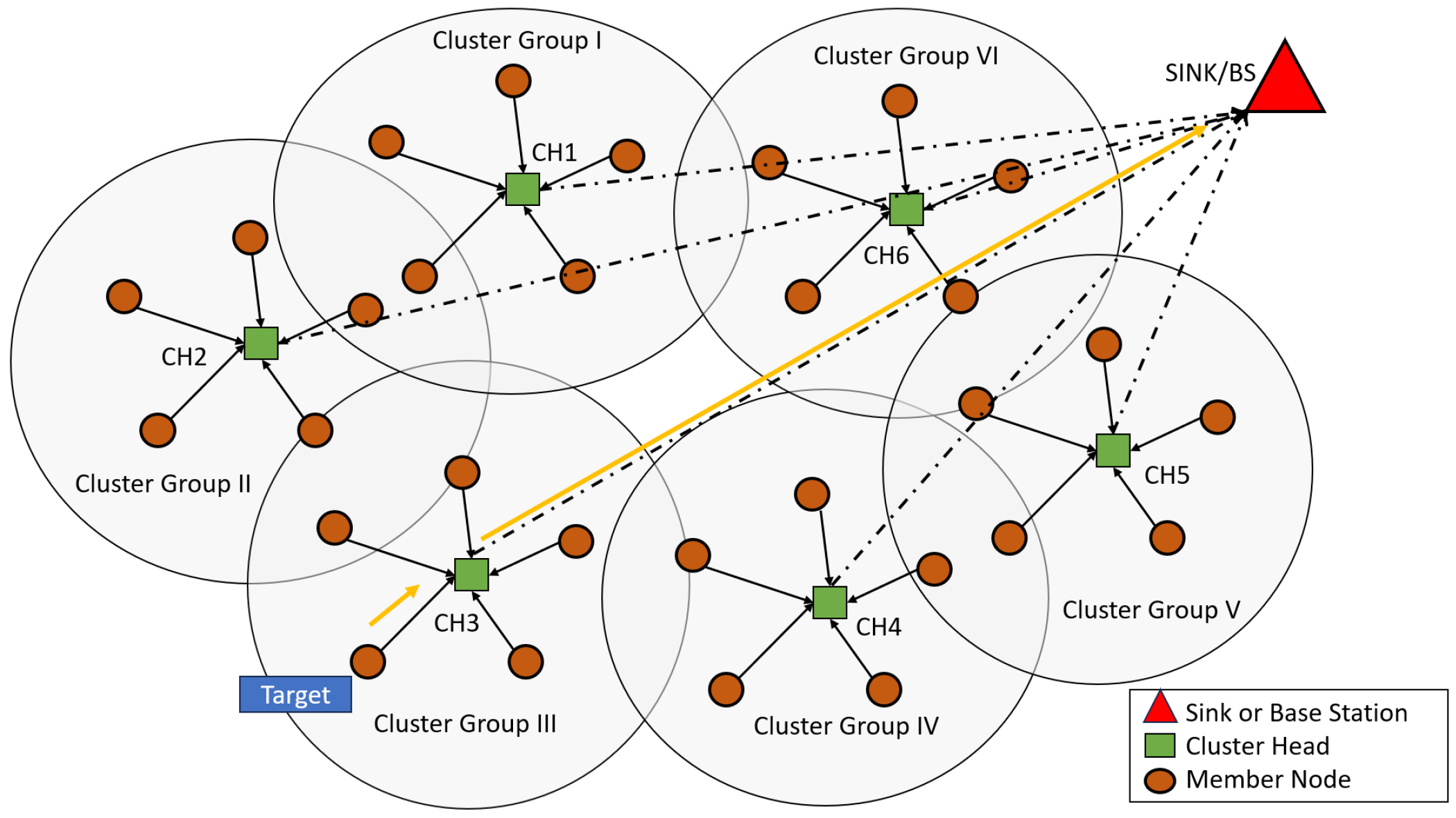
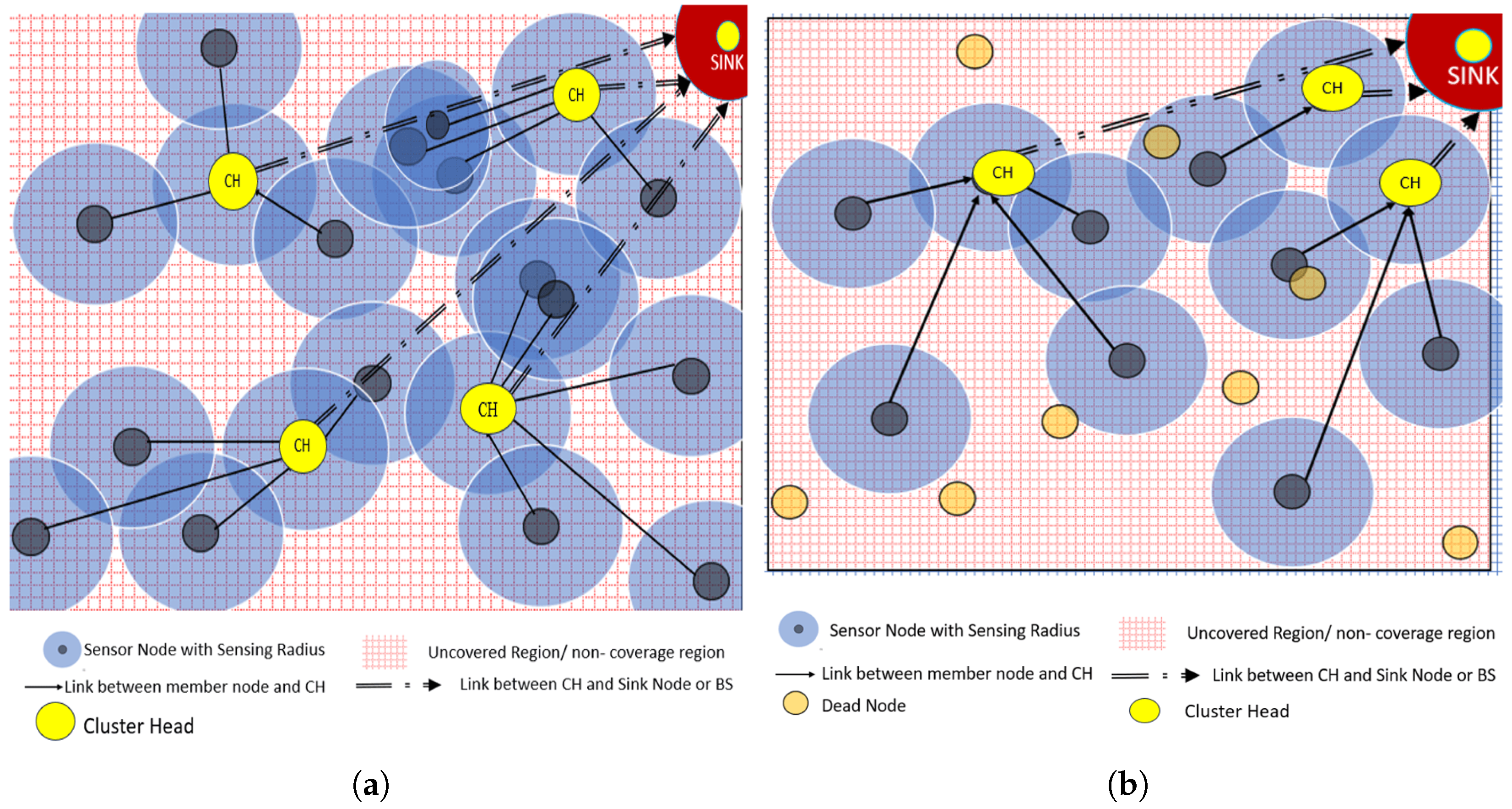
- Deployment-based coverage holes (coverage gaps): These occur due to uneven or random deployment, specifically in disaster-prone areas.
- Failure-based coverage holes (future holes or black holes): Even if the network is well covered initially, new holes emerge as a result of continuous transmission over time in the network. Issues like node failures, energy holes (black holes), or physical destruction of nodes in disaster scenarios account for these types of coverage holes.
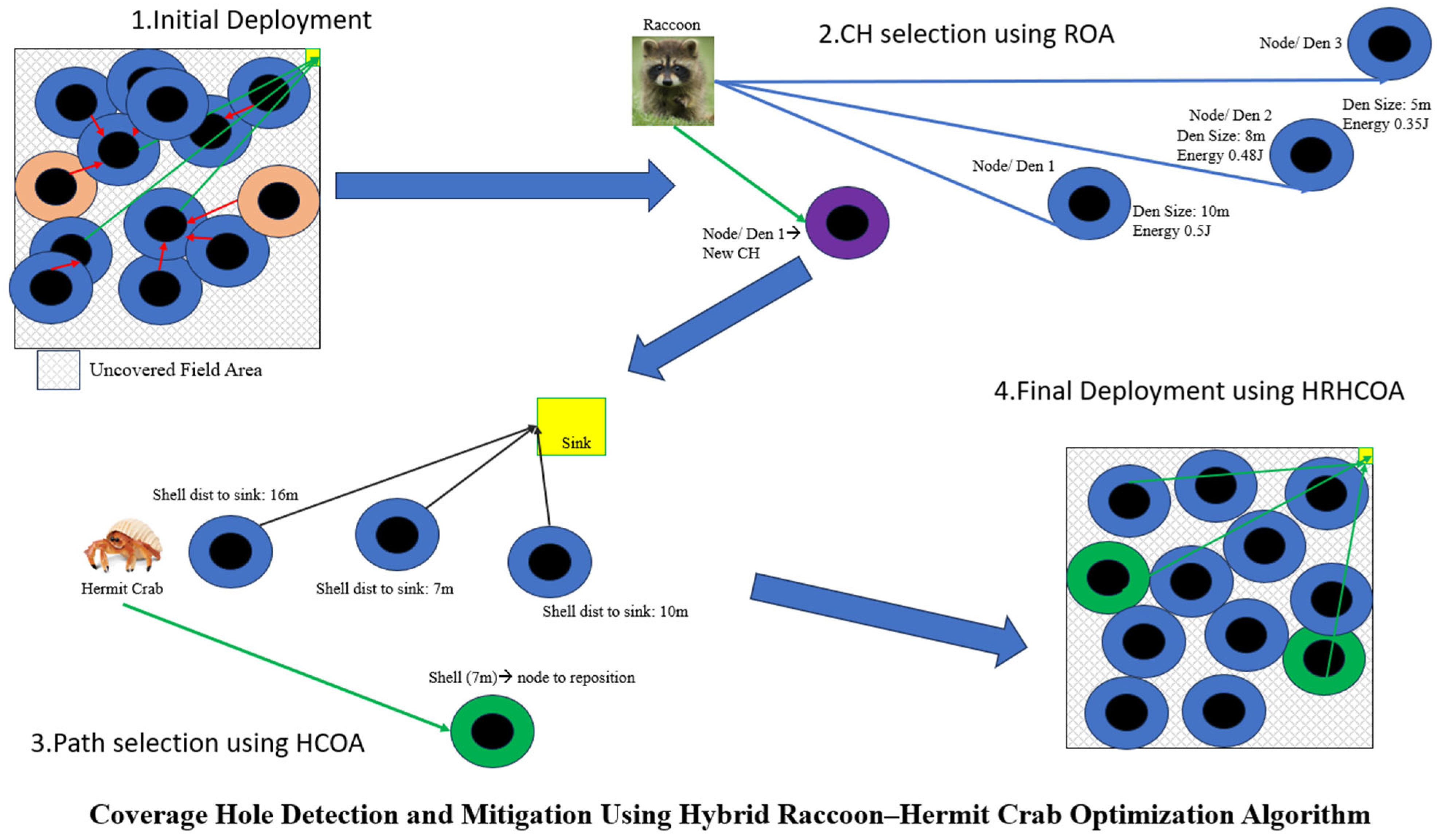
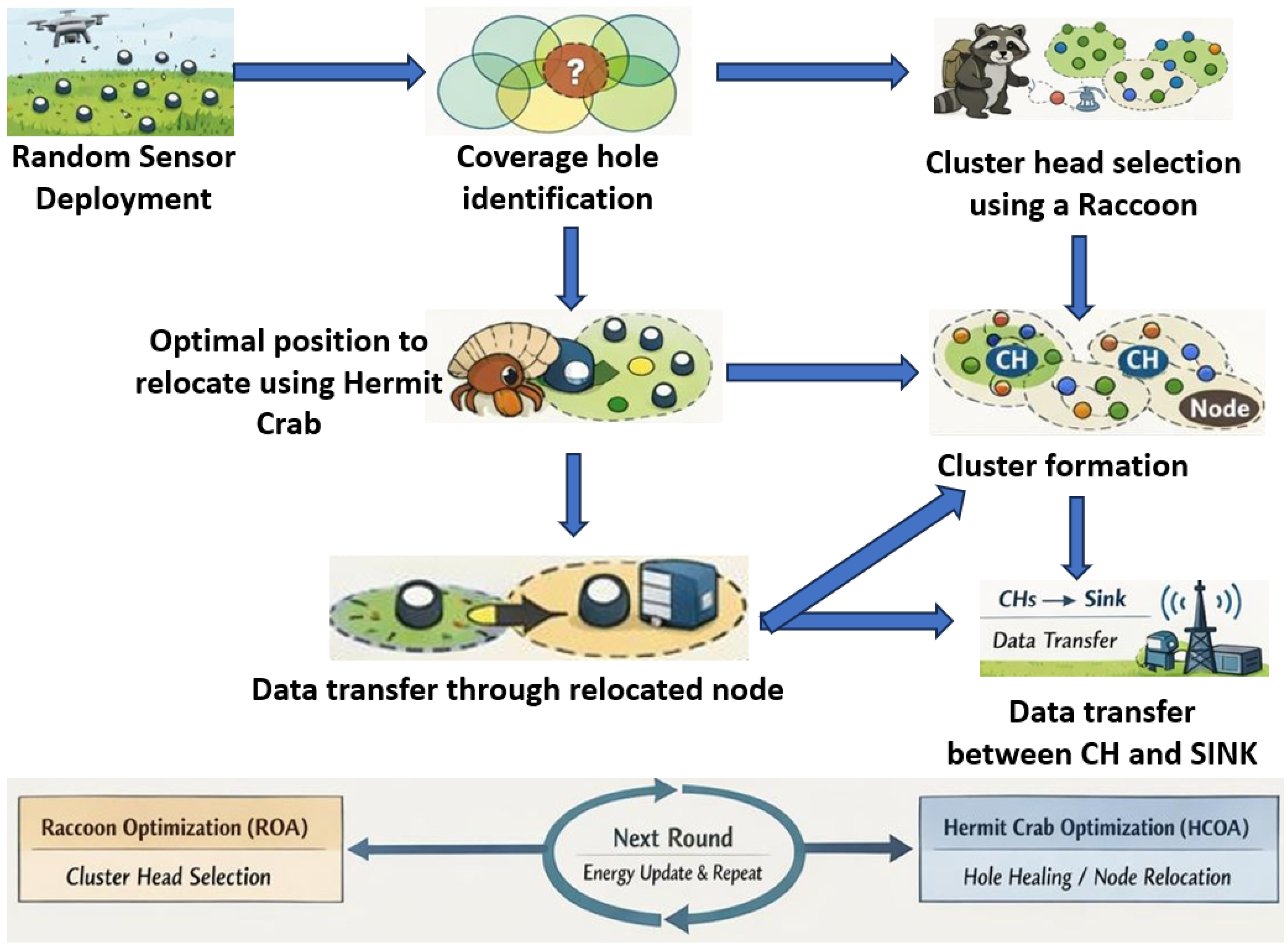
- The proposed HRHCOA detects coverage holes around the network (exploration) and repositions nodes to optimal locations in each grid sector to heal the coverage holes (exploitation).
- This proposed algorithm not only identifies and mitigates the initial deployment coverage holes but also mitigates the new coverage holes that emerge due to node failures during the network’s operation.
- Simulation results indicate that the proposed algorithm has resulted in extended network lifetime, maximized coverage ratio, increased throughput, and lower delay when compared to LEACH and its variants, ROA and HCOA.
2. Literature Review

| Reference | Optimization Technique | Key Contributions | Limitations | Static or Mobile |
|---|---|---|---|---|
| [19] | Coverage Hole Optimization Protocol (CHOP) | Balanced cluster head selection; approximately 20% coverage improvement over LEACH | Lacks proactive coverage hole prediction and healing mechanisms | static |
| [20] | I-LEACH with LeDiR-based healing | Dead node replacement using mobile sensors; extended network lifetime and improved connectivity | Relocation delay and increased node overhead due to mobility | mobile |
| [21] | DEAL protocol (distance- and energy-aware LEACH) | Enhanced network stability and reduced probability of coverage hole formation | Higher computational overhead during cluster head selection | static |
| [22] | Delaunay triangulation-based detection | Low operational cost and scalable geometric hole detection | No node relocation or healing strategy considered | static |
| [23] | Adaptive probabilistic CH selection | Reduced coverage hole formation and extended network lifetime | Misinterpretation of CH probability in certain operational rounds | static |
| [24] | Improved K-Means + enhanced LEACH with mobility | Optimized cluster head selection with mobile-node-based coverage hole healing | Requires specialized coordination and control of mobile nodes | mobile |
| Reference | Optimization Technique | Key Contributions | Limitations | Static or Mobile |
|---|---|---|---|---|
| [28] | Hybrid PSO + VDCOA | Improved connectivity, reduced coverage gaps, balanced energy in multi-hop networks | Assumes stable clusters; ignores packet loss and delay | static |
| [29] | Genetic Algorithm (GA) | Reliable multi-node k-coverage and improved fault tolerance | High computational overhead in dense networks | static |
| [30] | GA-based cover set scheduling | Extended lifetime and improved stability through coverage partitioning | Limited QoS improvement; static homogeneous nodes | static |
| [31] | Hybrid GA (global + local search) | High coverage and QoS stability across varying node densities | High delay and uneven energy usage under dynamic conditions | static |
| [32] | Adaptive GA variants | Energy-efficient coverage maximization | Simulation-only; static deployment | static |
| [33] | Improved dynamic GA deployment | Maximized coverage with reduced redundancy | Deterministic model; lacks probabilistic QoS analysis | static |
| [34] | GA + ACO hybrid | Reduced early hole formation and optimized CH–BS routing | High complexity in dense networks | static |
| [35] | ACO + hill climbing | Energy-aware node activation and improved coverage | Local optimization bias in sparse networks | static |
| Reference | Optimization Technique | Key Contributions | Limitations | Static or Mobile |
|---|---|---|---|---|
| [36] | Grey Wolf Optimizer (GWO) | Optimized node spacing and reduced coverage holes | Limited to static deployments | static |
| [37] | Hybrid GWO (Levy + RL) | Superior coverage improvement over PSO and GA | Not suitable for dynamic environments | static |
| [38] | Weighted GWO + DT + RSSI | Low latency, high throughput in disaster-prone WSNs | Mobile node coordination complexity | mobile |
| [39] | Whale Optimization Algorithm (WOA) | Achieved ∼90% coverage and stability | Sensitive to uneven node distribution | static |
| [40] | COOT Bird Optimization | Improved coverage in uneven deployments | No mobility or QoS modeling | static |
| [41] | WHO + Golden Sine | Reduced redundancy in obstacle environments | Increased algorithmic complexity | mobile |
| [42] | Jellyfish Algorithm + LEACH | Achieved ∼85% coverage with mobile sensors | Unstable in sparse networks | mobile |
| [43] | BAT Algorithm | Energy-efficient CH selection and coverage stability | Prone to local optima | static |
| [44] | HGWO–PSO/HGWO–HSA | Improved robustness, coverage, and trap avoidance | Higher computational overhead | static |
3. Network Modeling
3.1. First-Order Radio Model (Energy-Based)
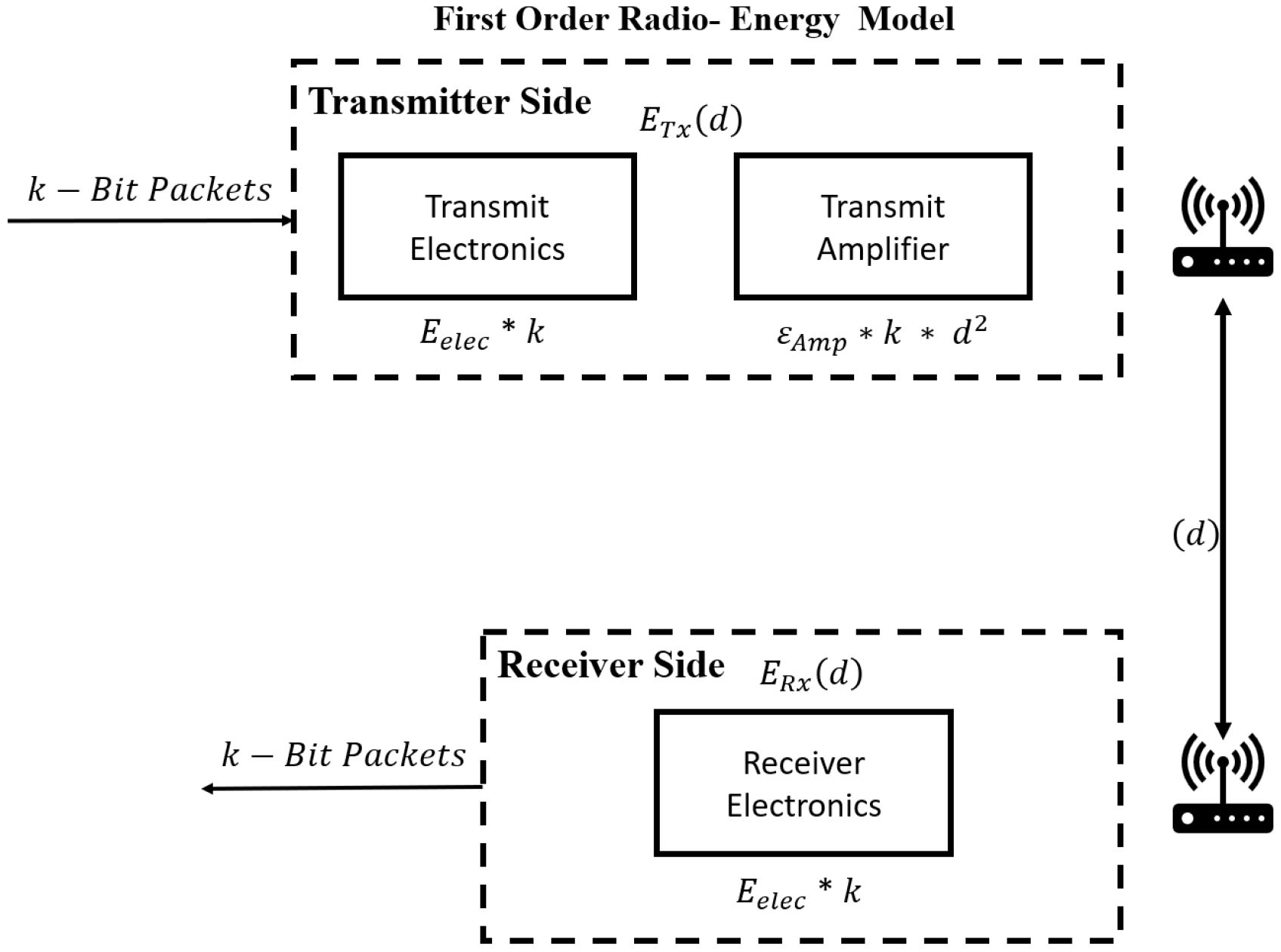
3.1.1. Basic First-Order Radio Model
- : Energy consumed per bit for electronics.
- : Energy consumed by the amplifier.
- k: Number of bits in the packet.
- d: Distance between transmitter and receiver.
- n: Path-loss exponent (typically 2 or 4).
- : Threshold distance (propagation model).
- : Energy consumed by amplifier in free space model.
- : Energy consumed by amplifier in multi path.
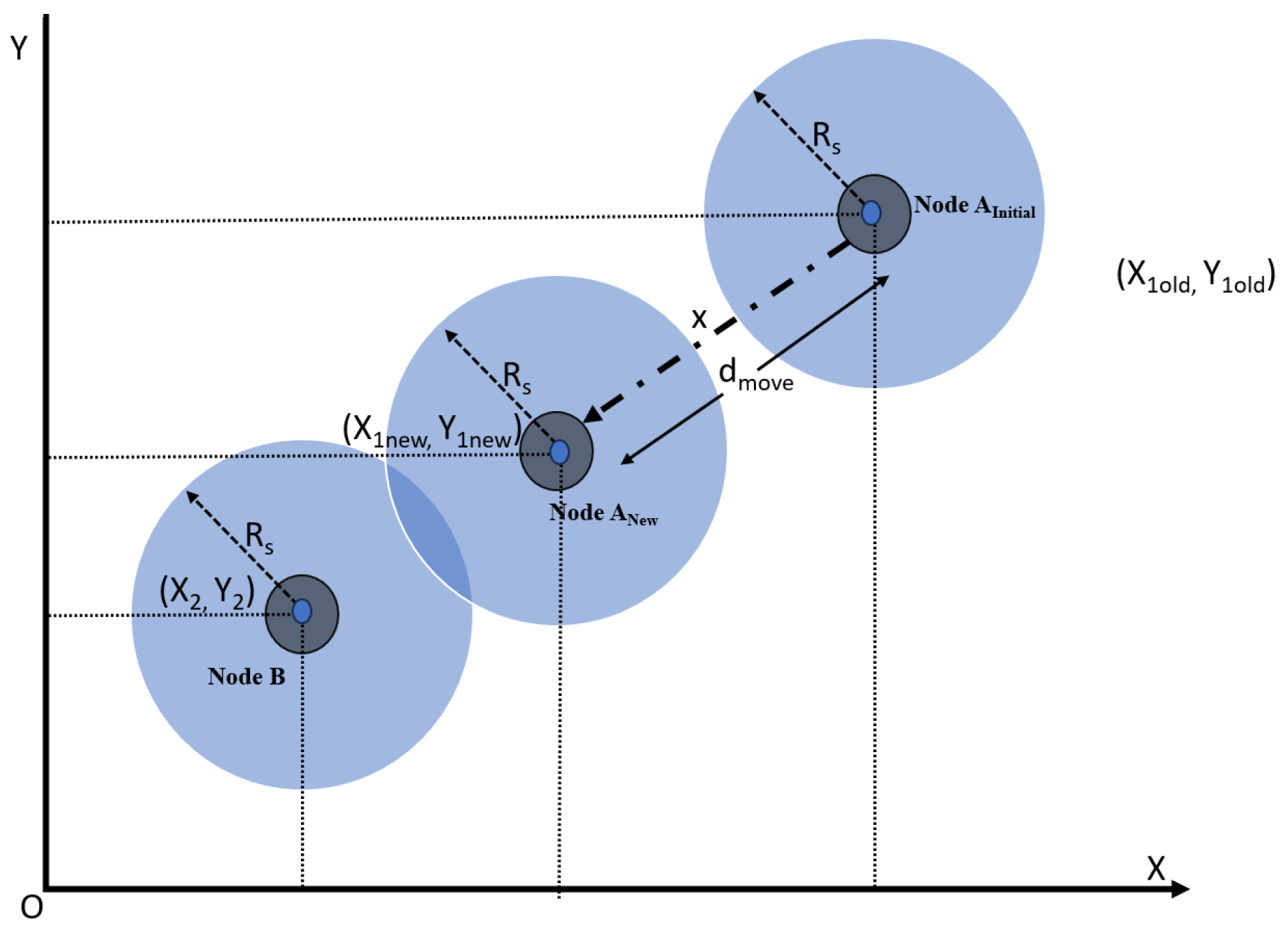
3.1.2. Node Repositioning Radio Model
- : Energy consumed per bit by mobility platform
- They are currently disconnected and separated: ;
- Assume, node A has enough energy to reposition and perform communication in Equation (8);where
- : Safety margin of residual energy between (10–20%).
- : Required movement distance and should be strictly under the distance threshold.
- To limit excessive node relocations, the required movement distance and mobility budget threshold are determined based on the sensor’s sensing range and a scaling factor ranging from 0.5 to 1, as defined in Equation (9).
- : Required movement distance and should be strictly under the distance threshold.
- : New distance to the node to move.
- : Maximum distance the node is moved.
3.2. Low-Energy Adaptive Clustering Hierarchy (LEACH) Protocol and Its Variants
- All nodes are randomly deployed and static.
- All nodes have the same initial energy, sensing, and communication range.
- BS is placed at the far end of the network, and it is immobile.
- P: Desired CH probability.
- r: Current round.
- 1/p: Number of rounds in one epoch or iteration.
- G: Set of nodes that has not been selected as CH in previous (1/p) rounds.
- : Energy consumed by the cluster.
- n: Number of nodes in the cluster.
- : Distance from CH to BS.
- : Average distance between member nodes and CH.
- : Effective coverage after repositioning.
- : Initial coverage (before repositioning).
- : Energy spent to move a node or CH.
- : Weight factor: A parameter that characterizes the rate at which coverage decreases with increasing energy consumption.
- : Residual energy of the node i.
- : Threshold energy, where a node cannot move.
- : Distance from point of x to node.
- : Sensing range of a node.
- AE: Overall Sensing area with respect to the energy model.
- N: Number of high-energy nodes.
- : CH threshold selected based on deterministic distance between CH and BS.
- : CH threshold selected based on probabilistic distance between CH and BS.
3.3. Raccoon Optimization Algorithm
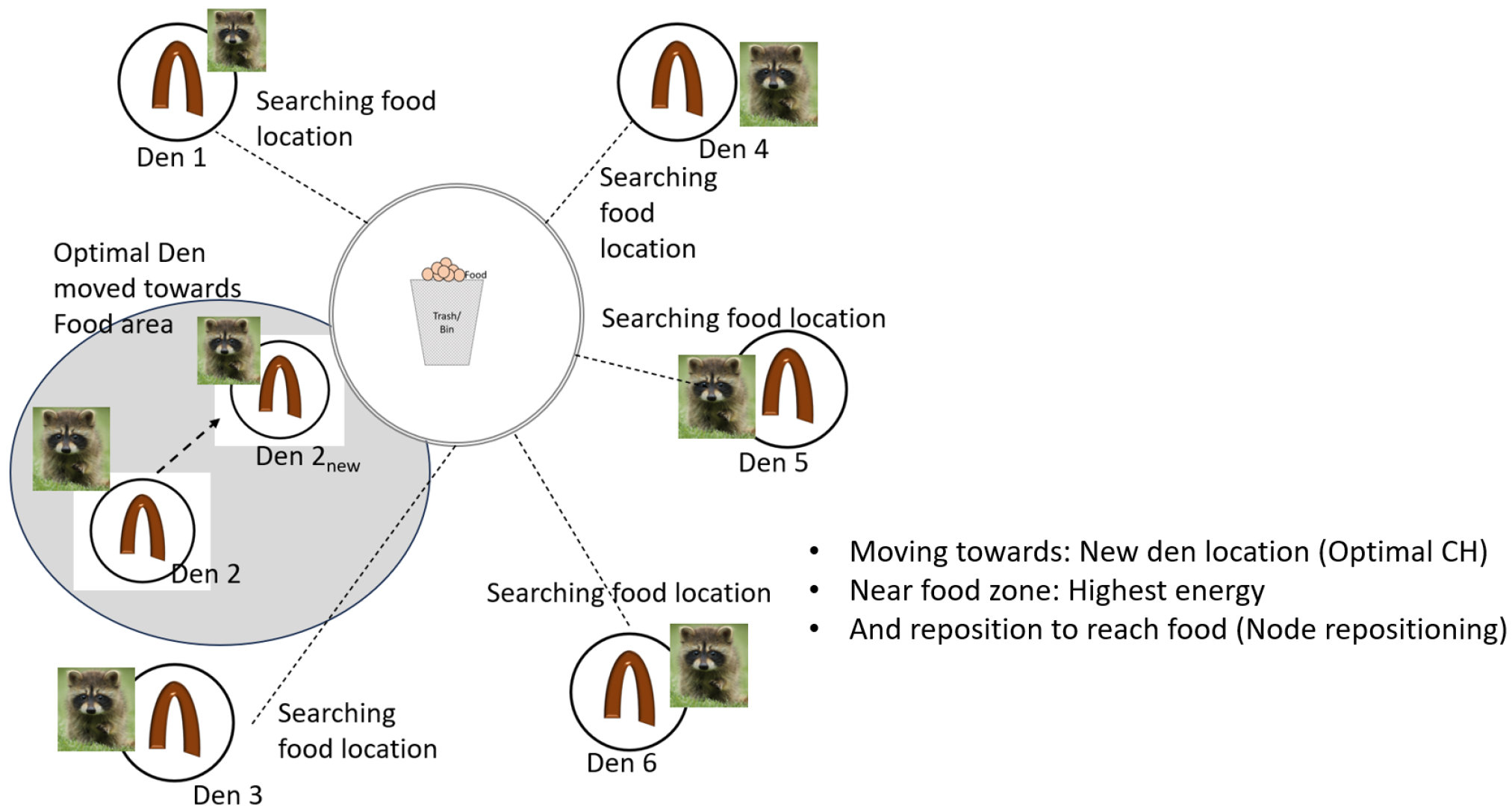
- : Exploration weight, moving towards the guiding point .
- : Random exploration factor to avoid local optima.
- : Exploitation weight for moving towards best-known position .
- : Random exploitation factor to avoid stagnation.
- : Current position of node i at time t.
- : Guiding point from helper/neighbor node j.
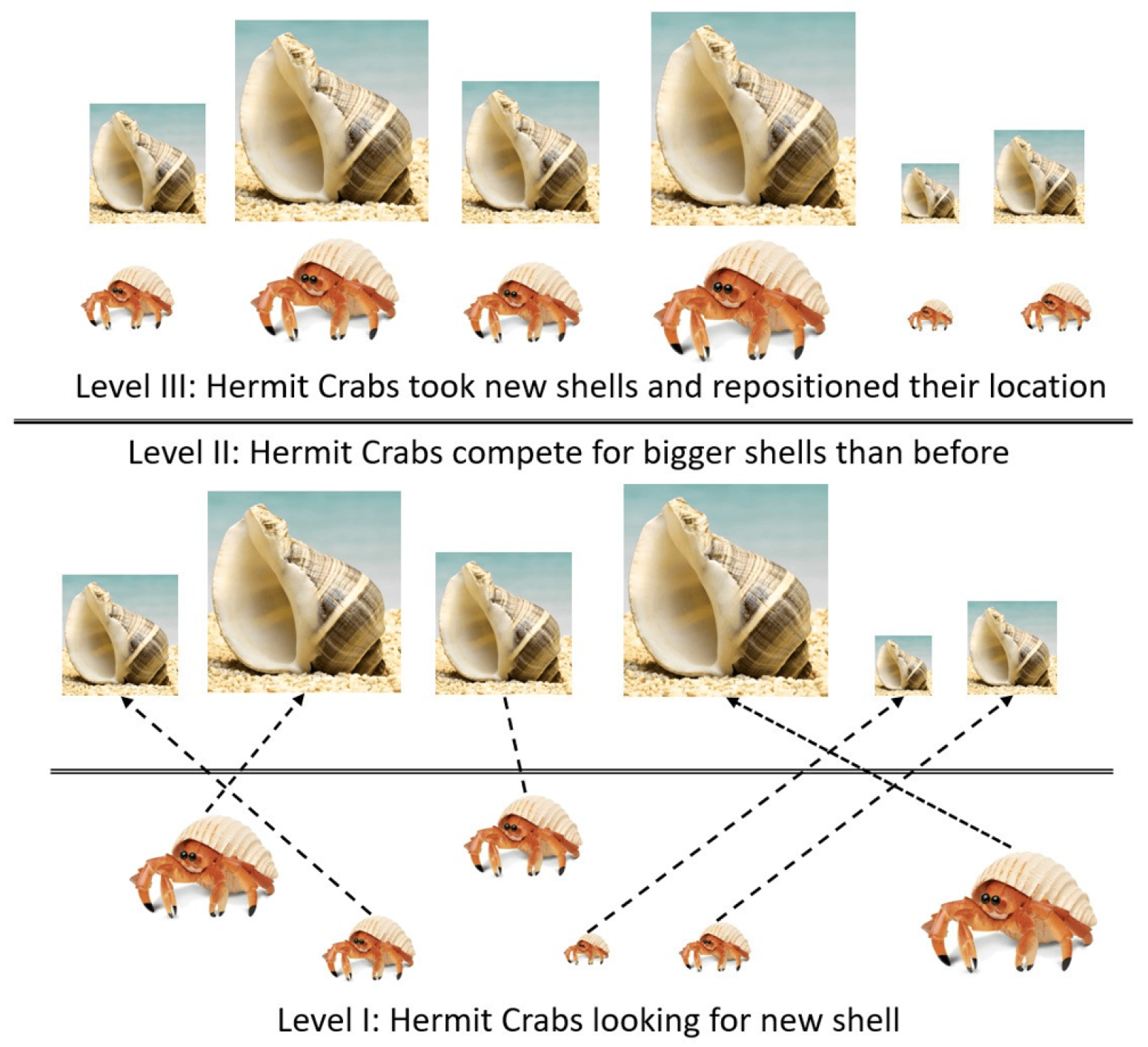
3.4. Hermit Crab Optimization Algorithm
- : Best local coverage position (shell).
- r: Random vector for exploration.
- : Control parameters for exploitation and exploration.
- : Exploitation weight (toward the hole).
- : Exploration weight (random movement).
- : Random position in the sensing field.
4. Proposed Method: Hybrid Raccoon-Hermit Crab Optimization (HRHCOA)
4.1. Network Modeling
4.1.1. Initial Deployment and Hole Healing
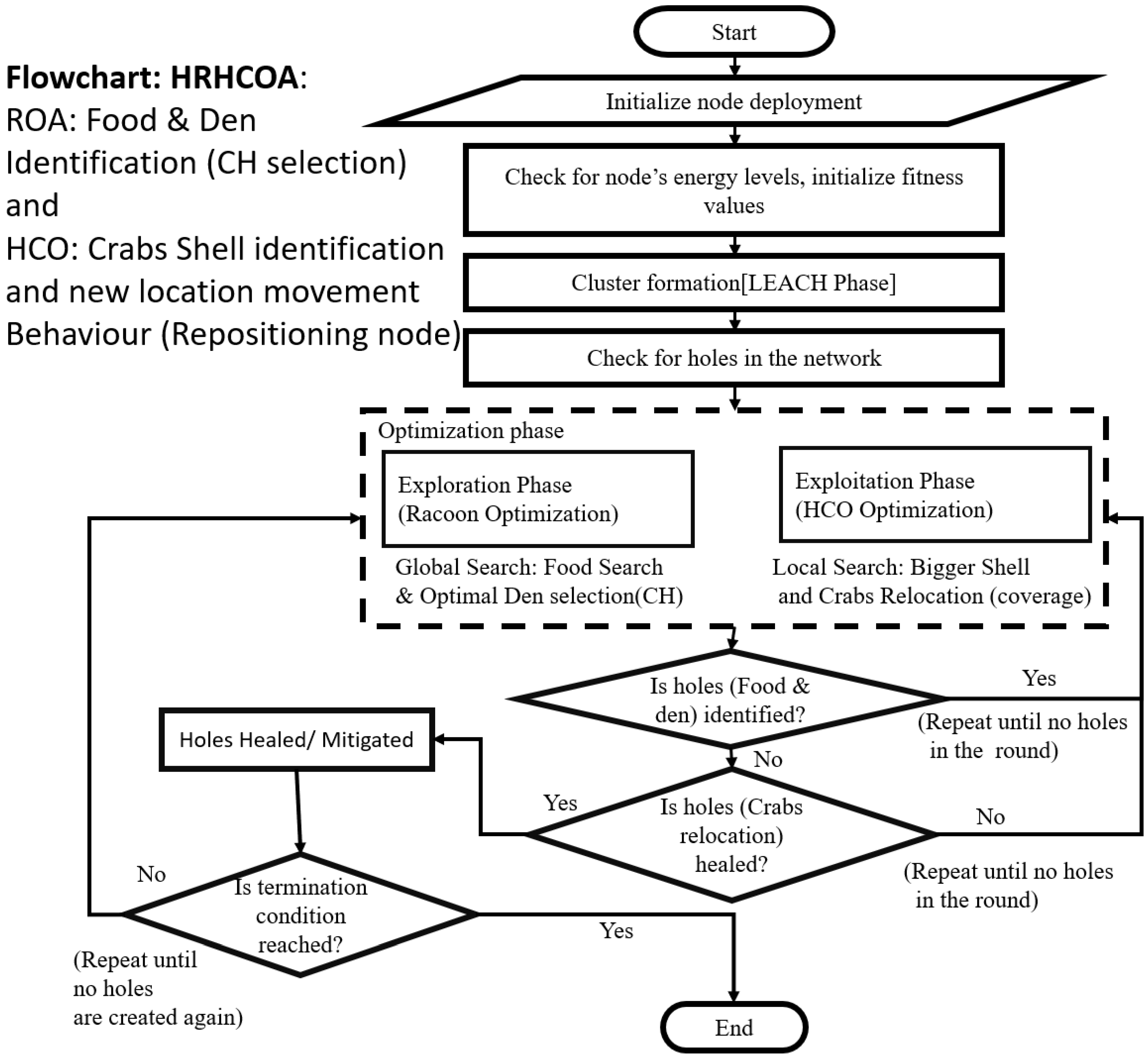
4.1.2. ROA-Based Global Search
- : Residual energy.
- : Average energy.
- : distance to base station.
- : total healed area.
4.1.3. HCO-Based Local Tuning
- : Directed movement of node towards the hole centroid.
- : Adaptive random shift using crabs behavior.
4.1.4. Healing Performance
- : Affected hole area (number of grids oints).
- : Coverage before and after healing calculated based on points in each grid sector.
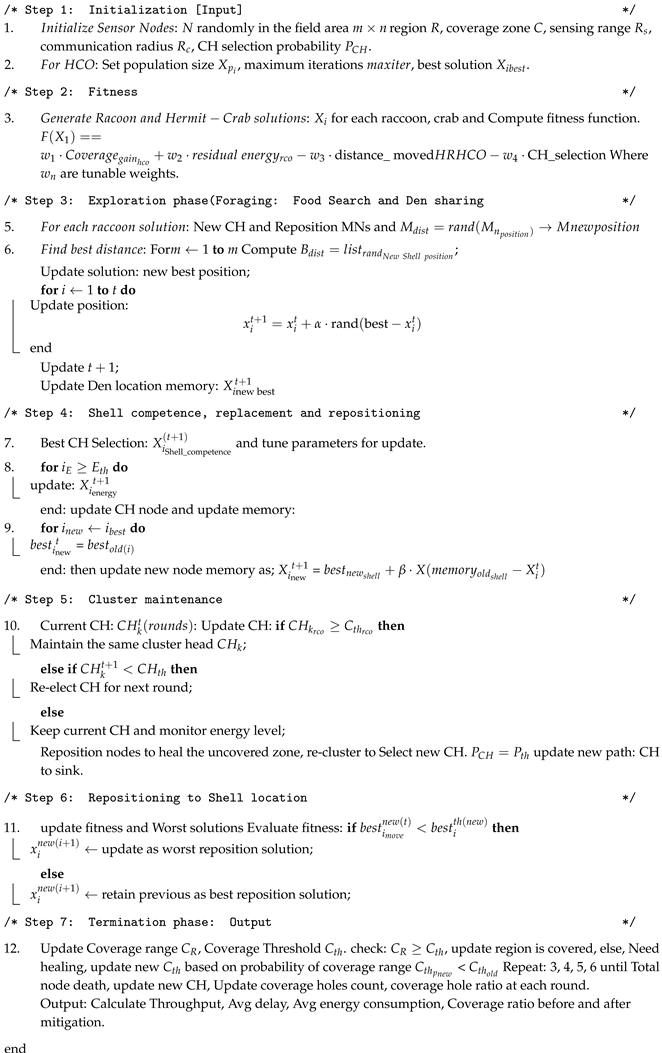
4.2. HRHCOA Algorithm and Flowchart
| Algorithm 1: Proposed HRHCOA |
 |
4.3. Time Complexity
- max_iter: Thirty is considered here because there is no large variation in coverage range after 30 counts.
- N: Population size varies based on selecting no of raccoons or hermit crabs with varying densities.
- : Depends based on the number of nodes used in the scenario.
5. Simulations Setup
5.1. System Parameters
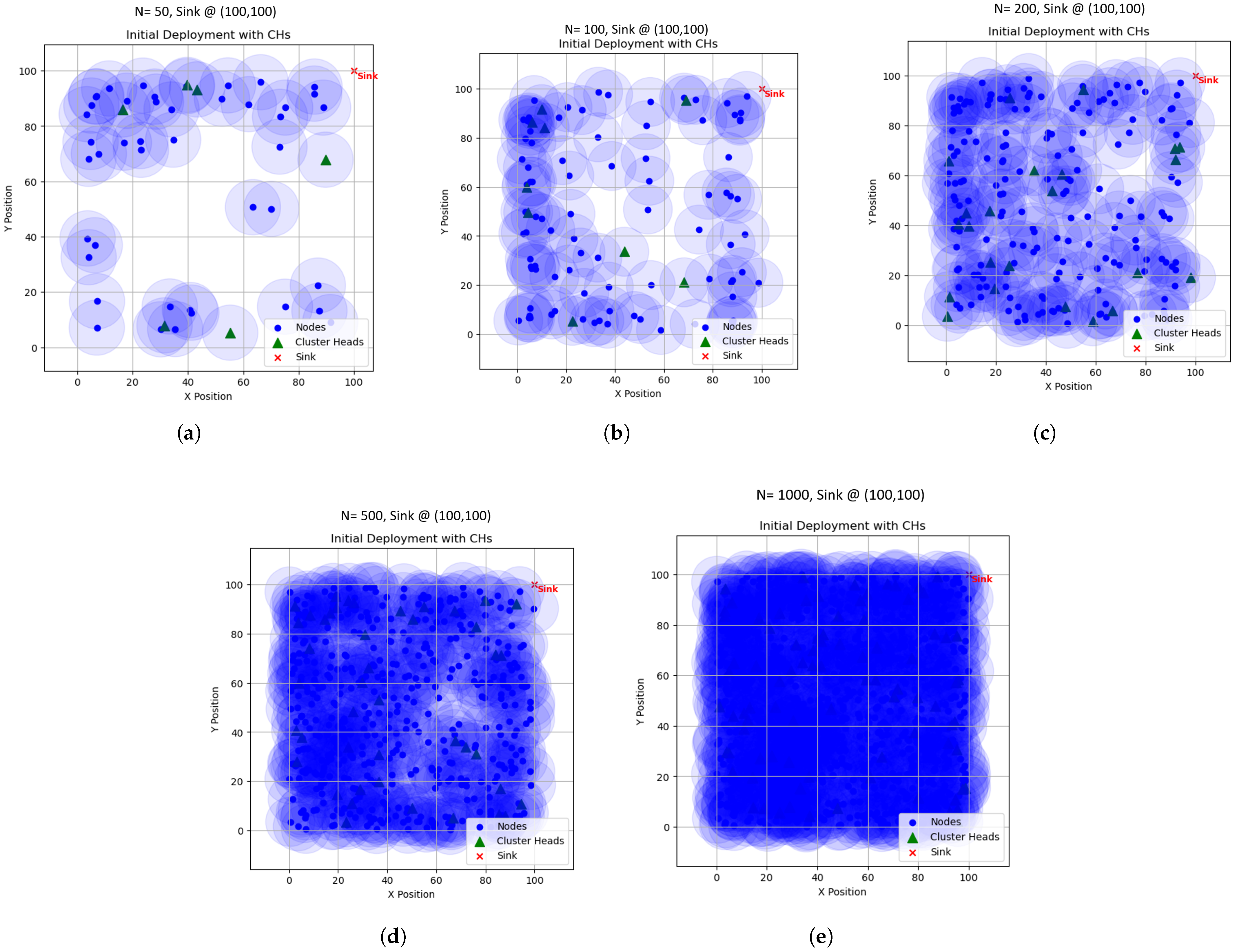
5.2. WSN Deployment
6. Results
6.1. Node Death Metrics
6.2. Coverage Ratio
7. Performance Analysis
7.1. Throughput Metrics
7.2. Delay Metrics
7.3. Energy Consumption in the Network
7.4. Limitations and Future Scope
- : As it combines both (ROA and HCO) methods that increases iteration time and processing overheads.
- : At each round, whenever a hole emerges, immediately the HRHCOA algorithm tries to heal holes, which is unnecessary at that moment, and it consumes energy and reduces lifetime.
- : When the number of nodes is increased, it proportionally increases the search space, which causes slower convergence and lower accuracy even for identifying small holes.
- : At some instances, due to misalignment and miscalculation, it may leave out small or micro neighbor holes.
- No mobile nodes or new additional nodes were added to reduce unattended area issues.
- Optimization usually runs at a centralized database; if it fails suddenly, it will create a single point of failure in the network.
- : Ensure to heal hole only, if that is necessary in that particular round. If not, proceed till necessity arrives.
- : Healing in each round increases burden, and choosing a node based on residual energy alone is not sufficient, but we need to look at other parameters associated with it.
- : Fitness evaluation functions like coverage, delay, residual energy levels, and stable connectivity need to be considered more sensitive during designing optimization techniques.
- Choosing optimized energy threshold to select optimal CH for efficient clustering.
8. Conclusions
Author Contributions
Funding
Data Availability Statement
Conflicts of Interest
Abbreviations
| Symbol/ Notation | Description |
| Transmission energy | |
| Received energy | |
| Initial energy | |
| Energy spent by electronics | |
| Amplification energy | |
| Energy spent to move | |
| Energy spent for data aggregation | |
| initial population | |
| Population based on hole | |
| Coverage new (updated coverage) | |
| Coverage old (previous coverage) | |
| H | Hole in the network |
| tunable weights for fitness | |
| Best value | |
| Cluster head Threshold | |
| Cluster head updated value based on CH number | |
| population best solution value | |
| Directed movement of the node of the Hermit crab | |
| Adaptive random shifting of Hermit crab movement | |
| Global best value of Raccoons for optimal Ch | |
| Local refining best value of Den selection by a raccoon | |
| Sensing range of the node | |
| Communication range of a node |
References
- Kandris, D.; Nakas, C.; Vomvas, D.; Koulouras, G. Applications of Wireless Sensor Networks: An Up-to-Date Survey. Appl. Syst. Innov. 2020, 3, 14. [Google Scholar] [CrossRef]
- Carlos-Mancilla, M.; López-Mellado, E.; Siller, M. Wireless Sensor Networks Formation: Approaches and Techniques. J. Sens. 2016, 2016, 2081902. [Google Scholar] [CrossRef]
- Angelin, A.C.; Silas, S. A Comparative Study of Coverage Hole Detection Techniques in Wireless Sensor Networks. Eng. Proc. 2023, 59, 5. [Google Scholar]
- Heinzelman, W.R.; Chandrakasan, A.; Balakrishnan, H. Energy-Efficient Communication Protocol for Wireless Microsensor Networks. In 33rd Annual Hawaii International Conference on System Sciences; IEEE: Piscataway, NJ, USA, 2000; p. 10. [Google Scholar]
- Sushil, L.; Satvir, S. Enhancing Energy Efficiency in Wireless Sensor Networks through I-LEACH: A Data Clustering and Routing Protocol. J. Electr. Syst. 2024, 20, 81–91. [Google Scholar]
- Gautam, N.; Pyun, J.Y. Distance Aware Intelligent Clustering Protocol for Wireless Sensor Networks. J. Commun. Netw. 2010, 12, 122–129. [Google Scholar] [CrossRef]
- Devi, S.; Sangwan, A. Genetic Algorithm-Based Coverage Maximization and Connectivity Preserving Approach Using Computational Geometry for 3-Dimensional Directional Sensor Networks. Int. J. Electron. Commun. Eng. 2025, 12, 22–39. [Google Scholar] [CrossRef]
- Bhargavi, K.V.N.A.; Varma, G.P.S.; Hemalatha, I.; Dilli, R. An Enhanced Particle Swarm Optimization-Based Node Deployment and Coverage in Sensor Networks. Sensors 2024, 24, 6238. [Google Scholar] [CrossRef] [PubMed]
- Yan, L.; He, Y.; Huangfu, Z. A Fish Swarm Inspired Holes Recovery Algorithm for Wireless Sensor Networks. Int. J. Wirel. Inf. Netw. 2020, 27, 89–101. [Google Scholar] [CrossRef]
- Onuzulike, V.C.; Nwabueze, C.A.; Obidike, A.I.; Ebih, U. Coverage Hole Detection in Embedded Wireless Sensor Network Using ACO Based Technique: Comparative Architecture. Int. J. Res. Eng. Sci. (IJRES) 2023, 11, 239–246. [Google Scholar]
- Wen, Q.; Zhao, X.Q.; Cui, Y.P.; Zeng, Y.P.; Chang, H.; Fu, Y.J. Coverage Enhancement Algorithm for WSNs Based on Vampire Bat and Improved Virtual Force. IEEE Sens. J. 2022, 22, 8245–8256. [Google Scholar] [CrossRef]
- Dey, R.; Thakurta, P.K.G.; Kar, S. Efficient Energy Aware Area Coverage in WSNs: A 2L-Voronoi Guided PSO Approach. In OPSEARCH; Springer: Berlin/Heidelberg, Germany, 2024; pp. 1–31. [Google Scholar]
- Khamlichi, Y.E.; Mesmoudi, Y.; Tahiri, A.; Abtoy, A. A Recovery Algorithm to Detect and Repair Coverage Holes in Wireless Sensor Network System. J. Commun. 2018, 13, 67–74. [Google Scholar] [CrossRef]
- Li, W.; Zhang, W. Coverage Hole and Boundary Nodes Detection in Wireless Sensor Networks. J. Netw. Comput. Appl. 2015, 48, 35–43. [Google Scholar] [CrossRef]
- Kumar Sahoo, P.; Chiang, M.J.; Wu, S.L. An Efficient Distributed Coverage Hole Detection Protocol for Wireless Sensor Networks. Sensors 2016, 16, 386. [Google Scholar] [CrossRef]
- Nguyen, D.T.; Nguyen, N.P.; Thai, M.T.; Helal, A. An Optimal Algorithm for Coverage Hole Healing in Hybrid Sensor Networks. 7th International Wireless Communications and Mobile Computing Conference; IEEE: Piscataway, NJ, USA, 2011; pp. 494–499. [Google Scholar][Green Version]
- Zhuang, Y.; Wu, C.; Wu, H.; Chu, H.; Gao, Y.; Li, L. The Repair Strategy for Event Coverage Holes Based on Mobile Robots in Wireless Sensor and Robot Networks. Sensors 2019, 19, 5045. [Google Scholar] [CrossRef] [PubMed]
- Al-Sodairi, S.; Ouni, R. Reliable and Energy-Efficient Multi-Hop LEACH-Based Clustering Protocol for Wireless Sensor Networks. Sustain. Comput. Inform. Syst. 2018, 20, 1–13. [Google Scholar] [CrossRef]
- Narayan, V.; Daniel, A.K. CHOP: Maximum Coverage Optimization and Resolve Hole Healing Problem Using Sleep and Wake-Up Technique for WSN. ADCAIJ Adv. Distrib. Comput. Artif. Intell. J. 2022, 11, 159. [Google Scholar] [CrossRef]
- Krishna, K.R.; Mohan, K.R. Hole Detection and Hole Healing in a Wireless Sensor Network Using LeDiR Methodology. Indian J. Sci. Technol. 2016, 9, 1–9. [Google Scholar] [CrossRef]
- Thakkar, A. DEAL: Distance and Energy Based Advanced LEACH Protocol. In Proceedings of the International Conference on Information and Communication Technology for Intelligent Systems; Springer International Publishing: Berlin/Heidelberg, Germany, 2017; pp. 370–376. [Google Scholar]
- Wang, F.; Hu, H. Symmetric Algorithm for Detection of Coverage Hole in Wireless Sensor Network. Wirel. Pers. Commun. 2022, 127, 141–158. [Google Scholar] [CrossRef]
- Suleiman, H.; Hamdan, M. Adaptive Probabilistic Model for Energy-Efficient Distance-Based Clustering in WSNs (Adapt-P): A LEACH-Based Analytical Study. arXiv 2021, arXiv:2110.13300. [Google Scholar]
- Yoon, C.; Cho, S.; Lee, Y. Extending WSN Lifetime with Enhanced LEACH Protocol in Autonomous Vehicle Using Improved K-Means and Advanced Cluster Configuration Algorithms. Appl. Sci. 2024, 14, 11720. [Google Scholar] [CrossRef]
- Wang, J.; Ju, C.; Gao, Y.; Kim, G.J. A PSO Based Energy Efficient Coverage Control Algorithm for Wireless Sensor Networks. Comput. Mater. Contin. 2018, 56, 433–446. [Google Scholar]
- Siamantas, G.; Kandris, D. Particle Swarm Optimization for K-Coverage and 1-Connectivity in Wireless Sensor Networks. Electronics 2024, 13, 4841. [Google Scholar] [CrossRef]
- Sekyere, Y.O.; Effah, F.B.; Okyere, P.Y. An Enhanced Particle Swarm Optimization Algorithm via Adaptive Dynamic Inertia Weight and Acceleration Coefficients. J. Electron. Electr. Eng. 2024, 3, 53–67. [Google Scholar]
- Zhao, Q.; Li, C.; Zhu, D.; Xie, C. Coverage Optimization of Wireless Sensor Networks Using Combinations of PSO and Chaos Optimization. Electronics 2022, 11, 853. [Google Scholar] [CrossRef]
- Elhoseny, M.; Tharwat, A.; Yuan, X.; Hassanien, A.E. Optimizing K-Coverage of Mobile WSNs. Expert Syst. Appl. 2018, 92, 142–153. [Google Scholar] [CrossRef]
- Larhlimi, I.; Lmkaiti, M.; Lachgar, M.; Ouchitachen, H.; Darif, A.; Mouncif, H. Genetic Algorithm-Driven Cover Set Scheduling for Longevity in Wireless Sensor Networks. Int. J. Adv. Comput. Sci. Appl. 2025, 16, 1104–1112. [Google Scholar] [CrossRef]
- Hanh, N.T.; Binh, H.T.T.; Hoai, N.X.; Palaniswami, M.S. An Efficient Genetic Algorithm for Maximizing Area Coverage in Wireless Sensor Networks. Inf. Sci. 2019, 488, 58–75. [Google Scholar] [CrossRef]
- Vishal, P. Deployment of Context-Aware Sensor in Wireless Sensor Network Based on the Variants of Genetic Algorithm. Int. J. Artif. Life Res. (IJALR) 2018, 8, 1–24. [Google Scholar] [CrossRef]
- Zain Eldin, H.; Badawy, M.; Elhosseini, M.; Arafat, H.; Abraham, A. An Improved Dynamic Deployment Technique Based on Genetic Algorithm (IDDT-GA) for Maximizing Coverage in Wireless Sensor Networks. J. Ambient Intell. Humaniz. Comput. 2020, 11, 4177–4194. [Google Scholar] [CrossRef]
- Tian, J.; Gao, M.; Ge, G. Wireless Sensor Network Node Optimal Coverage Based on Improved Genetic Algorithm and Binary Ant Colony Algorithm. EURASIP J. Wirel. Commun. Netw. 2016, 2016, 104. [Google Scholar] [CrossRef]
- Kurian, A.M.; Onuorah, M.J.; Ammari, H.M. Optimizing Coverage in Wireless Sensor Networks: A Binary Ant Colony Algorithm with Hill Climbing. Appl. Sci. 2024, 14, 960. [Google Scholar] [CrossRef]
- Jaiswal, K.; Anand, V. A QoS Aware Optimal Node Deployment in Wireless Sensor Network Using Grey Wolf Optimization Approach for IoT Applications. Telecommun. Syst. 2021, 78, 559–576. [Google Scholar] [CrossRef]
- Ou, Y.; Qin, F.; Zhou, K.Q.; Yin, P.F.; Mo, L.P.; Mohd Zain, A. An Improved Grey Wolf Optimizer with Multi-Strategies Coverage in Wireless Sensor Networks. Symmetry 2024, 16, 286. [Google Scholar] [CrossRef]
- Bashyam, S.L.R.; Subramanian, R.D.; Chandra, J. An Efficient Node-to-Node Coverage and Connectivity with RSSI Using Grey-Wolf Prediction Optimization Algorithm in Remote Low Accessibility Area. In 2023 2nd International Conference on Vision Towards Emerging Trends in Communication and Networking Technologies (ViTECoN); IEEE: Piscataway, NJ, USA, 2023; pp. 1–6. [Google Scholar]
- Xu, Y.; Zhang, B.; Zhang, Y. Application of an Enhanced Whale Optimization Algorithm on Coverage Optimization of Sensor. Biomimetics 2023, 8, 354. [Google Scholar] [CrossRef] [PubMed]
- Huang, Y.; Zhang, J.; Wei, W.; Qin, T.; Fan, Y.; Luo, X.; Yang, J. Research on Coverage Optimization in a WSN Based on an Improved COOT Bird Algorithm. Sensors 2022, 22, 3383. [Google Scholar] [CrossRef]
- Zeng, C.; Qin, T.; Tan, W.; Lin, C.; Zhu, Z.; Yang, J.; Yuan, S. Coverage Optimization of Heterogeneous Wireless Sensor Network Based on Improved Wild Horse Optimizer. Biomimetics 2023, 8, 70. [Google Scholar] [CrossRef] [PubMed]
- Kadoke, K.M.; Goyal, S.; Kaur, R. The Jellyfish Algorithm: A New Approach for Enhancing Coverage, Reducing Energy Consumption, and Extending Network Lifetime in Underwater Wireless Sensor Networks. J. Electr. Syst. Inf. Technol. 2025, 12, 68. [Google Scholar] [CrossRef]
- Kim, J.; Yoo, Y. Sensor Node Activation Using Bat Algorithm for Connected Target Coverage in WSNs. Sensors 2020, 20, 3733. [Google Scholar] [CrossRef]
- Subburathinam, K.; Bakthavatchalam, V.; Pandian, R.K.C.; Subramaniam, K.M. Enhancing Wireless Sensor Network Connectivity and Coverage Using Hybrid GWO-HSA Algorithm. Int. J. Commun. Syst. 2024, 37, e5858. [Google Scholar] [CrossRef]
- Bourebia, N.E.H.; Li, C. A Novel Raccoon Optimization Algorithm with Multi-Objective Clustering Strategy Based Routing Protocol for WSNs. Peer-to-Peer Netw. Appl. 2023, 16, 1624–1640. [Google Scholar] [CrossRef]
- Bashyam, S.L.R.; Subramanian, R.D. Hermit Crab Optimization to Overcome Coverage Hole Issue for Efficient Hole Issue in WSN. In 2024 International Conference on Electrical Electronics and Computing Technologies (ICEECT); IEEE: Piscataway, NJ, USA, 2024; Volume 1, pp. 1–8. [Google Scholar]
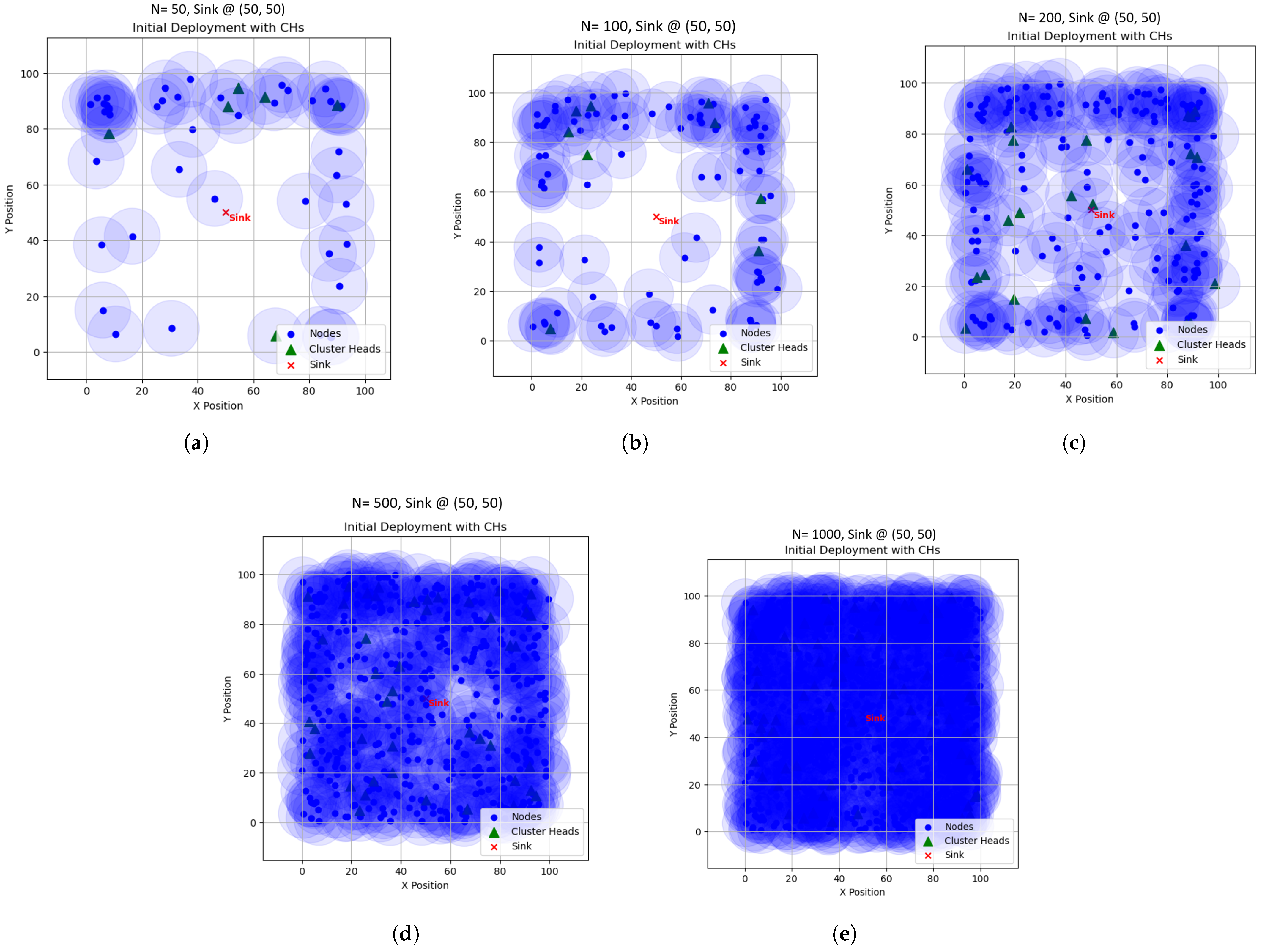
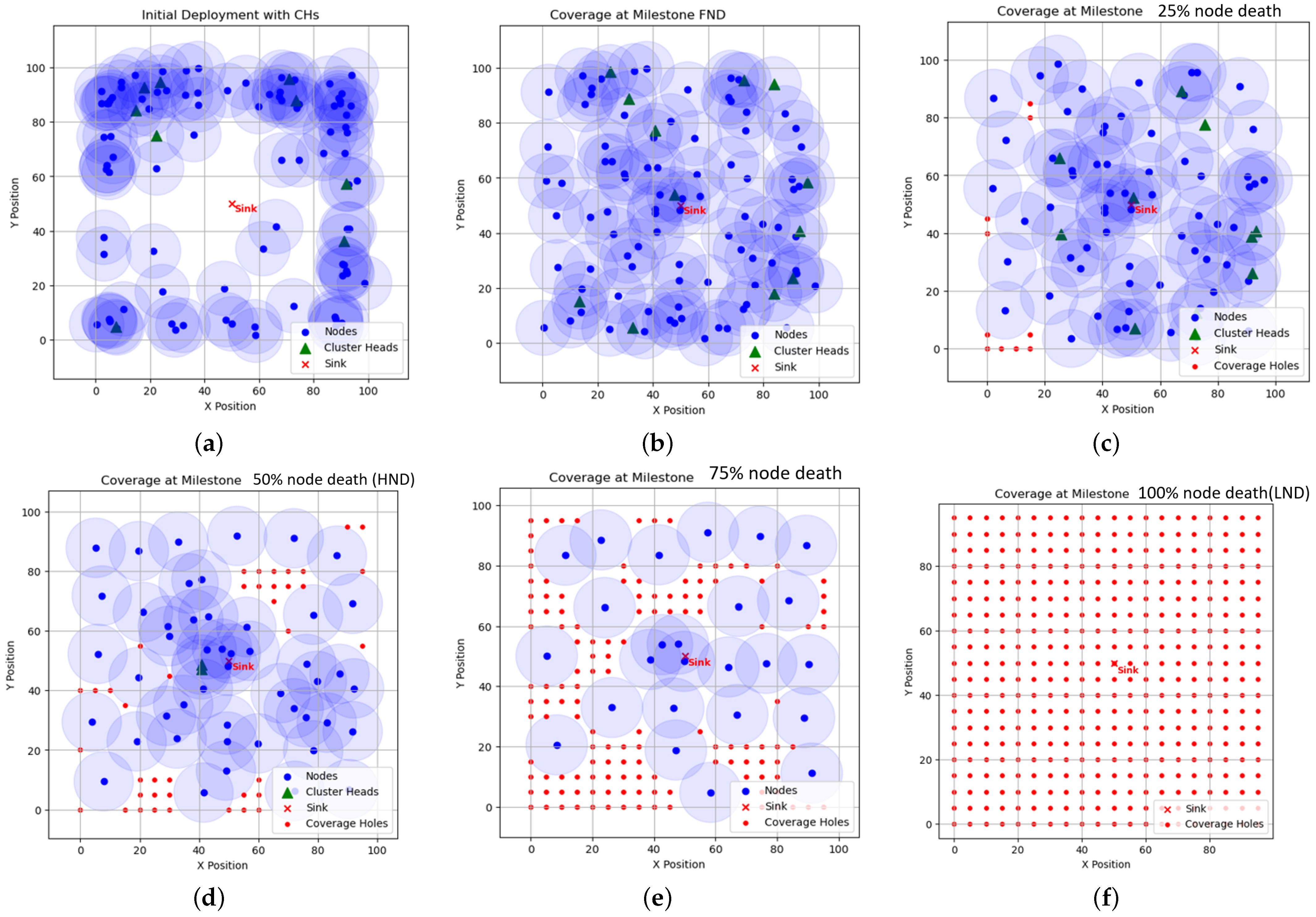
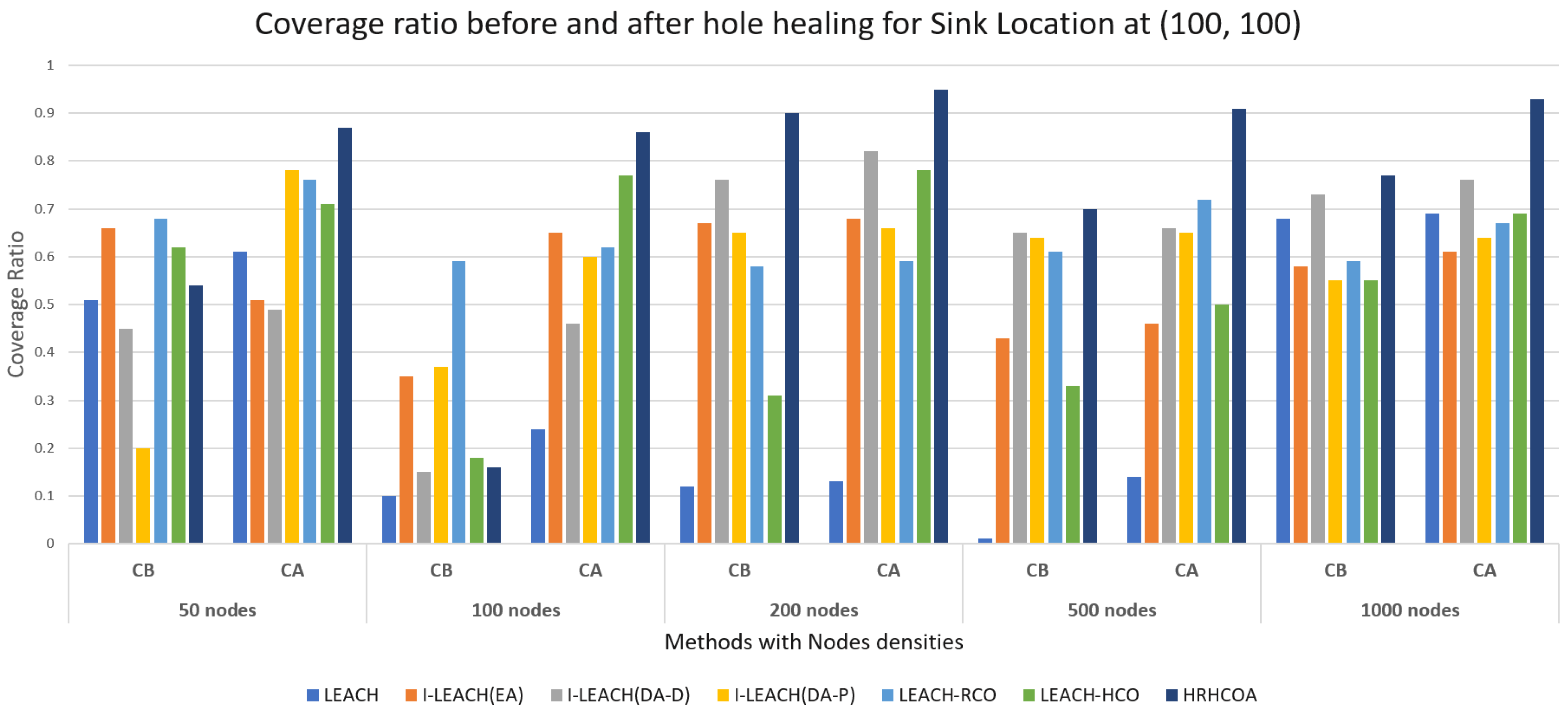
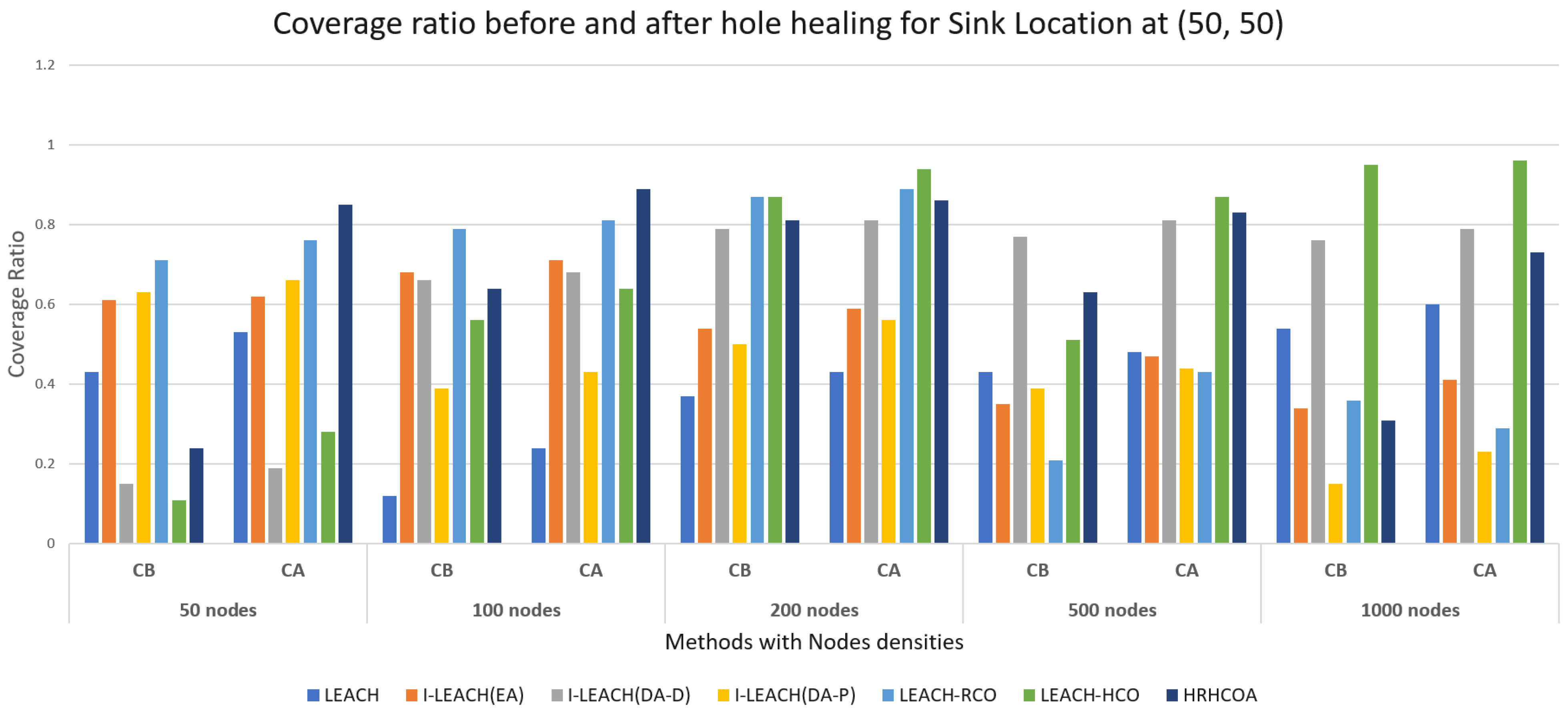
| Rounds/Metrics | Nodes Depleted | Coverage Hole Before Mitigation | Coverage Hole After Mitigation |
|---|---|---|---|
| 0 | Initial | 3 | 1 |
| 1 | 1000 | 0 | 0 |
| 50 | 1000 | 0 | 0 |
| 100 | 1000 | 0 | 0 |
| 150 | 1000 | 0 | 0 |
| 200 | 1000 | 0 | 0 |
| 250 | 1000 | 0 | 0 |
| 300 | 1000 | 0 | 0 |
| 312 | 399 (FND) | 0 | 0 |
| 350 | 999 | 0 | 0 |
| 400 | 995 | 0 | 0 |
| 450 | 981 | 0 | 0 |
| 500 | 949 | 1 | 0 |
| 550 | 876 | 3 | 0 |
| 600 | 792 | 1 | 1 |
| 650 | 683 | 14 | 12 |
| 700 | 569 | 17 | 13 |
| 730 | 500 (HND) | 20 | 18 |
| 750 | 450 | 39 | 37 |
| 800 | 323 | 36 | 35 |
| 850 | 191 | 119 | 111 |
| 900 | 11 | 309 | 308 |
| 910 | 2 | 375 | 373 |
| 911 | 1 | 386 | 381 |
| 912 | 0 (LND) | 400 | 400 |
| 913 | 0 | 400 | 400 |
| Metric/Scenario | I | II | III | IV | V |
|---|---|---|---|---|---|
| Field Size | |||||
| No. of Nodes | 50 | 100 | 200 | 500 | 1000 |
| Radio Model | Energy–Mobilty model | Energy–Mobilty model | Energy–Mobilty model | Energy–Mobilty model | Energy–Mobilty model |
| Sink location | (100, 100) (50, 50) | (100, 100) (50, 50) | (100, 100) (50, 50) | (100, 100) (50, 50) | (100, 100) (50, 50) |
| Sensing range | 10 | 10 | 10 | 10 | 10 |
| Comm range | 15 | 15 | 15 | 15 | 15 |
| (J) | 2 J | 2 J | 2 J | 2 J | 2 J |
| (J) | 50 nJ | 50 nJ | 50 nJ | 50 nJ | 50 nJ |
| 0.0073 nJ | 0.0073 nJ | 0.0073 nJ | 0.0073 nJ | 0.0073 nJ | |
| 0.0054 nJ | 0.0054 nJ | 0.0054 nJ | 0.0054nJ | 0.0054 nJ | |
| 100 pJ | 100 pJ | 100 pJ | 100 pJ | 100 pJ | |
| 10% | 10% | 10% | 10% | 10% | |
| Packet size (k) | 4000 | 4000 | 4000 | 4000 | 4000 |
| Rounds | 1500 | 1500 | 1500 | 1500 | 1500 |
| Metrics/Method | LEACH | I-LEACH (EA) | I-LEACH (DA-D) | I-LEACH (DA-P) | ROA | HCOA | HRHCOA |
|---|---|---|---|---|---|---|---|
| FND | 278 | 169 | 71 | 314 | 278 | 235 | 288 |
| HND | 478 | 375 | 248 | 512 | 479 | 539 | 456 |
| LND | 566 | 453 | 490 | 599 | 566 | 623 | 564 |
| Average Ec | 0.0443 | 0.0551 | 0.0510 | 0.0417 | 0.0443 | 0.0401 | 0.0445 |
| Average Delay | 4.6773 | 5.3845 | 5.8575 | 4.3867 | 4.6867 | 4.0958 | 4.4878 |
| Overall Throughput | 23,113 | 17,724 | 13,950 | 24,922 | 62,989 | 74,632 | 158,709 |
| CR Before (in %) | 51.25 | 66.20 | 45.20 | 20.51 | 68.90 | 62.10 | 54.21 |
| CR After (in %) | 61.40 | 67.10 | 49.90 | 78.24 | 76.98 | 71.38 | 87.81 |
| Metrics/Method | LEACH | I-LEACH (EA) | I-LEACH (DA-D) | I-LEACH (DA-P) | ROA | HCOA | HRHCOA |
|---|---|---|---|---|---|---|---|
| FND | 327 | 170 | 63 | 411 | 328 | 371 | 298 |
| HND | 591 | 532 | 323 | 628 | 592 | 623 | 564 |
| LND | 697 | 580 | 543 | 722 | 675 | 717 | 663 |
| Average Ec | 0.0721 | 0.0862 | 0.0092 | 0.0691 | 0.0710 | 0.0657 | 0.0559 |
| Average Delay | 3.720 | 4.4240 | 5.6067 | 3.6023 | 3.9104 | 3.4650 | 3.0028 |
| Overall Throughput | 57,258 | 47,725 | 31,770 | 32,802 | 62,353 | 79,735 | 83,406 |
| CR Before (in %) | 10.74 | 35.71 | 15.44 | 37.69 | 59.82 | 18.95 | 16.45 |
| CR After (in %) | 24.83 | 65.12 | 46.51 | 62.98 | 60.27 | 77.07 | 86.24 |
| Metrics/Method | LEACH | I-LEACH (EA) | I-LEACH (DA-D) | I-LEACH (DA-P) | ROA | HCOA | HRHCOA |
|---|---|---|---|---|---|---|---|
| FND | 388 | 192 | 37 | 522 | 376 | 336 | 299 |
| HND | 645 | 622 | 359 | 738 | 676 | 685 | 672 |
| LND | 802 | 674 | 477 | 849 | 816 | 836 | 805 |
| Average Ec | 0.1762 | 0.1483 | 0.1666 | 0.1477 | 0.1236 | 0.1196 | 0.1252 |
| Average Delay | 4.0012 | 3.9062 | 5.3121 | 3.9700 | 3.4330 | 2.8949 | 3.0721 |
| Overall Throughput | 131,109 | 112,247 | 170,628 | 147,659 | 641,710 | 632,861 | 647,498 |
| CR Before (in %) | 12.43 | 67.43 | 76.63 | 65.17 | 58.75 | 31.26 | 90.30 |
| CR After (in %) | 13.75 | 68.75 | 82.31 | 66.05 | 59.71 | 78.48 | 95.40 |
| Metrics/Method | LEACH | I-LEACH (EA) | I-LEACH (DA-D) | I-LEACH (DA-P) | ROA | HCOA | HRHCOA |
|---|---|---|---|---|---|---|---|
| FND | 393 | 208 | 25 | 627 | 375 | 384 | 374 |
| HND | 705 | 655 | 358 | 803 | 705 | 708 | 705 |
| LND | 868 | 734 | 660 | 948 | 879 | 908 | 874 |
| Average Ec | 0.3521 | 0.3405 | 0.3787 | 0.3637 | 0.3174 | 0.2753 | 0.2892 |
| Average Delay | 2.9742 | 3.6750 | 5.0545 | 2.8974 | 2.6776 | 2.4168 | 2.5732 |
| Overall Throughput | 346,320 | 300,462 | 184,857 | 406,008 | 1,573,697 | 1,530,017 | 1,581,633 |
| CR Before (in %) | 01.24 | 43.15 | 65.70 | 64.62 | 61.13 | 33.15 | 70.79 |
| CR After (in %) | 14.21 | 46.15 | 66.21 | 65.47 | 72.32 | 50.39 | 91.53 |
| Metrics/Method | LEACH | I-LEACH (EA) | I-LEACH (DA-D) | I-LEACH (DA-P) | ROA | HCOA | HRHCOA |
|---|---|---|---|---|---|---|---|
| FND | 347 | 245 | 10 | 647 | 318 | 317 | 317 |
| HND | 701 | 691 | 369 | 862 | 729 | 731 | 730 |
| LND | 908 | 807 | 720 | 1030 | 928 | 932 | 912 |
| Average Ec | 0.5060 | 0.6195 | 0.6944 | 0.6854 | 0.6453 | 0.5364 | 0.5029 |
| Average Delay | 3.1210 | 3.4910 | 4.8584 | 2.9200 | 2.3254 | 2.2960 | 2.2792 |
| Overall Throughput | 718,861 | 650,828 | 387,672 | 867,307 | 1,688,105 | 3,089,209 | 3,139,293 |
| CR Before (in %) | 68.71 | 58.63 | 73.12 | 55.61 | 59.21 | 55.61 | 77.05 |
| CR After (in %) | 69.31 | 61.27 | 76.23 | 64.23 | 67.82 | 69.53 | 93.94 |
| Metrics/Method | LEACH | I-LEACH (EA) | I-LEACH (DA-D) | I-LEACH (DA-P) | ROA | HCOA | HRHCOA |
|---|---|---|---|---|---|---|---|
| FND | 347 | 314 | 124 | 465 | 348 | 277 | 389 |
| HND | 574 | 536 | 571 | 678 | 576 | 613 | 566 |
| LND | 747 | 567 | 731 | 704 | 749 | 762 | 630 |
| Average Ec | 0.0335 | 0.0440 | 0.3419 | 0.0355 | 0.0346 | 0.0328 | 0.0307 |
| Average Delay | 3.8511 | 4.4660 | 4.2651 | 3.7869 | 3.7347 | 3.5604 | 3.9021 |
| Overall Throughput | 28,000 | 25,218 | 26,860 | 48,911 | 149,665 | 159,569 | 174,356 |
| CR Before (in %) | 43.29 | 61.65 | 15.42 | 63.57 | 71.43 | 01.14 | 24.71 |
| CR After (in %) | 53.74 | 62.93 | 19.74 | 66.41 | 76.57 | 28.55 | 85.42 |
| Metrics/Method | LEACH | I-LEACH (EA) | I-LEACH (DA-D) | I-LEACH (DA-P) | ROA | HCOA | HRHCOA |
|---|---|---|---|---|---|---|---|
| FND | 499 | 332 | 90 | 576 | 500 | 521 | 472 |
| HND | 764 | 669 | 652 | 765 | 819 | 777 | 753 |
| LND | 850 | 691 | 819 | 843 | 850 | 894 | 845 |
| Average Ec | 0.0590 | 0.0723 | 0.0610 | 0.0593 | 0.0580 | 0.0559 | 0.0519 |
| Average Delay | 3.3289 | 3.7529 | 3.9036 | 3.1203 | 3.0289 | 2.9922 | 3.0618 |
| Overall Throughput | 75,021 | 61,043 | 60,459 | 80,236 | 352,569 | 340,890 | 349,514 |
| CR Before (in %) | 12.56 | 68.89 | 66.49 | 39.71 | 79.42 | 56.84 | 64.32 |
| CR After (in %) | 24.89 | 71.04 | 68.42 | 43.51 | 81.02 | 68.91 | 89.71 |
| Metrics/Method | LEACH | I-LEACH (EA) | I-LEACH (DA-D) | I-LEACH (DA-P) | ROA | HCOA | HRHCOA |
|---|---|---|---|---|---|---|---|
| FND | 596 | 336 | 60 | 653 | 597 | 605 | 606 |
| HND | 924 | 742 | 761 | 992 | 925 | 924 | 916 |
| LND | 1005 | 761 | 959 | 1133 | 1005 | 1018 | 1008 |
| Average Ec | 0.1000 | 0.1314 | 0.1042 | 0.1008 | 0.1000 | 0.0923 | 0.1008 |
| Average Delay | 2.5917 | 3.3720 | 3.4579 | 2.5550 | 2.4917 | 2.4798 | 2.4583 |
| Overall Throughput | 180,531 | 134,620 | 137,587 | 191,550 | 717,735 | 724,892 | 720,004 |
| CR Before (in %) | 37.42 | 54.87 | 79.92 | 50.48 | 87.45 | 87.75 | 81.73 |
| CR After (in %) | 43.23 | 59.11 | 81.68 | 56.72 | 89.18 | 94.93 | 86.31 |
| Metrics/Method | LEACH | I-LEACH (EA) | I-LEACH (DA-D) | I-LEACH (DA-P) | ROA | HCOA | HRHCOA |
|---|---|---|---|---|---|---|---|
| FND | 706 | 446 | 46 | 930 | 707 | 734 | 706 |
| HND | 1004 | 821 | 819 | 1060 | 1005 | 709 | 1010 |
| LND | 1089 | 848 | 1085 | 1117 | 1064 | 908 | 1089 |
| Average Ec | 0.2314 | 0.2948 | 0.2304 | 0.2238 | 0.2145 | 0.2053 | 0.2136 |
| Average Delay | 2.1624 | 2.9860 | 3.0169 | 2.1473 | 2.1625 | 2.0168 | 2.0405 |
| Overall Throughput | 492,964 | 385,831 | 373,961 | 529,002 | 1,808,866 | 1,930,017 | 2,107,592 |
| CR Before (in %) | 43.91 | 35.08 | 77.82 | 39.03 | 21.41 | 51.30 | 63.39 |
| CR After (in %) | 48.91 | 47.31 | 81.39 | 44.78 | 43.18 | 87.57 | 83.28 |
| Metrics/Method | LEACH | I-LEACH (EA) | I-LEACH (DA-D) | I-LEACH (DA-P) | ROA | HCOA | HRHCOA |
|---|---|---|---|---|---|---|---|
| FND | 760 | 647 | 24 | 935 | 760 | 760 | 760 |
| HND | 1031 | 950 | 830 | 1106 | 1032 | 1029 | 1031 |
| LND | 1125 | 997 | 1130 | 1187 | 1096 | 1139 | 1129 |
| Average Ec | 0.4491 | 0.5015 | 0.4424 | 0.4212 | 0.3941 | 0.3898 | 0.3477 |
| Average Delay | 1.9275 | 2.5075 | 2.8274 | 1.9288 | 1.9275 | 1.8948 | 1.9039 |
| Overall Throughput | 1,014,673 | 922,848 | 759,938 | 1,102,151 | 3,604,170 | 3,860,228 | 3,589,427 |
| CR Before (in %) | 54.32 | 34.71 | 76.17 | 15.49 | 36.04 | 95.32 | 31.34 |
| CR After (in %) | 60.41 | 41.78 | 79.74 | 23.64 | 29.81 | 96.51 | 73.12 |
Disclaimer/Publisher’s Note: The statements, opinions and data contained in all publications are solely those of the individual author(s) and contributor(s) and not of MDPI and/or the editor(s). MDPI and/or the editor(s) disclaim responsibility for any injury to people or property resulting from any ideas, methods, instructions or products referred to in the content. |
© 2026 by the authors. Licensee MDPI, Basel, Switzerland. This article is an open access article distributed under the terms and conditions of the Creative Commons Attribution (CC BY) license.
Share and Cite
Bashyam, S.L.R.; Subramanian, R.D. Energy-Efficient Wireless Sensor Networks Through Coverage Hole Detection and Mitigation Using a Hybrid Raccoon–Hermit Crab Optimization Algorithm. Future Internet 2026, 18, 163. https://doi.org/10.3390/fi18030163
Bashyam SLR, Subramanian RD. Energy-Efficient Wireless Sensor Networks Through Coverage Hole Detection and Mitigation Using a Hybrid Raccoon–Hermit Crab Optimization Algorithm. Future Internet. 2026; 18(3):163. https://doi.org/10.3390/fi18030163
Chicago/Turabian StyleBashyam, Sean Laurel Rex, and Renuga Devi Subramanian. 2026. "Energy-Efficient Wireless Sensor Networks Through Coverage Hole Detection and Mitigation Using a Hybrid Raccoon–Hermit Crab Optimization Algorithm" Future Internet 18, no. 3: 163. https://doi.org/10.3390/fi18030163
APA StyleBashyam, S. L. R., & Subramanian, R. D. (2026). Energy-Efficient Wireless Sensor Networks Through Coverage Hole Detection and Mitigation Using a Hybrid Raccoon–Hermit Crab Optimization Algorithm. Future Internet, 18(3), 163. https://doi.org/10.3390/fi18030163