


Abstract
Bipartite network community detection is of significant importance for understanding the underlying structure and functional organization of real-world complex systems. Although many mature community detection algorithms exist for unipartite networks, they cannot be directly applied to bipartite networks due to their unique topological structure, characterized by heterogeneous node types and cross-layer connections. Furthermore, some existing bipartite network community detection methods still rely heavily on manual experience to set key parameters, which limits their applicability and scalability in practical scenarios. To address these issues, this paper proposes an enhanced framework—the Adaptive Network Reconstruction Framework (ANRF)—by introducing an adaptive parameter optimization mechanism based on the existing Network Reconstruction Framework (NRF). This framework can be effectively integrated with traditional unipartite network community detection algorithms to achieve automatic community detection with reduced dependence on manual parameter tuning. The core procedure of the method consists of four main steps. First, we calculate the interaction forces between node pairs. Second, through comprehensive analysis of the network topological features, we adaptively determine the threshold parameter and related parameters for the interaction forces. Third, based on these thresholds and parameters, we perform edge filtering on the bipartite network to construct a reconstructed network. Finally, we apply unipartite community detection algorithms directly to the reconstructed network to obtain the community structure. To validate the effectiveness of ANRF, we combined it with the Louvain method and the Greedy modularity method, and conducted experimental evaluations on multiple synthetic and real-world network datasets. A systematic comparison with current state-of-the-art algorithms was made. The experimental results on multiple synthetic and real-world datasets within our evaluated scope demonstrate that ANRF achieves competitive performance in terms of community modularity and community density compared to state-of-the-art algorithms, while significantly reducing reliance on manual parameter tuning and enhancing robustness under the tested conditions.
1. Introduction
Complex network analysis has emerged as a vital tool for uncovering the structural and functional organization of systems across diverse fields such as society [1], biology [2], and information science [3]. Within this domain, community detection—a key technique for identifying densely connected node subsets—plays an essential role in understanding the modular functions and dynamic behaviors of networks. A bipartite network represents a special type of complex network structure, consisting of two disjoint sets of nodes, where connections are only permitted between nodes from different sets. This characteristic enables bipartite networks to naturally represent real-world associations, such as user–item interactions [4], author–paper relationships [5], and protein–disease linkages [6]. Conducting community detection in bipartite networks thus facilitates the discovery of latent functional modules and organizational patterns within complex systems. The unique structure of bipartite networks presents distinct challenges for community detection. In such networks, a meaningful community typically needs to include members from both types of nodes, which prevents traditional community detection algorithms designed for unipartite networks from being directly applicable. To address this issue, a common approach is to map the bipartite network into a unipartite network [7,8] and then apply well-established unipartite community detection algorithms. However, such mapping methods may introduce redundant information or noise during the projection process, and the quality of community detection heavily depends on the accuracy of the projection step [9,10]. Further research by Candellone et al. [11] indicates that community detection results are highly sensitive to the choice of threshold parameter. Even in completely random networks, inappropriate parameters can generate spurious high-modularity communities. This finding not only confirms the universality of the parameter sensitivity issue but also highlights its severity, thus emphasizing the urgency and necessity of developing adaptive parameter adjustment mechanisms.
To address the above limitations, this paper proposes an Adaptive Network Reconstruction Framework (ANRF) based on self-optimizing parameters. The core idea of this framework involves four key steps. First, we calculate the interaction forces between node pairs in the bipartite network. Second, by empirically analyzing the network’s topological features and the distribution of interaction forces, we apply a set of heuristic rules to autonomously determine the interaction force threshold and the maximum connection count k per node. Third, based on the determined threshold and connection constraints, we perform edge filtering on the network, reconstructing the original bipartite network into a simplified version that retains key topological features while being suitable for community detection. Finally, we directly apply traditional unipartite network community detection algorithms to this reconstructed network to identify community structures.
The main contributions of this paper are as follows:
- Adaptive parameter optimization mechanism: By analyzing the network topological features and the distribution of interaction forces, the parameter combination () is automatically determined, eliminating the need for manual parameter setting and significantly reducing reliance on human intervention.
- Adaptive network reconstruction framework: The aforementioned parameter adaptation mechanism is embedded into the bipartite network reconstruction process, forming an adaptive community detection framework. This framework can adapt to networks with different densities and structural characteristics, enabling robust reconstruction of diverse bipartite networks.
- Systematic experimental validation: Comprehensive experimental evaluations were conducted on multiple synthetic and real-world networks. The results demonstrate that ANRF consistently detects relatively high-quality community structures across different parameter settings, while significantly reducing the sensitivity to parameter selection inherent in traditional methods.
The rest of this paper is organized as follows: Section 2 systematically reviews traditional bipartite network community detection methods and analyzes in detail the typical algorithms that rely on manual parameter tuning along with their limitations. Section 3 elaborates on the design principles of the ANRF, its adaptive parameter optimization mechanism, and the core concepts and implementation workflow of the algorithm. Section 4 validates the effectiveness of the ANRF through experiments on both synthetic networks and real-world networks, providing a comparative analysis. Section 5 concludes the paper and outlines potential directions for future research.
2. Related Works
Bipartite network community detection is essential for understanding the functional organization of complex systems. In recent years, with the explosive growth in data scale and complexity, the research focus in this field has gradually shifted from traditional community quality optimization toward achieving algorithmic efficient parameter tuning in bipartite networks.
2.1. Traditional Community Detection Algorithms in Bipartite Networks
Modularity is a core metric for evaluating community partition quality. Barber [12] introduced modularity specifically for bipartite networks, defined as the difference between the intra-community connection density and the expected density under a random configuration model—establishing the methodological foundation for this field. However, direct optimization of modularity is an NP-hard problem, and the modularity function itself suffers from a resolution limit, making it difficult to detect small-scale communities.
To rise to these optimization challenges, researchers have proposed various improved methods. It is important to note that these methods differ in how they handle the bipartite structure: some operate directly on bipartite graphs, while others rely on projection techniques that may introduce artifacts.
Projection-based approaches [7,8] first transform the bipartite network into a unipartite projection before applying standard community detection algorithms. While simple to implement, these methods may introduce redundant information or noise during the projection process, and the quality of community detection heavily depends on the accuracy of the projection step [9,10]. This limitation has been highlighted by studies showing that projection-induced artifacts can significantly affect community detection outcomes [11].
Direct modularity optimization methods operate on the bipartite structure without projection. For instance, Federico et al. [13] tackled a key limitation in conventional modularity optimization methods, where the number of communities must be predetermined or selected after the fact. By extending the Fuzzy Entropic Barber Modularity and incorporating a resolution parameter, they enabled online adaptation of the community count, thereby providing an efficient and self-tuning modularity optimization framework for detecting overlapping communities in bipartite networks. Similarly, the BiVoting algorithm proposed by Khosrozadeh et al. [14] integrates centrality metrics with modularity optimization, improving computational efficiency through voting and merging strategies. Wu et al. [15] employed a spectral clustering approach that operates directly on the bipartite modularity matrix, approximating the optimal partition by solving its eigenvectors and providing an effective benchmark for subsequent research. However, these methods are still constrained by the inherent limitations of the modularity function and often require preset key parameters (e.g., the number of communities), leading to insufficient adaptability to diverse network structures.
Similarity-based and clustering methods incorporate richer structural information to enhance model expressiveness. Wang et al. [16] focus on improving node similarity measurement, proposing a novel similarity index tailored for bipartite networks and achieving community identification based on this metric. Yang et al. [17] addressed a key bipartite-specific challenge—the presence of outlier and hub nodes—by defining node similarity based on the fundamental bipartite graph unit, the “butterfly” motif, and designed a novel structural clustering model that effectively identifies such special nodes. Contisciani et al. [18] proposed the Piham model, which can jointly model heterogeneous networks with multiple types of node attributes and multi-layer edge relationships, while enhancing parameter interpretability through techniques such as Laplacian matching. Cheng et al. [19] introduced the SADNG model—a Structured Autoencoder-like method that combines Deep Nonnegative Matrix Factorization (DNMF) with Graph Neural Networks (GNNs). This integration leverages DNMF’s high interpretability to alleviate the over-smoothing issue in GNNs, while simultaneously utilizing GNNs to enhance robustness against nonlinear structures and topological noise. For specific network types such as directed networks, Cionca et al. [20] introduced the theory of “dual modularity,” redefining communities as functionally complementary pairs of “source” and “sink” nodes, providing new insights for redesigning core metrics to adapt to network characteristics.
2.2. Community Detection Algorithms with Parameter Optimization in Bipartite Networks
In recent years, reducing reliance on manual parameter tuning while improving algorithm adaptability and interpretability has become a key research focus. Researchers have made efforts to reduce the number of preset parameters, with varying degrees of success in addressing bipartite-specific challenges.
Parameter-free and adaptive methods have emerged as a promising direction. Bouguessa and Nouri [21] proposed the BiNeTClus algorithm, which adopts a two-stage design combining transaction clustering and modularity optimization, thus eliminating the need to preset the number of communities. The GATFELPA model [22] integrates graph attention networks with label propagation and introduces an adaptive strategy to dynamically determine the optimal number of network aggregation layers, alleviating the over-smoothing problem. Zhou et al. [23] proposed an end-to-end community co-partitioning model for bipartite networks, which reconstructs bipartite modularity into a differentiable loss function and designs a compatible graph neural network encoder, enabling direct mapping from network input to community partition. Berahmand et al. [24], focusing on attributed networks, introduced a novel spectral clustering method that constructs a parameter-free affinity matrix, aiming to automatically learn robust node similarities from node attributes without relying on prior parameters.
Other approaches have explored different strategies for parameter adaptation. Zhao et al. [25] proposed a Louvain-based fusion framework that integrates topological and attribute structures, effectively incorporating node attribute information while utilizing network topological connections to achieve more comprehensive community structure mining in social networks. However, the “parameter-free” nature of such methods often applies primarily to the similarity calculation stage, and their performance may depend heavily on large amounts of training data, incurring high training costs and facing challenges in model interpretability.
Recently, Chang et al. [26] proposed the Network Reconstruction Framework (NRF) for bipartite networks. This framework reconstructs the original bipartite network by calculating both explicit and implicit interaction forces between node pairs, thereby enabling the direct application of unipartite network algorithms to the reconstructed network. The core idea of NRF is to transform the bipartite structure into a weighted unipartite graph that preserves the essential topological features of the original network while being compatible with standard community detection methods such as Louvain and Greedy Modularity.
However, despite its effectiveness in demonstrating the potential of reconstruction-based community detection, NRF has a significant limitation: its quality heavily depends on the setting of the interaction force threshold. This threshold must be manually tuned, making the framework’s performance sensitive to parameter selection and requiring extensive experimentation to identify optimal values for different network structures. This dependency on manual intervention restricts its applicability and scalability in practical scenarios where networks vary widely in their topological characteristics.
The proposed ANRF improves upon NRF by incorporating a self-optimization capability that eliminates the need for manual parameter tuning and refines the computation of implicit interaction forces, thereby overcoming the key limitation of its predecessor while preserving the advantages of reconstruction-based community detection for bipartite networks.
Given that existing algorithms heavily rely on researchers’ experience and laborious parameter tuning processes, this paper proposes an Adaptive Network Reconstruction Framework (ANRF). By analyzing the topological and interaction force distribution characteristics of the original bipartite network, this framework adaptively determines the key parameters for the reconstruction process.
3. The Description of ANRF-Based Community Detection Algorithm
The principal innovation of the ANRF proposed in this paper is a set of empirically driven heuristic rules for parameter selection. This mechanism is designed to adaptively accommodate diverse network structures without depending on any formally defined global objective function. The remainder of this section systematically elaborates on the framework from five perspectives: basic definitions, adaptive parameter determination, bipartite network reconstruction, the ANRF-based algorithm description, and complexity analysis.
3.1. Basic Definitions
Consider a bipartite network , where U and V represent two disjoint node sets, and E denotes the edge set. The objective of community detection is to partition the bipartite network G into k communities , where each community must contain nodes from both U and V (i.e., and ).
Definition 1.
Node Pair: In a bipartite network G, any two nodes connected by an edge are called a node pair.
Definition 2.
Neighbors (): In a bipartite network G, the set of all neighbors directly connected to node u or v is denoted as (or ).
Definition 3.
Second-order Neighbors (): In a bipartite network G, the set of all nodes connected to neighbors of node u or v is denoted as (or ).
Definition 4.
Interaction Force (): During network reconstruction, we consider both neighbors and second-order neighbors of nodes. Structural similarity is measured using Jaccard similarity, and node degree-based normalization is applied to ensure fairness across nodes with different degrees. In a bipartite network G, the interaction force between any node pair is calculated as follows:
where represents the force exerted by node u on node v, measured by the size of the intersection between the direct neighbors of u and the second-order neighbors of v. Similarly, represents the force exerted by node v on node u. The normalization factors and are introduced to ensure that the interaction force is not disproportionately high due to high node degrees.
For example, in social networks such as user-topic networks, the interaction force between entities has two components. The first is the user’s attention toward a topic, manifested through historical behaviors like likes and reposts, as well as the degree of shared attention to that topic within their social circle. The second is the topic’s attractiveness to the user, reflected by the overlap between the topic’s content and the user’s interest communities, such as affinity groups or related topic clusters.
3.2. Adaptive Parameter Determination Method
To address the issue of manual parameter tuning in traditional bipartite network community detection, this paper proposes an adaptive parameter determination method based on network statistical properties.
3.2.1. Adaptive Threshold Determination
Threshold determines which original edges are retained during reconstruction. An excessively high may result in the loss of substantial connection information, leading to an overly sparse network, while an excessively low may fail to effectively filter out noisy edges, thereby compromising the quality of community detection. To ensure robustness across networks with different topological characteristics, we integrate a parametric approach based on the normal distribution assumption with a non-parametric quantile-based method, maintaining robustness under varying distribution patterns.
Let the interaction forces of all original edges in the network form a set:
where and represent the sizes of the two node sets, respectively. The adaptive threshold is calculated as follows:
where denotes the mean of the interaction forces, represents the standard deviation of the interaction forces, and is the 20th percentile. This quantile is introduced to prevent the threshold from being set too high, thereby avoiding excessive removal of useful edges. is an adjustment coefficient that scales the standard deviation in threshold calculation. A minimum threshold of 0.01 is set as a safeguard to ensure basic network connectivity. This combined approach ensures robust edge selection across networks with diverse topological properties.
The threshold formulation in Equation (3) combines mean (), standard deviation (), and the 20th percentile () to leverage their complementary strengths. Parametric statistics (mean and standard deviation) efficiently capture global distribution properties when the interaction forces are approximately normal, while the non-parametric percentile provides robustness against skewed distributions and outliers. The min operator selects the most conservative estimate, ensuring the threshold adapts to diverse network characteristics. This design is empirically validated in Section 4.6.2, where different percentile settings yield NMI differences within .
3.2.2. Adaptive Connection Count Parameter k Determination
The parameter k controls the maximum number of connections retained for each node in the reconstructed network. This parameter is related to the network scale: an excessively large k may introduce redundant connections, while an excessively small k can compromise the integrity of the community structure. Let the total number of nodes in the network be to ensure a reasonable balance between connection count and network scale. The adaptive connection count k is calculated as follows:
where represents the upper bound of the connection count and controls network density after reconstruction. To avoid over-connection in large-scale networks, we set . The term reflects the natural scaling relationship with network size, where is the scaling coefficient (set to 2.0 herein) and controls the relationship between k and network size.
The upper bound is chosen to balance sparsity preservation and computational efficiency. This value grows sublinearly with network size: it is large enough to retain meaningful community structure, yet small enough to keep the reconstructed network sparse, in edges. Empirical testing during framework development confirmed that consistently provides the optimal trade-off compared to smaller values, which risk disconnection, or larger values, which introduce unnecessary density.
3.2.3. Adaptive Handling of Isolated Nodes
For potential isolated nodes that may arise after reconstruction, we set a minimum number of connections to ensure every node can be integrated into the network.
Let m be the actual number of edges in the bipartite network, and be the maximum possible number of edges. The network density is defined as:
To dynamically adjust the number of connections for isolated nodes based on network sparsity, the adaptive connection count, , is calculated as:
where indicates the network sparsity level—the larger the value, the sparser the network; the constant 3 acts as a scaling factor to adjust the base magnitude of the connection count, while the constant 1 serves as the final lower bound to ensure each isolated node retains at least one connection.
3.3. Bipartite Network Reconstruction
Based on the adaptively determined parameters described above, we reconstruct the original bipartite network using the interaction force . The original bipartite network is transformed into a weighted reconstructed network , where: denotes the set of nodes, represents the set of reconstructed edges, and W indicates the set of edge weights. The weighted adjacency matrix of the reconstructed network is expressed as:
where corresponds to the weight matrix between U-type and V-type nodes.
During reconstruction, each node retains the top-k connections with the highest weights, ensuring the network preserves essential community structures while controlling computational complexity.
3.4. Description of the ANRF-Based Algorithm
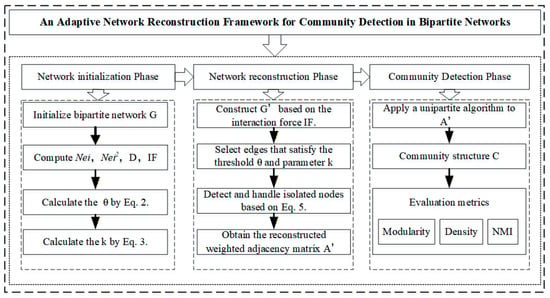
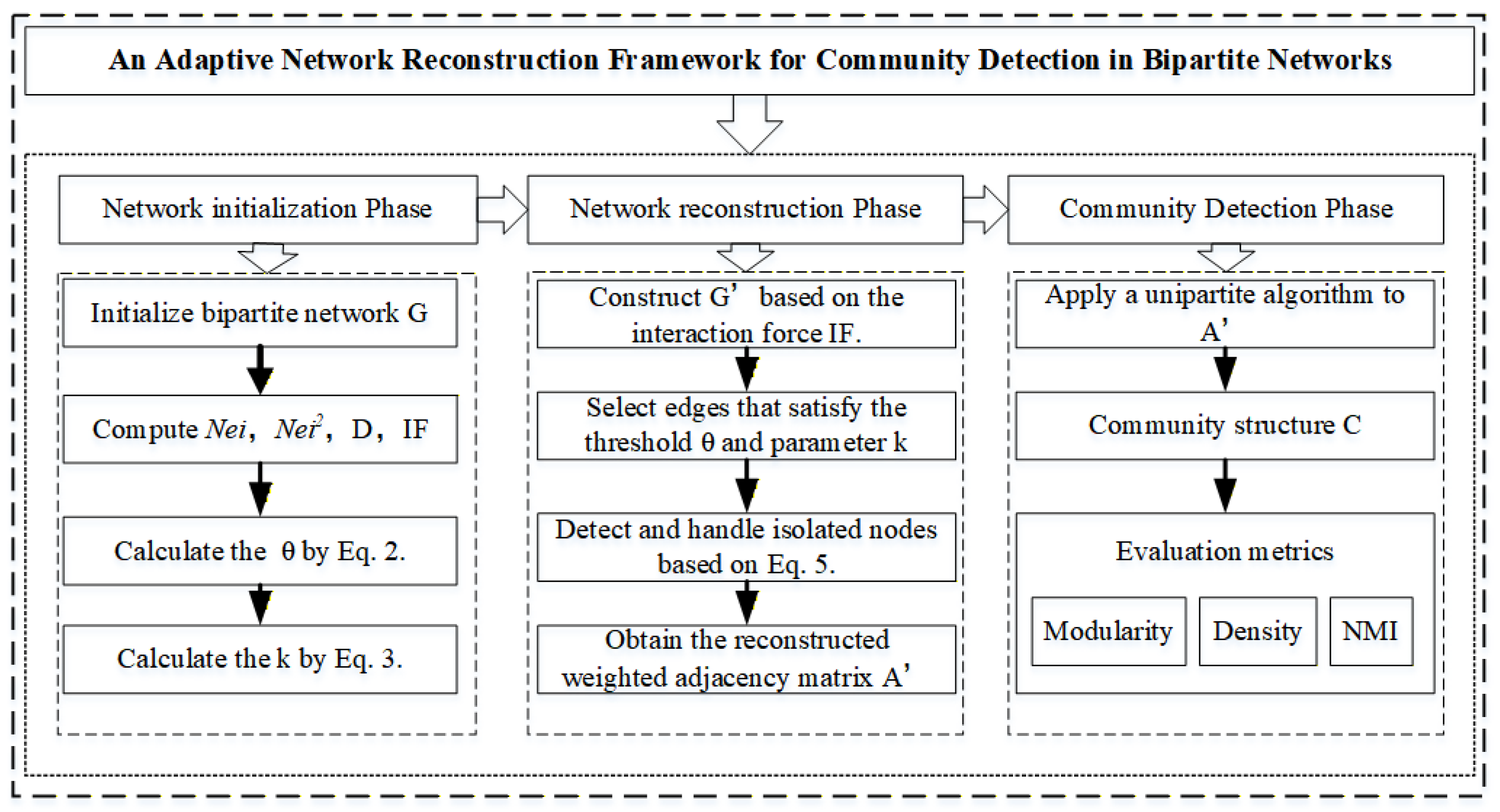
The overall framework of the ANRF-based algorithm is illustrated in Figure 1, which primarily consists of three core components: network reconstruction, community detection, and quality evaluation.
Figure 1.
Overall Framework of the Algorithm.
The ANRF algorithm operates as follows: it first computes node interaction forces and analyzes the network’s statistical features to adaptively determine key parameters for reconstruction. It then reconstructs the bipartite network and finally applies traditional unipartite detection algorithms to identify community structures. The detailed execution steps of ANRF are shown in Algorithm 1.
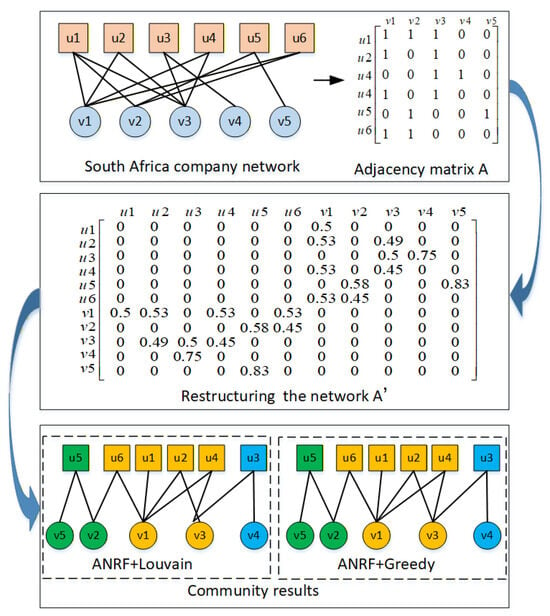
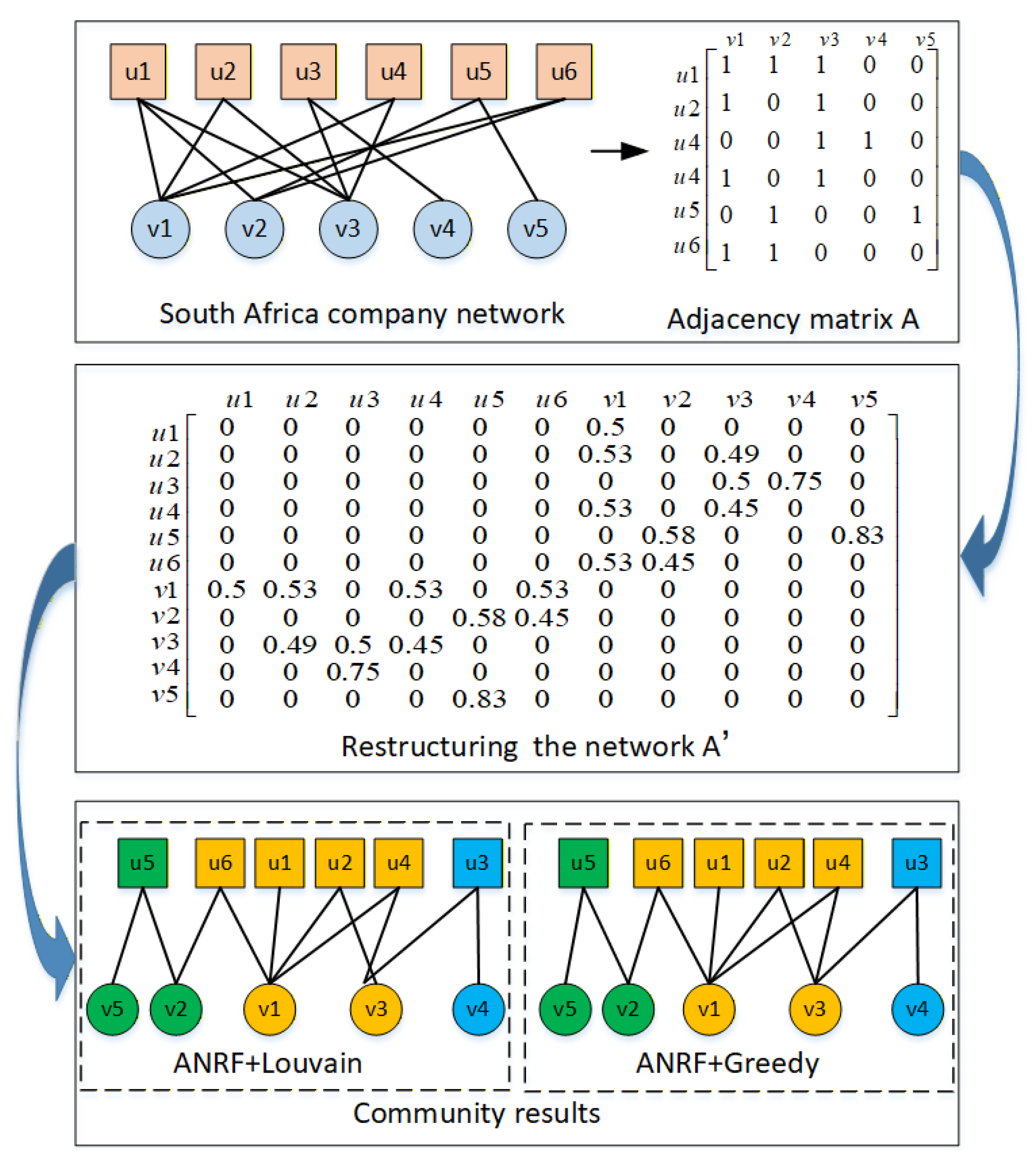
To clearly illustrate the operational workflow of the ANRF algorithm, this paper uses the South African companies network [27] as an example. The network consists of 13 appointment edges connecting 5 companies and 6 directors, forming a canonical bipartite structure. The overall algorithm process is depicted in Figure 2 and comprises three main modules.
Figure 2.
Illustration of the ANRF workflow on the African Company Network.
The first module presents the South African companies network and its corresponding adjacency matrix, where nodes to represent the 6 directors and to represent the 5 companies. The second module reconstructs the network based on Equations (1)–(3), resulting in the reconstructed matrix . Specifically, the mean of the interaction force () is calculated as 0.5346, with a standard deviation of 0.1208 and a percentile of 0.45, thus determining the threshold = 0.45. Among all node pairs, except for (,) and (,), whose interaction forces are 0.4167 (below 0.45), the interaction forces of all other node pairs are no less than 0.45. Consequently, these two weaker edges are filtered out. The third module applies the Louvain method and the Greedy Modularity method to the reconstructed network for community detection.
The experimental results show that both algorithms yield completely identical community structures on this network. A notable observation is that although and are each connected to only one node ( and , respectively), is assigned to the same community as . This occurs primarily because the interaction force between and (0.58) is higher than that between and (0.45), leading ANRF to assign to the community containing . Further evaluation indicates that the modularity of this community partition is 0.3314 and the community density is 0.9583. These results demonstrate that ANRF can effectively leverage the intrinsic characteristics of the network to automatically determine key parameters, thereby achieving stable and high-quality community detection.
| Algorithm 1 ANRF-based Community Detection Algorithm |
| Require: Original bipartite network |
| Ensure: Community partition result C |
|
3.5. Analysis of Complexity
The time complexity of ANRF is primarily determined by the computation of interaction forces and the subsequent community detection algorithm. Let be the total number of nodes in the network, be the number of edges, and d be the average node degree. Given that real-world bipartite networks are typically sparse, we assume and .
ANRF consists of four main computational stages, with their time complexity analyzed as follows: (1) Interaction Force Computation: ANRF adopts an optimized strategy to compute interaction forces, avoiding the calculation of all possible node pairs. For each node, interaction forces with its second-order neighbors are computed, resulting in a time complexity of . (2) Adaptive Parameter Calculation: This stage involves computing statistical features of interaction forces (mean, standard deviation, quantiles) and network density, with a time complexity of . (3) Network Reconstruction: Edge filtering based on the adaptive threshold and the application of the connection constraint k have a time complexity of . (4) Community Detection: Since ANRF is designed to be compatible with various unipartite community detection algorithms, the complexity of this stage depends on the specific algorithm employed. In this study, we primarily utilize the Louvain method and the Greedy Modularity method. The Louvain method is known for its efficiency with a time complexity of . The Greedy Modularity method (also known as the CNM algorithm), which uses a heap data structure for optimization, has a time complexity of on sparse networks. Therefore, the complexity for this stage is denoted as (representing the upper bound of the two methods used).
The overall time complexity of the ANRF is the sum of the complexities of the above stages:
After simplification, we obtain:
In sparse networks where d is small and k is constrained by n, the reconstruction term typically dominates the total complexity. However, for very large networks with extremely low average degrees, the time complexity of community detection () may become significant.
4. Experimental Results and Analysis
To validate the effectiveness of the ANRF, we integrated ANRF with the Louvain and Greedy Modularity algorithms (denoted as ANRF + Louvain and ANRF + Greedy, respectively) and tested them on synthetic networks and 9 real-world bipartite networks. Community partition quality was evaluated using , , and NMI. We evaluated the performance of ANRF against four established community detection algorithms (Cui’s method [28], Wang’s method [29], OCDBEN [30], and CBG&BEN [31]) for bipartite networks.
4.1. Evaluation Metrics
- ModularityModularity of Bipartite network () is an evaluation metric specifically designed for bipartite networks, introduced by Barber [12]. It measures the superiority of a community partition compared to a random network configuration. Its calculation formula is as follows:where m represents the total number of edges in the network; C denotes the set of community partitions; and refer to the subsets of nodes in community c belonging to the U-type and V-type, respectively; is the adjacency matrix element, which equals 1 if there is an edge between nodes u and v, and 0 otherwise; and and are the degrees of nodes u and v, respectively. The value range of is [−0.5, 1], where a value closer to 1 indicates a more distinct community structure and higher partition quality. Generally, if , the current partition fails to identify meaningful community structure. If , the network can be considered to exhibit significant community structure. In particular, when , it indicates that the algorithm achieves a very high-quality community partition with a highly clear community structure.
- DensityCommunity density [32] measures the closeness of connections among nodes within a community, reflecting the cohesiveness of the community structure. A higher community density indicates tighter intra-connections, making the community structure more prominent. The community density of the entire network is defined as the average of the density of all communities:where represents the number of internal edges within community c, and and denote the numbers of U-type and V-type nodes in that community, respectively. The value range of Density is [0, 1]. A higher value indicates tighter connections among nodes within the community, resulting in a more cohesive community structure.
- Normalized Mutual Information (NMI)NMI [33] is a widely used metric for measuring the similarity between two community partitions, particularly suitable for evaluating the consistency between algorithm-detected results and the ground-truth community structure. Let denote the ground-truth community partition and represent the algorithm-detected partition. The formula is as follows:where denotes the mutual information between the two partitions, and and represent the entropies of and , respectively. The value range of NMI is [0, 1]. A value closer to 1 indicates that the algorithm’s partition is more consistent with the true structure, with a value of 1 representing a perfect match. An NMI value of 0.8 or above indicates high-fidelity recovery of the community structure, reflecting strong algorithmic performance. NMI between 0.5 and 0.8 suggests that most true communities are correctly identified, albeit with some misassignments. When NMI falls between 0.3 and 0.5, only a portion of the structure is recovered, and a substantial number of nodes are misclassified.
4.2. Unipartite Network Community Detection Algorithms
To validate the effectiveness of ANRF, we integrated two classic unipartite network community detection algorithms—the Louvain method and the Greedy Modularity method—into the framework for combined validation.
- Louvain methodProposed by Blondel et al. [34] in 2008, the Louvain method is a multi-level community detection method based on modularity optimization. It adopts a greedy strategy and hierarchical clustering, iteratively executing two phases—local node movement and network aggregation—to progressively optimize network modularity for efficient and high-quality community detection.
- Greedy Modularity methodAlso known as the Clauset-Newman-Moore method, the Greedy Modularity method is another classic modularity-based community detection method, introduced by Clauset et al. [35] in 2004. It adopts a bottom-up hierarchical clustering strategy, continuously merging communities that yield the maximum modularity gain until all nodes are merged into a single community. Finally, it outputs the community structure with the highest modularity from the hierarchical partition.
4.3. Experimental Results and Analysis on Synthetic Networks
To systematically evaluate the performance of ANRF, we adopted the classic synthetic network generation model proposed by Lancichinetti et al. [36] to construct bipartite network datasets. The key parameters of the model are detailed in Table 1. Synthetic networks were generated with the following experimental settings: n was set to 64, 128, 256, 512, and 1024, with an equal number of nodes in both partitions; the mixing parameter controls the proportion of a node’s edges connecting to nodes outside its own community, where represents perfectly modular structure and indicates extremely noisy conditions; the average degree was fixed at 4; and the number of communities was set to 4.
Table 1.
Detailed Parameters of the Synthetic Networks.
The ANRF + Louvain and ANRF + Greedy Modularity algorithms were validated across synthetic networks of varying scales. The quality of the resulting community partitions was comprehensively evaluated using multiple metrics, including NMI, , and .
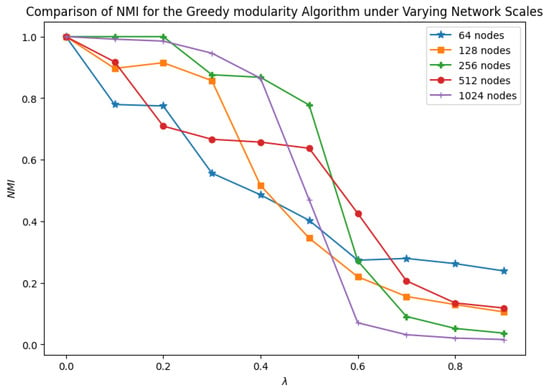
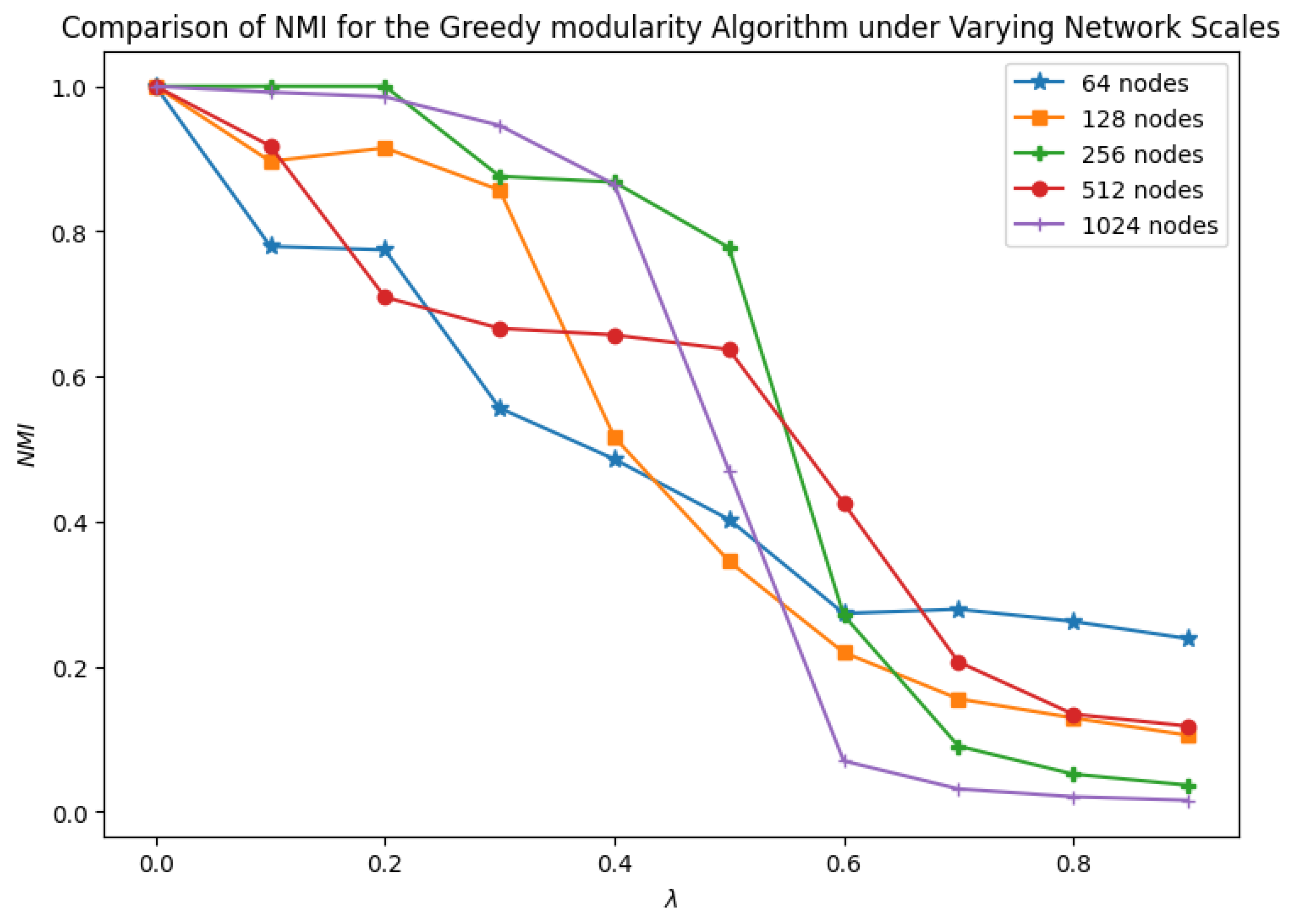
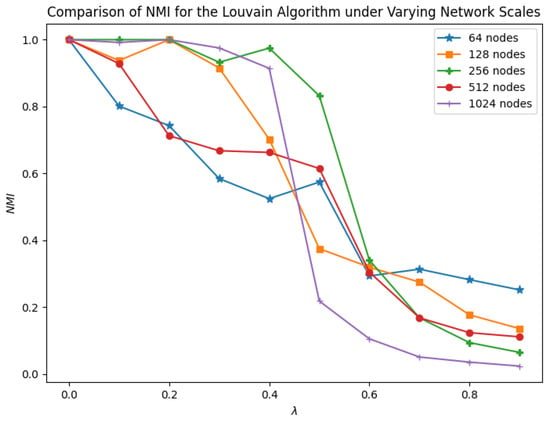
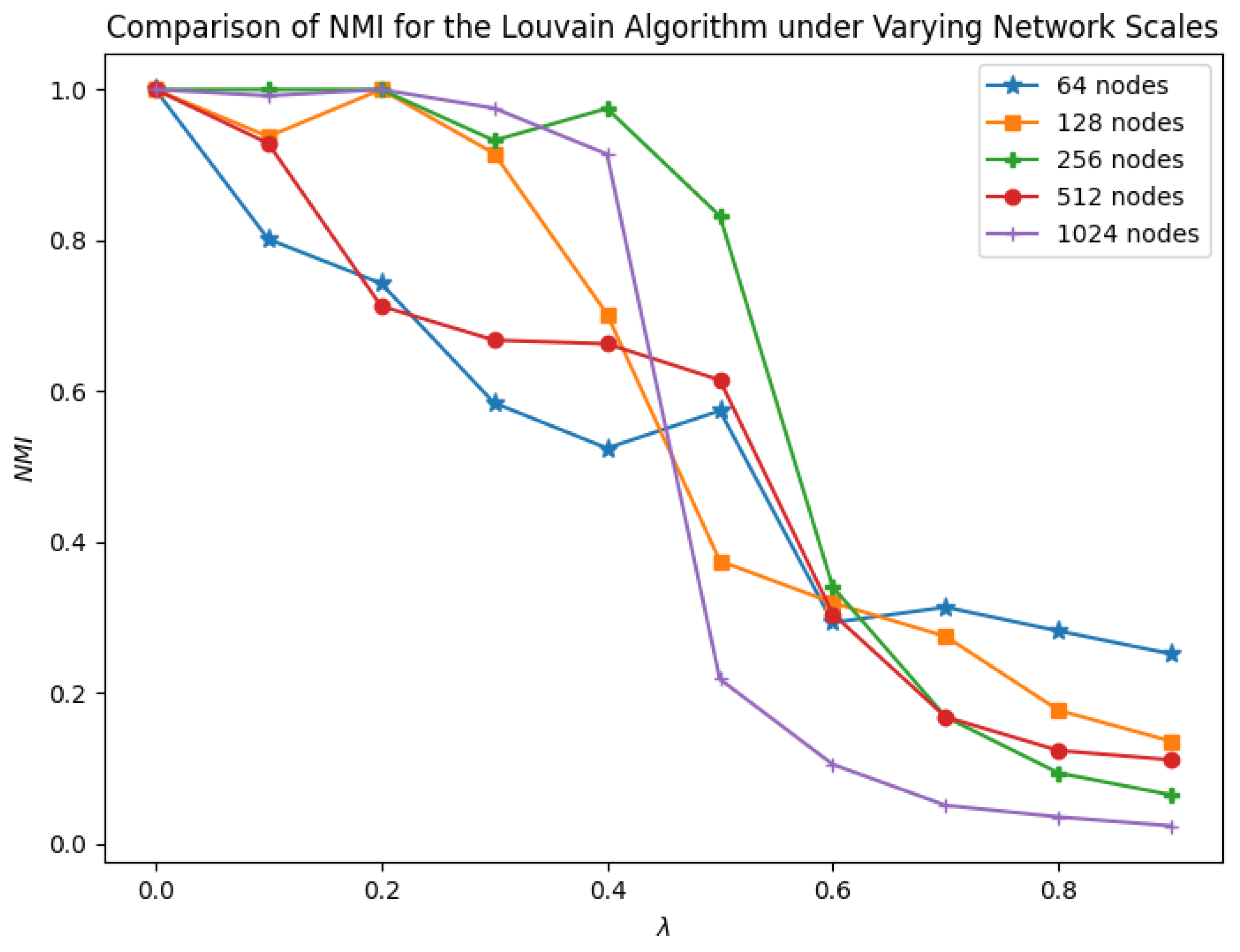
Figure 3 and Figure 4 illustrate the variation in NMI values with the mixing parameter for the ANRF + Greedy and ANRF + Louvain methods across networks of different scales. The experimental results indicate that when , all algorithms are able to correctly detect the community structure. As increases, the NMI values of all algorithms gradually decline, reaching their lowest at . For , both ANRF-based methods maintain good community detection performance, and the NMI values of both algorithms remain above 0.5, indicating that the majority of the community structure can still be correctly identified. It is noteworthy that even under extreme noise conditions (, corresponding to 64 nodes and a 90% noise ratio), the NMI values of both algorithms remain above 0.2—a level significantly higher than that expected from random partitioning under such structurally degraded conditions.
Figure 3.
NMI results of ANRF + Greedy modularity algorithm on synthetic networks of different scales.
Figure 4.
NMI results of ANRF + Louvain algorithm on synthetic networks of different scales.
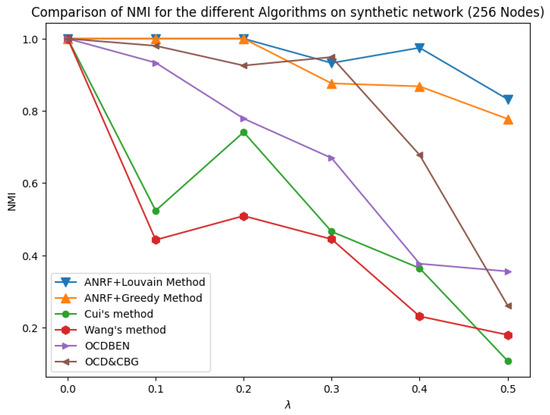
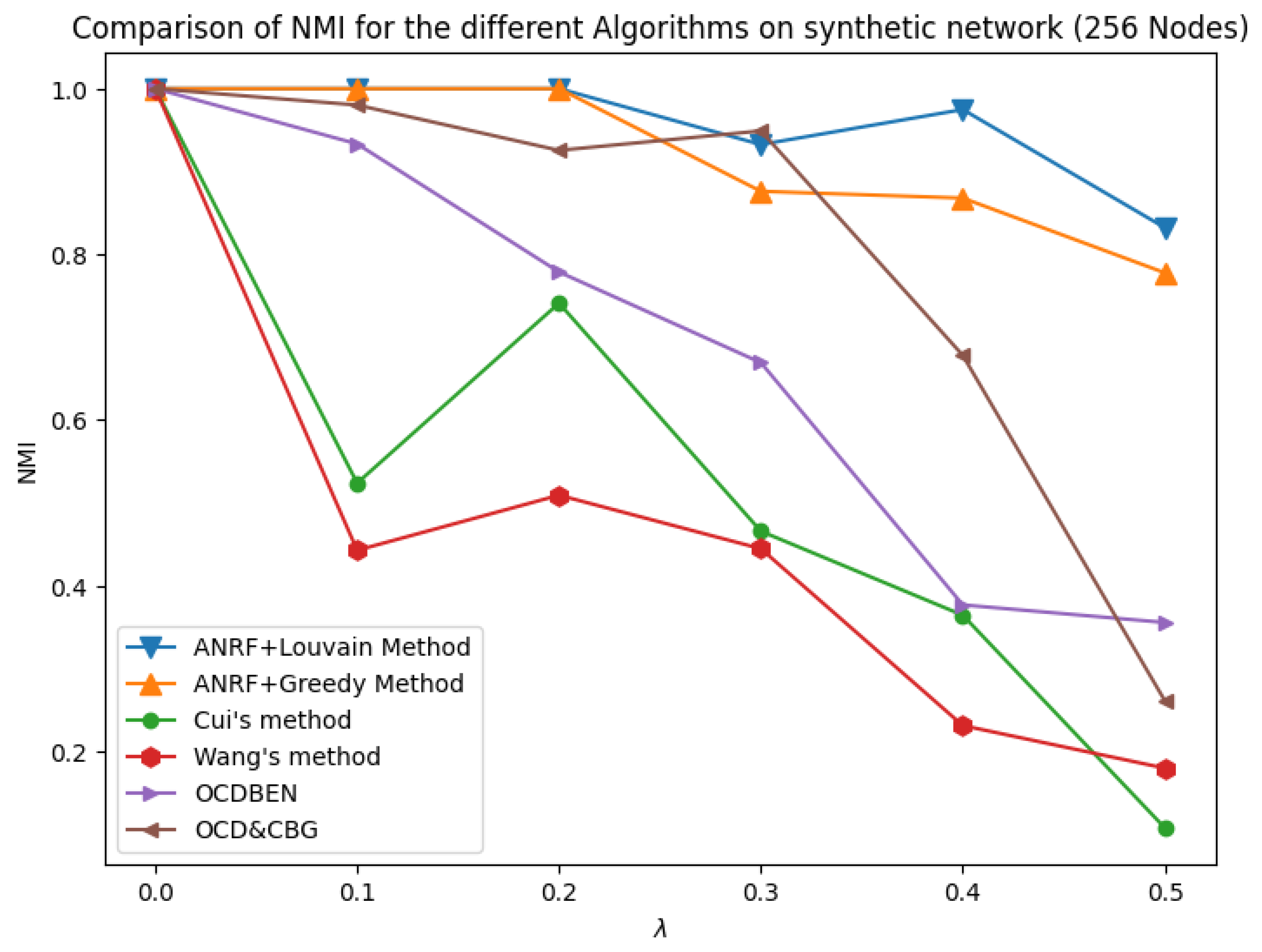
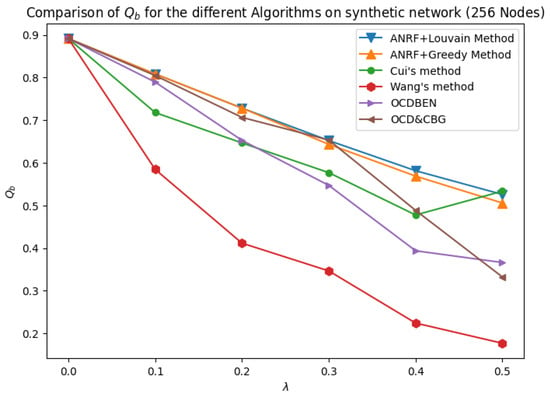
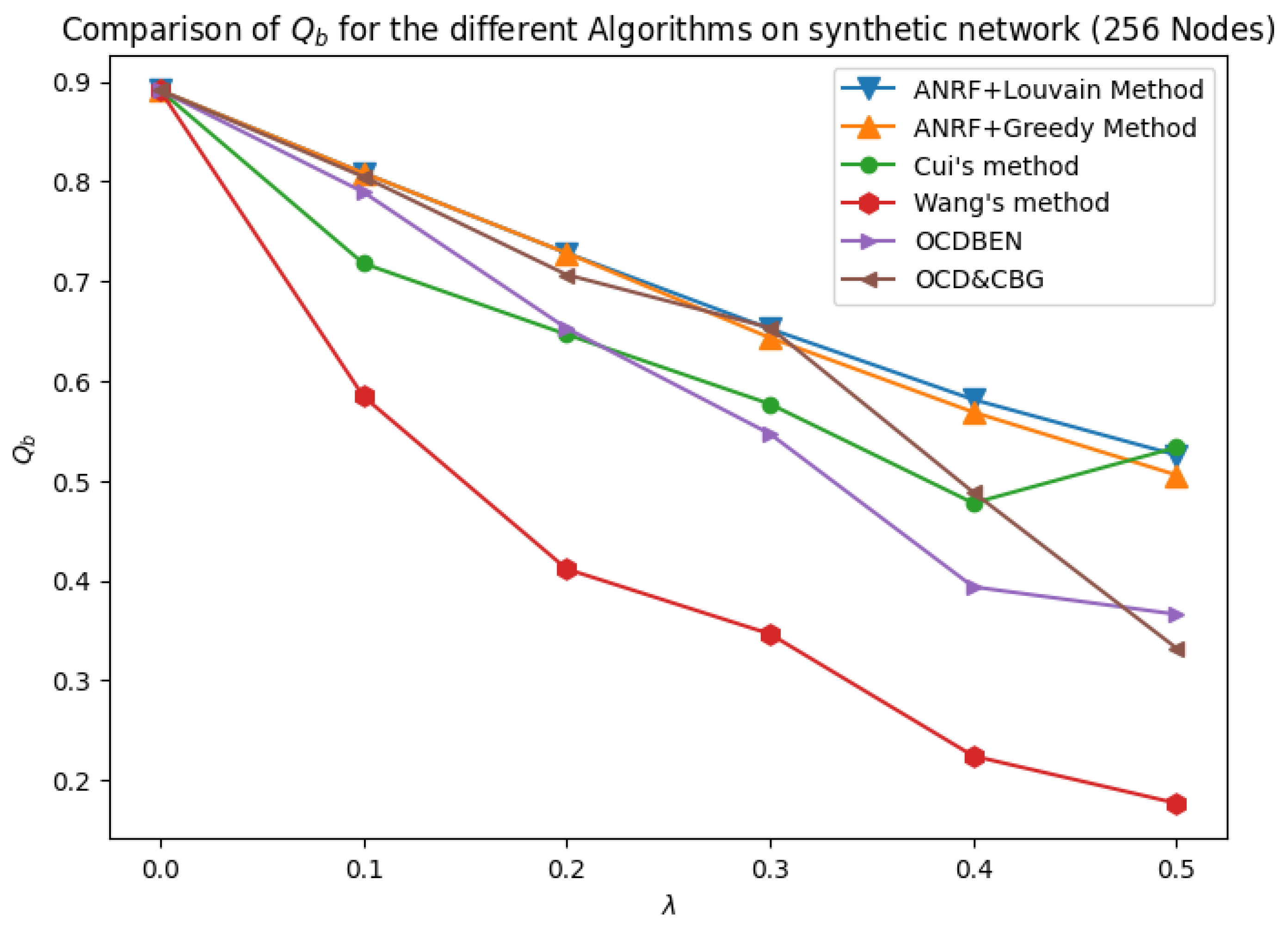
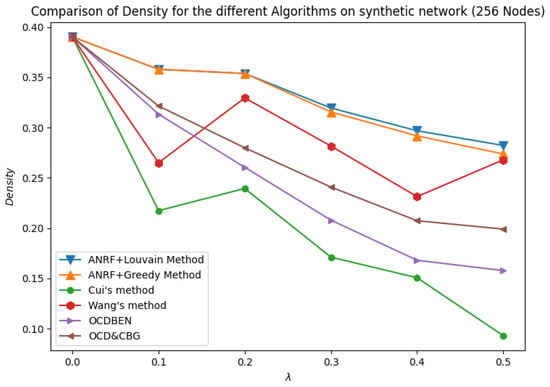
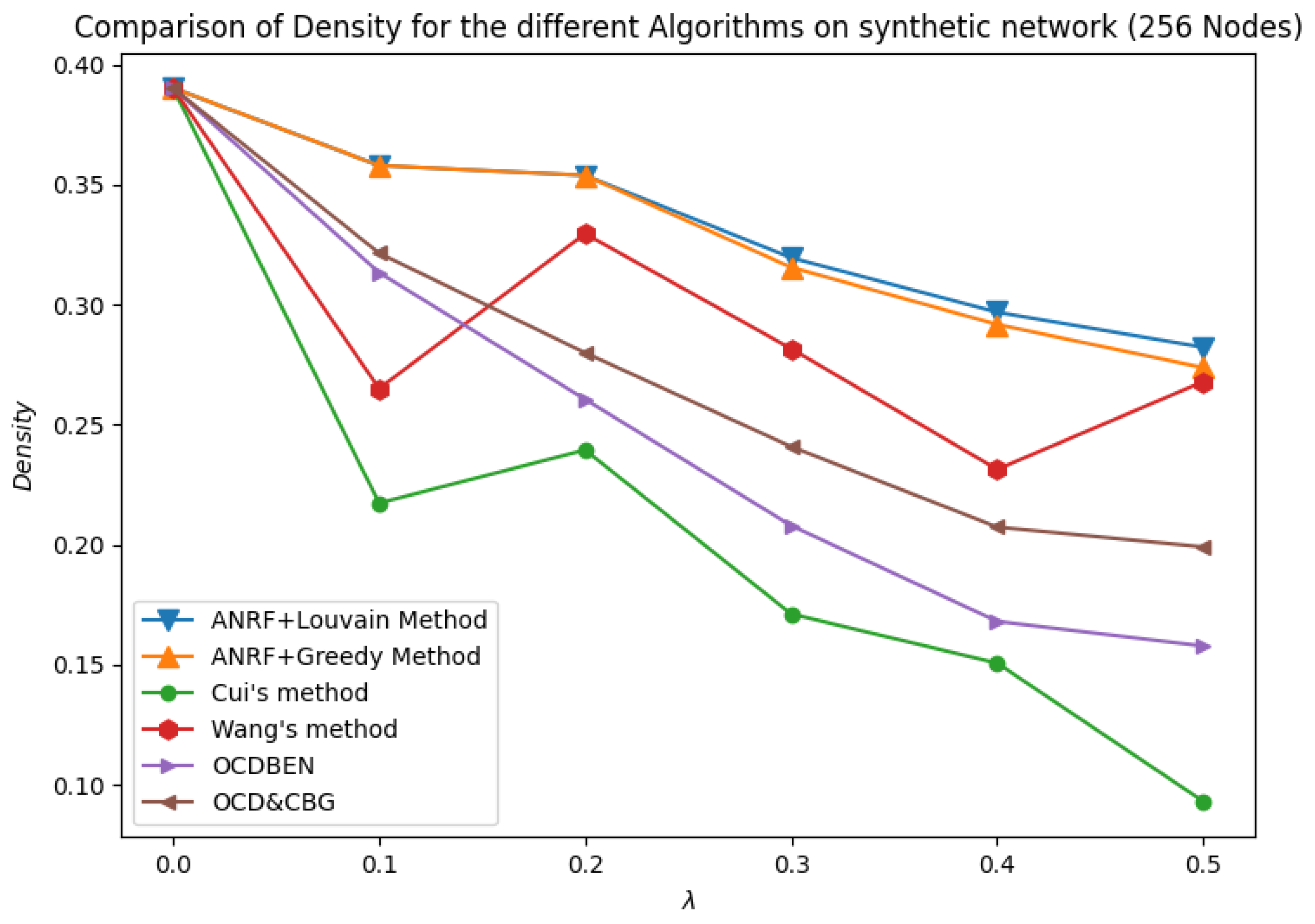
To systematically validate the effectiveness and advantages of ANRF on synthetic networks, we take a 256-node synthetic network as an example and compare ANRF + Louvain and ANRF + Greedy with four traditional bipartite network community detection algorithms. The evaluation metrics include NMI, , . The results are shown in Figure 5, Figure 6 and Figure 7.
Figure 5.
NMI results for synthetic networks with 256 nodes.
Figure 6.
results of different algorithms on synthetic network with 256 nodes.
Figure 7.
results of different algorithms on synthetic network with 256 nodes.
Figure 5 illustrates the variation in NMI values for ANRF + Louvain, ANRF + Greedy, and four comparative algorithms with the mixing parameter ranging from 0 to 0.5 in a synthetic network of 256 nodes. The experimental results show that both ANRF-based methods maintain high NMI levels across all values. Particularly when , both methods achieve fully accurate community detection, significantly outperforming all other algorithms. As increases (indicating increased noise), the NMI of all methods declines; however, the decrease is more gradual for the ANRF-based methods, demonstrating their ability to better preserve true community structures under higher noise conditions. The OCD&CBG method also maintains relatively high NMI when , but its NMI drops noticeably when , indicating weaker robustness under higher noise levels. In contrast, Cui’s method, Wang’s method, and OCDBEN all show a significant declining trend as increases, suggesting their inability to maintain effective community recognition in strongly noisy environments.
Figure 6 and Figure 7 illustrates the variations in values and community density values for ANRF + Louvain, ANRF + Greedy, and four comparative algorithms, as the mixing parameter increases from 0 to 0.5 in a synthetic network with 256 nodes.
As shown in Figure 6, the values of ANRF + Louvain and ANRF + Greedy exhibit a near-linear decreasing trend with increasing . Notably, even at , their modularity remains above 0.5, indicating that the detected communities are of high quality (clear community structure). Meanwhile, Figure 7 reveals that the community density of both algorithms also decreases approximately linearly, from a maximum of about 0.39 down to 0.28. In terms of both and density metrics, these two methods significantly outperform the other four algorithms and demonstrate good consistency between the two indicators. In contrast, Cui’s method and Wang’s method show a clear inconsistency between these metrics: in the plot, Cui’s method achieves significantly higher modularity than Wang’s method, yet in the density plot, its density value is markedly lower. This suggests that during the optimization process, these two methods may sacrifice one metric to improve the other. Although OCDBEN and OCD&CBG do not exhibit similar inconsistencies, their overall performance remains inferior to that of ANRF + Louvain and ANRF + Greedy.
4.4. Experimental Results and Analysis of Real Network
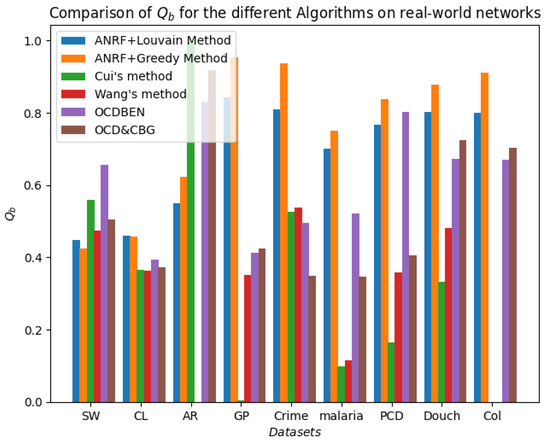
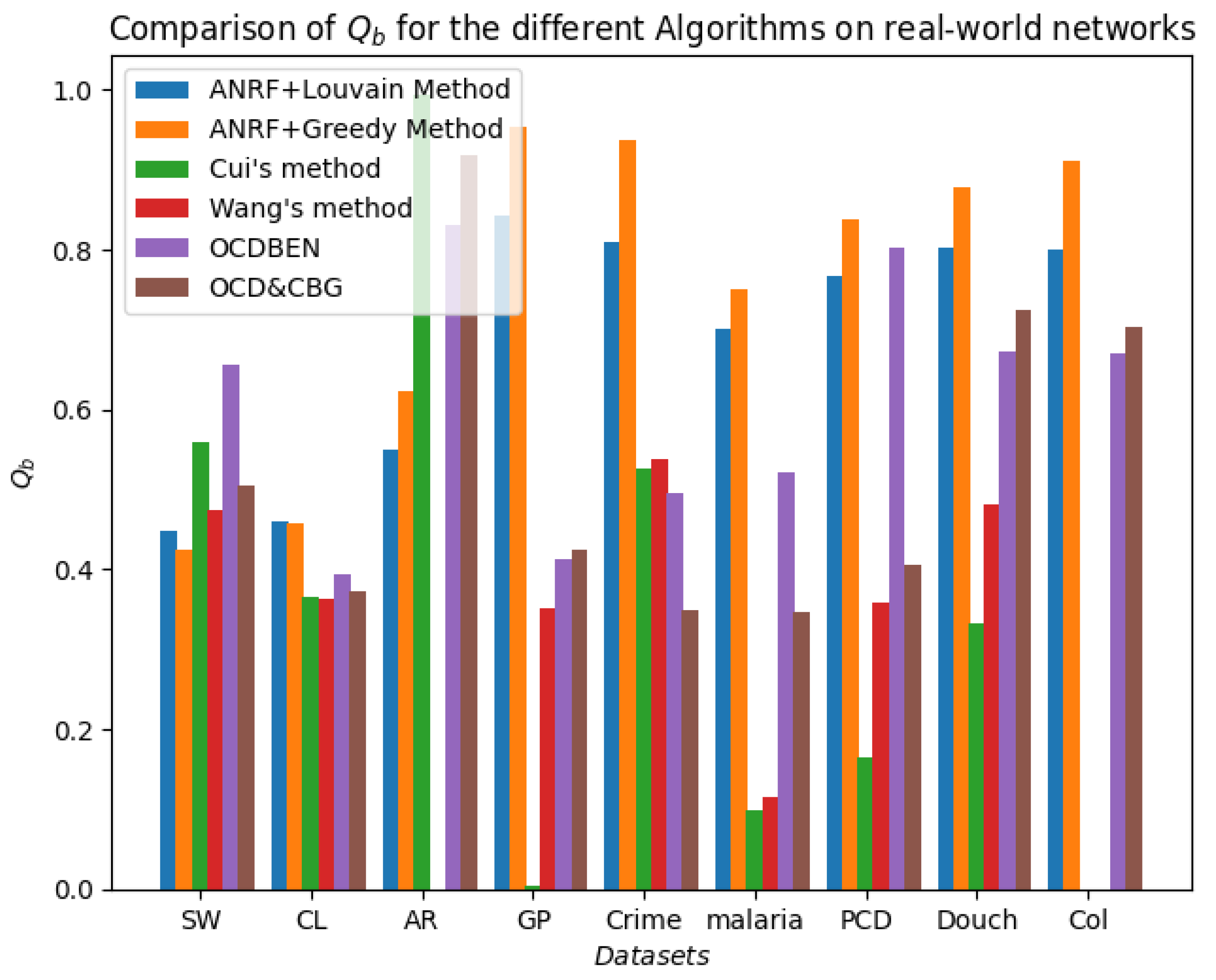
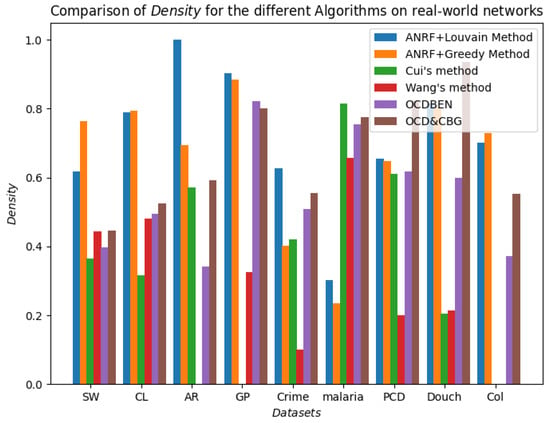
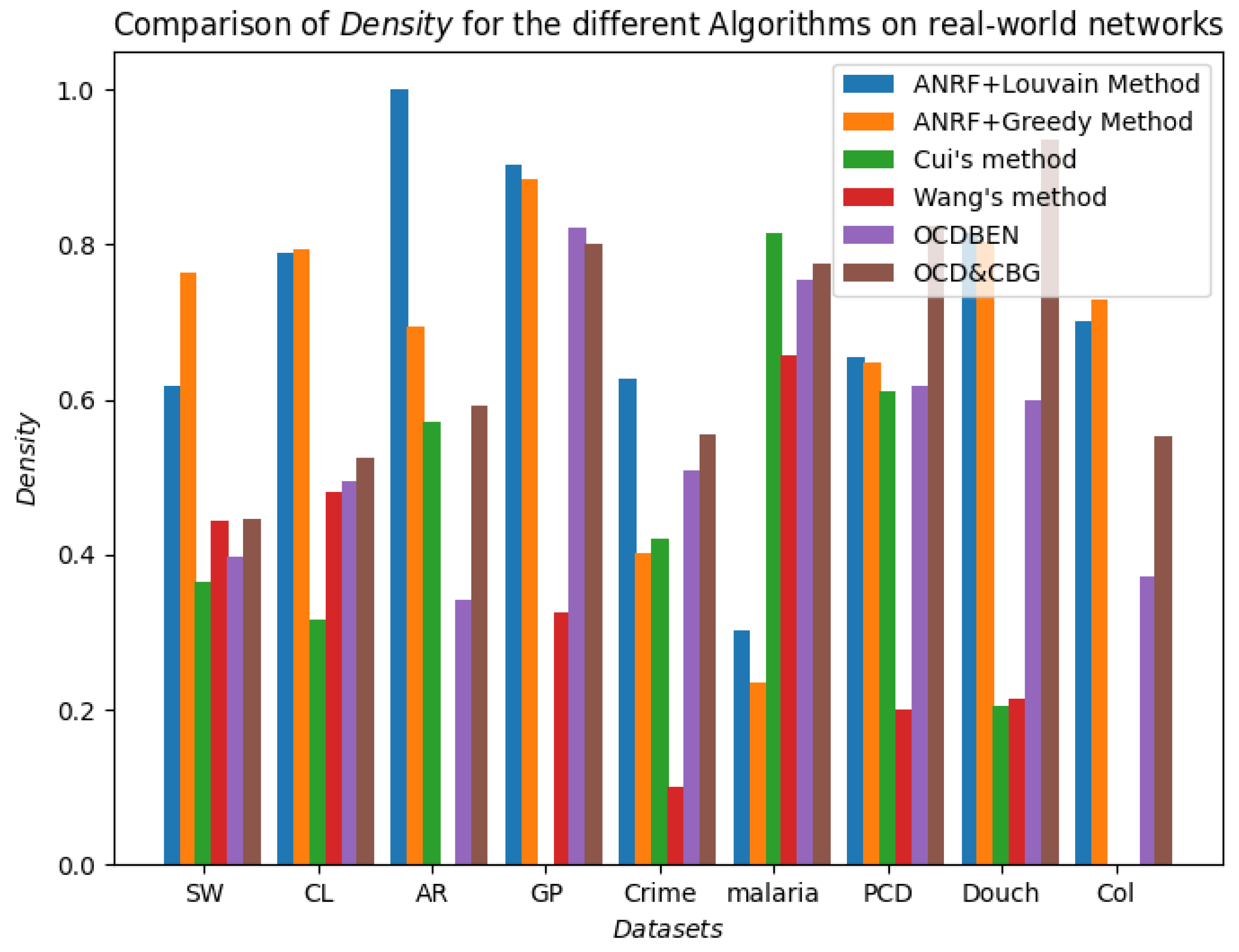
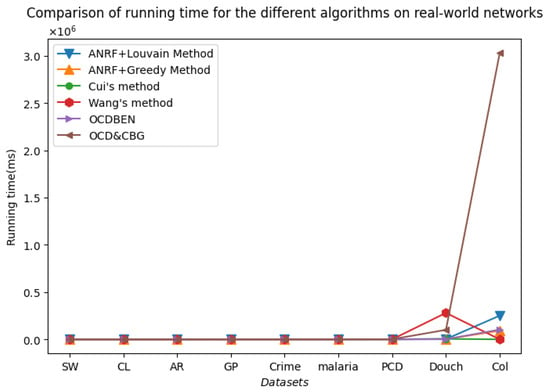
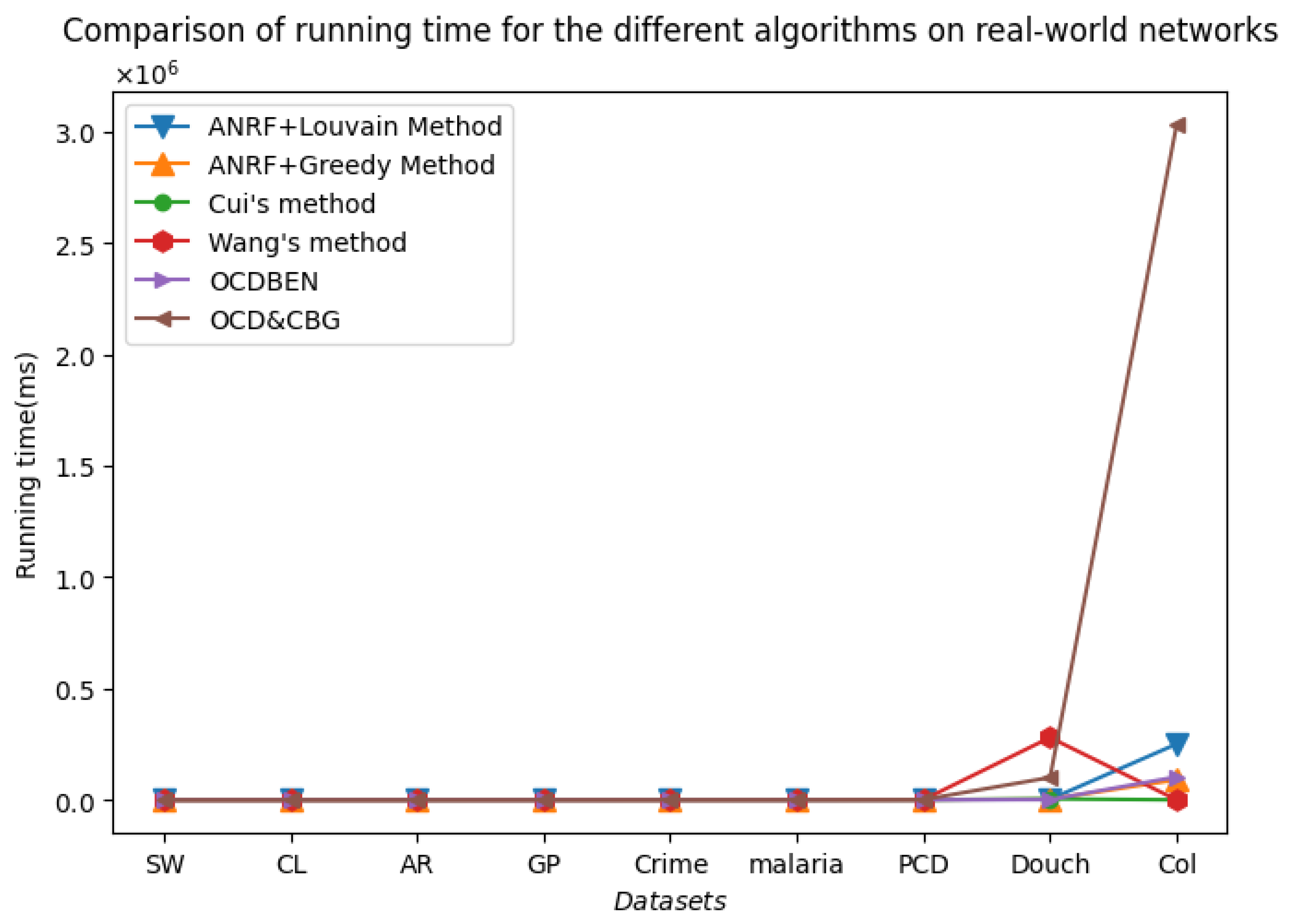
To comprehensively assess the effectiveness of ANRF in real-world scenarios, we conducted experiments on nine real bipartite networks. The basic statistical information of each network is shown in Table 2. We compared ANRF with four other bipartite network community detection algorithms, evaluating three key dimensions: community modularity (), community density, and runtime. The comparative results are presented in Figure 8, Figure 9 and Figure 10.
Table 2.
Description of Real-World Network Datasets.
Figure 8.
results of different algorithms on real networks.
Figure 9.
results of different algorithms on real networks.
Figure 10.
Running time of different algorithms on real networks.
Figure 8 and Figure 9 compares the community modularity and community density results of different algorithms on real-world networks. As shown in Figure 8, ANRF + Louvain, ANRF + Greedy, OCDBEN, and OCD&CBG are all able to effectively detect community structures across all datasets. In contrast, Cui’s method fails to identify communities on the AR and COL datasets: for AR, this is because one type of node appears only once in the data, making it infeasible for the algorithm to process such a structure; for COL, the method cannot complete community detection within a reasonable time. Wang’s method also fails to detect communities on the GP and COL datasets: for GP, this is mainly due to limitations in the algorithm’s design, while for COL, the dataset is too large for the algorithm to produce results within a reasonable computational time (one hour) on our experimental setup.
In Figure 9, ANRF + Louvain and ANRF + Greedy perform excellently on most datasets. Except for slightly lower modularity on the SW and AR datasets compared to the other four algorithms, they achieve the highest modularity on the remaining seven datasets. Regarding density, apart from being slightly lower than some benchmarks on the Crime and Malaria datasets, ANRF + Louvain and ANRF + Greedy generally outperform other algorithms in density on the other datasets. Notably, on the Crime dataset, ANRF + Louvain achieves higher density than all compared algorithms, while on the PCD dataset, OCD&CBG attains the highest density value.
To evaluate the temporal efficiency of ANRF, we executed all algorithms on a Windows 10 system with 16 GB RAM and an Intel i5 processor. The runtime comparison (Figure 10) shows that as network scale increases, the differences in computational cost among algorithms become more pronounced. After incorporating adaptive parameter calculation, the runtime of ANRF-based methods remains feasible even for large-scale networks (e.g., Col). In contrast, while some traditional methods are faster on a few small-scale networks, their runtime increases significantly for larger networks. This demonstrates that ANRF achieves good scalability without introducing excessive computational burden.
4.5. Analysis of Performance Differences Across Datasets
The experimental results show that the performance of ANRF varies across different real-world datasets, mainly due to the following factors:
- Match between network structure and adaptive mechanism: In networks with clear structures and evenly distributed connections (such as the Corporate Leadership network CL), ANRF can accurately identify threshold parameters and effectively retain key connections. However, in networks with sparse structures or uneven connection distributions (such as the AR network), the adaptive mechanism may face challenges, leading to slight fluctuations in performance.
- Structural preferences of the underlying algorithms: The Louvain algorithm is more suitable for large-scale hierarchical networks (such as the collaboration network COL), while Greedy Modularity performs better in networks with balanced community sizes (such as the Southern Women network SW). For some networks (such as the Crime network), the inherent modularity is strong, and both algorithms produce consistent results, indicating that ANRF reconstruction yields clear structures.
4.6. Algorithm Performance Analysis
4.6.1. Robustness Analysis
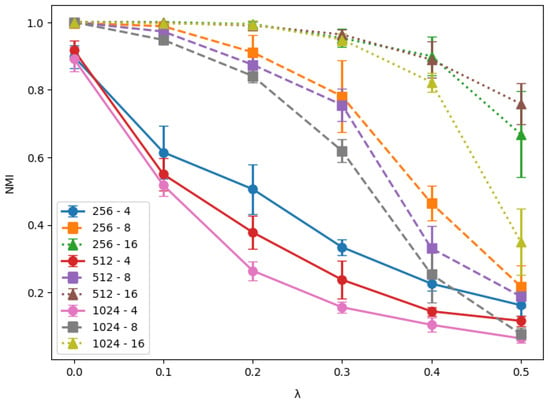
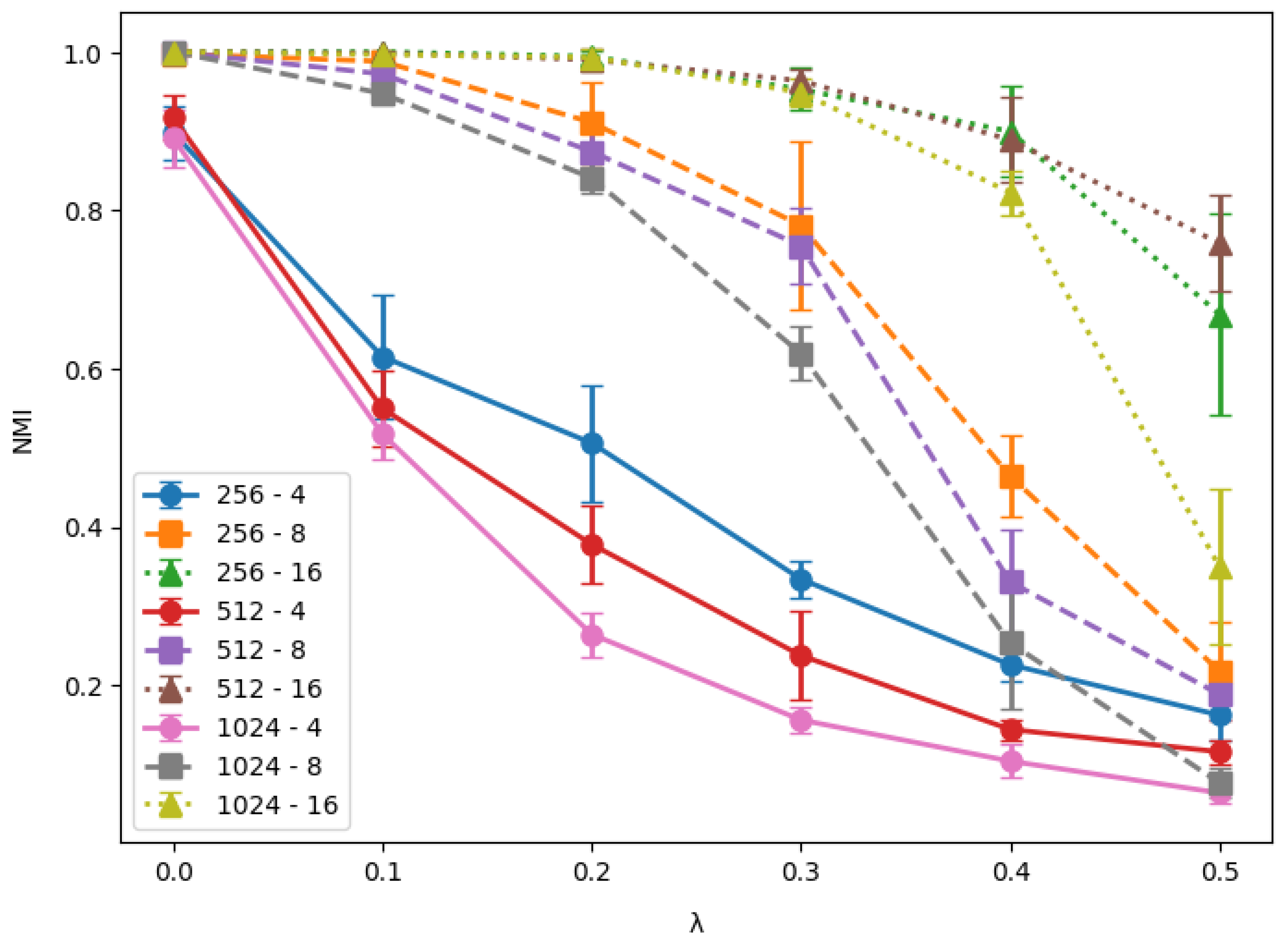
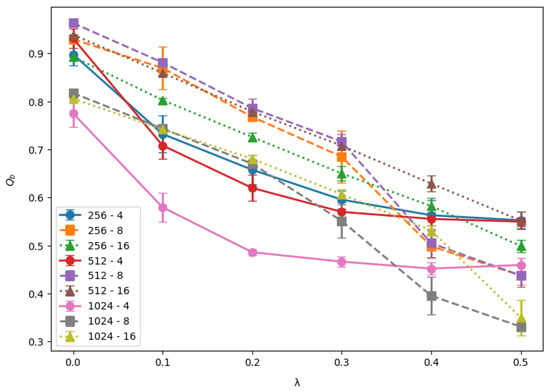
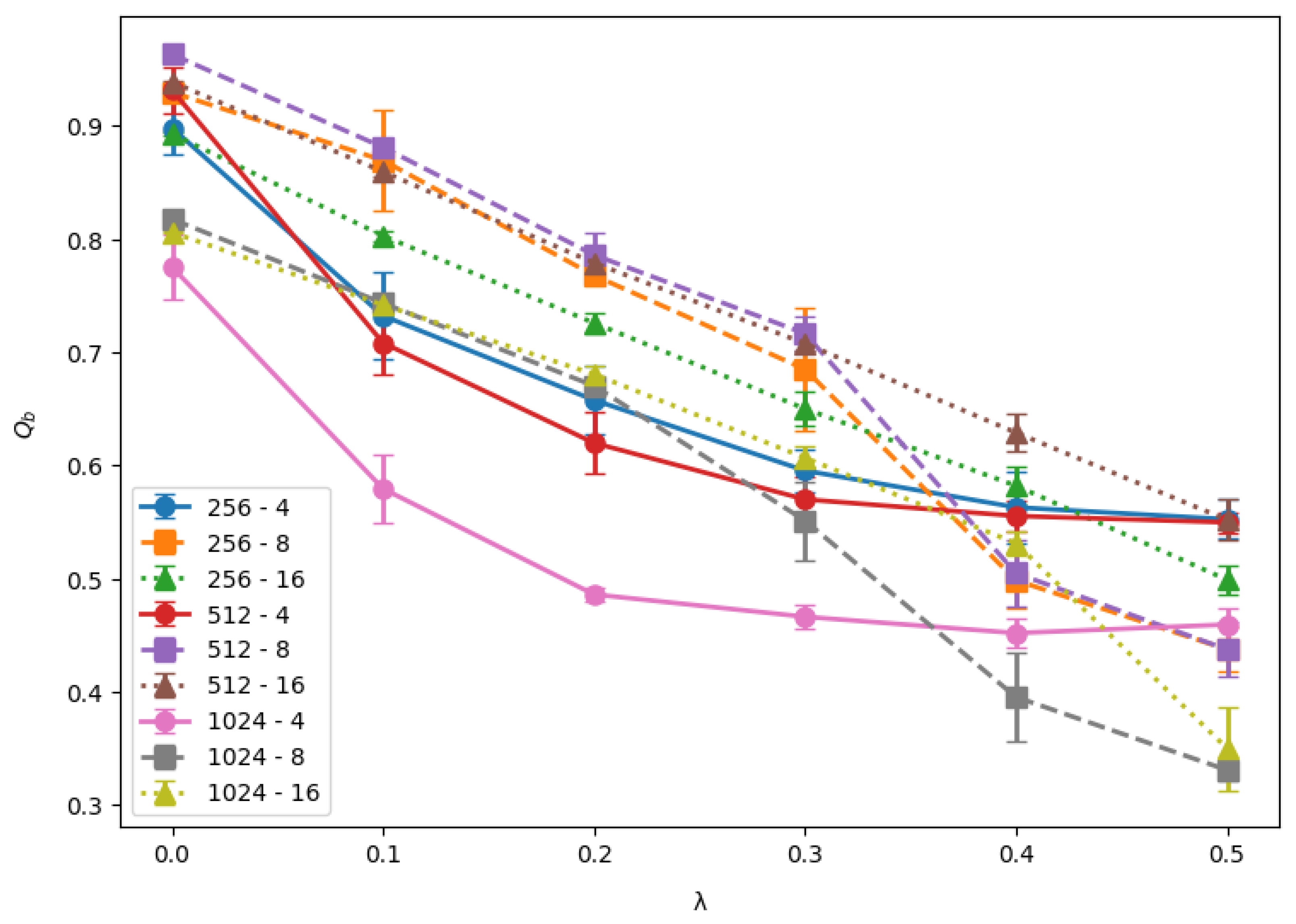
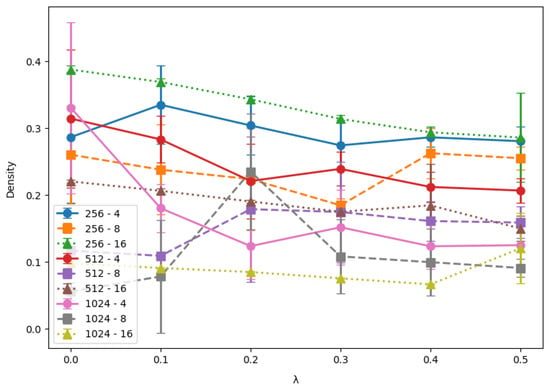
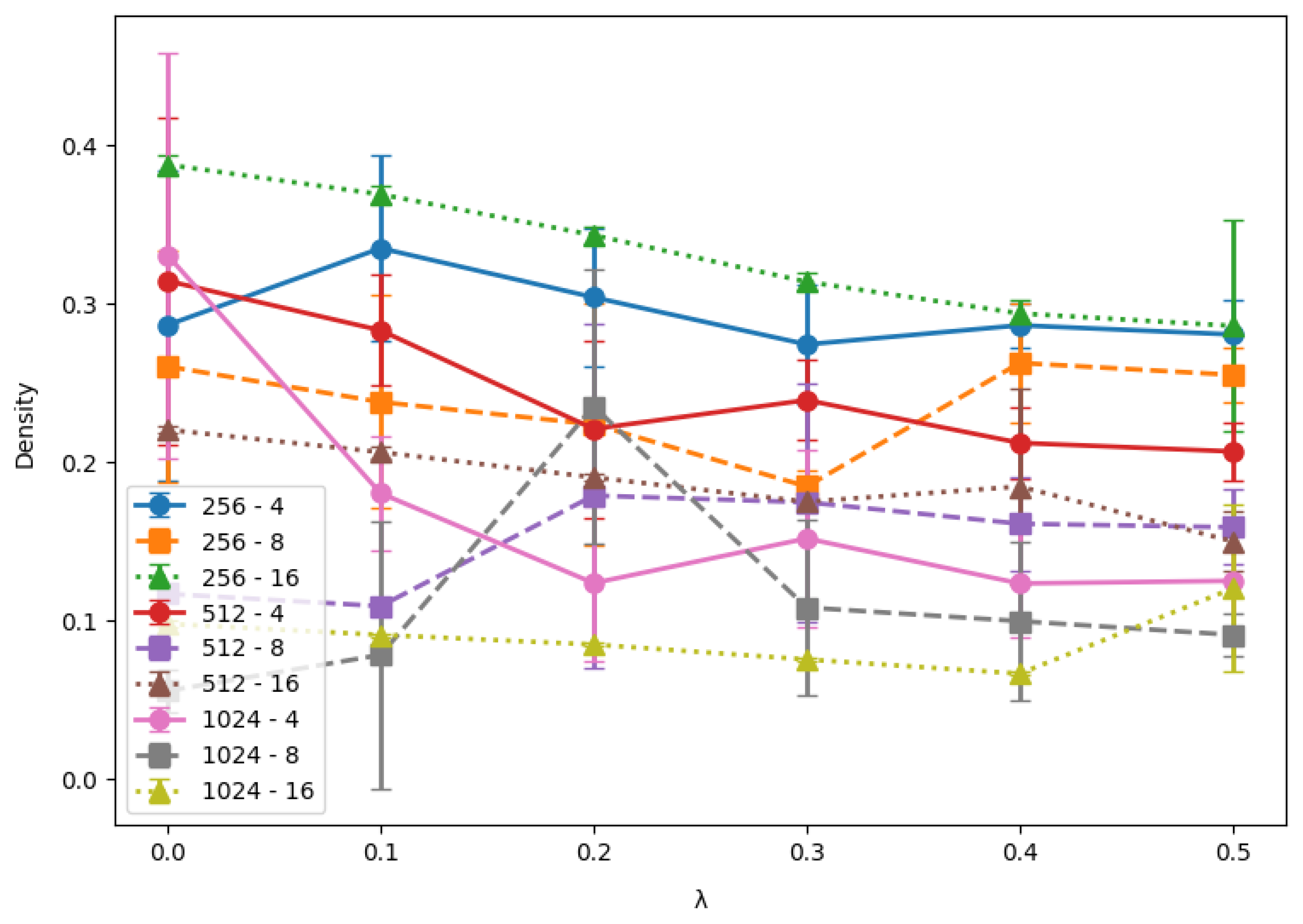
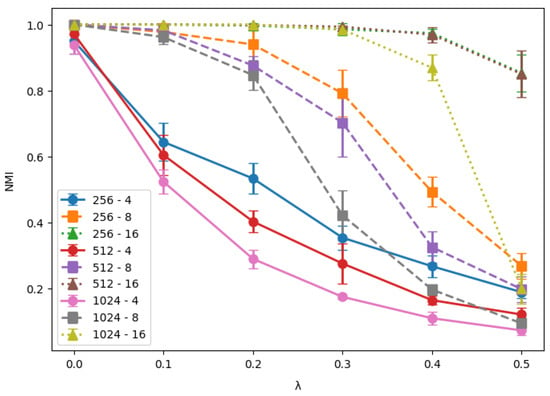
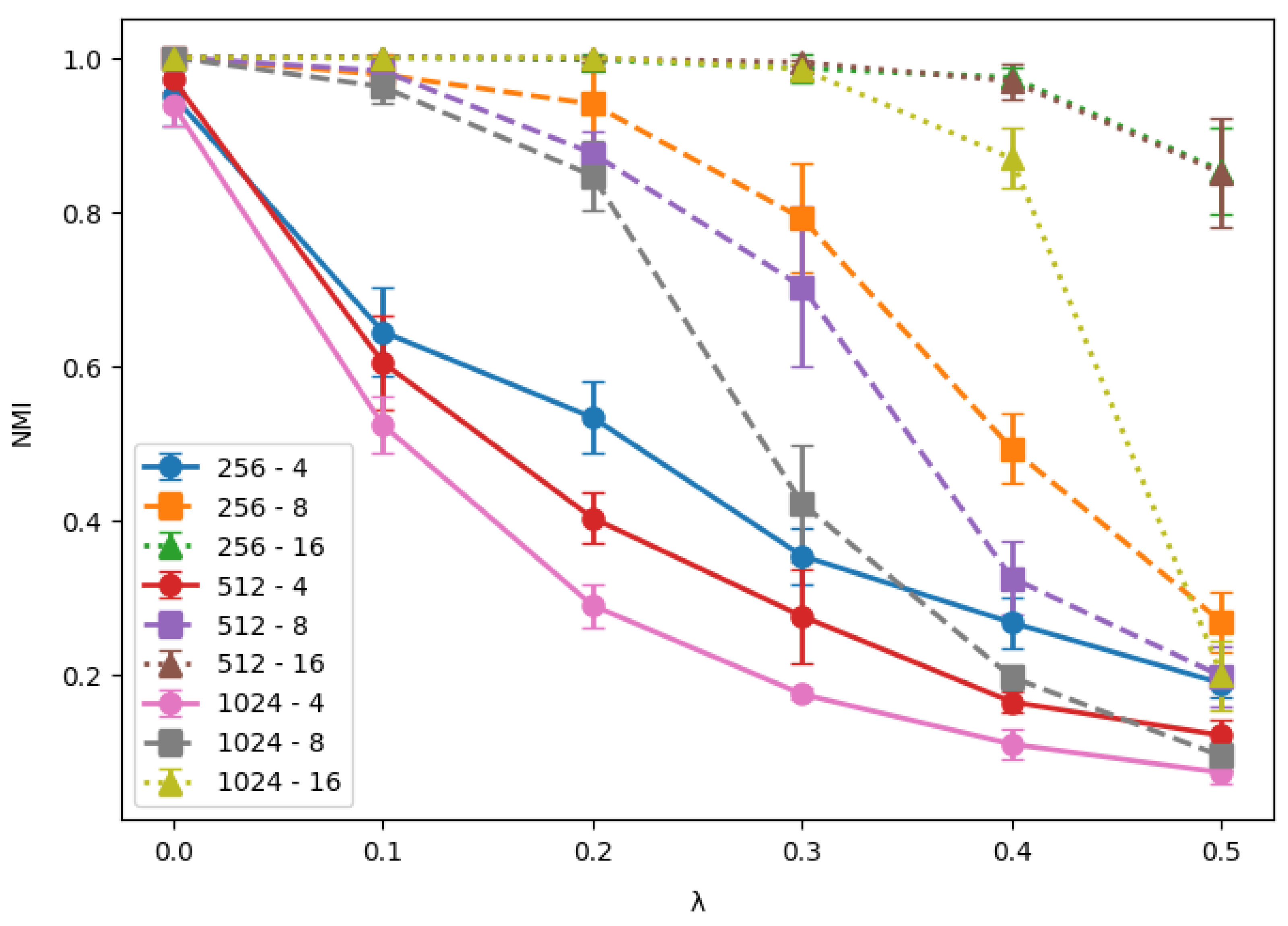
To further evaluate the robustness of ANRF under varying density conditions, we conducted additional experiments with larger network sizes and different average degree settings. Specifically, for network sizes of , 512, and 1024, we set the average degree to 4, 8, and 16, respectively. For each configuration, five independent network instances were generated to assess the stability of the proposed method. (It should be noted that for smaller networks such as and 128, setting would result in nearly complete graphs lacking meaningful community structure; therefore, these configurations were excluded to maintain the validity of the evaluation).
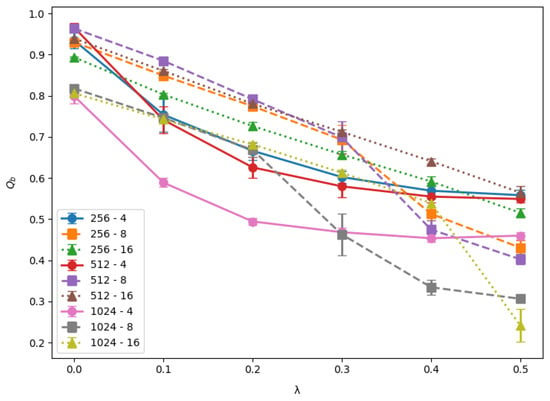
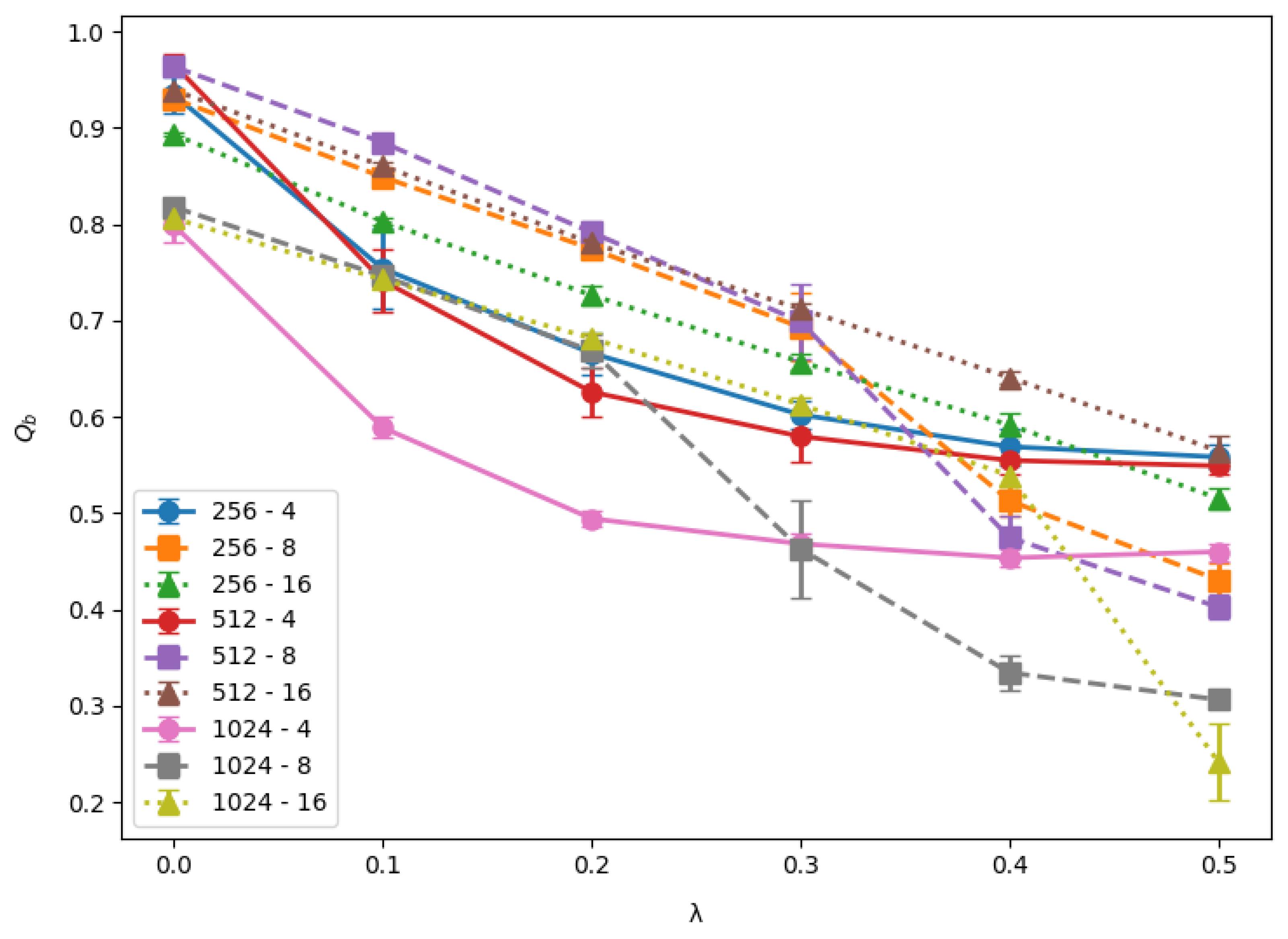
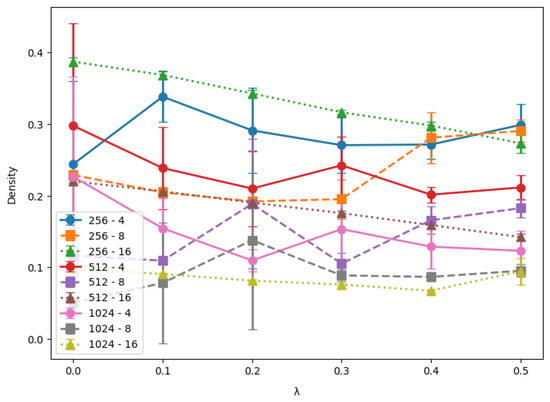
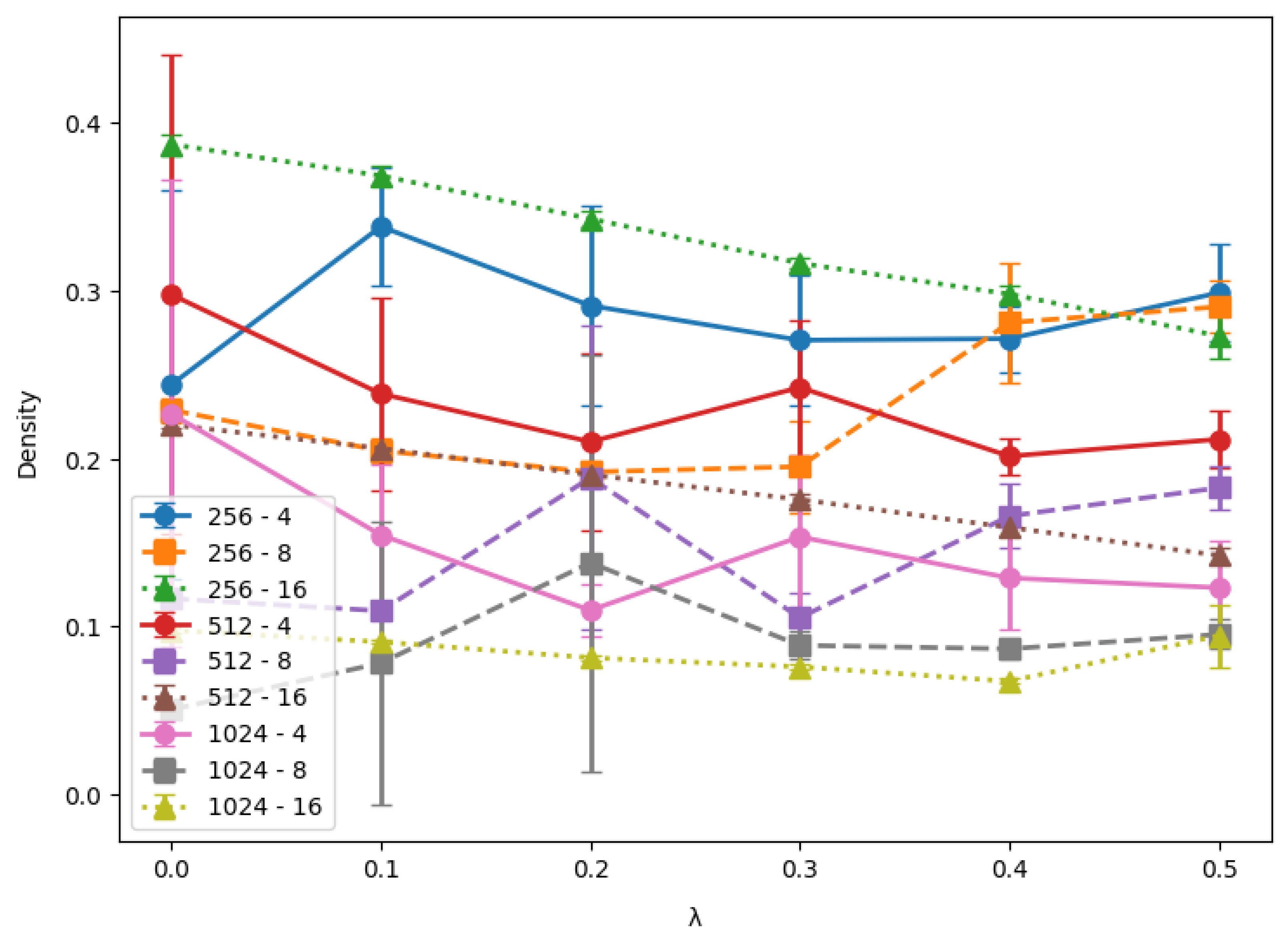
It is worth noting that when , the network structure becomes highly chaotic and community structure is largely obscured, causing NMI values for all algorithms to drop to very low levels; therefore, we focus our detailed analysis on the range , where community structure remains sufficiently meaningful to enable fair and discriminative comparison of algorithmic performance. The experimental results (NMI, , Density) of ANRF + Greedy and ANRF + Louvain methods are shown in Figure 11, Figure 12, Figure 13, Figure 14, Figure 15 and Figure 16.
Figure 11.
NMI results of ANRF + Greedy algorithm on synthetic networks with varying network size and average degree.
Figure 12.
results of ANRF + Greedy algorithm on synthetic networks with varying network size and average degree.
Figure 13.
Density results of ANRF + Greedy algorithm on synthetic networks with varying network size and average degree.
Figure 14.
NMI results of ANRF + Louvain algorithm on synthetic networks with varying network size and average degree.
Figure 15.
results of ANRF + Louvain algorithm on synthetic networks with varying network size and average degree.
Figure 16.
Density results of ANRF + Louvain algorithm on synthetic networks with varying network size and average degree.
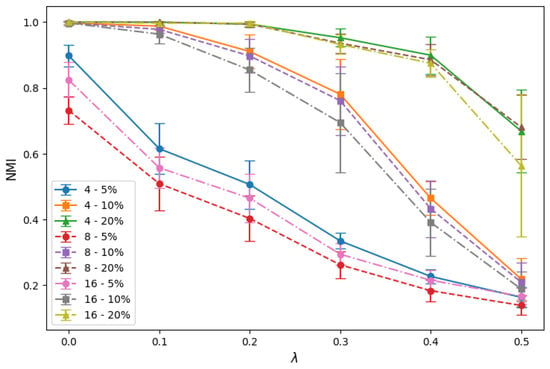
From the experimental results, we can observe the following: First, the performance of ANRF + Greedy and ANRF + Louvain is highly consistent across the three metrics (NMI, Qb, and Density), demonstrating that ANRF does not depend on specific community detection algorithms and exhibits good generality and compatibility. Second, across all three metrics, networks with higher density () perform best, followed by , and yields relatively lower performance, indicating that the ANRF has a more pronounced advantage in relatively dense networks, effectively leveraging the rich structural information within such networks. In terms of scale adaptability, networks with 256 nodes perform best across all metrics, followed by 512 nodes, while 1024 nodes show relatively lower performance. This is partly due to the increased complexity associated with larger network scales, and partly because, under the same average degree condition, larger networks exhibit lower overall density, which to some extent affects community detection performance. Furthermore, the consistent trends of NMI, Qb, and Density across both algorithms confirm that the ANRF can balance multiple evaluation dimensions, maintaining high community density and detection accuracy while improving modularity. Regarding experimental reproducibility, the error bars in all figures are relatively small, proving that the ANRF performs stably across multiple independent runs, exhibiting good reproducibility and statistical reliability. Finally, in terms of effectiveness under high-noise conditions, at , the value for the configuration remains above 0.5, meeting the paper’s definition of “high-quality community partition.” This demonstrates that the ANRF can effectively recover community structures even in noisy environments, exhibiting strong robustness.
4.6.2. Parameter Sensitivity Analysis
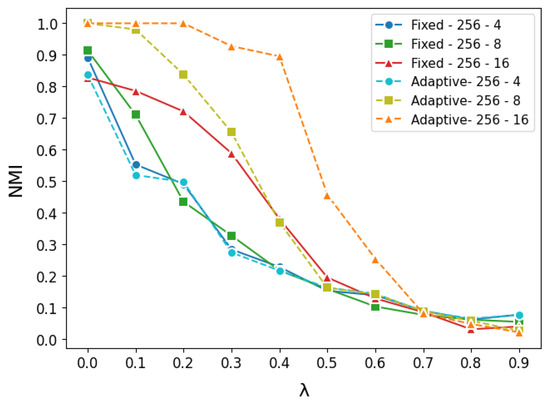
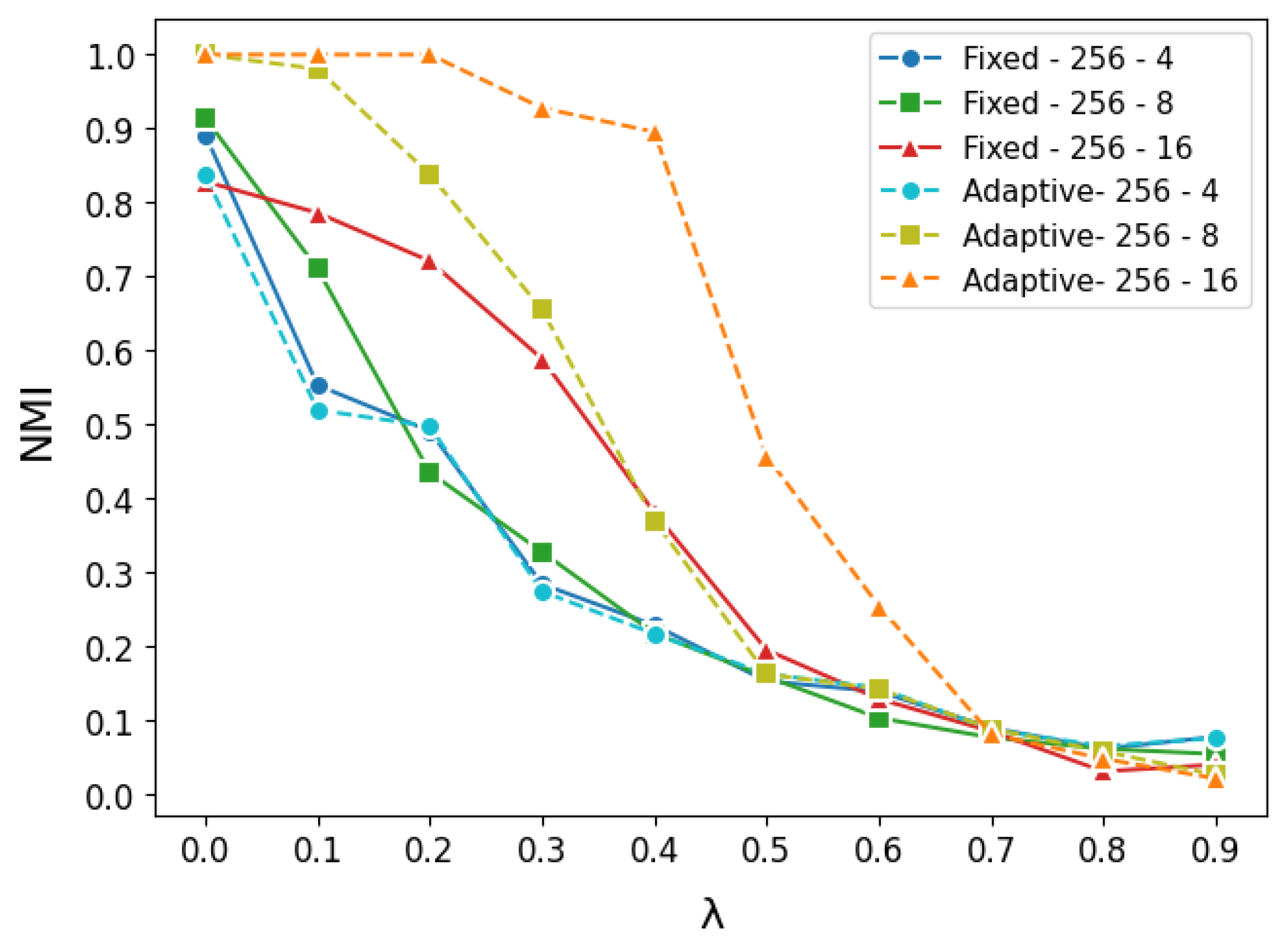
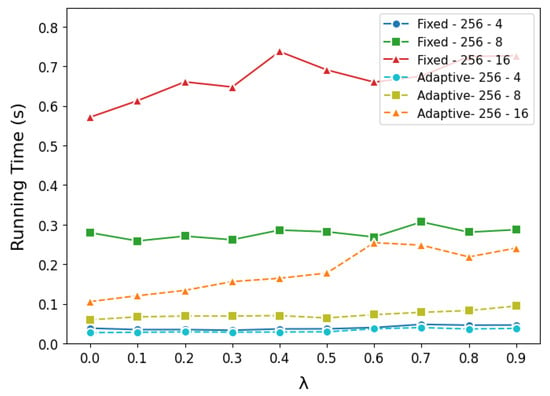
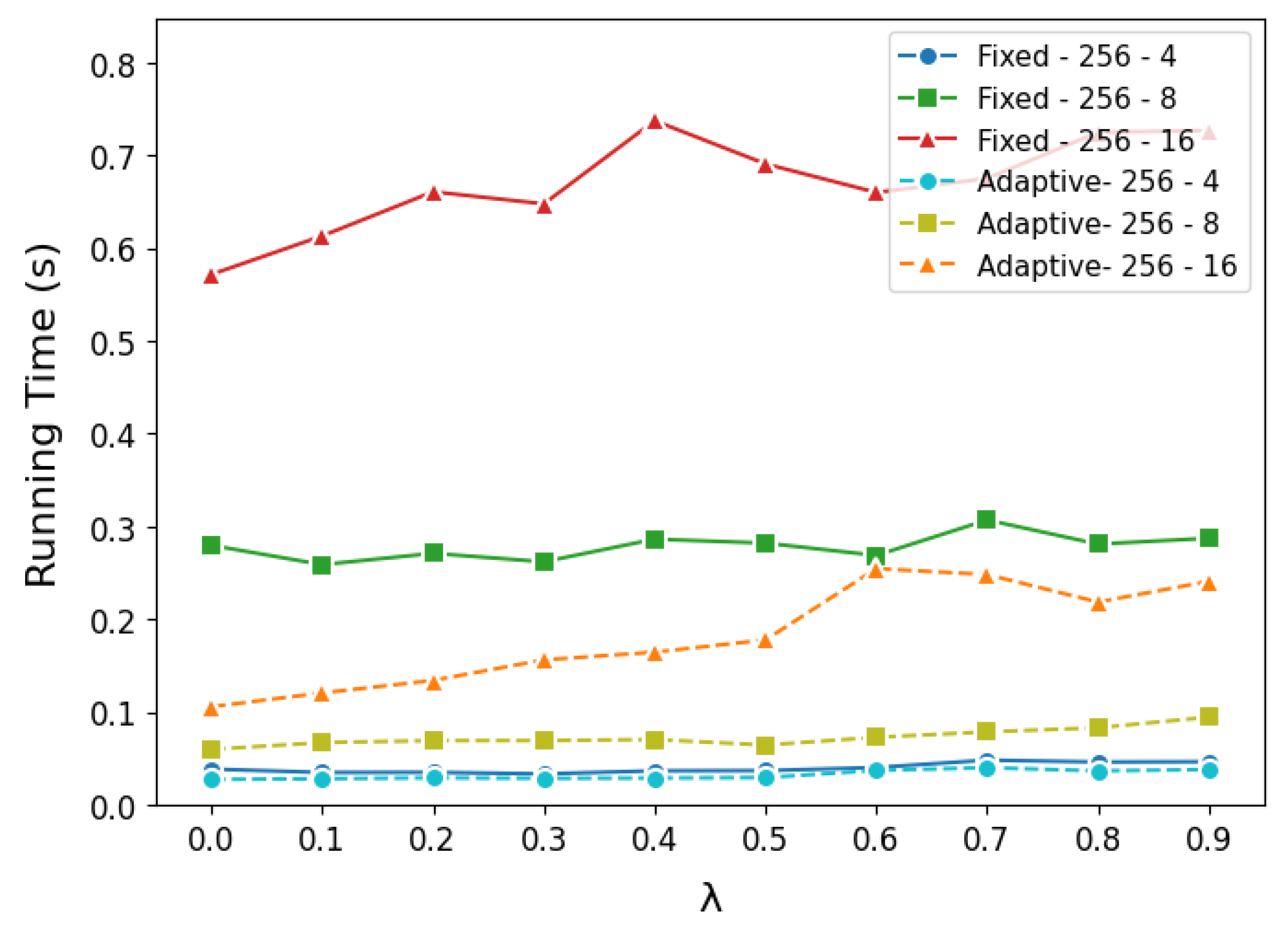
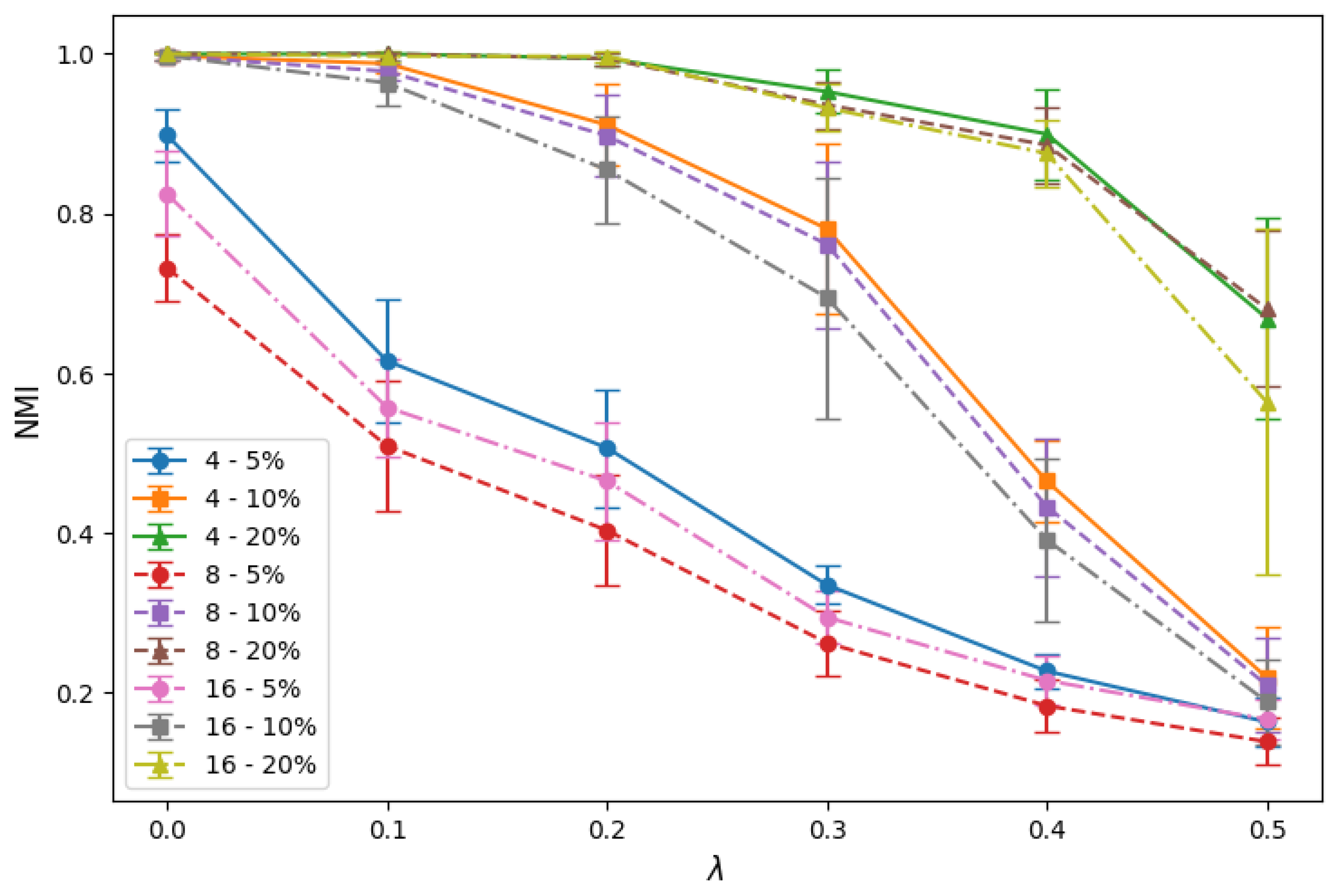
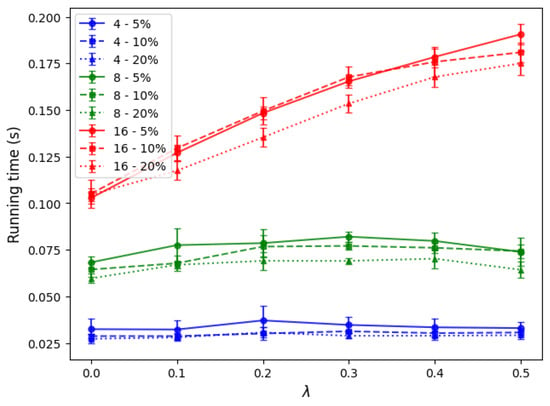
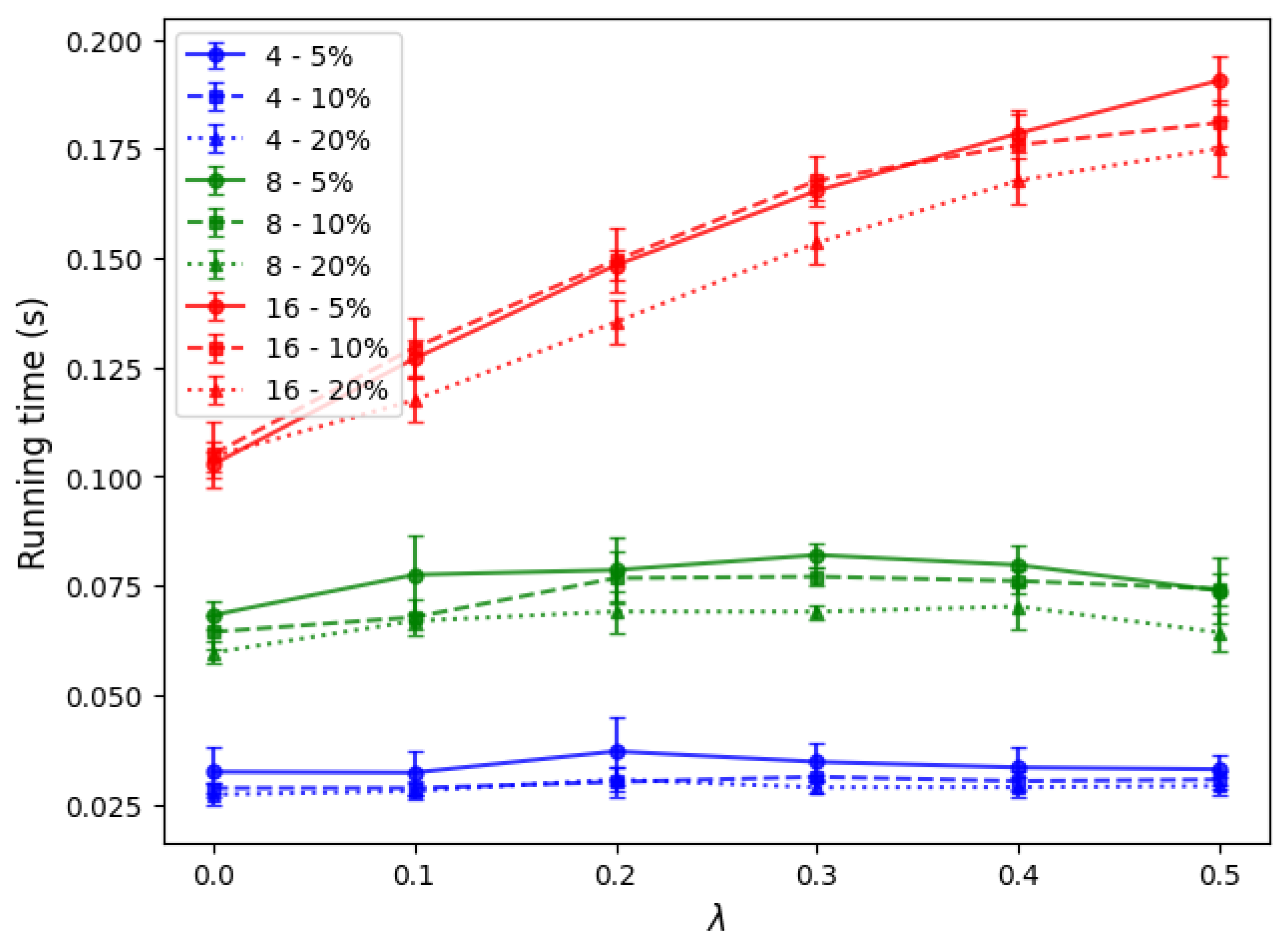
To evaluate the robustness of ANRF to parameter selection, we conducted two sets of sensitivity analyses using the ANRF + Greedy algorithm on 256-node synthetic networks. First, we compared the adaptive parameter mechanism with a fixed-parameter approach ( = 0.01, k = 50). The experimental results, as shown in the Figure 17 and Figure 18, present comparisons of NMI values and runtime. It can be observed that when , the fixed-parameter method achieves slightly higher NMI values than the adaptive approach, with comparable runtime. However, when and 16, the adaptive mechanism significantly outperforms the fixed-parameter method in both NMI values and runtime. Second, we compared the impact of three different quantile settings (5%, 10%, and 20%) in the formula on algorithm performance. The experimental results show that the differences in NMI across different quantile settings are within (as shown in Figure 19), confirming that ANRF is robust to the specific choice of quantile. From the runtime perspective (as shown in Figure 20), we observe a gradual decreasing trend in runtime as the quantile increases. This phenomenon is particularly evident in dense networks: for example, in networks with at , the runtime for Q = 5% is 0.191 s, which decreases to 0.181 s for , and further to 0.175 s for . As network density or scale increases, this time advantage becomes more pronounced, because higher quantiles filter out more weak connections, thereby reducing the computational burden of subsequent community detection. These results indicate that choosing a higher quantile (e.g., 20%) not only ensures detection quality but also improves computational efficiency to some extent, further validating the rationality of selecting in the ANRF. In summary, these experiments validate the effectiveness of the adaptive parameter mechanism, particularly in denser networks where its advantages are most pronounced.
Figure 17.
NMI results of ANRF + Greedy algorithm and fixed-parameter approach on 256 nodes synthetic network with varying average degree.
Figure 18.
Running time of ANRF + Greedy algorithm and fixed-parameter approach on 256 nodes synthetic network with varying average degree.
Figure 19.
NMI results of ANRF + Greedy algorithm on 256 nodes synthetic network with varying Q.
Figure 20.
Running time of ANRF + Greedy algorithm on 256 nodes synthetic network with varying Q.
5. Conclusions
This paper addresses the issues of high parameter sensitivity and heavy reliance on manual tuning in reconstruction-based community detection by proposing an adaptive enhancement to the existing NRF. The resulting Adaptive Network Reconstruction Framework (ANRF) retains the core reconstruction concept while introducing empirically driven heuristic rules that automatically determine key parameters based on network topological features. Building on this mechanism, ANRF adaptively determines key parameters such as the threshold and connection count k without human intervention, enabling the reconstruction of bipartite networks. Combined with traditional unipartite network community detection algorithms, it facilitates the identification of community structures. Experiments on synthetic and real-world bipartite networks (ranging from small to moderately large scales, e.g., up to 38,742 nodes) demonstrate that, within the evaluated scope, ANRF-based algorithms can effectively detect community structures across a variety of network types examined, significantly improving robustness and reducing parameter sensitivity. The framework offers a practical and empirically validated approach for bipartite network community detection, particularly in scenarios where manual parameter tuning is undesirable.
Although ANRF has achieved promising experimental results, several directions warrant further exploration: first, enhancing the efficiency of the method when handling extremely large-scale networks, such as by introducing parallel computing strategies to optimize performance; second, investigating adaptive parameter mechanisms suitable for dynamically evolving bipartite networks (as ANRF is currently designed for static networks), thereby broadening its applicability and adaptability to more scenarios.
Author Contributions
Conceptualization, F.C.; methodology, F.C., S.W. and Y.Z.; validation, S.W. and F.U.; formal analysis, S.W.; data curation, Y.Z.; writing—original draft preparation, F.C. and S.W.; writing—review and editing, F.C., F.U., Y.Z. and S.W.; visualization, F.C. and Y.Z.; funding acquisition, F.C. All authors have read and agreed to the published version of the manuscript.
Funding
This research was supported in part by the “Green Willow Finch Plan” and in part by Foundation of the Jiangsu Province High Vocational College Teacher Professional Leader High-end Training Program under grant 62023TDFX012, and also supported by the Wenzhou-Kean University internal research grant (ISRG2024008).
Data Availability Statement
The original data presented in the study are openly availability in http://konect.cc/networks/ (accessed on 15 January 2026).
Conflicts of Interest
The authors declare no conflicts of interest.
References
- Alzahrani, T. Complex Information Networks—Detecting Community Structure in Bipartite Networks. Ph.D. Thesis, RMIT University, Melbourne, Australia, 2016. [Google Scholar]
- Zhai, X.; Hu, H.; Hu, G.; Qu, Y. PRBL: A personalized recommendation system based on bipartite network projection and link community detection. In Proceedings of the ACM Turing Celebration Conference-China, Chengdu, China, 17–19 May 2019; Association for Computing Machinery: New York, NY, USA, 2019; pp. 1–7. [Google Scholar]
- Sharma, B.; Kathirvel, P.; Hegde, S.R. Identifying Communities in the Virus–Host Protein–Protein Interaction Networks. In Computational Virology; Springer: New York, NY, USA, 2025; pp. 307–319. [Google Scholar]
- Zhang, L.; Li, J.; Zhang, Q.; Meng, F.; Teng, W. Domain Knowledge-Based Link Prediction in Customer-Product Bipartite Graph for Product Recommendation. Int. J. Inf. Technol. Decis. Mak. 2019, 18, 311–338. [Google Scholar] [CrossRef] [Scilit]
- Wang, Y.; Han, X. Attractive Community Detection in Academic Social Network. J. Comput. Sci. 2021, 51, 101331. [Google Scholar] [CrossRef] [Scilit]
- Doluca, O.; Oğuz, K. APAL: Adjacency Propagation Algorithm for overlapping community detection in biological networks. Inf. Sci. 2021, 579, 574–590. [Google Scholar] [CrossRef] [Scilit]
- Gösgens, M.; van der Hofstad, R.; Litvak, N. The projection method: A unified formalism for community detection. Front. Complex Syst. 2024, 2, 1331320. [Google Scholar] [CrossRef] [Scilit]
- Cimini, G.; Carra, A.; Didomenicantonio, L.; Zaccaria, A. Meta-validation of bipartite network projections. Commun. Phys. 2022, 5, 76. [Google Scholar] [CrossRef] [Scilit]
- Cann, T.J.B.; Weaver, I.S.; Williams, H.T.P. Is it correct to project and detect? How weighting unipartite projections influences community detection. Netw. Sci. 2020, 8, S145–S163. [Google Scholar] [CrossRef] [Scilit]
- Coscia, M.; Rossi, L. The impact of projection and backboning on network topologies. In Proceedings of the 2019 IEEE/ACM International Conference on Advances in Social Networks Analysis and Mining; Association for Computing Machinery: New York, NY, USA, 2019; pp. 286–293. [Google Scholar]
- Candellone, E.; Van Kesteren, E.J.; Chelmi, S.; Garcia-Bernardo, J. Community Detection in Bipartite Signed Networks Is Highly Dependent on Parameter Choice. Adv. Complex Syst. 2025, 28, 2540002. [Google Scholar] [CrossRef] [Scilit]
- Barber, M.J. Modularity and community detection in bipartite networks. Phys. Rev. E 2007, 76, 066102. [Google Scholar] [CrossRef] [Scilit]
- Federico, L.; Auconi, A.; Bordi, G.A.B.; Piazza, S.; Caldarelli, G. An algorithm with tunable resolution for detecting overlapping communities in bipartite networks. Boll. Dell’Unione Mat. Ital. 2025, 1–17. [Google Scholar] [CrossRef] [Scilit]
- Khosrozadeh, A.; Movaghar, A.; Gilanian Sadeghi, M.M.; Mahyar, H. A Novel Method for Community Detection in Bipartite Networks. Information 2025, 16, 417. [Google Scholar] [CrossRef] [Scilit]
- Wu, G.; Gu, C.; Yang, H. A spectral method of modularity for community detection in bipartite networks. Europhys. Lett. 2022, 137, 31001. [Google Scholar] [CrossRef] [Scilit]
- Wang, D.; Nie, M.; Chen, D.; Wan, L.; Huang, X. Node Similarity Index and Community Identification in Bipartite Networks. J. Internet Technol. 2021, 22, 673–684. [Google Scholar]
- Yang, M.; Li, W.; Wang, W.; Wen, D.; Gao, M.; Qin, L. Structural Clustering for Bipartite Graphs. IEEE Trans. Knowl. Data Eng. 2026, 38, 645–658. [Google Scholar] [CrossRef] [Scilit]
- Contisciani, M.; Hobbhahn, M.; Power, E.A.; Hennig, P.; Bacco, C.D. Flexible inference in heterogeneous and attributed multilayer networks. PNAS Nexus 2025, 4, pgaf005. [Google Scholar] [PubMed]
- Cheng, J.; He, C.; Lin, X.; Liu, W.; Han, K.; Tang, Y. When graph neural networks meet deep nonnegative matrix factorization: An encoder and decoder-like method for community detection. Expert Syst. Appl. 2025, 271, 126676. [Google Scholar] [CrossRef] [Scilit]
- Cionca, A.; Chan, C.H.M.; Van De Ville, D. Community detection for directed networks revisited using bimodularity. Proc. Natl. Acad. Sci. USA 2025, 122, e2500571122. [Google Scholar] [PubMed]
- Bouguessa, M.; Nouri, K. BiNeTClus: Bipartite network community detection based on transactional clustering. ACM Trans. Intell. Syst. Technol. 2020, 12, 1–26. [Google Scholar]
- Tang, F.; Li, J.; Liu, X.; Chang, C.; Teng, L. GATFELPA integrates graph attention networks and enhanced label propagation for robust community detection. Sci. Rep. 2025, 15, 3952. [Google Scholar] [CrossRef] [Scilit]
- Zhou, C.; Wang, Y.; Zhang, J.; Jiang, J.; Hu, D. End-to-end modularity-based community co-partition in bipartite networks. In Proceedings of the 31st ACM International Conference on Information and Knowledge Management, Vancouver, BC, Canada, 27–30 August 2019; Association for Computing Machinery: New York, NY, USA, 2022; pp. 2711–2720. [Google Scholar]
- Berahmand, K.; Mohammadi, M.; Faroughi, A.; Mohammadiani, R.P. A novel method of spectral clustering in attributed networks by constructing parameter-free affinity matrix. Clust. Comput. 2022, 25, 869–888. [Google Scholar] [CrossRef] [Scilit]
- Zhao, Q.; Miao, Y.; Lian, J.; Li, X.; An, D. Louvain-Based Fusion of Topology and Attribute Structure of Social Networks. Comput. Inform. 2024, 43, 94–125. [Google Scholar] [CrossRef] [Scilit]
- Chang, F.; Wu, S.; Zhao, Y.; Yoshigoe, K.; Ullah, F.; Dong, X. NRF: A Network Reconstruction Framework for Community Detection in Bipartite Networks. IEEE Access 2025, 13, 181507–181518. [Google Scholar] [CrossRef] [Scilit]
- Kunegis, J. KONECT—The Koblenz Network Collection. In Proceedings of the International Conference on World Wide Web Companion, Rio de Janeiro, Brazil, 13–17 May 2019; Association for Computing Machinery: New York, NY, USA, 2013; pp. 1343–1350. [Google Scholar]
- Cui, Y.; Wang, X. Uncovering overlapping community structures by the key bi-community and intimate degree in bipartite networks. Phys. A Stat. Mech. Its Appl. 2014, 407, 7–14. [Google Scholar] [CrossRef] [Scilit]
- Wang, X.; Qin, X. Asymmetric intimacy and algorithm for detecting communities in bipartite networks. Phys. A Stat. Mech. Its Appl. 2016, 462, 569–578. [Google Scholar] [CrossRef] [Scilit]
- Chang, F.; Zhang, B.; Zhao, Y.; Wu, S.; Zou, G.; Niu, S. Overlapping community detection in bipartite networks using a micro-bipartite network model: Bi-EgoNet. J. Intell. Fuzzy Syst. 2019, 37, 7965–7976. [Google Scholar] [CrossRef] [Scilit]
- Chang, F.; Zhang, B.; Zhao, Y.; Wu, S.; Yoshigoe, K. Overlapping community detecting based on complete bipartite graphs in micro-bipartite network bi-egonet. IEEE Access 2019, 7, 91488–91498. [Google Scholar] [CrossRef] [Scilit]
- Li, Z.; Wang, R.S.; Zhang, S.; Zhang, X.S. Quantitative function and algorithm for community detection in bipartite networks. Inf. Sci. 2016, 367–368, 874–889. [Google Scholar] [CrossRef] [Scilit]
- Danon, L.; Diaz-Guilera, A.; Duch, J.; Arenas, A. Comparing community structure identification. J. Stat. Mech. Theory Exp. 2005, 2005, P09008. [Google Scholar] [CrossRef] [Scilit]
- Blondel, V.D.; Guillaume, J.L.; Lambiotte, R.; Lefebvre, E. Fast unfolding of communities in large networks. J. Stat. Mech. Theory Exp. 2008, 2008, P10008. [Google Scholar] [CrossRef] [Scilit]
- Clauset, A.; Newman, M.E.J.; Moore, C. Finding community structure in very large networks. Phys. Rev. E 2004, 70, 066111. [Google Scholar] [CrossRef] [Scilit]
- Lancichinetti, A.; Fortunato, S.; Radicchi, F. Benchmark graphs for testing community detection algorithms. Phys. Rev. E 2008, 78, 046110. [Google Scholar] [CrossRef] [Scilit]
- Davis, A.; Gardner, B.B.; Gardner, M.R. Deep South: A Social Anthropological Study of Caste and Class. Dataset: Southern Women. KONECT. 1941. Available online: http://konect.cc/networks/brunson_southern-women/ (accessed on 11 January 2026).
- Barnes, R.; Burkett, T. Structural Redundancy and Multiplicity in Corporate Networks. Int. Netw. Soc. Netw. Anal. 2010, 30, 4–20. [Google Scholar]
- Fischer, D.H. Paul Revere’s Ride; Oxford Paperbacks; Oxford University Press: London, UK, 1995. [Google Scholar]
- Imrich, W.; Klavžar, S. Product Graphs: Structure and Recognition; Wiley: Hoboken, NJ, USA, 2000. [Google Scholar]
- Larremore, D.B.; Clauset, A.; Buckee, C.O. A network approach to analyzing highly recombinant malaria parasite genes. PLoS Comput. Biol. 2013, 9, e1003268. [Google Scholar] [CrossRef] [Scilit]
- KONECT. Crime Network Dataset. 2017. Available online: http://konect.cc/networks/moreno_crime/ (accessed on 11 January 2026).
- Nacher, J.C.; Schwartz, J.M. Modularity in protein complex and drug interactions reveals new polypharmacological properties. PLoS ONE 2012, 7, e30028. [Google Scholar] [CrossRef] [Scilit]
- Newman, M.E.J. The structure of scientific collaboration networks. Proc. Natl. Acad. Sci. USA 2001, 98, 404–409. [Google Scholar] [CrossRef]

Disclaimer/Publisher’s Note: The statements, opinions and data contained in all publications are solely those of the individual author(s) and contributor(s) and not of MDPI and/or the editor(s). MDPI and/or the editor(s) disclaim responsibility for any injury to people or property resulting from any ideas, methods, instructions or products referred to in the content. |
© 2026 by the authors. Licensee MDPI, Basel, Switzerland. This article is an open access article distributed under the terms and conditions of the Creative Commons Attribution (CC BY) license.