

Model Procurement for Industrial Cyber-Physical Systems Using Cryptographic Performance Attestation

Abstract
1. Introduction
1.1. Motivation
- An OT Operator (Asset Owner) manages a fleet of legacy industrial assets (e.g., turbines, pumps) generating high-frequency vibration data. They want to detect anomalies earlier to prevent downtime but lack internal ML expertise.
- IT Vendors (ML Service Providers) possess advanced deep learning models capable of detecting these subtle anomalies. However, they treat their model architectures and weights as high-value Trade Secrets.
- Current procurement approaches create a deadlock. For the Operator to objectively compare competing models, vendors would traditionally need to share model artifacts or grant evaluation access, exposing proprietary architectures and trained weights to parties who may never purchase the solution. Conversely, if vendors withhold their models until after payment, the Operator must rely on unverified performance claims supported only by contractual assurances (NDAs, service-level agreements) and optional third-party audits, mechanisms that are legally binding but not cryptographically enforceable, cannot readily scale to open multi-vendor competition, and offer no automated guarantee that a specific model produced a specific evaluation result on agreed data.
- Pre-Deployment IP Protection: IT Vendors can prove their model’s performance (e.g., “Accuracy > 95%” or “Loss < 0.1”) on a representative dataset cryptographically during the procurement phase, without revealing the model weights to competitors or the public blockchain. This prevents premature disclosure to parties who ultimately do not purchase the solution.
- On-Chain Data Minimization: The on-chain workflow stores only compact commitments (hashes) and agreed metric outputs, not raw datasets. Evaluation data is provided to vendors out-of-band, either as a representative sample, a synthetic dataset generated by the Operator, or a public benchmark. This is an engineering property that reduces on-chain storage costs and avoids unnecessary data publication; it is not a data-confidentiality guarantee, as vendors necessarily receive the evaluation data to perform inference and generate proofs. This framework therefore addresses vendor-side IP protection through cryptographic means, while operator-side evaluation-data confidentiality is managed through data selection (synthetic, de-identified, or public benchmark datasets), not by ZKP directly.
- Verifiable Performance Claims: The Operator deposits funds into escrow at job creation. Escrowed funds are released to the winning Vendor only after on-chain ZKP verification confirms that the submitted model meets the specified performance baseline, and only if the Operator does not successfully dispute the result. This ensures the Operator never pays for an unverified claim, while the escrow mechanism commits credible demand.
- Automated Procurement: Smart contracts automate the procurement lifecycle by managing escrow, enforcing submission deadlines, selecting the best verified submission, and governing fund release or withdrawal, thereby reducing reliance on manual oversight or legal enforcement.
1.2. Contributions
- Novel Framework Proposal: We propose a novel framework architecture that integrates Zero-Knowledge Proofs with blockchain technology to enable trust-minimized, vendor-IP-protecting, and verifiable competitive procurement of machine learning models.
- We defined an industrial procurement use case and designed workflows intended to (i) accelerate competitive model procurement and reduce reliance on slow, trust-heavy mechanisms such as NDAs, manual audits, and ad hoc benchmarking, and (ii) protect both sides of the transaction: OT Operators against economic harm (e.g., paying for unverified regressions or malicious submissions) and IT Vendors against premature IP disclosure during bidding.
- We analyze three distinct ZKP workflow variations tailored for this use case, evaluating their inherent trade-offs concerning model-IP privacy guarantees, verification complexity, computational overhead, and potential for decentralization. We justify the selection of one specific variation for our Proof of Concept (PoC) implementation based on this analysis.
- Performance and Cost Evaluation: We provide an initial quantitative evaluation of the implemented solution. This includes measuring ZKP generation times, proof sizes, and the gas costs associated with key on-chain interactions (job creation, proof of improvement submission/verification, dispute handling) under defined experimental scenarios, offering insights into the system’s practical viability and potential bottlenecks.
2. Related Work
3. Proposed System
3.1. System Overview
- OT Operators (Asset Owners): Entities managing physical industrial assets (e.g., turbines, grids). They define the maintenance problem, provide baseline historical data (or its hash), and fund the reward.
- IT Vendors (Model Providers): Specialized ML firms or freelance data scientists. They develop superior predictive models off-chain, generate ZKPs to prove performance, and submit tamper-evident on-chain solution identifiers (e.g., a content address or handle pointing to the off-chain artifact).
- Arbiters (Auditors): Designated neutral parties or automated oracles responsible for resolving disputes, particularly verifying that a revealed solution matches the performance and the cryptographic commitment if an Operator claims it is invalid.
3.2. System Architecture and Implementation
3.2.1. CPS Integration Architecture
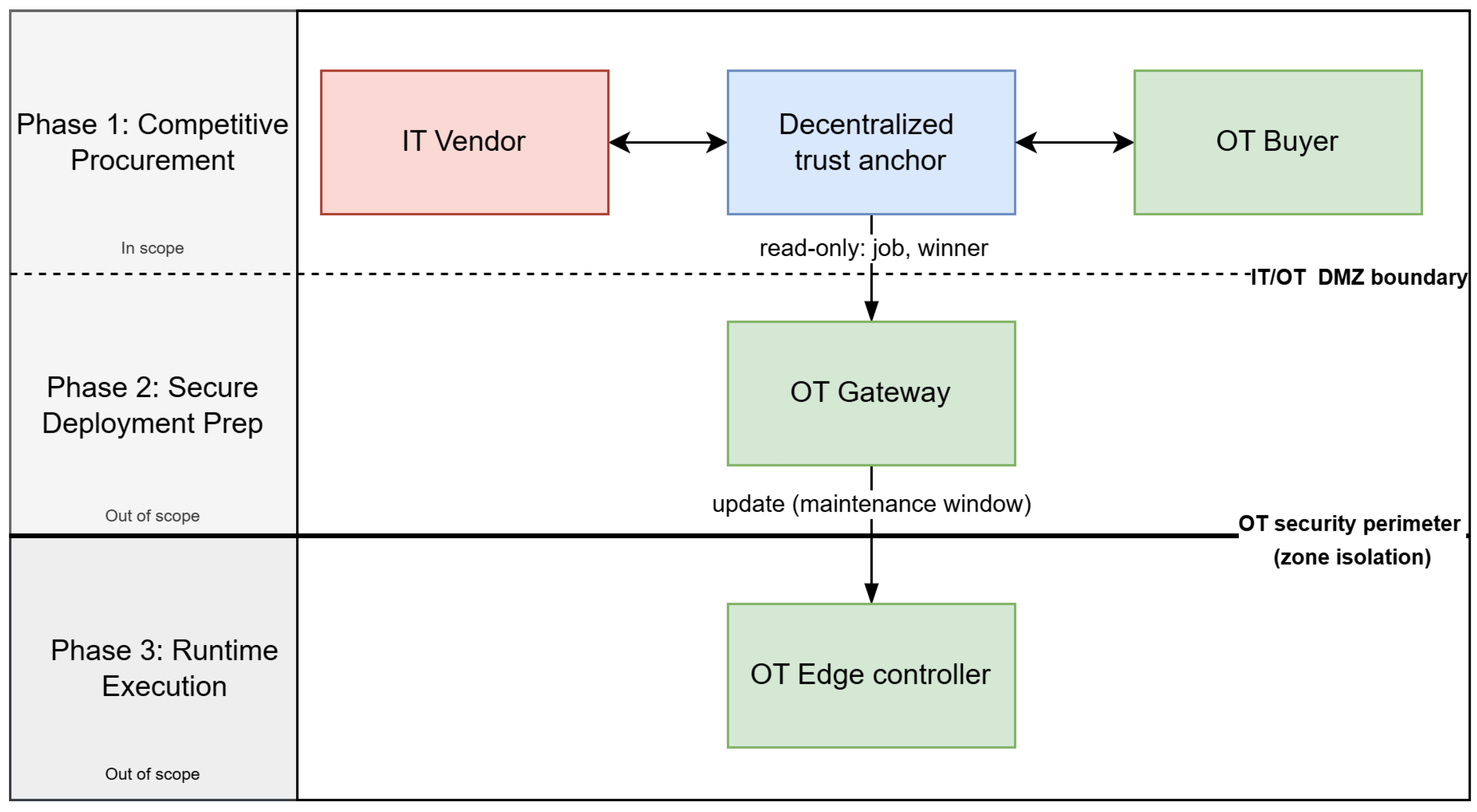
- Network segmentation and zone isolation: OT integration can be implemented as read-only consumption of chain state from a DMZ gateway, with the actual update crossing the OT security perimeter only during controlled maintenance windows.
- Legacy compatibility: PLCs/RTUs do not need blockchain clients or ZKP verifiers; cryptographic verification occurs during procurement, while deployment uses standard OT change-management procedures.
- Auditability: Proof verification results, winner selection, and dispute events are recorded on-chain as a tamper-evident procurement log (without exposing raw OT telemetry).
3.2.2. Off-Chain Subsystem
- 1.
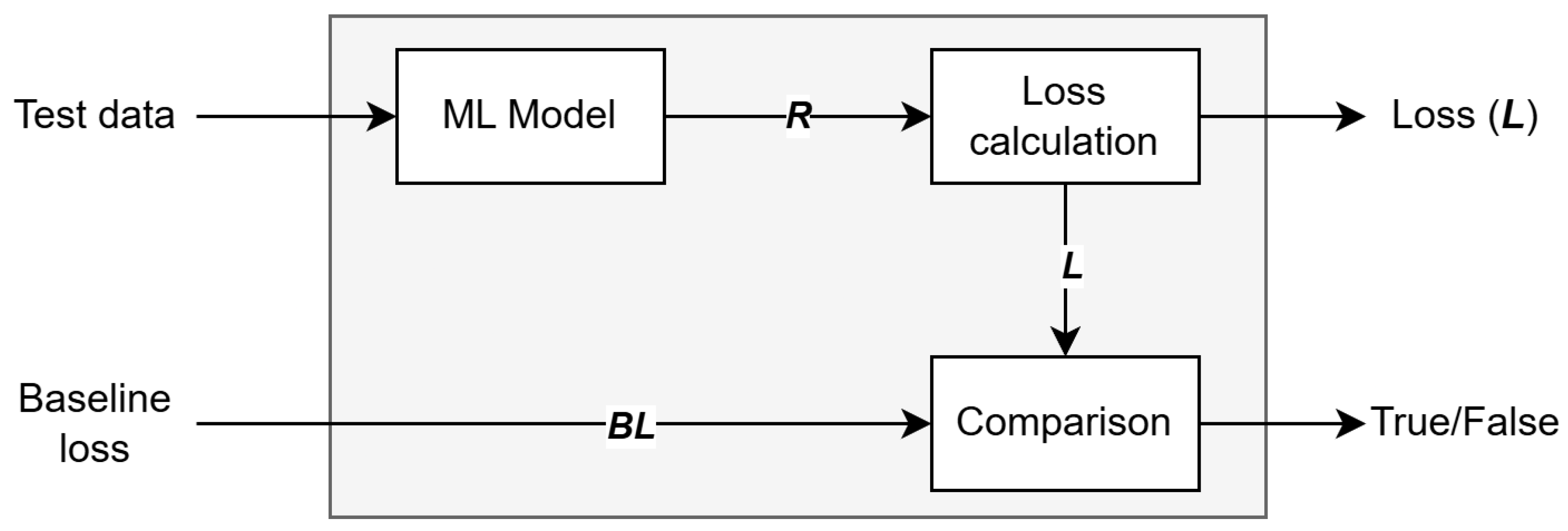
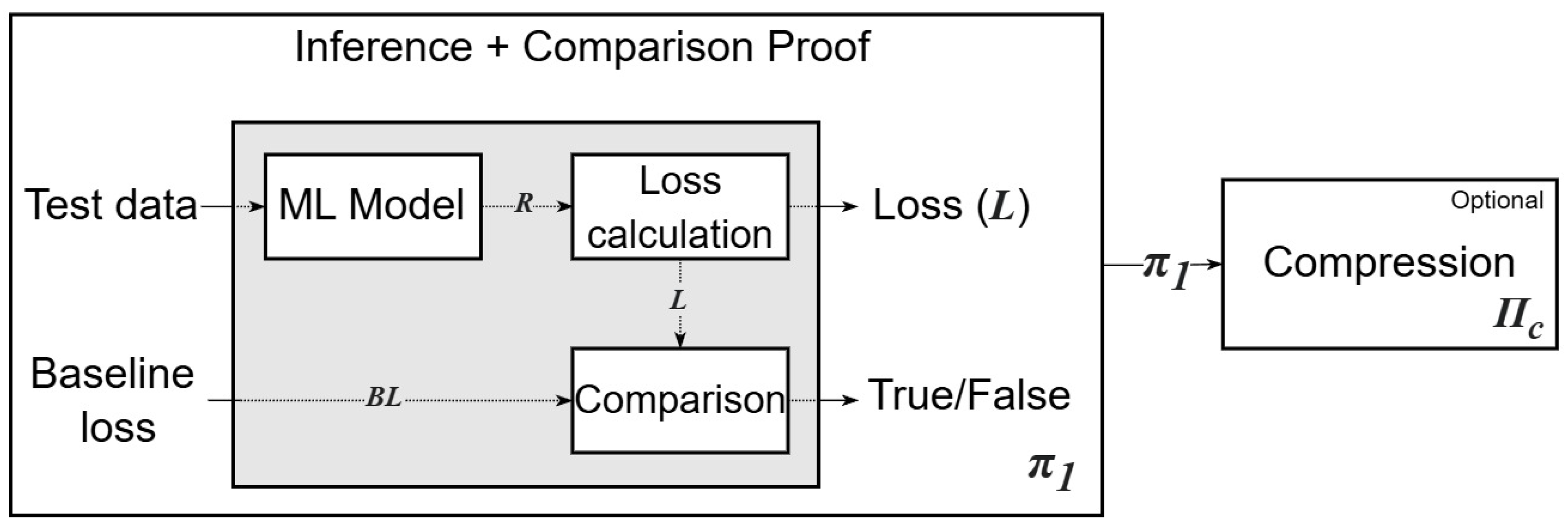
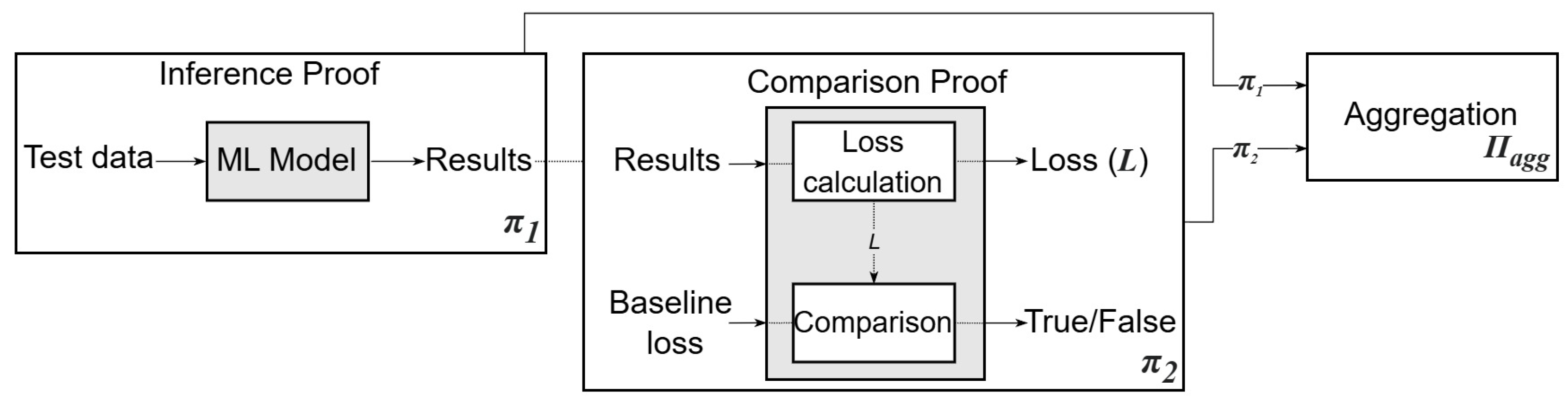
- Executing the circuit logic (model inference, loss calculation, comparison) on the public inputs (test data, baseline loss ) using the IT Vendor’s private model parameters correctly produces the claimed public outputs (the new loss L, the improvement flag).
- 2.
- A Poseidon hash, computed within the circuit over the private model parameters, matches a specific public hash value supplied as a public instance of the proof. This acts as the commitment to the parameters, ensuring the IT Vendor cannot later submit a different model while allowing the OT Operator or arbiters to verify solution authenticity against this public hash.
3.2.3. On-Chain Subsystem
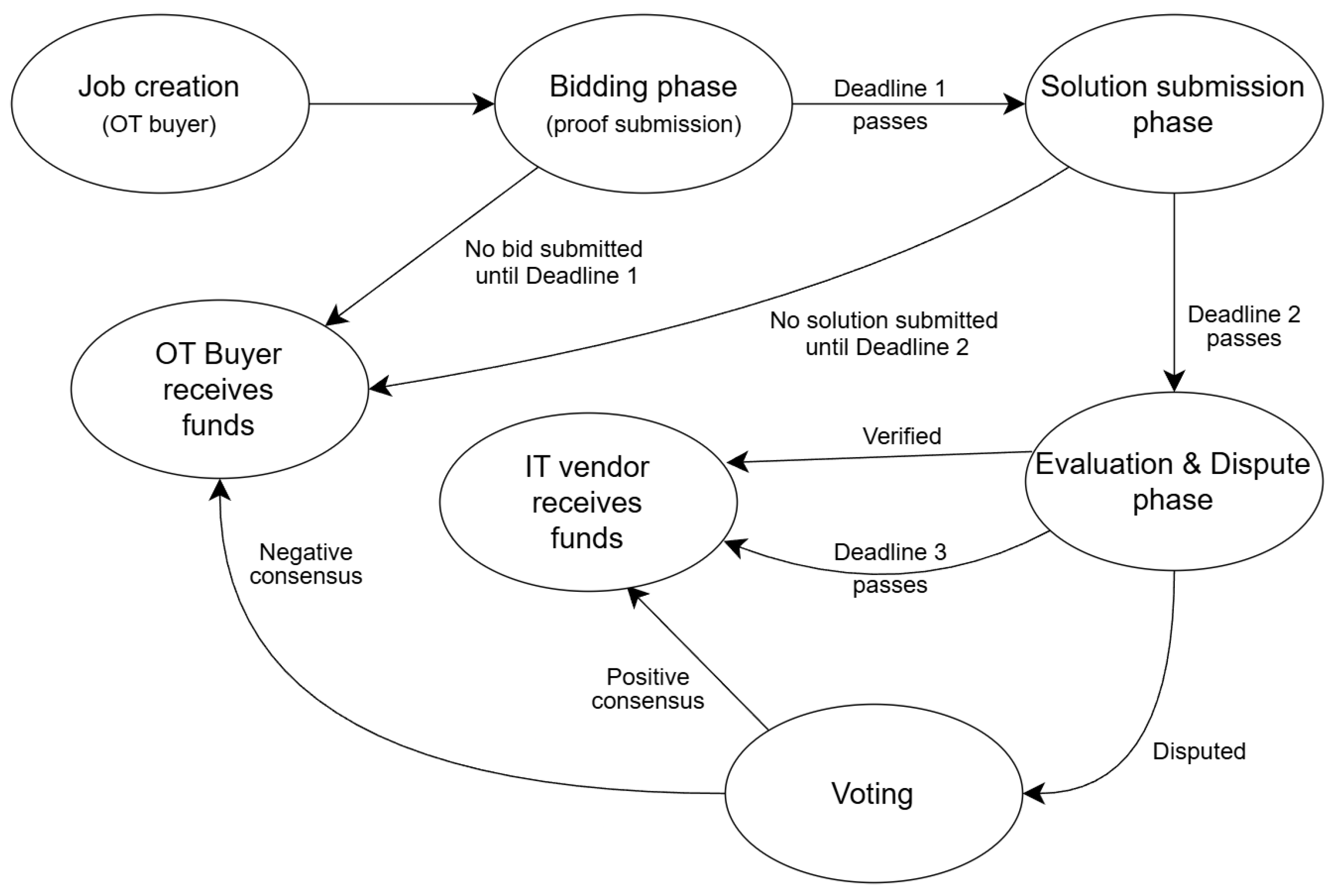
- Job Contract: This contract is responsible for managing the lifecycle of a job, including its creation, handling the escrow deposit and management, enforcing deadlines, and controlling the final release or withdrawal of funds.
- Improvement Contract: This contract manages the proof of improvement submissions. It triggers the ZKP verification process, keeps track of the best valid submission received for a job, and handles the final submission of the actual solution by the winning IT Vendor.
- Dispute Contract: This contract governs the dispute resolution process. Its responsibilities include managing arbiter registration, handling the initiation of disputes, overseeing the arbiter voting logic, and executing the final resolution based on the vote outcome.
- Initiation: An OT Operator, believing the submitted solution is faulty despite a valid ZKP (e.g., the model doesn’t generalize, isn’t relevant, or fails other qualitative checks), can initiate a dispute before deadline 3.
- Arbitration: A small panel of Arbiters (three in the PoC implementation) is selected from a pool of registered addresses.
- Review & Voting: Selected Arbiters review the job details, the IT Vendor’s claim (proof and solution), and any evidence provided off-chain before submitting their binding vote on-chain. The current implementation does not enforce an on-chain voting timeout; settlement liveness therefore depends on arbiter participation (see Section 5.1.3).
- Resolution: A majority vote resolves the dispute, automatically triggering the release of escrowed funds to the winning party (either the OT Operator or the winning IT Vendor).
3.3. Core Operational Workflow
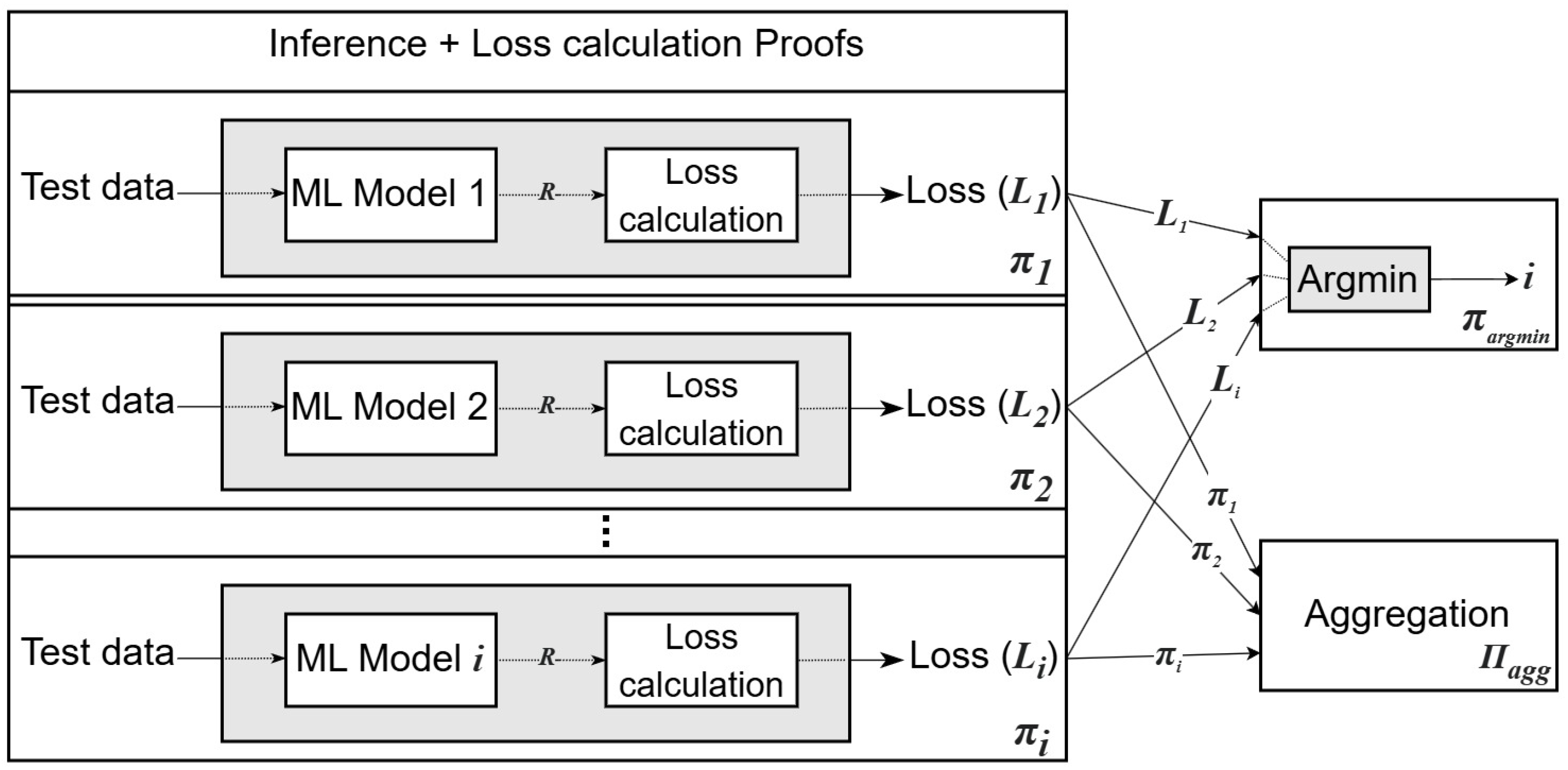
3.4. ZKP Variations
- 1.
- Platform-standard evaluation VKA: A global, public evaluation circuit/VKA shared by the platform (e.g., a canonical loss definition and comparison logic).
- 2.
- Job-specific evaluation VKA: The OT Operator deploys or registers a job-specific evaluation circuit/VKA at job creation (e.g., capturing a job-specific metric, baseline binding, and data-window commitment binding).
4. System Evaluation
4.1. Experimental Setup
4.2. Experimental Model
4.3. Zero-Knowledge Proof Performance Analysis
4.3.1. Setup and Proving Times
4.3.2. Proof and Key Sizes
4.4. On-Chain Workflow Cost Analysis
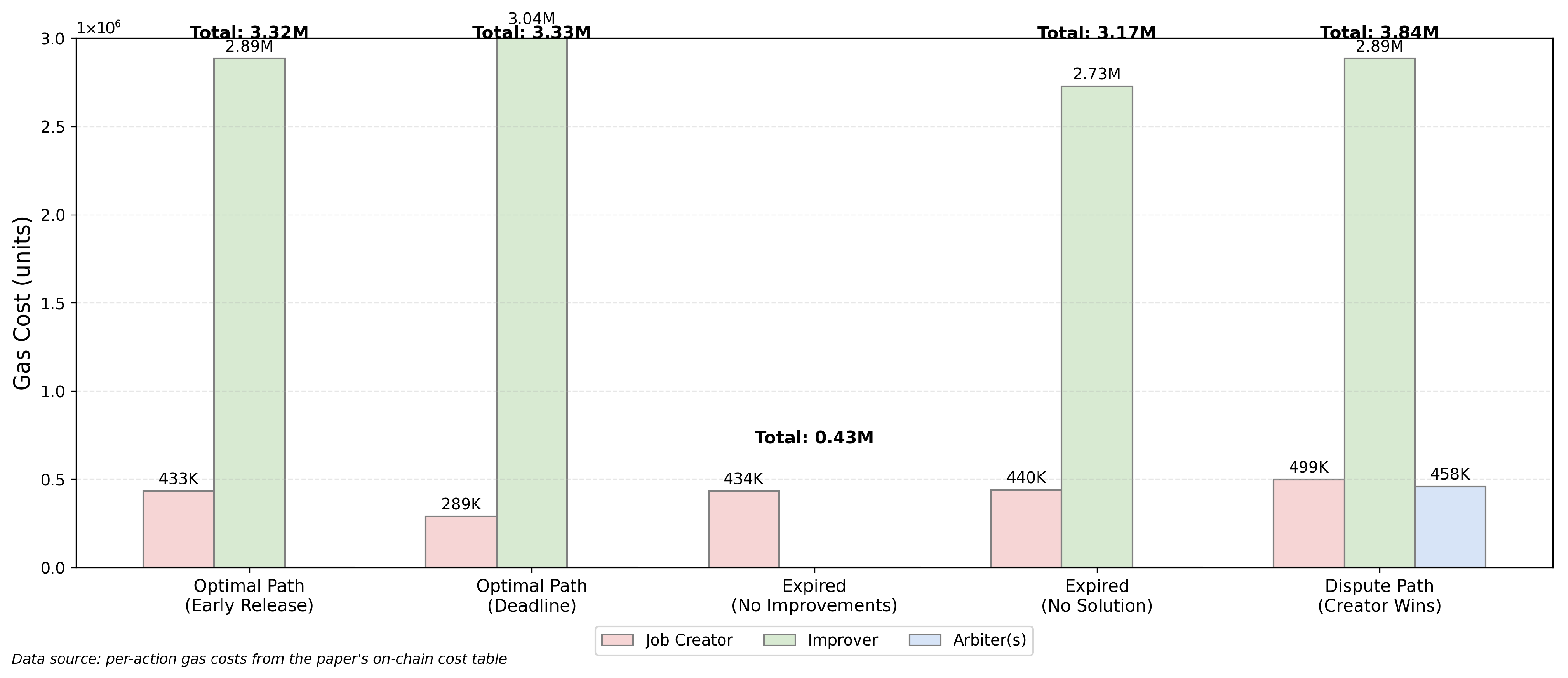
- Optimal Path (Early Release): Job Creation → Deploy VKA → Proof Submission & Verification → Solution Submission → Verifies & Releases Funds Early
- Optimal Path (Deadline Release): Job Creation → Deploy VKA → Proof Submission → Solution Submission → IT Vendor Withdraws Funds
- Expired (No Improvements): Create Job → Operator withdraws funds
- Expired (No Solution): Job Creation → Deploy VKA → Proof Submission → Operator Withdraws Funds
- Dispute Path: Job Creation → Deploy VKA → Proof Submission → Solution Submission → Dispute initiation → Vote1 & Vote2 & Vote3.
4.5. Real-Time Constraints in CPS Deployment
- Pre-Deployment Verification: IT Vendors generate proofs client-side during the procurement phase, demonstrating their model’s performance improvement. The smart contract verifies these proofs and selects the winning model, all before any code touches the physical system.
- Zero Runtime Overhead: Once a model is cryptographically verified and deployed to the edge controller (PLC, RTU, or embedded system), it operates as a standard inference model with no cryptographic overhead. The verified model executes in the real-time control loop with the same performance characteristics as any conventional model.
- Separation of Concerns: The verification layer (blockchain + ZKP) and the execution layer (edge device) are architecturally decoupled. The blockchain acts as a trust anchor and procurement platform, while the edge device focuses solely on real-time performance.
5. Security Discussion
5.1. Economic Deterrence and Game-Theoretic Security
5.1.1. IT Vendor Submission Flooding and Manipulation
5.1.2. OT Operator Dispute Abuse
5.1.3. Arbiter Non-Participation, Deadline 4, and Bounded Replacement
5.1.4. Cross-Cutting Trade-Offs and Scope
5.2. Safety-Critical Validation for Industrial CPS
- The proposed model achieves specific, measurable performance improvements on representative test data (e.g., “anomaly detection recall > 95%” or “MSE < 0.05”).
- The reported metric value is the result of correctly executing the agreed evaluation circuit (e.g., inference + loss computation + comparison) associated with the verification key.
- The model revealed for deployment is exactly the model that was evaluated in the proof, enforced through the parameter commitment hash verified by the Operator before deployment.
6. Conclusions
7. Future Work
- Expanding Platform Use: The system currently targets ML models, but its foundation could support wider software development tasks. OT Operators could define jobs, allowing IT Vendors (and potentially automated agents) to tackle the problem, shifting payment towards the final solution instead of time or resources. This differs from simply using autonomous agents to build products directly. Exploring Multi-Party Computation (MPC) could also enable more complex scenarios with multiple participants working together securely.
- Agentic Use Cases: Future work should explore trust-minimized agent participation in procurement workflows, where autonomous agents can discover jobs, submit cryptographically verified bids, and receive automated settlement on-chain. This is an application direction enabled by the framework’s properties (not an added formal guarantee), and the same trust assumptions and temporal boundaries apply as for human participants.
- Improving Dispute Resolution: As noted in Section 5.1, a production-ready dispute system should introduce an explicit voting timeout (deadline 4), arbiter staking, bounded replacement rounds, and a predefined fallback outcome if all replacement rounds are exhausted. Future work could entail calibration and validation of these mechanisms. This includes studying suitable voting-window lengths, slash fractions, replacement-round caps, fallback policies, and whether arbiter selection should combine randomness with reputation, and stake-based eligibility filters. Exploring Large language model (LLM)-assisted arbiters, potentially in secure execution environments, and allowing an OT Operator to select the second-best verified solution after a successful dispute might also be valuable extensions.
- Refining Economics and Fairness: Clear rules for arbiter compensation are necessary, perhaps funded by small reward deductions or integrated with systems like Kleros. Furthermore, the “winner-takes-all” model might create fairness issues or strategic bidding (“gas wars”); alternative reward structures (e.g., paying top contributors) or reputation systems could encourage wider participation. Another open problem is to calibrate role-specific deterrence across all three abuse channels identified in Section 5.1: IT Vendor submission flooding, OT Operator dispute abuse, and arbiter non-participation. Future work should therefore treat economic hardening as a formal mechanism-design problem for all protocol roles, not only IT Vendors, by simulating attacker and honest-participant behavior across job values, proving costs, gas prices, capital lock-up costs, dispute probabilities, voting-window lengths, chain congestion, and reputation-update rules. This is needed to estimate equilibrium participation, attack profitability, and appropriate ranges for bid-bond percentages, dispute-bond sizes, arbiter-stake levels, slash fractions, entry-fee schedules, and reputation thresholds.
Author Contributions
Funding
Data Availability Statement
Conflicts of Interest
References
- Berardi, D.; Callegati, F.; Giovine, A.; Melis, A.; Prandini, M.; Rinieri, L. When Operation Technology Meets Information Technology: Challenges and Opportunities. Future Internet 2023, 15, 95. [Google Scholar] [CrossRef] [Scilit]
- Farahani, B.; Monsefi, A.K. Smart and collaborative industrial IoT: A federated learning and data space approach. Digit. Commun. Netw. 2023, 9, 436–447. [Google Scholar] [CrossRef] [Scilit]
- Gaba, G.S.; Sari, A.; Butun, I.; Singh, P.; Gurtov, A.; Liyanage, M. A Survey on Security and Privacy of Industry 4.0 and Beyond: Technical Aspects, Use Cases, Challenges, and Research Directions. IEEE Open J. Commun. Soc. 2025, 6, 8865–8929. [Google Scholar] [CrossRef] [Scilit]
- Wetzels, J.; Santos, D.D.; Ghafari, M. Insecure by Design in the Backbone of Critical Infrastructure. In Proceedings of the Cyber-Physical Systems and Internet of Things Week 2023, San Antonio, TX, USA, 9–12 May 2023; pp. 7–12. [Google Scholar]
- Khokhar, R.H.; Rankothge, W.; Rashidi, L.; Mohammadian, H.; Ghorbani, A.; Frei, B.; Ellis, S.; Freitas, I. A Survey on Supply Chain Management: Exploring Physical and Cyber Security Challenges, Threats, Critical Applications, and Innovative Technologies. Int. J. Supply Oper. Manag. 2024, 11, 250–283. [Google Scholar]
- Sun, X.; Yu, F.R.; Zhang, P.; Sun, Z.; Xie, W.; Peng, X. A Survey on Zero-Knowledge Proof in Blockchain. IEEE Netw. 2021, 35, 198–205. [Google Scholar] [CrossRef] [Scilit]
- Zkonduit. EZKL: Zero-Knowledge Proofs for Machine Learning. 2025. Available online: https://github.com/zkonduit/ezkl (accessed on 28 December 2025).
- Lattice XYZ, MUD: A Smart Contract Framework for Autonomous Worlds. 2025. Available online: https://mud.dev/ (accessed on 28 April 2025).
- Mushtaq, S.; Mohsin, M.; Mushtaq, M.M. A Systematic Literature Review on the Implementation and Challenges of Zero Trust Architecture Across Domains. Sensors 2025, 25, 6118. [Google Scholar] [CrossRef] [Scilit]
- Cirne, A.; Sousa, P.R.; Resende, J.S.; Antunes, L. Hardware Security for Internet of Things Identity Assurance. IEEE Commun. Surv. Tutor. 2024, 26, 1041–1079. [Google Scholar] [CrossRef] [Scilit]
- Romansky, B.; Mazzuchi, T.; Sarkani, S. Extending The Update Framework (TUF) for Industrial Control System Applications. In Proceedings of the SoutheastCon 2024, Atlanta, GA, USA, 15–24 March 2024; IEEE: Piscataway, NJ, USA, 2024; pp. 1571–1576. [Google Scholar] [CrossRef] [Scilit]
- Du, Z.; Qian, C.; Liu, W.; Xie, Z.; Wang, Y.; Dang, Y.; Chen, W.; Yang, C. Multi-agent software development through cross-team collaboration. arXiv 2024, arXiv:2406.08979. [Google Scholar]
- Wang, L.; Ma, C.; Feng, X.; Zhang, Z.; Yang, H.; Zhang, J.; Chen, Z.; Tang, J.; Chen, X.; Lin, Y.; et al. A survey on large language model based autonomous agents. Front. Comput. Sci. 2024, 18, 186345. [Google Scholar] [CrossRef] [Scilit]
- Su, H.; Chen, R.; Tang, S.; Zheng, X.; Li, J.; Yin, Z.; Ouyang, W.; Dong, N. Two heads are better than one: A multi-agent system has the potential to improve scientific idea generation. arXiv 2024, arXiv:2410.09403. [Google Scholar] [CrossRef] [Scilit]
- Kondru, K.K.; Saranya, R.; Chacko, A. A Review of Distributed Supercomputing Platforms Using Blockchain. In Advances in Distributed Computing and Machine Learning; Tripathy, A.K., Sarkar, M., Sahoo, J.P., Li, K.C., Chinara, S., Eds.; Springer Nature: Singapore, 2021; pp. 123–133. [Google Scholar]
- Spataru, A. A review of blockchain-enabled fog computing in the cloud continuum context. Scalable Comput. Pract. Exp. 2021, 22, 463–468. [Google Scholar] [CrossRef] [Scilit]
- Ménétrey, J.; Göttel, C.; Khurshid, A.; Pasin, M.; Felber, P.; Schiavoni, V. Attestation mechanisms for trusted execution environments demystified. Distributed Applications and Interoperable Systems. In DAIS 2022; Lecture Notes in Computer Science; Springer: Cham, Switzerland, 2022; Volume 13272. [Google Scholar] [CrossRef] [Scilit]
- Peng, Z.; Wang, T.; Zhao, C.; Liao, G.; Lin, Z.; Liu, Y.; Cao, B.; Shi, L.; Yang, Q.; Zhang, S. A Survey of Zero-Knowledge Proof Based Verifiable Machine Learning. arXiv 2025, arXiv:2502.18535. [Google Scholar] [CrossRef] [Scilit]
- Xing, Z.; Zhang, Z.; Zhang, Z.; Li, Z.; Li, M.; Liu, J.; Zhang, Z.; Zhao, Y.; Sun, Q.; Zhu, L.; et al. Zero-Knowledge Proof-Based Verifiable Decentralized Machine Learning in Communication Network: A Comprehensive Survey. IEEE Commun. Surv. Tutor. 2025, 28, 985–1024. [Google Scholar] [CrossRef] [Scilit]
- Sun, H.; Li, J.; Zhang, H. zkLLM: Zero Knowledge Proofs for Large Language Models. In Proceedings of the 2024 on ACM SIGSAC Conference on Computer and Communications Security, Salt Lake City, UT, USA, 14–18 October 2024; ACM Digital Library: New York, NY, USA, 2024; pp. 4405–4419. [Google Scholar]
- Lu, T.; Wang, H.; Qu, W.; Wang, Z.; He, J.; Tao, T.; Chen, W.; Zhang, J. An Efficient and Extensible Zero-Knowledge Proof Framework for Neural Networks. Cryptology ePrint Archive. Paper 2024/703. 2024. Available online: https://eprint.iacr.org/2024/703 (accessed on 22 April 2025).
- South, T.; Camuto, A.; Jain, S.; Nguyen, S.; Mahari, R.; Paquin, C.; Morton, J.; Pentland, A. Verifiable evaluations of machine learning models using zkSNARKs. arXiv 2024, arXiv:2402.02675. [Google Scholar] [CrossRef] [Scilit]
- Ma, J.; Liu, H.; Zhang, M.; Liu, Z. VPFL: Enabling verifiability and privacy in federated learning with zero-knowledge proofs. Knowl.-Based Syst. 2024, 299, 112115. [Google Scholar] [CrossRef] [Scilit]
- Zhu, Y.; Wu, Y.; Luo, Z.; Ooi, B.C.; Xiao, X. Secure and Verifiable Data Collaboration with Low-Cost Zero-Knowledge Proofs. arXiv 2023, arXiv:2311.15310. [Google Scholar] [CrossRef] [Scilit]
- Wang, Z.; Dong, N.; Sun, J.; Knottenbelt, W.; Guo, Y. zkFL: Zero-Knowledge Proof-Based Gradient Aggregation for Federated Learning. IEEE Trans. Big Data 2025, 11, 447–460. [Google Scholar] [CrossRef] [Scilit]
- IEC 62443-1-1:2009; Industrial Communication Networks—Network and System Security—Part 1-1: Terminology, Concepts and Models. International Electrotechnical Commission: Geneva, Switzerland, 2009.
- Cindrić, I.; Jurčević, M.; Hadjina, T. Mapping of Industrial IoT to IEC 62443 Standards. Sensors 2025, 25, 728. [Google Scholar] [CrossRef] [Scilit]
- The Electric Coin Company. Halo 2: A Recursive Proof Composition System. 2023. Available online: https://github.com/zcash/halo2 (accessed on 18 April 2025).
- Nikolaenko, V.; Ragsdale, S.; Bonneau, J.; Boneh, D. Powers-of-Tau to the People: Decentralizing Setup Ceremonies. In Applied Cryptography and Network Security; Pöpper, C., Batina, L., Eds.; Springer Nature: Cham, Switzerland, 2024; pp. 105–134. [Google Scholar]
- Ethereum Foundation, Ethereum KZG Ceremony. 2023. Available online: https://github.com/ethereum/kzg-ceremony (accessed on 28 April 2025).
- IEC 61511-1:2016; Functional Safety—Safety Instrumented Systems for the Process Industry Sector—Part 1: Framework, Definitions, System, Hardware and Application Programming Requirements. International Electrotechnical Commission: Geneva, Switzerland, 2016.
- IEC 62061:2021; Safety of Machinery—Functional Safety of Safety-Related Control Systems. International Electrotechnical Commission: Geneva, Switzerland, 2021.
- Perez-Cerrolaza, J.; Abella, J.; Borg, M.; Donzella, C.; Cerquides, J.; Cazorla, F.J.; Englund, C.; Tauber, M.; Nikolakopoulos, G.; Flores, J.L. Artificial intelligence for safety-critical systems in industrial and transportation domains: A survey. ACM Comput. Surv. 2024, 56, 1–40. [Google Scholar] [CrossRef] [Scilit]
- Tambon, F.; Laberge, G.; An, L.; Nikanjam, A.; Mindom, P.S.N.; Pequignot, Y.; Khomh, F.; Antoniol, G.; Merlo, E.; Laviolette, F. How to certify machine learning based safety-critical systems? A systematic literature review. Autom. Softw. Eng. 2022, 29, 38. [Google Scholar] [CrossRef] [Scilit]
- RTCA, Inc. DO-178C: Software Considerations in Airborne Systems and Equipment Certification; RTCA: Washington, DC, USA, 2011. [Google Scholar]
- IEC 61508-1:2010; Functional Safety of Electrical/Electronic/Programmable Electronic Safety-Related Systems—Part 1: General Requirements. International Electrotechnical Commission: Geneva, Switzerland, 2010.
- Coopérative Kleros. Kleros: Decentralized Arbitration Protocol. 2025. Available online: https://kleros.io/ (accessed on 28 April 2025).
- Stauffer, T.; Clarke, P. Using alarms as a layer of protection. Proc. Safety Prog. 2016, 35, 76–83. [Google Scholar] [CrossRef] [Scilit]
- Jaouhari, S.E.; Bouvet, E. Secure firmware Over-The-Air updates for IoT: Survey, challenges, and discussions. Internet Things 2022, 18, 100508. [Google Scholar] [CrossRef] [Scilit]



| Variation | Proof | ST [s] | PT [s] | Executor |
|---|---|---|---|---|
| Variation 0 | Initial (ARIMA 2,0,1) | 2.6 | 2.9 | IT Vendor |
| Initial (ARIMA 1,0,1) | 2.5 | 2.7 | IT Vendor | |
| Aggregation (2 proofs) | 225.6 | 1267.8 | Agg. server | |
| Argmin (2 inputs) | 4.5 | 6.4 | Agg. server | |
| Variation 1 | Integrated (ARIMA 2,0,1) | 2.9 | 3.3 | IT Vendor |
| Compression | 38.3 | 73.4 | Optional | |
| Variation 2 | Proof 1 (ARIMA 2,0,1 Plain) | 2.7 | 2.8 | IT Vendor |
| Proof 2 (Loss Comp.) | 2.1 | 3.0 | IT Vendor | |
| Aggregation (2 proofs) | 85.1 | 317.6 | Optional |
| Variation | Proof | PK Size | VK Size | Proof Size |
|---|---|---|---|---|
| Variation 0 | Initial (ARIMA) | 552 MB | 257 KB | 46 KB |
| Aggregation (2 proofs) | 33.0 GB | 2.0 MB | 24 KB | |
| Argmin (2 inputs) | 1.3 GB | 385 KB | 28 KB | |
| Variation 1 | Integrated (No Aggr.) | 624 MB | 289 KB | 28 KB |
| Integrated (For Aggr.) | 624 MB | 289 KB | 54 KB | |
| Compression | 8.25 GB | 513 KB | 21 KB | |
| Variation 2 | Proof 1 (ARIMA Plain) | 552 MB | 257 KB | 60 KB |
| Proof 2 (Loss Comp.) | 600 MB | 289 KB | 60 KB | |
| Aggregation (2 proofs) | 16.5 GB | 1.0 MB | 34 KB |
| Action | Gas Used |
|---|---|
| Arbiter Registration | 136,938; 154,038 |
| Job Creation | 289,043–308,979 |
| VKA Deployment | 1,591,798 |
| Proof Submission | 1,109,948–1,135,658 |
| Solution Submission | 157,588 |
| Early Funds Release | 143,982 |
| IT Vendor Receives Funds | 155,780 |
| OT Operator Receives Funds | 144,691; 150,556 |
| Dispute Initiation | 210,183 |
| Arbiter Vote | 108,829; 120,685 |
| Arbiter Vote (Fund transfer) | 228,823 |
Disclaimer/Publisher’s Note: The statements, opinions and data contained in all publications are solely those of the individual author(s) and contributor(s) and not of MDPI and/or the editor(s). MDPI and/or the editor(s) disclaim responsibility for any injury to people or property resulting from any ideas, methods, instructions or products referred to in the content. |
© 2026 by the authors. Licensee MDPI, Basel, Switzerland. This article is an open access article distributed under the terms and conditions of the Creative Commons Attribution (CC BY) license.
Share and Cite
Bojič Burgos, J.; Sedlar, U.; Pustišek, M. Model Procurement for Industrial Cyber-Physical Systems Using Cryptographic Performance Attestation. Future Internet 2026, 18, 146. https://doi.org/10.3390/fi18030146
Bojič Burgos J, Sedlar U, Pustišek M. Model Procurement for Industrial Cyber-Physical Systems Using Cryptographic Performance Attestation. Future Internet. 2026; 18(3):146. https://doi.org/10.3390/fi18030146
Chicago/Turabian StyleBojič Burgos, Jay, Urban Sedlar, and Matevž Pustišek. 2026. "Model Procurement for Industrial Cyber-Physical Systems Using Cryptographic Performance Attestation" Future Internet 18, no. 3: 146. https://doi.org/10.3390/fi18030146
APA StyleBojič Burgos, J., Sedlar, U., & Pustišek, M. (2026). Model Procurement for Industrial Cyber-Physical Systems Using Cryptographic Performance Attestation. Future Internet, 18(3), 146. https://doi.org/10.3390/fi18030146