


Abstract
Centralized agricultural data platforms raise concerns about ownership, provenance, and vendor lock-in, motivating decentralized alternatives. This study evaluates BigchainDB as a blockchain-database hybrid for owner-controlled precision agriculture data sharing. We address three research questions: (1) functional feasibility for data integrity, access control, and heterogeneous sensor integration; (2) integration patterns bridging IoT ingestion with blockchain consensus; and (3) operational trade-offs versus centralized alternatives. A proof-of-concept implementation comprising a sensor simulator, FastAPI middleware, and three-node BigchainDB cluster demonstrates end-to-end data flow with cryptographic provenance. Key contributions include the following: identification of three integration patterns (message queue buffering for high-throughput ingestion, hierarchical asset modeling, and dual-key access control); comparative analysis against five blockchain-database alternatives; and characterization of deployment complexity. Results show BigchainDB satisfies the functional requirements for data integrity and access control, while requiring increased operational overhead compared to single-node databases. The architecture is viable when multi-party governance outweighs operational simplicity, though production deployments require further scalability validation, including detailed performance benchmarking.
1. Introduction
Precision agriculture relies on IoT sensing, analytics, and cloud or edge computing to monitor soil, crops, weather, and operations [1,2]. These data streams are shared among farmers, researchers, and public agencies, which raises questions of data reliability, access control, and provenance. Beyond operational accuracy, agricultural datasets often encode proprietary practices or competitive advantages, so confidentiality and ownership are central concerns even when no personal data are present [3,4]. Recent bibliometric evidence underscores a growing research focus on blockchain-enabled IoT and climate-smart agriculture, indicating sustained interest in secure data-sharing infrastructures for farming systems [5].
Centralized platforms dominate current data infrastructures, which can create uncertainty about data control, long-term access, and vendor lock-in for producers. Many farmers and food producers in the United States and Western countries are increasingly skeptical of large technology corporations such as Amazon, Google, and Microsoft. Their concerns revolve around several key issues:
- 1.
- Data Control: Large technology corporations collect and analyze vast amounts of data on farming practices, crop yields, weather patterns, and market prices. Farmers worry that this information could be misused or leveraged against them, potentially impacting pricing or competitiveness [6].
- 2.
- Technological Dependence: Farmers are becoming more reliant on technologies such as precision agriculture, IoT devices, drones, and AI platforms provided by large technology corporations. This dependence can lead to insecurity since farmers do not have full control over these technologies and the data they rely on [7].
- 3.
- Privacy and Security: There are significant concerns about the privacy of data and the security of farming operations. Farmers fear that large technology corporations could use or share their data with third parties without explicit consent [8].
- 4.
- Market Dominance: Some farmers worry that large technology corporations could dominate the agricultural sector, potentially taking over supply chains and disadvantaging small- and medium-sized farmers [9].
- 5.
- Economic Imbalance: There is a perception that large technology corporations are exacerbating economic imbalances within the agricultural sector, strengthening large players while making small farmers more vulnerable [10,11].
Agricultural data sharing inherently involves multiple stakeholders—farmers, cooperatives, equipment vendors, agronomists, regulators, and downstream supply-chain actors—each with distinct interests in data access and control. This multi-party governance challenge motivates decentralized approaches that allow farmers to share data selectively while preserving verifiable provenance and maintaining ownership control. BigchainDB is a decentralized database that enables secure and transparent tracking of data and assets, designed to provide high throughput with low latency, making it suitable for fast and reliable data storage and access applications in agricultural contexts.
The main research objective of this paper is to evaluate the feasibility of adapting BigchainDB for owner-controlled verifiable sharing of precision-agriculture data. This feasibility study addresses three specific research questions:
- RQ1:
- Functional Feasibility. Can BigchainDB satisfy core requirements for data integrity, access control, and heterogeneous sensor integration?
- RQ2:
- Integration Feasibility. What design patterns emerge when adapting BigchainDB to IoT data ingestion pipelines?
- RQ3:
- Operational Feasibility. What constraints arise from decentralized deployment, and how do these compare to centralized alternatives?
We answer these questions through requirements-driven design, proof-of-concept implementation, and comparative analysis. The evaluation is limited to simulated workloads and functional validation rather than field deployment.
The main contributions of this study are:
- 1.
- Architectural validation: We demonstrate that BigchainDB’s asset model can represent heterogeneous agricultural sensor records (soil moisture, temperature, humidity, pH) while preserving owner-controlled access through cryptographic key pairs, addressing a gap in prior work that focused primarily on supply chain traceability rather than continuous sensor data governance.
- 2.
- Integration patterns: We identify and document three key integration patterns for IoT-blockchain systems: (1) message queue buffering to bridge the throughput mismatch between high-frequency sensors and consensus-bound writes, (2) hierarchical asset modeling that maps multi-sensor farm deployments to BigchainDB’s CREATE/TRANSFER transaction semantics, and (3) dual-key access control separating data creation rights from transfer rights to enable selective sharing.
- 3.
- Feasibility evidence: We provide empirical evidence that BigchainDB satisfies functional requirements for agricultural data provenance but introduces operational complexity (multi-node coordination, key management, consensus latency) that must be weighed against the governance benefits when compared to centralized alternatives.
Scope boundaries. This feasibility study validates functional requirements under simulated workloads. It does not claim: (i) statistical performance superiority over alternatives, (ii) production-ready deployment evidence, or (iii) economic cost–benefit analysis. All IoT devices are simulated; no field deployment with actual agricultural sensors was conducted. Detailed benchmarking under production sensor loads is identified as critical future work.
The remainder of the paper is organized as follows. Section 2 provides background on IoT data characteristics and blockchain foundations. Section 3 details the methodology, including requirements and evaluation scope. Section 4 presents the implementation and data flow. Section 5 systematically answers the three research questions through comparative analysis. Section 6 addresses environmental considerations, and Section 7 concludes with implications for future work.
2. Background
This section summarizes the enabling technologies and data characteristics that motivate the proposed architecture.
2.1. Internet of Things in Precision Agriculture
The Internet of Things (IoT) in agriculture comprises networks of sensors, gateways, and computing infrastructure that collect and process environmental data to support farming decisions [12,13,14,15]. IoT deployments have fundamentally altered farming operations by enabling data-driven practices that improve crop yields and resource efficiency [16,17,18,19].
In agricultural IoT systems, sensors measure soil, atmospheric, and crop parameters and transmit readings through gateways to storage and processing nodes [3]. Modern deployments typically combine edge computing for real-time local processing with cloud resources for intensive analytics, creating hybrid architectures that balance latency requirements with computational capacity [20,21]. This is particularly relevant in agricultural settings where connectivity may be intermittent and time-critical decisions (irrigation, harvesting) require low-latency data access.
2.2. Agricultural Data Characteristics
Precision agriculture generates heterogeneous data streams from multiple sources. IoT sensors continuously monitor dynamic soil parameters such as moisture content, pH, temperature, and electrical conductivity, while laboratory analysis provides periodic nutrient assessments [22,23]. Weather stations capture temperature, humidity, and precipitation data that inform planting, irrigation, and chemical application decisions. Remote sensing technologies, including satellite imagery, provide information on crop health, growth patterns, and pest infestations at field scale. Additionally, computer vision systems can detect crop diseases and weed presence through image analysis [24].
Research has demonstrated that these data-driven approaches significantly increase crop yields while reducing input costs [25], and improve resource use efficiency, reduce environmental impacts, and increase profitability [22].
The extensive sensor infrastructure required for comprehensive agricultural monitoring generates massive data volumes that must be securely transmitted, stored, and analyzed. While cloud technologies offer powerful analytics capabilities, they introduce significant security and confidentiality vulnerabilities that are particularly problematic in agricultural contexts where data may represent proprietary farming practices or competitive advantages [3,4]. These security challenges remain inadequately addressed in current literature, creating an opportunity for blockchain-based approaches.
2.3. Blockchain Foundations and BigchainDB
This subsection presents blockchain fundamentals, surveys alternative platforms, identifies research gaps, and then describes BigchainDB’s architecture and suitability for precision agriculture.
2.3.1. Blockchain Fundamentals
A blockchain is a distributed ledger where multiple nodes maintain an ordered, tamper-evident history of transactions through cryptographic verification [12]. Consensus mechanisms coordinate agreement across nodes and involve trade-offs among performance, decentralization, and resource consumption [26,27,28]. These trade-offs are important for agricultural deployments that must balance throughput, latency, and operational constraints.
Blockchain-based data management aligns with agricultural requirements for provenance and controlled sharing, especially when data ownership and long-term access are contested among multiple stakeholders. In precision agriculture, the proliferation of distributed sensing devices across multiple farms, fields, and organizational boundaries further complicates data governance, as sensor data may be generated by one party but valuable to many. The goal is not to replace all operational databases, but to provide a verifiable layer for records that benefit from immutability and distributed governance.
2.3.2. Blockchain Applications in Agriculture
One potential use of blockchain in precision agriculture is in collecting and sharing data on crop health, soil conditions, and weather patterns. By storing this information on a blockchain platform, farmers can access real-time data to make informed decisions on when to plant, irrigate, and apply chemicals. This can help reduce the use of resources such as water and fertilizers while also improving crop yields.
Another application of blockchain in precision agriculture is authenticated provenance and supply chain traceability [29,30]. By using blockchain to track the movement of food products from the farm to the consumer, companies can ensure the integrity and quality of their products. Recent work extends these ideas with blockchain and IoT frameworks tailored to agricultural supply chains, including wheat crop traceability and broader supply chain management use cases [31,32,33].
2.3.3. Alternative Blockchain Solutions
Several blockchain-backed databases are available for immutable data management. Table 1 summarizes the common trade-offs among representative solutions. Rather than presenting an exhaustive benchmark, the table highlights the typical deployment considerations that matter for IoT data ingestion and governance.
Table 1.
Comparison of representative ledger and database platforms for IoT data governance. Columns show platform name, key strengths, primary limitations, and literature reference. IoT = Internet of Things; QLDB = Quantum Ledger Database.
Table 2 provides a more detailed comparison of BigchainDB against alternative distributed ledger technologies, highlighting the specific characteristics that informed our platform selection for agricultural IoT workloads.
Table 2.
Comparative characteristics of distributed ledger platforms for IoT data governance. Assessments are qualitative based on architectural properties; actual performance depends on configuration and workload.
Recent agriculture-focused studies provide additional context for this work. Comprehensive surveys on blockchain–IoT integration in agriculture [39,40] identify data sharing, provenance, and access control as persistent challenges. A bibliometric analysis of climate-smart agriculture highlights the growing intersection of IoT and blockchain in agricultural research, reinforcing the relevance of decentralized data-sharing infrastructures [5]. Additional recent studies (2022–2025) extend this evidence base beyond high-level surveys by examining agricultural IoT data sharing, trusted oracle-based access control, and smart-farming blockchain–IoT deployments [41,42,43,44,45].
2.3.4. Research Gap and Positioning
Table 3 summarizes the key gaps in the existing literature that motivate this study. While blockchain applications in agriculture have been extensively studied, three specific gaps remain underexplored:
- 1.
- Continuous sensor data vs. supply chain events: Most blockchain–agriculture studies focus on discrete supply chain events (product transfers, certifications) rather than continuous IoT sensor streams that characterize precision agriculture [46,47].
- 2.
- Platform selection justification: Studies often adopt a specific blockchain platform without systematic comparison of alternatives, leaving practitioners without guidance for technology selection [48].
- 3.
- Integration pattern documentation: Implementation details for bridging high-frequency IoT data with blockchain consensus constraints are rarely documented, creating barriers to replication [4].
Recent contributions on agricultural IoT data sharing and blockchain-assisted smart farming further underscore these gaps: they confirm the importance of decentralization and data sovereignty, but usually omit platform selection justification and detailed ingestion/consensus bottleneck analyses under sustained workloads [41,49].
Table 3.
Literature gap analysis: positioning of this study relative to prior work. Columns indicate whether each study addresses continuous IoT data (vs. discrete events), platform comparison, integration patterns, and agriculture-specific requirements. Checkmarks (✓) indicate coverage; dashes (–) indicate gaps.
2.3.5. BigchainDB Architecture
BigchainDB is a distributed database that combines blockchain properties (decentralization, immutability, tamper-evidence) with database capabilities (high throughput, flexible schemas, rich queries), making it suitable for IoT workloads that require both verifiability and performance [34]. It uses Tendermint, a Byzantine fault-tolerant (BFT) consensus engine, where predetermined validators propose and vote on blocks through a multi-round procedure, tolerating up to one-third malicious nodes [53]. This BFT approach provides faster transaction finality than proof-of-work systems while maintaining decentralized governance.
Key characteristics relevant to agricultural data management include: (i) decentralized operations that are resistant to single-point failures; (ii) immutable transaction storage, providing tamper-evident audit trails; (iii) flexible asset schemas that accommodate heterogeneous data types without rigid predefinition; and (iv) interoperability with existing systems through standard APIs.
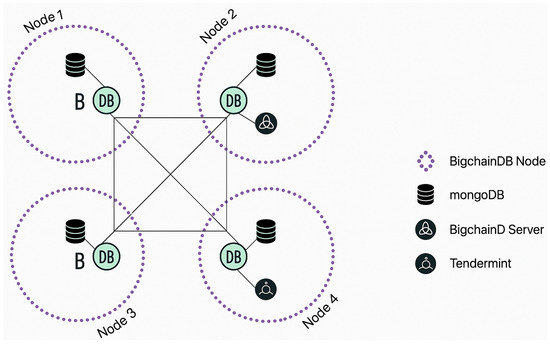
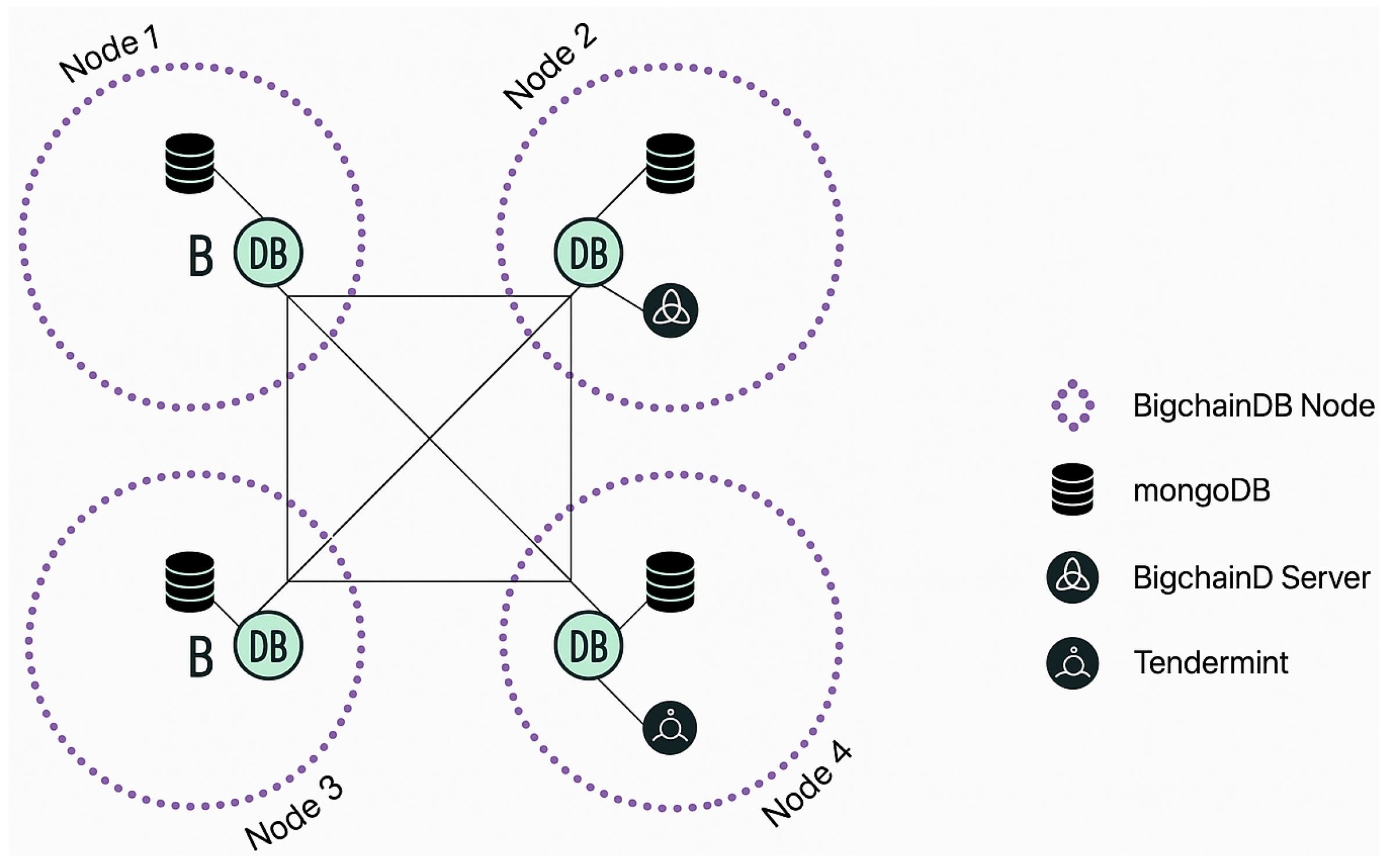
Each node comprises three components: the BigchainDB server for data handling, the Tendermint engine for consensus and transaction propagation, and a MongoDB instance for persistent storage. Transactions are submitted through the HTTP API, validated by the BigchainDB server, and then ordered by Tendermint consensus before being persisted in MongoDB (Figure 1). This workflow provides a verifiable record while keeping the data model flexible enough for application-specific assets.
Figure 1.
BigchainDB transaction processing workflow showing the data flow from client application through BigchainDB server to Tendermint Byzantine Fault Tolerant (BFT) consensus layer and MongoDB storage backend.
MongoDB storage backend. BigchainDB relies on MongoDB, a document-oriented NoSQL database, as its storage backend. MongoDB’s characteristics are well-suited to this role: horizontal scaling through sharding accommodates growing sensor data volumes; dynamic schemas allow the data model to evolve without migrations; and the aggregation pipeline provides expressive query capabilities for analytics [54]. For the agricultural use case, MongoDB’s flexible document model is particularly relevant because heterogeneous sensor types can be stored without rigid predefined schemas.
Deployment model. BigchainDB is primarily designed for private or consortium deployments, where federation members collectively operate nodes and share infrastructure costs. This consortium model aligns well with agricultural cooperatives or multi-stakeholder data-sharing arrangements where governance is distributed among known participants. BigchainDB’s operational costs are determined by the infrastructure required to run federation nodes, including computing power, storage, and network bandwidth.
2.3.6. Why BigchainDB for Precision Agriculture
BigchainDB is selected in this work because it offers a decentralized trust model while retaining a database-like API, which reduces integration effort for IoT pipelines. Within precision agriculture, it is relevant when the application requires verifiable data sharing across organizations while preserving a flexible data model for heterogeneous sensor records. It sits between traditional blockchains and centralized databases by providing a tamper-evident record with database-friendly query support.
Positioning relative to prior BigchainDB studies. Kim et al. [50] focused on access control mechanisms for general IoT deployments without addressing agricultural data characteristics. Gong et al. [51] examined data provenance in scientific workflows, emphasizing metadata lineage rather than real-time sensor ingestion. Nguyen et al. [52] explored supply chain applications with an emphasis placed on product tracking rather than continuous environmental monitoring. The present study differs from these efforts by (1) specifically addressing precision agriculture requirements, including heterogeneous sensor types and farmer-controlled sharing policies; (2) documenting concrete integration patterns (message queue buffering, hierarchical asset modeling) that bridge IoT ingestion rates with blockchain consensus constraints; and (3) providing a comparative feasibility assessment against both centralized databases and other blockchain platforms.Positioning relative to prior BigchainDB studies is documented in Table 3.
Centralized ledgers such as Amazon QLDB simplify operations but do not provide multi-party governance, while smart-contract-centric platforms introduce throughput and cost constraints that are difficult to reconcile with high-frequency sensor data. These considerations make BigchainDB a reasonable compromise for the requirements described in Section 3.
3. Materials and Methods
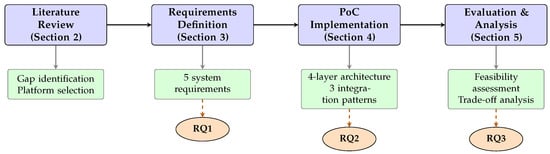
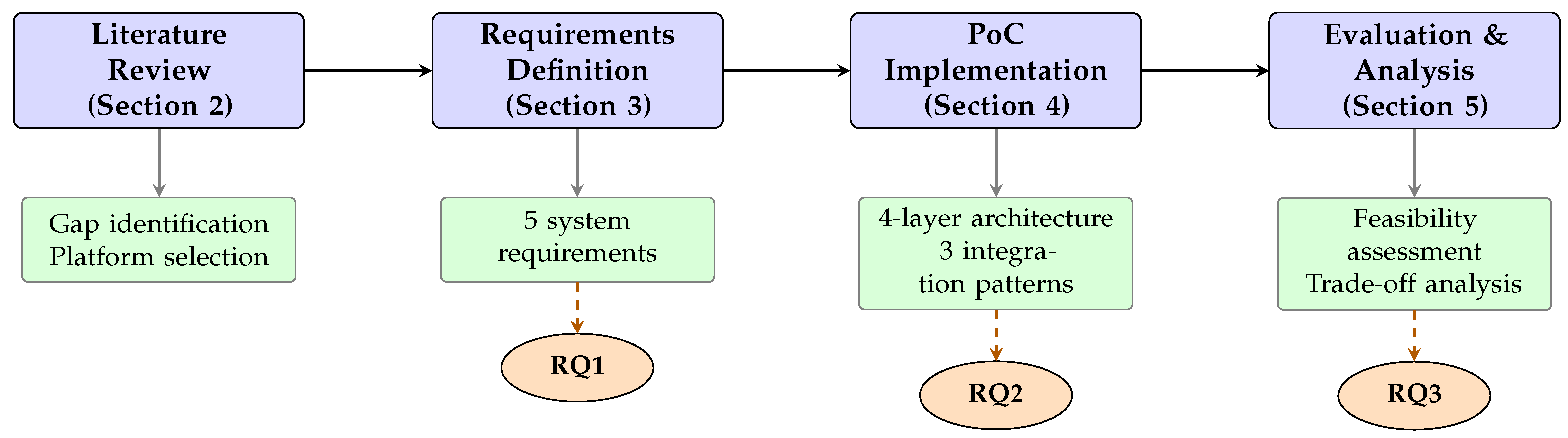
This feasibility study follows a design-oriented approach that combines a focused literature review, requirements definition, proof-of-concept implementation, and comparative analysis. The goal is to answer three research questions (RQ1–RQ3, stated in Section 1) concerning the functional, integration, and operational feasibility of adapting BigchainDB for owner-controlled agricultural data sharing. Figure 2 presents an overview of the research methodology and how each phase maps to the research questions.
Figure 2.
Research methodology framework showing the relationship between research phases, outputs, and research questions (RQ1–RQ3).
3.1. Research Questions
To structure the feasibility study, we focus on three research questions. First, can a BigchainDB-based architecture support owner-controlled, verifiable sharing of heterogeneous sensor data while preserving integration with existing IoT pipelines via APIs? Second, under simulated sensor workloads, does the proposed pipeline reliably ingest, store, and retrieve data with integrity and provenance guarantees? Third, what operational complexity and scalability constraints emerge from the implementation choices, and which requirements remain open for production deployment?
3.2. Literature Analysis
We conducted a targeted review of academic and industry publications on blockchain-enabled agriculture and IoT data management. Sources were identified through keyword searches in IEEE Xplore, ACM Digital Library, ScienceDirect, and Google Scholar, focusing on data ownership, interoperability, and performance constraints. The search covered publications from 2016–2024, with emphasis on works from 2020 onward to capture recent developments.
This review is narrative rather than systematic. Where foundational concepts are discussed (e.g., IoT architecture, blockchain fundamentals), we cite seminal works that established these fields [13,14], as these remain authoritative references despite their age. For application-specific insights, we prioritize recent publications (2020–2024) that reflect current practice in blockchain–agriculture integration [5,31,39,48].
To reduce citation hallucination risk, each newly emphasized reference was screened against at least one verifiable bibliographic identifier already present in the bibliography (DOI, publisher page, or journal metadata). Claims that could not be confidently mapped to a peer-reviewed source were either removed, softened, or moved to limitations/recommendations rather than being presented as validated evidence.
3.3. System Requirements
Based on the literature and the expected constraints of agricultural deployments, we defined system requirements that emphasize (i) data integrity and provenance, (ii) owner-controlled access and confidentiality, (iii) support for heterogeneous sensor data, (iv) integration with existing IoT pipelines through APIs, and (v) operational feasibility for distributed deployments. These requirements guide the architecture and the implementation choices described in Section 4.
3.4. System Design and Implementation
We designed a decentralized data management platform that uses BigchainDB for immutable record storage, a RESTful API layer for data ingestion and access, and a lightweight web interface for visualization. A sensor simulator provides representative agricultural readings to validate end-to-end data flow. The implementation follows an iterative development process with revisions based on internal testing.
3.5. Evaluation Scope
Our evaluation focuses on functional validation and simulated workloads rather than field deployment. We exercised the ingestion pipeline with synthetic sensor data, verified transaction creation and retrieval, and inspected system behavior under increased message queue load. This evaluation approach addresses RQ1 (functional feasibility) directly through validation testing, informs RQ2 (integration patterns) through observed design decisions, and contributes to RQ3 (operational trade-offs) through comparative analysis documented in Section 5. The results provide qualitative evidence of feasibility but do not constitute a full-scale performance benchmark or a multi-site field trial.
To improve methodological clarity, we distinguish feasibility validation from superiority testing. This study evaluates whether predefined requirements can be met under controlled workloads; it does not claim statistical superiority over alternative platforms. Therefore, Section 5 reports requirement-level pass/fail outcomes and descriptive metrics. Controlled baseline benchmarking with repeated trials, hypothesis tests, and confidence intervals is identified as essential future work.
3.6. Experimental Configuration
To support reproducibility, we document the experimental parameters used for functional validation.
Workload parameters: Event rate of 10 sensor readings per second (sustained); payload size of 256–512 bytes per reading (JSON format); 4 sensor types (soil moisture, temperature, humidity, pH); test duration of 1 h continuous operation per validation run.
Hardware and software environment: 3-node Docker cluster on single host (Intel Core i7, 32GB RAM); Ubuntu 22.04 LTS operating system; Docker 24.0 container runtime; Docker bridge network simulating LAN conditions.
BigchainDB configuration: BigchainDB version 2.2.2; Tendermint version 0.31.5; MongoDB version 4.4; replication factor of 3 (all nodes store all data); Tendermint BFT consensus with default settings.
Metrics collected: Functional validation results are reported as pass/fail per test scenario (Table 3). Operational observations are qualitative descriptions based on system behavior during testing, not statistically rigorous measurements.
Important: This study is entirely simulation-based using synthetic sensor data. No field deployment with actual agricultural IoT devices was conducted. The proof-of-concept validates functional and integration feasibility under controlled conditions; production performance characteristics remain to be determined through field trials.
4. Implementation
Our implementation demonstrates a modular BigchainDB-based pipeline for distributed agricultural monitoring. The architecture separates data collection, middleware processing, storage, and presentation to align with the requirements in Section 3.
4.1. System Architecture
The system comprises four layers, shown in Figure 3: (1) simulated IoT devices generate soil and environmental readings, (2) a FastAPI middleware layer validates and routes data, (3) a BigchainDB cluster stores transactions and asset metadata, and (4) a Vue.js dashboard provides visualization and access management. RabbitMQ buffers incoming messages to decouple ingestion from storage writes. In Figure 3, the API layer connects to storage both for transaction writes and for query reads, which are shown as separate flows to distinguish ingestion from retrieval paths.
Figure 3.
System architecture for distributed agricultural monitoring. Four layers are shown: (1) IoT sensor layer (simulated), (2) FastAPI middleware for validation and routing, (3) BigchainDB cluster with Tendermint consensus and MongoDB storage, and (4) Vue.js dashboard for visualization. RabbitMQ provides message queue buffering between layers.
Note on simulation: All IoT devices in this study are software-simulated. The sensor simulator generates synthetic readings with realistic value ranges and temporal patterns, but does not represent actual hardware deployments. This approach enables controlled functional validation while acknowledging that production deployments may encounter additional challenges (connectivity variability, power constraints, environmental conditions) not captured in simulation.
4.2. Data Model
The data model organizes assets hierarchically: farms contain fields, fields are associated with sensors, and sensors emit measurement transactions. This structure enables queries by owner, location, or time window while preserving the relationships between agronomic entities. For example, a hierarchical asset chain might be Farm_001 (root asset representing the farm entity) →Field_North (child asset linked to the farm) → Sensor_SM01 (soil moisture sensor linked to the field). Each sensor reading is then recorded as a TRANSFER transaction on the sensor asset, preserving the full provenance chain from measurement to farm.
4.3. Security Implementation
Authentication relies on BigchainDB’s public-key identities, and authorization rules constrain which actors can submit or query assets. Transactions are signed with Ed25519, and transport-level encryption protects data in transit. Together, these controls provide provenance and access control without assuming a single trusted administrator.
4.4. Data Flow
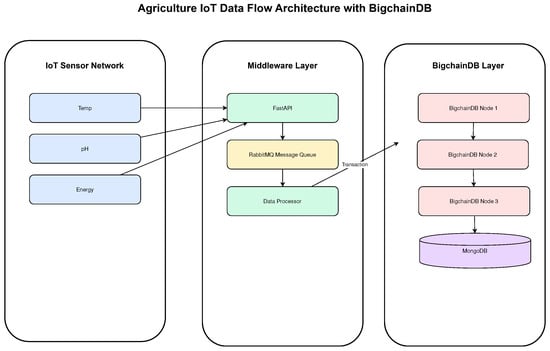
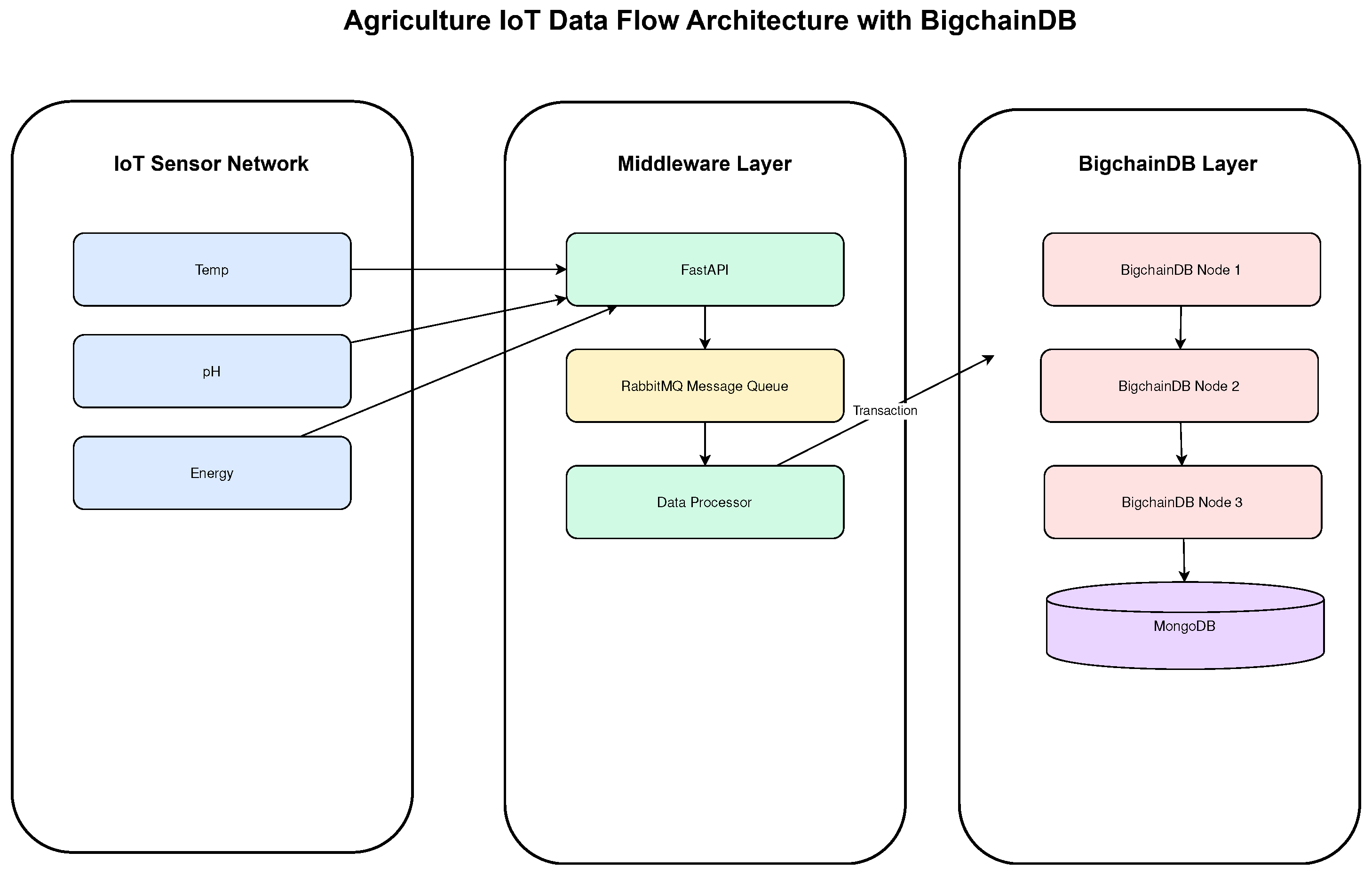
Figure 4 provides a compact flowchart illustrating the processing sequence from sensor data generation to decentralized storage and dashboard visualization.
Figure 4.
Processing pipeline flowchart showing data flow from IoT sensors through edge gateway, FastAPI middleware, RabbitMQ message queue, BigchainDB cluster, to Vue.js dashboard. Arrows indicate data flow direction; colors distinguish functional layers.
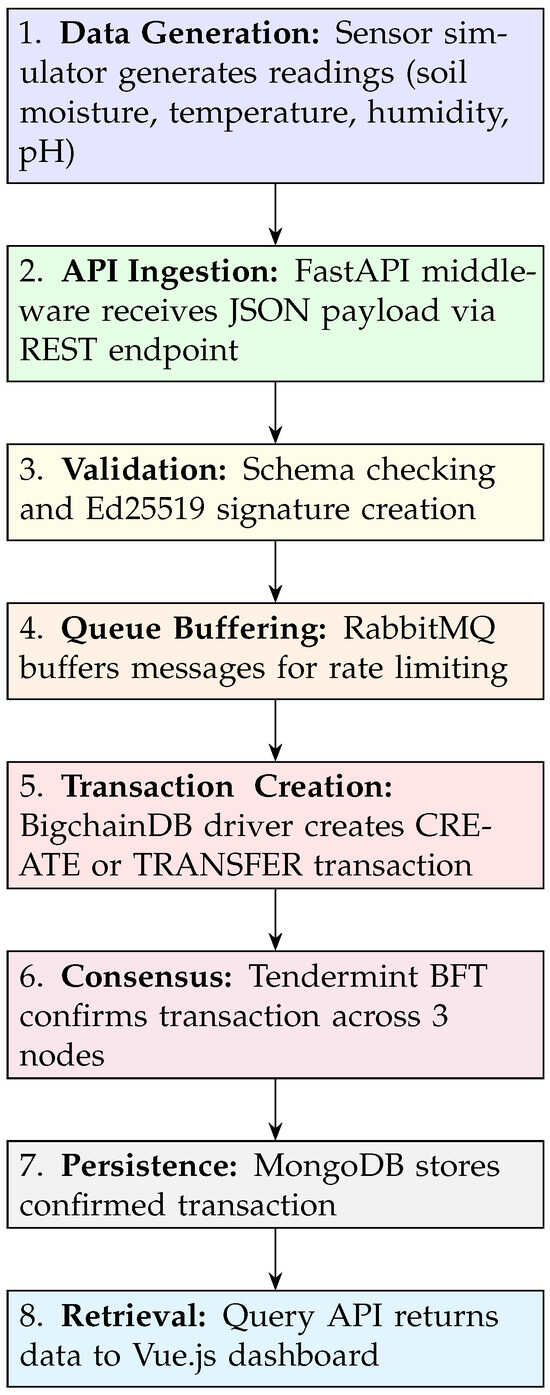
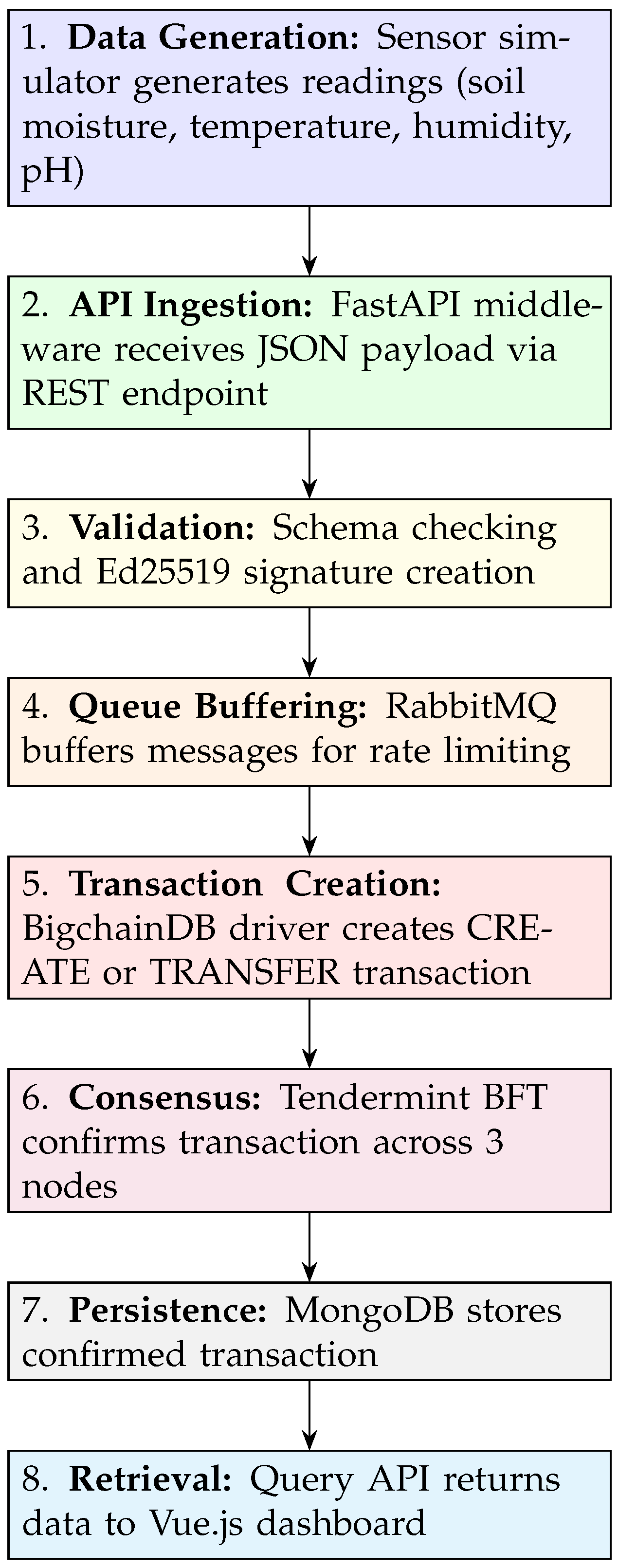
Figure 5 presents a step-by-step sequence of the transaction flow, clarifying the processing stages from sensor data generation to dashboard retrieval.
Figure 5.
Sequence diagram showing the step-by-step transaction flow from sensor data generation to dashboard retrieval. Each step represents a distinct processing stage in the pipeline.
Figure 6 presents a data flow diagram (DFD) for the end-to-end pipeline. Sensor data are collected at the edge, aggregated by a gateway, and sent through the message queue before being committed to BigchainDB. The diagram distinguishes two processing stages: a validation step that checks schema and signatures before storage, and an analytics step that queries MongoDB aggregation pipelines for dashboard consumption. This separation explains the two processing nodes depicted in the diagram.
Figure 6.
Data flow diagram (DFD) for the proposed system showing external entities (sensors, users), processing nodes (validation, analytics), and data stores (BigchainDB, MongoDB). Arrows indicate data flow with labeled transformations.
4.5. Deployment Configuration
The reference deployment uses Docker Compose to coordinate a three-node BigchainDB cluster, MongoDB backends, the FastAPI service, RabbitMQ, and a Vue.js frontend. Nginx can be placed in front of the API for routing and TLS termination. This setup runs on commodity servers and can be adapted for on-premises or cloud environments.
4.6. Code Availability
Public reference implementations are available for the main software components described here: the sensor simulator (https://github.com/ZeljkoDzafic/agri-iot-simulator), the FastAPI middleware service (https://github.com/ZeljkoDzafic/bigchaindb-agri-backend), and the Vue.js dashboard (https://github.com/ZeljkoDzafic/agri-monitoring-dashboard), all accessed on 23 February 2026.
4.7. Proposed Edge Device Architecture
While the current proof-of-concept uses software-simulated sensor data, we present a reference edge device architecture to demonstrate how the system could be extended to physical IoT deployments. This design has not been validated through field testing in the current study but illustrates the integration pathway from physical sensors to the BigchainDB pipeline.
4.7.1. Gateway Design
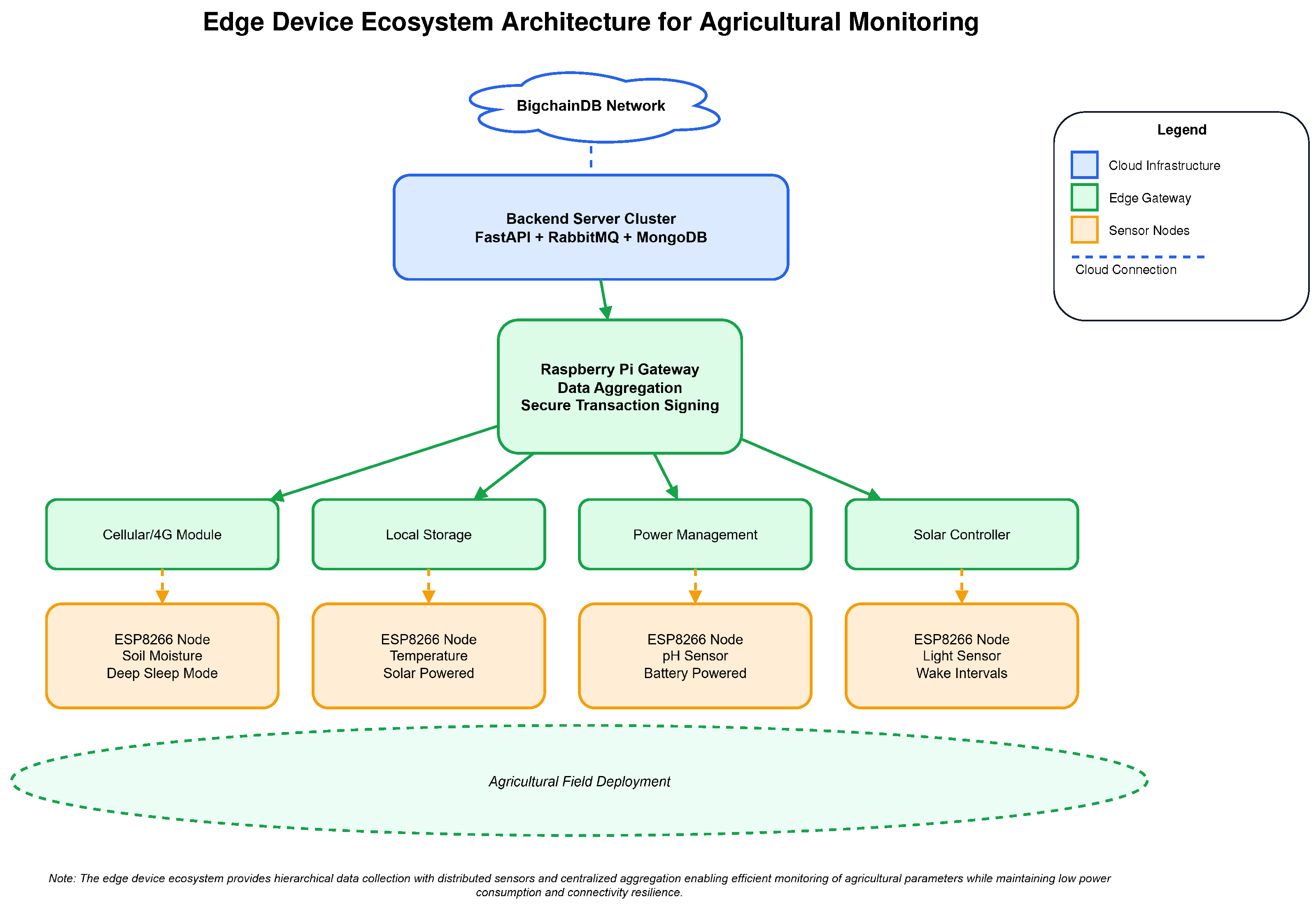
The proposed gateway uses a Raspberry Pi 4 (4GB RAM) with attached sensors (DHT22 for temperature/humidity, capacitive soil moisture sensor, UV sensor) and a 4G/LTE HAT for cellular connectivity in remote locations. The software stack runs Python 3.9 with Ed25519 for cryptographic transaction signing and SQLite for local data persistence during connectivity outages. Key design considerations include (i) store-and-forward buffering for intermittent network conditions, (ii) local preprocessing to reduce transmission overhead, and (iii) power management with configurable sleep modes for solar-powered deployments.
4.7.2. Sensor Nodes
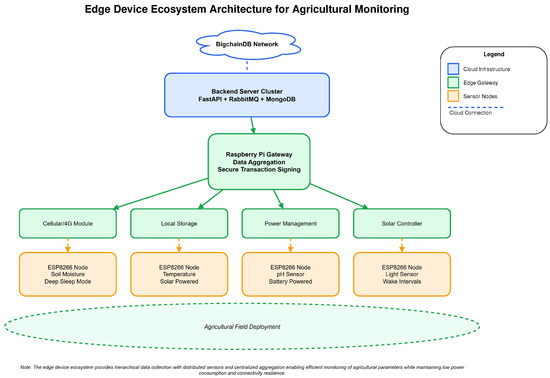
ESP8266 microcontrollers are proposed as low-cost sensor nodes that capture soil moisture and temperature readings, transmitting them to the gateway via WiFi at configurable intervals. Their minimal power consumption makes them suitable for distributed field deployments where many nodes must operate autonomously. Figure 7 illustrates the proposed edge device ecosystem architecture.
Figure 7.
Proposed edge device ecosystem architecture (not yet validated through field deployment). Shows Raspberry Pi 4 gateway with attached sensors (DHT22, soil moisture, UV) and ESP8266 sensor nodes communicating via WiFi; 4G/LTE provides connectivity to cloud services.
5. Discussion
This section answers the three research questions posed in Section 1 by synthesizing evidence from the requirements analysis, implementation, and comparative evaluation.
5.1. RQ1: Functional Feasibility
To what extent can a BigchainDB-based architecture satisfy the core requirements of owner-controlled, verifiable precision-agriculture data sharing in terms of data integrity, access control, and heterogeneous sensor integration?
The proof-of-concept implementation demonstrates that BigchainDB can satisfy the functional requirements defined in Section 3.2. First, data integrity and provenance are achieved through cryptographic transaction signatures using Ed25519 keys, which create an immutable audit trail for all sensor records. Second, owner-controlled access is enforced through BigchainDB’s public-key-based identities, where only authorized key holders can create or transfer assets representing farm data. Third, heterogeneous sensor support is enabled by BigchainDB’s flexible asset schema, which accommodates diverse data structures from soil moisture sensors, weather stations, and other devices without requiring rigid predefined schemas. Fourth, API integration is achieved through the RESTful middleware layer that translates IoT data formats into BigchainDB transactions. Fifth, operational feasibility for distributed deployments is supported by the Docker-based multi-node architecture described in Section 4.5.
Functional validation confirmed successful end-to-end data flow: sensor readings were ingested through the API, stored as BigchainDB transactions, retrieved via queries, and presented in the dashboard. Transaction signatures were verified, and access control policies were enforced at the API layer.
Table 4 summarizes the functional validation results from the proof-of-concept testing. The system successfully processed all test scenarios, demonstrating that BigchainDB can fulfill the functional requirements for owner-controlled agricultural data sharing.
Table 4.
Functional validation results from proof-of-concept testing. Each row shows a system requirement, the test scenario used for validation, and the outcome. Tests were conducted on a three-node BigchainDB cluster with simulated sensor data (10 readings/second for 1 h).
5.2. RQ2: Integration Feasibility
What architectural design patterns and integration trade-offs emerge when adapting BigchainDB’s blockchain–database hybrid model to IoT data ingestion pipelines characteristic of precision agriculture deployments?
Three key design patterns emerged from the implementation. First, message queue buffering using RabbitMQ decouples sensor data ingestion from blockchain write operations, preventing IoT burst traffic from overwhelming the consensus layer. This pattern addresses the mismatch between high-frequency sensor sampling and blockchain write latency. Second, dual processing stages separate validation logic (schema checking, signature verification) from analytics logic (aggregation queries for dashboard consumption), as shown in Figure 6. This separation allows read-heavy operations to leverage MongoDB’s indexing without introducing additional blockchain queries. Third, hierarchical asset modeling structures farm–field–sensor relationships as nested assets, enabling queries by owner, location, or time while preserving the agronomic context.
The integration trade-offs center on complexity versus control. BigchainDB’s MongoDB backend enabled straightforward integration with existing query patterns and indexing strategies, which would be more complex with smart-contract platforms that impose state-transition models. However, this flexibility came at the cost of operational overhead for managing multi-node Tendermint consensus, MongoDB replication, and inter-service coordination. The architecture is more involved than a single-server database but provides multi-party governance that centralized alternatives cannot offer.
5.3. RQ3: Operational Feasibility
What operational constraints and scalability limitations arise from deploying decentralized data governance for agricultural sensor data, and how do these compare to centralized alternatives?
The implementation exposed several operational constraints, quantified in Table 5.
Table 5.
Operational characteristics observed during proof-of-concept deployment. Configuration: three-node BigchainDB cluster on Docker (single host, Intel i7, 32GB RAM). Observations are qualitative descriptions; detailed statistical benchmarking is identified as future work. BFT = Byzantine Fault Tolerant.
First, deployment complexity is higher than centralized alternatives: each BigchainDB node requires a coordinated setup of three services (Tendermint, MongoDB, BigchainDB server), whereas a managed service like Amazon QLDB abstracts these components. Our deployment required substantially more time for initial three-node cluster configuration compared to a single-node MongoDB setup. Second, consensus overhead introduces latency for write operations, though Tendermint’s BFT finality avoids the energy costs and uncertainty of proof-of-work systems. Third, storage replication across nodes increases infrastructure costs proportionally to cluster size compared to single-instance databases, though this cost must be weighed against the benefits of decentralized data custody and resilience to single-point failures. Detailed performance benchmarking under production workloads is identified as future work.
A comparison to alternatives reveals specific trade-offs. Centralized ledgers such as Amazon QLDB simplify operations but concentrate governance in a single vendor, which conflicts with farmer autonomy objectives. Smart-contract platforms like Ethereum provide decentralized governance but introduce per-transaction fees and state-transition constraints that are difficult to reconcile with high-frequency sensor data. BigchainDB occupies a middle ground: it requires more operational effort than centralized solutions but avoids the cost and inflexibility of general-purpose blockchains. This positioning makes BigchainDB viable when decentralized governance and ownership control are prioritized over operational simplicity, and when high-frequency sensor data must be ingested without per-transaction fees.
Our findings align with recent blockchain–IoT agricultural studies. Morchid et al. [44] and Safeer et al. [5] similarly emphasize that decentralized governance provides verifiable data provenance but introduces operational complexity. Unlike permissioned blockchain deployments such as Hyperledger Fabric, BigchainDB’s document-oriented MongoDB backend reduced integration effort for heterogeneous sensor payloads in our implementation. However, Fabric’s endorsement policies may offer finer-grained access control for complex multi-stakeholder scenarios, suggesting that platform selection should be driven by specific governance requirements rather than general performance claims.
5.4. Summary: Answers to Research Questions
Based on the analysis presented above, we summarize the answers to each research question:
RQ1 (Functional feasibility): The results demonstrate that BigchainDB can satisfy the core requirements for owner-controlled agricultural data sharing. Data integrity is ensured through Ed25519 cryptographic signatures; access control is enforced through public-key-based identities that reject unauthorized transfers; and heterogeneous sensor support is enabled by flexible JSON-based asset schemas. The system maintained consensus during simulated single-node failure in the three-node cluster (Table 4).
RQ2 (Integration feasibility): Three architectural patterns were identified and validated: (i) message queue buffering using RabbitMQ to decouple high-throughput IoT ingestion from consensus-bound blockchain writes; (ii) hierarchical asset modeling that maps farm–field–sensor relationships to BigchainDB’s CREATE/TRANSFER transaction semantics; and (iii) dual-key access control that separates data creation rights from transfer rights to enable selective sharing.
RQ3 (Operational feasibility): BigchainDB deployment is feasible, though it introduces operational trade-offs compared to centralized alternatives. These include higher deployment complexity (three coordinated services per node), increased write latency due to BFT consensus, and storage overhead that is proportional to cluster size. These costs are offset by decentralized governance, Byzantine fault tolerance, and elimination of single-point-of-failure risks. The architecture is suitable when multi-party governance requirements outweigh operational simplicity.
5.5. Limitations
The evaluation in this study is limited to simulated workloads and functional validation. We do not claim field-level performance characteristics, energy impact, or long-term maintenance outcomes. Additional work is needed to quantify scalability under production sensor loads to evaluate network resilience in rural connectivity conditions and to measure the economic trade-offs of replicated storage. Social and organizational factors influencing adoption, such as farmer trust in decentralized systems and willingness to manage cryptographic keys, are beyond the scope of this technical feasibility study.
Specifically, the following limitations bound the generalizability of our findings:
- Scalability ceiling: Testing was limited to a three-node cluster and moderate throughput (10 readings/second). Behavior under hundreds of sensors or multi-farm deployments remains unvalidated.
- Operational overhead: Deployment complexity was observed qualitatively but not systematically measured against alternatives with controlled experiments.
- Simulation vs. reality: All validation used simulated sensor data on a single-host Docker environment. Real agricultural deployments face connectivity variability, environmental conditions, power constraints, and operator expertise limitations were not captured here.
- No statistical benchmarking: Performance observations are qualitative; rigorous benchmarking with confidence intervals, hypothesis tests, and repeated trials is identified as critical future work.
6. Environmental Aspects
Note: The environmental considerations discussed in this section are qualitative assessments based on architectural properties and literature evidence. Measured energy consumption data from the proof-of-concept deployment is not available; quantifying actual environmental impact would require instrumented field trials with power monitoring, which is beyond the scope of this feasibility study.
The proposed architecture has direct relevance to environmental sustainability in agriculture. Precision agriculture practices informed by sensor data can reduce overuse of fertilizers and pesticides through targeted application based on actual soil and crop conditions [55], and sensor-driven irrigation optimization has demonstrated measurable water-use reductions [56,57]. However, these environmental benefits depend on trusted, verifiable data: resource allocation decisions require confidence that sensor records have not been tampered with and that data provenance is traceable. The BigchainDB-based architecture described in this study provides exactly this assurance through immutable transaction records and cryptographic verification, creating an auditable chain from sensor measurement to management decision.
At the same time, the proposed multi-node blockchain deployment introduces its own environmental costs through energy consumption for consensus operations and data replication across nodes [58,59]. Compared to proof-of-work blockchains, BigchainDB’s Tendermint BFT consensus is substantially more energy-efficient, but the overhead remains higher than a single centralized database. Future deployments should evaluate whether the governance and trust benefits justify this additional infrastructure cost, particularly in resource-constrained agricultural settings.
Market projections estimate smart agriculture expanding from USD 18.12 billion in 2021 to USD 43.37 billion by 2030 (CAGR 10.2%) [60], indicating sustained demand for data-driven farming systems. As adoption grows, verifiable data management becomes increasingly important for regulatory compliance, sustainability certification, and cross-stakeholder trust—requirements that centralized platforms struggle to satisfy when data ownership is contested.
7. Conclusions
This feasibility study systematically evaluated whether BigchainDB can support owner-controlled, verifiable data sharing for precision agriculture. Through requirements-driven design, proof-of-concept implementation, and comparative analysis, we answered three research questions addressing functional, integration, and operational feasibility.
The primary contributions are:
- 1.
- Functional feasibility (RQ1): BigchainDB satisfies the core requirements for data integrity (signature verification), access control (rejection of unauthorized transfers), and heterogeneous sensor support (multiple sensor types validated). The system maintained consensus with one-node failure in a three-node cluster.
- 2.
- Integration patterns (RQ2): Three architectural patterns were identified and validated: (i) message queue buffering that decouples high-throughput IoT ingestion from blockchain writes; (ii) hierarchical asset modeling mapping farm–field–sensor relationships to BigchainDB’s transaction model; and (iii) dual-key access control separating creation from transfer rights.
- 3.
- Operational trade-offs (RQ3): Compared to centralized alternatives, BigchainDB introduces increased write latency due to consensus, storage overhead proportional to cluster size, and longer initial deployment time. These costs are offset by decentralized governance and Byzantine fault tolerance. Detailed performance benchmarking under production workloads is identified as future work.
Together, these findings establish that BigchainDB represents a viable technical approach for agricultural data management when ownership control and multi-party governance are prioritized, while deployment complexity and the identified scalability constraints require attention in production environments.
Several limitations must be acknowledged. First, our evaluation used simulated sensor data rather than production agricultural environments. Second, while our architecture addresses technical aspects of data sovereignty, social and organizational factors will significantly influence adoption in practice. Third, long-term scalability characteristics remain to be validated through extended deployment periods.
Future research should evaluate the architecture through field deployments with actual agricultural operations to determine how blockchain-based systems integrate with existing farm management practices. A critical next step is conducting detailed performance benchmarking under production sensor loads to quantify write latency, throughput, and scalability characteristics with rigorous measurement methodology. Research into simplified deployment models and standardized data schemas may reduce operational complexity. Hybrid architectures that combine edge computing with blockchain storage could be investigated to address connectivity constraints in rural environments.
This work contributes an evaluated reference architecture for decentralized agricultural data management and identifies remaining questions about scalability, operational overhead, and adoption pathways for blockchain-based platforms in precision agriculture. By situating this feasibility study within recent blockchain-IoT literature in agriculture, including newer reviews and smart-farming system reports, we clarify how the proposed BigchainDB pipeline extends current practice with documented integration patterns and quantified trade-offs [5,44,45].
Author Contributions
Conceptualization, Ž.D.; methodology, M.Č.; software, Ž.D.; validation, B.M. and M.Č.; investigation, Ž.D.; writing—original draft preparation, Ž.D.; writing—review and editing, B.M. and S.P.; visualization, Ž.D.; supervision, B.M., M.Č. and S.P. All authors have read and agreed to the published version of the manuscript.
Funding
This research received no external funding.
Data Availability Statement
Public reference implementations are available for the sensor simulator (https://github.com/ZeljkoDzafic/agri-iot-simulator), the FastAPI middleware service (https://github.com/ZeljkoDzafic/bigchaindb-agri-backend), the Vue.js dashboard (https://github.com/ZeljkoDzafic/agri-monitoring-dashboard), and the Docker orchestration platform (https://github.com/ZeljkoDzafic/bigchaindb-agri-app), all accessed on 23 February 2026.
Acknowledgments
I dedicate this paper to my son and wife who have shown incredible support throughout this research journey, to my brother whose encouragement has been unwavering, and to the loving memory of my deceased mother whose wisdom continues to guide me.
Conflicts of Interest
The authors declare no conflicts of interest.
Abbreviations
| API | Application Programming Interface |
| BFT | Byzantine Fault Tolerance |
| CAGR | Compound Annual Growth Rate |
| DAG | Directed Acyclic Graph |
| DFD | Data Flow Diagram |
| IoT | Internet of Things |
| PoS | Proof of Stake |
| PoW | Proof of Work |
References
- Coble, K.H.; Mishra, A.K.; Ferrell, S.; Griffin, T. Big Data in Agriculture: A Challenge for the Future. Appl. Econ. Perspect. Policy 2018, 40, 79–96. [Google Scholar] [CrossRef] [Scilit]
- Astill, J.; Dara, R.A.; Fraser, E.D.G.; Roberts, B.; Sharif, S. Smart poultry management: Smart sensors, big data, and the internet of things. Comput. Electron. Agric. 2020, 170, 105291. [Google Scholar] [CrossRef] [Scilit]
- Ferrag, M.A.; Shu, L.; Yang, X.; Derhab, A.; Maglaras, L. Security and Privacy for Green IoT-Based Agriculture: Review, Blockchain Solutions, and Challenges. IEEE Access 2020, 8, 32031–32053. [Google Scholar] [CrossRef] [Scilit]
- Friha, O.; Ferrag, M.A.; Shu, L.; Maglaras, L.; Wang, X. Internet of Things for the Future of Smart Agriculture: A Comprehensive Survey of Emerging Technologies. IEEE/CAA J. Autom. Sin. 2021, 8, 718–752. [Google Scholar] [CrossRef] [Scilit]
- Safeer, S.; De Mastro, G.; Pulvento, C. IoT based climate smart agriculture succeeded by blockchain database: A bibliometric analysis. Front. Sustain. Food Syst. 2024, 8, 1406871. [Google Scholar] [CrossRef] [Scilit]
- Carbonell, I.M. The ethics of big data in big agriculture. Internet Policy Rev. 2016, 5, 1–13. [Google Scholar] [CrossRef] [Scilit]
- Wiseman, L.; Sanderson, J.; Zhang, A.; Jakku, E. Farmers and their data: An examination of farmers’ reluctance to share their data through the lens of the laws impacting farm data. NJAS Wagening. J. Life Sci. 2019, 90–91, 100301. [Google Scholar] [CrossRef] [Scilit]
- Barham, B.L.; Antle, J.M. Protecting farmers’ data privacy and confidentiality: Recommendations and considerations. Front. Sustain. Food Syst. 2022, 6, 903230. [Google Scholar] [CrossRef] [Scilit]
- OECD. Issues Around Data Governance in the Digital Transformation of Agriculture; Technical Report 146, OECD Food, Agriculture and Fisheries Papers; OECD: Paris, France, 2020. [Google Scholar] [CrossRef]
- Trust In Food. Farmer Perspectives on Data. Technical Report, Farm Journal and The Sustainability Consortium, 2020. Available online: https://www.trustinfood.com/wp-content/uploads/2020/05/Farmer-Data-Perspectives-Research_final.pdf (accessed on 23 February 2026).
- Rotz, S.; Duncan, E.; Small, M.; Botschner, J.; Dara, R.; Mosby, I.; Reed, M.; Fraser, E.D.G. The Politics of Digital Agricultural Technologies: A Preliminary Review. Sociol. Rural. 2019, 59, 203–229. [Google Scholar] [CrossRef] [Scilit]
- Botterman, M. Internet of Things: An Early Reality of the Future Internet; Technical Report; European Commission, Information Society, and Media Directorate: Prague, Czech Republic, 2009. [Google Scholar]
- Atzori, L.; Iera, A.; Morabito, G. The Internet of Things: A survey. Comput. Netw. 2010, 54, 2787–2805. [Google Scholar] [CrossRef] [Scilit]
- Stankovic, J.A. Research Directions for the Internet of Things. IEEE Internet Things J. 2014, 1, 3–9. [Google Scholar] [CrossRef] [Scilit]
- ITU-T. Future Networks Including Cloud Computing, Mobile, and Next-Generation Networks (2013–2016). 2013. Available online: http://www.itu.int/en/ITU-T/studygroups/2013-2016/13/Pages/default.aspx (accessed on 23 February 2026).
- Dey, K.; Shekhawat, U. Blockchain for sustainable e-agriculture: Literature review, architecture for data management, and implications. J. Clean. Prod. 2021, 316, 128254. [Google Scholar] [CrossRef] [Scilit]
- Badran, A.; Kashmoola, M. Smart Agriculture Using Internet of Things: A Survey. In Proceedings of the 1st International Multi-Disciplinary Conference Theme: Sustainable Development and Smart Planning, IMDC-SDSP 2020, Cyberspace, 28–30 June 2020. [Google Scholar]
- Antony, A.P.; Leith, K.; Jolley, C.; Lu, J.; Sweeney, D.J.; Sweeney, D.J. A Review of Practice and Implementation of the Internet of Things (IoT) for Smallholder Agriculture. Sustainability 2020, 12, 3750. [Google Scholar] [CrossRef] [Scilit]
- Brewster, C.; Roussaki, I.; Kalatzis, N.; Doolin, K.; Ellis, K. IoT in Agriculture: Designing a Europe-Wide Large-Scale Pilot. IEEE Commun. Mag. 2017, 55, 26–33. [Google Scholar] [CrossRef] [Scilit]
- Ferrández-Pastor, F.J.; García-Chamizo, J.M.; Nieto-Hidalgo, M.; Mora-Pascual, J. Precision Agriculture Design Method Using a Distributed Computing Architecture on Internet of Things Context. Sensors 2018, 18, 1731. [Google Scholar] [CrossRef] [Scilit]
- Gill, S.S.; Tuli, S.; Xu, M.; Singh, I.; Singh, K.V.; Lindsay, D.; Tuli, S.; Smirnova, D.; Singh, M.; Jain, U.; et al. Transformative Effects of IoT, Blockchain and Artificial Intelligence on Cloud Computing: Evolution, Vision, Trends and Open Challenges. Internet Things 2019, 8, 100118. [Google Scholar] [CrossRef] [Scilit]
- Villa-Henriksen, A.; Edwards, G.T.C.; Pesonen, L.A.; Green, O.; Sørensen, C.A.G. Internet of Things in arable farming: Implementation, applications, challenges and potential. Biosyst. Eng. 2020, 191, 60–84. [Google Scholar] [CrossRef] [Scilit]
- Mehra, M.; Saxena, S.; Sankaranarayanan, S.; Tom, R.J.; Veeramanikandan, M. IoT based hydroponics system using Deep Neural Networks. Comput. Electron. Agric. 2018, 155, 473–486. [Google Scholar] [CrossRef] [Scilit]
- Chaganti, R.; Varadarajan, V.; Gorantla, V.S.; Gadekallu, T.R.; Ravi, V. Blockchain-Based Cloud-Enabled Security Monitoring Using Internet of Things in Smart Agriculture. Future Internet 2022, 14, 250. [Google Scholar] [CrossRef] [Scilit]
- Wolfert, S.; Ge, L.; Verdouw, C.; Bogaardt, M.J. Big Data in Smart Farming—A review. Agric. Syst. 2017, 153, 69–80. [Google Scholar] [CrossRef] [Scilit]
- Xu, J.; Wang, C.; Jia, X. A Survey of Blockchain Consensus Protocols. ACM Comput. Surv. 2023, 55, 1–35. [Google Scholar] [CrossRef] [Scilit]
- Xiao, Y.; Zhang, N.; Lou, W.; Hou, Y.T. A Survey of Distributed Consensus Protocols for Blockchain Networks. IEEE Commun. Surv. Tutor. 2020, 22, 1432–1465. [Google Scholar] [CrossRef] [Scilit]
- Sriman, B.; Ganesh Kumar, S.; Prabakaran, S. Blockchain Technology: Consensus Protocol Proof of Work and Proof of Stake. In Proceedings of the Intelligent Computing and Applications ICICA 2019, Ostrava, Czech Republic, 21–22 March 2019; Advances in Intelligent Systems and Computing. Springer: Singapore, 2020; Volume 1172. [Google Scholar]
- Tian, F. An agri-food supply chain traceability system for China based on RFID & blockchain technology. In Proceedings of the 2016 13th International Conference on Service Systems and Service Management (ICSSSM), Kunming, China, 24–26 June 2016; IEEE: New York, NY, USA, 2016; pp. 1–6. [Google Scholar] [CrossRef] [Scilit]
- Galvez, J.F.; Mejuto, J.C.; Simal-Gandara, J. Future challenges on the use of blockchain for food traceability analysis. TrAC Trends Anal. Chem. 2018, 107, 222–232. [Google Scholar] [CrossRef] [Scilit]
- Farooq, M.S.; Ansari, Z.K.; Alvi, A.; Rustam, F.; De La Torre Díaz, I.; Vidal Mazón, J.L.; Rodríguez, C.L.; Ashraf, I. Blockchain based transparent and reliable framework for wheat crop supply chain. PLoS ONE 2024, 19, e0295036. [Google Scholar] [CrossRef] [Scilit]
- Mirabelli, G.; Solina, V. Blockchain and agricultural supply chains traceability: Research trends and future challenges. Procedia Manuf. 2020, 42, 414–421. [Google Scholar] [CrossRef] [Scilit]
- Tribis, Y.; El Bouchti, A.; Bouayad, H. Supply chain management based on blockchain: A systematic mapping study. Matec Web Conf. 2018, 200, 00020. [Google Scholar] [CrossRef] [Scilit]
- McConaghy, T.; Marques, R.; Müller, A.; De Jonghe, D.; McMullen, G.; Henderson, R.; Bellemare, S.; Granzotto, A. BigchainDB: A Scalable Blockchain Database; Technical Report; BigchainDB GmbH: Berlin, Germany, 2016; White Paper; Available online: https://www.bigchaindb.com/whitepaper/ (accessed on 23 February 2026).
- Amazon Web Services. Amazon Quantum Ledger Database (Amazon QLDB). 2023. Available online: https://aws.amazon.com/qldb/ (accessed on 23 February 2026).
- ProvenDB. ProvenDB: Blockchain-Enabled Database. 2023. Available online: https://medium.com/provendb (accessed on 23 February 2026).
- Mohanta, B.K.; Panda, S.S.; Jena, D. An Overview of Smart Contract and Use Cases in Blockchain Technology. In Proceedings of the 2018 9th International Conference on Computing, Communication and Networking Technologies (ICCCNT), Bangalore, India, 10–12 July 2018; pp. 1–4. [Google Scholar] [CrossRef] [Scilit]
- Lamtzidis, O.; Pettas, D.; Gialelis, J. A novel combination of distributed ledger technologies on Internet of Things: Use case on precision agriculture. Appl. Syst. Innov. 2019, 2, 30. [Google Scholar] [CrossRef] [Scilit]
- Torky, M.; Hassanein, A.E. Integrating blockchain and the internet of things in precision agriculture: Analysis, opportunities, and challenges. Comput. Electron. Agric. 2020, 178, 105476. [Google Scholar] [CrossRef] [Scilit]
- Rejeb, A.; Rejeb, K.; Abdollahi, A.; Al-Turjman, F.; Treiblmaier, H. The interplay between the internet of things and agriculture: A bibliometric analysis and research agenda. Internet Things 2022, 19, 100580. [Google Scholar] [CrossRef] [Scilit]
- Lu, S.; Wang, X.; Zheng, J. Research on Agricultural Internet of Things Data Sharing System Based on Blockchain. In Proceedings of the 2020 35th Youth Academic Annual Conference of Chinese Association of Automation (YAC), Zhanjiang, China, 16–18 October 2020; IEEE: New York, NY, USA, 2020; pp. 221–225. [Google Scholar] [CrossRef] [Scilit]
- Manoj, T.; Makkithaya, K.; Narendra, V.G. A trusted IoT data sharing and secure oracle based access for agricultural production risk management. Comput. Electron. Agric. 2023, 204, 107544. [Google Scholar] [CrossRef] [Scilit]
- Nigam, S.; Sugandh, U.; Khari, M. The integration of blockchain and IoT edge devices for smart agriculture: Challenges and use cases. In Advances in Computers; Elsevier: Amsterdam, The Netherlands, 2022; Volume 127, pp. 507–537. [Google Scholar] [CrossRef] [Scilit]
- Morchid, A.; Ismail, A.; Khalid, H.M.; Qjidaa, H.; El Alami, R. Blockchain and IoT technologies in smart farming to enhance the efficiency of the agri-food supply chain: A review of applications, benefits, and challenges. Internet Things 2025, 33, 101733. [Google Scholar] [CrossRef] [Scilit]
- Pakseresht, A.; Ahmadi Kaliji, S.; Hakelius, K. Blockchain technology characteristics essential for the agri-food sector: A systematic review. Food Control 2024, 165, 110661. [Google Scholar] [CrossRef] [Scilit]
- Kamilaris, A.; Fonts, A.; Prenafeta-Boldú, F.X. The rise of blockchain technology in agriculture and food supply chains. Trends Food Sci. Technol. 2019, 91, 640–652. [Google Scholar] [CrossRef] [Scilit]
- Xiong, H.; Dalhaus, T.; Wang, P.; Huang, J. Blockchain Technology for Agriculture: Applications and Rationale. Front. Blockchain 2020, 3, 7. [Google Scholar] [CrossRef] [Scilit]
- Yogarajan, L.; Masukujjaman, M.; Ali, M.H.; Khalid, N.; Osman, L.H.; Alam, S.S. Exploring the Hype of Blockchain Adoption in Agri-Food Supply Chain: A Systematic Literature Review. Agriculture 2023, 13, 1173. [Google Scholar] [CrossRef] [Scilit]
- Thiruvenkatasamy, K.V.; Ghanimi, H.M.A.; Sengan, S.; Alharbi, M.G. An online tool based on the Internet of Things and intelligent blockchain technology for data privacy and security in rural and agricultural development. Sci. Rep. 2025, 15, 27349. [Google Scholar] [CrossRef] [Scilit]
- Kim, Y.; Lee, B.; Lee, S.; Rhee, K.H.; Seo, D. An automated data acquisition and management system for IoT devices using blockchain technology. In Proceedings of the 2018 International Conference on Information and Communication Technology Convergence (ICTC), Jeju, Republic of Korea, 17–19 October 2018; pp. 151–156. [Google Scholar]
- Gong, S.; Tcydenova, E.; Jo, J.; Lee, Y.; Park, J.H. Blockchain-Based Secure Device Management Framework for an Internet of Things Network in a Smart City. Sustainability 2019, 11, 3889. [Google Scholar] [CrossRef] [Scilit]
- Nguyen, D.H.; Huynh-Tuong, N.; Pham, H.A. A Blockchain-Based Framework for Developing Traceability Applications towards Sustainable Agriculture in Vietnam. Secur. Commun. Netw. 2022, 2022, e1834873. [Google Scholar] [CrossRef] [Scilit]
- Kwon, J.; Buchman, E. Cosmos: A Network of Distributed Ledgers. 2019. Available online: https://cdn4.bitturk.com/whitepaper/atom.pdf (accessed on 23 February 2026).
- MongoDB Documentation. Introduction to MongoDB. 2023. Available online: https://docs.mongodb.com/ (accessed on 23 February 2026).
- Ikanovic, J.; Popovic, V.; Pavlović, S. Agroekologija; Nezavisni Univerzitet Banja Luka: Banja Luka, Bosnia and Herzegovina, 2020. [Google Scholar]
- FAO. Climate-Smart Agriculture Case Studies 2021—Projects from Around the World; Technical Report; Food and Agriculture Organization of the United Nations: Rome, Italy, 2021. [Google Scholar] [CrossRef] [Scilit]
- Maraveasa, C.; Piromalisb, D.; Arvanitisc, K.G.; Bartzanasa, T.; Loukatosc, D. Applications of IoT for optimized greenhouse environment and resources management. Comput. Electron. Agric. 2022, 198, 106993. [Google Scholar] [CrossRef] [Scilit]
- Chen, W.; Lin, Y.; Lin, Y.; Chen, R.; Liao, J.; Ng, F.; Chan, Y.; Liu, Y.; Wang, C.; Chiu, C.; et al. AgriTalk: IoT for Precision Soil Farming of Turmeric Cultivation. IEEE Internet Things J. 2019, 6, 5209–5223. [Google Scholar] [CrossRef] [Scilit]
- Modarress Fathi, B.; Ansari, A.; Ansari, A. Threats of the Internet on Environmental Sustainability by E-Waste. Sustainability 2022, 14, 10161. [Google Scholar] [CrossRef] [Scilit]
- Precedence Research. Smart Agriculture Market (By Agriculture Type: Precision Farming, Livestock Monitoring, Precision Aquaculture, Precision Forestry, Smart Greenhouse, Others; By Offering: Hardware, Sensing Devices, Software, Services; By Farm Size: Small, Medium, Large) - Global Industry Analysis, Size, Share, Growth, Trends, Regional Outlook, and Forecast 2022–2030. 2022. Available online: https://www.precedenceresearch.com/smart-agriculture-market (accessed on 23 February 2026).

Disclaimer/Publisher’s Note: The statements, opinions and data contained in all publications are solely those of the individual author(s) and contributor(s) and not of MDPI and/or the editor(s). MDPI and/or the editor(s) disclaim responsibility for any injury to people or property resulting from any ideas, methods, instructions or products referred to in the content. |
© 2026 by the authors. Licensee MDPI, Basel, Switzerland. This article is an open access article distributed under the terms and conditions of the Creative Commons Attribution (CC BY) license.