


Abstract
Service Function Chaining (SFC) is a key enabler for delivering advanced services at the network edge by steering traffic through a sequence of virtualized service functions to meet diverse application requirements. Traditional SFC deployments typically rely on centralized control and IP-based routing, which may limit scalability, adaptability, and fault tolerance, particularly in dynamic and resource-constrained edge environments. Name-based communication paradigms, and Named Data Networking (NDN) in particular, provide a receiver-driven communication model with stateful forwarding and in-network caching that can natively address many of these limitations. This paper presents a distributed name-based SFC framework that embeds service chain execution into the NDN forwarding plane. The proposed design combines adaptive hop-by-hop function executor selection, which enables each function request to be dynamically steered toward the best available instance without centralized coordination, with a naming scheme that makes (intermediate) computation results cacheable and reusable across service chains sharing a common prefix sub-chain. Simulation results show that hop-by-hop executor selection alone provides a performance comparable to that of a centralized load-aware controller, with the same resilience to node failures and without requiring centralized coordination. When it is combined with the in-network reuse of final and intermediate (sub-chain) results, the proposed approach sustains about three times the load of the centralized load-aware controller while keeping the mean chain completion time below 100 ms, and it significantly limits redundant computations and network traffic.
1. Introduction
Edge computing is expected to become a key enabler of future sixth generation (6G) networks by supporting applications such as immersive Extended Reality, autonomous vehicles, and the Industrial Internet of Things (IIoT), all of which require low-latency processing and rapid service orchestration. By processing data closer to end users, edge computing enables the responsiveness required by these applications, particularly in scenarios involving real-time data analysis and decision-making [1].
Service Function Chaining (SFC) plays a vital role in organizing and managing service delivery at the network edge: it enables the dynamic chaining of virtualized service functions in a specific sequence to meet diverse and stringent service requirements. This approach allows for effective and efficient in-network computing and optimized resource utilization, which are essential in resource-constrained edge environments [2].
Deploying service chains in dynamic edge networks raises the following main challenges: (i) the judicious placement of virtualized functions while designing efficient resource allocation mechanisms [3,4]; (ii) the efficient discovery of the available instances of the requested service functions distributed in the edge domain and the subsequent selection of the actual function executors, as there are multiple instances of the same function type available in the network [5]; (iii) the formulation of effective routing of service requests across the selected function executors [6].
Function discovery and selection and routing of service requests in SFC can be optimized either independently or jointly. An independent approach reduces computational complexity and overhead, and improves adaptability to network dynamics. For instance, if network congestion suddenly occurs, routing policies can be adapted quickly without needing to alter function selection.
This adaptability is valuable in environments with fluctuating traffic loads or mobile edge nodes, where routing may need frequent adjustments. In practical designs, however, the chain of service functions and the routing paths towards them are typically defined at the beginning of the overall service provisioning process, when a service request enters the network domain, according to specific targets, e.g., maximizing load balancing or minimizing latency [7]. Incoming packets are encapsulated with identifiers indicating their next destination in the SFC path and once paths are calculated for given chains, it is challenging to update them in real time during service delivery, based on dynamic changes in the network [2].
These limitations motivate the exploration of alternative communication paradigms capable of dynamically matching service requests to available functions. In this paper, we explore the advantages of leveraging a name-based communication paradigm, namely Named Data Networking (NDN) [8], to effectively deploy SFC and enable the prompt steering of traffic on a per-hop basis. Unlike IP-based approaches, which route traffic towards specific network endpoints, NDN allows service requests to be expressed directly in terms of named functions. As a result, each stage of the service chain can be executed by any available node hosting the requested function, rather than by a single, predefined endpoint. By decoupling function access from a specific node address, NDN can dynamically reroute traffic around congested or unavailable nodes, leveraging alternative nodes that provide identical functionalities, thereby enabling adaptation to changing network conditions. Moreover, NDN’s stateful forwarding plane and in-network caching capabilities open up new possibilities for optimizing SFC execution, in line with recent advancements in in-network computing [9].
Despite these architectural advantages, existing NDN-based SFC proposals [10,11], largely treat NDN as a communication substrate and do not fully exploit its forwarding plane to support distributed service chain execution and runtime adaptation. These observations motivate rethinking service chain execution as a forwarding plane function, rather than treating SFC merely as a routing problem.
To fill this gap, the proposal in this work encompasses the following main original contributions:
- A forwarding plane execution model that embeds recursive service chain resolution into the NDN forwarding plane, without relying on centralized orchestration.
- An adaptive forwarding strategy that dynamically steers each stage of a service chain, hop-by-hop, toward the most suitable function instance according to network proximity and executor backlog.
- An in-network computation reuse mechanism based on caching (intermediate) service chain results.
Adaptive forwarding and in-network caching are well-known NDN mechanisms per se; the novelty of our proposal lies in their use for distributed chain execution, and specifically in the combination of (i) the per-stage, run-time selection of the executor, performed by the forwarding plane when the Interest for that stage is forwarded, rather than once at admission time or at the consumer side, and (ii) a naming scheme in which every sub-chain output is a self-contained named packet, which turns the native NDN CS into a computation-reuse layer for chains without any additional lookup mechanism.
We compare our approach against two centralized baselines, a static one, representative of conventional SFC data planes, and a load-aware one, which plans each chain at admission time with a periodically updated view of the load of the executors, as well as against two NDN-based schemes that adopt the proposed hop-by-hop executor selection, without any caching and with conventional caching of final results only, respectively. Simulation results show that hop-by-hop executor selection alone provides a performance comparable to that of the centralized load-aware controller, without requiring a controller, and that its combination with the native reuse of final and intermediate results allows the proposed framework to sustain about three times the load of the load-aware baseline while keeping the mean chain completion time below 100 ms, with comparable load-balancing fairness as the load grows and the same resilience to node failures. Moreover, compared with plain NDN, caching intermediate service chain results further reduces redundant computations and chain completion time.
The rest of the paper is organized as follows: Section 2 presents NDN and discusses the motivations for supporting SFC over the NDN forwarding plane. Section 3 summarizes the most relevant related works. Section 4 presents the proposed framework, while Section 5 shows the performance evaluation. Section 6 concludes the paper and outlines future research directions.
2. Named Data Networking for SFC
2.1. NDN Basics
NDN [12] is an Information-Centric Networking (ICN) architecture that shifts communication from a location-based paradigm, where data retrieval depends on host IP addresses, to a content- and service-centric model, where the primary concern is what data or service is requested rather than where it resides [8,9].
NDN routes and forwards packets based on application-defined hierarchical names that identify both content objects and computational services, making the architecture particularly suitable for service-oriented networking, where forwarding can support service execution in addition to packet delivery.
NDN inherently supports in-network caching, content replication, and dynamic service discovery, improving both efficiency and robustness in distributed environments. Unlike traditional IP networks, where communication is tied to a specific endpoint, NDN follows a receiver-driven, anycast-like model. A request packet, called Interest, can be satisfied by any node in the network that can produce the corresponding Data packet, regardless of its location or identity.
In addition to the Content Store (CS) used to cache Data packets, NDN nodes maintain two other key data structures at the forwarding plane: the Pending Interest Table (PIT), to temporarily store outstanding Interests, and the Forwarding Information Base (FIB), to forward Interests towards potential data or service providers. Figure 1 summarizes the NDN node architecture.
Figure 1.
The NDN node architecture and forwarding fabric.
The NDN forwarding plane operates in a stateful and adaptive manner [13]. When a router receives an Interest that cannot be satisfied by the CS, it checks the PIT. If an identical Interest is already pending, then the new one is aggregated and the incoming interface is added to the existing PIT entry. Otherwise, the router consults the FIB and creates a new PIT entry containing the Interest name, incoming interface, lifetime, and the set of outgoing interfaces to which the Interest has been forwarded. The lifetime defines the maximum time the router waits for a Data packet before discarding the PIT entry. This value is typically set by the Interest’s origin and can vary depending on the content and network conditions. If no Data packet is received within the lifetime, the PIT entry expires, prompting the router to retry forwarding through alternative paths or to notify the requester of the failure.
For each forwarded Interest, the router records the transmission time on the corresponding outgoing interface. When the Data packet returns, it computes the round-trip time (RTT) and updates the per-prefix forwarding metrics in the FIB. Unlike IP routing tables, which typically maintain a single best next hop, the NDN FIB stores multiple ranked next hops based on measured performance. To maintain freshness of these estimates, probing Interests may be periodically issued, e.g., every 60 s [14], to validate alternative paths.
When considering in-network computing scenarios, services can be identified by hierarchical names reflecting both the computing function(s) and the data to be processed [15]. Consumers request services by issuing Interest packets carrying the corresponding service name; any node capable of satisfying the request can act as a service provider: it retrieves the content, processes it according to the requested function(s), and returns the result in Data packets. NDN intermediate routers can cache Data packets carrying computation outputs, enabling computation reuse while reducing latency and bandwidth consumption [16]. Caching decisions can be based on various strategies, such as caching every passing Data packet, selectively caching only the first copy along a path, or probabilistic caching to avoid redundant storage. Moreover, multiple selective policies, based on content popularity or nodes’ attributes like available storage space or energy, have been proposed over the years [17,18].
2.2. Expected Benefits for SFC
SFC is traditionally implemented through a centralized control plane that orchestrates the discovery, selection and chaining of service functions, often relying on Software Defined Networking (SDN) solutions [19]. While effective in static or moderately dynamic environments, centralized approaches introduce scalability limitations and potential single points of failure. In addition, they require continuous coordination between control and data planes, which can become a bottleneck in large-scale or highly dynamic edge deployments. Frequent signaling further increases network overhead, particularly in scenarios involving mobility or rapidly changing traffic patterns.
These limitations motivate distributed approaches where service functions can be dynamically selected and executed within the network. In this context, NDN can natively provide a variety of benefits, as discussed in the following and summarized in Table 1.
Table 1.
Expected benefits of NDN for Service Function Chaining.
Efficient traffic steering. SFC requires the ability to steer traffic through a sequence of service functions based on content or processing needs [20]. In NDN, each function in the chain is requested dynamically by name, which removes reliance on fixed paths and enables adaptive routing based on current network conditions. This also allows multiple instances of the same function to operate in parallel across the network, with NDN forwarding decisions selecting the best available provider at each hop, thereby optimizing resource usage and avoiding congested links.
Reliable service path continuity. NDN’s stateful forwarding plane maintains per-request state and leverages RTT-based interface ranking to adapt forwarding decisions at runtime. This enables hop-by-hop rerouting around congestion or failures, avoiding the need for end-to-end path recomputation and improving service continuity under dynamic conditions.
Low-latency data retrieval. In-network caching allows NDN nodes to store both input content and computation results. This reduces retrieval latency and enables reuse of previously computed outputs, by saving precious computing resources [16,21]. Not only the final computing output but also intermediate results, in case of computations split over multiple nodes, can be cached. Beyond reducing redundant data retrieval in computing scenarios, caching intermediate computation results, e.g., partially processed sensor data or video frames, allows subsequent requests for recurring computations to be satisfied without repeating the entire processing chain. This capability is particularly beneficial for SFC, where cached outputs from one stage of the chain can be reused across different service chains.
Scalability. SFC requires a scalable framework to handle increasing service chains and fluctuating user demands without overwhelming the network [22]. NDN’s decentralized service provisioning architecture supports this by removing reliance on centralized routing controllers, which are often bottlenecks in traditional SFC setups. NDN’s name-based routing enables services to be dynamically accessed across distributed nodes, allowing each router to make autonomous decisions. Moreover, NDN’s architecture can adapt as service requests increase, gracefully balancing loads without needing frequent updates to a centralized control plane. This distributed decision-making capability is especially valuable in multi-domain edge environments, where service availability may vary across administrative boundaries.
Flexible service prioritization. Name-based forwarding policies allow traffic differentiation within service chains, enabling priority-aware routing of requests and relevant outputs of critical functions while maintaining efficient utilization of network resources.
Enhanced resilience through multipath forwarding. NDN supports multipath forwarding by maintaining multiple ranked next hops per name prefix. This allows service requests to be dynamically redirected in case of failures and enables load balancing across multiple function instances.
Overall, these properties suggest that the NDN forwarding plane can natively support distributed service chain execution.
3. Related Work
As extensively surveyed in [9], several studies have explored NDN as a promising enabler for service orchestration.
Named Function Networking (NFN) [23] is the seminal proposal extending NDN by integrating data processing capabilities alongside data retrieval and enabling compute reuse. The Named Computation Networking (NCN) approach in [24] targets similar objectives with focus on the processing of IoT data at the edge. Unlike [23], NCN foresees a low-overhead reactive discovery mechanism: service advertisements (unlike for contents) are not foreseen. Named Function as a Service (NFaaS) [25] targets processing functions implemented as unikernels. Consumers can either request the function code by sending Interests including the name of the function to be processed, or request the execution of a function.
The authors in [26] propose Remote method Invocation in ICN (RICE) which introduces a secure, four-way handshake in order to achieve shared secret derivation, consumer authentication and parameter passing. RICE employs the concept of thunks from the programming language literature to decouple method invocation from the return of results to enable long-running computations. Compute-First Networking (CFN) [27] builds upon RICE and can handle dynamic stateless and stateful method invocations. However, the aforementioned frameworks target general-purpose in-network computing and are not specifically designed for SFC, where an ordered chain of functions has to be steered across multiple function instances and the executor of each stage has to be selected. Indeed, despite the growing interest in NDN for in-network computing [9], only a limited number of works have explicitly addressed SFC. Existing contributions mostly focus on naming conventions for service chains, preliminary function execution models, and dynamic service discovery in multi-function scenarios, while largely overlooking distributed chain orchestration and runtime adaptation.
3.1. Function Naming
Several works investigate how to encode service composition directly into NDN names. In [28], a structured naming scheme is introduced to express the ordered application of functions over data. For instance, a chain such as specifies that raw data A should first be processed by function B and then by function C. Forwarding decisions can exploit the longest-prefix matching rule over these structured names, enabling Interests to be progressively directed toward function instances. Therefore, the request is first forwarded towards a node hosting function C, which modifies the Interest’s name to and forwards the request towards a provider of function B. The latter retrieves and processes the data and sends back the result for further processing by function C. The authors also argue that each router can take into account the whole chain information in the Interest to optimize the forwarding decision. While this approach elegantly encodes function ordering in the name, it assumes that functions are executed strictly in the specified order, and does not consider dynamic path optimization or parallel execution across multiple instances. Similarly, in [29], content and function names are built resembling the syntax of programming languages: the function name is identified by a slash character while the input content is enclosed in parentheses. For instance, applying function /A/ to data d is represented as /A/(d). The same notation can be nested to create a service chain, e.g., the name /A/(/B/(d)) can be used to first apply function B over data d and then process the result with function A. This syntax enhances readability and simplifies parsing, but still requires mechanisms for mapping function names to service instances and handling failures mid-chain or dynamic service orchestration in distributed environments.
3.2. Service Discovery and Execution
Service execution performance can be improved by implementing mechanisms for in-network function instances discovery and function executor selection integrated within NDN forwarding. However, to the best of our knowledge, such mechanisms have been addressed only for single service execution, without considering service chains. In [30], consumers requesting a service transmit an Interest carrying an additional header field designed to collect the lowest computation cost information. Nodes along the path between the consumer and the data producer locally calculate the cost of executing the computation, considering both the data retrieval latency and the local processing latency. On-path nodes update the header field only if their execution cost is lower, indicating they are the fastest option. The last on-path node sends back a Data packet carrying the discovered lowest cost; thus, the node with the matching value identifies itself as the executor. While effective for minimizing execution delay in a single function, this method does not capture dependencies among multiple functions in a service chain.
In [11], a discovery process is used to collect capability information from nodes within a bounded hop range. A Discovery Interest packet is transmitted by consumers until it reaches a predefined maximum hop count. Unlike [30], where only the lowest cost is carried, the request carries a Capability Information List, updated by nodes with their own capability information. The last node sends a Data packet carrying all collected capability information. The final function executor selection is performed at the consumer side based on both computational and connectivity metrics, like the transmission success probability along the path towards the executor. Although richer in decision metrics, this approach still relies on the consumer to make the final selection and does not exploit NDN’s native hop-by-hop adaptability during service execution. The work in [10] presents a preliminary implementation of SFC over NDN, where Docker containers are used to simulate in-network function processing on top of NDN nodes. Although this work demonstrates feasibility, it does not address scalable orchestration strategies for complex chains or dynamic adaptation in multi-instance, large-scale edge environments.
From the perspective of service chain execution, the above approaches provide complementary building blocks rather than a complete solution. The framework in [28] defines how function chains are named and progressively resolved, but not how the executor of each function is selected among multiple instances. Conversely, the works in [11,30] define executor selection strategies, but for a single function: extending them to service chains would require specifying, e.g., how and where the discovery is repeated for each stage. Moreover, in both cases the executor is selected once, before execution, on the basis of the information collected at request time, either along the path toward the data producer [30] or within a bounded hop range [11], and the decision is not revised while the service is being executed.
In summary, the existing literature confirms the feasibility of integrating SFC with NDN, but remains largely limited to static naming schemes, single-function execution models, basic resource discovery, or consumer-driven service selection. Key aspects such as distributed service chain execution, hop-by-hop adaptive chain execution, and the use of in-network caching for the reuse of intermediate computation results remain largely unexplored. These gaps motivate the design of an NDN forwarding plane-driven SFC execution model that enables runtime chain resolution and in-network computation reuse.
Table 2 positions our proposal with respect to the existing NDN-based SFC works. Our contribution makes the best of the native NDN adaptive forwarding and in-network caching for distributed chain execution, where the executor of each stage is selected at run time by the forwarding plane, and every sub-chain output is a named Data object that can be reused through the native CSs.
Table 2.
Comparison with related NDN-based works.
4. Our Proposal
We propose a distributed name-based SFC framework that combines adaptive hop-by-hop function executor selection with in-network reuse of (intermediate) computation results in an edge network domain. The design is fully embedded in the native NDN forwarding plane and does not require any centralized controller or external orchestration entity.
4.1. System Model and Naming
We model the edge domain as an undirected graph , where V is the set of N edge network nodes, equipped with computing and storage capabilities, and E is the set of links interconnecting them. Each link has delay . We denote by the latency of the minimum-delay path between nodes u and v. The network provides a catalog of functions where each function is instantiated at a set of nodes , so that the same function can be offered by multiple executors across the domain.
In our design, a service chain is an ordered sequence of functions to be applied, in the given order, to an input data object o, yielding
A consumer attached to node requests the chain by name, by issuing an Interest whose name encodes both the chain and the input data, and expects y in return. We define a sub-chain prefix of the first k functions, and express a request name asking for the service (svc) output of the sub-chain over o and made routable through its outermost function , as
Here, identifies the inner sub-chain whose output is provided as input to . For , the inner sub-chain is empty and the name is simply /svc//o. The routable prefix /svc/ is advertised in the FIB by all nodes in , enabling anycast-like forwarding toward available function instances. The remaining components and o are carried for the executor as opaque parameters and are not used for routing decisions.
NDN follows the rule that a Data packet inherits the name of the corresponding Interest. Therefore, the output produced after applying the first k functions of the chain c to o is returned under the same name. As a named object, the result can be stored in the CS and directly reused to satisfy any subsequent matching Interest. Since the name is uniquely determined by the outermost function, the inner sub-chain, and the input object, any two requests with identical parameters refer to the same Data packet. This property can be exploited to enable effective in-network reuse of (intermediate) computation outputs.
Specifically, the naming scheme enables the reuse of the results of sub-chains that share a common prefix, i.e., the first k functions applied to the same input object. This is the only form of exact reuse for chains applied to the same input object: a sub-sequence that does not start from the first function, e.g., within , operates on rather than on o, and thus does not correspond to the same computation as applied to o. Conversely, reuse is also enabled whenever an intermediate result is itself requested as the input of a different chain, since the name of the inner sub-chain identifies its output uniquely. The name of each function can also include an optional version component, so that the results computed with different implementations of the same function are kept distinct, as discussed in Section 4.4.
4.2. Chain Execution and Forwarding
Service chain execution is embedded into the NDN forwarding plane through a recursive sequence of NDN Interest exchanges. Starting from the outermost function, each executor retrieves the input required for its computation by issuing a new Interest for the inner sub-chain. Hence, chain resolution proceeds from the outermost to the innermost function, whereas function execution unfolds in the opposite direction as intermediate results are returned. As a result, the entire chain is resolved hop-by-hop through the native forwarding process, without relying on any external orchestration entity.
Function executor selection. For the routable prefix /svc/f, each NDN router maintains in its FIB a list of reachable next hops towards the instances in , ranked by routing metric and measured RTT.
Let denote the set of nodes hosting function instances that are currently reachable from router r via at least one valid FIB next hop. Among these candidates, the forwarding strategy selects the instance that minimizes the estimated response latency, defined as
where is the estimated delay toward the candidate executor v, and represents its processing backlog, expressed as the estimated busy time of its processing queue. In a real deployment, can be estimated by the router through the smoothed RTT measured for the corresponding FIB next hop.
Like in [25], we assume that a name-based routing protocol, such as the Named data Link State Routing (NLSR) protocol in [31], disseminates executor load information in addition to routing information for the corresponding service prefixes. Specifically, every , each node hosting function instances advertises its backlog. Since NLSR already disseminates Link State Advertisements for name prefixes, the backlog can be piggybacked as an additional field of the prefix advertisement of each /svc/f prefix served by the node. Each router therefore maintains, as part of the forwarding state associated with its FIB entries, the latest advertised backlog information for the reachable function instances. This information is disseminated by the routing plane asynchronously with respect to service requests: the forwarding decision only uses information locally stored at the router, which is populated by the routing protocol, and no per-request signaling is needed at forwarding time. The update period trades off signaling overhead and freshness of the load information, and can be tuned by the network operator.
Since the advertised backlog may be stale by up to , routers that rely on the same advertisement may simultaneously steer their requests toward the same apparently idle executor (herd effect). To mitigate it, each router locally increases the advertised backlog of executor v by the expected service time of f every time it forwards an Interest for f toward v, and resets this correction when a new advertisement of v is received. Hence, in (3) is the latest advertised backlog plus the local correction, which only uses state that is locally available at the router.
Parameter controls the trade-off between proximity and load, and can be set according to the policies of the network operator. Since both terms in (3) are expressed in time units, for , the metric is an estimate of the response latency of executor v; this is the value adopted in our work, and the sensitivity of the performance to w is analyzed in Section 5.2. Failed or unreachable instances are absent from and are thus implicitly excluded.
We remark that the selection in (3) is greedy. Due to the recursive resolution described below, the executor of stage is selected by the executor of stage k, i.e., relative to the location of the next stage of the chain; however, the selection does not account for the location of the remaining inner stages and of the input data, which may lead to non-optimal, zigzagging paths. Extending the metric to account for the size of the result to be transferred, as well as look-ahead strategies that consider the downstream stages, are left to future work.
Recursive resolution. To obtain the chain result, the consumer invokes the resolution of the full chain, i.e., it expresses the Interest /svc///o, corresponding conceptually to the recursive procedure Resolve in Algorithm 1, which describes the forwarding logic executed through legacy NDN Interest processing. Specifically, the resolution of a sub-chain requested by a node r proceeds as follows: an executor of is selected among the reachable instances through (3), and the Interest /svc///o is forwarded toward it, leaving PIT state along the path. If a copy of the requested result is found in a CS along the path, including that of r, the request is immediately satisfied and the whole sub-chain is served from the cache. Otherwise, to compute its stage, first obtains the result of the inner sub-chain over o, by recursively issuing the corresponding request (the base case returns the raw data o, lines 1–2). Once the inner result x is available, executes over it, producing . The resulting Data object is named /svc///o, stored in the CS, and returned along the PIT reverse path. The recursion unwinds from the innermost stage outwards, so that the final result /svc///o reaches the consumer. If no instance of a function in the chain is reachable, the resolution fails (⊥), and the failure is propagated back to the consumer.
Chain-aware caching. Final and intermediate results compete for the same CS space. Intermediate results are mostly requested by the executors of the following stages, whereas final results are requested by consumers, which may be located anywhere in the network: caching every intermediate result along the whole return path would fill the CSs with objects that are rarely requested there, evicting the final results. We thus adopt a chain-aware placement: final results and raw input objects are cached along the return path, as in legacy NDN, whereas each intermediate result is cached only by the executor that computed it. This placement is realized through a cache admission policy: an executor stores the results it computes in its own CS, whereas the intermediate routers do not admit intermediate results to their CSs and simply forward them. To this purpose, the Interests that an executor issues for its inner sub-chain are marked as such, so that each router along the path knows, from the corresponding PIT entry, that the returning Data carries an intermediate result. Final results, which answer the Interests issued by the consumers, are instead admitted by all the routers along the return path.
| Algorithm 1 : name-based resolution of a (sub-)chain |
|
Remarks. The procedure exhibits two key properties. First, because the executor of every stage is chosen at run time, heavily loaded or failed executors can be avoided without any end-to-end path recomputation, and multiple instances of the same function are exploited in parallel. Second, because every stage output is a named, cacheable object, recurrent sub-chains are served directly from the network. This reuse extends classical NDN content caching to computation reuse [9] and is most effective when requests exhibit skewed popularity over (chain, data) pairs, as common prefix sub-chains would otherwise be repeatedly recomputed by designs that do not support intermediate result caching.
4.3. A Toy Example
A simple workflow is shown in Figure 2. Node acts as a consumer and requests the chain over data o by issuing an Interest named /svc/C//o, requesting the outer function C whose input is the output of the inner sub-chain (step ① in Figure 2).
Figure 2.
Toy example: Execution of a chain of two functions over data o and computation reuse.
The Interest is routed towards an instance of function C hosted at node . Function C needs as input. Therefore, in its turn, issues a new Interest for the inner sub-chain named /svc/B/o (step ② in Figure 2).
The Interest reaches node which can execute function B. Hence, it retrieves the raw input data o, computes , stores the result in its CS and returns it to the requesting node , executor of function C, using the same name (step ③ in Figure 2).
The node receives , produces , stores the result in its CS and returns it to the consumer, , using the same name as the initial Interest (step ④ in Figure 2).
To illustrate computation reuse across different chains, consider a later request for a second chain by node : over the same data o. The executor of D requires as input and, therefore, issues an Interest named /svc/B/o (step ⑤ in Figure 2).
This Interest can be directly satisfied by the result cached during the previous execution of , available at node , thus avoiding the recomputation of (step ⑥ in Figure 2).
4.4. Practical Considerations
This section discusses some aspects that are relevant for a practical deployment of the proposed framework.
Validity of cached results. Computation reuse is correct only if a cached result is still the output that a new execution would produce. In the proposed design, this is guaranteed by the naming scheme. Following the NDN principle that named Data are immutable, a new version of an input object (e.g., a new sensor reading) is published under a new name, e.g., with a version or timestamp component. Since the name of the input object is part of every sub-chain name in Equation (2), the results computed over an outdated input are never returned for a request on the new one. Similarly, the name of each function can include an optional version component, i.e., /svc///…, so that the update of a function implementation leads to new names and prevents the reuse of results computed with older versions. For time-sensitive data, the lifetime of cached results can be further bounded through the FreshnessPeriod of Data packets, with consumers and executors setting the MustBeFresh flag in their Interests. Both fields are natively supported by NDN packets. Finally, reuse is meaningful only for deterministic functions. For non-deterministic or context-dependent functions, reuse is prevented by combining two legacy NDN elements: the executor sets a zero FreshnessPeriod in the Data packet carrying the result, which is therefore non-fresh as soon as it is received, and the Interests for these functions carry the MustBeFresh flag, so that they cannot be satisfied by non-fresh Data found in a Content Store and always reach an executor. Note that this mechanism does not forbid the storage of a result: it prevents its reuse.
Interest lifetime and PIT state. Due to the recursive resolution, the Interest for stage k remains pending until all the inner stages have been resolved, so that its lifetime must exceed the resolution time of the inner sub-chain. We adopt a decreasing lifetime budget: the consumer sets the lifetime of the outer Interest according to the application deadline, and each executor sets the lifetime of the inner Interest to the remaining budget minus its own expected processing time. For a chain of length L, the PIT state along the path grows linearly with L, and each entry is held for at most the remaining budget. For long-running functions, whose execution time exceeds the typical Interest lifetime, the result can be retrieved in a separate exchange once the computation is completed, as proposed in [26].
Failures during chain execution. If an executor fails, or becomes unreachable, while an inner stage is pending, the downstream node receives a NACK or detects a timeout, and re-forwards the Interest toward the next-ranked instance in its FIB [13], without involving the consumer, as long as the remaining lifetime budget allows it; otherwise, the failure is propagated back to the consumer. The results computed by the inner stages before the failure remain cached, and are reused upon retransmission. The same local recovery applies to packet losses: the node that issued the Interest for a stage retransmits it after a timeout, without restarting the whole chain.
Mobility and topology changes. Consumer mobility is natively supported by NDN: a consumer that moves re-expresses its pending Interests from the new point of attachment, and the results already computed are retrieved from the Content Stores instead of being computed again. Changes in the topology and in the set of available function instances, including those due to the mobility of the executors, are handled by the routing protocol, which updates the FIB entries of the /svc/ prefixes, and, in the meantime, by the adaptive forwarding plane, which re-forwards the pending Interests via alternative next hops upon NACKs or timeouts.
Security, trust and privacy. In NDN, every Data packet is signed by its producer, so that its authenticity can be verified regardless of where it is retrieved from. In the proposed framework, each executor signs the results it produces, and trust schemas [32] define which keys are authorized to sign Data under each service prefix /svc/. Consumers and downstream executors can thus verify that a result, either final or intermediate, was produced by an authorized executor, even when it is retrieved from a Content Store. This is particularly relevant in multi-tenant edge environments, where the instances of the same function may be operated by different providers. Since signature verification is optional for NDN routers, forged results could still be stored in the Content Stores and returned to the requesting nodes, i.e., a content poisoning attack [33]. Within a single edge domain, where the set of authorized executors is known, routers can verify the signatures before caching, and in any case forged results are discarded by the executors and the consumers, which re-issue the Interest. Signatures guarantee the authenticity of a result, but not its correctness: a compromised or misbehaving executor could sign a wrong result, which would then be reused by other requests. Detecting such behaviors requires additional mechanisms, such as trusted execution environments with remote attestation, verifiable computing [34], or the cross-checking of the results provided by multiple executors, whose integration is left for future work. As for privacy, service names reveal both the requested functions and the input objects to the nodes along the path. Sensitive requests can be protected through name obfuscation, e.g., by hashing the name component of the input object, and through name-based access control and encryption of the results, at the cost of restricting reuse to the requests of authorized consumers.
5. Performance Evaluation
5.1. Simulation Settings
We evaluate the proposed framework using a custom discrete-event simulator developed in Python 3.13. This choice enables the modeling and assessment of the specific mechanisms underlying name-based SFC, including recursive chain resolution, adaptive hop-by-hop executor selection, and in-network computation reuse, within a controlled experimental environment. In particular, the evaluation targets the system-level behavior of these mechanisms and their comparison with host-centric centralized baselines under the same conditions over a large number of configurations and settings, providing flexibility capabilities in building different scenarios and conducting comprehensive ablation studies. Such a comparison is not currently covered by established simulation platforms like ndnSIM [35]. The simulation settings described in the following are summarized in Table 3.
Table 3.
Main simulation settings.
Network model. We simulate a single NDN edge domain as a connected random geometric graph of N nodes distributed over a unit square, where two nodes are connected if their Euclidean distance is below a connectivity radius. This model provides a spatially structured topology with heterogeneous path lengths, representative of the connectivity characteristics of a distributed edge network domain, where nodes are connected to geographically close neighbors and path lengths and delays depend on the distance between nodes [36]. Similarly to [30], the link delay is set to ms, where denotes the Euclidean distance between nodes i and j. The resulting end-to-end network delays are computed along minimum-delay paths and are in the order of a few milliseconds, consistent with typical edge latency targets [37]. All links have a capacity Gb/s, i.e., Gigabit Ethernet [38], as in a homogeneous edge domain: this choice ensures that differences in link load are due to the forwarding and caching strategies rather than to the heterogeneity of the topology, and it is conservative, since it makes the transfer cost of the results more visible than with faster links. We consider two network sizes: , which is the reference scenario, and , which allows us to assess the behavior of the proposal in a larger topology. In the latter case, the connectivity radius is scaled to preserve a comparable node degree.
Functions and executors. We consider distinct function types, each instantiated at distinct nodes ( for ), chosen uniformly at random among the N nodes, independently for each simulation run. A node may host more than one function, in which case the hosted functions share the same processing queue. Each executor is modeled as a single-server First-In First-Out (FIFO) queue with exponentially distributed service times. An executor waiting for the result of its inner Interest does not occupy its processing queue: the execution of is enqueued only when its input is available (line 17 of Algorithm 1), and the waiting phase only consumes PIT state.
Functions have heterogeneous computing demands: each function is characterized by its own mean service time , drawn uniformly between 1 and 10 ms. These values are representative of lightweight real-time video analytics functions, e.g., image classification or object detection with light models, for which the MLPerf Inference benchmark sets a latency constraint of 10 ms [39]. In each scenario, the slowest function is on average more than five times slower than the fastest one. The drawn values are multiplied by a common factor so that their average is 5 ms [40] in every scenario: this preserves the relative differences among the functions, while keeping the aggregate computing demand the same in all the randomly generated scenarios, so that the observed differences are due to the heterogeneity of the functions and not to a different overall load.
Data sizes and transfer times. Input data objects have a size of 125 kB, which corresponds to a compressed video frame, i.e., the typical input of video analytics chains at the network edge: a 720p () frame encoded with JPEG at about 1.1 bits/pixel, a rate that provides excellent visual quality [41]. Since service functions are known to change the volume of the data they process [42], each function is also characterized by an output-to-input size ratio , drawn uniformly in , which models functions that compress (e.g., feature extraction, aggregation) or expand (e.g., decoding, rendering) the data. The size of the result of a sub-chain is thus given by the size of the input object multiplied by the ratios of its functions.
Each input object is published by a producer node, chosen uniformly at random, and it is retrieved from there by the executor of the first stage of the chain through a regular Interest/Data exchange. The transfer time of input objects and (intermediate) results over the capacity-limited links is accounted for in the chain completion time: the delivery of an object of size S over a path with delay D takes . Interests and control packets have a size of 100 B. Queueing at the links is not modeled, since in the considered settings the links operate below their capacity and the bottleneck is represented by the executors.
Workload. Service chains have lengths ranging from 2 to 4 (from 2 to 6 for ) and are selected from a catalog of 60 chains following a Zipf popularity distribution [43], with skew parameter , unless differently stated in the text. Input data objects are drawn from a catalog of 120 items, also following a Zipf distribution with skew parameter , unless otherwise specified. The resulting combinations of requested chains and input objects generate recurring computations and chains sharing a common prefix sub-chain, providing opportunities for intermediate-result reuse. Service requests are issued by randomly selected consumers and arrive according to a Poisson process with rate , which is varied to investigate system behavior under different offered loads. For , the offered load is scaled proportionally to the number of nodes.
Compared schemes. We compare five schemes under identical experimental conditions: (i) Centralized (static), a baseline representative of conventional SFC data planes [44], where the executor of each stage is assigned at admission time to the nearest function instance along the chain, on the basis of proximity only, without subsequent per-hop adaptation or computation reuse. (ii) Centralized (load-aware), where a central controller plans the entire chain at admission time using the same load-aware cost function as the proposed NDN approach and a global view of the load of the executors, which is periodically updated as described below. If a selected executor becomes unavailable at execution time, the controller replans the remaining stages. No computation-result caching is performed, consistently with the host-centric execution model. (iii) NDN (no cache), which employs the adaptive hop-by-hop executor selection mechanism described in Section 4.2, without any result caching. (iv) NDN, which employs the same executor selection mechanism and supports conventional caching of final chain results, without caching intermediate sub-chain outputs. (v) NDN + computation reuse, which enables in-network caching and reuse of both intermediate and final chain results through the CSs, as described in Section 4.2.
The NDN (no cache) scheme is not meant as a deployable solution, since every NDN node natively includes a CS: it is considered to distinguish the benefits of adaptive forwarding from those of computation reuse. The comparison between Centralized (load-aware) and NDN (no cache), neither of which caches computation results, isolates the contribution of per-stage executor selection, whereas the comparison among NDN (no cache), NDN, and NDN + computation reuse isolates the contribution of caching final and intermediate results.
The centralized baselines do not include computation reuse. In conventional host-centric SFC data planes, packets are steered toward the addresses of the selected executors, and the reuse of computation results is not natively supported: it would require dedicated mechanisms to track, advertise and look up the cached results, which are not part of conventional SFC architectures [44] and have been proposed only as specific extensions (e.g., [21]). Since our goal is to compare the proposal against representative conventional designs, such mechanisms are not added to the centralized baselines. As for the static baseline, it represents the data plane in which the service path is computed once and encoded in the packets, e.g., via Network Service Header (NSH) or Segment Routing headers [44]; its limited adaptability is therefore expected by construction, and the meaningful term of comparison for the proposal, also in terms of resilience, is the load-aware controller.
The NDN-based approaches in [11,28,30] are not included among the compared schemes, since none of them provides a complete solution for the execution of service chains that could be used as a baseline without introducing design choices of our own (Section 3). Moreover, these approaches share a common feature, i.e., the executor is selected once, before execution, on the basis of the information collected at request time. This feature is captured by the Centralized (load-aware) baseline, which selects the executors of all the stages at admission time with a view of the whole network, i.e., with information at least as complete as that collected by a bounded-range discovery, at the cost of a single round trip to the controller.
Load information and signaling. In the NDN-based schemes, the load advertisements described in Section 4.2 are disseminated as in NLSR: their availability is notified through the sync Interests that routers periodically exchange, and each router retrieves it once from a neighbor, at the cost of about link traversals. Each router uses the most recent advertisement it has received: an advertisement issued at time by node v becomes available at router r at time , so that the load information is stale by up to plus the propagation delay of the advertisement over each traversed hop. The local correction of the advertised backlog described in Section 4.2 is applied by all the routers that forward an Interest toward the selected executor. Unless otherwise specified, ms. As for the delay in Equation (3), we use the minimum-delay path latency as an idealized estimate, which corresponds to the RTT measured in the absence of queueing.
For a fair comparison, the centralized load-aware controller is subject to the same update period for its global view of the executors’ load: the advertisements are sent to it in unicast, at the cost of the corresponding path length, and the controller applies the same correction to the executors it assigns. The centralized static scheme does not require load information. In both centralized schemes, the controller is placed at the node minimizing the average delay toward all the other nodes, and each service request requires a round trip between the consumer and the controller, which computes the executors of all the stages. Consistently with conventional SFC data planes, the resulting plan is encoded in the packet header [44], so that no further signaling toward the executors is needed. The delay and the hops of this exchange are accounted for in the chain completion time and in the exchanged traffic (and relevant breakdown) metrics, respectively.
Caching. In the NDN and NDN + computation reuse schemes, each node is equipped with a CS managed with a least recently used (LRU) replacement policy, whose capacity is expressed in bytes. Unless otherwise specified, the capacity is set to 2% of the overall size of the cacheable results, which include all the intermediate and final results, i.e., all the (prefix sub-chain, input object) pairs that can be generated by the chain and data catalogs; this corresponds to 67 MB per node on average for . Sizing the per-node cache as a small percentage of the content catalog is a common practice in the ICN literature, where values of a few percent are typically considered [45]. Computation results follow the naming scheme defined in Section 4.1 and are placed according to the chain-aware policy described in Section 4.2: final results and input data are cached along the Data return path, whereas, in NDN + computation reuse, intermediate results are cached only by the executors that computed them.
Node failures and packet losses. Node failures are simulated according to a fail-stop model [46]: a randomly selected fraction of nodes loses its computing capabilities for the whole simulation run, while packet forwarding is not affected. Failures are assumed to be promptly detected, e.g., through Negative Acknowledgements (NACKs) in the NDN-based schemes and through status updates to the controller in the centralized load-aware scheme, so that failed instances are excluded from executor selection. The static baseline, instead, relies on the executors assigned at admission time. Since each failure is notified only once, the corresponding signaling overhead is negligible and is not counted.
In addition to node failures, we consider link-level packet losses: each link independently drops packets with a rate , which is varied up to 2%. When the Interest/Data (request/response) exchange of a stage is lost, the requesting node retransmits the Interest for the same stage after a retransmission timeout, set to twice the round-trip time of the exchange, up to six times, without restarting the whole chain. In all the schemes, a retransmitted request triggers again the execution of the stage and of its inner stages, unless their results are found in a CS. The admission exchange with the controller is subject to the same loss model.
Performance metrics. We evaluate the proposed framework using the following performance metrics:
Chain completion time is defined as the elapsed time between the generation of a service request and the delivery of the corresponding final computation result, and is averaged over successfully completed requests.
The maximum sustainable load of a scheme is defined as the largest offered load for which the mean chain completion time stays below 100 ms, obtained by interpolating between the simulated load values. This threshold corresponds to the delay budget that 3GPP specifies for interactive services, such as conversational voice, live video streaming and interactive gaming [47], and it is thus representative of the latency-sensitive applications targeted by service chaining at the network edge.
Load-balancing fairness is quantified through Jain’s fairness index [48], computed over the processing workloads of the function-hosting nodes. Let denote the set of nodes hosting at least one function instance, i.e., , and let be the cumulative busy time of node during the simulation. The index is defined as
and ranges from , when the whole workload is concentrated on a single node, to 1, when the workload is evenly distributed across all function-hosting nodes.
Service success rate is measured as the fraction of submitted service requests that are successfully completed in the presence of node failures.
Computation savings quantify the fraction of function executions avoided through the reuse of cached (final or intermediate) results, relative to the total number of function executions that would otherwise be required to process the same requests.
Finally, the exchanged traffic is measured as the average number of packet-hops per service request and includes three contributions: (i) the data plane traffic, i.e., the number of link traversals performed by Interest and Data packets to resolve all the stages of a chain, including the retrieval of the input data, where each Interest/Data exchange over a path of h hops contributes packet-hops and exchanges satisfied by a CS only account for the path up to the node holding the cached result; (ii) the periodic load advertisements; and (iii) the admission signaling between consumers and controller in the centralized schemes.
All results are averaged over 30 independent simulation runs, with confidence intervals. Unless otherwise specified, the sensitivity analyses are carried out at an offered load of 400 req/s, whereas those on node failures and on the CS capacity are carried out at 600 req/s.
5.2. Results
All the results are obtained with the heterogeneous workloads described in Section 5.1. In the figures, the centralized static and load-aware schemes are labeled as Centralized (S) and Centralized (LA), respectively, and NDN + computation reuse as NDN + CR. In the plots with a logarithmic axis, the lower end of the confidence intervals is clipped at 10% of the mean value.
In the following, we report results under a variety of different settings and configurations through the previously described meaningful metrics.
In particular, we first assess the considered metrics when varying the offered load. Then, we analyze the robustness of the compared schemes in the presence of node failures and packet losses. To delve into the benefits of caching, we consider different popularity distribution and CS capacity values. The sensitivity to the load advertisement period and to the weight controlling the trade-off between proximity and load is then assessed to understand the pros and cons of the adaptive schemes and of their specific design choices. The analysis is concluded with the study under a large-scale network topology.
Completion time and sustainable load. Figure 3 reports the chain completion time (log scale) versus the offered load (). The centralized static baseline saturates early: by always steering requests to the nearest function instances, a few executors become hotspots. With heterogeneous functions, in some scenarios, the nearest instances are overloaded already at the lowest simulated load, and these scenarios dominate the mean completion time, as shown by the wide confidence interval.
Figure 3.
Chain completion time (log scale) vs. offered load (, no failures).
The two load-aware schemes that do not cache computation results, i.e., Centralized (load-aware) and NDN (no cache), exhibit almost the same behavior over the whole range of loads. They keep the completion time in the order of tens of milliseconds at low load and saturate at moderate loads, since the functions with longer service times become bottlenecks when many requests are steered toward their instances. Hence, per-stage executor selection alone provides a performance comparable to that of the centralized load-aware controller, but without requiring a controller.
Conversely, caching final and intermediate results removes a large part of the workload from the executors. The NDN scheme sustains a considerably higher load, and our proposal, NDN + computation reuse, achieves the best performance across all loads, as the results of recurrent sub-chains are served directly from the CSs. The substantial gain of the proposed scheme thus stems from the combination of per-stage executor selection with the reuse of final and intermediate results, which in NDN is natively supported by the CSs and enabled by the proposed naming scheme.
These observations are quantified in Table 4, which reports the maximum sustainable load of each scheme, i.e., the largest offered load for which the mean chain completion time stays below 100 ms, as defined in Section 5.1; the values for the 100-node topology are discussed at the end of this section. The schemes without caching sustain similar loads, whereas NDN + computation reuse sustains about three times the load of the centralized load-aware scheme, with the reuse of intermediate results providing a further gain with respect to the reuse of final results only. The centralized static scheme exceeds the threshold already at the lowest simulated load. Beyond its maximum sustainable load, the mean completion time of a scheme grows with the duration of the experiment, so that the values reported in Figure 3 only indicate instability. We also verified that the conclusions do not depend on the specific threshold: with a looser threshold of 200 ms, the ranking of the schemes is unchanged, and NDN + computation reuse still sustains about three times the load of the centralized load-aware scheme.
Table 4.
Maximum sustainable load [req/s], i.e., the largest offered load with a mean chain completion time below 100 ms.
Load balancing. Figure 4a reports Jain’s fairness index of the per-node processing load. The static baseline remains around for all values of . Since each function of a chain is always assigned to the nearest instance, regardless of its load, each instance serves a fixed fraction of the requests, determined by the network topology and by the placement of the function instances. As the offered load increases, the workload of all executors thus grows proportionally, and the fairness index, which is scale-invariant, remains unchanged; its value reflects the imbalance between instances located in more or less central areas of the network. In contrast, the other schemes improve fairness with increasing load, since backlog-aware executor selection progressively shifts the workload away from congested executors. At low load, backlog is negligible and executor selection is mainly driven by proximity, whereas, as the load increases, the backlog component becomes dominant. The centralized load-aware scheme achieves the highest fairness at low and medium loads, while the NDN-based schemes start from slightly lower values and progressively close the gap as the load grows. It is worth noting that the slightly lower fairness of the name-based schemes at low load does not translate into a performance penalty: when executors are lightly loaded, proximity-driven selection keeps completion times low (Figure 3), while, as the load increases and balancing becomes critical, their fairness approaches that of the centralized load-aware scheme.
Figure 4.
(a) Load balancing fairness (Jain’s index) vs. offered load and (b) per-node cumulative busy time, sorted in decreasing order, at 400 req/s.
To explain the differences among the NDN-based schemes, Figure 4b reports the cumulative busy time of the function-hosting nodes, sorted in decreasing order, at 400 req/s. With computation reuse, the busy time of the executors is lower than with NDN, since the avoided executions remove part of the workload. However, the residual workload is less evenly distributed, since caching mainly removes the executions of the most popular sub-chains, and this slightly lowers Jain’s index. Since the index is scale-invariant, a slightly lower fairness does not imply a higher load on any executor: on the contrary, the most loaded executor is less busy with computation reuse than with any other scheme. Moreover, part of the difference with respect to the centralized load-aware scheme is due to the distributed correction of stale load information, since each router only accounts for the Interests it forwards, whereas the controller is aware of all its assignments; this is confirmed by the fairness of NDN (no cache), which does not cache any result.
Exchanged traffic. The overall amount of exchanged traffic, in packet-hops per request, is shown in Figure 5a as a function of the offered load. It includes the data plane traffic, the periodic load advertisements and the admission signaling, and its breakdown among these three contributions (with the latter two representing the signaling overhead) is shown in Figure 5b, at 400 req/s.
Figure 5.
(a) Exchanged traffic, in packet-hops per request, vs. offered load and (b) its breakdown into data plane traffic, load advertisements and admission signaling, at 400 req/s (, ms).
The advertisements are the main signaling cost of the NDN-based schemes; since they are generated at a fixed rate, their cost per request decreases as the offered load grows. Moreover, in NDN + computation reuse this cost is more than compensated by the reduction in the data plane traffic enabled by caching, since the exchanges satisfied by a CS are shorter and the inner stages of a reused sub-chain are not resolved at all. As a result, the overall amount of exchanged traffic for NDN + computation reuse is lower than that of the centralized load-aware scheme from 400 req/s. Without caching, instead, the cost of the advertisements is not compensated, and NDN (no cache) exhibits the highest exchanged traffic. The centralized static scheme does not use load information and always selects the nearest instances: it thus exhibits the lowest traffic at low load, when, however, it already saturates in several scenarios, while at higher loads, the NDN-based schemes with caching fall below it.
Resilience to node failures. Figure 6 reports the service success rate under increasing node failure ratios at a fixed load of 600 req/s. All adaptive schemes (centralized load-aware, NDN (no cache), NDN, and NDN + computation reuse) exhibit virtually identical behavior: since failed instances are excluded from executor selection, a request fails only when all the instances of a function of the requested chain are unavailable. This event is rare for moderate node failure ratios, and the success rate remains close to for up to of failed nodes, and above on average even when half of the nodes are unavailable. The superposition of the adaptive schemes confirms that resilience is driven by the ability to select an alternative executor at run time, either through the centralized controller or through the per-hop executor selection of the name-based schemes, rather than by the specific forwarding paradigm.
Figure 6.
Service success rate vs. fraction of failed nodes (600 req/s). The curves of the four adaptive schemes overlap.
Under the considered failure model, caching does not lead to appreciable differences in service success rate among the adaptive schemes, whose resilience is primarily determined by their ability to select alternative function executors.
In contrast, the static baseline exhibits a marked degradation as failures increase, since its executors are bound at admission time and cannot be replaced when they become unavailable: its success rate drops steadily from without failures to about when half of the nodes are unavailable. This behavior is expected by construction, since the static baseline represents the data plane in which the service path is computed once and encoded in the packets: in terms of resilience, the meaningful comparison is the one with the load-aware controller, which selects the executors among the live instances and whose success rate is matched by the proposed scheme without any centralized entity.
Packet losses. We complement results under varying node failures with those achieved under varying packet loss rates. Figure 7 shows the chain completion time when the per-link loss rate grows up to 2%, at 400 req/s. All the schemes recover from the losses and complete all the requests, but at a different cost. In the schemes without caching, each retransmission triggers a new execution of the lost stage: the additional load brings some scenarios close to saturation, and with 2% losses, the mean completion time of the centralized load-aware scheme more than doubles. Conversely, the NDN-based schemes with caching are only marginally affected (about for NDN + computation reuse), since fewer exchanges are needed for each request and, upon retransmission, the results already computed are retrieved from the CSs. Together with the results on node failures, this confirms that per-stage executor selection and the retransmission of the lost stage only allow chains to be completed without restarting their execution.
Figure 7.
Chain completion time vs. per-link loss rate, at 400 req/s.
Impact of the popularity distribution. Figure 8a shows the percentage of computation savings in the proposed NDN + computation reuse scheme, when varying the popularity skew parameter under two offered loads, namely 400 req/s (solid lines) and 800 req/s (dashed lines). A very similar trend can be observed under both load conditions, increasing steadily as the Zipf exponent grows from 0, i.e., uniform popularity, to 2. This behavior is expected since larger Zipf exponents concentrate requests on a smaller set of service chains and intermediate results, thereby increasing cache hit opportunities. Uniform popularity represents the worst case for computation reuse; even in this case, about one third of the computations are saved, since the requests for the same (prefix sub-chain, input object) pairs still recur within the finite catalogs.
Figure 8.
(a) Computation savings of NDN + computation reuse and (b) chain completion time of all the schemes vs. popularity skew (Zipf ), at 400 req/s (solid lines) and 800 req/s (dashed lines).
Figure 8b, instead, reports the corresponding mean chain completion time, when varying the popularity skew parameter for all the considered approaches. The schemes without computation reuse do not benefit from the popularity skew, and are even penalized by it. The static baseline is saturated for all values of , since its fixed executor binding prevents any adaptation to the workload. The centralized load-aware scheme is stable for low and moderate skew at 400 req/s, whereas its completion time grows for larger values of , because popular chains concentrate the requests on the same instances, which become bottlenecks; at 800 req/s it is saturated regardless of . NDN (no cache) follows exactly the same trend: this behavior is thus due to the absence of computation reuse, rather than to the centralized paradigm itself.
In the NDN case, performance improves as the Zipf parameter increases, especially under higher load. This behavior is mainly attributable to the caching of final chain results: as requests become concentrated on a smaller set of (chain, input) pairs, cache hits increasingly avoid repeated chain executions, reducing processing load and queueing delays.
Conversely, the proposed NDN + computation reuse scheme benefits even more from the increased popularity skew under both load conditions. As more requests target previously computed intermediate results, a larger fraction of executions can be bypassed through cache reuse, reducing both computational load and queueing time. Notably, at 800 req/s it is the only scheme that keeps the mean completion time below 100 ms over the whole range, including uniform popularity, where at 400 req/s it still reduces the completion time by about one half with respect to the centralized load-aware scheme. These results confirm that naming and caching intermediate stage outputs become increasingly effective as workload popularity becomes more concentrated, a condition commonly observed in edge computing scenarios.
The effect of request popularity on the overall exchanged traffic is shown in Figure 9. As the Zipf exponent increases, the metric of the name-based schemes with caching falls markedly under both loads, since a growing share of the requests is satisfied by cached final or intermediate results, with shorter exchanges. In contrast, the amount of exchanged traffic for the schemes without caching is essentially independent of the popularity. Hence, while for low skew the static scheme exhibits the lowest exchanged traffic, as popularity becomes more concentrated, the name-based schemes with caching turn the skewed demand into a lower exchanged traffic as well.
Figure 9.
Exchanged traffic vs. popularity skew at 400 and 800 req/s (solid and dashed lines, respectively).
Impact of the Content Store capacity. Table 5 shows the chain completion time and the computations saved when the per-node CS capacity varies from 20 to 500 MB at 600 req/s. As the capacity grows, more results are reused, fewer computations reach the executors, and the completion time decreases, until it levels off at a few hundred MB per node.
Table 5.
(a) Chain completion time and (b) computations saved vs. the per-node Content Store capacity, at 600 req/s (mean over 30 runs).
The table also compares the two placement policies for the intermediate results. When every result is cached along the whole return path (copy everywhere), intermediate results compete with final results for the space of small CSs, and computation reuse provides almost no benefit over NDN in-network caching alone. The chain-aware placement, where intermediate results are cached only by the executors that computed them, avoids this competition: with small and medium CSs, it saves more computations and reduces the completion time by about 10–20% with respect to the copy everywhere policy, and with the default capacity, it reduces the completion time by 18% with respect to NDN. The two policies achieve comparable performance when the Content Stores are sufficiently large.
Impact of the load advertisement period. Figure 10 shows the chain completion time, with and without the local correction of the advertised backlog, and the amount of exchanged traffic when the update period varies from 50 ms to 1 s, at 400 req/s. Without the correction (dashed curves), stale information degrades the performance of all the load-aware schemes as grows, and the degradation is severe for the schemes without caching, where all the requests reach the executors. With the correction, the completion time of NDN + computation reuse is almost insensitive to , since it only grows from about 20 ms to about 25 ms as increases from 50 ms to 1 s: the routers keep track of the Interests they forward between two advertisements. Conversely, the completion time of the centralized load-aware scheme doubles over the same range.
Figure 10.
(a) Chain completion time, with and without the local correction, and (b) exchanged traffic vs. the update period , at 400 req/s.
The exchanged traffic of the NDN-based schemes decreases with , since fewer advertisements are disseminated, whereas that of the centralized load-aware scheme, dominated by the data plane traffic and by the admission signaling, is almost constant. The update period thus allows trading signaling overhead for the freshness of the load information, and the robustness provided by the local correction enables the use of relatively long update periods. This motivates the default value ms.
Sensitivity to the weight w. To assess the sensitivity to the weight w in Equation (3), we vary , where corresponds to purely proximity-based selection, under three compute-to-communication ratios, i.e., with functions that are twice as fast as, as fast as, and twice as slow as in the default setting (respectively, shortened in Figure 11 as ×0.5, ×1, ×2), for the same link delays. In each case, the offered load is adapted (800, 400 and 200 req/s, respectively) so that the executors are equally loaded, and only the relative weight of computing and network delays changes. The results are shown in Figure 11. Ignoring the load of the executors () leads all the load-aware schemes to saturation, as with the static scheme, since requests are always steered toward the nearest instances. Conversely, for any positive w between 0.25 and 4, the completion time changes only moderately for all the considered ratios: the backlog differences among the instances are typically larger than the differences among path delays, so that any positive weight is sufficient to steer the requests away from congested executors. With caching, slightly smaller weights are marginally beneficial, since they favor closer executors, which are also more likely to lie on the path of cached results. Overall, the proposed scheme does not require fine tuning of w, and turns out to be a robust choice, close to the best value in all the considered settings.
Figure 11.
Chain completion time vs. the weight w in Equation (3), for functions twice as fast as (left), as fast as (center) and twice as slow as (right) in the default setting.
Large-scale assessment. Figure 12 shows the chain completion time, the load balancing fairness and the exchanged traffic as a function of the offered load in the 100-node scenario. The results confirm the trends observed with 25 nodes. Without any caching, per-stage selection again performs similarly to the centralized load-aware controller, whereas the NDN-based schemes with caching sustain a considerably higher load: as reported in Table 4, the maximum sustainable load grows from about 1200 req/s for the centralized load-aware scheme to about 3700 and 4800 req/s for NDN and NDN + computation reuse, respectively, i.e., about four times in the latter case, with the reuse of intermediate results providing a further gain with respect to the reuse of final results only.
Figure 12.
(a) Chain completion time, (b) load balancing fairness (Jain’s index) and (c) exchanged traffic, in packet-hops per request, vs. offered load in the 100-node scenario.
In terms of fairness, the NDN-based schemes are slightly less balanced at low load when caching removes a large part of the workload and the residual one is less evenly spread, while they become comparable to the centralized controller as the load grows and the backlog term dominates the executor selection. Finally, the cost of the load advertisements grows with the number of executors, but it is amortized over a load that also grows with the network size: the overall amount of exchanged traffic of NDN + computation reuse is higher than that of the centralized load-aware scheme only at low load, whereas at medium and high load it becomes lower, thanks to the traffic saved by reusing cached results.
6. Conclusions and Future Directions
This paper presented a distributed SFC framework that embeds service chain execution into the NDN forwarding plane. Building upon the native mechanisms of NDN, the proposed design eliminates the need for centralized controllers or external orchestration entities by resolving service chains through recursive, hop-by-hop Interest forwarding. It combines adaptive hop-by-hop executor selection, driven by a response latency metric that jointly accounts for path delay and executor backlog, with a naming scheme that turns the output of every processing stage into a cacheable Data object, enabling transparent in-network reuse of recurrent sub-chains. Simulation results, obtained with heterogeneous functions, periodically disseminated load information and topologies of up to 100 nodes, showed that the proposed forwarding plane approach substantially improves the sustainable load, load balancing, and resilience to node failures compared with a conventional static SFC design. When compared with a centralized load-aware controller, hop-by-hop executor selection alone provides a comparable performance and the same resilience to node failures, while only using information locally stored at the routers, which is populated by the routing protocol, and without any centralized coordination. The substantial gain of the proposal stems from the combination of hop-by-hop selection with the native reuse of final and intermediate results: the proposed scheme sustains from about three to four times the load of the centralized load-aware controller, depending on the network size, while keeping the mean chain completion time below 100 ms, and it is only marginally affected by packet losses. Moreover, whereas the schemes without computation reuse do not benefit, and may even suffer, from skewed request popularity, the proposed design turns it into a performance gain. The results also showed that a local correction of the advertised backlog makes the scheme robust to stale load information, thus allowing long advertisement periods and a low signaling overhead, and that a simple chain-aware placement of the intermediate results makes computation reuse effective also with small CSs.
Several research directions remain open for future work. First, a packet-level implementation in the reference NDN simulator, ndnSIM [35], as well as a prototype over the NDN Forwarding Daemon (NFD), represent the natural next step to assess implementation-level aspects such as packet processing overheads and link-level queueing dynamics. Second, the evaluation in multi-domain deployments, which would require the inter-domain dissemination of function prefixes and load information, and the evaluation under node mobility deserve further investigation. With respect to forwarding, the executor selection metric can be extended to account for the size of the result to be transferred, and look-ahead strategies that consider the downstream stages of the chain can be designed to avoid zigzagging paths. With respect to caching, more advanced policies, e.g., popularity-aware replacement and cooperative caching among the nodes along a chain, can be investigated, as well as the compression of (intermediate) results before their storage. In particular, adaptive techniques that select the compression method according to the available bandwidth, the CPU load and the data characteristics [49] could be applied at the executor before signing and caching the result, in order to reduce storage pressure and transfer overhead. Finally, we plan to integrate mechanisms to verify the correctness of the computations.
Author Contributions
Conceptualization, M.A., S.S., C.C., G.R., A.M. and G.L.; methodology, M.A., S.S., C.C., G.R., A.M. and G.L.; software, M.A. and S.S.; validation, M.A. and S.S.; formal analysis, M.A. and S.S.; investigation, M.A. and S.S.; writing—original draft preparation, M.A., S.S. and C.C.; writing—review and editing, M.A., S.S., C.C., G.R., A.M. and G.L.; visualization, M.A. and S.S.; supervision, M.A. All authors have read and agreed to the published version of the manuscript.
Funding
This research received no external funding.
Institutional Review Board Statement
Not applicable.
Data Availability Statement
The simulator source code, the configuration files and the scripts used to produce the results presented in this study are available from the corresponding author upon request.
Acknowledgments
During the preparation of this study, the authors used Claude Opus 5.5 (Anthropic) to assist with the development and revision of the code of the simulator used for the performance evaluation, and with the drafting and language editing of parts of the manuscript. The authors have reviewed and edited the output, verified the code and the results, and take full responsibility for the content of this publication.
Conflicts of Interest
The authors declare no conflicts of interest.
References
- Kong, X.; Wu, Y.; Wang, H.; Xia, F. Edge computing for internet of everything: A survey. IEEE Internet Things J. 2022, 9, 23472–23485. [Google Scholar] [CrossRef] [Scilit]
- Hantouti, H.; Benamar, N.; Taleb, T. Service function chaining in 5G & beyond networks: Challenges and open research issues. IEEE Netw. 2020, 34, 320–327. [Google Scholar] [CrossRef] [Scilit]
- Yuan, Z.; Luo, L.; Guo, D.; Wong, D.C.K.; Cheng, G.; Ren, B.; Zhang, Q. To deploy new or to deploy more?: An online SFC deployment scheme at network edge. IEEE Internet Things J. 2023, 11, 2336–2350. [Google Scholar] [CrossRef] [Scilit]
- Chen, W.; Yin, X.; Wang, Z.; Shi, X.; Yao, J. Placement and routing optimization problem for service function chain: State of art and future opportunities. In Proceedings of the International Conference on Artificial Intelligence and Security; Springer: Cham, Switzerland, 2020; pp. 176–188. [Google Scholar]
- Medhat, A.M.; Carella, G.; Lück, C.; Corici, M.I.; Magedanz, T. Near optimal service function path instantiation in a multi-datacenter environment. In Proceedings of the 2015 11th International Conference on Network and Service Management (CNSM); IEEE: Piscataway, NJ, USA, 2015; pp. 336–341. [Google Scholar]
- Pei, J.; Hong, P.; Xue, K.; Li, D. Resource aware routing for service function chains in SDN and NFV-enabled network. IEEE Trans. Serv. Comput. 2018, 14, 985–997. [Google Scholar] [CrossRef] [Scilit]
- Dwaraki, A.; Wolf, T. Adaptive service-chain routing for virtual network functions in software-defined networks. In Proceedings of the ACM Workshop on Hot Topics in Middleboxes and Network Function Virtualization, Florianopolis, Brazil, 22–26 August 2016; pp. 32–37. [Google Scholar]
- Afanasyev, A.; Burke, J.; Refaei, T.; Wang, L.; Zhang, B.; Zhang, L. A brief introduction to named data networking. In Proceedings of the IEEE Military Communications Conference (MILCOM), Los Angeles, CA, USA, 29–31 October 2018; pp. 1–6. [Google Scholar]
- Amadeo, M.; Ruggeri, G. Exploring in-network computing with information-centric networking: Review and research opportunities. Future Internet 2025, 17, 42. [Google Scholar] [CrossRef] [Scilit]
- Kumamoto, Y.; Yoshii, H.; Nakazato, H. Real-world implementation of function chaining in named data networking for IoT environments. In Proceedings of the IEEE International Workshop on Communications Quality and Reliability (CQR), Stevenson, WA, USA, 14 May 2020; pp. 1–6. [Google Scholar]
- Zhang, Y.; Srikanteswara, S.; Feng, H.; Arrobo, G.; Spoczynski, M.; Himayat, N.; Moltchanov, D.; Glazkov, R. Dynamic Pervasive Compute Orchestration using Information Centric Network. In Proceedings of the IEEE Wireless Communications and Networking Conference (WCNC), Glasgow, UK, 26–29 March 2023; pp. 1–6. [Google Scholar]
- Serhane, O.; Yahyaoui, K.; Nour, B.; Moungla, H. A survey of ICN content naming and in-network caching in 5G and beyond networks. IEEE Internet Things J. 2020, 8, 4081–4104. [Google Scholar] [CrossRef] [Scilit]
- Yi, C.; Afanasyev, A.; Moiseenko, I.; Wang, L.; Zhang, B.; Zhang, L. A case for stateful forwarding plane. Comput. Commun. 2013, 36, 779–791. [Google Scholar] [CrossRef] [Scilit]
- Wang, L.; Lane, A.; Serban, C.; Elwell, J.; Afanasyev, A.; Zhang, L. Investigating the Synergy between Routing and Forwarding Strategy in NDN Networks. In Proceedings of the ACM Conference on Information-Centric Networking, Reykjavik, Iceland, 8–10 October 2023; pp. 67–77. [Google Scholar]
- Amadeo, M.; Campolo, C.; Ruggeri, G.; Molinaro, A.; Iera, A. SDN-managed provisioning of named computing services in edge infrastructures. IEEE Trans. Netw. Serv. Manag. 2019, 16, 1464–1478. [Google Scholar] [CrossRef] [Scilit]
- Barrios, C.; Kumar, M. Service caching and computation reuse strategies at the edge: A survey. ACM Comput. Surv. 2023, 56, 1–38. [Google Scholar] [CrossRef] [Scilit]
- Abdullahi, I.; Arif, S.; Hassan, S. Survey on caching approaches in information centric networking. J. Netw. Comput. Appl. 2015, 56, 48–59. [Google Scholar] [CrossRef] [Scilit]
- Amadeo, M.; Campolo, C.; Ruggeri, G.; Molinaro, A. Popularity-aware closeness based caching in NDN edge networks. Sensors 2022, 22, 3460. [Google Scholar] [CrossRef] [Scilit] [PubMed]
- Fan, X.; Xu, H.; Huang, H.; Yang, X. Real-time update of joint SFC and routing in software defined networks. IEEE/ACM Trans. Netw. 2021, 29, 2664–2677. [Google Scholar] [CrossRef] [Scilit]
- Chen, R.; Zhao, J. Scalable and flexible traffic steering for service function chains. IEEE Trans. Netw. Serv. Manag. 2022, 19, 2048–2062. [Google Scholar] [CrossRef] [Scilit]
- Amadeo, M.; Campolo, C.; Lia, G.; Molinaro, A.; Ruggeri, G. In-network placement of reusable computing tasks in an SDN-based network edge. IEEE Trans. Mob. Comput. 2023, 23, 1456–1471. [Google Scholar] [CrossRef] [Scilit]
- Onsu, M.A.; Lohan, P.; Kantarci, B.; Janulewicz, E. Scalability Assurance in SFC provisioning via Distributed Design for Deep Reinforcement Learning. arXiv 2024, arXiv:2412.19995. [Google Scholar]
- Tschudin, C.; Sifalakis, M. Named functions and cached computations. In Proceedings of the IEEE 11th Consumer Communications and Networking Conference (CCNC), Las Vegas, NV, USA, 10–13 January 2014; pp. 851–857. [Google Scholar]
- Amadeo, M.; Campolo, C.; Molinaro, A.; Ruggeri, G. IoT data processing at the edge with named data networking. In Proceedings of the 24th European Wireless Conference, Catania, Italy, 2–4 May 2018; pp. 1–6. [Google Scholar]
- Król, M.; Psaras, I. NFaaS: Named function as a service. In Proceedings of the 4th ACM Conference on Information-Centric Networking, Berlin, Germany, 26–28 September 2017; pp. 134–144. [Google Scholar]
- Król, M.; Habak, K.; Oran, D.; Kutscher, D.; Psaras, I. RICE: Remote method invocation in ICN. In Proceedings of the 5th ACM Conference on Information-Centric Networking, Boston, MA, USA, 21–23 September 2018; pp. 1–11. [Google Scholar]
- Król, M.; Mastorakis, S.; Oran, D.; Kutscher, D. Compute first networking: Distributed computing meets ICN. In Proceedings of the 6th ACM Conference on Information-Centric Networking, Macao, China, 24–26 September 2019; pp. 67–77. [Google Scholar]
- Liu, L.; Peng, Y.; Bahrami, M.; Xie, L.; Ito, A.; Mnatsakanyan, S.; Qu, G.; Ye, Z.; Guo, H. ICN-FC: An information-centric networking based framework for efficient functional chaining. In Proceedings of the IEEE International Conference on Communications (ICC), Paris, France, 21–25 May 2017; pp. 1–7. [Google Scholar]
- Kobayashi, H.; Nakazato, H. Service Function Chain Description Scheme in Named Data Networking. In Proceedings of the IEEE International Workshop Technical Committee on Communications Quality and Reliability (CQR), Seattle, WA, USA, 9–12 September 2024; pp. 1–6. [Google Scholar]
- Amadeo, M.; Ruggeri, G.; Campolo, C.; Molinaro, A. IoT services allocation at the edge via named data networking: From optimal bounds to practical design. IEEE Trans. Netw. Serv. Manag. 2019, 16, 661–674. [Google Scholar] [CrossRef] [Scilit]
- Hoque, A.M.; Amin, S.O.; Alyyan, A.; Zhang, B.; Zhang, L.; Wang, L. NLSR: Named-data link state routing protocol. In Proceedings of the 3rd ACM SIGCOMM workshop on Information-centric networking, Hong Kong, China, 12 August 2013; pp. 15–20. [Google Scholar]
- Yu, Y.; Afanasyev, A.; Clark, D.; Claffy, K.; Jacobson, V.; Zhang, L. Schematizing Trust in Named Data Networking. In Proceedings of the 2nd ACM Conference on Information-Centric Networking (ICN), San Francisco, CA, USA, 30 September–2 October 2015; pp. 177–186. [Google Scholar] [CrossRef] [Scilit]
- Ghali, C.; Tsudik, G.; Uzun, E. Needle in a Haystack: Mitigating Content Poisoning in Named-Data Networking. In Proceedings of the Workshop on Security of Emerging Networking Technologies (SENT), San Diego, CA, USA, 23 February 2014. [Google Scholar]
- Gennaro, R.; Gentry, C.; Parno, B. Non-interactive Verifiable Computing: Outsourcing Computation to Untrusted Workers. In Proceedings of the Advances in Cryptology—CRYPTO 2010; Lecture Notes in Computer Science; Springer: Berlin/Heidelberg, Germany, 2010; Volume 6223, pp. 465–482. [Google Scholar] [CrossRef] [Scilit]
- Mastorakis, S.; Afanasyev, A.; Zhang, L. On the evolution of ndnSIM: An open-source simulator for NDN experimentation. ACM SIGCOMM Comput. Commun. Rev. 2017, 47, 19–33. [Google Scholar]
- Barthélemy, M. Spatial networks. Phys. Rep. 2011, 499, 1–101. [Google Scholar] [CrossRef] [Scilit]
- Mao, Y.; You, C.; Zhang, J.; Huang, K.; Letaief, K.B. A survey on mobile edge computing: The communication perspective. IEEE Commun. Surv. Tutor. 2017, 19, 2322–2358. [Google Scholar] [CrossRef] [Scilit]
- Standard 802.3-2022 (Revision of IEEE Std 802.3-2018); IEEE Standard for Ethernet. IEEE: Piscataway, NJ, USA, 2022. [Google Scholar] [CrossRef] [Scilit]
- Reddi, V.J.; Cheng, C.; Kanter, D.; Mattson, P.; Schmuelling, G.; Wu, C.J.; Anderson, B.; Breughe, M.; Charlebois, M.; Chou, W.; et al. MLPerf Inference Benchmark. In Proceedings of the ACM/IEEE 47th Annual International Symposium on Computer Architecture (ISCA), Virtual, 29 May–3 June 2020; pp. 446–459. [Google Scholar] [CrossRef] [Scilit]
- Liao, D.; Wu, Y.; Wu, Z.; Zhu, Z.; Zhang, W.; Sun, G.; Chang, V. AI-based software-defined virtual network function scheduling with delay optimization. Clust. Comput. 2019, 22, 13897–13909. [Google Scholar] [CrossRef] [Scilit]
- Wallace, G.K. The JPEG still picture compression standard. Commun. ACM 1991, 34, 30–44. [Google Scholar] [CrossRef] [Scilit]
- Ma, W.; Sandoval, O.; Beltran, J.; Pan, D.; Pissinou, N. Traffic aware placement of interdependent NFV middleboxes. In Proceedings of the IEEE INFOCOM 2017-IEEE Conference on Computer Communications; IEEE: Piscataway, NJ, USA, 2017; pp. 1–9. [Google Scholar]
- Breslau, L.; Cao, P.; Fan, L.; Phillips, G.; Shenker, S. Web caching and Zipf-like distributions: Evidence and implications. In Proceedings of the IEEE INFOCOM’99; IEEE: Piscataway, NJ, USA, 1999; Volume 1, pp. 126–134. [Google Scholar]
- AbdelSalam, A.; Clad, F.; Filsfils, C.; Salsano, S.; Siracusano, G.; Veltri, L. Implementation of virtual network function chaining through segment routing in a linux-based NFV infrastructure. In Proceedings of the IEEE Conference on Network Softwarization (NetSoft), Bologna, Italy, 3–7 July 2017; pp. 1–5. [Google Scholar]
- Fayazbakhsh, S.K.; Lin, Y.; Tootoonchian, A.; Ghodsi, A.; Koponen, T.; Maggs, B.; Ng, K.C.; Sekar, V.; Shenker, S. Less Pain, Most of the Gain: Incrementally Deployable ICN. In Proceedings of the ACM SIGCOMM 2013 Conference, Hong Kong, China, 12–16 August 2013; pp. 147–158. [Google Scholar] [CrossRef] [Scilit]
- Schlichting, R.D.; Schneider, F.B. Fail-stop processors: An approach to designing fault-tolerant computing systems. ACM Trans. Comput. Syst. (TOCS) 1983, 1, 222–238. [Google Scholar]
- 3GPP TS 23.501 V18.9.0; System Architecture for the 5G System (5GS); Stage 2 (Release 18). 3rd Generation Partnership Project (3GPP): Sophia Antipolis, France, 2025. Available online: https://www.3gpp.org/ftp/Specs/archive/23_series/23.501/ (accessed on 21 November 2026).
- Jain, R.K.; Chiu, D.M.W.; Hawe, W.R. A Quantitative Measure of Fairness and Discrimination; Eastern Research Laboratory, Digital Equipment Corporation: Hudson, MA, USA, 1984. [Google Scholar]
- Wiseman, Y.; Schwan, K.; Widener, P. Efficient end to end data exchange using configurable compression. ACM SIGOPS Oper. Syst. Rev. 2005, 39, 4–23. [Google Scholar] [CrossRef] [Scilit]
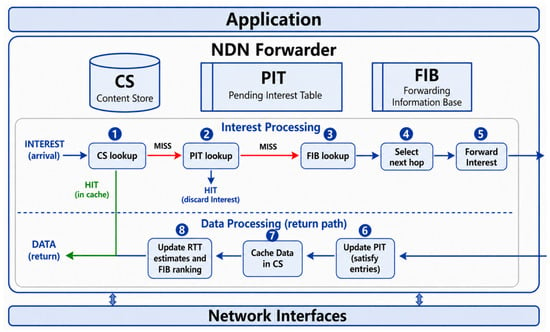
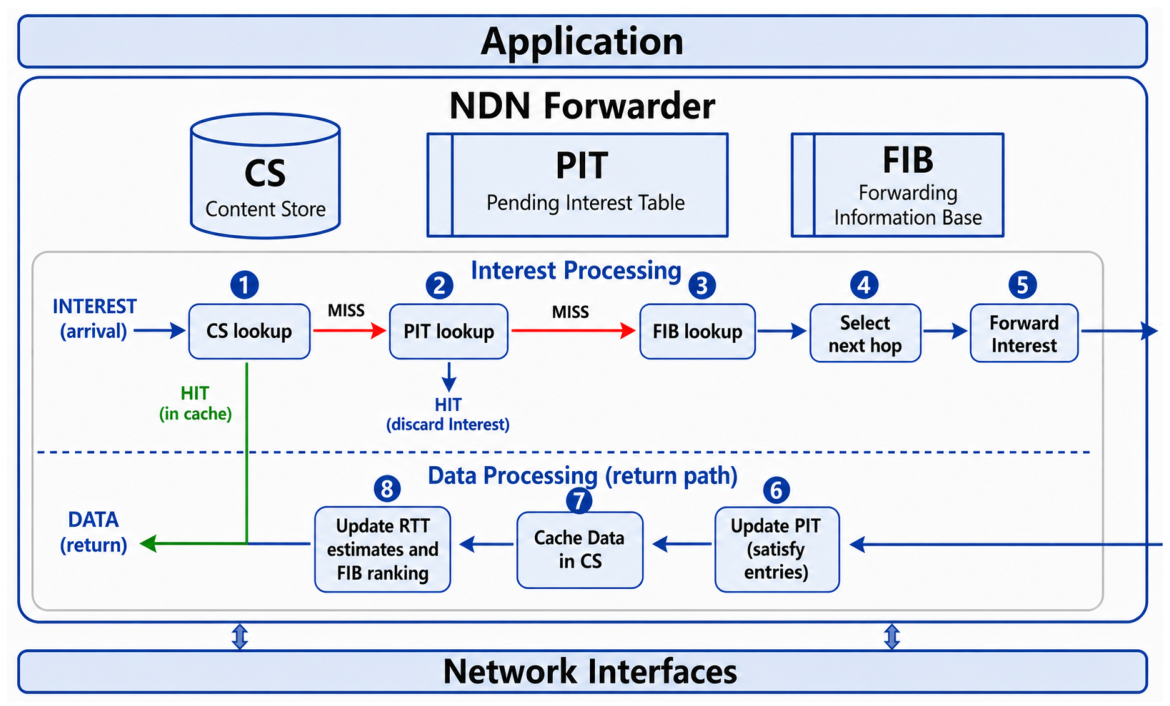
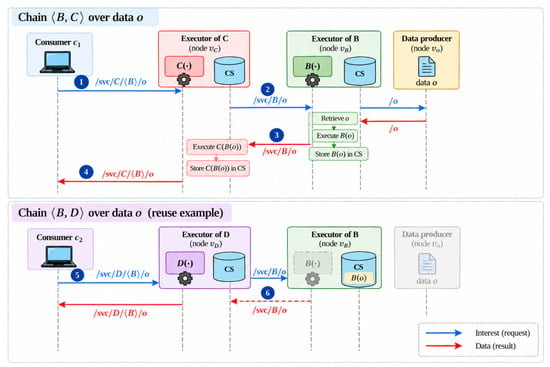
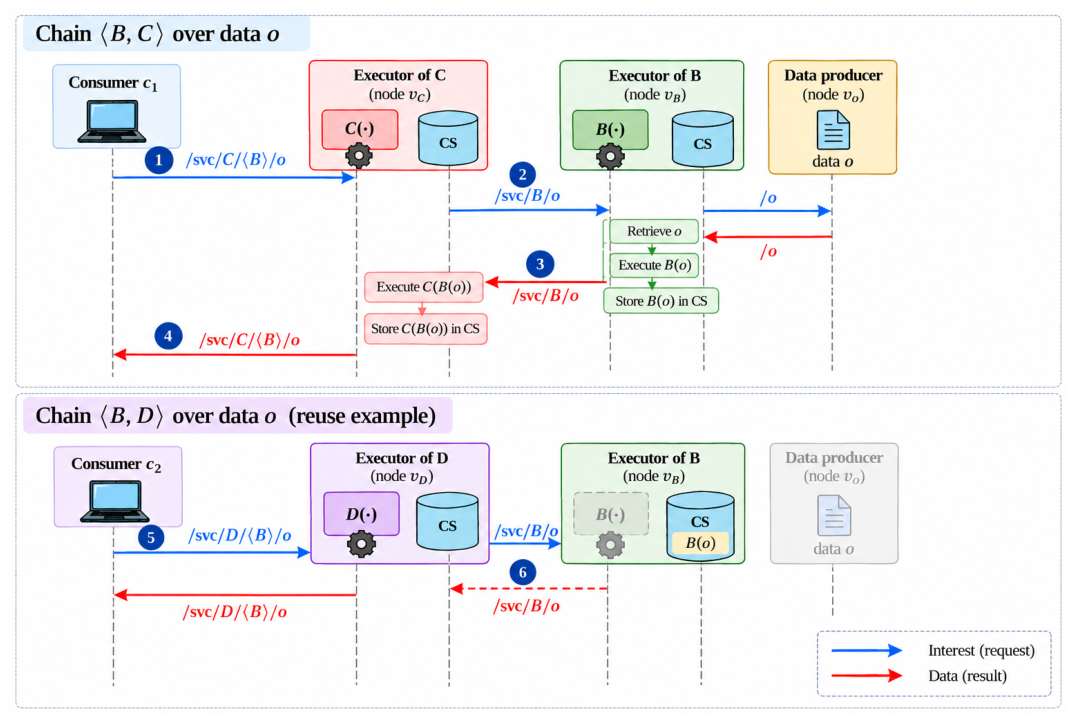
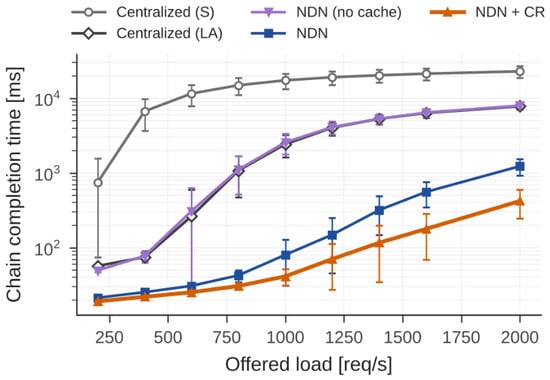
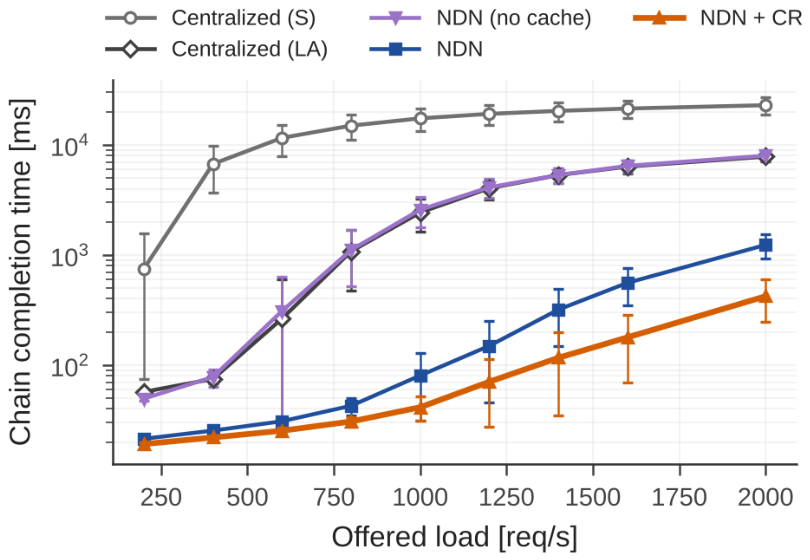
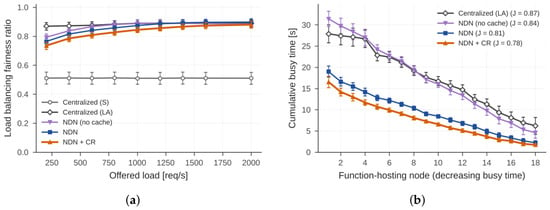
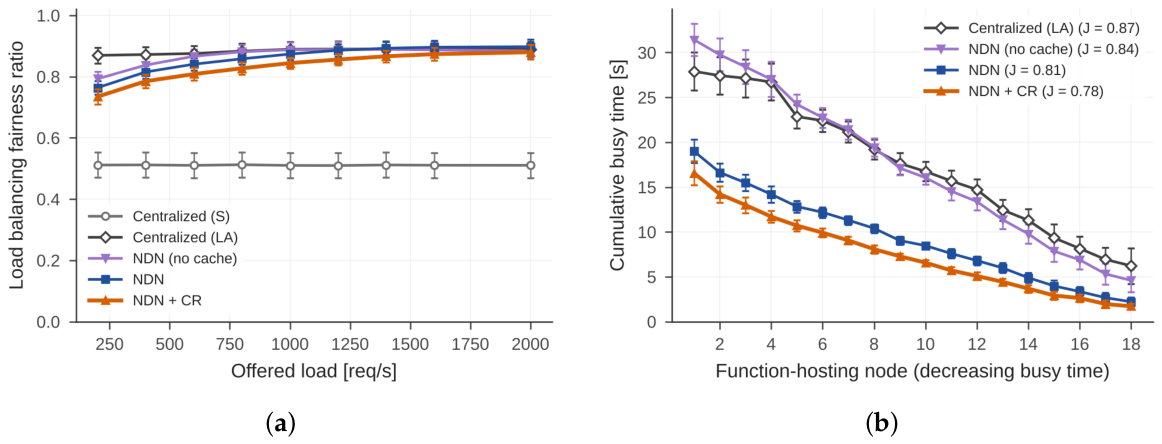
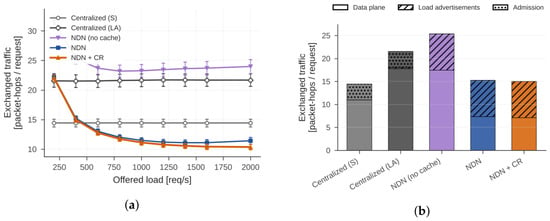
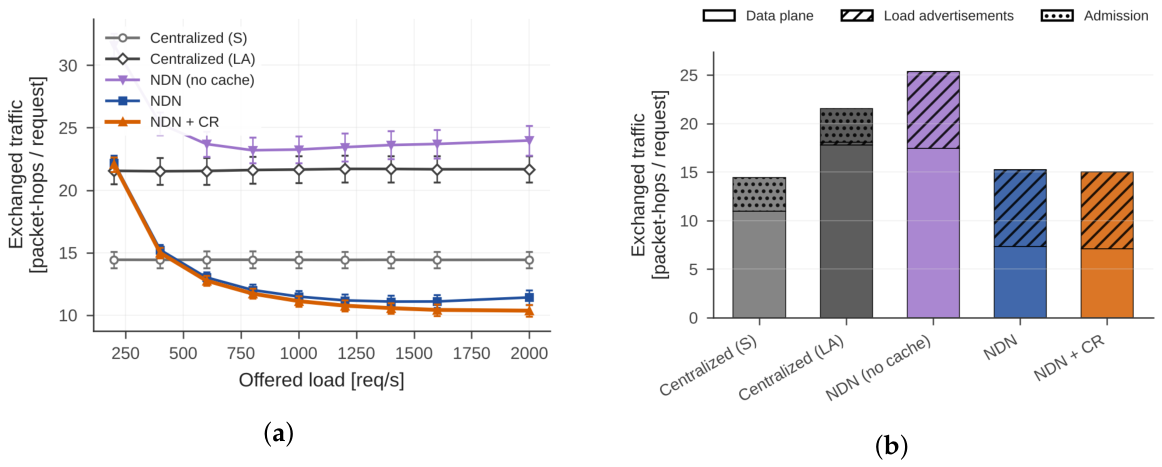
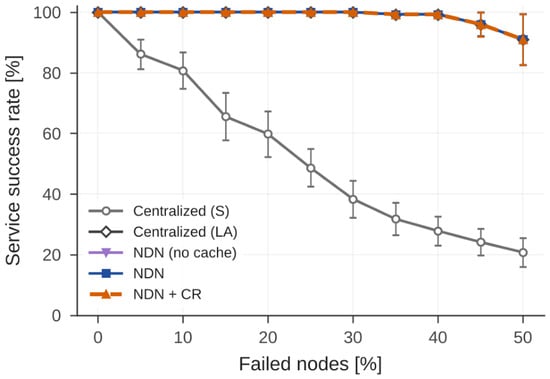
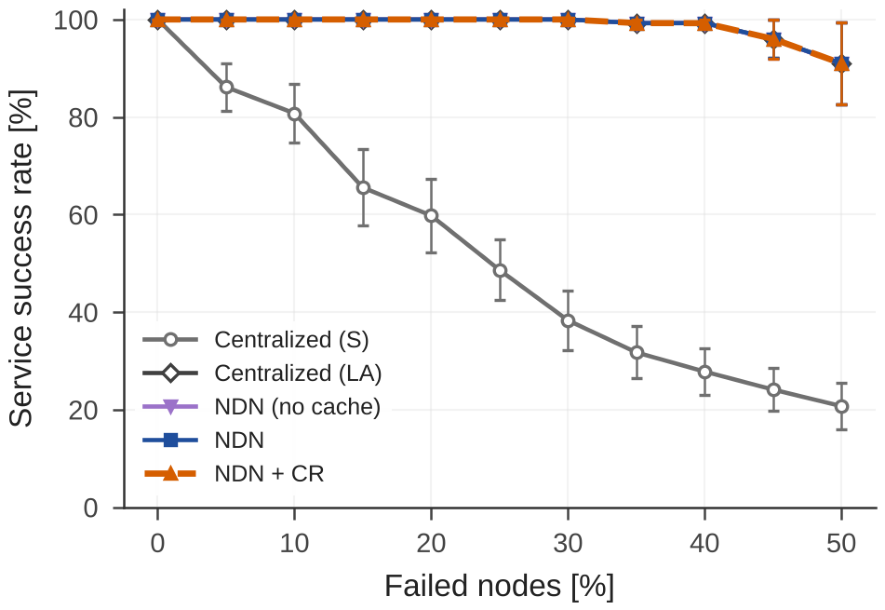
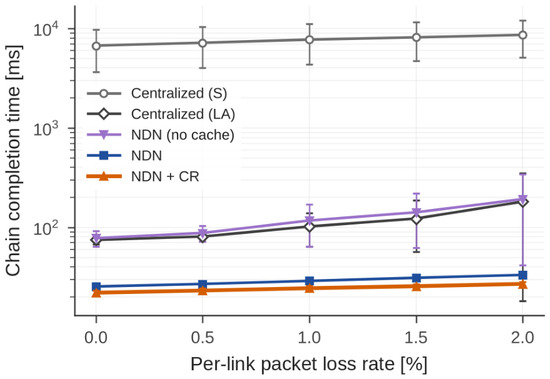
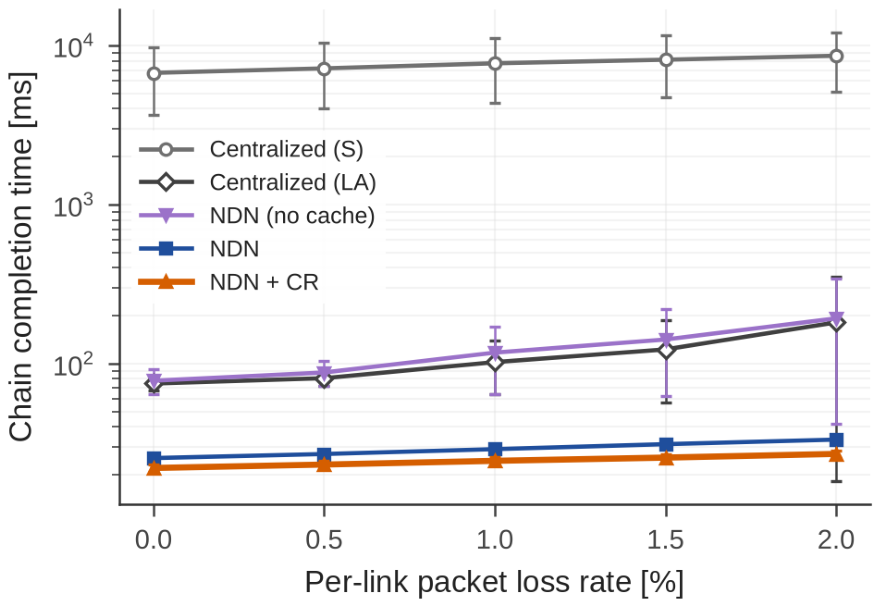
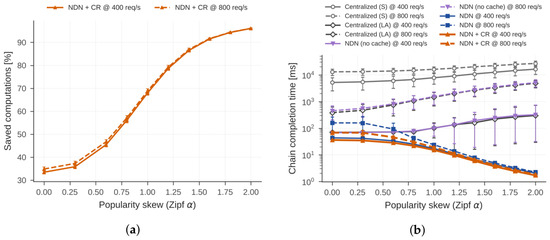
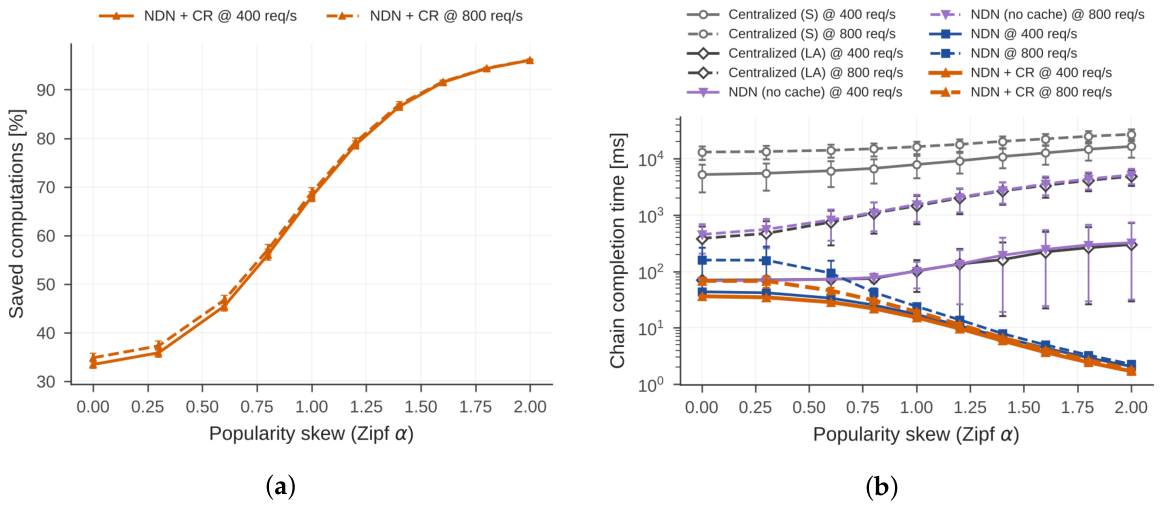
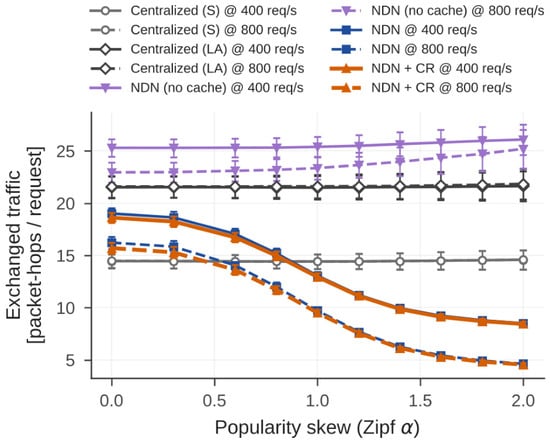
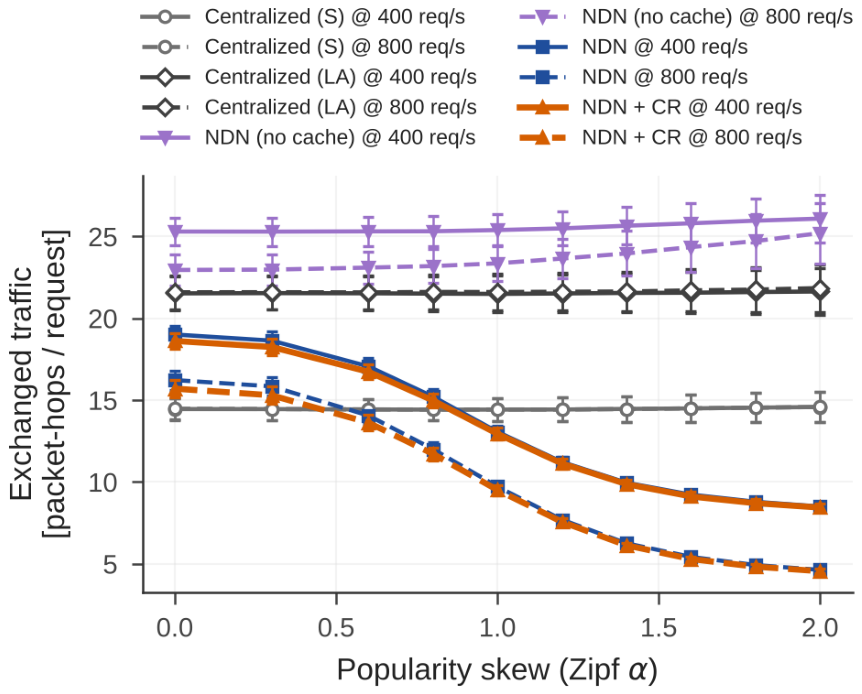
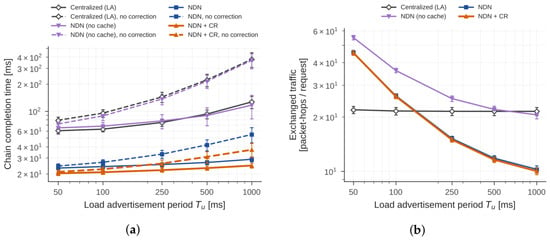
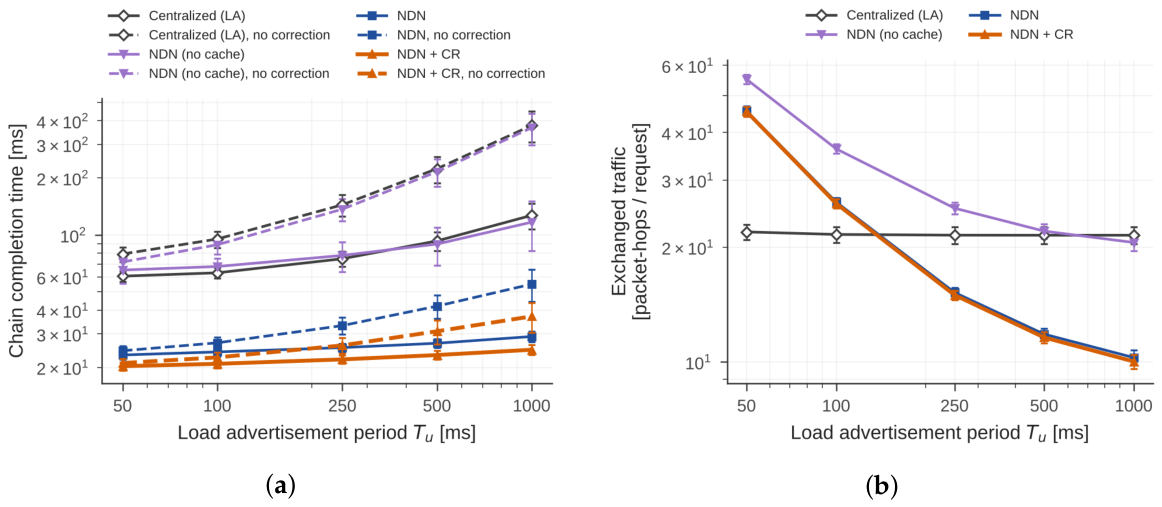
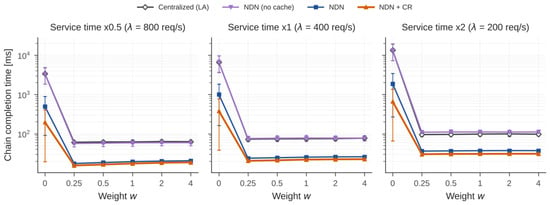
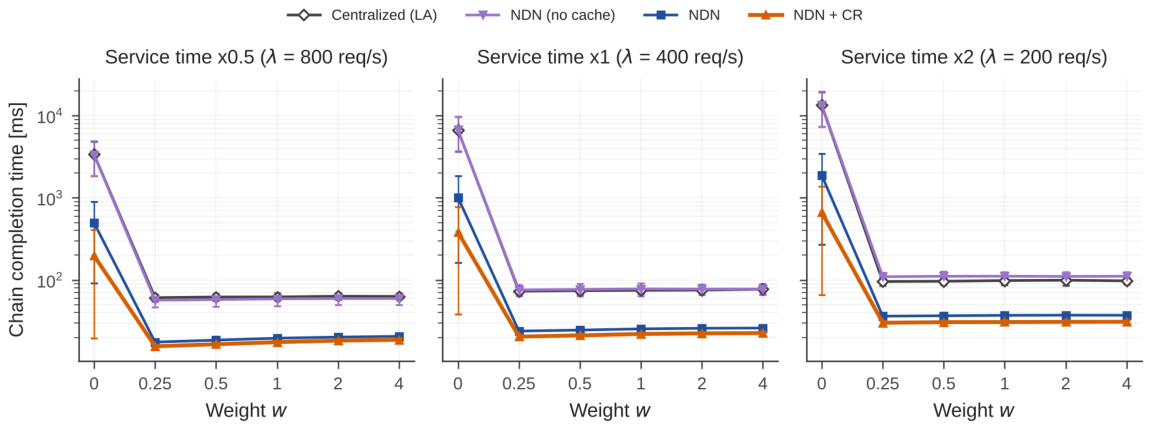
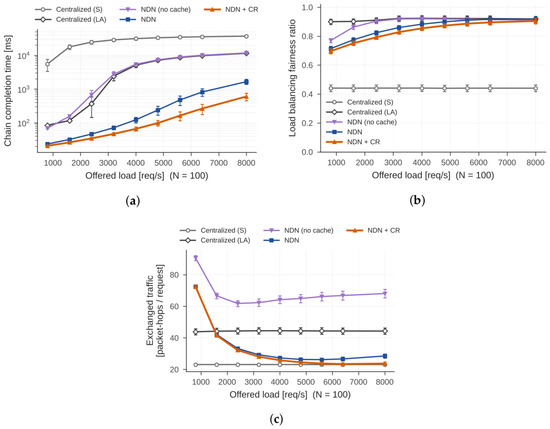
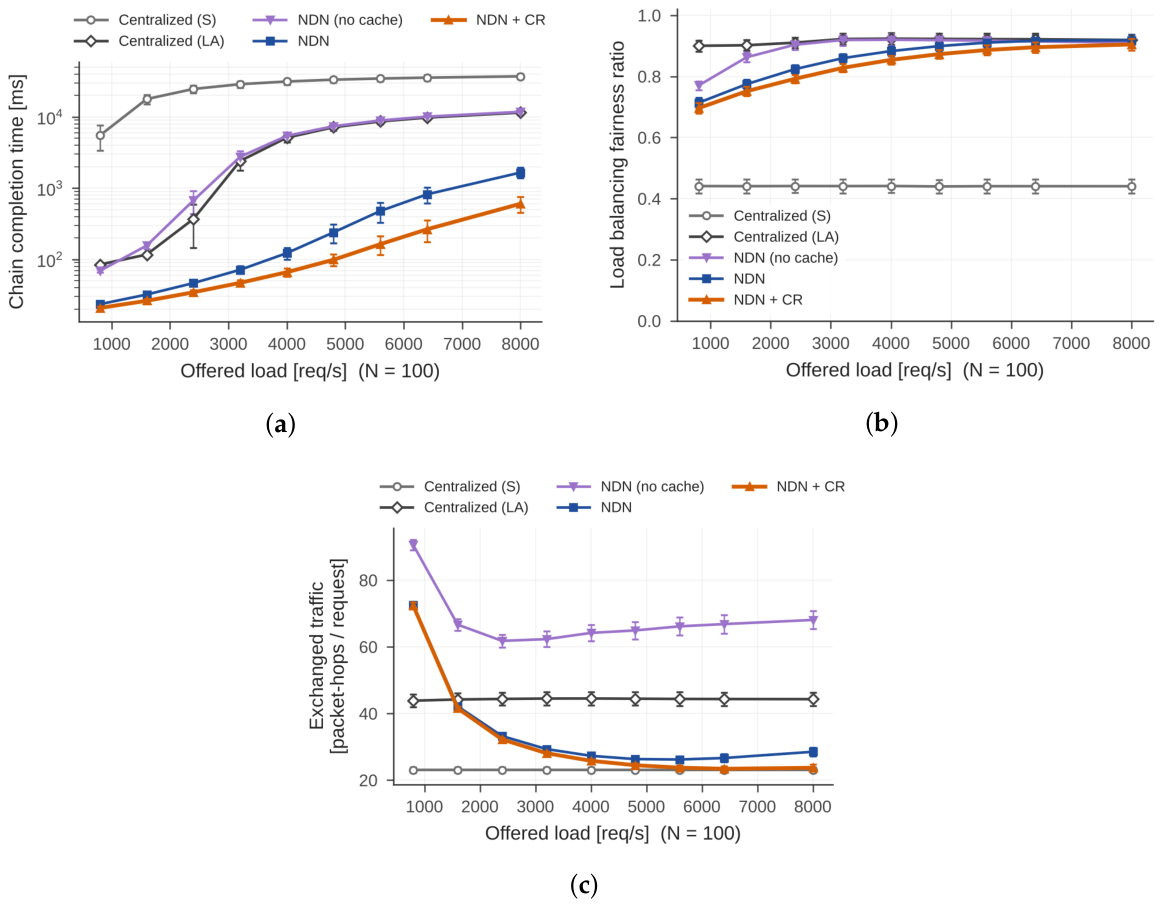

Disclaimer/Publisher’s Note: The statements, opinions and data contained in all publications are solely those of the individual author(s) and contributor(s) and not of MDPI and/or the editor(s). MDPI and/or the editor(s) disclaim responsibility for any injury to people or property resulting from any ideas, methods, instructions or products referred to in the content. |
© 2026 by the authors. Licensee MDPI, Basel, Switzerland. This article is an open access article distributed under the terms and conditions of the Creative Commons Attribution (CC BY) license.