


Abstract
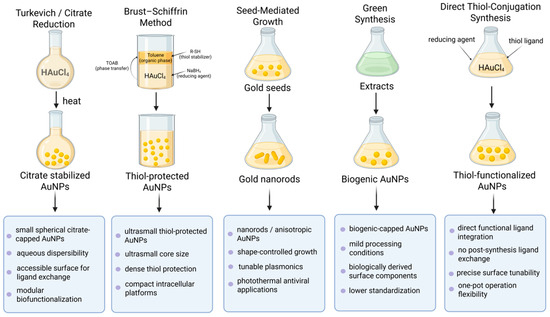
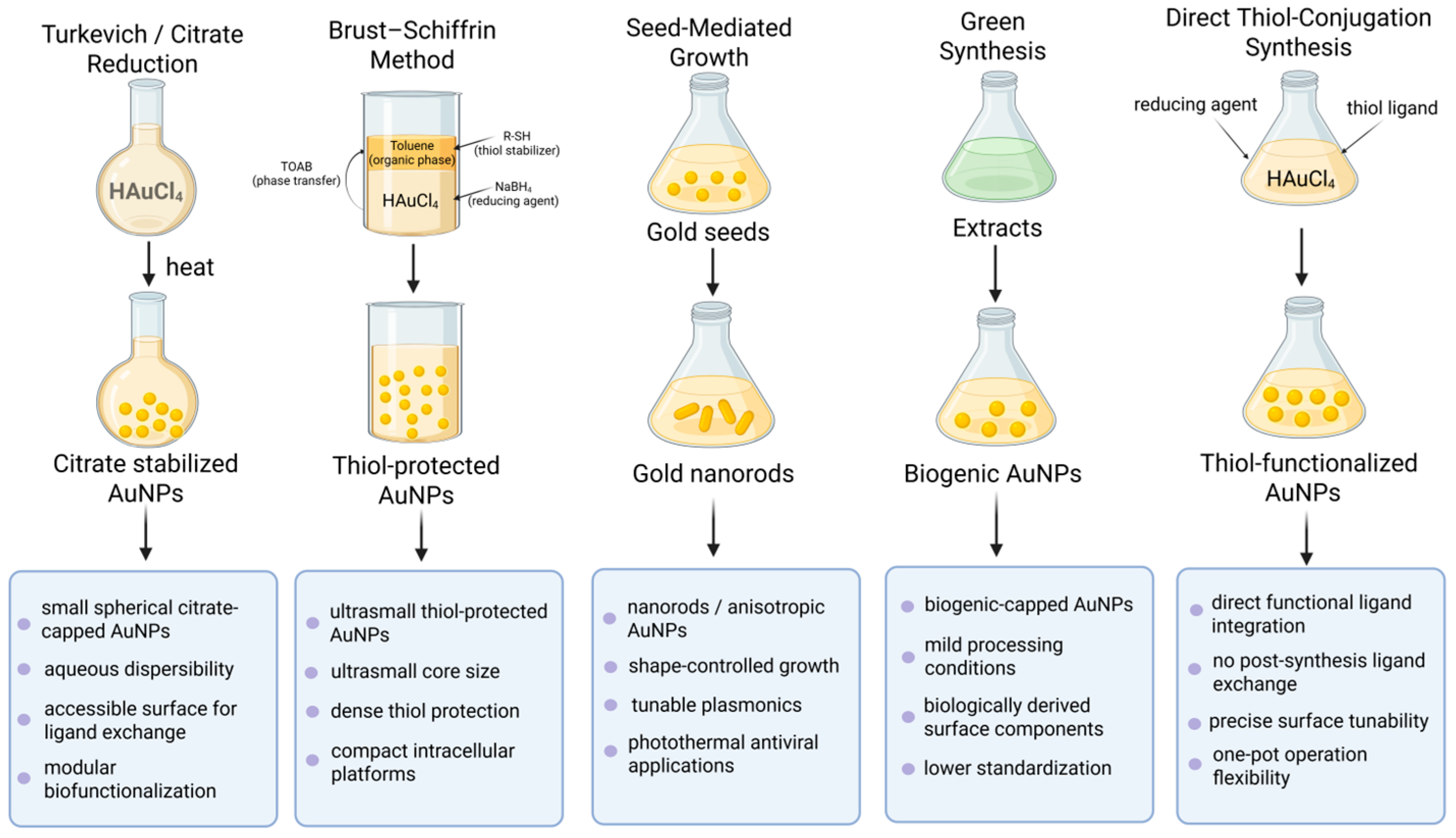
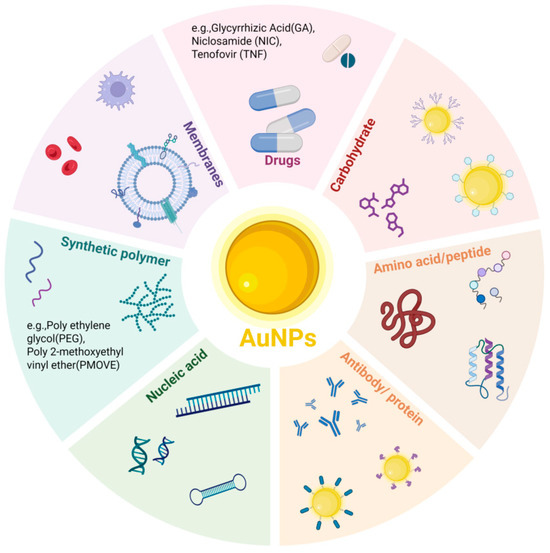
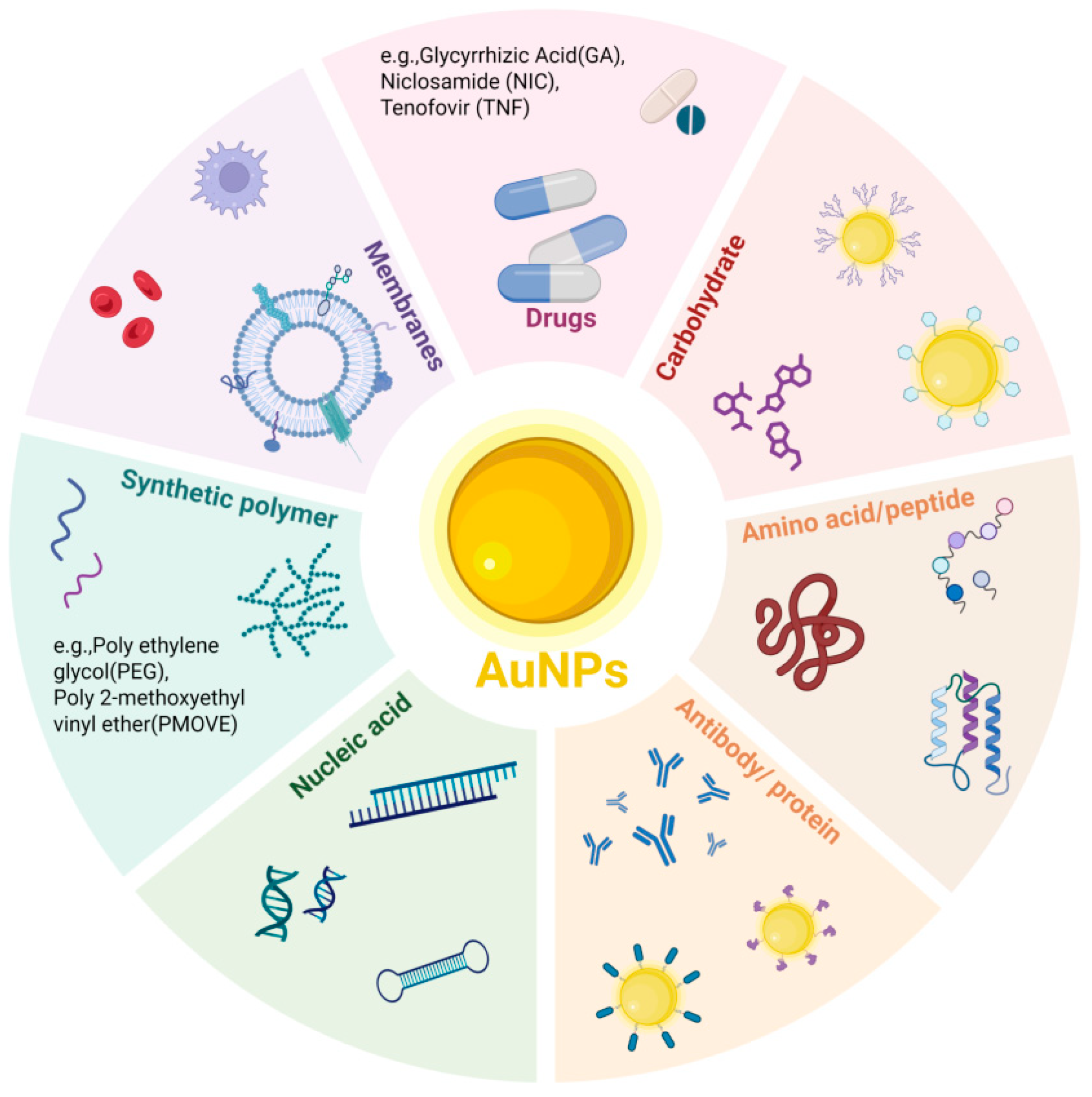
Gold nanoparticles (AuNPs) have emerged as versatile antiviral nanoplatforms because their size, morphology, plasmonic properties, and surface chemistry can be precisely engineered. In this review, we summarize the core design principles of antiviral AuNPs from a structure–function–mechanism perspective. We first outline representative synthetic and interface-programming routes for AuNP preparation, including citrate reduction, Brust–Schiffrin synthesis, seed-mediated growth, green synthesis, direct thiol-conjugation, and mixed-ligand shell strategies, emphasizing how these approaches define particle size, morphology, surface accessibility, interfacial composition, and downstream biofunctionalization potential. We then discuss major surface engineering strategies, including polyethylene glycol, nucleic acids, antibodies and nanobodies, peptides, glycans, antiviral drugs, and biomimetic coatings, with particular attention to how ligand density, orientation, flexibility, and interfacial stability determine biological performance. Next, we examine how functionalized AuNPs inhibit different stages of the viral life cycle, including viral attachment and entry, intracellular replication, assembly and egress, photothermal inactivation, and immune modulation or vaccine delivery. Finally, we highlight current challenges, including incomplete structure–activity relationships, dynamic nano–bio interactions under physiological conditions, limited standardization across studies, and translational barriers related to safety, reproducibility, and scale-up. This review provides a conceptual framework for the rational development of next-generation AuNP-based antiviral nanotherapeutics.
1. Introduction
Viral infections remain a major and evolving threat to global public health, particularly in the context of rapidly mutating RNA viruses, recurrent zoonotic spillover, and the continued emergence of antiviral resistance [1,2]. Although vaccines and direct-acting antiviral drugs have substantially improved the prevention and treatment of many viral diseases, their overall effectiveness can still be limited by antigenic drift, incomplete cross-protection, narrow antiviral spectrum, suboptimal tissue delivery, and the eventual selection of resistant strains [3]. These limitations have stimulated growing interest in antiviral strategies that are mechanistically versatile and adaptable across different viral families.
Nanomaterials have emerged as promising tools in antiviral research because their characteristic dimensions are comparable to those of many virions and subcellular structures involved in infection [4]. This size compatibility enables direct interactions with viral particles, host–cell membranes, and intracellular trafficking pathways. More importantly, nanoparticles can be engineered to integrate multiple functions within a single platform, including blockade of viral attachment, delivery of antiviral cargos, modulation of host–cell responses, and externally triggered inactivation [5]. In contrast to many conventional small-molecule antivirals, which typically act on a single viral or host target, nanoplatforms can be designed to combine recognition, delivery, and therapeutic action at the nano–bio interface.
A wide range of inorganic nanomaterials, including silver [6], copper [7,8], zinc [9,10], selenium [11,12], tellurium [13], iron [14], and silicon [15] systems, have shown antiviral activity through mechanisms such as direct virion disruption, redox-associated damage, adsorption-mediated inhibition, or carrier-enabled delivery of therapeutic agents. Within this broader landscape, AuNPs are especially attractive because they combine controllable synthesis, tunable size and morphology, chemical stability, localized surface plasmonic properties, and well-established surface conjugation chemistry [16]. The gold core provides a structurally robust nanoscale scaffold, while the surface can be readily modified with thiolated polymers, nucleic acids, peptides, proteins, glycans, small-molecule drugs, and biomimetic coatings. As a result, AuNPs can be adapted to distinct antiviral purposes, including multivalent inhibition of virus–host interactions, stabilization and intracellular delivery of labile therapeutics, photothermal inactivation, and enhancement of antiviral immunity [17,18,19,20].
A central concept in AuNP-based antiviral design is multivalency. Many viruses rely on the collective engagement of multiple weak interactions with host–cell receptors, glycans, or attachment factors during the earliest stages of infection. AuNPs provide a nanoscale scaffold capable of presenting ligands at high local density and in controlled spatial arrangements, thereby amplifying binding avidity and enabling biological effects that are difficult to achieve with free ligands alone [21]. In this context, antiviral performance is determined not only by ligand identity, but also by how that ligand is displayed at the nanoparticle interface. Parameters such as ligand density, orientation, linker flexibility, surface charge, and particle curvature can strongly influence colloidal stability, protein adsorption, cellular uptake, intracellular trafficking, and ultimately antiviral outcome.
Over the past decade, increasing evidence has indicated that functionalized AuNPs can inhibit or modulate infection by a wide range of medically relevant viruses, including influenza virus, human immunodeficiency virus (HIV), herpes simplex virus (HSV), respiratory syncytial virus (RSV), hepatitis B virus (HBV), and SARS-CoV-2 [17]. However, the field remains conceptually fragmented. Many studies focus on a specific nanoparticle formulation, a single ligand class, or one antiviral application, whereas fewer analyses systematically connect nanoparticle synthesis, surface engineering, and antiviral mechanism, within a unified design framework. Consequently, it remains difficult to extract generalizable principles that explain how physicochemical design and interfacial architecture jointly determine biological behavior and antiviral efficacy.
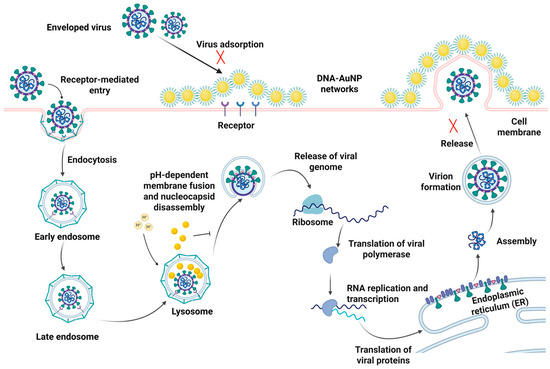
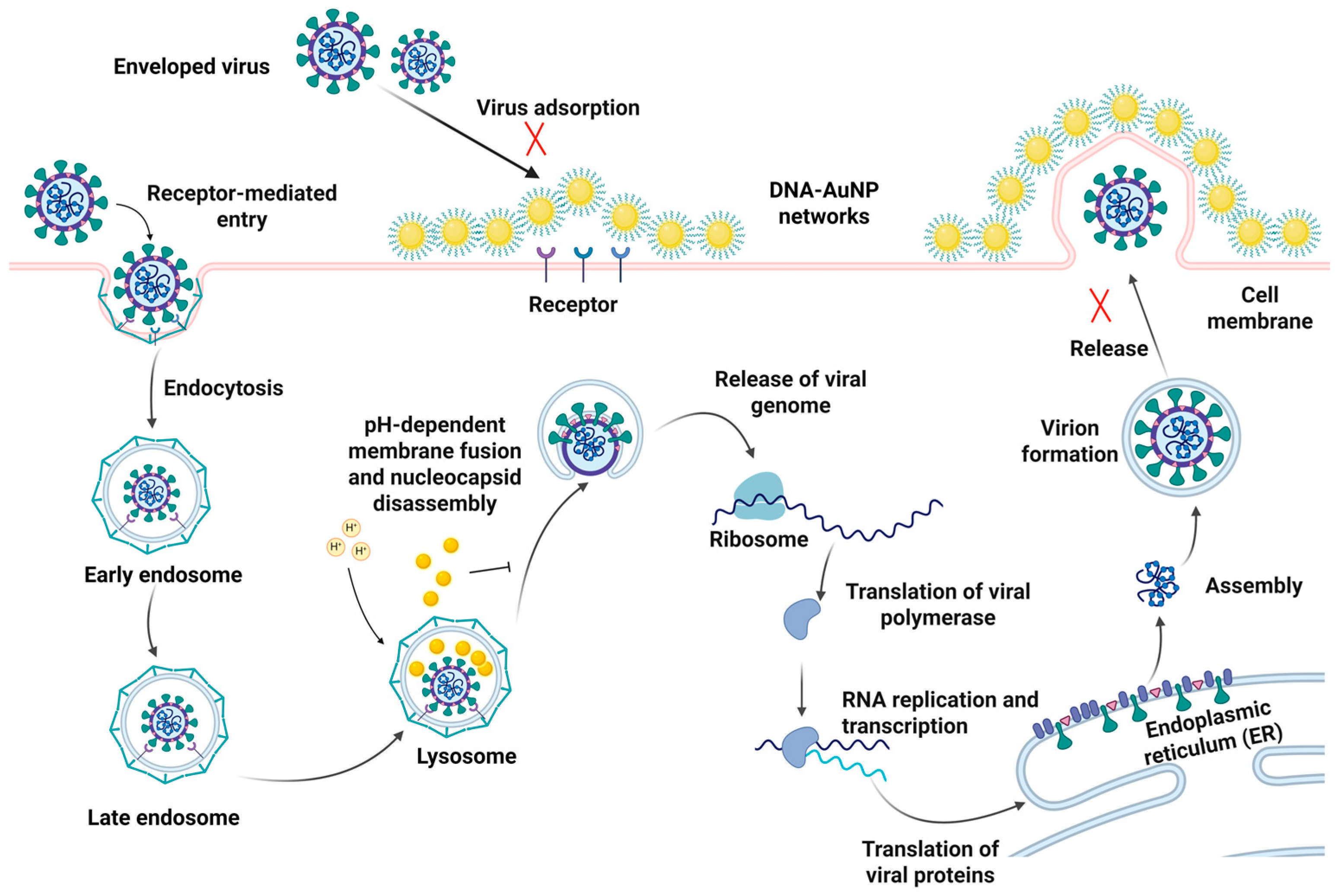
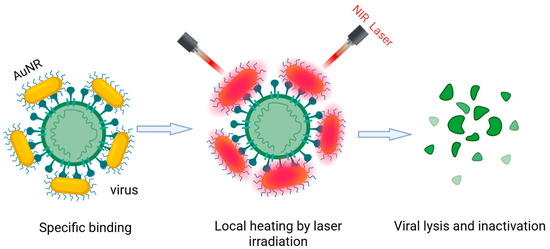
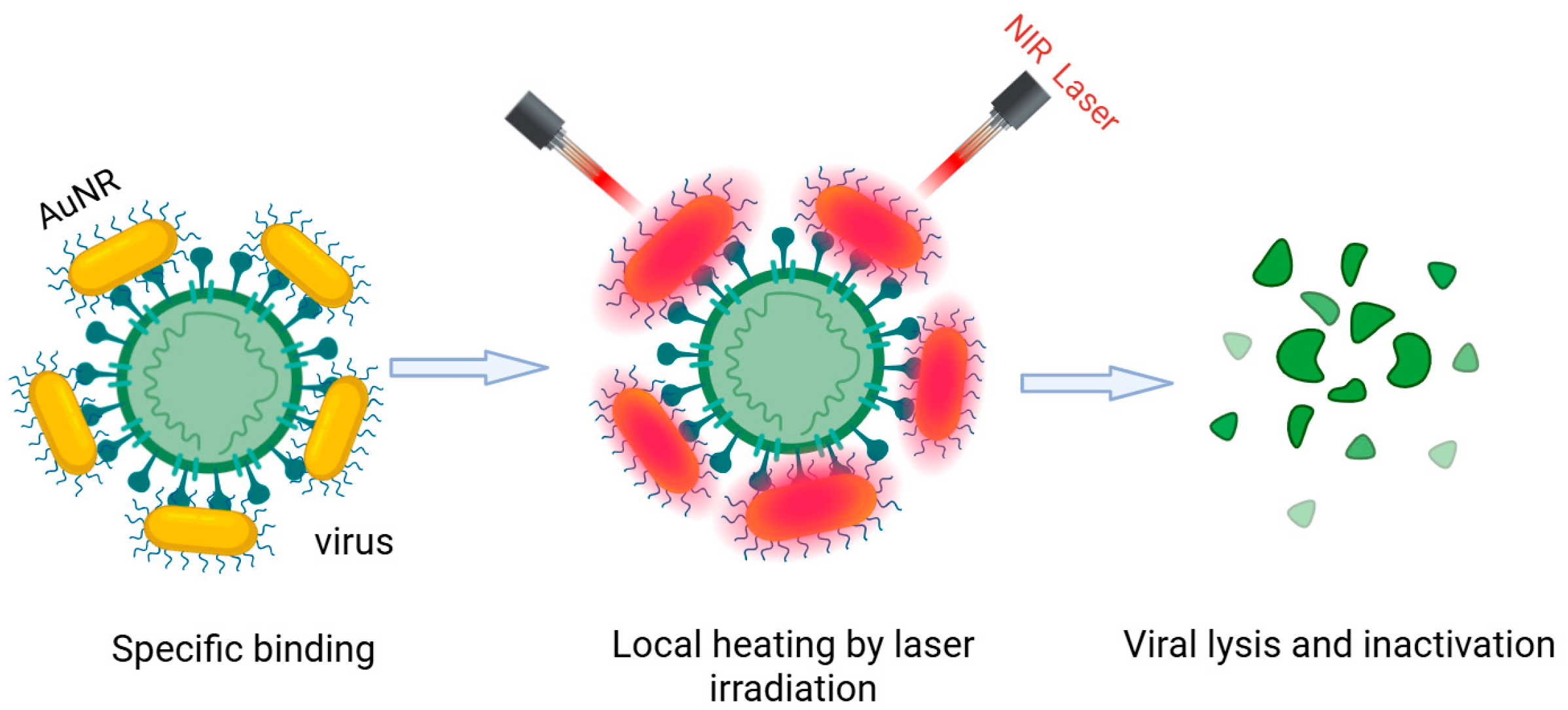
In this review, we therefore examine antiviral AuNPs from a structure–function–mechanism perspective. We first summarize the principal synthetic and interface-programming routes used to prepare AuNP cores and functionalizable surfaces for antiviral nanoplatforms, emphasizing how synthesis influences size, morphology, surface accessibility, dispersibility, and ligand-shell design. We then discuss representative surface engineering strategies—including PEGylation, nucleic acid conjugation, antibody and protein coupling, peptide functionalization, glycan display, drug loading, and biomimetic coating—and highlight how these interfacial designs regulate colloidal stability, biological identity, targeting, and cargo handling. Next, we analyze how functionalized AuNPs interfere with different stages of the viral life cycle, including viral attachment and entry, intracellular replication, assembly and egress, photothermal inactivation, and immune modulation or vaccine delivery. Finally, we discuss the major current challenges in antiviral AuNP research, including incomplete understanding of structure–activity relationships, the dynamic complexity of the nano–bio interface, and the lack of standardized comparative frameworks across studies.
5. Current Challenges and Future Research Directions
Functionalized AuNPs have emerged as highly adaptable antiviral nanoplatforms because they can integrate multiple therapeutic functions within a single construct. As discussed throughout this review, their antiviral performance is governed not only by the intrinsic properties of the gold core, but also by the architecture of the interfacial layer. Parameters such as particle size, morphology, ligand identity, surface density, linker flexibility, charge distribution, and colloidal stability collectively determine how AuNPs interact with viral particles, host–cell membranes, serum proteins, and immune components. This tunability underlies their diverse utility as entry inhibitors, intracellular delivery vehicles, photothermal agents, and vaccine or immune-modulating platforms. At the same time, it is precisely this multifunctional complexity that makes clinical translation challenging.
A first major barrier is the still-limited predictability of structure–activity relationships under physiologically relevant conditions. Although many studies demonstrate promising antiviral effects in vitro, biological performance often changes substantially in the presence of serum proteins, mucus, extracellular matrix components, or complex tissue environments. In particular, protein corona formation can alter nanoparticle identity after administration, thereby affecting ligand accessibility, biodistribution, immune recognition, and cellular uptake [80]. As a result, formulations that appear highly effective under simplified experimental conditions may behave differently in vivo. Future progress will therefore require more rigorous correlation of physicochemical design parameters with biological performance in relevant media, tissues, and animal models.
A second major challenge concerns safety, biodistribution, and long-term fate. Many AuNP formulations show acceptable short-term cytocompatibility, but this should not be taken as evidence of long-term safety across exposure routes, dosing schedules, or particle classes. Retention in organs, chronic inflammatory responses, off-target accumulation, and the biological consequences of repeated administration remain insufficiently resolved for many antiviral AuNP systems. These issues are particularly important for formulations intended for prophylactic use, repeated dosing, mucosal delivery, or immune modulation, where safety thresholds may be especially stringent. A more complete understanding of how core size, shape, surface chemistry, and degradability influence long-term in vivo behavior will be essential for translational development.
Third, the field is hindered by limited standardization across studies. Differences in synthesis, purification, ligand quantification, colloidal characterization, antiviral assay design, dose reporting, and endpoint selection make it difficult to compare results across laboratories or to derive robust general design rules. In many cases, nominally similar AuNP formulations are described without sufficiently detailed characterization of particle size distribution, surface composition, ligand density, or stability in biologically relevant media. This lack of harmonization complicates interpretation of antiviral efficacy and contributes to uncertainty regarding reproducibility. More standardized reporting frameworks and benchmarking practices will be needed to establish reliable structure–function–mechanism relationships.
A fourth barrier lies in manufacturing and scale-up. Antiviral AuNPs are often most effective when they incorporate multiple functional elements—such as stealth coatings, targeting ligands, therapeutic cargos, and trigger-responsive components—but each added layer increases synthetic complexity and potential batch variability. Large-scale production of multifunctional AuNPs with consistent size, surface composition, ligand coverage, and biological behavior remains a substantial technical challenge. In addition, purification, storage stability, sterilization, and quality control must all be optimized in ways compatible with regulatory expectations. Thus, translational success will depend not only on elegant proof-of-concept designs, but also on manufacturable and reproducible formulations.
Looking forward, three research directions appear particularly important. First, the field would benefit from more quantitatively designed multivalent interfaces that better match the geometry, spacing, and binding characteristics of viral surfaces. Second, greater emphasis should be placed on smart and context-responsive systems capable of activating drug release, structural reconfiguration, or photothermal effects selectively within infected tissues. Third, there is a pressing need for integrated evaluation pipelines that combine rigorous nanoparticle characterization with mechanistic virology, pharmacology, immunology, and long-term biosafety assessment. Advances in these areas would help shift antiviral AuNPs from isolated proof-of-concept studies toward more predictable and translationally relevant platforms.
Another important translational issue is the potential emergence of viral resistance to AuNP-based antiviral platforms. Multivalent AuNPs may impose a higher genetic barrier to resistance than conventional single-target small molecules, particularly when they target conserved host–virus interfaces, multiple spatially distributed viral surface features, or physical properties of virions. However, resistance should not be assumed to be impossible. Viruses may reduce susceptibility by altering glycosylation patterns, receptor usage, envelope-protein charge, surface accessibility, or virion stability. Future studies should evaluate resistance using serial viral passaging under subinhibitory nanoparticle concentrations, sequencing of escape populations, receptor-usage and glycosylation analyses, cross-resistance testing against related nanoparticle formulations, and fitness-cost assessment of putative escape variants.
In summary, functionalized AuNPs offer a uniquely versatile foundation for antiviral nanomedicine, but their future impact will depend on whether interfacial complexity can be converted into biological precision and manufacturable robustness. The most successful next-generation systems are likely to be those designed not only for strong antiviral activity in simplified models, but also for reproducibility, safety, and mechanistic clarity in clinically relevant settings. By addressing these challenges, AuNP-based antiviral platforms may progress from promising experimental constructs to credible candidates for broad-spectrum and precision antiviral intervention.
Author Contributions
Conceptualization, T.T.; methodology, K.S.; software, L.L.; validation, Y.L., L.L., S.W. and K.S.; formal analysis, Y.L.; investigation, K.S. and S.W.; resources, T.T. and T.D.; data curation, K.S.; writing—original draft preparation, K.S.; writing—review and editing, T.T.; visualization, Y.L.; supervision, T.T.; project administration, T.T. and T.D.; funding acquisition, T.T. All authors have read and agreed to the published version of the manuscript.
Funding
This research was funded by the National Natural Science Foundation of China (grant number 32402880) and the Hunan Provincial Natural Science Foundation of China (grant number 2024JJ6212).
Institutional Review Board Statement
Not applicable.
Informed Consent Statement
Not applicable.
Data Availability Statement
No new data were created or analyzed in this study. Data sharing is not applicable to this article.
Conflicts of Interest
The authors declare no conflicts of interest.
References
- Aw, D.Z.H.; Zhang, D.X.; Vignuzzi, M. Strategies and efforts in circumventing the emergence of antiviral resistance against conventional antivirals. npj Antimicrob. Resist. 2025, 3, 54. [Google Scholar] [CrossRef] [Scilit] [PubMed]
- Gupta, R.K.; Hill, A.; Sawyer, A.W.; Cozzi-Lepri, A.; von Wyl, V.; Yerly, S.; Lima, V.D.; Günthard, H.F.; Gilks, C.; Pillay, D. Virological monitoring and resistance to first-line highly active antiretroviral therapy in adults infected with HIV-1 treated under WHO guidelines: A systematic review and meta-analysis. Lancet Infect. Dis. 2009, 9, 409–417. [Google Scholar] [CrossRef] [Scilit] [PubMed]
- Du, S.; Hu, X.; Li, P.; Xu, S.; Kim, M.; Liu, X.; Zhan, P. Antiviral drug discovery and development: Challenges and future directions. Signal Transduct. Target. Ther. 2026, 11, 69. [Google Scholar] [CrossRef] [Scilit] [PubMed]
- Xin, G.-L.; Zhang, C.; Ni, J.-L.; Li, Y.-K.; Sun, Y.; He, X.-X. Nanomaterial Applications in Prevention and Treatment Strategies of Virus: A Review. Bioconjug. Chem. 2025, 36, 1341–1361. [Google Scholar] [CrossRef] [Scilit] [PubMed]
- Huang, Y.; Guo, X.; Wu, Y.; Chen, X.; Feng, L.; Xie, N.; Shen, G. Nanotechnology’s frontier in combatting infectious and inflammatory diseases: Prevention and treatment. Signal Transduct. Target. Ther. 2024, 9, 34. [Google Scholar] [CrossRef] [Scilit] [PubMed]
- Jeevanandam, J.; Krishnan, S.; Hii, Y.S.; Pan, S.; Chan, Y.S.; Acquah, C.; Danquah, M.K.; Rodrigues, J. Synthesis approach-dependent antiviral properties of silver nanoparticles and nanocomposites. J. Nanostruct. Chem. 2022, 12, 809–831. [Google Scholar] [CrossRef] [Scilit]
- Nakano, R.; Nakano, A.; Sasahara, T.; Suzuki, Y.; Nojima, Y.; Yano, H. Antiviral effects of copper and copper alloy and the underlying mechanisms in severe acute respiratory syndrome coronavirus 2. J. Hazard. Mater. Adv. 2025, 17, 100589. [Google Scholar] [CrossRef] [Scilit]
- Aich, P.; Chung, W.P.; Wang, W.J.; Takahashi, H.; Hsieh, M.S.; Lin, Y.C.; Kwon, O.S.; Li, W.P.; Huang, W.L. Biomimetic Copper Nanoparticles Coated with ACE2-Overexpressing Membranes for Selective SARS-CoV-2 Neutralization and Disinfection. Adv. Healthc. Mater. 2026, 17, e05424. [Google Scholar]
- Gutiérrez Rodelo, C.; Salinas, R.A.; Armenta Jaime, E.; Armenta, S.; Galdámez-Martínez, A.; Castillo-Blum, S.E.; Astudillo-de la Vega, H.; Nirmala Grace, A.; Aguilar-Salinas, C.A.; Gutiérrez Rodelo, J.; et al. Zinc associated nanomaterials and their intervention in emerging respiratory viruses: Journey to the field of biomedicine and biomaterials. Coord. Chem. Rev. 2022, 457, 214402. [Google Scholar] [CrossRef] [Scilit] [PubMed]
- Zhou, Y.; Tong, T.; Jiang, X.; Fang, L.; Wu, Y.; Liang, J.; Xiao, S. GSH-ZnS Nanoparticles Exhibit High-Efficiency and Broad-Spectrum Antiviral Activities via Multistep Inhibition Mechanisms. ACS Appl. Bio Mater. 2020, 3, 4809–4819. [Google Scholar] [CrossRef] [Scilit] [PubMed]
- El-Zahed, M.M.; Kandel, S.A.; Khalifa, M.E. Antiviral activity of green synthesized selenium nanoparticles alone and in combination with chitosan against SARS-CoV-2. Nanoscale Res. Lett. 2026, 21, 12. [Google Scholar] [CrossRef] [Scilit]
- Su, J.; Lai, J.; Li, J.; Li, C.; Liu, X.; Wang, C.; Zhu, B.; Li, Y. Selenium Nanoparticles Control H1N1 Virus by Inhibiting Inflammatory Response and Cell Apoptosis. Molecules 2023, 28, 5920. [Google Scholar] [CrossRef] [Scilit] [PubMed]
- Zhou, Y.; Jiang, X.; Tong, T.; Fang, L.; Wu, Y.; Liang, J.; Xiao, S. High antiviral activity of mercaptoethane sulfonate functionalized Te/BSA nanostars against arterivirus and coronavirus. RSC Adv. 2020, 10, 14161–14169. [Google Scholar] [CrossRef] [Scilit] [PubMed]
- Tong, T.; Deng, S.; Zhang, X.; Fang, L.; Liang, J.; Xiao, S. Inhibitory effect and mechanism of gelatin stabilized ferrous sulfide nanoparticles on porcine reproductive and respiratory syndrome virus. J. Nanobiotechnol. 2022, 20, 70. [Google Scholar] [CrossRef] [Scilit]
- Osminkina, L.A.; Agafilushkina, S.N.; Kropotkina, E.A.; Saushkin, N.Y.; Bozhev, I.V.; Abramchuk, S.S.; Samsonova, J.V.; Gambaryan, A.S. Antiviral adsorption activity of porous silicon nanoparticles against different pathogenic human viruses. Bioact. Mater. 2022, 7, 39–46. [Google Scholar] [CrossRef] [Scilit] [PubMed]
- Xu, C.; Zhang, Y.; Zhang, C.; Gao, X. Gold nanoclusters—A promising atomically precise atomic aggregation-based drug and its biomedical applications. Nano Today 2026, 67, 102985. [Google Scholar] [CrossRef] [Scilit]
- Teimouri, H.; Taheri, S.; Saidabad, F.E.; Nakazato, G.; Maghsoud, Y.; Babaei, A. New insights into gold nanoparticles in virology: A review of their applications in the prevention, detection, and treatment of viral infections. Biomed. Pharmacother. 2025, 183, 117844. [Google Scholar] [CrossRef] [Scilit] [PubMed]
- Di Gianvincenzo, P.; Marradi, M.; Martínez-Ávila, O.M.; Bedoya, L.M.; Alcamí, J.; Penadés, S. Gold nanoparticles capped with sulfate-ended ligands as anti-HIV agents. Bioorg. Med. Chem. Lett. 2010, 20, 2718–2721. [Google Scholar] [CrossRef] [Scilit] [PubMed]
- Baram-Pinto, D.; Shukla, S.; Gedanken, A.; Sarid, R. Inhibition of HSV-1 Attachment, Entry, and Cell-to-Cell Spread by Functionalized Multivalent Gold Nanoparticles. Small 2010, 6, 1044–1050. [Google Scholar] [CrossRef] [Scilit] [PubMed]
- Papp, I.; Sieben, C.; Ludwig, K.; Roskamp, M.; Böttcher, C.; Schlecht, S.; Herrmann, A.; Haag, R. Inhibition of Influenza Virus Infection by Multivalent Sialic-Acid-Functionalized Gold Nanoparticles. Small 2010, 6, 2900–2906. [Google Scholar] [CrossRef] [Scilit] [PubMed]
- Forsyth, C.M.; Chan, R.R.; Fink, T.D.; Kang, J.; Cohen, J.D.; Petrosko, S.H.; Mirkin, C.A. Spherical Nucleic Acids: Turning Synthetic Advances and Fundamental Discovery into Translational Breakthroughs in Chemistry, Materials Development, Biology, and Medicine. Acc. Chem. Res. 2026, 59, 817–837. [Google Scholar] [CrossRef] [Scilit] [PubMed]
- Sati, A.; Mali, S.N.; Samdani, N.; Annadurai, S.; Dongre, R.; Satpute, N.; Ranade, T.N.; Pratap, A.P. From Past to Present: Gold Nanoparticles (AuNPs) in Daily Life—Synthesis Mechanisms, Influencing Factors, Characterization, Toxicity, and Emerging Applications in Biomedicine, Nanoelectronics, and Materials Science. ACS Omega 2025, 10, 33999–34087. [Google Scholar] [CrossRef] [Scilit] [PubMed]
- Patil, T.; Gambhir, R.; Vibhute, A.; Tiwari, A.P. Gold Nanoparticles: Synthesis Methods, Functionalization and Biological Applications. J. Clust. Sci. 2023, 34, 705–725. [Google Scholar]
- Turkevich, J.; Stevenson, P.C.; Hillier, J. A study of the nucleation and growth processes in the synthesis of colloidal gold. Discuss. Faraday Soc. 1951, 11, 55–75. [Google Scholar] [CrossRef] [Scilit]
- Frens, G. Controlled Nucleation for the Regulation of the Particle Size in Monodisperse Gold Suspensions. Nat. Phys. Sci. 1973, 241, 20–22. [Google Scholar] [CrossRef] [Scilit]
- Kimling, J.; Maier, M.; Okenve, B.; Kotaidis, V.; Ballot, H.; Plech, A. Turkevich method for gold nanoparticle synthesis revisited. Phys. Chem. B 2006, 110, 15700–15707. [Google Scholar] [CrossRef] [Scilit]
- Tyagi, H.; Kushwaha, A.; Kumar, A.; Aslam, M. A Facile pH Controlled Citrate-Based Reduction Method for Gold Nanoparticle Synthesis at Room Temperature. Nanoscale Res. Lett. 2016, 11, 362. [Google Scholar] [CrossRef] [Scilit] [PubMed]
- Dong, J.; Carpinone, P.L.; Pyrgiotakis, G.; Demokritou, P.; Moudgil, B.M. Synthesis of Precision Gold Nanoparticles Using Turkevich Method. Kona Powder Part. J. 2020, 37, 224–232. [Google Scholar] [CrossRef] [Scilit]
- Salloum, S.; Rüther, J.; Celik, Z.; Janiak, C. Comparative analysis of synthesis techniques for citrate-capped gold nanoparticles: Insights into optimized wet-chemical approaches for controlled morphology and stability. Nanoscale 2025, 17, 23373–23386. [Google Scholar] [CrossRef] [Scilit] [PubMed]
- Sibug-Torres, S.M.; Wallace, G.Q.; Jones, T.; Graham, D.; Baumberg, J.J. The role of Au–Cl adlayers in the Turkevich synthesis of gold nanoparticles. Chem. Commun. 2026, 62, 5890–5894. [Google Scholar] [CrossRef] [Scilit]
- Jin, R. Quantum sized, thiolate-protected gold nanoclusters. Nanoscale 2010, 2, 343–362. [Google Scholar] [CrossRef] [Scilit] [PubMed]
- Perala, S.R.K.; Kumar, S. On the Mechanism of Metal Nanoparticle Synthesis in the Brust–Schiffrin Method. Langmuir 2013, 29, 9863–9873. [Google Scholar] [CrossRef] [Scilit] [PubMed]
- Li, Y.; Zaluzhna, O.; Xu, B.; Gao, Y.; Modest, J.M.; Tong, Y.J. Mechanistic Insights into the Brust−Schiffrin Two-Phase Synthesis of Organo-chalcogenate-Protected Metal Nanoparticles. J. Am. Chem. Soc. 2011, 133, 2092–2095. [Google Scholar] [CrossRef] [Scilit] [PubMed]
- Zhu, L.; Zhang, C.; Guo, C.; Wang, X.; Sun, P.; Zhou, D.; Chen, W.; Xue, G. New Insight into Intermediate Precursors of Brust–Schiffrin Gold Nanoparticles Synthesis. J. Phys. Chem. C 2013, 117, 11399–11404. [Google Scholar] [CrossRef] [Scilit]
- Booth, S.G.; Uehara, A.; Chang, S.Y.; La Fontaine, C.; Fujii, T.; Okamoto, Y.; Imai, T.; Schroeder, S.L.M.; Dryfe, R.A.W. The significance of bromide in the Brust–Schiffrin synthesis of thiol protected gold nanoparticles. Chem. Sci. 2017, 8, 7954–7962. [Google Scholar] [CrossRef] [Scilit] [PubMed]
- Zhao, P.; Li, N.; Astruc, D. State of the art in gold nanoparticle synthesis. Coord. Chem. Rev. 2013, 257, 638–665. [Google Scholar] [CrossRef] [Scilit]
- Xia, Y.; Gilroy, K.D.; Peng, H.-C.; Xia, X. Seed-Mediated Growth of Colloidal Metal Nanocrystals. Angew. Chem. Int. Ed. 2017, 56, 60–95. [Google Scholar] [CrossRef] [Scilit]
- Niu, W.; Zhang, L.; Xu, G. Seed-mediated growth of noble metal nanocrystals: Crystal growth and shape control. Nanoscale 2013, 5, 3172–3181. [Google Scholar] [CrossRef] [Scilit] [PubMed]
- Zürbes, K.R.; Mani, E.; Bandyopadhyay, S. Synthesis of anisotropic gold nanoparticles in binary surfactant mixtures: A review on mechanisms of particle formation. RSC Adv. 2025, 15, 4377–4407. [Google Scholar] [CrossRef] [Scilit] [PubMed]
- Wei, M.-Z.; Deng, T.-S.; Zhang, Q.; Cheng, Z.; Li, S. Seed-Mediated Synthesis of Gold Nanorods at Low Concentrations of CTAB. ACS Omega 2021, 6, 9188–9195. [Google Scholar] [CrossRef] [Scilit] [PubMed]
- Wang, K.-P.; Liu, J.; Chen, X.; Wu, G.-L.; Zhang, E.-J.; Deng, T.-S. Two-step seed-mediated growth for the reproducible synthesis of high quality gold nanorods. J. Chem. Sci. 2026, 138, 15. [Google Scholar] [CrossRef] [Scilit]
- Belew, A.A.; Gebre, S.H.; Assege, M.A.; Meshesha, D.S.; Ayana, M.T. Biosynthesis of gold nanoparticle: Current applications, challenges, and future prospects. Results Chem. 2025, 18, 102859. [Google Scholar] [CrossRef] [Scilit]
- Jadoun, S.; Arif, R.; Jangid, N.K.; Meena, R.K. Green synthesis of nanoparticles using plant extracts: A review. Environ. Chem. Lett. 2021, 19, 355–374. [Google Scholar]
- Mehra, V.; Kumar, S.; Tamang, A.M.; Chandraker, S.K. Green Synthesis of Gold Nanoparticles (AuNPs) by Using Plant Extract and Their Biological Application: A Review. BioNanoScience 2024, 15, 18. [Google Scholar] [CrossRef] [Scilit]
- Santhosh, P.B.; Genova, J.; Chamati, H. Green Synthesis of Gold Nanoparticles: An Eco-Friendly Approach. Chemistry 2022, 4, 345–369. [Google Scholar] [CrossRef] [Scilit]
- Jannathul Firdhouse, M.; Lalitha, P. Biogenic green synthesis of gold nanoparticles and their applications—A review of promising properties. Inorg. Chem. Commun. 2022, 143, 109800. [Google Scholar] [CrossRef] [Scilit]
- Meléndez-Villanueva, M.A.; Morán-Santibañez, K.; Martínez-Sanmiguel, J.J.; Rangel-López, R.; Garza-Navarro, M.A.; Rodríguez-Padilla, C.; Zarate-Triviño, D.G.; Trejo-Ávila, L.M. Virucidal Activity of Gold Nanoparticles Synthesized by Green Chemistry Using Garlic Extract. Viruses 2019, 11, 1111. [Google Scholar] [CrossRef] [Scilit] [PubMed]
- Halder, A.; Das, S.; Ojha, D.; Chattopadhyay, D.; Mukherjee, A. Highly monodispersed gold nanoparticles synthesis and inhibition of herpes simplex virus infections. Mat. Sci. Eng. C-Mater. 2018, 89, 413–421. [Google Scholar] [CrossRef] [Scilit]
- Sugie, A.; Somete, T.; Matsubara, M.; Kanie, K.; Muramatsu, A.; Mori, A. Generation of Gold Nanoparticles via Direct Thiol-Capping with THP-Protected Thiols without Deprotection. Synlett 2009, 2009, 2453–2456. [Google Scholar] [CrossRef] [Scilit]
- Lohse, S.E.; Dahl, J.A.; Hutchison, J.E. Direct Synthesis of Large Water-Soluble Functionalized Gold Nanoparticles Using Bunte Salts as Ligand Precursors. Langmuir 2010, 26, 7504–7511. [Google Scholar] [CrossRef] [Scilit] [PubMed]
- Xu, X.; Liu, Y.; Yang, Y.; Wu, J.; Cao, M.; Sun, L. One-pot synthesis of functional peptide-modified gold nanoparticles for gene delivery. Colloids Surf. A 2022, 640, 128491. [Google Scholar] [CrossRef] [Scilit]
- Ncobeni, N.; de la Torre, B.G.; Albericio, F.; Kruger, H.G.; Parboosing, R. Active targeting of CD4+ T lymphocytes by PEI-capped, peptide-functionalized gold nanoparticles. Nanotechnology 2022, 33, 405101. [Google Scholar] [CrossRef] [Scilit]
- Adokoh, C.K.; Keter, F.K.; Kinfe, H.H.; Tshikhudo, R.; Darkwa, J. Development and characterization of functionalized glyco thiolate capped gold nanoparticles for biological applications. RSC Med. Chem. 2020, 11, 283–292. [Google Scholar] [CrossRef] [Scilit] [PubMed]
- Oh, E.; Susumu, K.; Jain, V.; Kim, M.; Huston, A. One-pot aqueous phase growth of biocompatible 15–130 nm gold nanoparticles stabilized with bidentate PEG. J. Colloid Interface Sci. 2012, 376, 107–111. [Google Scholar] [CrossRef] [Scilit] [PubMed]
- Temur, N.; Dadi, S.; Dogan, A.N.; Nisari, M.; Avan, I.; Ocsoy, I. Benefiting from Both Ethanol Oxidation and Bidentate Thiol Groups of DHLA Ligands under Photoirradiation for Synthesis of Au Nanoparticles with Their Catalytic and Peroxidase Like Activity. ACS Omega 2025, 10, 15484–15492. [Google Scholar] [CrossRef] [Scilit] [PubMed]
- Susumu, K.; Stewart, M.H.; Meares, A.; Medintz, I.L.; Oh, E. Thioctic Acid-Based Compact Hydrophilic Ligands for Biocompatible Quantum Dots and Gold Nanoparticles: Facile Synthesis and Improved Utility. Chem. Mater. 2025, 37, 4375–4392. [Google Scholar] [CrossRef] [Scilit]
- Borsley, S.; Edwards, W.; Mati, I.K.; Poss, G.; Diez-Castellnou, M.; Marro, N.; Kay, E.R. A General One-Step Synthesis of Alkanethiyl-Stabilized Gold Nanoparticles with Control over Core Size and Monolayer Functionality. Chem. Mater. 2023, 35, 6168–6177. [Google Scholar] [CrossRef] [Scilit] [PubMed]
- Cagno, V.; Andreozzi, P.; D’Alicarnasso, M.; Jacob Silva, P.; Mueller, M.; Galloux, M.; Le Goffic, R.; Jones, S.T.; Vallino, M.; Hodek, J.; et al. Broad-spectrum non-toxic antiviral nanoparticles with a virucidal inhibition mechanism. Nat. Mater. 2018, 17, 195–203. [Google Scholar] [PubMed]
- Raza, S.; Mente, P.; Kamiński, B.; Bończak, B.; Maleki-Ghaleh, H.; Vignesh, V.; Paczesny, J. Engineering hydrophobic and electrostatic interactions for selective inactivation of bacteriophages by mixed-ligand nanoparticles. Nanoscale 2025, 17, 12929–12936. [Google Scholar] [CrossRef] [Scilit] [PubMed]
- Nguyenova, H.Y.; Hubalek Kalbacova, M.; Dendisova, M.; Sikorova, M.; Jarolimkova, J.; Kolska, Z.; Ulrychova, L.; Weber, J.; Reznickova, A. Stability and biological response of PEGylated gold nanoparticles. Heliyon 2024, 10, e30601. [Google Scholar] [CrossRef] [Scilit] [PubMed]
- Suk, J.S.; Xu, Q.; Kim, N.; Hanes, J.; Ensign, L.M. PEGylation as a strategy for improving nanoparticle-based drug and gene delivery. Adv. Drug Deliv. Rev. 2016, 99, 28–51. [Google Scholar] [CrossRef] [Scilit] [PubMed]
- Maus, L.; Dick, O.; Bading, H.; Spatz, J.P.; Fiammengo, R. Conjugation of Peptides to the Passivation Shell of Gold Nanoparticles for Targeting of Cell-Surface Receptors. ACS Nano 2010, 4, 6617–6628. [Google Scholar] [CrossRef] [Scilit] [PubMed]
- Fujiura, K.; Naito, M.; Tanaka, Y.; Tanaka, M.; Nakanishi, Y.; Ejima, H.; Negishi, L.; Kujirai, T.; Kurumizaka, H.; Ohta, S.; et al. Development of stealth nanoparticles coated with poly(2-methoxyethyl vinyl ether) as an alternative to poly(ethylene glycol). J. Appl. Polym. Sci. 2024, 141, e55044. [Google Scholar]
- Kozma, G.T.; Shimizu, T.; Ishida, T.; Szebeni, J. Anti-PEG antibodies: Properties, formation, testing and role in adverse immune reactions to PEGylated nano-biopharmaceuticals. Adv. Drug Deliv. Rev. 2020, 154, 163–175. [Google Scholar] [CrossRef] [Scilit] [PubMed]
- Liu, B.; Liu, J. Methods for preparing DNA-functionalized gold nanoparticles, a key reagent of bioanalytical chemistry. Anal. Methods 2017, 9, 2633–2643. [Google Scholar] [CrossRef] [Scilit]
- Gorbunova, E.A.; Epanchintseva, A.V.; Pyshnyi, D.V.; Pyshnaya, I.A. Noncovalent Adsorption of Single-Stranded and Double-Stranded DNA on the Surface of Gold Nanoparticles. Appl. Sci. 2023, 13, 7324. [Google Scholar] [CrossRef] [Scilit]
- Carnerero, J.M.; Jimenez-Ruiz, A.; Castillo, P.M.; Prado-Gotor, R. Covalent and Non-Covalent DNA–Gold-Nanoparticle Interactions: New Avenues of Research. ChemPhysChem 2017, 18, 17–33. [Google Scholar] [PubMed]
- Ding, Y.; Jiang, Z.; Saha, K.; Kim, C.S.; Kim, S.T.; Landis, R.F.; Rotello, V.M. Gold Nanoparticles for Nucleic Acid Delivery. Mol. Ther. 2014, 22, 1075–1083. [Google Scholar] [CrossRef] [Scilit] [PubMed]
- Sun, M.; Wu, Z.; Zhang, J.; Chen, M.; Lu, Y.; Yang, C.; Song, Y. Spherical neutralizing aptamer suppresses SARS-CoV-2 Omicron escape. Nano Today 2022, 44, 101499. [Google Scholar] [CrossRef] [Scilit] [PubMed]
- Xia, C.; Cheng, H.; Hou, X.; Zhang, Y.; Zhou, X.; Yan, Q.; Cao, S. Spherical nucleic acids for biomedical applications. Adv. Sens. Energy Mater. 2024, 3, 100117. [Google Scholar] [CrossRef] [Scilit]
- Paul, A.M.; Shi, Y.; Acharya, D.; Douglas, J.R.; Cooley, A.; Anderson, J.F.; Huang, F.; Bai, F. Delivery of antiviral small interfering RNA with gold nanoparticles inhibits dengue virus infection in vitro. J. Gen. Virol. 2014, 95, 1712–1722. [Google Scholar] [CrossRef] [Scilit] [PubMed]
- Wolff, N.; Kollenda, S.; Klein, K.; Loza, K.; Heggen, M.; Brochhagen, L.; Witzke, O.; Krawczyk, A.; Hilger, I.; Epple, M. Silencing of proinflammatory NF-κB and inhibition of herpes simplex virus (HSV) replication by ultrasmall gold nanoparticles (2 nm) conjugated with small-interfering RNA. Nanoscale Adv. 2022, 4, 4502–4516. [Google Scholar] [CrossRef] [Scilit] [PubMed]
- Giljohann, D.A.; Seferos, D.S.; Prigodich, A.E.; Patel, P.C.; Mirkin, C.A. Gene Regulation with Polyvalent siRNA−Nanoparticle Conjugates. J. Am. Chem. Soc. 2009, 131, 2072–2073. [Google Scholar] [CrossRef] [Scilit] [PubMed]
- Shiang, Y.-C.; Ou, C.-M.; Chen, S.-J.; Ou, T.-Y.; Lin, H.-J.; Huang, C.-C.; Chang, H.-T. Highly efficient inhibition of human immunodeficiency virus type 1 reverse transcriptase by aptamers functionalized gold nanoparticles. Nanoscale 2013, 5, 2756–2764. [Google Scholar] [CrossRef] [Scilit] [PubMed]
- Jazayeri, M.H.; Amani, H.; Pourfatollah, A.A.; Pazoki-Toroudi, H.; Sedighimoghaddam, B. Various methods of gold nanoparticles (GNPs) conjugation to antibodies. Sens. Bio-Sens. Res. 2016, 9, 17–22. [Google Scholar] [CrossRef] [Scilit]
- Ruiz, G.; Tripathi, K.; Okyem, S.; Driskell, J.D. pH Impacts the Orientation of Antibody Adsorbed onto Gold Nanoparticles. Bioconjug. Chem. 2019, 30, 1182–1191. [Google Scholar] [CrossRef] [Scilit] [PubMed]
- Sotnikov, D.V.; Berlina, A.N.; Ivanov, V.S.; Zherdev, A.V.; Dzantiev, B.B. Adsorption of proteins on gold nanoparticles: One or more layers? Colloids Surf. B 2019, 173, 557–563. [Google Scholar] [CrossRef] [Scilit]
- Song, T.; Cooper, L.; Galván Achi, J.; Wang, X.; Dwivedy, A.; Rong, L.; Wang, X. Polyvalent Nanobody Structure Designed for Boosting SARS-CoV-2 Inhibition. J. Am. Chem. Soc. 2024, 146, 5894–5900. [Google Scholar] [CrossRef] [Scilit] [PubMed]
- Dominguez-Medina, S.; Blankenburg, J.; Olson, J.; Landes, C.F.; Link, S. Adsorption of a Protein Monolayer via Hydrophobic Interactions Prevents Nanoparticle Aggregation under Harsh Environmental Conditions. ACS Sustain. Chem. Eng. 2013, 1, 833–842. [Google Scholar] [CrossRef] [Scilit] [PubMed]
- Halder, K.; Dasgupta, S. Temperature dependent human serum albumin Corona formation: A case study on gold nanorods and nanospheres. Int. J. Biol. Macromol. 2025, 290, 138581. [Google Scholar] [CrossRef] [Scilit] [PubMed]
- Shirazi, A.N.; Vadlapatla, R.; Koomer, A.; Nguyen, A.; Khoury, V.; Parang, K. Peptide-Based Inorganic Nanoparticles as Efficient Intracellular Delivery Systems. Pharmaceutics 2025, 17, 1123. [Google Scholar] [CrossRef] [Scilit] [PubMed]
- Liu, X.; Zhang, Q.; Knoll, W.; Liedberg, B.; Wang, Y. Rational Design of Functional Peptide–Gold Hybrid Nanomaterials for Molecular Interactions. Adv. Mater. 2020, 32, 2000866. [Google Scholar] [CrossRef] [Scilit]
- Bowman, M.-C.; Ballard, T.E.; Ackerson, C.J.; Feldheim, D.L.; Margolis, D.M.; Melander, C. Inhibition of HIV Fusion with Multivalent Gold Nanoparticles. J. Am. Chem. Soc. 2008, 130, 6896–6897. [Google Scholar] [CrossRef] [Scilit] [PubMed]
- Kotelnikov, I.; Mondo, G.B.; da Silva Ribeiro, C.A.; Sosa, M.M.R.; Alves, W.A.; Batista, B.L.; Pop-Georgievski, O.; Proks, V.; Giacomelli, C.; Giacomelli, F.C. Building a Simple Platform for Tailoring Peptide Surface Chemistry to Enhance Cellular Uptake of Polymer-Coated Gold Nanoparticles. ACS Omega 2026, 11, 14626–14637. [Google Scholar] [CrossRef] [Scilit] [PubMed]
- Mathez, G.; Cagno, V. Viruses Like Sugars: How to Assess Glycan Involvement in Viral Attachment. Microorganisms 2021, 9, 1238. [Google Scholar] [CrossRef] [Scilit] [PubMed]
- García, I.; Marradi, M.; Penadés, S. Glyconanoparticles: Multifunctional Nanomaterials for Biomedical Applications. Nanomedicine 2010, 5, 777–792. [Google Scholar] [CrossRef] [Scilit] [PubMed]
- Sapsford, K.E.; Algar, W.R.; Berti, L.; Gemmill, K.B.; Casey, B.J.; Oh, E.; Stewart, M.H.; Medintz, I.L. Functionalizing Nanoparticles with Biological Molecules: Developing Chemistries that Facilitate Nanotechnology. Chem. Rev. 2013, 113, 1904–2074. [Google Scholar] [CrossRef] [Scilit] [PubMed]
- Wang, X.; Matei, E.; Deng, L.; Ramström, O.; Gronenborn, A.M.; Yan, M. Multivalent glyconanoparticles with enhanced affinity to the anti-viral lectin Cyanovirin-N. Chem. Commun. 2011, 47, 8620–8622. [Google Scholar] [CrossRef] [Scilit]
- Chen, X.; Zhao, X.; Wang, G. Review on marine carbohydrate-based gold nanoparticles represented by alginate and chitosan for biomedical application. Carbohydr. Polym. 2020, 244, 116311. [Google Scholar] [CrossRef] [Scilit] [PubMed]
- Sun, X.-L. The role of cell surface sialic acids for SARS-CoV-2 infection. Glycobiology 2021, 31, 1245–1253. [Google Scholar] [CrossRef] [Scilit] [PubMed]
- Basaran, R.; Budhadev, D.; Dimitriou, E.; Wootton, H.S.; Miller, G.J.; Kempf, A.; Nehlmeier, I.; Pöhlmann, S.; Guo, Y.; Zhou, D. Polyvalent Mannuronic Acid-Coated Gold Nanoparticles for Probing Multivalent Lectin–Glycan Interaction and Blocking Virus Infection. Viruses 2025, 17, 1066. [Google Scholar] [CrossRef] [Scilit] [PubMed]
- Tong, T.; Zhang, X.; Lei, Y.; Li, L.; Xiao, S.; Liang, J. Glycyrrhizic Acid-Modified Gold Nanoparticles Show Inhibitory Activity Against PRRSV and SARS-CoV-2 Pseudovirus In Vitro. Viruses 2026, 18, 454. [Google Scholar] [CrossRef] [Scilit] [PubMed]
- Fotooh Abadi, L.; Kumar, P.; Paknikar, K.; Gajbhiye, V.; Kulkarni, S. Tenofovir-tethered gold nanoparticles as a novel multifunctional long-acting anti-HIV therapy to overcome deficient drug delivery-: An in vivo proof of concept. J. Nanobiotechnol. 2023, 21, 19. [Google Scholar] [CrossRef] [Scilit]
- Georgeous, J.; AlSawaftah, N.; Abuwatfa, W.H.; Husseini, G.A. Review of Gold Nanoparticles: Synthesis, Properties, Shapes, Cellular Uptake, Targeting, Release Mechanisms and Applications in Drug Delivery and Therapy. Pharmaceutics 2024, 16, 1332. [Google Scholar] [CrossRef] [Scilit] [PubMed]
- Song, L.; Ho, V.H.B.; Chen, C.; Yang, Z.; Liu, D.; Chen, R.; Zhou, D. Efficient, pH-Triggered Drug Delivery Using a pH-Responsive DNA-Conjugated Gold Nanoparticle. Adv. Healthc. Mater. 2013, 2, 275–280. [Google Scholar] [CrossRef] [Scilit] [PubMed]
- Park, J.; Han, H.; Ahn, J.K. Development of Targeted Drug Delivery System for the Treatment of SARS-CoV-2 Using Aptamer-Conjugated Gold Nanoparticles. Pharmaceutics 2024, 16, 1288. [Google Scholar] [CrossRef] [Scilit] [PubMed]
- Amina, S.J.; Guo, B. A Review on the Synthesis and Functionalization of Gold Nanoparticles as a Drug Delivery Vehicle. Int. J. Nanomed. 2020, 15, 9823–9857. [Google Scholar] [CrossRef] [Scilit]
- Yoon, B.K.; Jeon, W.-Y.; Sut, T.N.; Cho, N.-J.; Jackman, J.A. Stopping Membrane-Enveloped Viruses with Nanotechnology Strategies: Toward Antiviral Drug Development and Pandemic Preparedness. ACS Nano 2021, 15, 125–148. [Google Scholar] [PubMed]
- Kenry. Microfluidic-assisted formulation of cell membrane-camouflaged anisotropic nanostructures. Nanoscale 2024, 16, 7874–7883. [Google Scholar] [CrossRef] [Scilit] [PubMed]
- Zhang, Y.; Cai, K.; Li, C.; Guo, Q.; Chen, Q.; He, X.; Liu, L.; Zhang, Y.; Lu, Y.; Chen, X.; et al. Macrophage-Membrane-Coated Nanoparticles for Tumor-Targeted Chemotherapy. Nano Lett. 2018, 18, 1908–1915. [Google Scholar] [CrossRef] [Scilit] [PubMed]
- Wang, C.; Wang, S.; Chen, Y.; Zhao, J.; Han, S.; Zhao, G.; Kang, J.; Liu, Y.; Wang, L.; Wang, X.; et al. Membrane Nanoparticles Derived from ACE2-Rich Cells Block SARS-CoV-2 Infection. ACS Nano 2021, 15, 6340–6351. [Google Scholar] [CrossRef] [Scilit] [PubMed]
- Ma, J.; Xie, Y.; Teng, Z.; Jiang, L.; Liu, G. Engineered cell membrane-based nano therapies fight infectious diseases. J. Control. Release 2025, 384, 113884. [Google Scholar] [CrossRef] [Scilit] [PubMed]
- Manson, J.; Kumar, D.; Meenan, B.J.; Dixon, D. Polyethylene glycol functionalized gold nanoparticles: The influence of capping density on stability in various media. Gold Bull. 2011, 44, 99–105. [Google Scholar] [CrossRef] [Scilit]
- Harrison, E.; Nicol, J.R.; Macias–Montero, M.; Burke, G.A.; Coulter, J.A.; Meenan, B.J.; Dixon, D. A comparison of gold nanoparticle surface co-functionalization approaches using Polyethylene Glycol (PEG) and the effect on stability, non-specific protein adsorption and internalization. Mat. Sci. Eng. C-Mater. 2016, 62, 710–718. [Google Scholar] [CrossRef] [Scilit]
- Li, X.; Huang, Y.; Jin, Q.; Ji, J. Mixed-charge modification as a robust method to realize the antiviral ability of gold nanoparticles in a high protein environment. Nanoscale 2021, 13, 19857–19863. [Google Scholar] [CrossRef] [Scilit] [PubMed]
- Goodman, C.M.; McCusker, C.D.; Yilmaz, T.; Rotello, V.M. Toxicity of Gold Nanoparticles Functionalized with Cationic and Anionic Side Chains. Bioconjug. Chem. 2004, 15, 897–900. [Google Scholar] [CrossRef] [Scilit] [PubMed]
- Alkilany, A.M.; Murphy, C.J. Toxicity and cellular uptake of gold nanoparticles: What we have learned so far? J. Nanopart. Res. 2010, 12, 2313–2333. [Google Scholar] [CrossRef] [Scilit]
- Budhadev, D.; Hooper, J.; Rocha, C.; Nehlmeier, I.; Kempf, A.M.; Hoffmann, M.; Krüger, N.; Zhou, D.; Pöhlmann, S.; Guo, Y. Polyvalent Nano-Lectin Potently Neutralizes SARS-CoV-2 by Targeting Glycans on the Viral Spike Protein. JACS Au 2023, 3, 1755–1766. [Google Scholar] [CrossRef] [Scilit] [PubMed]
- Ning, X.; Budhadev, D.; Pollastri, S.; Nehlmeier, I.; Kempf, A.; Manfield, I.; Turnbull, W.B.; Pöhlmann, S.; Bernardi, A.; Li, X.; et al. Polyvalent Glycomimetic-Gold Nanoparticles Revealing Critical Roles of Glycan Display on Multivalent Lectin–Glycan Interaction Biophysics and Antiviral Properties. JACS Au 2024, 4, 3295–3309. [Google Scholar] [CrossRef] [Scilit] [PubMed]
- Budhadev, D.; Poole, E.; Nehlmeier, I.; Liu, Y.; Hooper, J.; Kalverda, E.; Akshath, U.S.; Hondow, N.; Turnbull, W.B.; Pöhlmann, S.; et al. Glycan-Gold Nanoparticles as Multifunctional Probes for Multivalent Lectin–Carbohydrate Binding: Implications for Blocking Virus Infection and Nanoparticle Assembly. J. Am. Chem. Soc. 2020, 142, 18022–18034. [Google Scholar] [CrossRef] [Scilit] [PubMed]
- Yang, M.-L.; Yeh, N.-C.; Wu, C.-L.; Shiau, A.-L.; Chen, Y.-H. Galectin-1-conjugated gold nanoparticles as a multivalent macromolecular platform for broad-spectrum inhibition of influenza virus via glycan recognition. Int. J. Biol. Macromol. 2025, 328, 147558. [Google Scholar] [CrossRef] [Scilit] [PubMed]
- Sergeeva, Y.; Yeung, S.Y.; Hix-Janssens, T.; Sellergren, B. Gold Nanoparticles with Adaptable Self-Assembled Monolayer Shells Allow Multivalent Inhibition and Sensing of Influenza Virus at Ultralow Concentrations. ACS Cent. Sci. 2025, 11, 1659–1669. [Google Scholar] [CrossRef] [Scilit] [PubMed]
- Bhebhe, L.M.; Kim, J.; Jones, L.M.; Super, E.H.; Jones, S.T. Antiviral mechanism change of poly(styrene sulfonate) through gold nanoparticle coating. Polym. Chem. 2024, 15, 945–951. [Google Scholar] [CrossRef] [Scilit]
- Kim, J.; Yeom, M.; Lee, T.; Kim, H.-O.; Na, W.; Kang, A.; Lim, J.-W.; Park, G.; Park, C.; Song, D.; et al. Porous gold nanoparticles for attenuating infectivity of influenza A virus. J. Nanobiotechnol. 2020, 18, 54. [Google Scholar] [CrossRef] [Scilit]
- Elste, J.; Kumari, S.; Sharma, N.; Razo, E.P.; Azhar, E.; Gao, F.; Nunez, M.C.; Anwar, W.; Mitchell, J.C.; Tiwari, V.; et al. Plant Cell-Engineered Gold Nanoparticles Conjugated to Quercetin Inhibit SARS-CoV-2 and HSV-1 Entry. Int. J. Mol. Sci. 2023, 24, 14792. [Google Scholar] [CrossRef] [Scilit] [PubMed]
- Ren, M.; Zhou, J.; Song, Z.; Mei, H.; Zhou, M.; Fu, Z.F.; Han, H.; Zhao, L. Aptamer and RVG functionalized gold nanorods for targeted photothermal therapy of neurotropic virus infection in the mouse brain. Chem. Eng. J. 2021, 411, 128557. [Google Scholar] [CrossRef] [Scilit]
- DeRussy, B.M.; Aylward, M.A.; Fan, Z.; Ray, P.C.; Tandon, R. Inhibition of cytomegalovirus infection and photothermolysis of infected cells using bioconjugated gold nanoparticles. Sci. Rep. 2014, 4, 5550. [Google Scholar] [CrossRef] [Scilit] [PubMed]
- Bai, Y.; Zhou, Y.; Liu, H.; Fang, L.; Liang, J.; Xiao, S. Glutathione-Stabilized Fluorescent Gold Nanoclusters Vary in Their Influences on the Proliferation of Pseudorabies Virus and Porcine Reproductive and Respiratory Syndrome Virus. ACS Appl. Nano Mater. 2018, 1, 969–976. [Google Scholar] [CrossRef] [Scilit]
- Feng, C.; Fang, P.; Zhou, Y.; Liu, L.; Fang, L.; Xiao, S.; Liang, J. Different Effects of His-Au NCs and MES-Au NCs on the Propagation of Pseudorabies Virus. Glob. Chall. 2018, 2, 1800030. [Google Scholar] [CrossRef] [Scilit] [PubMed]
- De Carli, A.; Favaro, D.; Filipponi, C.; Filippini, F.; Fonnesu, R.; Plicanti, E.; Nottoli, S.; Barski, P.; Lindstaedt, A.; Witt, D.; et al. Fighting RNA viruses with a gold nanoparticle Cas13d gene-editing armor. Mol. Ther. Nucl. Acids 2025, 36, 102540. [Google Scholar] [CrossRef] [Scilit]
- Rafiei, S.; Rezatofighi*, S.E.; Ardakani, M.R.; Rastegarzadeh, S. Gold Nanoparticles Impair Foot-and-Mouth Disease Virus Replication. IEEE Trans. Nanobiosci. 2016, 15, 34–40. [Google Scholar] [CrossRef] [Scilit]
- Li, C.M.; Zheng, L.L.; Yang, X.X.; Wan, X.Y.; Wu, W.B.; Zhen, S.J.; Li, Y.F.; Luo, L.F.; Huang, C.Z. DNA-AuNP networks on cell membranes as a protective barrier to inhibit viral attachment, entry and budding. Biomaterials 2016, 77, 216–226. [Google Scholar] [CrossRef] [Scilit] [PubMed]
- Li, F.; Huang, Q.; Zhou, Z.; Guan, Q.; Ye, F.; Huang, B.; Guo, W.; Liang, X.-J. Gold nanoparticles combat enveloped RNA virus by affecting organelle dynamics. Signal Transduct. Target. Ther. 2023, 8, 285. [Google Scholar] [CrossRef] [Scilit] [PubMed]
- Carja, G.; Grosu, E.F.; Petrarean, C.; Nichita, N. Self-assemblies of plasmonic gold/layered double hydroxides with highly efficient antiviral effect against the hepatitis B virus. Nano Res. 2015, 8, 3512–3523. [Google Scholar] [CrossRef] [Scilit]
- Yang, W.; Liang, H.; Ma, S.; Wang, D.; Huang, J. Gold nanoparticle based photothermal therapy: Development and application for effective cancer treatment. Sustain. Mater. Technol. 2019, 22, e00109. [Google Scholar] [CrossRef] [Scilit]
- Taylor, M.L.; Wilson, R.E.; Amrhein, K.D.; Huang, X. Gold Nanorod-Assisted Photothermal Therapy and Improvement Strategies. Bioengineering 2022, 9, 200. [Google Scholar] [CrossRef] [Scilit] [PubMed]
- Zhou, R.; Zhang, M.; Xi, J.; Li, J.; Ma, R.; Ren, L.; Bai, Z.; Qi, K.; Li, X. Gold Nanorods-Based Photothermal Therapy: Interactions Between Biostructure, Nanomaterial, and Near-Infrared Irradiation. Nanoscale Res. Lett. 2022, 17, 68. [Google Scholar] [CrossRef] [Scilit] [PubMed]
- Wang, J.; Zhang, Y.; Jin, N.; Mao, C.; Yang, M. Protein-Induced Gold Nanoparticle Assembly for Improving the Photothermal Effect in Cancer Therapy. ACS Appl. Mater. Interfaces 2019, 11, 11136–11143. [Google Scholar] [CrossRef] [Scilit] [PubMed]
- Nguyen, H.A.; Darwish, S.; Pham, H.N.; Ammar, S.; Ha-Duong, N.-T. Gold and Iron Oxide Nanoparticle Assemblies on Turnip Yellow Mosaic Virus for In-Solution Photothermal Experiments. Nanomaterials 2023, 13, 2509. [Google Scholar] [CrossRef] [Scilit] [PubMed]
- Chen, J.; Li, Y.; Xiao, L.; Guo, Z.; Lu, W.; Huang, J.; Li, J.; Li, B.; Liu, Z. An Intranasal Nanomedicine Functions as Both Potent Broad-spectrum Viral Inhibitor and Quasi-Vaccine. Adv. Funct. Mater. 2025, 35, 2501533. [Google Scholar] [CrossRef] [Scilit]
- Buiel, J.; Robert, J.; Mekhjian, D.; Chauhan, D.S.; Banquy, X. Photothermal Therapy: From Encouraging Lab Results to Lackluster Clinical Translation. Adv. Ther. 2025, 8, 2400347. [Google Scholar] [CrossRef] [Scilit]
- Tao, W.; Hurst, B.L.; Shakya, A.K.; Uddin, M.J.; Ingrole, R.S.J.; Hernandez-Sanabria, M.; Arya, R.P.; Bimler, L.; Paust, S.; Tarbet, E.B.; et al. Consensus M2e peptide conjugated to gold nanoparticles confers protection against H1N1, H3N2 and H5N1 influenza A viruses. Antivir. Res. 2017, 141, 62–72. [Google Scholar] [CrossRef] [Scilit] [PubMed]
- Tao, W.; Gill, H.S. M2e-immobilized gold nanoparticles as influenza A vaccine: Role of soluble M2e and longevity of protection. Vaccine 2015, 33, 2307–2315. [Google Scholar] [CrossRef] [Scilit] [PubMed]
- Bimler, L.; Song, A.Y.; Le, D.T.; Murphy Schafer, A.; Paust, S. AuNP-M2e + sCpG vaccination of juvenile mice generates lifelong protective immunity to influenza A virus infection. Immun. Ageing 2019, 16, 23. [Google Scholar] [CrossRef] [Scilit] [PubMed]
- Wang, C.; Zhu, W.; Wang, B.Z. Dual-linker gold nanoparticles as adjuvanting carriers for multivalent display of recombinant influenza hemagglutinin trimers and flagellin improve the immunological responses in vivo and in vitro. Int. J. Nanomed. 2017, 12, 4747–4762. [Google Scholar] [CrossRef] [Scilit]
- Farfán-Castro, S.; García-Soto, M.J.; Betancourt-Mendiola, L.; Cervantes, J.; Segura, R.; González-Ortega, O.; Rosales-Mendoza, S. Synthesis and evaluation of gold nanoparticles conjugated with five antigenic peptides derived from the spike protein of SARS-CoV-2 for vaccine development. Front. Nanotechnol. 2024, 6, 1335346. [Google Scholar] [CrossRef] [Scilit]
- Staroverov, S.A.; Volkov, A.A.; Mezhenny, P.V.; Domnitsky, I.Y.; Fomin, A.S.; Kozlov, S.V.; Dykman, L.A.; Guliy, O.I. Prospects for the use of spherical gold nanoparticles in immunization. Appl. Microbiol. Biot. 2019, 103, 437–447. [Google Scholar]
- Janicka, M.; Chodkowski, M.; Osińska, A.; Bylińska, K.; Obuch-Woszczatyńska, O.; Patrycy, M.; Chodaczek, G.; Ranoszek-Soliwoda, K.; Tomaszewska, E.; Celichowski, G.; et al. Adjuvanticity of Tannic Acid-Modified Nanoparticles Improves Effectiveness of the Antiviral Response. Int. J. Nanomed. 2025, 20, 3977–3997. [Google Scholar] [CrossRef] [Scilit]
- Dhandapani, S.; Ha, Y.; Wang, R.; Kwon, T.W.; Cho, I.-H.; Kim, Y.-J. Lipid-encapsulated gold nanoparticles: An advanced strategy for attenuating the inflammatory response in SARS-CoV-2 infection. J. Nanobiotechnol. 2025, 23, 15. [Google Scholar] [CrossRef] [Scilit]
- Kartouzian, A.; Heiz, A.; Shameli, K.; Moeini, H. Polyethylenimine-Conjugated Au-NPs as an Efficient Vehicle for in vitro and in vivo DNA Vaccine Delivery. Int. J. Nanomed. 2025, 20, 4021–4034. [Google Scholar] [CrossRef] [Scilit]
- Lin, Z.-Y.; Chen, Y.-L.; Wu, C.-L.; Chen, Y.-H.; Chen, M.-C. Augmenting Subunit-Vaccine-Induced Immunity through a Dual Strategy of Gold Nanoparticle Conjugation and Chitosan Microneedle-Mediated Sustained Delivery. ACS Appl. Mater. Interfaces 2026, 18, 553–565. [Google Scholar] [CrossRef] [Scilit] [PubMed]

Disclaimer/Publisher’s Note: The statements, opinions and data contained in all publications are solely those of the individual author(s) and contributor(s) and not of MDPI and/or the editor(s). MDPI and/or the editor(s) disclaim responsibility for any injury to people or property resulting from any ideas, methods, instructions or products referred to in the content. |
© 2026 by the authors. Licensee MDPI, Basel, Switzerland. This article is an open access article distributed under the terms and conditions of the Creative Commons Attribution (CC BY) license.