


Abstract
Polysorbate 20 and polysorbate 80 are the most widely used nonionic surfactants in biopharmaceutical formulations, and they serve as critical excipients protecting therapeutic proteins from interfacial damage and aggregation. Traditionally considered chemically inert, polysorbates are now known to undergo substantial degradation, compromising formulation stability. Polysorbate degradation proceeds via chemical hydrolysis, enzymatic hydrolysis, and oxidative pathways. In particular, trace transition metal ions initiate catalytic oxidation through Fenton and Haber–Weiss reactions to generate reactive oxygen species, triggering a self-amplifying cascade of polysorbate autoxidation and subsequent protein oxidative damage. Metal contaminants originate from raw materials, manufacturing equipment, and primary packaging, and degradation can be induced at trace concentrations, posing considerable challenges for contamination tracing and risk control. Despite the ubiquity of metal contaminants, the current literature lacks systematic and integrated mechanistic analyses of metal-catalyzed polysorbate degradation. This review comprehensively describes the structural characteristics, differential degradation profiles, metal-mediated oxidation mechanisms, and contamination sources of polysorbates before discussing the analytical methodologies and multi-barrier mitigation strategies used to address polysorbate use. The knowledge gaps identified and future research recommendations provided in this review offer mechanistic insights into quality optimization, risk management, and long-term stability control of biotherapeutic formulations.
1. Introduction
Nonionic surfactants are indispensable excipients in more than half of marketed liquid formulations containing biological products [1,2,3]. Their primary function is competing with protein molecules for hydrophobic interfaces—air–water and solid–water—to prevent interfacial adsorption, unfolding, and the subsequent cascade of aggregation and particle formation that would otherwise compromise product quality [4,5,6]. Among the limited repertoire of parenterally acceptable surfactants, polysorbate 20 (PS20; also known as polyoxyethylene (20) sorbitan monolaurate) and polysorbate 80 (PS80; also known as polyoxyethylene (20) sorbitan monooleate) have achieved near-universal adoption, appearing in the vast majority of approved antibody drug products [1,6,7,8].
For decades, polysorbates were regarded as functionally inert excipients; their degradation [9], if acknowledged at all, was treated as a minor quality concern. With further research, this perception has shifted dramatically. A growing body of industrial case studies and academic investigations has demonstrated that polysorbates degrade through at least three distinct pathways: chemical hydrolysis of the ester linkage, enzymatic hydrolysis via co-purification of host cell proteins (HCPs) by lipase or esterase activity, and oxidative degradation via autoxidation chain reactions [9,10,11,12]. Carbonylation of lysine (Lys), arginine (Arg), threonine (Thr), and proline (Pro) residues represents another potential form of oxidative protein modification [3]. The consequences of degradation by one of these pathways are far-reaching. Hydrolysis releases free fatty acids (FFAs) that, owing to their poor aqueous solubility, can nucleate into visible or subvisible particles [13,14]. Oxidation generates reactive peroxides and aldehydes that can directly oxidize susceptible amino acid residues, notably methionine (Met) and tryptophan (Trp), in the therapeutic protein, leading to loss of biological potency, fragmentation, and enhanced aggregation propensity [15,16,17].
Among the factors that accelerate polysorbate oxidative degradation, transition metal ions occupy a uniquely insidious position. While the factors affecting pH and temperature can be monitored and controlled through process engineering, those affecting metal contamination often arise from multiple sources, are typically trace-level, and are frequently distributed across the entire manufacturing chain. They include residual metals in excipient raw materials, corrosion and wear products from stainless steel processing equipment (Fe, chromium [Cr], and nickel [Ni]), tungsten residues from the pin-manufacturing process of prefilled syringes (PFSs), and metal oxides leached from glass primary containers [3,18,19]. At catalytically relevant concentrations, often parts per billion (ppb) and below, these metals can participate in Fenton and Haber–Weiss reaction to generate highly reactive hydroxyl radicals (•OH) to initiate and propagate radical chain reactions that degrade both the surfactant and the protein [3,17]. Beyond direct oxidative modification, PS80 degradation may compromise therapeutic protein quality through several interconnected mechanisms, including oxidation of Met, Trp, and histidine (His) residues by polysorbate-derived reactive species, potentially leading to reduced biological potency and protein fragmentation [15,16,17]; enhanced protein aggregation and particle formation following the loss of interfacial protection [4,5,6]; and FFA particle formation, which may promote the nucleation of proteinaceous particles [13,14].
Despite growing recognition of the problems associated with metal-catalyzed surfactant degradation, the literature on the topic remains fragmented. Mechanistic studies of metal-catalyzed oxidation (MCO) in protein formulations often focus on direct protein damage [3], while polysorbate degradation studies emphasize enzymatic hydrolysis or generic “oxidative degradation” without systematically analyzing the catalytic role of specific metal ions [9,20]. Few studies have investigated the relationships among metal source identification, degradation kinetics, analytical detection, and mitigation strategy design in a single integrated analysis.
This review aims to fill this gap by systematically examining the metal-catalyzed degradation of polysorbate surfactants in the context of biopharmaceutical formulation. After presenting the background to this issue in Section 1, this review describes the knowledge of and challenges associated with, as well as mitigation strategies and research recommendations for, metal-catalyzed degradation in Section 2, Section 3, Section 4, Section 5, Section 6 and Section 7. Section 2 reviews the chemical structure, compositional heterogeneity, and degradation pathways of polysorbates, revealing the often-overlooked contribution of manufacturing-derived peroxides. Section 3 presents the fundamental chemistry of metal-catalyzed oxidation and its specific implications for polysorbate and protein stability. Section 4 maps the diverse sources of metal contamination across the biopharmaceutical manufacturing chain. Section 5 surveys the analytical toolbox available for characterizing polysorbate degradation and metal content. Section 6 evaluates current and emerging mitigation strategies before Section 7 summarizes the key findings and identifies critical knowledge gaps that should be addressed in future research.
2. Polysorbate Structure, Composition, and Degradation Pathways
2.1. Chemical Structure and Compositional Heterogeneity
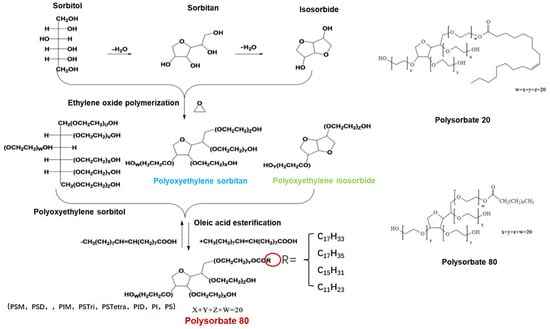
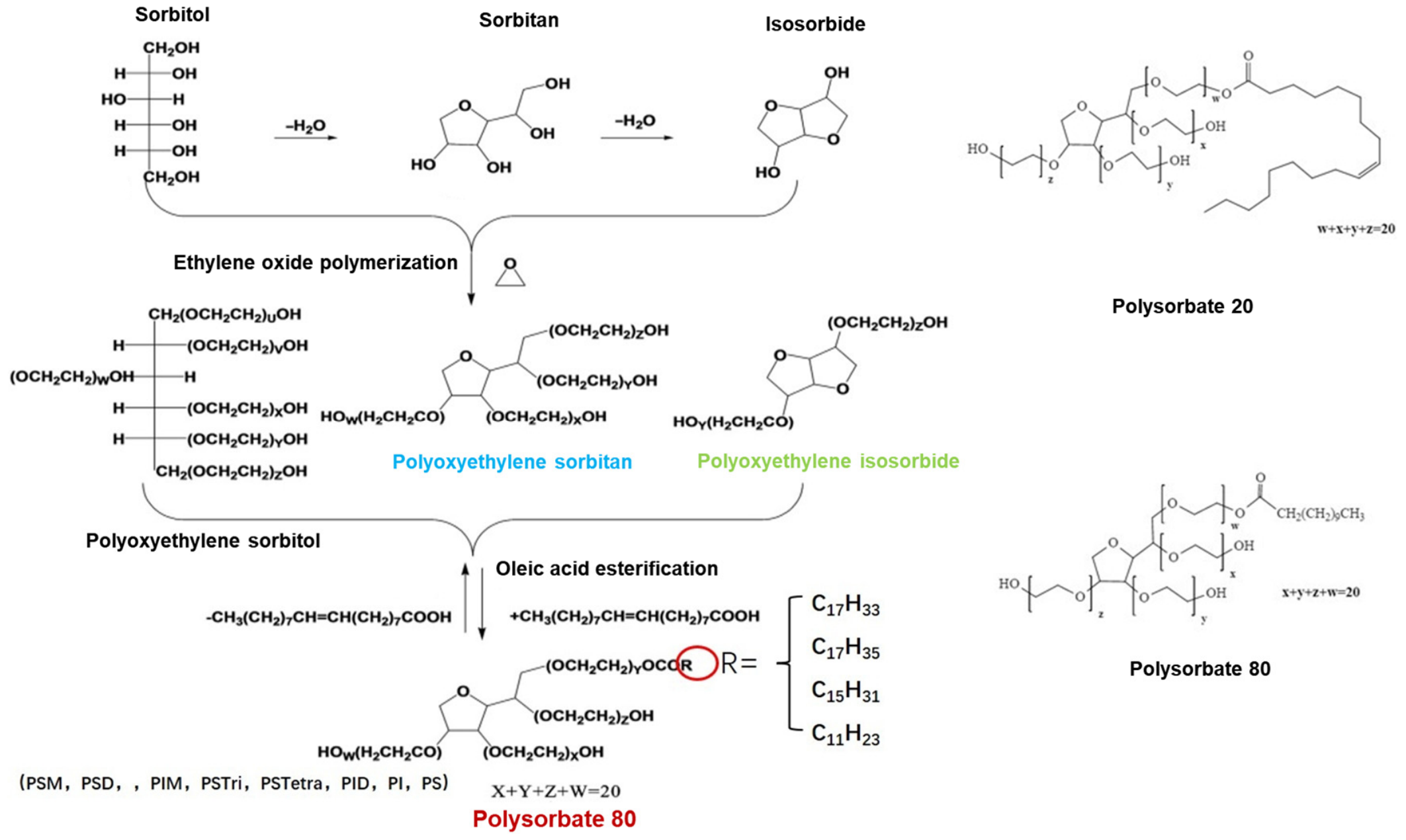
Polysorbates are complex mixtures of fatty acid esters of ethoxylated sorbitan. While PS20 is predominantly esterified with lauric acid (C12:0), PS80 contains primarily oleic acid (C18:1) as the fatty acid side chain. Both products are synthesized by the ethoxylation of sorbitan followed by esterification, resulting in a heterogeneous distribution of polyoxyethylene (POE) chain lengths with varying degrees (mono-, di-, and tri-) of esterification and a mixture of unesterified sorbitan POE species [11,12]. This compositional complexity has direct functional consequences: the surface activity, critical micelle concentration, and protective efficacy of a given polysorbate lot depend on the relative abundance of the active monoester fraction compared with the less surface-active, higher-order esters and unesterified species [21], as shown in Figure 1.
Figure 1.
Synthetic route and structural features of polysorbate 80 (PS80) and polysorbate 20 (PS20). Sorbitol, sorbitan, and isosorbide are de-hydrated to sorbitan, ethoxylated with ethylene oxide to introduce polyoxyethylene chains, and esterified with fatty acids to yield heterogeneous mixtures of mono-, di-, and tri-esters together with unesterified ethoxylated sorbitan species. PS80 is enriched in oleate (C18:1) esters, whereas PS20 is enriched in laurate (C12:0) esters; this difference in fatty-acid unsaturation underlies their distinct susceptibility to oxidative and enzymatic degradation. Commercial polysorbates are mixtures of fatty acid esters rather than single chemical entities. In compendial PS80, oleate accounts for at least 58% of the total fatty acid content, with palmitate, linoleate, and stearate serving as minor species. In PS20, laurate represents approximately 40–60% of the total fatty acid content. Main chemical products are highlighted in bold for clarity.
Although both PS20 and PS80 are susceptible to degradation, their degradation profiles differ in important ways. The saturated lauric acid side chain of PS20 makes it more prone to enzymatic hydrolysis by HCP lipases and esterases [20,22], whereas the unsaturated oleic acid moiety of PS80 renders it more susceptible to oxidative attack at the double bond [9]. These differential sensitivities have significant implications for formulation design: a monoclonal antibody (mAb) product manufactured with a given HCP clearance profile may perform acceptably with PS80 but may fail with PS20 (or vice versa). Therefore, the choice of surfactant grade, particularly for multi-compendial products certified to meet the United States Pharmacopeia (USP), the European Pharmacopoeia (Ph. Eur.), and the Japanese Pharmacopoeia (JP) specifications simultaneously, versus super-refined (subjected to additional purification that reduces residual peroxides and FFAs by roughly an order of magnitude relative to compendial material), may substantially alter degradation rates [22,23]. The fatty acid composition of PS80 can also influence subvisible particle formation in protein formulations under stress conditions [24].
2.2. Manufacturing-Derived Peroxide Impurities
An often underappreciated aspect in maintaining polysorbate quality is the introduction of residual peroxides during the manufacturing process. Peroxide content (peroxide value) is routinely quantified by iodometric titration or by colorimetric ferrous oxidation-xylenol orange (FOX) assay (see Section 5.2). The ethoxylation step involves the polymerization of ethylene oxide, which is accompanied by the formation of trace peroxides and hydroperoxides as side products [17]. Not removed by standard purification, these peroxides remain as intrinsic impurities in the polysorbate raw material. Demonstrating that the peroxide content of commercial PS80 can vary substantially between lots, Ha et al. [17] observed that even low levels of residual peroxides could directly oxidize Met residues in co-formulated proteins. Lam et al. [15] subsequently showed that PS20-mediated oxidation of Trp residues in an IgG1 antibody occurs through an autocatalytic mechanism by which polysorbate degradation products themselves act as pro-oxidants, creating a self-amplifying cycle of oxidative damage.
Without incoming raw material controls for peroxide levels, two nominally identical batches of a formulation may exhibit markedly different stability profiles, confounding root cause investigations when degradation occurs. Such batch-to-batch variability in peroxide content represents a significant quality risk. A risk-based control strategy should therefore include routine characterization of peroxide levels in incoming polysorbate raw materials, establishment of supplier- and process-specific acceptance criteria, use of lot-to-lot trending, and appropriate investigation of atypically elevated peroxide values. When elevated peroxide levels are identified, appropriate mitigation measures may include supplier qualification; optimization of manufacturing and purification processes; and protection of raw material from factors known to accelerate autoxidation, including elevated temperature, light exposure, and redox-active metal contaminants [25].
Polysorbate autoxidation can generate hydroperoxides and other reactive oxidation products, while trace transition metals can promote radical-generating oxidative pathways involving hydrogen peroxide and hydroxyl radicals [25,26,27,28,29]. Accordingly, peroxide value should be considered not only a quality attribute of the incoming surfactant but also a useful process- and formulation-development parameter for assessing oxidative degradation risk.
2.3. Hydrolytic Degradation
Hydrolysis of the ester bond linking the fatty acid to the ethoxylated sorbitan core, the most extensively documented polysorbate degradation pathway, proceeds through two distinct mechanisms: chemical hydrolysis and enzymatic hydrolysis. Chemical hydrolysis of polysorbates is influenced by both pH and temperature, as well as surfactant concentration and micelle formation [11,12]. Under formulation-relevant conditions (typically pH 5.0–6.5), chemical hydrolysis is relatively slow at room temperature. In an investigation of PS20 and PS80 in aqueous formulations at pH 5.5, Kishore et al. [12] estimated hydrolysis half-lives of approximately 19 months at 25 °C and 5 months at 40 °C. These results indicate that hydrolysis contributes little to overall polysorbate degradation at room temperature but becomes significant under accelerated stability conditions at 40 °C. However, polysorbates can also undergo autoxidation, which may contribute substantially to degradation under pharmaceutical storage conditions [11,12].
Enzymatic hydrolysis represents the more aggressive pathway under real-world storage conditions. Host cell proteins that co-purify with the mAb product, particularly lipases, esterases, and certain hydrolases, may catalyze the hydrolysis of polysorbate esters with remarkable efficiency even at trace levels (ng/mg mAb range) [20,22]. After Labrenz [22] provided early evidence linking HCP-mediated PS80 hydrolysis to visible particulate formation in mAb drug products, Li et al. [20] developed a systematic framework for identifying and quantifying “high-risk” HCPs responsible for polysorbate degradation, enabling targeted process improvements to enhance HCP clearance during downstream purification. Another less explored interaction concerns HCPs with redox activity: co-purifying enzymes such as peroxidases or metalloenzymes could, in the presence of trace metals, either generate reactive oxygen species (ROS) or decompose peroxides, thereby modulating polysorbate oxidation in either direction. However, as direct evidence of this interaction in biologic formulations remains limited, it warrants consideration when HCP clearance and metal control strategies are designed jointly.
FFA molecules are the immediate products of ester hydrolysis. Among them, lauroyl (C12:0) and oleoyl (C18:1) molecules have very low aqueous solubility, and once their concentration exceeds the solubility limit, they precipitate to form FFA particles [13,14]. Using microspectroscopic techniques to identify and characterize FFA particles in protein formulations, Cao et al. [13] demonstrated that these particles are chemically distinct from protein aggregates. PS20 and PS80 have different tendencies toward particle formation: PS20-derived lauric acid particles appear to form more readily than PS80-derived oleic acid particles, partly because of their higher melting point and lower solubility in saturated C12:0 compared with unsaturated C18:1 [14].
2.4. Oxidative Degradation
The oxidative degradation of polysorbates proceeds through a free-radical chain mechanism initiated by the abstraction of a hydrogen atom from the ethylene oxide backbone or, in the case of PS80, from the allylic position of the oleic acid side chain [9,11]. The resulting alkyl radicals react rapidly with dissolved molecular oxygen to form peroxyl radicals (ROO•), which propagate the chain by abstracting hydrogen from neighboring polysorbate molecules and generating hydroperoxides (ROOH) and new alkyl radicals. Hydroperoxides are relatively unstable; they decompose, particularly in the presence of transition metal ions, to yield alkoxyl radicals (RO•), aldehydes, ketones, and carboxylic acids.
In a systematic comparative stability study of PS20 and PS80 under oxidative stress conditions, Kozuch et al. [9] confirmed that PS80 is significantly more susceptible to oxidative degradation than PS20, which they attributed to the presence of the unsaturated oleic acid moiety. After storage at 40 °C for 48 weeks, they found that the remaining PS80 content in aqueous formulations initially containing 100 mg/mL of PS80 was approximately 25–40%, depending on the formulation conditions. In contrast, at 5 °C, they detected PS80 degradation after 36–48 weeks, with approximately 45–66% of the initial PS80 content remaining at 48 weeks. These findings, which demonstrate the strong dependence of PS80 oxidative degradation on storage temperature and formulation conditions, have been corroborated by multiple industrial reports [22,23]. Moreover, they highlight that the products of polysorbate oxidation are not inert endpoints but rather secondary pro-oxidants that can damage the therapeutic protein. In accordance, Liu et al. [16] observed that PS80 oxidation products directly triggered Trp oxidation and subsequent fragmentation of an IgG1 antibody, while Lam et al. [15] reported that PS20 autocatalytic oxidation products caused site-specific Trp oxidation. These findings underscore that polysorbate degradation and protein chemical instability are mechanistically coupled rather than independent phenomena.
Polysorbates can also function as photosensitizers. Upon exposure to ultraviolet or visible light in the presence of dissolved oxygen, polysorbates generate singlet oxygen, a highly reactive electrophilic species that oxidizes Trp, tyrosine, His, and Met residues in proteins [3]. This photochemical pathway is especially relevant for liquid products stored in clear vials or administered via infusion bags under ambient lighting conditions.
2.5. Cascade Effects of Degradation on Formulation Quality
Through a series of steps, the degradation of polysorbates triggers a multi-pronged assault on formulation quality [30]. First, the depletion of intact surfactant reduces the formulation’s capacity to protect proteins against interfacial stresses encountered during manufacturing (pumping and filling), transportation (agitation and drop shock), and clinical administration [31] (in-use dilution in intravenous bags). Second, the accumulation of FFA particles may lead to failure to meet pharmacopeial limits for subvisible and visible particulate matter [32,33]. Third, oxidative degradation products chemically modify the therapeutic protein, potentially compromising potency and increasing immunogenic risk [34,35,36,37,38,39]. These three consequences may not be mutually exclusive and are likely synergistic; for instance, surfactant-depleted formulations are more susceptible to interfacial aggregation, and the resulting protein aggregates can serve as nucleation sites for further FFA particle formation [40].
Whether partially degraded polysorbates retain their protective function remains undetermined. Hydrolytic cleavage removes the fatty acid anchor underlying interfacial activity, and oxidized species exhibit altered micelle structure, suggesting progressive loss of protection; however, some degradation products retain surface activity, and functional protection may persist until degradation exceeds a threshold level. Quantitative data linking the degree of degradation to the loss of interfacial protection remain scarce, a research problem identified here as a knowledge gap. Long-term stability studies have demonstrated that polysorbate degradation can occur during refrigerated storage. For example, Zhang et al. monitored PS80 degradation for 36 months at 5 °C in a monoclonal antibody formulation containing 0.2% PS80 to illustrate that degradation can continue over the product shelf life [41]. Morar-Mitrica observed that Met oxidation at the M254 residue remained below 4.1% over 6 months in antibody formulations containing Met and EDTA, while little or no oxidation was observed at M430 [42]. These findings highlight the formulation-dependent nature of polysorbate degradation and protein oxidation during storage.
3. Metal-Catalyzed Degradation Mechanisms
3.1. Fundamental Chemistry of Metal-Catalyzed Oxidation
Transition metal ions participate in the degradation of biopharmaceutical formulations primarily through their ability to cycle between multiple oxidation states and thereby catalyze ROS formation. The archetypal reaction in the degradation process is the Fenton reaction (Equation (1)), in which ferrous iron (Fe2+) reduces hydrogen peroxide to generate the highly reactive hydroxyl radical (•OH) and hydroxide ion:
Fe2+ + H2O2 → Fe3+ + •OH + OH−
The ferric iron (Fe3+) produced in the Fenton reaction can be reduced back to Fe2+ by the superoxide radical (O2•−) in the Haber–Weiss cycle (Equation (2)), enabling catalytic turnover from trace quantities of metal:
Fe3+ + O2•− → Fe2+ + O2
Superoxide radicals can be generated through the single-electron reduction of dissolved oxygen by ferrous iron (Fe2+ + O2 → Fe3+ + O2•−), linking molecular oxygen, peroxides, and the metal redox couple in a radical-generating reaction network.
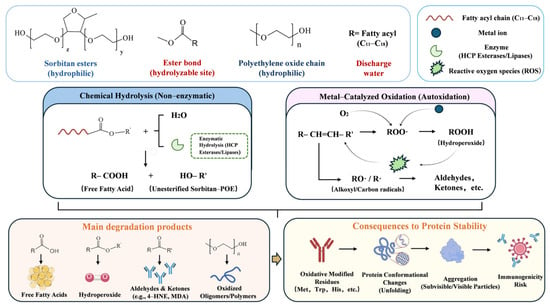
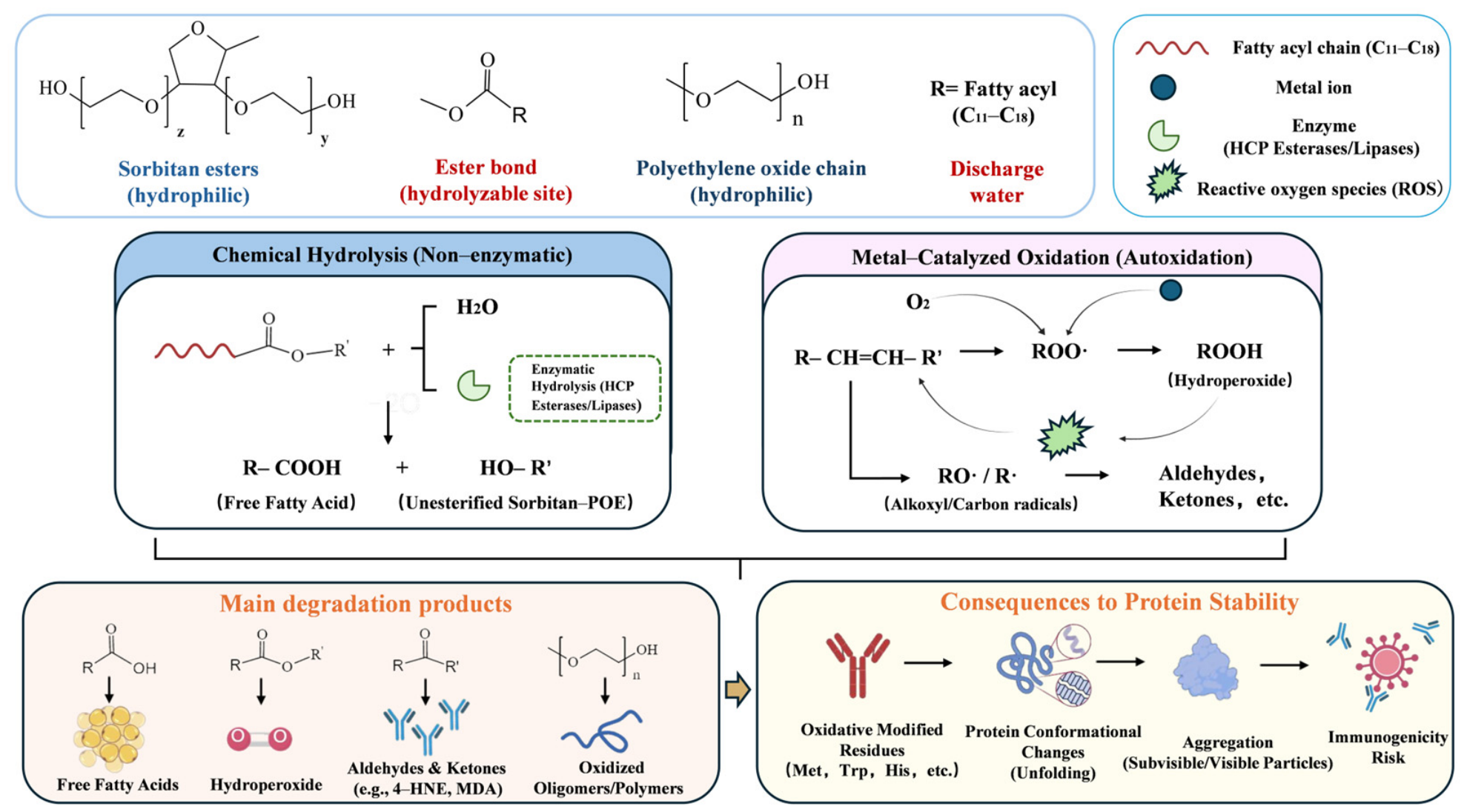
Copper ions (Cu+/Cu2+) catalyze analogous reactions, with the Cu+-driven Fenton-like reaction proceeding approximately 60-fold faster than the Fe2+-driven reaction [3]. Other transition metals found in pharmaceutical manufacturing environments, including Cr, Ni, and tungsten, can also participate in single-electron redox chemistry generating ROS, albeit with varying catalytic efficiencies [3], as shown in Figure 2.
Figure 2.
Polysorbate degradation pathways, metal-catalyzed oxidation, and protein instability. (Blue and pink panels distinguish hydrolytic and oxidative pathways, respectively. The colored symbols are defined in the figure legend).
The critical practical consequence of this reaction is catalytic amplification, which arises from the metal ion regeneration that occurs during each redox cycle. Hydroperoxides, whether introduced during manufacturing or formed during autoxidation, can be decomposed by reduced metal ions (ROOH + Fe2+ → RO• + OH− + Fe3+) to generate alkoxyl radicals that can initiate or propagate oxidative reactions. The resulting Fe3+ can then be reduced back to Fe2+ by superoxide radicals or other reducing species (Fe3+ + O2•− → Fe2+ + O2), allowing the cycle to repeat. A single metal ion can therefore catalyze multiple reaction cycles, promoting the conversion of hydroperoxides into reactive radicals and enabling ROS generation to exceed the initial metal concentration substantially. Notably, this amplification can occur in the presence of hydroperoxides, oxygen, and a susceptible surfactant substrate even in the absence of protein.
3.2. Metal-Catalyzed Oxidation of Polysorbates
The ROS generated through Fenton-type reactions, particularly •OH, are potent initiators of polysorbate autoxidation. As described in Section 2.4, the hydroxyl radical abstracts hydrogen atoms from the ethylene oxide backbone of both PS20 and PS80 with near diffusion-limited kinetics, generating alkyl radicals that enter the autoxidation chain. Owing to the resonance stabilization of the resulting allylic radical, the allylic C–H bonds of the oleic acid side chain in PS80 are especially susceptible to hydrogen abstraction, providing a mechanistic basis for the greater oxidative sensitivity of PS80 compared with PS20 [9].
In a recent study providing direct experimental evidence for iron-catalyzed degradation of PS80, Escobar et al. [19] observed that PS80 in citrate buffer containing Fe ions and disulfide underwent significant changes in surface activity upon photoirradiation, consistent with metal-catalyzed oxidative modification of the surfactant structure. This finding provides support that seemingly innocuous buffer components, such as citrate, a common pharmaceutical buffer, can chelate metals and alter their redox activity, thereby modulating metal-catalyzed degradation in formulationally relevant ways.
A mechanistic feature that distinguishes metal-catalyzed from purely thermal autoxidation is the potential for site-specific radical generation. Metal ions that adsorb to or complex with polysorbate molecules may generate ROS immediately proximate to the surfactant, enhancing the effective local concentration of radicals and biasing degradation toward specific positions within the polysorbate structure. This localized damage may produce degradation product profiles that differ qualitatively from those observed under homogeneous thermal stress. However, systematic studies comparing metal-catalyzed versus metal-free oxidation product distributions remain scarce.
3.3. The Metal–Surfactant–Protein Damage Cascade
Perhaps the most consequential aspect of metal-catalyzed surfactant degradation is that it does not occur in isolation from protein damage; rather, the two processes are mechanistically intertwined in a self-amplifying cascade that proceeds in four interconnected stages. In the first stage, metal-catalyzed surfactant oxidation, trace metals (Fe, Cu, and Cr) catalyze the formation of ROS that initiate polysorbate autoxidation, generating hydroperoxides, aldehydes, and FFAs. In the second stage, secondary protein oxidation, polysorbate-derived peroxides and aldehydes oxidize susceptible amino acid residues (Met, Trp, and cysteine [Cys]) [43] in the therapeutic protein, leading to chemical modifications that can reduce biological potency [15,16,17,43]. In the third stage, conformational destabilization, Met oxidation increases local polarity as oxidized proteins undergo conformational changes, while Trp oxidation disrupts hydrophobic packing, which exposes aggregation-prone regions [3]. In the final step, surfactant depletion and aggregation, simultaneous surfactant degradation and protein structure destabilization create a permissive environment for aggregation [44], while protein aggregates further nucleate FFA particle formation, with the resulting particles capable of triggering additional protein aggregation on their surfaces [40].
Quantitative analysis argues against substantial surfactant depletion by aggregate adsorption under typical conditions. At 50–150 mg/mL of mAb and 0.1–0.5 mg/mL of polysorbate, the surfactant-to-protein mass ratio is roughly 1:300–1:1000. Therefore, even if a few percent of the protein unfolds and recruits surfactant to newly exposed hydrophobic surfaces, the fraction of total surfactant consumed remains small. At very high protein concentrations or advanced degradation states, however, such compensatory adsorption could become non-negligible and merits experimental assessment. This cascade is amplified by autocatalytic feedback; oxidized protein products can, in turn, catalyze further polysorbate oxidation through mechanisms that remain incompletely characterized but may involve the generation of additional ROS or the exposure of protein-bound metals [3]. The practical consequence is that once metal-catalyzed degradation is initiated, it can accelerate over time even if the initiating metal source is removed, a temporal dynamic that complicates root cause investigation and highlights the importance of preventive rather than reactive strategies.
4. Sources of Metal Contamination
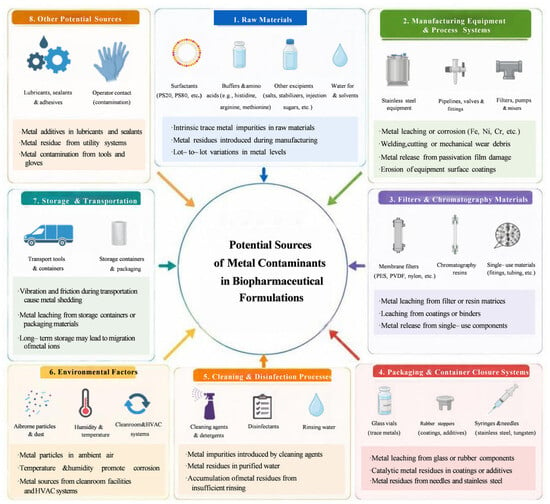
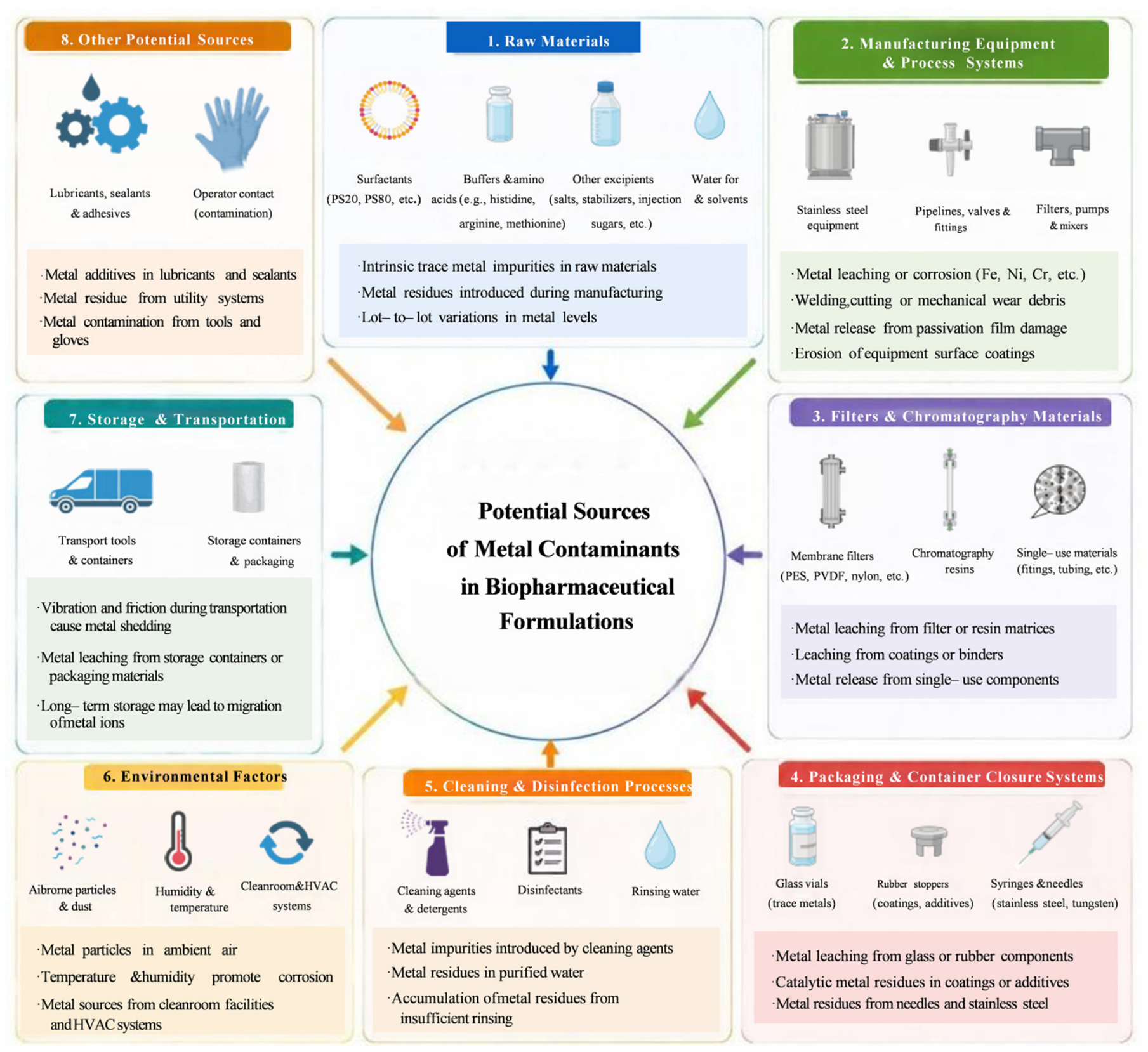
The metals that catalyze surfactant degradation in biologic formulations originate from multiple points along the manufacturing chain, from raw material sourcing through primary packaging. Identifying and quantifying these sources are essential for the design of effective mitigation strategies. Figure 3 shows the major potential sources of metal contaminants in biopharmaceutical formulations, including raw materials, manufacturing equipment and process systems, filtration and chromatography materials, packaging and container closure systems, cleaning and disinfection processes, environmental factors, and storage and transportation systems.
Figure 3.
Sources of metal contaminants in biopharmaceutical formulations.
4.1. Raw Materials and Excipients
Residual impurities and contaminants introduced during biopharmaceutical manufacturing can compromise protein stability [45]. Transition metals originating from raw materials, process equipment, and primary packaging are typically present in biopharmaceutical formulations and process streams at low-ppb to sub-parts per million (ppm) levels. Nevertheless, even at these trace levels, redox-active metals such as Fe and Cu can sustain catalytic degradation cycles (see Table 1). Despite meeting compendial specifications, pharmaceutical-grade excipients contain trace levels of metal impurities. Buffering agents (His, phosphate, and citrate), tonicity modifiers (sodium chloride, trehalose, and sucrose), and even water for injection can serve as vectors for the introduction of Fe, Cu, and other redox-active transition metals into a final formulation [46]. The compendial limits for heavy metals are typically set at levels that are safe from a toxicological perspective but can nonetheless exceed the catalytic threshold for oxidative degradation, a distinction not always appreciated during formulation development [3]. Occurring at elevated temperatures or under acidic conditions [47], sucrose hydrolysis can release reducing sugars that participate in glycation reactions and may synergize with metal-catalyzed oxidation [3]. Although pharmaceutical-grade sucrose is subject to compendial quality requirements for reducing sugars, these raw-material specifications do not establish the rate of reducing sugar formation during storage. In biopharmaceutical formulations, sucrose hydrolysis has been shown to promote protein glycation and aggregation under accelerated storage conditions. However, in one monoclonal antibody formulation, no detectable increase in glycation was observed during refrigerated storage at 2–8 °C [48]. As the extent of hydrolysis depends on the pH, temperature, and formulation composition, a single quantitative hydrolysis rate cannot be reliably generalized across formulations.
Table 1.
Metal-specific sources, redox roles, and reported effects relevant to polysorbate degradation.
4.2. Stainless Steel Processing Equipment
The biopharmaceutical industry relies heavily on stainless steel, primarily 316L grade, in the production of product–contact surfaces in bioreactors, hold tanks, chromatography skids, and filling lines. While stainless steel is valued for its corrosion resistance, it is not entirely inert. The passive Cr oxide layer that protects the alloy can be compromised by mechanical wear during processes such as pump cavitation and valve cycling, chemical cleaning agents, and localized chloride-induced pitting, exposing the underlying Fe/Cr/Ni matrix. The resulting metal ions and particulate debris enter the process stream at concentrations that depend on the equipment age, maintenance history, and processing conditions [3].
Positive-displacement pumps, particularly rotary piston pumps used in filling operations, represent a notable risk. The close-tolerance metal-on-metal contact in these pumps generates frictional wear that releases stainless steel microparticles and dissolved metal ions directly into the drug product solution. Significant increases in protein aggregation after passage through piston pumps have been attributed in part to metal-catalyzed oxidation combined with cavitation-induced shear stress [3]. Switching from stainless steel to ceramic pump components or to non-contact filling technologies (time–pressure or peristaltic systems) can substantially mitigate this risk.
4.3. Primary Packaging Components
As the final drug product is in close contact with its primary container for its entire shelf life—often 2–3 years—the metal contribution from packaging components is particularly significant. Type I borosilicate glass vials, the standard for parenteral products, contain alkali and alkaline earth oxides that can leach into solution over time, especially under accelerated conditions [18]. Demonstrating that glass leachables can function as nucleation factors for FFA particle formation, Allmendinger et al. [18] provided a mechanistic link between metal release from packaging and the particulate burden in polysorbate-containing formulations.
PFSs represent an additional potential source of metal contamination, particularly tungsten. During glass syringe barrel manufacturing, tungsten pins are used to form the needle channel, potentially leaving tungsten-containing residues on the inner surface of the barrel. These residues may leach into the drug product, and soluble tungsten species have been associated with protein aggregation in PFSs [49,50]. Tungsten is specifically implicated in the catalysis of hinge-region hydrolysis in antibodies and, of greater relevance to this review, it can participate in oxidative reactions that accelerates polysorbate degradation. The move toward “low-tungsten” or “tungsten-free” PFS technologies is an active area of industrial development.
Elastomeric closures (stoppers and plungers) contain metal oxide additives, including titanium dioxide, zinc oxide, and magnesium oxide, which serve as pigments, fillers, or vulcanization activators. Depending on the closure composition and formulation conditions, metal-containing species may be extracted or leached into the drug product, particularly in the presence of acidic or chelating media [51]. Among these additives, titanium dioxide warrants particular attention because of its potential redox and photocatalytic activity under appropriate conditions, although its contribution to oxidative degradation in pharmaceutical formulations depends on its physicochemical properties and exposure conditions. The erythropoietin/pure red cell aplasia incident, while primarily a case of surfactant-leachable incompatibility rather than metal catalysis per se, provides a stark illustration of the clinical consequences that can arise when formulation components interact with packaging-derived impurities in unanticipated ways [52].
4.4. Tracing Metal Sources: The Quantitative Challenge
A major practical challenge in addressing metal-catalyzed degradation is the difficulty of definitively attributing observed degradation to a specific metal source. Inductively coupled plasma mass spectrometry (ICP-MS) can be used to quantify individual metal concentrations at sub-ppb levels in the final formulation. However, this snapshot analysis does not reveal whether the metals originated from raw materials, processing equipment, or packaging, nor does it account for metals that may have been consumed in catalytic reactions and are no longer present in their original form. Isotopic tracing and spatially resolved elemental mapping (e.g., by scanning electron microscopy [SEM] with energy-dispersive X-ray spectroscopy) are research tools that can aid source attribution but have not yet been widely adopted in routine pharmaceutical development [18]. In addition to quantifying metals in solution, surface-sensitive techniques can localize metals on solid materials in contact with biological products. X-ray photoelectron spectroscopy (XPS) probes the outermost 1–10 nm, SEM with energy-dispersive X-ray spectroscopy (SEM-EDS) maps elemental distributions at the micrometer scale, X-ray fluorescence (XRF) provides non-destructive near-surface analysis, and laser-induced breakdown spectroscopy (LIBS) enables rapid depth profiling with micrometer resolution. These methods are particularly informative for plastic and elastomeric components of single-use systems and primary packaging.
5. Analytical Methods
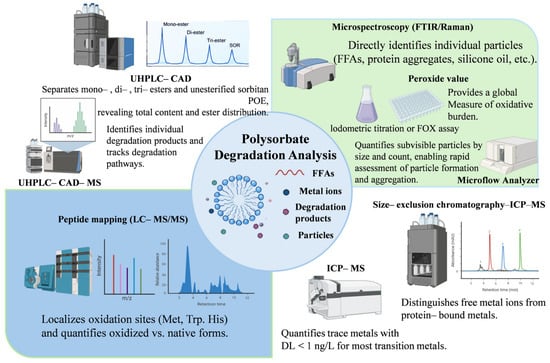
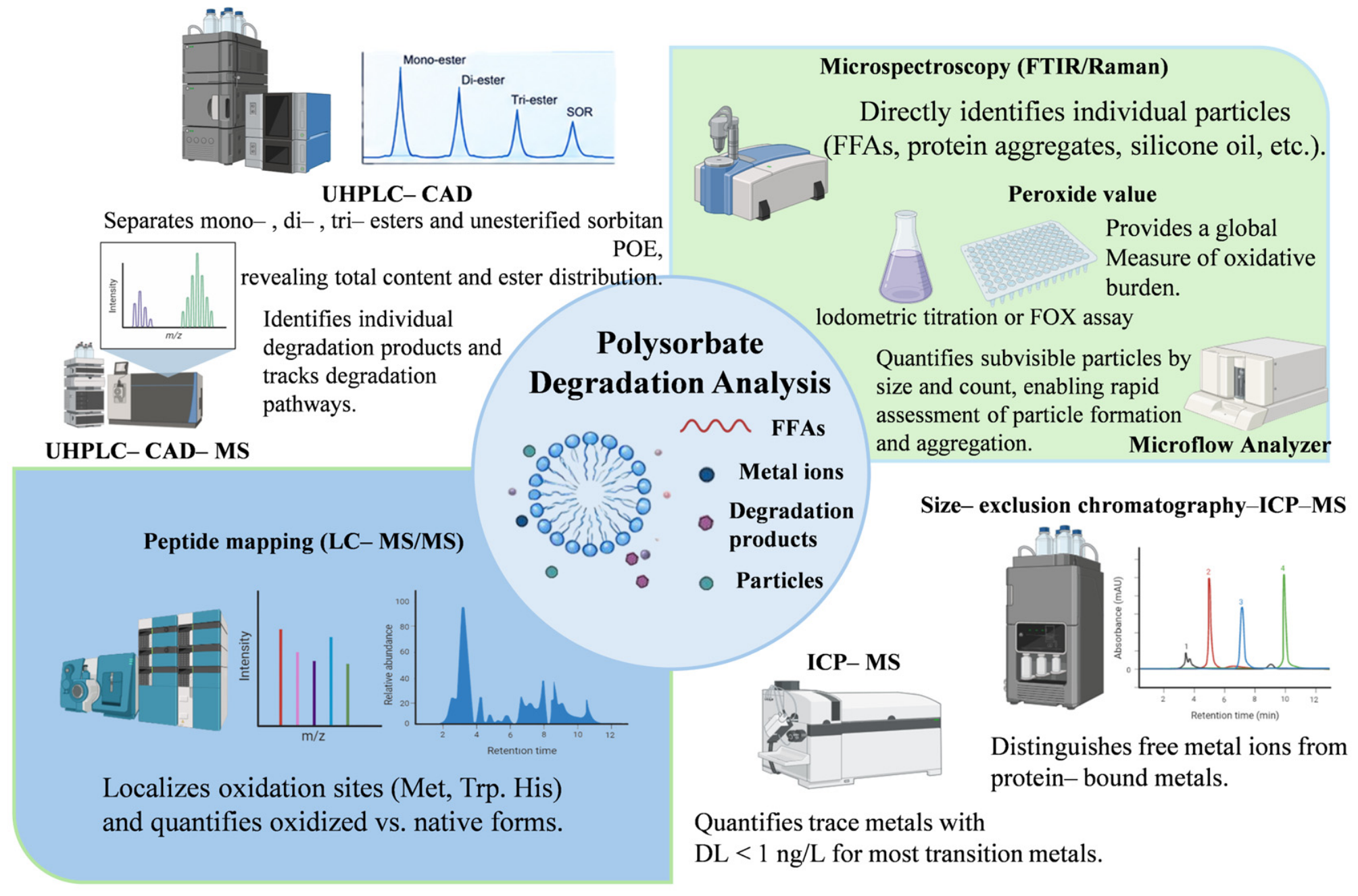
With the maturity of high-performance liquid chromatography (HPLC) and mass spectrometry techniques, a variety of analytical approaches to characterize polysorbate degradation, identify degradation products, and evaluate protein modifications and metal contamination have become well established. Figure 4 shows the analytical methods used to monitor polysorbate degradation, degradation products, protein modifications, and metal contaminants. Table 2 provides a comparative overview of the analytical techniques discussed in this section, including their target analytes, detection limits, and practical limitations.
Figure 4.
Analytical methods used for monitoring polysorbate degradation, degradation products, protein modifications, and metal contaminants.
Table 2.
Comparative overview of analytical techniques used for metal analysis and degradation monitoring.
5.1. Polysorbate Quantification and Compositional Fingerprinting
Traditional methods for polysorbate quantification, including colorimetric assays based on complex formations with cobalt thiocyanate and evaporative light scattering detection (ELSD), have been largely supplanted by ultra-high-performance liquid chromatography with charged aerosol detection and mass spectrometry (UHPLC-CAD-MS). UHPLC-CAD-MS separates the individual ester species (mono-, di-, and tri-esters) and unesterified sorbitan POE, providing a compositional “fingerprint” that reveals not only total polysorbate content but also shifts in the ester distribution characteristic of degradation [9,20]. Multidimensional UHPLC-CAD-MS extends this capability by coupling chromatographic separation with mass spectrometric identification of individual degradation products, enabling the tracking of specific degradation pathways.
Fluorescent molecular rotor dyes offer a complementary functional approach by exhibiting low fluorescence quantum yield in low-viscosity aqueous environments and enhanced fluorescence when molecular rotation is restricted in more viscous or constrained microenvironments. Commonly used molecular rotors include 9-(dicyanovinyl)julolidine (DCVJ), 9-(2-carboxy-2-cyanovinyl)julolidine (CCVJ), and BODIPY-based rotors such as BODIPY-C12 [53,54,55]. Changes in fluorescence intensity indicate the functional integrity of the surfactant population and provide a readout directly relevant to the surfactant’s protective function, which composition-based assays do not capture [53].
5.2. Detection of FFAs and Degradation Products
Liquid chromatography-tandem mass spectrometry (LC-MS/MS) enables the identification and quantification of individual FFA species released by polysorbate hydrolysis. The FFA profile, specifically the ratio of lauric acid to myristic acid, palmitic acid, and other minor fatty acids, can distinguish PS20- from PS80-derived FFAs and reveal whether hydrolysis is enzymatic, which may indicate substrate specificity, or chemical, which is typically less selective [10]. Microspectroscopic techniques, including Fourier-transform infrared and Raman microscopy, allow direct chemical identification of individual particles isolated from stressed formulations, enabling differentiation of FFA particles from protein aggregates, silicone oil droplets, and other particulate species [13]. Peroxide values provide a global measure of the oxidative burden in polysorbate raw material and stressed formulations [17].
5.3. Detection of Protein Oxidative Modifications
The protein consequences of metal-catalyzed surfactant degradation can be detected using well-established techniques for characterizing chemically modified proteins. Peptide mapping with LC-MS/MS localizes oxidation sites to specific residues (Met, Trp, and His) and quantifies the relative abundance of oxidized versus native forms. Reversed-phase HPLC provides a higher-throughput alternative for monitoring Met oxidation in the Fc region, a particularly sensitive quality attribute for many mAbs. Carbonylation, the oxidative modification of Lys, Arg, Thr, and Pro side chains to carbonyl derivatives, can be detected by derivatization with 2,4-dinitrophenylhydrazine (DNPH) followed by spectrophotometric or immunochemical detection [3].
5.4. Metal Analysis
ICP-MS is the method of choice for quantifying trace metals in pharmaceutical formulations, excipients, and packaging extracts. Modern ICP-MS instruments, particularly those equipped with collision/reaction cell technology, can achieve detection limits below 1 ng/L for most transition metals, enabling the quantification of metals at the catalytically relevant concentrations encountered in biologic formulations [18]. When coupled with chromatographic separation (e.g., size-exclusion chromatography), ICP-MS can distinguish free metal ions from protein-bound metals, providing insight into the speciation that determines catalytic activity.
A critical gap in current analytical practice is the lack of routine correlation analysis between metal concentration data and polysorbate degradation kinetics. Most stability studies measure either metal content or polysorbate degradation but rarely both factors in a design that permits quantitative correlation. Filling this gap requires development of deliberate experimental designs that systematically vary metal concentrations and monitor degradation products over time, yielding the kinetic data needed to establish predictive models.
6. Mitigation Strategies
Given the multi-source, multi-mechanism nature of metal-catalyzed surfactant degradation, the development of an effective mitigation strategy requires a multi-pronged approach. Current strategies can be grouped into four categories: chelating agent use, antioxidant and sacrificial additive use, process and packaging optimization, and alternative surfactant use. Table 3 summarizes the principal mitigation interventions, their targeted degradation pathways, and the associated monitoring approaches.
6.1. Chelating Agent Use
Reported to suppress metal-catalyzed oxidation of both proteins and surfactants, ethylenediaminetetraacetic acid (EDTA) is the most widely used chelating agent in parenteral formulations [3]. By sequestering free metal ions in a hexadentate coordination complex occupying all available coordination sites, EDTA limits the metal’s ability to participate in Fenton-type redox cycling. Manning et al. [3] noted that the combination of EDTA with free Met as a sacrificial antioxidant can be particularly effective at reducing MCO in therapeutic proteins.
Although its use in marketed products is less common than that of EDTA, diethylenetriaminepentaacetic acid (DTPA) is an alternative agent with a higher affinity for certain metal ions. The choice between chelators should be guided by experimental determination of metal-binding constants under formulation-relevant conditions and should consider pH, ionic strength, and competing ligands from buffer components. A potential concern with EDTA is the pH-dependence of its metal-chelating activity, with an optimal range of approximately pH 8–10. In contrast, DTPA retains effective chelation from approximately pH 6–9. At low pH, protonation of the carboxylate groups reduces EDTA’s metal-binding affinity, which may be relevant during the low-pH viral inactivation step in mAb purification.
6.2. Antioxidant and Sacrificial Additive Use
Free Met is the industry-standard sacrificial antioxidant for protecting proteins against oxidative damage. At concentrations up to approximately 10 mM in marketed products, Met acts as a competitive substrate for ROS, being preferentially oxidized to Met sulfoxide before ROS can attack more critical residues in the therapeutic protein [3]. Met is particularly effective against peroxide- and hydroxyl-radical-mediated oxidation, but it does not directly protect the surfactant itself from degradation, instead acting downstream, where it intercepts ROS that would otherwise damage the protein. Trp derivatives and Cys-based compounds have been investigated as alternative sacrificial additives with complementary ROS scavenging profiles [3]. The combination of EDTA (to sequester the catalytic metal) with Met (to scavenge any ROS that are nonetheless generated) represents a rational, mechanistically grounded approach that is supported by experimental evidence and is already employed in several commercial products [56].
6.3. Process and Packaging Optimization
Process-level interventions can reduce metal introduction at the source. Selecting low-peroxide polysorbate grades through rigorous incoming raw material testing and supplier qualification can reduce de novo introduction of peroxides. Nitrogen blanketing of headspace gas during filling and oxygen-barrier packaging use can reduce the availability of dissolved oxygen, a required co-substrate for autoxidation [57]. Use of light-protective packaging, such as amber vials and aluminum overwrap, can mitigate photochemical generation of singlet oxygen by polysorbates [3].
On the equipment side, replacing stainless steel product-contact surfaces with alternative materials, such as ceramic pump pistons, perfluoropolymer linings, and single-use disposable flow paths, can substantially reduce metal contamination from processing equipment. Using non-contact filling technologies, such as time–pressure systems, can eliminate the metal-on-metal wear inherent in piston pump designs.
In primary packaging, the use of fluoroelastomer-coated stoppers (e.g., FluroTec®) creates a barrier that reduces the leaching of metal ions and organic extractables from the elastomer matrix into the drug product. Using low-tungsten PFS technologies, the needle insertion process can be modified to minimize tungsten oxide deposition, addressing a metal source unique to the syringe format. The key principle is that packaging selection should be based not only on compendial compliance but also on direct experimental evaluation of metal leaching under formulation-relevant stress conditions [18].
6.4. Alternative Surfactant Use
The challenges associated with polysorbate degradation have stimulated the search for alternative surfactants that retain the protective interfacial properties of polysorbates while providing greater intrinsic chemical stability. Poloxamer 188 (Pluronic® F68), a triblock co-polymer of poly (ethylene oxide)-poly (propylene oxide)-poly (ethylene oxide), is currently the only non-polysorbate surfactant approved in multiple marketed biologic products [1,58]. Containing no ester linkages, poloxamer 188 is not susceptible to ester hydrolysis, which eliminates the FFA particle pathway, but its protective efficacy against interfacial aggregation is generally considered inferior to that of polysorbates at equivalent concentrations, likely due to its lower surface activity and slower adsorption kinetics [4]. Antibody–surfactant competition has likewise been documented at solid–liquid interfaces, including stainless steel, glass, and silicone oil–water interfaces [59,60].
Among emerging alternatives, n-dodecyl-\beta-D-maltoside (DDM), a nonionic alkyl glycoside surfactant, has shown promise in protecting proteins against light-, agitation-, and heat-induced aggregation [61,62]. Brij-58 (polyoxyethylene (20) cetyl ether) outperformed other nonionic surfactants in forced degradation studies [63]. N-acyl amino acid surfactants (e.g., FM1000) represent a class of surfactants designed specifically for enhanced chemical stability. Preliminary data suggest that FM1000 may compete more effectively than polysorbates for interfacial protection while being less susceptible to oxidative degradation [64]. The discovery that human serum albumin (HSA) can mitigate FFA particle formation in polysorbate-containing solutions [65] suggests that mixed surfactant–stabilizer systems may offer advantages over single-component approaches. Kim et al. [65] found that detectable particle formation was prevented at 7.5 mg/mL (approximately 113 μM) of HAS, a concentration representing an approximately 11–113-fold molar excess relative to an illustrative FFA concentration range of 1–10 μM. Although this finding suggests that HSA-mediated FFA sequestration is stoichiometrically plausible, it is an example rather than a direct estimate of the FFA-to-HSA ratio in degraded commercial formulations. Another consideration is that HSA supplementation introduces additional raw-material and regulatory considerations.
Despite the growing pipeline of alternatives, the regulatory burden of introducing a novel parenteral excipient, which requires comprehensive toxicological evaluation and may necessitate a separate regulatory submission, remains a substantial barrier to adoption. In the near-to-medium term, polysorbates are likely to remain the dominant surfactant class in biologic formulations, and emphasis will continue to be placed on understanding and controlling their degradation rather than on replacing them.
Table 3.
Summary of mitigation interventions for metal-catalyzed polysorbate degradation.
7. Conclusions and Future Perspectives
Metal-catalyzed degradation of surfactants in biopharmaceutical formulations is a system-level problem that spans chemistry, materials science, process engineering, and analytical technology. This review of this issue yielded several key conclusions. First, polysorbates degrade through multiple interconnected pathways, primarily chemical hydrolysis, enzymatic hydrolysis, and metal-catalyzed oxidation, operating simultaneously and synergistically within a single formulation. Second, transition metal ions, primarily Fe, Cu, Cr, Ni, and W, catalyze surfactant degradation at catalytically relevant concentrations (ppb) through Fenton and Haber–Weiss reactions, with the resulting ROS initiating polysorbate autoxidation and subsequently damaging the therapeutic protein. Third, metals are introduced from diverse sources, including raw materials, processing equipment, and primary packaging, making source attribution a critical but analytically challenging task. Fourth, current mitigation strategies, including the use of EDTA, free Met, low-peroxide raw materials, oxygen exclusion, coated stoppers, and alternative surfactants, are individually effective but most powerful when combined in a holistic, multi-barrier approach. Finally, polysorbate degradation and protein oxidative damage are mechanistically coupled in an autocatalytic cascade, indicating that control strategies addressing only one component are likely insufficient.
Several critical knowledge gaps define the frontier of this field and represent opportunities for impactful future research. First, no research has quantitatively analyzed the degradation kinetics of individual metal ions under pharmaceutically relevant conditions (at pH 5–7, in ambient O2, and at typical polysorbate concentrations). Without the data from such research, establishing threshold metal concentrations below which degradation is acceptably slow or predicting the additive or synergistic effects of metal mixtures is not possible. Second, the ternary metal–polysorbate–protein interaction remains incompletely characterized at the molecular level. Conducting spectroscopic and computational studies that can determine whether binding to polysorbate increases or decreases the catalytic activity of metals and whether protein-bound metals participate in surfactant oxidation or are kinetically isolated would provide a mechanistic foundation for rational formulation design. Third, the development of in-line or at-line process analytical technology tools for real-time monitoring of polysorbate degradation during drug product manufacturing and storage would enable proactive rather than reactive quality control. Finally, research aimed at identifying and validating the efficacy of novel surfactants with intrinsic resistance to metal-catalyzed oxidation, guided by knowledge of structure–property relationships derived from systematic studies of degradation mechanisms, would fulfill a high-impact goal for both academic and industrial research.
From an industrial perspective, the path forward involves integrating metal-catalyzed degradation risk assessment into the Quality by Design framework. Rather than treating metal contamination as an unanticipated barrier to be investigated retrospectively, manufacturers should prospectively identify potential metal sources, quantify their contributions through extractable and leachable studies, and design formulation and packaging combinations robust against the metal loads expected over the product lifecycle. Such an approach, grounded in mechanistic understanding and supported by appropriate analytical characterization, is the most reliable means of ensuring that surfactants fulfill their critical protective function throughout the shelf life of biologic drug products.
Author Contributions
Original draft preparation: X.Y. and J.L.; manuscript revision: X.Y., J.L., F.W., C.Y. and H.W.; funding acquisition: X.Y. and C.Y. All authors have read and agreed to the published version of the manuscript.
Funding
This work was supported by the Innovative Drug Research and Development National Science and Technology Major Project (Grant No. 2026ZD1805800) and the State Key Laboratory of Drug Regulatory Science Project (2025SKLDRS0318).
Data Availability Statement
No new data were created or analyzed in this study. Data sharing is not applicable to this article.
Acknowledgments
The authors thank the members of the Biopharmaceutical Formulation Laboratory at Shenyang Pharmaceutical University for their advice and assistance. During the preparation of this manuscript, the authors used a Kimi AI-based language model for language editing and writing assistance. The authors have reviewed and edited the final version of this manuscript, and they take full responsibility for its content.
Conflicts of Interest
The authors declare no conflicts of interest.
Abbreviations
PS20, polysorbate 20; PS80, polysorbate 80; mAb, monoclonal antibody; HCP, host cell protein; FFA, free fatty acid; ROS, reactive oxygen species; EDTA, ethylenediaminetetraacetic acid; DTPA, diethylenetriaminepentaacetic acid; HSA, human serum albumin; DDM, n-dodecyl-beta-D-maltoside; ICP-MS, inductively coupled plasma mass spectrometry; UHPLC-CAD, ultra-high-performance liquid chromatography–charged aerosol detection; ELSD, evaporative light scattering detection; DNPH, 2,4-dinitrophenylhydrazine; FOX, ferrous oxidation-xylenol orange; SEM-EDS, scanning electron microscopy–energy-dispersive X-ray spectroscopy.
References
- Nema, S.; Brendel, R.J. Excipients and their role in approved injectable products: Current usage and future directions. PDA J. Pharm. Sci. Technol. 2011, 65, 287–332. [Google Scholar] [CrossRef] [Scilit] [PubMed]
- Strickley, R.G.; Lambert, W.J. A review of formulations of commercially available antibodies. J. Pharm. Sci. 2021, 110, 2590–2608. [Google Scholar] [CrossRef] [Scilit] [PubMed]
- Manning, M.C.; Holcomb, R.E.; Katayama, D.S.; Payne, R.W.; Stillahn, J.M.; Henry, C.S.; Murphy, B.M. Stability of protein pharmaceuticals: Recent advances. Pharm. Res. 2024, 41, 1301–1367. [Google Scholar] [CrossRef] [Scilit] [PubMed]
- Kanthe, A.D.; Krause, M.; Zheng, S.; Ilott, A.; Li, J.; Bu, W.; Bera, M.K.; Lin, B.; Maldarelli, C.; Tu, R.S. Armoring the interface with surfactants to prevent the adsorption of monoclonal antibodies. ACS Appl. Mater. Interfaces 2020, 12, 9977–9988. [Google Scholar] [CrossRef] [Scilit] [PubMed]
- Zoeller, M.P.; Hafiz, S.; Marx, A.; Erwin, N.; Fricker, G.; Carpenter, J.F. Exploring the protein stabilizing capability of surfactants against agitation stress and the underlying mechanisms. J. Pharm. Sci. 2022, 111, 3261–3274. [Google Scholar] [CrossRef] [Scilit] [PubMed]
- Wang, W.; Singh, S.; Zeng, D.L.; King, K.; Nema, S. Antibody structure, instability, and formulation. J. Pharm. Sci. 2007, 96, 1–26. [Google Scholar] [CrossRef] [Scilit] [PubMed]
- Ghosh, I.; Gutka, H.; Krause, M.E.; Clemens, R.; Kashi, R.S. A systematic review of commercial high concentration antibody drug products approved in the US: Formulation composition, dosage form design and primary packaging considerations. MAbs 2023, 15, 2205540. [Google Scholar] [CrossRef] [Scilit] [PubMed]
- Maggio, E.T. Polysorbates, biotherapeutics, and anaphylaxis. BioProcess. Int. 2017, 15, 48–52. [Google Scholar]
- Akers, M.J. Excipient–Drug interactions in parenteral formulations. J. Pharm. Sci. 2002, 91, 2283–2300. [Google Scholar] [CrossRef] [Scilit] [PubMed]
- Kozuch, B.; Weber, J.; Buske, J.; Mäder, K.; Garidel, P.; Diederichs, T. Comparative stability study of polysorbate 20 and polysorbate 80 related to oxidative degradation. Pharmaceutics 2023, 15, 2332. [Google Scholar] [CrossRef] [Scilit] [PubMed]
- Kerwin, B.A. Polysorbates 20 and 80 used in the formulation of protein biotherapeutics: Structure and degradation pathways. J. Pharm. Sci. 2008, 97, 2924–2935. [Google Scholar] [CrossRef] [Scilit] [PubMed]
- Kishore, R.S.K.; Kiese, S.; Fischer, S.; Pappenberger, A.; Grauschopf, U.; Mahler, H.-C. The degradation of polysorbates 20 and 80 and its potential impact on the stability of biotherapeutics. Pharm. Res. 2011, 28, 1194–1210. [Google Scholar] [CrossRef] [Scilit] [PubMed]
- Cao, X.; Fesinmeyer, R.M.; Pierini, C.J.; Siska, C.C.; Litowski, J.R.; Brych, S.; Wen, Z.-Q.; Kleemann, G.R. Free fatty acid particles in protein formulations, Part 1: Microspectroscopic identification. J. Pharm. Sci. 2015, 104, 433–446. [Google Scholar] [CrossRef] [Scilit] [PubMed]
- Siska, C.C.; Pierini, C.J.; Lau, H.R.; Latypov, R.F.; Fesinmeyer, R.M.; Litowski, J.R. Free fatty acid particles in protein formulations, Part 2: Contribution of polysorbate raw material. J. Pharm. Sci. 2015, 104, 447–456. [Google Scholar] [CrossRef] [Scilit] [PubMed]
- Lam, X.M.; Lai, W.G.; Chan, E.K.; Ling, V.; Hsu, C.C. Site-specific tryptophan oxidation induced by autocatalytic reaction of polysorbate 20 in protein formulation. Pharm. Res. 2011, 28, 2543–2555. [Google Scholar] [CrossRef] [Scilit] [PubMed]
- Liu, Y.; Li, H.; Yan, Z.; Zhang, L.; Sun, P. Discovery and reduction of tryptophan oxidation-induced IgG1 fragmentation in a polysorbate 80-dependent manner. Eur. J. Pharm. Biopharm. 2022, 173, 45–53. [Google Scholar] [CrossRef] [Scilit] [PubMed]
- Ha, E.; Wang, W.; Wang, Y.J. Peroxide formation in polysorbate 80 and protein stability. J. Pharm. Sci. 2002, 91, 2252–2264. [Google Scholar] [CrossRef] [Scilit] [PubMed]
- Allmendinger, A.; Lebouc, V.; Bonati, L.; Woehr, A.; Kishore, R.S.K.; Abstiens, K. Glass leachables as a nucleation factor for free fatty acid particle formation in biopharmaceutical formulations. J. Pharm. Sci. 2021, 110, 785–795. [Google Scholar] [CrossRef] [Scilit] [PubMed]
- Escobar, E.L.N.; Ke, G.; Zhang, Y. Surface activity changes after photoirradiation of PS80 in citrate buffer containing iron and disulfide. Mol. Pharm. 2026, 23, 1505–1516. [Google Scholar] [CrossRef] [Scilit] [PubMed]
- Li, X.; Wang, F.; Li, H.; Richardson, D.D.; Roush, D.J. The measurement and control of high-risk host cell proteins for polysorbate degradation in biologics formulations. Antib. Ther. 2022, 5, 42–54. [Google Scholar] [CrossRef] [Scilit] [PubMed]
- Diederichs, T.; Mittag, J.J.; Humphrey, J.; Voss, S.; Carle, S.; Buske, J.; Garidel, P. Existence of a superior polysorbate fraction in respect to protein stabilization and particle formation? Int. J. Pharm. 2023, 635, 122660. [Google Scholar] [CrossRef] [Scilit] [PubMed]
- Labrenz, S.R. Ester hydrolysis of polysorbate 80 in mAb drug product: Evidence in support of the hypothesized risk after the observation of visible particulate in mAb formulations. J. Pharm. Sci. 2014, 103, 2268–2277. [Google Scholar] [CrossRef] [Scilit] [PubMed]
- Vaclaw, C.; Merritt, K.; Pringle, V.; Whitaker, N.; Gokhale, M.; Carvalho, T.; Pan, D.; Liu, Z.; Bindra, D.; Khossravi, M.; et al. Impact of polysorbate 80 grade on the interfacial properties and interfacial stress induced subvisible particle formation in monoclonal antibodies. J. Pharm. Sci. 2021, 110, 746–759. [Google Scholar] [CrossRef] [Scilit] [PubMed]
- Pegues, M.A.; Szczepanek, K.; Sheikh, F.; Thacker, S.G.; Aryal, B.; Ghorab, M.K.; Wolfgang, S.; Donnelly, R.P.; Verthelyi, D.; Rao, V.A. Effect of fatty acid composition in polysorbate 80 on the stability of therapeutic protein formulations. Pharm. Res. 2021, 38, 1961–1975. [Google Scholar] [CrossRef] [Scilit] [PubMed]
- Donbrow, M.; Azaz, E.; Pillersdorf, A. Autoxidation of polysorbates. J. Pharm. Sci. 1978, 67, 1676–1681. [Google Scholar] [CrossRef] [Scilit] [PubMed]
- Buxton, G.V.; Greenstock, C.L.; Helman, W.P.; Ross, A.B. Critical review of rate constants for reactions of hydrated electrons, hydrogen atoms and hydroxyl radicals in aqueous solution. J. Phys. Chem. Ref. Data 1988, 17, 513–886. [Google Scholar] [CrossRef] [Scilit]
- Wardman, P.; Candeias, L.P. Fenton chemistry: An introduction. Radiat. Res. 1996, 145, 523–531. [Google Scholar] [CrossRef] [Scilit]
- Koppenol, W.H. The Haber–Weiss cycle–70 years later. Redox Rep. 2001, 6, 229–234. [Google Scholar] [CrossRef] [Scilit] [PubMed]
- Winterbourn, C.C. Toxicity of iron and hydrogen peroxide: The Fenton reaction. Toxicol. Lett. 1995, 82–83, 969–974. [Google Scholar] [CrossRef] [Scilit] [PubMed]
- Imlay, J.A. Pathways of oxidative damage. Annu. Rev. Microbiol. 2003, 57, 395–418. [Google Scholar] [CrossRef] [Scilit] [PubMed]
- Frokjaer, S.; Otzen, D.E. Protein drug stability: A formulation challenge. Nat. Rev. Drug Discov. 2005, 4, 298–306. [Google Scholar] [CrossRef] [Scilit] [PubMed]
- Chi, E.Y.; Krishnan, S.; Randolph, T.W.; Carpenter, J.F. Physical stability of proteins in aqueous solution: Mechanism and driving forces in nonnative protein aggregation. Pharm. Res. 2003, 20, 1325–1336. [Google Scholar] [CrossRef] [Scilit] [PubMed]
- Carpenter, J.F.; Randolph, T.W.; Jiskoot, W.; Crommelin, D.J.; Russell Middaugh, C.; Winter, G.; Fan, Y.X.; Kirshner, S.; Verthelyi, D.; Kozlowski, S.; et al. Overlooking subvisible particles in therapeutic protein products: Gaps that may compromise product quality. J. Pharm. Sci. 2009, 98, 1201–1205. [Google Scholar] [CrossRef] [Scilit] [PubMed]
- Singh, S.K.; Afonina, N.; Awwad, M.; Bechtold-Peters, K.; Blue, J.T.; Chou, D.; Cromwell, M.; Krause, H.J.; Mahler, H.C.; Meyer, B.K.; et al. An industry perspective on the monitoring of subvisible particles as a quality attribute for protein therapeutics. J. Pharm. Sci. 2010, 99, 3302–3321. [Google Scholar] [CrossRef] [Scilit] [PubMed]
- Li, S.; Schöneich, C.; Borchardt, R.T. Chemical instability of protein pharmaceuticals: Mechanisms of oxidation and strategies for stabilization. Biotechnol. Bioeng. 1995, 48, 490–500. [Google Scholar] [CrossRef] [Scilit] [PubMed]
- Stadtman, E.R.; Levine, R.L. Free radical-mediated oxidation of free amino acids and amino acid residues in proteins. Amino Acids 2003, 25, 207–218. [Google Scholar] [CrossRef] [Scilit] [PubMed]
- Hawkins, C.L.; Davies, M.J. Generation and propagation of radical reactions on proteins. Biochim. Biophys. Acta 2001, 1504, 196–219. [Google Scholar] [CrossRef] [Scilit] [PubMed]
- Jiskoot, W.; Randolph, T.W.; Volkin, D.B.; Russell Middaugh, C.; Schöneich, C.; Winter, G.; Friess, W.; Crommelin, D.J.; Carpenter, J.F. Protein instability and immunogenicity: Roadblocks to clinical application of injectable protein delivery systems for sustained release. J. Pharm. Sci. 2012, 101, 946–954. [Google Scholar] [CrossRef] [Scilit] [PubMed]
- Moussa, E.M.; Panchal, J.P.; Moorthy, B.S.; Blum, J.S.; Joubert, M.K.; Narhi, L.O.; Topp, E.M. Immunogenicity of therapeutic protein aggregates. J. Pharm. Sci. 2016, 105, 417–430. [Google Scholar] [CrossRef] [Scilit] [PubMed]
- Zhang, J.; He, J.; Smith, K.J. Fatty acids can induce the formation of proteinaceous particles in monoclonal antibody formulations. J. Pharm. Sci. 2022, 111, 655–662. [Google Scholar] [CrossRef] [Scilit] [PubMed]
- Zhang, S.; Riccardi, C.; Carlson, D.; Kamen, D.; Graham, K.S.; Shameem, M.; Bak, H.; Xiao, H.; Li, N. Prediction of long-term polysorbate degradation according to short-term degradation kinetics. mAbs 2023, 15, 2232486. [Google Scholar] [CrossRef] [Scilit] [PubMed]
- Morar-Mitrica, S.; Puri, M.; Beumer Sassi, A.; Fuller, J.; Hu, P.; Crotts, G.; Nesta, D. Development of a stable low-dose aglycosylated antibody formulation to minimize protein loss during intravenous administration. mAbs 2015, 7, 792–803. [Google Scholar] [CrossRef] [Scilit] [PubMed]
- Stadtman, E.R. Metal ion-catalyzed oxidation of proteins: Biochemical mechanism and biological consequences. Free Radic. Biol. Med. 1990, 9, 315–325. [Google Scholar] [CrossRef] [Scilit] [PubMed]
- Stadtman, E.R.; Oliver, C.N. Metal-catalyzed oxidation of proteins: Physiological consequences. J. Biol. Chem. 1991, 266, 2005–2008. [Google Scholar] [CrossRef] [Scilit]
- Wang, W.; Ignatius, A.A.; Thakkar, S.V. Impact of residual impurities and contaminants on protein stability. J. Pharm. Sci. 2014, 103, 1315–1330. [Google Scholar] [CrossRef] [Scilit] [PubMed]
- Wang, W. Protein aggregation and its inhibition in biopharmaceutics. Int. J. Pharm. 2005, 289, 1–30. [Google Scholar] [CrossRef] [Scilit] [PubMed]
- Wolfenden, R.; Yuan, Y. Rates of Spontaneous Cleavage of Glucose, Fructose, Sucrose, and Trehalose in Water, and the Catalytic Proficiencies of Invertase and Trehalas. J. Am. Chem. Soc. 2008, 130, 7548–7549. [Google Scholar] [CrossRef] [Scilit] [PubMed]
- Banks, D.D.; Hambly, D.M.; Scavezze, J.L.; Siska, C.C.; Stackhouse, N.L.; Gadgil, H.S. The effect of sucrose hydrolysis on the stability of protein therapeutics during accelerated formulation studies. J. Pharm. Sci. 2009, 98, 4501–4510. [Google Scholar] [CrossRef] [Scilit] [PubMed]
- Liu, W.; Swift, R.; Torraca, G.; Nashed-Samuel, Y.; Wen, Z.-Q.; Jiang, Y.; Vance, A.; Mire-Sluis, A.; Freund, E.; Davis, J.; et al. Root cause analysis of tungsten-induced protein aggregation in pre-filled syringes. PDA J. Pharm. Sci. Technol. 2010, 64, 11–19. [Google Scholar] [PubMed]
- Seidl, A.; Hainzl, O.; Richter, M.; Fischer, R.; Böhm, S.; Deutel, B.; Hartinger, M.; Windisch, J.; Casadevall, N.; London, G.M.; et al. Tungsten-Induced Denaturation and Aggregation of Epoetin Alfa During Primary Packaging as a Cause of Immunogenicity. Pharm. Res. 2012, 29, 1454–1467. [Google Scholar] [CrossRef] [Scilit] [PubMed]
- Li, X.; Qian, P. Identification of an exposure risk to heavy metals from pharmaceutical-grade rubber stoppers. J. Food Drug Anal. 2017, 25, 723–730. [Google Scholar] [CrossRef] [Scilit] [PubMed] [PubMed Central]
- Boven, K.; Knight, J.; Bader, F.; Rossert, J.; Eckardt, K.U.; Casadevall, N. Epoetin-associated pure red cell aplasia in patients with chronic kidney disease: Solving the mystery. Nephrol. Dial. Transpl. 2005, 20, iii33–iii40, Erratum in Nephrol. Dial. Transpl. 2006, 21, 2678. [Google Scholar] [CrossRef] [Scilit] [PubMed][Green Version]
- Hawe, A.; Filipe, V.; Jiskoot, W. Fluorescent molecular rotors as dyes to characterize polysorbate-containing IgG formulations. Pharm. Res. 2010, 27, 314–326. [Google Scholar] [CrossRef] [Scilit] [PubMed] [PubMed Central]
- Sutharsan, J.; Lichlyter, D.; Wright, N.E.; Dakanali, M.; Haidekker, M.A.; Theodorakis, E.A. Molecular rotors: Synthesis and evaluation as viscosity sensors. Tetrahedron 2010, 66, 2582–2588. [Google Scholar] [CrossRef] [Scilit] [PubMed] [PubMed Central]
- Levitt, J.A.; Chung, P.H.; Kuimova, M.K.; Yahioglu, G.; Wang, Y.; Qu, J.; Suhling, K. Fluorescence anisotropy of molecular rotors. Chemphyschem 2011, 12, 662–672. [Google Scholar] [CrossRef] [Scilit] [PubMed]
- Dion, M.Z.; Leiske, D.; Sharma, V.K.; de Zafra, C.L.Z.; Salisbury, C.M. Mitigation of Oxidation in Therapeutic Antibody Formulations: A Biochemical Efficacy and Safety Evaluation of N-Acetyl-Tryptophan and L-Methionine. Pharm. Res. 2018, 35, 222. [Google Scholar] [CrossRef] [Scilit] [PubMed]
- Mould, R.; Sargent, P.W., Jr.; Huang, Y.; Fields, A.L.; Zhang, L.; Herbert, F.C.; Stewart, S.L.; Wang, T. Impact of Primary Container Closure System on PS80 Oxidation and the Mechanistic Understanding. Pharm. Res. 2023, 40, 1965–1976. [Google Scholar] [CrossRef] [Scilit] [PubMed]
- Bollenbach, L.; Buske, J.; Mäder, K.; Garidel, P. Poloxamer 188 as surfactant in biological formulations–An alternative for polysorbate 20/80? Int. J. Pharm. 2022, 620, 121706. [Google Scholar] [CrossRef] [Scilit] [PubMed]
- Zhang, Z.; Woys, A.M.; Hong, K.; Grapentin, C.; Khan, T.A.; Zarraga, I.E.; Wagner, N.J.; Liu, Y. Adsorption of non-ionic surfactant and monoclonal antibody on siliconized surface studied by neutron reflectometry. J. Colloid Interface Sci. 2021, 584, 429–438. [Google Scholar] [CrossRef] [Scilit] [PubMed]
- Bee, J.S.; Davis, M.; Freund, E.; Carpenter, J.F.; Randolph, T.W. Aggregation of a monoclonal antibody induced by adsorption to stainless steel. Biotechnol. Bioeng. 2010, 105, 121–129. [Google Scholar] [CrossRef] [Scilit]
- Mahjoubi, N.; Fazeli, A.; Dinarvand, R.; Khoshayand, M.R.; Shekarchi, M.; Fazeli, M.R. Effect of nonionic surfactants (dodecyl maltoside and polysorbate 20) on prevention of aggregation and conformational changes of recombinant human IFN\beta-1b induced by light. Iran. J. Pharm. Res. 2017, 16, 103–111. [Google Scholar] [CrossRef] [Scilit]
- Siposova, K.; Kozar, T.; Stupakova, M.; Musatov, A. Complementary experimental and computational analysis of the effects of nonionic detergents and phospholipids on insulin amyloid aggregation. Colloids Surf. B Biointerfaces 2021, 197, 111428. [Google Scholar] [CrossRef] [Scilit] [PubMed]
- Yue, L.Y.; Yan, Z.; Li, H.; Liu, X.; Sun, P.Y. Brij-58, a potential injectable protein-stabilizer used in therapeutic protein formulation. Eur. J. Pharm. Biopharm. 2020, 146, 73–83. [Google Scholar] [CrossRef] [Scilit] [PubMed]
- Bordes, R.; Holmberg, K. Amino acid-based surfactants—Do they deserve more attention? Adv. Colloid Interface Sci. 2015, 222, 79–91. [Google Scholar] [CrossRef] [Scilit] [PubMed]
- Kim, D.M.; Stansberry-Perkins, K.; Marlow, M.S.; Pyles, E.A. Human serum albumin mitigates formation of fatty acid particles in polysorbate-containing solutions. J. Pharm. Sci. 2022, 111, 3185–3188. [Google Scholar] [CrossRef] [Scilit] [PubMed]

Disclaimer/Publisher’s Note: The statements, opinions and data contained in all publications are solely those of the individual author(s) and contributor(s) and not of MDPI and/or the editor(s). MDPI and/or the editor(s) disclaim responsibility for any injury to people or property resulting from any ideas, methods, instructions or products referred to in the content. |
© 2026 by the authors. Licensee MDPI, Basel, Switzerland. This article is an open access article distributed under the terms and conditions of the Creative Commons Attribution (CC BY) license.