


Abstract
Background/Objectives: Extracellular vesicles (EVs) are nanosized carriers with high biocompatibility, low immunogenicity, and the ability to cross biological barriers, making them attractive for drug delivery. Despite growing interest, the clinical translation of drug-loaded EVs remains limited. This systematic review aimed to summarize current evidence on EV sources, loading strategies, therapeutic applications, and translational challenges. Methods: Following PRISMA 2020 guidelines, a systematic search was conducted in Embase, PubMed, Reaxys, and Scopus for the period 2020–2025. Eligible studies included original articles on drug-loaded EVs from human, animal, plant, or other sources. Data on EV source, drug type, particle size, loading method, administration route, and therapeutic application were extracted. Clinical trials were identified through ClinicalTrials.gov. Results: A total of 65 studies were included after screening 5316 records, along with two clinical trials. Human mesenchymal stem cell (MSC)-derived EVs were the most frequent source in oncology, while plant-derived EVs predominated in non-oncology applications. Anti-cancer drugs such as doxorubicin, gemcitabine, and docetaxel were most frequently loaded, alongside curcumin, berberine, and atorvastatin. EV sizes generally ranged from 50 to 200 nm, with larger vesicles reported for plant-derived EVs. Intravenous administration predominated, with most studies demonstrating sustained release and enhanced therapeutic efficacy. Passive loading was most common, especially for hydrophobic drugs, whereas active methods such as electroporation and sonication were preferred for hydrophilic cargo. Two clinical trials showed preliminary therapeutic benefits with favorable safety. Conclusions: Drug-loaded EVs represent a promising and versatile drug delivery platform, yet their clinical translation is hindered by variability in isolation and loading methods, production scalability, and safety evaluation. Further standardization and large-scale studies are needed to advance EV-based therapeutics toward clinical use.
1. Introduction
Extracellular vesicles (EVs) are nanosized lipid bilayer vesicles secreted by nearly all cell types, mediating intercellular communication through the transfer of proteins, nucleic acids, lipids, and metabolites [1,2]. EVs are broadly divided into two main subtypes based on their biogenesis: exosomes, which are generated within multivesicular bodies and released upon their fusion with the plasma membrane (30–150 nm), and microvesicles (ectosomes), which are formed by direct outward budding of the plasma membrane (100–1000 nm). Their particle size typically ranges from 50 to 200 nm, although larger vesicles up to 350–400 nm have also been reported, particularly in plant-derived EVs [3,4]. Apoptotic bodies represent another class of EVs, but they are less commonly investigated for drug delivery applications. Because of their natural origin, EVs exhibit several desirable features for biomedical applications, including high biocompatibility, low immunogenicity, and the ability to cross biological barriers such as the blood–brain barrier [5]. These properties have spurred increasing interest in harnessing EVs as drug delivery systems.
Drug-loaded EVs offer several advantages over conventional synthetic nanocarriers (e.g., liposomes, polymeric nanoparticles, micelles). They can protect therapeutic cargo from enzymatic degradation, prolong circulation time, and facilitate targeted delivery through surface molecules inherited from their parent cells [6,7]. Moreover, EVs can encapsulate a diverse range of therapeutic agents, including small molecules such as doxorubicin, curcumin, and cisplatin, as well as proteins and nucleic acids; however, in the 2020–2025 studies meeting our criteria, exogenous loading was applied predominantly to small-molecule cargo [2,8,9]. Preclinical studies have demonstrated promising applications in oncology [2,9,10], neurodegenerative diseases (Alzheimer’s) [11], metabolic disorders (diabetes) [12,13], infectious diseases [4,14], rheumatoid arthritis [15,16], and tissue regeneration [17], while early-phase clinical trials are beginning to test their feasibility in humans (NCT04879810 [18]; NCT06930326 [19]).
Despite this potential, several barriers continue to hinder the clinical translation of drug-loaded EVs. There is no consensus on standardized protocols for EV isolation, characterization, and drug loading, leading to heterogeneity across studies [2,20,21,22]. Drug loading strategies vary considerably, from simple passive incubation [8] to active methods such as sonication and electroporation [2,9,20] each with trade-offs in efficiency and vesicle integrity. Large-scale production and quality control remain challenging due to the biological complexity of EVs [7,23], and safety concerns such as long-term biodistribution and immunogenicity are insufficiently addressed [24,25,26].
While previous reviews have discussed the biological properties of extracellular vesicles more broadly [16,27,28], this systematic review provides a focused, evidence-based synthesis emphasizing: (1) comprehensive EV source comparison, including human, animal, plant, and bacterial sources [29]; (2) a mechanism-of-action framework with a 3-step cellular uptake model; (3) disease-specific pathophysiological targeting strategies for oncology, neurodegeneration, and inflammatory disorders; (4) critical analysis of active versus passive loading controversies; (5) manufacturing scalability solutions with cost–benefit analysis [30]; and (6) regulatory pathway guidance for bioengineered EV platforms [31].
Therefore, this review aims to provide a comprehensive overview of drug-loaded EVs published between 2020 and 2025, examining EV sources, drug-loading strategies, particle characteristics, administration routes, therapeutic applications, and the status of clinical translation. By consolidating current evidence, we seek to highlight both the opportunities and the challenges in advancing EV-based drug delivery toward clinical application.
In contrast to existing reviews, the present work integrates EV source comparison, loading strategy trade-offs, and a matrix-based evaluation of loading efficiency to provide a translationally focused framework for drug-loaded EV-based delivery systems.
2. Materials and Methods
The Preferred Reporting Items for Systematic Reviews and Meta-Analyses (PRISMA 2020 in Supplementary Materials) guidelines were used to conduct the search for relevant studies and reports. In addition, interventional clinical trials were identified through ClinicalTrials.gov using the same search strategy and eligibility criteria.
2.1. Eligibility Criteria
Studies involving extracellular vesicles (EVs) derived from humans, animals, plants, or other sources loaded with therapeutic agents were eligible for inclusion. Eligible drug categories included: (1) small-molecule drugs (doxorubicin, curcumin, cisplatin); (2) biologics (antibodies, proteins, insulin); (3) nucleic acid therapeutics (siRNA, miRNA, plasmid DNA, mRNA) [32,33]; and (4) phytochemicals (berberine, curcumin, astragalus components). Although nucleic acid therapeutics (siRNA, miRNA, plasmid DNA, mRNA) were included in the eligibility criteria, the final dataset was numerically dominated by EVs loaded with small-molecule drugs, with only a limited number of studies reporting exogenous loading of nucleic acid payloads. Only original research articles published in peer-reviewed journals were included. Reviews, editorials, conference abstracts, protocols, and commentaries were excluded.
Clinical trials were included if they investigated extracellular vesicles derived from human, plant, or other biological sources that were actively loaded with a therapeutic agent and administered to human participants. Both interventional and completed trials were eligible, provided that drug loading into EVs was explicitly described. Trials using EVs as biomarkers or without exogenous drug loading were excluded. Ongoing, terminated, or withdrawn studies without available results were not included in the analysis.
2.2. Search Strategy
A comprehensive systematic search was conducted across Embase, PubMed, Reaxys, and Scopus. The search strategy employed a combination of keywords as follows: Extracellular vesicles AND drug delivery OR drug-loaded extracellular vesicles. The search interval was between January 2020 and September 2025. Only articles written in English were included.
Clinical trials were searched exclusively in ClinicalTrials.gov using the same combination of keywords. Trials were included only if they investigated exogenously drug-loaded EVs, were registered as interventional studies, and reported at least summary results; trials using unmodified EVs, EV-based diagnostics, or without a clearly described loading step were excluded. Under these strict criteria, two completed clinical trials were identified and analyzed.
2.3. Screening Process and Data Extraction
All the records identified from different databases were imported into EndNote for screening, and then duplicate records were removed. The articles were initially screened based on their titles and abstracts, followed by a full-text review of all those deemed eligible.
- Table 1 summarizes the characteristics of each study, including the type and source of EVs, type of loaded drug, particle size, targeted release of the active pharmaceutical ingredient (API), route of administration or drug release characteristics, and therapeutic indication.
- Table 2 presents detailed information on the type of loaded drug, loading method, loading efficiency, loading conditions (e.g., pH value, added excipients), and observed outcomes.
- Table 3 provides data on the clinical trials, including the type of vesicle, trial status, indication, loaded active ingredient, observed outcomes, and the ClinicalTrials.gov identifier (NCT number).
3. Results
3.1. Study Selection
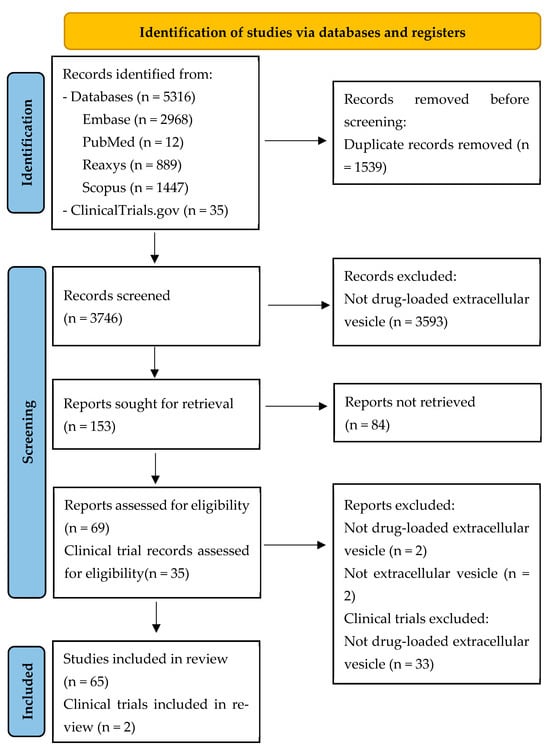
A total of 5316 articles were identified from different databases, including Embase, PubMed, Reaxys, and Scopus. 2968 were from Embase, 12 from PubMed, 889 from Reaxys and 1447 from Scopus. After screening, at the end, 64 articles were included in the review. 2 clinical trials that met the inclusion criteria from clinicaltrials.gov were also selected for this review. The detailed selection process is illustrated in Figure 1, following the PRISMA 2020 flow diagram.
Figure 1.
PRISMA 2020 flow diagram of the study selection process for drug-loaded extracellular vesicle studies.
3.2. Overview of Included Studies
The data extracted from the included studies were compiled into four main tables summarizing the characteristics and outcomes of drug-loaded EVs. Table 1 provides an overview of the EV sources, types of loaded drugs, particle size, administration route, and therapeutic indications. Table 2 presents the main loading strategies, efficiencies, and experimental conditions, while Table 3 summarizes completed clinical trials involving drug-loaded EVs. Within the narrow scope of exogenously drug-loaded EVs registered in ClinicalTrials.gov, two completed clinical trials with available outcomes were identified (Table 3). This focused subset does not encompass the broader clinical EV landscape, which includes numerous trials of unmodified or endogenously loaded EV therapeutics summarized in recent reviews. The following subsections describe the main findings derived from these data. Table 4 presents the Biopharmaceutics Classification System analysis with loading efficiency data. The following subsections describe the main findings derived from these data.
Comparative Analysis of EV Sources
Extracellular vesicles used in drug delivery research derive from diverse biological sources, each with specific advantages, limitations, and regulatory implications [34]. A comparative analysis of human-, animal-, plant-, milk-, and bacterial-derived EVs reveals distinct profiles with respect to yield, scalability, immunogenicity, and translational potential.
Human-derived EVs, particularly from mesenchymal stem cells (MSCs), dominated preclinical oncology studies. These vesicles inherit cell-type-specific surface markers (e.g., CD29, CD44, CD90) that can confer organotropism and tumor-homing capacity. However, production yields from conventional 2D MSC cultures are modest (typically 0.1–0.5 × 10⁹ EVs/mL of conditioned medium), and batch-to-batch variability can be substantial (15–35% CV). Despite these limitations, human-derived EVs benefit from the most mature regulatory experience.
Animal-derived EVs (e.g., bovine, equine, porcine sources) offer moderate scalability (1–2 × 10⁹ EVs/mL) and lower costs compared with human primary cells. However, zoonotic safety concerns and less clearly defined regulatory pathways may complicate clinical development.
Plant-derived EVs from edible plants (e.g., ginger, grapes, grapefruit) represent a rapidly growing category. These vesicles can be produced at large scale from agricultural by-products, exhibit excellent stability (6–12 months at refrigerated conditions), and typically demonstrate low immunogenicity. The main limitations are compositional heterogeneity and uncertain regulatory classification.
Milk-derived EVs leverage a strong dietary safety precedent. They occur at very high concentrations (109–1010 EVs/mL), are scalable via dairy-industry infrastructure, and are promising for oral or mucosal delivery. However, regulatory classification as food vs. therapeutic biologic is not yet fully harmonized.
Bacterial-derived EVs (e.g., outer membrane vesicles from Gram-negative bacteria) emerge as immunomodulatory platforms. They offer high yields via fermentation (5–10 × 109 EVs/mL) and structural robustness, but concerns about endotoxin content and pyrogenicity require stringent purification strategies.
From a cost–benefit perspective, human EVs incur the highest production costs per dose (tens of thousands to >100,000 USD), whereas plant- and milk-derived EVs have the lowest costs due to abundant raw materials. Timelines to regulatory approval are shortest for human- and milk-derived vesicles, intermediate for animal and plant EVs, and longest for bacterial-derived EVs.
Table 1.
Summary of drug-loaded EV studies (2020–2025).
Table 2.
Summary of drug-loaded EV studies (2020–2025).
Table 3.
Summary of drug-loaded EVs clinical trials (2020–2025).
4. Discussion
4.1. Mechanisms of Action: A Three-Step Cellular Uptake Framework
Understanding the mechanisms of action underlying extracellular vesicle–mediated drug delivery is essential for translating promising preclinical findings into clinically effective therapies. Unlike conventional nanocarriers, EVs exploit endogenous cellular communication pathways, enabling efficient cellular uptake, cargo protection, and intracellular trafficking. The therapeutic activity of drug-loaded EVs can be conceptualized as a sequence of interdependent biological events encompassing cellular uptake, endosomal escape, and intracellular cargo engagement.
The therapeutic performance of drug-loaded EVs depends on a sequence of interrelated processes: (i) cellular uptake into target cells, (ii) endosomal escape and intracytoplasmic release of cargo, and (iii) subsequent intracellular targeting and functional engagement of molecular pathways. Dissecting these mechanisms is essential for rational design and optimization of EV-based drug delivery systems.
4.1.1. Step 1—Cellular Uptake
Drug-loaded EVs can enter target cells through multiple, partially overlapping endocytic pathways. The most frequently implicated mechanisms include clathrin-mediated endocytosis, macropinocytosis, and lipid raft/caveolin-dependent uptake. Clathrin-mediated endocytosis is often responsible for a substantial fraction of EV internalization (40–60% in several model systems), while macropinocytosis contributes significantly at higher EV concentrations (50–80% reduction with inhibitors). Lipid raft- and caveolin-dependent mechanisms are particularly important for smaller EVs (<100 nm) enriched in tetraspanins.
4.1.2. Step 2—Endosomal Escape and Cargo Release
After internalization, EVs are typically trafficked to early endosomes and then along the endo-lysosomal pathway. For therapeutic cargo to exert intracellular effects, especially for nucleic acids and certain small molecules, efficient endosomal escape is required. Several escape mechanisms have been proposed, including back-fusion of internal EV membranes with limiting endosomal membranes, pH-dependent destabilization of membranes modulated by lipid composition and protein corona, and fusion events facilitated by fusogenic lipids or engineered peptides.
4.1.3. Step 3—Cargo Targeting and Functional Engagement
The final step involves trafficking of released cargo to its intracellular site of action. EV surface proteins such as phosphatidylserine-binding moieties, integrins, and tetraspanins (CD9, CD63, CD81) can direct preferential uptake by specific cell types or tissues. Engineered decorations (e.g., aptamers, peptides, antibodies) can further refine targeting specificity. The interplay between intrinsic EV tropism and exogenous targeting ligands represents a key design variable.
4.2. Advantages and Limitations of EV-Based Drug Delivery
EV-based drug delivery offers several advantages over conventional approaches. First, EVs enhance biocompatibility and exhibit low immunogenicity due to their natural origin, making them less likely to trigger immune responses than synthetic nanoparticles. For instance, MSC-derived EVs show a low risk of immunogenicity and tumorigenicity compared to whole-cell therapy [5]. Second, EVs can encapsulate a wide range of therapeutic agents, including hydrophobic drugs such as curcumin [3,72]. Third, they enable targeted delivery to specific tissues or tumors [7].
A comparative overview of extracellular vesicle sources and their key characteristics across therapeutic applications is summarized in Table 1. For example, AS1411 aptamer-functionalized exosomes targeted nucleolin-positive colorectal cancer cells [6], while M2 macrophage-derived EVs accumulated at spinal cord injury sites [7].
However, EV-based delivery also faces notable limitations. Loading efficiency varies with both the drug and the loading method, requiring optimization of parameters; for instance, loading lonidamine into EVs resulted in markedly different encapsulation efficiencies—0.81 ± 0.22% and 4.16 ± 1.9%, respectively—despite using the same EV source and method [2]. Similarly, loading 17β-estradiol by passive versus active methods yielded different efficiencies [20]. In addition, the long-term safety profile and biodistribution of drug-loaded EVs are not fully established. In alopecia areata mouse models, baricitinib-loaded EVs reduced inflammation and promoted hair regrowth, but the authors noted the absence of long-term toxicological data and emphasized the need for further safety evaluation prior to clinical translation.
Additionally, large-scale manufacturing, batch-to-batch reproducibility, and quality control of EV formulations continue to pose challenges for regulatory standardization. Overall, EV-based systems represent a biologically inspired and highly adaptable platform for drug delivery, yet their clinical transition depends on addressing these safety, reproducibility, and scalability limitations [24].
Only a minority of the included studies reported exogenous loading of nucleic acids into EVs, typically in the context of co-delivery with chemotherapeutic agents (e.g., miRNA mimics or plasmid constructs combined with taxanes or other cytotoxics). These formulations aimed to synergistically modulate oncogenic signaling and chemosensitivity, but they remain at an early preclinical stage and were numerically outweighed by small-molecule-only EV formulations in the 2020–2025 literature set.
4.3. Disease-Specific Pathophysiological Targeting of Drug-Loaded EVs
The therapeutic relevance of drug-loaded EVs is highly dependent on disease-specific pathophysiological mechanisms. In oncology, EVs exploit enhanced permeability and retention effects, tumor-associated macrophage interactions, and receptor-mediated uptake to improve intratumoral drug accumulation while reducing systemic toxicity. In inflammatory and autoimmune disorders, EVs preferentially accumulate at inflamed sites due to increased vascular permeability and immune cell recruitment, enabling localized immunomodulation. In neurodegenerative diseases, the ability of EVs to cross the blood–brain barrier represents a decisive advantage, facilitating central nervous system drug delivery where conventional formulations fail.
4.4. Loading Method Preferences and Trade-Offs
Across the studies included, passive loading was the most frequently employed approach, likely due to its procedural simplicity and minimal disruption of vesicle integrity. Representative drug-loaded EV formulations, loading methods, and experimental conditions are summarized in Table 2.
This strategy was particularly effective for hydrophobic molecules, which readily partition into the lipid bilayer. For example, curcumin and berberine were successfully incorporated into EVs via passive incubation [7,8]. However, passive loading often results in low encapsulation efficiency, especially for hydrophilic or charged drugs. Li et al. reported a marked difference in loading outcomes between doxorubicin and lonidamine, despite using the same EV source and method, highlighting how drug properties influence efficiency [2].
In contrast, active loading methods—including electroporation, sonication, extrusion, and freeze–thaw cycles—were employed to overcome poor passive permeability. These techniques improved encapsulation of hydrophilic agents, such as doxorubicin and cisplatin [2,9], but also carried risks of membrane damage, aggregation, or altered surface protein composition, which may affect biodistribution and biological function. To balance these trade-offs, several studies employed mixed strategies that combined passive incubation with an active step, though outcomes remained highly variable and poorly standardized [20].
An overview of ongoing and completed clinical trials involving drug-loaded extracellular vesicles is provided in Table 3.
Despite encouraging preclinical outcomes, significant heterogeneity exists across studies regarding EV source selection, isolation protocols, loading efficiency, and biological characterization. Reported drug encapsulation efficiencies vary widely even for identical drugs and loading methods, reflecting both methodological inconsistencies and intrinsic EV variability. Furthermore, active loading techniques, while improving encapsulation of hydrophilic cargo, may compromise membrane integrity and surface protein composition, potentially altering biodistribution and biological function. These unresolved issues underscore the need for standardized protocols and comparative studies.
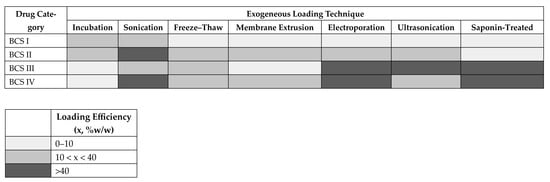
To further clarify these observations, we synthesized the data into a matrix analysis of loading efficiency across different exogenous loading techniques, stratified by Biopharmaceutics Classification System (BCS) drug categories (Table 4; Figure 2). The resulting heat matrix (Figure 2) visually captures these trade-offs between drug class and loading efficiency, providing a comparative framework to guide method selection. Passive approaches remain preferable for simple, lipophilic molecules where membrane insertion is sufficient, while active methods are indispensable for hydrophilic, charged, or bulky cargo. This analysis emphasizes that no single loading technique is universally optimal; rather, method choice should be tailored to the drug’s BCS profile while balancing encapsulation yield against preservation of vesicle structure.
Figure 2.
Matrix analysis loading efficiency across different exogenous loading techniques.
To further clarify these observations, we synthesized the data into a matrix analysis of loading efficiency across different exogenous loading techniques, stratified by Biopharmaceutics Classification System (BCS) drug categories (Table 4; Figure 2).
The resulting heat matrix (Figure 2) visually captures these trade-offs between drug class and loading efficiency, providing a comparative framework to guide method selection.
Passive approaches remain preferable for simple, lipophilic molecules where membrane insertion is sufficient, while active methods are indispensable for hydrophilic, charged, or bulky cargo.
This analysis emphasizes that no single loading technique is universally optimal; rather, method choice should be tailored to the drug’s BCS profile while balancing encapsulation yield against preservation of vesicle structure.
In the future, the integration of microfluidic technologies, machine learning-based optimization, and standardized evaluation protocols may facilitate more reproducible and scalable EV-loading strategies.
Table 4.
Drug class and loading efficiency.
4.5. Clinical Translation and Future Directions
Despite substantial progress in preclinical research, the clinical translation of drug-loaded extracellular vesicles remains limited, highlighting critical gaps in standardization, large-scale manufacturing, long-term safety evaluation, and regulatory harmonization. Recent systematic and narrative reviews catalog a substantially larger number of EV-related clinical trials, including unmodified EV therapeutics, diagnostic applications, and studies registered in multiple international repositories; our analysis should therefore be interpreted as a strictly defined subset concentrating on EVs with explicitly described exogenous drug loading. While EV-based therapy has emerged as a rapidly growing area of research, only 2 clinical trials were included in this review (NCT06930326 [19]; NCT04879810 [18]), indicating that most studies remain at the preclinical stage. This gap highlights the need for greater emphasis on translational studies that bridge laboratory-scale findings with clinical validation. A major hurdle in translating EVs to clinical use is the lack of standardized platforms for their production, measurement, and molecular characterization, including critical variability across laboratories. The absence of harmonized protocols for isolation, purification, and potency testing hampers the comparability and reproducibility of results across studies. Another key limitation involves targeting efficiency remaining suboptimal, and off-target delivery continues to limit therapeutic precision. Strategies such as surface ligand conjugation or charge modification have demonstrated potential to enhance circulation time and accumulation at target sites [79]. Further development of engineered EVs with tunable surface properties and controlled release kinetics may significantly improve clinical performance. Recent advances in bioengineered extracellular vesicles, including genetically modified producer cells and surface-functionalized vesicles, highlight promising strategies to enhance targeting specificity, improve loading efficiency, and facilitate clinical translation. A scalable manufacturing procedure and quality control for EVs is still a big challenge because of the biological complexity of EVs. Recent advances, including the use of bioreactor systems, have yielded up to a 38-fold increase in productivity compared with conventional flask cultures while preserving critical quality attributes [80]. However, unless such large-scale production methods become cost-effective, clinical use of EV-based therapies will likely remain confined to niche or experimental applications.
In the future, integrating automated bioprocessing, advanced analytics, and real-time quality control systems could enable the transition of EV-based drug delivery from bench to bedside. Collaborative standardization efforts among academia, industry, and regulatory bodies will be essential to ensure safe, reproducible, and scalable EV therapeutics.
5. Conclusions
EV-based drug delivery systems represent a promising next-generation therapeutic platform that combines the advantages of biological compatibility, versatile cargo loading, and targeted delivery.
The studies included in this review collectively demonstrate that EVs can effectively encapsulate and transport a wide range of therapeutic agents, enhancing stability, cellular uptake, and pharmacological efficacy compared with conventional nanocarriers. However, challenges related to standardized isolation methods, scalable manufacturing, and reproducible loading efficiency continue to hinder clinical translation. The integration of engineered EVs, automated bioprocessing, and advanced analytics is expected to improve reproducibility and facilitate regulatory approval in the future. A coordinated, multi-disciplinary research approach emphasizing standardization, manufacturing optimization, and clinical trial prioritization is required to advance EV-based therapeutics from bench to bedside. With sustained investment in research infrastructure, regulatory pathway clarity from FDA/EMA guidance documents, and collaborative academic-industry partnerships, EV-based therapeutics have the potential for substantial clinical impact across oncology, neurodegeneration, inflammatory diseases, and regenerative medicine applications.
Overall, EV-based formulations hold substantial potential to bridge the gap between experimental nanomedicine and clinical therapeutics, offering new opportunities for precision and regenerative medicine.
Supplementary Materials
The following supporting information can be downloaded at: https://www.mdpi.com/article/10.3390/pharmaceutics18010045/s1, PRISMA 2020 checklist [81].
Author Contributions
Conceptualization, L.L.D., A.K. and R.Z.; methodology, L.L.D., A.K. and R.Z.; writing—original draft preparation, L.L.D. and A.K.; writing—review and editing, A.K. and R.Z. All authors have read and agreed to the published version of the manuscript.
Funding
This research received no external funding.
Data Availability Statement
No new data were created or analyzed in this study.
Acknowledgments
During the preparation of this study, the author(s) used ChatGPT (OpenAI) and Perplexity for the purposes of paraphrasing and idea organization. The authors have reviewed and edited the output and take full responsibility for the content of this publication.
Conflicts of Interest
The authors declare no conflict of interest.
Abbreviations
The following abbreviations are used in this manuscript:
| EVs | Extracellular Vesicles |
References
- Chen, W.; Lin, W.; Yu, N.; Zhang, L.; Wu, Z.; Chen, Y.; Li, Z.; Gong, F.; Li, N.; Chen, X.; et al. Activation of Dynamin-Related Protein 1 and Induction of Mitochondrial Apoptosis by Exosome-Rifampicin Nanoparticles Exerts Anti-Osteosarcoma Effect. Int. J. Nanomed. 2022, 17, 5431–5446. [Google Scholar] [CrossRef] [Scilit]
- Li, H.; Xu, W.; Li, F.; Zeng, R.; Zhang, X.; Wang, X.; Zhao, S.; Weng, J.; Li, Z.; Sun, L. Amplification of anticancer efficacy by co-delivery of doxorubicin and lonidamine with extracellular vesicles. Drug Deliv. 2022, 29, 192–202. [Google Scholar] [CrossRef] [Scilit]
- Huang, S.; Zhang, M.; Li, X.; Pei, J.; Zhou, Z.; Lei, P.; Wang, M.; Zhang, P.; Yu, H.; Fan, G.; et al. Formulation, characterization, and evaluation of curcumin-loaded ginger-derived nanovesicles for anti-colitis activity. J. Pharm. Anal. 2024, 14, 101014. [Google Scholar] [CrossRef] [Scilit]
- Nemidkanam, V.; Banlunara, W.; Chaichanawongsaroj, N. Kaempferia parviflora Extracellular Vesicle Loaded with Clarithromycin for the Treatment of Helicobacter pylori Infection. Int. J. Nanomed. 2024, 19, 1967–1983. [Google Scholar] [CrossRef] [Scilit] [PubMed]
- Li, H.; Zhang, Z.; Li, Y.; Su, L.; Duan, Y.; Zhang, H.; An, J.; Ni, T.; Li, X.; Zhang, X. Therapeutic Effect of Rapamycin-Loaded Small Extracellular Vesicles Derived from Mesenchymal Stem Cells on Experimental Autoimmune Uveitis. Front. Immunol. 2022, 13, 864956. [Google Scholar] [CrossRef] [Scilit]
- Hosseini, N.F.; Amini, R.; Ramezani, M.; Saidijam, M.; Hashemi, S.M.; Najafi, R. AS1411 aptamer-functionalized exosomes in the targeted delivery of doxorubicin in fighting colorectal cancer. Biomed. Pharmacother. 2022, 155, 113690. [Google Scholar] [CrossRef] [Scilit] [PubMed]
- Gao, Z.-S.; Zhang, C.-J.; Xia, N.; Tian, H.; Li, D.-Y.; Lin, J.-Q.; Mei, X.-F.; Wu, C. Berberine-loaded M2 macrophage-derived exosomes for spinal cord injury therapy. Acta Biomater. 2021, 126, 211–223. [Google Scholar] [CrossRef] [Scilit]
- Li, Z.; Yuan, Y.; Zhang, Z.; Zhang, X.; Yang, H.; Li, H.; Han, B.; Deng, Z.; Zhou, Z.; Fan, X. Cell penetrating peptide modified M2 macrophage derived exosomes treat spinal cord injury and rheumatoid arthritis by loading curcumin. Mater. Des. 2023, 225, 111455. [Google Scholar] [CrossRef] [Scilit]
- Ye, M.; Liu, T.; Miao, L.; Ji, H.; Xu, Z.; Wang, H.; Zhang, J.; Zhu, X. Cisplatin-encapsulated TRAIL-engineered exosomes from human chorion-derived MSCs for targeted cervical cancer therapy. Stem Cell Res. Ther. 2024, 15, 396. [Google Scholar] [CrossRef] [Scilit]
- Wu, J.; Jin, Z.; Fu, T.; Qian, Y.; Bian, X.; Zhang, X.; Zhang, J. Extracellular Vesicle-Based Drug Delivery Systems in Cancer Therapy. Int. J. Mol. Sci. 2025, 26, 4835. [Google Scholar] [CrossRef] [Scilit] [PubMed]
- Silva, R.O.; Counil, H.; Rabanel, J.-M.; Haddad, M.; Zaouter, C.; Khedher, M.R.f.B.; Patten, S.A.; Ramassamy, C. Donepezil-Loaded Nanocarriers for the Treatment of Alzheimer?s Disease: Superior Efficacy of Extracellular Vesicles Over Polymeric Nanoparticles. Int. J. Nanomed. 2024, 19, 1077–1096. [Google Scholar] [CrossRef] [Scilit]
- Rodríguez-Morales, B.; Antunes-Ricardo, M.; González-Valdez, J. Exosome-mediated insulin delivery for the potential treatment of diabetes mellitus. Pharmaceutics 2021, 13, 1870. [Google Scholar] [CrossRef] [Scilit]
- Zhuang, M.; Rao, L.; Chen, Y.; Xiao, S.; Xia, H.; Yang, J.; Lv, X.; Qin, D.; Zhu, C. Controlled SPION-Exosomes Loaded with Quercetin Preserves Pancreatic Beta Cell Survival and Function in Type 2 Diabetes Mellitus. Int. J. Nanomed. 2023, 18, 5733–5748. [Google Scholar] [CrossRef] [Scilit] [PubMed]
- Goudarzi, F.; Jajarmi, V.; Shojaee, S.; Mohebali, M.; Keshavarz, H. Formulation and evaluation of atovaquone-loaded macrophage-derived exosomes against Toxoplasma gondii: In vitro and in vivo assessment. Microbiol. Spectr. 2024, 12, e0308023. [Google Scholar] [CrossRef] [Scilit]
- He, X.; Zhang, C.; Amirsaadat, S.; Jalil, A.T.; Kadhim, M.M.; Abasi, M.; Pilehvar, Y. Curcumin-Loaded Mesenchymal Stem Cell–Derived Exosomes Efficiently Attenuate Proliferation and Inflammatory Response in Rheumatoid Arthritis Fibroblast-Like Synoviocytes. Appl. Biochem. Biotechnol. 2023, 195, 51–67. [Google Scholar] [CrossRef] [Scilit]
- Jin, Y.; Xu, C.; Zhu, Y.; Gu, Z. Extracellular vesicle as a next-generation drug delivery platform for rheumatoid arthritis therapy. J. Control. Release 2025, 381, 113610. [Google Scholar] [CrossRef] [Scilit]
- Liu, X.; Chen, H.; Lei, L.; Yang, P.; Ju, Y.; Fan, X.; Fang, B. Exosomes-carried curcumin based on polysaccharide hydrogel promote flap survival. Int. J. Biol. Macromol. 2024, 270, 132367. [Google Scholar] [CrossRef] [Scilit] [PubMed]
- Available online: https://www.clinicaltrials.gov/study/NCT04879810 (accessed on 15 October 2025).
- Available online: https://clinicaltrials.gov/study/NCT06930326 (accessed on 15 October 2025).
- Farashah, M.S.G.; Javadi, M.; Rad, J.S.; Shakouri, S.K.; Asnaashari, S.; Dastmalchi, S.; Nikzad, S.; Roshangar, L. 17β-Estradiol-Loaded Exosomes for Targeted Drug Delivery in Osteoporosis: A Comparative Study of Two Loading Methods. Adv. Pharm. Bull. 2023, 13, 736–746. [Google Scholar] [CrossRef] [Scilit] [PubMed]
- Ramezani, R.; Sajadi, H.M.; Babashah, S. The effect of curcumin-loaded exosomes on the proliferation of human ovarian cancer SKOV3 cells. J. Food Sci. Technol. 2024, 21, 58–67. [Google Scholar] [CrossRef]
- Barkallah, M.; Nzoughet-Kouassi, J.; Simard, G.; Thoulouze, L.; Marze, S.; Ropers, M.H.; Andriantsitohaina, R. Enhancement of the anti-angiogenic effects of delphinidin when encapsulated within small extracellular vesicles. Nutrients 2021, 13, 4378. [Google Scholar] [CrossRef] [Scilit]
- Chen, C.; Shen, M.; Wan, X.; Sheng, L.; He, Y.; Xu, M.; Yuan, M.; Ji, Z.; Zhang, J. Activated T cell-derived exosomes for targeted delivery of AXL-siRNA loaded paclitaxel-poly-L-lysine prodrug to overcome drug resistance in triple-negative breast cancer. Chem. Eng. J. 2023, 468, 143454. [Google Scholar] [CrossRef] [Scilit]
- Tang, H.; Wang, F.; Yang, R.; Zhao, Z.; Zhang, Y.; Yang, L.; Li, B. Baricitinib-loaded EVs promote alopecia areata mouse hair regrowth by reducing JAK-STAT-mediated inflammation and promoting hair follicle regeneration. Drug Discov. Ther. 2024, 18, 368–374. [Google Scholar] [CrossRef] [Scilit]
- Shaikh, S.; Younis, M.; Yingying, S.; Tanziela, T.; Yuan, L. Bleomycin loaded exosomes enhanced antitumor therapeutic efficacy and reduced toxicity. Life Sci. 2023, 330, 121977. [Google Scholar] [CrossRef] [Scilit]
- Song, L.L.; Tang, Y.P.; Qu, Y.Q.; Yun, Y.X.; Zhang, R.L.; Wang, C.R.; Wong, V.K.W.; Wang, H.M.; Liu, M.H.; Qu, L.Q.; et al. Exosomal delivery of rapamycin modulates blood-brain barrier penetration and VEGF axis in glioblastoma. J. Control. Release 2025, 381, 113605. [Google Scholar] [CrossRef] [Scilit]
- Meng, W.; He, C.; Hao, Y.; Wang, L.; Li, L.; Zhu, G. Prospects and challenges of extracellular vesicle-based drug delivery system: Considering cell source. Drug Deliv. 2020, 27, 585–598. [Google Scholar] [CrossRef] [Scilit]
- Xu, G.; Jin, J.; Fu, Z.; Wang, G.; Lei, X.; Xu, J.; Wang, J. Extracellular vesicle-based drug overview: Research landscape, quality control and nonclinical evaluation strategies. Signal Transduct. Target. Ther. 2025, 10, 255. [Google Scholar] [CrossRef] [Scilit]
- Welsh, J.A.; Goberdhan, D.C.; O’Driscoll, L.; Théry, C.; Witwer, K.W. MISEV2023: An updated guide to EV research and applications. J Extracell Vesicles 2024, 13, e12416. [Google Scholar] [CrossRef] [Scilit] [PubMed]
- Kul, E.; Okoroafor, U.; Dougherty, A.; Palkovic, L.; Li, H.; Valiño-Ramos, P.; Aberman, L.; Young, S.M., Jr. Development of adenoviral vectors that transduce Purkinje cells and other cerebellar cell-types in the cerebellum of a humanized mouse model. Mol. Ther. Methods Clin. Dev. 2024, 32, 101243. [Google Scholar] [CrossRef] [Scilit] [PubMed]
- Tran, P.H.; Xiang, D.; Nguyen, T.N.; Tran, T.T.; Chen, Q.; Yin, W.; Zhang, Y.; Kong, L.; Duan, A.; Chen, K.; et al. Aptamer-guided extracellular vesicle theranostics in oncology. Theranostics 2020, 10, 3849–3866. [Google Scholar] [CrossRef] [Scilit] [PubMed]
- Jiang, L.; Vader, P.; Schiffelers, R.M. Extracellular vesicles for nucleic acid delivery: Progress and prospects for safe RNA-based gene therapy. Gene Ther. 2017, 24, 157–166. [Google Scholar] [CrossRef] [Scilit]
- Aquino, A.; Rubinstein, A.; Kudryavtsev, I.; Yakovlev, A.; Golovkin, A. Extracellular vesicles as the drug delivery vehicle for gene-based therapy. Appl. Phys. Rev. 2025, 12, 041301. [Google Scholar] [CrossRef] [Scilit]
- Zhao, A.G.; Shah, K.; Cromer, B.; Sumer, H. Comparative analysis of extracellular vesicles isolated from human mesenchymal stem cells by different isolation methods and visualisation of their uptake. Exp. Cell Res. 2022, 414, 113097. [Google Scholar] [CrossRef] [Scilit]
- Liu, X.; Muhammed, F.K.; Liu, Y. Simvastatin encapsulated in exosomes can enhance its inhibition of relapse after or-thodontic tooth movement. Am. J. Orthod. Dentofacial Orthop. 2022, 162, 881–889. [Google Scholar] [CrossRef] [Scilit]
- Wang, S.; Qiao, C.; Kong, X.; Yang, J.; Guo, F.; Chen, J.; Wang, W.; Zhang, B.; Xiu, H.; He, Y.; et al. Adhesion between EVs and tumor cells facilitated EV-encapsulated doxorubicin delivery via ICAM1. Pharmacol. Res. 2024, 205, 107244. [Google Scholar] [CrossRef] [Scilit] [PubMed]
- Valipour, E.; Ranjbar, F.E.; Mousavi, M.; Ai, J.; Malekshahi, Z.V.; Mokhberian, N.; Taghdiri-Nooshabadi, Z.; Khanmohammadi, M.; Nooshabadi, V.T. The anti-angiogenic effect of atorvastatin loaded exosomes on glioblastoma tumor cells: An in vitro 3D culture model. Microvasc. Res. 2022, 143, 104385. [Google Scholar] [CrossRef] [Scilit] [PubMed]
- Shi, Y.; Zhang, R.; Da, N.; Wang, Y.; Yang, J.; Li, B.; He, X. Aspirin loaded extracellular vesicles inhibit inflammation of macrophages via switching metabolic phenotype in periodontitis. Biochem. Biophys. Res. Commun. 2023, 667, 25–33. [Google Scholar] [CrossRef] [Scilit]
- Wang, H.; Tang, Q.; Lu, Y.; Chen, C.; Zhao, Y.L.; Xu, T.; Yang, C.W.; Chen, X.Q. Berberine-loaded MSC-derived sEVs encapsulated in injectable GelMA hydrogel for spinal cord injury repair. Int. J. Pharm. 2023, 643, 123283. [Google Scholar] [CrossRef] [Scilit] [PubMed]
- Sun, L.; Fan, M.; Huang, D.; Li, B.; Xu, R.; Gao, F.; Chen, Y. Clodronate-loaded liposomal and fibroblast-derived exosomal hybrid system for enhanced drug delivery to pulmonary fibrosis. Biomaterials 2021, 271, 120761. [Google Scholar] [CrossRef] [Scilit]
- Wang, Y.; Guo, M.; Lin, D.; Liang, D.; Zhao, L.; Zhao, R.; Wang, Y. Docetaxel-loaded exosomes for targeting non-small cell lung cancer: Preparation and evaluation in vitro and in vivo. Drug Deliv. 2021, 28, 1510–1523. [Google Scholar] [CrossRef] [Scilit]
- Zhao, Y.; Zheng, Y.; Zhu, Y.; Li, H.; Zhu, H.; Liu, T. Docetaxel-loaded M1 macrophage-derived exosomes for a safe and efficient chemoimmunotherapy of breast cancer. J. Nanobiotechnology 2022, 20, 359. [Google Scholar] [CrossRef] [Scilit]
- Farhat, W.; Yeung, V.; Kahale, F.; Parekh, M.; Cortinas, J.; Chen, L.; Ross, A.E.; Ciolino, J.B. Doxorubicin-Loaded Extracellular Vesicles Enhance Tumor Cell Death in Retinoblastoma. Bioengineering 2022, 9, 671. [Google Scholar] [CrossRef] [Scilit] [PubMed]
- Zhang, C.; Song, J.; Lou, L.; Qi, X.; Zhao, L.; Fan, B.; Sun, G.; Lv, Z.; Fan, Z.; Jiao, B.; et al. Doxorubicin-loaded nanoparticle coated with endothelial cells-derived exosomes for immunogenic chemotherapy of glioblastoma. Bioeng. Transl. Med. 2021, 6, e10203. [Google Scholar] [CrossRef] [Scilit]
- Hashemi, Z.S.; Ghavami, M.; Mohammadi, F.; Shokrollahi Barough, M.; Shokati, F.; Asghari, S.; Khalili, S.; Akbari Yekta, M.; Ghavamzadeh, A.; Forooshani, R.S. Doxorubicin-loaded NK exosomes enable cytotoxicity against triple-negative breast cancer spheroids. Iran. J. Basic Med. Sci. 2024, 27, 1604–1615. [Google Scholar] [CrossRef] [Scilit]
- Salek, A.; Selmi, M.; Barboura, M.; Martinez, M.C.; Chekir-Ghedira, L.; Andriantsitohaina, R. Enhancement of the In Vitro Antitumor Effects of Berberine Chloride When Encapsulated within Small Extracellular Vesicles. Pharmaceutics 2022, 14, 1913. [Google Scholar] [CrossRef] [Scilit] [PubMed]
- Yang, X.; Xie, B.; Peng, H.; Shi, G.; Sreenivas, B.; Guo, J.; Wang, C.; He, Y. Eradicating intracellular MRSA via targeted delivery of lysostaphin and vancomycin with mannose-modified exosomes. J. Control. Release 2021, 329, 454–467. [Google Scholar] [CrossRef] [Scilit]
- Basak, M.; Kulkarni, M.; Narisepalli, S.; Chitkara, D.; Mittal, A. Exosomal fragment enclosed polyamine-salt nano-complex for co-delivery of docetaxel and mir-34a exhibits higher cytotoxicity and apoptosis in breast cancer cells. Sci. Rep. 2024, 14, 21669. [Google Scholar] [CrossRef] [Scilit]
- Wang, J.; Li, M.; Jin, L.; Guo, P.; Zhang, Z.; Zhanghuang, C.; Tan, X.; Mi, T.; Liu, J.; Wu, X.; et al. Exosome mimetics derived from bone marrow mesenchymal stem cells deliver doxorubicin to osteosarcoma in vitro and in vivo. Drug Deliv. 2022, 29, 3291–3303. [Google Scholar] [CrossRef] [Scilit]
- Zhao, J.; Fang, W.; Gao, Y.; Chen, J.; Wang, G.; Gu, J. iPSC-derived exosomes as amphotericin B carriers: A promising approach to combat cryptococcal meningitis. Front. Microbiol. 2025, 16, 1531425. [Google Scholar] [CrossRef] [Scilit]
- Dehghani, P.; Varshosaz, J.; Mirian, M.; Minaiyan, M.; Kazemi, M.; Bodaghi, M. Keratinocyte Exosomes for Topical Delivery of Tofacitinib in Treatment of Psoriasis: An In Vitro/ In Vivo Study in Animal Model of Psoriasis. Pharm. Res. 2024, 41, 263–279. [Google Scholar] [CrossRef] [Scilit]
- Xu, W.; Wang, K.; Wang, K.; Zhao, Y.; Yang, Z.; Li, X. Key Magnetized Exosomes for Effective Targeted Delivery of Doxorubicin Against Breast Cancer Cell Types in Mice Model. Int. J. Nanomed. 2024, 19, 10711–10724. [Google Scholar] [CrossRef] [Scilit] [PubMed]
- Ashour, A.A.; El-Kamel, A.H.; Mehanna, R.A.; Mourad, G.; Heikal, L. Luteolin-loaded exosomes derived from bone marrow mesenchymal stem cells: A promising therapy for liver fibrosis. Drug Deliv. 2022, 29, 3270–3280. [Google Scholar] [CrossRef] [Scilit] [PubMed]
- Wei, H.; Chen, F.; Chen, J.; Lin, H.; Wang, S.; Wang, Y.; Wu, C.; Lin, J.; Zhong, G. Mesenchymal Stem Cell Derived Exosomes as Nanodrug Carrier of Doxorubicin for Targeted Osteosarcoma Therapy via SDF1-CXCR4 Axis. Int. J. Nanomed. 2022, 17, 3483–3495. [Google Scholar] [CrossRef] [Scilit] [PubMed]
- Liu, G.-S.; Chen, H.-A.; Chang, C.-Y.; Chen, Y.-J.; Wu, Y.-Y.; Widhibrata, A.; Yang, Y.-H.; Hsieh, E.-H.; Delila, L.; Lin, I.C.; et al. Platelet-derived extracellular vesicle drug delivery system loaded with kaempferol for treating corneal neovascularization. Biomaterials 2025, 319, 123205. [Google Scholar] [CrossRef] [Scilit]
- Reddy, S.K.; Ballal, A.R.; Shailaja, S.; Seetharam, R.N.; Raghu, C.H.; Sankhe, R.; Pai, K.; Tender, T.; Mathew, M.; Aroor, A.; et al. Small extracellular vesicle-loaded bevacizumab reduces the frequency of intravitreal injection required for diabetic retinopathy. Theranostics 2023, 13, 2241–2255. [Google Scholar] [CrossRef] [Scilit]
- Kim, Y.S.; Go, G.; Yun, C.-W.; Yea, J.-H.; Yoon, S.; Han, S.-Y.; Lee, G.; Lee, M.-Y.; Lee, S.H. Topical administration of melatonin-loaded extracellular vesicle-mimetic nanovesicles improves 2,4-dinitrofluorobenzene-induced atopic dermatitis. Biomolecules 2021, 11, 1450. [Google Scholar] [CrossRef] [Scilit]
- Lara, P.; Huis; T Veld, R.V.; Jorquera-Cordero, C.; Chan, A.B.; Ossendorp, F.; Cruz, L.J. Zinc-phthalocyanine-loaded extracellular vesicles increase efficacy and selectivity of photodynamic therapy in co-culture and preclinical models of colon cancer. Pharmaceutics 2021, 13, 1547. [Google Scholar] [CrossRef] [Scilit]
- Tang, Z.G.; Chen, T.M.; Lu, Y.; Wang, Z.; Wang, X.C.; Kong, Y. Human bone marrow mesenchymal stem cell-derived exosomes loaded with gemcitabine inhibit pancreatic cancer cell proliferation by enhancing apoptosis. World J. Gastrointest. Oncol. 2024, 16, 4006–4013. [Google Scholar] [CrossRef] [Scilit]
- Basak, M.; Sahoo, B.; Chaudhary, D.K.; Narisepalli, S.; Tiwari, S.; Chitkara, D.; Mittal, A. Human umbilical cord blood-mesenchymal stem cell derived exosomes as an efficient nanocarrier for Docetaxel and miR-125a: Formulation optimization and anti-metastatic behaviour. Life Sci. 2023, 322, 121621. [Google Scholar] [CrossRef] [Scilit]
- Barbosa, L.M.P.; Gomes, E.R.; de Barros, A.L.B.; Cassali, G.D.; de Carvalho, A.T.; Silva, J.d.O.; Pádua, A.L.; Oliveira, M.C. Hybrid Nanosystem Formed by DOX-Loaded Liposomes and Extracellular Vesicles from MDA-MB-231 Is Effective against Breast Cancer Cells with Different Molecular Profiles. Pharmaceutics 2024, 16, 739. [Google Scholar] [CrossRef] [Scilit]
- Kazsoki, A.; Németh, K.; Visnovitz, T.; Lenzinger, D.; I Buzás, E.; Zelkó, R. Formulation and characterization of nanofibrous scaffolds incorporating extracellular vesicles loaded with curcumin. Sci. Rep. 2024, 14, 27574. [Google Scholar] [CrossRef] [Scilit]
- Thakur, A.; Sidu, R.K.; Zou, H.; Alam, M.K.; Yang, M.; Lee, Y. Inhibition of Glioma Cells’ proliferation by doxorubicin-loaded Exosomes via microfluidics. Int. J. Nanomed. 2020, 15, 8331–8343. [Google Scholar] [CrossRef] [Scilit]
- Li, H.; Ding, Y.; Huang, J.; Zhao, Y.; Chen, W.; Chen, R.; Hu, C.; Tang, Q.; An, Y. Angiopep-2 Modified Exosomes Load Rifampicin with Potential for Treating Central Nervous System Tuberculosis. Int. J. Nanomed. 2023, 18, 489–503. [Google Scholar] [CrossRef] [Scilit]
- Jiang, Q.; Sun, Y.; Si, X.; Cui, H.; Li, J.; Bao, Y.; Wang, L.; Li, B. Anthocyanin-loaded milk-derived extracellular vesicles nano-delivery system: Stability, mucus layer penetration, and pro-oxidant effect on HepG2 cells. Food Chem. 2024, 458, 140152. [Google Scholar] [CrossRef] [Scilit]
- Wang, M.; Yang, X.; Ye, Y.; Fan, K.; Chen, C.; Zheng, L.; Li, X.; Dong, C.; Li, C.; Dong, N. Anti-inflammatory and Restorative effects of milk exosomes and Dexamethasone-Loaded exosomes in a corneal alkali burn model. Int. J. Pharm. 2024, 666, 124784. [Google Scholar] [CrossRef] [Scilit]
- Zhu, W.; Dong, Y.; Xu, P.; Pan, Q.; Jia, K.; Jin, P.; Zhou, M.; Xu, Y.; Guo, R.; Cheng, B. A composite hydrogel containing resveratrol-laden nanoparticles and platelet-derived extracellular vesicles promotes wound healing in diabetic mice. Acta Biomater. 2022, 154, 212–230. [Google Scholar] [CrossRef] [Scilit]
- Mukhopadhya, A.; Tsiapalis, D.; McNamee, N.; Talbot, B.; O’driscoll, L. Doxorubicin Loading into Milk and Mesenchymal Stem Cells? Extracellular Vesicles as Drug Delivery Vehicles. Pharmaceutics 2023, 15, 718. [Google Scholar] [CrossRef] [Scilit] [PubMed]
- Chu, L.; Sun, Y.; Zhao, Y.; Wang, A.; Sun, Y.; Duan, X.; Li, N.; Xia, H.; Liu, W.; Sun, K. Exosome-mediated delivery platform of biomacromolecules into the brain: Cetuximab in combination with doxorubicin for glioblastoma therapy. Int. J. Pharm. 2024, 660, 124262. [Google Scholar] [CrossRef] [Scilit] [PubMed]
- Ran, B.; Ren, X.; Lin, X.; Teng, Y.; Xin, F.; Ma, W.; Zhao, X.; Li, M.; Wang, J.; Wang, C.; et al. Glycyrrhetinic acid loaded in milk-derived extracellular vesicles for inhalation therapy of idiopathic pulmonary fibrosis. J. Control. Release 2024, 370, 811–820. [Google Scholar] [CrossRef] [Scilit] [PubMed]
- Go, G.; Park, H.J.; Lee, J.H.; Yun, C.W.; Lee, S.H. Inhibitory Effect of Oxaliplatin-loaded Engineered Milk Extracellular Vesicles on Tumor Progression. Anticancer Res. 2022, 42, 857–866. [Google Scholar] [CrossRef] [Scilit]
- Liu, H.; Liu, Y.; Peng, S.; Zhou, L.; McClements, D.J.; Fang, S.; Liu, W. Colonic delivery and controlled release of curcumin encapsulated within plant-based extracellular vesicles loaded into hydrogel beads. Food Res. Int. 2025, 202, 115540. [Google Scholar] [CrossRef] [Scilit]
- Guo, Z.; Zhang, Y.; Gong, Y.; Li, G.; Pan, J.; Dou, D.; Ma, K.; Cui, C.; Liu, Y.; Zhu, X. Antibody functionalized curcuma-derived extracellular vesicles loaded with doxorubicin overcome therapy-induced senescence and enhance chemotherapy. J. Control. Release 2025, 379, 377–389. [Google Scholar] [CrossRef] [Scilit] [PubMed]
- Feng, W.; Teng, Y.; Zhong, Q.; Zhang, Y.; Zhang, J.; Zhao, P.; Chen, G.; Wang, C.; Liang, X.-J.; Ou, C. Biomimetic Grapefruit-Derived Extracellular Vesicles for Safe and Targeted Delivery of Sodium Thiosulfate against Vascular Calcification. ACS Nano 2023, 17, 24773–24789. [Google Scholar] [CrossRef] [Scilit]
- Yang, X.; Peng, Y.; Wang, Y.-e.; Zheng, Y.; He, Y.; Pan, J.; Liu, N.; Xu, Y.; Ma, R.; Zhai, J.; et al. Curcumae Rhizoma Exosomes-like nanoparticles loaded Astragalus components improve the absorption and enhance anti-tumor effect. J. Drug Deliv. Sci. Technol. 2023, 81, 104274. [Google Scholar] [CrossRef] [Scilit]
- Lee, Y.; Cho, H.; Kim, K.-S. Antibiotic-loaded Lactobacillus-derived extracellular vesicles enhance the bactericidal efficacy against Staphylococcus species. J. Drug Deliv. Sci. Technol. 2025, 105, 106607. [Google Scholar] [CrossRef] [Scilit]
- Carrasco-Rojas, J.; Zavala, G.; Contreras-Lopez, R.; Olivares, B.; Aarsund, M.; Inngjerdingen, M.; Nyman, T.A.; Sandoval, F.I.; Ramírez, O.; Alarcón-Moyano, J.; et al. Artificial cell-derived vesicles by extrusion, a novel docetaxel drug delivery system for lung cancer. J. Drug Deliv. Sci. Technol. 2025, 106, 106693. [Google Scholar] [CrossRef] [Scilit]
- Qi, Y.; Guo, L.; Jiang, Y.; Shi, Y.; Sui, H.; Zhao, L. Brain delivery of quercetin-loaded exosomes improved cognitive function in AD mice by inhibiting phosphorylated tau-mediated neurofibrillary tangles. Drug Deliv. 2020, 27, 745–755. [Google Scholar] [CrossRef] [Scilit]
- Wiklander, O.P.B.; Brennan, M.; Lötvall, J.; Breakefield, X.O.; El Andaloussi, S. Advances in therapeutic applications of extracellular vesicles. Sci. Transl. Med. 2019, 11, 492. [Google Scholar] [CrossRef] [Scilit]
- Kink, J.A.; Bellio, M.A.; Forsberg, M.H.; Lobo, A.; Thickens, A.S.; Lewis, B.M.; Ong, I.M.; Khan, A.; Capitini, C.M.; Hematti, P. Large-scale bioreactor production of extracellular vesicles from mesenchymal stromal cells for treatment of acute radiation syndrome. Stem Cell Res. Ther. 2024, 15, 72. [Google Scholar] [CrossRef] [Scilit]
- Page, M.J.; McKenzie, J.E.; Bossuyt, P.M.; Boutron, I.; Hoffmann, T.C.; Mulrow, C.D.; Shamseer, L.; Tetzlaff, J.M.; Akl, E.A.; Brennan, S.E.; et al. The PRISMA 2020 statement: An updated guideline for reporting systematic reviews. BMJ 2021, 372, n71. [Google Scholar] [CrossRef] [Scilit]
Disclaimer/Publisher’s Note: The statements, opinions and data contained in all publications are solely those of the individual author(s) and contributor(s) and not of MDPI and/or the editor(s). MDPI and/or the editor(s) disclaim responsibility for any injury to people or property resulting from any ideas, methods, instructions or products referred to in the content. |
© 2025 by the authors. Licensee MDPI, Basel, Switzerland. This article is an open access article distributed under the terms and conditions of the Creative Commons Attribution (CC BY) license.