

You are currently viewing a new version of our website. To view the old version click .

Pharmaceutics, Volume 16, Issue 10

October 2024 - 108 articles

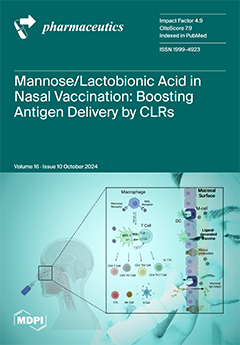
Cover Story: Ensuring the prompt and effective induction of mucosal immune responses is a critical area of study in immunology. Nasal vaccines, in particular, offer a promising approach to disease prevention by targeting mucosal tissues. This review delves into the complexities of engineering nasal vaccines with different glycoconjugates aimed at engaging specific C-type lectin receptors, as well as their performance in the nasal mucosa. A thorough analysis of these formulations demonstrated consistent antigen uptake patterns, while further studies confirmed improved immune responses compared to conventional nasal delivery systems. These findings underline the efficacy-boosting potential of targeting CLRs in nasal vaccine development to strengthen immune protection, offering new strategies for more effectively combating respiratory pathogens. View this paper
  • Issues are regarded as officially published after their release is announced to the table of contents alert mailing list .
  • You may sign up for email alerts to receive table of contents of newly released issues.
  • PDF is the official format for papers published in both, html and pdf forms. To view the papers in pdf format, click on the "PDF Full-text" link, and use the free Adobe Reader to open them.

Articles (108)

  • Article
  • Open Access
9 Citations
2,565 Views
22 Pages

Priming Mesenchymal Stem Cells with Lipopolysaccharide Boosts the Immunomodulatory and Regenerative Activity of Secreted Extracellular Vesicles

  • Aina Areny-Balagueró,
  • Marta Camprubí-Rimblas,
  • Elena Campaña-Duel,
  • Anna Solé-Porta,
  • Adrián Ceccato,
  • Anna Roig,
  • John G. Laffey,
  • Daniel Closa and
  • Antonio Artigas

Background: Mesenchymal stem cells (MSCs)-derived extracellular vesicles (EVs) have been proposed as an alternative to live-cell administration for Acute Respiratory Distress Syndrome (ARDS). MSC-EVs can be chiefly influenced by the environment to wh...

  • Article
  • Open Access
7 Citations
2,501 Views
13 Pages

Clindamycin-Loaded Polyhydroxyalkanoate Nanoparticles for the Treatment of Methicillin-Resistant Staphylococcus aureus-Infected Wounds

  • Muneeb Ullah,
  • Juho Lee,
  • Nurhasni Hasan,
  • Md. Lukman Hakim,
  • Dongmin Kwak,
  • Hyunwoo Kim,
  • Eunhye Lee,
  • Jeesoo Ahn,
  • Bora Mun and
  • Eun Hee Lee
  • + 2 authors

Background/Objectives: Owing to the growing resistance of methicillin-resistant Staphylococcus aureus (MRSA) to conventional antibiotics, the development of innovative therapeutic strategies for the treatment of MRSA-infected cutaneous wounds poses a...

  • Article
  • Open Access
6 Citations
5,812 Views
25 Pages

A Human Brain-Chip for Modeling Brain Pathologies and Screening Blood–Brain Barrier Crossing Therapeutic Strategies

  • Shek Man Chim,
  • Kristen Howell,
  • Alexandros Kokkosis,
  • Brian Zambrowicz,
  • Katia Karalis and
  • Elias Pavlopoulos

Background/Objectives: The limited translatability of preclinical experimental findings to patients remains an obstacle for successful treatment of brain diseases. Relevant models to elucidate mechanisms behind brain pathogenesis, including cell-spec...

  • Article
  • Open Access
1 Citations
2,141 Views
22 Pages

Capparis sepiaria-Loaded Sodium Alginate Single- and Double-Layer Membrane Composites for Wound Healing

  • Sindi P. Ndlovu,
  • Keolebogile S. C. M. Motaung,
  • Mapula Razwinani,
  • Sibusiso Alven,
  • Samson A. Adeyemi,
  • Philemon N. Ubanako,
  • Lindokuhle M. Ngema,
  • Thierry Y. Fonkui,
  • Derek T. Ndinteh and
  • Pradeep Kumar
  • + 2 authors

Background: Effective wound dressing is the key solution to combating the increased death rate and prolonged hospital stay common to patients with wounds. Methods: Sodium alginate-based single- and double-layer membranes incorporated with Capparis se...

  • Article
  • Open Access
1,717 Views
17 Pages

Background/Objectives: The World Health Organization has selected enterococci as one of the priority multidrug-resistant microorganisms for the development of new antibacterial drugs. Bacteriophages are promising antibacterial agents, but the biology...

  • Article
  • Open Access
1,477 Views
11 Pages

Background/Objectives: Epidemiological studies indicate a potential correlation between the consumption of polyphenols and a reduced risk of developing cardiovascular disorders. The present study investigates the potential of a red wine polyphenol or...

  • Article
  • Open Access
5 Citations
4,920 Views
14 Pages

Establishing a Relationship between In Vitro Potency in Cell-Based Assays and Clinical Efficacious Concentrations for Approved GLP-1 Receptor Agonists

  • Alessandro Boianelli,
  • Pär Nordell,
  • Joseph Earl,
  • Jacqueline Naylor,
  • David Hornigold,
  • Rasmus Jansson Löfmark and
  • Monika Sundqvist

Background: Glucagon-like peptide-1 receptor agonists (GLP-1RAs) play an important role in the treatment of type 2 diabetes (T2D) and obesity. The relationship between efficacy and dosing regimen has been studied extensively for this class of molecul...

  • Article
  • Open Access
7 Citations
2,651 Views
18 Pages

Immortelle Essential-Oil-Enriched Hydrogel for Diabetic Wound Repair: Development, Characterization, and In Vivo Efficacy Assessment

  • Marijana Andjic,
  • Jovana Bradic,
  • Aleksandar Kocovic,
  • Marko Simic,
  • Veljko Krstonosic,
  • Ivan Capo,
  • Vladimir Jakovljevic and
  • Nevena Lazarevic

Background: Alarming data revealed that 19% to 34% of adults with diabetes mellitus develop chronic wounds, which are characterized by impaired healing and a higher risk of infections. Inspired by the traditional use of immortelle for wound healing a...

  • Review
  • Open Access
4 Citations
2,968 Views
46 Pages

Mannose and Lactobionic Acid in Nasal Vaccination: Enhancing Antigen Delivery via C-Type Lectin Receptors

  • Mariana Colaço,
  • Maria T. Cruz,
  • Luís Pereira de Almeida and
  • Olga Borges

Background/Objectives: Nasal vaccines are a promising strategy for enhancing mucosal immune responses and preventing diseases at mucosal sites by stimulating the secretion of secretory IgA, which is crucial for early pathogen neutralization. However,...

  • Article
  • Open Access
3 Citations
1,999 Views
14 Pages

Background/Objectives: Coated drug pellets enjoy widespread use in hard gelatine capsules. In heterogeneous pellets, the drug substance is layered onto core pellets. Coatings are often applied to generate a retarded release or an enteric coating. Met...

of 11

Get Alerted

Add your email address to receive forthcoming issues of this journal.

XFacebookLinkedIn
Pharmaceutics - ISSN 1999-4923