You are currently viewing a new version of our website. To view the old version click .

Pharmaceutics, Volume 12, Issue 7

July 2020 - 94 articles

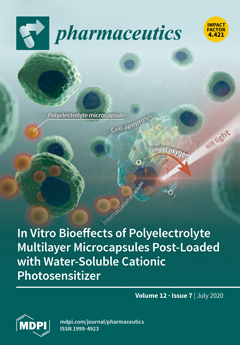
Cover Story: In this study, biodegradable polymeric multilayer microcapsules were assembled from dextran sulfate and poly-L-arginine, then loaded with a photosensitizer that efficiently eliminated cancer cells and microbial pathogens. The capsules were loaded with a water-soluble cationic photosensitizer, Cholosens, after removing the CaCO3 template. Possessing low toxicity in the original state, the encapsulated forms of Cholosens acquired significant cyto- and bacterial toxicity, which was triggered by 680 mn light and a result of the singlet oxygen generated by a photosensitizer. In this paper, we discovered the potential of Cholosens to be efficient as a PDT drug for both eukaryotic cells and bacteria at specified capsule-to-cell ratios. View this paper
  • Issues are regarded as officially published after their release is announced to the table of contents alert mailing list .
  • You may sign up for email alerts to receive table of contents of newly released issues.
  • PDF is the official format for papers published in both, html and pdf forms. To view the papers in pdf format, click on the "PDF Full-text" link, and use the free Adobe Reader to open them.

Articles (94)

  • Article
  • Open Access
24 Citations
5,365 Views
18 Pages

Approaches to Dose Finding in Neonates, Illustrating the Variability between Neonatal Drug Development Programs

  • John N. Van den Anker,
  • Susan McCune,
  • Pieter Annaert,
  • Gerri R. Baer,
  • Yeruk Mulugeta,
  • Ramy Abdelrahman,
  • Kunyi Wu,
  • Kevin M. Krudys,
  • Jeffrey Fisher and
  • William Slikker
  • + 3 authors

Drug dosing in neonates should be based on integrated knowledge concerning the disease to be treated, the physiological characteristics of the neonate, and the pharmacokinetics (PK) and pharmacodynamics (PD) of a given drug. It is critically importan...

  • Article
  • Open Access
15 Citations
4,528 Views
16 Pages

Silicon Nanofluidic Membrane for Electrostatic Control of Drugs and Analytes Elution

  • Nicola Di Trani,
  • Antonia Silvestri,
  • Yu Wang,
  • Danilo Demarchi,
  • Xuewu Liu and
  • Alessandro Grattoni

Individualized long-term management of chronic pathologies remains an elusive goal despite recent progress in drug formulation and implantable devices. The lack of advanced systems for therapeutic administration that can be controlled and tailored ba...

  • Article
  • Open Access
15 Citations
5,066 Views
13 Pages

Y-Site Physical Compatibility of Numeta G13E with Drugs Frequently Used at Neonatal Intensive Care

  • Katerina Nezvalova-Henriksen,
  • Niklas Nilsson,
  • Camilla Tomine Østerberg,
  • Vigdis Staven Berge and
  • Ingunn Tho

Preterm neonates require parenteral nutrition (PN) in addition to intravenous drug therapy. Due to limited venous access, drugs are often co-administered with PN via the same lumen. If incompatible, precipitation and emulsion destabilization may occu...

  • Article
  • Open Access
18 Citations
4,702 Views
16 Pages

Exploring the Effect of Esomeprazole on Gastric and Duodenal Fluid Volumes and Absorption of Ritonavir

  • Tom de Waal,
  • Jari Rubbens,
  • Michael Grimm,
  • Vincent Vandecaveye,
  • Jan Tack,
  • Werner Weitschies,
  • Joachim Brouwers and
  • Patrick Augustijns

Proton-pump inhibitors (PPIs), frequently prescribed to lower gastric acid secretion, often exert an effect on the absorption of co-medicated drug products. A previous study showed decreased plasma levels of the lipophilic drug ritonavir after co-adm...

  • Article
  • Open Access
19 Citations
4,199 Views
23 Pages

Study on Ajuga reptans Extract: A Natural Antioxidant in Microencapsulated Powder Form as an Active Ingredient for Nutraceutical or Pharmaceutical Purposes

  • Tiziana Esposito,
  • Francesca Sansone,
  • Giulia Auriemma,
  • Silvia Franceschelli,
  • Michela Pecoraro,
  • Patrizia Picerno,
  • Rita P. Aquino and
  • Teresa Mencherini

The administration of natural antioxidants is considered to be a prevention strategy for chronic diseases and a useful tool for the healthcare system to reduce the administration of expensive and often not effective treatments. The chemical character...

  • Review
  • Open Access
112 Citations
13,246 Views
18 Pages

The bioavailability of an orally administered small molecule is often dictated by drug-specific physicochemical characteristics and is influenced by many biological processes. For example, in fed or fasted conditions, the transit time within the gast...

  • Article
  • Open Access
1 Citations
4,041 Views
17 Pages

The efflux pump P-glycoprotein (P-gp) affects drug distribution after absorption in humans and animals. P-gp is encoded by the multidrug resistance gene (MDR1) gene in humans, while rodents (the most common preclinical animal model) express the two i...

  • Article
  • Open Access
22 Citations
5,419 Views
18 Pages

Formulation of Sustained Release Hydrophilic Matrix Tablets of Tolcapone with the Application of Sedem Diagram: Influence of Tolcapone’s Particle Size on Sustained Release

  • Anna Nardi-Ricart,
  • Isaac Nofrerias-Roig,
  • Marc Suñé-Pou,
  • Pilar Pérez-Lozano,
  • Montse Miñarro-Carmona,
  • Encarna García-Montoya,
  • Josep R. Ticó-Grau,
  • Raul Insa Boronat and
  • Josep M. Suñé-Negre

Hydrophilic matrix tablets are a type of sustained release dosage form characterized by distributing a drug in a matrix that is usually polymeric. Tolcapone is a drug that inhibits the enzyme catechol-O-methyl transferase. In recent years, it has bee...

  • Article
  • Open Access
11 Citations
3,797 Views
17 Pages

NIR Stimulus-Responsive PdPt Bimetallic Nanoparticles for Drug Delivery and Chemo-Photothermal Therapy

  • Chun Chu,
  • Zhihong Bao,
  • Meng Sun,
  • Xiaowei Wang,
  • Hongyan Zhang,
  • Weiguo Chen,
  • Yang Sui,
  • Ji Li,
  • Yuanyuan Zhuang and
  • Dongkai Wang

The combination of chemotherapy and phototherapy has attracted increasing attention for cancer treatment in recent years. In the current study, porous PdPt bimetallic nanoparticles (NPs) were synthesized and used as delivery carriers for the anti-can...

  • Article
  • Open Access
19 Citations
3,803 Views
15 Pages

mTHPC-Loaded Extracellular Vesicles Significantly Improve mTHPC Diffusion and Photodynamic Activity in Preclinical Models

  • Marie Millard,
  • Solène Posty,
  • Max Piffoux,
  • Jordane Jasniewski,
  • Henri-Pierre Lassalle,
  • Ilya Yakavets,
  • Florence Gazeau,
  • Claire Wilhelm,
  • Amanda K. A. Silva and
  • Lina Bezdetnaya

Extracellular vesicles (EVs), derived from the cell, display a phospholipid bilayer membrane that protects the cargo molecules from degradation and contributes to increasing their stability in the bloodstream and tumor targeting. EVs are interesting...

of 10

Get Alerted

Add your email address to receive forthcoming issues of this journal.

XFacebookLinkedIn
Pharmaceutics - ISSN 1999-4923