


Abstract
Neonatal calf diarrhea exhibits a complex multietiological landscape, yet diagnostic and vaccination paradigms remain historically anchored to Bovine Rotavirus A (BoRVA) and monovalent Bovine Coronavirus (BCoV) infections. The primary objective of this systematic review is to synthesize contemporary genomic evidence to elucidate the evolutionary dynamics, taxonomical diversity, and complex viral coinfection of underreported bovine enteric viruses. In strict adherence to PRISMA 2020 guidelines, we systematically searched Scopus and PubMed for primary genomic studies published between January 2016 and June 2026 and the protocol was pre-registered on OSF Registries on 15 May 2026. The AXIS tool was utilized to appraise the methodological quality of the included studies. Data synthesis involved taxonomical categorization and comparative analysis of clinical morbidity. From an initial 732 records, 70 high-quality studies were included. The review reveals a paradigm shift towards whole-genome sequencing (WGS) and metagenomics (24.3% of studies), uncovering a highly heterogeneous virome driven by Caliciviridae, Picornaviridae, Coronaviridae, and Astroviridae. While BCoV represents 38.6% of the monovalent evidence, multivalent approaches demonstrate that clinical morbidity is significantly amplified by viral co-infections. Notably, evidence from the included literature indicates that tripartite infections (e.g., Bovine Astrovirus + BoRVA + Bovine Kobuvirus) are significantly associated with a higher risk of severe morbidity (OR = 14.82). Furthermore, individual phylodynamic studies report localized instances of rapid mutational dynamics (e.g., in BCoV) and persistent homologous recombination, facilitating structural divergence and immune evasion. The synthesis demonstrates that bovine enteritis is strongly associated with an altered enteric viral-community composition rather than isolated single-pathogen invasions. Future veterinary diagnostics and multivalent vaccine designs must address the genomic plasticity and complex co-detection patterns of the enteric viral consortium.
1. Introduction
Neonatal calf diarrhea (NCD) and associated enteric complexes are among the most devastating conditions facing the global livestock industry [1,2], resulting in severe financial losses due to direct mortality, loss of body condition, and a marked decrease in milk production in adult cows [3,4,5]. Conventionally, the viral etiology of the aforementioned syndrome, in conjunction with the established diagnostic algorithms, has predominantly concentrated on well-documented primary pathogens, such as Bovine Rotavirus A (BoRVA) and Bovine Coronavirus (BCoV), which cause endemic gastrointestinal and respiratory diseases worldwide [6,7,8]. However, this linear approach underestimates the multifactorial nature of NCDs and downplays the role of multiple emerging pathogens [9].
With the arrival of next-generation sequencing (NGS) and viral metagenomics, it has become evident that the bovine gastrointestinal tract harbors a complex ecosystem in which numerous viral families—historically overlooked or considered “orphan” in clinical diagnosis—co-circulate [10,11,12,13,14]. For example, bovine norovirus (BNoV) has recently emerged as one of the leading pathogens causing diarrhea in calves [15]. Furthermore, in-depth characterization of agents belonging to the Astroviridae, Picornaviridae, and certain Coronaviridae families shows that these viruses are constantly evolving through rapid mutations and inter- and intra-genotypic genetic recombination events [15,16,17].
Notwithstanding this technological advancement, a critical gap persists in the extant literature. The actual epidemiological impact and biological integration of these pathogens have not been conclusively summarized [9,12]. There is intense debate regarding the pathogenic role of emerging viruses, given that agents such as BCoV are detected at high prevalence rates not only in calves with diarrhea (37.46%), but also in clinically healthy animals (20.50%) [5]. This phenomenon of subclinical excretion suggests that NCD is rarely the result of a monovalent infection, but rather the result of mixed infections and pathogenic synergies in which minor viruses act as factors that exacerbate morbidity [10,18].
In order to address this knowledge gap and organize the fragmented evidence, this systematic review was structured in strict accordance with the updated guidelines of the PRISMA 2020 statement [19]. The objective of this study is to provide a critical synthesis of the genomic findings reported in recent literature in order to: (i) systematically evaluate the spatiotemporal distribution and technological transition in bovine virome sequencing; (ii) map the taxonomic and phylodynamic diversity of underdiagnosed bovine enteric viruses; (iii) synthesize the targeted genomic regions (e.g., WGS versus partial amplicons) and the impact of viral recombination on their evolution; and (iv) redefine their etiological role in the synergistic pathogenesis of bovine diarrhea through quantitative pooled genomic detection rates.
2. Materials and Methods
2.1. Search Strategy and Information Sources
A systematic literature review was conducted in strict accordance with the PRISMA 2020 guidelines (Preferred Reporting Items for Systematic Reviews and Meta-Analyses) [19]. To map the genomic and evolutionary landscape of bovine enteric viruses, an exhaustive search was conducted on 9 June 2026, utilizing Scopus and PubMed. Scopus was strategically selected as the primary macro-database because it provides 100% coverage of Embase (a critical source for veterinary, pharmacological, and biomedical literature), thereby ensuring a massive retrieval footprint without the need for redundant database queries.
The search algorithm was structured to cover three conceptual domains: (i) host species, (ii) target viral pathogens, and (iii) genomic/sequencing methodologies. To ensure reproducibility and consistency in search sensitivity, the exact same Boolean syntax was applied to both databases. For Scopus, the TITLE-ABS-KEY syntax was utilized, whereas for PubMed, the equivalent [Title/Abstract] tags were applied. The root query used was: [(cattle OR bovine OR calf OR calves) AND (virome OR “enteric virus*” OR astrovirus* OR “bovine coronavirus” OR norovirus* OR kobuvirus* OR torovirus*) AND (genom* OR “sequence analysis” OR “OR phylogen* OR metagenom* OR “next-generation sequencing” OR ngs)]. The protocol for this systematic review was pre-registered on the Open Science Framework (OSF) Registries on 15 May 2026 (stable DOI: https://osf.io/6kjbe/, accessed on 23 October 2026), prior to the initiation of the formal search. This ensures transparency and reproducibility, and we confirm there were no methodological deviations from the original protocol. While the explicit query targeted established viruses, the broad inclusion of the term “virome” effectively captured additional emerging agents discussed subsequently.
2.2. Eligibility Criteria
To ensure that the synthesis captured high-throughput, contemporary genomic data, the time frame was restricted to a ten-year window, from 1 January 2016, to 9 June 2026. Inclusion criteria were strictly limited to primary research articles published in English. In Scopus, filters were applied to restrict the results to Open Access literature, ensuring transparency and full availability of methodological and genomic data. While the primary focus was neonatal calf diarrhea, studies comprising asymptomatic calves and adult cattle were explicitly included to serve as comparative cohorts for assessing subclinical shedding and baseline viral-community composition.
Studies were excluded if they were: (1) narrative reviews, editorials, or conference abstracts lacking primary genomic data; (2) studies focused exclusively on systemic bovine viruses. In particular, Bovine Viral Diarrhea Virus (BVDV) and other systemic or immunosuppressive agents [e.g., Bovine Herpesvirus 1 (BoHV-1) and Bovine Immunodeficiency Virus (BIV)] were methodically ruled out; despite occasionally presenting secondary gastrointestinal symptoms, they are essentially systemic agents that cause severe immunosuppression and mucosal illness. Systemic immunomodulators would confound the localized ecological dysbiosis unique to primary enteric viromes. Conversely, pathogens exhibiting dual tropism, such as Bovine Coronavirus (BCoV), were strictly included because they act as primary, direct mucosal pathogens in the gastrointestinal tract of neonatal calves, driving local enteric damage without inducing the profound systemic lymphoid depletion characteristic of BVDV.
2.3. Study Selection, Data Extraction, and Quality Assessment
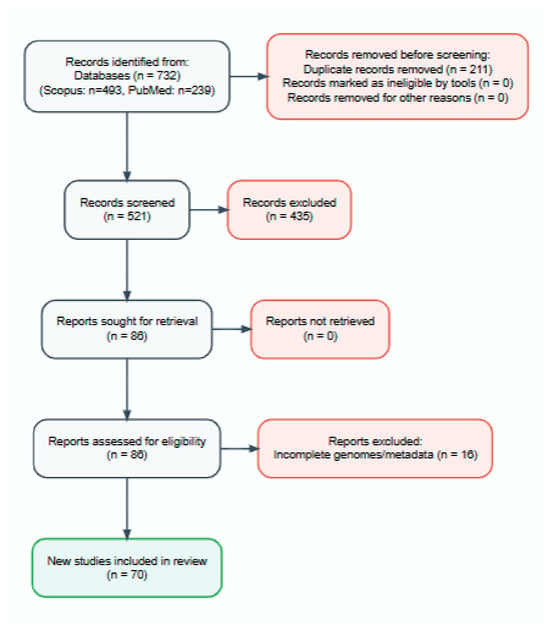
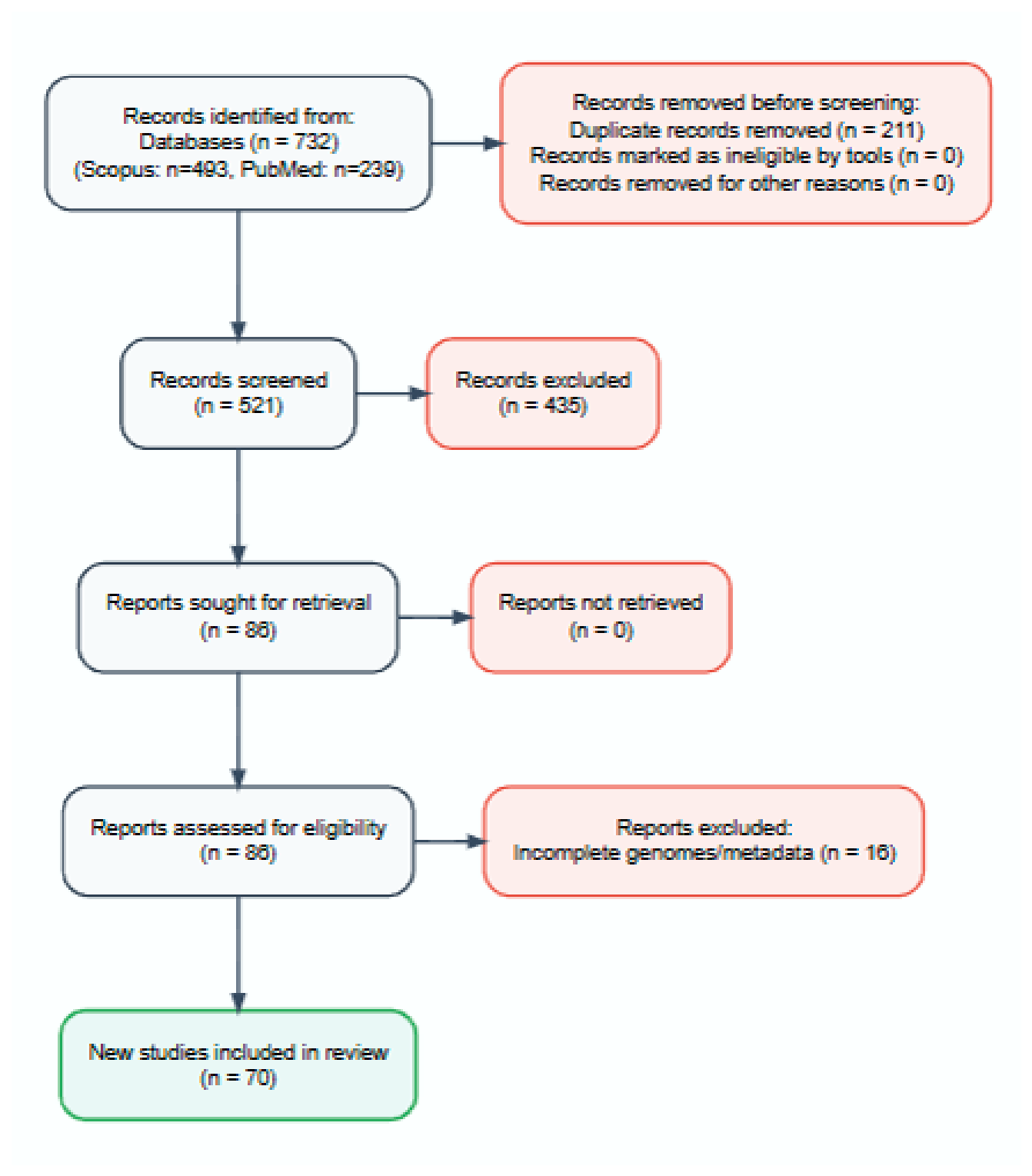
The systematic search yielded a total of 732 records (Scopus: n = 493; PubMed: n = 239). After systematically exporting the citations to the Zotero reference manager, exact duplicates were manually removed, resulting in 521 unique records. During the initial screening phase, two independent reviewers (M.C. and N.T.C.M.) blindly assessed the titles and abstracts against the predefined eligibility criteria, leading to the exclusion of 435 irrelevant records.
Subsequently, the full text of 86 reports was retrieved, and these were subjected to a rigorous secondary screening. Disagreements among the primary reviewers were resolved by consensus or by arbitration by a third senior author (L.N.). Following the full-text evaluation, 16 articles were excluded, primarily due to the absence of complete functional genomic sequences or ambiguity in the host’s clinical metadata.
Given that all 70 eligible studies fundamentally employed observational cross-sectional or single-timepoint genomic surveillance designs, their methodological quality and risk of bias were independently assessed by two reviewers (M.C. and N.T.C.M.) using the Appraisal Tool for Cross-Sectional Studies (AXIS) [20] without requiring structural adaptation. Discrepancies in quality scores were resolved by consensus or, when necessary, by adjudication by a third senior author (L.N.). The critical appraisal addressed 20 standardized domains, with particular emphasis on the representativeness of the sampling frame for cattle herds, the justification for the clinical sample size, and the rigor of nucleic acid extraction and sequencing protocols (e.g., WGS) (Figure 1). The domain-specific results of this critical appraisal for all 70 included studies are detailed in Supplementary Material—Table S1.
Figure 1.
PRISMA 2020 flowchart detailing the study search and selection process.
Data Extraction Variables and Statistical Synthesis
A standardized data extraction protocol was applied to all 70 studies. Extracted variables included: publication year, country, host population, viral species, sample type, sequencing method, and genomic region examined. A comprehensive summary of these characteristics is provided in Supplementary Material—Table S2.
It is imperative to clarify that this study constitutes a systematic synthesis of primary literature. Metrics regarding evolutionary dynamics, substitution rates, and recombination events were extracted exactly as reported by the original authors. For quantitative synthesis, extracted genomic detection rates and co-infection events were tabulated. The pooled global and regional detection rates (reported with 95% Confidence Intervals) were calculated using a random-effects model (DerSimonian–Laird estimator), defining the denominator strictly as the total sample size of studies reporting the specific viral agent. Reported clinical morbidity risks (such as Odds Ratios, including the dual-infection OR of 8.14 and the tripartite OR of 14.82) were extracted directly as point estimates from specific primary studies [18] rather than generated via a pooled meta-analytic calculation, due to the high methodological heterogeneity and sparse contingency cells across primary reports. Data processing was conducted using R software (version 4.2.1, meta package).
3. Results
3.1. Descriptive Synthesis: Spatiotemporal Distribution and Technological Transition
The systematic selection process resulted in the inclusion of 70 primary articles that strictly met the genomic and clinical eligibility criteria. Analysis of the time window (2016–2026) revealed a steady upward trend in research on non-rotavirus enteric viromes, culminating in a peak in scientific output concentrated between 2024 (n = 15) and 2025 (n = 11). Although the systematic search extended until June 2026, only a single study fully met the highly stringent eligibility criteria for the current year. Since a large portion of the raw genomic data produced in early 2026 is still being developed, undergoing peer review, or lacking the clinical context necessary for inclusion, this appropriately represents the stringent need for comprehensive whole-genome sequencing (WGS) and explicit clinical information.
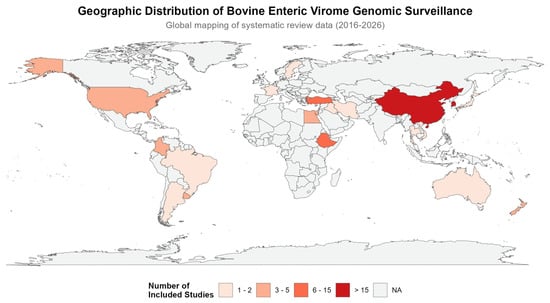
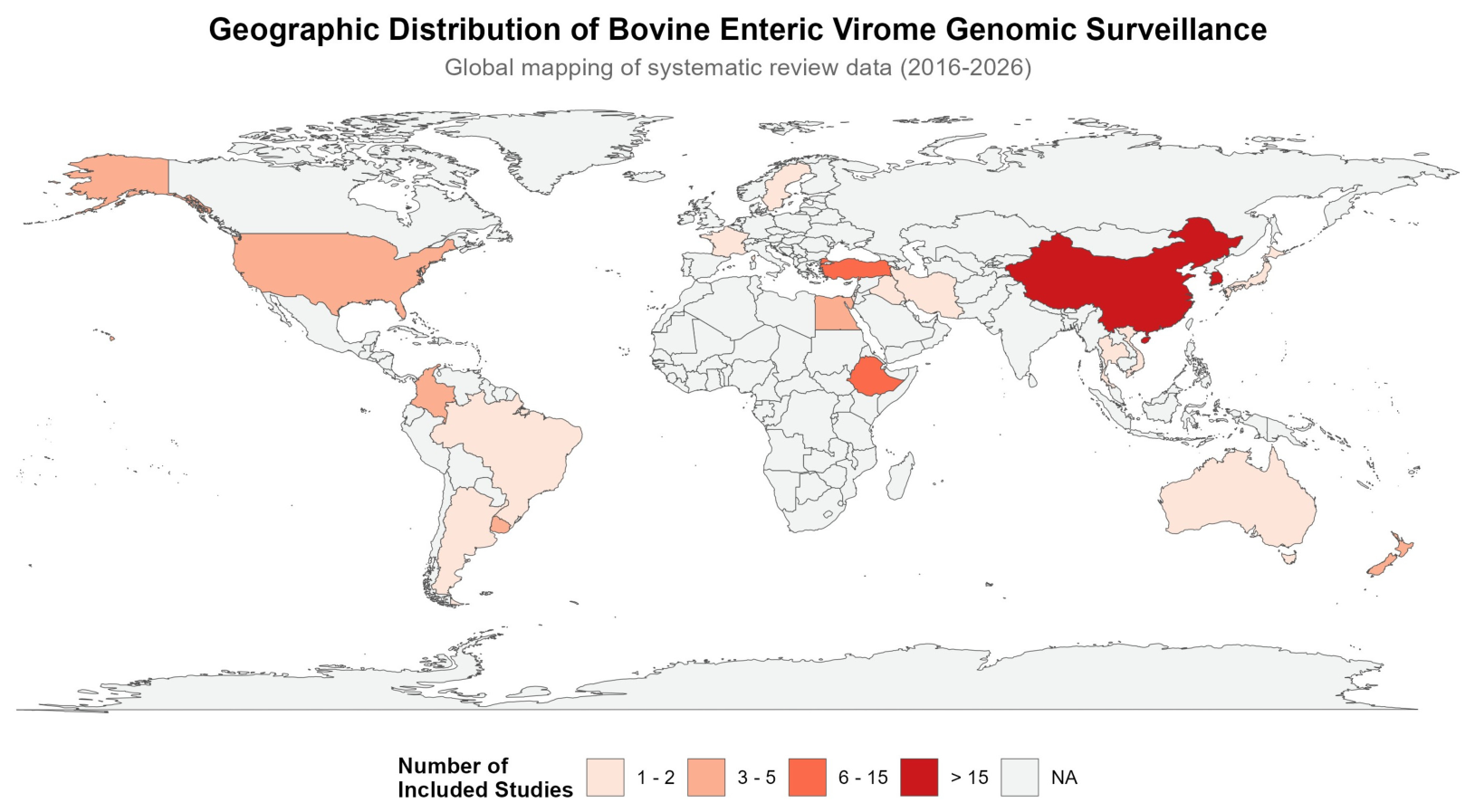
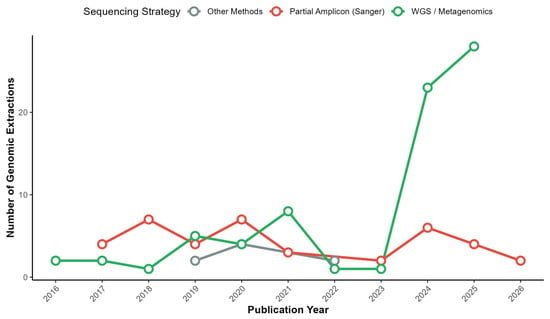
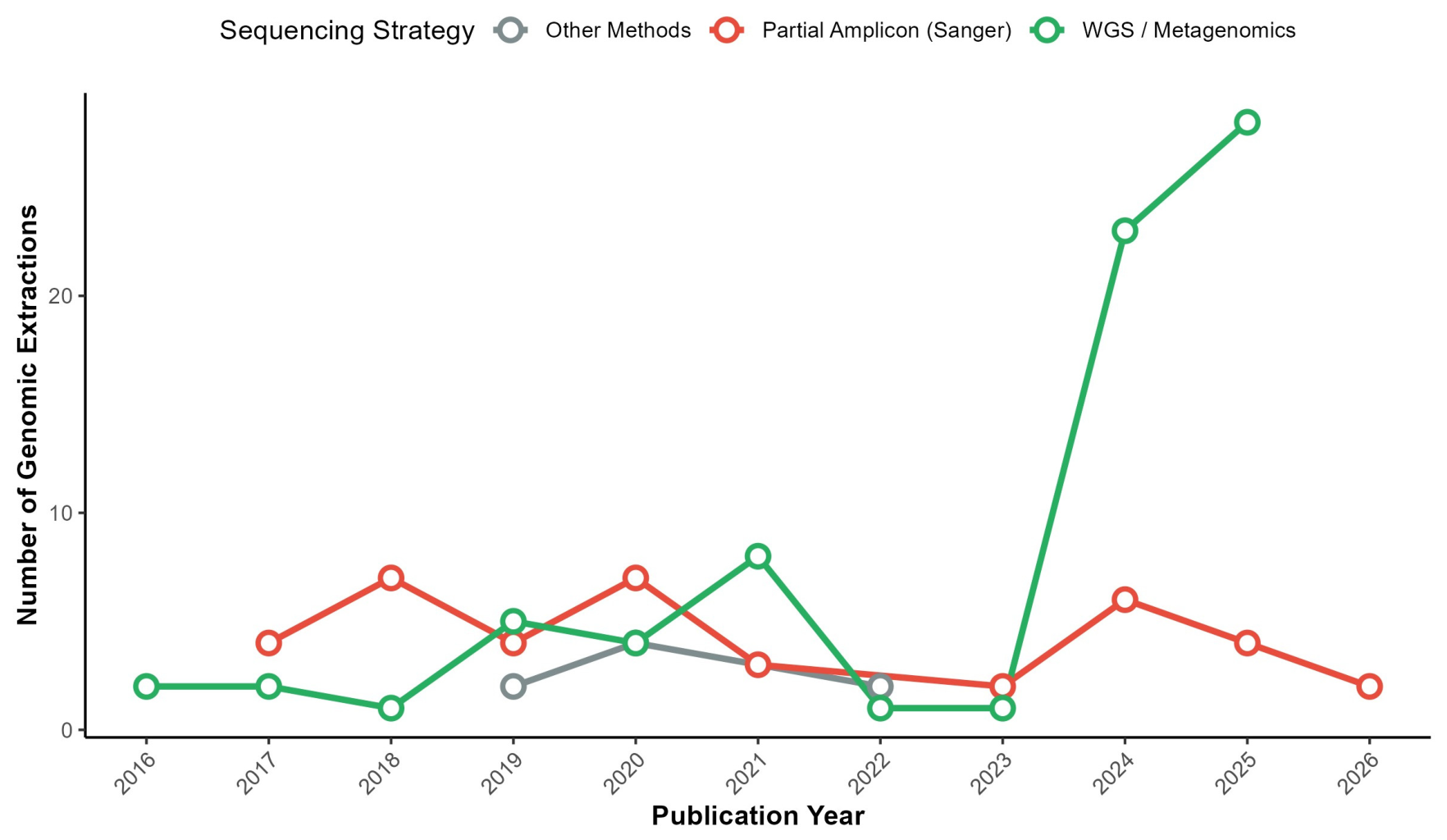
Geographic mapping revealed a strong bias in global epidemiological surveillance. Asia dominated the production of bovine enteric genomes (China n = 38, Turkey n = 13, South Korea n = 13), presenting a marked asymmetry compared to the Americas (n = 11), Africa (n = 13), and Western Europe (n = 4) (Figure 2). In parallel with geographic expansion, an analysis of sequencing methodologies revealed a technological paradigm shift. While early research relied on partial amplicons, contemporary surveillance has shifted decisively toward NGS platforms and cell culture-independent WGS metagenomics (Figure 3). This approach has overcome the limitations of classical in vitro viral isolation by employing de novo assembly algorithms together with advanced taxonomic profiling tools.
Figure 2.
Geographic Distribution of Bovine Enteric Virome Genomic Surveillance.
Figure 3.
Shift in the methodological paradigm toward next-generation sequencing (2016–2026).
Regarding methodological quality, the 70 included studies were appraised using the AXIS tool (Supplementary Material—Table S1). Overall, the cohort demonstrated robust methodological rigor: 62 studies (88.5%) were categorized as high quality (meeting ≥16 of 20 criteria), and 8 studies (11.5%) as moderate quality (meeting 14–15 criteria). No studies that met the genomic inclusion criteria were subsequently excluded based solely on quality scores. The most frequent methodological weaknesses identified across the cohort were the absence of a priori sample size justification for field surveillance (AXIS Q3) and a lack of formal assessment of non-response bias (AXIS Q7 and Q14), which are common, expected limitations in opportunistic veterinary field sampling. Because no low-quality studies were retained in the final synthesis, and key estimates (such as the specific co-infection Odds Ratios) were derived exclusively from high-quality primary cohorts, a sensitivity analysis excluding low-quality records was not applicable.
3.2. Taxonomic Diversity of the Bovine Enteric Virome
The methodological exclusion of studies focused solely on the systematic synthesis of the 70 eligible studies reveals a highly heterogeneous pathogenic ecosystem, marking a notable departure from the traditional dogma centered exclusively on BoRVA. The taxonomic distribution of the recovered sequences confirms the existence of a diversified enteric virome, dominated by four major viral families: Caliciviridae (n = 17), Picornaviridae (n = 13), Coronaviridae (n = 28), and Astroviridae (n = 7).
At the species level, BCoV remains the agent subject to the most genomic scrutiny, with 28 independent characterizations or complete assemblies. However, a critical mass of emerging evidence documents a shift toward pathogens that have historically been overlooked or considered “orphan” pathogens. Specifically, a sustained increase was observed in genomic surveillance targeting Bovine Norovirus (BNoV; n = 7) and Bovine Torovirus (BToV; n = 4), whose high detection rate in clinical diarrhea cohorts suggests an underestimated primary etiological role in conventional diagnostic algorithms.
Furthermore, the detection of bovine astroviruses (BoAstV; n = 3) and bovine kobuviruses (BKoV; n = 10) in comprehensive metagenomic surveillance studies underscores the complexity of neonatal viral etiology. This taxonomic distribution (Table 1) confirms that enteric disease in calves should not be interpreted as a monovalent phenomenon, but rather as a viromic dysbiosis wherein the coexistence of multiple viral families contributes to the clinical picture. These findings lend credence to the theory that cattle serve as an active reservoir for interspecies recombination, enabling the formation of clades that could put the livestock reservoir under immunological pressure.
Table 1.
Breakdown of Genomic Studies by Primary Viral Focus (2016–2026).
3.3. Evolutionary Dynamics, Recombination, and Genomic Markers
Phylodynamic analysis of the recovered sequences reveals profound evolutionary plasticity in the enteric virome, driven by accelerated substitution rates and recombination events. As detailed in Table 2, molecular clock analyses based on S-gene sequences for pathogens such as BCoV estimated an accelerated evolutionary rate of 5.055 × 10⁻⁴ substitutions per site per year (95% Confidence Interval: 4.4448 × 10⁻⁴ to 5.6832 × 10⁻⁴). It is crucial to note that this specific estimate derives from a single study [5] analyzing a finite number of isolates; thus, while it highlights profound genomic plasticity, its global generalizability must be interpreted with caution.
Table 2.
Genomic Alteration (Mutation, Deletion, or Recombination).
Far from being mere incidental findings, genomic evidence demonstrates that these structural alterations—including deletions within the receptor-binding domain and conserved mutations in membrane proteins—have a direct phenotypic impact. In the case of BoAstV, the extreme nucleotide divergence (39.9% identity compared to reference sequences) and the confirmation of cross-recombination with wildlife establish cattle as an active epidemiological mixing reservoir. This evolutionary convergence facilitates immune evasion and viral adaptation, which are key factors for the survival and persistence of these underdiagnosed pathogens in modern intensive production systems.
3.4. Clinical Impact, Subclinical Excretion, and Complex Viral Coinfection
To ensure conceptual clarity, this review explicitly distinguishes between genomic detection (presence of viral nucleic acid), subclinical shedding (detection in asymptomatic hosts), and clinical morbidity (active infection associated with overt enteric disease). The pooled prevalence analysis of a consolidated global sample of 39,147 cattle yielded a genomic detection rate of 10.86% (n = 4251). However, stratification by continent revealed marked epidemiological heterogeneity. While extensive surveillance in Asia (n = 34,833) reported a diluted detection rate of 8.92%, indicative of a high proportion of subclinical carriers, evidence from the Americas (n = 2343) demonstrated an exponentially higher disease burden, with a morbidity-associated detection rate of 38.71%. Nevertheless, Africa and Western Europe reported positivity rates of 17.09% and 9.77%, respectively. This statistical asymmetry suggests that, in the West, the diagnosis of these “orphan” viruses remains heavily skewed toward cohorts presenting acute morbidity.
The integration of retrieved clinical metadata challenges the traditional dogma of linear pathogenicity. Systematic analysis reveals a clear epidemiological dichotomy: while some agents possess primary etiological capacity, others function primarily as synergistic amplifiers. In diarrhea cohorts negative for classic pathogens (BoRVA, Cryptosporidium, E. coli), agents such as BToV emerged with genomic detection rates of up to 16.7%, highlighting their strong association with severe clinical enteritis even in monovalent detections.
Large-scale genomic surveillance (N > 900) of BCoV indicates widespread viral circulation within the bovine reservoir. BCoV sequences have been recovered at rates of 37.46% in specific diarrheic cohorts and up to 20.50% in separate asymptomatic cohorts [5]. Because these observations derive from distinct studies with heterogeneous populations and sampling frames, direct statistical comparisons cannot be made. However, this high frequency of subclinical shedding suggests that genomic detection alone does not equate to pathogenesis; nonetheless, the expression of clinical virulence depends heavily on environmental stressors or coinfection events.
The shift toward metagenomic approaches independent of viral isolation has made it possible to unravel this complexity, identifying agents that historically evaded in vitro isolation. The seventeen contemporary multivalent studies included in this review demonstrate that the coexistence of multiple viral families is the primary driver of the alteration of the enteric viral-community composition. BoAstV illustrates this “synergistic amplifier” paradigm: its detection alone was associated with a marginal clinical impact, whereas its coinfection with BoRVA was strongly associated with an increased likelihood of severe diarrhea (e.g., an individual study report indicating an unadjusted OR of 8.14, p = 0.001 [18]). Furthermore, this associative pattern reached higher magnitudes in specific primary evaluations of tripartite infections (BoAstV + BoRVA + BKoV), which reported an association with severe morbidity reaching an OR of 14.82 (p < 0.001 [18]); however, these estimates should be interpreted with caution given the limited number of studies and sparse cells evaluating such specific co-infection combinations. These findings offer a novel conceptualization of bovine enteritis as a viral and microbial dysbiosis, thereby underscoring the need for an update to existing diagnostic tools.
4. Discussion
4.1. From Incidental Discovery to Complex Viral Coinfection: The Rise of “Orphan” Viruses”
The classic paradigm of neonatal bovine gastroenteritis has historically been dominated by the triad of BoRVA, BCoV, and E. coli. However, the present genomic analysis demonstrates that the systematic exclusion of these primary pathogens reveals an underlying virome that is highly prevalent and pathogenic. Current evidence highlights that agents previously marginalized as “orphans” or commensals—specifically BToV (up to 16.7%) and BNoV (up to 19.82%)—exhibit sustained genomic detection rates in concentrated herds, consolidating their status as clinically significant agents strongly associated with morbidity in the absence of classic co-infections.
However, the notable finding of this review is the shift toward a model of synergistic pathogenesis or viral dysbiosis. BoAstV exemplifies this ecological phenomenon: rarely detected as a singular causative factor, its simultaneous existence with BoRVA significantly heightens clinical severity, which is strongly associated with an elevated likelihood of severe diarrhea (OR = 8.14). This “amplification” effect reaches critical levels (OR = 14.82) during tripartite infections involving BKoV. At the same time, extensive surveillance shows that BCoV maintains massive subclinical shedding, with viral genomes detected in up to 20.50% of apparently healthy cattle in some cohorts, parallel to high detection rates (37.46%) in separate diarrhea-affected cohorts. While the lack of within-study case–control matching precludes direct statistical comparison, this pattern suggests that the alteration of the enteric viral-community composition and the onset of clinical symptoms depend more on network interactions among multiple viral families than on the mere invasion of a single pathogen.
4.2. Genomic Plasticity: Key Mutations and Convergent Evolution
To maintain this endemic status and evade immune pressure in the bovine reservoir, these enteric viruses have deployed rapid evolutionary strategies of genomic plasticity. Recent molecular clock analyses based on specific localized cohorts [5] estimated a BCoV evolutionary rate of 5.055 × 10⁻⁴ substitutions per site per year. Because molecular clock rates are highly dependent on the dataset, substitution model, and sampling time span, this metric is presented strictly as a narrative example of localized mutational dynamics rather than a universal baseline. Nevertheless, this localized selective pressure is prominently manifested in genes such as the Hemagglutinin-Esterase (HE) gene, a critical determinant of viral attachment and release. Recent literature has documented insertion events (e.g., ‘KATV’ motifs) and 12-nucleotide deletion events (e.g., ‘NGKF’) in the receptor-binding domain (RBD) of the HE gene in North American and Asian strains. Surprisingly, predictive structural models computed by the original authors of these primary studies [17,31,42] reveal that, although these mutations severely alter the beta-sheet architecture in the R3 loop, the domains retain their ability to bind 9-O-acetyl-sialic acid and their esterase activity. This evidence points to convergent evolution designed to alter antigenic epitopes without sacrificing cellular tropism.
At the same time, WGS has revealed that the evolution of these agents is not limited to antigenic drift (point mutations), but is strongly driven by recombination events. Robust intra-genotypic recombinations have been confirmed in circulating BCoV strains (e.g., mutations at S501/F and deletions at 206-SRA-208 in the N protein), and, more critically, interspecies recombination events in BoAstV, where the exchange of genomic material between bovine astroviruses and genomes from wildlife [roe deer (Capreolus capreolus) and takins (Budorcas taxicolor)] has been demonstrated. This cross-species recombination dynamic confirms that cattle serve as a highly active “mixing vessel,” facilitating the emergence of new pathogenic clades.
4.3. Epidemiological Blind Spots and Asymmetry in Genomic Surveillance
Geospatial mapping in this review revealed a structural asymmetry in global virome surveillance [11,66,69]. The overwhelming concentration of genomic sequencing in Asia—led by China, Turkey, and South Korea—exhibits a notable divergence from the fragmentation of genomic surveillance observed in the Western Hemisphere and Europe (Italy, France, and Sweden) [13,14,26,66]. This disparity does not necessarily reflect an absence of minor pathogens (such as BoAstV or BNoV) in the Americas, but rather an artifact of surveillance priorities. It is plausible that Asian animal health agencies, driven by recent zoonotic and epizootic emergencies, have adopted WGS metagenomics as the frontline standard in production medicine [26,63]. In contrast, surveillance in regions with a strong livestock industry (such as North America and South America) appears to remain focused on molecular diagnostic assays (qPCR) targeting only classical pathogens (rotavirus, coronavirus, BVDV), ignoring the full genomic picture and leaving “orphan” viruses off the epidemiological radar.
4.4. Limitations of the Study
In strict accordance with the PRISMA 2020 reporting guidelines [19], it is imperative to acknowledge certain methodological limitations of this review. First, the geographic bias discussed above may be partially exacerbated by our methodological restriction to Open Access literature. While this decision ensured complete transparency and accessibility to genomic metadata repositories, it is possible that Western genomes published under traditional subscription models may have been omitted (n = 4 records were excluded solely due to non-Open Access paywalls, predominantly from European cohorts). As correctly highlighted by peer review, the strict restriction to English-language and Open-Access literature introduces a demonstrable directional bias: it inherently skews the synthesis toward well-funded, large-scale national surveillance programs (particularly from Asia) while likely underrepresenting regional, small-scale veterinary reports from the Americas, Europe, or Africa published in local languages or behind paywalls. This limitation dictates that our geographic asymmetry findings (Section 4.3) must be interpreted partly as an artifact of publication accessibility rather than a strict biological absence of these viruses in the West. Furthermore, formal statistical assessment of publication bias (e.g., via funnel plots) was not performed, as standard asymmetry tests are generally unreliable for observational prevalence data lacking bidirectional effect sizes.
Second, the extraction of clinical data revealed inconsistent granularity in the metadata of the primary studies. A significant proportion of the studies lacked rigorous stratification with respect to critical confounding variables, such as host vaccination status, colostrum intake, production system, and the exact age of the calves in days, and coinfection with the bacterial microbiome (absence of 16S rRNA profiles) or parasites (e.g., Cryptosporidium). This shortcoming makes it difficult to mathematically isolate the purely viral pathogenic effect from underlying bacterial dysbiosis.
Finally, a “genomic representativeness bias” was detected in several of the analyzed studies: while prevalence was calculated based on hundreds of fecal samples (n > 500), evolutionary and phylodynamic conclusions were frequently extrapolated from whole-genome sequencing of a marginal number of isolates (e.g., n ≤ 3) [5], which limits the population-level inferential power regarding the true mutation rate in the field.
5. Conclusions
Neonatal bovine diarrhea can no longer be addressed under the historical dogma of “one pathogen, one disease.” Genomic and epidemiological findings from the past decade demonstrate that previously underestimated viral entities—such as bovine astrovirus, norovirus, and torovirus—are significantly associated with primary pathogenesis or act as co-factors strongly linked to clinical morbidity through complex co-infections. Simultaneously, well-established pathogens such as bovine coronavirus exhibit localized evidence of rapid mutational dynamics, intra- and cross-species recombination events, and persistent subclinical shedding. Taken together, these findings support redefining bovine enteritis as a condition of viral dysbiosis. Effective control of this disease will require that future diagnostic platforms and vaccine design strategies move away from a monovalent approach and adopt multivalent models adapted to the high genomic plasticity of this viral consortium.
Supplementary Materials
The following supporting information can be downloaded at https://osf.io/6kjbe/ (accessed on 23 October 2026), Table S1: Methodological quality appraisal of the 70 included studies using the AXIS tool; Table S2: Comprehensive characteristics and genomic metadata of included studies; Table S3: PRISMA checklist.
Author Contributions
M.C.: Conceptualization, methodology, formal analysis, investigation, visualization, data curation, project administration, writing—original draft preparation; N.T.C.M.: conceptualization, methodology, formal analysis, investigation, visualization, data curation, project administration, writing—original draft preparation; M.I.: investigation, writing—review and editing; L.N.: validation, project administration, funding acquisition and writing—review and editing. All authors have read and agreed to the published version of the manuscript.
Funding
This study was funded by the Universidad de Las Americas, Quito—Ecuador research grant #596.A.XVII.25.
Institutional Review Board Statement
Not applicable.
Informed Consent Statement
Not applicable.
Data Availability Statement
The original contributions presented in this study are included in the article and its Supplementary Material. The raw data extraction sheets and the R scripts utilized for the statistical synthesis have been deposited in the Open Science Framework (OSF) and are publicly accessible at https://osf.io/6kjbe/ (accessed on 23 October 2026).
Conflicts of Interest
The authors declare no conflicts of interest.
Abbreviations
The following abbreviations are used in this manuscript:
| BCoV | Bovine Coronavirus |
| BEV | Bovine Enterovirus |
| BKoV | Bovine Kobuvirus |
| BNoV | Bovine Norovirus |
| BoAstV | Bovine Astrovirus |
| BoRVA | Bovine Rotavirus A |
| BToV | Bovine Torovirus |
| HE | Hemagglutinin-Esterase |
| NCD | Neonatal Calf Diarrhea |
| NGS | Next-Generation Sequencing |
| OR | Odds Ratio |
| PRISMA | Preferred Reporting Items for Systematic Reviews and Meta-Analyses |
| RBD | Receptor-Binding Domain |
| WGS | Whole-Genome Sequencing |
References
- Chen, J.; Meng, W.; Zeng, H.; Wang, J.; Liu, S.; Jiang, Q.; Chen, Z.; Ma, Z.; Wang, Z.; Li, S.; et al. Epidemiological survey of calf diarrhea related viruses in several areas of Guangdong Province. Front. Microbiol. 2024, 15, 1441419. [Google Scholar] [CrossRef] [Scilit] [PubMed]
- Ma, Z.; Jiang, Q.; Quan, C.; Liu, L.; Zhang, Z.; Xie, J.; Zhao, L.; Zhong, Q.; Yao, G.; Ma, X. The first complete genome sequence and genetic evolution analysis of bovine norovirus in Xinjiang, China. J. Vet. Res. Pol. 2024, 68, 1–8. [Google Scholar] [CrossRef] [Scilit] [PubMed]
- Shi, Z.; Wang, W.; Xu, Z.; Zhao, M.; Lan, Y. Detection and molecular characterization of BCoVs circulating in central China based on the full-length spike gene. Kafkas Univ. Vet. Fak. Derg. 2020, 26, 181–186. [Google Scholar] [CrossRef] [Scilit]
- Singasa, K.; Songserm, T.; Lertwatcharasarakul, P.; Arunvipas, P. Molecular and phylogenetic characterization of bovine coronavirus virus isolated from dairy cattle in Central Region, Thailand. Trop. Anim. Health Prod. 2017, 49, 1523–1529. [Google Scholar] [CrossRef] [Scilit] [PubMed]
- Qi, S.; Yang, Y.; Deng, J.; Wang, X.; Li, Y.; Sun, J.; Li, Q.; Yang, S.; Yin, G.; Li, Y.; et al. Whole-Genome Sequencing Reveals the Evolutionary Characterization of Bovine Coronavirus. Transbound. Emerg. Dis. 2025, 2025, 5152361. [Google Scholar] [CrossRef] [Scilit]
- Redda, Y.T.; Adamu, H.; Bergholm, J.; Lindahl, J.F.; Blomström, A.-L.; Berg, M.; Sisay Tessema, T. Detection and characterization of bovine coronavirus and rotavirus in calves in Ethiopia. BMC Vet. Res. 2025, 21, 122. [Google Scholar] [CrossRef] [Scilit] [PubMed]
- Bergholm, J.; Tessema, T.S.; Blomström, A.-L.; Berg, M. Detection and molecular characterization of major enteric pathogens in calves in central Ethiopia. BMC Vet. Res. 2024, 20, 389. [Google Scholar] [CrossRef] [Scilit] [PubMed]
- Mohamed, F.F.; Mansour, S.M.G.; El-Araby, I.E.; Mor, S.K.; Goyal, S.M. Molecular detection of enteric viruses from diarrheic calves in Egypt. Arch. Virol. 2017, 162, 129–137. [Google Scholar] [CrossRef] [Scilit] [PubMed]
- Castells, M.; Caffarena, R.D.; Casaux, M.L.; Schild, C.; Castells, F.; Castells, D.; Victoria, M.; Riet-Correa, F.; Giannitti, F.; Parreño, V.; et al. Detection, risk factors and molecular diversity of norovirus GIII in cattle in Uruguay. Infect. Genet. Evol. 2020, 86, 104613. [Google Scholar] [CrossRef] [Scilit] [PubMed]
- Zhu, Q.; Qi, S.; Guo, D.; Li, C.; Su, M.; Wang, J.; Li, Z.; Yang, D.; Sun, H.; Wang, X.; et al. A survey of fecal virome and bacterial community of the diarrhea-affected cattle in northeast China reveals novel disease-associated ecological risk factors. mSystems 2024, 9, e0084223. [Google Scholar] [CrossRef] [Scilit] [PubMed]
- Medina, J.E.; Castañeda, S.; Páez-Triana, L.; Camargo, M.; Garcia-Corredor, D.J.; Gómez, M.; Luna, N.; Ramírez, A.L.; Pulido-Medellín, M.; Muñoz, M.; et al. High prevalence of Enterovirus E, Bovine Kobuvirus, and Astrovirus revealed by viral metagenomics in fecal samples from cattle in Central Colombia. Infect. Genet. Evol. 2024, 117, 105543. [Google Scholar] [CrossRef] [Scilit] [PubMed]
- Bergholm, J.; Tessema, T.S.; Blomström, A.-L.; Berg, M. Metagenomic insights into the complex viral composition of the enteric RNA virome in healthy and diarrheic calves from Ethiopia. Virol. J. 2025, 22, 188. [Google Scholar] [CrossRef] [Scilit] [PubMed]
- Chae, J.-B.; Kim, W.G.; Song, S.; Chae, J.-S. Molecular characterization of ten viral pathogens causing calf diarrhea in Hanwoo (Bos Taurus coreanae) by next generation sequencing. BMC Vet. Res. 2025, 21, 464. [Google Scholar] [CrossRef] [Scilit] [PubMed]
- Wu, Q.; Li, J.; Wang, W.; Zhou, J.; Wang, D.; Fan, B.; Zhang, X.; Sun, D.; Gong, G.; Suolang, S.; et al. Next-generation sequencing reveals four novel viruses associated with calf diarrhea. Viruses 2021, 13, 1907. [Google Scholar] [CrossRef] [Scilit] [PubMed]
- Karayel-Hacioglu, I.; Alkan, F. Molecular characterization of bovine noroviruses and neboviruses in turkey: Detection of recombinant strains. Arch. Virol. 2019, 164, 1411–1417. [Google Scholar] [CrossRef] [Scilit] [PubMed]
- Ferragut, F.; Vega, C.G.; Mauroy, A.; Conceição-Neto, N.; Zeller, M.; Heylen, E.; Uriarte, E.L.; Bilbao, G.; Bok, M.; Matthijnssens, J.; et al. Molecular detection of bovine Noroviruses in Argentinean dairy calves: Circulation of a tentative new genotype. Infect. Genet. Evol. 2016, 40, 144–150. [Google Scholar] [CrossRef] [Scilit] [PubMed]
- Keha, A.; Xue, L.; Yan, S.; Yue, H.; Tang, C. Prevalence of a novel bovine coronavirus strain with a recombinant hemagglutinin/esterase gene in dairy calves in China. Transbound. Emerg. Dis. 2019, 66, 1971–1981. [Google Scholar] [CrossRef] [Scilit] [PubMed]
- Zhu, J.; Qi, M.; Jiang, C.; Peng, Y.; Peng, Q.; Chen, Y.; Hu, C.; Chen, J.; Chen, X.; Chen, H.; et al. Prevalence of bovine astroviruses and their genotypes in sampled Chinese calves with and without diarrhoea. J. Gen. Virol. 2021, 102, 1640. [Google Scholar] [CrossRef] [Scilit] [PubMed]
- Page, M.J.; McKenzie, J.E.; Bossuyt, P.M.; Boutron, I.; Hoffmann, T.C.; Mulrow, C.D.; Shamseer, L.; Tetzlaff, J.M.; Akl, E.A.; Brennan, S.E.; et al. The PRISMA 2020 statement: An updated guideline for reporting systematic reviews. BMJ 2021, 372, n71. [Google Scholar] [CrossRef] [Scilit] [PubMed] [PubMed Central]
- Downes, M.J.; Brennan, M.L.; Williams, H.C.; Dean, R.S. Development of a critical appraisal tool to assess the quality of cross-sectional studies (AXIS). BMJ Open 2016, 6, e011458. [Google Scholar] [CrossRef] [Scilit] [PubMed]
- Abi, K.-M.; Zhang, Q.; Zhang, B.; Zhou, L.; Yue, H.; Tang, C. An emerging novel bovine coronavirus with a 4-amino-acid insertion in the receptor-binding domain of the hemagglutinin-esterase gene. Arch. Virol. 2020, 165, 3011–3015. [Google Scholar] [CrossRef] [Scilit] [PubMed]
- Lotfollahzadeh, S.; Madadgar, O.; Reza Mohebbi, M.; Reza Mokhber Dezfouli, M.; George Watson, D. Bovine coronavirus in neonatal calf diarrhoea in Iran. Vet. Med. Sci. 2020, 6, 686–694. [Google Scholar] [CrossRef] [Scilit] [PubMed]
- Sevinc Temizkan, S.; Alkan, F. Bovine coronavirus infections in Turkey: Molecular analysis of the full-length spike gene sequences of viruses from digestive and respiratory infections. Arch. Virol. 2021, 166, 2461–2468. [Google Scholar] [CrossRef] [Scilit] [PubMed]
- David, D.; Storm, N.; Ilan, W.; Sol, A. Characterization of winter dysentery bovine coronavirus isolated from cattle in israel. Viruses 2021, 13, 1070. [Google Scholar] [CrossRef] [Scilit] [PubMed]
- Nakagawa, K.; Kumano, H.; Kitamura, Y.; Kuwata, K.; Tanaka, E.; Fukushi, H. Complete Genome Sequence of Bovine Coronavirus in Blood Diarrhea from Adult Cattle That Died from Winter Dysentery in Japan. Microbiol. Resour. Announc. 2021, 10, e0080721. [Google Scholar] [CrossRef] [Scilit] [PubMed]
- Aksoy, E.; Azkur, A.K.; Miraloglu, İ.H. Comprehensive genetic analysis of the first near-complete genome of bovine coronavirus and partial genome of bovine rotavirus in Türkiye through metagenomics. Vet. Ital. 2024, 60, 22817. [Google Scholar] [CrossRef] [Scilit] [PubMed]
- Kin, N.; Guerard, P.; Diancourt, L.; Caro, V.; Vabret, A.; Gouilh, M.A. First complete genome sequence of a French Bovine coronavirus strain. Genome Announc. 2017, 5, e00319-17. [Google Scholar] [CrossRef] [Scilit] [PubMed]
- Li, S.; Yuan, X.; Mao, L.; Cai, X.; Xu, X.; Li, J.; Li, B. First isolation of bovine coronavirus with a three-amino-acid deletion in the N gene causing severe respiratory and digestive disease in calve. Front. Microbiol. 2024, 15, 1466096. [Google Scholar] [CrossRef] [Scilit] [PubMed]
- Shin, J.; Tark, D.; Le, V.P.; Choe, S.; Cha, R.M.; Park, G.-N.; Cho, I.-S.; Nga, B.T.T.; Lan, N.T.; An, D.-J. Genetic characterization of bovine coronavirus in Vietnam. Virus Genes 2019, 55, 415–420. [Google Scholar] [CrossRef] [Scilit] [PubMed]
- Zhang, F.; Chai, C.; Niu, R.; Diao, Y.; Zhou, Y.; Zhang, J.; Feng, L.; Yao, C.; Wu, Y.; Ma, Y.; et al. Genetic characterization of bovine coronavirus strain isolated in Inner Mongolia of China. BMC Vet. Res. 2024, 20, 209. [Google Scholar] [CrossRef] [Scilit] [PubMed]
- Li, Q.; Bai, H.; Pan, Y.; Liao, Y.; Pei, Z.; Wu, C.; Ma, C.; Chen, Z.; Li, C.; Gong, Y.; et al. Genome-Wide Genomic Analysis and Evolutionary Insights into Bovine Coronavirus Strains in Southwest China. Vet. Sci. 2024, 12, 9. [Google Scholar] [CrossRef] [Scilit] [PubMed]
- Suzuki, T.; Otake, Y.; Uchimoto, S.; Hasebe, A.; Goto, Y. Genomic Characterization and Phylogenetic Classification of Bovine Coronaviruses Through Whole Genome Sequence Analysis. Viruses 2020, 12, 183. [Google Scholar] [CrossRef] [Scilit] [PubMed]
- Zhao, L.; Wang, D.; Jiang, H.; Gu, Q.; Gao, H.; Zhang, L.; Liu, W.; Li, S.; Kang, X.; Guo, K. Isolation and characterization of bovine coronavirus variants with mutations in the hemagglutinin-esterase gene in dairy calves in China. BMC Vet. Res. 2025, 21, 92. [Google Scholar] [CrossRef] [Scilit] [PubMed]
- Li, Y.; Palomares, R.A.; Liu, M.; Xu, J.; Koo, C.; Granberry, F.; Locke, S.R.; Habing, G.; Saif, L.J.; Wang, L.; et al. Isolation and Characterization of Contemporary Bovine Coronavirus Strains. Viruses 2024, 16, 965. [Google Scholar] [CrossRef] [Scilit] [PubMed]
- Shin, J.; Choe, S.; Park, G.-N.; Song, S.; Kim, K.-S.; An, B.-H.; Hyun, B.-H.; An, D.-J. Isolation and Genetic Characterization of a Bovine Coronavirus KBR-1 Strain from Calf Feces in South Korea. Viruses 2022, 14, 2376. [Google Scholar] [CrossRef] [Scilit] [PubMed]
- Enayati, S.; Ranjbar, M.M.; Hooshmandi, S.; Ahangarzadeh, S.; Aboutalebian, S. Molecular and Antigen Detection, Phylogenetics, and Immunoinformatics Study of the Zoonotic Coronavirus in Iranian Diarrheic Calves. Adv. Biomed. Res. 2023, 12, 224. [Google Scholar] [CrossRef] [Scilit] [PubMed]
- Marif, H.F. Molecular characterization and phylogenic analysis of coronavirus in diarrheic calves using partial sequence n gene from sulaymaniyah, iraq. Assiut Vet. Med. J. Egypt 2024, 70, 48–56. [Google Scholar] [CrossRef] [Scilit]
- Yilmaz, S.G.; Yilmaz, A.; Karadag, G.; Turan, N.; Richt, J.; Yilmaz, H. Molecular characterization of BCoV infecting vaccinated and non-vaccinated cattle in Thrace district Türkiye and isolation of field strains. Virol. J. 2025, 22, 388. [Google Scholar] [CrossRef] [Scilit] [PubMed]
- Ates, O.; Yesilbag, K. Molecular epidemiology of group A rotavirus (RVA) and bovine coronavirus (BCoV) associated with neonatal calf diarrhea in Türkiye. Trop. Anim. Health Prod. 2026, 58, 188. [Google Scholar] [CrossRef] [Scilit] [PubMed]
- Li, S.; Huang, J.; Cai, X.; Mao, L.; Xie, L.; Wang, F.; Zhou, H.; Yuan, X.; Sun, X.; Fu, X.; et al. Prevalence and Evolutionary Characteristics of Bovine Coronavirus in China. Vet. Sci. 2024, 11, 230. [Google Scholar] [CrossRef] [Scilit] [PubMed]
- Kim, E.-M.; Cho, H.-C.; Shin, S.-U.; Park, J.; Choi, K.-S. Prevalence and genetic characterization of bovine coronavirus identified from diarrheic pre-weaned native Korean calves from 2019 to 2021. Infect. Genet. Evol. J. Mol. Epidemiol. Evol. Genet. Infect. Dis. 2022, 100, 105263. [Google Scholar] [CrossRef] [Scilit] [PubMed]
- Workman, A.M.; McDaneld, T.G.; Harhay, G.P.; Das, S.; Loy, J.D.; Hause, B.M. Recent Emergence of Bovine Coronavirus Variants with Mutations in the Hemagglutinin-Esterase Receptor Binding Domain in U.S. Cattle. Viruses 2022, 14, 125. [Google Scholar] [CrossRef] [Scilit] [PubMed]
- Işidan, H.; Turan, T.; Atasoy, M.O.; Sözdutmaz, I.; Irehan, B. Detection and first molecular characterisation of three picornaviruses from diarrhoeic calves in Turkey. Acta Vet. Hung. 2019, 67, 463–476. [Google Scholar] [CrossRef] [Scilit] [PubMed]
- Turan, T.; Işıdan, H.; Atasoy, M.O.; Irehan, B. Detection and molecular analysis of bovine enteric norovirus and nebovirus in Turkey. J. Vet. Res. Pol. 2018, 62, 129–135. [Google Scholar] [CrossRef] [Scilit] [PubMed]
- Li, H.; Zhang, B.; Yue, H.; Tang, C. First detection and genomic characteristics of bovine torovirus in dairy calves in China. Arch. Virol. 2020, 165, 1577–1583. [Google Scholar] [CrossRef] [Scilit] [PubMed]
- Guo, Z.; He, Q.; Yue, H.; Zhang, B.; Tang, C. First detection of Nebovirus and Norovirus from cattle in China. Arch. Virol. 2018, 163, 475–478. [Google Scholar] [CrossRef] [Scilit] [PubMed]
- Tråvén, M.; Svensson, A.; Axén, C.; Åberg, M.; Leclerc, A.; Björkman, C.; Werme, K.; Blanco-Penedo, I. Molecular characteristics of bovine norovirus and nebovirus in Swedish dairy herds. Acta Vet. Scand. 2025, 67, 46. [Google Scholar] [CrossRef] [Scilit] [PubMed]
- Ryu, J.-H.; Shin, S.-U.; Choi, K.-S. Molecular surveillance of viral pathogens associated with diarrhea in pre-weaned Korean native calves. Trop. Anim. Health Prod. 2020, 52, 1811–1820. [Google Scholar] [CrossRef] [Scilit] [PubMed]
- Grimwood, R.M.; Darnley, J.A.; O’Connell, J.P.; Hunt, H.; Taylor, H.S.; Lawrence, K.E.; Abbott, M.B.W.; Jauregui, R.; Geoghegan, J.L. Oral and Faecal Viromes of New Zealand Calves on Pasture With an Idiopathic Ill-Thrift Syndrome. Transbound. Emerg. Dis. 2025, 2025, 7737989. [Google Scholar] [CrossRef] [Scilit] [PubMed]
- Symes, S.; Allen, J.; Mansell, P.; Woodward, K.; Bailey, K.; Gilkerson, J.; Browning, G. First detection of bovine noroviruses and detection of bovine coronavirus in Australian dairy cattle. Aust. Vet. J. 2018, 96, 203–208. [Google Scholar] [CrossRef] [Scilit] [PubMed] [PubMed Central]
- Wang, L.; Fredrickson, R.; Duncan, M.; Samuelson, J.; Hsiao, S.-H. Bovine kobuvirus in calves with diarrhea, United States. Emerg. Infect. Dis. 2020, 26, 176–178. [Google Scholar] [CrossRef] [Scilit] [PubMed]
- Mohamed, F.F.; Mansour, S.M.G.; Orabi, A.; El-Araby, I.E.; Ng, T.F.F.; Mor, S.K.; Goyal, S.M. Detection and genetic characterization of bovine kobuvirus from calves in Egypt. Arch. Virol. 2018, 163, 1439–1447. [Google Scholar] [CrossRef] [Scilit] [PubMed]
- Pellegrini, F.; Lanave, G.; Caringella, F.; Diakoudi, G.; Salvaggiulo, A.; Cavalli, A.; Papaleo, A.; Martino, B.D.; Camero, M.; Bányai, K.; et al. Identification of Recombinant Aichivirus D in Cattle, Italy. Animals 2024, 14, 3315. [Google Scholar] [CrossRef] [Scilit] [PubMed]
- Otomaru, K.; Naoi, Y.; Haga, K.; Omatsu, T.; Uto, T.; Koizumi, M.; Masuda, T.; Yamasato, H.; Takai, H.; Aoki, H.; et al. Detection of novel kobu-like viruses in Japanese black cattle in Japan. J. Vet. Med. Sci. 2016, 78, 321–324. [Google Scholar] [CrossRef] [Scilit] [PubMed]
- Hause, B.M.; Nelson, E.; Christopher-Hennings, J. Identification of boosepivirus B in U.S. calves. Arch. Virol. 2021, 166, 3193–3197. [Google Scholar] [CrossRef] [Scilit] [PubMed]
- Candido, M.; Batinga, M.C.A.; Alencar, A.L.F.; de Almeida-Queiroz, S.R.; da Glória Buzinaro, M.; Livonesi, M.C.; Fernandes, A.M.; de Sousa, R.L.M. Molecular characterization and genetic diversity of bovine Kobuvirus, Brazil. Virus Genes 2017, 53, 105–110. [Google Scholar] [CrossRef] [Scilit] [PubMed]
- Righi, C.; Curini, V.; Torresi, C.; Cammà, C.; Pirani, S.; Di Lollo, V.; Gobbi, P.; Giammarioli, M.; Viola, G.; Pela, M.; et al. Molecular Detection and Genetic Characterization of Bovine Kobuvirus (BKV) in Diarrhoeic Calves in a Central Italy Herd. Transbound. Emerg. Dis. 2023, 2023, 6637801. [Google Scholar] [CrossRef] [Scilit] [PubMed]
- Ribeiro, J.; Lorenzetti, E.; Júnior, J.C.R.; da Silva Medeiros, T.N.; Alfieri, A.F.; Alfieri, A.A. Phylogenetic analysis of VP1 and RdRP genes of Brazilian aichivirus B strains involved in a diarrhea outbreak in dairy calves. Arch. Virol. 2017, 162, 3691–3696. [Google Scholar] [CrossRef] [Scilit] [PubMed]
- Li, H.; Tang, C.; Yue, H. Molecular detection and genomic characteristics of bovine kobuvirus from dairy calves in China. Infect. Genet. Evol. 2019, 74, 103939. [Google Scholar] [CrossRef] [Scilit] [PubMed]
- Wang, G.; Deng, Q.; Zhu, P.; Punyapornwithaya, V.; Shi, X.; Liu, Y.; Duan, X.; Li, Z.; Li, W. Genomic sequencing and evolutionary analysis of bovine kobuvirus in Yunnan Province, China. BMC Vet. Res. 2025, 21, 367. [Google Scholar] [CrossRef] [Scilit] [PubMed]
- Timurkan, M.Ö.; Aydin, H. An Agent Forgotten in the Diagnosis of Calf Diarrhea: Bovine Noroviruses and Molecular Characterization. Vet. Sci. Pract. 2023, 18, 102–106. [Google Scholar] [CrossRef] [Scilit]
- Shi, Z.; Wang, W.; Xu, Z.; Zhang, X.; Lan, Y. Genetic and phylogenetic analyses of the first GIII.2 bovine norovirus in China. BMC Vet. Res. 2019, 15, 311. [Google Scholar] [CrossRef] [Scilit] [PubMed]
- Mohamed, F.F.; Ktob, G.K.F.; Ismaeil, M.E.A.; Ali, A.A.H.; Goyal, S.M. Phylogeny of bovine norovirus in Egypt based on VP2 gene. Int. J. Vet. Sci. Med. 2018, 6, 48–52. [Google Scholar] [CrossRef] [Scilit] [PubMed]
- Wang, Y.; Yue, H.; Tang, C. Prevalence and complete genome of bovine norovirus with novel VP1 genotype in calves in China. Sci. Rep. 2019, 9, 12023. [Google Scholar] [CrossRef] [Scilit] [PubMed]
- Turan, T.; Isidan, H. A comparison of bovine torovirus strains based on partial membrane glycoprotein (M) gene sequences. Ataturk Univ. Vet. Bilim. Derg. 2021, 16, 141–148. [Google Scholar] [CrossRef] [Scilit]
- Castells, M.; Benítez-Galeano, M.J.; Marandino, A.; Caffarena, R.D.; Casaux, M.L.; Pérez, R.; Giannitti, F.; Colina, R. Detection and Genetic Characterization of Bovine Torovirus in Uruguay. Viruses 2024, 16, 835. [Google Scholar] [CrossRef] [Scilit] [PubMed]
- Shi, Z.; Wang, W.; Chen, C.; Zhang, X.; Wang, J.; Xu, Z.; Lan, Y. First report and genetic characterization of bovine torovirus in diarrhoeic calves in China. BMC Vet. Res. 2020, 16, 272. [Google Scholar] [CrossRef] [Scilit] [PubMed]
- Aydin, H.; Timurkan, M.O.; Kirmizi, G.A. Sequence analysis of Turkish field strains of bovine torovirus shows unique amino acid changes in the partial M gene. Asian Pac. J. Trop. Biomed. 2019, 9, 129–134. [Google Scholar] [CrossRef] [Scilit]
- Mansour, S.M.G.; Mohamed, F.F.; Abdallah, F.M.; El-Araby, I.E.; Mor, S.K.; Goyal, S.M. Genomic features of first bovine astrovirus detected in Egypt. VirusDisease 2021, 32, 601–607. [Google Scholar] [CrossRef] [Scilit] [PubMed]
- Castells, M.; Bertoni, E.; Caffarena, R.D.; Casaux, M.L.; Schild, C.; Victoria, M.; Riet-Correa, F.; Giannitti, F.; Parreño, V.; Colina, R. Bovine astrovirus surveillance in Uruguay reveals high detection rate of a novel mamastrovirus species. Viruses 2019, 12, 32. [Google Scholar] [CrossRef] [Scilit] [PubMed]
- Wu, C.; Zhong, S.; Feng, S.; He, H.; Hu, S.; Chen, Z.; Li, C.; Xuan, X.; Peng, H.; Wei, Z.; et al. Genomic Characterization of Two Bovine Enterovirus Strains Isolated from Newly Transported Cattle. Vet. Sci. 2025, 12, 660. [Google Scholar] [CrossRef] [Scilit] [PubMed]
- Yan, N.; Xu, D.; Yue, H.; Tang, C. Isolation and molecular characteristics of D2 genotype of Aichivirus D in dairy cattle in China. Front. Vet. Sci. 2025, 12, 1551420. [Google Scholar] [CrossRef] [Scilit] [PubMed]

Disclaimer/Publisher’s Note: The statements, opinions and data contained in all publications are solely those of the individual author(s) and contributor(s) and not of MDPI and/or the editor(s). MDPI and/or the editor(s) disclaim responsibility for any injury to people or property resulting from any ideas, methods, instructions or products referred to in the content. |
© 2026 by the authors. Licensee MDPI, Basel, Switzerland. This article is an open access article distributed under the terms and conditions of the Creative Commons Attribution (CC BY) license.