


Abstract
Foot-and-mouth-disease (FMD) is a highly contagious disease affecting cloven-hoofed animals, with important direct and indirect socio-economic impacts on the livestock industry. Although the disease has been successfully eradicated from some regions, it is still endemic in most of the world. One of the main tools for its prevention is the use of vaccines that contain strains that match antigenically with the FMD strains circulating in the field, together with a good epidemiology plan. Additionally, the characterization of circulating strains is useful to maintain antigen banks updated to be prepared to deal with eventual disease outbreaks. Previous studies have reported genetic changes in the evolution of FMD virus type O circulating lineages in Vietnam and other countries of Southeast Asia. Here, we present genetic and antigenic characterization of type O viral strains circulating in Vietnam during 2019 until 2024. Vaccine matching tests were performed using a sera pool collected from pigs vaccinated with a monovalent vaccine containing the O1 Campos strain at 28 days post-vaccination. High neutralizing antibody titers were recorded for type O isolates, with r1 values over 0.3 in most of the cases, indicating good cross-reactivity. Furthermore, a swine challenge test performed against one of the field isolates from the Mya-98 lineage exhibited 100% protection even with a single vaccine dose. Together, these results support the potential of high-potency O1 Campos vaccines to provide clinical protection against antigenically and genetically distinct FMD virus serotype O strains circulating in endemic regions.
1. Introduction
Foot-and-mouth-disease (FMD) is a highly contagious disease affecting cloven-hoofed animals, which has significant socio-economic impact on the livestock industry due to restriction of animal movements and trade, as well as severe production losses. The FMD virus (FMDV) is a member of the family Picornaviridae, genus Aphtovirus [1]. A widely used tool for the genetic characterization of FMDV and for the classification of viruses into topotypes and lineages is analysis of the VP1 sequence. FMDV is classified into seven antigenically distinct serotypes, and serotype O is further divided into 11 topotypes [2,3].
In Vietnam, livestock plays a crucial role in the agricultural sector, contributing to both food security and the national economy. The raising of cattle, pigs, sheep and poultry is essential for food production in the country, with pork and chicken being especially popular in the local diet. According to the World Organization for Animal Health (WOAH), the Republic of Vietnam currently has an endemic status of FMD. Previous reports have been published in relation to the genetic and antigenic characterization of circulating strains in the region [4,5,6].
Having updated information on FMDV circulating strains is essential for analyzing and making informed decisions regarding the potential updating of antigen banks, emergency vaccine banks, or epidemiological strategies to fight the disease. The present work provides an updated analysis on the FMDV serotype O isolates that have been circulating in the last years [7,8,9] and reports the genetic and antigenic characterization of 33 viral isolates collected from outbreaks that took place in Vietnam between 2019 and 2024. The genetic analysis revealed a relevant genetic change for the Mya-98 lineage that correlates with other reports [10,11] and informal communications received from veterinary officers in different countries of Southeast Asia at the WOAH reference laboratory for FMD at the National Agro-food Health and Quality Service of Argentina (SENASA). The O1 Campos monovalent vaccine used in this study for antigenic characterization demonstrated robust potency with high cross-reactivity against most Vietnamese local field strains. An in vivo trial also correlated with the in vitro results, obtaining 100% efficacy.
2. Materials and Methods
2.1. Sample Collection and Viral Isolation and Amplification
A total of 33 FMDV serotype O-positive epithelial tissue samples collected in Vietnam between 2019 and 2024 from different livestock animals (cattle, pigs and buffaloes) by the Regional Animal Health Office No. 6, the Department of Animal Health, and the National Center for Veterinary Diagnosis were submitted to the WOAH reference laboratory for FMD at SENASA, Argentina, for molecular characterization and further analysis.
The geographic origin, host species, and year of collection of each isolate are provided in Table 1. Sample collection was based on suspected cases detected and the clinical lesions identified in the animals as part of outbreak investigations. The sampling was designed to cover different provinces and sites along the country, including different productive systems. All the samples collected were included in this study to confirm FMD cases at the laboratory, as well as to identify the circulation of emerging and previously detected lineages [6].
Table 1.
FMDV serotype O field isolates collected in Vietnam between 2019 and 2024, including accession number, province of origin, host species, and year of collection.
The samples collected in the field were processed by grinding, and virus amplification was carried out by infecting confluent monolayers of baby hamster kidney-21 (BHK-21) clone 13 cell line under the same conditions as stated before [6]. The whole process was carried out in containment facilities, according to the standards of the WOAH Manual of Diagnostic Tests and Vaccines for Terrestrial Animals. Each viral stock was titrated by the end-point dilution method.
2.2. Genetic Characterization: Nucleotide Sequencing
The procedures for RNA extraction, amplification and sequencing conditions applied to determine the complete VP1 coding sequence of the viral isolates have already been published [5,12]. The nucleotide sequences were determined using the BigDye ® Terminator v3. 1 Cycle Sequencing Kit (Applied Biosystems, MA USA), following the manufacturer’s procedure. The reaction product was purified by ethanol/EDTA precipitation and the recovered material was dyed. For reading, the dyed samples were resuspended in formamide 10%, as recommended for use in a 3500 Genetic Analyzer (Applied Biosystems, MA USA).
2.3. Sequence and Phylogenetic Analysis
VP1 nucleotide and amino acid sequences were edited and aligned using Bioedit software v7.2.5. Pairwise sequence identity matrices were generated in MEGA12 using the p-distance method, and phylogenetic inference was performed with the same software [13]. The phylogenetic tree was also constructed with MEGA12. The best-fitting evolutionary model was selected according to the Bayesian Information Criterion and the corrected Akaike Information Criterion. The Tamura-Nei 1993 model was selected, with Gamma-distributed rate variation among sites and a proportion of invariant sites (TN93 + G + I). Phylogenetic relationships among FMDV serotype O strains were inferred from VP1 nucleotide sequences using the Maximum Likelihood method, and branch support was assessed with 1000 bootstrap replicates. The final dataset comprised 101 coding nucleotide sequences and 633 positions.
2.4. Antigenic Characterization and In Vitro Antigenic Analysis of Field Isolates
Vaccine matching was assessed by a bidimensional virus neutralization test (VNT), followed by r1-value calculation, as previously described [6]. Pools of swine sera collected at 28 days post-vaccination (dpv) from animals immunized with a commercial monovalent oil-adjuvanted O1 Campos vaccine (>6PD50) (Biogénesis Bagó S.A., Buenos Aires, Argentina) were used. The O1 Campos virus strain included in the in vitro assays was obtained from the virus collection of the WOAH reference laboratory for FMD at SENASA.
2.5. In Vivo Challenge Test
Animal experiments were conducted in accordance with the guidelines of the Institutional Committee for the Care and Use of Laboratory/Experimental Animals of SENASA, Argentina. The FMDV serotype O strain SEA Mya-98 O/VTN/24FS02/2024 was selected for the in vivo challenge experiment. Prior to the challenge, a single passage in pigs was performed to obtain the challenge virus stock. Briefly, naïve Landrace x Large White pigs, 8–9 weeks of age and weighing 15–20 kg, were obtained from a commercial farm and inoculated with 100,000 TCID50/mL of virus. Epithelial tissue and vesicular fluid were collected at 72 h post-inoculation, homogenized in cell culture medium at a 1:5 dilution, titrated and stored at −80 °C until use. The pig-adapted virus stock was subsequently used in a vaccination-challenge experiment involving two groups of ten clinically healthy pigs. Vaccination and challenge procedures were based on the principles of the Protection against Podal Generalization (PPG) test described in the European Pharmacopoeia [14] and the WOAH Manual of Diagnostic Tests and Vaccines for Terrestrial Animals, with modifications introduced to accommodate the objectives of the study and the porcine challenge model.
All animals were seronegative for FMDV antibodies and had no history of FMD vaccination. The animals were randomly assigned to the two groups. In group 1, pigs received a single full dose of a commercial monovalent O1 Campos vaccine 28 days before challenge. The vaccine was administered intramuscularly in the neck region at a volume of 2 mL. In group 2, pigs were vaccinated 56 days before challenge and revaccinated 28 days after the first vaccination. Two naïve pigs were included as unvaccinated controls for each group. Seventy-two hours before the challenge, animals were transferred to WOAH biosafety level 4 animal facilities. Vaccinated animals and unvaccinated controls were housed in separate rooms with independent air-handling systems. Vaccinated groups were kept without direct contact between groups and provided with separate feed and water troughs. For the challenge, pigs were inoculated intramuscularly with 100,000 infectious doses of the pig-adapted O/VTN/24FS02/2024 strain in a final volume of 1 mL. Animals were monitored daily for clinical signs of FMD for 7 days after the challenge. Animals showing generalized lesions were considered non-protected, whereas animals without clinical generalization were considered protected. Serum samples were collected at different time points before and after vaccination, revaccination, and challenge. Antibody titers against the vaccine strain and the field isolate were determined by the bidimensional VNT, as previously described [6].
3. Results
3.1. Genetic Characterization
Sequence analysis of the 33 FMDV isolates revealed that all of them belonged to viral serotype O. The nucleotide sequences of the complete VP1 coding region were submitted to the National Center for Biotechnology Information (NCBI) (Accession No. shown in Table 1).
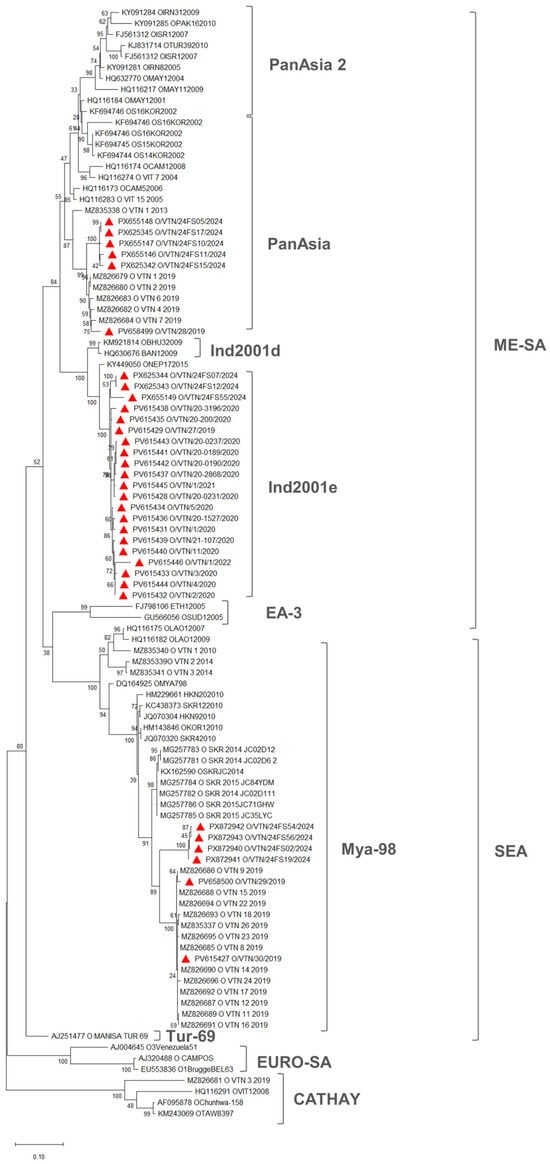
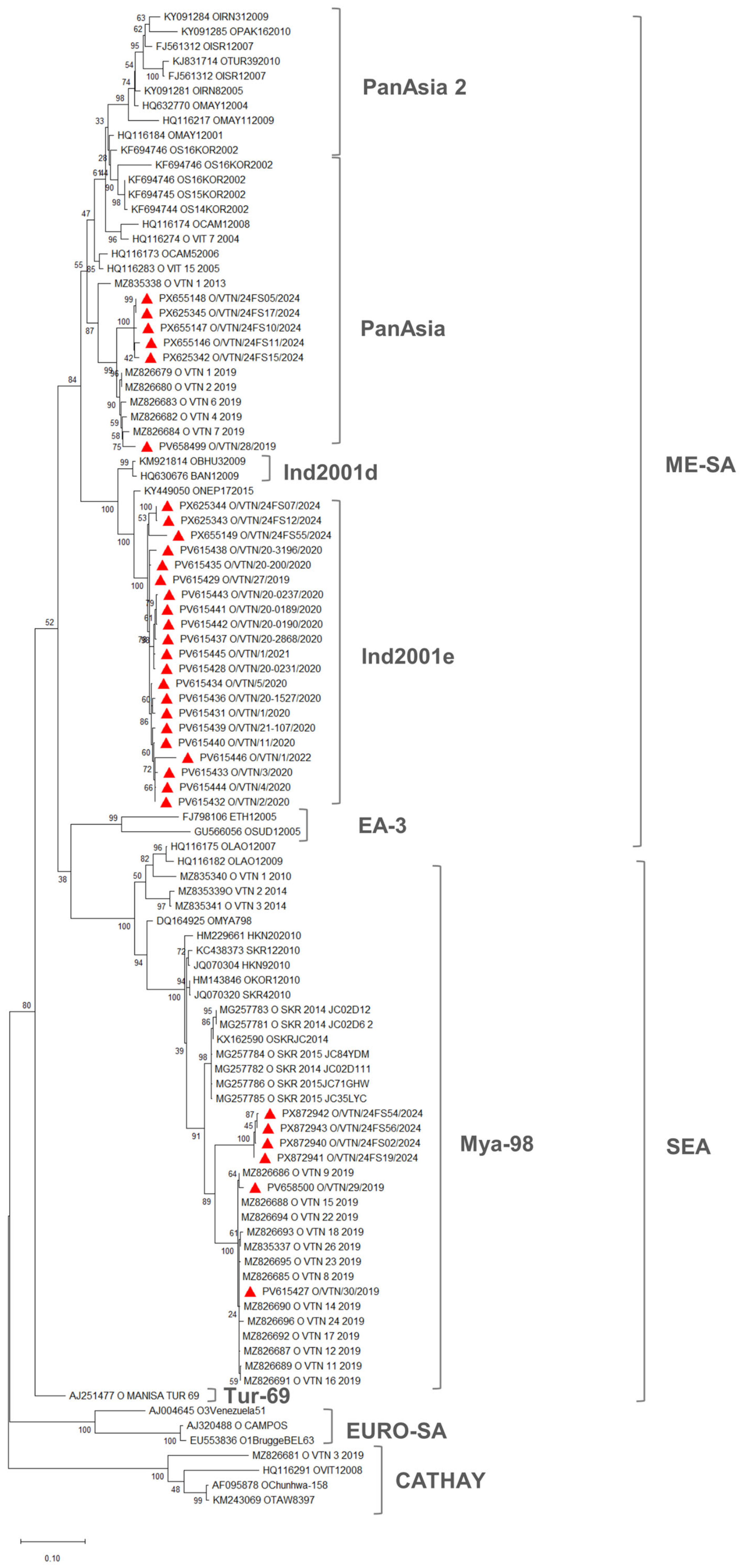
The VP1 nucleotide sequences were then compared with 68 previously published FMDV sequences to assess their phylogenetic relationships. The results show that the isolates studied clustered into three distinct lineages within two topotypes: ME-SA/PanAsia (6 isolates), ME-SA/Ind-2001 (21 isolates), and SEA/Mya-98 (6 isolates) (Figure 1). The isolates clustered within the ME-SA topotype, PanAsia lineage, showed 88.13–100% nucleotide identity and 94.79–100% amino acid identity with the sequences constituting this lineage; those grouped into the ME-SA topotype, Ind-2001 lineage, showed 91.31–99.84% nucleotide identity and 96.21–100% amino acid identity within the lineage; and those clustered into the SEA topotype, Mya-98 lineage, showed 84.83–100% nucleotide and 88.63–100% amino acid identity within the lineage.
Figure 1.
Phylogenetic tree showing the genetic relationships of FMDV type O isolates collected in Vietnam during 2019–2024. A Maximum Likelihood tree was constructed computing the evolutionary distances by the Tamura three-parameter model, based on the comparison of the complete region coding for the VP1 protein, using the Mega software, version XII. The sequences obtained are indicated, together with their accession numbers (▲). The viruses used for comparisons were obtained from GenBank. Relevant lineages and topotypes are indicated with brackets. The scale bar refers to a phylogenetic distance of 0.1 nucleotide substitutions per site.
Nucleotide and amino acid identities between the Vietnamese isolates and the vaccine strain O1 Campos (Accession number AJ320488) were also evaluated. Compared with O1 Campos, PanAsia isolates showed 77.07–78.66% nucleotide identity and 86.85–87.93% amino acid identity; Ind-2001 isolates showed 72.68–75.01% nucleotide identity and 86.31–87.39% amino acid identity; and Mya-98 isolates showed 70.66–74.53% nucleotide identity and 84.66–85.76% amino acid identity (Supplementary Table S1).
3.2. Variation in the Amino Acids of the VP1 Gene
Amino acid differences between the FMDV isolates and FMDV reference strains for each lineage were analyzed within the main antigenic regions of VP1: the BC-loop region (residues 40–60), the GH-loop region (residues 130–160) and the C-terminal region (residues 200–211) [15]. Interestingly, for the Ind-2001 lineage, several substitutions were observed at positions 45, 49, 59, 138–142, 153 and 155. Notably, substitutions at positions E138G, A140P and T142A in O/VTN/24FS55/2024 involve polar to non-polar changes. Regarding the Mya-98 lineage, amino acid changes were detected at positions 50, 135, 156 and 209. A V209T substitution involving a polarity change was observed in isolates O/VTN/24FS02/2024, O/VTN/24FS19/2024, O/VTN/24FS54/2024 and O/VTN/24FS56/2024. Within the PanAsia lineage, notable differences were also observed among the most recent isolates. O/VTN/24FS05/2024, O/VTN/24FS17/2024, O/VTN/24FS10/2024, O/VTN/24FS11/2024 and O/VTN/24FS15/2024 showed a P140S substitution, involving a change from a non-polar to a polar residue. In addition, O/VTN/24FS11/2024 showed a conservative R157K substitution. The RGD motif, located at amino acid positions 145–147, was fully conserved among all isolates and reference strains analyzed. The alignments of VP1 amino acid sequences for each lineage are shown in Supplementary Figures S1–S3.
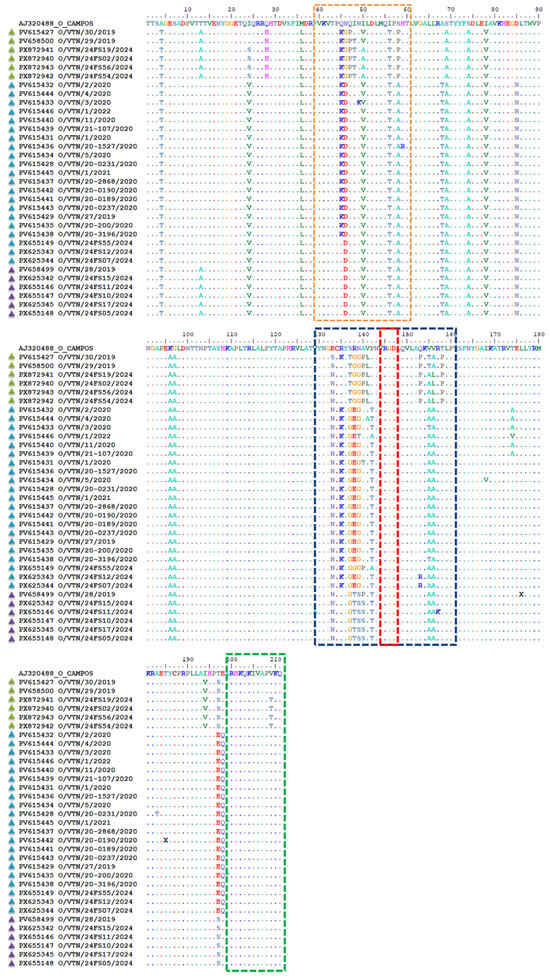
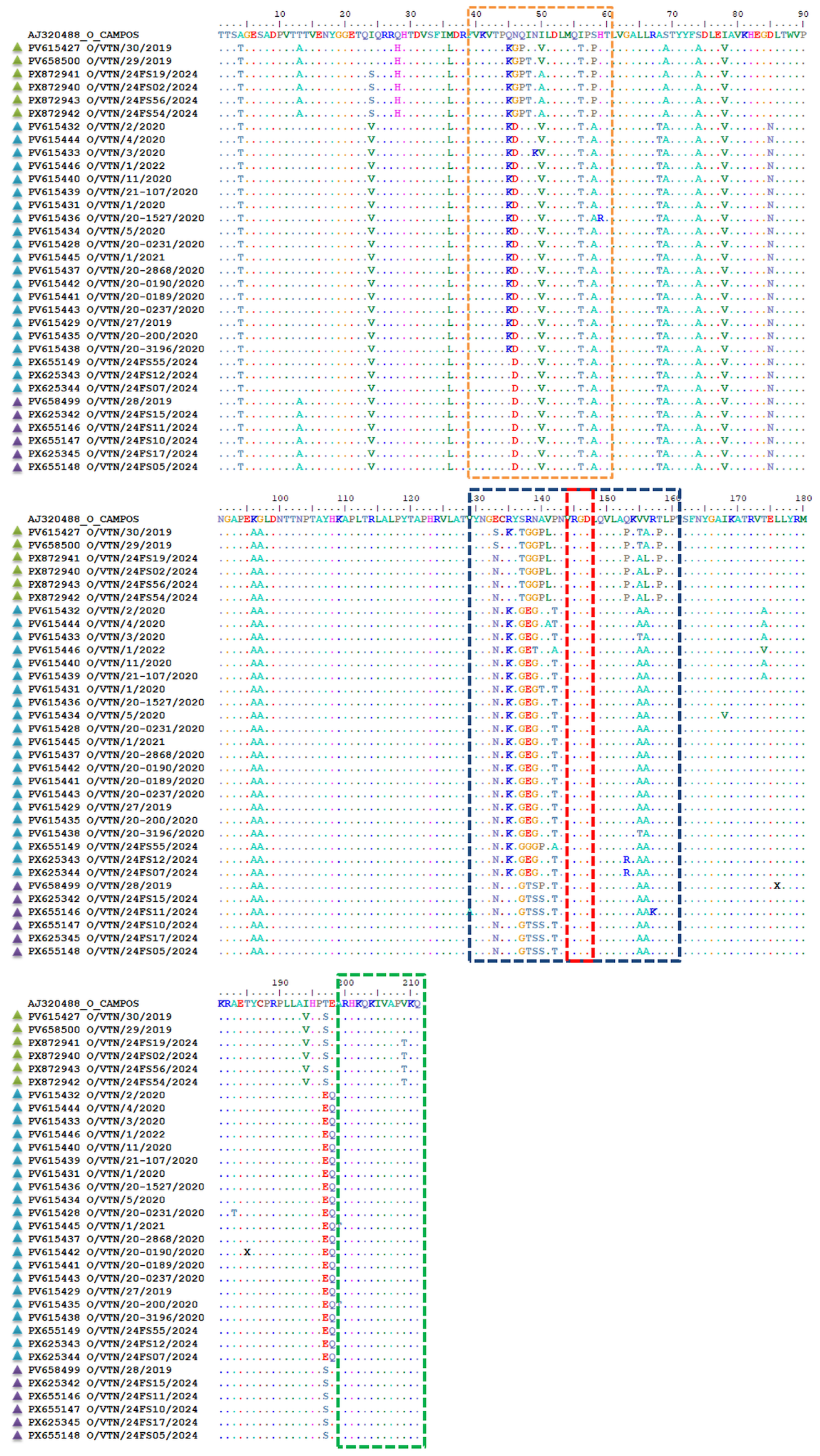
When comparing the main VP1 antigenic regions between the isolates reported in this work and the O1 Campos vaccine strain (Figure 2), the substitutions in the Ind-2001 lineage were found at positions 45–46, 50, 56, 58–59, 133, 135, 137–142, 153, 155 and 156, those in the PanAsia lineage were found at positions 46, 50, 56, 58, 133, 137–140, 142 and 155–157, and those in the Mya-98 lineage were found at positions 45–48, 50, 56, 58, 133, 135, 137–141, 153, 155–156, 158 and 209.
Figure 2.
Amino acid sequences of antigenic regions in VP1 of the FMDV isolates studied. Amino acid alignment of the VP1 sequences from FMDV serotype O isolates collected in Vietnam between 2019 and 2024, using the O1 Campos vaccine strain (AJ320488) as reference. Colored ▲ symbols indicate the lineage assignment of each isolate: purple ▲ symbols correspond to PanAsia isolates, light blue ▲ symbols correspond to Ind-2001 isolates, and green ▲ symbols correspond to Mya-98 isolates. Dots indicate amino acid residues identical to O1 Campos, whereas letters indicate amino acid substitutions. Highlighted boxes indicate antigenically relevant regions of VP1: the BC loop region (residues 40–60; orange), the GH loop region (residues 130–160; blue), the RGD motif involved in cell attachment (residues 145–147; red), and the C-terminal region (residues 200–211; green).
3.3. Antigenic Analysis
Vaccine matching studies were performed using the monovalent O1 Campos vaccine strain to assess the antigenic relationship of this vaccine strain with Vietnamese field isolates. The mean neutralization antibody titer against the homologous strain was 2.16 Log10 across the different sets of tests. The post-vaccination swine sera pool collected at 28 dpv showed satisfactory heterologous neutralizing titers (>1.5 Log10) against the isolates tested. Although most isolates showed r1 values above 0.3, two isolates, O/VTN/20-200/2020 and O/VTN/24FS56/2024, had r1 values below this threshold (Table 2). These findings suggest that O1 Campos has a good antigenic relationship with representative Vietnamese serotype O viruses from the Ind-2001, Mya-98 and PanAsia lineages.
Table 2.
VNT titer (Log10) and r1 value of O1 Campos calculated for each field strain. The means of three repetitions and their standard deviation (SD) is presented.
3.4. In Vivo Challenge
To confirm the in vitro results obtained for the type O 2024 strains that showed a genetic divergence from the vaccine strain, an in vivo challenge test with the O/VTN/24FS02/2024 strain was performed as described in the Materials and Methods Section. Control animals showed lesions in the four feet, tongue, nose and mouth cavity, demonstrating viral generalization, whereas those challenged at 28 dpv after a single vaccination (group 1; n = 10) and those challenged after receiving a booster dose at 28 days post-vaccination (group 2; n = 10) showed no lesions. This indicates that the vaccine conferred full protection against the heterologous challenge. Sera from the animals obtained at 0 dpv were negative for VNT antibody detection. At the time of the challenge test, mean heterologous VNT titers (Log10) were 1.58 for animals in group 1 (SD 0.07) and 2.40 in group 2 (SD 0.18). These values are consistent with the in vitro test described before.
4. Discussion
Identifying effective vaccines and vaccine strains to control FMD outbreaks that may spread to new regions is essential for preparedness and disease control. Continuous monitoring of vaccine strains included in strategic antigen reserves is therefore critical to ensure their suitability against contemporary field strains. In this context, the present study provides updated evidence on the antigenic and protective performance of the O1 Campos vaccine strain against FMDV serotype O isolates circulating in Vietnam during 2019–2024.
The O1 Campos vaccine strain has been widely and successfully used in South America and has also been included in vaccination strategies or vaccine banks in other regions, including parts of Asia [5,6,16,17]. Previous studies have shown that high-quality vaccines formulated with O1 Campos can induce protective immunity against heterologous serotype O strains belonging to different genetic lineages [5,6,16]. The present results further support this observation, since Vietnamese isolates belonging to three distinct lineages, SEA/Mya-98, ME-SA/Ind-2001 and ME-SA/PanAsia, showed evidence of antigenic relationship with O1 Campos.
Phylogenetic analysis confirmed that the 33 Vietnamese isolates analyzed in this study were distributed into three major lineages. Despite the genetic diversity observed among them, particularly between ME-SA and SEA topotypes, the in vitro and in vivo results suggest that a high-quality monovalent O1 Campos vaccine may provide relevant cross-protection against divergent serotype O strains. This is particularly important for emergency vaccination scenarios, where rapid deployment of an available and well-characterized vaccine strain is required.
Analysis of VP1 amino acid sequences revealed several amino acid substitutions in antigenically relevant sites, particularly in the GH loop within the Ind-2001, Mya-98 and PanAsia lineages. Although VP1 sequencing provides a robust framework for FMDV molecular characterization and lineage assignment, antigenic variation may also be influenced by amino acid changes in other capsid proteins. Therefore, the VP1-based analysis performed in this study does not fully capture the overall antigenic diversity of the isolates analyzed. Nevertheless, this was complemented by the in vitro antigenic characterization throughout vaccine matching assessment (VNT and r1 values), which revealed that the vaccine tested covers these strains antigenically. Some substitutions may contribute to local conformational or antigenic variation; hence, their functional impact should be interpreted in the context of serological and challenge data. However, the analysis of the effect of individual amino acid changes in global antigenic properties was not within the scope of the present work and should be addressed with mutational functional studies.
Most isolates showed r1 values consistent with a good antigenic relationship with the O1 Campos vaccine strain. However, three isolates, O/VTN/20-200/2020, O/VTN/24FS12/2024 and O/VTN/24FS56/2024, showed reduced in vitro vaccine matching values based on r1 determination. This finding highlights an important limitation of interpreting r1 values in isolation.
Although r1 values are widely used as an indicator of antigenic relationship between strains, the association with in vivo protection may vary depending on the overall formulation, including antigen payload, adjuvant composition, manufacturing quality, and appropriate dosing intervals. Previous studies have shown that high-potency vaccines can confer protection even when reduced cross-reactivity is observed in vitro [18,19]. For this reason, r1 values should be interpreted together with complementary serological and biological data. In the present study, VNT antibody titers obtained using sera from vaccinated animals provided additional evidence of expected protection. The analysis of pooled sera neutralizing antibody levels revealed titers >1.5 for all the isolates tested, supporting the broad protective potential of the O1 Campos vaccine. A heterologous titer of 1.5 has been widely used recently as an indicator of likely cross-protection [20]. In the present study, the in vivo heterologous challenge was performed with the O/VTN/24FS02/2024, which presented r1 values ranging from 0.25 to 0.46 in different determinations (mean value 0.33). The selection of the field isolate was based on the better replication and adaptation of the strain among the group of the more antigenically diverse strains detected. In vivo results confirm the in vitro prediction based on the antibody titers (mean value 1.5 for animals with a single dose), as vaccinated animals were fully protected even with a single vaccine dose.
Overall, the results reinforce the value of integrating phylogenetic characterization, VP1 amino acid analysis, r1-value determination, VNT antibody titers and in vivo challenge studies when assessing vaccine suitability. The findings support the continued relevance of the O1 Campos vaccine strain as a candidate for protection against diverse FMDV serotype O lineages circulating in Vietnam [21,22]. However, the genetic and antigenic variability observed among contemporary isolates underscores the need for continued surveillance of circulating strains and periodic reassessment of vaccine matching.
5. Conclusions
The results of the present study provide evidence of the suitability of including the O1 Campos strain in high-quality vaccines for conferring cross-reactivity and protection against recent Vietnamese circulating strains.
These findings are consistent with previous results supporting that the use of a high-potency, good-quality vaccine elicits a cross-reactive immune response. In this sense, a vaccine strain belonging to the EURO-SA topotype has shown high antibody titers against all Vietnamese isolates belonging to SEA/Mya-98, ME-SA/Ind-2001 and ME-SA/PanAsia [6].
Re-emerging strains indicate that FMDV adapts through local evolution in pigs and cattle, highlighting the need for regular monitoring and updates of vaccine strains.
Supplementary Materials
The following supporting information can be downloaded at: https://www.mdpi.com/article/10.3390/v18111176/s1, Table S1: Nucleotide and Amino acid identity (%) between FMDV serotype O field isolates collected in Vietnam during 2019–2024 and vaccine strain O1 Campos. 1. (AJ320488) O_CAMPOS; 2. (PV615427) O/VTN/30/2019; 3. (PV658500) O/VTN/29/2019; 4. (PX872941) O/VTN/24FS19/2024; 5. (PX872940) O/VTN/24FS02/2024; 6. (PX872943) O/VTN/24FS56/2024; 7. (PX872942) O/VTN/24FS54/2024; 8. (PV615432) O/VTN/2/2020; 9. (PV615444) O/VTN/4/2020; 10. (PV615433) O/VTN/3/2020; 11. (PV615446) O/VTN/1/2022; 12. (PV615440) O/VTN/11/2020; 13. (PV615439) O/VTN/21-107/2020; 14. (PV615431) O/VTN/1/2020; 15. (PV615436) O/VTN/20-1527/2020; 16. (PV615434) O/VTN/5/2020; 17. (PV615428) O/VTN/20-0231/2020; 18. (PV615445) O/VTN/1/2021; 19. (PV615437) O/VTN/20-2868/2020; 20. (PV615442) O/VTN/20-0190/2020; 21. (PV615441) O/VTN/20-0189/2020; 22. (PV615443) O/VTN/20-0237/2020; 23. (PV615429) O/VTN/27/2019; 24. (PV615435) O/VTN/20-200/2020; 25. (PV615438) O/VTN/20-3196/2020; 26. (PX655149) O/VTN/24FS55/2024; 27. (PX625343) O/VTN/24FS12/2024; 28. (PX625344) O/VTN/24FS07/2024; 29. (PV658499) O/VTN/28/2019; 30. (PX625342) O/VTN/24FS15/2024; 31. (PX655146) O/VTN/24FS11/2024; 32. (PX655147) O/VTN/24FS10/2024; 33. (PX625345) O/VTN/24FS17/2024; 34. (PX655148) O/VTN/24FS05/2024; Figure S1: Alignment of amino acid sequences of VP1 protein from strains and isolates belonging to Ind-2001 lineage. Sequences obtained in this work are indicated, together with their accession numbers (▲). Viruses used for comparisons were obtained from GenBank. Dots indicate amino acid residues identical to O/BHU/3/2009 (KM921814), whereas letters indicate amino acid substitutions. Highlighted boxes indicate antigenically relevant regions of VP1: the BC loop region (residues 40–60; orange), the GH loop region (residues 130–160; blue), the RGD motif involved in cell attachment (residues 145–147; red), and the C-terminal region (residues 200–211; green); Figure S2: Alignment of amino acid sequences of VP1 protein from strains and isolates belonging to Mya-98 lineage. Sequences obtained in this work are indicated, together with their accession numbers (▲). Viruses used for comparisons were obtained from GenBank. Dots indicate amino acid residues identical to O/LAO/1/2007 (HQ116175), whereas letters indicate amino acid substitutions. Highlighted boxes indicate antigenically relevant regions of VP1: the BC loop region (residues 40–60; orange), the GH loop region (residues 130–160; blue), the RGD motif involved in cell attachment (residues 145–147; red), and the C-terminal region (residues 200–211; green); Figure S3: Alignment of amino acid sequences of VP1 protein from strains and isolates belonging to PanAsia lineage. Sequences obtained in this work are indicated, together with their accession numbers (▲). Viruses used for comparisons were obtained from GenBank. Dots indicate amino acid residues identical to O/China/5/99 (HQ009509), whereas letters indicate amino acid substitutions. Highlighted boxes indicate antigenically relevant regions of VP1: the BC loop region (residues 40–60; orange), the GH loop region (residues 130–160; blue), the RGD motif involved in cell attachment (residues 145–147; red), and the C-terminal region (residues 200–211; green).
Author Contributions
D.C.: methodology, data curation, writing, revision, software, images; C.M.M.: methodology, bench work, writing, revision, software, images; V.V.H.: methodology, writing—review and editing; N.T.P.: methodology, writing—review and editing; A.I.T.: methodology, data curation, supervision; S.C.: conceptualization, writing—review and editing; C.M.: methodology; S.G.N.: conceptualization, methodology, data curation, writing—review and editing, resources, software, supervision. All authors have read and agreed to the published version of the manuscript.
Funding
This research received no external funding.
Institutional Review Board Statement
The animal study protocol was reviewed and approved by the CICUAE SENASA Ethics Committee.
Data Availability Statement
All data are available upon request to the authors.
Conflicts of Interest
The authors C.M.M. and S.C., employees of Biogénesis Bagó S.A., declare that their judgment and objectivity was not biased by their contractual condition. The remaining authors declare no competing interests.
References
- Bachrach, H.L. Foot-and-mouth disease. Annu. Rev. Microbiol. 1968, 22, 201–244. [Google Scholar] [CrossRef] [Scilit] [PubMed]
- Samuel, A.R.; Knowles, N.J. Foot-and-mouth disease type O viruses exhibit genetically and geographically distinct evolutionary lineages (topotypes). J. Gen. Virol. 2001, 82, 609–621. [Google Scholar] [CrossRef] [Scilit] [PubMed]
- Kitching, R.P.; Knowles, N.J.; Samuel, A.R.; Donaldson, A.I. Development of foot and- mouth disease virus strain characterisation—A review. Trop. Anim. Health Prod. 2001, 21, 153–166. [Google Scholar]
- Galdo Novo, S.; Malirat, V.; Maradei, E.D.; Espinoza, A.; Smitsaart, E.; Pedemonte, A.; Mattion, N.; Bergmann, I. Antigenic and immunogenic spectrum of Foot-and- Mouth Disease vaccine strain O 1 Campos against representative viruses of topotypes that circulated in Asia over the past decade. Vaccine 2017, 35, 1016. [Google Scholar] [CrossRef] [Scilit] [PubMed]
- Galdo Novo, S.; Malirat, V.; Maradei, E.D.; Pedemonte, A.; Espinoza, A.; Smitsaart, E.; Lee, K.; Park, J.; Bergmann, I. Efficacy of a high quality O1 Campos foot-and-mouth disease vaccine upon challenge with a heterologous Korean O Mya-98 lineage virus in pigs. Vaccine 2018, 36, 15. [Google Scholar] [CrossRef] [Scilit] [PubMed]
- Taffarel, A.I.; Barrios Benito, M.Y.; Hung, V.V.; Cardillo, S.; Phuong, N.T.; Caldevilla, C.; Galdo Novo, S. Foot-and-mouth disease virus strains isolated in Vietnam during 2010–2019: Genetic characterization and antigenic relatedness to the Euro SA vaccine. Arch. Virol. 2024, 169, 44. [Google Scholar] [CrossRef] [Scilit] [PubMed]
- Le, V.P.; Nguyen, T.; Lee, K.N.; Ko, Y.-J.; Lee, H.-S.; Nguyen, V.C.; Mai, T.D.; Do, T.H.; Kim, S.-M.; Cho, I.-S.; et al. Molecular characterization of serotype A foot-and-mouth disease viruses circulating in Vietnam in 2009. Vet. Microbiol. 2010, 144, 58–66. [Google Scholar] [CrossRef] [Scilit] [PubMed]
- Le, V.P.; Nguyen, T.; Park, J.H.; Kim, S.-M.; Ko, Y.-J.; Lee, H.-S.; Nguyen, V.C.; Mai, T.D.; Do, T.H.; Cho, I.-S.; et al. Heterogeneity and genetic variations of serotypes O and Asia 1 foot-and-mouth disease viruses isolated in Vietnam. Vet. Microbiol. 2010, 145, 220–229. [Google Scholar] [CrossRef] [Scilit] [PubMed]
- Le, V.P.; Vu, T.T.H.; Duong, H.Q.; Than, V.T.; Song, D. Evolutionary phylodynamics of foot-and-mouth disease virus serotypes O and A circulating in Vietnam. BMC Vet. Res. 2016, 12, 269. [Google Scholar] [CrossRef] [Scilit] [PubMed]
- Khanh, N.P.; Khang, T.D.; Lam, N.T.; Trang, C.T.H.; Hoang, L.T. Molecular Characterization and Genetic Diversity of Isolated Foot-and-Mouth Disease Viruses Circulating in Cattle in The Mekong Delta Provinces, Vietnam. Vet. Med. Int. 2025, 2025, 6680850. [Google Scholar] [CrossRef] [Scilit] [PubMed] [PubMed Central]
- Khang, T.D.; Khanh, N.P. Phylogenetic and genotypic characteristics of foot-and-mouth-disease virus in cattle in Tra Vinh province, Vietnam. Vet. World 2024, 17, 2858–2864. [Google Scholar] [CrossRef] [Scilit] [PubMed] [PubMed Central]
- Malirat, V.; Franca de Barros, J.J.; Bergmann, I.E.; Campos, R.d.M.; Neitzert, E.; da Costa, E.V.; da Silva, E.E.; Falczuk, A.J.; Pinheiro, D.S.B.; de Vergara, N.; et al. Phylogenetic analysis of foot-and-mouth disease vírus type O re-remerging in free areas of South America. Virus Res. 2007, 124, 22–28. [Google Scholar] [CrossRef] [Scilit] [PubMed]
- Kumar, S.; Stecher, G.; Suleski, M.; Sanderford, M.; Sharma, S.; Tamura, K. MEGA12: Molecular Evolutionary Genetic Analysis Version 12 for Adaptive and Green Computing. Mol. Biol. Evol. 2024, 41, msae263. [Google Scholar] [CrossRef] [Scilit] [PubMed]
- European Pharmacopoeia. Foot-and-mouth disease (ruminants) vaccine (inactivated). In European Pharmacopoeia, 9th ed.; Council of Europe (EDQM): Strasbourg, France, 2017; Volume 1. [Google Scholar]
- Asfor, A.S.; Upadhyaya, S.; Knowles, N.J.; King, D.P.; Paton, D.J.; Mahapatra, M. Novel antibody binding determinants on the capsid surface of serotype O foot-and-mouth disease virus. J. General. Virol. 2014, 95, 1104–1116. [Google Scholar] [CrossRef] [Scilit] [PubMed]
- Yang, M.; Xu, W.; Goolia, M.; Zhang, Z. Characterization of monoclonal antibodies against foot-and-mouth disease virus serotype O and application in identification of antigenic variation in relation to vaccine strain selection. Virol. J. 2014, 11, 136. [Google Scholar] [CrossRef] [Scilit] [PubMed]
- Harmsen, M.M.; Li, H.; Sun, S.; Van der Poel, W.H.M.; Dekker, A. Mapping of foot-and-mouth disease virus antigenic sites recognized by single-domain antibodies reveals different 146S particle specific sites and particle flexibility. Front. Vet. Sci. 2023, 9, 1040802. [Google Scholar] [CrossRef] [Scilit] [PubMed]
- Yang, F.; Zhu, Z.; Cao, W.; Liu, H.; Wei, T.; Zheng, M.; Zhang, K.; Jin, Y.; He, J.; Guo, J.; et al. Genetic Determinants of Altered Virulence of Type O Foot-and-Mouth Disease Virus. J. Virol. 2020, 94, e01657-19. [Google Scholar] [CrossRef] [Scilit] [PubMed] [PubMed Central]
- Brehm, K.E.; Kumar, N.; Thulke, H.H.; Haas, B. High potency vaccines induce protection against heterologous challenge with foot-and-mouth disease virus. Vaccine 2008, 26, 1681–1687. [Google Scholar] [CrossRef] [Scilit] [PubMed]
- Gubbins, S.; Paton, D.J.; Dekker, A.; Ludi, A.B.; Wilsden, G.; Browning, C.F.J.; Eschbaumer, M.; Barnabei, J.; Duque, H.; Pauszek, L.L.; et al. Predicting cross-protection against foot-and-mouth disease virus strains by serology after vaccination. Front. Vet. Sci. 2022, 9, 1027006. [Google Scholar] [CrossRef] [Scilit] [PubMed] [PubMed Central]
- Park, M.-Y.; Han, Y.J.; Choi, E.-J.; Kim, H.Y.; Pervin, R.; Shin, W.; Kwon, D.; Kim, J.M.; Pyo, H.M. Post-vaccination Monitoring to Assess Foot-and-Mouth Disease Immunity at Population Level in Korea. Front. Vet. Sci. 2021, 8, 673820. [Google Scholar] [CrossRef] [Scilit] [PubMed]
- Choi, J.; Jo, H.J.; Jung, S.S.; Choi, J.; Lee, S.H.; Kim, H.-H.; Kim, Y.-J.; Kim, B.; Park, J.-H.; Kim, J. Evaluation of swine protection with foot-and-mouth disease O 1/Campos and O/Primorsky/2014 vaccines against the O Mya-98 lineage virus from East Asia. Vaccine 2021, 39, 1701–1707. [Google Scholar] [CrossRef] [Scilit] [PubMed]

Disclaimer/Publisher’s Note: The statements, opinions and data contained in all publications are solely those of the individual author(s) and contributor(s) and not of MDPI and/or the editor(s). MDPI and/or the editor(s) disclaim responsibility for any injury to people or property resulting from any ideas, methods, instructions or products referred to in the content. |
© 2026 by the authors. Licensee MDPI, Basel, Switzerland. This article is an open access article distributed under the terms and conditions of the Creative Commons Attribution (CC BY) license.