


Error in Figure
In the original publication [1], there was a mistake in Figure 6. The published Figure 6 is a duplicate of Figure 2B. The correct Figure 6 appears below. The authors state that the scientific conclusions are unaffected. This correction was approved by the Academic Editor. The original publication has also been updated. The images were correct in the proofreading version, but the images might have been mixed up when we checked the proof. We apologize for the error.
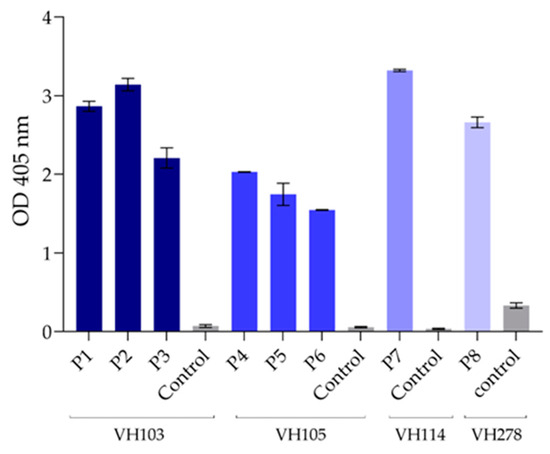
Figure 6.
Peptide-binding ELISA to demonstrate binding of the nanobodies to the RBD peptides. The nanobodies VH103 bound to VH103-P1 (P1), VH103-P2 (P2), and VH103-P3 (P3); VH105 bound to VH105-P4 (P4), VH105-P5 (P5), and VH105-P6 (P6); VH114 bound to VH114-P7 (P7); and VH278 bound to VH278-P8 (P8), which verified that the consensus peptides contained epitopes of the respective nanobodies. Control (irrelevant) peptide was included in the assay as negative control.
Reference
- Kaewchim, K.; Glab-ampai, K.; Mahasongkram, K.; Saenlom, T.; Thepsawat, W.; Chulanetra, M.; Choowongkomon, K.; Sookrung, N.; Chaicumpa, W. Neutralizing and Enhancing Epitopes of the SARS-CoV-2 Receptor-Binding Domain (RBD) Identified by Nanobodies. Viruses 2023, 15, 1252. [Google Scholar] [CrossRef] [PubMed]
Disclaimer/Publisher’s Note: The statements, opinions and data contained in all publications are solely those of the individual author(s) and contributor(s) and not of MDPI and/or the editor(s). MDPI and/or the editor(s) disclaim responsibility for any injury to people or property resulting from any ideas, methods, instructions or products referred to in the content. |
© 2023 by the authors. Licensee MDPI, Basel, Switzerland. This article is an open access article distributed under the terms and conditions of the Creative Commons Attribution (CC BY) license (https://creativecommons.org/licenses/by/4.0/).