


Abstract
The chikungunya virus (CHIKV) is a mosquito-borne virus of the family Togaviridae transmitted to humans by Aedes spp. mosquitoes. In Brazil, imported cases have been reported since June 2014 through two independent introductions, one caused by Asian Lineage in Oiapoque, Amapá state, North Region, and another caused by East/Central/South African (ECSA) in Feira de Santana, Bahia state, Northeast Region. Moreover, there is still limited information about the genomic epidemiology of the CHIKV from surveillance studies. The Tocantins state, located in Northern Brazil, reported an increase in the number of CHIKV cases at the end of 2021 and the beginning of 2022. Thus, to better understand the dispersion dynamics of this viral pathogen in the state, we generated 27 near-complete CHIKV genome sequences from four cities, obtained from clinical samples. Our results showed that the newly CHIKV genomes from Tocantins belonged to the ECSA lineage. Phylogenetic reconstruction revealed that Tocantins’ strains formed a single well-supported clade, which appear to be closely related to isolates from the Rio Grande do Norte state (Northeast Brazil) and the Rio de Janeiro state (Southeast Brazil), that experienced an explosive ECSA epidemic between 2016–2019. Mutation analyses showed eleven frequent non-synonymous mutations in the structural and non-structural proteins, indicating the autochthonous transmission of the CHIKV in the state. None of the genomes recovered within the Tocantins samples carry the A226V mutation in the E1 protein associated with increased transmission in A. albopictus. The study presented here highlights the importance of continued genomic surveillance to provide information not only on recording mutations along the viral genome but as a molecular surveillance tool to trace virus spread within the country, to predict events of likely occurrence of new infections, and, as such, contribute to an improved public health service.
1. Introduction
The chikungunya virus (CHIKV) is a single-strand RNA virus belonging to the Togaviridae family, of the Alphavirus genus, transmitted by Aedes aegypti and A. albopictus mosquitoes and often causes a polyarthritis polyarthralgia accompanied by fever, muscle pain, rash, and severe joint pain, which may last for months to years [1,2,3,4].
The first identified outbreak of the CHIKV was reported in 1952/53 in the Tanganyika Province, actually Tanzania, East Africa, and since then it has been responsible for important emerging and re-emerging epidemics in several tropical and temperate regions [5]. Phylogenetic analyses reveal that the CHIKV originated in Africa (without a precise localization) and then spread to Asia [6]. Based on genomic diversity, the CHIKV is classified into four distinct genotypes (or lineages): (i) the West African; (ii) the East/Central/South African (ECSA); (iii) the Asian, and (iv) the Indian Ocean Lineage (IOL), which emerged from the ECSA lineage between 2005 and 2006 [7,8].
In the Americas, the first autochthonous CHIKV transmission was reported in December 2013, when the French National Reference Center for Arboviruses confirmed the first local Chikungunya cases on the island of Saint Martin in the Caribbean [9,10]. Sequence analysis confirmed that CHIKV sequences isolated from Saint Martin at the beginning of the outbreak in the Americas belonged to the Asian lineage [9]. By the end of December 2015, approximately one million cases were reported in the Americas, resulting in 71 deaths, and an autochthonous transmission was reported in over 50 countries [11,12].
In Brazil, the local transmission of the Asian lineage was detected for the first time in September 2014 in the Oiapoque city, Amapá state, North Region. Seven days later, a new cluster of CHIKV infections was notified in the city of Feira de Santana, Bahia state, Northeast Region [12,13,14,15]. Since then, the disease has spread across the country, posing a serious threat to public health. Until the epidemiological week 7, Brazil reported 6002 suspected cases (with a rate of incidence of 2.8 cases/100,000). The North Region presents the highest incidence with 7.1 cases/100,000 inhabitants, followed by Central-West with 3.3 cases/100 mi inhabitants [16]. These numbers are smaller than those registered last year but keep the authorities in alarm.
The Tocantins is a Brazilian state located in the North Region, bordering six states, being a corridor for the transmission of pathogens between the North and the Northeast and Central-West Regions [17]. According to the Brazilian Institute of Geography and Statistics (IBGE; https://cidades.ibge.gov.br/brasil/to/panorama, accessed on 1 September 2022), in 2021, the state had an estimated population of 1,607,363 inhabitants, and its human development index was 0.699. The first cases of chikungunya fever in the Tocantins were reported in 2015 and 2017 when the state registered the highest number of notified cases (6669) with an incidence of 200.44 cases per 100,000 inhabitants. The Secretary of Health of Tocantins (SHT) has reported an increase in the number of cases of CHIKV infection at the end of 2021 and the beginning of 2022. Until July 2022, 3794 cases have been notified in the state [18].
Despite several suspected cases reported in the state during the last years, to date, there was still a paucity of complete genomes recovered from cases of chikungunya fever occurring within the state, thus hampering our ability to understand its transmission dynamics. In this study, 27 newly complete CHIKV genome sequences were recovered from autochthonous cases of infection reported in the Tocantins and used to provide a preliminary overview of the likely ways of introduction and circulation of the CHIKV within the state.
2. Materials and Methods
2.1. Sample Collection and Sequencing
Serum samples from individuals who presented with febrile disease associated with joint pain were collected for molecular diagnostics by the Central Public Health Laboratory of the Tocantins state, North Brazil. Based on resources and time availability, we selected 27 acute-phase serum samples that were RT-qPCR positive for CHIKV with cycle thresholds (Ct) values < 26.9 at the time of diagnosis.
2.2. cDNA Synthesis and Whole-Genome Sequencing
Extracted RNA was converted to cDNA by using a Luna Script RT SuperMix (5×) (New England Biolabs, Ipswich, MA, USA). The synthesized cDNAs were used as templates for whole-genome amplification by multiplex PCR using the CHIKV sequencing primers’ scheme (divided into two, separated pools), designed as previously described in [19]. Amplicons from the two primer pools were combined and purified with one volume of AMPure XP beads (Beckman Coulter, Brea, CA, USA), and cleaned-up PCR products’ concentrations were measured using a Qubit dsDNA HS Assay Kit on a Qubit 3.0 fluorometer (ThermoFisher Scientific Corporation, Waltham, MA, USA).
The MinION library preparation was performed using a Ligation Sequencing kit SQK-LSK-109 and Natives Barcoding kits EXP-NBD104 and EXP-NBD114 (Oxford Nanopore, Oxford, UK). The resulting library was loaded on R9.4 Oxford MinION flowcells (FLO-MIN106) and sequenced using a MinION Mk1B device. ONT MinKNOW software was used to collect raw data. High-accuracy base-calling of raw FAST5 files and barcode demultiplexing were performed using Guppy (v6.0.1). Consensus sequences were generated by de novo assembling using Genome Detective [20].
2.3. Phylogenetic Analyses
The 27 new CHIKV genome sequences reported in this study were initially assigned to genotypes using the Chikungunya Virus Typing Tool [20].
To compare the phylogenetic relationships of CHIKV genomes, the newly generated sequences were analyzed together with 1156 reference sequences from all genotypes (West Africa, ECSA, and Asian and Caribbean) obtained from the National Center for Biotechnology Information (http://www.ncbi.nlm.nih.gov/ accessed on 5 September 2022) and collected up to July 2022 (Supplementary Table S1). Only genome sequences with more than 9000 bases and with recorded dates and sampling locations were selected. Sequences were aligned using MAFFT v7.490 [21] with default settings and manually inspected using AliView v1.28 [22].
The maximum likelihood (ML) phylogeny was reconstructed using IQ-TREE v2.2.0 [23]. The ML analyses were performed under the generalized time-reversible (GTR) model of nucleotide substitution with the empirical base frequencies (+F) plus FreeRate model (+R3), as selected by the ModelFinder software [24] and 1000 replicates of ultrafast bootstrapping (−B 1000) and an SH-aLRT branch test (−alrt 1000). Tree visualization was performed using FigTree v1.4.4 [25].
To infer a time-scaled phylogeny, we extracted sequences of the Brazilian ECSA clade from the phylogenetic tree using a caper R package [26]. A maximum likelihood (ML) phylogeny was reconstructed from the dataset using IQ-TREE2 software under the GTR+G+I nucleotide substitution model with four gamma categories, which was inferred in jModelTest2 v2.1.10 [27] as the best-fitting model. The ML tree was inspected in TempEst v1.5.3 [28] to investigate the temporal signal through a regression analysis of root-to-tip genetic distance against sampling dates. Outlier sequences were removed from the analysis, leaving in the final dataset 186 sequences (Supplementary Table S2).
The phylogeny was reconstructed for the Brazilian ECSA clade using Bayesian inference with Markov Chain Monte Carlo (MCMC) sampling, as implemented in the BEAST v1.10.4 package [29]. A stringent model selection analysis using both path-sampling (PS) and stepping stone (SS) procedures was employed to estimate the most appropriate molecular clock model for the Bayesian phylogenetic analysis [30]. For that, we used the strict molecular clock model and the more flexible uncorrelated relaxed molecular clock model with a Bayesian skygrid coalescent model of population size and growth [31,32]. Both SS and PS estimators indicated the uncorrelated relaxed molecular clock was the best-fitted model for the dataset under analysis. Triplicate MCMC runs of 50 million states each were computed, with sampling every 5000 steps. The three independent runs were merged with Log combiner v1.10.4 [29], and the convergence of the MCMC chain was assessed using Tracer v1.7.2 [33]. Maximum clade trees were summarized from the MCMC samples using TreeAnnotator V1.10.4, with 10% removed as burn-in [29]. The MCMC phylogenetic trees were visualized using a ggtree R package [34].
A discrete phylogeographical model [35] was used to reconstruct the virus’ spatial diffusion across the compiled dataset’s sampling locations. Phylogeographic analyses were then performed by applying an asymmetric model of location-transitioning, and location diffusion rates were estimated using the Bayesian stochastic search variable selection (BSSVS) model with a discretization scheme defined as Brazilian states. MCMC was run sufficiently long enough to ensure stationarity and an adequate, effective sample size (ESS) of >200.
3. Results
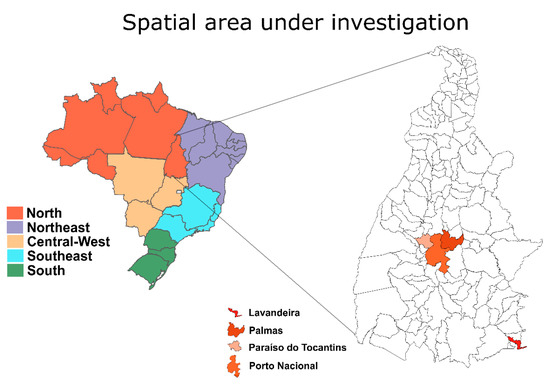
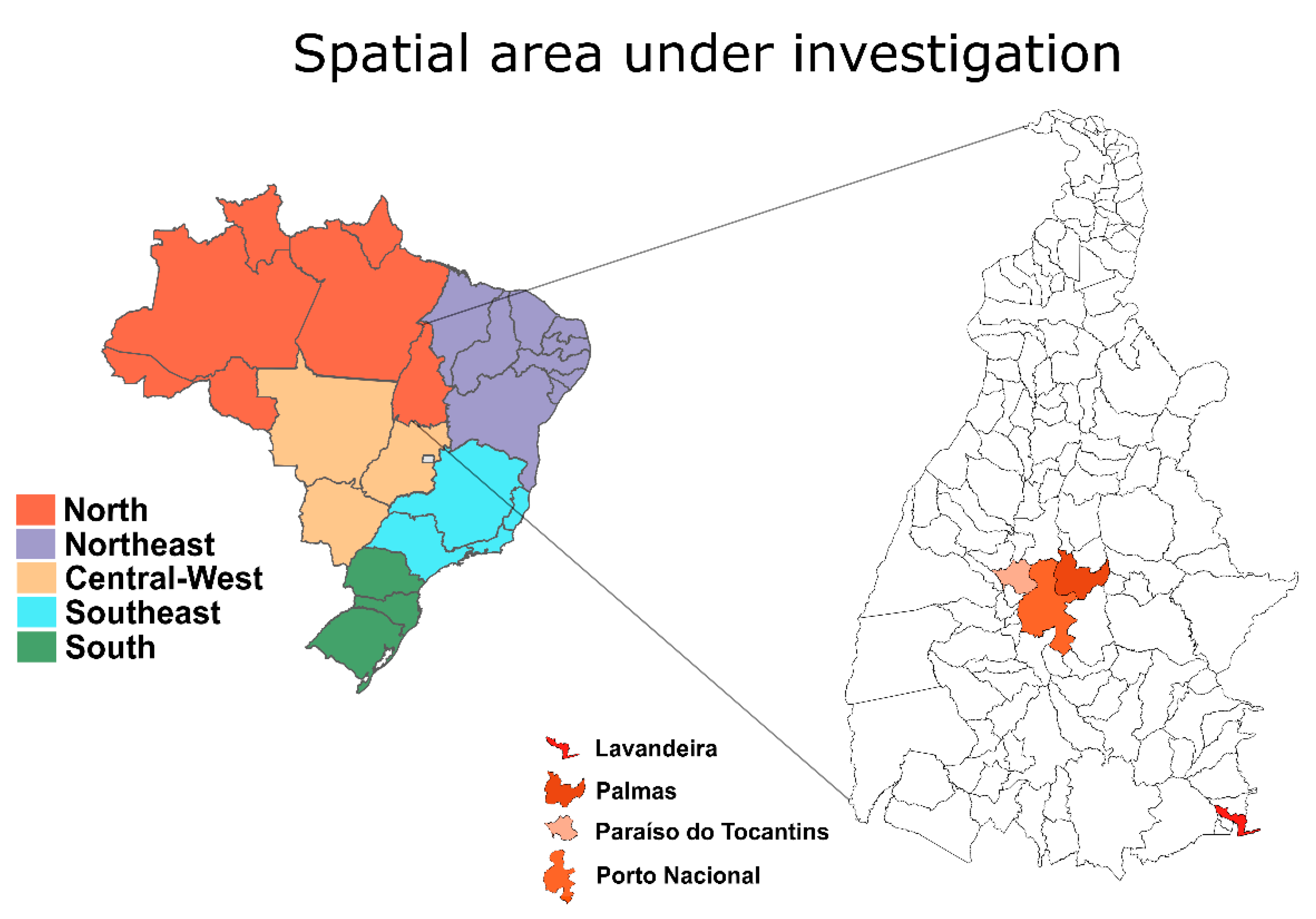
We used, here, a portable MinION sequencer and an amplicon approach to generate 27 partial and near-complete CHIKV genomes (with a coverage range of 74.3–98.4%, and a mean = 87.1%) from the serum samples provided by the Central Public Health Laboratory and collected during 2021 and in January and July of 2022 in the Tocantins state (Table 1). The mean Ct value for the RT-qPCR was 23.0 (range: 16.2 to 26.9). These samples were in the majority of male patients (n = 14; 51.9%), and the mean patient age was 34.2 years (Table 1). Most of the isolates (n = 20; 74.1%) belonged to patients that resided in the municipality of Palmas, the capital of the Tocantins state. The remaining seven samples were from Lavandeira (n = 2; 7.4%), and two neighboring municipalities of the capital, Paraíso do Tocantins (n = 2; 7.4%) and Porto Nacional (n = 3; 11.1%) (Figure 1).
Table 1.
Epidemiological data associated with sequenced samples were analyzed in this study.
Figure 1.
Political map (MOU1) of Brazilian regions with highlights on the Tocantins state, showing locations of the origin of the patients in which the CHIKV genomes reported in this study were collected. The figure was generated using R v4.1.2 with the following packages: ggplot2, geojsonio, sf, broom, and dplyr, and manually edited using Inkscape (GNU GPL v1.2; See http://www.inkscape.org, accessed on 12 September 2022).
3.1. Phylogenetic Analysis
The initial maximum likelihood phylogenetic tree was constructed using the dataset containing 1156 sequences from the four distinct genotypes plus the sequences recovered here. This analysis revealed that all 27 sequences belonged to the ECSA lineage and clustered with other Brazilian strains from previous outbreaks reported in other geographic regions (Supplementary Figure S1). These findings were also confirmed by the analysis performed with the Chikungunya Virus Typing Tool.
The temporal analysis of the Brazilian ECSA sequences showed a sufficient temporal signal (with R2 = 0.78 and a correlation coefficient of 0.88; Supplementary Figure S2) between the genetic divergence from root to tip against the sampling dates, supporting the use of temporal calibration directly from the sequences. The evolutionary rate of the ECSA lineage estimated in this study was 2.64 × 10⁻³ substitutions per site, per year (95% highest posterior density interval-HDP: 1.96 × 10⁻³ to 3.28 × 10⁻³ substitutions per site, per year). The time of the most recent common ancestor (TMRCA) of the Tocantins clade was estimated to be around March 2021 (95%: HDP: November 2020 to May 2021).
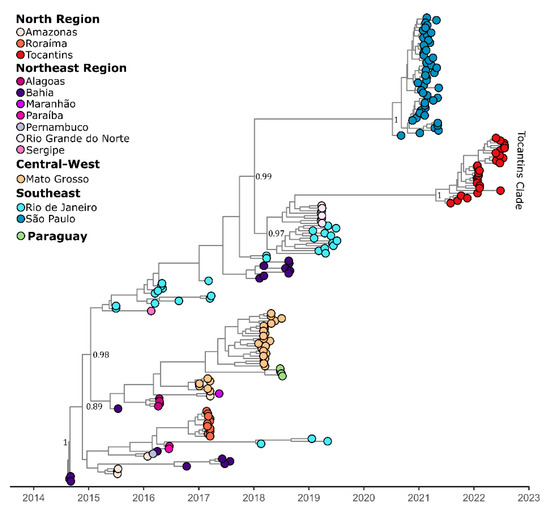
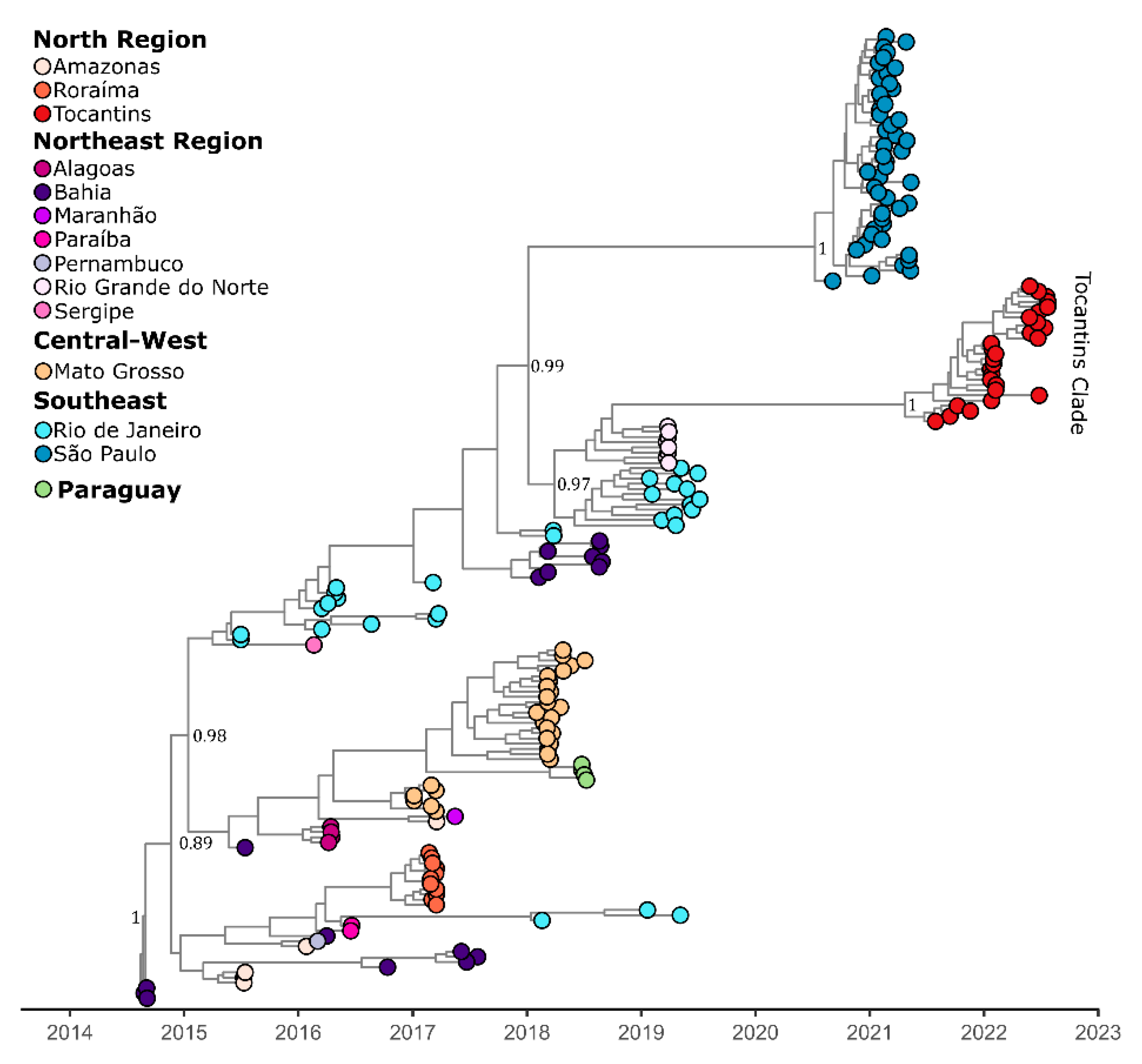
The Bayesian phylogeny showed that the CHIKV isolates from the Tocantins state collected between 2021 and 2022 and formed a single, well-supported clade (posterior probability = 1.0), which was closely related to the isolates from the 2019 CHIKV epidemic in both Rio de Janeiro and Rio Grande do Norte states (Figure 2). The BSSVS procedure identified well-supported rates of diffusion from Rio de Janeiro to Tocantins (Bayes Factor: 29.9; Posterior Probability: 0.77). This suggests that the outbreak in Tocantins was caused by an introduction event from Rio de Janeiro, which appears to have been mediated also by the Northeast Region, which has played an important role in the introduction and establishment of the ECSA lineage in Brazil.
Figure 2.
Time-scaled phylogenetic tree of 186 complete and near-complete CHIKV genome sequences from the ECSA genotype sampled in Brazil and Paraguay. Colors represent different sampling locations according to the legend on the left of the tree. Genomes reported in the presented study are colored in red.
3.2. Single Nucleotide Polymorphisms (SNPs) Analysis
The genomic analysis revealed 110 different mutations in the 27 sequences obtained in this study (Supplementary Table S3). Of the total mutations detected, 76 (69.1%) were synonymous and 34 were missense (30.9%) (Table 2). Highly frequent mutations (found in at least twelve genomes or ≥44.4% of the genomes) were found in 42 genome positions. Of these, 73.8% (31) were synonymous and 26.2% (11) were missense. Among the highly frequent missense mutations, six were located in the nonstructural polyprotein sequence (NSP2: P352M, M466L, and A545S; NSP3: A388T and L434P; NSP4: A481D) and five in the structural protein (E1: A98T, K211T, V269M, and A305T; E2: L248F) (Table 2).
Table 2.
Missense mutations found in the newly sequenced genomes of CHIKV from Tocantins, between 2021 and 2022, reported in this study. Showing only mutations observed in at least two sequenced genomes.
4. Discussion
Previous phylogenetic data are not available to show the circulation of autochthonous CHIKV in the Tocantins. Our phylogenetic analysis placed the genomes to the ECSA genotype. This lineage has been reported as predominant in the Southeast and Northeast Region of Brazil, respectively [12,36,37,38,39]. Naveca et al. [40] reported the introduction of the ECSA lineage in Roraima in the North Region of Brazil, and de Castro et al. reported the ESCA circulation in the Paraná state in the South Region of Brazil. Taken together, this makes it clear that the ECSA lineage is prevalent and spread across the country [41].
The analysis of the full or nearly full genomes maximizes the usefulness of molecular clock models to infer time-scaled phylogenetic trees [28]. The Bayesian phylogeny demonstrates that all TO-CHIKV genomes reported here belong to a distinct clade from those previously identified in Brazil and were phylogenetically close to the 2019-Rio Grande do Norte [42] and 2019-Rio de Janeiro cluster [36]. We also found evidence of dispersal from Rio de Janeiro to the Tocantins, mediated from the Northeast Region. The strategic location of the Tocantins state was previously demonstrated as a transmission virus corridor between the North and South Regions of Brazil [17]. We agreed that the dispersion of the CHIKV is influenced by multiple factors, including the geographic parameters and traffic metrics that contribute to the vector transport. In addition, population density improves the chances of encountering a susceptible individual.
Genomic analysis revealed eleven highly frequent missense mutations in the twenty-seven TO-CHIKV genomes: six of those were placed in the nonstructural polyprotein and five in the structural polyprotein. This set of mutations characterizes the profile of sequences evidencing the autochthonous transmission of the CHIKV in Tocantins. Mutations in the genome could impact the viral fitness of these lineages in different vectors [3]. The presence of the T98A variant on the envelope gene (E1) of the CHIKV was associated with the enhancement of the vector-adaptability of A. albopictus. The substitution of E1-A226V was reported to suffer and exert strong epistatic effects, blocking the ability of most of the ECSA and endemic Asian strains to A. albopictus adaptability [6,43]. However, strains whose epidemiologic success contained E-211T and E1-98A residues were not affected by these interactions [6].
Studies showing genomic differences among CHIKV circulation are important to determine the changes or neutral occurrences in the viral genome. The evolution of the CHIKV with novel mutations has proven to be the epidemic potential for viral re-emergence due to altered vector specificity and infectivity. Additionally, the K211E variant in the E1 gene and V264A in the E2 gene leads to an increase in viral dissemination and transmission for A. aegypti but not for A. albopictus [44]. The E1 adaptative mutation, E1-A226V, enhances CHIKV replication in A. albobictus. Furthermore, other variants in genes E1 and E2 increase, enhance, or promote an epistatic effect in vector dissemination. Our study detected sequences without substitutions previously described, allowing virus transmission by different species of mosquitoes [44,45].
Moreover, other mutations already found among Brazilian samples in the envelope protein (E1: A98T, K211T, V269M, and A305T) were detected in this study. The impact of these mutations on CHIKV fitness stays under investigation [39,46]. The K211T amino acid substitution in the E1 gene was described for the first time in Rio de Janeiro and was found in all of the samples analyzed without the A226V mutation [39]. This reinforces the need for further studies to better understand these mutations and their consequences on vector fitness and the human immune system.
Several adaptive mutations enhance CHIKV transmissibility by different mosquito species. The appearance of those adaptive mutations has led to large-scale CHIKV outbreaks in Asia, Africa, Europe, and Brazil [47]. The only method to control the CHIKV is to decrease the exposure between people and mosquitoes. In remote and extensive nature or forest habitats, vector control is a challenge. However, the reduction of endemic/epidemic transmissions is feasible in regions where resources are designated to minimize the proliferation of the vectors. The largely sympatric distribution of the vectors, as well as the increasing cocirculation of different lineages, were important factors to consider in tracking/preventing the dissemination of mosquitoes and genomic surveillance [48].
In this study, we have provided the CHIKV genomic epidemiology showing the dynamic spread of the CHIKV ECSA lineage from symptomatic cases reported in the Tocantins state. Our research enhances the number of CHIKV genome sequences available, allowing us to learn more about the evolution and genomic diversity of the ECSA lineage. In addition, this emphasizes genomic surveillance strategies in order to track viral adaptations. Several conditions, such as the high density of vector mosquitoes, high population density, poor income, and insecure sanitary conditions, as well as significant air connectivity and land transport between different Brazilian regions with a constant movement of people, may contribute to the modeling of this complex viral transmission scenario.
Some limitations of this study involve the small number of samples analyzed in relation to the total number of cases. In addition, there is no frequent monitoring in all of the Brazilian states, which makes it difficult to establish the real dispersion route of the CHIKV in Brazil. Moreover, it is important to specify that we do not designate if this is a new clade in the state or even if this clade already exists in other Brazilian regions. The principal limitation is that there were no sequences from the state prior to this study. However, the role of the most populous regions, such as the state of Rio de Janeiro, as an amplifier of the virus and disseminator to other Brazilian regions appears to be clear. This makes monitoring through genomic surveillance more important and should be something to be implemented and used in all of the Brazilian states to combat arboviruses, especially the CHIKV, the target of the present study.
Supplementary Materials
The following supporting information can be downloaded at: https://www.mdpi.com/article/10.3390/v14102311/s1, Figure S1. Maximum-likelihood tree of 1156 genome sequences representing the Tocantins outbreak clade (red circles) within the ECSA. Figure S2. Root-to-tip regression of genetic distances and sampling dates for the Americas ECSA clade including a total number of 186 genome sequences. Table S1. Accession number list and full details of all reference sequences retrieved from NCBI and used in the genotype assignment analysis. Table S2. Full details of the 186 complete and near-complete CHIKV genome sequences from the ECSA lineage sampled in Brazil and the Americas analyzed in this study. Table S3. Synonymous and missense mutations found in the 27 new CHIKV genomes from the Tocantins state.
Author Contributions
Conceived and designed the experiments: U.J.B.d.S., R.N.d.S. and F.S.C. Performed the experiments: U.J.B.d.S. and F.D.P.C. Analyzed the data: U.J.B.d.S., R.N.d.S., M.G., L.C.J.A., F.R.S. and F.S.C. Contributed to the writing of the manuscript: U.J.B.d.S., R.N.d.S., M.G., L.C.J.A., J.D.G., F.D.P.C., F.C.S.B., A.C.F., P.M.R., B.M.R., F.R.S. and F.S.C. All authors have read and agreed to the published version of the manuscript.
Funding
This work was partially supported by grants from Rede Corona-ômica BR MCTI/FINEP (http://www.corona-omica.br-mcti.lncc.br, accessed on 12 January 2022) affiliated by RedeVírus/MCTI (FINEP = 01.20.0029.000462/20, CNPq = 404096/2020-4), and Fundação de Apoio à Pesquisa do Distrito Federal (FAP-DF) grant # 193001532/2016 to B.M.R. Fundação de Amparo à Pesquisa of Tocantins states (FAPT) paid for the CHIKV primers. National Council for Scientific and Technological Development–CNPq–Process number: 443215/2019-7.
Institutional Review Board Statement
Not applicable.
Informed Consent Statement
Not applicable.
Data Availability Statement
The authors declare that all data supporting the findings of this study are available within the paper. Analysis scripts and the dataset used are available at: https://github.com/Ueric/Chikungunya-ECSA-lineage-Tocantins-state.git (accessed on 1 September 2022).
Acknowledgments
We thank the entire team at Lacen-TO for their tireless work during the SARS-CoV-2 pandemic and during another epidemic outbreak of arboviruses. U.J.B.d.S. and R.N.d.S. were granted a post-doctoral scholarship (DTI-A) from CNPq. M.G., L.C.J.A, A.C.F., P.M.R., B.M.R., F.R.S., and F.S.C. are CNPq research fellows. M.G. and L.C.J.A. are supported by Fundação de Amparo à Pesquisa do Estado do Rio de Janeiro (FAPERJ) (E-26/202.248/2018(238504); E26/202.665/2019(247400)). M.G. is funded by PON “Ricerca e Innovazione” 2014–2020.
Conflicts of Interest
The authors declare no conflict of interest.
References
- Pialoux, G.; Gaüzère, B.-A.; Jauréguiberry, S.; Strobel, M. Chikungunya, an Epidemic Arbovirosis. Lancet Infect. Dis. 2007, 7, 319–327. [Google Scholar] [CrossRef] [Scilit]
- Weaver, S.C.; Lecuit, M. Chikungunya Virus and the Global Spread of a Mosquito-Borne Disease. N. Engl. J. Med. 2015, 372, 1231–1239. [Google Scholar] [CrossRef] [Scilit] [PubMed]
- Cunha, M.S.; Costa, P.A.G.; Correa, I.A.; de Souza, M.R.M.; Calil, P.T.; da Silva, G.P.D.; Costa, S.M.; Fonseca, V.W.P.; da Costa, L.J. Chikungunya Virus: An Emergent Arbovirus to the South American Continent and a Continuous Threat to the World. Front. Microbiol. 2020, 11, 1297. [Google Scholar] [CrossRef] [Scilit] [PubMed]
- Suhrbier, A. Rheumatic manifestations of chikungunya: Emerging concepts and interventions. Nat. Rev. Rheumatol. 2019, 15, 597–611. [Google Scholar] [CrossRef] [Scilit]
- Weaver, S.C. Arrival of Chikungunya Virus in the New World: Prospects for Spread and Impact on Public Health. PLoS Negl. Trop. Dis. 2014, 8, e2921. [Google Scholar] [CrossRef] [Scilit]
- Zeller, H.; van Bortel, W.; Sudre, B. Chikungunya: Its History in Africa and Asia and Its Spread to New Regions in 2013–2014. J. Infect. Dis. 2016, 214, S436–S440. [Google Scholar] [CrossRef] [Scilit]
- Tsetsarkin, K.A.; Chen, R.; Sherman, M.B.; Weaver, S.C. Chikungunya Virus: Evolution and Genetic Determinants of Emergence. Curr. Opin. Virol. 2011, 1, 310–317. [Google Scholar] [CrossRef] [Scilit]
- Powers, A.M. Genomic Evolution and Phenotypic Distinctions of Chikungunya Viruses Causing the Indian Ocean Outbreak. Exp. Biol. Med. 2011, 236, 909–914. [Google Scholar] [CrossRef] [Scilit]
- Yactayo, S.; Staples, J.E.; Millot, V.; Cibrelus, L.; Ramon-Pardo, P. Epidemiology of Chikungunya in the Americas. J. Infect. Dis. 2016, 214, S441–S445. [Google Scholar] [CrossRef] [Scilit]
- Cassadou, S.; Boucau, S.; Petit-Sinturel, M.; Huc, P.; Leparc-Goffart, I.; Ledrans, M. Emergence of Chikungunya Fever on the French Side of Saint Martin Island, October to December 2013. Eurosurveillance 2014, 19, 20752. [Google Scholar] [CrossRef] [Scilit]
- Pan American Health Organization. Number of Reported Cases of Chikungunya Fever in the Americas, by Country or Territory 2015 (to Week Noted) Epidemiological Week/EW52 (Updated as of 13 May 2016). Available online: https://www.paho.org/hq/dmdocuments/2016/2015-cha-CHIKV-cumulative-cases-update.pdf (accessed on 1 September 2022).
- Faria, N.R.; Lourenço, J.; Marques de Cerqueira, E.; Maia de Lima, M.; Carlos Junior Alcantara, L. Epidemiology of Chikungunya Virus in Bahia, Brazil, 2014–2015. PLoS Curr. 2016, 8. [Google Scholar] [CrossRef] [Scilit] [PubMed]
- Goes de Jesus, J.; da Luz Wallau, G.; Lima Maia, M.; Xavier, J.; Oliveira Lima, M.A.; Fonseca, V.; Salgado de Abreu, A.; Fraga de Oliveira Tosta, S.; Ramos do Amaral, H.; Andrade Barbosa Lima, I.; et al. Persistence of Chikungunya ECSA Genotype and Local Outbreak in an Upper Medium Class Neighborhood in Northeast Brazil. PLoS ONE 2020, 15, e0226098. [Google Scholar] [CrossRef] [Scilit] [PubMed]
- Nunes, M.R.T.; Faria, N.R.; de Vasconcelos, J.M.; Golding, N.; Kraemer, M.U.; de Oliveira, L.F.; Azevedo, R.d.S.d.S.; da Silva, D.E.A.; da Silva, E.V.P.; da Silva, S.P.; et al. Emergence and Potential for Spread of Chikungunya Virus in Brazil. BMC Med. 2015, 13, 102. [Google Scholar] [CrossRef] [Scilit] [PubMed]
- de Souza, T.; Ribeiro, E.; Corrêa, V.; Damasco, P.; Santos, C.; de Bruycker-Nogueira, F.; Chouin-Carneiro, T.; Faria, N.; Nunes, P.; Heringer, M.; et al. Following in the Footsteps of the Chikungunya Virus in Brazil: The First Autochthonous Cases in Amapá in 2014 and Its Emergence in Rio de Janeiro during 2016. Viruses 2018, 10, 623. [Google Scholar] [CrossRef] [Scilit]
- Secretaria de Vigilância em Saúde. Monitoramento Dos Casos de Arboviroses Urbanas Causados Por Vírus Transmitidos Pelo Mosquito Aedes (Dengue, Chikungunya e Zika), Semanas Epidemiológicas 1 a 7, 2022. Bol. Epidemiológico Arboviroses 2022, 53, 1–36. Available online: http://plataforma.saude.gov.br/anomalias-congenitas/boletim-epidemiologico-SVS-07-2022.pdf (accessed on 1 September 2022).
- de Souza, U.J.B.; dos Santos, R.N.; de Melo, F.L.; Belmok, A.; Galvão, J.D.; de Rezende, T.C.V.; Cardoso, F.D.P.; Carvalho, R.F.; da Silva Oliveira, M.; Ribeiro Junior, J.C.; et al. Genomic Epidemiology of SARS-CoV-2 in Tocantins State and the Diffusion of P.1.7 and AY.99.2 Lineages in Brazil. Viruses 2022, 14, 659. [Google Scholar] [CrossRef] [Scilit]
- S H T Secretary of Health of the Tocantins. Available online: http://integra.saude.to.gov.br/Paineis/Chikungunya (accessed on 1 September 2022).
- Quick, J.; Grubaugh, N.D.; Pullan, S.T.; Claro, I.M.; Smith, A.D.; Gangavarapu, K.; Oliveira, G.; Robles-Sikisaka, R.; Rogers, T.F.; Beutler, N.A.; et al. Multiplex PCR Method for MinION and Illumina Sequencing of Zika and Other Virus Genomes Directly from Clinical Samples. Nat. Protoc. 2017, 12, 1261–1276. [Google Scholar] [CrossRef] [Scilit]
- Vilsker, M.; Moosa, Y.; Nooij, S.; Fonseca, V.; Ghysens, Y.; Dumon, K.; Pauwels, R.; Alcantara, L.C.; vanden Eynden, E.; Vandamme, A.-M.; et al. Genome Detective: An Automated System for Virus Identification from High-Throughput Sequencing Data. Bioinformatics 2019, 35, 871–873. [Google Scholar] [CrossRef] [Scilit]
- Katoh, K.; Standley, D.M. MAFFT Multiple Sequence Alignment Software Version 7: Improvements in Performance and Usability. Mol. Biol. Evol. 2013, 30, 772–780. [Google Scholar] [CrossRef] [Scilit] [PubMed]
- Larsson, A. AliView: A Fast and Lightweight Alignment Viewer and Editor for Large Datasets. Bioinformatics 2014, 30, 3276–3278. [Google Scholar] [CrossRef] [Scilit]
- Minh, B.Q.; Schmidt, H.A.; Chernomor, O.; Schrempf, D.; Woodhams, M.D.; von Haeseler, A.; Lanfear, R. IQ-TREE 2: New Models and Efficient Methods for Phylogenetic Inference in the Genomic Era. Mol. Biol. Evol. 2020, 37, 1530–1534. [Google Scholar] [CrossRef] [Scilit] [PubMed]
- Kalyaanamoorthy, S.; Minh, B.Q.; Wong, T.K.F.; von Haeseler, A.; Jermiin, L.S. ModelFinder: Fast Model Selection for Accurate Phylogenetic Estimates. Nat. Methods 2017, 14, 587–589. [Google Scholar] [CrossRef] [Scilit] [PubMed]
- Rambaut, A. FigTree. Version v1.4.4. Available online: http://tree.bio.ed.ac.uk/software/figtree/ (accessed on 5 September 2022).
- Orme, D.; Freckleton, R.; Thomas, G.; Petzoldt, T.; Fritz, S.; Isaac, N.; Pearse, W. Caper: Comparative Analyses of Phylogenetics and Evolution in R. R Package Version 0.5. 2012, Volume 2, p. 458. Available online: https://cran.r-project.org/web/packages/caper/vignettes/caper.pdf (accessed on 5 September 2022).
- Darriba, D.; Taboada, G.L.; Doallo, R.; Posada, D. JModelTest 2: More Models, New Heuristics and Parallel Computing. Nat. Methods 2012, 9, 772. [Google Scholar] [CrossRef] [Scilit] [PubMed]
- Rambaut, A.; Lam, T.T.; Max Carvalho, L.; Pybus, O.G. Exploring the Temporal Structure of Heterochronous Sequences Using TempEst (Formerly Path-O-Gen). Virus Evol. 2016, 2, vew007. [Google Scholar] [CrossRef] [Scilit]
- Suchard, M.A.; Lemey, P.; Baele, G.; Ayres, D.L.; Drummond, A.J.; Rambaut, A. Bayesian Phylogenetic and Phylodynamic Data Integration Using BEAST 1.10. Virus Evol. 2018, 4, vey016. [Google Scholar] [CrossRef] [Scilit]
- Baele, G.; Li, W.L.S.; Drummond, A.J.; Suchard, M.A.; Lemey, P. Accurate Model Selection of Relaxed Molecular Clocks in Bayesian Phylogenetics. Mol. Biol. Evol. 2012, 30, 239–243. [Google Scholar] [CrossRef] [Scilit]
- Drummond, A.J.; Ho, S.Y.W.; Phillips, M.J.; Rambaut, A. Relaxed Phylogenetics and Dating with Confidence. PLoS Biol. 2006, 4, e88. [Google Scholar] [CrossRef] [Scilit]
- Gill, M.S.; Lemey, P.; Faria, N.R.; Rambaut, A.; Shapiro, B.; Suchard, M.A. Improving Bayesian Population Dynamics Inference: A Coalescent-Based Model for Multiple Loci. Mol. Biol. Evol. 2013, 30, 713–724. [Google Scholar] [CrossRef] [Scilit]
- Rambaut, A.; Drummond, A.J.; Xie, D.; Baele, G.; Suchard, M.A. Posterior Summarization in Bayesian Phylogenetics Using Tracer 1.7. Syst. Biol. 2018, 67, 901–904. [Google Scholar] [CrossRef] [Scilit]
- Yu, G.; Smith, D.K.; Zhu, H.; Guan, Y.; Lam, T.T. Ggtree: An r Package for Visualization and Annotation of Phylogenetic Trees with Their Covariates and Other Associated Data. Methods Ecol. Evol. 2017, 8, 28–36. [Google Scholar] [CrossRef] [Scilit]
- Lemey, P.; Rambaut, A.; Drummond, A.J.; Suchard, M.A. Bayesian Phylogeography Finds Its Roots. PLoS Comput. Biol. 2009, 5, e1000520. [Google Scholar] [CrossRef] [Scilit] [PubMed]
- Fabri, A.A.; Rodrigues, C.D.d.S.; Santos, C.C.d.; Chalhoub, F.L.L.; Sampaio, S.A.; Faria, N.R.d.C.; Torres, M.C.; Fonseca, V.; Brasil, P.; Calvet, G.; et al. Co-Circulation of Two Independent Clades and Persistence of CHIKV-ECSA Genotype during Epidemic Waves in Rio de Janeiro, Southeast Brazil. Pathogens 2020, 9, 984. [Google Scholar] [CrossRef] [Scilit]
- Souza, T.M.L.; Vieira, Y.R.; Delatorre, E.; Barbosa-Lima, G.; Luiz, R.L.F.; Vizzoni, A.; Jain, K.; Miranda, M.M.; Bhuva, N.; Gogarten, J.F.; et al. Emergence of the East-Central-South-African Genotype of Chikungunya Virus in Brazil and the City of Rio de Janeiro May Have Occurred Years before Surveillance Detection. Sci. Rep. 2019, 9, 2760. [Google Scholar] [CrossRef] [Scilit] [PubMed]
- Xavier, J.; Giovanetti, M.; Fonseca, V.; Thézé, J.; Gräf, T.; Fabri, A.; Goes de Jesus, J.; Lima de Mendonça, M.C.; Damasceno dos Santos Rodrigues, C.; Mares-Guia, M.A.; et al. Circulation of Chikungunya Virus East/Central/South African Lineage in Rio de Janeiro, Brazil. PLoS ONE 2019, 14, e0217871. [Google Scholar] [CrossRef] [Scilit] [PubMed]
- Souza, T.M.A.; Azeredo, E.L.; Badolato-Corrêa, J.; Damasco, P.V.; Santos, C.; Petitinga-Paiva, F.; Nunes, P.C.G.; Barbosa, L.S.; Cipitelli, M.C.; Chouin-Carneiro, T. First Report of the East-Central South African Genotype of Chikungunya Virus in Rio de Janeiro, Brazil. PLoS Curr. 2017, 9. [Google Scholar] [CrossRef] [Scilit]
- Naveca, F.G.; Claro, I.; Giovanetti, M.; de Jesus, J.G.; Xavier, J.; Iani, F.C.d.M.; do Nascimento, V.A.; de Souza, V.C.; Silveira, P.P.; Lourenço, J.; et al. Genomic, Epidemiological and Digital Surveillance of Chikungunya Virus in the Brazilian Amazon. PLoS Negl. Trop. Dis. 2019, 13, e0007065. [Google Scholar] [CrossRef] [Scilit]
- de Castro Moreira, D.; Junior, F.F.D.; Júnior, J.R.P.; Jorge, F.A.; dos Santos Rando, F.; Thomazella, M.V.; Presibella, M.M.; Riediger, I.N.; Fernandez, M.A.; Bertolini, D.A. Genetic Characterization of Chikungunya Virus Circulating in Individuals from Paraná, Brazil. Braz. J. Microbiol. 2022, 53, 641–645. [Google Scholar] [CrossRef] [Scilit]
- Xavier, J.; Fonseca, V.; Bezerra, J.F.; do Monte Alves, M.; Mares-Guia, M.A.; Claro, I.M.; de Jesus, R.; Adelino, T.; Araújo, E.; Cavalcante, K.R.L.J.; et al. Chikungunya Virus ECSA Lineage Reintroduction in the Northeasternmost Region of Brazil. Int. J. Infect. Dis. 2021, 105, 120–123. [Google Scholar] [CrossRef] [Scilit]
- Tsetsarkin, K.A.; Vanlandingham, D.L.; McGee, C.E.; Higgs, S. A Single Mutation in Chikungunya Virus Affects Vector Specificity and Epidemic Potential. PLoS Pathog. 2007, 3, e201. [Google Scholar] [CrossRef] [Scilit]
- Agarwal, A.; Sharma, A.K.; Sukumaran, D.; Parida, M.; Dash, P.K. Two Novel Epistatic Mutations (E1:K211E and E2:V264A) in Structural Proteins of Chikungunya Virus Enhance Fitness in Aedes Aegypti. Virology 2016, 497, 59–68. [Google Scholar] [CrossRef] [Scilit]
- Tsetsarkin, K.A.; McGee, C.E.; Volk, S.M.; Vanlandingham, D.L.; Weaver, S.C.; Higgs, S. Epistatic Roles of E2 Glycoprotein Mutations in Adaption of Chikungunya Virus to Aedes Albopictus and Ae. Aegypti Mosquitoes. PLoS ONE 2009, 4, e6835. [Google Scholar] [CrossRef] [Scilit] [PubMed]
- Maeda, A.Y.; Nogueira, J.S.; Campos, K.R.; Camargo, C.H.; da Silva Vasami, F.G.; Arvigo, A.P.B.; Santos, M.B.N.; Abbud, A.; Sacchi, C.T. Circulation of Chikungunya Virus East-Central-South African Genotype during the 2020–21 Outbreak in São Paulo State, Brazil. J. Clin. Virol. Plus 2022, 2, 100070. [Google Scholar] [CrossRef] [Scilit]
- Fischer, C.; de Lamballerie, X.; Drexler, J.F. Enhanced Molecular Surveillance of Chikungunya Virus. mSphere 2019, 4, e00295-19. [Google Scholar] [CrossRef] [Scilit] [PubMed]
- Chen, R.; Plante, J.A.; Plante, K.S.; Yun, R.; Shinde, D.; Liu, J.; Haller, S.; Mukhopadhyay, S.; Weaver, S.C. Lineage Divergence and Vector-Specific Adaptation Have Driven Chikungunya Virus onto Multiple Adaptive Landscapes. mBio 2021, 12, e0273821. [Google Scholar] [CrossRef] [Scilit]

Publisher’s Note: MDPI stays neutral with regard to jurisdictional claims in published maps and institutional affiliations. |
© 2022 by the authors. Licensee MDPI, Basel, Switzerland. This article is an open access article distributed under the terms and conditions of the Creative Commons Attribution (CC BY) license (https://creativecommons.org/licenses/by/4.0/).