


Abstract
Stoichiometry provides an integrative framework for evaluating nutrient dynamics in plantation ecosystems. However, whether stand-age-related changes in leaf–litter–soil carbon (C), nitrogen (N), and phosphorus (P) stoichiometry are consistent among plantation types remains unclear. Using a space-for-time substitution approach, we quantified C, N, and P concentrations, mass-based stoichiometric ratios, and leaf N and P resorption efficiencies across five species-specific stand age classes in Eucalyptus robusta, Pinus massoniana, and Cunninghamia lanceolata plantations in subtropical China. Stand-age-related patterns differed markedly among the three plantation types. In E. robusta, leaf N and P concentrations and soil total P generally decreased with stand age, whereas leaf C:P and soil C:P and N:P increased, with no significant age-related changes in N or P resorption efficiency (NRE and PRE). In P. massoniana, leaf nutrient concentrations, stoichiometric ratios, and resorption efficiencies remained relatively stable, whereas litter C and N varied nonmonotonically and soil organic C (SOC) and soil C:N and C:P peaked in the mature stand. In C. lanceolata, increasing N resorption efficiency was accompanied by declining litter N and P concentrations and increasing leaf N:P, litter C:N, C:P, and N:P, and soil N:P. These findings reveal plantation-type-specific shifts in nutrient distribution and conservation during stand development.
1. Introduction
Carbon (C), nitrogen (N), and phosphorus (P) are fundamental elements regulating plant growth and ecosystem biogeochemical processes. Stoichiometry provides an integrative framework for evaluating the balance and relationships among these elements in plant tissues, litter, and soil [1,2]. Characterizing C:N:P stoichiometry across ecosystem compartments can therefore improve our understanding of nutrient allocation and cycling in plantation ecosystems.
In plantation ecosystems, leaves, litter, and soil are linked through plant nutrient uptake, litterfall, decomposition, and organic matter turnover. Leaf C:N:P stoichiometry reflects tissue elemental composition and plant nutrient-use strategies [3,4]. Before abscission, plants can withdraw N and P from senescing leaves, making nutrient resorption an important nutrient-conservation mechanism [5]. Following senescence and abscission, leaves enter the litter pool, where nutrient concentrations and stoichiometric ratios influence substrate quality and are associated with decomposition and nutrient release. High litter C:N or C:P ratios are generally associated with low substrate quality and may slow decomposition and nutrient release, whereas nutrient-rich litter commonly decomposes more rapidly [6,7,8]. Soil C:N:P stoichiometry reflects the relative amounts of soil organic C, total N, and total P and integrates the combined effects of organic matter inputs and turnover. Previous studies have examined individual ecosystem compartments, pairwise leaf–soil or litter–soil relationships, and, in some cases, coordinated leaf–litter–soil stoichiometry within individual plantation types [9,10,11,12]. However, comparative evidence across multiple plantation types and stand age classes remains limited.
C:N:P stoichiometry may vary with both plantation type and stand age because tree species and forest types differ in growth strategy, nutrient acquisition, litter quality, and nutrient conservation [13], while stands of different ages differ in biomass structure, nutrient demand, and litter inputs [10,14]. Previous chronosequence studies have shown that stand-age-related changes are often compartment-specific, with plant tissues, litter, and soil not necessarily exhibiting parallel changes during forest development [3,15,16]. These findings suggest that stand-age-related stoichiometric patterns cannot be generalized across plantation types or ecosystem compartments.
Eucalyptus robusta, Pinus massoniana, and Cunninghamia lanceolata are widely planted in subtropical China and are important for regional timber production and ecosystem functioning [17]. These species differ in growth rate, mycorrhizal associations, tissue nutrient demand, and nutrient-resorption characteristics. Rapid biomass accumulation during early stand development may be associated with high nutrient demand in fast-growing Eucalyptus plantations [18,19]. Pinus massoniana is an ectomycorrhizal tree species, and its fungal symbionts can influence nutrient acquisition [20]. Cunninghamia lanceolata and P. massoniana also exhibit species- and stand-age-specific N and P resorption patterns [21,22,23]. These differences may result in contrasting stand-age-related C:N:P trajectories. However, few studies have simultaneously compared leaves, litter, and soil across multiple stand age classes and plantation types.
Here, we used a space-for-time substitution approach to characterize leaf, litter, and soil C:N:P stoichiometry across five species-specific stand age classes in three representative subtropical plantation types. We aimed to: (1) quantify variation in C, N, and P concentrations and mass-based stoichiometric ratios among stand age classes within each plantation type; (2) determine whether stand-age-related patterns differed among plantation types and ecosystem compartments; and (3) evaluate variation in leaf N:P and leaf N and P resorption efficiencies. We hypothesized that: (H1) leaf, litter, and soil C:N:P stoichiometry would vary among stand age classes; (H2) stand-age-related patterns would differ among plantation types; and (H3) the three plantation types would exhibit different leaf N:P and nutrient-resorption patterns.
2. Materials and Methods
2.1. Study Area
This study was conducted at the Guangxi Gaofeng State-owned Forest Farm (22°53′49″–23°07′09″ N, 108°09′02″–108°50′30″ E), Guangxi Zhuang Autonomous Region, southern China. The study area is characterized by low hilly terrain at elevations of 150–500 m above sea level. The region has a humid subtropical monsoon climate, with a mean annual temperature of 21.6 °C, mean annual precipitation of 1304 mm, and mean annual relative humidity of approximately 79%. January is the coldest month, with a mean temperature of 12.8 °C, whereas July and August are the warmest months, with a mean temperature of 28.2 °C. Precipitation is concentrated in summer, and winter is relatively dry (Figure S1). The dominant soil is a lateritic red soil developed from sandstone and shale and classified as an Ultisol.
2.2. Field Design and Sample Collection
In May 2021, we established 45 independent 20 × 20 m plots across three plantation types and five species-specific stand age classes: young, middle, near-mature, mature, and over-mature (Table 1). One 20 × 20 m plot was established within each stand, resulting in 15 treatment combinations and 45 independent experimental units. Three replicate stands located in separate forest compartments were selected for each plantation type × stand age class combination.
Table 1.
Stand characteristics and selected soil properties across stand age classes in three subtropical plantation types.
The five stand age classes were defined separately for each plantation type based on previous chronosequence studies [24]. Stand age and management history were obtained from forest-farm records and interviews with local managers. Within each plot, we recorded tree height, diameter at breast height (DBH), stand density, canopy cover, and dominant understory species (Table 1). Stand establishment methods were considered when interpreting age-related patterns. All E. robusta stands and young to near-mature C. lanceolata and P. massoniana stands were established using container-grown seedlings, whereas mature and over-mature stands of the latter two species used bare-root seedlings.
For leaf sampling, one healthy tree of the target plantation species was randomly selected within each plot. Healthy, fully expanded, sun-exposed foliage was collected from the lower, middle, and upper crown positions using a pole pruner and combined into one composite green-leaf sample per plot. A consistent foliage developmental stage was sampled within each plantation type.
For litter sampling, recently fallen, intact senesced foliage of the target plantation species was collected from multiple points along an S-shaped transect within each plot using a 20 × 20 cm stainless-steel frame. Foliage of other species, branches, stones, and visibly decomposed materials were removed. The remaining senesced foliage was combined into one composite litter sample per plot.
After removal of the surface litter layer, five mineral-soil cores were collected from the 0–10 cm depth along the same S-shaped transect using a stainless-steel auger with an internal diameter of 5 cm [25]. The five cores were thoroughly homogenized to form one composite soil sample per plot. All samples were transported to the laboratory immediately after collection.
2.3. Sample Preparation and Analyses
Leaf and litter samples were heated at 105 °C for 15 min, oven-dried at 65 °C to constant mass, ground, and passed through a 0.25 mm sieve before chemical analysis. Fresh soil samples were divided into two subsamples. One subsample was sieved through a 2 mm mesh to determine soil water content (SWC), extractable ammonium (NH4+-N) and nitrate (NO3−-N). The other subsample was air-dried and sieved through a 2 mm sieve for soil pH (pH) and available P analyses and through a 0.25 mm sieve for soil organic carbon (SOC), soil total nitrogen (TN), and soil total phosphorus (TP) analyses.
Soil water content was determined gravimetrically by oven-drying a representative fresh-soil subsample at 105 °C for 8 h. Soil NH4+-N and NO3−-N were extracted with 50 mL of 2 M KCl and quantified using a flow-injection autoanalyzer (FIAstar 5000; FOSS Tecator, Höganäs, Sweden). pH was determined in a soil-to-water suspension at a ratio of 1:2.5 using a pH meter (FE20K; Mettler-Toledo, Greifensee, Switzerland). Leaf and litter carbon (C) concentrations and SOC were determined using the externally heated potassium dichromate oxidation method followed by FeSO4 titration [25,26]. Leaf and litter nitrogen (N) concentrations were measured using an elemental analyzer (EA 3000; EuroVector, Milan, Italy) [27], whereas TN was determined by semi-micro Kjeldahl digestion followed by flow-injection analysis. Leaf and litter phosphorus (P) concentrations were determined colorimetrically using the molybdate–ascorbic acid method following H2SO4-H2O2 digestion. TP was determined colorimetrically using the molybdate–ascorbic acid method following H2SO4-HClO4 digestion [26,27]. Soil available P (AVP) was extracted with Bray-1 solution (0.03 M NH4F and 0.025 M HCl; soil-to-solution ratio, 1:10) and determined using the molybdate–ascorbic acid method [26]. Mass-based C:N, C:P, and N:P ratios were calculated separately for each plot by directly dividing the corresponding C, N, and P concentrations expressed in g kg−1. The ratios were dimensionless.
2.4. Data Analysis
Leaf N and P resorption efficiencies (NRE and PRE) were calculated as indicators of nutrient withdrawal from leaves during senescence [3,28,29]:
where NRE and PRE are N and P resorption efficiencies (%). NLe and PLe are N and P concentrations (g kg−1) in mature green leaves, and NLi and PLi are the corresponding N and P concentrations (g kg−1) in recently senesced litter of the same plantation species. Because leaf mass loss during senescence was not measured directly, species-specific mass loss correction factors (MLCFs) could not be determined. Failure to account for such mass loss may substantially underestimate nutrient resorption efficiency [30]. Therefore, we applied plant functional group-specific MLCFs [28] to correct NRE and PRE for changes in leaf mass during senescence. An MLCF of 0.780 was assigned to the evergreen broad-leaved species (E. robusta), whereas an MLCF of 0.745 was used for the coniferous species (P. massoniana and C. lanceolata). The same MLCF was applied to the calculation of both NRE and PRE for each species.
The normality of model residuals was assessed using the Shapiro–Wilk test, and residual plots were inspected to evaluate homoscedasticity. Separate two-way linear models were fitted for each C, N, and P concentration and each mass-based C:N, C:P, and N:P ratio in leaves, litter, and soil, as well as for NRE and PRE. Plantation type, stand age class, and their interaction were included as fixed effects [31]. Stand age class was treated as a five-level categorical variable. When a significant stand age effect or plantation type × stand age interaction was detected, Tukey-adjusted pairwise comparisons among stand age classes were conducted separately within each plantation type. Spearman’s rank correlations were used to explore relationships among leaf, litter, and soil variables within each plantation type. Statistical significance was set at p < 0.05, and all statistical analyses were performed using R version 4.4.1 (R Foundation for Statistical Computing, Vienna, Austria).
3. Results
3.1. Stand-Age-Related Variation in Leaf, Litter, and Soil C, N, and P Concentrations
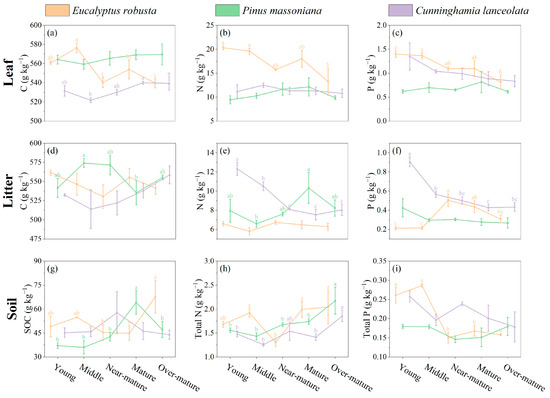
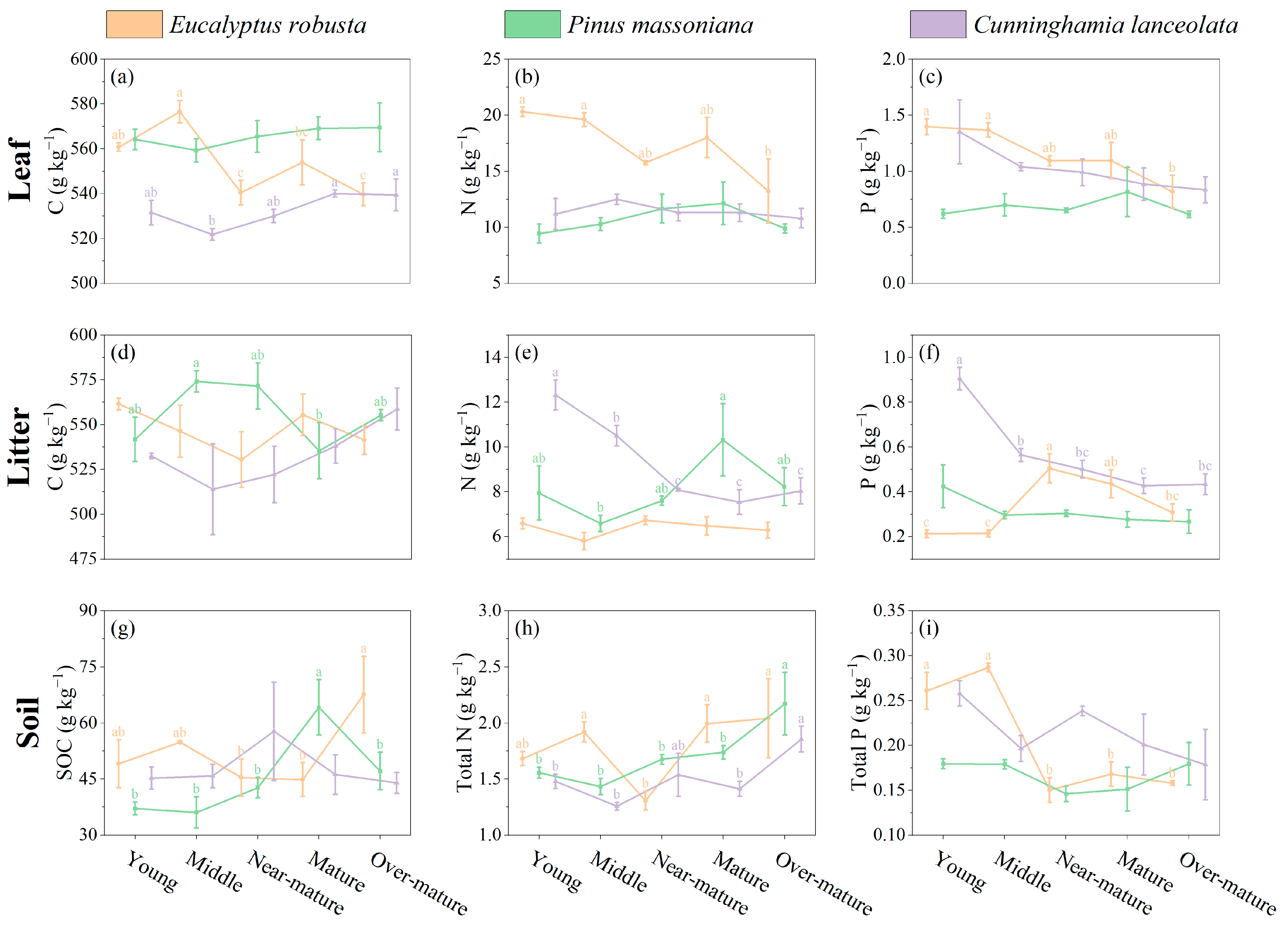
Leaf, litter, and soil C, N, and P concentrations showed distinct stand-age-related patterns among the three plantations (Figure 1; Table 2 and Table S1). In E. robusta, leaf C showed a nonmonotonic pattern and was highest in the middle-aged stand and lowest in the near-mature and over-mature stands. Leaf N and P generally decreased with stand age and were lowest in the over-mature stand. Litter P increased sharply from the middle-aged to the near-mature stand and subsequently declined, whereas litter C showed nonmonotonic variation. Litter N did not differ significantly among stand age classes. SOC was highest in the over-mature stand, soil TN was lowest in the near-mature stand, and soil TP generally decreased after the middle-aged stage.
Figure 1.
Leaf, litter, and soil carbon (C), nitrogen (N), and phosphorus (P) concentrations across five stand age classes in Eucalyptus robusta, Pinus massoniana, and Cunninghamia lanceolata plantations. Panels show (a) leaf C, (b) leaf N, (c) leaf P, (d) litter C, (e) litter N, (f) litter P, (g) soil organic C, (h) soil total N, and (i) soil total P. Orange, green, and purple boxes represent E. robusta, P. massoniana, and C. lanceolata plantations, respectively. Values are means ± standard errors. Different lowercase letters indicate significant differences among stand age classes within the same plantation type at p < 0.05. The absence of letters indicates no significant differences.
Table 2.
Results of two-way linear models testing the effects of plantation type, stand age class, and their interaction on leaf, litter, and soil C, N, and P concentrations and stoichiometric ratios.
In P. massoniana, leaf C, N, and P concentrations did not differ significantly among stand age classes (Figure 1; Table S1). Litter C and N showed pronounced nonmonotonic variation, whereas litter P remained relatively stable. SOC was highest in the mature stand (64.21 ± 7.37 g kg−1), and soil TN was highest in the over-mature stand (2.17 ± 0.28 g kg−1). Soil TP did not differ significantly among stand age classes.
In C. lanceolata, leaf C was lowest in the middle-aged stand (521.83 ± 2.55 g kg−1), whereas leaf N and P did not differ significantly among stand age classes (Figure 1; Table S1). Litter N and P declined sharply from the young to the near-mature stand and remained low in the mature and over-mature stands. SOC and soil TP did not differ significantly among stand age classes, whereas soil TN was highest in the over-mature stand (1.86 ± 0.12 g kg−1).
3.2. Stand-Age-Related Variation in Leaf, Litter, and Soil C:N:P Ratios
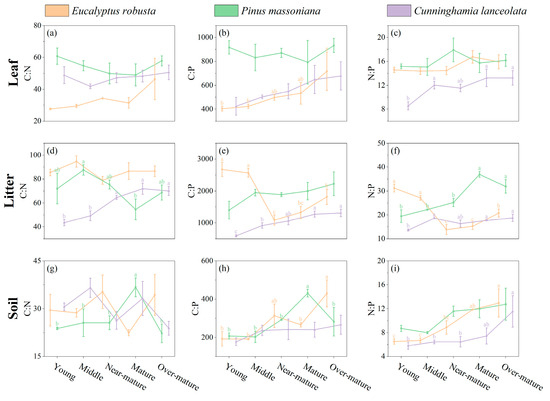
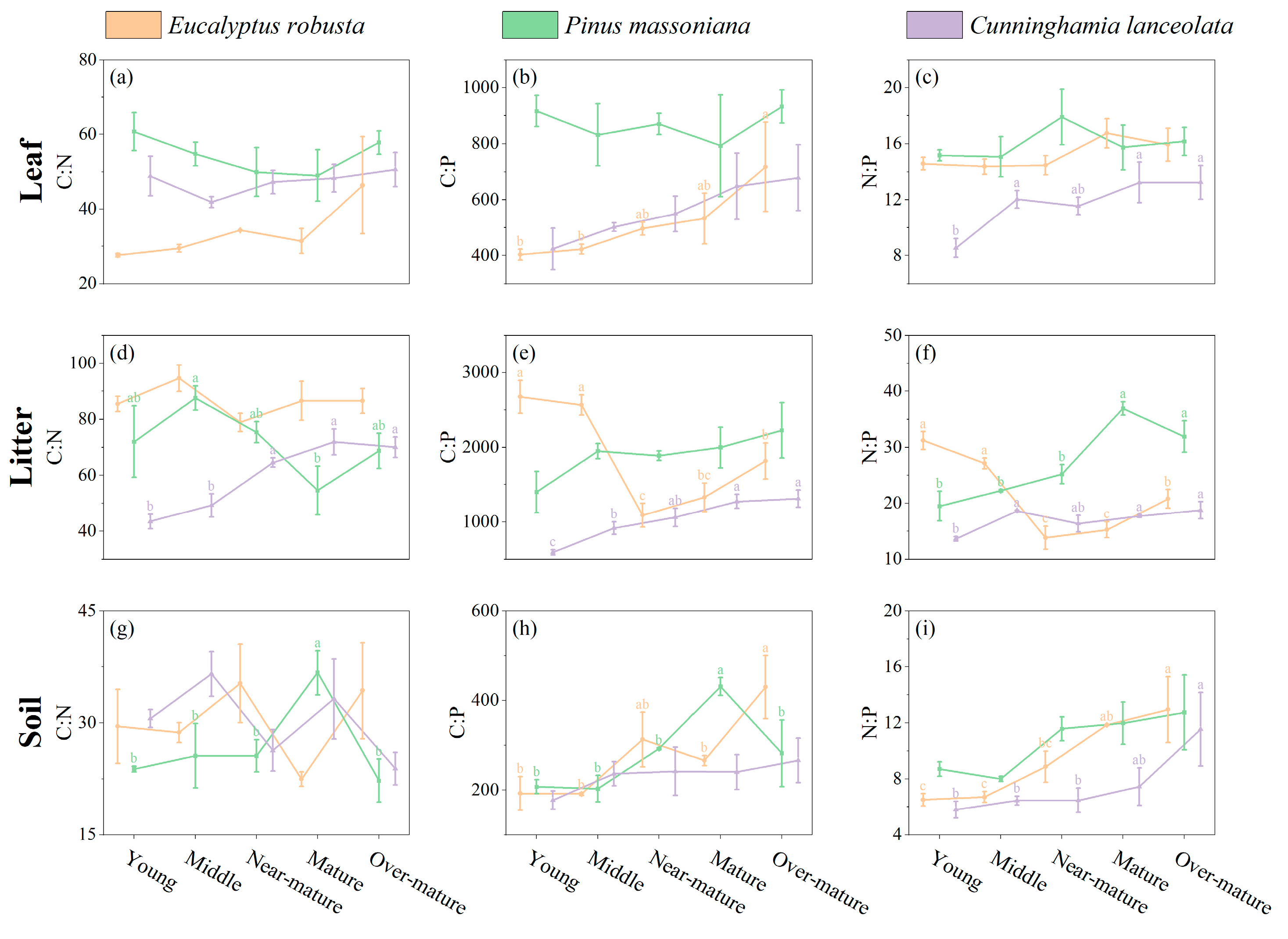
Mass-based C:N, C:P, and N:P ratios exhibited plantation-type-specific variation among stand age classes (Figure 2; Table 2 and Table S2). In E. robusta, leaf C:P generally increased with stand age. Litter C:P and N:P were highest in the young and middle-aged stands, declined sharply in the near-mature and mature stands, and showed intermediate values in the over-mature stand. Soil C:P and N:P generally increased with stand age and were highest in the over-mature stand. Leaf, litter, and soil C:N showed no consistent stand-age-related pattern.
Figure 2.
Leaf, litter, and soil C:N, C:P, and N:P ratios across five stand age classes in Eucalyptus robusta, Pinus massoniana, and Cunninghamia lanceolata plantations. Panels show (a) leaf C:N, (b) leaf C:P, (c) leaf N:P, (d) litter C:N, (e) litter C:P, (f) litter N:P, (g) soil C:N, (h) soil C:P, and (i) soil N:P. Orange, green, and purple boxes represent E. robusta, P. massoniana, and C. lanceolata, respectively. Values are means ± standard errors. Different lowercase letters indicate significant differences among stand age classes within the same plantation type at p < 0.05. The absence of letters indicates no significant differences.
In P. massoniana, leaf C:N, C:P, and N:P did not differ significantly among stand age classes (Figure 2; Table S2). Litter C:N was highest in the middle-aged stand and lowest in the mature stand, whereas litter N:P was higher in the mature and over-mature stands than in the young stand. Litter C:P did not differ significantly among stand age classes. Soil C:N and C:P were highest in the mature stand, whereas soil N:P showed no significant stand-age-related difference.
In C. lanceolata, leaf N:P was lower in the young stand than in the middle-aged, mature, and over-mature stands (Figure 2; Table S2). Litter C:N, C:P, and N:P increased markedly with stand age. Soil N:P was highest in the over-mature stand, whereas soil C:N and C:P showed no consistent stand-age-related pattern.
3.3. Stand-Age-Related Variation in Leaf Nutrient Resorption
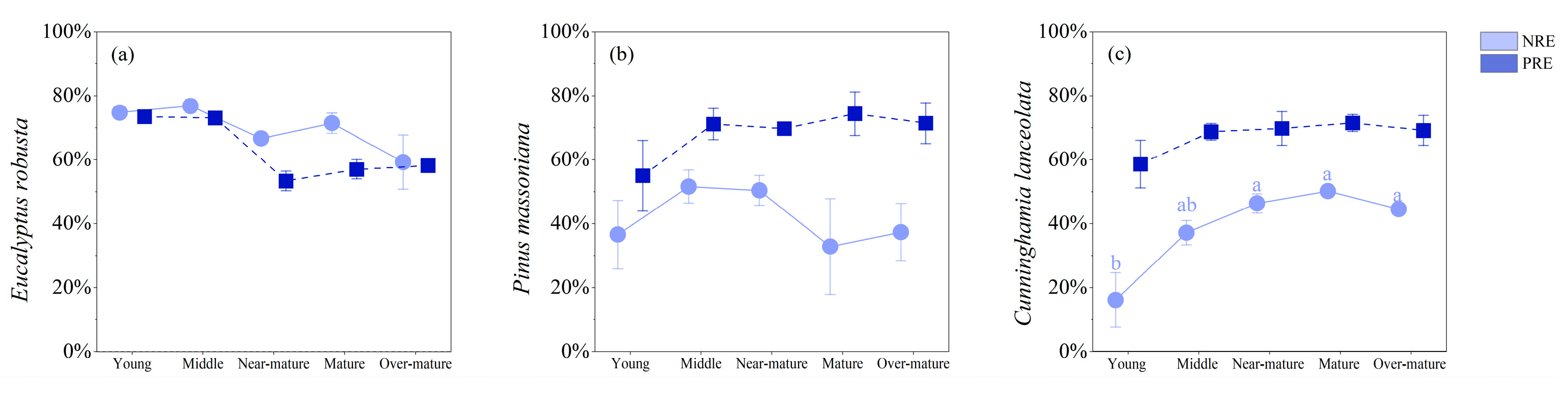
Leaf N and P resorption efficiencies (NRE and PRE) showed different stand-age-related patterns among the three plantation types (Figure 3). In E. robusta, neither NRE nor PRE differed significantly among stand age classes (Figure 3a), while leaf P and soil TP concentrations were lower in older stands (Figure S2). Similarly, neither NRE nor PRE differed significantly among stand age classes in P. massoniana (Figure 3b). In contrast, NRE increased from the young stand to older stands in C. lanceolata, whereas PRE did not differ significantly among stand age classes (Figure 3c). This increase in NRE and the decline in litter N were accompanied by higher soil ammonium (NH4+-N) concentrations in mature and over-mature stands, whereas soil nitrate (NO3−-N) did not differ significantly among stand age classes (Figure S3).
Figure 3.
Leaf N resorption efficiency (NRE) and P resorption efficiency (PRE) across five stand age classes in (a) Eucalyptus robusta, (b) Pinus massoniana, and (c) Cunninghamia lanceolata plantations. Light-blue circles and dark-blue squares represent NRE and PRE, respectively. Values are means ± standard errors. Different lowercase letters indicate significant differences among stand age classes for the same resorption efficiency at p < 0.05. The absence of letters indicates no significant differences.
3.4. Relationships Among Leaf, Litter, and Soil Variables
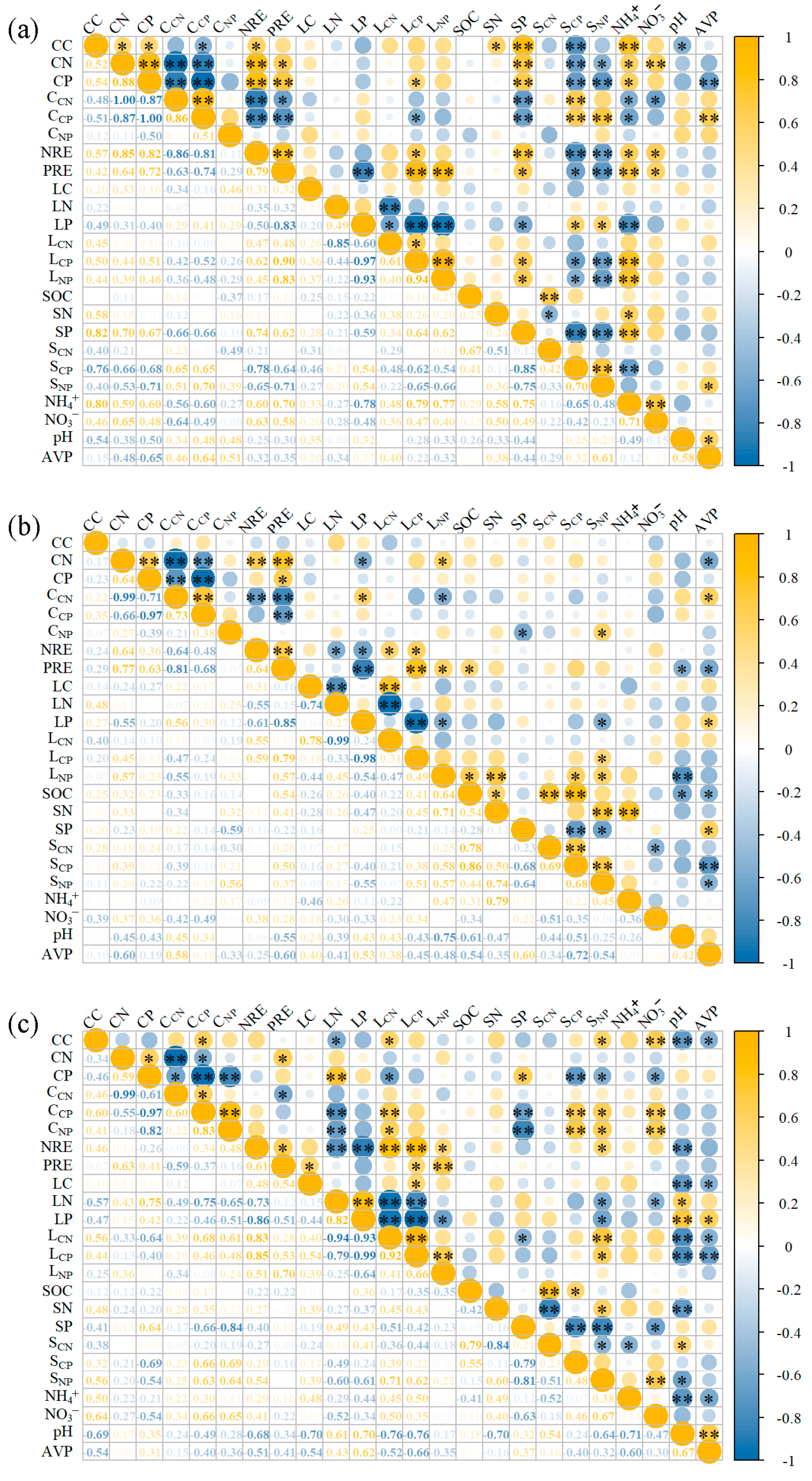
Spearman correlation analyses revealed plantation-type-specific relationships among leaf, litter, and soil variables (Figure 4). In E. robusta, leaf C, N, and P concentrations were positively correlated with soil TP and negatively correlated with soil C:P (Figure 4a). Leaf N and P were negatively correlated with soil N:P. In P. massoniana, leaf N was negatively correlated with litter P but positively correlated with litter N:P, while litter N:P was positively correlated with SOC, TN, soil C:P, and soil N:P (Figure 4b). In C. lanceolata, leaf P was positively correlated with soil total P, whereas litter N and P were negatively correlated with soil N:P (Figure 4c). Litter C:N and C:P were positively correlated with soil N:P. These relationships describe covariation and do not establish causal nutrient transfer among ecosystem compartments.
Figure 4.
Spearman correlation matrices among leaf, litter, and soil variables in (a) Eucalyptus robusta, (b) Pinus massoniana, and (c) Cunninghamia lanceolata plantations. Asterisks denote significance at p < 0.05 (*) and p < 0.01 (**). CC: leaf C, CN: leaf N, CP: leaf P, CCN: leaf C:N, CCP: leaf C:P, CNP: leaf N:P, NRE: N resorption efficiency, PRE: P resorption efficiency, LC: litter C, LN: litter N, LP: litter P, LCN: litter C:N, LCP: litter C:P, LNP: litter N:P, SOC: soil organic carbon, SN: soil total N, SP: soil total P, SCN: soil C:N, SCP: soil C:P, SNP: soil N:P, AVP: soil available phosphorus, pH: soil pH, NH4+: ammonium, and NO3−: nitrate.
4. Discussion
4.1. Plantation-Specific Stand Age Patterns in Leaf–Litter–Soil Stoichiometry
Stand-age-related variation in leaf–litter–soil C:N:P stoichiometry differed markedly among the three plantation types, supporting H1 and H2. The most coherent stand-age-related changes involved leaf and soil P-related variables in E. robusta, litter and soil variables in P. massoniana, and N resorption and litter nutrient concentrations in C. lanceolata. These contrasting patterns demonstrate that plantation development does not produce a uniform stoichiometric trajectory across tree species.
In E. robusta, leaf N and P concentrations generally decreased with stand age, whereas leaf C showed a nonmonotonic pattern. The comparatively high leaf N and P concentrations in young and middle-aged stands may be associated with the high nutrient requirement of rapid biomass accumulation during the early stages of stand development [19]. Similar age-related variation across leaf, litter, and soil compartments has been reported in Eucalyptus chronosequences [16]. More importantly, leaf P and soil TP declined after the middle-aged stage, while leaf and soil C:P increased and PRE tended to decrease, although the differences in PRE among stand age classes were not statistically significant. Meanwhile, litter P reached a maximum in the near-mature stand (Figure S2). Previous work has also documented the translocation of both N and P from senescing foliage in mature Eucalyptus forests, highlighting the importance of internal nutrient recycling in this genus [32]. These coordinated changes suggest a marked redistribution of P among leaves, litter, and soil during stand development. Lower PRE may have increased the amount of P remaining in senesced foliage and contributed to the temporary peak in litter P. However, plant P uptake, litterfall production, decomposition, and leaching were not measured, and the direction and magnitude of P fluxes remain uncertain. Consistent with previous evidence of age-related variation in SOC in Eucalyptus plantations [16], SOC was highest in the over-mature stand. This pattern potentially reflects greater organic matter inputs or slower decomposition.
In P. massoniana, leaf C, N, and P concentrations, stoichiometric ratios, and nutrient-resorption efficiencies remained relatively stable across stand age classes. This contrasts with previously reported stand-age-related changes in N and P resorption in other P. massoniana chronosequences [22]. Other studies have also documented age-related changes across foliage, litter, roots, and soil, indicating that the most responsive ecosystem compartment may vary among sites [15,22]. In contrast, litter C, N, C:N, and N:P showed pronounced stage-specific variation, while SOC and soil C:N and C:P peaked in the mature stand. Thus, stand-age-related variation was more evident in litter and soil than in leaves. The relative stability of foliar stoichiometry and nutrient resorption suggests that leaf nutrient conservation was comparatively well maintained across stand age classes. Global evidence indicates that nutrient resorption in conifers is governed more strongly by stoichiometric control than by nutrient limitation [33]. This framework may be relevant to P. massoniana, although the underlying controls were not assessed directly in this study. In addition, P. massoniana is an ectomycorrhizal tree species, and ectomycorrhizal associations can influence nutrient acquisition and carbon allocation [20], but their contribution to the observed pattern was not assessed directly.
In C. lanceolata, the clearest stand-age-related pattern involved N conservation. Leaf N remained relatively stable, but NRE increased from the young stand toward later stand age classes. At the same time, litter N declined sharply, while litter C:N and N:P increased. These coordinated changes are consistent with greater N withdrawal from senescing foliage in older stands and a lower N concentration in recently senesced foliage [21,23]. However, they do not demonstrate a reduction in total N return through litterfall, which depends on both litter N concentration and litterfall production. Previous research in Chinese fir plantations showed that annual litterfall production and N input increased between 10- and 34-year-old stands [34]. Litter P also decreased with stand age, whereas PRE remained relatively stable, suggesting that the decline in litter P was not primarily driven by enhanced P resorption. Instead, it may reflect changes in green-leaf P, P uptake, allocation, or litterfall dynamics. The comparatively weak stand-age-related variation observed in SOC concentration in C. lanceolata does not necessarily imply stable ecosystem C storage, because tree biomass C and mineral soil C may follow different trajectories during stand development [35].
Overall, the three plantation types exhibited distinct stand-age-related pathways. Eucalyptus robusta was characterized mainly by changes in P-related variables. Pinus massoniana maintained relatively stable leaf stoichiometry but showed stage-specific litter and soil variation, and C. lanceolata exhibited increasingly conservative N dynamics in older stands. These differences may reflect variation in species traits, stand structure, litter inputs, and nutrient-acquisition strategies.
4.2. Relative N and P Status and Nutrient Resorption
Consistent with H3, mass-based leaf N:P ratios differed among plantation types and stand age classes. Across stand ages, leaf N:P was generally intermediate in E. robusta, comparatively high in P. massoniana, and comparatively low in C. lanceolata. According to the commonly used mass-based thresholds proposed by Güsewell [36], values below 10 are often interpreted as indicating relatively low N status, whereas values above 20 indicate relatively low P status. However, ratios within the intermediate range (10–20) do not clearly indicate either N or P limitation, and the use of leaf N:P thresholds alone is associated with considerable uncertainty [37]. This uncertainty is particularly relevant to forest ecosystems, where fertilization experiments have shown that nutrient responses can vary with tree size, taxonomic identity, and ecosystem context, making a single foliar N:P threshold unlikely to provide a universally reliable diagnosis of nutrient limitation [38,39]. In our study, leaf N:P ratios across almost all plantation types and stand age classes fell within this intermediate range (10–20), except for young C. lanceolata, where the N:P ratio was slightly below 10. This pattern suggests that most plantations did not exhibit clear evidence of single nutrient limitation based solely on leaf stoichiometry.
Leaf nutrient resorption can be jointly regulated by nutrient limitation and stoichiometric relationships, although the relative importance of these controls differs among plant functional groups [33]. In the present study, NRE and PRE showed different patterns among plantation types and stand age classes. The clearest stand-age-related change was the increase in NRE in older C. lanceolata stands, indicating a change in N conservation during stand development. Nutrient resorption is known to vary among species and with stand development [21,22,28]. Because recently senesced foliage of the target plantation species was used, the observed patterns reflect variation in nutrient withdrawal during senescence among plantation types and stand age classes [21,22,23].
4.3. Leaf–Litter–Soil Relationships and Management Implications
The correlation analyses revealed different patterns of leaf–litter–soil covariation among plantation types. In E. robusta, leaf P and soil TP changed in parallel, while leaf C:P was positively associated with soil C:P and N:P, further highlighting the importance of P-related variation during stand development. Comparable age-related shifts across leaf, litter, and soil C:N:P properties have been reported in Eucalyptus chronosequences [16]. In P. massoniana, relatively stable leaf stoichiometry contrasted with strong relationships between litter N:P and SOC and soil N variables, indicating that stand-age-related variation was more evident in litter and soil than leaves. Similar stand-age-related shifts in N and P dynamics have been reported in other P. massoniana chronosequences [15,22]. In C. lanceolata, declining litter N and P were associated with increasing soil N:P, indicating covariation between litter nutrient concentrations and soil stoichiometry. Related linkages among leaf, litter, and soil stoichiometry have also been documented in Chinese fir plantations [11,40]. Because these correlations were cross-sectional and several ratios shared constituent variables, they should not be interpreted as evidence of direct nutrient transfer or causal regulatory pathways.
From a management perspective, the results indicate that nutrient monitoring should consider both plantation type and stand age. P-related indicators may deserve particular attention during the later development of E. robusta and P. massoniana, whereas litter N and NRE may be especially informative in C. lanceolata. However, specific fertilization recommendations should be based on nutrient-addition experiments and tree-growth responses rather than on stoichiometric ratios alone.
5. Conclusions
This study demonstrates that leaf–litter–soil C, N, and P stoichiometry varied markedly with stand age and that the dominant patterns differed among E. robusta, P. massoniana, and C. lanceolata plantations. In E. robusta, older stands generally exhibited lower leaf N and P concentrations and soil total P, together with higher leaf C:P and soil C:P and N:P, whereas NRE and PRE did not differ significantly among stand age classes. Pinus massoniana maintained comparatively stable leaf stoichiometry and nutrient-resorption efficiencies across stand age classes, despite nonmonotonic variation in litter and soil properties. In C. lanceolata, declining litter N and P concentrations were accompanied by increasing litter C:N, C:P and N:P and enhanced NRE during stand development. These contrasting patterns demonstrate that nutrient distribution and conservation across the leaf–litter–soil continuum are specific to a plantation types and the ecosystem compartments. The observed patterns should be interpreted in light of the chronosequence design and the methodological assumptions underlying the calculation of NRE and PRE. Direct measurements of litter decomposition, microbial activity, root nutrient acquisition, and nutrient fluxes would help clarify the mechanisms underlying these patterns.
Supplementary Materials
The following supporting information can be downloaded at: https://www.mdpi.com/article/10.3390/f17091099/s1, Figure S1: Climatic conditions at the study site. The arrow and shaded area indicate the sampling period. (a) Mean monthly precipitation. (b) Monthly temperature, including mean, mean monthly maximum, and mean minimum temperatures. (c) Mean monthly relative humidity. Data were obtained from the China Meteorological Administration (http://data.cma.cn/); Figure S2: Stand-age-related variation in leaf N resorption efficiency (NRE) and P resorption efficiency (PRE), leaf P, litter N and P, and soil total P in Eucalyptus robusta plantations. Values are means ± standard errors. Different lowercase letters indicate significant differences among stand age classes for the same variable at p < 0.05. The absence of letters indicates no significant differences; Figure S3: Stand-age-related variation in (a) litter N, (b) soil ammonium nitrogen (NH4+-N) and nitrate nitrogen (NO3−-N), and (c) leaf N resorption efficiency (NRE) in Cunninghamia lanceolata plantations. Values are means ± standard errors. Different lowercase letters indicate significant differences among stand age classes at p < 0.05. The absence of letters indicates no significant differences; Table S1: Carbon (C), nitrogen (N), and phosphorus (P) concentrations in leaves, litter, and soil across five stand age classes in three subtropical plantation types; Table S2: C:N, C:P, and N:P ratios of leaves, litter and soil across five stand age classes in three subtropical plantation types.
Author Contributions
Conceptualization, Z.W.; methodology, Z.W.; investigation, X.L., J.W., G.L. and P.Y.; formal analysis, S.L., R.H. and Z.W.; data curation, S.L., R.H. and Z.F.; visualization, S.L., R.H. and V.W.; writing—original draft preparation, S.L. and R.H.; writing—review and editing, S.L., R.H., Z.W. and V.W.; supervision, Z.W.; project administration, Z.W.; funding acquisition, Z.W.; resources, Z.W. All authors have read and agreed to the published version of the manuscript.
Funding
This research was funded by the National Natural Science Foundation of China (42367035), the Guangxi Young Elite Scientist Sponsorship Program (GXYESS2025026), the China Scholarship Council (202308450085), the Open Research Fund of the Guangxi Key Laboratory of Earth Surface Processes and Intelligent Simulation, Nanning Normal University (NNNU-KLOP-X2001), and the Innovation and Entrepreneurship Training Program for College Students (202510603805). The funders had no role in the design of the study; in the collection, analyses, or interpretation of data; in the writing of the manuscript; or the decision to publish the results.
Data Availability Statement
The data supporting the findings of this study are available from the corresponding author upon reasonable request.
Conflicts of Interest
Author Ping Yang was employed by the company Qinghai Institute of Science and Technology Information Co., Ltd. The remaining authors declare that the research was conducted in the absence of any commercial or financial relationships that could be construed as a potential conflict of interest.
References
- Elser, J.J.; Fagan, W.F.; Kerkhoff, A.J.; Swenson, N.G.; Enquist, B.J. Biological stoichiometry of plant production: Metabolism, scaling and ecological response to global change. New Phytol. 2010, 186, 593–608. [Google Scholar] [CrossRef] [Scilit]
- Hessen, D.O.; Elser, J.J.; Sterner, R.W.; Urabe, J. Ecological stoichiometry: An elementary approach using basic principles. Limnol. Oceanogr. 2013, 58, 2219–2236. [Google Scholar] [CrossRef] [Scilit]
- Yang, Y.; Luo, Y. Carbon:nitrogen stoichiometry in forest ecosystems during stand development. Glob. Ecol. Biogeogr. 2011, 20, 354–361. [Google Scholar] [CrossRef] [Scilit]
- Han, W.; Fang, J.; Guo, D.; Zhang, Y. Leaf nitrogen and phosphorus stoichiometry across 753 terrestrial plant species in China. New Phytol. 2005, 168, 377–385. [Google Scholar] [CrossRef] [Scilit]
- Killingbeck, K.T. Nutrients in senesced leaves: Keys to the search for potential resorption and resorption proficiency. Ecology 1996, 77, 1716–1727. [Google Scholar] [CrossRef] [Scilit]
- Parton, W.; Silver, W.L.; Burke, I.C.; Grassens, L.; Harmon, M.E.; Currie, W.S.; King, J.Y.; Adair, E.C.; Brandt, L.A.; Hart, S.C.; et al. Global-scale similarities in nitrogen release patterns during long-term decomposition. Science 2007, 315, 361–364. [Google Scholar] [CrossRef] [Scilit]
- Cornwell, W.K.; Cornelissen, J.H.C.; Amatangelo, K.; Dorrepaal, E.; Eviner, V.T.; Godoy, O.; Hobbie, S.E.; Hoorens, B.; Kurokawa, H.; Pérez-Harguindeguy, N.; et al. Plant species traits are the predominant control on litter decomposition rates within biomes worldwide. Ecol. Lett. 2008, 11, 1065–1071. [Google Scholar] [CrossRef] [Scilit]
- de la Casa, J.; Sardans, J.; Galindo, M.; Peñuelas, J. Stoichiometry of litter decomposition under the effects of climate change and nutrient enrichment: A meta-analysis. Plant Soil 2025, 506, 709–726. [Google Scholar] [CrossRef] [Scilit]
- Ren, Y.; Gao, G.-L.; Ding, G.-D.; Zhang, Y.; Zhao, P.-S. Patterns and environmental drivers of C, N, and P stoichiometry in the leaf-litter-soil system associated with Mongolian pine forests. Ecol. Evol. 2024, 14, e11172. [Google Scholar] [CrossRef] [Scilit]
- Fan, H.; Wu, J.; Liu, W.; Yuan, Y.; Hu, L.; Cai, Q. Linkages of plant and soil C:N:P stoichiometry and their relationships to forest growth in subtropical plantations. Plant Soil 2015, 392, 127–138. [Google Scholar] [CrossRef] [Scilit]
- Shen, L.; Ye, S.; Liu, H.; Deng, X.; He, P.; Cheng, F. Linkage between leaf-litter-soil, microbial resource limitation, and carbon-use efficiency in successive Chinese fir (Cunninghamia lanceolata) plantations. Forests 2023, 14, 357. [Google Scholar] [CrossRef] [Scilit]
- Liu, R.; Wang, D. C:N:P stoichiometric characteristics and seasonal dynamics of leaf-root-litter-soil in plantations on the loess plateau. Ecol. Indic. 2021, 127, 107772. [Google Scholar] [CrossRef] [Scilit]
- Luo, X.; Hou, E.; Chen, J.; Li, J.; Zhang, L.; Zang, X.; Wen, D. Dynamics of carbon, nitrogen, and phosphorus stocks and stoichiometry resulting from conversion of primary broadleaf forest to plantation and secondary forest in subtropical China. CATENA 2020, 193, 104606. [Google Scholar] [CrossRef] [Scilit]
- Tong, R.; Zhou, B.; Jiang, L.; Ge, X.; Cao, Y.; Shi, J. Leaf litter carbon, nitrogen and phosphorus stoichiometry of Chinese fir (Cunninghamia lanceolata) across China. Glob. Ecol. Conserv. 2021, 27, e01542. [Google Scholar] [CrossRef] [Scilit]
- Ali, A.; Hussain, M.; Ali, S.; Akhtar, K.; Muhammad, M.W.; Zamir, A.; Ali, A.; Nizami, S.M.; Ahmad, B.; Harrison, M.T.; et al. Ecological stoichiometry in Pinus massoniana L. plantation: Increasing nutrient limitation in a 48-year chronosequence. Forests 2022, 13, 469. [Google Scholar] [CrossRef] [Scilit]
- Xu, Y.X.; Wang, Z.C.; Zhang, L.L.; Zhu, W.K.; Du, A.P. The stoichiometric characteristics of C, N and P in leaf-litter-soil of different aged Eucalyptus urophylla × E. grandis plantations. For. Res. 2018, 31, 168–174, (In Chinese with English abstract). [Google Scholar]
- FAO. Global Forest Resources Assessment 2025; Food and Agriculture Organization of the United Nations: Rome, Italy, 2025. [Google Scholar]
- Mensah, P.; Pimenta, A.S.; Melo, R.R.d.; Amponsah, J.; Rusch, F.; Danso, H.; Miranda, N.d.O.; Medeiros, P.L.d.; Gama, G.S.P. Benefits of Eucalyptus plantations: Ecological services, socioeconomic contributions, and innovation—A global review. Forests 2026, 17, 644. [Google Scholar] [CrossRef] [Scilit]
- Silva, N.F.d.; Barros, N.F.d.; Neves, J.C.L.; Schulthais, F.; Novais, R.F.d.; Mattiello, E.M. Yield and nutrient demand and efficiency of Eucalyptus under coppicing regime. Forests 2020, 11, 852. [Google Scholar] [CrossRef] [Scilit]
- Sun, P.; Shen, Y.; Wang, L.; Chen, T.; Zhang, M.; Xiao, W.; Cheng, R. Photosynthetic product allocations of Pinus massoniana seedlings inoculated with ectomycorrhizal fungi along a nitrogen addition gradient. Front. Plant Sci. 2022, 13, 948676. [Google Scholar] [CrossRef] [Scilit]
- Chen, F.; Niklas, K.J.; Liu, Y.; Fang, X.; Wan, S.; Wang, H. Nitrogen and phosphorus additions alter nutrient dynamics but not resorption efficiencies of Chinese fir leaves and twigs differing in age. Tree Physiol. 2015, 35, 1106–1117. [Google Scholar] [CrossRef] [Scilit]
- Guo, W.; Jiao, P.; Lopez C, M.L.; Chen, Z.; Wei, L.; Liu, X.; Hu, Y.; Wang, Y. Nitrogen and phosphorous dynamics with stand development of Pinus massoniana plantations in Southeast China. Front. Plant Sci. 2023, 14, 1139945. [Google Scholar] [CrossRef] [Scilit]
- Wu, H.; Xiang, W.; Ouyang, S.; Xiao, W.; Li, S.; Chen, L.; Lei, P.; Deng, X.; Zeng, Y.; Zeng, L.; et al. Tree growth rate and soil nutrient status determine the shift in nutrient-use strategy of Chinese fir plantations along a chronosequence. For. Ecol. Manag. 2020, 460, 117896. [Google Scholar] [CrossRef] [Scilit]
- Du, H.; Zeng, F.; Wang, K.; Song, T.; Wen, Y.; Li, C.; Peng, W.; Liang, H.; Zhu, H.; Zeng, Z. Dynamics of biomass and productivity of three major plantation types in southern China. Acta Ecol. Sin. 2014, 34, 2712–2724, (In Chinese with English abstract). [Google Scholar] [CrossRef] [Scilit]
- Robertson, G.P.; Coleman, D.C.; Bledsoe, C.S.; Sollins, P. (Eds.) Standard Soil Methods for Long-Term Ecological Research; Oxford University Press: New York, NY, USA, 1999. [Google Scholar]
- Carter, M.R.; Gregorich, E.G. (Eds.) Soil Sampling and Methods of Analysis, 2nd ed.; CRC Press: Boca Raton, FL, USA, 2008. [Google Scholar]
- Jones, J.B., Jr. Laboratory Guide for Conducting Soil Tests and Plant Analysis; CRC Press: Boca Raton, FL, USA, 2001. [Google Scholar]
- Vergutz, L.; Manzoni, S.; Porporato, A.; Novais, R.F.; Jackson, R.B. Global resorption efficiencies and concentrations of carbon and nutrients in leaves of terrestrial plants. Ecol. Monogr. 2012, 82, 205–220. [Google Scholar] [CrossRef] [Scilit]
- Du, H.; Zeng, F.; Peng, W.; Wang, K.; Zhang, H.; Liu, L.; Song, T. Carbon storage in a Eucalyptus plantation chronosequence in southern China. Forests 2015, 6, 1763–1778. [Google Scholar] [CrossRef] [Scilit]
- van Heerwaarden, L.M.; Toet, S.; Aerts, R. Current measures of nutrient resorption efficiency lead to a substantial underestimation of real resorption efficiency: Facts and solutions. Oikos 2003, 101, 664–669. [Google Scholar] [CrossRef] [Scilit]
- Winter, B. A Very Basic Tutorial for Performing Linear Mixed Effects Analyses: Tutorial 2; University of California, Merced: Merced, CA, USA, 2018. [Google Scholar]
- Crous, K.Y.; Wujeska-Klause, A.; Jiang, M.; Medlyn, B.E.; Ellsworth, D.S. Nitrogen and phosphorus retranslocation of leaves and stemwood in a mature Eucalyptus forest exposed to 5 years of elevated CO2. Front. Plant Sci. 2019, 10, 664. [Google Scholar] [CrossRef] [Scilit]
- Sun, X.; Li, D.; Lü, X.; Fang, Y.; Ma, Z.; Wang, Z.; Chu, C.; Li, M.; Chen, H. Widespread controls of leaf nutrient resorption by nutrient limitation and stoichiometry. Funct. Ecol. 2023, 37, 1653–1662. [Google Scholar] [CrossRef] [Scilit]
- Zhou, L.; Addo-Danso, D.S.; Wu, P.; Li, S.; Jia, Y.; Ma, X. Litterfall production and nutrient return in different-aged Chinese fir (Cunninghamia lanceolata) plantations in South China. J. For. Res. 2015, 26, 79–89. [Google Scholar] [CrossRef]
- Chen, G.; Yang, Z.; Gao, R.; Xie, J.; Guo, J.; Huang, Z.; Yang, Y. Carbon storage in a chronosequence of Chinese fir plantations in southern China. For. Ecol. Manag. 2013, 300, 68–76. [Google Scholar] [CrossRef] [Scilit]
- Güsewell, S. N:P ratios in terrestrial plants: Variation and functional significance. New Phytol. 2004, 164, 243–266. [Google Scholar] [CrossRef] [Scilit]
- Yan, Z.; Tian, D.; Han, W.; Tang, Z.; Fang, J. An assessment on the uncertainty of the nitrogen to phosphorus ratio as a threshold for nutrient limitation in plants. Ann. Bot. 2017, 120, 937–942. [Google Scholar] [CrossRef] [Scilit]
- Sullivan, B.W.; Alvarez-Clare, S.; Castle, S.C.; Porder, S.; Reed, S.C.; Schreeg, L.; Townsend, A.R.; Cleveland, C.C. Assessing nutrient limitation in complex forested ecosystems: Alternatives to large-scale fertilization experiments. Ecology 2014, 95, 668–681. [Google Scholar] [CrossRef] [Scilit]
- Alvarez-Clare, S.; Mack, M.C.; Brooks, M. A direct test of nitrogen and phosphorus limitation to net primary productivity in a lowland tropical wet forest. Ecology 2013, 94, 1540–1551. [Google Scholar] [CrossRef] [Scilit]
- Zhang, Z.; Guo, Y.; Ye, S.; Wang, S. Response of soil microbial communities and nutrient stoichiometry to stand age in Chinese fir plantations: Insights at the aggregate scale. J. Soil Sci. Plant Nutr. 2024, 24, 1067–1082. [Google Scholar] [CrossRef] [Scilit]

Disclaimer/Publisher’s Note: The statements, opinions and data contained in all publications are solely those of the individual author(s) and contributor(s) and not of MDPI and/or the editor(s). MDPI and/or the editor(s) disclaim responsibility for any injury to people or property resulting from any ideas, methods, instructions or products referred to in the content. |
© 2026 by the authors. Licensee MDPI, Basel, Switzerland. This article is an open access article distributed under the terms and conditions of the Creative Commons Attribution (CC BY) license.