


Abstract
Tree competition strongly shapes forest productivity, yet how it alters root growth dynamics and thereby influences tree performance remains poorly understood. Here, using 50 custom rhizoboxes containing 130 one-year-old seedlings, we conducted long-term, high-frequency, non-destructive monitoring of visible living root length at the observation panel in Cyclobalanopsis glauca and Cunninghamia lanceolata subjected to control, intraspecific, and interspecific competition. Each competition-treatment rhizobox contained one target seedling with either one or three neighboring seedlings. We found that competition significantly reduced visible living root length, altered temporal variation in visible living root length, and advanced the onset of summer root decline. The reduction was stronger under interspecific than intraspecific competition, with mean visible living root lengths of 802 mm (95% CI: 709–894 mm) and 2147 mm (95% CI: 1976–2317 mm), respectively. Although competition also altered root phenology, these phenological shifts showed little relationship with aboveground growth. Instead, root length consistently explained variation in stem radial growth across treatments. Our findings demonstrate that competition-related reductions in aboveground growth were more closely associated with reduced root length than shifts in root phenology, highlighting the potential importance of root length dynamics in plant competitive interactions.
1. Introduction
Competition for limited soil resources is a fundamental ecological process that shapes plant performance, species coexistence, and forest ecosystem functioning [1,2,3]. As the primary interface for water and nutrient acquisition, roots play a central role in belowground resource uptake and are closely linked to whole-plant carbon allocation, thereby influencing tree growth and biomass accumulation [4,5]. However, belowground responses to competition are highly dynamic, as root growth patterns change continuously throughout the growing season in response to resource availability, carbon allocation, and environmental conditions [6,7,8]. Understanding how competition modifies these temporal dynamics is therefore essential for elucidating how belowground processes are associated with tree growth under competitive environments.
Root systems are characterized by diverse morphological, architectural and anatomical properties, including root length, branching intensity, root volume, diameter, spatial distribution, and tissue structure [9]. Plant species exhibit different belowground strategies, through combinations of these root characteristics, which may influence their capacity for resource acquisition and tolerance to competition [10,11]. For example, species with extensive, fine, or highly branched root systems may rapidly occupy local soil resources, whereas species with thicker or deeper roots may reduce overlap or access resources from different soil domains [12,13]. When species with contrasting root characteristics coexist within the same soil environment, differences in root deployment and resource acquisition strategies may influence the degree of belowground competitive outcomes [14,15,16]. Other root characteristics, including anatomical and architectural traits, may further influence resource acquisition by affecting the costs and efficiency of soil exploration [17,18,19]. However, these functional strategies have mostly been inferred from static trait measurements rather than from repeated observations of root growth through time. Consequently, how competition affects the temporal dynamics of root development remains poorly understood [9,20].
Root traits and root phenology jointly influence both the capacity for soil exploration and the timing of resource acquisition throughout the growing season [21,22]. Root systems are multidimensional and can be represented by multiple traits [9,23]. Among these traits, root length provides an important indicator of belowground expansion and potential resource exploration capacity. Repeated observations of visible living root length allowed us to characterize seasonal changes in root growth trajectories and link these dynamics with root phenological patterns. Competition may influence tree performance by altering root length development, advancing early-season root production, or inducing earlier cessation of root activity [24,25,26]. Yet, whether competition constrains tree growth through changes in root length, altered seasonal root growth dynamics, or shifts in root phenology remains unclear. Moreover, the relative importance of root length and root phenology in explaining variation in aboveground growth has rarely been evaluated.
In this study, we used 50 custom rhizoboxes to conduct long-term, high-frequency, non-destructive observations of visible living root length in Cyclobalanopsis glauca and Cunninghamia lanceolata (hereafter Cy. glauca and Cu. lanceolata), two tree species exhibiting different root functional strategies. By applying three competition treatments (control, intraspecific competition, and interspecific competition), we quantified total temporal variation in root length, seasonal root dynamics, and root phenology, and examined their relationships with aboveground growth. We hypothesized that (1) competition, particularly interspecific competition, would suppress visible living root length at the observation panel and alter total temporal variability in root growth; (2) competition would modify seasonal root length trajectories and root phenology, including the timing of summer root decline, start of the root growing season (SOS), end of the root growing season (EOS), and root growing season length; and (3) root length would show stronger relationships with aboveground growth than root phenology, especially with final basal diameter.
2. Materials and Methods
2.1. Study Site and Plant Materials
The competition experiment was conducted in a naturally illuminated and ventilated greenhouse at the Pengzhou Experimental Research Station, Sichuan, China (31.18° N, 104.00° E), from December 2023 to December 2024.
One-year-old seedlings of Cy. glauca and Cu. lanceolata were selected as the study species because they exhibit different root functional traits. Cy. glauca typically develops fine, highly branched root systems, whereas Cu. lanceolata forms coarser roots with larger diameters. These contrasting root morphologies allowed us to examine whether the effects of tree competition on root length, root phenology, and aboveground growth were consistent across species with distinct belowground trait strategies. Seedlings were obtained from a nearby nursery before transplantation. Initial seedling height and basal diameter did not differ significantly among competition treatments within each species, as shown in Table S1.
2.2. Rhizobox Setup
Fifty custom rhizoboxes (40 cm × 40 cm × 45 cm) were used to monitor root growth. One side of each rhizobox was fitted with a transparent acrylic observation panel to enable repeated, non-destructive root observation and image acquisition, whereas the remaining sides were opaque. Throughout the experiment, the observation panel was covered with a removable black cloth to exclude light and minimize its potential effects on root growth and was uncovered only during imaging (Figure S1a).
Before transplantation, all rhizoboxes were disinfected and filled with a 1:1 (v/v) mixture of local topsoil and a commercial growing substrate consisting of peat, vermiculite, and perlite. Soil pH, organic matter, total nitrogen, ammonium nitrogen, nitrate nitrogen, available phosphorus, available potassium, and slowly available potassium were determined following standard soil agrochemical methods described by Lu (1999) [27]. Soil organic carbon was calculated from soil organic matter. Total phosphorus and total potassium were determined by acid digestion followed by inductively coupled plasma optical emission spectrometry according to LY/T 1232-2015 and LY/T 1234-2015, respectively [28,29].
Seedlings were transplanted into the rhizoboxes on 12 December 2023. Roots were carefully washed to remove adhering soil and positioned adjacent to the observation panel. After planting, rhizoboxes were thoroughly irrigated with a solution containing a commercial 50% carbendazim fungicide (Dafusheng®, Xuzhou, China) and a commercial 2% indole-3-butyric acid-naphthaleneacetic acid (IBA-NAA) rooting regulator (Aigensheng®, Meishan, China) to facilitate seedling establishment. Later, leaves were uniformly removed from all seedlings to reduce transpirational water loss and minimize transplanting stress. These procedures were applied to standardize seedling establishment and enable repeated root observation. Although these manipulations may differ from natural field conditions, seedlings were shaded for one week after transplantation and allowed to acclimate for three months before root measurements began to minimize potential short-term effects. Throughout the experiment, seedlings were irrigated regularly to avoid water limitation. Rhizoboxes were randomly assigned to positions in the greenhouse and rotated every two to three weeks to minimize positional effects associated with light, temperature, and ventilation.
Soil temperature and relative soil moisture were continuously monitored using soil moisture sensors (S21A, Pengyun IoT, Xuzhou, China), with measurements recorded at 10-min intervals. The sensors use frequency-domain reflectometry (FDR) to estimate soil water content from the dielectric permittivity of the substrate. Sensor output was expressed as relative soil water content, calculated as the percentage of the soil water content relative to field capacity (% FC). The measurement accuracy of the sensors was ±5%. Mean soil temperature and relative soil moisture during the experimental period were 22.5 °C and 72.8%, respectively (Figure S2).
2.3. Experimental Design
A total of 170 seedlings of Cy. glauca and Cu. lanceolata were initially procured to allow for potential transport losses and the selection of uniformly sized individuals. Following selection, 130 seedlings (65 per species seedlings) were assigned to 50 rhizoboxes. Three treatments were established for each species: (1) control, consisting of a single target seedling; (2) intraspecific competition, consisting of one target seedling and one or three neighboring conspecific seedlings; and (3) interspecific competition, consisting of one target seedling and one or three neighboring heterospecific seedlings (Table S2). The control treatment was replicated five times, whereas the intraspecific and interspecific competition treatments were each replicated ten times. In all treatments, the target seedling was positioned adjacent to the observation panel. In the competition treatments, one or three neighboring seedlings were planted on the opposite side of the rhizobox, either of the same species (intraspecific competition) or the other species (interspecific competition) (Figure S1b).
2.4. Tree Growth Observations
Plant height and basal diameter of target seedlings were measured on the initial and final observation date using a steel ruler (0.1 cm accuracy) and a digital vernier caliper (0.1 mm accuracy), respectively. Basal diameter was measured at a fixed position approximately 3 cm above the soil surface.
Root growth of target seedlings was monitored from March to December 2024 at 7-day intervals using a Canon EOS M50 mirrorless camera (Canon Inc., Tokyo, Japan). Target roots were identified from their initial appearance near the observation panel and tracked across sequential images based on root continuity and branching patterns. At crossings or overlaps, only segments that could be confidently traced to the target seedling were included, whereas ambiguous segments were excluded. During each observation, the camera was positioned perpendicular to the observation panel to capture the entire root system. Approximately 1900 root images were obtained in this study.
2.5. Root Image Analysis
Root images were analysed using RootSnap software (v1.4.0.109, CID Bio-Science, Camas, WA, USA) following a standardized semi-automated workflow. All visible roots of the target seedlings within the observation panel were assessed in each image. Images with clean backgrounds were initially processed using automated root detection, whereas images with substantial debris or visual interference were manually traced. Images were not blind-coded, but all traces were visually inspected and corrected by the same trained analyst to resolve erroneous paths, missed or spurious root segments, and inaccurate branch trajectories. Dead, blackened, or obscured root segments were excluded. Only manually verified measurements of visible living root length at the observation panel were used in subsequent analyses.
Root length measurements represented standing visible living root length at each observation date, and temporal changes reflected net changes in visible living root length during the monitoring period. Root segments were tracked across sequential images at the observation panel rather than whole-root measurements, and individual root birth and death events were not quantified.
To characterize total temporal variability in root growth, the coefficient of variation (CV) of root length was calculated for each seedling as a descriptive measure:
where SD and mean were calculated for each target seedling within each species and competition treatment, using all repeated root length observations across the monitoring period.
2.6. Estimation of Root Phenology
To account for differences in initial root length among seedlings, changes in visible living root length were expressed relative to the initial observation as
where Root lengthi and Root length0 represent the visible living root length at observation time i and at the initial observation, respectively.
Temporal dynamics of root length change were characterized using locally estimated scatterplot smoothing (LOESS), a flexible non-parametric approach for fitting temporal growth trajectories [30]. Models were fitted with a span of 0.30, a second-degree local polynomial, and a Gaussian family. Before fitting, observations outside the median ± 2.5 median absolute deviations for each individual time series were excluded.
For each seedling, the fitted seasonal maximum of root length change was identified from the LOESS curve. The start of the root growing season (SOS) was defined as the first date on which the fitted root length change exceeded 20% of the fitted seasonal maximum and the growth rate showed a positive trend. The end of the root growing season (EOS) was defined as the first date on which the fitted root length change declined below 20% of the fitted seasonal maximum and the growth rate showed a negative trend. When multiple growth pulses occurred, the first and last threshold crossings were used to define SOS and EOS, respectively. If the smoothed curve was already above the threshold at the first observation, SOS was classified as left-censored; if it remained above the threshold at the last observation, EOS was classified as right-censored. Root growing season length was calculated as the interval between SOS and EOS. This threshold-based approach follows the general logic of phenological transition extraction from smoothed seasonal trajectories, in which the onset and end of the growing season are identified when the fitted curve crosses a predefined proportion of seasonal amplitude [31,32].
2.7. Statistical Analyses
To evaluate competition effects on root length and its total temporal variability, differences in visible living root length and its coefficient of variation (CV) among competition treatments were assessed using one-way analysis of variance (ANOVA) followed by Tukey’s honestly significant difference (HSD) test. Analyses were conducted for the pooled dataset and separately for each species. Neighbor-density effects were evaluated separately by comparing weak (one neighbor) and strong (three neighbors) density levels within intraspecific and interspecific competition for each species, with effect estimates and 95% confidence intervals calculated for each comparison. Because the primary analyses focused on competition type, the two neighbor-density levels were pooled to compare control, intraspecific competition, and interspecific competition. To distinguish residual temporal variation from differences in root-length scale and seasonal trajectories, we conducted an additional longitudinal mixed-effects analysis. Root length was log-transformed before analysis. Species, competition treatment, observation date treated as a categorical factor, and all their interactions were included as fixed effects, whereas seedling identity was included as a random intercept. Standardized residuals were extracted for each observation, and their standard deviation was calculated separately for each target seedling as an index of residual temporal variation around the expected group-specific seasonal trajectory. These seedling-level residual standard deviations were log-transformed and analyzed using species, competition treatment, and their interaction as predictors. Within each species, intraspecific and interspecific competition treatments were compared with the control using Dunnett-adjusted contrasts.
To descriptively characterize seasonal trajectories of root dynamics, root observations were grouped into spring (March–May), summer (June–August), and autumn (September–November). Monthly root dynamics were summarized as means ± standard errors. To account for repeated weekly observations of the same seedlings, we fitted a longitudinal linear mixed-effects model using log-transformed visible living root length as the response variable. Species, competition treatment, time, and their interactions were included as fixed effects. Time was modeled using a natural spline with four degrees of freedom to allow for nonlinear seasonal trajectories. Seedling identity was included as a random intercept, and a continuous-time autoregressive correlation structure was used to account for temporal autocorrelation among repeated observations.
Competition effects on root phenology (SOS, EOS, and root growing season length) and aboveground increment (plant height increment and basal diameter increment) were evaluated using linear models with fixed effects. In the combined analysis across the two species, competition treatment, species, and their interaction were included as fixed effects. For species-specific analyses, separate linear models were fitted for each species with competition treatment as the fixed effect. Model-estimated treatment means were then extracted from the fitted models, and their uncertainty was quantified using bootstrap resampling with 1000 iterations. For each bootstrap iteration, treatment estimates were calculated from the fitted model coefficients, generating a distribution of estimated treatment means. The mean and standard deviation of these bootstrap estimates were then calculated for each treatment level. Pairwise differences among treatments were evaluated using Tukey’s HSD test based on model results.
Relationships between belowground and aboveground traits were examined using ordinary least-squares (OLS) linear regression based on pooled observations from both species. Predictor variables included root phenology (SOS, EOS, and root growing season length) and root length (mean root length during the whole experimental period, spring, and autumn), whereas response variables were final plant height and final basal diameter. 95% confidence intervals were calculated for all fitted regressions.
All statistical analyses were performed using R version 4.4.1 (R Core Team, Vienna, Austria) [33].
3. Results
3.1. Effects of Competition on Root Length
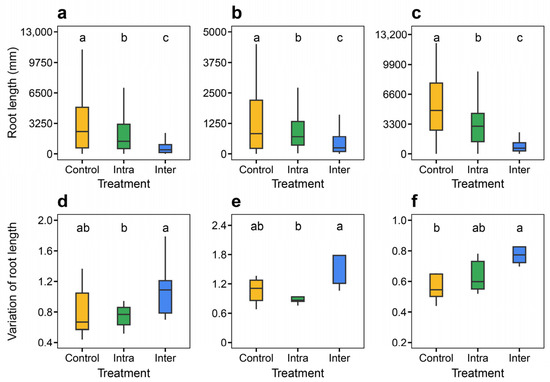
Competition significantly affected root length and its total temporal variation under current soil condition (Figure 1, Tables S3 and S4). Overall, seedlings grown under competition developed shorter roots than those grown alone, with interspecific competition causing the greatest reduction (Figure 1a). When neighbor-density levels were examined separately, no statistically significant differences in root length were detected between the weak and strong density levels within either intraspecific or interspecific competition for either species (Table S5). When examined separately by species, mean visible living root length of Cy. glauca decreased by 30.8% under intraspecific competition and by 51.8% under interspecific competition relative to the control, with 95% confidence intervals (CIs) of 859–1033 mm and 526–791 mm, respectively (Figure 1b). Corresponding reductions for Cu. lanceolata were 34.0% and 81.3%, with 95% CIs of 3101–3653 mm and 828–1083 mm, respectively (Figure 1c). The coefficient of variation (CV) of root length also differed among competition treatments, particularly under interspecific competition (Figure 1d–f), indicating differences in total temporal variation in root length during the monitoring period. However, residual temporal variation showed contrasting species-specific responses to competition (species × competition interaction: F2,41 = 37.95, p < 0.001, Table S6). In Cu. lanceolata, residual variation increased under both competition, whereas in Cy. glauca it decreased.
Figure 1.
Effects of experimental competition on visible living root length and its total temporal variation. Root length (a–c) and its total temporal variation (d–f) for both species (a,d), Cyclobalanopsis glauca (b,e) and Cunninghamia lanceolata (c,f), under different competition treatments during the experimental period. Boxplots show the median, interquartile range, and 5th–95th percentiles. Different letters indicate significant differences among competition treatment (Tukey’s HSD, p < 0.05). Intra and Inter denote intraspecific and interspecific competition, respectively.
3.2. Effects of Competition on Seasonal Root Dynamics
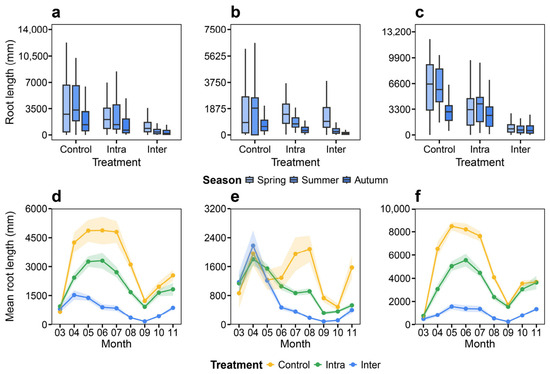
The temporal dynamics of root length revealed a sustained suppressive effect of competition throughout the observation period, with interspecific competition consistently exerting a stronger effect than intraspecific competition. Longitudinal mixed-effects modeling confirmed that visible living root length varied significantly over time and that seasonal trajectories differed among competition treatments (Table S7). Across the two species, root length increased rapidly from March to April, remained relatively stable during spring and early summer, and declined during autumn under control conditions (Figure 2a,d). Intraspecific competition generally preserved this seasonal pattern but reduced overall root length, whereas interspecific competition advanced the onset of root decline during summer (Figure 2a,d).
Figure 2.
Seasonal and monthly dynamics of visible living root length under different competition treatments. Seasonal (a–c) and monthly (d–f) dynamics of root length for both species (a,d), Cyclobalanopsis glauca (b,e), and Cunninghamia lanceolata (c,f). In (a–c), boxplots show the median, interquartile range, and 5th–95th percentiles. In (d–f), points and shaded areas represent monthly means ± standard errors. Intra and Inter denote intraspecific and interspecific competition, respectively.
Seasonal responses differed between species. In Cy. glauca, root length differed little among treatments during spring (March–May), whereas seedlings under control maintained greater root length than those under competition from June onward (Figure 2b,e). Under control conditions, root growth occurred during both March–April and June–July, resulting in no obvious difference in root length between spring and summer (Figure 2b). In contrast, both competition treatments exhibited only one major growth flush during March–April, followed by an earlier summer decline in root length, resulting in obvious differences between spring and summer (Figure 2e).
For Cu. lanceolata, root growth mainly occurred from March to May, followed by a continuous decline after July across all treatments (Figure 2c,f). Intraspecific competition largely preserved the seasonal pattern observed under control conditions but reduced overall root length, whereas interspecific competition substantially reduced root length throughout the experimental period and weakened seasonal root growth (Figure 2c,f).
3.3. Effects of Competition on Root Phenology and Aboveground Growth
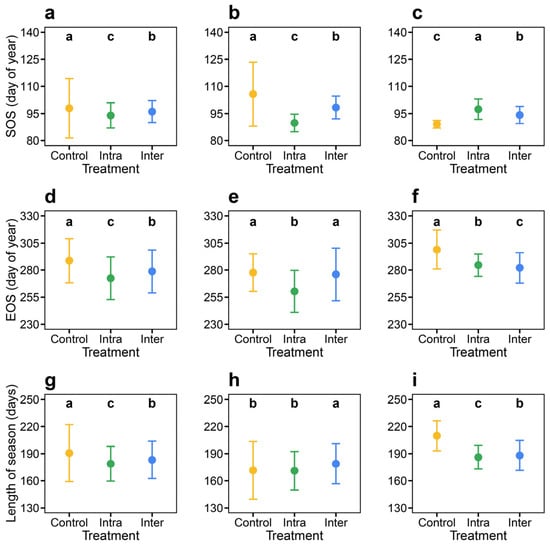
Competition significantly influenced root phenology, although responses differed between species (Figure 3). Combined-species analyses summarized the overall treatment response across species and showed that, competition advanced both the start (SOS) and end (EOS) of the root growing season, resulting in the reduction in growing season length (Figure 3a,d,g). In Cy. glauca, SOS advanced under competition, whereas EOS advanced mainly under intraspecific competition (Figure 3b,e,h). In contrast, Cu. lanceolata exhibited delayed SOS together with earlier EOS, leading to a pronounced shortening of the root growing season (Figure 3c,f,i).
Figure 3.
Effects of experimental competition on root phenology. Start of the root growing season (SOS; a–c), end of the root growing season (EOS; d–f), and root growing season length (g–i) for both species (a,d,g), Cyclobalanopsis glauca (b,e,h) and Cunninghamia lanceolata (c,f,i), under different competition treatments. Points represent model-estimated treatment means, and error bars represent the standard deviation of the model estimates obtained from 1000 bootstrap iterations. Different letters indicate significant differences among competition treatments based on model-based pairwise comparisons with Tukey adjustment (p < 0.05). Intra and Inter denote intraspecific and interspecific competition, respectively.
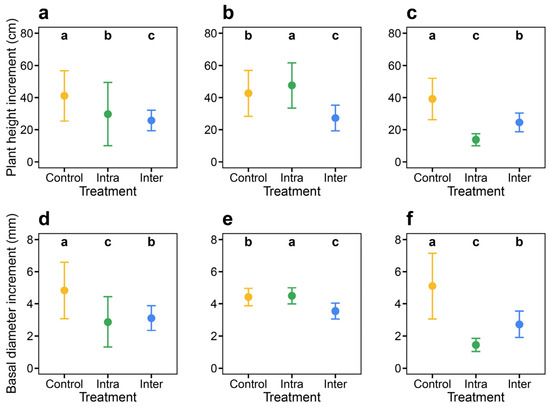
Initial plant height and basal diameter did not differ among treatments (Table S1). However, the overall analysis of the two species showed that competition significantly affected subsequent aboveground growth (Figure 4a,d). In Cy. glauca, intraspecific competition significantly increased plant height and basal diameter increments, whereas interspecific competition reduced both growth traits (Figure 4b,e). In Cu. lanceolata, both competition treatments reduced height and basal diameter increments, with stronger inhibition under intraspecific competition (Figure 4c,f).
Figure 4.
Effects of experimental competition on plant height and basal diameter increments. Plant height increment (a–c) and basal diameter increment (d–f) for both species (a,d), Cyclobalanopsis glauca (b,e), and Cunninghamia lanceolata (c,f) under different competition treatments. Points represent model-estimated treatment means, and error bars represent the standard deviation of the model estimates obtained from 1000 bootstrap iterations. Different letters indicate significant differences among competition treatments based on model-based pairwise comparisons with Tukey adjustment (p < 0.05). Intra and Inter denote intraspecific and interspecific competition, respectively.
3.4. Relationships Between Belowground and Aboveground Traits
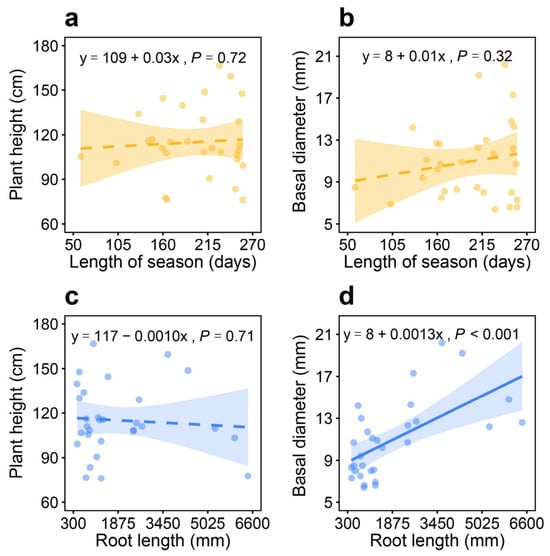
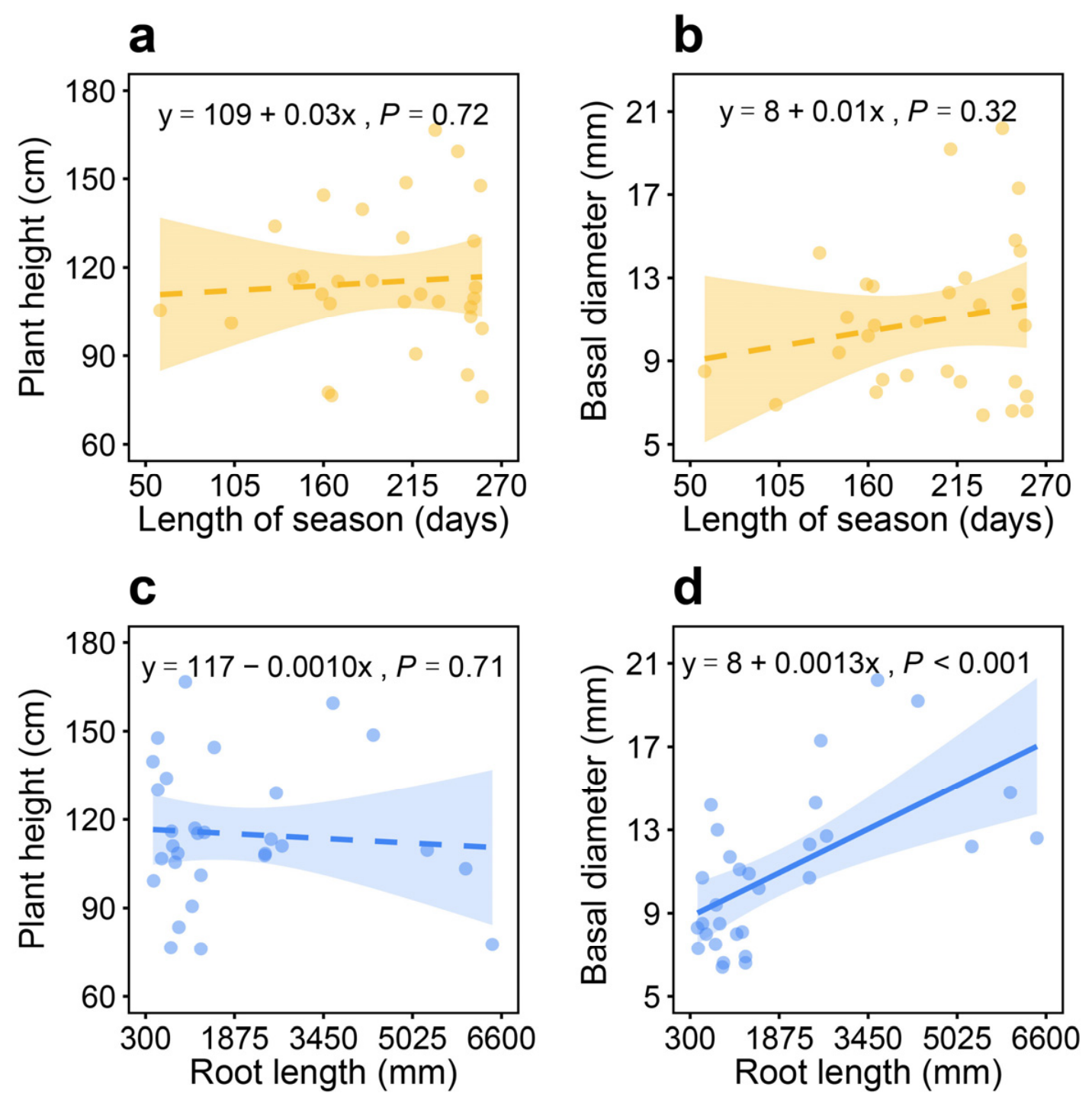
Root growing season length was not significantly correlated with either final plant height or final basal diameter (Figure 5a,b). In contrast, mean root length during the experimental period was positively associated with final basal diameter but showed no significant relationship with final plant height (Figure 5c,d).
Figure 5.
Relationships between belowground and aboveground traits. Relationships between root growing season length and final plant height (a) and final basal diameter (b), and between mean root length during the experimental period and final plant height (c) and final basal diameter (d). Data from Cyclobalanopsis glauca and Cunninghamia lanceolata were pooled. Solid and dashed lines indicate significant and non-significant linear relationships, respectively. Shaded areas represent 95% confidence intervals. Each panel includes 30 target seedlings (3 control, 6 intraspecific competition, and 6 interspecific competition seedlings per species).
Consistent patterns were observed when individual root phenological metrics and seasonal root traits were examined (Figures S3 and S4). Neither SOS nor EOS was significantly related to final plant height or basal diameter (Figures S3a,b and S4a,b). Similarly, mean root length during both spring and autumn was positively associated with final basal diameter but showed weak or non-significant relationships with final plant height (Figures S3c,d and S4c,d).
4. Discussion
4.1. Neighbor Identity Modifies Visible Living Root Length Responses
Both intraspecific and interspecific competition substantially reduced visible living root length relative to the control, indicating that neighboring seedlings constrained belowground growth at the observation panel. Importantly, the reduction was consistently greater under interspecific than intraspecific competition in our experiment. After accounting for seasonal trajectories, total temporal variation in root length also showed species-dependent responses to competition, indicating that competitive effects on root dynamics differed between species.
Previous studies have shown that the effects of neighboring plants on tree root growth vary with species identity, neighbor composition, and environmental context [34,35]. Accordingly, root traits, including root production, biomass, diameter, and rooting depth, may respond differently to competition depending on species combinations and environmental conditions [11,24,36]. Evidence from in situ root-chamber experiments indicates that belowground interactions can be strongly asymmetric between species. Quercus petraea roots tended to grow more slowly when adjacent to Fagus sylvatica roots than when adjacent to conspecific roots, whereas F. sylvatica showed a different response pattern [37]. Similar species-specific asymmetries have also been reported among F. sylvatica, Q. petraea, Carpinus betulus and Tilia cordata roots [38]. These contrasting responses indicate that heterospecific neighbors may either suppress or facilitate root growth. Consistent with this interpretation, stand-level evidence showed that mixed-species boreal forest stands had higher fine-root length than single-species dominated stands, suggesting that species mixtures can also alter belowground space occupation and root production at the community scale [39]. Moreover, competition-induced changes in root traits may influence shoot growth, while aboveground interactions may further modify belowground competitive responses, producing complex feedbacks between plants and their neighbors [40,41,42].
Differences in reported root morphological characteristics between the two focal species provide one possible explanation for the stronger reduction observed under interspecific competition. Previous studies have shown that Cy. glauca tends to develop finer and more highly branched roots, whereas Cu. lanceolata generally forms coarser roots with larger diameters [43,44]. These contrasting root characteristics may influence resource acquisition strategies and spatial interactions when the two species grow together. However, root morphology represents only one possible factor influencing competitive responses. Because aboveground and belowground interactions were not experimentally separated in this study, the observed responses should be interpreted as outcomes of whole-plant competition rather than belowground competition alone.
4.2. Competition Alters Seasonal Dynamics of Visible Living Root Length
Visible living root length exhibited pronounced seasonal dynamics throughout the growing season, with rapid increases during spring, species-specific changes during early summer, and an overall decline during autumn. Compared with control seedlings, competing seedlings showed earlier reductions in visible living root length and a shorter period of net root-length accumulation at the observation panel. This result indicates that competition altered the seasonal maintenance of visible roots in addition to reducing their cumulative length. Seasonal trajectories also differed between the two species. Cy. glauca showed a secondary increase in visible living root length during early summer under intraspecific competition, whereas Cu. lanceolata showed a single spring increase followed by a more continuous decline. These differences indicate that the temporal response of visible root growth to competition was species dependent.
In perennial woody plants, root growth can exhibit one or more seasonal pulses, although the occurrence and timing of such patterns are not universal [45,46]. In studies that directly quantify root production or elongation, bimodal patterns generally refer to two distinct periods of increased root production or extension separated by reduced activity within the growing season [45,47,48]. Such patterns have been observed under some controlled or favorable conditions. For example, both short- and long-root growth of Norway spruce saplings showed bimodal patterns under controlled soil-temperature conditions [47]. However, multi-species field studies indicates that seasonal root dynamics are highly context dependent. In a two-year study of five temperate tree species, root-tip length production generally showed a single summer peak, whereas bimodal patterns occurred only in particular species and years [49]. These contrasting findings suggest that belowground phenology is influenced by species identity, environmental conditions, soil properties, root order, and local resource conditions.
The secondary increase in visible living root length observed in control Cy. Glauca seedlings is therefore consistent with a bimodal seasonal pattern of root dynamics. The bimodal trend in the control variant likely reflected a late-season root growth pulse after the alleviation of high-temperature stress in the greenhouse and rhizobox soil. The weakening of this pattern under competition may reflect altered resource availability or plant growth conditions under competitive interactions. Previous studies have shown that root production and mortality may follow different seasonal patterns in woody plants [50], further emphasizing that changes in visible root length represent the combined effects of multiple processes. Similarly, persistence or increases in visible living roots during late season are not unexpected under favorable temperature and soil conditions, as late season root growth or increased root length density has been reported in several woody systems [22,48]. In the present greenhouse experiment, late season dynamics likely reflected the combined influences of environmental conditions, species-specific growth patterns, and local rhizobox conditions.
4.3. Root Length Shows a Stronger Association with Aboveground Growth than Root Phenology
Competition significantly altered root phenology inferred from visible living root length, affecting the estimated timing of seasonal root growth onset and cessation. However, SOS, EOS, and root growing season length were not significantly associated with final plant height or basal diameter. In contrast, visible living root length was positively associated with final basal diameter. This pattern suggested that the extent of root development may be more closely linked to stem radial growth than the timing of seasonal root growth alone. Greater visible living root length may indicate greater belowground development and potential resource acquisition capacity, which could contribute to stem radial growth during early seedling establishment.
Evidence from field studies supports the importance of belowground characteristics during seedling establishment. Across sites differing in soil moisture and canopy conditions, temperate tree seedlings with deeper root systems showed greater drought avoidance and survival, highlighting the role of root development in water acquisition [51]. Similarly, a field drought experiment involving five woody species found that seedling survival was positively related to maximum rooting depth [52]. Beyond rooting depth, other aspects of early seedling morphology, including root volume and lateral root development, have also been associated with subsequent field performance [53,54,55]. Together, these studies indicate that variation in belowground development can influence seedling establishment by affecting resource acquisition and recovery under environmental stress. In our experiment, all seedlings underwent standardized leaf removal during transplantation, which may have temporarily reduced photosynthetic capacity during early establishment. Under such conditions, differences in visible root development may have become particularly important for maintaining water and nutrient acquisition after transplantation. This may partly explain why visible living root length showed a stronger association with final basal diameter than root phenological traits.
The weak relationship between root phenology and aboveground growth does not imply that seasonal timing of root growth is ecologically unimportant. Instead, the effects of root phenology may depend on environmental conditions, species-specific strategies, and the availability of sufficient belowground resources. Previous studies have shown that belowground and aboveground phenology can be coordinated, but these relationships are often context-dependent. For example, in woody seedlings from cool and temperate forests of Japan, root and shoot phenology showed positive relationships for growth cessation and duration, suggesting seasonal coordinated between belowground and aboveground organs [56]. Experimental evidence from Cunninghamia lanceolata plantations further showed that fine-root production was positively related to height growth, although the strength of this relationship varied among climatic treatments [7]. At a broader interspecific scale, root production across six temperate tree species frequently peaked before bud break and before maximum leaf area, indicating that root and canopy phenology can be functionally linked without being strictly synchronized [57]. Thus, root phenology may contribute to plant performance under particular environmental conditions or over longer time scales, even though such relationships were not evident in our one-year rhizobox experiment.
5. Limitations
Although this study provides new insights into how plant competition influences root growth dynamics, several limitations should be acknowledged. First, the experiment was conducted with young seedlings under greenhouse conditions with relatively homogeneous soil and regular irrigation. Root washing, leaf removal, and the application of fungicide and rooting hormone were used to standardize seedling establishment and facilitate root observation in rhizoboxes. However, these conditions and procedures differed from those experienced by field-grown seedlings and may have influenced early root growth patterns. Second, root traits are highly variable and environmentally dependent. Our study focused on visible living root length and root phenology, whereas other root characteristics, including root biomass, surface area, volume, diameter, branching pattern, rooting depth, and root hair density, were not quantified. In addition, traits of neighboring plants were not measured, preventing direct evaluation of how neighbor characteristics contributed to the observed competitive responses. Third, although all root images were manually verified by the same trained analyst following a standardized workflow, intra-observer repeatability of the manual corrections was not independently quantified. Fourth, final seedling size may partly reflect initial size or inherent growth differences among individuals. Therefore, the observed relationships between root characteristics and aboveground size should be interpreted as associations rather than direct causal effects. Accordingly, our conclusion that visible living root length showed a stronger association with aboveground growth than root phenology applies specifically to the root characteristics and growth responses quantified in this experiment.
6. Conclusions
Plant competition is a fundamental ecological process, yet most studies of plant competition have focused on static root traits while overlooking the temporal dynamics of root growth. Using long-term, high-frequency, non-destructive monitoring, we quantified the dynamic responses of root growth in Cy. glauca and Cu. lanceolata under both intraspecific and interspecific competition. Our results showed that (1) competition, particularly interspecific competition, substantially reduced visible living root length and altered the total temporal variability of root growth; (2) competition altered seasonal root dynamics and root phenology, although the two species adopted contrasting phenological strategies; and (3) visible living root length, showed a stronger association with aboveground growth than root phenology, particularly with final basal diameter. Our study highlights the importance of considering dynamic root growth response when evaluating plant competitive interactions and provides insights into how belowground dynamics may contribute to variation in tree growth under competition.
Supplementary Materials
The following supporting information can be downloaded at: https://www.mdpi.com/article/10.3390/f17091012/s1, Figure S1: Schematic diagram of the custom rhizobox and the competition treatments; Figure S2: Soil temperature and relative soil moisture in the custom rhizobox during the experimental period; Figure S3: Relationships between spring belowground and aboveground traits; Figure S4: Relationships between autumn belowground and aboveground traits; Table S1: Initial plant height and basal diameter of Cyclobalanopsis glauca and Cunninghamia lanceolata under different competition treatments; Table S2: Allocation of target and neighbouring seedlings among rhizoboxes; Table S3: Initial physicochemical properties of the mixed growth substrate; Table S4: Overall and species-specific ANOVA results for the effects of competition on root length and total temporal variation in root length; Table S5: Pairwise comparisons of scaled root length between weak and strong neighbor-density levels within each competition type; Table S6: Species-specific effects of competition on seedling-level residual temporal variation in log-transformed root length after accounting for species-, treatment-, and observation date-specific mean trajectories; Table S7: Longitudinal mixed-effects analysis of temporal variation in root length.
Author Contributions
W.T. conceived and designed the study. X.H. conducted these experiments. A.Y. performed the data analysis. A.Y. produced the figures with the inputs of W.T., A.Y. and W.T. wrote the paper with the inputs of L.C. All authors have read and agreed to the published version of the manuscript.
Funding
This research was funded by the National Key R&D Program of China (2023YFF0806600) and the National Natural Science Foundation of China (32401380), and was supported by the Postdoctoral Fellowship Program of CPSF (GZC20261491).
Data Availability Statement
The processed data supporting the figures and conclusions of this article were provided as a minimal dataset. The raw root images are not publicly available due to their large file size but are available from the corresponding author upon reasonable request.
Acknowledgments
The authors acknowledge the Pengzhou Experimental Research Station of Sichuan University for providing convenience and manpower support for the experiment. During the preparation of this manuscript, the authors used ChatGPT (GPT-5.6) for English-language editing. The authors reviewed and edited the output and take full responsibility for the content of this publication.
Conflicts of Interest
The authors declare no competing interests.
References
- Homulle, Z.; George, T.S.; Karley, A.J. Root traits with team benefits: Understanding belowground interactions in intercropping systems. Plant Soil 2021, 471, 1–26. [Google Scholar] [CrossRef] [Scilit]
- Zhong, M.; Liu, C.; Wang, X.; Hu, W.; Qiao, N.; Song, H.; Chen, J.; Miao, Y.; Wang, G.; Wang, D.; et al. Belowground root competition alters the grass seedling establishment response to light by a nitrogen addition and mowing experiment in a temperate steppe. Front. Plant Sci. 2022, 13, 801343. [Google Scholar] [CrossRef] [Scilit]
- Wu, J.; Zeng, H.; Zhao, F.; Chen, C.; Singh, A.K.; Jiang, X.; Yang, B.; Liu, W. Plant hydrological niches become narrow but stable as the complexity of interspecific competition increases. Agric. For. Meteorol. 2022, 320, 108953. [Google Scholar] [CrossRef] [Scilit]
- Cusack, D.F.; Addo-Danso, S.D.; Agee, E.A.; Andersen, K.M.; Arnaud, M.; Batterman, S.A.; Brearley, F.Q.; Ciochina, M.I.; Cordeiro, A.L.; Dallstream, C.; et al. Tradeoffs and synergies in tropical forest root traits and dynamics for nutrient and water acquisition: Field and modeling advances. Front. For. Glob. Change 2021, 4, 704469. [Google Scholar] [CrossRef] [Scilit]
- Wong, M.Y.; Wurzburger, N.; Hall, J.S.; Wright, S.J.; Tang, W.; Hedin, L.O.; Saltonstall, K.; van Breugel, M.; Batterman, S.A. Trees adjust nutrient acquisition strategies across tropical forest secondary succession. New Phytol. 2024, 243, 132–144. [Google Scholar] [CrossRef] [Scilit]
- Nakahata, R. Time-varying response of fine root growth to soil temperature and soil moisture in cypress and deciduous oak forests. Plant-Environ. Interact. 2022, 3, 60–73. [Google Scholar] [CrossRef] [Scilit]
- Qu, Z.; Lin, C.; Zhao, H.; Chen, T.; Yao, X.; Wang, X.; Yang, Y.; Chen, G. Above- and belowground phenology responses of subtropical Chinese fir (Cunninghamia lanceolata) to soil warming, precipitation exclusion and their interaction. Sci. Total Environ. 2024, 933, 173147. [Google Scholar] [CrossRef] [Scilit]
- Jaeger, F.C.; Handa, I.T.; Paquette, A.; Parker, W.C.; Messier, C. Young temperate tree species show different fine root acclimation capacity to growing season water availability. Plant Soil 2023, 496, 485–504. [Google Scholar] [CrossRef] [Scilit]
- Freschet, G.T.; Roumet, C.; Comas, L.H.; Weemstra, M.; Bengough, A.G.; Rewald, B.; Bardgett, R.D.; De Deyn, G.B.; Johnson, D.; Klimešová, J.; et al. Root traits as drivers of plant and ecosystem functioning: Current understanding, pitfalls and future research needs. New Phytol. 2021, 232, 1123–1158. [Google Scholar] [CrossRef] [Scilit]
- Dabu, X.; Ji, H.; Yang, L.; Bezemer, T.M.; Jing, J. Root traits and soil legacies drive species competition outcomes. Funct. Ecol. 2024, 38, 2139–2155. [Google Scholar] [CrossRef] [Scilit]
- Středa, T.; Hajzlerová, J.; Alba-Mejía, J.; Jovanović, I.; Frantová, N.; Středová, H. Quo vadis, breeding for an efficient root system, in the era of climate change? Czech J. Genet. Plant Breed. 2024, 60, 181–211. [Google Scholar] [CrossRef] [Scilit]
- Semchenko, M.; Lepik, A.; Abakumova, M.; Zobel, K. Different sets of belowground traits predict the ability of plant species to suppress and tolerate their competitors. Plant Soil 2017, 424, 157–169. [Google Scholar] [CrossRef] [Scilit]
- Ravenek, J.M.; Mommer, L.; Visser, E.J.W.; van Ruijven, J.; van der Paauw, J.W.; Smit-Tiekstra, A.; de Caluwe, H.; de Kroon, H. Linking root traits and competitive success in grassland species. Plant Soil 2016, 407, 39–53. [Google Scholar] [CrossRef] [Scilit]
- Zu, C.; Li, Z.; Wang, C.; Wang, X.-X.; Ji, H.; Shen, J.; Rengel, Z.; Li, H.; Yang, J. Dissimilarity in root traits and spatial distribution promotes the productivity of Piper nigrum L. and tree species in mixture systems. Eur. J. Agron. 2024, 154, 127094. [Google Scholar] [CrossRef] [Scilit]
- Ji, H.; Zhou, N.; Rengel, Z.; Jing, J.; Li, H. Root traits and plasticity differences explain complementarity between co-existing species in phosphorus-limited grassland. Plant Soil 2024, 501, 611–627. [Google Scholar] [CrossRef] [Scilit]
- Yang, J.; Wang, X.; Carmona, C.P.; Wang, X.; Shen, G. Inverse relationship between species competitiveness and intraspecific trait variability may enable species coexistence in experimental seedling communities. Nat. Commun. 2024, 15, 2895. [Google Scholar] [CrossRef] [Scilit]
- Lynch, J.P.; Strock, C.F.; Schneider, H.M.; Sidhu, J.S.; Ajmera, I.; Galindo-Castañeda, T.; Klein, S.P.; Hanlon, M.T. Root anatomy and soil resource capture. Plant Soil 2021, 466, 21–63. [Google Scholar] [CrossRef] [Scilit]
- Postma, J.A.; Lynch, J.P. Root cortical aerenchyma enhances the growth of maize on soils with suboptimal availability of nitrogen, phosphorus, and potassium. Plant Physiol. 2011, 156, 1190–1201. [Google Scholar] [CrossRef] [Scilit]
- Li, T.; Ren, J.; He, W.; Wang, Y.; Wen, X.; Wang, X.; Ye, M.; Chen, G.; Zhao, K.; Hou, G.; et al. Anatomical structure interpretation of the effect of soil environment on fine root function. Front. Plant Sci. 2022, 13, 993127. [Google Scholar] [CrossRef] [Scilit]
- Radville, L.; McCormack, M.L.; Post, E.; Eissenstat, D.M. Root phenology in a changing climate. J. Exp. Bot. 2016, 67, 3617–3628. [Google Scholar] [CrossRef] [Scilit]
- Likulunga, L.E.; Clausing, S.; Krüger, J.; Lang, F.; Polle, A. Fine root biomass of European beech trees in different soil layers show different responses to season, climate, and soil nutrients. Front. For. Glob. Change 2022, 5, 955327. [Google Scholar] [CrossRef] [Scilit]
- Garthen, A.; Brandt, K.; Klisz, M.; Malyshev, A.V.; Peters, B.; Weigel, R.; Kreyling, J. Seasonal dynamics of fine root length in European beech: Unveiling unexpected winter peaks and summer declines. Oecologia 2025, 207, 31. [Google Scholar] [CrossRef] [Scilit]
- Wang, R.; Kong, D.; Han, M.; Sack, L.; Lambers, H.; Cornelissen, J.H.C.; Li, Q.; Zhang, S.; Wang, X.; Wang, Z.; et al. Root quantity traits: A leading dimension in root trait space. New Phytol. 2026, 250, 2136–2148. [Google Scholar] [CrossRef] [Scilit]
- Gottlieb, R.; Gruntman, M. Belowground plant competition: Uncoupling root response strategies of peas. Proc. Biol. Sci. 2024, 291, 20240673. [Google Scholar] [CrossRef] [Scilit]
- Artacho, P.; Bonomelli, C. Changes in fine-root production, phenology and spatial distribution in response to N application in irrigated sweet cherry trees. Tree Physiol. 2016, 36, 601–617. [Google Scholar] [CrossRef] [Scilit]
- Gruber, A.; Oberhuber, W.; Wieser, G. Nitrogen addition and understory removal but not soil warming increased radial growth of Pinus cembra at treeline in the Central Austrian Alps. Front. Plant Sci. 2018, 9, 711. [Google Scholar] [CrossRef] [Scilit]
- Lu, R.K. Soil Agrochemical Analysis Methods; China Agricultural Science and Technology Press: Beijing, China, 1999. [Google Scholar]
- LY/T 1232-2015; Determination of Phosphorus in Forest Soil; Forest Industry Standard. National Forestry and Grassland Administration: Beijing, China, 2015.
- LY/T 1234-2015; Determination of Potassium in Forest Soil; Forest Industry Standard. National Forestry and Grassland Administration: Beijing, China, 2015.
- Cleveland, W.S.; Susan, J.D. Locally weighted regression: An approach to regression analysis by local fitting. J. Am. Stat. Assoc. 1988, 83, 596–610. [Google Scholar] [CrossRef] [Scilit]
- Mariën, B.; Ostonen, I.; Penanhoat, A.; Fang, C.; Nguyen, H.X.; Ghisi, T.; Sigurðsson, P.; Willems, P.; Campioli, M. On the below- and aboveground phenology in deciduous trees: Observing the fine-root lifespan, turnover rate, and phenology of Fagus sylvatica L., Quercus robur L., and Betula pendula Roth for two growing seasons. Forests 2021, 12, 1680. [Google Scholar] [CrossRef] [Scilit]
- Ma, X.; Huete, A.; Tran, N.N. Interaction of seasonal sun-angle and savanna phenology observed and modelled using MODIS. Remote Sens. 2019, 11, 1398. [Google Scholar] [CrossRef] [Scilit]
- R Core Team. R: A Language and Environment for Statistical Computing; R Foundation for Statistical Computing: Vienna, Austria, 2024; Available online: https://www.R-project.org/ (accessed on 20 August 2026).
- Lak, Z.A.; Sandén, H.; Mayer, M.; Godbold, D.L.; Rewald, B. Plasticity of root traits under competition for a nutrient-rich patch depends on tree species and possesses a large congruency between intra- and interspecific situations. Forests 2020, 11, 528. [Google Scholar] [CrossRef] [Scilit]
- Foxx, A.J.; Fort, F. Root and shoot competition lead to contrasting competitive outcomes under water stress: A systematic review and meta-analysis. PLoS ONE 2019, 14, e0220674. [Google Scholar] [CrossRef] [Scilit]
- Werner, R.; Gasser, L.T.; Steinparzer, M.; Mayer, M.; Ahmed, I.U.; Sandén, H.; Godbold, D.L.; Rewald, B. Early overyielding in a mixed deciduous forest is driven by both above- and below-ground species-specific acclimatization. Ann. Bot. 2024, 134, 1077–1096. [Google Scholar] [CrossRef] [Scilit]
- Hertel, D.; Leuschner, C. The in situ root chamber: A novel tool for the experimental analysis of root competition in forest soils. Pedobiologia 2006, 50, 217–224. [Google Scholar] [CrossRef] [Scilit]
- Rewald, B.; Leuschner, C. Belowground competition in a broad-leaved temperate mixed forest: Pattern analysis and experiments in a four-species stand. Eur. J. For. Res. 2009, 128, 387–398. [Google Scholar] [CrossRef] [Scilit]
- Huang, C.; Chen, H.Y.H.; Chang, S.X.; Cahill, J.F., Jr.; Ma, Z. Species mixtures increase fine root length to support greater stand productivity in a natural boreal forest. J. Ecol. 2023, 111, 1139–1150. [Google Scholar] [CrossRef] [Scilit]
- Casper, B.B.; Jackson, R.B. Plant competition underground. Annu. Rev. Ecol. Syst. 1997, 28, 545–570. [Google Scholar] [CrossRef] [Scilit]
- Cahill, J.F., Jr. Interactions between root and shoot competition vary among species. Oikos 2002, 99, 101–112. [Google Scholar] [CrossRef] [Scilit]
- Kiær, L.P.; Weisbach, A.N.; Weiner, J. Root and shoot competition: A meta-analysis. J. Ecol. 2013, 101, 1298–1312. [Google Scholar] [CrossRef] [Scilit]
- Xiang, W.; Wu, W.; Tong, J.; Deng, X.; Tian, D.; Zhang, L.; Liu, C.; Peng, C. Differences in fine root traits between early and late-successional tree species in a Chinese subtropical forest. Forestry 2013, 86, 343–351. [Google Scholar] [CrossRef] [Scilit]
- Wang, Y.R.; Quan, X.Q.; Li, X.Y.; Cheng, C.; Yu, J.X.; Tang, X.H.; Wu, P.F.; Ma, X.Q.; Yan, X.L. Integrated morphological and physiological plasticity of root for improved seedling growth in Cunninghamia lanceolata and Schima superba under nitrogen deficiency and different NH4+-N to NO3−-N ratio. Front. Plant Sci. 2025, 16, 1673572. [Google Scholar] [CrossRef] [Scilit]
- Huh, W.; Lee, M.; Kim, S.; Byeon, S.; Kim, T.K.; Hong, J.; Park, C.; Won, G.; Kim, E.; Kim, H.S. Contrasting spatio-temporal variation of fine root dynamics in nearby evergreen Korean pine and deciduous oak forests. Plant Soil 2025, 514, 2045–2066. [Google Scholar] [CrossRef] [Scilit]
- Withington, J.M.; Goebel, M.; Bułaj, B.; Oleksyn, J.; Reich, P.B.; Eissenstat, D.M. Remarkable similarity in timing of absorptive fine-root production across 11 diverse temperate tree species in a common garden. Front. Plant Sci. 2021, 11, 623722. [Google Scholar] [CrossRef] [Scilit]
- Kilpeläinen, J.; Domisch, T.; Lehto, T.; Finér, L.; Aphalo, P.J.; Leinonen, I.; Ryyppö, A.; Repo, T. Root and shoot phenology and root longevity of Norway spruce saplings grown at different soil temperatures. Can. J. For. Res. 2019, 49, 1441–1452. [Google Scholar] [CrossRef] [Scilit]
- Tamura, A.; Oguma, H.; Fujimoto, R.; Kuribayashi, M.; Makita, N. Phenology of fine root and shoot using high frequency temporal resolution images in a temperate larch forest. Rhizosphere 2022, 22, 100541. [Google Scholar] [CrossRef] [Scilit]
- Ma, Y.; Yang, N.; Wang, S.; Huo, C.; Yu, L.; Gu, J. Climatic and edaphic controls of root-tip production and mortality in five temperate tree species. J. For. Res. 2024, 35, 145. [Google Scholar] [CrossRef] [Scilit]
- Huo, C.; Gu, J.; Yu, L.; Wang, P.; Cheng, W. Temporal dynamics of fine root production, mortality and turnover deviate across branch orders in a larch stand. Oecologia 2022, 199, 699–709. [Google Scholar] [CrossRef] [Scilit]
- Walters, M.B.; Kunkle, J.M.; Kobe, R.K.; Farinosi, E.J. Seedling drought responses governed by root traits, site-soil moisture regimes and overstory competition-facilitation. For. Ecol. Manag. 2023, 544, 121159. [Google Scholar] [CrossRef] [Scilit]
- Padilla, F.M.; Pugnaire, F.I. Rooting depth and soil moisture control Mediterranean woody seedling survival during drought. Funct. Ecol. 2007, 21, 489–495. [Google Scholar] [CrossRef] [Scilit]
- Tsakaldimi, M.; Ganatsas, P.; Jacobs, D.F. Prediction of planted seedling survival of five Mediterranean species based on initial seedling morphology. New For. 2012, 44, 327–339. [Google Scholar] [CrossRef] [Scilit]
- Larsen, H.S.; South, D.B.; Boyer, J.M. Root growth potential, seedling morphology and bud dormancy correlate with survival of loblolly pine seedlings planted in December in Alabama. Tree Physiol. 1986, 1, 253–263. [Google Scholar] [CrossRef] [Scilit]
- Jacobs, D.; Salifu, K.; Seifert, J. Relative contribution of initial root and shoot morphology in predicting field performance of hardwood seedlings. New For. 2005, 30, 235–251. [Google Scholar] [CrossRef] [Scilit]
- Kobayashi, M.; Wilson, S.D.; Sato, T.; Blume-Werry, G.; Cornelissen, J.H.C. Synchronous and asynchronous root and shoot phenology in temperate woody seedlings. Oikos 2020, 129, 643–650. [Google Scholar] [CrossRef] [Scilit]
- McCormack, M.L.; Gaines, K.P.; Pastore, M.; Eissenstat, D.M. Early season root production in relation to leaf production among six diverse temperate tree species. Plant Soil 2014, 389, 121–129. [Google Scholar] [CrossRef] [Scilit]
Disclaimer/Publisher’s Note: The statements, opinions and data contained in all publications are solely those of the individual author(s) and contributor(s) and not of MDPI and/or the editor(s). MDPI and/or the editor(s) disclaim responsibility for any injury to people or property resulting from any ideas, methods, instructions or products referred to in the content. |
© 2026 by the authors. Licensee MDPI, Basel, Switzerland. This article is an open access article distributed under the terms and conditions of the Creative Commons Attribution (CC BY) license.