


Abstract
The “algarrobo” (Neltuma pallida) is a key tree species in the seasonally dry tropical forests in Equatorial Pacific coast of South America, currently at risk. Its regeneration depends on endozoochorous dispersal, in which seeds are ingested and later defecated by animals, helping to release and scarify them. We compared the role of the native white-tailed deer (Odocoileus virginianus peruvianus) and the introduced goat (Capra hircus) in seed dispersal. Seeds were recovered from the dung of both species after experimental feeding and from grazing goats in a fruiting N. pallida forest. Seed recovery was higher in deer dung (9.34%) than in goat dung (3.09%), and retention time was shorter in deer than in goats (peak at 48 and 84 h respectively). Only passage of seeds through the deer’s digestive tract significantly improved cumulative germination (63% vs. 44%) and germination rate (time to reach 25% germination, T25 = 8.98 days). Meanwhile, the passage of seeds through the goat’s digestive system reduced germination rate under experimental conditions (T25 = 19.25 days) but slightly increased it under forest conditions (T25 = 12.81 days), where goats ingest fruits constantly. Differences in seed recovery and germination are explained by the morphophysiological traits of ruminants. In conclusion, both goats and deer contribute to seed dispersal. White-tailed deer enhances seed germination (~66%), whereas goats maintain seed viability (~44%) and exhibit a longer seed retention time. During peak fruiting, alternating grazing between high-fruiting and degraded areas is recommended to maximize seed incorporation into the soil.
1. Introduction
The “algarrobo”, Neltuma pallida (Humb. & Bonpl. ex Willd.) C.E. Hughes & G.P. Lewis, is a tree species within the genus Neltuma, which is distributed across the arid and seasonally dry tropical region of South America [1]. N. pallida occurs naturally in the lowlands along the Pacific coast of Peru, Colombia, and Ecuador, and has been introduced into other regions of the Americas and Asia [2]. It is a keystone species, highly adapted to the variable dry and wet conditions [3] and plays a vital role in sustaining rural livelihoods by providing firewood, charcoal, and forage for livestock [4]. Currently, N. pallida population is undergoing a decline due to illegal logging, pest outbreaks, and land-use change [5,6,7]. It is considered a high-risk genetic resource in South America [8].
Natural forest regeneration depends on seed dispersal, a critical ecological process for habitat colonization and landscape connectivity [9,10,11]. N. pallida, like other species within the genus Neltuma (formerly Prosopis), is primarily dispersed through endozoochory [12,13], a form of seed dispersal mediated by animals that involves consumption, seed release from their coverings, scarification, and transport to long distances. The species produces indehiscent legumes with thick seed coats that protect the seeds [14]. Seed release is essential, as seeds contained in intact pods and deposited on the ground typically fail to germinate [15]. Moreover, Neltuma seeds exhibit physical dormancy due to a water-impermeable seed coat [16]; without scarification, germination rates can be lower than 7% for several Neltuma species [17].
Among the most important endozoochorous dispersers of Neltuma species are wild and domestic herbivorous mammals, which are capable of transporting seeds over long distances [15,18,19,20]. In the case of N. pallida in dry forest ecosystems, this role would historically have been fulfilled by the white-tailed deer (Odocoileus virginianus peruvianus), a remnant of the Neotropical megafauna [21]. However, this species is now highly scarce, mainly due to poaching. Conversely, since the expansion of goat (Capra hircus) husbandry in the 18th century [22], goat herding has become an important livelihood activity in these forests. Currently, approximately 500,000 goats are raised in these ecosystems in Peru alone.
This shift in ruminant populations may influence the efficiency of N. pallida endozoochory. Exotic dispersers can have negative effects on the germination of seeds from native species [23]; even though both species are ruminants, they differ functionally in their feeding strategies. While the white-tailed deer is a concentrate selector (browser), the goat is classified as an intermediate feeder [24]. These feeding types are characterized by distinct morphophysiological traits. Browsers have a smaller relative reculorumen volume, less complex forestomach compartments, and wider connecting orifices, features that are associated with a faster digesta passage rate [24,25]. These differences may influence seed recovery and scarification, potentially altering the natural regeneration dynamics of N. pallida.
To date, no studies have evaluated the seed scarification efficiency of N. pallida by goats and white-tailed deer. We hypothesize that seed passage through the gastrointestinal tract enhances both the germination rate and percentage of N. pallida seeds, and that this effect may be greater when mediated by white-tailed deer. To assess endozoochorous efficiency in goats and white-tailed deer, we evaluated seed recovery and germination of N. pallida through both controlled experiments and grazing trials in dry forest ecosystems. The results will help design spatial and temporal goat grazing strategies to maximize seed input into the soil and support the regeneration of N. pallida in dry forests.
2. Materials and Methods
2.1. Location
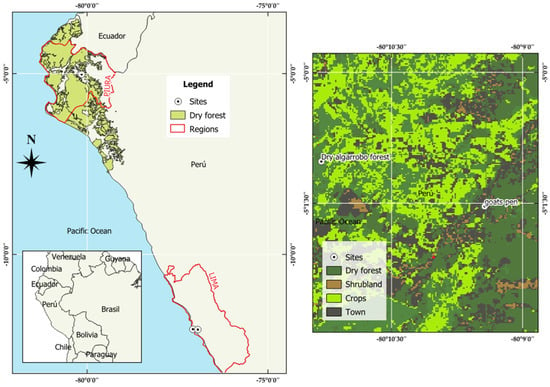
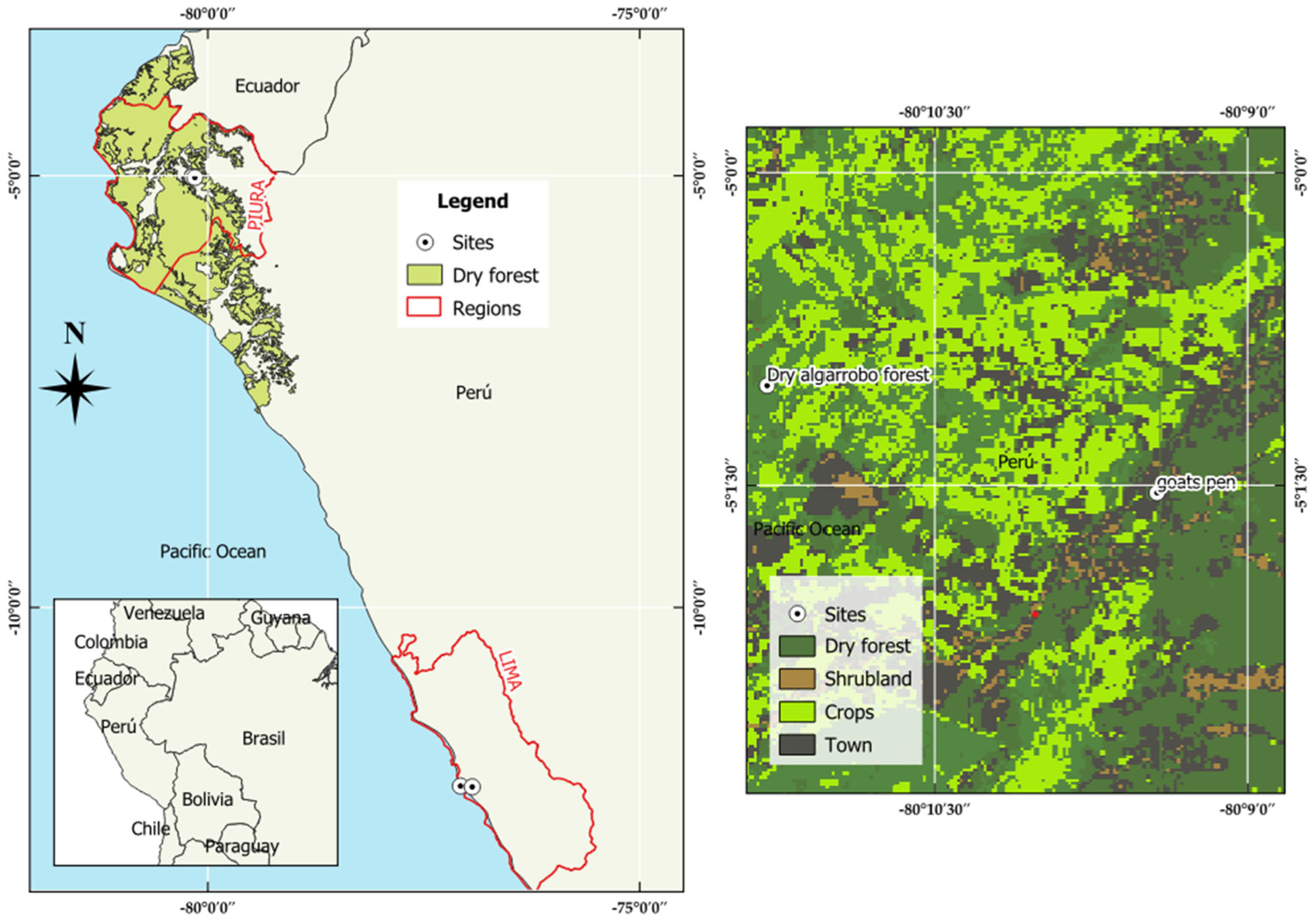
Two feeding trials for seed scarification were conducted: one under field conditions with grazing goats, and another under controlled feeding conditions with both goats and white-tailed deer (Figure 1). For the grazing trial, a goat herd was selected in the locality of Belén (5°01′42.9″ S, 80°09′31.41″ W; 104 m.a.s.l.), located within the dry forests of Chulucanas, Piura region. The controlled feeding experiments were conducted using enclosures (12°4′59.91″ S, 76°56′38.75″ W; 64 m.a.s.l.) at the Universidad Nacional Agraria La Molina (UNALM) and a fenced area at the “White-tailed Deer” breeding center (12°4′23.90″ S, 77°4′48.20″ W; 240 m.a.s.l.) of the Pontificia Universidad Católica del Perú (PUCP) from May to September 2018.
Figure 1.
Location of experimental sites, experimental goats and white-tailed deer in Lima, and grazing goats in the dry forest of Piura.
2.2. Fruit Collection and Characteristics
Fruits of N. pallida were randomly collected from 40 trees within a 12-hectare relict dry forest in Chulucanas, Piura region, Peru (5°1′1.20″ S, 80°11′18.08″ W; 102 m.a.s.l.) during April 2018. The fruits were stored in a dry environment until the start of the feeding trials, two weeks later. Fruits were characterized by the number of healthy seeds per kilogram, as N. pallida seeds are rapidly parasitized by bruchid beetles over successive generations [26]. At the time of the experimental feeding, the average weight of a healthy seed was 38 ± 6 mg (n = 249), corresponding to an estimated 2140 viable seeds per kilogram of fruit at the onset of the feeding experiment. A seed was considered healthy when it had a normal appearance and no visible damage (e.g., holes associated with parasitism). The viability of these seeds was assessed through a germination test following mechanical scarification, yielding a germination percentage of 99.2%.
2.3. Feeding Trials
Feeding trials using N. pallida fruits were carried out in Lima with goats and white-tailed deer under confinement conditions, and with goats grazing in a fenced area of dry forest in Chulucanas, Piura. Deer were excluded from the dry forest trial due to their extremely low density and the lack of breeding facilities. Ruminant species was considered the main factor, as interspecific morphophysiological differences largely determine food passage rate [24], while dietary fiber mainly affects intraspecific variability [27].
Five female goats were housed in a 40 m2 pen with ad libitum forage and water, and three female deer in a 150 m2 fenced enclosure. Goats received maize forage (Zea mays) and sorghum (Sorghum bicolor), while deer were fed alfalfa (Medicago sativa) and broad bean pods (Vicia faba), since deer rejected grasses. Both species underwent a 14-day adaptation period during which N. pallida fruits were gradually introduced (300–700 g/animal), followed by 14 days without fruits to ensure complete seed defecation.
Subsequently, animals were fed a single dose of N. pallida fruits proportional to body weight. Minimal fruit residues remained; the individual amounts ingested were 894 g for deer (~1914 seeds) and 1114 g for goats (~2214 seeds). Dungs were collected every 12 h over 7 days, and samples were oven-dried at 48 °C (pellet surface ~40 °C) for 3 h to prevent premature germination. The number of seeds recovered from dung was recorded every 12 h over a 5-day period to characterize recovery dynamics and percentage.
Goat dung under dry forest conditions was collected in May 2018, after the rainy season during peak fruiting. A herd of 11 goats that had accumulated dung over two weeks while grazing in a nearby algarrobo forest was selected. Several portions were randomly collected from the corral to form a 3 kg composite sample. Oven-drying was not required due to warm conditions (max ~35 °C), which allowed the dung pellets to dry rapidly and maintain their shape. Samples were transported and stored at Laboratorio de Ecología y Utilización de Pastizales (LEUP) of the Universidad Nacional Agraria La Molina (UNALM), Peru.
2.4. Scarification Treatment
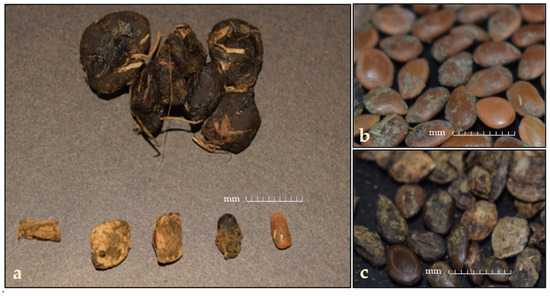
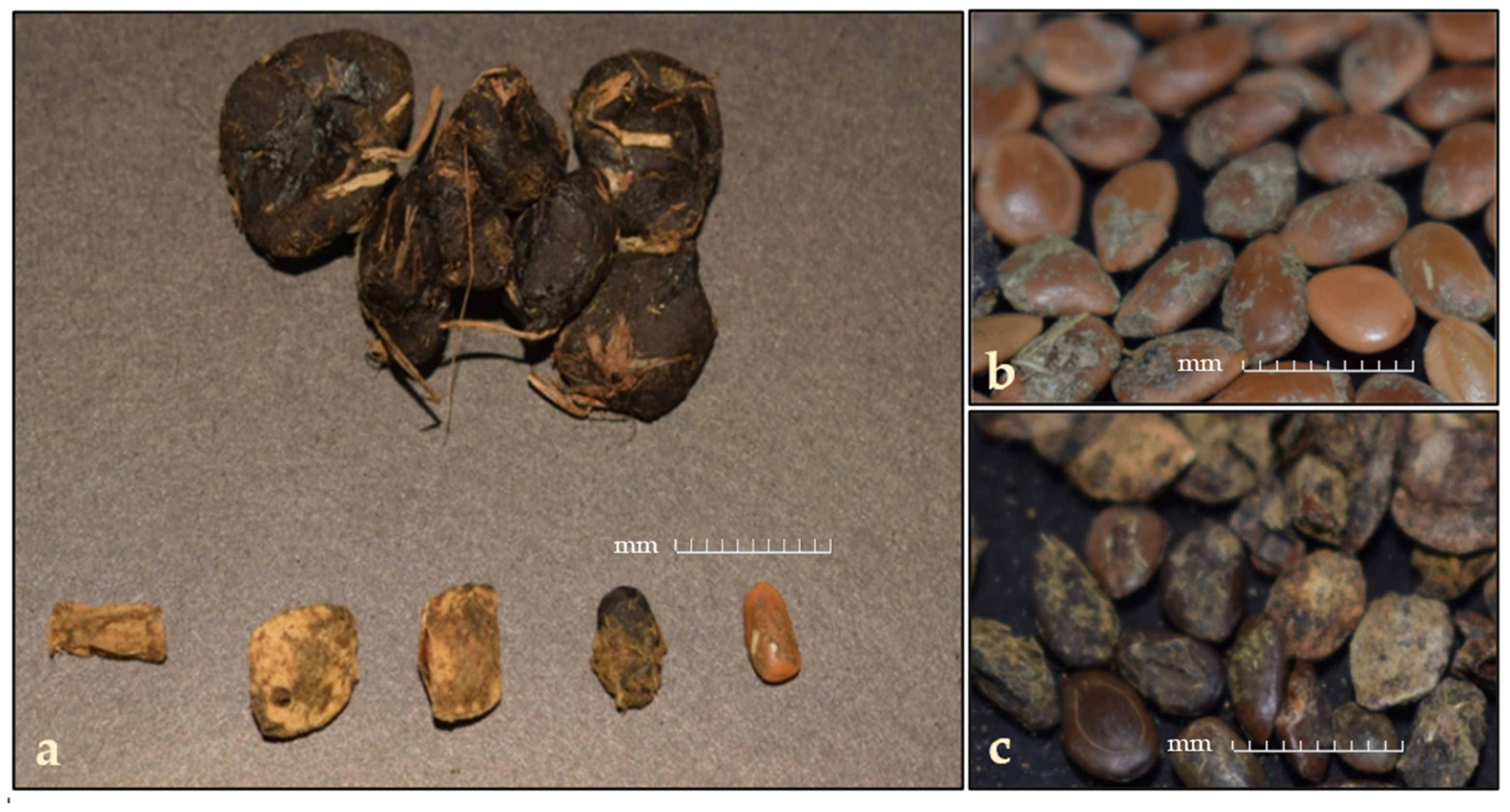
Seeds were recovered from the dung of goats and white-tailed deer to evaluate germination performance, compared to intact seeds and seeds subjected to mechanical scarification (control treatments). The treatments are detailed in Table 1. During seed recovery, two categories of seeds were observed: (1) normal seeds with an appearance identical to the ingested ones, and (2) non-normal seeds, typically black in color and ranging from smooth to wrinkled (seeds germinated in dung or damaged seeds). For germination trials, only seeds with normal appearance were counted and used (Figure 2). Germinated seeds within the dung were excluded from the analysis because they would not persist in the dung seed bank until the following rainy season and, consequently, would not develop into seedlings.
Table 1.
Description of treatments used for scarification of N. pallida.
Figure 2.
(a) Fragments and seeds recovered from white-tailed deer dung, (b) appearance of seeds considered for the germination experiment. (c) Seeds in the process of germination, with signs of imbibition and darkening.
2.5. Germination Experiment
Germination experiment was conducted between June and July 2018 at the LEUP-UNALM, Peru. All seeds were disinfected by immersion in a 1% sodium hypochlorite solution for 2 min, followed by rinsing with distilled water. This low concentration did not scarify them further. For each treatment, six 9 cm Petri dishes (replicates) were prepared, each containing 50 seeds. Seeds were placed on layers of filter paper, and moisture was maintained daily using distilled water. Petri dishes were placed in controlled-environment germination chambers, set to a photoperiod of 12 h light at 30 °C and 12 h dark at 15 °C, with constant relative humidity at 70%. A gradual temperature transition between the higher and lower temperatures was programmed to simulate field dry forest conditions. Germination was monitored daily over 35 days. A seed was considered germinated when the radicle reached a length of 2 mm.
2.6. Data and Statistical Analyses
Seed recovery and germination data were treated as proportions of the total seed number of the trial (ingested and incubated respectively). The temporal dynamics of seed recovery (seeds/12 h) and germination (seeds germinated/day) were described using the Morgan–Mercer–Flodin (MMF) function [28], a method used to model cumulative seed recovery and germination curves [15]. This function models sigmoidal cumulative curves (assuming recovery and germination equal to zero at time zero). The model includes three parameters: alpha, gamma, and m.
In the model, g represents cumulative germination, t is time in days, alpha is the asymptote or maximum cumulative germination, m is the growth rate, and gamma is a parameter controlling the inflection point. These parameters were estimated using nonlinear least squares regression. Additionally, to accurately estimate the actual asymptotes, the evaluation period was extended from 35 to 90 days, roughly corresponding to the duration of the rainy season in the dry forest.
For germination analysis, final germination percentage at 35 days was calculated, along with two germination speed indices: time to reach 25% germination (T25) and mean germination time (MGT) [29]. T25 was used instead of T50, as most treatments did not reach 50% cumulative germination within the 35-day evaluation. Final germination percentage and MGT were compared using one-way ANOVA, after verifying assumptions of normality and homoscedasticity. Pairwise comparisons among treatments were conducted using Tukey’s test.
All analyses were performed using R software version 4.4.1 [30], with the packages “growthmodels” (for nonlinear regression), “binom” (for binomial confidence intervals), and “multcompView” (for mean comparison visualizations).
3. Results
3.1. Seed Recovery
The average number of seeds consumed per animal housed in the enclosure was 2214.0 for goats and 1913.7 for white-tailed deer, derived from the quantity of fruits ingested by the animals during the experimental trials. Seed recovery of N. pallida from dung was 68.4 seeds per individual (3.09%) in goats and 178.7 seeds per individual (9.34%) in deer. Germinated seeds in dung (excluded from the germination test) were 85 per individual (3.84%) in goats and 250 per individual (13.06%) in deer.
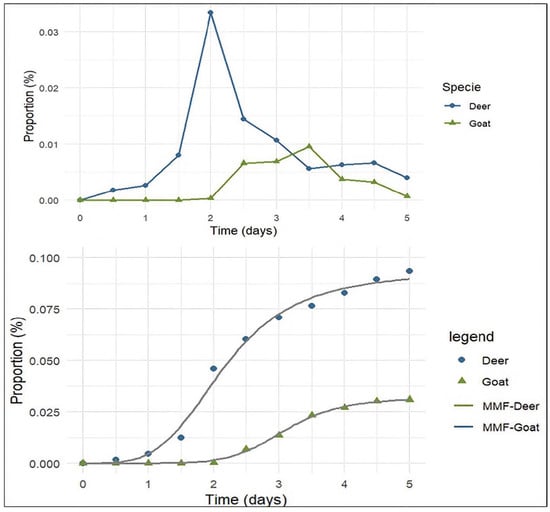
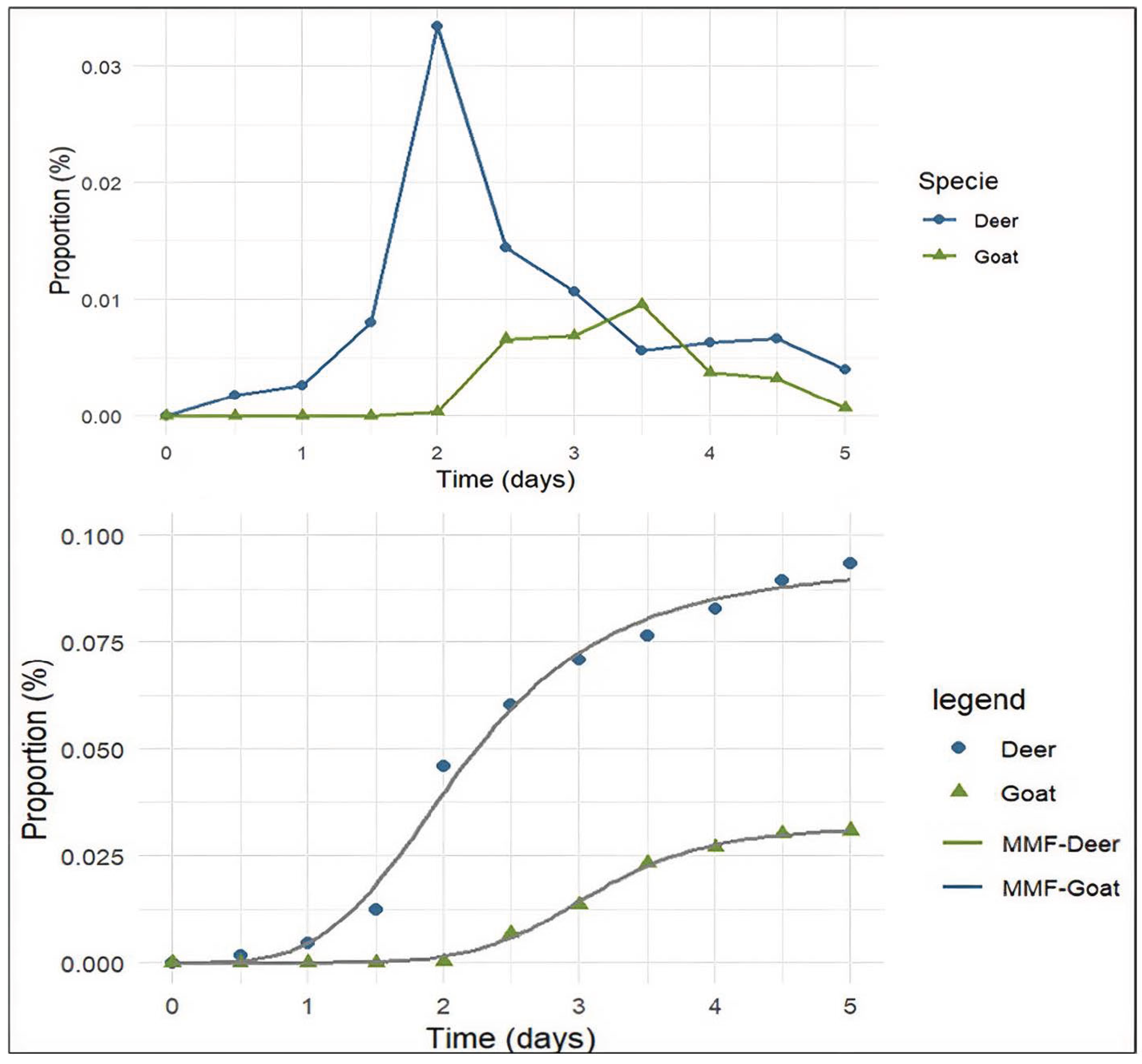
Table 2 presents the estimated parameters of the MMF model for seed recovery; the asymptotes correspond to the final percentages of recovered seeds. Maximum seed recovery in white-tailed deer occurred at 48 h (2 days), with 35.7% of the total recovered seeds being defecated by that time. In goats, peak recovery occurred at 84 h (3.5 days), with 31% of the total recovered seeds (Figure 3).
Table 2.
Model parameters for recovered N. pallida seeds from dung according to MMF function.
Figure 3.
Proportion of N. pallida seeds recovered from the dung of white-tailed deer and goats, by intervals (upper) and cumulatively (lower). The curves show the predictions of the Morgan–Mercer–Flodin model for the cumulative proportion recovered.
3.2. Germination Dynamics
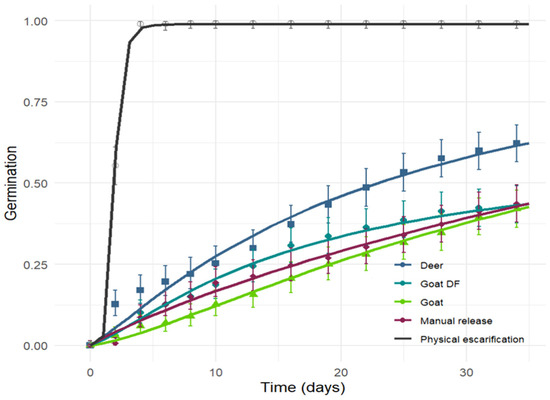
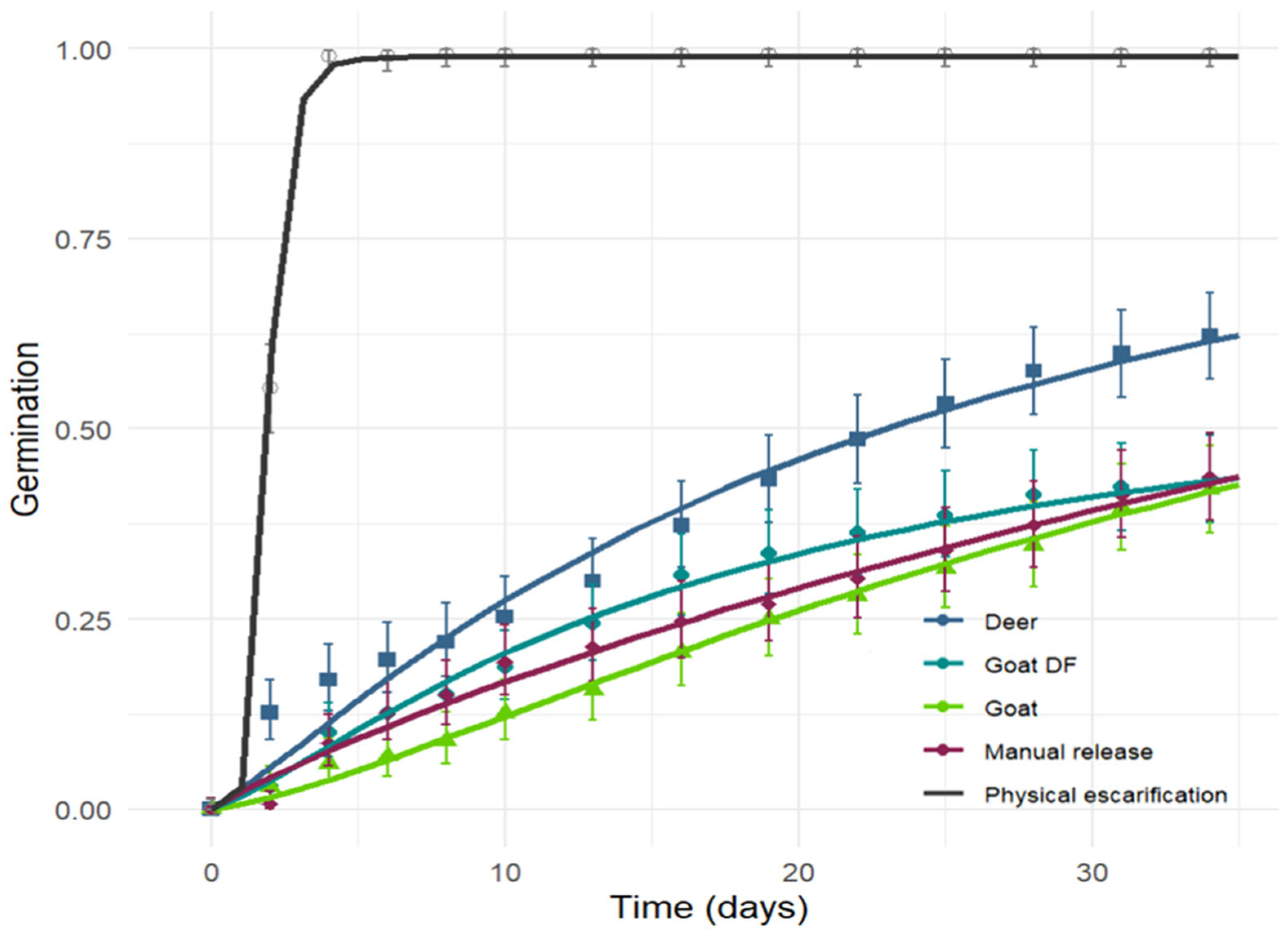
The modeled curves revealed substantial differences in the cumulative germination dynamics among treatments (Table 3 and Figure 4). The highest asymptotic values (alpha) were observed for the manual extraction treatment (171%), followed by deer (101%), mechanical scarification (99%), confined goats (96%), and goats under dry forest grazing conditions (61%).
Table 3.
Model parameters for predicting the proportion of germinated seeds of N. pallida according to the Morgan–Mercer–Flodin model.
Figure 4.
Cumulative germination dynamics of seeds from Neltuma pallida for different treatments. Error bars indicate the Clopper–Pearson binomial confidence interval, and the curves show predictions according to the Morgan–Mercer–Flodin Models. Deer: White-tailed deer, Goat DF: Goat in dry forest.
Final germination was significantly higher in seeds subjected to mechanical scarification and in seeds recovered from white-tailed deer dung (p < 0.001). In contrast, seed passage through the gastrointestinal tract of goats, both under confined conditions and in dry forest grazing, had no significant effect compared to manually released seeds. Except for the mechanical scarification treatment, all treatments exhibited MGT values similar to the untreated control (manual release). However, significant differences were detected between the confined goat and grazing goat treatments (p < 0.001). T25 was lowest in physically scarified seeds (1.59 days), followed by seeds recovered from white-tailed deer dung (8.98 days). Grazing goats reduced T25 to 12.81 days, whereas confined goats increased it to 19.25 days (Table 4), regarding manual release.
Table 4.
Effect of different treatments on seed germination of Neltuma pallida.
4. Discussion
4.1. Seed Recovery
Due to the limitation of housing a wild species such as the white-tailed deer in individual pens, this study did not evaluate the effect of individual variation on seed retention. Instead, three deer were housed in a shared enclosure, allowing controlled feeding and complete fecal collection. Although similar studies have characterized seed retention using small numbers of ruminants [15,31,32], it is recommended that future studies increase the number of animals and consider individual variation.
Overall, seed recovery from goat and white-tailed deer dung was low (3.09% and 9.34% respectively), consistent with previous studies in ruminants [15,31,33,34,35]. Studies involving deer are relatively scarce, whereas the literature on domestic species such as goats is less limited. Seed recovery percentages are similar to those reported for herbaceous and shrubby species consumed by fallow deer, with values below 10% [31], and higher than 14% for herbaceous species consumed by Korean water deer [36]. Recovery rates below 11% have been reported for Fabaceae species ingested by goats in dry forests of Brazil [35]. In Mediterranean shrublands, seed recovery from goat dung ranges from 1% to 31% [34,37]. These values also fall within the range reported for Neltuma species. For N. juliflora, recovery rates of 7% in goat and 15% in cattle have been reported [15]; for N. glandulosa, 9.2% and 11.3% for goats and sheep, respectively [38]; and for N. pallida, 2.1% in camels [18].
Low seed recovery from dung is primarily attributed to losses during mastication and rumination [39], which historically led ruminants to be regarded more as seed predators than seed dispersers [40,41,42]. Nevertheless, goats and deer can also regurgitate or spit out seeds during rumination, a poorly studied process [40]. The differences observed in our study may therefore reflect variation in chewing behavior and rumination-related seed expulsion. Although these behaviors were not quantified, goats were observed to chew the fruits more times than deer before swallowing them, which may have contributed to the lower seed recovery observed in goats. Future studies should quantify chewing behavior and seed expulsion during rumination to clarify the relative importance of these mechanisms in determining seed recovery.
Regarding seed retention time, it was shorter in white-tailed deer (peaking at 48 h) than in goats (peaking at 84 h), which is consistent with previous reports for other deer species and goats. Seed recovery from dung occurred earlier in fallow deer and Korean water deer, between 24 and 48 h [31,36]. In goats, the retention time for most seeds can be longer. In Brazilian shrubs, it typically ranges between 72 and 96 h [35], whereas in Spanish shrubs, the majority of seeds consumed by goats are excreted within 24 to 72 h [37,43]. The shorter retention time of N. pallida seeds in white-tailed deer can be explained by a relatively smaller stomach size, fewer subdivisions, and larger openings that facilitate the passage of ingested material [24]. This variation in seed retention is attributed to the presence of structures and mechanisms that delay the passage of ingested material in different types of ruminants: white-tailed deer (browser) exhibit shorter retention than goats (intermediate feeders), which in turn have shorter retention than cows (grazers) described by Hofmann [24].
4.2. Seed Germination Dynamics
Species of the genus Neltuma, like many members of the Fabaceae family, exhibit physical dormancy. The seed coat contains a water-impermeable layer that prevents imbibition and germination [16]. This impermeability is due to a palisade layer of tightly packed cells impregnated with water-repellent substances [16,44]. This type of dormancy can be broken through mechanical or acid scarification [45]. The 99% germination observed in the mechanical scarification (sandpaper) treatment, compared to the much lower germination in manually extracted seeds, confirms the presence of physical dormancy in N. pallida.
Similar results have been reported for N. juliflora using chemical scarification [15]. Among the biological scarification treatments, only white-tailed deer significantly increased the final germination of N. pallida seeds. These findings are consistent with prior evidence indicating that physical dormancy is not always broken through endozoochory [46]. The differences observed between white-tailed deer and goats under experimental feeding conditions may be explained by variation in hydrochloric acid (HCl) concentration in the abomasum. White-tailed deer have a greater proportion of HCl-producing tissues in the abomasum compared to goats, an adaptation related to their distinct evolutionary feeding strategies [24]. However, the duration of seed exposure to acidic conditions is also important, as it can influence the extent of scarification by HCl [45].
Although goat scarification treatments (under dry forest conditions and confined feeding) did not affect cumulative germination, they did modify the germination rate (T25). Seeds recovered from confined goats showed delayed germination (T25 = 19.25), whereas seeds recovered from goats in the dry forest germinated more rapidly (T25 = 12.81) than untreated seeds (T25 = 16.24). This differential response suggests that the conditions under which scarification occurred may have influenced the intensity or effectiveness of the treatment, despite producing similar final germination percentages.
Differences in diet, such as fruit consumption frequency or dietary fiber content (neutral detergent fiber; grasses under confined feeding versus woody browse in the dry forest), could alter gut passage rate in goats [47] and, indirectly, influence germination speed. In several species, seeds recovered from goats after intermediate retention intervals (36–80 h) exhibited higher germination speed [35], while in other Mediterranean shrub species, recovery intervals between 48 and 72 h have even improved cumulative germination [37,43]. It is also worth noting that ambient temperatures were higher in the dry forest, which may have additionally influenced dung desiccation and seed preservation before collection. The effects of post-defecation environmental conditions on germination remain poorly studied [48], but, like dietary differences, they did not have a substantial effect on cumulative germination.
5. Conclusions
Our study found clear differences in the recovery and germination of N. pallida seeds ingested by goats and deer. A lower proportion of seeds was recovered from goat dung compared to deer dung. Biological scarification by the white-tailed deer was more effective than that performed by goats in enhancing seed germination. Goats, however, maintain seed viability at around 44%, a value similar to that of untreated seeds, both under experimental conditions and in dry forest environments. Therefore, our findings suggest that goats act as effective seed carriers rather than germination enhancers.
This study provides evidence supporting the role of the white-tailed deer as a legitimate seed disperser of N. pallida and emphasizes the need to implement more effective management strategies to promote deer movement and recolonization from protected areas. Although both ruminant species contribute to seed dispersal, the current low population density of the white-tailed deer gives goats greater importance as the primary dispersers of N. pallida. Despite the lower seed recovery, goats release seeds from the fruits and are able to maintain seed viability for germination. Future studies should assess how feeding frequency influences seed retention time and how retention time, in turn, affects germination.
The longer seed retention time in goats can promote seed dispersal over greater distances, through targeted grazing from N. pallida forests to degraded areas. Maximum seed deposition is achieved between the third and fourth day after fruit consumption. Either by keeping the herd in the target area or by applying dung collected from pens during this period. These practices could contribute to the rehabilitation and restoration of degraded sites.
Author Contributions
Conceptualization, J.D.S.-M. and L.A.-T.; methodology, J.D.S.-M.; investigation, J.D.S.-M. and L.A.-T.; supervision, L.A.-T.; writing—original draft, J.D.S.-M. and L.A.-T.; writing—review and editing, L.A.-T. and J.C.-L.; funding acquisition, J.D.S.-M. All authors have read and agreed to the published version of the manuscript.
Funding
This research was funded by the Vice-Rectorate for Research of the National Agrarian University La Molina through a thesis grant competition (Rectoral Resolution 0618-2017), and the APC was funded by the Instituto Nacional de Innovación Agraria (INIA), through the research goat project (CUI Nº 2506684).
Data Availability Statement
The raw data supporting the conclusions of this article will be made available by the authors upon request.
Acknowledgments
We express our gratitude to the Programa de Animales Menores of the Universidad Nacional Agraria La Molina for their support during the goat experiments; to the Zoocriadero ‘Venado Cola Blanca’ of the Pontificia Universidad Católica del Perú for authorizing the experiments with white-tailed deer; and to the residents of the annex of Belén, Chulucanas, Piura, for their valuable assistance in accessing the forest, visiting goat herds, and collecting seeds.
Conflicts of Interest
The authors declare no conflicts of interest.
References
- Hughes, C.E.; Ringelberg, J.J.; Lewis, G.P.; Catalano, S.A. Disintegration of the Genus Prosopis L. (Leguminosae, Caesalpinioideae, Mimosoid Clade). PhytoKeys 2022, 205, 147–189. [Google Scholar] [CrossRef] [Scilit] [PubMed]
- Burkart, A. A Monograph of the Genus Prosopis (Leguminosae Subfam. Mimosoideae). J. Arnold Arbor. 1976, 57, 450–525. [Google Scholar] [CrossRef] [Scilit]
- Salazar Zarzosa, P.; Mendieta-Leiva, G.; Navarro-Cerrillo, R.M.; Cruz, G.; Grados, N.; Villar, R. An Ecological Overview of Prosopis pallida, One of the Most Adapted Dryland Species to Extreme Climate Events. J. Arid Environ. 2021, 193, 104576. [Google Scholar] [CrossRef] [Scilit]
- Depenthal, J.; Meitzner Yoder, L.S. Community Use and Knowledge of Algarrobo (Prosopis pallida) and Implications for Peruvian Dry Forest Conservation. Rev. Ambient. 2017, 52, 49. [Google Scholar] [CrossRef] [Scilit]
- Barboza, E.; Salazar, W.; Gálvez-Paucar, D.; Valqui-Valqui, L.; Saravia, D.; Gonzales, J.; Aldana, W.; Vásquez, H.V.; Arbizu, C.I. Cover and Land Use Changes in the Dry Forest of Tumbes (Peru) Using Sentinel-2 and Google Earth Engine Data. Environ. Sci. Proc. 2022, 22, 2. [Google Scholar] [CrossRef] [Scilit]
- Vera, E.; Cruz, C.; Barboza, E.; Salazar, W.; Canta, J.; Salazar, E.; Vásquez, H.V.; Arbizu, C.I. Change of Vegetation Cover and Land Use of the Pómac Forest Historical Sanctuary in Northern Peru. Int. J. Environ. Sci. Technol. 2024, 21, 8919–8930. [Google Scholar] [CrossRef] [Scilit]
- Zorogastúa Cruz, P.; Quiroz Guerra, R.; Garatuza Payán, J. Evaluación de Cambios En La Cobertura y Uso de La Tierra Con Imágenes de Satélite En Piura—Perú. Ecol. Apl. 2011, 10, 13–22. [Google Scholar] [CrossRef] [Scilit]
- van Zonneveld, M.; Thomas, E.; Castañeda-Álvarez, N.P.; Van Damme, V.; Alcazar, C.; Loo, J.; Scheldeman, X. Tree Genetic Resources at Risk in South America: A Spatial Threat Assessment to Prioritize Populations for Conservation. Divers. Distrib. 2018, 24, 718–729. [Google Scholar] [CrossRef] [Scilit]
- Schupp, E.W.; Jordano, P.; Gómez, J.M. Seed Dispersal Effectiveness Revisited: A Conceptual Review. New Phytol. 2010, 188, 333–353. [Google Scholar] [CrossRef] [Scilit] [PubMed]
- Cain, M.L.; Milligan, B.G.; Strand, A.E. Long-Distance Seed Dispersal in Plant Populations. Am. J. Bot. 2000, 87, 1217–1227. [Google Scholar] [CrossRef] [Scilit] [PubMed]
- Eichberg, C.; Storm, C.; Schwabe, A. Endozoochorous Dispersal, Seedling Emergence and Fruiting Success in Disturbed and Undisturbed Successional Stages of Sheep-Grazed Inland Sand Ecosystems. Flora Morphol. Distrib. Funct. Ecol. Plants 2007, 202, 3–26. [Google Scholar] [CrossRef] [Scilit]
- Campos, C.M.; Ramos, L.; Manrique, N.; Cona, M.I.; Sartor, C.; De Los Ríos, C.; Cappa, F.M. Filling Gaps in the Seed Dispersal Effectiveness Model for Prosopis flexuosa: Quality of Seed Treatment in the Digestive Tract of Native Animals. Seed Sci. Res. 2020, 30, 215–223. [Google Scholar] [CrossRef] [Scilit]
- Nascimento, C.E.D.S.; Da Silva, C.A.D.; Leal, I.R.; Tavares, W.D.S.; Serrão, J.E.; Zanuncio, J.C.; Tabarelli, M. Seed Germination and Early Seedling Survival of the Invasive Species Prosopis juliflora (Fabaceae) Depend on Habitat and Seed Dispersal Mode in the Caatinga Dry Forest. PeerJ 2020, 8, e9607. [Google Scholar] [CrossRef] [Scilit] [PubMed]
- Gunn, C.R. Fruits and Seeds of Genera in the Subfamily Mimosoideae (Fabaceae); United States Department of Agriculture, Economic Research Service: Kansas City, MO, USA, 1986. [Google Scholar]
- Alvarez, M.; Leparmarai, P.; Heller, G.; Becker, M. Recovery and Germination of Prosopis juliflora (Sw.) DC Seeds after Ingestion by Goats and Cattle. Arid Land Res. Manag. 2017, 31, 71–80. [Google Scholar] [CrossRef] [Scilit]
- Baskin, J.M.; Baskin, C.C. A Classification System for Seed Dormancy. Seed Sci. Res. 2004, 14, 1–16. [Google Scholar] [CrossRef] [Scilit]
- D’Aubeterre, R.; Principal, J.; García, J. Effect of Different Scarification Methods on the Germination of Three Species of the Prosopis Genera. Rev. Científica 2002, 7, 575–577. [Google Scholar]
- Abbas, A.M.; Mancilla-Leytón, J.M.; Castillo, J.M. Can Camels Disperse Seeds of the Invasive Tree Prosopis juliflora ? Weed Res. 2018, 58, 221–228. [Google Scholar] [CrossRef] [Scilit]
- Campos, C.M.; Campos, V.E.; Mongeaud, A.; Borghi, C.E.; De Los Rios, C.; Giannoni, S.M. Relationships between Prosopis flexuosa (Fabaceae) and Cattle in the Monte Desert: Seeds, Seedlings and Saplings on Cattle-Use Site Classes. Rev. Chil. De Hist. Nat. 2011, 84, 289–299. [Google Scholar] [CrossRef] [Scilit]
- Campos, C.M.; Velez, S. Opportunistic scatter hoarders and frugivores: The role of mammals in dispersing Prosopis flexuosa in the Monte desert, Argentina. ECOS 2015, 24, 28–34. [Google Scholar] [CrossRef] [Scilit]
- Jara-Guerrero, A.; Escribano-Avila, G.; Espinosa, C.I.; De La Cruz, M.; Méndez, M. White-tailed Deer as the Last Megafauna Dispersing Seeds in Neotropical Dry Forests: The Role of Fruit and Seed Traits. Biotropica 2018, 50, 169–177. [Google Scholar] [CrossRef] [Scilit]
- Rivasplata Varillas, E.P. Cambio de paisajes de la costa norte peruana desde una perspectiva histórica y geográfica. Hist. 2.0 Conoc. Histórico Clave Digit. 2014, 8, 47–73. [Google Scholar]
- Torres, D.A.; Castaño, J.H.; Carranza-Quiceno, J.A. Global Patterns in Seed Germination after Ingestion by Mammals. Mammal. Rev. 2020, 50, 278–290. [Google Scholar] [CrossRef] [Scilit]
- Hofmann, R.R. Evolutionary Steps of Ecophysiological Adaptation and Diversification of Ruminants: A Comparative View of Their Digestive System. Oecologia 1989, 78, 443–457. [Google Scholar] [CrossRef] [Scilit] [PubMed]
- Clauss, M.; Lechner-Doll, M.; Streich, W.J. Ruminant Diversification as an Adaptation to the Physicomechanical Characteristics of Forage. A Reevaluation of an Old Debate and a New Hypothesis. Oikos 2003, 102, 253–262. [Google Scholar]
- Mattar, V.T.; Hollmann, A.; Rodriguez, S.A. Insecticidal and Repellent Properties of Baccharis salicifolia Essential Oil against the Stored Product Pest of Neltuma alba, Riphibruchus picturatus (F.) (Coleoptera: Chrysomelidae: Bruchinae): Chemical Composition and Mechanism of Action. S. Afr. J. Bot. 2025, 184, 205–216. [Google Scholar] [CrossRef] [Scilit]
- Huhtanen, P.; Ahvenjärvi, S.; Weisbjerg, M.R.; Nørgaard, P. Digestion and Passage of Fibre in Ruminants; Brill: Leiden, The Netherlands, 2006. [Google Scholar]
- Tjørve, E. Shapes and Functions of Species–Area Curves: A Review of Possible Models. J. Biogeogr. 2003, 30, 827–835. [Google Scholar] [CrossRef] [Scilit]
- Soltani, E.; Ghaderi-Far, F.; Baskin, C.C.; Baskin, J.M. Problems with Using Mean Germination Time to Calculate Rate of Seed Germination. Aust. J. Bot. 2015, 63, 631. [Google Scholar] [CrossRef] [Scilit]
- R. CoreTeam. R: A Language and Environment for Statistical Computing; R Foundation for Statistical Computing: Vienna, Austria, 2024. [Google Scholar]
- Mouissie, A.M.; Veen, C.E.J.V.D.; Veen, G.F.; Diggelen, R.V. Ecological Correlates of Seed Survival after Ingestion by Fallow Deer. Funct. Ecol. 2005, 19, 284–290. [Google Scholar] [CrossRef] [Scilit]
- Manzano, P.; Malo, J.E.; Peco, B. Sheep Gut Passage and Survival of Mediterranean Shrub Seeds. Seed Sci. Res. 2005, 15, 21–28. [Google Scholar] [CrossRef] [Scilit]
- Egea, Á.V.; Campagna, M.S.; Cona, M.I.; Sartor, C.; Campos, C.M. Experimental Assessment of Endozoochorous Dispersal of Prosopis flexuosa Seeds by Domestic Ungulates. Appl. Veg. Sci. 2022, 25, e12651. [Google Scholar] [CrossRef] [Scilit]
- Grande, D.; Mancilla-Leytón, J.M.; Delgado-Pertiñez, M.; Martín-Vicente, A. Endozoochorus Seed Dispersal by Goats: Recovery, Germinability and Emergence of Five Mediterranean Shrub Species. Span. J. Agric. Res. 2013, 11, 347–355. [Google Scholar] [CrossRef] [Scilit]
- Nóbrega, J.S.; de Lucena Alcântara Bruno, R.; Gleide da Silva, L.; Lima, L.K.S.; Nunes de Medeiros, A.; Pereira de Andrade, A.; Rodrigues Magalhães, A.L.; Rufino de Lima, C. Seed Recovery of Native Plant Species of the Caatinga Biome Ingested by Goats and Its Effect on Seed Germination, in Brazilian Semiarid Region. Arid Land Res. Manag. 2024, 38, 109–121. [Google Scholar] [CrossRef] [Scilit]
- Lee, S.-K.; Shin, W.-J.; Ahn, S.; Kim, Y.; Kim, J.-T.; Lee, E.J. Seed Recovery and Germination Rate after Gut Passage by Korean Water Deer (Hydropotes Inermis Argyropus). Seed Sci. Res. 2021, 31, 311–318. [Google Scholar] [CrossRef] [Scilit]
- Mancilla-Leytón, J.M.; Fernández-Alés, R.; Vicente, A.M. Plant-Ungulate Interaction: Goat Gut Passage Effect on Survival and Germination of Mediterranean Shrub Seeds: Plant-Ungulate Interaction. J. Veg. Sci. 2011, 22, 1031–1037. [Google Scholar] [CrossRef] [Scilit]
- Kneuper, C.L.; Scott, C.B.; Pinchak, W.E. Consumption and Dispersion of Mesquite Seeds by Ruminants. J. Range Manag. 2000, 56, 255–259. [Google Scholar]
- Schupp, E.W. Quantity, Quality and the Effectiveness of Seed Dispersal by Animals. Vegetatio 1993, 107, 15–29. [Google Scholar] [CrossRef] [Scilit]
- Delibes, M.; Castañeda, I.; Fedriani, J.M. Spitting Seeds From the Cud: A Review of an Endozoochory Exclusive to Ruminants. Front. Ecol. Evol. 2019, 7, 265. [Google Scholar] [CrossRef] [Scilit]
- Traveset, A. Effect of Seed Passage through Vertebrate Frugivores’ Guts on Germination: A Review. Perspect. Plant Ecol. Evol. Syst. 1998, 1, 151–190. [Google Scholar] [CrossRef] [Scilit]
- Janzen, D.H. Dispersal of Small Seeds by Big Herbivores: Foliage Is the Fruit. Am. Nat. 1984, 123, 338–353. [Google Scholar] [CrossRef] [Scilit]
- Mancilla Leytón, J.M.; Fernández-Alés, R.; Martín Vicente, Á. Seed dispersal effectiveness of shrubs by goat. Ecosistemas 2015, 24, 22–27. [Google Scholar] [CrossRef] [Scilit]
- Jayasuriya, K.M.G.G.; Baskin, J.M.; Geneve, R.L.; Baskin, C.C. A Proposed Mechanism for Physical Dormancy Break in Seeds of Ipomoea Lacunosa (Convolvulaceae). Ann. Bot. 2009, 103, 433–445. [Google Scholar] [CrossRef] [Scilit] [PubMed]
- Haider Ali, H.; Tanveer, A.; Ather Nadeem, M.; Naeem Asghar, H. Methods to Break Seed Dormancy of Rhynchosia Capitata, a Summer Annual Weed. Chil. J. Agric. Res. 2011, 71, 483–487. [Google Scholar] [CrossRef] [Scilit]
- Jaganathan, G.K.; Yule, K.; Liu, B. On the Evolutionary and Ecological Value of Breaking Physical Dormancy by Endozoochory. Perspect. Plant Ecol. Evol. Syst. 2016, 22, 11–22. [Google Scholar] [CrossRef] [Scilit]
- Tedeschi, L.O.; Cannas, A.; Solaiman, S.G.; Vieira, R.A.M.; Gurung, N.K. Development and Evaluation of Empirical Equations to Predict Ruminal Fractional Passage Rate of Forages in Goats. J. Agric. Sci. 2012, 150, 95–107. [Google Scholar] [CrossRef] [Scilit]
- Ramos, L.C.; Campos, C.M.; Cona, M.I.; Giordano, C.V. The Quality of Endozoochorous Depositions: Effect of Dung on Seed Germination and Seedling Growth of Neltuma flexuosa (DC.) C.E. Hughes & G.P. Lewis. J. Arid Environ. 2024, 220, 105114. [Google Scholar] [CrossRef] [Scilit]

Disclaimer/Publisher’s Note: The statements, opinions and data contained in all publications are solely those of the individual author(s) and contributor(s) and not of MDPI and/or the editor(s). MDPI and/or the editor(s) disclaim responsibility for any injury to people or property resulting from any ideas, methods, instructions or products referred to in the content. |
© 2026 by the authors. Licensee MDPI, Basel, Switzerland. This article is an open access article distributed under the terms and conditions of the Creative Commons Attribution (CC BY) license.