


Abstract
The present study investigated the effects of different soil substrates (mixtures, based on a mica schist-derived soil), on the plant growth, soil chemical properties, nutritional status and photosynthetic parameters of chestnut (Castanea sativa) seedlings. The aim was to produce robust seedlings, suitable for plantations or reforestation of forest ecosystems, while also provide the necessary nutrient input during the early stages of development. A pot experiment was conducted comprising four treatments: (i) CONTROL, consisting of soil derived from mica schist weathering (MS), (ii) MS with inorganic fertilization (MS-FER), (iii) MS amended with forest floor, derived from evergreen broad-leaved trees (MS-EFF); and (iv) MS amended with forest floor, derived from chestnut trees (MS-CFF). Regarding seedlings’ growth, both types of forest floor exerted a positive effect similar to that observed after inorganic fertilization (MS-FER), while all treatments maintained a satisfactory and stable photosynthetic performance; however, an enhancement in leaf chlorophyll content (CCI) was specifically observed under inorganic fertilization. Except Olsen P and exchangeable Mg, which were significantly higher in the MS-FER treatment, all the other soil nutrients were higher either in the MS-EFF, or in the MS-CFF treatments. Overall, both types of forest floor proved effective as organic amendments, suggesting that they could serve as an alternative or complement to inorganic fertilization, potentially reducing fertilizer inputs in chestnut seedling production.
1. Introduction
European chestnut (Castanea sativa Mill.) is cultivated in almost all European countries, from Spain and Portugal to the Caucasus; it is also widespread in all the countries bordering the Mediterranean Sea [1,2]. In Europe, the main chestnut producers are Italy, Portugal, Spain, Russia, France and Greece [3]. In 2020 and with a worldwide chestnut tree area of approximately 600,000 ha, chestnut production was approximately 2.3 million t [4]. For 2015, the area used for chestnut cultivation in Greece covered 8270 ha, producing 30390 t of nuts [5].
The demand for chestnut in Europe is high, and this tendency has led to the adoption of more intensive management practices aimed at increasing nut and wood production [6]. Chestnut wood is known for its high quality, durability and decay resistance, while it is also an important resource for timber, construction and furniture industries, since both its physical and mechanical properties make it unrivaled as a material for outdoor constructions in the Mediterranean environments [7,8]. It is considered as endangered species due to its susceptibility to various diseases, such as chestnut blight, ink disease, etc., which are responsible for the decline in many chestnut orchards [9].
Chestnut tree prefers moderate to high precipitation, ranging between 500 and 3500 mm/year, thrives at an average annual temperature between 8 and 15 °C and can occur up to 1800 m above sea level [10,11]. Castanea sativa Mill. is considered a moderately shade-tolerant tree species; however, it requires sufficient light during its early developmental stages [11]. It typically grows on poor sandy to loamy soils on slopes, avoiding calcareous soils [12], although it can tolerate limestone soil conditions, provided that the climatic conditions are favorable for bases’ leaching.
Pereira–Lorenzo et al. [13], presenting the advantages of chestnut tree among others, mention that it is a fast-growing species, creating excellent ecosystems for wildlife, since (i) its nuts are nutritious, (ii) it composes attractive forests from an esthetic point of view, (iii) it is a tree species resistant to forest fires, and (iv) it is considered as a suitable tree species for organic farming. Nuts are considered as valuable food, due to their high content in antioxidant, anticancer and cardio-protective substances [14]. Another important role of chestnut is that of sequestering carbon dioxide from the atmosphere. Chestnuts can bind up to five times more CO2, compared to other broad-leaved tree species and grow rapidly, absorbing huge amounts of carbon dioxide during the early stages of their lives [15]. Chestnut is an important tree species for Greece, since its cultivation in commercial orchards for nut production, as well as in coppice stands for timber exploitation, plays a crucial role for the economic development of the mountainous areas.
Due to the economic and ecological importance of chestnut tree, its timber, as well as the health benefits of its products, the demand for which is constantly increasing worldwide, it is necessary to thoroughly study the soil conditions, as well as to determine the critical nutrient quantities required for its optimum growth. However, published knowledge on chestnut tree’s fertilization and nutrition, as well as on nutrient management and fertility of soil types, on which it is grown, is limited. More specifically, there is a lack of literature on how different organic soil amendments, used as substrates, in mixture with soil, affect the growth and nutritional status of chestnut seedlings. The effect of fertilization has been studied extensively in older chestnut trees, either in stands, or in orchards [16,17,18,19]. In the most recent study of Roussos et al. [20], organic fertilization applied to 6–7-year-old chestnut trees provided promising results. Our study is a continuation of a previous one, that of Papaioannou et al. [21], in which soil derived from gneiss weathering was used as plants’ substrate, in an attempt to find the optimum combination between soil type and organic amendments.
The aim of the present research was to investigate the effects of soil mixtures, based on soil derived from mica schist weathering and two forest floor types, on growth, physiological characteristics, and the nutritional status of chestnut seedlings. In order to compare inorganic and organic fertilization, a treatment with soil and a controlled release fertilizer was used, whose chemical composition is provided below. The hypothesis on which our study was based on was that forest floors, derived from different forest types, could improve soil fertility and nutrient uptake by chestnut seedlings, as well as their robustness. The ultimate goal of this pot experiment was to identify suitable organic soil amendments that could serve as alternatives or complements to inorganic fertilization, providing adequate nutrient supply for chestnut seedlings during their early developmental stages, with the potential to reduce reliance on synthetic fertilizers. Finally, by improving the robustness of seedlings, this study aims to render new chestnut plantations more suitable for afforestation purposes.
2. Materials and Methods
2.1. Experimental Design and Soil Mixtures
For the purposes of the present research, the nuts that were sown in the pot experiment were collected from the Mount Pelion in Thessaly, Central Greece (indicative coordinates: 39°23′54″ N, 23°6′53″ E). After their collection, they were washed; the unsuitable nuts were removed and the most robust were selected. Afterwards, the nuts were placed in peat and refrigerated at 0 °C to promote germination. Nut moisture content at sowing was found to be 45% of fresh weight. The nuts were repeatedly dried and weighed until a constant weight was achieved. Two nuts were sown per pot and, after 100% germination, one seedling was removed, leaving one robust seedling per pot to grow for the experimental period. The mean weight of the nuts used was approximately 10 g, as 1 kg contained 102 nuts, and all nuts were of similar size and visual quality to minimize initial variation. The total duration of the experiment was 8 months and was carried out in a greenhouse for the first 3 months and then, during the hot summer months, the plants were transported to the farm of the Department of Forestry and Natural Environment of the Aristotle University of Thessaloniki, where they remained until the end of the experiment, under shady conditions (approximately 28% of sunlight was blocked). The nuts were planted in 5 L pots and the materials that used to fill them were
- Mineral forest soil derived from mica schist weathering, with a sandy clay texture and pH 5.8;
- Evergreen broad-leaved tree forest floor (EFF);
- Chestnut tree forest floor (CFF).
The two types of forest floor were collected in January, prior to the start of the experiment. EFF was collected from low-altitude areas in Gomati, Chalkidiki, Greece, while CFF, as well as the mica schist-derived soil, were collected from Mount Cholomon, Chalkidiki, Greece. They were obtained from the F (fermentation) and H (humus) horizons, consisting of plant residues at advanced and fully decomposed stages. Before use, the two types of forest floor were homogenized and manually sieved to remove woody debris, shoots, stones, and other inorganic contaminants. No additional composting or aging was required, as the material was already in an advanced state of decomposition; therefore, both forest floor types were in natural litter form. The treatments that were applied, based on the above-mentioned type of soil and the two types of forest floor, were the following:
- (a)
- Soil (CONTROL, MS);
- (b)
- 2/3 soil + 1/3 evergreen broad-leaved tree forest floor (MS-EFF);
- (c)
- 2/3 soil + 1/3 chestnut tree forest floor (MS-CFF);
- (d)
- Soil + fertilizer Osmocote Topdress 19 (9% ΝO3-Ν and 10% ΝH4-Ν)-6-11 + 2MgO + 0.5Fe (ICL Specialty Fertilizers Americas) (MS-FER).
A soil:forest floor ratio of 2:1 (v/v) was chosen to (i) supply adequate organic matter for nutrient availability while preserving soil physical properties; (ii) avoid phytotoxic effects associated with higher organic matter content; and (iii) retain practicality for nursery or reforestation applications.
The experiment was conducted in a completely randomized design, with 4 treatments and 7 replicates per treatment. To minimize microenvironmental variability, pots were rotated at least once a week. During the initial 3-month greenhouse phase, plants were irrigated with tap water 3 times per week. Following their relocation to the farm, irrigation was conducted every morning for 10 minutes using drilling water. The two types of forest floor were applied as a single incorporation at the start of the experiment, consistent with the common practice for organic soil amendments, whereas the inorganic fertilizer was applied in split applications throughout the growing period to maintain nutrient availability. Fertilization was carried out 3 times during the whole experimental period, with each pot receiving 10 g of Osmocote fertilizer per application. The chemical characteristics of the mica schist-derived soil, as well as those of the two forest floor types and that of the irrigation water, are provided below, in Table 1, Table 2 and Table 3, respectively.
Table 1.
Chemical analysis of three independent samples from soil derived from mica schist weathering (MS) (mean values).
Table 2.
Chemical analysis of three independent samples from evergreen broad-leaved tree forest floor (EFF) and chestnut tree forest floor (CFF) (mean values).
Table 3.
Chemical analysis of three independent samples of the irrigation water (mean values).
2.2. Seedlings’ Growth Parameters and Photosynthesis Measurements
At the end of the experiment, both growth characteristics and physiological parameters were measured. The growth traits measured included seedlings’ height, stem diameter, aboveground dry weight, root dry weight and total dry weight. In addition, photosynthetic quantum yield, chlorophyll content index (CCI) and net photosynthesis (CO2 assimilation) were evaluated once at the final stage of the experiment (mid-September), using the following protocols.
Photosynthetic quantum yield was measured with a Fluorpen FP100 fluorometer (Photon System Instruments, Drásov, Czech Republic) directly on light-adapted leaves under natural solar irradiance, using the instrument’s pre-programmed, factory-preset protocol for light-adapted samples. Measurements were performed on healthy, uninjured fully expanded mature leaves located at the uppermost position (upper third of the main shoot) of the seedlings, ensuring they were at the same growth stage, with similar orientation and sun exposure. In all replications of each treatment, two measurements were taken from leaves at different positions on each seedling.
Chlorophyll content index (CCI) and net photosynthesis (CO2 assimilation) were recorded under identical conditions. CCI was determined using a CCM-200 chlorophyll meter (Opti-Science, Hudson, NH, USA), which measures chlorophyll absorption at two distinct wavelengths. Net photosynthesis was quantified with the LCi Portable Photosynthesis System (ADC BioScientific Ltd., Hoddesdon, UK) under natural daylight on clear, sunny days between 10:00 AM and 12:00 PM. During these gas exchange measurements, the chamber microclimatic values were characterized by incoming photosynthetically active radiation (Qleaf) exceeding 1000 μmol m−2s−1, reference CO2 concentration (cref) between 385 and 400 ppm and leaf temperature (Ti) at approximately 31–32 °C.
2.3. Soil Analysis
After the completion of the experiment, the soil from each pot was transported to the laboratory, air-dried, ground and passed through a 2 mm sieve prior to chemical analyses. Soil pH was measured electrometrically in a 1:1 soil-to-water suspension (w/v) by using a pH meter (Crison, Barcelona, Spain), following the method of McLean [22]. Total organic carbon (TOC) was determined by the wet oxidation method [23], while organic nitrogen (ON) was measured using the Kjeldahl method [24]. Available phosphorus was extracted with 0.5 N NaHCO3 (pH 8.5) and measured at 882 nm with a UV-1201 V spectrophotometer (Shimadzu, Kyoto, Japan), using the molybdenum blue method [25]. Exchangeable potassium (K), calcium (Ca), magnesium (Mg) and sodium (Na) were extracted with 1 N CH3COONH4 (pH 7), according to Thomas [26], and determined by atomic absorption spectroscopy with a PinAAcle 500 (Perkin-Elmer, Shelton, CT, USA). Micronutrients (Cu, Fe, Zn and Mn) were extracted with a DTPA solution (pH 7.3), following the procedure of Lindsay and Norvell [27] and measured by atomic absorption spectroscopy. Finally, boron (B) was extracted using the hot water method [28] and determined spectrophotometrically with the azomethine-H method.
2.4. Plant Tissue Analysis
After removal from the pots, each seedling was separated into leaves, shoot and root and the fresh weight of each sample was recorded. All the samples were rinsed with deionized water and dried in an oven at 75 °C for 48 h; after that, their dry weight was measured. Once dried, all leaf, shoot and root samples were ground in a laboratory mill until they could pass through a 40-mesh sieve and were subsequently stored in small plastic containers.
The following chemical analyses were performed on the plant tissue samples:
Total N was determined by the Kjeldahl method [24]. Calcium, Mg, K, Na, Cu, Fe, Zn and Mn were determined by atomic absorption spectrophotometry, in a solution obtained after wet oxidation of the powdered plant tissue samples with H2SO4, HNO3 and HClO4 [29]. In the same solution, P was determined by the molybdenum blue method [25]. Boron was determined after dry combustion of the samples for 4 h at 500 °C and dissolution of the ash with 0.1 N HCl. The analytical determination of B was performed by the azomethine-H method [30].
2.5. Statistical Analysis
Statistical analysis was performed using IBM SPSS Statistics (version 29.0). Prior to statistical analysis, the assumptions of normality (Shapiro–Wilk test) and homogeneity of variances (Levene’s test) were checked and met. A univariate general linear model was applied to compare seedling growth, soil parameters, plant tissue nutrient concentrations, and physiological parameters among the 4 experimental treatments, with treatment as the fixed factor. Significant differences among treatment means were identified using Tukey’s HSD test at a significance level of p ≤ 0.05.
3. Results
3.1. Chestnut Seedlings’ Growth
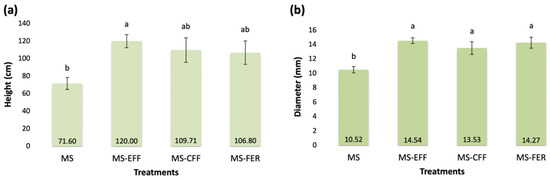
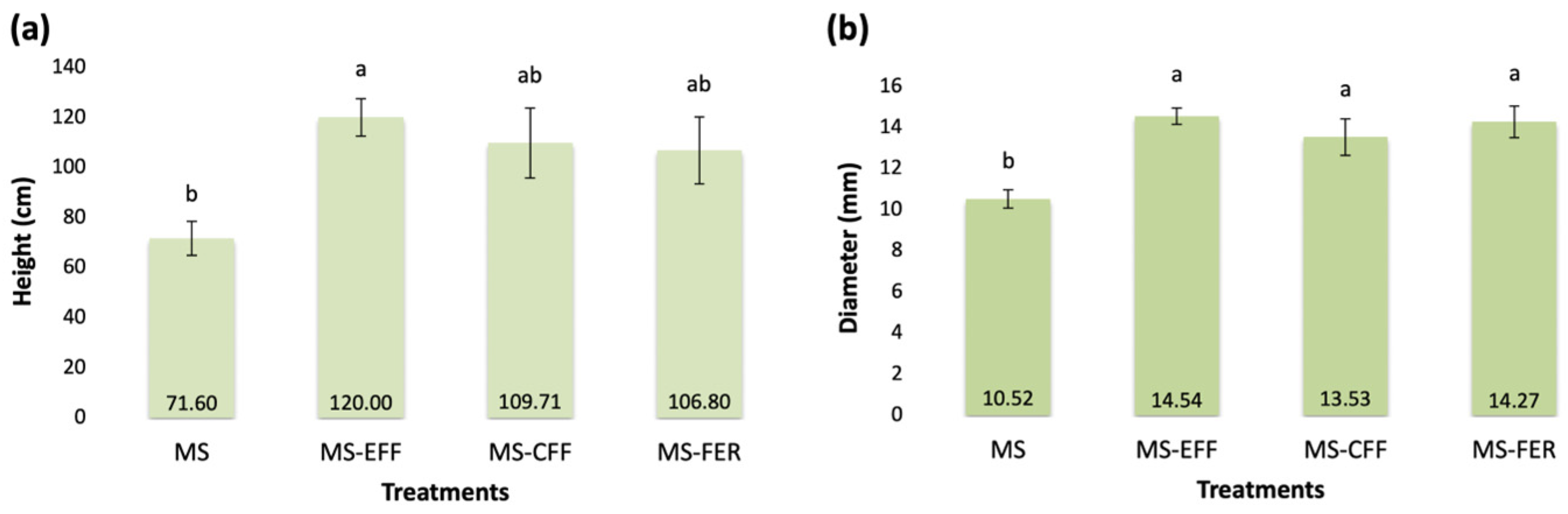
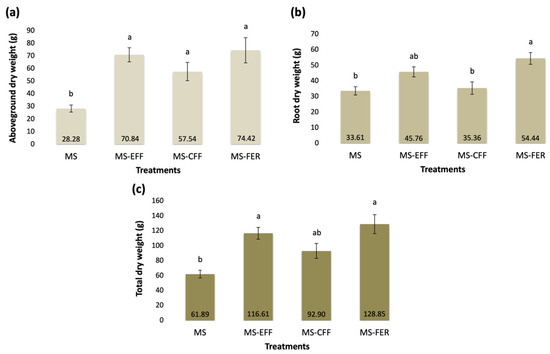
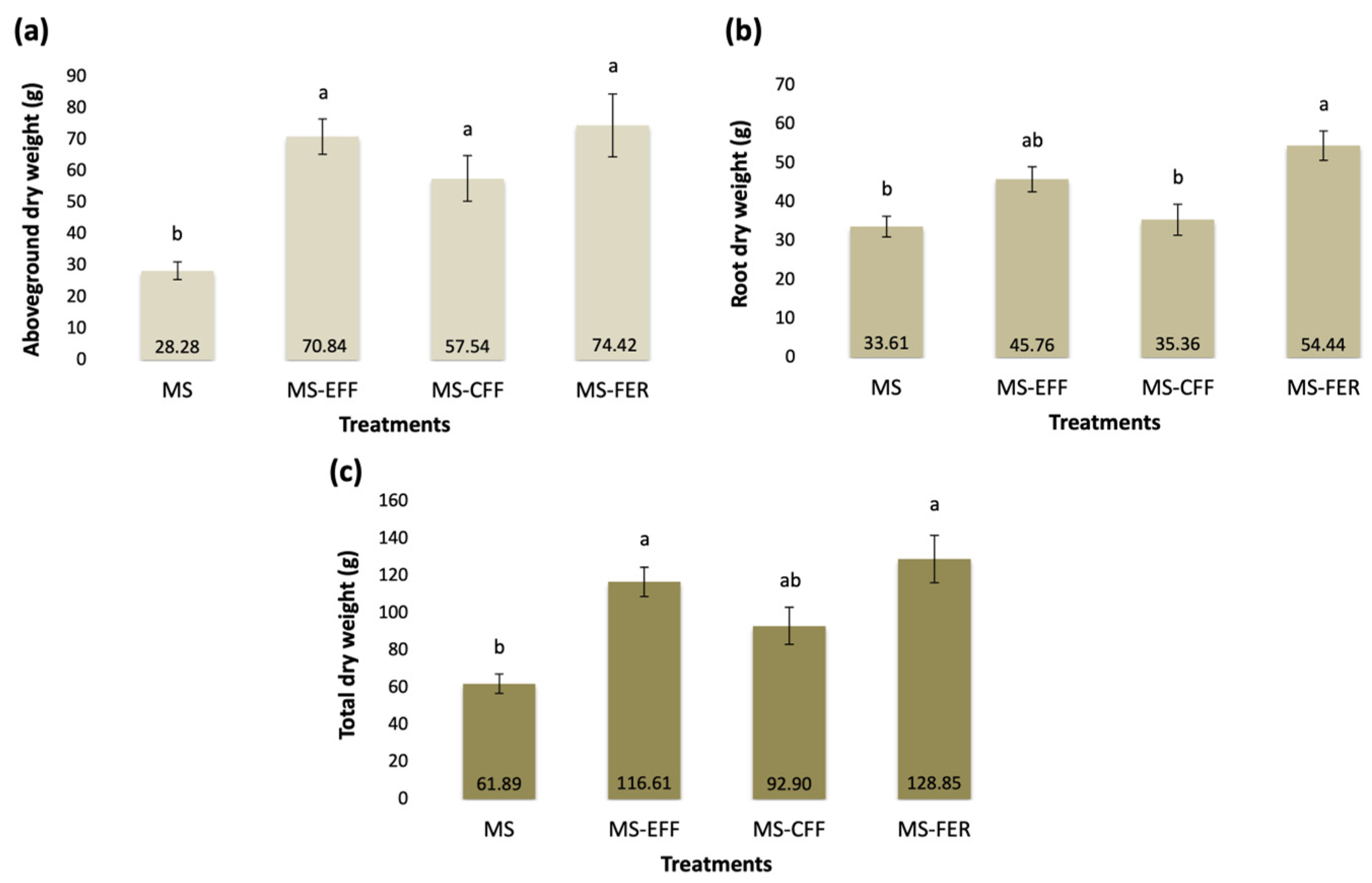
Figure 1a,b presents the means and standard errors of the chestnut seedlings’ height (cm) and diameter (mm), respectively, and the MS treatment showed significantly lower values, compared to the MS-EFF treatment in the case of height and to all the other treatments in the case of diameter. In contrast, the MS-EFF treatment showed higher values, for both seedlings’ height and diameter, compared to the other treatments (Figure 1a,b). From Figure 2a–c, it is also clear that total dry mass of the chestnut seedlings was significantly lower in MS, compared to the MS-EFF and MS-FER treatments. In the case of the three dry weight measurements of chestnut seedlings, a consistent trend with higher values was shown by the treatment with the addition of fertilization (MS-FER), compared to the other treatments.
Figure 1.
Height (a) and diameter (b) (means and standard errors) of chestnut seedlings in the four treatments at the end of the experiment. Error bars on the top of each column represent the standard errors of the means. Different letters above columns indicate significant differences in mean values among the treatments (Tukey’s HSD test, p ≤ 0.05).
Figure 2.
Aboveground dry weight (a), root dry weight (b) and total dry weight (c) (means and standard errors) of chestnut seedlings in the four treatments at the end of the experiment. Error bars on the top of each column represent the standard errors of the means. Different letters above columns indicate significant differences in mean values among the treatments (Tukey’s HSD test, p ≤ 0.05).
3.2. Soil Chemical Properties
According to Table 4, presenting pH, TOC and soil nutrient concentrations, it appears that the MS treatment had significantly higher pH, compared to the other treatments. Regarding soil TOC and ON, K, Zn and B concentrations, the MS-EFF treatment recorded significantly higher values, compared to MS and MS-FER treatments, in the case of TOC and B, as well as from all other treatments in the case of ON, K and Zn. The MS-CFF treatment presented significantly higher values of C/N ratio and soil Ca, Na and Fe concentrations, compared to the MS and MS-FER treatments in terms of C/N ratio and Ca, and compared to the MS-FER and MS treatments for Na and Fe concentrations, respectively. The significantly higher soil P and Mg concentrations were found in the treatment that received the addition of fertilization (MS-FER), with P concentrations appearing 6 to 11 times higher and Mg concentrations 2.6 to 4 times higher, compared to the values of all the other treatments. For Cu and Mn concentrations, there were insignificant differences among the four experimental treatments.
Table 4.
pH, TOC and nutrient concentrations (mean values and standard errors) in the soil of the four treatments.
3.3. Chestnut Seedlings’ Tissue Nutrient Concentrations
Nutrient concentrations in the chestnut seedlings’ leaves, shoots and roots are presented in Table 5, Table 6 and Table 7, respectively. TN and Mn in leaves, shoots and roots were found to be significantly higher in the MS-FER treatment, compared to all the other treatments. Regarding root P content, chestnut seedlings in the MS-CFF treatment showed significantly higher values, compared to MS treatment. For the three vegetal tissues of the seedlings, the MS-FER treatment presented higher K values, with statistically significant differences in the shoots and roots, compared to all the other treatments, while in the case of the leaf concentrations, there were insignificant differences among the treatments. Leaf B and root Ca concentrations of the chestnut seedlings were significantly higher in the MS-EFF treatment, compared to MS-FER. In contrast, leaf and shoot Ca concentrations showed their highest values in the MS-FER treatment; however, the differences among the treatments were insignificant. Regarding Mg concentrations in both leaves and shoots, significantly higher values were found in the MS-FER treatment, compared to the MS-EFF and MS-CFF treatments, in the case of the leaves, and only to the MS-EFF treatment, in the case of the shoots. Regarding Cu, it seems that there is no trend towards increased content in the various parts of the seedlings, and only in the case of the roots, the MS-CFF treatment showed significantly higher value, compared only to the MS-FER treatment. In the case of Fe, there is neither a statistically significant difference nor a trend among the experimental treatments in terms of plant tissue concentrations. Shoot Zn concentrations were significantly higher in the MS-CFF treatment than in the MS and MS-EFF treatments. Root Zn concentrations were also higher in the MS-CFF treatment compared to all other treatments, but these differences were not statistically significant.
Table 5.
Nutrient concentrations (mean values and standard errors) in the chestnut seedlings’ leaves of the four treatments.
Table 6.
Nutrient concentrations (mean values and standard errors) in the chestnut seedlings’ shoots of the four treatments.
Table 7.
Nutrient concentrations (mean values and standard errors) in the chestnut seedlings’ roots of the four treatments.
3.4. Chestnut Seedlings’ Photosynthetic Parameters
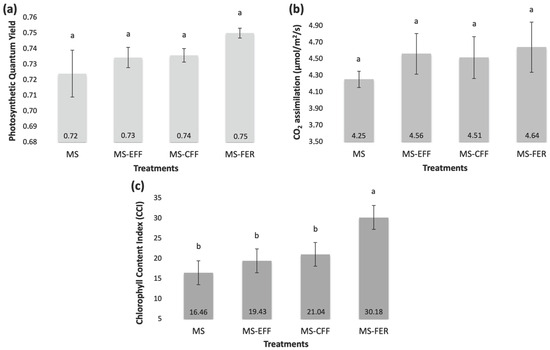
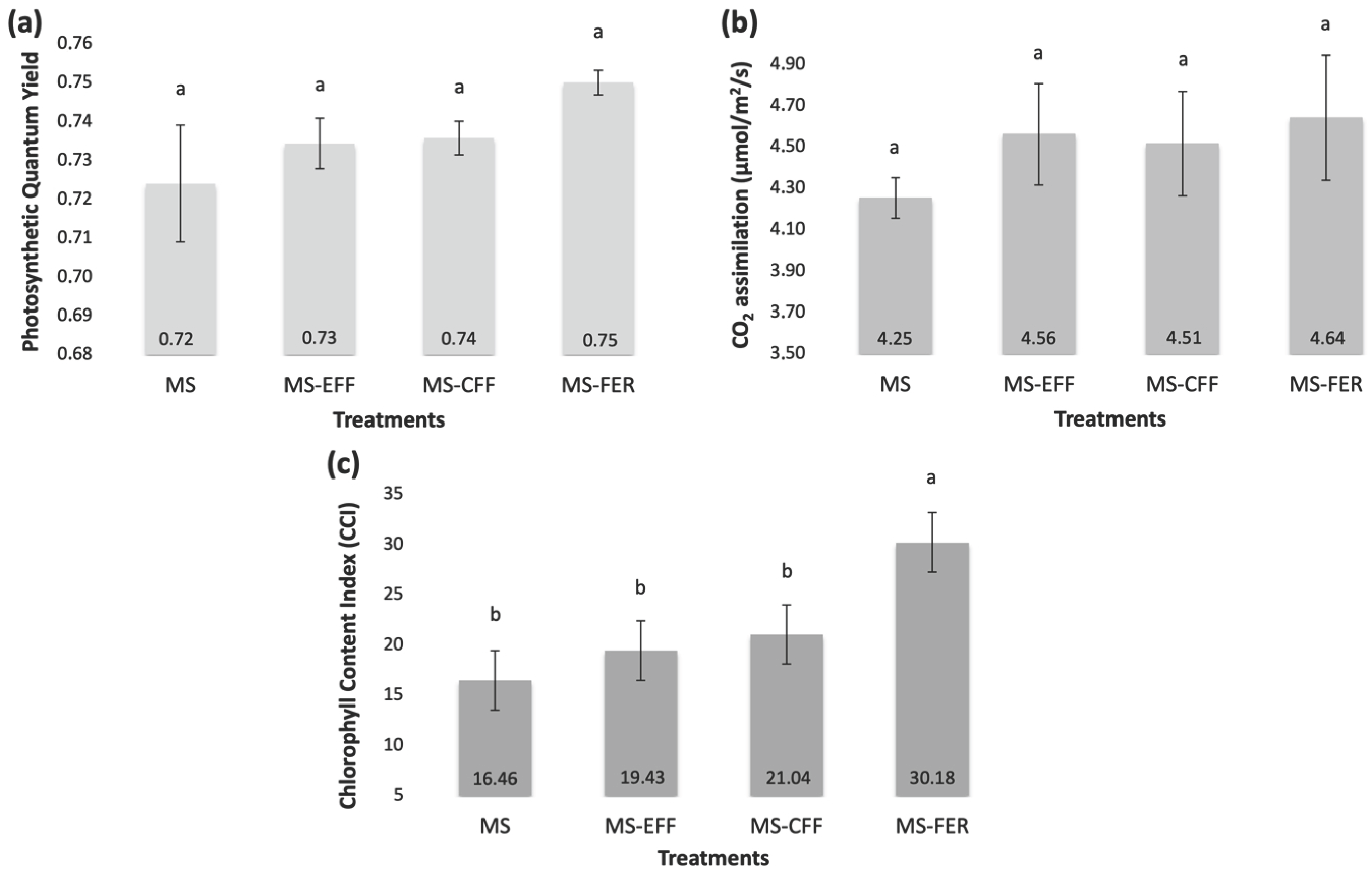
Figure 3a–c presents the measurements of photosynthetic quantum yield, CO2 assimilation and chlorophyll content index, respectively. Photosynthetic quantum yield and CO2 assimilation efficiency of the chestnut seedlings were not significantly affected by any treatment. Regarding CCI, MS-FER displayed significantly higher values, compared to all the other treatments.
Figure 3.
Photosynthetic quantum yield (a), CO2 assimilation (b) and chlorophyll content index (c) (means and standard errors) of chestnut seedlings in the four treatments at the end of the experiment. Error bars on the top of each column represent the standard errors of the means. Different letters above columns indicate significant differences in mean values among the treatments (Tukey’s HSD test, p ≤ 0.05).
4. Discussion
The higher values for chestnut seedling height, diameter, and biomass production recorded in the MS-EFF, MS-CFF, and MS-FER treatments, compared to the MS treatment, can be attributed to (i) the presence of the forest floor, which enhanced nutrient supply, improved soil structure and microbial activity, and increased soil moisture retention [31,32]; and (ii) nutrient release from the fertilizer application [18]. The forest floor from both chestnut and evergreen broad-leaved trees positively affected seedling growth, with similar effects to those of fertilization. The results indicate that both types of forest floor contributed significantly to nutrient availability for chestnut seedlings. However, all measured morphological growth parameters (height, diameter, and dry weights) showed higher mean values in the MS-EFF treatment than in the MS-CFF treatment, although these differences were not statistically significant. This trend can be attributed to the properties of the evergreen broad-leaved forest floor, particularly its enhanced nutrient availability for plant uptake. This availability is driven by faster nutrient release rates associated with intense microbial activity in mixed-species litter, as in the case of the evergreen broad-leaved forest floor used in this study, which was composed of residues from Quercus coccifera, Quercus ilex, Arbutus unedo, and Phillyrea media. According to Bai et al. [33], decomposition rates of mixed-species litter were 4.4% significantly higher than those of mono-species litter, such as the chestnut forest floor, used in the present study.
According to the results, the highest pH value was recorded in the MS treatment, while the lowest was recorded in the MS-FER treatment. Castanea sativa is a calcifuge species and prefers acidic soils. Metreveli et al. [34] observed that optimal growth conditions for younger chestnut stands were recorded in acidic soils with increased nitrogen content. In the present study, the initial pH value of the soil derived from mica schist weathering was 5.8 and at the end of the experiment, pH among the four treatments ranged from 6.25 to 7.81. This increase can be attributed to the HCO3− concentration (261 mg L−1) of the irrigation water. Rank et al. [35] reported that when bicarbonate levels exceed 120 mg L−1 along with a water pH above 7.5, negative effects on plants are observed, such as nutrient imbalance and increased substrate pH.
The addition to the soil of the two types of forest floor, enriched with microorganisms, appears not only to have contributed decisively to organic carbon decomposition but also, according to the results, to have favored the release of N, K, Ca, Na, Cu, Fe, Zn and B, as well as the C/N ratio, since the MS-EFF and MS-CFF treatments recorded higher values compared to the MS and MS-FER treatments. Total-organic-carbon content was significantly lower in the CONTROL (11.4 g k−1), compared to the MS-CFF and MS-EFF treatments (21.7 and 25.3 g k−1, respectively). Arrobas et al. [17] measured 2.3 g k−1 of organic carbon in the topsoil (0–20 cm) of a schist-derived soil when transplanting chestnut seedlings in the field. A higher organic C concentration (11.4 g k−1) in a schist-derived topsoil (0–20 cm) was reported by Fonseca and Figueiredo [36], during the establishment of chestnut seedlings in an experimental plot in northeastern Portugal.
Regarding soil organic N, significantly higher concentration was recorded in the MS-EFF treatment, compared to all the other treatments. This finding is also supported by the higher growth characteristics (height and diameter) of chestnut seedlings in the MS-EFF treatment. Zhang et al. [37] used a global meta-analysis from 119 studies across different ecosystems and found that the addition of litter significantly increased soil N pools by 4–24%. The higher C/N values in the MS-EFF and MS-CFF treatments can be attributed to the correspondingly higher organic carbon concentrations. Menendez–Miguelez et al. [38], in their study on soil conditions influencing the spread of the species in northwestern Spain, reported a wide C/N ratio range of 9.50–57.80. Exchangeable K concentrations were also significantly higher in the MS-EFF and MS-CFF treatments (10.69 and 8.20 cmolc kg−1, respectively), compared to the MS and MS-FER treatments (4.81 and 4.41 cmolc kg−1, respectively), indicating that both forest floor-derived organic inputs enhanced K availability from the K-rich mica schist substrate [39]. This response likely reflects the stimulation of mineral weathering processes and/or the reduction in K fixation through increased organic matter inputs and rhizosphere activity [40,41]. Mechshanova et al. [42] reported that rapid potassium leaching from fresh litter is typical of broad-leaved species, which is in agreement with the results of our study.
Soil Ca concentrations were also significantly higher in the two forest floor treatments, compared to those of MS and MS-FER. Βroad-leaved litter, in particular, has higher levels of readily decomposable carbohydrates and calcium, which is linked to faster decomposition at the early stages [43]. Patricio et al. [44] reported calcium concentrations ranging from 0.05 to 0.86 cmolc kg−1 in soils developed on metamorphic rocks (schists) beneath chestnut stands in northern Portugal. Regarding soil Na concentrations, the MS-CFF treatment recorded significantly higher values compared to the MS-FER treatment. Moreover, exchangeable Na concentrations observed in the present study were substantially higher than the 0.15 cmolc kg−1 reported by Portela et al. [45] in a shallow soil of a 15-year-old chestnut grove in Portugal, as well as those reported by Roussos et al. [20], for a moderately fine-textured, acidic soil with a reddish hue in a young chestnut orchard in Greece.
The highest soil Cu, Fe, Zn, and B concentrations recorded in the MS-EFF and MS-CFF treatments could be attributed to acidification and chelation mechanisms. Zhang et al. [46] observed that the decomposition of forest litter produced low molecular weight organic acids, which induced a decline in soil pH and a rise in exchangeable H+ and Al3+. These changes subsequently affected soil organic matter and increased the activity of Cu, Zn, and other heavy metals in the soil. Portela et al. [45], who studied a 15-year-old chestnut grove, on a siliceous schist soil in Portugal, found that B concentrations decreased sharply with depth from 0.53 mg kg−1 in the surface soil (0–20 cm) to 0.07 mg kg−1 in the subsurface layer (20–40 cm). The higher soil P and Mg concentrations observed in the MS-FER treatment, compared to the other treatments, could be possibly attributed to the composition of the applied fertilizer (19-6-11 + 2MgO + 0.5Fe).
The literature on nutrient uptake by chestnut seedlings, or trees, still remains limited. In a 6-year extensive study, Arrobas et al. [47] invited farmers to provide soil, leaf, and fruit samples from chestnut orchards of different ages in northeastern Portugal. Based on their results, the authors established three sufficiency classes for leaf nutrient concentrations—excess, adequacy, and deficiency—with the following adequacy limits: Ν (20–28 g kg−1), Ρ (1–3 g kg−1), Κ (7.7–18 g kg−1), Ca (5–15 g kg−1), Mg (1.6–6 g kg−1), Cu (4–40 mg kg−1), Fe (20–300 mg kg−1), Zn (16–75 mg kg−1), Mn (50–2000 mg kg−1), and B (35–100 mg kg−1).
In the present study, leaf total nitrogen (TN) concentrations fell within the adequacy limits for almost all treatments, except for the MS treatment. The MS-FER treatment showed the highest leaf N concentration (30.47 g kg−1), which was significantly different from both forest floor treatments (MS-EFF and MS-CFF). The same trend was observed for shoots and roots of chestnut seedlings. Strong evidence indicates that fertilization—particularly nitrogen fertilization—consistently increases leaf N concentration in both young and mature chestnut trees [19,48,49]. Regarding leaf P concentrations, the mean values of all treatments remained within the adequacy limits as presented by Arrobas et al. [47]. The highest leaf P content was recorded in the MS-FER treatment, though no significant differences among treatments were found. Similar trends in P values were observed across treatments for shoot P concentrations. Only in the case of root P content did the MS-CFF treatment show a significant difference, with a higher value compared to the MS treatment. Higher leaf P concentrations (1.94–2.22 g kg−1) were measured in pure chestnut plantations and in mixed-species plantations containing chestnut, all grown on schist soils [50]. Leaf K concentrations were found below the adequacy limits by Arrobas et al. [47] in all experimental treatments. The same trend was observed across all plant tissues among treatments, with the highest leaf, shoot and root K values recorded in the MS-FER treatment. Notably higher leaf K values have been reported by Santa Regina et al. [51] in young chestnut trees aged 7 to 30 years growing in Italy, France, and Spain (6.50–15.60 g kg−1) and by Sariyildiz and Anderson [52] in southwest England (7.10–9.40 g kg−1). Recently, Roussos et al. [20] investigated the effects of three organic soil amendments of distinct origin—namely chicken manure, fungal biomass, and a leonardite-derived humic acid product—applied in combination with mineral fertilization to young chestnut trees (6–7 years old). During the second year of the experiment, trees receiving the fungal biomass treatment exhibited consistently higher foliar K concentrations relative to those subjected solely to mineral fertilization, indicating a potential enhancement of soil K availability and/or uptake efficiency. In a study of 1-year-old chestnut plants grown in unamended substrates (without added fertilization), Laroche et al. [53] reported root K values ranging from 2.5 to 3 g kg−1.
Regarding leaf concentrations of Ca, Mg and Na among the experimental treatments, the highest values for Ca and Na were recorded in the MS-FER treatment, though without significant differences compared to the other treatments. For Mg, the highest value was also observed in the MS-FER treatment, which was significantly different from both forest floor treatments (MS-EFF and MS-CFF). Based on the adequacy limits presented by Arrobas et al. [47], both leaf Ca and Mg concentrations of the present research fell within the adequacy range for all treatments. Shoot Ca concentrations did not show any significant differences among the treatments, with the highest value recorded in the MS-FER treatment. In the roots, however, the MS-FER treatment had the lowest Ca content and differed significantly from the MS-EFF treatment. The results of the present study regarding leaf Ca concentrations are in accordance with Mota et al. [54], who reported foliar Ca concentrations ranging from 4 to 11 g kg−1 in non-irrigated, drip-irrigated, and micro-sprinkler-irrigated chestnut trees at different dates along the vegetative cycle, and with Raimundo [55], who recorded a leaf Ca content increase from 4.6 to 10.4 g kg−1 from July to November in a chestnut grove in Northeast Portugal. Regarding the shoot Mg content of chestnut seedlings, the MS-FER treatment recorded the highest value and differed significantly only from the MS-EFF treatment. Mg concentrations in the seedlings’ roots were similar to those in the shoots and did not show any significant differences among the treatments. Portela et al. [56] reported that under good growing conditions, the highest foliar Mg concentration in 10- to 30-year-old chestnut trees was 1.8 g kg−1, whereas the maximum concentration in leaves showing Mg deficiency symptoms was 1.5 g kg−1. These values are significantly lower than the Mg values recorded in the seedlings’ leaves across all experimental treatments in the present study (3.99–5.20 g kg−1).
All trace element concentrations (Fe, Cu, Mn, Zn, and B) in the leaves of chestnut seedlings across all experimental treatments fell within the adequacy ranges reported by Arrobas et al. [47], indicating that no trace element deficiency or toxicity occurred under the tested conditions. The foliar Fe values measured in the present study were lower than those reported by Toprak and Seferoğlu [57] (197–271 mg kg−1) in 30 chestnut groves in Turkey. Foliar Mn concentrations observed in the present study were substantially higher than those previously reported by Papaioannou et al. [58] for 10- to 40-year-old chestnut trees cultivated on Mount Athos, Greece (450–739 mg kg−1), as well as by Roussos et al. [20] for 6–7-year-old chestnut trees grown in Velina, Korinthia, Greece (500–780 mg kg−1). Notably, the MS-FER treatment resulted in significantly higher Mn content in the seedlings’ leaves, shoots and roots, suggesting that inorganic fertilization enhanced Mn uptake. Laroche et al. [53] found elevated Mn values (140–200 mg kg−1) in the root system of 1-year-old chestnut seedlings grown on acidic soils in western France. Leaf Cu concentrations in this study were lower than those recorded by Anagnostakis et al. [59] (6–28 mg kg−1) in 1- to 12-year-old chestnut trees in America. According to Alloway [60], foliar Zn concentrations between 20 and 150 mg kg−1 are considered sufficient while concentrations between 150 and 400 mg kg−1 are characterized as toxic. Arrobas et al. [17] reported foliar Zn concentrations of 25–44 mg kg−1 in a young chestnut plantation in northeastern Portugal. In a 10-year study on the boron adequacy of chestnut leaves in Portugal, it was reported that B is often deficient when found below 20 mg kg−1 [61]. Furthermore, in a study on 4-year-old chestnut trees growing on a schist-derived soil, B concentrations in the leaves ranged between 5 and 20 mg kg−1 in a treatment without B fertilization and from 65 to 145 mg kg−1 in a treatment with the addition of 3 kg ha−1 borax (11% B) per year [17].
The chlorophyll content index (CCI) was significantly higher in the MS-FER treatment, compared to all the other treatments. This fact could be attributed to the application of fertilization, which led to a significantly higher N content in the leaves of MS-FER seedlings. The positive relationship between total leaf nitrogen and chlorophyll content is well-established and reflects the N status of the leaves. Similar findings have been reported for other Fagaceae species, including Quercus robur L. and Fagus sylvatica L., where a strong positive correlation between chlorophyll and leaf N content was observed [62,63].
In contrast, no significant differences among treatments were found for photosynthetic quantum yield or CO2 assimilation. Additionally, no published data are currently available on the photosynthetic quantum yield of chestnut leaves. According to Maxwell and Johnson [64], quantum yield values close to 0.8 typically indicate the absence of stress in most plants, while values below 0.75 suggest potential stress. In the present study, quantum yield values ranged from 0.72 to 0.75 across all treatments. These values could be attributed to the measurement period in September, when high temperatures combined with increased evapotranspiration likely induced stress in the seedlings. Finally, all CO2 assimilation values were similar among treatments, indicating satisfactory photosynthetic capacity of the chestnut seedlings regardless of the experimental treatment. This suggests that while organic amendments and fertilization successfully support seedling vigor, and inorganic fertilization specifically enhances leaf chlorophyll content (CCI), they do not directly upscale the core gas exchange rates or the photochemical efficiency under the evaluated environmental conditions. Gomes–Laranjo et al. [65] reported CO2 assimilation values of 6.1–8.5 μmol CO2 m−2 s−1 between July and September in three chestnut cultivars in NE Portugal.
5. Conclusions
The novelty of this study is that it provides data regarding the effect of different substrates on the growth, soil conditions and the nutritional and physiological status of Castanea sativa seedlings. This addresses a critical gap in the literature, which has largely focused on mature trees of the species and soil properties alone. The results confirmed the hypothesis on which the research was based, namely that the forest floors of chestnut trees and evergreen broad-leaved species, when combined with the mica schist-derived soil, improved the fertility, nutrient uptake, and vigor of chestnut seedlings under controlled pot conditions. Both types of forest floor show promise as organic soil amendments, as they satisfied the chestnut seedlings’ nutritional needs and supported the production of robust plants suitable for plantation establishment or forest afforestation. The incorporation of forest floor into soil derived from mica schist weathering, combined with limited addition of N, P and K for improved plant tissue nutrition, appears to be a promising environmental and sustainable management practice for chestnut seedling production. However, it should be acknowledged that these findings are based on a pot experiment, and further field-based studies are needed to confirm their effectiveness under natural conditions, particularly in relation to long-term growth, survival, and the potential to reduce inorganic fertilizer inputs. Moreover, the forest floor and inorganic fertilizer treatments were not compared on an equivalent nutrient-input basis, as the forest floor amendments were incorporated once at the beginning of the experiment, whereas the Osmocote fertilizer was applied in three split applications during the growing period. Accordingly, the observed differences between treatments should be interpreted considering the distinct nutrient application methodologies. Future studies incorporating soil microbiome analyses together with a broader range of forest floor conditions and soil types are needed to elucidate the complex interactions influencing chestnut growth and productivity, and to determine whether more effective combinations of soil and forest floor characteristics exist for enhancing tree performance.
Author Contributions
Conceptualization, E.P. and D.G.; methodology, E.P., D.G., S.S., T.C., S.T. and K.K.; formal analysis, E.P.; investigation, E.P., D.G., S.S., T.C., S.T. and K.K.; resources, E.P. and D.G.; data curation, E.P. and D.G.; writing—original draft preparation, E.P. and D.G.; writing—review and editing, E.P., D.G., S.S., T.C. and H.G. All authors have read and agreed to the published version of the manuscript.
Funding
This research received no external funding.
Data Availability Statement
Data are contained within the article. The original contributions presented in the study are included in the article; further inquiries can be directed to the corresponding author.
Conflicts of Interest
The authors declare no conflicts of interest.
References
- Ketenoğlu, O.; Tug, G.N.; Kurt, L. An Ecological and Syntaxonomical Overview of Castanea sativa and a New Association in Turkey. J. Environ. Biol. 2010, 31, 81–86. [Google Scholar] [PubMed]
- Conedera, M.; Krebs, P.; Tinner, W.; Pradella, M.; Torriani, D. The Cultivation of Castanea sativa (Mill.) in Europe, from Its Origin to Its Diffusion on a Continental Scale. Veg. Hist. Archaeobotany 2004, 13, 161–179. [Google Scholar] [CrossRef] [Scilit]
- Bounous, G. The Chestnut: A Multipurpose Resource for the New Millennium. In Acta Horticulturae; ISHS: Leuven, Belgium, 2005; pp. 33–40. [Google Scholar] [CrossRef] [Scilit]
- FAO Food and Agriculture Organization of United Nations. FAOSTAT Crops and Livestock Products. 2020. Available online: https://www.fao.org/faostat/en/#data/QCL (accessed on 14 January 2026).
- Zafeiriou, E.; Chatzissavvidis, C.; Antonopoulou, C.; Arabatzis, G. Sweet Chestnut and Agricultural Development: A Farmers’ Perspective for Northern Greece. Int. J. Agric. Sustain. 2022, 20, 199–215. [Google Scholar] [CrossRef] [Scilit]
- Venanzi, R.; Picchio, R.; Piovesan, G. Silvicultural and Logging Impact on Soil Characteristics in Chestnut (Castanea sativa Mill.) Mediterranean Coppice. Ecol. Eng. 2016, 92, 82–89. [Google Scholar] [CrossRef] [Scilit]
- Conedera, M.; Krebs, P.; Gehring, E.; Wunder, J.; Hülsmann, L.; Abegg, M.; Maringer, J. How Future-Proof Is Sweet Chestnut (Castanea sativa) in a Global Change Context? For. Ecol. Manag. 2021, 494, 119320. [Google Scholar] [CrossRef] [Scilit]
- Papaioannou, A. Assessment of the Empirical Management Method of Coppice Chestnut (Castanea sativa Mill.) Forests Practiced by the Monks and Its Effect on the Availability of Forest Soil Resources in Mount Athos, Greece. Not. Bot. Horti Agrobot. Cluj-Napoca 2013, 41, 317. [Google Scholar] [CrossRef] [Scilit]
- Carneiro-Carvalho, A.; Pinto, T.; Ferreira, H.; Martins, L.; Pereira, C.; Gomes-Laranjo, J.; Anjos, R. Effect of Silicon Fertilization on the Tolerance of Castanea sativa Mill. Seedlings against Cryphonectria parasitica Barr. J. Plant Dis. Prot. 2020, 127, 197–210. [Google Scholar] [CrossRef] [Scilit]
- Nakhutsrishvili, G.S. The Vegetation of Georgia (South Caucasus). In Geobotany Studies; Springer: Berlin/Heidelberg, Germany, 2013; ISBN 978-3-642-29914-8. [Google Scholar]
- Conedera, M.; Tinner, W.; Krebs, P.; de Rigo, D.; Caudullo, G. Castanea sativa in Europe: Distribution, Habitat, Usage and Threats. In European Atlas of Forest Tree Species; San-Miguel-Ayanz, J., de Rigo, D., Caudullo, G., Houston Durrant, T., Mauri, A., Eds.; Publication Office of the European Union: Luxembourg, 2016. [Google Scholar]
- Velizarova, E. Physico-Chemical and Morphological Properties of Soils in Chestnut (Castanea sativa Mill.) Habitats of Belasitsa Mountain. Silva Balc. 2015, 16, 60–70. [Google Scholar]
- Pereira-Lorenzo, S.; Díaz-Hernández, M.B.; Ramos-Cabrer; Spain, A.M. Following Chestnut Footprints (Castanea spp.)–Cultivation and Culture, Folklore and History, Traditions and Uses; Avanzato, D., Ed.; Scripta Horticulturae: Leuven, Belgium, 2009; ISBN 978-90-6605-632-9. [Google Scholar]
- Braga, N.; Rodrigues, F.; Oliveira, M.B.P.P. Castanea sativa by-Products: A Review on Added Value and Sustainable Application. Nat. Prod. Res. 2015, 29, 1–18. [Google Scholar] [CrossRef] [Scilit] [PubMed]
- Jacobs, D.F.; Selig, M.F.; Severeid, L.R. Aboveground Carbon Biomass of Plantation-Grown American Chestnut (Castanea dentata) in Absence of Blight. For. Ecol. Manag. 2009, 258, 288–294. [Google Scholar] [CrossRef] [Scilit]
- Toprak, S.; Ateş, Ö.; Yalçin, G.; Taşpinar, K. How Does N: P: K Fertilizer Applications in Different Levels Affect the Nutrition of Anatolian Chestnut (Castanea sativa Mill.)? Uluslar. Anadolu Ziraat Mühendisliği Bilim. Derg. 2021, 3, 1–9. [Google Scholar] [CrossRef]
- Arrobas, M.; Afonso, S.; Ferreira, I.Q.; Moutinho-Pereira, J.; Correia, C.M.; Rodrigues, M.Â. Liming and Application of Nitrogen, Phosphorus, Potassium, and Boron on a Young Plantation of Chestnut. Turk. J. Agric. For. 2017, 41, 441–451. [Google Scholar] [CrossRef] [Scilit]
- Rodrigues, M.Â.; Grade, V.; Barroso, V.; Pereira, A.; Cassol, L.C.; Arrobas, M. Chestnut Response to Organo-Mineral and Controlled-Release Fertilizers in Rainfed Growing Conditions. J. Soil Sci. Plant Nutr. 2020, 20, 380–391. [Google Scholar] [CrossRef] [Scilit]
- Rodrigues, M.Â.; Raimundo, S.; Pereira, A.; Arrobas, M. Large Chestnut Trees (Castanea sativa) Respond Poorly to Liming and Fertilizer Application. J. Soil Sci. Plant Nutr. 2020, 20, 1261–1270. [Google Scholar] [CrossRef] [Scilit]
- Roussos, P.A.; Ligka, M.; Katsenos, P.D.; Zoti, M.; Gasparatos, D. Impacts of Organic Soil Amendments of Diverse Origins on Soil Properties, Nutrient Status, and Physiological Responses of Young Chestnut (Castanea sativa Mill.) Trees. Agriculture 2026, 16, 128. [Google Scholar] [CrossRef] [Scilit]
- Papaioannou, E.; Gasparatos, D.; Stefanou, S.; Chatzistathis, T.; Karamanoli, K.; Matziris, E. Effect of Soil Mixtures Based on a Gneiss-Derived Soil and Two Forest Floor Types on Growth and Nutritional Status of Castanea sativa Mill. Seedlings. J. Soil Sci. Plant Nutr. 2023, 23, 1339–1350. [Google Scholar] [CrossRef] [Scilit]
- McLean, E.O. Soil pH and Lime Requirement. In Methods of Soil Analysis. Part 2. Chemical and Microbiological Properties; American Society of Agronomy, Soil Science Society of America: Madison, WI, USA, 1982; pp. 199–224. [Google Scholar] [CrossRef] [Scilit]
- Nelson, D.W.; Sommers, L.E. Total Carbon, Organic Carbon, and Organic Matter. In Methods of Soil Analysis; John Wiley & Sons, Ltd.: Hoboken, NJ, USA, 1982; pp. 539–579. ISBN 978-0-89118-977-0. [Google Scholar]
- Stevenson, F.J. Organic Forms of Soil Nitrogen. In Nitrogen in Agricultural Soils; John Wiley & Sons, Ltd.: Hoboken, NJ, USA, 1982; pp. 67–122. ISBN 978-0-89118-216-0. [Google Scholar]
- Olsen, S.R.; Sommers, L.E. Phosphorus. In Methods of Soil Analysis; John Wiley & Sons, Ltd.: Hoboken, NJ, USA, 1982; pp. 403–430. ISBN 978-0-89118-977-0. [Google Scholar]
- Thomas, G.W. Exchangeable Cations. In Methods of Soil Analysis; John Wiley & Sons, Ltd.: Hoboken, NJ, USA, 1982; pp. 159–165. ISBN 978-0-89118-977-0. [Google Scholar]
- Lindsay, W.L.; Norvell, W.A. Development of a DTPA Soil Test for Zinc, Iron, Manganese, and Copper. Soil Sci. Soc. Am. J. 1978, 42, 421–428. [Google Scholar] [CrossRef] [Scilit]
- Keren, R. Boron. In Methods of Soil Analysis; John Wiley & Sons, Ltd.: Hoboken, NJ, USA, 1996; pp. 603–626. ISBN 978-0-89118-866-7. [Google Scholar]
- Allen, S.E.; Grimshaw, H.M.; Rowland, A.P. Chemical Analysis. In Methods of Plant Ecology; Moore, P.D., Chapman, S.B., Eds.; Blackwell: Oxford, UK, 1986; pp. 285–344. [Google Scholar]
- Petridis, A.; Gasparatos, D.; Haidouti, C.; Paschalidis, C.; Zamanidis, P. Effects of Nitrogen and Boron Fertilization on Lettuce Mineral Nutrition in a Calcareous Soil. Commun. Soil Sci. Plant Anal. 2013, 44, 733–740. [Google Scholar] [CrossRef] [Scilit]
- Aučina, A.; Rudawska, M.; Leski, T.; Skridaila, A.; Pašakinskiene, I.; Riepšas, E. Forest Litter as the Mulch Improving Growth and Ectomycorrhizal Diversity of Bare-Root Scots Pine (Pinus sylvestris) Seedlings. IForest—Biogeosciences For. 2015, 8, 394–400. [Google Scholar] [CrossRef] [Scilit]
- Douterlungne, D.; Martínez, G.M.C.; Badano, E.I.; Cano, J.A.F.; Rivas, J.D.F. Restoring Oak Forests on Bare Ground Using Topsoil Translocation. Ecol. Eng. 2018, 120, 76–84. [Google Scholar] [CrossRef] [Scilit]
- Bai, L.; Song, C.; Li, M.; Yang, L.; Wang, X.; Wu, Q.; Zhu, J. Global Patterns and Drivers of Decomposition of Mixed-Species Litter. Geoderma 2026, 465, 117662. [Google Scholar] [CrossRef] [Scilit]
- Metreveli, V.; Kreft, H.; Javakhishvili, Z.; Mdivani, S.; Chikorashvili, G.; Akobia, I.; Gavashelishvili, A. On the Relationship between Environment and Growth of Sweet Chestnut (Castanea sativa) in the Caucasus. Front. For. Glob. Change 2025, 8, 1670459. [Google Scholar] [CrossRef] [Scilit]
- Rank, M.; Chaturvedi, N.; Vyas, K.D.; Singh, A. Biodesalination of RO Reject Water by Salinity-Tolerant Bacteria and Nutrient Fortification for Agricultural Applications—A Sustainable Energy-Efficient Solution to Valorize Wastewater. Desalination 2025, 600, 118484. [Google Scholar] [CrossRef] [Scilit]
- Fonseca, F.; Figueiredo, T.D. Effects of Site Preparation on Physical and Chemical Properties as Indicators of Forest Soil Quality. Gaia Sci. 2016, 10, 38–46. [Google Scholar] [CrossRef] [Scilit]
- Zhang, X.; Pei, G.; Sun, J.; Huang, Y.; Huang, Q.; Xie, H.; Mo, J.; Zhao, M.; Hu, B. Responses of Soil Nitrogen Cycling to Changes in Aboveground Plant Litter Inputs: A Meta-Analysis. Geoderma 2023, 439, 116678. [Google Scholar] [CrossRef] [Scilit]
- Menéndez-Miguélez, M.; Álvarez-Álvarez, P.; Majada, J.; Canga, E. Effects of Soil Nutrients and Environmental Factors on Site Productivity in Castanea sativa Mill. Coppice Stands in NW Spain. New For. 2015, 46, 217–233. [Google Scholar] [CrossRef] [Scilit]
- Song, S.K.; Huang, P.M. Dynamics of Potassium Release from Potassium-Bearing Minerals as Influenced by Oxalic and Citric Acids. Soil Sci. Soc. Am. J. 1988, 52, 383–390. [Google Scholar] [CrossRef] [Scilit]
- Hinsinger, P.; Bell, M.J.; Kovar, J.L.; White, P.J. Rhizosphere Processes and Root Traits Determining the Acquisition of Soil Potassium. In Proceedings of the Improving Potassium Recommendations for Agricultural Crops; Murrell, T.S., Mikkelsen, R.L., Sulewski, G., Norton, R., Thompson, M.L., Eds.; Springer International Publishing: Cham, Switzerland, 2021; pp. 99–117. [Google Scholar]
- Taiwo, A.A.; Adetunji, M.T.; Azeez, J.O.; Elemo, K.O. Kinetics of Potassium Release and Fixation in Some Soils of Ogun State, Southwestern, Nigeria as Influenced by Organic Manure. Int. J. Recycl. Org. Waste Agric. 2018, 7, 251–259. [Google Scholar] [CrossRef] [Scilit]
- Mechshanova, A.; Berillo, D.; Polyakov, V. Chemical Composition and Ecological Adaptation of Populus (Salicaceae) Species and Hybrids Depending on Soil and Environmental Conditions. RSC Adv. 2026, 16, 3368–3386. [Google Scholar] [CrossRef] [Scilit] [PubMed]
- Yin, C.; Wu, D.; Chi, H.; Fan, Y.; Liu, Z.; Jin, G. Identifying the Key Factors of Lignocellulose Degradation at Different Stages of Decomposition in Litter from Different Forest Types. Ind. Crops Prod. 2025, 237, 122277. [Google Scholar] [CrossRef] [Scilit]
- Patricio, M.S.; Nunes, L.F.; Pereira, E.L. Litterfall and Litter Decomposition in Chestnut High Forest Stands in Northern Portugal. For. Syst. 2012, 21, 259–271. [Google Scholar] [CrossRef] [Scilit]
- Portela, E.A.C.; Ferreira-Cardoso, J.V.; Louzada, J.L. Boron Application on a Chestnut Orchard: Effect on Yield and Quality of Nuts. J. Plant Nutr. 2011, 34, 1245–1253. [Google Scholar] [CrossRef] [Scilit]
- Zhang, Y.; Zhou, J.; Lei, Z.; Ren, H.; Chen, H. Effect of Acid Production from Forest Litter on the Availability of Heavy Metals in Soil. Forests 2024, 15, 2097. [Google Scholar] [CrossRef] [Scilit]
- Arrobas, M.; Afonso, S.; Rodrigues, M.Â. Diagnosing the Nutritional Condition of Chestnut Groves by Soil and Leaf Analyses. Sci. Hortic. 2018, 228, 113–121. [Google Scholar] [CrossRef] [Scilit]
- Arrobas, M.; Silva, J.; Busato, M.R.; Ferreira, A.C.; Raimundo, S.; Pereira, A.; Finatto, T.; de Mello, N.A.; Correia, C.M.; Rodrigues, M.Â. Large Chestnut Trees Did Not Respond to Annual Fertiliser Applications, Requiring a Long-Term Approach to Establishing Effective Fertilisation Plans. Soil Syst. 2023, 7, 2. [Google Scholar] [CrossRef] [Scilit]
- Warmund, M.R. Nutrient Status and Fruiting Response of Young Chinese Chestnut Trees Following Application of Nitrogen. J. Am. Pomol. Soc. 2018, 72, 12–20. [Google Scholar] [CrossRef] [Scilit]
- Nunes, L.; Coutinho, J.; Nunes, L.F.; Castro Rego, F.; Lopes, D. Growth, Soil Properties and Foliage Chemical Analysis Comparison. For. Syst. 2011, 20, 496–507. [Google Scholar] [CrossRef] [Scilit]
- Santa Regina, I. Foliar Nutrient Dynamics and Nutrient-Use Efficiency in Castanea sativa Coppice Stands of Southern Europe. Forestry 2001, 74, 1–10. [Google Scholar] [CrossRef] [Scilit]
- Sariyildiz, T.; Anderson, J.M. Variation in the Chemical Composition of Green Leaves and Leaf Litters from Three Deciduous Tree Species Growing on Different Soil Types. For. Ecol. Manag. 2005, 210, 303–319. [Google Scholar] [CrossRef] [Scilit]
- Laroche, A.; Freyssac, V.; Rahmani, A.; Verger, J.; Morvan, H. Growth and Mineral Content of Young Chestnut Trees under Controlled Conditions of Nutrition. Ann. Sci. For. 1997, 54, 681–693. [Google Scholar] [CrossRef] [Scilit]
- Mota, M.; Pinto, T.; Vilela, A.; Marques, T.; Borges, A.; Caço, J.; Ferreira-Cardoso, J.; Raimundo, F.; Gomes-Laranjo, J. Irrigation Positively Affects the Chestnut’s Quality: The Chemical Composition, Fruit Size and Sensory Attributes. Sci. Hortic. 2018, 238, 177–186. [Google Scholar] [CrossRef] [Scilit]
- Raimundo, F. Sistemas de Mobilização Do Solo Em Soutos, Influências Da Produtividade de Castanha e Nas Características Físicas e Químicas Do Solo. Ph.D. Thesis, Universidade de Trás-os-Montes e Alto Douro, Vila Real, Portugal, 2003. [Google Scholar]
- Portela, E.; Pires, C.C.; Louzada, J. Magnesium Deficiency in Chestnut Groves: The Influence of Soil Manganese. J. Plant Nutr. 2010, 33, 452–460. [Google Scholar] [CrossRef] [Scilit]
- Toprak, S.; Seferoğlu, S. The Seasonal Changes of Nutritional Elements of Chestnut (Castanea sativa) Plant and Determination of Leaf Sampling Times. Am. J. Res. Commun. 2013, 1, 1–8. [Google Scholar]
- Papaioannou, A.; Matziris, E.; Papaioannou, E. The Athonite Traditional Empirical Method of Cultivating Chestnut (Castanea sativa Mill.) Coppices and Its Impact on Soil Fertility. In Proceedings of the 2nd International Scientific Workshop of Mount Athos Center, Thessaloniki, Greece, 8 December 2017; pp. 21–22. [Google Scholar]
- Anagnostakis, S.L.; Pinchot, C.; Stilwell, D.; Schlarbaum, S.E. Soil and Leaf Minerals and Survival and Growth of Hybrid Chestnut Trees Planted in Forest and Field Plots in Connecticut; Annual Report of the Northern Nut Growers Association; Northern Nut Growers Association: Lawrence, Kansas, 2012; pp. 43–47. [Google Scholar]
- Alloway, B.J. Zinc in Soils and Crop Nutrition; IZA: Brussels, Belgium; IFA: Paris, France, 2008. [Google Scholar]
- Portela, E.; Martins, A.; Pires, A.L.; Raimundo, F.; Marques, G. Cap 6-Práticas Culturais No Souto: O Manejo Do Solo. Castanheiros Vila Real Port. Programa AGRO 2007, 499, 207–264. [Google Scholar]
- Sever, K.; Bogdan, S.; Škvorc, Ž.; Sever, M.Z.O.; Franjić, J. Estimation of Leaf Nitrogen Concentrations in Quercus robur L. Using the CCM-200 Portable Chlorophyll Meter for Different Patterns of Vegetative Growth and Acorn Production. New For. 2016, 47, 513–527. [Google Scholar] [CrossRef] [Scilit]
- Stiegel, S.; Entling, M.H.; Mantilla-Contreras, J. Reading the Leaves’ Palm: Leaf Traits and Herbivory along the Microclimatic Gradient of Forest Layers. PLoS ONE 2017, 12, e0169741. [Google Scholar] [CrossRef] [Scilit] [PubMed]
- Maxwell, K.; Johnson, G.N. Chlorophyll Fluorescence—A Practical Guide. J. Exp. Bot. 2000, 51, 659–668. [Google Scholar] [CrossRef]
- Gomes-Laranjo, J.; Peixoto, F.; Sang, H.W.W.F.; Torres-Pereira, J. Study of the Temperature Effect in Three Chestnut (Castanea sativa Mill.) Cultivars’ Behaviour. J. Plant Physiol. 2006, 163, 945–955. [Google Scholar] [CrossRef] [Scilit] [PubMed]

Disclaimer/Publisher’s Note: The statements, opinions and data contained in all publications are solely those of the individual author(s) and contributor(s) and not of MDPI and/or the editor(s). MDPI and/or the editor(s) disclaim responsibility for any injury to people or property resulting from any ideas, methods, instructions or products referred to in the content. |
© 2026 by the authors. Licensee MDPI, Basel, Switzerland. This article is an open access article distributed under the terms and conditions of the Creative Commons Attribution (CC BY) license.